
Mr. OP Verma, M. Pharm.
Associate Professor (Dept. of
Pharmacognosy)
Goel Institute of Pharmacy and Sciences
Lucknow
CLASSIFICATION OF CRUDE
DRUGS
Crude drugs may be derived from various natural
sources like plants, animals, minerals and marine
organisms etc.
In order to pursue (or to follow) the study of the
individual drugs, one must adopt some particular
sequence of arrangement, and this is referred to a
system of classification of drugs.
A method of classification should be:
(a) simple,
(b) easy to use,
(c) free from confusion and ambiguities.
Because of their wide distribution, each arrangement of
classification has its own merits and demerits, but for the
purpose of study the drugs are classified in the following
different ways:
Classification of crude drugs
• Because of their wide distribution the arrangement
of classification in a definite sequence is
necessary to understand easily. Although each
system of classification has its own merits and
demerits, but for the purpose of study the drugs
are classified in the following different ways:
❖Alphabetical classification
❖Morphological classification
❖Taxonomical classification
❖Pharmacological classification
❖Chemical classification
❖Chemo-taxonomical classification
1. Alphabetical
classification
• The crude drugs are arranged according to the
alphabetical order/form of their Latin and English
names. Some of the Pharmacopoeias and
reference books which classify crude drugs
according to this system are as follows.
1)Indian Pharmacopoeia (IP) 1955 (Latin)
2)Indian Pharmacopoeia (IP) 1966 (English)
3)British Pharmacopoeia (BP) (English)
4)British Pharmacopoeia Codex (BPC)
(English)
5)United States of Pharmacopoeia (USP)
(English)
6)European Pharmacopoeia (Latin)
Examples:
Acacia, Benzoin, Cinchona, Dill, Ergot,
Fennel, Gentian, Hyoscyamus,
Ipecacuanha, Jalap, Kurchi, Liquorice,
Mints, Nux vomica, Opium, Podophyllum,
Quassia, Rauwolfia, Senna, Vasaka, Wool
fat, Yellow bees wax, Zeodary etc.
• Advantages:
• It is simple method, in this systemlocation, tracing
and addition of the drug is easy,
• No technical person is required for handling the system.
• Disadvantages:
• Scientific nature of the drug cannot be identified by this
method, whether they are organised or unorganised
drug.
• This system does not help in distinguishing the drugs
of plant, animal and mineral source. (Original source is
2. Morphological classification:
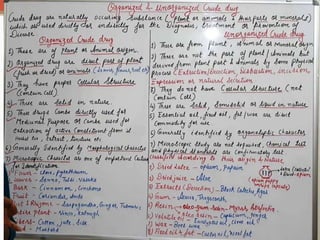
• Here the crude
according to
the
drug
s
part
are arranged
(Grouped) of the
plant or
animal
represented into organised (Cellular) drugs
and unorganised ( Acellular ) drugs.
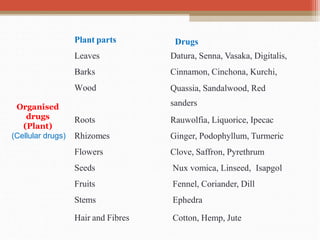
• Organised (Cellular):
• Drugs are the direct parts of the plant and are
divided into leaves, barks wood, root, rhizome,
seed, fruit, flower, stem, hair and fibers.
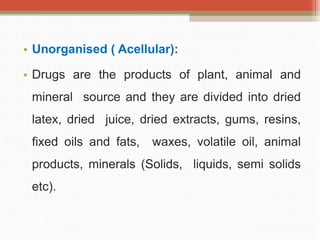
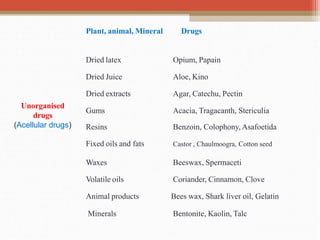
• Unorganised ( Acellular):
• Drugs are the products of plant, animal and
mineral source and they are divided into dried
latex, dried juice, dried extracts, gums, resins,
fixed oils and fats, waxes, volatile oil, animal
products, minerals (Solids, liquids, semi solids
etc).
Plant parts
Leaves
Barks
Wood
Roots
Rhizomes
Flowers
Seeds
Fruits
Stems
Hair and Fibres
Drugs
Datura, Senna, Vasaka, Digitalis,
Cinnamon, Cinchona, Kurchi,
Quassia, Sandalwood, Red
sanders
Rauwolfia, Liquorice, Ipecac
Ginger, Podophyllum, Turmeric
Clove, Saffron, Pyrethrum
Nux vomica, Linseed, Isapgol
Fennel, Coriander, Dill
Ephedra
Cotton, Hemp, Jute
Organised
drugs
(Plant)
(Cellular drugs)
Plant, animal, Mineral Drugs
Dried latex Opium, Papain
Dried Juice Aloe, Kino
Dried extracts Agar, Catechu, Pectin
Gums
Resins
Acacia, Tragacanth, Stericulia
Benzoin, Colophony, Asafoetida
Fixed oils and fats Castor , Chaulmoogra, Cotton seed
Waxes Beeswax, Spermaceti
Volatile oils Coriander, Cinnamon, Clove
Animal products Bees wax, Shark liver oil, Gelatin
Minerals Bentonite, Kaolin, Talc
Unorganised
drugs
(Acellular drugs)
• Advantages:
• This system of classification is more convenient for
practical study especially when the chemical nature
of the drug is not clearly understood.
• This type of classification is very useful in identifying
the adulterants used.
• Disadvantages:
• It does not give an idea about biological
source,
chemical constituents and uses.
• When different parts of the plant contain
different chemical constituents, it is difficult to
classify them.
3. Chemical classifications of crude drugs
• Here, the crude drugs are divided into different
groups according to the chemical nature of their
most important constituent present in the drug to
which the pharmacological/therapeutic activity of
drug is attributed.
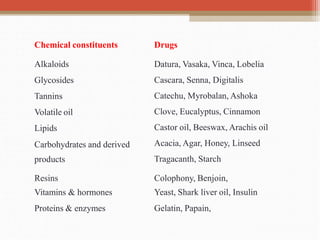
Chemical constituents Drugs
Alkaloids
Glycosides
Tannins
Volatile oil
Lipids
Carbohydrates and derived
products
Resins
Vitamins & hormones
Proteins & enzymes
Datura, Vasaka, Vinca, Lobelia
Cascara, Senna, Digitalis
Catechu, Myrobalan, Ashoka
Clove, Eucalyptus, Cinnamon
Castor oil, Beeswax, Arachis oil
Acacia, Agar, Honey, Linseed
Tragacanth, Starch
Colophony, Benjoin,
Yeast, Shark liver oil, Insulin
Gelatin, Papain,
• Advantages :
• Chemical constituents are known,
• Medicinal uses are known
• Disadvantages :
• Drugs of different origin are grouped under similar
chemical titles.
• This type of classification makes no proper placement of
drugs containing two different types of chemicals.
• Eg: Certain drugs are found to contain alkaloids and
glycosides (Cinchona), Fixed oil and volatile oil (Nutmeg)
of equal importance together and hence it is difficult to
categorize them properly
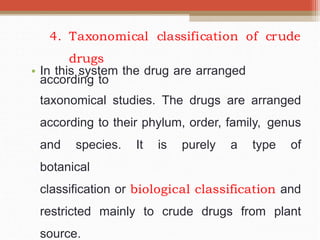
4. Taxonomical classification of crude
drugs
• In this system the drug are arranged
according to
taxonomical studies. The drugs are arranged
according to their phylum, order, family, genus
and species. It is purely a type of
botanical
classification or biological classification and
restricted mainly to crude drugs from plant
source.
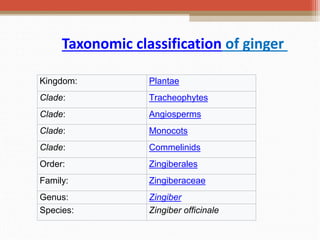
Kingdom: Plantae
Clade: Tracheophytes
Clade: Angiosperms
Clade: Monocots
Clade: Commelinids
Order: Zingiberales
Family: Zingiberaceae
Genus: Zingiber
Species: Zingiber officinale
Taxonomic classification of ginger
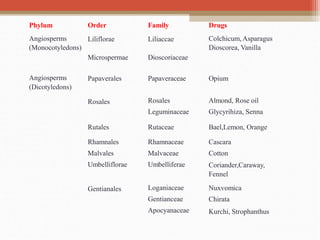
Phylum
Angiosperms
(Monocotyledons)
Order
Liliflorae
Microspermae
Family
Liliaccae
Dioscoriaceae
Drugs
Colchicum,Asparagus
Dioscorea, Vanilla
Angiosperms
(Dicotyledons)
Papaverales Papaveraceae Opium
Rosales
Rutales
Rosales
Leguminaceae
Rutaceae
Almond, Rose oil
Glycyrihiza, Senna
Bael,Lemon, Orange
Rhamnales
Malvales
Umbelliflorae
Rhamnaceae
Malvaceae
Umbelliferae
Gentianales Loganiaceae
Gentianceae
Apocyanaceae
Cascara
Cotton
Coriander,Caraway,
Fennel
Nuxvomica
Chirata
Kurchi, Strophanthus
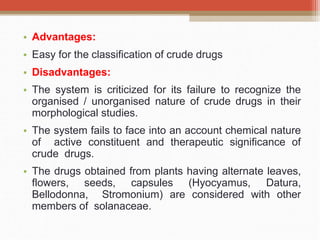
• Advantages:
• Easy for the classification of crude drugs
• Disadvantages:
• The system is criticized for its failure to recognize the
organised / unorganised nature of crude drugs in their
morphological studies.
• The system fails to face into an account chemical nature
of active constituent and therapeutic significance of
crude drugs.
• The drugs obtained from plants having alternate leaves,
flowers, seeds, capsules (Hyocyamus, Datura,
Bellodonna, Stromonium) are considered with other
members of solanaceae.
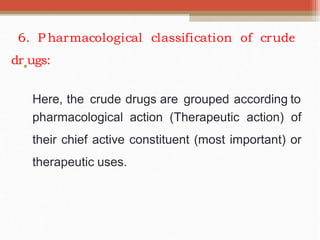
6. P harmacological classification of crude
dr•ugs:
Here, the crude drugs are grouped according to
pharmacological action (Therapeutic action) of
their chief active constituent (most important) or
therapeutic uses.
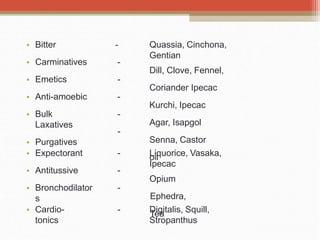
• Bitter
• Carminatives
• Emetics
• Anti-amoebic
• Bulk
Laxatives
• Purgatives
-
-
-
-
-
-
Quassia, Cinchona,
Gentian
Dill, Clove, Fennel,
Coriander Ipecac
Kurchi, Ipecac
Agar, Isapgol
Senna, Castor
oil
• Expectorant
• Antitussive
• Bronchodilator
s
-
-
-
Liquorice, Vasaka,
Ipecac
Opium
Ephedra,
Tea
• Cardio-
tonics
- Digitalis, Squill,
Stropanthus
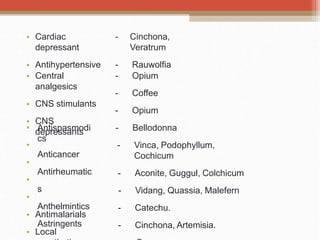
• Cardiac
depressant
• Antihypertensive
- Cinchona,
Veratrum
- Rauwolfia
• Central
analgesics
• CNS stimulants
• CNS
depressants
•
•
•
•
•
Antispasmodi
cs
Anticancer
Antirheumatic
s
Anthelmintics
Astringents
• Antimalarials
• Local
- Opium
- Coffee
- Opium
- Bellodonna
- Vinca, Podophyllum,
Cochicum
- Aconite, Guggul, Colchicum
- Vidang, Quassia, Malefern
- Catechu.
- Cinchona, Artemisia.
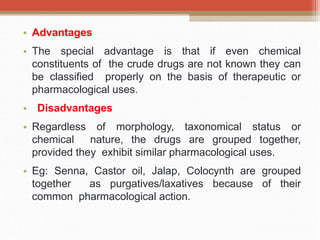
• Advantages
• The special advantage is that if even chemical
constituents of the crude drugs are not known they can
be classified properly on the basis of therapeutic or
pharmacological uses.
• Disadvantages
• Regardless of morphology, taxonomical status or
chemical nature, the drugs are grouped together,
provided they exhibit similar pharmacological uses.
• Eg: Senna, Castor oil, Jalap, Colocynth are grouped
together as purgatives/laxatives because of their
common pharmacological action.
6. Chemo- taxonomical classification of crude
drugs
• In this system of classification, the equal
importance
is given for taxonomical status and chemical
constituents. There are certain types of chemical
constituents which are characteristics of certain
classes of plants.
• Eg: Tropane alkaloids generally occur in most of
the members of Solanaceae
• Eg: Volatile oils occur in the
members of Umbelliferae and
Rutaceae.
Question bank
• 1. Define crude drug 2 marks
• 2. Name the various methods of classification of
crude drugs. 2 marks
• 3. What do you mean by organised ( Cellular)
and unorganised ( Acellular ) crude drugs give
examples
5 marks
• 4. Describe morphological classification of crude
drugs with examples 5 marks
• 5. Explain chemical classification of crude drugs
with examples 5
marks
• 7.Explain pharmacological or therapeutic
classification of crude drugs with examples 5
marks
• 8. Write in detail alphabetical and taxonomical or
botanical classification of crude drugs 5
marks
• 9. Define chemotaxonomy. Give its significances
or importance's 5
marks
• 10. Explain the differences between organised and
unorganised crude drugs. 5
marks
• 11. Define crude drug. Explain various methods of
Classification of crude drugs