PHARMACOGNOSY & PHYTOCHEMISTRY:
AN INTRODUCTION
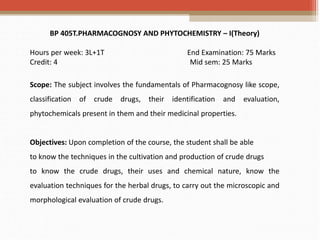
BP 405T.PHARMACOGNOSY AND PHYTOCHEMISTRY – I(Theory)
Hours per week: 3L+1T End Examination: 75 Marks
Credit: 4 Mid sem: 25 Marks
Scope: The subject involves the fundamentals of Pharmacognosy like scope,
classification of crude drugs, their identification and evaluation,
phytochemicals present in them and their medicinal properties.
Objectives: Upon completion of the course, the student shall be able
to know the techniques in the cultivation and production of crude drugs
to know the crude drugs, their uses and chemical nature, know the
evaluation techniques for the herbal drugs, to carry out the microscopic and
morphological evaluation of crude drugs.
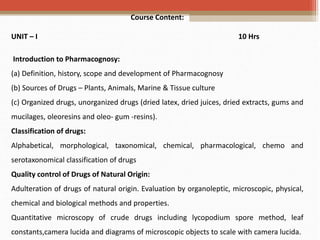
Course Content:
UNIT – I 10 Hrs
Introduction to Pharmacognosy:
(a) Definition, history, scope and development of Pharmacognosy
(b) Sources of Drugs – Plants, Animals, Marine & Tissue culture
(c) Organized drugs, unorganized drugs (dried latex, dried juices, dried extracts, gums and
mucilages, oleoresins and oleo- gum -resins).
Classification of drugs:
Alphabetical, morphological, taxonomical, chemical, pharmacological, chemo and
serotaxonomical classification of drugs
Quality control of Drugs of Natural Origin:
Adulteration of drugs of natural origin. Evaluation by organoleptic, microscopic, physical,
chemical and biological methods and properties.
Quantitative microscopy of crude drugs including lycopodium spore method, leaf
constants,camera lucida and diagrams of microscopic objects to scale with camera lucida.
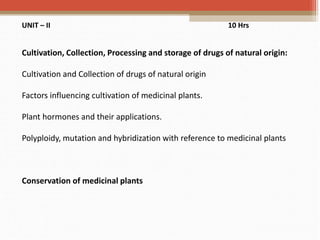
UNIT – II 10 Hrs
Cultivation, Collection, Processing and storage of drugs of natural origin:
Cultivation and Collection of drugs of natural origin
Factors influencing cultivation of medicinal plants.
Plant hormones and their applications.
Polyploidy, mutation and hybridization with reference to medicinal plants
Conservation of medicinal plants
UNIT – III 07 Hrs
Plant tissue culture:
Historical development of plant tissue culture, types of
cultures, Nutritional requirements, growth and their
maintenance.
Applications of plant tissue culture in Pharmacognosy.
Edible vaccines
UNIT – IV 10 Hrs
Study of biological source, chemical nature and uses of drugs of
natural origin containing following drugs:
Powders of natural occurrence -Lycopodium, Pollen, Kamala,
Lupulin
Fibers - Cotton, Jute, Hemp, Silk
Mineral drugs – Chalk, Kaolin, Bentonite, Fuller’s earth
Hallucinogens, Teratogens, Natural allergens
UNIT – V 08 Hrs
Study of biological source, chemical nature and uses of drugs of natural origin
containing following drugs
Primary metabolites: General introduction, detailed study with respect to
chemistry, sources, preparation, evaluation, preservation, storage, therapeutic used
and commercial utility as Pharmaceutical Aids and/or Medicines for the following
Primary metabolites:
Carbohydrates: Acacia, Agar, Tragacanth, Honey, Starch
Proteins and Enzymes: Gelatin, casein, proteolytic enzymes (Papain, bromelain,
serratiopeptidase, urokinase, streptokinase, pepsin).
Lipids (Waxes, fats, fixed oils): Castor oil, Chaulmoogra oil, Wool Fat, Bees Wax
Marine Drugs: Novel medicinal agents from marine sources.
Pharmakon: Drug Gnosis: To acquire knowledge of
Drug – Drogue – Dried Herb
Coined by Seydler, 1815, German Scientist. Analecta Pharmacognostica.
Branch of bioscience dealing with the physical, chemical, sensory, and biological
characteristics of crude drugs of plant, animal or mineral origin encompassing
the knowledge of history, distribution, cultivation, collection, processing for
marketing and preservation.
PHARMACOGNOSY
Classification of crude drugs
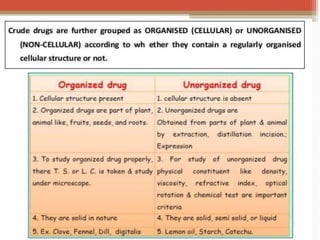
• Crude drug i.e Simple drug
• Crude drugs may be derived from various natural
sources like plants, animals, minerals and micro-
organisms etc.
• Crude drugs are plant, animal or their parts which after
collection are subjected only to conditions that do not
affect their quality or quantity of active constituents
except for those that prepare them for their
commercial use. Eg. drying or cutting them into
transverse/ longitudinal slices pieces or peeling them in
somecases.They exist in natural form.
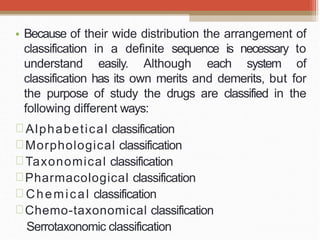
• Because of their wide distribution the arrangement of
classification in a definite sequence is necessary to
understand easily. Although each system of
classification has its own merits and demerits, but for
the purpose of study the drugs are classified in the
following different ways:
Alphabetical classification
Morphological classification
Taxonomical classification
Pharmacological classification
Chemical classification
Chemo-taxonomical classification
Serrotaxonomic classification
1.Alphabetical classification
• The crude drugs are arranged according to the
alphabetical order/form of their Latin and English
names. Some of the Pharmacopoeias and reference
books which classify crude drugs according to this
systemare as follows.
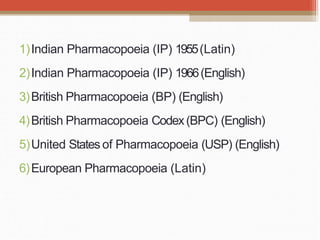
1)Indian Pharmacopoeia (IP) 1955(Latin)
2)Indian Pharmacopoeia (IP) 1966(English)
3)British Pharmacopoeia (BP) (English)
4)British Pharmacopoeia Codex(BPC) (English)
5)United States of Pharmacopoeia (USP) (English)
6)European Pharmacopoeia (Latin)
• Advantages:
• It is simple method, in this system location, tracing and
addition of the drug iseasy,
• No technical person isrequired for handling thesystem.
• Disadvantages:
• Scientific nature of the drug cannot be identified by this
method, whether they are organised or unorganised drug.
• This system does not help in distinguishing the drugs of
plant, animal and mineral source. (Original source is not
clear)
• Examples:
• Acacia, Agar, Benzoin, Beeswax, Cinchona,
Cinnamon, Digitalis, Datura, Ephedra,
Jalap, Kino, Linseed,
Fennel,
Mus
tard,
Ginger, Isapagol,
Nutmeg, etc.
2. Morphological classification:
• Here the crude
according to the
drugs
part
are arranged (Grouped)
of the plant or animal
represented into organised (Cellular) drugs and
unorganised ( Acellular ) drugs.
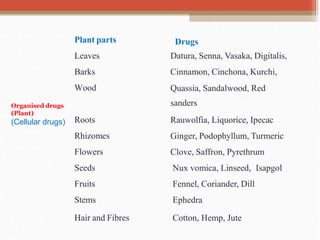
• Organised (Cellular):
• Drugs are the direct parts of the plant and are
divided into leaves, barks wood, root, rhizome, seed,
fruit, flower, stem, hair and fibers.
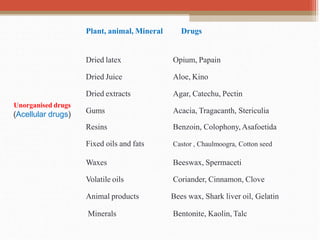
• Unorganised ( Acellular):
• Drugs are the products of plant, animal and mineral
source and they are divided into dried latex, dried
juice, dried extracts, gums, resins, fixed oils and fats,
waxes, volatile oil, animal products, minerals (Solids,
liquids, semisolids etc).
Plant parts
Leaves
Barks
Wood
Roots
Rhizomes
Flowers
Seeds
Fruits
Stems
Hair and Fibres
Drugs
Datura, Senna, Vasaka, Digitalis,
Cinnamon, Cinchona, Kurchi,
Quassia, Sandalwood, Red
sanders
Rauwolfia, Liquorice, Ipecac
Ginger, Podophyllum, Turmeric
Clove, Saffron, Pyrethrum
Nux vomica, Linseed, Isapgol
Fennel, Coriander, Dill
Ephedra
Cotton, Hemp, Jute
Organised drugs
(Plant)
(Cellular drugs)
Plant, animal, Mineral Drugs
Dried latex Opium, Papain
Dried Juice Aloe, Kino
Dried extracts Agar, Catechu, Pectin
Gums
Resins
Acacia, Tragacanth, Stericulia
Benzoin, Colophony, Asafoetida
Fixed oils and fats Castor , Chaulmoogra, Cotton seed
Waxes Beeswax, Spermaceti
Volatile oils Coriander, Cinnamon, Clove
Animal products Bees wax, Shark liver oil, Gelatin
Minerals Bentonite, Kaolin, Talc
Unorganised drugs
(Acellular drugs)
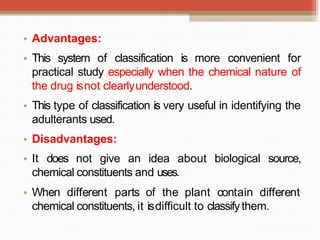
• Advantages:
• This system of classification is more convenient for
practical study especially when the chemical nature of
the drug isnot clearlyunderstood.
• This type of classification is very useful in identifying the
adulterants used.
• Disadvantages:
• It does not give an idea about biological source,
chemical constituents and uses.
• When different parts of the plant contain different
chemical constituents, it isdifficult to classifythem.
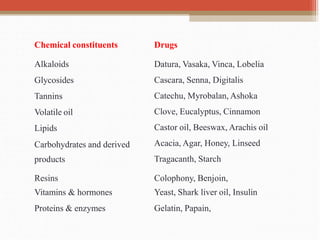
3. Chemical classifications of crude drugs
• Here, the crude drugs are divided into different
groups according to the chemical nature of their
most important constituent present in the drug to
which the pharmacological/therapeutic activity of
drug isattributed.
Chemical constituents Drugs
Alkaloids
Glycosides
Tannins
Volatile oil
Lipids
Carbohydrates and derived
products
Resins
Vitamins & hormones
Proteins & enzymes
Datura, Vasaka, Vinca, Lobelia
Cascara, Senna, Digitalis
Catechu, Myrobalan, Ashoka
Clove, Eucalyptus, Cinnamon
Castor oil, Beeswax, Arachis oil
Acacia, Agar, Honey, Linseed
Tragacanth, Starch
Colophony, Benjoin,
Yeast, Shark liver oil, Insulin
Gelatin, Papain,
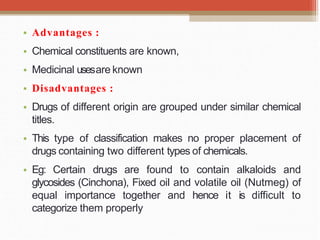
• Advantages :
• Chemical constituents are known,
• Medicinal usesare known
• Disadvantages :
• Drugs of different origin are grouped under similar chemical
titles.
• This type of classification makes no proper placement of
drugs containing two different types of chemicals.
• Eg: Certain drugs are found to contain alkaloids and
glycosides (Cinchona), Fixed oil and volatile oil (Nutmeg) of
equal importance together and hence it is difficult to
categorize them properly
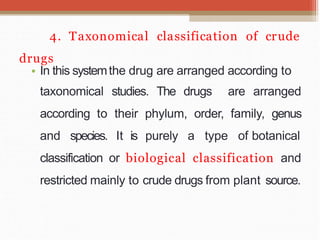
4. Taxonomical classification of crude
drugs
• In this systemthe drug are arranged according to
taxonomical studies. The drugs are arranged
according to their phylum, order, family, genus
and species. It is purely a type of botanical
classification or biological classification and
restricted mainly to crude drugs from plant source.
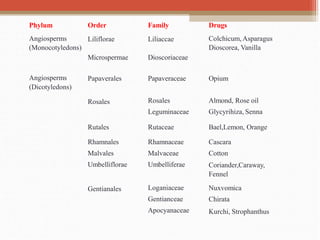
Phylum
Angiosperms
(Monocotyledons)
Order
Liliflorae
Microspermae
Family
Liliaccae
Dioscoriaceae
Drugs
Colchicum,Asparagus
Dioscorea, Vanilla
Angiosperms
(Dicotyledons)
Papaverales Papaveraceae Opium
Rosales
Rutales
Rosales
Leguminaceae
Rutaceae
Almond, Rose oil
Glycyrihiza, Senna
Bael,Lemon, Orange
Rhamnales
Malvales
Umbelliflorae
Rhamnaceae
Malvaceae
Umbelliferae
Gentianales Loganiaceae
Gentianceae
Apocyanaceae
Cascara
Cotton
Coriander,Caraway,
Fennel
Nuxvomica
Chirata
Kurchi, Strophanthus
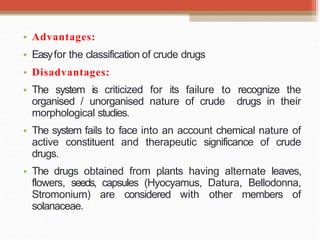
• Advantages:
• Easyfor the classification of crude drugs
• Disadvantages:
• The system is criticized for its failure to recognize the
organised / unorganised nature of crude drugs in their
morphological studies.
• The system fails to face into an account chemical nature of
active constituent and therapeutic significance of crude
drugs.
• The drugs obtained from plants having alternate leaves,
flowers, seeds, capsules (Hyocyamus, Datura, Bellodonna,
Stromonium) are considered with other members of
solanaceae.
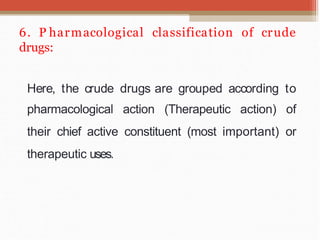
6. P harmacological classification of crude
drugs:
Here, the crude drugs are grouped according to
pharmacological action (Therapeutic action) of
their chief active constituent (most important) or
therapeutic uses.
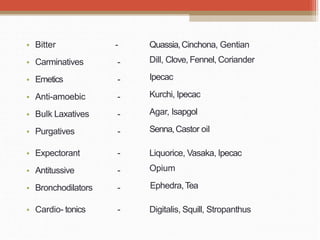
• Bitter
• Carminatives
• Emetics
• Anti-amoebic
• Bulk Laxatives
• Purgatives
-
-
-
-
-
-
Quassia,Cinchona, Gentian
Dill, Clove, Fennel, Coriander
Ipecac
Kurchi, Ipecac
Agar, Isapgol
Senna,Castor oil
• Expectorant
• Antitussive
• Bronchodilators
-
-
-
Liquorice, Vasaka, Ipecac
Opium
Ephedra,Tea
• Cardio- tonics - Digitalis, Squill, Stropanthus
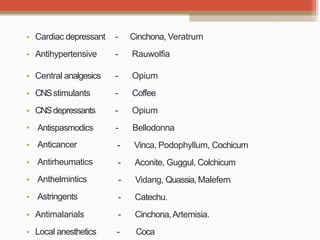
• Cardiac depressant
• Antihypertensive
- Cinchona, Veratrum
- Rauwolfia
• Central analgesics
• CNSstimulants
• CNSdepressants
•
•
•
•
•
Antispasmodics
Anticancer
Antirheumatics
Anthelmintics
Astringents
• Antimalarials
• Local anesthetics
- Opium
- Coffee
- Opium
- Bellodonna
- Vinca, Podophyllum, Cochicum
- Aconite, Guggul, Colchicum
- Vidang, Quassia, Malefern
- Catechu.
- Cinchona,Artemisia.
- Coca
• Advantages
• The special advantage is that if even chemical constituents of
the crude drugs are not known they can be classified
properly on the basisof therapeutic or pharmacological uses.
• Disadvantages
• Regardless of morphology, taxonomical status or chemical
nature, the drugs are grouped together, provided they
exhibit similar pharmacological uses.
• Eg: Senna, Castor oil, Jalap, Colocynth are grouped together
as purgatives/laxatives because of their common
pharmacological action.
6. Chemo- taxonomical classification of crude
drugs
• In this systemof classification, the equal importance
is given for taxonomical status and chemical
constituents. There are certain types of chemical
constituents which are characteristics of certain
classesofplants.
• Eg: Tropane alkaloids generally occur in most of the
members of Solanaceae
• Eg:Volatile oilsoccur in the members of
Umbelliferae and Rutaceae.
7. SEROTAXONOMIC CLASSIFICATION
• The study of antigen-antibody reaction is called serology.
• The substance capable of stimulating the formation of an
antibody isantigen.
• A specific protein molecule produced by plasma cell in the
immune system is antibody. The antibodies combine
chemically with specific antigen and this combination
elevatesanimmune response.
• The application of serology in solving taxonomic problems is
called serotaxonomy.
• PROCESSOF SEROTAXONOMY
The process of serotaxonomy involves thefollowing
• The protein extract of the plant origin i.e. the antigen is
extracted.
• The antigen is injected into the blood stream of an
experimental animal to formantibodies.
• The experimental animal produces specific antibody in
responseto theantigen.
• The serum with antibodies is called antiserum. Antiserum is
made to react in vitro with antigenic protein as well as
proteins of other taxa, whose affinities areto bedetermined.
• The amount of precipitationshows the degreeof homology.
• For example, to know the closeness of the taxon A with B, C,
D, E
• The proteins from A are extracted and are injected into the
experimental animal rabbit or mice. The experimental animal
in return producesantibodies.
• These antibodies are extracted from the blood of the
experimental animal in the form of antiserum.
• When this antiserum is allowed to react with the original
protein extract fromA, complete coagulation takes place.
• When this antiserum is allowed to react with the protein
extracts from other taxa B, C, D, E the degree of coagulation
varies.
• The degrees of coagulation are compared to know the
closeness of the taxa. More the degree of coagulation more is
the closeness.
• Gel Diffusion ,Immunoelectrophoresis, Radio-ImmunoAssay,
Enzyme Linked Immunosorbent Assay(ELISA).
• IMPORTANCE OFSEROTAXONOMY
• In 1983,Fairbrothers usedserological data in classificationof
orders and assignment of families in Apiales, Fagales,
Magnoliales, Juglandales, Rubiales, Ranunculales etc.
• GeneraMagnolia and Michelia show closest affinitywithin
Magnoliaceae.
• Simon in 1971demonstrated close relationship between
Nymphaeaceaeand nelumbonaceaebasedon serological data.
• Klos applied serotaxonomic data in the classification of
Leguminosae.

introduction and classification.pptx

  • 1.
  • 2.
    BP 405T.PHARMACOGNOSY ANDPHYTOCHEMISTRY – I(Theory) Hours per week: 3L+1T End Examination: 75 Marks Credit: 4 Mid sem: 25 Marks Scope: The subject involves the fundamentals of Pharmacognosy like scope, classification of crude drugs, their identification and evaluation, phytochemicals present in them and their medicinal properties. Objectives: Upon completion of the course, the student shall be able to know the techniques in the cultivation and production of crude drugs to know the crude drugs, their uses and chemical nature, know the evaluation techniques for the herbal drugs, to carry out the microscopic and morphological evaluation of crude drugs.
  • 3.
    Course Content: UNIT –I 10 Hrs Introduction to Pharmacognosy: (a) Definition, history, scope and development of Pharmacognosy (b) Sources of Drugs – Plants, Animals, Marine & Tissue culture (c) Organized drugs, unorganized drugs (dried latex, dried juices, dried extracts, gums and mucilages, oleoresins and oleo- gum -resins). Classification of drugs: Alphabetical, morphological, taxonomical, chemical, pharmacological, chemo and serotaxonomical classification of drugs Quality control of Drugs of Natural Origin: Adulteration of drugs of natural origin. Evaluation by organoleptic, microscopic, physical, chemical and biological methods and properties. Quantitative microscopy of crude drugs including lycopodium spore method, leaf constants,camera lucida and diagrams of microscopic objects to scale with camera lucida.
  • 4.
    UNIT – II10 Hrs Cultivation, Collection, Processing and storage of drugs of natural origin: Cultivation and Collection of drugs of natural origin Factors influencing cultivation of medicinal plants. Plant hormones and their applications. Polyploidy, mutation and hybridization with reference to medicinal plants Conservation of medicinal plants
  • 5.
    UNIT – III07 Hrs Plant tissue culture: Historical development of plant tissue culture, types of cultures, Nutritional requirements, growth and their maintenance. Applications of plant tissue culture in Pharmacognosy. Edible vaccines
  • 6.
    UNIT – IV10 Hrs Study of biological source, chemical nature and uses of drugs of natural origin containing following drugs: Powders of natural occurrence -Lycopodium, Pollen, Kamala, Lupulin Fibers - Cotton, Jute, Hemp, Silk Mineral drugs – Chalk, Kaolin, Bentonite, Fuller’s earth Hallucinogens, Teratogens, Natural allergens
  • 7.
    UNIT – V08 Hrs Study of biological source, chemical nature and uses of drugs of natural origin containing following drugs Primary metabolites: General introduction, detailed study with respect to chemistry, sources, preparation, evaluation, preservation, storage, therapeutic used and commercial utility as Pharmaceutical Aids and/or Medicines for the following Primary metabolites: Carbohydrates: Acacia, Agar, Tragacanth, Honey, Starch Proteins and Enzymes: Gelatin, casein, proteolytic enzymes (Papain, bromelain, serratiopeptidase, urokinase, streptokinase, pepsin). Lipids (Waxes, fats, fixed oils): Castor oil, Chaulmoogra oil, Wool Fat, Bees Wax Marine Drugs: Novel medicinal agents from marine sources.
  • 8.
    Pharmakon: Drug Gnosis:To acquire knowledge of Drug – Drogue – Dried Herb Coined by Seydler, 1815, German Scientist. Analecta Pharmacognostica. Branch of bioscience dealing with the physical, chemical, sensory, and biological characteristics of crude drugs of plant, animal or mineral origin encompassing the knowledge of history, distribution, cultivation, collection, processing for marketing and preservation. PHARMACOGNOSY
  • 9.
    Classification of crudedrugs • Crude drug i.e Simple drug • Crude drugs may be derived from various natural sources like plants, animals, minerals and micro- organisms etc. • Crude drugs are plant, animal or their parts which after collection are subjected only to conditions that do not affect their quality or quantity of active constituents except for those that prepare them for their commercial use. Eg. drying or cutting them into transverse/ longitudinal slices pieces or peeling them in somecases.They exist in natural form.
  • 11.
    • Because oftheir wide distribution the arrangement of classification in a definite sequence is necessary to understand easily. Although each system of classification has its own merits and demerits, but for the purpose of study the drugs are classified in the following different ways: Alphabetical classification Morphological classification Taxonomical classification Pharmacological classification Chemical classification Chemo-taxonomical classification Serrotaxonomic classification
  • 12.
    1.Alphabetical classification • Thecrude drugs are arranged according to the alphabetical order/form of their Latin and English names. Some of the Pharmacopoeias and reference books which classify crude drugs according to this systemare as follows.
  • 13.
    1)Indian Pharmacopoeia (IP)1955(Latin) 2)Indian Pharmacopoeia (IP) 1966(English) 3)British Pharmacopoeia (BP) (English) 4)British Pharmacopoeia Codex(BPC) (English) 5)United States of Pharmacopoeia (USP) (English) 6)European Pharmacopoeia (Latin)
  • 14.
    • Advantages: • Itis simple method, in this system location, tracing and addition of the drug iseasy, • No technical person isrequired for handling thesystem. • Disadvantages: • Scientific nature of the drug cannot be identified by this method, whether they are organised or unorganised drug. • This system does not help in distinguishing the drugs of plant, animal and mineral source. (Original source is not clear)
  • 15.
    • Examples: • Acacia,Agar, Benzoin, Beeswax, Cinchona, Cinnamon, Digitalis, Datura, Ephedra, Jalap, Kino, Linseed, Fennel, Mus tard, Ginger, Isapagol, Nutmeg, etc.
  • 16.
    2. Morphological classification: •Here the crude according to the drugs part are arranged (Grouped) of the plant or animal represented into organised (Cellular) drugs and unorganised ( Acellular ) drugs. • Organised (Cellular): • Drugs are the direct parts of the plant and are divided into leaves, barks wood, root, rhizome, seed, fruit, flower, stem, hair and fibers.
  • 17.
    • Unorganised (Acellular): • Drugs are the products of plant, animal and mineral source and they are divided into dried latex, dried juice, dried extracts, gums, resins, fixed oils and fats, waxes, volatile oil, animal products, minerals (Solids, liquids, semisolids etc).
  • 18.
    Plant parts Leaves Barks Wood Roots Rhizomes Flowers Seeds Fruits Stems Hair andFibres Drugs Datura, Senna, Vasaka, Digitalis, Cinnamon, Cinchona, Kurchi, Quassia, Sandalwood, Red sanders Rauwolfia, Liquorice, Ipecac Ginger, Podophyllum, Turmeric Clove, Saffron, Pyrethrum Nux vomica, Linseed, Isapgol Fennel, Coriander, Dill Ephedra Cotton, Hemp, Jute Organised drugs (Plant) (Cellular drugs)
  • 19.
    Plant, animal, MineralDrugs Dried latex Opium, Papain Dried Juice Aloe, Kino Dried extracts Agar, Catechu, Pectin Gums Resins Acacia, Tragacanth, Stericulia Benzoin, Colophony, Asafoetida Fixed oils and fats Castor , Chaulmoogra, Cotton seed Waxes Beeswax, Spermaceti Volatile oils Coriander, Cinnamon, Clove Animal products Bees wax, Shark liver oil, Gelatin Minerals Bentonite, Kaolin, Talc Unorganised drugs (Acellular drugs)
  • 20.
    • Advantages: • Thissystem of classification is more convenient for practical study especially when the chemical nature of the drug isnot clearlyunderstood. • This type of classification is very useful in identifying the adulterants used. • Disadvantages: • It does not give an idea about biological source, chemical constituents and uses. • When different parts of the plant contain different chemical constituents, it isdifficult to classifythem.
  • 21.
    3. Chemical classificationsof crude drugs • Here, the crude drugs are divided into different groups according to the chemical nature of their most important constituent present in the drug to which the pharmacological/therapeutic activity of drug isattributed.
  • 22.
    Chemical constituents Drugs Alkaloids Glycosides Tannins Volatileoil Lipids Carbohydrates and derived products Resins Vitamins & hormones Proteins & enzymes Datura, Vasaka, Vinca, Lobelia Cascara, Senna, Digitalis Catechu, Myrobalan, Ashoka Clove, Eucalyptus, Cinnamon Castor oil, Beeswax, Arachis oil Acacia, Agar, Honey, Linseed Tragacanth, Starch Colophony, Benjoin, Yeast, Shark liver oil, Insulin Gelatin, Papain,
  • 23.
    • Advantages : •Chemical constituents are known, • Medicinal usesare known • Disadvantages : • Drugs of different origin are grouped under similar chemical titles. • This type of classification makes no proper placement of drugs containing two different types of chemicals. • Eg: Certain drugs are found to contain alkaloids and glycosides (Cinchona), Fixed oil and volatile oil (Nutmeg) of equal importance together and hence it is difficult to categorize them properly
  • 24.
    4. Taxonomical classificationof crude drugs • In this systemthe drug are arranged according to taxonomical studies. The drugs are arranged according to their phylum, order, family, genus and species. It is purely a type of botanical classification or biological classification and restricted mainly to crude drugs from plant source.
  • 25.
    Phylum Angiosperms (Monocotyledons) Order Liliflorae Microspermae Family Liliaccae Dioscoriaceae Drugs Colchicum,Asparagus Dioscorea, Vanilla Angiosperms (Dicotyledons) Papaverales PapaveraceaeOpium Rosales Rutales Rosales Leguminaceae Rutaceae Almond, Rose oil Glycyrihiza, Senna Bael,Lemon, Orange Rhamnales Malvales Umbelliflorae Rhamnaceae Malvaceae Umbelliferae Gentianales Loganiaceae Gentianceae Apocyanaceae Cascara Cotton Coriander,Caraway, Fennel Nuxvomica Chirata Kurchi, Strophanthus
  • 26.
    • Advantages: • Easyforthe classification of crude drugs • Disadvantages: • The system is criticized for its failure to recognize the organised / unorganised nature of crude drugs in their morphological studies. • The system fails to face into an account chemical nature of active constituent and therapeutic significance of crude drugs. • The drugs obtained from plants having alternate leaves, flowers, seeds, capsules (Hyocyamus, Datura, Bellodonna, Stromonium) are considered with other members of solanaceae.
  • 27.
    6. P harmacologicalclassification of crude drugs: Here, the crude drugs are grouped according to pharmacological action (Therapeutic action) of their chief active constituent (most important) or therapeutic uses.
  • 28.
    • Bitter • Carminatives •Emetics • Anti-amoebic • Bulk Laxatives • Purgatives - - - - - - Quassia,Cinchona, Gentian Dill, Clove, Fennel, Coriander Ipecac Kurchi, Ipecac Agar, Isapgol Senna,Castor oil • Expectorant • Antitussive • Bronchodilators - - - Liquorice, Vasaka, Ipecac Opium Ephedra,Tea • Cardio- tonics - Digitalis, Squill, Stropanthus
  • 29.
    • Cardiac depressant •Antihypertensive - Cinchona, Veratrum - Rauwolfia • Central analgesics • CNSstimulants • CNSdepressants • • • • • Antispasmodics Anticancer Antirheumatics Anthelmintics Astringents • Antimalarials • Local anesthetics - Opium - Coffee - Opium - Bellodonna - Vinca, Podophyllum, Cochicum - Aconite, Guggul, Colchicum - Vidang, Quassia, Malefern - Catechu. - Cinchona,Artemisia. - Coca
  • 30.
    • Advantages • Thespecial advantage is that if even chemical constituents of the crude drugs are not known they can be classified properly on the basisof therapeutic or pharmacological uses. • Disadvantages • Regardless of morphology, taxonomical status or chemical nature, the drugs are grouped together, provided they exhibit similar pharmacological uses. • Eg: Senna, Castor oil, Jalap, Colocynth are grouped together as purgatives/laxatives because of their common pharmacological action.
  • 31.
    6. Chemo- taxonomicalclassification of crude drugs • In this systemof classification, the equal importance is given for taxonomical status and chemical constituents. There are certain types of chemical constituents which are characteristics of certain classesofplants. • Eg: Tropane alkaloids generally occur in most of the members of Solanaceae • Eg:Volatile oilsoccur in the members of Umbelliferae and Rutaceae.
  • 32.
    7. SEROTAXONOMIC CLASSIFICATION •The study of antigen-antibody reaction is called serology. • The substance capable of stimulating the formation of an antibody isantigen. • A specific protein molecule produced by plasma cell in the immune system is antibody. The antibodies combine chemically with specific antigen and this combination elevatesanimmune response. • The application of serology in solving taxonomic problems is called serotaxonomy.
  • 33.
    • PROCESSOF SEROTAXONOMY Theprocess of serotaxonomy involves thefollowing • The protein extract of the plant origin i.e. the antigen is extracted. • The antigen is injected into the blood stream of an experimental animal to formantibodies. • The experimental animal produces specific antibody in responseto theantigen. • The serum with antibodies is called antiserum. Antiserum is made to react in vitro with antigenic protein as well as proteins of other taxa, whose affinities areto bedetermined. • The amount of precipitationshows the degreeof homology.
  • 34.
    • For example,to know the closeness of the taxon A with B, C, D, E • The proteins from A are extracted and are injected into the experimental animal rabbit or mice. The experimental animal in return producesantibodies. • These antibodies are extracted from the blood of the experimental animal in the form of antiserum. • When this antiserum is allowed to react with the original protein extract fromA, complete coagulation takes place. • When this antiserum is allowed to react with the protein extracts from other taxa B, C, D, E the degree of coagulation varies. • The degrees of coagulation are compared to know the closeness of the taxa. More the degree of coagulation more is the closeness.
  • 35.
    • Gel Diffusion,Immunoelectrophoresis, Radio-ImmunoAssay, Enzyme Linked Immunosorbent Assay(ELISA). • IMPORTANCE OFSEROTAXONOMY • In 1983,Fairbrothers usedserological data in classificationof orders and assignment of families in Apiales, Fagales, Magnoliales, Juglandales, Rubiales, Ranunculales etc. • GeneraMagnolia and Michelia show closest affinitywithin Magnoliaceae. • Simon in 1971demonstrated close relationship between Nymphaeaceaeand nelumbonaceaebasedon serological data. • Klos applied serotaxonomic data in the classification of Leguminosae.