Jordan
Nawal Ragit
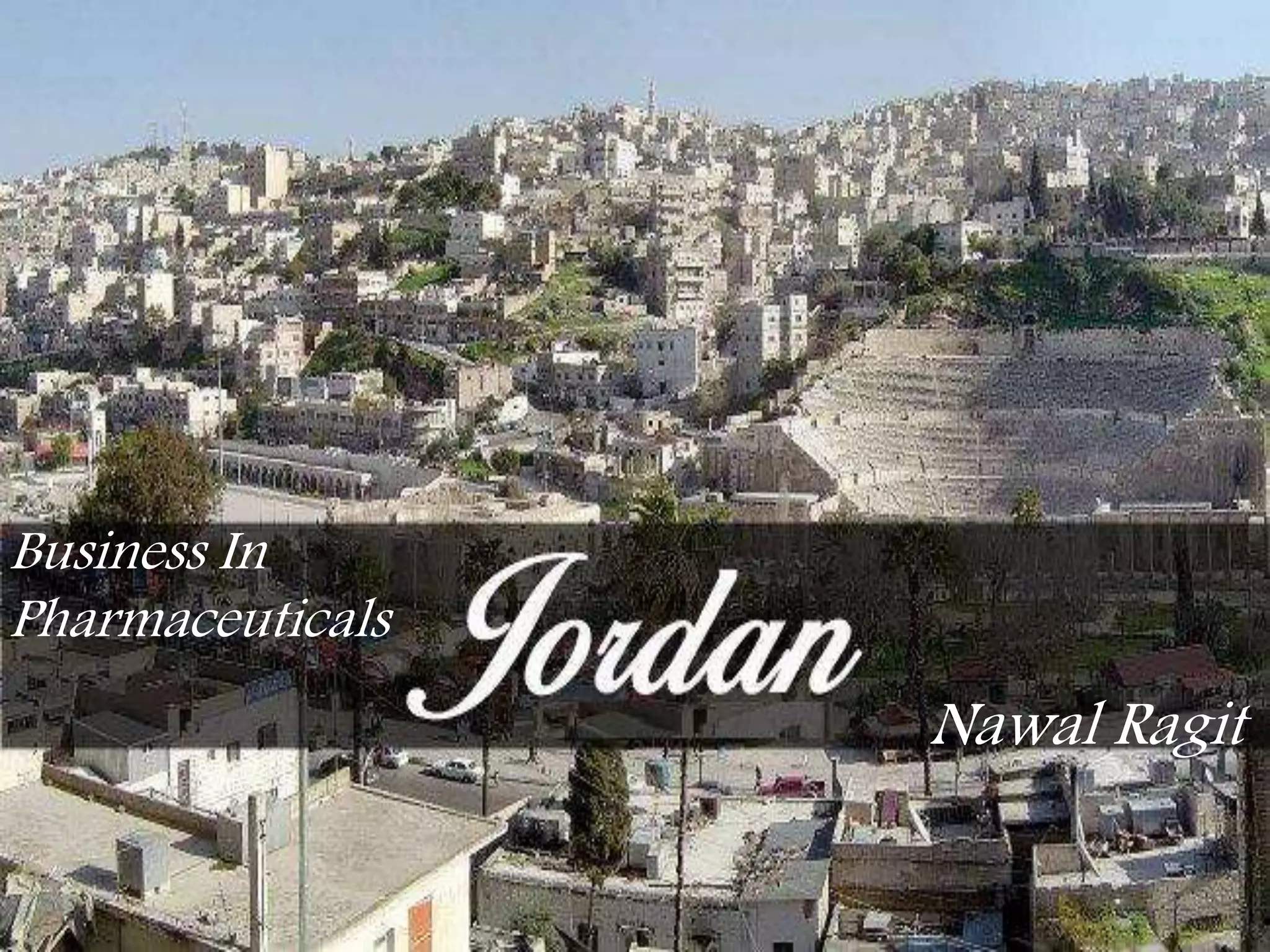
Business In
Pharmaceuticals
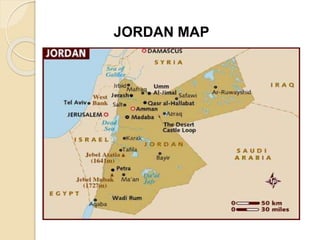
JORDAN MAP
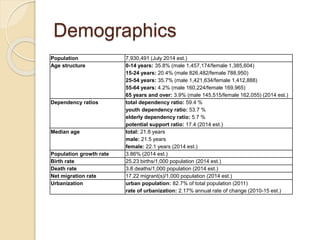
Demographics
Population 7,930,491 (July 2014 est.)
Age structure 0-14 years: 35.8% (male 1,457,174/female 1,385,604)
15-24 years: 20.4% (male 826,482/female 788,950)
25-54 years: 35.7% (male 1,421,634/female 1,412,888)
55-64 years: 4.2% (male 160,224/female 169,965)
65 years and over: 3.9% (male 145,515/female 162,055) (2014 est.)
Dependency ratios total dependency ratio: 59.4 %
youth dependency ratio: 53.7 %
elderly dependency ratio: 5.7 %
potential support ratio: 17.4 (2014 est.)
Median age total: 21.8 years
male: 21.5 years
female: 22.1 years (2014 est.)
Population growth rate 3.86% (2014 est.)
Birth rate 25.23 births/1,000 population (2014 est.)
Death rate 3.8 deaths/1,000 population (2014 est.)
Net migration rate 17.22 migrant(s)/1,000 population (2014 est.)
Urbanization urban population: 82.7% of total population (2011)
rate of urbanization: 2.17% annual rate of change (2010-15 est.)
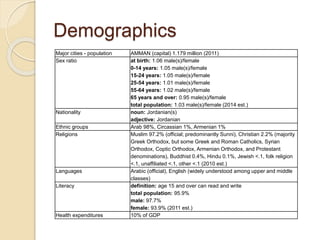
Demographics
Major cities - population AMMAN (capital) 1.179 million (2011)
Sex ratio at birth: 1.06 male(s)/female
0-14 years: 1.05 male(s)/female
15-24 years: 1.05 male(s)/female
25-54 years: 1.01 male(s)/female
55-64 years: 1.02 male(s)/female
65 years and over: 0.95 male(s)/female
total population: 1.03 male(s)/female (2014 est.)
Nationality noun: Jordanian(s)
adjective: Jordanian
Ethnic groups Arab 98%, Circassian 1%, Armenian 1%
Religions Muslim 97.2% (official; predominantly Sunni), Christian 2.2% (majority
Greek Orthodox, but some Greek and Roman Catholics, Syrian
Orthodox, Coptic Orthodox, Armenian Orthodox, and Protestant
denominations), Buddhist 0.4%, Hindu 0.1%, Jewish <.1, folk religion
<.1, unaffiliated <.1, other <.1 (2010 est.)
Languages Arabic (official), English (widely understood among upper and middle
classes)
Literacy definition: age 15 and over can read and write
total population: 95.9%
male: 97.7%
female: 93.9% (2011 est.)
Health expenditures 10% of GDP
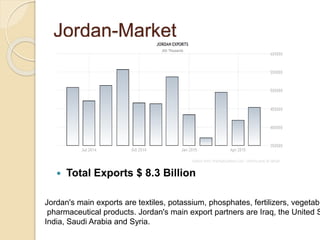
Jordan-Market
 Total Exports $ 8.3 Billion
Jordan's main exports are textiles, potassium, phosphates, fertilizers, vegetabl
pharmaceutical products. Jordan's main export partners are Iraq, the United S
India, Saudi Arabia and Syria.
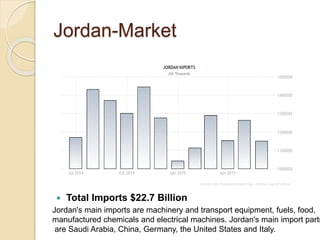
Jordan-Market
 Total Imports $22.7 Billion
Jordan's main imports are machinery and transport equipment, fuels, food,
manufactured chemicals and electrical machines. Jordan's main import partn
are Saudi Arabia, China, Germany, the United States and Italy.
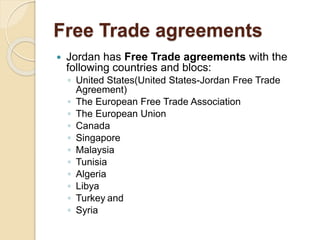
Free Trade agreements
 Jordan has Free Trade agreements with the
following countries and blocs:
◦ United States(United States-Jordan Free Trade
Agreement)
◦ The European Free Trade Association
◦ The European Union
◦ Canada
◦ Singapore
◦ Malaysia
◦ Tunisia
◦ Algeria
◦ Libya
◦ Turkey and
◦ Syria
Pharmaceutical Market
 Jordan current Pharma Market size is close to 0.9 Billion $.
 Jordan is hoping its exports of the pharmaceutical industry would generate US $1 billion
by the end of 2015.
 Jordan imported pharmaceutical products valued at US$0.6 billion approx in 2014
 Switzerland and the UK were the leading suppliers.
 Imports of medical equipment and pharmaceuticals exceeded $450 million in the
year 2013 and are expected to grow to $615 million by the end of 2016.
 Currently, 16 local pharmaceutical plants, having a market value exceeding US
$1.18 billion are engaged in the production of medicines in Jordan.
 The majority of pharmaceutical exports were destined for other countries in the Middle
East & Africa region.
Pharmaceutical Products- Export & Domestic
Use
Pharma
Export
80%
Domestic
20%
Pharmaceutical Products- Export & Domestic
use
90% to
Arab
Countries
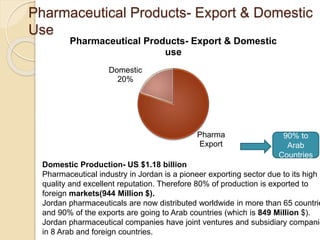
Domestic Production- US $1.18 billion
Pharmaceutical industry in Jordan is a pioneer exporting sector due to its high
quality and excellent reputation. Therefore 80% of production is exported to
foreign markets(944 Million $).
Jordan pharmaceuticals are now distributed worldwide in more than 65 countrie
and 90% of the exports are going to Arab countries (which is 849 Million $).
Jordan pharmaceutical companies have joint ventures and subsidiary companie
in 8 Arab and foreign countries.
Pharmaceutical Import
Medical
equipment
69%
Pharmaceutic
al
28%
Other
Medical
Products
3%
% Share
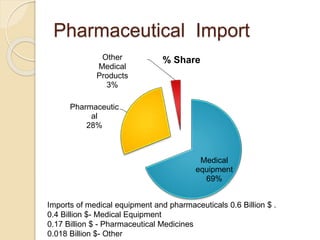
Imports of medical equipment and pharmaceuticals 0.6 Billion $ .
0.4 Billion $- Medical Equipment
0.17 Billion $ - Pharmaceutical Medicines
0.018 Billion $- Other
Total Demand Of Pharmaceutical Produc
Pharmaceutical
Products
Consumption
(Domestic)= $0.9
Billion Approx
Medical Equipment
$0.4 Billion Approx
Pharmaceutical
medicines $0.45
Billion Approx
Local Manufacturer
$0.28 Billion Approx
Pharmaceutical
Medicine Import
$0.16 Billion Approx
Other $0.05 Billion
Approx
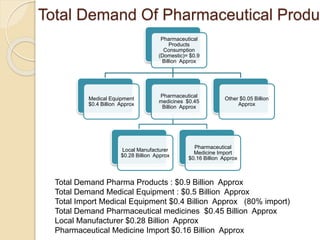
Total Demand Pharma Products : $0.9 Billion Approx
Total Demand Medical Equipment : $0.5 Billion Approx
Total Import Medical Equipment $0.4 Billion Approx (80% import)
Total Demand Pharmaceutical medicines $0.45 Billion Approx
Local Manufacturer $0.28 Billion Approx
Pharmaceutical Medicine Import $0.16 Billion Approx
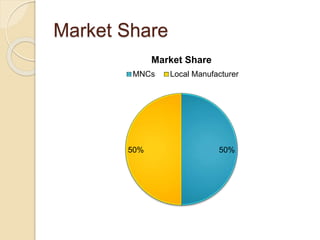
Market Share
50%50%
Market Share
MNCs Local Manufacturer
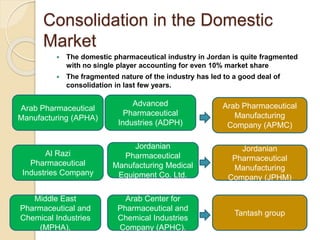
Consolidation in the Domestic
Market
 The domestic pharmaceutical industry in Jordan is quite fragmented
with no single player accounting for even 10% market share
 The fragmented nature of the industry has led to a good deal of
consolidation in last few years.
Arab Pharmaceutical
Manufacturing (APHA)
Advanced
Pharmaceutical
Industries (ADPH)
Arab Pharmaceutical
Manufacturing
Company (APMC)
Jordanian
Pharmaceutical
Manufacturing
Company (JPHM)
Al Razi
Pharmaceutical
Industries Company
Jordanian
Pharmaceutical
Manufacturing Medical
Equipment Co. Ltd.
Tantash group
Middle East
Pharmaceutical and
Chemical Industries
(MPHA),
Arab Center for
Pharmaceutical and
Chemical Industries
Company (APHC).
Expenditure Projections
 Pharmaceuticals: JOD643mn
(USD905mn) in 2014 to JOD683mn
(USD962mn) in 2015; +6.3% in local
currency terms and US dollar terms.
 Healthcare: JOD1.85bn (USD2.61bn) in
2014 to JOD1.97bn (USD2.77bn) in
2015; +6.2% in local currency terms
and US dollar terms.
Major Disease
 Jordanians increasingly suffer from
◦ Asthma;
◦ Cancer;
◦ Diabetes;
◦ Obesity;
◦ Heart stroke,
◦ Vascular disease;
◦ Osteoarthritis,
◦ Rheumatoid arthritis; and
◦ Osteoporosis.
Opportunities exist for technologies that avert or
reduce disability because of these diseases.
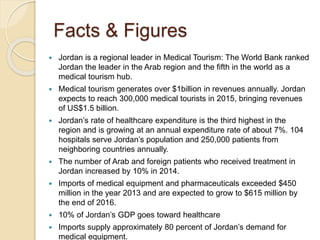
Facts & Figures
 Jordan is a regional leader in Medical Tourism: The World Bank ranked
Jordan the leader in the Arab region and the fifth in the world as a
medical tourism hub.
 Medical tourism generates over $1billion in revenues annually. Jordan
expects to reach 300,000 medical tourists in 2015, bringing revenues
of US$1.5 billion.
 Jordan’s rate of healthcare expenditure is the third highest in the
region and is growing at an annual expenditure rate of about 7%. 104
hospitals serve Jordan’s population and 250,000 patients from
neighboring countries annually.
 The number of Arab and foreign patients who received treatment in
Jordan increased by 10% in 2014.
 Imports of medical equipment and pharmaceuticals exceeded $450
million in the year 2013 and are expected to grow to $615 million by
the end of 2016.
 10% of Jordan’s GDP goes toward healthcare
 Imports supply approximately 80 percent of Jordan’s demand for
medical equipment.
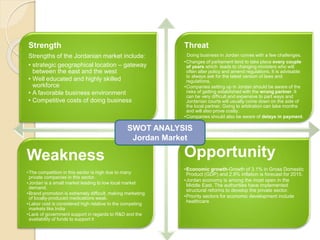
Strength
Strengths of the Jordanian market include:
• strategic geographical location – gateway
between the east and the west
• Well educated and highly skilled
workforce
• A favorable business environment
• Competitive costs of doing business
Threat
Doing business in Jordan comes with a few challenges.
•Changes of parliament tend to take place every couple
of years which leads to changing ministers who will
often alter policy and amend regulations. It is advisable
to always ask for the latest version of laws and
regulations.
•Companies setting up in Jordan should be aware of the
risks of getting established with the wrong partner. It
can be very difficult and expensive to part ways and
Jordanian courts will usually come down on the side of
the local partner. Going to arbitration can take months
and will also prove costly.
•Companies should also be aware of delays in payment.
Weakness
•The competition in this sector is high due to many
private companies in this sector.
•Jordan is a small market leading to low local market
demand.
•Brand promotion is extremely difficult, making marketing
of locally-produced medications weak.
•Labor cost is considered high relative to the competing
markets like India
•Lack of government support in regards to R&D and the
availability of funds to support it
Opportunity
•Economic growth-Growth of 3.1% in Gross Domestic
Product (GDP) and 2.9% inflation is forecast for 2015.
•Jordan economy is among the most open in the
Middle East. The authorities have implemented
structural reforms to develop the private sector.
•Priority sectors for economic development include
healthcare
SWOT ANALYSIS
Jordan Market
Local Companies
 Al-Razi Pharmaceutical Industries Co
 Amman Pharmaceutical Industries Co.
(API)
 Arab Pharmaceutical Manufacturers
(APM)
 Dar Al-Dawa (DAD)
 Hayat Pharmaceuticals Industries (HPI)
 Hikma Pharmaceuticals
 Jordan Pharmaceuticals Manufacturing
 Midpharrma
 United Pharmaceutical Manufacturing
MNC
 Leo Pharma,
 Novo Nordisk, and
 Lundbeck
The companies source their raw
materials (APIs) mainly from Asian
suppliers, mainly in India and China,
on account of their low cost while
keeping the quality intact. The
excipients are sourced mainly from
Europe.
Public-listed pharmaceutical
companies in Jordan
There are seven public-listed pharmaceutical
companies in Jordan. These are
 Hikma Pharmaceuticals
 Dar Al Dawa Development and Investment Company
(DADI)
 Arab Pharmaceutical Manufacturing Company (APMC)
 Jordanian Pharmaceutical Manufacturing Company
(JPHM)
 Middle East Pharmaceutical and Chemical Industries
(MPHA)
 Hayat Pharmaceutical Industries (HPIC)
 Arab Center for Pharmaceutical and Chemical
Industries Company (APHC)
Non-listed pharmaceutical
companies
Among the non-listed pharmaceutical
companies, prominent players are
 Amman Pharmaceutical Industries Co.
 Jordan River Pharmaceutical Industries
 Jordan Sweden Medical and Sterilization
Co.
 Pharma International Co.
 Ram Pharmaceutical Industries Co. Ltd.
 United Pharmaceutical Manufacturing Co.
Ltd
Registration Process
In Jordan, the Jordan Food and Drug Administration is responsible
for product registration, including assessment of clinical trials,
bioequivalence studies, pricing, accreditation of pharmaceutical
manufacturers, promotion of rational drug use, and post-
marketing surveillance.
The approval process for new products takes approximately 12
months.
A fast-track application may be requested for vital and highly
required medication. This process may take 6 months.
Most Jordanian patients are insured in public hospitals. In order
for public hospitals to acquire fast-tracked medication, the drug
must be listed in the Rational Drug List of Jordan, a process that
may take 1-2 years.
Registration Guidelines
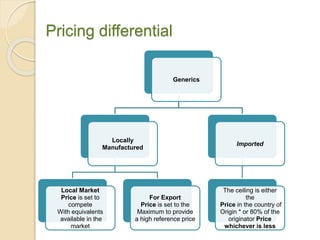
Pricing differential
Generics
Locally
Manufactured
Local Market
Price is set to
compete
With equivalents
available in the
market
For Export
Price is set to the
Maximum to provide
a high reference price
Imported
The ceiling is either
the
Price in the country of
Origin * or 80% of the
originator Price
whichever is less
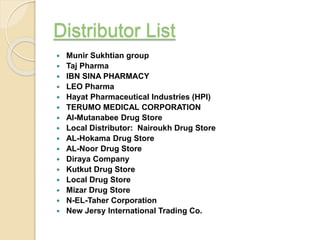
Distributor List
 Munir Sukhtian group
 Taj Pharma
 IBN SINA PHARMACY
 LEO Pharma
 Hayat Pharmaceutical Industries (HPI)
 TERUMO MEDICAL CORPORATION
 Al-Mutanabee Drug Store
 Local Distributor: Nairoukh Drug Store
 AL-Hokama Drug Store
 AL-Noor Drug Store
 Diraya Company
 Kutkut Drug Store
 Local Drug Store
 Mizar Drug Store
 N-EL-Taher Corporation
 New Jersy International Trading Co.
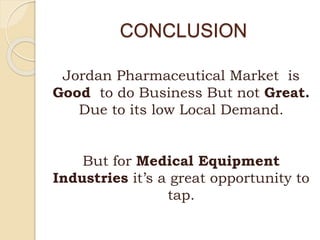
CONCLUSION
Jordan Pharmaceutical Market is
Good to do Business But not Great.
Due to its low Local Demand.
But for Medical Equipment
Industries it’s a great opportunity to
tap.
pharmaceutical business in Jordan

pharmaceutical business in Jordan

  • 1.
  • 3.
  • 4.
    Demographics Population 7,930,491 (July2014 est.) Age structure 0-14 years: 35.8% (male 1,457,174/female 1,385,604) 15-24 years: 20.4% (male 826,482/female 788,950) 25-54 years: 35.7% (male 1,421,634/female 1,412,888) 55-64 years: 4.2% (male 160,224/female 169,965) 65 years and over: 3.9% (male 145,515/female 162,055) (2014 est.) Dependency ratios total dependency ratio: 59.4 % youth dependency ratio: 53.7 % elderly dependency ratio: 5.7 % potential support ratio: 17.4 (2014 est.) Median age total: 21.8 years male: 21.5 years female: 22.1 years (2014 est.) Population growth rate 3.86% (2014 est.) Birth rate 25.23 births/1,000 population (2014 est.) Death rate 3.8 deaths/1,000 population (2014 est.) Net migration rate 17.22 migrant(s)/1,000 population (2014 est.) Urbanization urban population: 82.7% of total population (2011) rate of urbanization: 2.17% annual rate of change (2010-15 est.)
  • 5.
    Demographics Major cities -population AMMAN (capital) 1.179 million (2011) Sex ratio at birth: 1.06 male(s)/female 0-14 years: 1.05 male(s)/female 15-24 years: 1.05 male(s)/female 25-54 years: 1.01 male(s)/female 55-64 years: 1.02 male(s)/female 65 years and over: 0.95 male(s)/female total population: 1.03 male(s)/female (2014 est.) Nationality noun: Jordanian(s) adjective: Jordanian Ethnic groups Arab 98%, Circassian 1%, Armenian 1% Religions Muslim 97.2% (official; predominantly Sunni), Christian 2.2% (majority Greek Orthodox, but some Greek and Roman Catholics, Syrian Orthodox, Coptic Orthodox, Armenian Orthodox, and Protestant denominations), Buddhist 0.4%, Hindu 0.1%, Jewish <.1, folk religion <.1, unaffiliated <.1, other <.1 (2010 est.) Languages Arabic (official), English (widely understood among upper and middle classes) Literacy definition: age 15 and over can read and write total population: 95.9% male: 97.7% female: 93.9% (2011 est.) Health expenditures 10% of GDP
  • 6.
    Jordan-Market  Total Exports$ 8.3 Billion Jordan's main exports are textiles, potassium, phosphates, fertilizers, vegetabl pharmaceutical products. Jordan's main export partners are Iraq, the United S India, Saudi Arabia and Syria.
  • 7.
    Jordan-Market  Total Imports$22.7 Billion Jordan's main imports are machinery and transport equipment, fuels, food, manufactured chemicals and electrical machines. Jordan's main import partn are Saudi Arabia, China, Germany, the United States and Italy.
  • 8.
    Free Trade agreements Jordan has Free Trade agreements with the following countries and blocs: ◦ United States(United States-Jordan Free Trade Agreement) ◦ The European Free Trade Association ◦ The European Union ◦ Canada ◦ Singapore ◦ Malaysia ◦ Tunisia ◦ Algeria ◦ Libya ◦ Turkey and ◦ Syria
  • 9.
    Pharmaceutical Market  Jordancurrent Pharma Market size is close to 0.9 Billion $.  Jordan is hoping its exports of the pharmaceutical industry would generate US $1 billion by the end of 2015.  Jordan imported pharmaceutical products valued at US$0.6 billion approx in 2014  Switzerland and the UK were the leading suppliers.  Imports of medical equipment and pharmaceuticals exceeded $450 million in the year 2013 and are expected to grow to $615 million by the end of 2016.  Currently, 16 local pharmaceutical plants, having a market value exceeding US $1.18 billion are engaged in the production of medicines in Jordan.  The majority of pharmaceutical exports were destined for other countries in the Middle East & Africa region.
  • 10.
    Pharmaceutical Products- Export& Domestic Use Pharma Export 80% Domestic 20% Pharmaceutical Products- Export & Domestic use 90% to Arab Countries Domestic Production- US $1.18 billion Pharmaceutical industry in Jordan is a pioneer exporting sector due to its high quality and excellent reputation. Therefore 80% of production is exported to foreign markets(944 Million $). Jordan pharmaceuticals are now distributed worldwide in more than 65 countrie and 90% of the exports are going to Arab countries (which is 849 Million $). Jordan pharmaceutical companies have joint ventures and subsidiary companie in 8 Arab and foreign countries.
  • 11.
    Pharmaceutical Import Medical equipment 69% Pharmaceutic al 28% Other Medical Products 3% % Share Importsof medical equipment and pharmaceuticals 0.6 Billion $ . 0.4 Billion $- Medical Equipment 0.17 Billion $ - Pharmaceutical Medicines 0.018 Billion $- Other
  • 12.
    Total Demand OfPharmaceutical Produc Pharmaceutical Products Consumption (Domestic)= $0.9 Billion Approx Medical Equipment $0.4 Billion Approx Pharmaceutical medicines $0.45 Billion Approx Local Manufacturer $0.28 Billion Approx Pharmaceutical Medicine Import $0.16 Billion Approx Other $0.05 Billion Approx Total Demand Pharma Products : $0.9 Billion Approx Total Demand Medical Equipment : $0.5 Billion Approx Total Import Medical Equipment $0.4 Billion Approx (80% import) Total Demand Pharmaceutical medicines $0.45 Billion Approx Local Manufacturer $0.28 Billion Approx Pharmaceutical Medicine Import $0.16 Billion Approx
  • 13.
  • 14.
    Consolidation in theDomestic Market  The domestic pharmaceutical industry in Jordan is quite fragmented with no single player accounting for even 10% market share  The fragmented nature of the industry has led to a good deal of consolidation in last few years. Arab Pharmaceutical Manufacturing (APHA) Advanced Pharmaceutical Industries (ADPH) Arab Pharmaceutical Manufacturing Company (APMC) Jordanian Pharmaceutical Manufacturing Company (JPHM) Al Razi Pharmaceutical Industries Company Jordanian Pharmaceutical Manufacturing Medical Equipment Co. Ltd. Tantash group Middle East Pharmaceutical and Chemical Industries (MPHA), Arab Center for Pharmaceutical and Chemical Industries Company (APHC).
  • 15.
    Expenditure Projections  Pharmaceuticals:JOD643mn (USD905mn) in 2014 to JOD683mn (USD962mn) in 2015; +6.3% in local currency terms and US dollar terms.  Healthcare: JOD1.85bn (USD2.61bn) in 2014 to JOD1.97bn (USD2.77bn) in 2015; +6.2% in local currency terms and US dollar terms.
  • 16.
    Major Disease  Jordaniansincreasingly suffer from ◦ Asthma; ◦ Cancer; ◦ Diabetes; ◦ Obesity; ◦ Heart stroke, ◦ Vascular disease; ◦ Osteoarthritis, ◦ Rheumatoid arthritis; and ◦ Osteoporosis. Opportunities exist for technologies that avert or reduce disability because of these diseases.
  • 17.
    Facts & Figures Jordan is a regional leader in Medical Tourism: The World Bank ranked Jordan the leader in the Arab region and the fifth in the world as a medical tourism hub.  Medical tourism generates over $1billion in revenues annually. Jordan expects to reach 300,000 medical tourists in 2015, bringing revenues of US$1.5 billion.  Jordan’s rate of healthcare expenditure is the third highest in the region and is growing at an annual expenditure rate of about 7%. 104 hospitals serve Jordan’s population and 250,000 patients from neighboring countries annually.  The number of Arab and foreign patients who received treatment in Jordan increased by 10% in 2014.  Imports of medical equipment and pharmaceuticals exceeded $450 million in the year 2013 and are expected to grow to $615 million by the end of 2016.  10% of Jordan’s GDP goes toward healthcare  Imports supply approximately 80 percent of Jordan’s demand for medical equipment.
  • 18.
    Strength Strengths of theJordanian market include: • strategic geographical location – gateway between the east and the west • Well educated and highly skilled workforce • A favorable business environment • Competitive costs of doing business Threat Doing business in Jordan comes with a few challenges. •Changes of parliament tend to take place every couple of years which leads to changing ministers who will often alter policy and amend regulations. It is advisable to always ask for the latest version of laws and regulations. •Companies setting up in Jordan should be aware of the risks of getting established with the wrong partner. It can be very difficult and expensive to part ways and Jordanian courts will usually come down on the side of the local partner. Going to arbitration can take months and will also prove costly. •Companies should also be aware of delays in payment. Weakness •The competition in this sector is high due to many private companies in this sector. •Jordan is a small market leading to low local market demand. •Brand promotion is extremely difficult, making marketing of locally-produced medications weak. •Labor cost is considered high relative to the competing markets like India •Lack of government support in regards to R&D and the availability of funds to support it Opportunity •Economic growth-Growth of 3.1% in Gross Domestic Product (GDP) and 2.9% inflation is forecast for 2015. •Jordan economy is among the most open in the Middle East. The authorities have implemented structural reforms to develop the private sector. •Priority sectors for economic development include healthcare SWOT ANALYSIS Jordan Market
  • 19.
    Local Companies  Al-RaziPharmaceutical Industries Co  Amman Pharmaceutical Industries Co. (API)  Arab Pharmaceutical Manufacturers (APM)  Dar Al-Dawa (DAD)  Hayat Pharmaceuticals Industries (HPI)  Hikma Pharmaceuticals  Jordan Pharmaceuticals Manufacturing  Midpharrma  United Pharmaceutical Manufacturing
  • 20.
    MNC  Leo Pharma, Novo Nordisk, and  Lundbeck
  • 21.
    The companies sourcetheir raw materials (APIs) mainly from Asian suppliers, mainly in India and China, on account of their low cost while keeping the quality intact. The excipients are sourced mainly from Europe.
  • 22.
    Public-listed pharmaceutical companies inJordan There are seven public-listed pharmaceutical companies in Jordan. These are  Hikma Pharmaceuticals  Dar Al Dawa Development and Investment Company (DADI)  Arab Pharmaceutical Manufacturing Company (APMC)  Jordanian Pharmaceutical Manufacturing Company (JPHM)  Middle East Pharmaceutical and Chemical Industries (MPHA)  Hayat Pharmaceutical Industries (HPIC)  Arab Center for Pharmaceutical and Chemical Industries Company (APHC)
  • 23.
    Non-listed pharmaceutical companies Among thenon-listed pharmaceutical companies, prominent players are  Amman Pharmaceutical Industries Co.  Jordan River Pharmaceutical Industries  Jordan Sweden Medical and Sterilization Co.  Pharma International Co.  Ram Pharmaceutical Industries Co. Ltd.  United Pharmaceutical Manufacturing Co. Ltd
  • 24.
    Registration Process In Jordan,the Jordan Food and Drug Administration is responsible for product registration, including assessment of clinical trials, bioequivalence studies, pricing, accreditation of pharmaceutical manufacturers, promotion of rational drug use, and post- marketing surveillance. The approval process for new products takes approximately 12 months. A fast-track application may be requested for vital and highly required medication. This process may take 6 months. Most Jordanian patients are insured in public hospitals. In order for public hospitals to acquire fast-tracked medication, the drug must be listed in the Rational Drug List of Jordan, a process that may take 1-2 years. Registration Guidelines
  • 25.
    Pricing differential Generics Locally Manufactured Local Market Priceis set to compete With equivalents available in the market For Export Price is set to the Maximum to provide a high reference price Imported The ceiling is either the Price in the country of Origin * or 80% of the originator Price whichever is less
  • 26.
    Distributor List  MunirSukhtian group  Taj Pharma  IBN SINA PHARMACY  LEO Pharma  Hayat Pharmaceutical Industries (HPI)  TERUMO MEDICAL CORPORATION  Al-Mutanabee Drug Store  Local Distributor: Nairoukh Drug Store  AL-Hokama Drug Store  AL-Noor Drug Store  Diraya Company  Kutkut Drug Store  Local Drug Store  Mizar Drug Store  N-EL-Taher Corporation  New Jersy International Trading Co.
  • 27.
    CONCLUSION Jordan Pharmaceutical Marketis Good to do Business But not Great. Due to its low Local Demand. But for Medical Equipment Industries it’s a great opportunity to tap.