14th Meeting of the Independent Science
& Partnership Council (ISPC)
12-16 September 2016
ICRISAT, Hyderabad, Patencheru, India
Contribution to Agenda Item 5.
Panel discussion: Prioritization at the CGIAR System Level – principles for choosing criteria for
prioritization and the ISPC role in building an effective system for prioritization at the system
level.
Peter Gardiner
System Management Office
Montpellier, France.
On Vision, strategic direction and advocacy -
Article 8.1 a) recommend a process for, and oversee development of,
each CGIAR Strategy and Results Framework for approval by the System
Council that reflects knowledge form the CGIAR System, involves
participatory processes of national, regional and global partners, and
includes relevant inputs from Center’s corporate and strategic planning
exercises.
Article 8.1 b) contribute to foresight activities led by ISPC on ongoing
trends and risks in science and in the field of agricultural research for
development. Such foresight shall include inputs from Center-conducted
foresight activities, program studies and knowledge of new science and
regional developments
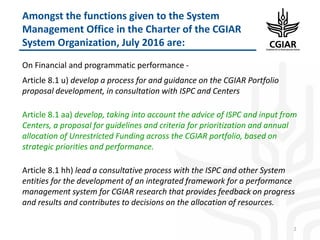
Amongst the functions given to the System
Management Board in the Charter of the CGIAR
System Organization, July 2016 are:
On Financial and programmatic performance -
Article 8.1 u) develop a process for and guidance on the CGIAR Portfolio
proposal development, in consultation with ISPC and Centers
Article 8.1 aa) develop, taking into account the advice of ISPC and input from
Centers, a proposal for guidelines and criteria for prioritization and annual
allocation of Unrestricted Funding across the CGIAR portfolio, based on
strategic priorities and performance.
Article 8.1 hh) lead a consultative process with the ISPC and other System
entities for the development of an integrated framework for a performance
management system for CGIAR research that provides feedback on progress
and results and contributes to decisions on the allocation of resources.
2
Amongst the functions given to the System
Management Office in the Charter of the CGIAR
System Organization, July 2016 are:
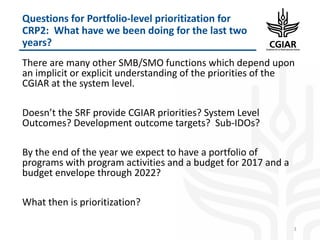
There are many other SMB/SMO functions which depend upon
an implicit or explicit understanding of the priorities of the
CGIAR at the system level.
Doesn’t the SRF provide CGIAR priorities? System Level
Outcomes? Development outcome targets? Sub-IDOs?
By the end of the year we expect to have a portfolio of
programs with program activities and a budget for 2017 and a
budget envelope through 2022?
What then is prioritization?
3
Questions for Portfolio-level prioritization for
CRP2: What have we been doing for the last two
years?
www.cgiar.org
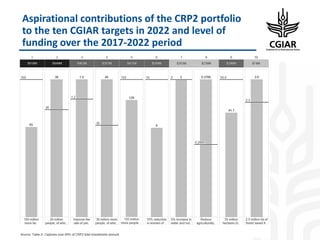
Aspirational contributions of the CRP2 portfolio
to the ten CGIAR targets in 2022 and level of
funding over the 2017-2022 period
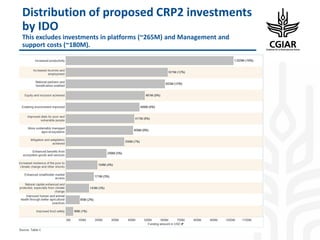
Distribution of proposed CRP2 investments
by IDO
This excludes investments in platforms (~265M) and Management and
support costs (~180M).
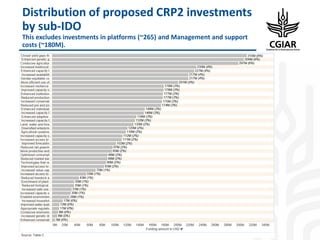
Distribution of proposed CRP2 investments
by sub-IDO
This excludes investments in platforms (~265) and Management and support
costs (~180M).
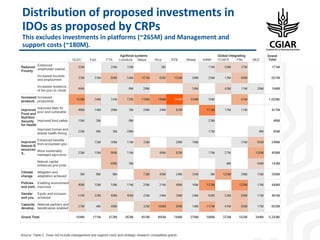
Distribution of proposed investments in
IDOs as proposed by CRPs
This excludes investments in platforms (~265M) and Management and
support costs (~180M).
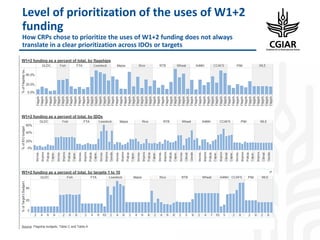
Level of prioritization of the uses of W1+2
funding
How CRPs chose to prioritize the uses of W1+2 funding does not always
translate in a clear prioritization across IDOs or targets
Questions for Portfolio-level prioritization
for CRP2: What is envisioned?
Confirmation of the 2017 portfolio
Adjusting the balance of the portfolio with time on the basis of performance and learning
(performance based management: reward expectation of results, cut back poor projects).
Increasing/decreasing the intensity of funding in a strategic fashion (CRPs or FPs or platforms
or groupings) against most desired outcomes ($$$, fund availability, uplift budgets – may be
related to quality of scientific effort, but the choice might not be directly congruent with
outcome delivery in difficult areas e.g. awarding funding to bottleneck FPs)
Could also include changing or favouring the means/pathways through which the CGIAR
addresses any of its higher level goals (comparative program evaluations, hypothesis testing,
feasibility of ToCs and partner delivery etc.).
Introducing/balancing new program activities to meet emerging needs (foresight, funder
expectation, balancing ex ante feasibility and the cost expectation of new against continuing
activities, calls for proposals, new FPs rather than whole programs, move others out of the
portfolio for bilateral uptake?)
[Article 8.1 aa) says that both results based allocation and strategic adjustment may occur, but
they are not the same]
Questions for Portfolio-level prioritization
for CRP2: Dependent on level
Managers or decision makers want to invest in activities that, all combined
(portfolio effect), will lead to the greatest impact at the lowest cost, in the
shortest timeframe possible and with the lowest possible risk.
However:
How can donors get a handle on how to prioritize funding at the portfolio
level? This is a decision-making problem. There are two axes for allocating
funding: a) across CRPs (or lower, such as FP or platform module) and b) over
time.
Where do we draw the information from to make decisions and do we ask
portfolio-wide questions or do we invest in data around specific activities or
functions? Here, there are foresight and performance dimensions.
How can CGIAR Leaders create a culture of prioritization at all levels of CRP2
(flagships, cluster of activities, etc.)? This is a change management problem.
Questions for Portfolio-level prioritization
for CRP2: Tradeoffs
Are there tradeoffs to be made at the portfolio level?
If the answer is no, then flagships can be ranked independently
of each other. Then donors can see which flagships get funded
or not within each CRP based on how much funding they
decide to allocate to this CRP.
If the answer is yes, then flagships need to be ranked together,
in one big list.
However, more likely that flagships are inter-dependent and
then they would need to be prioritized in groups.
Questions for Portfolio-level prioritization for
CRP2: what criteria for ranking investments?
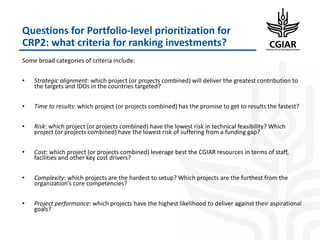
Some broad categories of criteria include:
• Strategic alignment: which project (or projects combined) will deliver the greatest contribution to
the targets and IDOs in the countries targeted?
• Time to results: which project (or projects combined) has the promise to get to results the fastest?
• Risk: which project (or projects combined) have the lowest risk in technical feasibility? Which
project (or projects combined) have the lowest risk of suffering from a funding gap?
• Cost: which project (or projects combined) leverage best the CGIAR resources in terms of staff,
facilities and other key cost drivers?
• Complexity: which projects are the hardest to setup? Which projects are the furthest from the
organization’s core competencies?
• Project performance: which projects have the highest likelihood to deliver against their aspirational
goals?
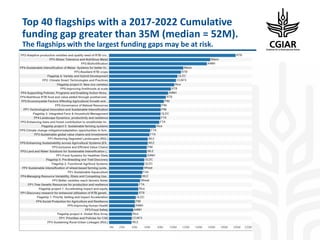
Top 40 flagships with a 2017-2022 Cumulative
funding gap greater than 35M (median = 52M).
The flagships with the largest funding gaps may be at risk.
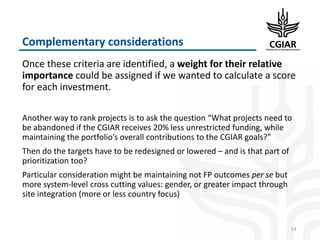
Complementary considerations
Once these criteria are identified, a weight for their relative
importance could be assigned if we wanted to calculate a score
for each investment.
Another way to rank projects is to ask the question “What projects need to
be abandoned if the CGIAR receives 20% less unrestricted funding, while
maintaining the portfolio’s overall contributions to the CGIAR goals?”
Then do the targets have to be redesigned or lowered – and is that part of
prioritization too?
Particular consideration might be maintaining not FP outcomes per se but
more system-level cross cutting values: gender, or greater impact through
site integration (more or less country focus)
14
Questions for Portfolio-level prioritization for
CRP2: How do we organize the process(es)?
What process will be setup to conduct this prioritization exercise?
What will be ranked (for e.g. all flagships together, all flagships within individual CRPs)? Who
will determine the ranking criteria (and weight if scoring)? Who will rank the investments?
What is the nature of the decisions to be made? Will the System Council make the
portfolio-level prioritization decisions, or will it only incentivize CRP leaders to make good
prioritization at the portfolio level? Etc.
What are the roles of each stakeholders in these decisions? (System Council, System
Management Office, ISPC, CRP leaders, DGs, etc.). For example, shall we assume that good
CRP leaders will prioritize their investments well within their own CRP but not well across
the CRPs? The iteration of perspectives from strategic foresight and performance measures
are clearly required to provide comprehensive advice to funders.
What is the frequency of “prioritization” – and does this differ from recommending an
annual budget allocation across the portfolio?
What resources are needed to conduct this exercise?
www.cgiar.org
Thank you
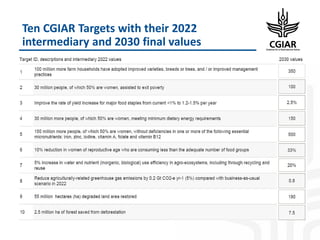
Ten CGIAR Targets with their 2022
intermediary and 2030 final values

Peter Gardiner Prioritization at the CGIAR System level

  • 1.
    14th Meeting ofthe Independent Science & Partnership Council (ISPC) 12-16 September 2016 ICRISAT, Hyderabad, Patencheru, India Contribution to Agenda Item 5. Panel discussion: Prioritization at the CGIAR System Level – principles for choosing criteria for prioritization and the ISPC role in building an effective system for prioritization at the system level. Peter Gardiner System Management Office Montpellier, France.
  • 2.
    On Vision, strategicdirection and advocacy - Article 8.1 a) recommend a process for, and oversee development of, each CGIAR Strategy and Results Framework for approval by the System Council that reflects knowledge form the CGIAR System, involves participatory processes of national, regional and global partners, and includes relevant inputs from Center’s corporate and strategic planning exercises. Article 8.1 b) contribute to foresight activities led by ISPC on ongoing trends and risks in science and in the field of agricultural research for development. Such foresight shall include inputs from Center-conducted foresight activities, program studies and knowledge of new science and regional developments Amongst the functions given to the System Management Board in the Charter of the CGIAR System Organization, July 2016 are:
  • 3.
    On Financial andprogrammatic performance - Article 8.1 u) develop a process for and guidance on the CGIAR Portfolio proposal development, in consultation with ISPC and Centers Article 8.1 aa) develop, taking into account the advice of ISPC and input from Centers, a proposal for guidelines and criteria for prioritization and annual allocation of Unrestricted Funding across the CGIAR portfolio, based on strategic priorities and performance. Article 8.1 hh) lead a consultative process with the ISPC and other System entities for the development of an integrated framework for a performance management system for CGIAR research that provides feedback on progress and results and contributes to decisions on the allocation of resources. 2 Amongst the functions given to the System Management Office in the Charter of the CGIAR System Organization, July 2016 are:
  • 4.
    There are manyother SMB/SMO functions which depend upon an implicit or explicit understanding of the priorities of the CGIAR at the system level. Doesn’t the SRF provide CGIAR priorities? System Level Outcomes? Development outcome targets? Sub-IDOs? By the end of the year we expect to have a portfolio of programs with program activities and a budget for 2017 and a budget envelope through 2022? What then is prioritization? 3 Questions for Portfolio-level prioritization for CRP2: What have we been doing for the last two years?
  • 5.
    www.cgiar.org Aspirational contributions ofthe CRP2 portfolio to the ten CGIAR targets in 2022 and level of funding over the 2017-2022 period
  • 6.
    Distribution of proposedCRP2 investments by IDO This excludes investments in platforms (~265M) and Management and support costs (~180M).
  • 7.
    Distribution of proposedCRP2 investments by sub-IDO This excludes investments in platforms (~265) and Management and support costs (~180M).
  • 8.
    Distribution of proposedinvestments in IDOs as proposed by CRPs This excludes investments in platforms (~265M) and Management and support costs (~180M).
  • 9.
    Level of prioritizationof the uses of W1+2 funding How CRPs chose to prioritize the uses of W1+2 funding does not always translate in a clear prioritization across IDOs or targets
  • 10.
    Questions for Portfolio-levelprioritization for CRP2: What is envisioned? Confirmation of the 2017 portfolio Adjusting the balance of the portfolio with time on the basis of performance and learning (performance based management: reward expectation of results, cut back poor projects). Increasing/decreasing the intensity of funding in a strategic fashion (CRPs or FPs or platforms or groupings) against most desired outcomes ($$$, fund availability, uplift budgets – may be related to quality of scientific effort, but the choice might not be directly congruent with outcome delivery in difficult areas e.g. awarding funding to bottleneck FPs) Could also include changing or favouring the means/pathways through which the CGIAR addresses any of its higher level goals (comparative program evaluations, hypothesis testing, feasibility of ToCs and partner delivery etc.). Introducing/balancing new program activities to meet emerging needs (foresight, funder expectation, balancing ex ante feasibility and the cost expectation of new against continuing activities, calls for proposals, new FPs rather than whole programs, move others out of the portfolio for bilateral uptake?) [Article 8.1 aa) says that both results based allocation and strategic adjustment may occur, but they are not the same]
  • 11.
    Questions for Portfolio-levelprioritization for CRP2: Dependent on level Managers or decision makers want to invest in activities that, all combined (portfolio effect), will lead to the greatest impact at the lowest cost, in the shortest timeframe possible and with the lowest possible risk. However: How can donors get a handle on how to prioritize funding at the portfolio level? This is a decision-making problem. There are two axes for allocating funding: a) across CRPs (or lower, such as FP or platform module) and b) over time. Where do we draw the information from to make decisions and do we ask portfolio-wide questions or do we invest in data around specific activities or functions? Here, there are foresight and performance dimensions. How can CGIAR Leaders create a culture of prioritization at all levels of CRP2 (flagships, cluster of activities, etc.)? This is a change management problem.
  • 12.
    Questions for Portfolio-levelprioritization for CRP2: Tradeoffs Are there tradeoffs to be made at the portfolio level? If the answer is no, then flagships can be ranked independently of each other. Then donors can see which flagships get funded or not within each CRP based on how much funding they decide to allocate to this CRP. If the answer is yes, then flagships need to be ranked together, in one big list. However, more likely that flagships are inter-dependent and then they would need to be prioritized in groups.
  • 13.
    Questions for Portfolio-levelprioritization for CRP2: what criteria for ranking investments? Some broad categories of criteria include: • Strategic alignment: which project (or projects combined) will deliver the greatest contribution to the targets and IDOs in the countries targeted? • Time to results: which project (or projects combined) has the promise to get to results the fastest? • Risk: which project (or projects combined) have the lowest risk in technical feasibility? Which project (or projects combined) have the lowest risk of suffering from a funding gap? • Cost: which project (or projects combined) leverage best the CGIAR resources in terms of staff, facilities and other key cost drivers? • Complexity: which projects are the hardest to setup? Which projects are the furthest from the organization’s core competencies? • Project performance: which projects have the highest likelihood to deliver against their aspirational goals?
  • 14.
    Top 40 flagshipswith a 2017-2022 Cumulative funding gap greater than 35M (median = 52M). The flagships with the largest funding gaps may be at risk.
  • 15.
    Complementary considerations Once thesecriteria are identified, a weight for their relative importance could be assigned if we wanted to calculate a score for each investment. Another way to rank projects is to ask the question “What projects need to be abandoned if the CGIAR receives 20% less unrestricted funding, while maintaining the portfolio’s overall contributions to the CGIAR goals?” Then do the targets have to be redesigned or lowered – and is that part of prioritization too? Particular consideration might be maintaining not FP outcomes per se but more system-level cross cutting values: gender, or greater impact through site integration (more or less country focus) 14
  • 16.
    Questions for Portfolio-levelprioritization for CRP2: How do we organize the process(es)? What process will be setup to conduct this prioritization exercise? What will be ranked (for e.g. all flagships together, all flagships within individual CRPs)? Who will determine the ranking criteria (and weight if scoring)? Who will rank the investments? What is the nature of the decisions to be made? Will the System Council make the portfolio-level prioritization decisions, or will it only incentivize CRP leaders to make good prioritization at the portfolio level? Etc. What are the roles of each stakeholders in these decisions? (System Council, System Management Office, ISPC, CRP leaders, DGs, etc.). For example, shall we assume that good CRP leaders will prioritize their investments well within their own CRP but not well across the CRPs? The iteration of perspectives from strategic foresight and performance measures are clearly required to provide comprehensive advice to funders. What is the frequency of “prioritization” – and does this differ from recommending an annual budget allocation across the portfolio? What resources are needed to conduct this exercise?
  • 17.
  • 18.
    Ten CGIAR Targetswith their 2022 intermediary and 2030 final values