


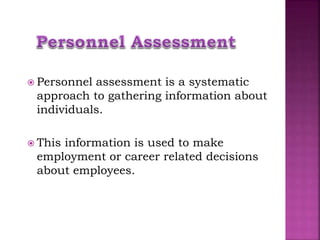
 Personnel assessment is a systematic
approach to gathering information about
individuals.
 This information is used to make
employment or career related decisions
about employees.
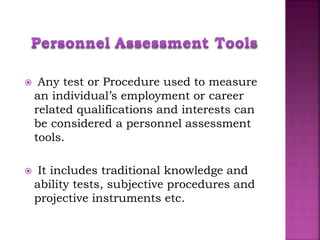
 Any test or Procedure used to measure
an individual’s employment or career
related qualifications and interests can
be considered a personnel assessment
tools.
 It includes traditional knowledge and
ability tests, subjective procedures and
projective instruments etc.
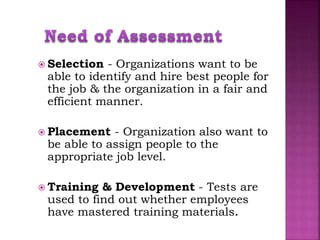
 Selection - Organizations want to be
able to identify and hire best people for
the job & the organization in a fair and
efficient manner.
 Placement - Organization also want to
be able to assign people to the
appropriate job level.
 Training & Development - Tests are
used to find out whether employees
have mastered training materials.
 Promotion - Organizations may use tests to
identify employees who possess higher level
capabilities.
 Career exploration and guidance - Tests
are sometimes used to help people make
educational and vocational choices.
 Program evaluation - Tests may provide
information that the organization can use to
determine whether employees are benefiting
from training and development programs.
 People in organization interact with each
other during work formally or informally.
During course of interaction, relationship
develop, which is invisible connecting
links, colored by emotions of love, hate,
respect, fear and so on.
 Relationships influence behaviors at work
i.e. expectations of each other, perception
of intension are to some extent outcome of
these relationship
 Reduction in absenteeism
Improve moral and motivation
Harmony in organization
Reduce cost of Training & Less cost of
retention
Attract good talent
Responsible for increase in productivity
Shared learning & continuous improvement
A MIS provides information which is needed
to manage organizations efficiently and
effectively manner.
MIS refers broadly to a computer based
system that provides managers with the tools
for organizing , evaluating and efficiently
running their organization.
MIS is a collection of men, tools,
procedures and software to perform
various business tasks at various levels
in the organizations
HRIS refers to the systems and
processes at the intersections between
human resource management and
information technology.
Features of HRIS :-
In any organization managers will have
varieties of task to manage. MIS is mainly
designed to take care of the needs of the
managers in the organizations.
MIS is a system broken down in sub
system; each sub system may be
programmed. This results in easy access
of data, accuracy of data and information.
It helps in maintaining the consistency of
data.
HRIS helps in integrating the information
generated by various departments of the
organizations.
Large amount of data and
information to be processed.
Project based work environment.
Employee empowerment.
Increase of knowledge of workers &
associated information.
Learning organization.
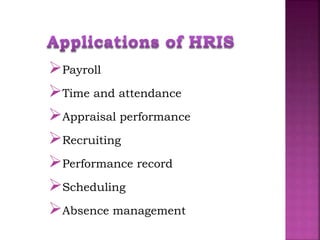
Payroll
Time and attendance
Appraisal performance
Recruiting
Performance record
Scheduling
Absence management
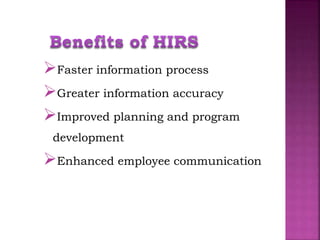
Faster information process
Greater information accuracy
Improved planning and program
development
Enhanced employee communication
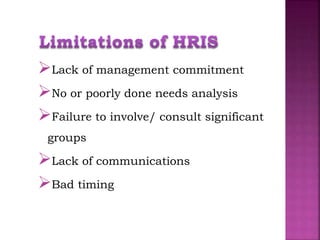
Lack of management commitment
No or poorly done needs analysis
Failure to involve/ consult significant
groups
Lack of communications
Bad timing
Thank you

Personel assessment

  • 1.
  • 2.
     Personnel assessmentis a systematic approach to gathering information about individuals.  This information is used to make employment or career related decisions about employees.
  • 3.
     Any testor Procedure used to measure an individual’s employment or career related qualifications and interests can be considered a personnel assessment tools.  It includes traditional knowledge and ability tests, subjective procedures and projective instruments etc.
  • 4.
     Selection -Organizations want to be able to identify and hire best people for the job & the organization in a fair and efficient manner.  Placement - Organization also want to be able to assign people to the appropriate job level.  Training & Development - Tests are used to find out whether employees have mastered training materials.
  • 5.
     Promotion -Organizations may use tests to identify employees who possess higher level capabilities.  Career exploration and guidance - Tests are sometimes used to help people make educational and vocational choices.  Program evaluation - Tests may provide information that the organization can use to determine whether employees are benefiting from training and development programs.
  • 6.
     People inorganization interact with each other during work formally or informally. During course of interaction, relationship develop, which is invisible connecting links, colored by emotions of love, hate, respect, fear and so on.  Relationships influence behaviors at work i.e. expectations of each other, perception of intension are to some extent outcome of these relationship
  • 7.
     Reduction inabsenteeism Improve moral and motivation Harmony in organization Reduce cost of Training & Less cost of retention Attract good talent Responsible for increase in productivity Shared learning & continuous improvement
  • 8.
    A MIS providesinformation which is needed to manage organizations efficiently and effectively manner. MIS refers broadly to a computer based system that provides managers with the tools for organizing , evaluating and efficiently running their organization.
  • 9.
    MIS is acollection of men, tools, procedures and software to perform various business tasks at various levels in the organizations
  • 10.
    HRIS refers tothe systems and processes at the intersections between human resource management and information technology. Features of HRIS :- In any organization managers will have varieties of task to manage. MIS is mainly designed to take care of the needs of the managers in the organizations.
  • 11.
    MIS is asystem broken down in sub system; each sub system may be programmed. This results in easy access of data, accuracy of data and information. It helps in maintaining the consistency of data. HRIS helps in integrating the information generated by various departments of the organizations.
  • 12.
    Large amount ofdata and information to be processed. Project based work environment. Employee empowerment. Increase of knowledge of workers & associated information. Learning organization.
  • 13.
    Payroll Time and attendance Appraisalperformance Recruiting Performance record Scheduling Absence management
  • 14.
    Faster information process Greaterinformation accuracy Improved planning and program development Enhanced employee communication
  • 15.
    Lack of managementcommitment No or poorly done needs analysis Failure to involve/ consult significant groups Lack of communications Bad timing
  • 17.