What is MIS?
Management information system is a
system, which is designed to provide
information to various organizational
levels, to assist them in analyzing,
planning, controlling and decision-
making process.
Definition of MIS
According to JAMES BREIN,” Management information
system is a system of people, equipment, procedures,
documents and communications, that collects, validates,
operates, stores, retrieves, and presents data which is help in
planning, budgeting, accounting, controlling ,organizing and
decision making process”
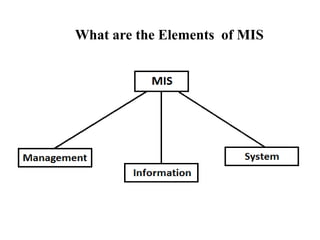
What are the Elements of MIS
Management?
• Management is a
process of
planning, controlling,
organizing all of the
people working in an
organization, to work
together for achieving
a common target.
• Management relies on
the 5 functions –
 Planning,
 Organizing
 Staffing
 Directing and
 Controlling.
Information:
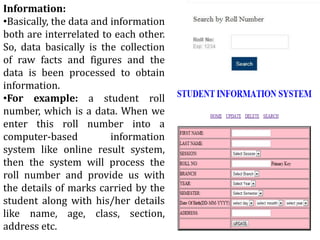
•Basically, the data and information
both are interrelated to each other.
So, data basically is the collection
of raw facts and figures and the
data is been processed to obtain
information.
•For example: a student roll
number, which is a data. When we
enter this roll number into a
computer-based information
system like online result system,
then the system will process the
roll number and provide us with
the details of marks carried by the
student along with his/her details
like name, age, class, section,
address etc.
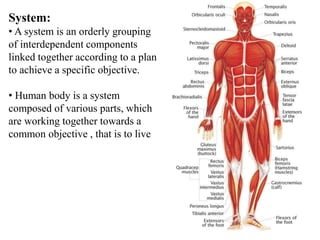
System:
• A system is an orderly grouping
of interdependent components
linked together according to a plan
to achieve a specific objective.
• Human body is a system
composed of various parts, which
are working together towards a
common objective , that is to live
Information System(IS)
An information System is a system where data is
processed digitally to provide and generate information.
An information system is an organized combination of
people, hardware, software, communications network,
and data resources that collects, transforms, and
disseminates in an organization.
Components of Information System
• Input
• Processor
• Output
•People (Accountants, human resource managers)
• Hardware(physical devices like: computers, printers,
networking devices)
•Software (Windows, OS, Payroll program, banking system)
•Data (data is collected from activities such as deposits,
withdrawals)
•Network (LAN,MAN,TOPOLOGY)
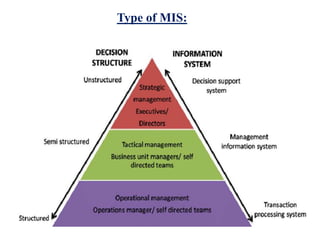
Type of MIS:
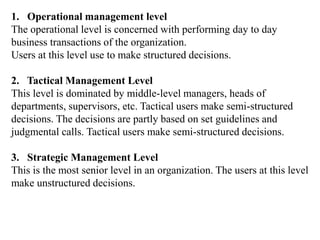
1. Operational management level
The operational level is concerned with performing day to day
business transactions of the organization.
Users at this level use to make structured decisions.
2. Tactical Management Level
This level is dominated by middle-level managers, heads of
departments, supervisors, etc. Tactical users make semi-structured
decisions. The decisions are partly based on set guidelines and
judgmental calls. Tactical users make semi-structured decisions.
3. Strategic Management Level
This is the most senior level in an organization. The users at this level
make unstructured decisions.
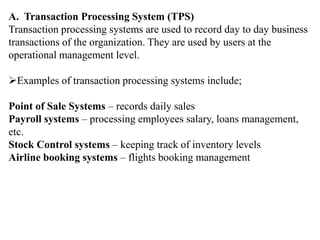
A. Transaction Processing System (TPS)
Transaction processing systems are used to record day to day business
transactions of the organization. They are used by users at the
operational management level.
Examples of transaction processing systems include;
Point of Sale Systems – records daily sales
Payroll systems – processing employees salary, loans management,
etc.
Stock Control systems – keeping track of inventory levels
Airline booking systems – flights booking management
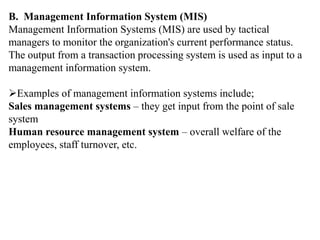
B. Management Information System (MIS)
Management Information Systems (MIS) are used by tactical
managers to monitor the organization's current performance status.
The output from a transaction processing system is used as input to a
management information system.
Examples of management information systems include;
Sales management systems – they get input from the point of sale
system
Human resource management system – overall welfare of the
employees, staff turnover, etc.
C. Decision Support System (DSS)
Decision support systems are used by senior management to make
non-routine decisions. Decision support systems use input from
internal systems (transaction processing systems and management
information systems) and external systems.
Here the decision maker deals with semi-structure and unstructured
decision.
Examples of decision support systems include;
Bank loan management systems – It is used to verify the credit of
the loan applicant and predict the likelihood of the loan being
recovered.
BENEFITS OF MIS :
• Data can easily be accessed and analyzed without time consuming.
• Decisions can be made more quickly and with confidence that the
data are both time-relevant and accurate.
• Cost benefits, time savings, productivity gains with the use of data
warehouse for information processing.
Human Resource Information System (HRIS) :
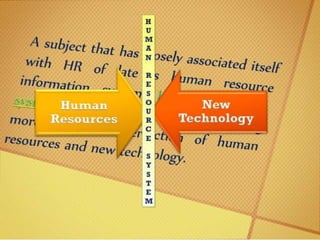
•It is an interaction of HR and Information Technology through a
software specially designed to allow HR activities and process to
occur electronically.
• A database system that keeps important information about employees
in a central and accessible location.
HRIS Definition:
• HRIS is a system used to acquire , store, manipulate, analyze,
retrieve, and distribute information related to the company Human
Resource.
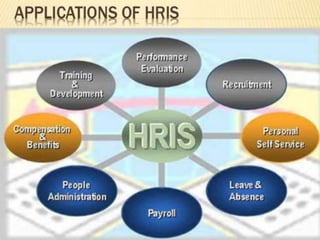
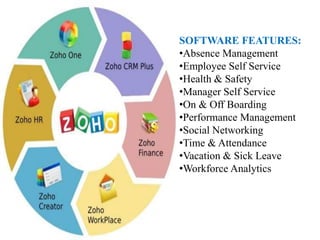
SOFTWARE FEATURES:
•Absence Management
•Employee Self Service
•Health & Safety
•Manager Self Service
•On & Off Boarding
•Performance Management
•Social Networking
•Time & Attendance
•Vacation & Sick Leave
•Workforce Analytics
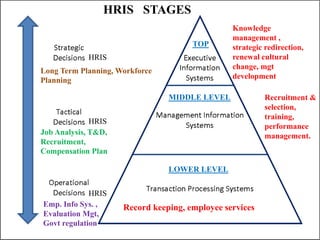
HRIS STAGES
HRIS
HRIS
HRIS
TOP
MIDDLE LEVEL
LOWER LEVEL
Recruitment &
selection,
training,
performance
management.
Record keeping, employee services
Knowledge
management ,
strategic redirection,
renewal cultural
change, mgt
development
Long Term Planning, Workforce
Planning
Job Analysis, T&D,
Recruitment,
Compensation Plan
Emp. Info Sys. ,
Evaluation Mgt,
Govt regulation
HRIS Benefits :
•Faster information process,
•Greater information accuracy,
• Improved planning and program development, and
• Enhanced employee communications
Advantages of MIS:
•Improves quality of an organization or an information content by
providing relevant information for sound decision making.
•MIS change large amount of data into summarize form and thereby
avoid confusion which may an answer when an information officer
are flooded with detailed fact.
•MIS facilitates integration of specialized activities by keeping each
department aware of problem and requirements of other departments.
•MIS serves as a link between managerial planning and control. It
improves the ability of management to evaluate and improve
performance.
Disadvantages:
•Too rigid and difficult to adapt.
•Resistance in sharing internal information between departments can
reduce the effectiveness.
•Hard to quantify benefit to justify implementation of MIS.
•Quality of output of an MIS is directly proportional to quality of
input and processes.
How HRIS helps in Team Management ?
STAFFING :
• All managers know the importance of having right person at the
right place. To recruit the right person for the right job requires
information from various resources. HRIS play a very important role
in providing vital information to managers so that they can hire right
person for the right job.
ORGANIZING :
It is important that organizations not only recruit the right person for
the right job but also keep an employee motivated. Here again, HRIS
plays a vital role by helping, the managers to keep a vigil on the staff
so that nobody feels neglected. Motivation can be given in the
simplest forms, such as an email of appreciation from the boss to the
staff or wishes to a subordinate on his birthday.
Directing & Controlling :
Managers have to be on their toes always because the staff needs
constant direction and redirection for countering he competitors.
HRIS helps the managers and staff require quick information for
directing their energies towards the overall goals and objectives of the
organization. As an organization grows, it is very difficult for the
managers to be present at all the places at all the times. Yet, he has to
keep an eye on the activities of the staff. With the help of the HRIS a
manager can acquire information regarding the staff even when he is
not physically present.
MIS Presentation Module 2.pptx

MIS Presentation Module 2.pptx

  • 2.
    What is MIS? Managementinformation system is a system, which is designed to provide information to various organizational levels, to assist them in analyzing, planning, controlling and decision- making process.
  • 3.
    Definition of MIS Accordingto JAMES BREIN,” Management information system is a system of people, equipment, procedures, documents and communications, that collects, validates, operates, stores, retrieves, and presents data which is help in planning, budgeting, accounting, controlling ,organizing and decision making process”
  • 4.
    What are theElements of MIS
  • 5.
    Management? • Management isa process of planning, controlling, organizing all of the people working in an organization, to work together for achieving a common target. • Management relies on the 5 functions –  Planning,  Organizing  Staffing  Directing and  Controlling.
  • 6.
    Information: •Basically, the dataand information both are interrelated to each other. So, data basically is the collection of raw facts and figures and the data is been processed to obtain information. •For example: a student roll number, which is a data. When we enter this roll number into a computer-based information system like online result system, then the system will process the roll number and provide us with the details of marks carried by the student along with his/her details like name, age, class, section, address etc.
  • 7.
    System: • A systemis an orderly grouping of interdependent components linked together according to a plan to achieve a specific objective. • Human body is a system composed of various parts, which are working together towards a common objective , that is to live
  • 8.
    Information System(IS) An informationSystem is a system where data is processed digitally to provide and generate information. An information system is an organized combination of people, hardware, software, communications network, and data resources that collects, transforms, and disseminates in an organization.
  • 9.
    Components of InformationSystem • Input • Processor • Output •People (Accountants, human resource managers) • Hardware(physical devices like: computers, printers, networking devices) •Software (Windows, OS, Payroll program, banking system) •Data (data is collected from activities such as deposits, withdrawals) •Network (LAN,MAN,TOPOLOGY)
  • 10.
  • 11.
    1. Operational managementlevel The operational level is concerned with performing day to day business transactions of the organization. Users at this level use to make structured decisions. 2. Tactical Management Level This level is dominated by middle-level managers, heads of departments, supervisors, etc. Tactical users make semi-structured decisions. The decisions are partly based on set guidelines and judgmental calls. Tactical users make semi-structured decisions. 3. Strategic Management Level This is the most senior level in an organization. The users at this level make unstructured decisions.
  • 12.
    A. Transaction ProcessingSystem (TPS) Transaction processing systems are used to record day to day business transactions of the organization. They are used by users at the operational management level. Examples of transaction processing systems include; Point of Sale Systems – records daily sales Payroll systems – processing employees salary, loans management, etc. Stock Control systems – keeping track of inventory levels Airline booking systems – flights booking management
  • 13.
    B. Management InformationSystem (MIS) Management Information Systems (MIS) are used by tactical managers to monitor the organization's current performance status. The output from a transaction processing system is used as input to a management information system. Examples of management information systems include; Sales management systems – they get input from the point of sale system Human resource management system – overall welfare of the employees, staff turnover, etc.
  • 14.
    C. Decision SupportSystem (DSS) Decision support systems are used by senior management to make non-routine decisions. Decision support systems use input from internal systems (transaction processing systems and management information systems) and external systems. Here the decision maker deals with semi-structure and unstructured decision. Examples of decision support systems include; Bank loan management systems – It is used to verify the credit of the loan applicant and predict the likelihood of the loan being recovered.
  • 15.
    BENEFITS OF MIS: • Data can easily be accessed and analyzed without time consuming. • Decisions can be made more quickly and with confidence that the data are both time-relevant and accurate. • Cost benefits, time savings, productivity gains with the use of data warehouse for information processing.
  • 18.
    Human Resource InformationSystem (HRIS) : •It is an interaction of HR and Information Technology through a software specially designed to allow HR activities and process to occur electronically. • A database system that keeps important information about employees in a central and accessible location. HRIS Definition: • HRIS is a system used to acquire , store, manipulate, analyze, retrieve, and distribute information related to the company Human Resource.
  • 20.
    SOFTWARE FEATURES: •Absence Management •EmployeeSelf Service •Health & Safety •Manager Self Service •On & Off Boarding •Performance Management •Social Networking •Time & Attendance •Vacation & Sick Leave •Workforce Analytics
  • 22.
    HRIS STAGES HRIS HRIS HRIS TOP MIDDLE LEVEL LOWERLEVEL Recruitment & selection, training, performance management. Record keeping, employee services Knowledge management , strategic redirection, renewal cultural change, mgt development Long Term Planning, Workforce Planning Job Analysis, T&D, Recruitment, Compensation Plan Emp. Info Sys. , Evaluation Mgt, Govt regulation
  • 23.
    HRIS Benefits : •Fasterinformation process, •Greater information accuracy, • Improved planning and program development, and • Enhanced employee communications
  • 24.
    Advantages of MIS: •Improvesquality of an organization or an information content by providing relevant information for sound decision making. •MIS change large amount of data into summarize form and thereby avoid confusion which may an answer when an information officer are flooded with detailed fact. •MIS facilitates integration of specialized activities by keeping each department aware of problem and requirements of other departments. •MIS serves as a link between managerial planning and control. It improves the ability of management to evaluate and improve performance.
  • 25.
    Disadvantages: •Too rigid anddifficult to adapt. •Resistance in sharing internal information between departments can reduce the effectiveness. •Hard to quantify benefit to justify implementation of MIS. •Quality of output of an MIS is directly proportional to quality of input and processes.
  • 26.
    How HRIS helpsin Team Management ? STAFFING : • All managers know the importance of having right person at the right place. To recruit the right person for the right job requires information from various resources. HRIS play a very important role in providing vital information to managers so that they can hire right person for the right job. ORGANIZING : It is important that organizations not only recruit the right person for the right job but also keep an employee motivated. Here again, HRIS plays a vital role by helping, the managers to keep a vigil on the staff so that nobody feels neglected. Motivation can be given in the simplest forms, such as an email of appreciation from the boss to the staff or wishes to a subordinate on his birthday.
  • 27.
    Directing & Controlling: Managers have to be on their toes always because the staff needs constant direction and redirection for countering he competitors. HRIS helps the managers and staff require quick information for directing their energies towards the overall goals and objectives of the organization. As an organization grows, it is very difficult for the managers to be present at all the places at all the times. Yet, he has to keep an eye on the activities of the staff. With the help of the HRIS a manager can acquire information regarding the staff even when he is not physically present.