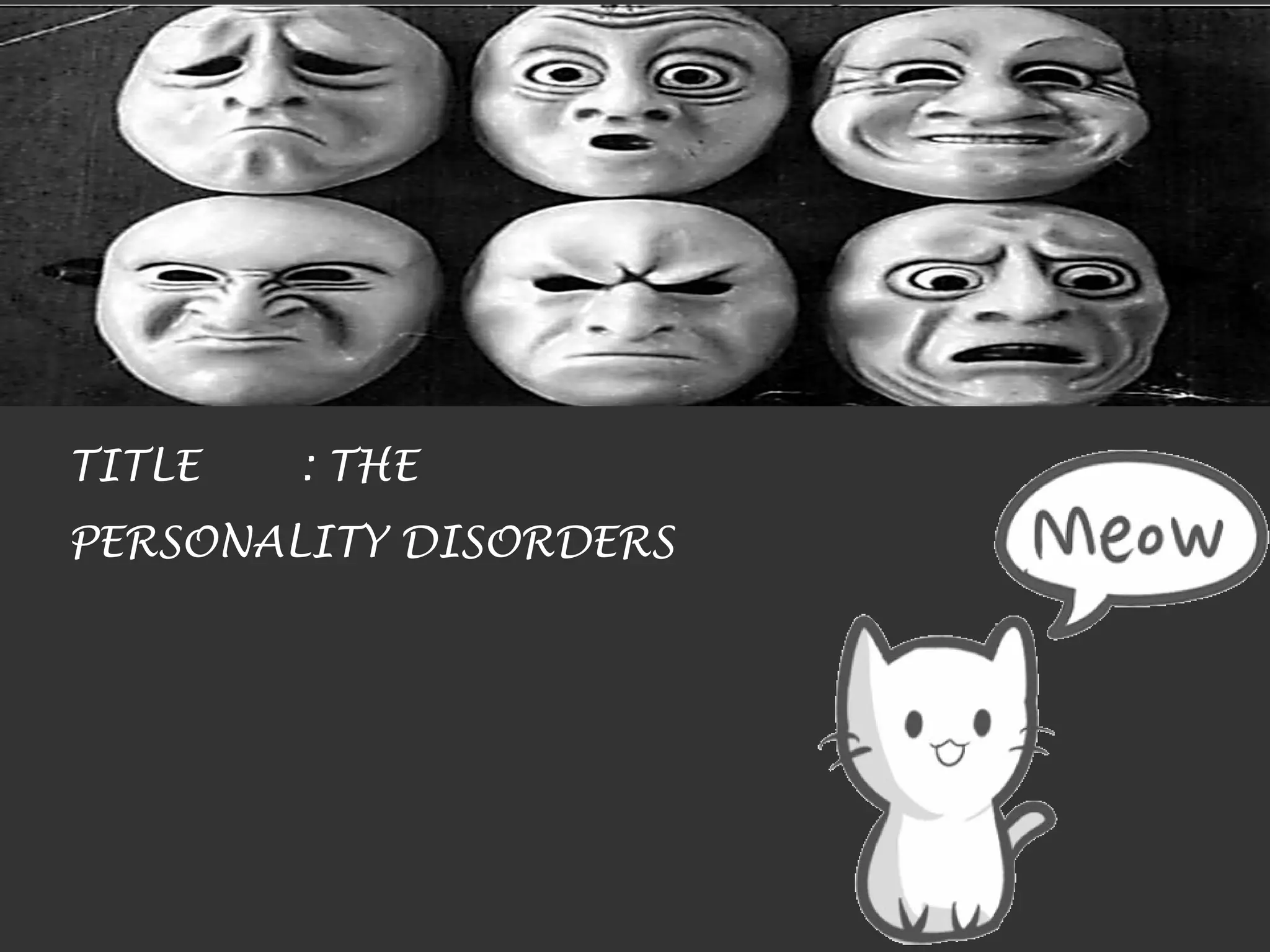
TITLE : THE
PERSONALITY DISORDERS
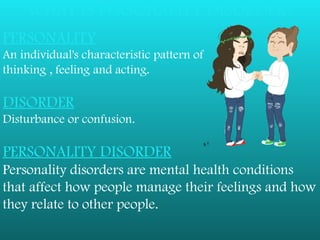
WHAT IS PERSONALITY DISORDER?
PERSONALITY
An individual's characteristic pattern of
thinking , feeling and acting.
DISORDER
Disturbance or confusion.
PERSONALITY DISORDER
Personality disorders are mental health conditions
that affect how people manage their feelings and how
they relate to other people.
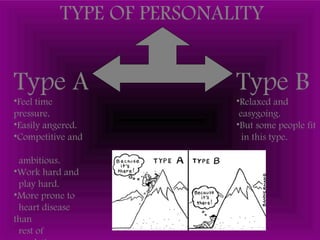
TYPE OF PERSONALITY
Type A
•Feel time
pressure.
•Easily angered.
•Competitive and
ambitious.
•Work hard and
play hard.
•More prone to
heart disease
than
rest of
Type B
•Relaxed and
easygoing.
•But some people fit
in this type.
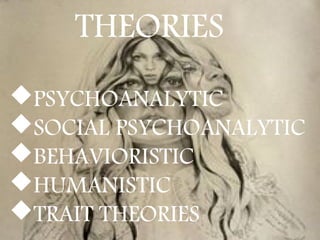
THEORIES
PSYCHOANALYTIC
SOCIAL PSYCHOANALYTIC
BEHAVIORISTIC
HUMANISTIC
TRAIT THEORIES
DEFINITIONDEFINITION
PERSONALITYPERSONALITY
DISORDERSDISORDERS
A personality disorders is enduring pattern of
inner experiences and behaviors that deviate
markedly from the expectation of the
idividual culture.Is pervasive and flexible has
an outset and in adolescence and early
adulthood . That create distress or
impairment.
A personality disorders is enduring pattern of inner experiences and
behaviors that deviate markedly from the expectation of the idividual
culture.Is pervasive and flexible has an outset and in adolescence and
early adulthood . That create distress or impairment.
PERSONALITPERSONALIT
Y DISORDERY DISORDER
THE TYPES OF PERSONALITY
DISORDERS
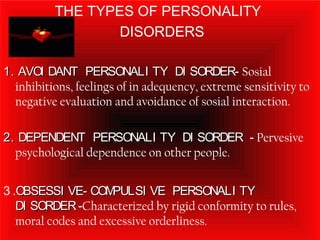
1. AVOI DANT PERSONALI TY DI SORDER1. AVOI DANT PERSONALI TY DI SORDER- Sosial
inhibitions, feelings of in adequency, extreme sensitivity to
negative evaluation and avoidance of sosial interaction.
2. DEPENDENT PERSONALI TY DI SORDER2. DEPENDENT PERSONALI TY DI SORDER - Pervesive
psychological dependence on other people.
3 .OBSESSI VE- COMPULSI VE PERSONALI TYOBSESSI VE- COMPULSI VE PERSONALI TY
DI SORDERDI SORDER-Characterized by rigid conformity to rules,
moral codes and excessive orderliness.
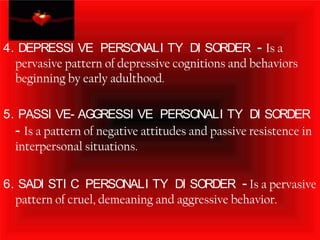
4. DEPRESSI VE PERSONALI TY DI SORDER - Is a
pervasive pattern of depressive cognitions and behaviors
beginning by early adulthood.
5. PASSI VE- AGGRESSI VE PERSONALI TY DI SORDER
- Is a pattern of negative attitudes and passive resistence in
interpersonal situations.
6. SADI STI C PERSONALI TY DI SORDER - Is a pervasive
pattern of cruel, demeaning and aggressive behavior.
SIGNS & SYMPTOMS FOR
AVOIDANT PERSONALITY
DISORDER
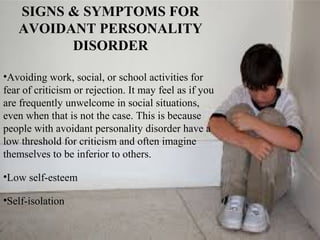
•Avoiding work, social, or school activities for
fear of criticism or rejection. It may feel as if you
are frequently unwelcome in social situations,
even when that is not the case. This is because
people with avoidant personality disorder have a
low threshold for criticism and often imagine
themselves to be inferior to others.
•Low self-esteem
•Self-isolation
SIGNS & SYPMTOMS FORSIGNS & SYPMTOMS FOR
DEPENDANTDEPENDANT
PERSONALITYPERSONALITY
DISORDERDISORDER
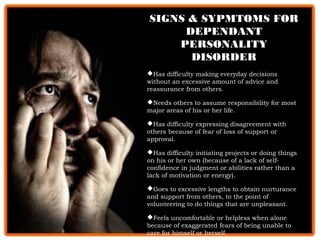
Has difficulty making everyday decisions
without an excessive amount of advice and
reassurance from others.
Needs others to assume responsibility for most
major areas of his or her life.
Has difficulty expressing disagreement with
others because of fear of loss of support or
approval.
Has difficulty initiating projects or doing things
on his or her own (because of a lack of self-
confidence in judgment or abilities rather than a
lack of motivation or energy).
Goes to excessive lengths to obtain nurturance
and support from others, to the point of
volunteering to do things that are unpleasant.
Feels uncomfortable or helpless when alone
because of exaggerated fears of being unable to
care for himself or herself.
•They find it hard to express their feelings.
•They have difficulty forming and maintaining close relationships with others.
•They’re hard working, but their obsession with perfection can make them inefficient.
•They often feel righteous, indignant, and angry.
•They often face social isolation.
•They can experience anxiety that occurs with depression.
SIGN & SYMPTOMS OF
DEPRESSIVE PERSONALITY
DISODER
These people are chronically unhappy , anhedonic, and
generally pessimistic
Their lives are usually described as lonely and sad .
They tend to feel hopeless and inadequate with frequent self-
doubting
Their personality trait are consistent with depressive
symptoms
SIGNS & SYMPTOMS OF PASSIVE-AGGRESSIVESIGNS & SYMPTOMS OF PASSIVE-AGGRESSIVE
PERSONALITY DISORDERPERSONALITY DISORDER
Acting sullen
Avoiding responsibility by claiming forgetfulness
Being inefficient on purpose
Blaming others
Complaining
SIGN & SYMPTOMS OFSIGN & SYMPTOMS OF
SADISTIS PERSONALITYSADISTIS PERSONALITY
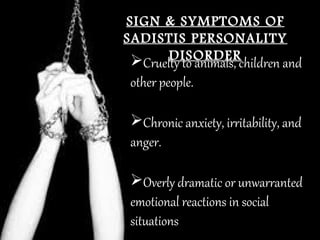
DISORDERDISORDERCruelty to animals, children and
other people.
Chronic anxiety, irritability, and
anger.
Overly dramatic or unwarranted
emotional reactions in social
situations
CAUSES OFCAUSES OF
PERSONALITYPERSONALITY
DISORDERDISORDER
GenesGenes - Certain personality traits may- Certain personality traits may
be passed on to us by our parentsbe passed on to us by our parents
through inherited genes. These traitsthrough inherited genes. These traits
are sometimes called TEMPERAMENT.are sometimes called TEMPERAMENT.
ENVIRONMENT -ENVIRONMENT - This involves theThis involves the
surroundings one grew up in, eventssurroundings one grew up in, events
that occured, and relationship withthat occured, and relationship with
family members and others.family members and others.
TREATMENT FOR PERSONALITYTREATMENT FOR PERSONALITY
DISORDERDISORDER
PSYCHOTHERAPY
•Talk theraphy
•Insight theraphy
•Group theraphy
•Counselling theraphy
MEDICATIONS
•Antidepressants
•Mood stabilizers
•Antipsychotics
COPING SKILLS FOR FAMILY
MEMBERS
If u have a loved one with antisocial
personality disorder, its critical that you
also get help for yourself. Mental health
professionals with experience managing
this condition can teach you skills to learn
how to set boundaries and help protect
yourself from the aggression, violence and
anger common to antisocial personality
disorder. They can also recommend
strategies for coping.
We have all traits integrated with eachWe have all traits integrated with each
other.other.
If one trait dominates on the other traitsIf one trait dominates on the other traits
then we have a personality disorder.then we have a personality disorder.
Personality disorder have no onset.Personality disorder have no onset.
Personality disorder need a long time toPersonality disorder need a long time to
treat.treat.
Psychoteraphy is the main theraphy forPsychoteraphy is the main theraphy for
personality disorder.personality disorder.
PERSONALITY DISORDER

PERSONALITY DISORDER

  • 1.
  • 2.
    WHAT IS PERSONALITYDISORDER? PERSONALITY An individual's characteristic pattern of thinking , feeling and acting. DISORDER Disturbance or confusion. PERSONALITY DISORDER Personality disorders are mental health conditions that affect how people manage their feelings and how they relate to other people.
  • 3.
    TYPE OF PERSONALITY TypeA •Feel time pressure. •Easily angered. •Competitive and ambitious. •Work hard and play hard. •More prone to heart disease than rest of Type B •Relaxed and easygoing. •But some people fit in this type.
  • 4.
  • 5.
    DEFINITIONDEFINITION PERSONALITYPERSONALITY DISORDERSDISORDERS A personality disordersis enduring pattern of inner experiences and behaviors that deviate markedly from the expectation of the idividual culture.Is pervasive and flexible has an outset and in adolescence and early adulthood . That create distress or impairment. A personality disorders is enduring pattern of inner experiences and behaviors that deviate markedly from the expectation of the idividual culture.Is pervasive and flexible has an outset and in adolescence and early adulthood . That create distress or impairment. PERSONALITPERSONALIT Y DISORDERY DISORDER
  • 6.
    THE TYPES OFPERSONALITY DISORDERS 1. AVOI DANT PERSONALI TY DI SORDER1. AVOI DANT PERSONALI TY DI SORDER- Sosial inhibitions, feelings of in adequency, extreme sensitivity to negative evaluation and avoidance of sosial interaction. 2. DEPENDENT PERSONALI TY DI SORDER2. DEPENDENT PERSONALI TY DI SORDER - Pervesive psychological dependence on other people. 3 .OBSESSI VE- COMPULSI VE PERSONALI TYOBSESSI VE- COMPULSI VE PERSONALI TY DI SORDERDI SORDER-Characterized by rigid conformity to rules, moral codes and excessive orderliness.
  • 7.
    4. DEPRESSI VEPERSONALI TY DI SORDER - Is a pervasive pattern of depressive cognitions and behaviors beginning by early adulthood. 5. PASSI VE- AGGRESSI VE PERSONALI TY DI SORDER - Is a pattern of negative attitudes and passive resistence in interpersonal situations. 6. SADI STI C PERSONALI TY DI SORDER - Is a pervasive pattern of cruel, demeaning and aggressive behavior.
  • 8.
    SIGNS & SYMPTOMSFOR AVOIDANT PERSONALITY DISORDER •Avoiding work, social, or school activities for fear of criticism or rejection. It may feel as if you are frequently unwelcome in social situations, even when that is not the case. This is because people with avoidant personality disorder have a low threshold for criticism and often imagine themselves to be inferior to others. •Low self-esteem •Self-isolation
  • 9.
    SIGNS & SYPMTOMSFORSIGNS & SYPMTOMS FOR DEPENDANTDEPENDANT PERSONALITYPERSONALITY DISORDERDISORDER Has difficulty making everyday decisions without an excessive amount of advice and reassurance from others. Needs others to assume responsibility for most major areas of his or her life. Has difficulty expressing disagreement with others because of fear of loss of support or approval. Has difficulty initiating projects or doing things on his or her own (because of a lack of self- confidence in judgment or abilities rather than a lack of motivation or energy). Goes to excessive lengths to obtain nurturance and support from others, to the point of volunteering to do things that are unpleasant. Feels uncomfortable or helpless when alone because of exaggerated fears of being unable to care for himself or herself.
  • 10.
    •They find ithard to express their feelings. •They have difficulty forming and maintaining close relationships with others. •They’re hard working, but their obsession with perfection can make them inefficient. •They often feel righteous, indignant, and angry. •They often face social isolation. •They can experience anxiety that occurs with depression.
  • 11.
    SIGN & SYMPTOMSOF DEPRESSIVE PERSONALITY DISODER These people are chronically unhappy , anhedonic, and generally pessimistic Their lives are usually described as lonely and sad . They tend to feel hopeless and inadequate with frequent self- doubting Their personality trait are consistent with depressive symptoms
  • 12.
    SIGNS & SYMPTOMSOF PASSIVE-AGGRESSIVESIGNS & SYMPTOMS OF PASSIVE-AGGRESSIVE PERSONALITY DISORDERPERSONALITY DISORDER Acting sullen Avoiding responsibility by claiming forgetfulness Being inefficient on purpose Blaming others Complaining
  • 13.
    SIGN & SYMPTOMSOFSIGN & SYMPTOMS OF SADISTIS PERSONALITYSADISTIS PERSONALITY DISORDERDISORDERCruelty to animals, children and other people. Chronic anxiety, irritability, and anger. Overly dramatic or unwarranted emotional reactions in social situations
  • 14.
    CAUSES OFCAUSES OF PERSONALITYPERSONALITY DISORDERDISORDER GenesGenes- Certain personality traits may- Certain personality traits may be passed on to us by our parentsbe passed on to us by our parents through inherited genes. These traitsthrough inherited genes. These traits are sometimes called TEMPERAMENT.are sometimes called TEMPERAMENT. ENVIRONMENT -ENVIRONMENT - This involves theThis involves the surroundings one grew up in, eventssurroundings one grew up in, events that occured, and relationship withthat occured, and relationship with family members and others.family members and others.
  • 15.
    TREATMENT FOR PERSONALITYTREATMENTFOR PERSONALITY DISORDERDISORDER PSYCHOTHERAPY •Talk theraphy •Insight theraphy •Group theraphy •Counselling theraphy MEDICATIONS •Antidepressants •Mood stabilizers •Antipsychotics
  • 16.
    COPING SKILLS FORFAMILY MEMBERS If u have a loved one with antisocial personality disorder, its critical that you also get help for yourself. Mental health professionals with experience managing this condition can teach you skills to learn how to set boundaries and help protect yourself from the aggression, violence and anger common to antisocial personality disorder. They can also recommend strategies for coping.
  • 17.
    We have alltraits integrated with eachWe have all traits integrated with each other.other. If one trait dominates on the other traitsIf one trait dominates on the other traits then we have a personality disorder.then we have a personality disorder. Personality disorder have no onset.Personality disorder have no onset. Personality disorder need a long time toPersonality disorder need a long time to treat.treat. Psychoteraphy is the main theraphy forPsychoteraphy is the main theraphy for personality disorder.personality disorder.