Personality disorder
1 Definition and aetiology
2 Types of personality disorder
Individuals with a personality disorder show
an enduring pattern of inner experience.
These patterns are inflexible and pervasive
across a wide rang of social and personal
situations and lead to clinically significant
distress or impairment in social, occupational
and other important areas of functioning.
Overview
To understand the concept of personality disorder, one
first has to understand what is meant by personality. this usually
refers to the individual characteristics, behaviours
and emotional qualities of a person, which the person
knows to be themselves. That people differ from each other is
obvious.
How and why they differ is less clear and is the subject of the
scientific study of personality and individual differences.
Personality
The treatment interventions included,
cognitive
therapies,
Mixed
therapies
Supportive
therapies
1. Definition and aetiology
Learning objectives
You should:
be familiar with the main criteria for
personality disorder
be familiar with different ways of construing
personality.
be aware of the importance of genetic,fami-
lial and environmental factors in relation
to personality.
All studies reported improvement in personality
disorders with psychotherapy. Among the three
randomized controlled trials, active psychotherapy
was more effective than no treatment.
: an enduring pattern of inner
experience and behaviour that deviates
markedly from the expectations of the
individual's culture, is pervasive and
inflexible, has an onset in adolescence
or early adulthood, is stable over time,
and leads to distress or impairment.
The formal definition of a personality disorder is
evidence of a problem must be present from an early age, as
the adult personality is beginning to form
the behaviour is persistent and resistant to change
behavioural problems are evident in a variety of different
areas of social functioning, e.g. disruptive(分裂) interpersonal
relationships, poor work record, antisocial behaviour, etc.
the behaviour results in damage or distress
to the individual concerned or others.
Key aspects of the definition are
That:
Categorical types
Categorical types are used to understand personality in
psychiatric classification systems.
Individuals are grouped together according to particular
characteristics; for example, someone with a schizoid personality
would have the following characteristics:
difficulty in making close social relationships,
a preference for spending time alone,
a cold and distant manner
a tendency to spend a lot of time day dreaming or thinking about
abstract concepts rather than engaging in the real world.
Different ways of understanding personality
The different types of personality disorder
are described later, but all are based upon
extreme forms of what are essentially normal
personality variations.
there is some evidence that
particular characteristics of personality have a strong
hereditary component (e.g. anxiety traits). Most of the
evidence comes from twin studies, where monozygotic
twins have a much greater probability of shared
personality characteristics than dizygotic twins. However,
the nature versus nurture argument is very difficult to
untangle, and both are probably important.
Etiology
Genetic factors
There is very
little hard evidence to confirm a general
assumption that important components of
personality are developed by learning from
parental guidance or behaviour.
Familial and environmental factors
Childhood neglect or abuse, however, strongly
associated with the development of certain forms of
personality disorder as an adult.
Therefore, it is easier to demonstrate the influence
of negative childhood events or experiences on
personality than it is to show the subtle effects of
normal or mundane experiences.
Learning objectives
You should:
~ be familiar with the main types of personality
disorder
~ know which types of personality disorder are
associated with certain forms of psychiatric illness.
2. Types of personality disorder
The main types of personality
disorder, with a brief description, are
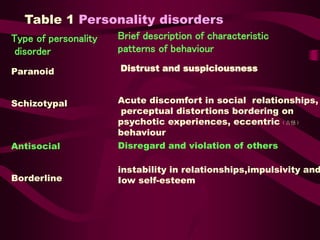
shown in Table 1.
Fuller descriptions of the more common types of
disorder are given later in this section.
Type of personality
disorder
Paranoid
Schizotypal
Antisocial
Borderline
Brief description of characteristic
patterns of behaviour
Distrust and suspiciousness
Acute discomfort in social relationships,
perceptual distortions bordering on
psychotic experiences, eccentric(古怪)
behaviour
Disregard and violation of others
instability in relationships,impulsivity and
Iow self-esteem
Table 1 Personality disorders
Histrionic
Narcissistic
Avoidant
Dependent
Obsessive-compulsive
Excessive emotionality and
attention seeking
Grandiosity, need for
admiration, lack of empathy
Social inhibition, hypersensitivity
to negative evaluation
Submissive and clinging behaviour
Preoccupation with orderliness,
perfectionism and control
Each category is based around a
normal personality trait, which in
the disorder is manifest in an
extreme and pathological manner.
Most personality traits convey some kind of
positive advantage provided they are tempered by
recognition of the needs of others and by some kind
of balance within the personality itself.
For example,
moderate obsessional traits may be
advantageous for individuals who have responsible
jobs and have to carry out precise and meticulous
work.
Histrionic traits may be an advantage for
individuals who wish to pursue an artistic career,
and even
antisocial traits may be useful for those in highly
competitive industries where a certain degree of
ruthlessness may be required.
Paranoid personality disorder
Characteristics of a paranoid personality disorder include
suspiciousness, marked self-reference, feelings that other people
are hostile or involved in conspiracies against the individual, a
sense of injustice, preoccupation with imagined wrongs, litigious
(好上诉) and aggressive behaviour.
Antisocial personality disorder
Individuals with an antisocial personality disorder have a
complete disregard for the thoughts of others. They
are self-centred, selfish and sometimes cruel. They are cold and
affectionless. They rarely form long-term relationships and
usually exploit others with whom they are involved. They are
unable to appreciate the needs or feelings of others or may
even gain pleasure from the humiliation or suffering of others.
They often have a criminal record, which may include violent or
sexual offences. Evidence of antisocial or aberrant behaviour will
be present from an early age. The disorder is more common in
males
Drug or alcohol abuse is common, which can result in the
development of short-lived psychotic states or, in the case of
alcohol, long-term brain damage. These individuals may also
receive injuries to their brain because of frequent fighting or
other kinds of reckless activity.
Obsessive-compulsive personality disorder
Individuals with an obsessive-compulsive disorder are extremely
ordered, meticulous and pedantic. They find it difficult to express
emotion or show feelings towards others, although inwardly they
may ruminate and worry about social encounters.
They are perfectionistic and often find it difficult
to complete tasks because of such high standards.
They are rigid and find it difficult to adapt to change.
They often have conflicts regarding sex, which they
may regard as messy or dirty. They find it difficult to
develop long-term relationships as most others do
not live up to their high standards.
Histrionic(dramatic) personality disorder
Individuals are over dramatic in their behaviour.
Minor troubles or events are perceived as major
disasters.
Individuals are over emotional and frequently
moved to tears. They are self-centred and
attention seeking and are rarely happy unless
surrounded by admirers. They profess to be
deeply moved but appear to be shallow and
immature in relationships.
Dependent personality disorder People with a
dependent personality disorder are overly dependent
upon others.
They find it impossible to live on an independent
basis and collapse emotionally whenever they have to
fend for themselves.
They often develop stable but imbalanced
relationships with a very dominant partner, either a
spouse or parent.
3 Assessment and management
You should:
be aware of different methods of assessing personality
be able to assess personality from a clinical perspective
be aware of the specific treatment approaches that have
been evaluated in the treatment of personality disorder
know the principles underlying clinical management.
Assessment
The diagnosis of personality disorder is difficult
and often clinicians may disagree about the
nature and severity of the disorder.
Various instruments have been developed
to assess personality; some measure
specific traits of personality in a
dimensional form and others take a
categorical approach.
clinical assessment
From a clinical perspective, the following
areas of clinical history should be paid
particular attention.
1. Birth history: any evidence of birth
trauma that may have lead to brain injury
2. Childhood brain illness, or head injury
3. Behavioural difficulties at school
(expulsion, referred to educational
psychologist)
4. Evidence of failure to form long-
term friendships(describes self as
loner at school, was bullied or was a
school bully)
5. Cruelty to animals or other children
(torture of small animals or younger
siblings)
6. History of childhood physical or
sexual abuse
7. Childhood neglect (foster care or
parent alcoholic)
8. Criminal record (e.g. history of
petty offences from an early age or
serious offences such as arson or
assault)
9. Evidence of an inability to
sustain employment(e.g. never worked or
no long-term work; history of conflict
with employers)
10. Disruptive and unsettled
interpersonal/sexual
relationships.
There is little consensus within psychiatry regarding the
treat ability of personality disorder, particularly patients
with antisocial personality disorder.
Brief treatments are unsuitable and most therapeutic
interventions involve treatments of greater than 6
months in duration.
Cognitive analytic therapy, dialectical behaviour
therapy and psychodynamic interpersonal therapy have
been shown to be helpful in patients with borderline
personality disorder.
Intensive inpatient treatment programmes
lasting months to years have been tried in
patients with anti-social personality
disorder. These therapeutic regimens have
usually been implemented in prison
settings for individuals who have
committed serious sexual or violent
crimes. There is some evidence that very
intensive
treatment may be helpful for certain individuals, but all
these treatments require further evaluation before any
firm conclusions can be drawn.
There is some evidence that different
kinds of personality may respond
differently to treatment. With cognitive
therapy, patients with obsessional or
anxious personality types do better
than those with borderline personality.
Patients with schizotypal personality
disorder and antisocial personality
disorder are more difficult to treat with
psychotherapeutic methods.
Jean is a 44-year-olds woman. She has a history of sexual
abuse and spent several years in care as a child. She was
returned home by social services to live with her mother
when she was 15 years old. Her mother showed little
interest in her and was threatened and bullied by her
stepfather. She ran away from home and spent 2 years living
rough on the streets.She survived by working as a street
prostitute. She has had little schooling and is unable to read
and write. She became pregnant at the age of 17 and was
housed in a small flat by social services. After her son was
born, she suffered from postnatal depression(产后) and
received a brief period of inpatient psychiatric care. During
this period, she began to cut herself.
By the time she was 21 years old she had
three children, all by different fathers. She
had begun to abuse alcohol and social
services had placed one of three children
on the at-risk register. She had never
formed any close relationships or
friendships in her and finds it difficult to
trust others. She began frequently to
present at the local A〥E department with
Cutting to her arms and chest. She said that
cutting helped to relieve tension but also said
wanted to die. On assessment, she did not
have any biological symptoms of depression
although she complained of feeling
depressed and tired most of the time.
Thank you!

personality 8.ppt

  • 1.
  • 2.
    1 Definition andaetiology 2 Types of personality disorder
  • 3.
    Individuals with apersonality disorder show an enduring pattern of inner experience. These patterns are inflexible and pervasive across a wide rang of social and personal situations and lead to clinically significant distress or impairment in social, occupational and other important areas of functioning. Overview
  • 4.
    To understand theconcept of personality disorder, one first has to understand what is meant by personality. this usually refers to the individual characteristics, behaviours and emotional qualities of a person, which the person knows to be themselves. That people differ from each other is obvious. How and why they differ is less clear and is the subject of the scientific study of personality and individual differences. Personality
  • 5.
    The treatment interventionsincluded, cognitive therapies, Mixed therapies Supportive therapies
  • 6.
    1. Definition andaetiology Learning objectives You should: be familiar with the main criteria for personality disorder be familiar with different ways of construing personality. be aware of the importance of genetic,fami- lial and environmental factors in relation to personality.
  • 7.
    All studies reportedimprovement in personality disorders with psychotherapy. Among the three randomized controlled trials, active psychotherapy was more effective than no treatment.
  • 8.
    : an enduringpattern of inner experience and behaviour that deviates markedly from the expectations of the individual's culture, is pervasive and inflexible, has an onset in adolescence or early adulthood, is stable over time, and leads to distress or impairment. The formal definition of a personality disorder is
  • 9.
    evidence of aproblem must be present from an early age, as the adult personality is beginning to form the behaviour is persistent and resistant to change behavioural problems are evident in a variety of different areas of social functioning, e.g. disruptive(分裂) interpersonal relationships, poor work record, antisocial behaviour, etc. the behaviour results in damage or distress to the individual concerned or others. Key aspects of the definition are That:
  • 10.
    Categorical types Categorical typesare used to understand personality in psychiatric classification systems. Individuals are grouped together according to particular characteristics; for example, someone with a schizoid personality would have the following characteristics: difficulty in making close social relationships, a preference for spending time alone, a cold and distant manner a tendency to spend a lot of time day dreaming or thinking about abstract concepts rather than engaging in the real world. Different ways of understanding personality
  • 11.
    The different typesof personality disorder are described later, but all are based upon extreme forms of what are essentially normal personality variations.
  • 12.
    there is someevidence that particular characteristics of personality have a strong hereditary component (e.g. anxiety traits). Most of the evidence comes from twin studies, where monozygotic twins have a much greater probability of shared personality characteristics than dizygotic twins. However, the nature versus nurture argument is very difficult to untangle, and both are probably important. Etiology Genetic factors
  • 13.
    There is very littlehard evidence to confirm a general assumption that important components of personality are developed by learning from parental guidance or behaviour. Familial and environmental factors
  • 14.
    Childhood neglect orabuse, however, strongly associated with the development of certain forms of personality disorder as an adult. Therefore, it is easier to demonstrate the influence of negative childhood events or experiences on personality than it is to show the subtle effects of normal or mundane experiences.
  • 15.
    Learning objectives You should: ~be familiar with the main types of personality disorder ~ know which types of personality disorder are associated with certain forms of psychiatric illness. 2. Types of personality disorder
  • 16.
    The main typesof personality disorder, with a brief description, are shown in Table 1. Fuller descriptions of the more common types of disorder are given later in this section.
  • 17.
    Type of personality disorder Paranoid Schizotypal Antisocial Borderline Briefdescription of characteristic patterns of behaviour Distrust and suspiciousness Acute discomfort in social relationships, perceptual distortions bordering on psychotic experiences, eccentric(古怪) behaviour Disregard and violation of others instability in relationships,impulsivity and Iow self-esteem Table 1 Personality disorders
  • 18.
    Histrionic Narcissistic Avoidant Dependent Obsessive-compulsive Excessive emotionality and attentionseeking Grandiosity, need for admiration, lack of empathy Social inhibition, hypersensitivity to negative evaluation Submissive and clinging behaviour Preoccupation with orderliness, perfectionism and control
  • 19.
    Each category isbased around a normal personality trait, which in the disorder is manifest in an extreme and pathological manner.
  • 20.
    Most personality traitsconvey some kind of positive advantage provided they are tempered by recognition of the needs of others and by some kind of balance within the personality itself. For example, moderate obsessional traits may be advantageous for individuals who have responsible jobs and have to carry out precise and meticulous work. Histrionic traits may be an advantage for individuals who wish to pursue an artistic career, and even antisocial traits may be useful for those in highly competitive industries where a certain degree of ruthlessness may be required.
  • 21.
    Paranoid personality disorder Characteristicsof a paranoid personality disorder include suspiciousness, marked self-reference, feelings that other people are hostile or involved in conspiracies against the individual, a sense of injustice, preoccupation with imagined wrongs, litigious (好上诉) and aggressive behaviour.
  • 22.
    Antisocial personality disorder Individualswith an antisocial personality disorder have a complete disregard for the thoughts of others. They are self-centred, selfish and sometimes cruel. They are cold and affectionless. They rarely form long-term relationships and usually exploit others with whom they are involved. They are unable to appreciate the needs or feelings of others or may even gain pleasure from the humiliation or suffering of others. They often have a criminal record, which may include violent or sexual offences. Evidence of antisocial or aberrant behaviour will be present from an early age. The disorder is more common in males
  • 23.
    Drug or alcoholabuse is common, which can result in the development of short-lived psychotic states or, in the case of alcohol, long-term brain damage. These individuals may also receive injuries to their brain because of frequent fighting or other kinds of reckless activity. Obsessive-compulsive personality disorder Individuals with an obsessive-compulsive disorder are extremely ordered, meticulous and pedantic. They find it difficult to express emotion or show feelings towards others, although inwardly they may ruminate and worry about social encounters.
  • 24.
    They are perfectionisticand often find it difficult to complete tasks because of such high standards. They are rigid and find it difficult to adapt to change. They often have conflicts regarding sex, which they may regard as messy or dirty. They find it difficult to develop long-term relationships as most others do not live up to their high standards.
  • 25.
    Histrionic(dramatic) personality disorder Individualsare over dramatic in their behaviour. Minor troubles or events are perceived as major disasters. Individuals are over emotional and frequently moved to tears. They are self-centred and attention seeking and are rarely happy unless surrounded by admirers. They profess to be deeply moved but appear to be shallow and immature in relationships.
  • 26.
    Dependent personality disorderPeople with a dependent personality disorder are overly dependent upon others. They find it impossible to live on an independent basis and collapse emotionally whenever they have to fend for themselves. They often develop stable but imbalanced relationships with a very dominant partner, either a spouse or parent.
  • 27.
    3 Assessment andmanagement You should: be aware of different methods of assessing personality be able to assess personality from a clinical perspective be aware of the specific treatment approaches that have been evaluated in the treatment of personality disorder know the principles underlying clinical management.
  • 28.
    Assessment The diagnosis ofpersonality disorder is difficult and often clinicians may disagree about the nature and severity of the disorder.
  • 29.
    Various instruments havebeen developed to assess personality; some measure specific traits of personality in a dimensional form and others take a categorical approach.
  • 30.
    clinical assessment From aclinical perspective, the following areas of clinical history should be paid particular attention. 1. Birth history: any evidence of birth trauma that may have lead to brain injury 2. Childhood brain illness, or head injury 3. Behavioural difficulties at school (expulsion, referred to educational psychologist)
  • 31.
    4. Evidence offailure to form long- term friendships(describes self as loner at school, was bullied or was a school bully) 5. Cruelty to animals or other children (torture of small animals or younger siblings) 6. History of childhood physical or sexual abuse 7. Childhood neglect (foster care or parent alcoholic)
  • 32.
    8. Criminal record(e.g. history of petty offences from an early age or serious offences such as arson or assault) 9. Evidence of an inability to sustain employment(e.g. never worked or no long-term work; history of conflict with employers) 10. Disruptive and unsettled interpersonal/sexual relationships.
  • 33.
    There is littleconsensus within psychiatry regarding the treat ability of personality disorder, particularly patients with antisocial personality disorder. Brief treatments are unsuitable and most therapeutic interventions involve treatments of greater than 6 months in duration. Cognitive analytic therapy, dialectical behaviour therapy and psychodynamic interpersonal therapy have been shown to be helpful in patients with borderline personality disorder.
  • 34.
    Intensive inpatient treatmentprogrammes lasting months to years have been tried in patients with anti-social personality disorder. These therapeutic regimens have usually been implemented in prison settings for individuals who have committed serious sexual or violent crimes. There is some evidence that very intensive
  • 35.
    treatment may behelpful for certain individuals, but all these treatments require further evaluation before any firm conclusions can be drawn.
  • 36.
    There is someevidence that different kinds of personality may respond differently to treatment. With cognitive therapy, patients with obsessional or anxious personality types do better than those with borderline personality. Patients with schizotypal personality disorder and antisocial personality disorder are more difficult to treat with psychotherapeutic methods.
  • 37.
    Jean is a44-year-olds woman. She has a history of sexual abuse and spent several years in care as a child. She was returned home by social services to live with her mother when she was 15 years old. Her mother showed little interest in her and was threatened and bullied by her stepfather. She ran away from home and spent 2 years living rough on the streets.She survived by working as a street prostitute. She has had little schooling and is unable to read and write. She became pregnant at the age of 17 and was housed in a small flat by social services. After her son was born, she suffered from postnatal depression(产后) and received a brief period of inpatient psychiatric care. During this period, she began to cut herself.
  • 38.
    By the timeshe was 21 years old she had three children, all by different fathers. She had begun to abuse alcohol and social services had placed one of three children on the at-risk register. She had never formed any close relationships or friendships in her and finds it difficult to trust others. She began frequently to present at the local A〥E department with
  • 39.
    Cutting to herarms and chest. She said that cutting helped to relieve tension but also said wanted to die. On assessment, she did not have any biological symptoms of depression although she complained of feeling depressed and tired most of the time.
  • 40.