YESHASWI BHAV TRAINING & MANAGEMENT SOLUTIONS LLP
www.yeshaswibhav.com
 Albert Humphrey led a research project at Stanford University
in the 1960s and 1970s
 Fortune 500 companies were used to identify why corporate
planning failed.
• Albert Humphrey and the original research team used the
following categories: “What is good in the present is
Satisfactory, good in the future is an Opportunity; bad in the
present is a Fault and bad in the future is a Threat.”
 In 1964, at a conference the F in ‘SOFT’ was changed to a W,
and thus, the emergence of ‘SWOT’ Analysis as we know it
today came into existence.
www.yeshaswibhav.com
 He who knows others is wise
 He who knows oneself is enlightened
www.yeshaswibhav.com
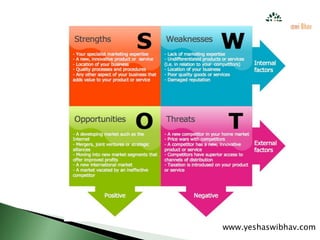
 SWOT is a situation analysis tool to evaluate internal
strengths and weaknesses , external opportunities and
threats for better decision making and competitive edge
www.yeshaswibhav.com
 Internal Resource is helpful in achieving desired goals
 An internal barrier to achieve desired goals
 An external situation that could provide competitive edge
 An external situation which could damage your scope for attaining
objectives
www.yeshaswibhav.com
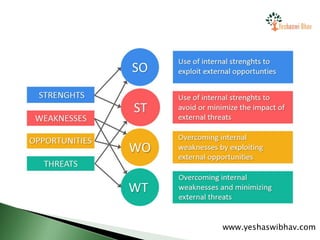
 To capitalize on strengths
 To overcome weaknesses
 To exploit opportunities
 To survive threats
To be proactive and take better decisions
www.yeshaswibhav.com
 Advantages you have that others don't have (for example, skills,
certifications, education, or connections)?
 What do you do better than anyone else?
 What personal resources can you access?
 What do other people see as your strengths?
 Which of your achievements are you most proud of?
 What values do you believe in that others fail to exhibit?
 Are you part of a network? Connections with influential people?
www.yeshaswibhav.com
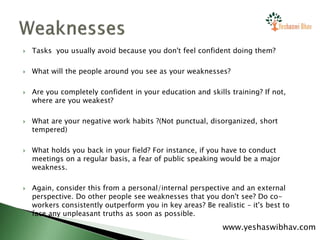
 Tasks you usually avoid because you don't feel confident doing them?
 What will the people around you see as your weaknesses?
 Are you completely confident in your education and skills training? If not,
where are you weakest?
 What are your negative work habits ?(Not punctual, disorganized, short
tempered)
 What holds you back in your field? For instance, if you have to conduct
meetings on a regular basis, a fear of public speaking would be a major
weakness.
 Again, consider this from a personal/internal perspective and an external
perspective. Do other people see weaknesses that you don't see? Do co-
workers consistently outperform you in key areas? Be realistic – it's best to
face any unpleasant truths as soon as possible.
www.yeshaswibhav.com
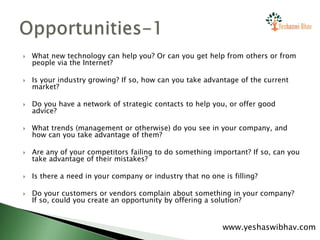
 What new technology can help you? Or can you get help from others or from
people via the Internet?
 Is your industry growing? If so, how can you take advantage of the current
market?
 Do you have a network of strategic contacts to help you, or offer good
advice?
 What trends (management or otherwise) do you see in your company, and
how can you take advantage of them?
 Are any of your competitors failing to do something important? If so, can you
take advantage of their mistakes?
 Is there a need in your company or industry that no one is filling?
 Do your customers or vendors complain about something in your company?
If so, could you create an opportunity by offering a solution?
www.yeshaswibhav.com
 You might find useful opportunities in the following:
 Networking events, educational classes, or conferences.
 A colleague going on an extended leave. Could you take on some of
this person's projects to gain experience?
 A new role or project that forces you to learn new skills, like public
speaking or international relations.
 A company expansion or acquisition. Do you have specific skills (like
a second language) that could help with the process?
 Also, importantly, look at your strengths, and ask yourself whether
these open up any opportunities – and look at your weaknesses, and
ask yourself whether you could open up opportunities by eliminating
those weaknesses.
www.yeshaswibhav.com
 What obstacles do you currently face at work?
 Are any of your colleagues competing with you for projects or roles?
 Is your job (or the demand for the things you do) changing?
 Does changing technology threaten your position?
 Could any of your weaknesses lead to threats?
www.yeshaswibhav.com
 Reflect
 List five of your weaknesses
 Highlight one that immediately needs action
 Discover your weakness
 Vow to stop
 Restrain yourself
 Congratulate yourself
 Persist till your conquer
www.yeshaswibhav.com
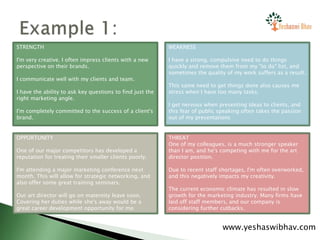
STRENGTH
I'm very creative. I often impress clients with a new
perspective on their brands.
I communicate well with my clients and team.
I have the ability to ask key questions to find just the
right marketing angle.
I'm completely committed to the success of a client's
brand.
WEAKNESS
I have a strong, compulsive need to do things
quickly and remove them from my "to do" list, and
sometimes the quality of my work suffers as a result.
This same need to get things done also causes me
stress when I have too many tasks.
I get nervous when presenting ideas to clients, and
this fear of public speaking often takes the passion
out of my presentations
OPPORTUNITY
One of our major competitors has developed a
reputation for treating their smaller clients poorly.
I'm attending a major marketing conference next
month. This will allow for strategic networking, and
also offer some great training seminars.
Our art director will go on maternity leave soon.
Covering her duties while she's away would be a
great career development opportunity for me.
THREAT
One of my colleagues, is a much stronger speaker
than I am, and he's competing with me for the art
director position.
Due to recent staff shortages, I'm often overworked,
and this negatively impacts my creativity.
The current economic climate has resulted in slow
growth for the marketing industry. Many firms have
laid off staff members, and our company is
considering further cutbacks.
www.yeshaswibhav.com
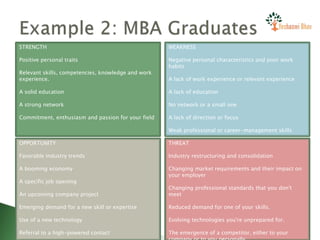
STRENGTH
Positive personal traits
Relevant skills, competencies, knowledge and work
experience.
A solid education
A strong network
Commitment, enthusiasm and passion for your field
WEAKNESS
Negative personal characteristics and poor work
habits
A lack of work experience or relevant experience
A lack of education
No network or a small one
A lack of direction or focus
Weak professional or career-management skills
OPPORTUNITY
Favorable industry trends
A booming economy
A specific job opening
An upcoming company project
Emerging demand for a new skill or expertise
Use of a new technology
Referral to a high-powered contact
THREAT
Industry restructuring and consolidation
Changing market requirements and their impact on
your employer
Changing professional standards that you don't
meet
Reduced demand for one of your skills.
Evolving technologies you're unprepared for.
The emergence of a competitor, either to your
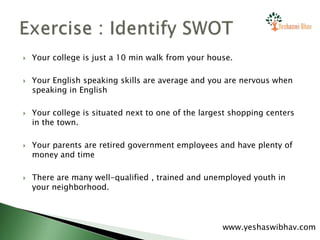
 Your college is just a 10 min walk from your house.
 Your English speaking skills are average and you are nervous when
speaking in English
 Your college is situated next to one of the largest shopping centers
in the town.
 Your parents are retired government employees and have plenty of
money and time
 There are many well-qualified , trained and unemployed youth in
your neighborhood.
www.yeshaswibhav.com
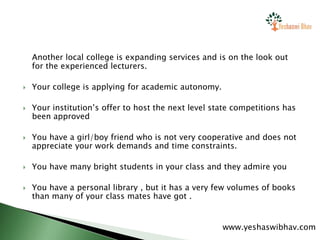
Another local college is expanding services and is on the look out
for the experienced lecturers.
 Your college is applying for academic autonomy.
 Your institution’s offer to host the next level state competitions has
been approved
 You have a girl/boy friend who is not very cooperative and does not
appreciate your work demands and time constraints.
 You have many bright students in your class and they admire you
 You have a personal library , but it has a very few volumes of books
than many of your class mates have got .
www.yeshaswibhav.com

Personal swot

  • 1.
    YESHASWI BHAV TRAINING& MANAGEMENT SOLUTIONS LLP www.yeshaswibhav.com
  • 2.
     Albert Humphreyled a research project at Stanford University in the 1960s and 1970s  Fortune 500 companies were used to identify why corporate planning failed. • Albert Humphrey and the original research team used the following categories: “What is good in the present is Satisfactory, good in the future is an Opportunity; bad in the present is a Fault and bad in the future is a Threat.”  In 1964, at a conference the F in ‘SOFT’ was changed to a W, and thus, the emergence of ‘SWOT’ Analysis as we know it today came into existence. www.yeshaswibhav.com
  • 3.
  • 4.
  • 5.
     He whoknows others is wise  He who knows oneself is enlightened www.yeshaswibhav.com
  • 6.
     SWOT isa situation analysis tool to evaluate internal strengths and weaknesses , external opportunities and threats for better decision making and competitive edge www.yeshaswibhav.com
  • 7.
     Internal Resourceis helpful in achieving desired goals  An internal barrier to achieve desired goals  An external situation that could provide competitive edge  An external situation which could damage your scope for attaining objectives www.yeshaswibhav.com
  • 8.
     To capitalizeon strengths  To overcome weaknesses  To exploit opportunities  To survive threats To be proactive and take better decisions www.yeshaswibhav.com
  • 9.
     Advantages youhave that others don't have (for example, skills, certifications, education, or connections)?  What do you do better than anyone else?  What personal resources can you access?  What do other people see as your strengths?  Which of your achievements are you most proud of?  What values do you believe in that others fail to exhibit?  Are you part of a network? Connections with influential people?
  • 10.
  • 11.
     Tasks youusually avoid because you don't feel confident doing them?  What will the people around you see as your weaknesses?  Are you completely confident in your education and skills training? If not, where are you weakest?  What are your negative work habits ?(Not punctual, disorganized, short tempered)  What holds you back in your field? For instance, if you have to conduct meetings on a regular basis, a fear of public speaking would be a major weakness.  Again, consider this from a personal/internal perspective and an external perspective. Do other people see weaknesses that you don't see? Do co- workers consistently outperform you in key areas? Be realistic – it's best to face any unpleasant truths as soon as possible. www.yeshaswibhav.com
  • 12.
  • 13.
     What newtechnology can help you? Or can you get help from others or from people via the Internet?  Is your industry growing? If so, how can you take advantage of the current market?  Do you have a network of strategic contacts to help you, or offer good advice?  What trends (management or otherwise) do you see in your company, and how can you take advantage of them?  Are any of your competitors failing to do something important? If so, can you take advantage of their mistakes?  Is there a need in your company or industry that no one is filling?  Do your customers or vendors complain about something in your company? If so, could you create an opportunity by offering a solution? www.yeshaswibhav.com
  • 14.
     You mightfind useful opportunities in the following:  Networking events, educational classes, or conferences.  A colleague going on an extended leave. Could you take on some of this person's projects to gain experience?  A new role or project that forces you to learn new skills, like public speaking or international relations.  A company expansion or acquisition. Do you have specific skills (like a second language) that could help with the process?  Also, importantly, look at your strengths, and ask yourself whether these open up any opportunities – and look at your weaknesses, and ask yourself whether you could open up opportunities by eliminating those weaknesses. www.yeshaswibhav.com
  • 15.
     What obstaclesdo you currently face at work?  Are any of your colleagues competing with you for projects or roles?  Is your job (or the demand for the things you do) changing?  Does changing technology threaten your position?  Could any of your weaknesses lead to threats? www.yeshaswibhav.com
  • 16.
     Reflect  Listfive of your weaknesses  Highlight one that immediately needs action  Discover your weakness  Vow to stop  Restrain yourself  Congratulate yourself  Persist till your conquer www.yeshaswibhav.com
  • 17.
  • 18.
    STRENGTH I'm very creative.I often impress clients with a new perspective on their brands. I communicate well with my clients and team. I have the ability to ask key questions to find just the right marketing angle. I'm completely committed to the success of a client's brand. WEAKNESS I have a strong, compulsive need to do things quickly and remove them from my "to do" list, and sometimes the quality of my work suffers as a result. This same need to get things done also causes me stress when I have too many tasks. I get nervous when presenting ideas to clients, and this fear of public speaking often takes the passion out of my presentations OPPORTUNITY One of our major competitors has developed a reputation for treating their smaller clients poorly. I'm attending a major marketing conference next month. This will allow for strategic networking, and also offer some great training seminars. Our art director will go on maternity leave soon. Covering her duties while she's away would be a great career development opportunity for me. THREAT One of my colleagues, is a much stronger speaker than I am, and he's competing with me for the art director position. Due to recent staff shortages, I'm often overworked, and this negatively impacts my creativity. The current economic climate has resulted in slow growth for the marketing industry. Many firms have laid off staff members, and our company is considering further cutbacks. www.yeshaswibhav.com
  • 19.
    STRENGTH Positive personal traits Relevantskills, competencies, knowledge and work experience. A solid education A strong network Commitment, enthusiasm and passion for your field WEAKNESS Negative personal characteristics and poor work habits A lack of work experience or relevant experience A lack of education No network or a small one A lack of direction or focus Weak professional or career-management skills OPPORTUNITY Favorable industry trends A booming economy A specific job opening An upcoming company project Emerging demand for a new skill or expertise Use of a new technology Referral to a high-powered contact THREAT Industry restructuring and consolidation Changing market requirements and their impact on your employer Changing professional standards that you don't meet Reduced demand for one of your skills. Evolving technologies you're unprepared for. The emergence of a competitor, either to your
  • 20.
     Your collegeis just a 10 min walk from your house.  Your English speaking skills are average and you are nervous when speaking in English  Your college is situated next to one of the largest shopping centers in the town.  Your parents are retired government employees and have plenty of money and time  There are many well-qualified , trained and unemployed youth in your neighborhood. www.yeshaswibhav.com
  • 21.
    Another local collegeis expanding services and is on the look out for the experienced lecturers.  Your college is applying for academic autonomy.  Your institution’s offer to host the next level state competitions has been approved  You have a girl/boy friend who is not very cooperative and does not appreciate your work demands and time constraints.  You have many bright students in your class and they admire you  You have a personal library , but it has a very few volumes of books than many of your class mates have got . www.yeshaswibhav.com
  • 22.