Staying Relevant 
Learning Team A 
E-Learning/AET 541 
September 29, 2014 
Dr. Mary Poe 
(Elizabeth Andrews)
The Effective Online Course 
From the perspective of the adult, online learner 
there are a number of attributes that create an ideal 
educational experience. This presentation will 
discuss a number of these attributes, their 
educational role and other related information. 
(Elizabeth Andrews)
Asynchronous Learning 
Environment 
As many adult learners have hectic schedules filled with a variety of family, 
work, and social obligations an asynchronous learning environment allows 
them to fully participate in the course but on their own schedule 
(Haythornthwaite, 2011, Chapter 12). 
“Asynchronicity sets the stage for anywhere, anytime, and anyone 
communication. It removes the necessity for all participants to be in the 
same physical or online meeting place at the same time. It also serves 
ubiquitous learning well since it can be managed on a just in-time and as-time- 
is-available schedule: formal learners can choose when to dip into 
and join online class discussions; lifelong learners can pick up new 
information and skills as and when needed; and everyday learners can 
search the web now for information on today’s activity” (Haythornthwaite, 
2011, Chapter 12). 
(Elizabeth Andrews)
Technology Participatory 
Practices 
Games, simulations, and social networking are examples of technology 
participatory practices. They create an opportunity for creative teaching practices, 
and “captures the interest and curiosity” of online learners (Haythornwaite & 
Andrews, 2011). 
Technology participatory practices enable learners to effectively communicate and 
collaborate with classmates, and the instructor. It also encourages engagement and 
active learning for the online learner 
Technological participatory practices provide relevant use of materials to the 
learner’s life experience, and enable learners to take control of their own learning, 
by becoming engaged in open interaction with the use of simulations. In addition, 
learners are self-directed and motivated 
(Brockers-White)
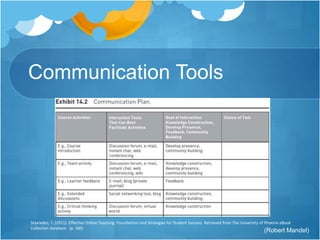
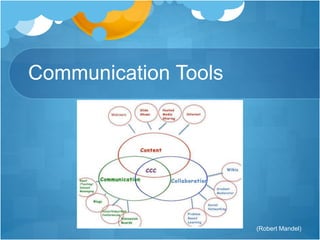
Communication Tools 
The effectiveness of an online course is dependent on the methods of 
communication used to facilitate interaction between instructor to student, 
student to instructor, and student to student. 
There are various communication tools available for both synchronous and 
asynchronous learning environments to increase presence, build 
community, and promote learning. 
“The more deliberate you can be about planning interactions and using the 
appropriate communication tools for the interactions, the more you can 
enhance the opportunities to build a learning community that will assist 
learners in staying motivated and persisting and ultimately achieving the 
learning outcomes of the course” (Stavredes, 2011). 
(Robert Mandel)
Communication Tools 
Stavredes, T. (2011). Effective Online Teaching: Foundations and Strategies for Student Success. Retrieved from The University of Phoenix eBook 
Collection database. (p. 180) 
(Robert Mandel)
Communication Tools 
(Robert Mandel)
Discourse and Collaboration 
According to Stavredes (2011), “through discourse, learners can discover 
viewpoints different from their own; through this discovery learners may 
learn to question their own conceptions and resolve conflicts between 
opposing ideas (Chapter 12). 
Stavredes (2011), goes on to state that “It is through collaboration between 
learners that higher-order thinking skills can be developed, including 
critical thinking, creative thinking, and problem solving (Chapter 12). 
When discourse and collaboration are both utilized through classroom 
discussions, participation threads, and group assignments a learning 
experience that both enhances learners’ knowledge and problem solving 
skills is created. 
(Elizabeth Andrews)
Problem-Based Learning 
Problem-based learning is student centered, and constructs and challenges prior 
knowledge, content specific and encourages collaborative learning. 
In addition, according to Stavredes, 2011 “problem- based learning incorporates active 
learning and critical thinking skills” (Stavredes, 2011). Also, critical thinking in problem 
based learning engages and builds a sense of community in order to solve real world 
problems. 
Content specifics is another aspect of problem-based learning, which teaches real world 
issues by “presenting a real world challenge to learners”, to prepare them for what they may 
encounter in the future (Gallow, 2014). 
Moreover, problem-based learning enables learners to become actively engaged, 
motivated, take responsibility for their learning and gives rise to reflection, and gives 
learners the opportunity to interpret, synthesize and apply information. 
(Brockers- 
White)
Staying Relevant and Current 
Technology is always changing and it is important to 
look ahead at the benefits innovation will bring to 
education. 
Embracing new technologies will help keep the 
learning experience relevant and current for both the 
facilitator and students. 
(Robert Mandel)
Staying Relevant and Current 
When incorporating new technologies in the course it 
is important to stay current with copyright laws that 
protect intellectual property and define “fair use” for 
education. 
“Copyright is a critical legal issue in the online 
learning environment that must be carefully 
considered when using resources in an online 
course” (Stavredes, 2011). 
(Robert Mandel)
Staying Relevant and Current 
Some of the resources used: 
• Games 
• Simulations 
• Grammar and Plagiarism Checkers 
• Presentation Programs 
• Audio and Visual Tools 
(Robert Mandel)
Ensuring a Long Shelf Life 
Simulations in teaching and learning addresses the modalities of all online learners, and 
actively engages and stimulate learners. Also learners are able to discuss and see their 
responses, while “discovering the impact of multiple decisions at the same time” (Harvard 
Business Publishing for Educators, 2014). Also, it encourages self-directed learning. 
Teaching and learning with Web 2.0 tools involves individual learners and collaboration most 
widely known as the “sociotechnical” strategies, which aids in building a community. In 
addition, educational informatics applies to “digital technologies and techniques to the use and 
communication of information in learning and education” (Haythornwaite & Andrews, 2011). 
In addition, Web 2.0 tools are constructed with a sense of community, in which collaboration 
and sharing resources. Web 2.0 tools aid learners into becoming active, and taking control of 
their learning, while becoming responsible learners. Web 2.0 tools furnishes a more flexible 
learning environment for online learners, and enables the instructor to become the facilitator. 
(Brockers-White)
Ensuring a Long Shelf Life 
Multimedia discussion forums support collaborative learning for the online learner. In addition, 
web based threaded discussion forums such as Mind Bridges, supports embedded multimedia 
content for discussion forums Multimedia discussion forums are interactive, and are part of a 
“collaborative nature” ("Asynchronous Discussion Boards", 2014).Multimedia discussion 
forums enable online learners to exchange images, audio, and video files. Multimedia discussion 
forums actively engages the online learner, by having the online learner watch a multimedia 
clip or image and respond. 
Personal bios and introductions builds communication between the instructor and online 
learner. In addition, they provide an opportunity to learn about the learner and instructor 
professionally and personally. Moreover, personal bios and introduction build a relationship 
of trust between instructor and online learner, and set the scene and tone for the online 
classroom. 
(Brockers- 
White)
Strategies to Stay Relevant 
Stay current with new methods for learning as technology 
progresses. 
Conduct periodic assessments of course materials and update 
learning objectives to meet current learning needs. 
Develop learning activities based on real-world problems and 
cases so students can identify more deeply with the topic. 
Create a strong sense of community in the classroom. 
(Robert Mandel)
Rubric 
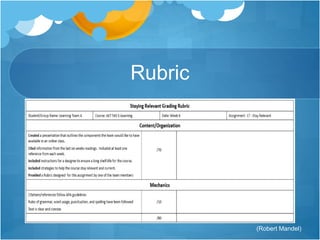
Feedback is a key element in an online course and is 
used as a measure for assessing learner progress and 
identifies areas needing attention for improving learning 
performance. 
One method used to provide feedback in an online course 
is a simple grading Rubric. 
The following is a Rubric designed for measuring this 
presentation. 
(Robert Mandel)
Rubric 
(Robert Mandel)
Conclusion 
• Every learner has individual needs, but there are 
common components that every online learner wants 
and/or benefits from. This presentation delivered a 
number of these components along with supporting 
ideas, explanations, and examples to help others 
create a relevant and effective online course.
References 
Gallow, Dr. D. (2014). Problem-Based Learning Faculty Institute. Retrieved from 
http://www.pbl.uci.edu/whatispbl.html 
Harvard Business Publishing for Educators. (2014). Teaching with Simulations. Retrieved from 
http://hbsp.harvard.edu/list/simulations-feature 
Haythornthwaite, C. (2011). E-learning theory and practice. Retrieved from The University of 
Phoenix eBook Collection database. 
Stavredes, T. (2011). Effective online teaching: Foundations and strategies for student 
success. San Francisco, CA: Jossey-Bass.

AET/541 LT (A) Staying Relevant

  • 1.
    Staying Relevant LearningTeam A E-Learning/AET 541 September 29, 2014 Dr. Mary Poe (Elizabeth Andrews)
  • 2.
    The Effective OnlineCourse From the perspective of the adult, online learner there are a number of attributes that create an ideal educational experience. This presentation will discuss a number of these attributes, their educational role and other related information. (Elizabeth Andrews)
  • 3.
    Asynchronous Learning Environment As many adult learners have hectic schedules filled with a variety of family, work, and social obligations an asynchronous learning environment allows them to fully participate in the course but on their own schedule (Haythornthwaite, 2011, Chapter 12). “Asynchronicity sets the stage for anywhere, anytime, and anyone communication. It removes the necessity for all participants to be in the same physical or online meeting place at the same time. It also serves ubiquitous learning well since it can be managed on a just in-time and as-time- is-available schedule: formal learners can choose when to dip into and join online class discussions; lifelong learners can pick up new information and skills as and when needed; and everyday learners can search the web now for information on today’s activity” (Haythornthwaite, 2011, Chapter 12). (Elizabeth Andrews)
  • 4.
    Technology Participatory Practices Games, simulations, and social networking are examples of technology participatory practices. They create an opportunity for creative teaching practices, and “captures the interest and curiosity” of online learners (Haythornwaite & Andrews, 2011). Technology participatory practices enable learners to effectively communicate and collaborate with classmates, and the instructor. It also encourages engagement and active learning for the online learner Technological participatory practices provide relevant use of materials to the learner’s life experience, and enable learners to take control of their own learning, by becoming engaged in open interaction with the use of simulations. In addition, learners are self-directed and motivated (Brockers-White)
  • 5.
    Communication Tools Theeffectiveness of an online course is dependent on the methods of communication used to facilitate interaction between instructor to student, student to instructor, and student to student. There are various communication tools available for both synchronous and asynchronous learning environments to increase presence, build community, and promote learning. “The more deliberate you can be about planning interactions and using the appropriate communication tools for the interactions, the more you can enhance the opportunities to build a learning community that will assist learners in staying motivated and persisting and ultimately achieving the learning outcomes of the course” (Stavredes, 2011). (Robert Mandel)
  • 6.
    Communication Tools Stavredes,T. (2011). Effective Online Teaching: Foundations and Strategies for Student Success. Retrieved from The University of Phoenix eBook Collection database. (p. 180) (Robert Mandel)
  • 7.
  • 8.
    Discourse and Collaboration According to Stavredes (2011), “through discourse, learners can discover viewpoints different from their own; through this discovery learners may learn to question their own conceptions and resolve conflicts between opposing ideas (Chapter 12). Stavredes (2011), goes on to state that “It is through collaboration between learners that higher-order thinking skills can be developed, including critical thinking, creative thinking, and problem solving (Chapter 12). When discourse and collaboration are both utilized through classroom discussions, participation threads, and group assignments a learning experience that both enhances learners’ knowledge and problem solving skills is created. (Elizabeth Andrews)
  • 9.
    Problem-Based Learning Problem-basedlearning is student centered, and constructs and challenges prior knowledge, content specific and encourages collaborative learning. In addition, according to Stavredes, 2011 “problem- based learning incorporates active learning and critical thinking skills” (Stavredes, 2011). Also, critical thinking in problem based learning engages and builds a sense of community in order to solve real world problems. Content specifics is another aspect of problem-based learning, which teaches real world issues by “presenting a real world challenge to learners”, to prepare them for what they may encounter in the future (Gallow, 2014). Moreover, problem-based learning enables learners to become actively engaged, motivated, take responsibility for their learning and gives rise to reflection, and gives learners the opportunity to interpret, synthesize and apply information. (Brockers- White)
  • 10.
    Staying Relevant andCurrent Technology is always changing and it is important to look ahead at the benefits innovation will bring to education. Embracing new technologies will help keep the learning experience relevant and current for both the facilitator and students. (Robert Mandel)
  • 11.
    Staying Relevant andCurrent When incorporating new technologies in the course it is important to stay current with copyright laws that protect intellectual property and define “fair use” for education. “Copyright is a critical legal issue in the online learning environment that must be carefully considered when using resources in an online course” (Stavredes, 2011). (Robert Mandel)
  • 12.
    Staying Relevant andCurrent Some of the resources used: • Games • Simulations • Grammar and Plagiarism Checkers • Presentation Programs • Audio and Visual Tools (Robert Mandel)
  • 13.
    Ensuring a LongShelf Life Simulations in teaching and learning addresses the modalities of all online learners, and actively engages and stimulate learners. Also learners are able to discuss and see their responses, while “discovering the impact of multiple decisions at the same time” (Harvard Business Publishing for Educators, 2014). Also, it encourages self-directed learning. Teaching and learning with Web 2.0 tools involves individual learners and collaboration most widely known as the “sociotechnical” strategies, which aids in building a community. In addition, educational informatics applies to “digital technologies and techniques to the use and communication of information in learning and education” (Haythornwaite & Andrews, 2011). In addition, Web 2.0 tools are constructed with a sense of community, in which collaboration and sharing resources. Web 2.0 tools aid learners into becoming active, and taking control of their learning, while becoming responsible learners. Web 2.0 tools furnishes a more flexible learning environment for online learners, and enables the instructor to become the facilitator. (Brockers-White)
  • 14.
    Ensuring a LongShelf Life Multimedia discussion forums support collaborative learning for the online learner. In addition, web based threaded discussion forums such as Mind Bridges, supports embedded multimedia content for discussion forums Multimedia discussion forums are interactive, and are part of a “collaborative nature” ("Asynchronous Discussion Boards", 2014).Multimedia discussion forums enable online learners to exchange images, audio, and video files. Multimedia discussion forums actively engages the online learner, by having the online learner watch a multimedia clip or image and respond. Personal bios and introductions builds communication between the instructor and online learner. In addition, they provide an opportunity to learn about the learner and instructor professionally and personally. Moreover, personal bios and introduction build a relationship of trust between instructor and online learner, and set the scene and tone for the online classroom. (Brockers- White)
  • 15.
    Strategies to StayRelevant Stay current with new methods for learning as technology progresses. Conduct periodic assessments of course materials and update learning objectives to meet current learning needs. Develop learning activities based on real-world problems and cases so students can identify more deeply with the topic. Create a strong sense of community in the classroom. (Robert Mandel)
  • 16.
    Rubric Feedback isa key element in an online course and is used as a measure for assessing learner progress and identifies areas needing attention for improving learning performance. One method used to provide feedback in an online course is a simple grading Rubric. The following is a Rubric designed for measuring this presentation. (Robert Mandel)
  • 17.
  • 18.
    Conclusion • Everylearner has individual needs, but there are common components that every online learner wants and/or benefits from. This presentation delivered a number of these components along with supporting ideas, explanations, and examples to help others create a relevant and effective online course.
  • 19.
    References Gallow, Dr.D. (2014). Problem-Based Learning Faculty Institute. Retrieved from http://www.pbl.uci.edu/whatispbl.html Harvard Business Publishing for Educators. (2014). Teaching with Simulations. Retrieved from http://hbsp.harvard.edu/list/simulations-feature Haythornthwaite, C. (2011). E-learning theory and practice. Retrieved from The University of Phoenix eBook Collection database. Stavredes, T. (2011). Effective online teaching: Foundations and strategies for student success. San Francisco, CA: Jossey-Bass.

Editor's Notes

  • #2 Elizabeth Andrews
  • #3 Elizabeth Andrews
  • #4 Elizabeth Andrews Source from week 1: Haythornthwaite, C. (2011). E-learning theory and practice. Retrieved from The University of Phoenix eBook Collection database.
  • #9 Elizabeth Andrews Source from week 4: Stavredes, T. (2011). Effective online teaching: Foundations and strategies for student success. San Francisco, CA: Jossey-Bass
  • #19 Elizabeth Andrews
  • #20 All members