Personal Learning Environments: If ePortfolios are the Solution, then what is the Problem? Mark Brown Director, Teaching, Learning and Distance Education WITT July 22 nd , 2011
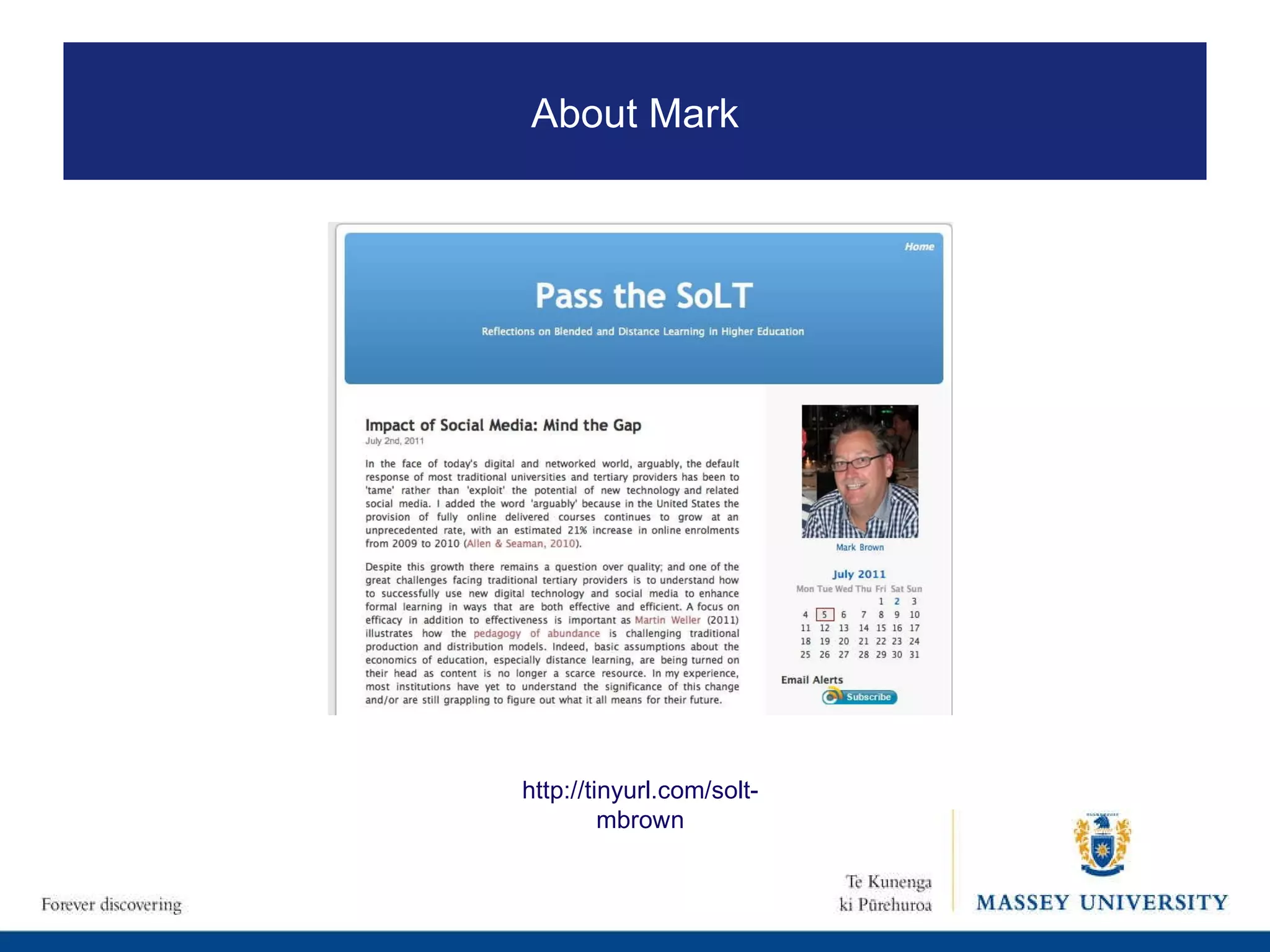
•  Director, Teaching, Learning & Distance Education •  Previous Coordinator of the Doctor of Education (EdD) •  On original Steering Committee for Mahara •  On several executive committees (ACiLiTE, DEANZ, DEHub,) •  On several journal editorial boards ( Research in Learning Technology, Journal of Further and Higher Education,  etc) •  Current Horizon Report Board Member •  Recipient of National Award for Sustained Excellence in Tertiary Teaching •  Try to share some of my musings in “Pass the SoLT” [email_address] About Mark
http://tinyurl.com/solt-mbrown About Mark
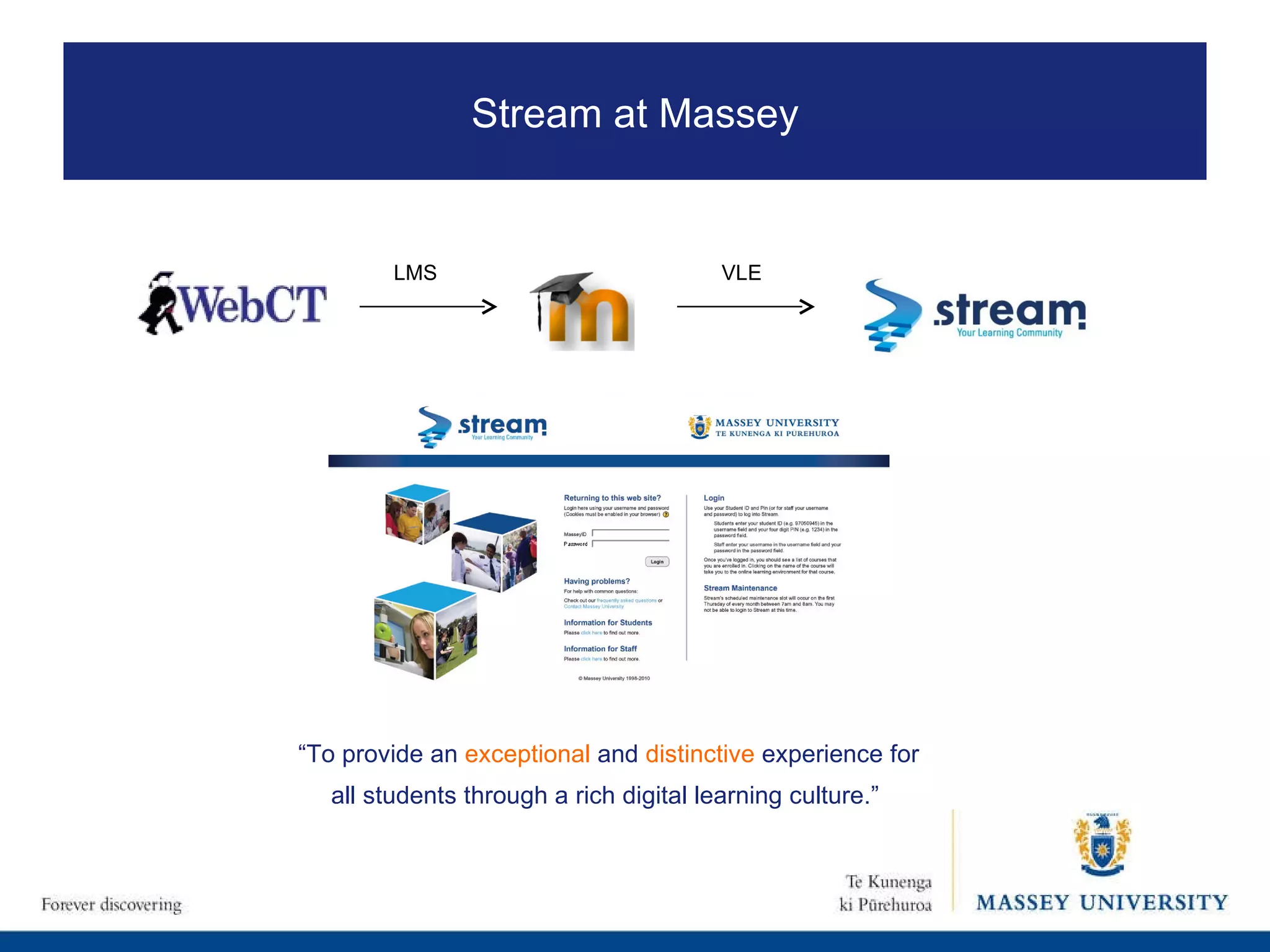
LMS VLE Stream at Massey “ To provide an  exceptional  and  distinctive  experience for all students through a rich digital learning culture.”
MyPortfolio - Their place Stream - Our place Stream at Massey
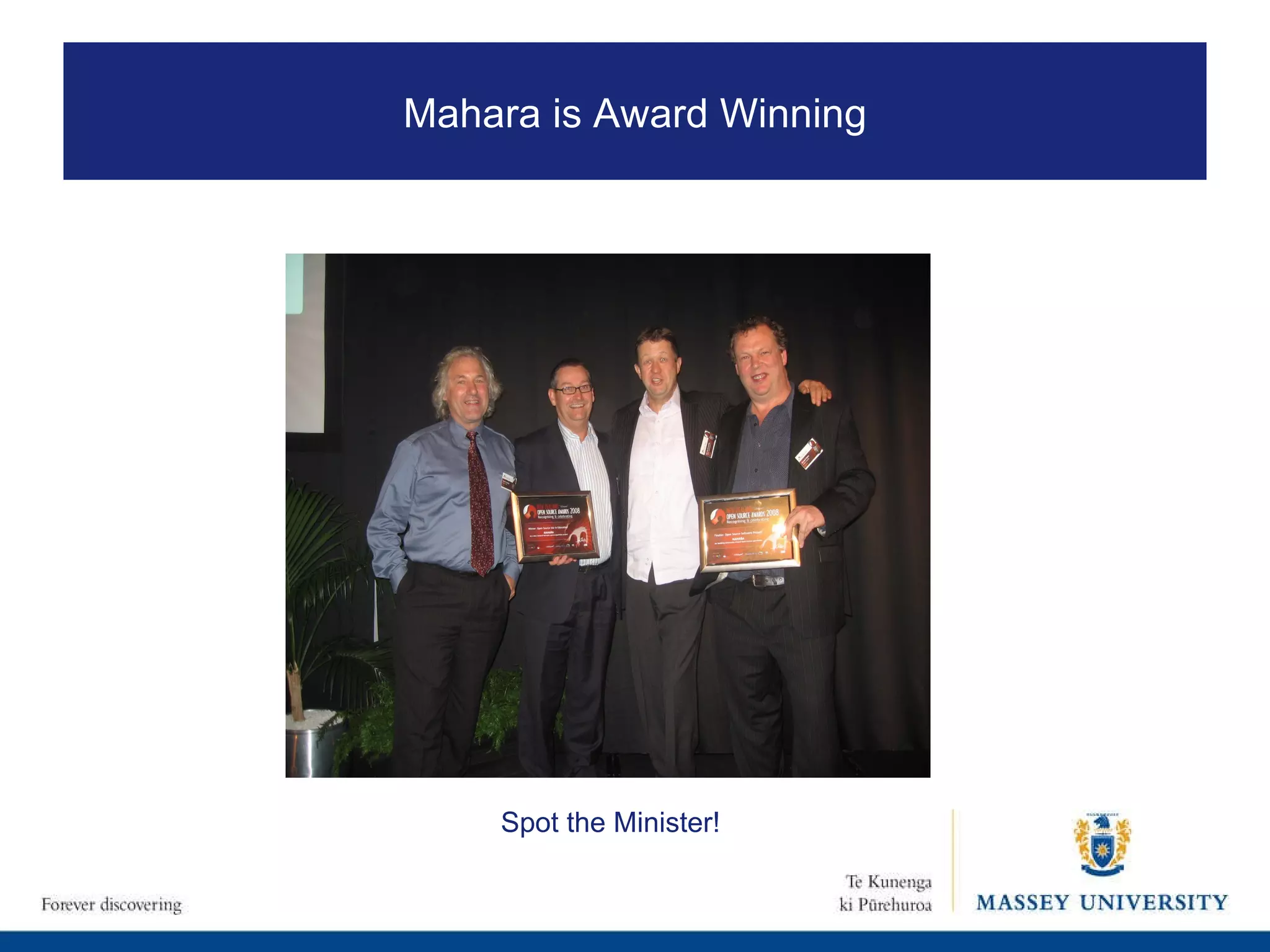
Spot the Minister! Mahara is Award Winning
If ePortfolios are the Solution, then what is the Problem?
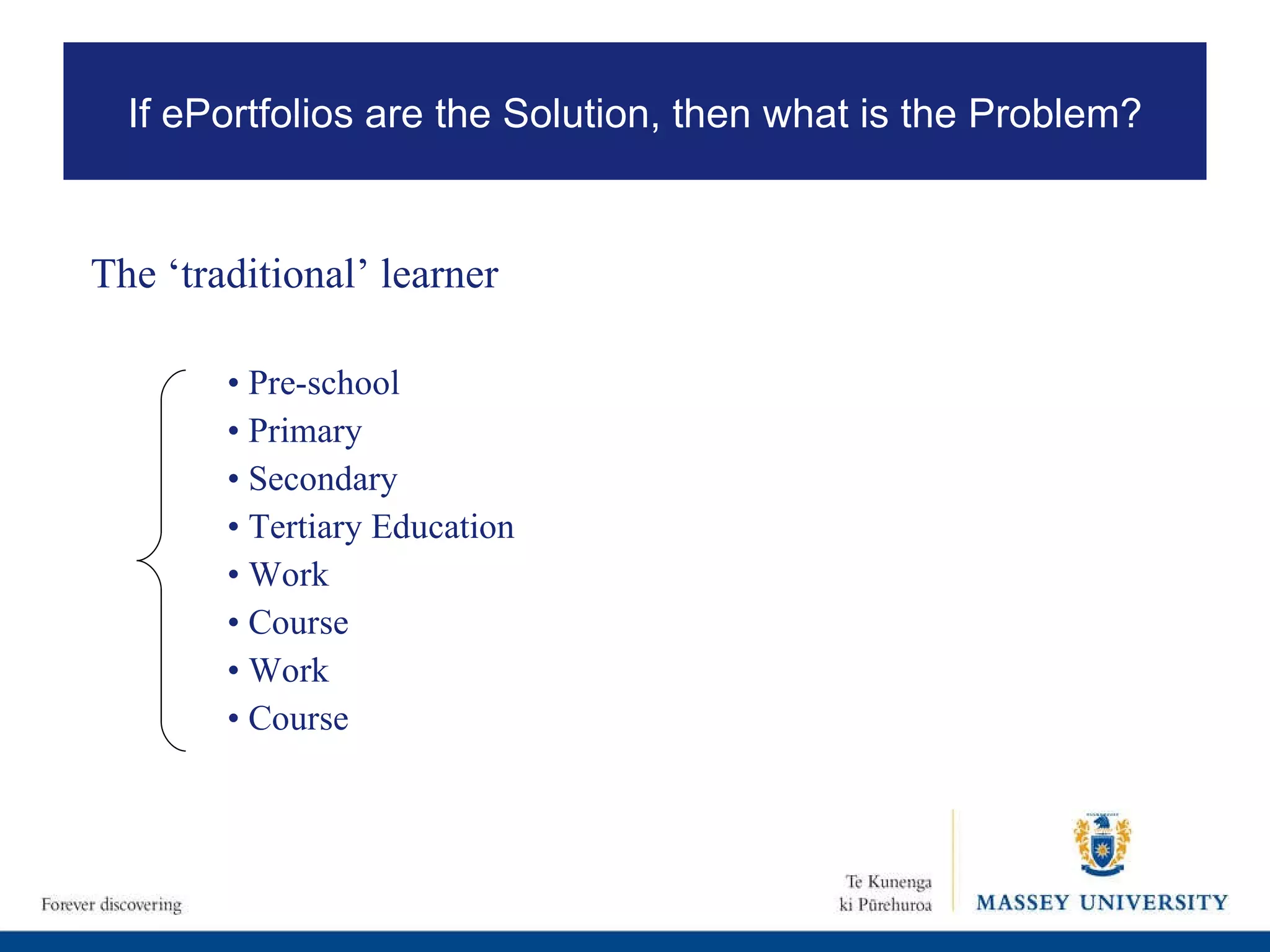
The ‘traditional’ learner •  Pre-school •  Primary •  Secondary •  Tertiary Education •  Work •  Course •  Work •  Course If ePortfolios are the Solution, then what is the Problem?
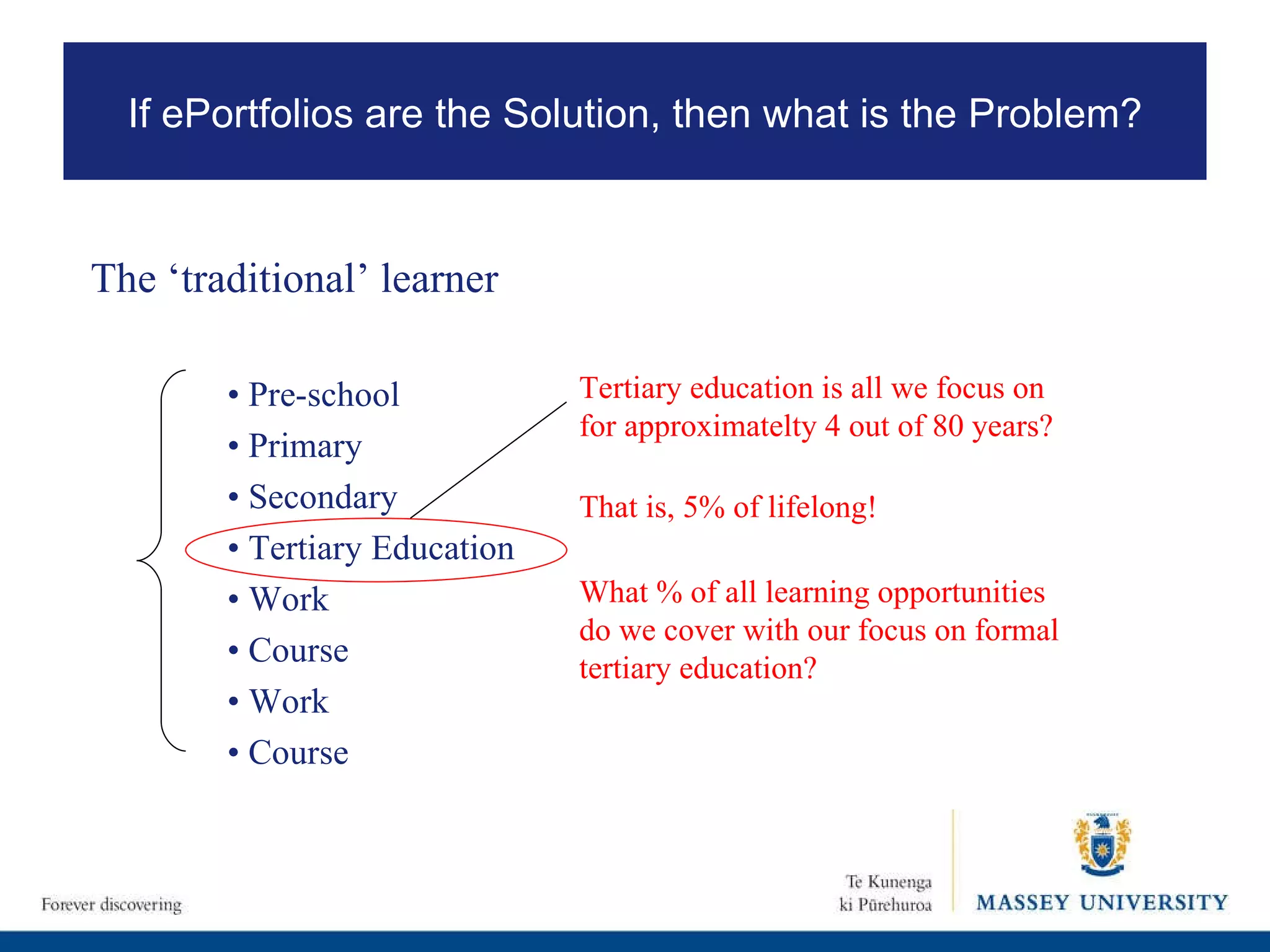
Tertiary education is all we focus on for approximatelty 4 out of 80 years? That is, 5% of lifelong! What % of all learning opportunities do we cover with our focus on formal tertiary education? The ‘traditional’ learner •  Pre-school •  Primary •  Secondary •  Tertiary Education •  Work •  Course •  Work •  Course If ePortfolios are the Solution, then what is the Problem?
If ePortfolios are the Solution, then what is the Problem?
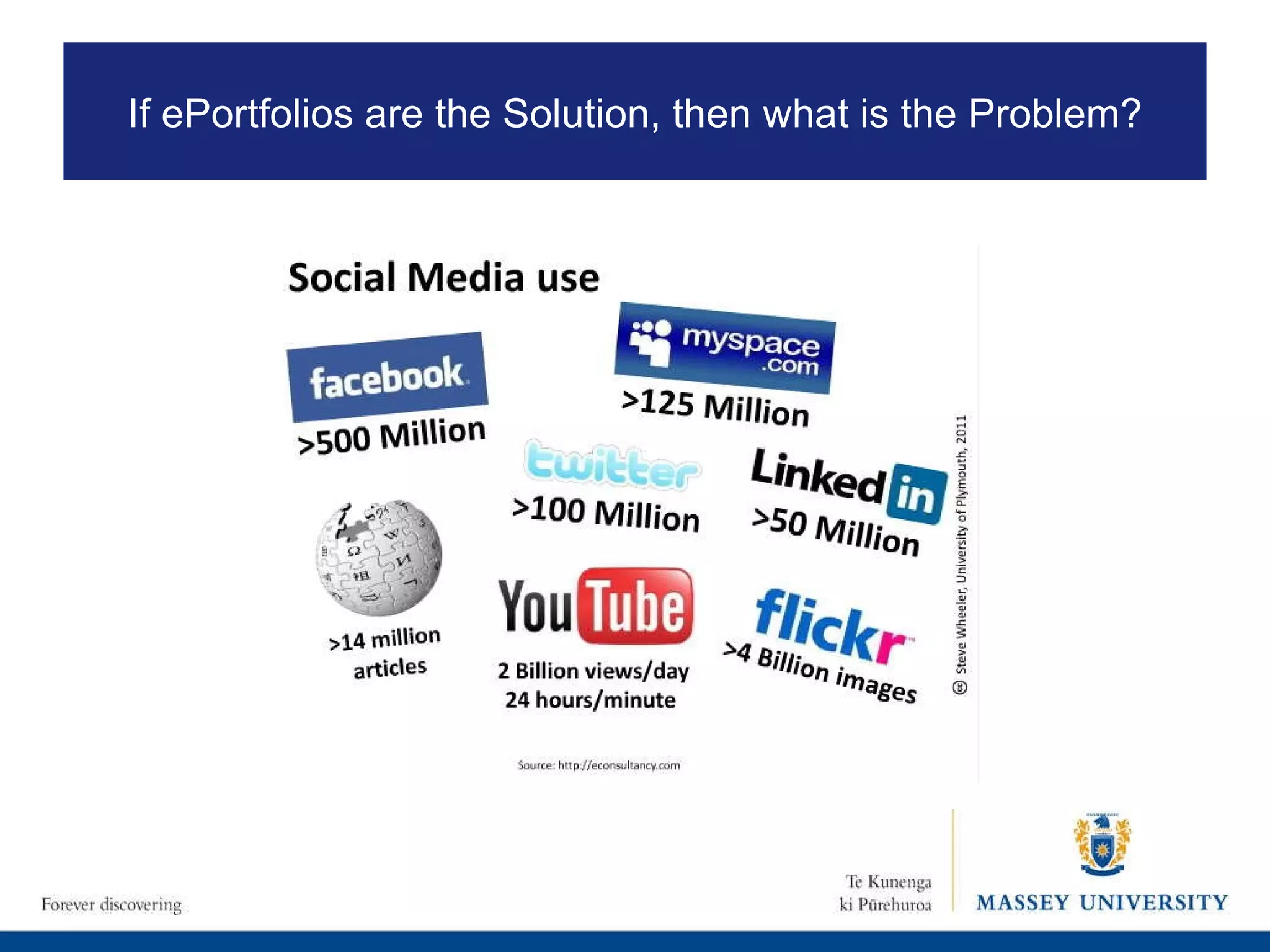
There is a growing gap between how we learn informally and the way we design and offer formal learning.  What does all this mean? If ePortfolios are the Solution, then what is the Problem?
1. About Mahara 2. A Case Study in Practice 3. Thinking Strategically about Blended Learning If ePortfolios are the Solution, then what is the Problem?
While ePortfolios have tremendous potential their successful implementation in tertiary education is another matter. We may  damage  the mission of promoting life-long learning by restricting our thinking to formal institutional learning.  If ePortfolios are the Solution, then what is the Problem? Central message…
1. About Mahara
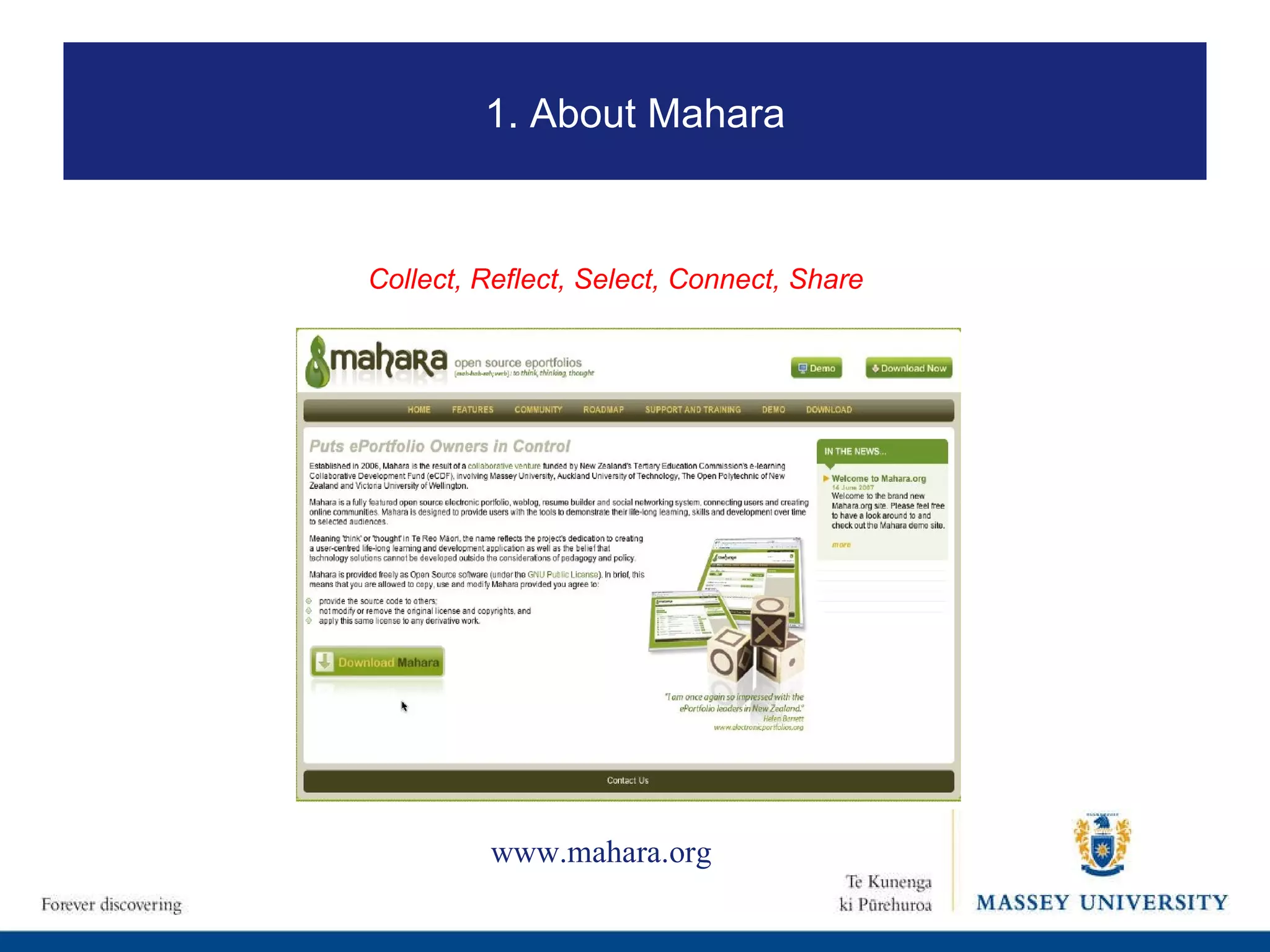
•  Open source eportfolio - 2007 •  Mahara ( Te Reo Māori for ‘think’ or ‘thought’) •  Funded by New Zealand Government ($700,000) •  Collaborative project led by Massey University •  Learner ownership was the key driver and principle •  Huge level of interest and significant international uptake •  Designed to provide an environment for critical reflection and life-long learning 1. About Mahara
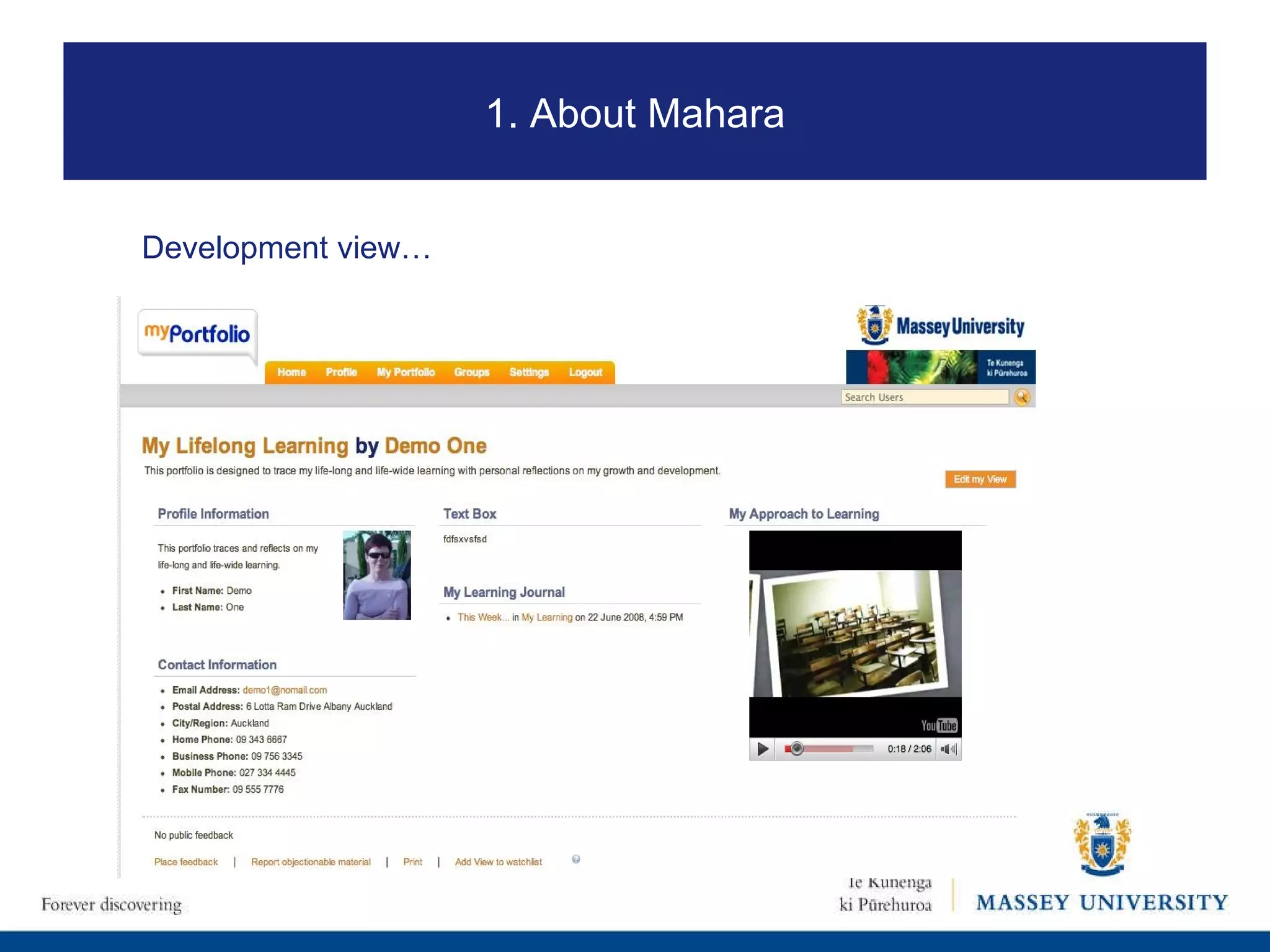
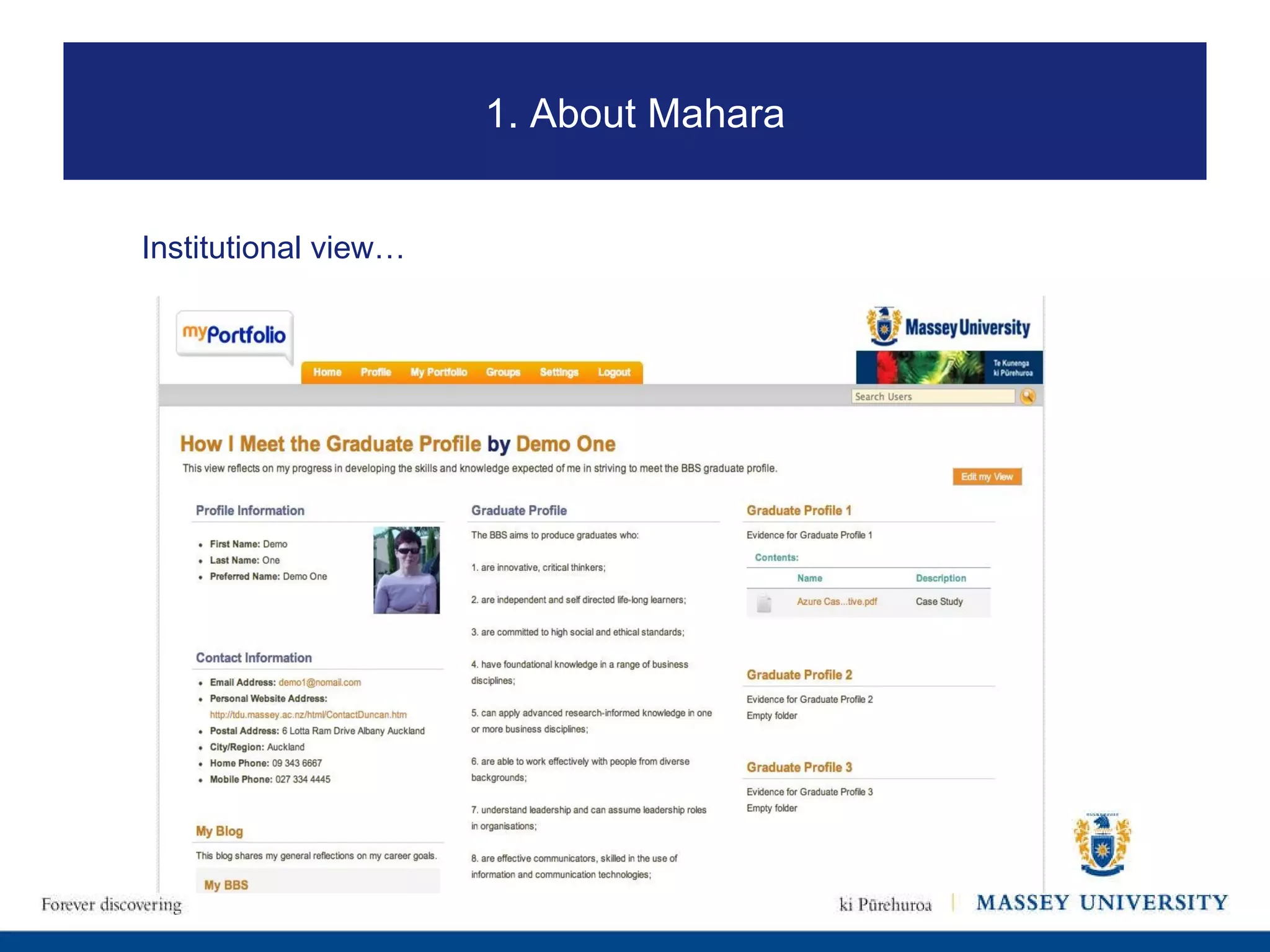
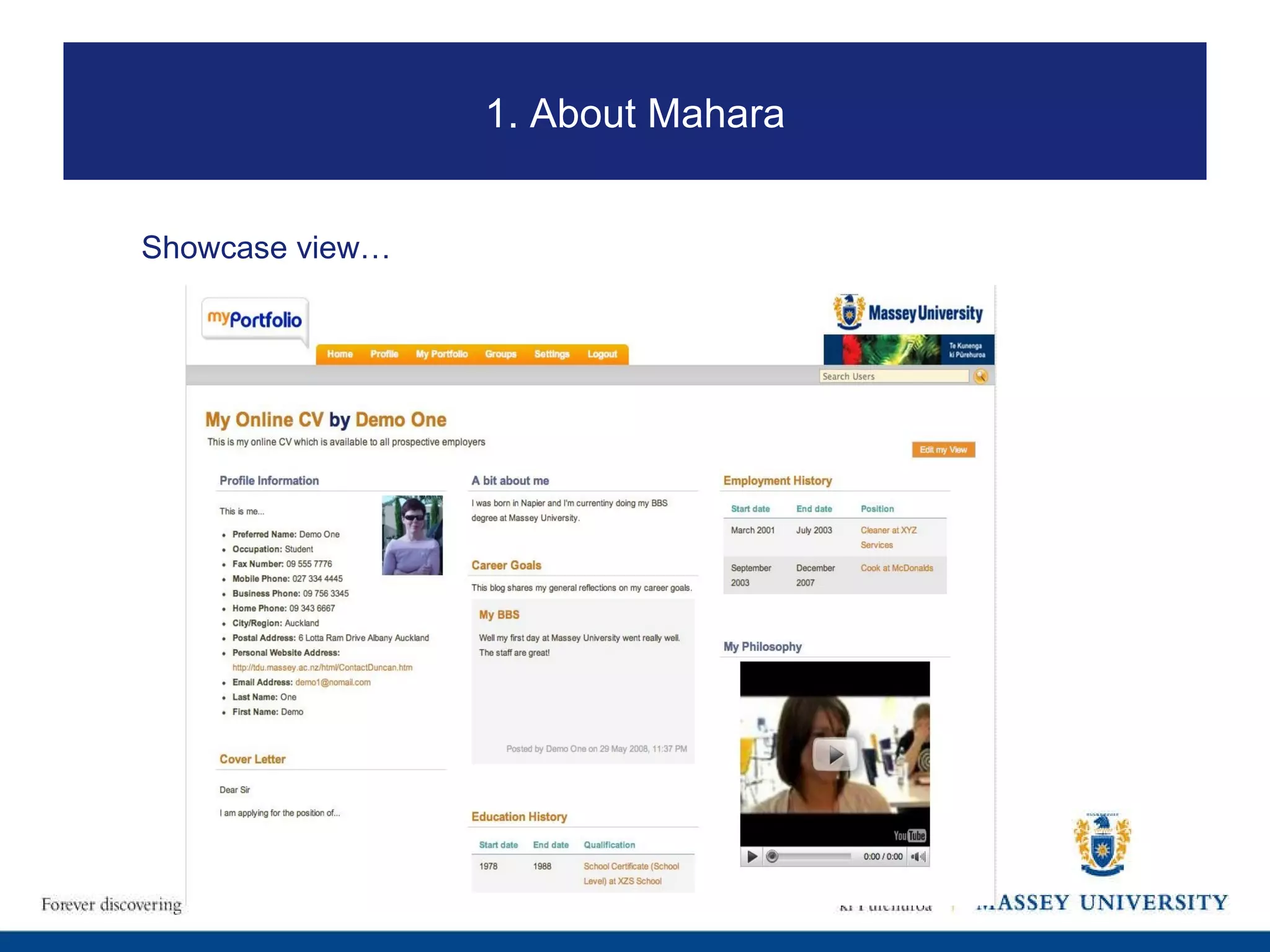
A bit about eportfolios… Wealth of literature supporting the use of eportfolios in education  An eportfolio is an online collection of digital artifacts and reflections (e.g., images, lesson plans, assignments, feedback reports, etc) Provides more authentic and arguably valid evidence of learning Three main uses or categories of eportfolio:  Development Institutional Showcase 1. About Mahara
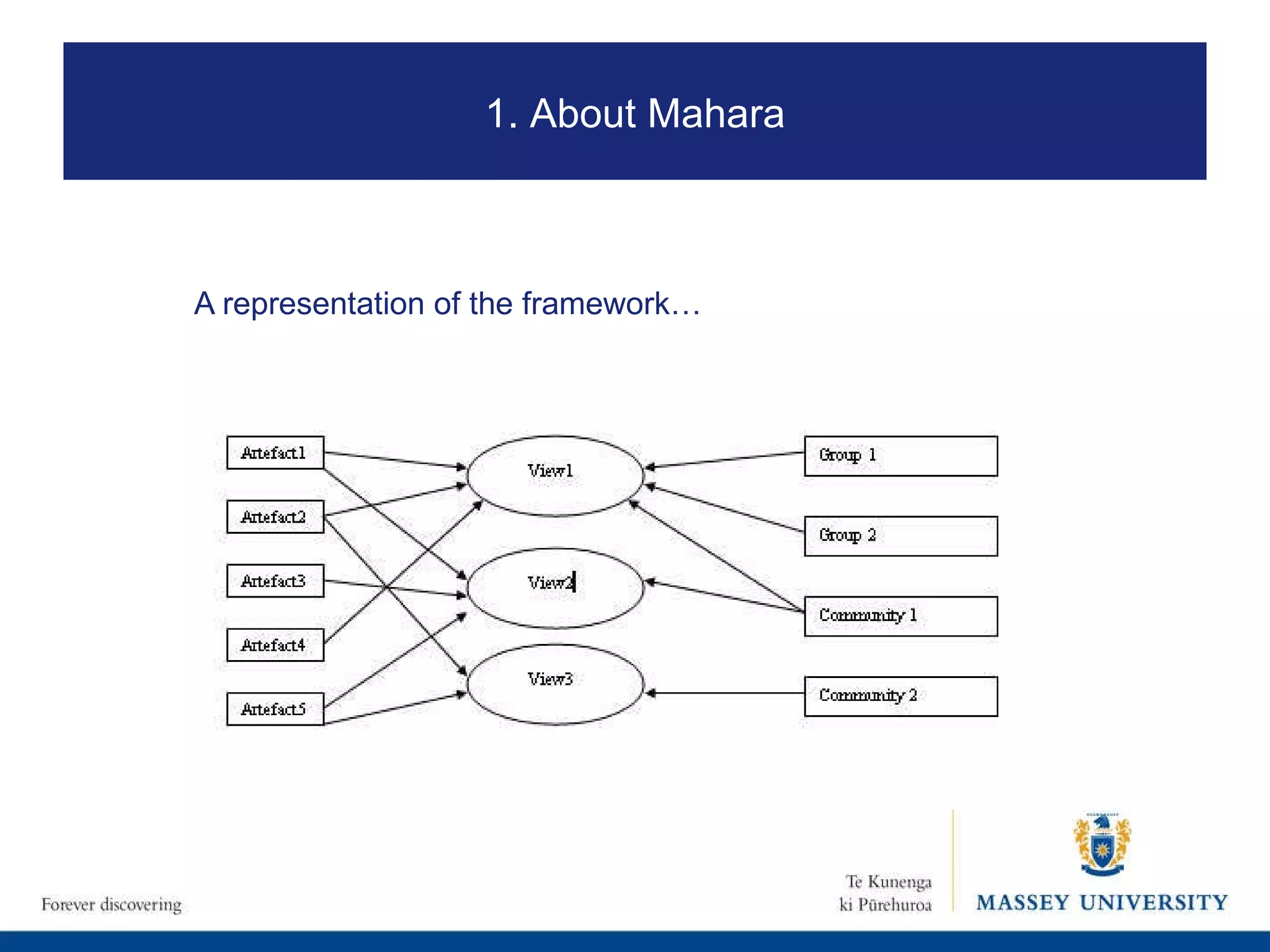
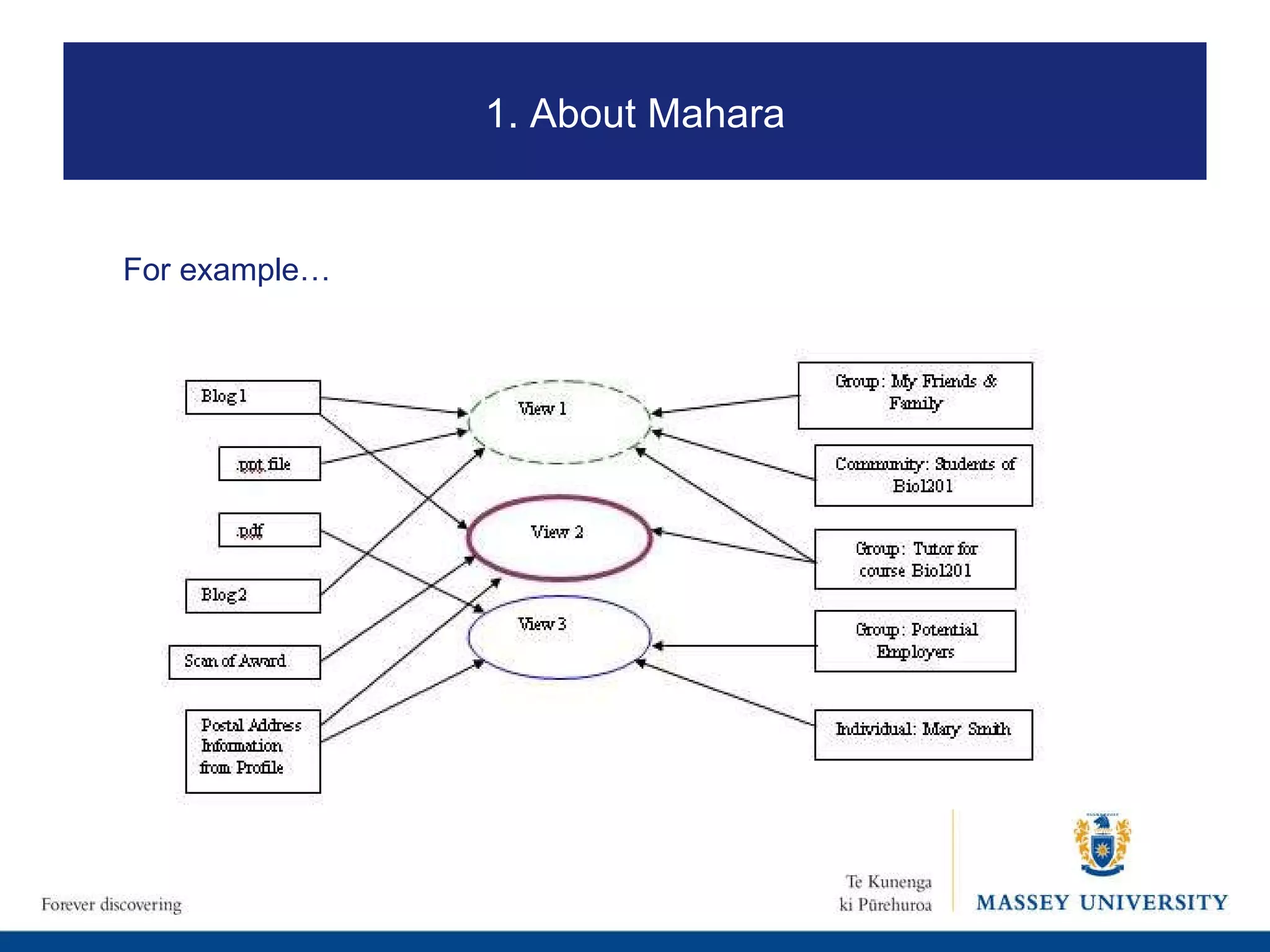
Mahara is based on an  Artefacts, Views  and  Access  framework Views  are a collection of any number of artefacts that exist in a student’s portfolio Students can create any number of  ‘views’  and assign view access to any number of individuals, groups and/or communities as they wish Basic Framework… 1. About Mahara
A representation of the framework… 1. About Mahara
For example… 1. About Mahara
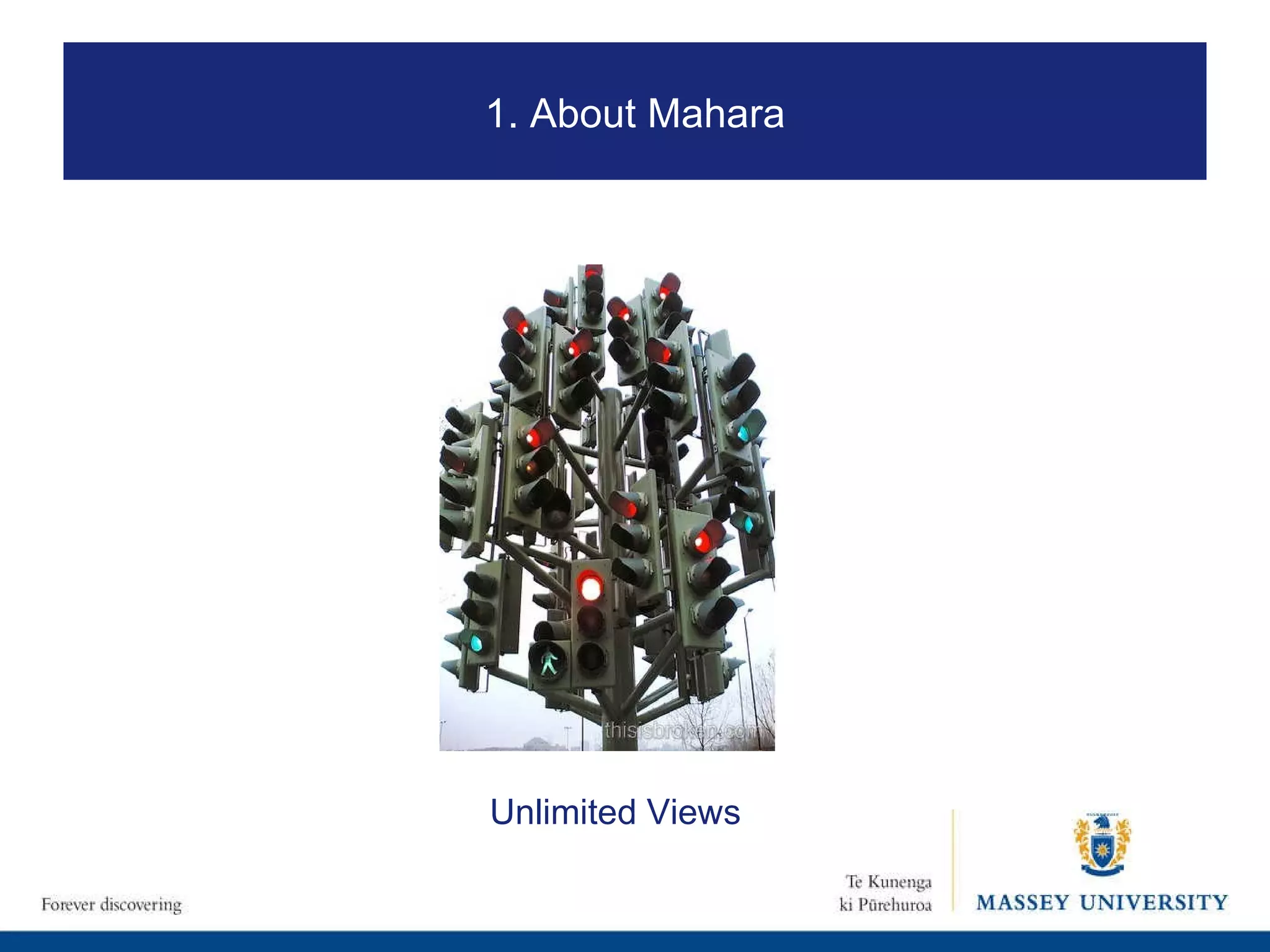
Unlimited Views 1. About Mahara
Development view… 1. About Mahara
Institutional view… 1. About Mahara
Showcase view… 1. About Mahara
1. About Mahara
www.mahara.org Collect, Reflect, Select, Connect, Share 1. About Mahara
2. Case Study in Practice
A Massey example…   2. Case Study in Practice “ Learning is not a  spectator sport.  Students do not learn much just sitting in classes listening to teachers, memorizing prepackaged assignments, and spitting out answers.
“ Learning is not a  spectator sport.  Students do not learn much just sitting in classes listening to teachers, memorizing prepackaged assignments, and spitting out answers.  They must talk about what they are learning, write  reflectively  about it, relate it to past experiences, and apply it to their daily lives. They must make what they learn part of themselves”  (Chickering & Gamson, 1987). 2. Case Study in Practice A Massey example…
An example from initial teacher education… 2. Case Study in Practice
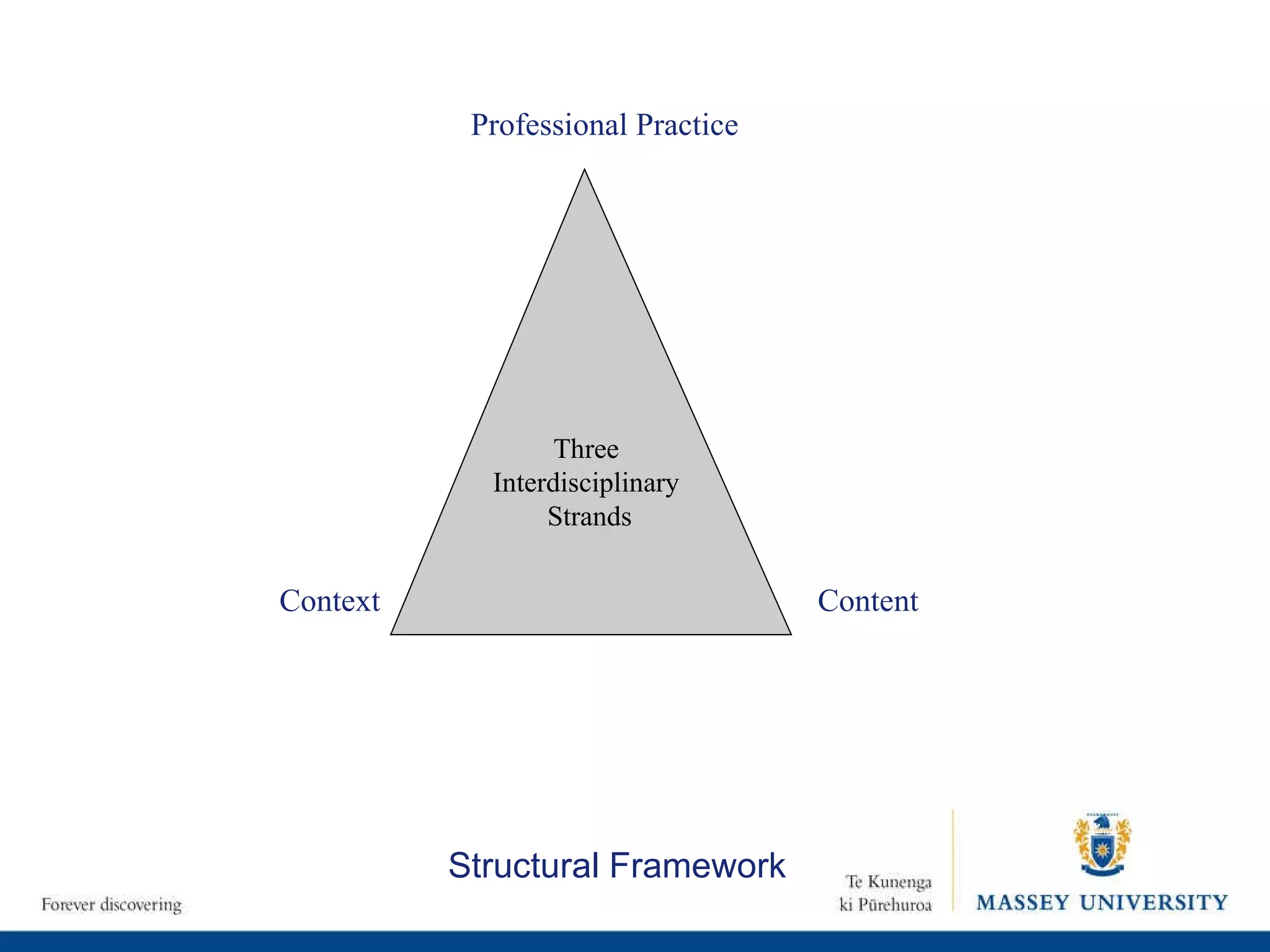
Structural Framework Three  Interdisciplinary  Strands Context Content Professional Practice
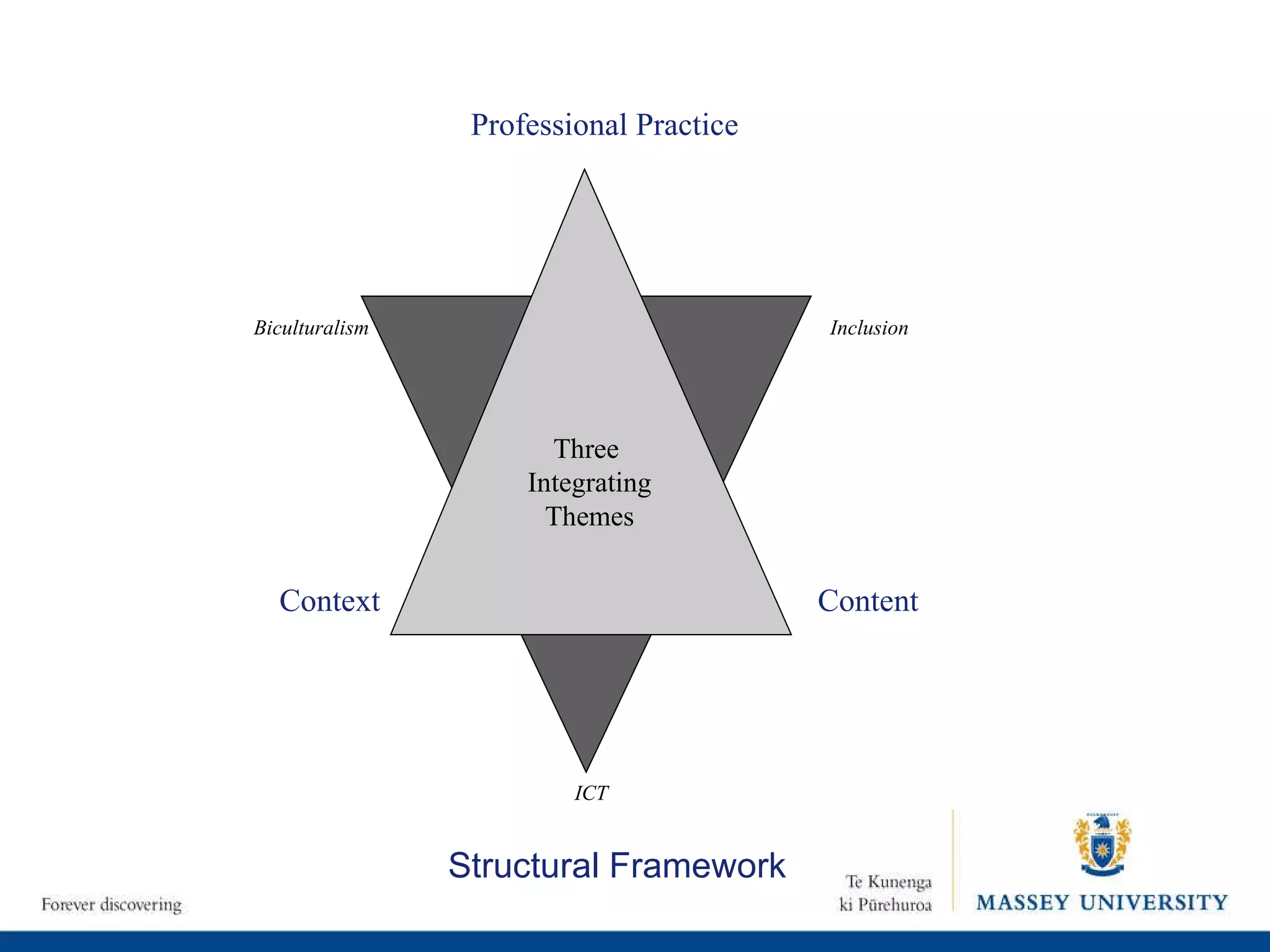
ICT Inclusion Biculturalism Three  Integrating Themes Structural Framework Context Content Professional Practice
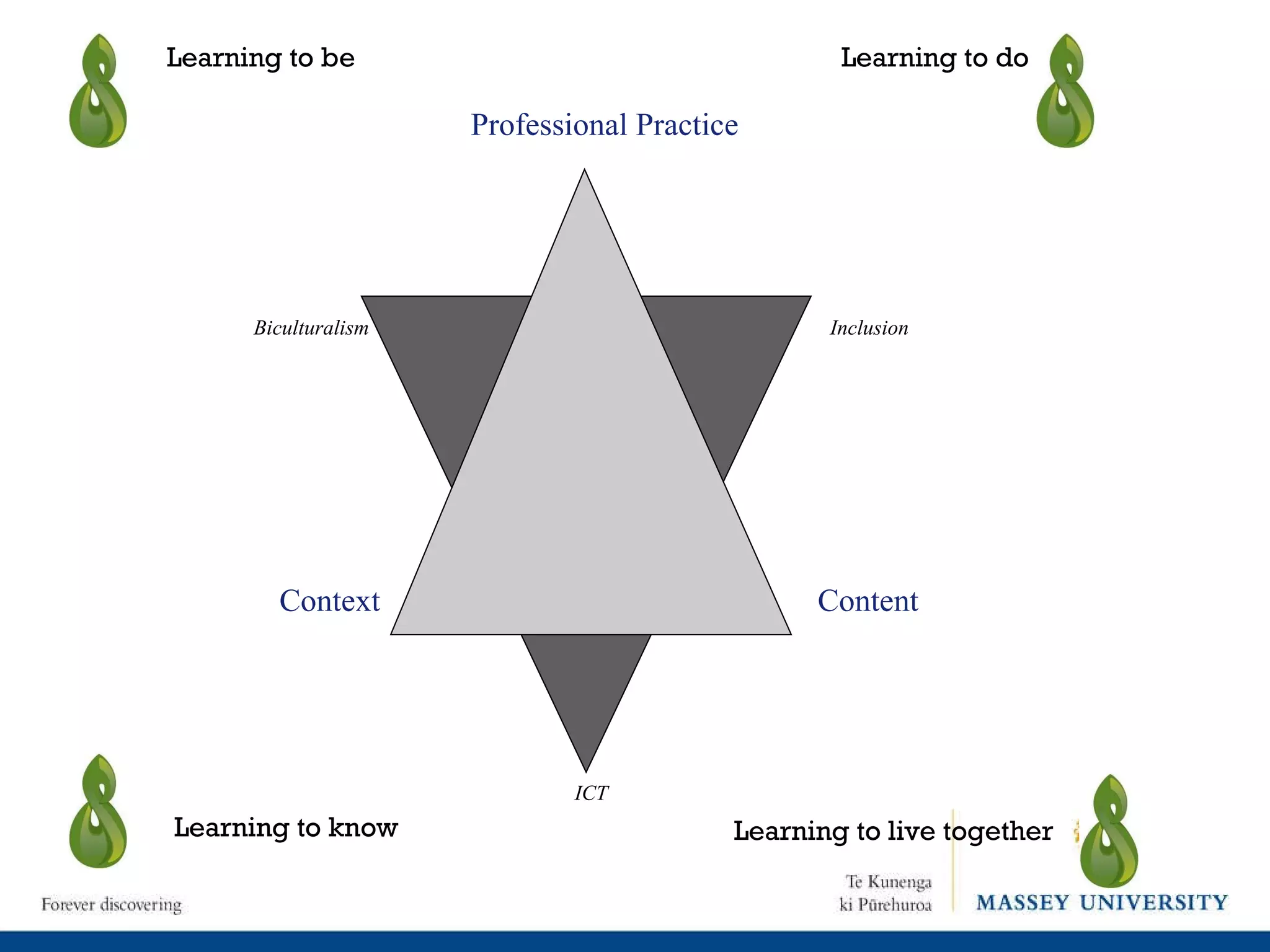
ICT Inclusion Biculturalism Learning to be Learning to do Learning to know Learning to live together Context Content Professional Practice
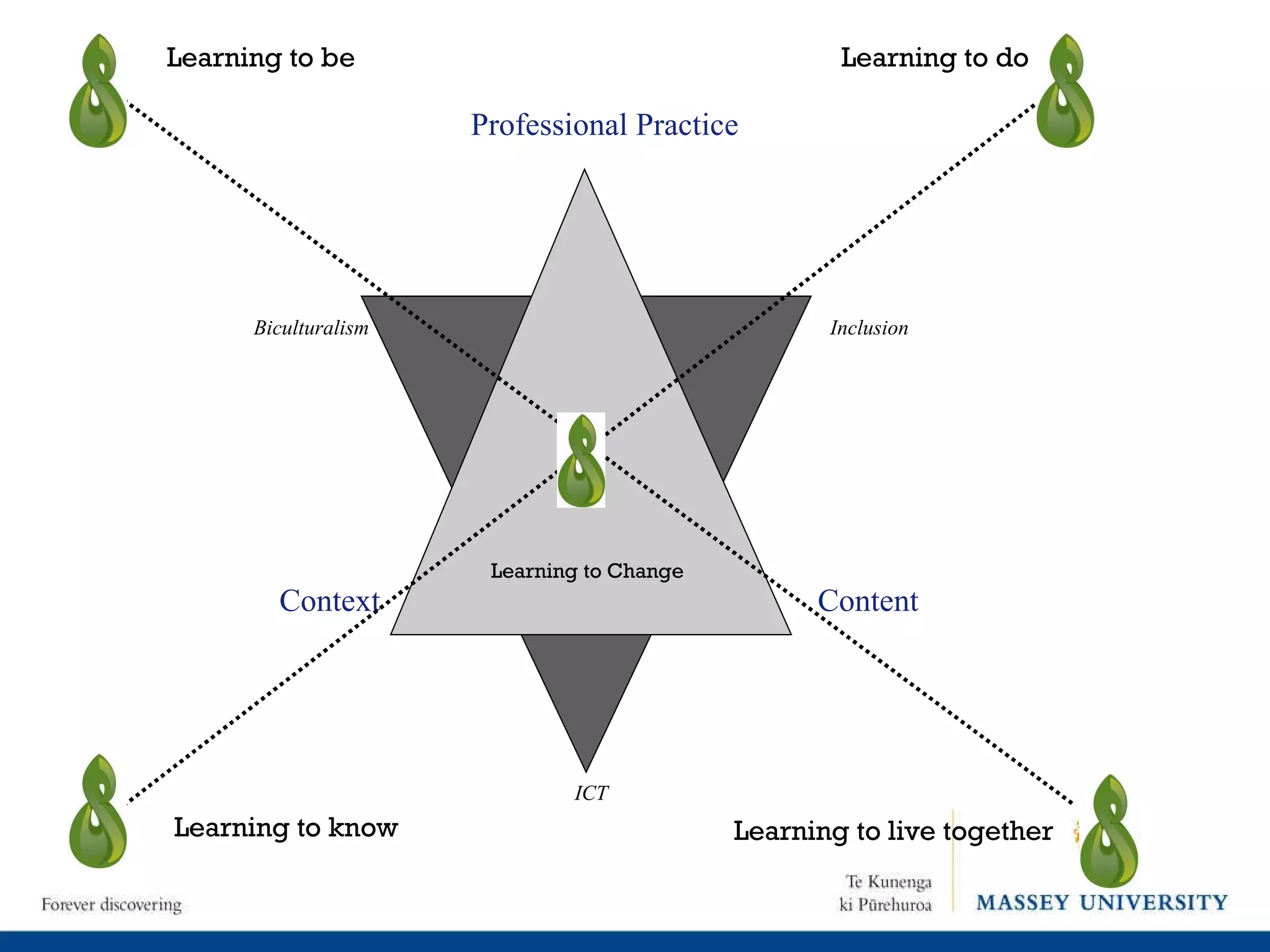
Context Content ICT Inclusion Biculturalism Professional Practice Learning to be Learning to do Learning to Change Learning to know Learning to live together
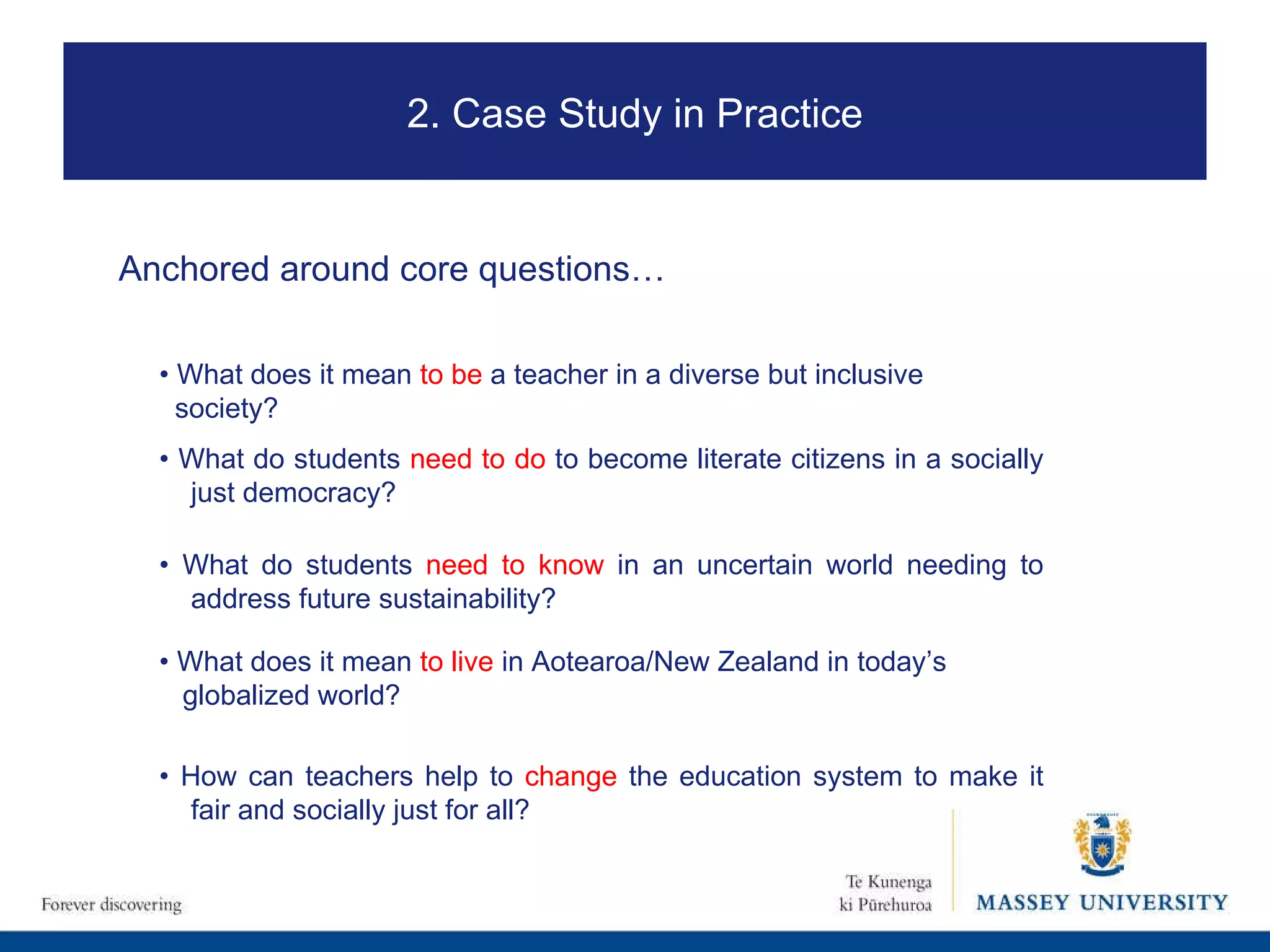
Anchored around core questions… •  What does it mean  to be  a teacher in a diverse but inclusive  society? •  What do students  need to do  to become literate citizens in a socially just democracy? •  What do students  need to know  in an uncertain world needing to address future sustainability? •  What does it mean  to live  in Aotearoa/New Zealand in today’s  globalized world? •  How can teachers help to  change  the education system to make it fair and socially just for all? 2. Case Study in Practice
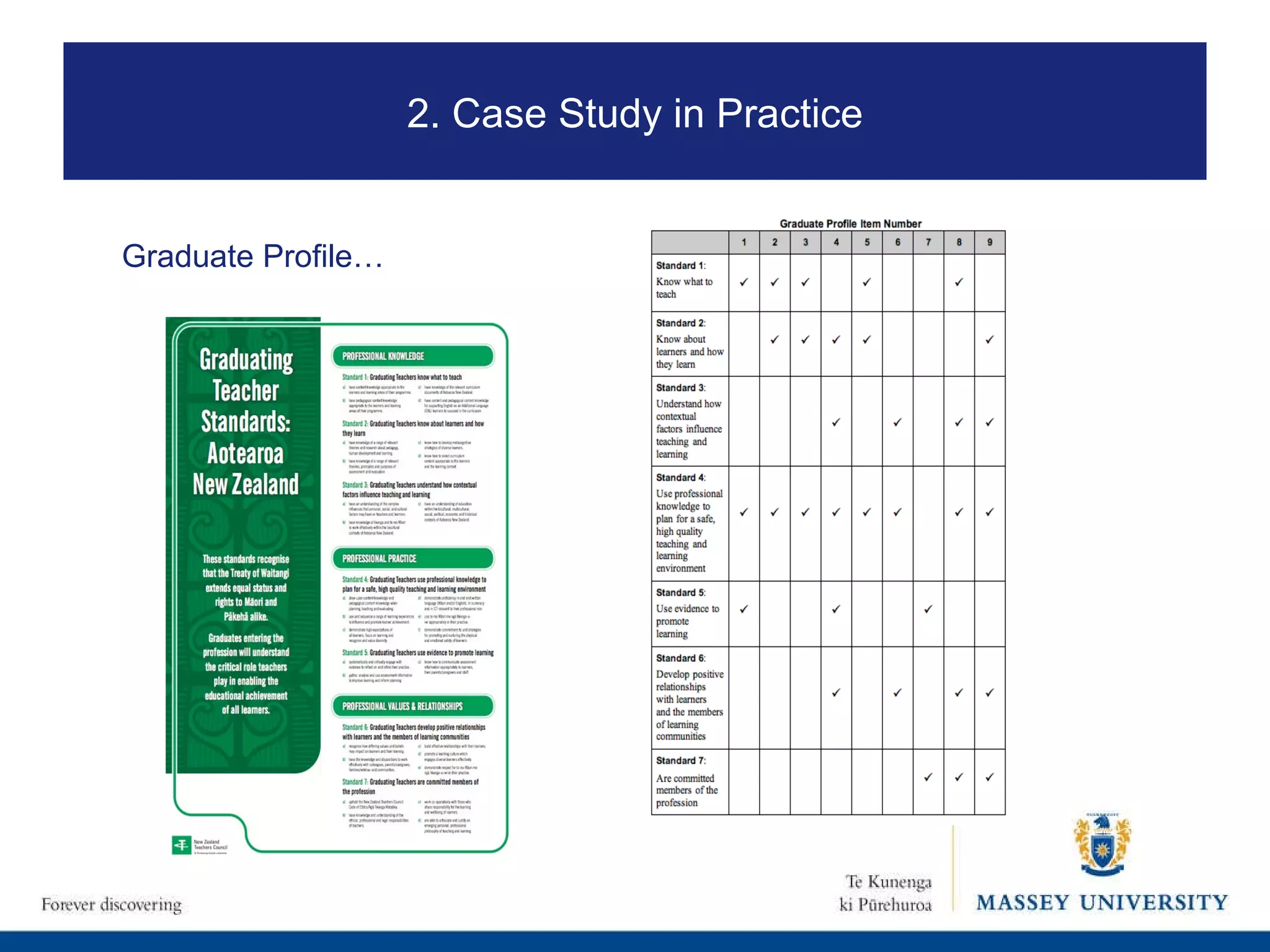
Graduate Profile… 2. Case Study in Practice
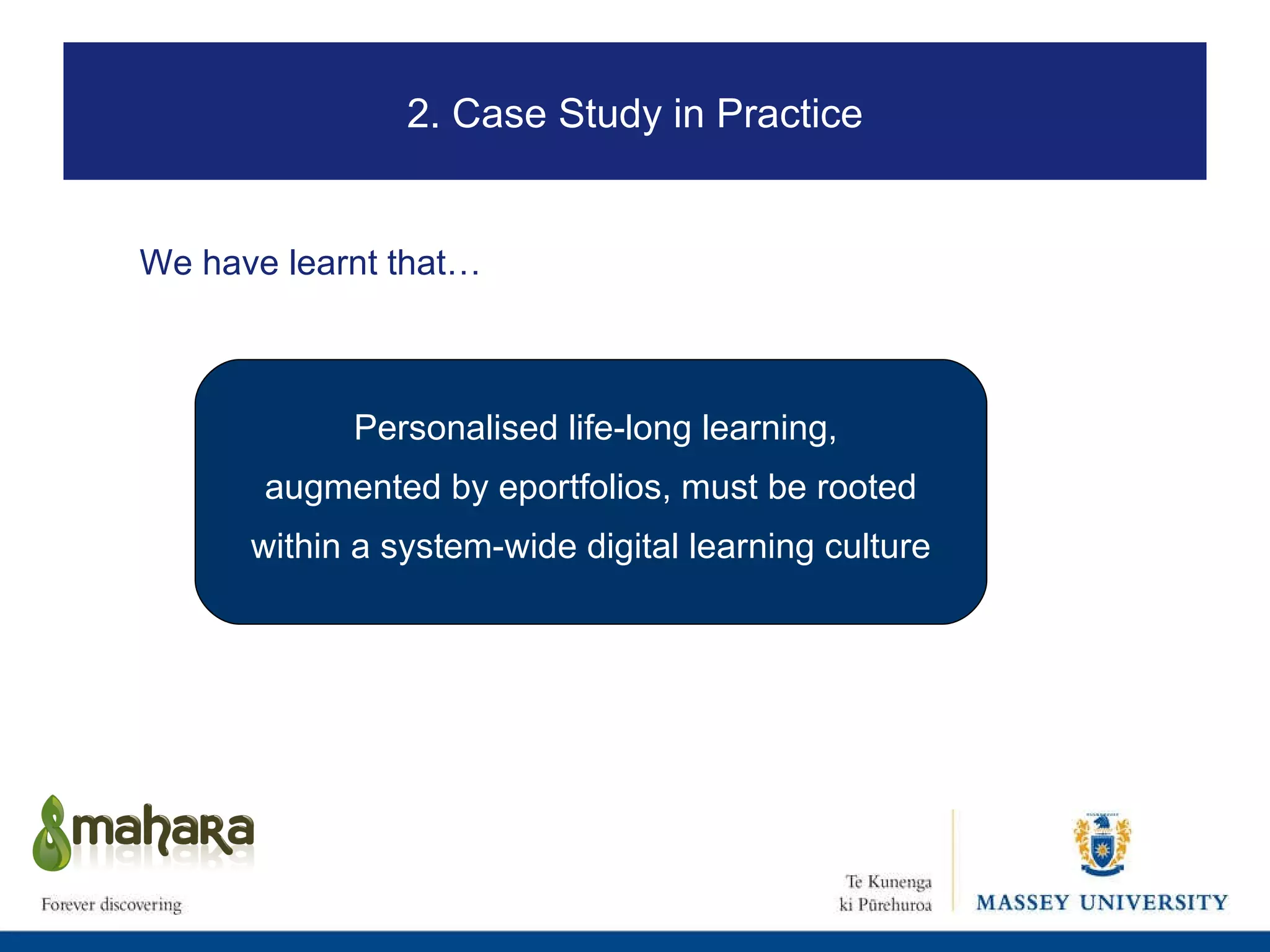
Personalised life-long learning, augmented by eportfolios, must be rooted  within a system-wide digital learning culture   We have learnt that… 2. Case Study in Practice
3. Thinking Strategically About Blended Learning
Moodle/Mahara is not just an online environment but the catalyst for a  new strategic direction  which gives the opportunity to rethink, redesign and future-proof your curriculum/institution. 3. Thinking Strategically About Blended Learning
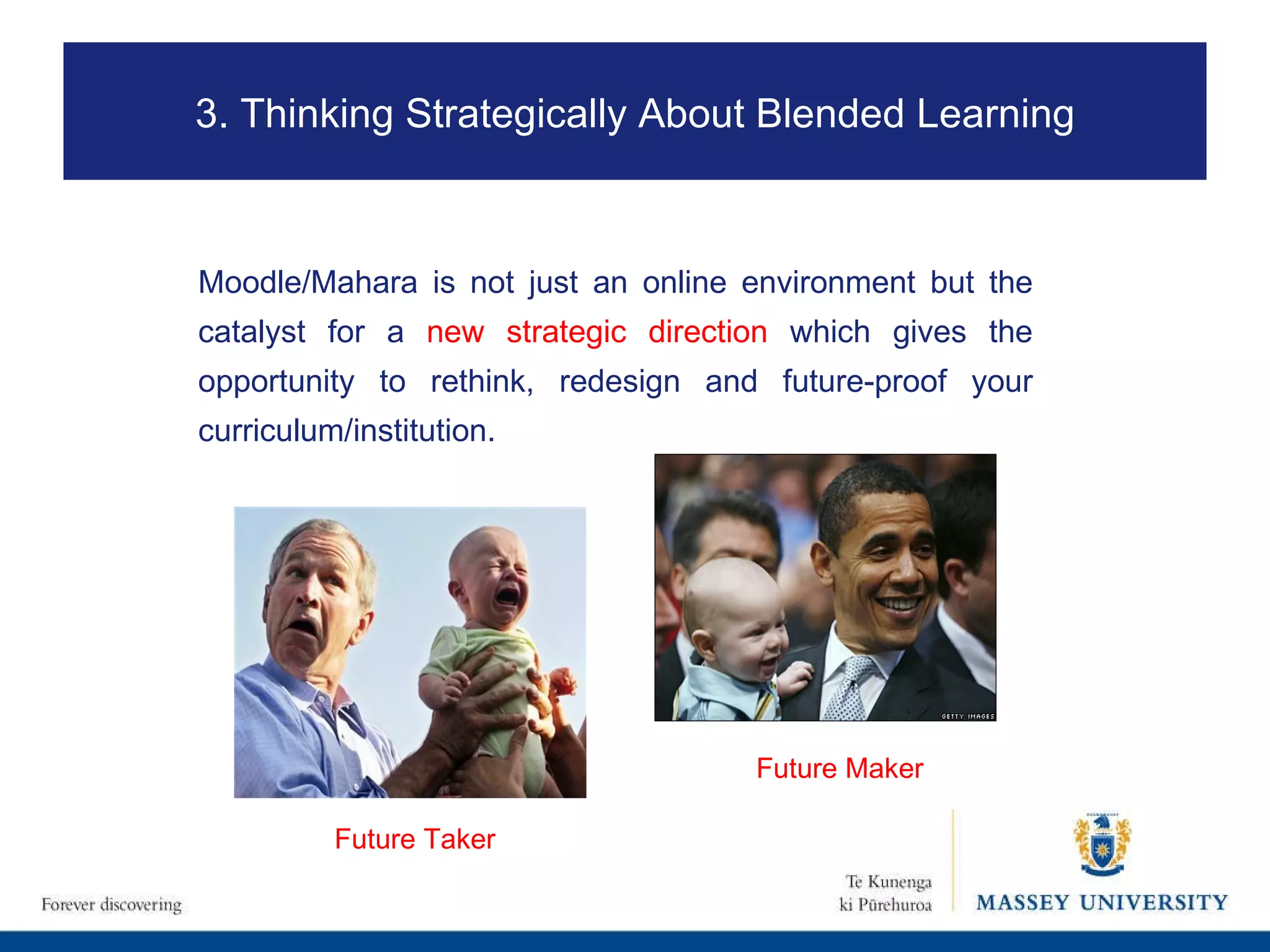
Future Maker Future Taker Moodle/Mahara is not just an online environment but the catalyst for a  new strategic direction  which gives the opportunity to rethink, redesign and future-proof your curriculum/institution. 3. Thinking Strategically About Blended Learning
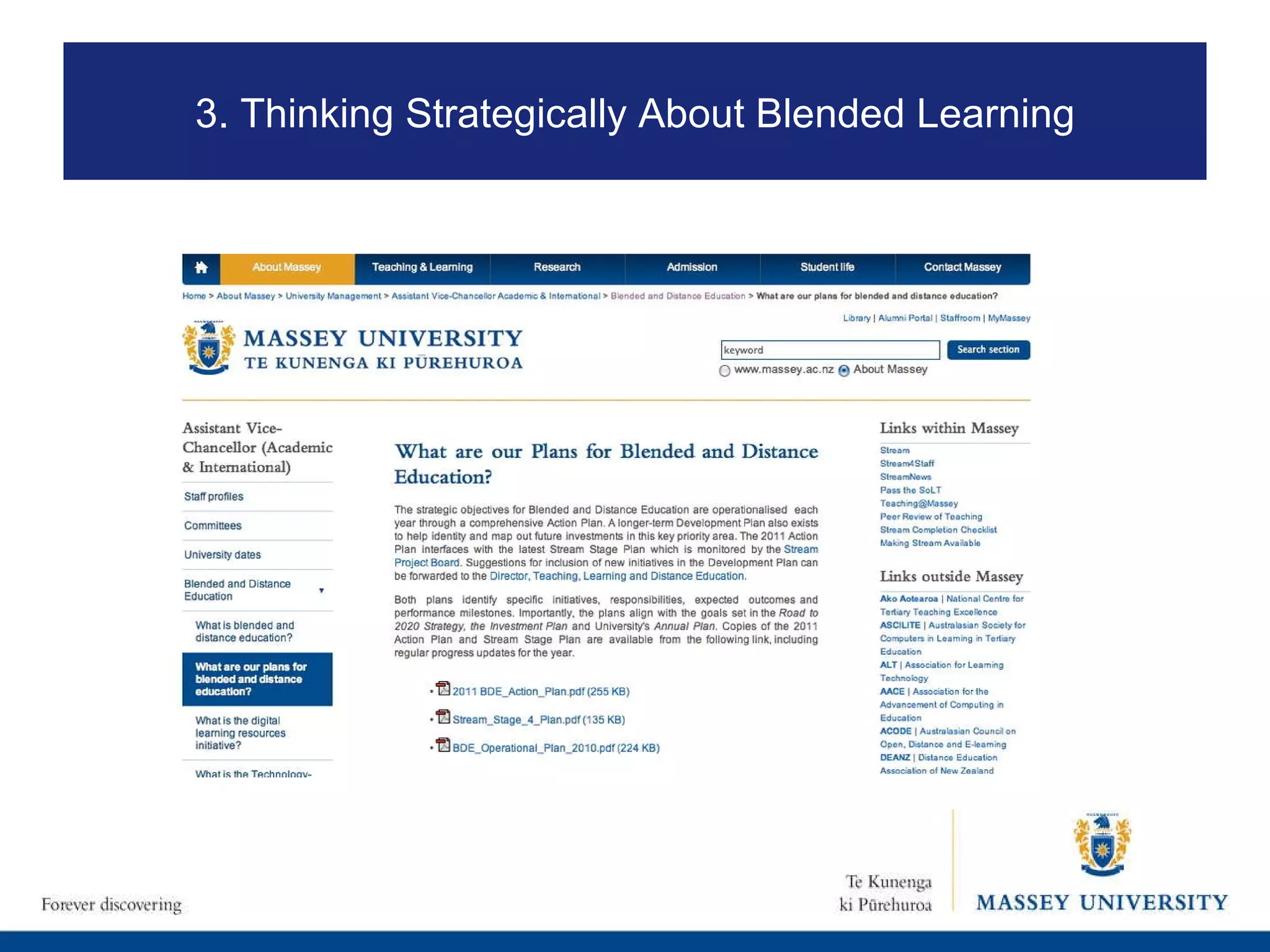
3. Thinking Strategically About Blended Learning
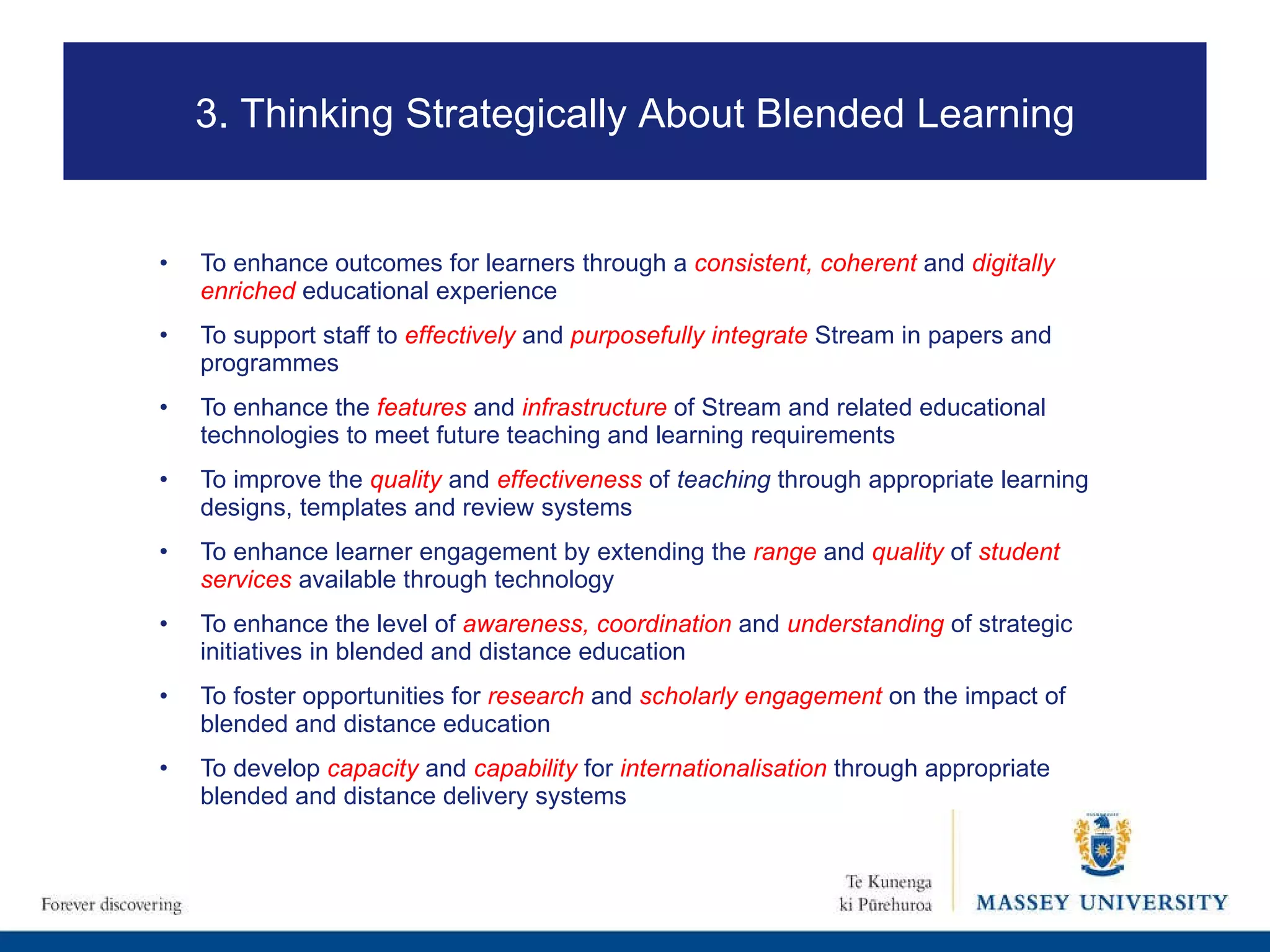
To enhance outcomes for learners through a  consistent, coherent   and  digitally   enriched  educational experience  To support staff to  effectively  and  purposefully integrate   Stream in papers and programmes To enhance the  features  and  infrastructure  of Stream and related educational technologies to meet future teaching and learning requirements   To improve  the  quality  and  effectiveness   of  teaching  through appropriate learning designs, templates and review systems To  enhance learner engagement by extending the  range   and  quality  of  student   services  available through technology To enhance the level of   awareness, coordination   and  understanding  of strategic initiatives in blended and distance education   To foster opportunities for  research   and  scholarly engagement   on the impact of blended and distance education To develop  capacity  and  capability  for  internationalisation  through appropriate blended and distance delivery systems 3. Thinking Strategically About Blended Learning
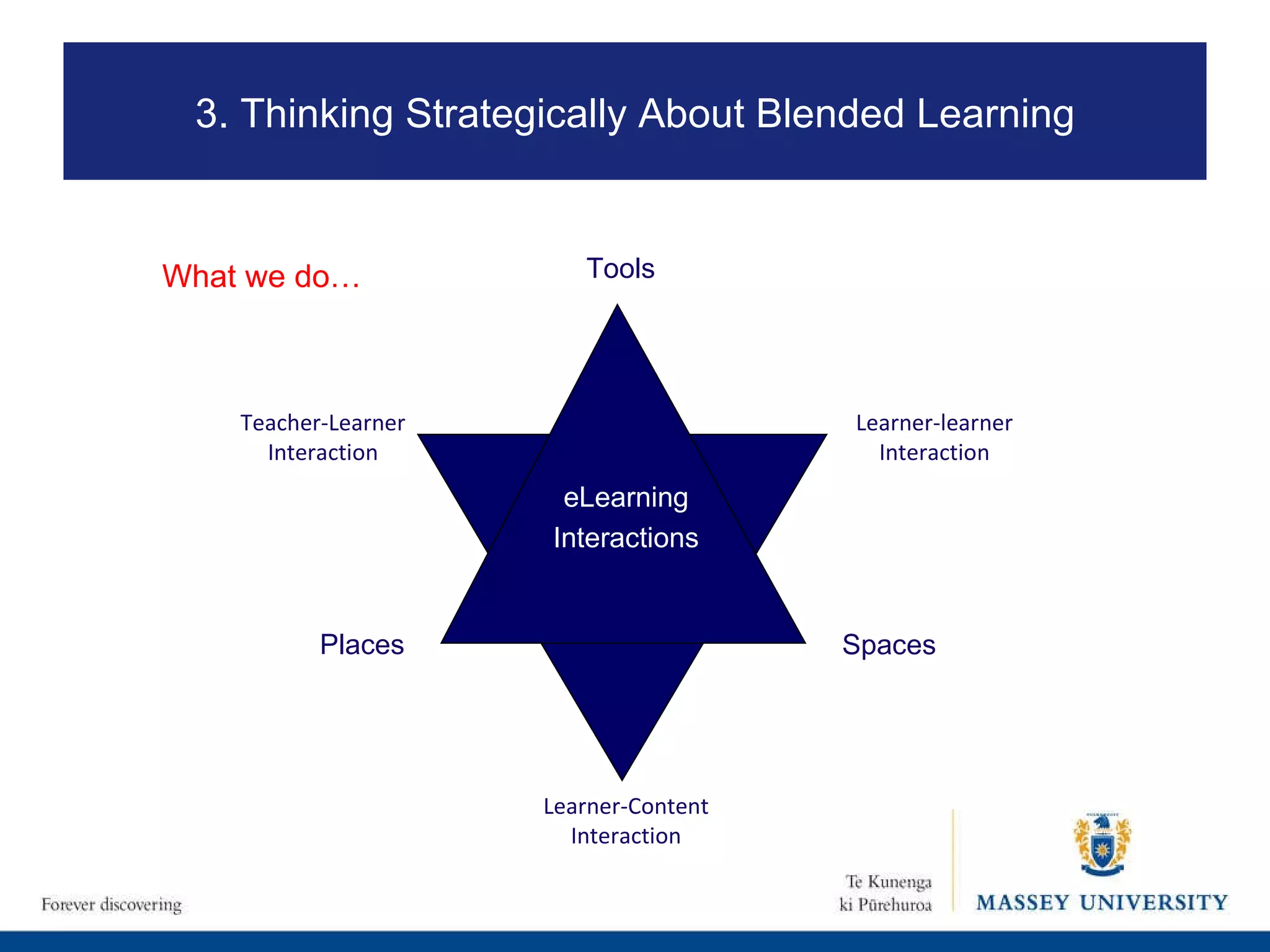
Places Tools Learner-Content Interaction Learner-learner Interaction Spaces Teacher-Learner Interaction eLearning Interactions 1. What is eLearning? What we do… 3. Thinking Strategically About Blended Learning
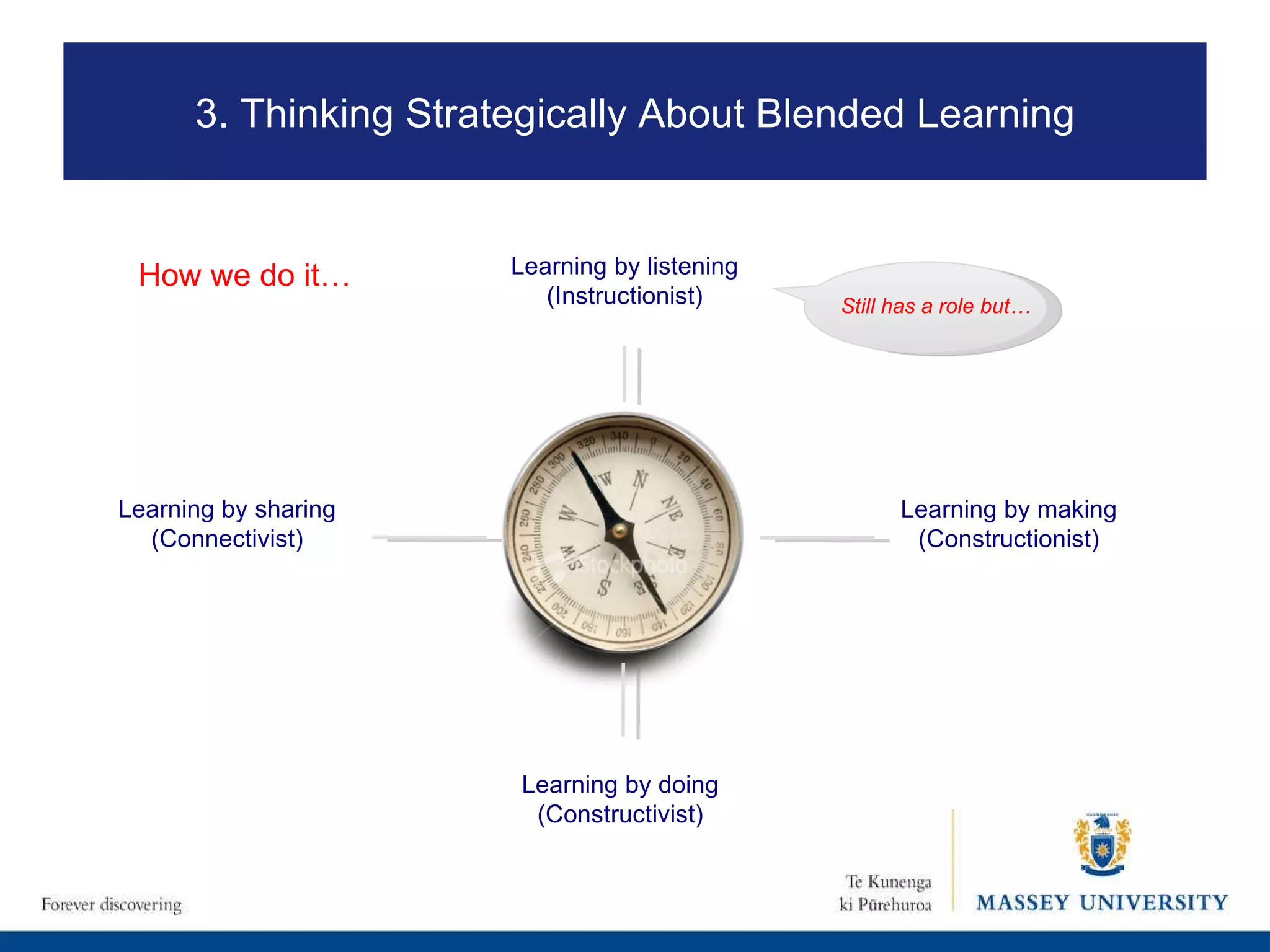
Learning by sharing (Connectivist) Learning by listening (Instructionist) Learning by doing (Constructivist) Learning by making (Constructionist) Still has a role but… How we do it… 3. Thinking Strategically About Blended Learning
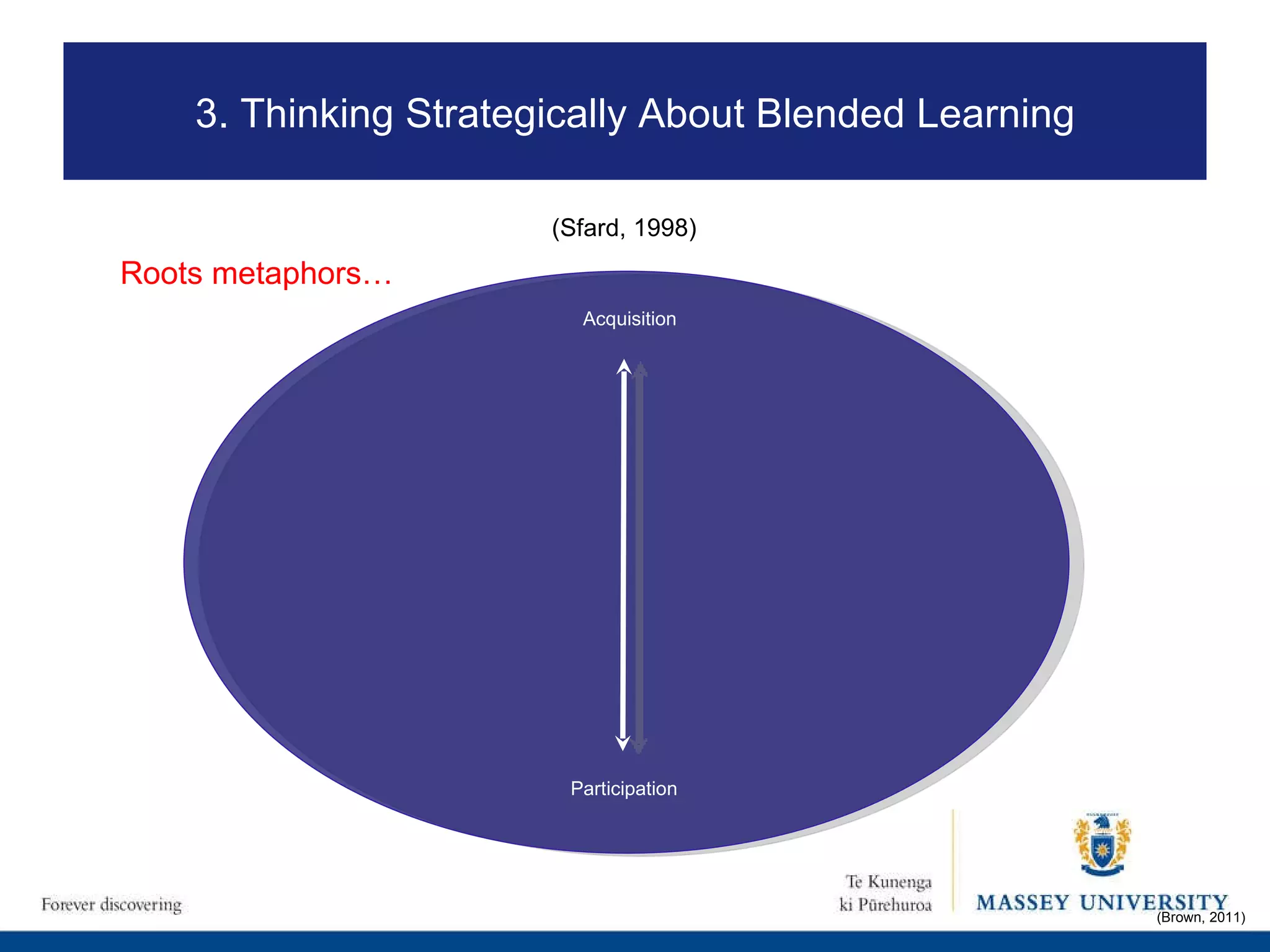
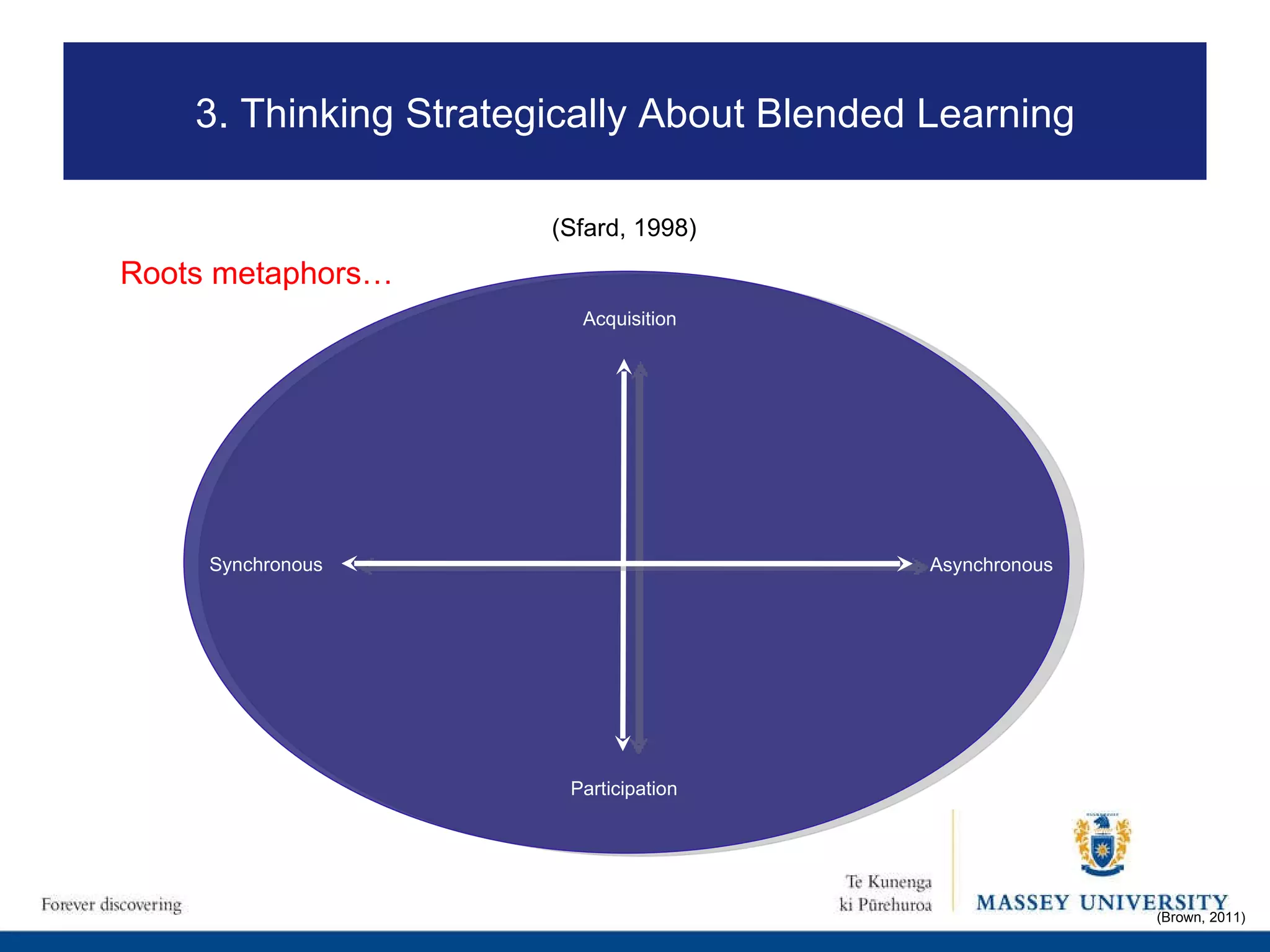
Acquisition Participation Roots metaphors… (Brown, 2011) (Sfard, 1998) 3. Thinking Strategically About Blended Learning
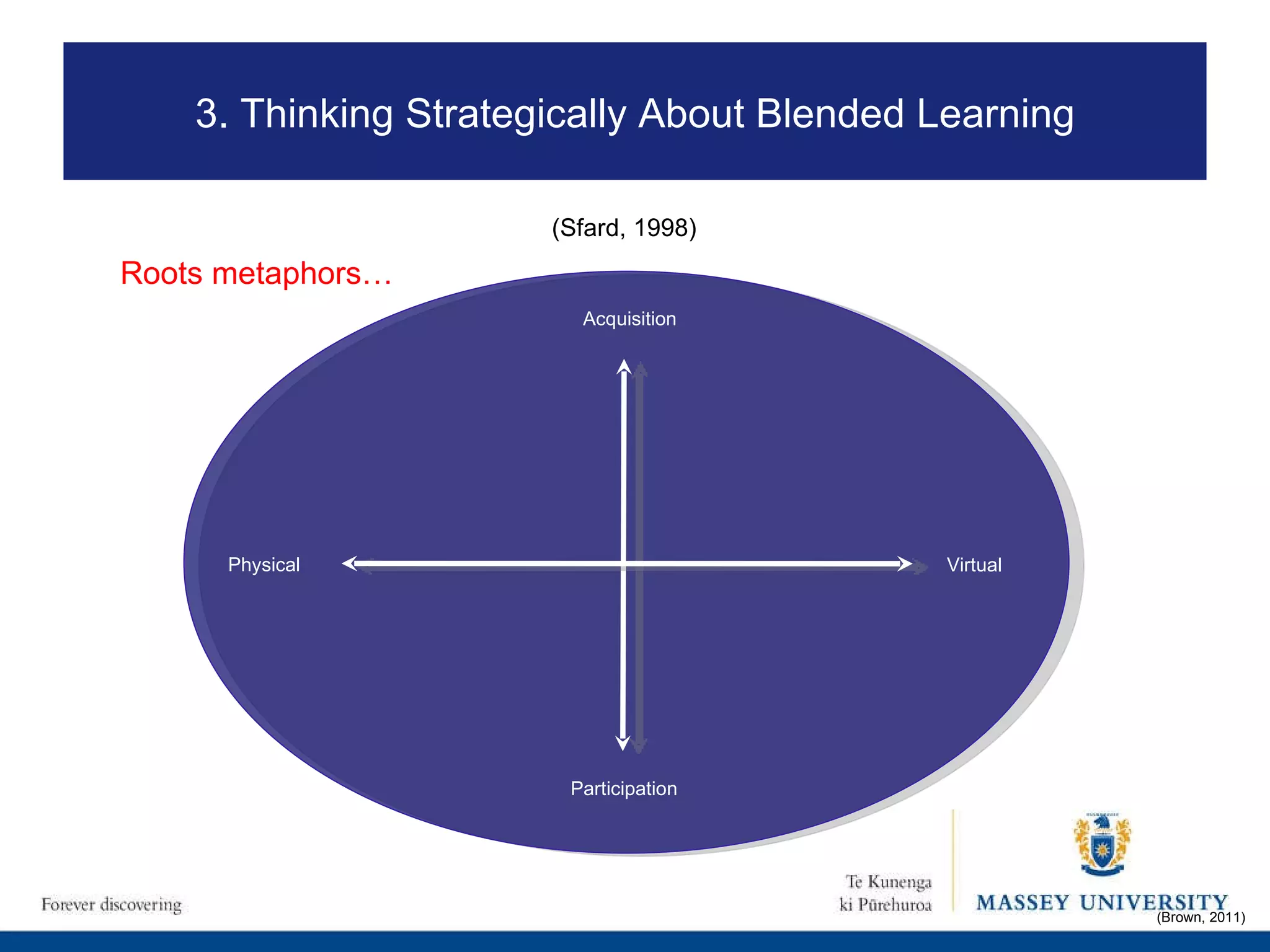
Physical Virtual Acquisition Participation (Brown, 2011) (Sfard, 1998) Roots metaphors… 3. Thinking Strategically About Blended Learning
Synchronous Asynchronous Acquisition Participation (Brown, 2011) (Sfard, 1998) Roots metaphors… 3. Thinking Strategically About Blended Learning
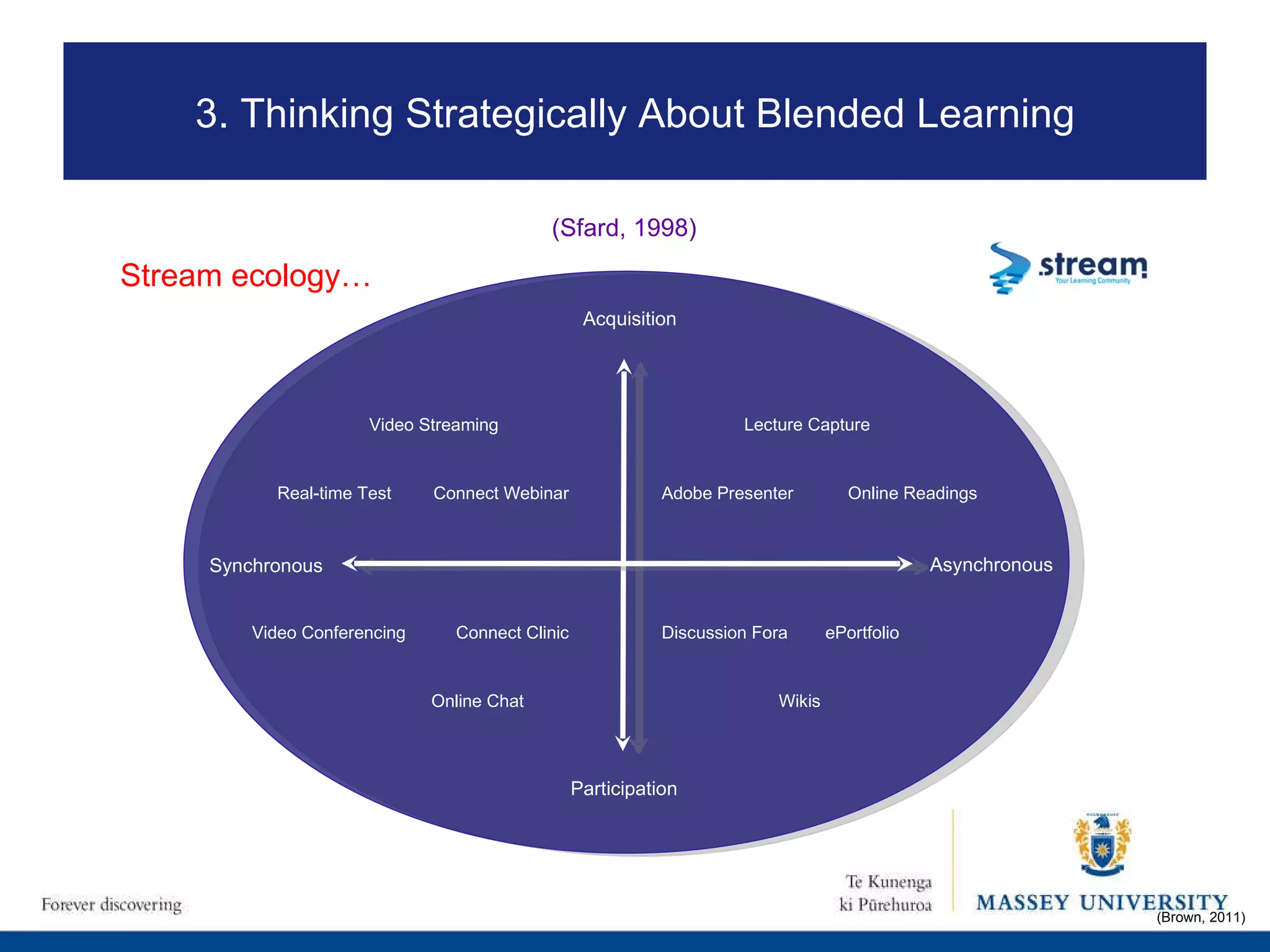
Synchronous Asynchronous Acquisition Participation Discussion Fora Lecture Capture Connect Clinic Connect Webinar Adobe Presenter Wikis ePortfolio Online Readings Video Streaming Online Chat Video Conferencing (Brown, 2011) Real-time Test (Sfard, 1998) Stream ecology… 3. Thinking Strategically About Blended Learning
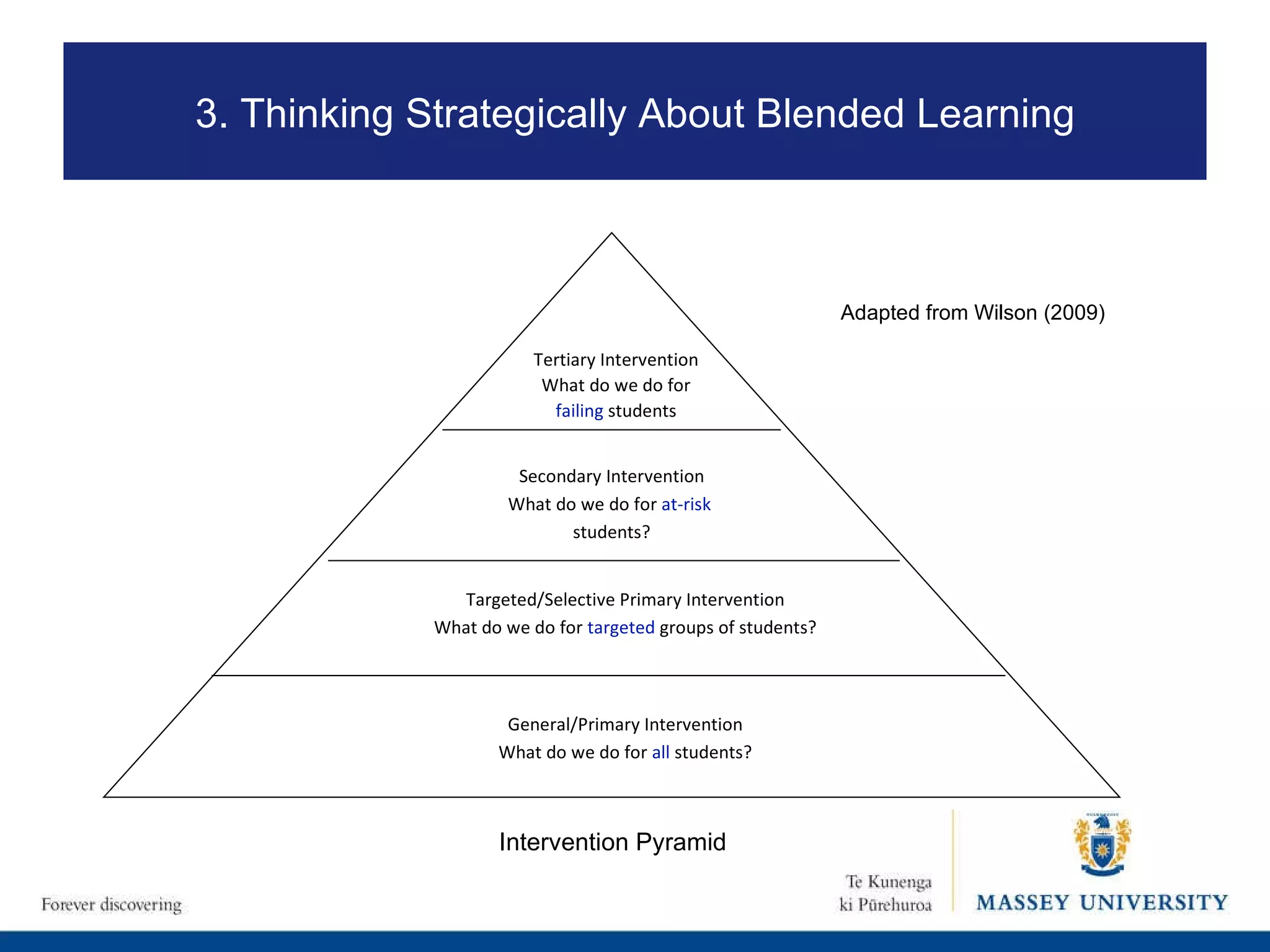
Tertiary Intervention What do we do for  failing  students Secondary Intervention What do we do for  at-risk  students? Targeted/Selective Primary Intervention What do we do for  targeted  groups of students? General/Primary Intervention What do we do for  all  students? Intervention Pyramid Adapted from Wilson (2009) 3. Thinking Strategically About Blended Learning
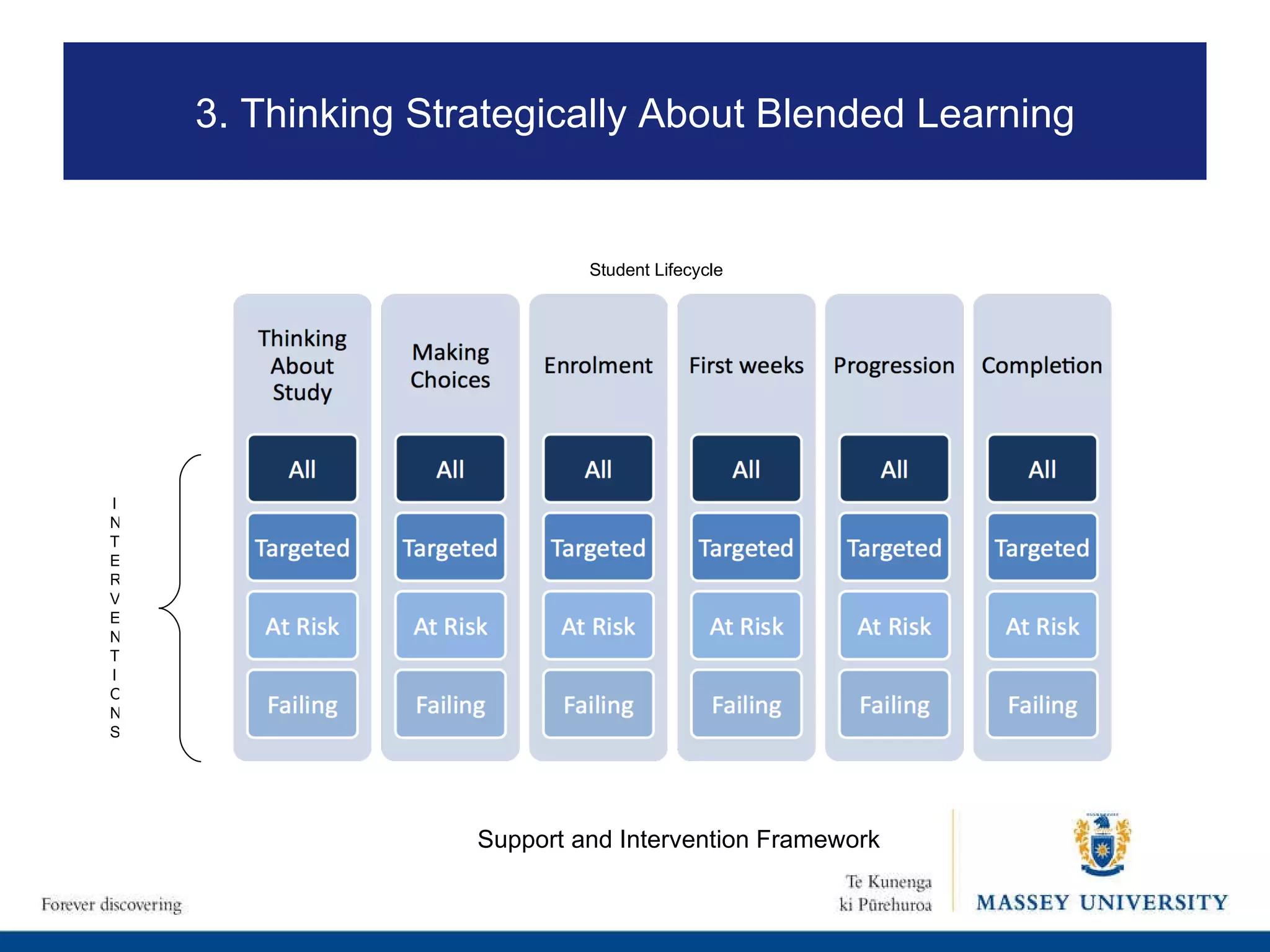
Support and Intervention Framework INTERVENTIONS Student Lifecycle 3. Thinking Strategically About Blended Learning
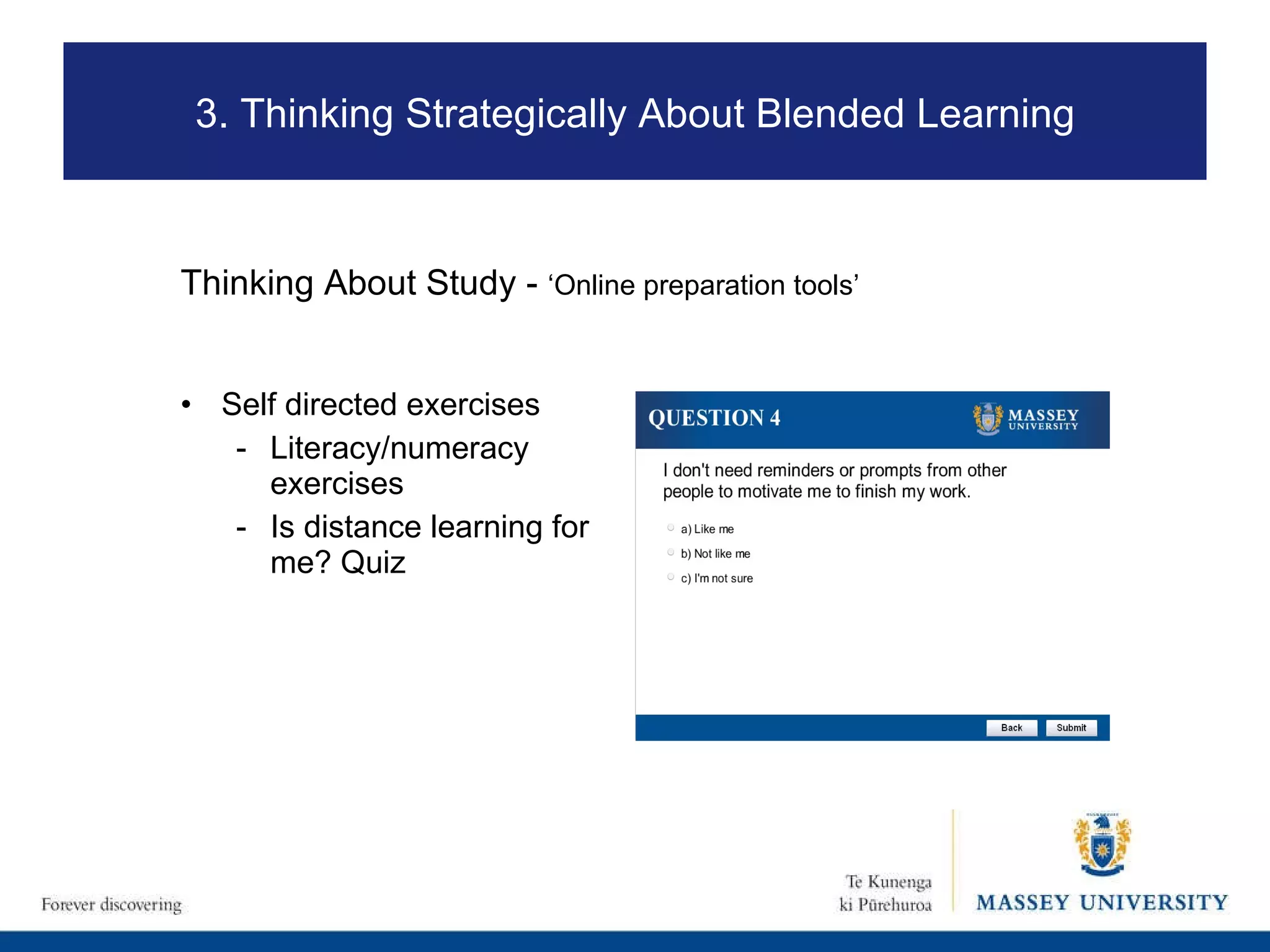
Self directed exercises Literacy/numeracy exercises Is distance learning for me? Quiz Thinking About Study -  ‘Online preparation tools’ 3. Thinking Strategically About Blended Learning
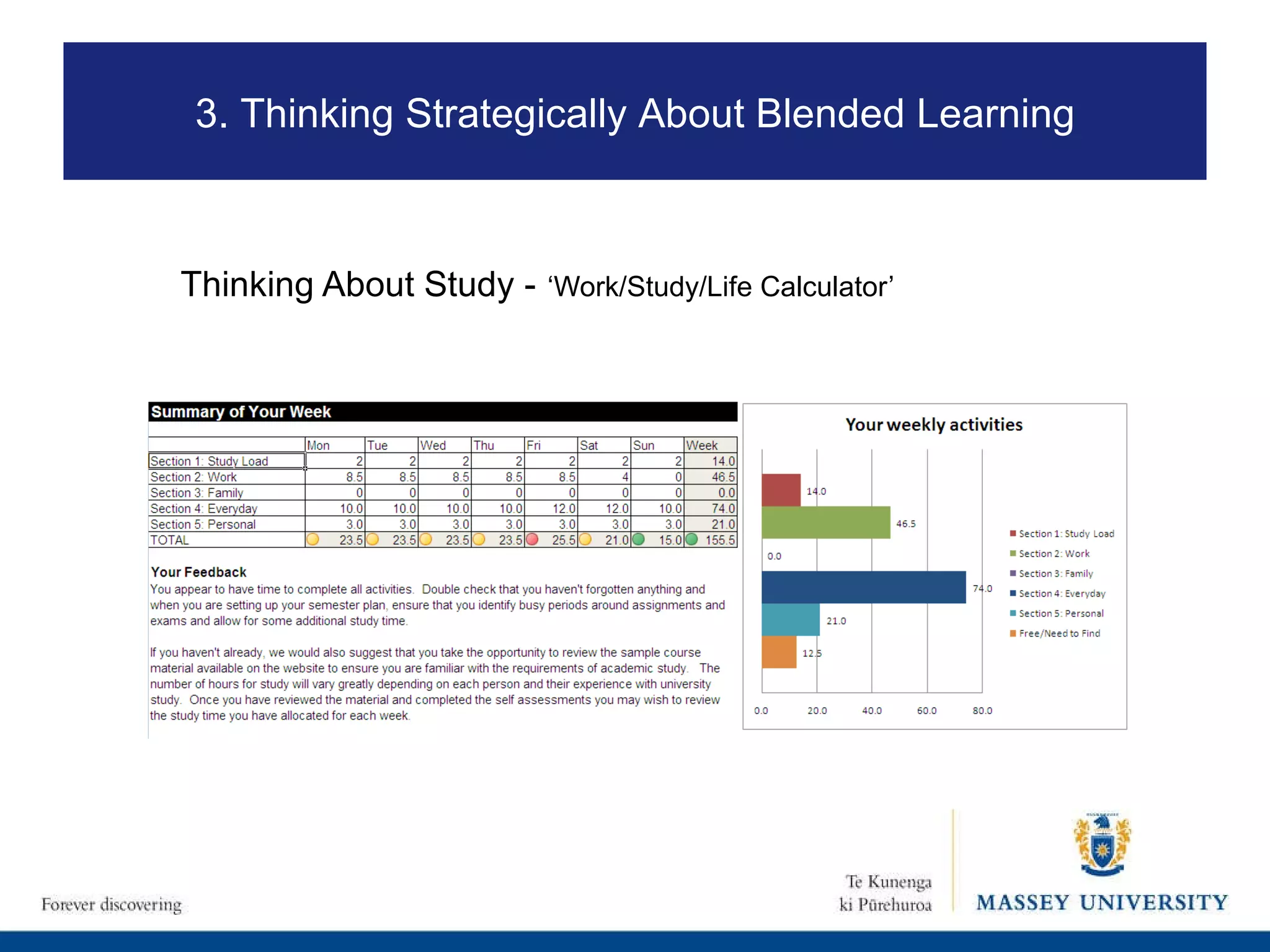
Thinking About Study -   ‘Work/Study/Life Calculator’ 3. Thinking Strategically About Blended Learning
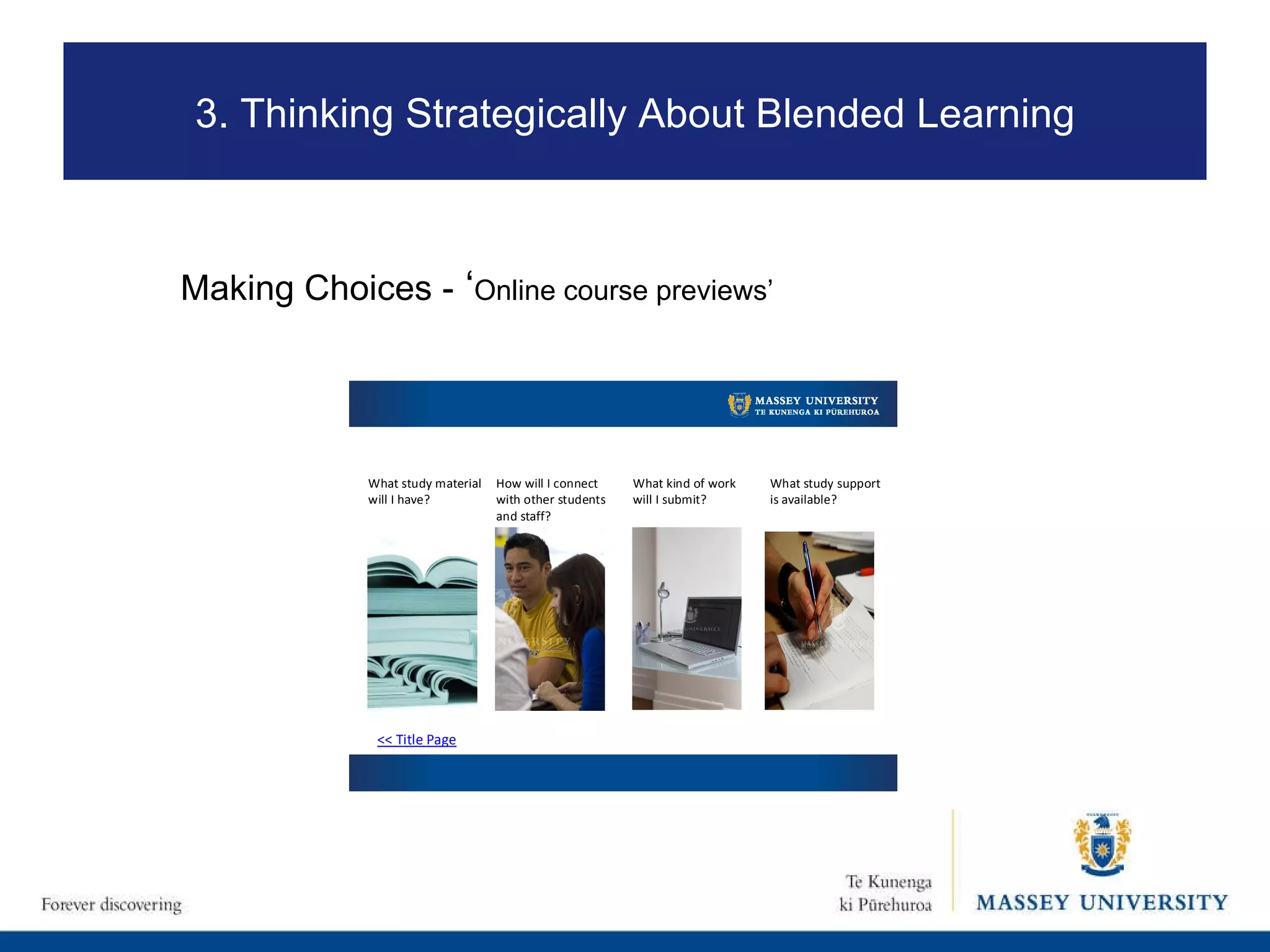
Making Choices -  ‘ Online course previews’ 3. Thinking Strategically About Blended Learning
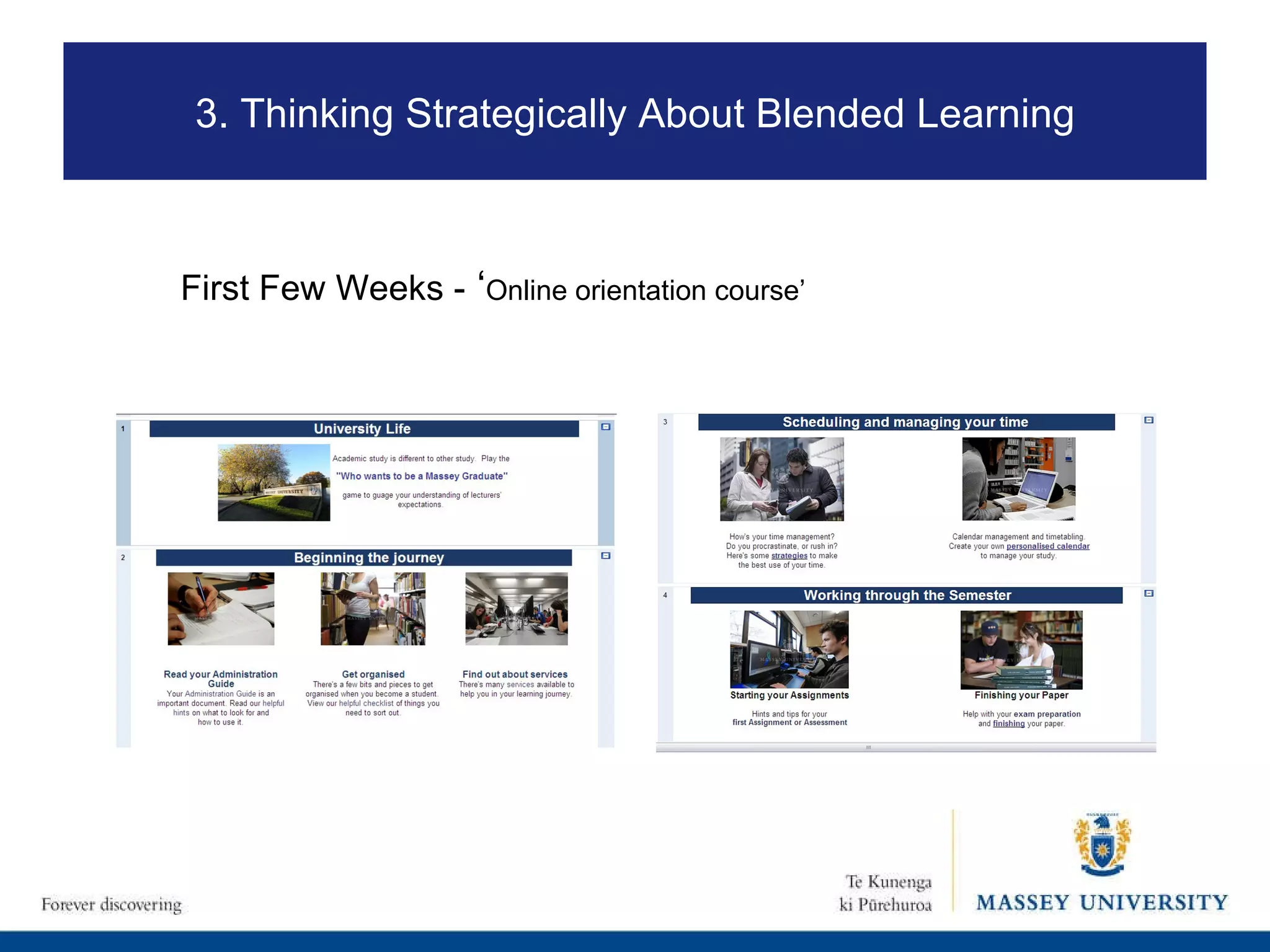
First Few Weeks -  ‘ Online orientation course’ 3. Thinking Strategically About Blended Learning
Conclusion
“ I think blended learning will  never  go away... and for some courses, some contexts, a blend which is 90 per cent conventional and 10 per cent digital is probably right and you’d get the reverse for other kinds of course.  Conclusion
“ I think blended learning will  never  go away... and for some courses, some contexts, a blend which is 90 per cent conventional and 10 per cent digital is probably right and you’d get the reverse for other kinds of course.  So it’s entirely up to the particular  context  what kind of blend you have and we’ve just got to get practised at being able to find the  right blend  for the  right course  and  context ”   (Diana Laurillard; cited in Joint Information Systems Committee, 2009, p.46). Conclusion
Unfreezing  an institutional culture is only the tip of the challenge.  You need  vision,   strong  leadership,  a  steadfast  compass  and  unified crew to navigate from rhetoric to reality - with  impact . Conclusion
“ A prudent question is one-half of wisdom. ” Francis Bacon Questions [email_address] http://www.slideshare.net/mbrownz/

Personal Learning Environments: If ePortfolios are the Solution, then what is the Problem?

  • 1.
    Personal Learning Environments:If ePortfolios are the Solution, then what is the Problem? Mark Brown Director, Teaching, Learning and Distance Education WITT July 22 nd , 2011
  • 2.
    • Director,Teaching, Learning & Distance Education • Previous Coordinator of the Doctor of Education (EdD) • On original Steering Committee for Mahara • On several executive committees (ACiLiTE, DEANZ, DEHub,) • On several journal editorial boards ( Research in Learning Technology, Journal of Further and Higher Education, etc) • Current Horizon Report Board Member • Recipient of National Award for Sustained Excellence in Tertiary Teaching • Try to share some of my musings in “Pass the SoLT” [email_address] About Mark
  • 3.
  • 4.
    LMS VLE Streamat Massey “ To provide an exceptional and distinctive experience for all students through a rich digital learning culture.”
  • 5.
    MyPortfolio - Theirplace Stream - Our place Stream at Massey
  • 6.
    Spot the Minister!Mahara is Award Winning
  • 7.
    If ePortfolios arethe Solution, then what is the Problem?
  • 8.
    The ‘traditional’ learner• Pre-school • Primary • Secondary • Tertiary Education • Work • Course • Work • Course If ePortfolios are the Solution, then what is the Problem?
  • 9.
    Tertiary education isall we focus on for approximatelty 4 out of 80 years? That is, 5% of lifelong! What % of all learning opportunities do we cover with our focus on formal tertiary education? The ‘traditional’ learner • Pre-school • Primary • Secondary • Tertiary Education • Work • Course • Work • Course If ePortfolios are the Solution, then what is the Problem?
  • 10.
    If ePortfolios arethe Solution, then what is the Problem?
  • 11.
    If ePortfolios arethe Solution, then what is the Problem?
  • 12.
    There is agrowing gap between how we learn informally and the way we design and offer formal learning. What does all this mean? If ePortfolios are the Solution, then what is the Problem?
  • 13.
    1. About Mahara2. A Case Study in Practice 3. Thinking Strategically about Blended Learning If ePortfolios are the Solution, then what is the Problem?
  • 14.
    While ePortfolios havetremendous potential their successful implementation in tertiary education is another matter. We may damage the mission of promoting life-long learning by restricting our thinking to formal institutional learning. If ePortfolios are the Solution, then what is the Problem? Central message…
  • 15.
  • 16.
    • Opensource eportfolio - 2007 • Mahara ( Te Reo Māori for ‘think’ or ‘thought’) • Funded by New Zealand Government ($700,000) • Collaborative project led by Massey University • Learner ownership was the key driver and principle • Huge level of interest and significant international uptake • Designed to provide an environment for critical reflection and life-long learning 1. About Mahara
  • 17.
    A bit abouteportfolios… Wealth of literature supporting the use of eportfolios in education An eportfolio is an online collection of digital artifacts and reflections (e.g., images, lesson plans, assignments, feedback reports, etc) Provides more authentic and arguably valid evidence of learning Three main uses or categories of eportfolio: Development Institutional Showcase 1. About Mahara
  • 18.
    Mahara is basedon an Artefacts, Views and Access framework Views are a collection of any number of artefacts that exist in a student’s portfolio Students can create any number of ‘views’ and assign view access to any number of individuals, groups and/or communities as they wish Basic Framework… 1. About Mahara
  • 19.
    A representation ofthe framework… 1. About Mahara
  • 20.
    For example… 1.About Mahara
  • 21.
    Unlimited Views 1.About Mahara
  • 22.
  • 23.
  • 24.
    Showcase view… 1.About Mahara
  • 25.
  • 26.
    www.mahara.org Collect, Reflect,Select, Connect, Share 1. About Mahara
  • 27.
    2. Case Studyin Practice
  • 28.
    A Massey example… 2. Case Study in Practice “ Learning is not a spectator sport. Students do not learn much just sitting in classes listening to teachers, memorizing prepackaged assignments, and spitting out answers.
  • 29.
    “ Learning isnot a spectator sport. Students do not learn much just sitting in classes listening to teachers, memorizing prepackaged assignments, and spitting out answers. They must talk about what they are learning, write reflectively about it, relate it to past experiences, and apply it to their daily lives. They must make what they learn part of themselves” (Chickering & Gamson, 1987). 2. Case Study in Practice A Massey example…
  • 30.
    An example frominitial teacher education… 2. Case Study in Practice
  • 31.
    Structural Framework Three Interdisciplinary Strands Context Content Professional Practice
  • 32.
    ICT Inclusion BiculturalismThree Integrating Themes Structural Framework Context Content Professional Practice
  • 33.
    ICT Inclusion BiculturalismLearning to be Learning to do Learning to know Learning to live together Context Content Professional Practice
  • 34.
    Context Content ICTInclusion Biculturalism Professional Practice Learning to be Learning to do Learning to Change Learning to know Learning to live together
  • 35.
    Anchored around corequestions… • What does it mean to be a teacher in a diverse but inclusive society? • What do students need to do to become literate citizens in a socially just democracy? • What do students need to know in an uncertain world needing to address future sustainability? • What does it mean to live in Aotearoa/New Zealand in today’s globalized world? • How can teachers help to change the education system to make it fair and socially just for all? 2. Case Study in Practice
  • 36.
    Graduate Profile… 2.Case Study in Practice
  • 37.
    Personalised life-long learning,augmented by eportfolios, must be rooted within a system-wide digital learning culture We have learnt that… 2. Case Study in Practice
  • 38.
    3. Thinking StrategicallyAbout Blended Learning
  • 39.
    Moodle/Mahara is notjust an online environment but the catalyst for a new strategic direction which gives the opportunity to rethink, redesign and future-proof your curriculum/institution. 3. Thinking Strategically About Blended Learning
  • 40.
    Future Maker FutureTaker Moodle/Mahara is not just an online environment but the catalyst for a new strategic direction which gives the opportunity to rethink, redesign and future-proof your curriculum/institution. 3. Thinking Strategically About Blended Learning
  • 41.
    3. Thinking StrategicallyAbout Blended Learning
  • 42.
    3. Thinking StrategicallyAbout Blended Learning
  • 43.
    To enhance outcomesfor learners through a consistent, coherent and digitally enriched educational experience To support staff to effectively and purposefully integrate Stream in papers and programmes To enhance the features and infrastructure of Stream and related educational technologies to meet future teaching and learning requirements To improve the quality and effectiveness of teaching through appropriate learning designs, templates and review systems To enhance learner engagement by extending the range and quality of student services available through technology To enhance the level of awareness, coordination and understanding of strategic initiatives in blended and distance education To foster opportunities for research and scholarly engagement on the impact of blended and distance education To develop capacity and capability for internationalisation through appropriate blended and distance delivery systems 3. Thinking Strategically About Blended Learning
  • 44.
    Places Tools Learner-ContentInteraction Learner-learner Interaction Spaces Teacher-Learner Interaction eLearning Interactions 1. What is eLearning? What we do… 3. Thinking Strategically About Blended Learning
  • 45.
    Learning by sharing(Connectivist) Learning by listening (Instructionist) Learning by doing (Constructivist) Learning by making (Constructionist) Still has a role but… How we do it… 3. Thinking Strategically About Blended Learning
  • 46.
    Acquisition Participation Rootsmetaphors… (Brown, 2011) (Sfard, 1998) 3. Thinking Strategically About Blended Learning
  • 47.
    Physical Virtual AcquisitionParticipation (Brown, 2011) (Sfard, 1998) Roots metaphors… 3. Thinking Strategically About Blended Learning
  • 48.
    Synchronous Asynchronous AcquisitionParticipation (Brown, 2011) (Sfard, 1998) Roots metaphors… 3. Thinking Strategically About Blended Learning
  • 49.
    Synchronous Asynchronous AcquisitionParticipation Discussion Fora Lecture Capture Connect Clinic Connect Webinar Adobe Presenter Wikis ePortfolio Online Readings Video Streaming Online Chat Video Conferencing (Brown, 2011) Real-time Test (Sfard, 1998) Stream ecology… 3. Thinking Strategically About Blended Learning
  • 50.
    Tertiary Intervention Whatdo we do for failing students Secondary Intervention What do we do for at-risk students? Targeted/Selective Primary Intervention What do we do for targeted groups of students? General/Primary Intervention What do we do for all students? Intervention Pyramid Adapted from Wilson (2009) 3. Thinking Strategically About Blended Learning
  • 51.
    Support and InterventionFramework INTERVENTIONS Student Lifecycle 3. Thinking Strategically About Blended Learning
  • 52.
    Self directed exercisesLiteracy/numeracy exercises Is distance learning for me? Quiz Thinking About Study - ‘Online preparation tools’ 3. Thinking Strategically About Blended Learning
  • 53.
    Thinking About Study- ‘Work/Study/Life Calculator’ 3. Thinking Strategically About Blended Learning
  • 54.
    Making Choices - ‘ Online course previews’ 3. Thinking Strategically About Blended Learning
  • 55.
    First Few Weeks- ‘ Online orientation course’ 3. Thinking Strategically About Blended Learning
  • 56.
  • 57.
    “ I thinkblended learning will never go away... and for some courses, some contexts, a blend which is 90 per cent conventional and 10 per cent digital is probably right and you’d get the reverse for other kinds of course. Conclusion
  • 58.
    “ I thinkblended learning will never go away... and for some courses, some contexts, a blend which is 90 per cent conventional and 10 per cent digital is probably right and you’d get the reverse for other kinds of course. So it’s entirely up to the particular context what kind of blend you have and we’ve just got to get practised at being able to find the right blend for the right course and context ” (Diana Laurillard; cited in Joint Information Systems Committee, 2009, p.46). Conclusion
  • 59.
    Unfreezing aninstitutional culture is only the tip of the challenge. You need vision, strong leadership, a steadfast compass and unified crew to navigate from rhetoric to reality - with impact . Conclusion
  • 60.
    “ A prudentquestion is one-half of wisdom. ” Francis Bacon Questions [email_address] http://www.slideshare.net/mbrownz/

Editor's Notes

  • #7 These days, with a name like Brown, I feel rather ‘hip’ with a middle name beginning with ‘e’. You could say putting the ‘e’ in learning comes naturally. On a more serious note, my reflections on e-learning are grounded in the saying that the light comes through the cracks .
  • #8 Last year I presented a paper on… This is part 2 or follow up on my previous paper.
  • #14 The first section talks about why and how we started the dialogue for change The second part explains how we then formalised the conversation for change The final section briefly describes what we came up with and how if differs redically from what we have been doing in past.
  • #54 Course choice Capacity Capability
  • #55 Course Choice
  • #60 Still unclear whether we can pull it off