Compiled by Col Mukteshwar Prasad(Retd),
MTech,CE(I),FIE(I),FIETE,FISLE,FInstOD,AMCSI
Contact -+919007224278, e-mail
muktesh_prasad@yahoo.co.in
for book ”Decoding Services Selection Board” and SSB
guidance and training at Shivnandani Edu and Defence
Academy,Kolkata
Personal Development
Personality Development and SSB
guidance are also provided through
Online Training on one to one or a
group
Def of Self Development
 We consider personal development largely ‘personal’;
something we do for ourselves in order to grow and
develop.
 Though pretty obvious yet seemingly self-explanatory
concept of personal development is misleading.
 Conventional definitions of personal development:
 Wikipedia considers personal development as a
process of gaining self-awareness, developing talent
and aspiring towards a high quality life.
 The Oxford online dictionary suggests that self-
development is “the process by which a person’s
character or abilities are gradually developed”, and
 The Cambridge online dictionary explains personal
development within a business context, seeing it as
“the process of improving your skills and increasing the
amount of experience that you have in your job”.
Def of Self Development
 Variation in definitions shows that personal development
is quite an elusive concept.
 One thing they all have in common is that they are
 Essentially Concerned with the investment in
ourselves so as to actively participate in the
transformative process of personal development
like
 Focus on our own persona and
 Keep nurturing our talents
 The first steps towards becoming the mature person we
aim to be are
 To become self-aware
 Know who we are and
 Get degreed in an area that suits our talents
 The expression of personal development requires
Maslow Needs
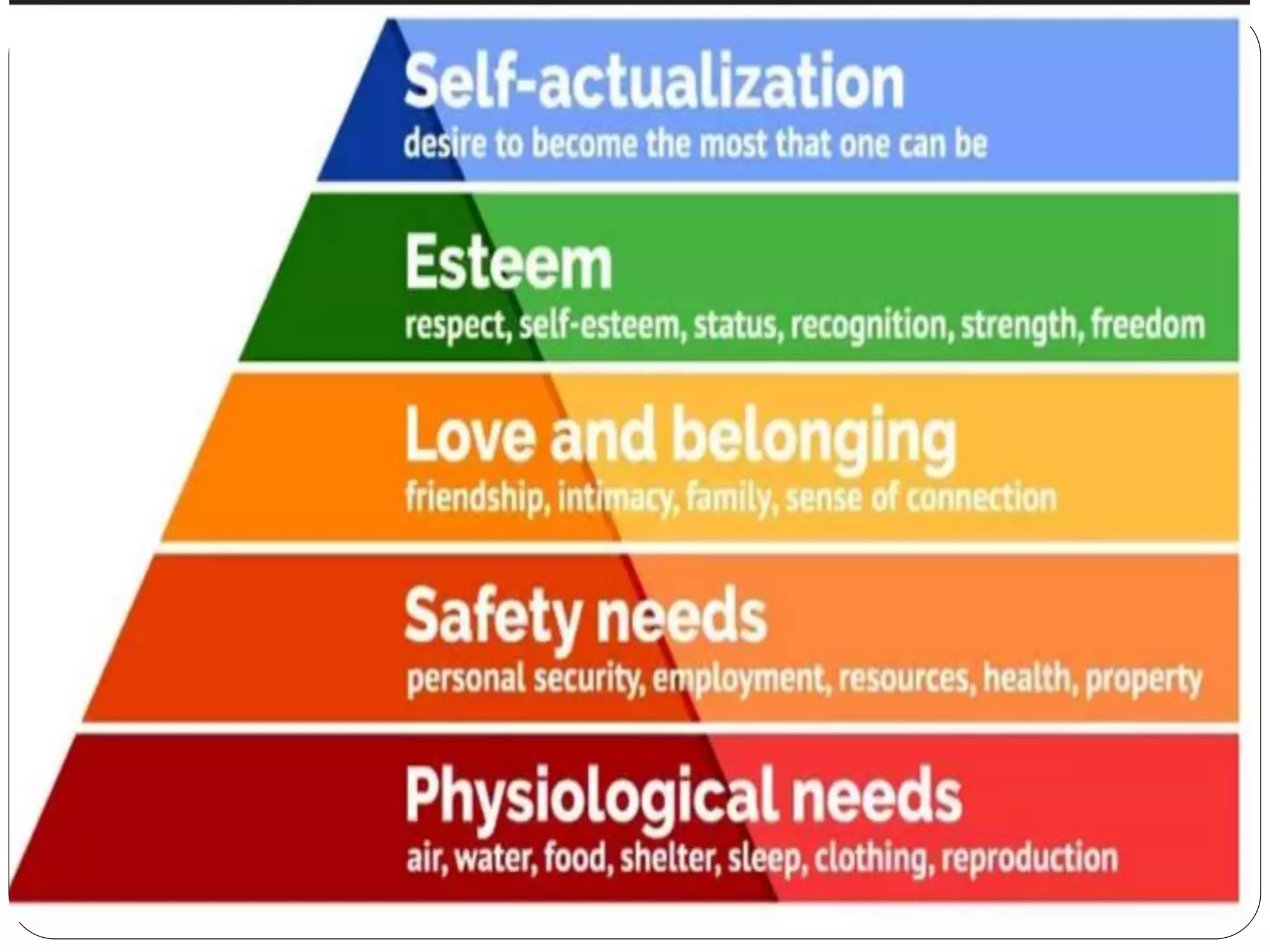
 Behavioral actions beyond the self-centered approach has been
supported and explained by Maslow Need Theory where order of needs
might be flexible based on external circumstances or individual
differences
 Hierarchy of needs summary
 (a)Human beings are motivated by a hierarchy of needs.
 (b) Needs are organized in a hierarchy of prepotency in which more basic
needs must be more or less met (rather than all or none) prior to higher
needs.
 (c) The order of needs is not rigid but instead may be flexible based on
external circumstances or individual differences.
 (d)Most behavior is multi-motivated, that is, simultaneously determined by
more than one basic need.
 (e) For self development we move up hierarchy from Physiological
Need to Self Actualization (Achieved by merely 2% of population)
 For details on Maslow Need read “Maslow Need Theory Perspective
Today - https://www.slideshare.net/ColMukteshwarPrasad/maslow-
need-theory-perspective-today
 Maslow theory has since undergone many changes ,modification and
criticism.
 Yet it explains beautifully the path for personal development
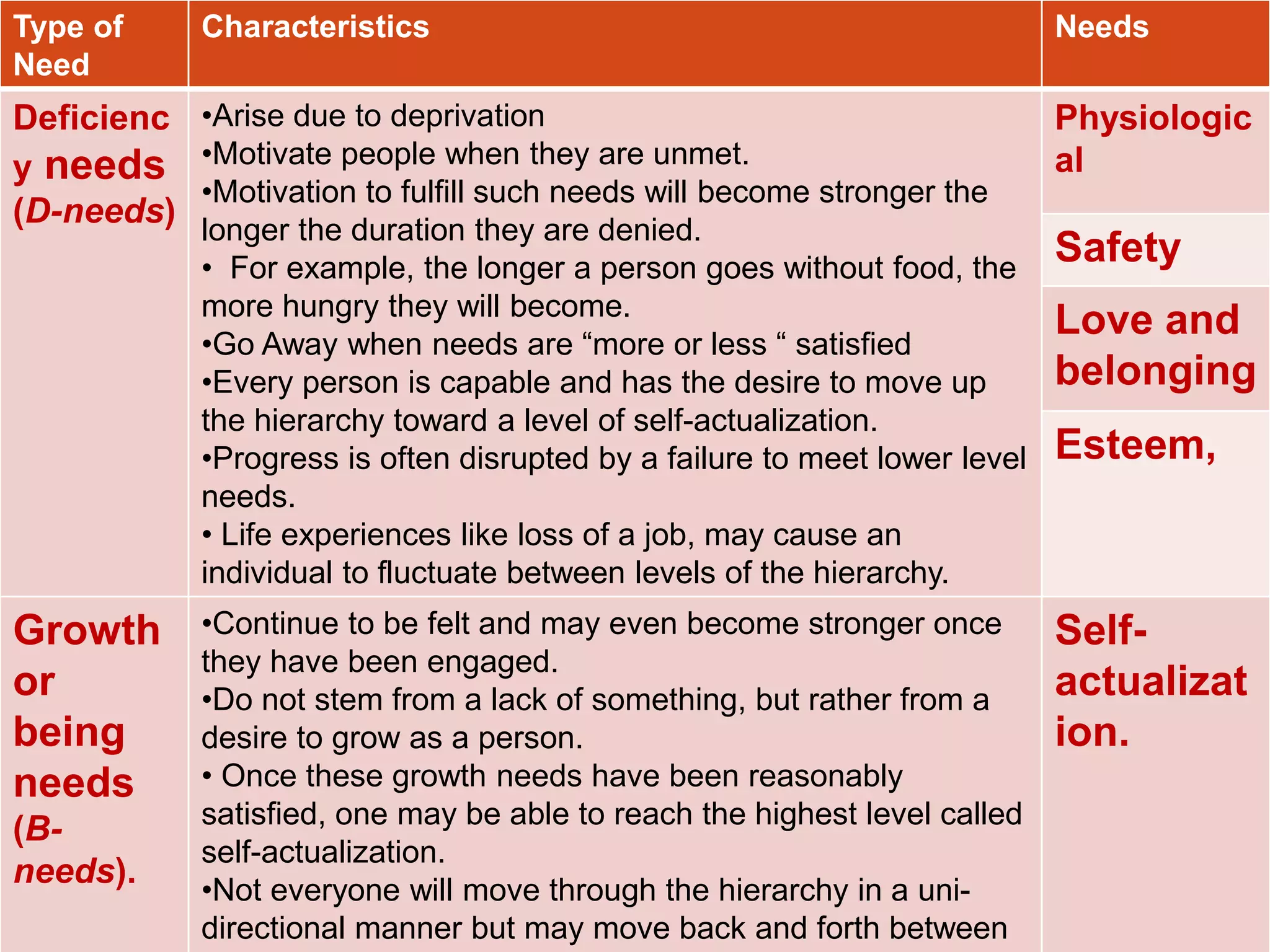
Type of
Need
Characteristics Needs
Deficienc
y needs
(D-needs)
•Arise due to deprivation
•Motivate people when they are unmet.
•Motivation to fulfill such needs will become stronger the
longer the duration they are denied.
• For example, the longer a person goes without food, the
more hungry they will become.
•Go Away when needs are “more or less “ satisfied
•Every person is capable and has the desire to move up
the hierarchy toward a level of self-actualization.
•Progress is often disrupted by a failure to meet lower level
needs.
• Life experiences like loss of a job, may cause an
individual to fluctuate between levels of the hierarchy.
Physiologic
al
Safety
Love and
belonging
Esteem,
Growth
or
being
needs
(B-
needs).
•Continue to be felt and may even become stronger once
they have been engaged.
•Do not stem from a lack of something, but rather from a
desire to grow as a person.
• Once these growth needs have been reasonably
satisfied, one may be able to reach the highest level called
self-actualization.
•Not everyone will move through the hierarchy in a uni-
directional manner but may move back and forth between
Self-
actualizat
ion.
Maslow Theory of Needs
 Maslow saw ‘self-actualization’ as the highest level of achievement in
people’s lives (Maslow, 1943). He argued that
 Self-actualization was a manifestation of the fully developed person.
 Those who achieved it had reached their full potential and were
blessed to experience selfhood, enjoy peak experiences and live their
dreams.
 The pursuit of self-actualization was only sustainable
until it had been satisfied.
 Over-indulgence with the self could stretch the noble
quest for personal growth, making us appear as self-
aggrandizing(To increase the power, rank or wealth)
individuals.
 People with a true interest in personal development
needed to shift their focus away from themselves and
begin focusing on the world around them.
 Maslow called this process ‘self-transcendence’, which
literally means ‘going beyond ourselves’.
Self-transcendence
 Self-transcendence follows self-actualization. It is the stage
where action follows complacency.
 Paradoxically, self-transcendence requires us to rid our
identity and all concerns about ourselves, including our
pride in the skills we possess and in the degrees that we
so effort fully accumulated.
 Yet, self-transcendence is liberating, it frees us up to function
for the purpose of the greater good (Maslow, 1969).
 With this in mind, how can we redefine personal development?
 Personal development can be summarized as a two-stage
process:
 Stage one includes the conventional self-actualizing
objectives, such as
 Developing self-awareness and identity,
 Gaining expert knowledge and
 Nurturing our personal potential.
 Stage two then necessitates the critical transition to
reach beyond ourselves (self-transcendence), to spread
our enthusiasm with the wider community and to enrich
How can you take your personal development to the next level?
 1.Treat personal development as a life
approach.
We often ‘work on’ our personal development in
our spare time: we attend inspiring seminars,
read the success stories of others, or indulge in
self-help literature.
However, it is the day-to-day application of
these passive, safe behaviours through
which we nurture and experience our
personal development.
Going out there, offering our talents, sharing
our skills and knowledge, and making a
difference in the life of others are the
essential action steps that make our
personal development come to life.
How can you take your personal development to the next level?
 2. Become the best human being you can possibly be.
 This bold statement requires our continuous motivation for
generosity, integrity, and fairness, especially when our mood is
low and competition is tough.
 Be honest.
 How often have you found yourself doing one or more of the
following:
 Hide ideas so that they don’t get pinched by others?
 Hold back on complimenting a colleague’s achievement
because you wished it was your own? Or
 Fail to pass on exciting opportunities in order to limit the
success of others?
 These behaviours are signs of fear and envy.
 They are unnecessary, because ideas only come to life through
communication and action.
 Likewise, compliments and encouragement not only create
energy in others, but equally enhance your own visibility.
 Giving away those gifts and promoting others are acts of self-
How can you take your personal development to the next level?
 3. Take actions that exceed expectations of
others.
Following the rules and standards are safe
ways to approaching any task, job, or service
that we do for others.
 They will help us to meet expectations.
But they are also the safest ways to
mediocrity and wasting talent.
Make a conscious decision to put your heart
and soul into everything you do and make it
a habit to letting your work reflect your high
self-worth.
Exceeding expectations will let you perceive the
efforts of your own personal development,
whilst also making you indispensable.
How can you take your personal development to the next level?
 4. Keep a service-oriented mind.
 This step is particularly important and may well be the most
difficult one to accomplish.
 We tend to become self-satisfied with our achievements
and gravitate towards retaining the status quo.
 However, societal needs and trends are continuously
changing, requiring us to re-think solutions and stay
innovative.
 Keeping a service-oriented mind demands flexibility.
 By asking ‘How can I be of service?’ we adapt to the needs
of our ever-changing environment and overcome
stagnation.
 This not only ensures the continuation of our own personal
growth, but maintains its useful and timely application to real-
life problems.
 References
 Maslow, A. H. (1943). A theory of human motivation.
Psychological Review, 50, 370–396.
 Maslow, A. H. (1969). The farther reaches of human nature.

Personal development

  • 1.
    Compiled by ColMukteshwar Prasad(Retd), MTech,CE(I),FIE(I),FIETE,FISLE,FInstOD,AMCSI Contact -+919007224278, e-mail muktesh_prasad@yahoo.co.in for book ”Decoding Services Selection Board” and SSB guidance and training at Shivnandani Edu and Defence Academy,Kolkata Personal Development Personality Development and SSB guidance are also provided through Online Training on one to one or a group
  • 2.
    Def of SelfDevelopment  We consider personal development largely ‘personal’; something we do for ourselves in order to grow and develop.  Though pretty obvious yet seemingly self-explanatory concept of personal development is misleading.  Conventional definitions of personal development:  Wikipedia considers personal development as a process of gaining self-awareness, developing talent and aspiring towards a high quality life.  The Oxford online dictionary suggests that self- development is “the process by which a person’s character or abilities are gradually developed”, and  The Cambridge online dictionary explains personal development within a business context, seeing it as “the process of improving your skills and increasing the amount of experience that you have in your job”.
  • 3.
    Def of SelfDevelopment  Variation in definitions shows that personal development is quite an elusive concept.  One thing they all have in common is that they are  Essentially Concerned with the investment in ourselves so as to actively participate in the transformative process of personal development like  Focus on our own persona and  Keep nurturing our talents  The first steps towards becoming the mature person we aim to be are  To become self-aware  Know who we are and  Get degreed in an area that suits our talents  The expression of personal development requires
  • 4.
    Maslow Needs  Behavioralactions beyond the self-centered approach has been supported and explained by Maslow Need Theory where order of needs might be flexible based on external circumstances or individual differences  Hierarchy of needs summary  (a)Human beings are motivated by a hierarchy of needs.  (b) Needs are organized in a hierarchy of prepotency in which more basic needs must be more or less met (rather than all or none) prior to higher needs.  (c) The order of needs is not rigid but instead may be flexible based on external circumstances or individual differences.  (d)Most behavior is multi-motivated, that is, simultaneously determined by more than one basic need.  (e) For self development we move up hierarchy from Physiological Need to Self Actualization (Achieved by merely 2% of population)  For details on Maslow Need read “Maslow Need Theory Perspective Today - https://www.slideshare.net/ColMukteshwarPrasad/maslow- need-theory-perspective-today  Maslow theory has since undergone many changes ,modification and criticism.  Yet it explains beautifully the path for personal development
  • 6.
    Type of Need Characteristics Needs Deficienc yneeds (D-needs) •Arise due to deprivation •Motivate people when they are unmet. •Motivation to fulfill such needs will become stronger the longer the duration they are denied. • For example, the longer a person goes without food, the more hungry they will become. •Go Away when needs are “more or less “ satisfied •Every person is capable and has the desire to move up the hierarchy toward a level of self-actualization. •Progress is often disrupted by a failure to meet lower level needs. • Life experiences like loss of a job, may cause an individual to fluctuate between levels of the hierarchy. Physiologic al Safety Love and belonging Esteem, Growth or being needs (B- needs). •Continue to be felt and may even become stronger once they have been engaged. •Do not stem from a lack of something, but rather from a desire to grow as a person. • Once these growth needs have been reasonably satisfied, one may be able to reach the highest level called self-actualization. •Not everyone will move through the hierarchy in a uni- directional manner but may move back and forth between Self- actualizat ion.
  • 7.
    Maslow Theory ofNeeds  Maslow saw ‘self-actualization’ as the highest level of achievement in people’s lives (Maslow, 1943). He argued that  Self-actualization was a manifestation of the fully developed person.  Those who achieved it had reached their full potential and were blessed to experience selfhood, enjoy peak experiences and live their dreams.  The pursuit of self-actualization was only sustainable until it had been satisfied.  Over-indulgence with the self could stretch the noble quest for personal growth, making us appear as self- aggrandizing(To increase the power, rank or wealth) individuals.  People with a true interest in personal development needed to shift their focus away from themselves and begin focusing on the world around them.  Maslow called this process ‘self-transcendence’, which literally means ‘going beyond ourselves’.
  • 8.
    Self-transcendence  Self-transcendence followsself-actualization. It is the stage where action follows complacency.  Paradoxically, self-transcendence requires us to rid our identity and all concerns about ourselves, including our pride in the skills we possess and in the degrees that we so effort fully accumulated.  Yet, self-transcendence is liberating, it frees us up to function for the purpose of the greater good (Maslow, 1969).  With this in mind, how can we redefine personal development?  Personal development can be summarized as a two-stage process:  Stage one includes the conventional self-actualizing objectives, such as  Developing self-awareness and identity,  Gaining expert knowledge and  Nurturing our personal potential.  Stage two then necessitates the critical transition to reach beyond ourselves (self-transcendence), to spread our enthusiasm with the wider community and to enrich
  • 9.
    How can youtake your personal development to the next level?  1.Treat personal development as a life approach. We often ‘work on’ our personal development in our spare time: we attend inspiring seminars, read the success stories of others, or indulge in self-help literature. However, it is the day-to-day application of these passive, safe behaviours through which we nurture and experience our personal development. Going out there, offering our talents, sharing our skills and knowledge, and making a difference in the life of others are the essential action steps that make our personal development come to life.
  • 10.
    How can youtake your personal development to the next level?  2. Become the best human being you can possibly be.  This bold statement requires our continuous motivation for generosity, integrity, and fairness, especially when our mood is low and competition is tough.  Be honest.  How often have you found yourself doing one or more of the following:  Hide ideas so that they don’t get pinched by others?  Hold back on complimenting a colleague’s achievement because you wished it was your own? Or  Fail to pass on exciting opportunities in order to limit the success of others?  These behaviours are signs of fear and envy.  They are unnecessary, because ideas only come to life through communication and action.  Likewise, compliments and encouragement not only create energy in others, but equally enhance your own visibility.  Giving away those gifts and promoting others are acts of self-
  • 11.
    How can youtake your personal development to the next level?  3. Take actions that exceed expectations of others. Following the rules and standards are safe ways to approaching any task, job, or service that we do for others.  They will help us to meet expectations. But they are also the safest ways to mediocrity and wasting talent. Make a conscious decision to put your heart and soul into everything you do and make it a habit to letting your work reflect your high self-worth. Exceeding expectations will let you perceive the efforts of your own personal development, whilst also making you indispensable.
  • 12.
    How can youtake your personal development to the next level?  4. Keep a service-oriented mind.  This step is particularly important and may well be the most difficult one to accomplish.  We tend to become self-satisfied with our achievements and gravitate towards retaining the status quo.  However, societal needs and trends are continuously changing, requiring us to re-think solutions and stay innovative.  Keeping a service-oriented mind demands flexibility.  By asking ‘How can I be of service?’ we adapt to the needs of our ever-changing environment and overcome stagnation.  This not only ensures the continuation of our own personal growth, but maintains its useful and timely application to real- life problems.  References  Maslow, A. H. (1943). A theory of human motivation. Psychological Review, 50, 370–396.  Maslow, A. H. (1969). The farther reaches of human nature.