Discovering Oneself
Val Ed 1
Instructor:
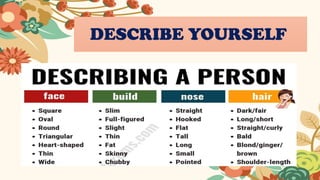
DESCRIBE YOURSELF
The self is made up of
many self-perceptions,
abilities, and personality
characteristics that are
organized and consistent
with one another.
Rogers 1953
•Contends that self-concept
plays an important role in
personality because it
influences human behaviors,
feelings, and thoughts.
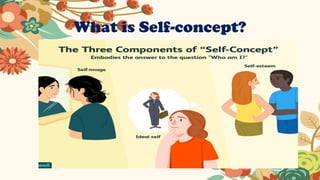
What is Self-concept?
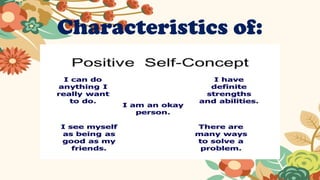
Characteristics of:
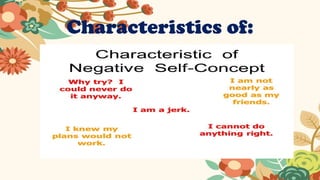
Characteristics of:
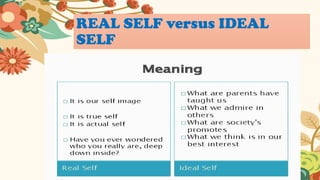
REAL SELF versus IDEAL
SELF
Discrepancy in Self-concept
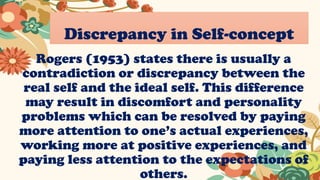
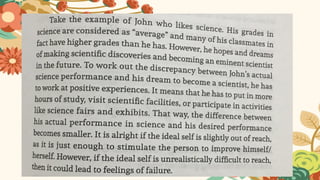
Rogers (1953) states there is usually a
contradiction or discrepancy between the
real self and the ideal self. This difference
may result in discomfort and personality
problems which can be resolved by paying
more attention to one’s actual experiences,
working more at positive experiences, and
paying less attention to the expectations of
others.
POSITIVE REGARD
•Is believed to be important for the healthy
development of one’s self-concept and for
successful interpersonal relationships
(Liebert & Spiegler, 1994)
•Positive regards includes love, sympathy,
warmth, acceptance, and respect with
which people crave from family, friends,
and other significant people.
CONDITIONAL POSITIVE REGARD
•Refers to positive regard received
as a result of acceptable behaviour
or living up to the expectations and
standards of others.
•For example, a teacher may reward
students for passing the test.
UNCONDITIONAL POSITIVE
REGARD
•On the other hand refers to the love
and acceptance by a person
regardless of who he/she is or what
he/she does. For instance, parents
may still love and respect their
child even if the child flunks an
exam.
SELF-ESTEEM
SELF-ESTEEM
•Personality and social development
refer to how a person’s sense of self-
identity, relationships with others,
and skills necessary for social
interactions evolve.
•Self-esteem is the level of importance
attributed to oneself and one’s
abilities.
•One may put a high value or a low
value on his/her worth as a person.
In many ways, self-esteem relates
to a person’s attractiveness and
social competence.
•It is likewise associated with
important positive or negative
outcomes.
•One should strive to develop a high
self-esteem because it determines
his/her kind of personal and social
relationships. Holding good feelings
about oneself results in flexibility and
adaptability to situations and people.
•On the other hand, a low-self esteem
may lead to poor social relationships.
Self-Actualization
Human possess an inner drive to grow, improve, and use
their potential to the fullest (Plotnik, 2014). The final stage
in completed growth is known as self-actualization or self-
fulfillment.
• According to Abraham Maslow (1943), a self-actualizing
person has reached the highest level or peak of his/her
personal development and has fully realized his/her
potential as a human being.
• The self-fulfilled person is generally happy, generous
with his/her time and effort to help others, and strives
for the common good for his/her family, community,
country, and even humanity.
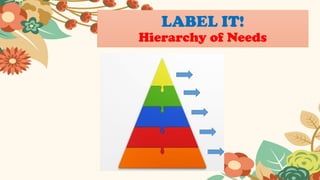
LABEL IT!
Hierarchy of Needs
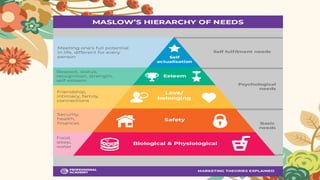
FIRST LEVEL (Physiological Needs)
It is for survival comprised of
food, water, shelter, clothing,
and sleep.
SECOND LEVEL ( SAFETY AND
SECURITY NEEDS
This stage involves health and well-
being, property, social stability, and
protection from harm, among others.
THIRD LEVEL (LOVE AND
BELONGINGNESS)
Adults and adolescence who are
starting to look for serious
relationships are particularly
concerned with satisfying the
needs at this level.
FOURTH LEVEL (ESTEEM NEEDS)
It contains items such as
achievement, competency,
approval, recognition, and respect
from others.
FINAL LEVEL (SELF
ACTUALIZATION NEEDS)
Included in this level are morality,
realization of the purpose in life,
meaning, inner potentials, and the
like.
This level aims for the full
development of one’s unique
potentials.
Characteristics of Self-actualized
Persons
They have a reached high level of moral
development and are more concerned with the
welfare of loved ones, friends, and humanity in
general than themselves.
They are open, honest, and have the courage to
act on their convictions, even if it makes them
unpopular.
They have an accurate, concrete, and
realistic- rather than a romanticized-view
of people and life, and yet they are positive
about life.
Life is always challenging and fresh to self-
actualizing individuals.
One key action to fully satisfy
your needs at each stage and to
achieve self-actualization is to
study hard. In the process, you
acquire a big stock of knowledge,
as well as develop the necessary life
skills which will help you achieve
your goals.
Lesson 1 Self Concept (Discovering oneself)

Lesson 1 Self Concept (Discovering oneself)

  • 1.
  • 2.
  • 4.
    The self ismade up of many self-perceptions, abilities, and personality characteristics that are organized and consistent with one another.
  • 5.
    Rogers 1953 •Contends thatself-concept plays an important role in personality because it influences human behaviors, feelings, and thoughts.
  • 6.
  • 7.
  • 8.
  • 9.
    REAL SELF versusIDEAL SELF
  • 10.
    Discrepancy in Self-concept Rogers(1953) states there is usually a contradiction or discrepancy between the real self and the ideal self. This difference may result in discomfort and personality problems which can be resolved by paying more attention to one’s actual experiences, working more at positive experiences, and paying less attention to the expectations of others.
  • 12.
    POSITIVE REGARD •Is believedto be important for the healthy development of one’s self-concept and for successful interpersonal relationships (Liebert & Spiegler, 1994) •Positive regards includes love, sympathy, warmth, acceptance, and respect with which people crave from family, friends, and other significant people.
  • 13.
    CONDITIONAL POSITIVE REGARD •Refersto positive regard received as a result of acceptable behaviour or living up to the expectations and standards of others. •For example, a teacher may reward students for passing the test.
  • 14.
    UNCONDITIONAL POSITIVE REGARD •On theother hand refers to the love and acceptance by a person regardless of who he/she is or what he/she does. For instance, parents may still love and respect their child even if the child flunks an exam.
  • 15.
  • 16.
    SELF-ESTEEM •Personality and socialdevelopment refer to how a person’s sense of self- identity, relationships with others, and skills necessary for social interactions evolve. •Self-esteem is the level of importance attributed to oneself and one’s abilities.
  • 17.
    •One may puta high value or a low value on his/her worth as a person. In many ways, self-esteem relates to a person’s attractiveness and social competence. •It is likewise associated with important positive or negative outcomes.
  • 18.
    •One should striveto develop a high self-esteem because it determines his/her kind of personal and social relationships. Holding good feelings about oneself results in flexibility and adaptability to situations and people. •On the other hand, a low-self esteem may lead to poor social relationships.
  • 19.
    Self-Actualization Human possess aninner drive to grow, improve, and use their potential to the fullest (Plotnik, 2014). The final stage in completed growth is known as self-actualization or self- fulfillment. • According to Abraham Maslow (1943), a self-actualizing person has reached the highest level or peak of his/her personal development and has fully realized his/her potential as a human being. • The self-fulfilled person is generally happy, generous with his/her time and effort to help others, and strives for the common good for his/her family, community, country, and even humanity.
  • 20.
  • 22.
    FIRST LEVEL (PhysiologicalNeeds) It is for survival comprised of food, water, shelter, clothing, and sleep.
  • 23.
    SECOND LEVEL (SAFETY AND SECURITY NEEDS This stage involves health and well- being, property, social stability, and protection from harm, among others.
  • 24.
    THIRD LEVEL (LOVEAND BELONGINGNESS) Adults and adolescence who are starting to look for serious relationships are particularly concerned with satisfying the needs at this level.
  • 25.
    FOURTH LEVEL (ESTEEMNEEDS) It contains items such as achievement, competency, approval, recognition, and respect from others.
  • 26.
    FINAL LEVEL (SELF ACTUALIZATIONNEEDS) Included in this level are morality, realization of the purpose in life, meaning, inner potentials, and the like. This level aims for the full development of one’s unique potentials.
  • 27.
    Characteristics of Self-actualized Persons Theyhave a reached high level of moral development and are more concerned with the welfare of loved ones, friends, and humanity in general than themselves. They are open, honest, and have the courage to act on their convictions, even if it makes them unpopular.
  • 28.
    They have anaccurate, concrete, and realistic- rather than a romanticized-view of people and life, and yet they are positive about life. Life is always challenging and fresh to self- actualizing individuals.
  • 29.
    One key actionto fully satisfy your needs at each stage and to achieve self-actualization is to study hard. In the process, you acquire a big stock of knowledge, as well as develop the necessary life skills which will help you achieve your goals.