PERSONAL BRANDING FOR
UNDERGRADUATES:
HOW TO MARKET
YOURSELF ONLINE
Suna Gurol
Fred Hutchinson Cancer Research Center
June 12, 2012
Introduction
Suna Gurol

•MA in Communication in Digital Media, University of
Washington, 2011

•Lead Web Producer, Fred Hutchinson Cancer
Research Center since 2003

•Social media at Center since 2008
Outline
• What is online personal branding?
• Social media channels
• Tips on what not to do
• Dumb tales of woe
• Do this!
• Questions?
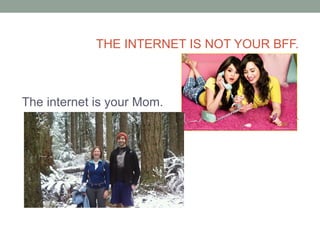
THE INTERNET IS NOT YOUR BFF.


The internet is your Mom.
So, what do you want your Mom to
say about you?
• What makes you stand out from others (besides your general
  awesomeness)?
• What do people say about you when you aren’t around?
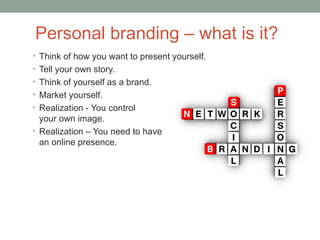
Personal branding – what is it?
• Think of how you want to present yourself.
• Tell your own story.
• Think of yourself as a brand.
• Market yourself.
• Realization - You control
  your own image.
• Realization – You need to have
  an online presence.
Old days of networking
• Curriculum Vitae
• Professors
• Friends and colleagues
• Alumni
• Friends and relatives of colleagues
But now…
• Majority of careers recruiters are using the
 internet to review job candidates. New survey from
 Jobvite reports that this year 92% of U.S.
 companies are using social networks and media to
 find new job candidates.

• Many admissions committees are Googling
 applicants. Or if they aren’t then alumni
 interviewers may.
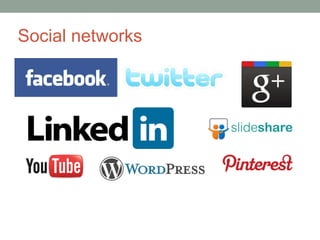
Social networks
Each online social
channel has a different flavor
• Facebook – For friends/family.
• LinkedIn – Professional network.
  Very important to have.
• Twitter – Builds a voice. But needs to be
  maintained.
• Wordpress / Blogger – Creating a blog. Use
  it to keep a record of your important papers,
  projects. Can be a sort of capstone project.
• Others – Slideshare, Pinterest, Google+, Flickr
Don’t!
• Don’t use a cutesy nickname for your
 social profiles or email address.
 “@WaterSkiNut” or
 “dummie420@email.com” doesn’t say
 ‘I’m a serious person.”

• Don’t bite off more than you can chew.
 Don’t join every social network or start a blog
 if you can’t maintain it. (How many
 abandoned 8th grade diaries are there out there?)

• Don’t post or allow yourself to be tagged in photos in
 compromising situations. (Remember Mom).

• Don’t lie. Really. You will get caught. Or caught in the cover
 up of the lie. Which is worse.
Don’t!

• #1 Don’t –

 Don’t complain about your
 job/co-workers/BOSS online!

 Stick to safe subjects to complain about – (weather,
 traffic, the Mariners)
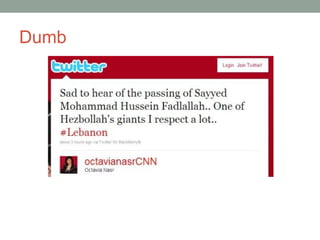
Dumb
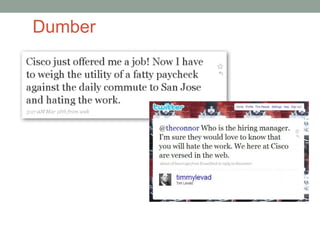
Dumber
Dumbest
Yes, do!
• Do have a professional online
 presence – At the very least:
  • LinkedIn profile
  • A blog/website with links
     to publications, papers
  • Facebook profile that is
    semi-professional

• Do use your real name.

• Do develop your online network – connect with professors,
  colleagues.
   • Ask for recommendations
   • Reciprocate! Follow people back on Twitter, comment on other
     blogs, recommend each other on LinkedIn.
• Follow your interests! They will follow you back.
More things to do
• Do develop your online network –
 connect with professors, colleagues.
  • Ask for recommendations
  • Reciprocate! Follow people back
    on Twitter, comment on other blogs0
    , recommend each other on LinkedIn.

• Follow your interests! Follow interesting people.
 They may follow you back.
Still more do’s
• Do set boundaries.
• Do Google yourself … and
• Do clean up any digital dirt
    before you apply to jobs, schools.
•   Do remember that everything on the Internet can
    live forever.
•   Do (try) to think before you post!
•   Do be relevant, timely.
•   Do make non-professional networks (Facebook)
    somewhat professional.
•   Do show your leadership.
Exercise
• Review my online personal branding


• Let’s Google/Bing someone! Volunteer
please!
Good job! Questions?
Credits
• Usage Of Social Media Sites For Recruitment Continues To Grow According To Survey of 1,000+
    HR Pros. http://
    shakerrecruitment.ning.com/profiles/blogs/usage-of-social-media-sites-for-recruitment-continues-to-grow
•   Social media can affect your college dreams http://
    seattletimes.nwsource.com/html/living/2014424681_social08.html
•     Social media and college admissions.
    http://theivycoach.com/the-ivy-coach-blog/college-interviews/social-media-and-college-admissions
    /
•   11 tips for using social media to find your next job
    http://memeburn.com/2012/07/11-tips-for-using-social-media-to-find-your-next-job/
•   Social Media Cost Me My Jobttp://
    blog.hudsonhorizons.com/Article/Social-Media-Cost-Me-My-Job.htm
Suna Gurol

Fred Hutchinson Cancer Research Center
E 1: sgurol@fhcrc.org
E 2: sunagurol@gmail.com
W: http://sunagurol.com
L: http://www.linkedin.com/in/sunagurol
T: @SunaG

Thank you Harry Hayward!

Personal Branding for Undergraduates

  • 1.
    PERSONAL BRANDING FOR UNDERGRADUATES: HOWTO MARKET YOURSELF ONLINE Suna Gurol Fred Hutchinson Cancer Research Center June 12, 2012
  • 2.
    Introduction Suna Gurol •MA inCommunication in Digital Media, University of Washington, 2011 •Lead Web Producer, Fred Hutchinson Cancer Research Center since 2003 •Social media at Center since 2008
  • 3.
    Outline • What isonline personal branding? • Social media channels • Tips on what not to do • Dumb tales of woe • Do this! • Questions?
  • 4.
    THE INTERNET ISNOT YOUR BFF. The internet is your Mom.
  • 5.
    So, what doyou want your Mom to say about you? • What makes you stand out from others (besides your general awesomeness)? • What do people say about you when you aren’t around?
  • 6.
    Personal branding –what is it? • Think of how you want to present yourself. • Tell your own story. • Think of yourself as a brand. • Market yourself. • Realization - You control your own image. • Realization – You need to have an online presence.
  • 7.
    Old days ofnetworking • Curriculum Vitae • Professors • Friends and colleagues • Alumni • Friends and relatives of colleagues
  • 8.
    But now… • Majorityof careers recruiters are using the internet to review job candidates. New survey from Jobvite reports that this year 92% of U.S. companies are using social networks and media to find new job candidates. • Many admissions committees are Googling applicants. Or if they aren’t then alumni interviewers may.
  • 9.
  • 10.
    Each online social channelhas a different flavor • Facebook – For friends/family. • LinkedIn – Professional network. Very important to have. • Twitter – Builds a voice. But needs to be maintained. • Wordpress / Blogger – Creating a blog. Use it to keep a record of your important papers, projects. Can be a sort of capstone project. • Others – Slideshare, Pinterest, Google+, Flickr
  • 11.
    Don’t! • Don’t usea cutesy nickname for your social profiles or email address. “@WaterSkiNut” or “dummie420@email.com” doesn’t say ‘I’m a serious person.” • Don’t bite off more than you can chew. Don’t join every social network or start a blog if you can’t maintain it. (How many abandoned 8th grade diaries are there out there?) • Don’t post or allow yourself to be tagged in photos in compromising situations. (Remember Mom). • Don’t lie. Really. You will get caught. Or caught in the cover up of the lie. Which is worse.
  • 12.
    Don’t! • #1 Don’t– Don’t complain about your job/co-workers/BOSS online! Stick to safe subjects to complain about – (weather, traffic, the Mariners)
  • 13.
  • 14.
  • 15.
  • 16.
    Yes, do! • Dohave a professional online presence – At the very least: • LinkedIn profile • A blog/website with links to publications, papers • Facebook profile that is semi-professional • Do use your real name. • Do develop your online network – connect with professors, colleagues. • Ask for recommendations • Reciprocate! Follow people back on Twitter, comment on other blogs, recommend each other on LinkedIn. • Follow your interests! They will follow you back.
  • 17.
    More things todo • Do develop your online network – connect with professors, colleagues. • Ask for recommendations • Reciprocate! Follow people back on Twitter, comment on other blogs0 , recommend each other on LinkedIn. • Follow your interests! Follow interesting people. They may follow you back.
  • 18.
    Still more do’s •Do set boundaries. • Do Google yourself … and • Do clean up any digital dirt before you apply to jobs, schools. • Do remember that everything on the Internet can live forever. • Do (try) to think before you post! • Do be relevant, timely. • Do make non-professional networks (Facebook) somewhat professional. • Do show your leadership.
  • 19.
    Exercise • Review myonline personal branding • Let’s Google/Bing someone! Volunteer please!
  • 20.
  • 21.
    Credits • Usage OfSocial Media Sites For Recruitment Continues To Grow According To Survey of 1,000+ HR Pros. http:// shakerrecruitment.ning.com/profiles/blogs/usage-of-social-media-sites-for-recruitment-continues-to-grow • Social media can affect your college dreams http:// seattletimes.nwsource.com/html/living/2014424681_social08.html • Social media and college admissions. http://theivycoach.com/the-ivy-coach-blog/college-interviews/social-media-and-college-admissions / • 11 tips for using social media to find your next job http://memeburn.com/2012/07/11-tips-for-using-social-media-to-find-your-next-job/ • Social Media Cost Me My Jobttp:// blog.hudsonhorizons.com/Article/Social-Media-Cost-Me-My-Job.htm
  • 22.
    Suna Gurol Fred HutchinsonCancer Research Center E 1: sgurol@fhcrc.org E 2: sunagurol@gmail.com W: http://sunagurol.com L: http://www.linkedin.com/in/sunagurol T: @SunaG Thank you Harry Hayward!