ISLAMIC ART AND
CALLIGRAPHY
ISLAMIC ART
• Encompasses the visual arts produced from the 7th century on wards by
people belonging to the Muslim world.
• Reflects the beliefs, culture and traditions of Islam.
• Does not belong to a particular region & time period.
• Spans many different regions, cultures and over a 1000 centuries.
• It includes painting, glass, ceramics, woodwork, textile and calligraphy.
• ARABESQUE
• CERAMIC & TILES
• TEXTILE
• GLASS
• METAL-WORK
• WOOD
• CALLIGRAPHY
TYPES OF ISLAMIC ART
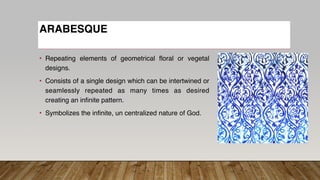
ARABESQUE
• Repeating elements of geometrical floral or vegetal
designs.
• Consists of a single design which can be intertwined or
seamlessly repeated as many times as desired
creating an infinite pattern.
• Symbolizes the infinite, un centralized nature of God.
CERAMIC & TILES
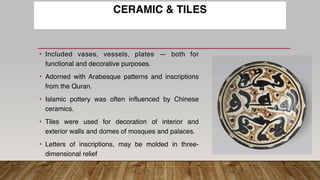
• Included vases, vessels, plates — both for
functional and decorative purposes.
• Adorned with Arabesque patterns and inscriptions
from the Quran.
• Islamic pottery was often influenced by Chinese
ceramics.
• Tiles were used for decoration of interior and
exterior walls and domes of mosques and palaces.
• Letters of inscriptions, may be molded in three-
dimensional relief
GLASS, METAL AND WOOD-WORK
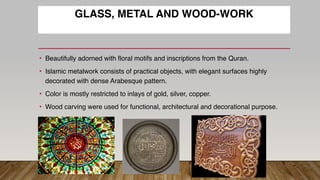
• Beautifully adorned with floral motifs and inscriptions from the Quran.
• Islamic metalwork consists of practical objects, with elegant surfaces highly
decorated with dense Arabesque pattern.
• Color is mostly restricted to inlays of gold, silver, copper.
• Wood carving were used for functional, architectural and decorational purpose.
INTRODUCTION TO CALLIGRAPHY
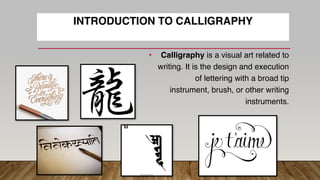
• Calligraphy is a visual art related to
writing. It is the design and execution
of lettering with a broad tip
instrument, brush, or other writing
instruments.
ISLAMIC CALLIGRAPHY
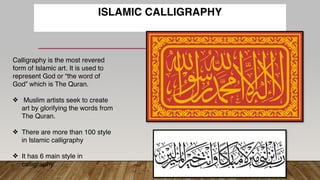
Calligraphy is the most revered
form of Islamic art. It is used to
represent God or “the word of
God” which is The Quran.
❖ Muslim artists seek to create
art by glorifying the words from
The Quran.
❖ There are more than 100 style
in Islamic calligraphy
❖ It has 6 main style in
calligraphy.
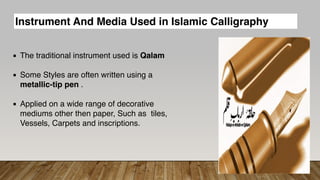
Instrument And Media Used in Islamic Calligraphy
▪ The traditional instrument used is Qalam
▪ Some Styles are often written using a
metallic-tip pen .
▪ Applied on a wide range of decorative
mediums other then paper, Such as tiles,
Vessels, Carpets and inscriptions.
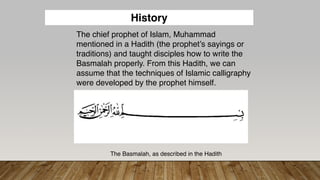
The chief prophet of Islam, Muhammad
mentioned in a Hadith (the prophet’s sayings or
traditions) and taught disciples how to write the
Basmalah properly. From this Hadith, we can
assume that the techniques of Islamic calligraphy
were developed by the prophet himself.
The Basmalah, as described in the Hadith
History
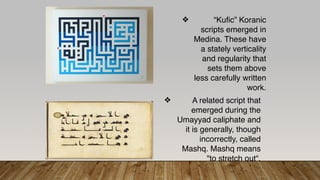
❖ “Kufic” Koranic
scripts emerged in
Medina. These have
a stately verticality
and regularity that
sets them above
less carefully written
work.
❖ A related script that
emerged during the
Umayyad caliphate and
it is generally, though
incorrectly, called
Mashq. Mashq means
"to stretch out“.
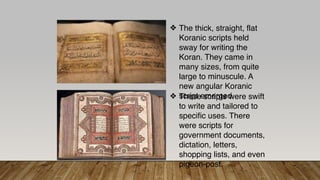
❖ The thick, straight, flat
Koranic scripts held
sway for writing the
Koran. They came in
many sizes, from quite
large to minuscule. A
new angular Koranic
script emerged.❖ These scripts were swift
to write and tailored to
specific uses. There
were scripts for
government documents,
dictation, letters,
shopping lists, and even
pigeon-post.
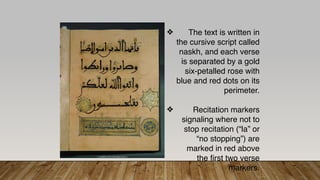
❖ The text is written in
the cursive script called
naskh, and each verse
is separated by a gold
six-petalled rose with
blue and red dots on its
perimeter.
❖ Recitation markers
signaling where not to
stop recitation (“la” or
“no stopping”) are
marked in red above
the first two verse
markers.
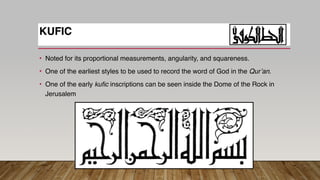
• Noted for its proportional measurements, angularity, and squareness.
• One of the earliest styles to be used to record the word of God in the Qur’an.
• One of the early kufic inscriptions can be seen inside the Dome of the Rock in
Jerusalem
KUFIC
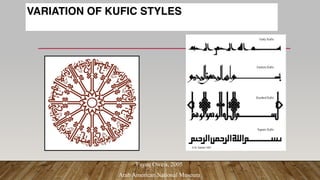
VARIATION OF KUFIC STYLES
Fayeq Oweis, 2005
Arab American National Museum
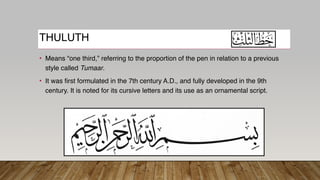
THULUTH
• Means “one third,” referring to the proportion of the pen in relation to a previous
style called Tumaar.
• It was first formulated in the 7th century A.D., and fully developed in the 9th
century. It is noted for its cursive letters and its use as an ornamental script.
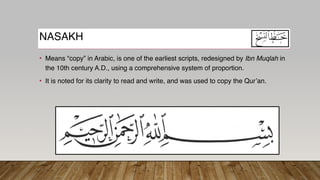
NASAKH
• Means “copy” in Arabic, is one of the earliest scripts, redesigned by Ibn Muqlah in
the 10th century A.D., using a comprehensive system of proportion.
• It is noted for its clarity to read and write, and was used to copy the Qur’an.
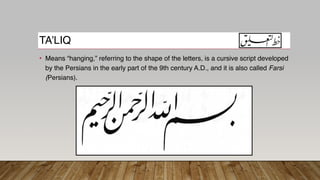
TA’LIQ
• Means “hanging,” referring to the shape of the letters, is a cursive script developed
by the Persians in the early part of the 9th century A.D., and it is also called Farsi
(Persians).
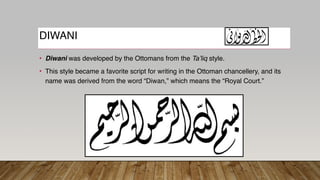
DIWANI
• Diwani was developed by the Ottomans from the Ta’liq style.
• This style became a favorite script for writing in the Ottoman chancellery, and its
name was derived from the word “Diwan,” which means the “Royal Court.”
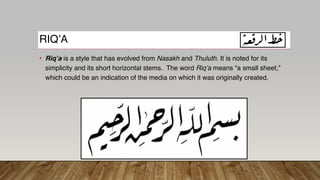
RIQ’A
• Riq’a is a style that has evolved from Nasakh and Thuluth. It is noted for its
simplicity and its short horizontal stems. The word Riq’a means “a small sheet,”
which could be an indication of the media on which it was originally created.
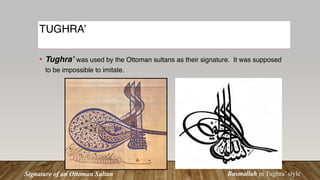
TUGHRA’
• Tughra’ was used by the Ottoman sultans as their signature. It was supposed
to be impossible to imitate.
Signature of an Ottoman Sultan Basmallah in Tughra’ style
USE OF CALLIGRAPHY IN ISLAMIC
ARCHITECTURE
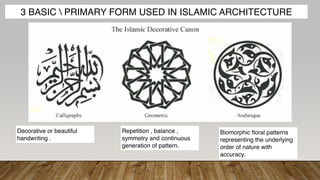
3 BASIC  PRIMARY FORM USED IN ISLAMIC ARCHITECTURE
Decorative or beautiful
handwriting .
Repetition , balance ,
symmetry and continuous
generation of pattern.
Biomorphic floral patterns
representing the underlying
order of nature with
accuracy.
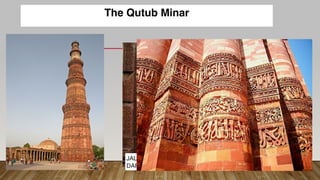
The Qutub Minar
JALI work , NAKSH calligraphy and FLORAL pattern on ALI
DARWAZA.
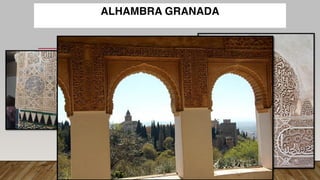
ALHAMBRA GRANADA
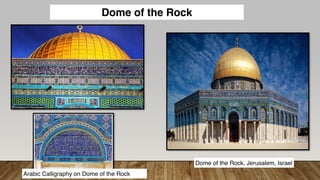
Dome of the Rock, Jerusalem, Israel
Dome of the Rock
Arabic Calligraphy on Dome of the Rock
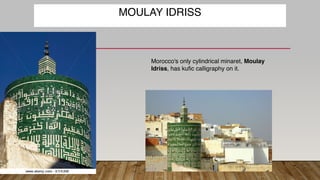
Morocco's only cylindrical minaret, Moulay
Idriss, has kufic calligraphy on it.
MOULAY IDRISS
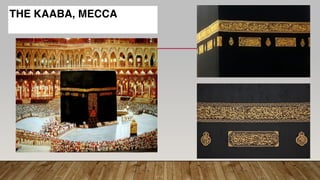
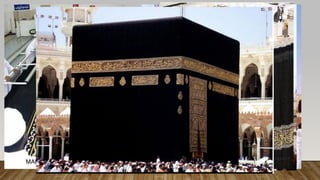
THE KAABA, MECCA

MAKING OF KISWAH CLOTH
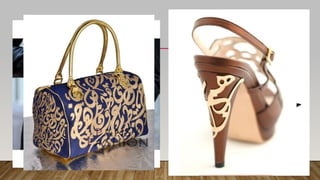
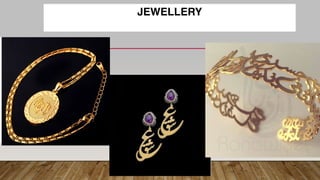
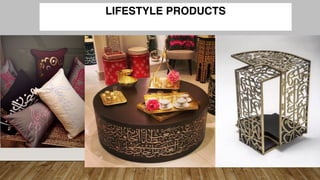
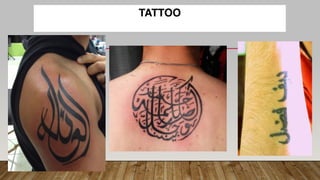
CONTEMPORARY USE OF CALLIGRAPHY
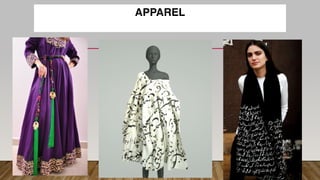
APPAREL

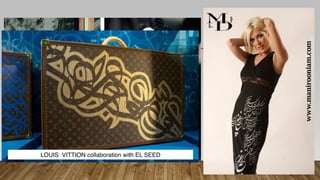
EVENING GOWN BY FASHION BRAND CHANNEL Marios Schwabs collection in LFWLOUIS VITTION collaboration with EL SEED
JEWELLERY
LIFESTYLE PRODUCTS
TATTOO
LOGO
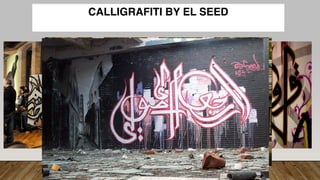
CALLIGRAFITI BY EL SEED
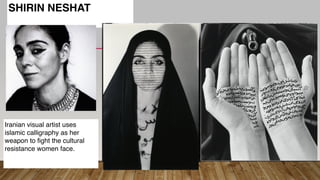
SHIRIN NESHAT
Iranian visual artist uses
islamic calligraphy as her
weapon to fight the cultural
resistance women face.

THANKYOU

Islamic art and calligraphy

  • 1.
  • 2.
    ISLAMIC ART • Encompassesthe visual arts produced from the 7th century on wards by people belonging to the Muslim world. • Reflects the beliefs, culture and traditions of Islam. • Does not belong to a particular region & time period. • Spans many different regions, cultures and over a 1000 centuries. • It includes painting, glass, ceramics, woodwork, textile and calligraphy.
  • 3.
    • ARABESQUE • CERAMIC& TILES • TEXTILE • GLASS • METAL-WORK • WOOD • CALLIGRAPHY TYPES OF ISLAMIC ART
  • 4.
    ARABESQUE • Repeating elementsof geometrical floral or vegetal designs. • Consists of a single design which can be intertwined or seamlessly repeated as many times as desired creating an infinite pattern. • Symbolizes the infinite, un centralized nature of God.
  • 5.
    CERAMIC & TILES •Included vases, vessels, plates — both for functional and decorative purposes. • Adorned with Arabesque patterns and inscriptions from the Quran. • Islamic pottery was often influenced by Chinese ceramics. • Tiles were used for decoration of interior and exterior walls and domes of mosques and palaces. • Letters of inscriptions, may be molded in three- dimensional relief
  • 6.
    GLASS, METAL ANDWOOD-WORK • Beautifully adorned with floral motifs and inscriptions from the Quran. • Islamic metalwork consists of practical objects, with elegant surfaces highly decorated with dense Arabesque pattern. • Color is mostly restricted to inlays of gold, silver, copper. • Wood carving were used for functional, architectural and decorational purpose.
  • 7.
    INTRODUCTION TO CALLIGRAPHY •Calligraphy is a visual art related to writing. It is the design and execution of lettering with a broad tip instrument, brush, or other writing instruments.
  • 8.
    ISLAMIC CALLIGRAPHY Calligraphy isthe most revered form of Islamic art. It is used to represent God or “the word of God” which is The Quran. ❖ Muslim artists seek to create art by glorifying the words from The Quran. ❖ There are more than 100 style in Islamic calligraphy ❖ It has 6 main style in calligraphy.
  • 9.
    Instrument And MediaUsed in Islamic Calligraphy ▪ The traditional instrument used is Qalam ▪ Some Styles are often written using a metallic-tip pen . ▪ Applied on a wide range of decorative mediums other then paper, Such as tiles, Vessels, Carpets and inscriptions.
  • 10.
    The chief prophetof Islam, Muhammad mentioned in a Hadith (the prophet’s sayings or traditions) and taught disciples how to write the Basmalah properly. From this Hadith, we can assume that the techniques of Islamic calligraphy were developed by the prophet himself. The Basmalah, as described in the Hadith History
  • 11.
    ❖ “Kufic” Koranic scriptsemerged in Medina. These have a stately verticality and regularity that sets them above less carefully written work. ❖ A related script that emerged during the Umayyad caliphate and it is generally, though incorrectly, called Mashq. Mashq means "to stretch out“.
  • 12.
    ❖ The thick,straight, flat Koranic scripts held sway for writing the Koran. They came in many sizes, from quite large to minuscule. A new angular Koranic script emerged.❖ These scripts were swift to write and tailored to specific uses. There were scripts for government documents, dictation, letters, shopping lists, and even pigeon-post.
  • 13.
    ❖ The textis written in the cursive script called naskh, and each verse is separated by a gold six-petalled rose with blue and red dots on its perimeter. ❖ Recitation markers signaling where not to stop recitation (“la” or “no stopping”) are marked in red above the first two verse markers.
  • 14.
    • Noted forits proportional measurements, angularity, and squareness. • One of the earliest styles to be used to record the word of God in the Qur’an. • One of the early kufic inscriptions can be seen inside the Dome of the Rock in Jerusalem KUFIC
  • 15.
    VARIATION OF KUFICSTYLES Fayeq Oweis, 2005 Arab American National Museum
  • 16.
    THULUTH • Means “onethird,” referring to the proportion of the pen in relation to a previous style called Tumaar. • It was first formulated in the 7th century A.D., and fully developed in the 9th century. It is noted for its cursive letters and its use as an ornamental script.
  • 17.
    NASAKH • Means “copy”in Arabic, is one of the earliest scripts, redesigned by Ibn Muqlah in the 10th century A.D., using a comprehensive system of proportion. • It is noted for its clarity to read and write, and was used to copy the Qur’an.
  • 18.
    TA’LIQ • Means “hanging,”referring to the shape of the letters, is a cursive script developed by the Persians in the early part of the 9th century A.D., and it is also called Farsi (Persians).
  • 19.
    DIWANI • Diwani wasdeveloped by the Ottomans from the Ta’liq style. • This style became a favorite script for writing in the Ottoman chancellery, and its name was derived from the word “Diwan,” which means the “Royal Court.”
  • 20.
    RIQ’A • Riq’a isa style that has evolved from Nasakh and Thuluth. It is noted for its simplicity and its short horizontal stems. The word Riq’a means “a small sheet,” which could be an indication of the media on which it was originally created.
  • 21.
    TUGHRA’ • Tughra’ wasused by the Ottoman sultans as their signature. It was supposed to be impossible to imitate. Signature of an Ottoman Sultan Basmallah in Tughra’ style
  • 22.
    USE OF CALLIGRAPHYIN ISLAMIC ARCHITECTURE
  • 23.
    3 BASIC PRIMARY FORM USED IN ISLAMIC ARCHITECTURE Decorative or beautiful handwriting . Repetition , balance , symmetry and continuous generation of pattern. Biomorphic floral patterns representing the underlying order of nature with accuracy.
  • 24.
    The Qutub Minar JALIwork , NAKSH calligraphy and FLORAL pattern on ALI DARWAZA.
  • 25.
  • 26.
    Dome of theRock, Jerusalem, Israel Dome of the Rock Arabic Calligraphy on Dome of the Rock
  • 27.
    Morocco's only cylindricalminaret, Moulay Idriss, has kufic calligraphy on it. MOULAY IDRISS
  • 28.
  • 29.
  • 30.
  • 31.
  • 32.
    EVENING GOWN BYFASHION BRAND CHANNEL Marios Schwabs collection in LFWLOUIS VITTION collaboration with EL SEED
  • 34.
  • 35.
  • 36.
  • 37.
  • 38.
  • 39.
    SHIRIN NESHAT Iranian visualartist uses islamic calligraphy as her weapon to fight the cultural resistance women face. 

  • 40.