Essay on Consumption
Hypotheses


Khalid Khan
Lasbela University of Agriculture, Water and
Marine Sciences, Uthal, Lasbela, Balochistan
Outline of Presentation
   INTRODUCTION
   Background of the Study
   Statement of the Problem
   Significance of the Study
   LITERATURE REVIEW
   METHODOLOGY
   DATA
Introduction
   Background of the Study
    According to the simple Keynesian
    consumption function, consumption
    depends solely on disposable
    income in the current period.
    However, it does not consider
    individuals’ expected income or and
    time preference for consumption.
Introduction
 Therefore, there are contradictions
 between the simple Keynesian
 consumption function and empirical
 evidence. Friedman’s permanent income
 hypothesis (PIH) takes into account
 lifetime income and is more general and
 better than the Keynesian absolute
 income hypothesis (AIH). Many
 economists treat PIH and Life Cycle
 Hypothesis (LCH) equal.
Introduction
 Statement of the Problem
Absolute Income Hypothesis
Relative Income Hypothesis
Permanent Income Hypothesis
Life Cycle Income Hypothesis
  So, it is important for policy makers
  that what type of hypothesis is
  consistent with Pakistan
Introduction
   Significances of the Study
   Consumption expenditure accounts
    for approximately sixty percent of
    GDP in Pakistan.
   Critical determinant of aggregate
    demand.
   Consumption is less volatile than
    investment.
Introduction
   Help us in the understanding of
    business cycle, and second, it is the
    basic determinant of economic
    welfare
   Counterpart of consumption is
    saving
Literature Review
   The psychological law of
    consumption generally known as
    absolute income hypothesis (AIH)
    introduced by Keynes (1936)
   Kuznets (1946) empirical puzzle.
   Duesenberry (1948) relative income
    hypothesis (RIH).
   Friedman (1957) Permanent Income
    Hypothesis s
Literature Review
   Modigliani and Brumbergh (1954) Life
    Cycle Income Hypothesis.
   Hall (1978) developed new approach to
    test consumption hypothesis, he took life
    cycle permanent income hypothesis and
    applied rational expectation and he
    conclude that current consumption is
    sufficient for estimation of future
    consumption.
Literature Review
   Flavin (1981) tested the Hall REH by
    simple structural econometric model of
    consumption.
   Campbell and Mankiw (1989) test the PIH
    they find that about fifty percent of
    individual’s consumption choices are
    based on the PIH while the remaining
    individual’s consumption choices are
    based on their current income.
Literature Review
   Hsich et al. (1994) tested the PIH and AIH
    for four Asian countries (Korea, Taiwan,
    Thailand, and India)
   Shea (1995) tested the life cycle
    permanent income hypothesis for U.S
    economy
   Drakos et al. (2002) investigated that the
    aggregate consumption in Greece used
    the aggregate data of consumption
Literature Review
   Manitsaris (2006) using annual data
    of fifteen European Union countries
    and estimate consumption function
    under the PIH.
   Dejuan et al. (2006) tested the PIH
    for 11 states of West German.
   Liu et al. (2007) tested PIH with
    Hong Kong’s consumption data from
    1984 to 2006
Methodology
   There are several ways through which we
    estimate the consumption function. But
    the standard model is Euler equation
    approach. The pioneer of testing the PIH
    under the rational expectation with Euler
    equation was Hall (1978). Friedman
    (1947) estimated the permanent income
    by using the distributive lag of current
    income. Lucase (1976) postulates that the
    lags of current income did not explained
    the current consumption
Methodology
   In the response to Lucase (1976) critique,
    Hall (1978) showed that with out current
    consumption other variable have no
    explanatory power to forecast future
    consumption
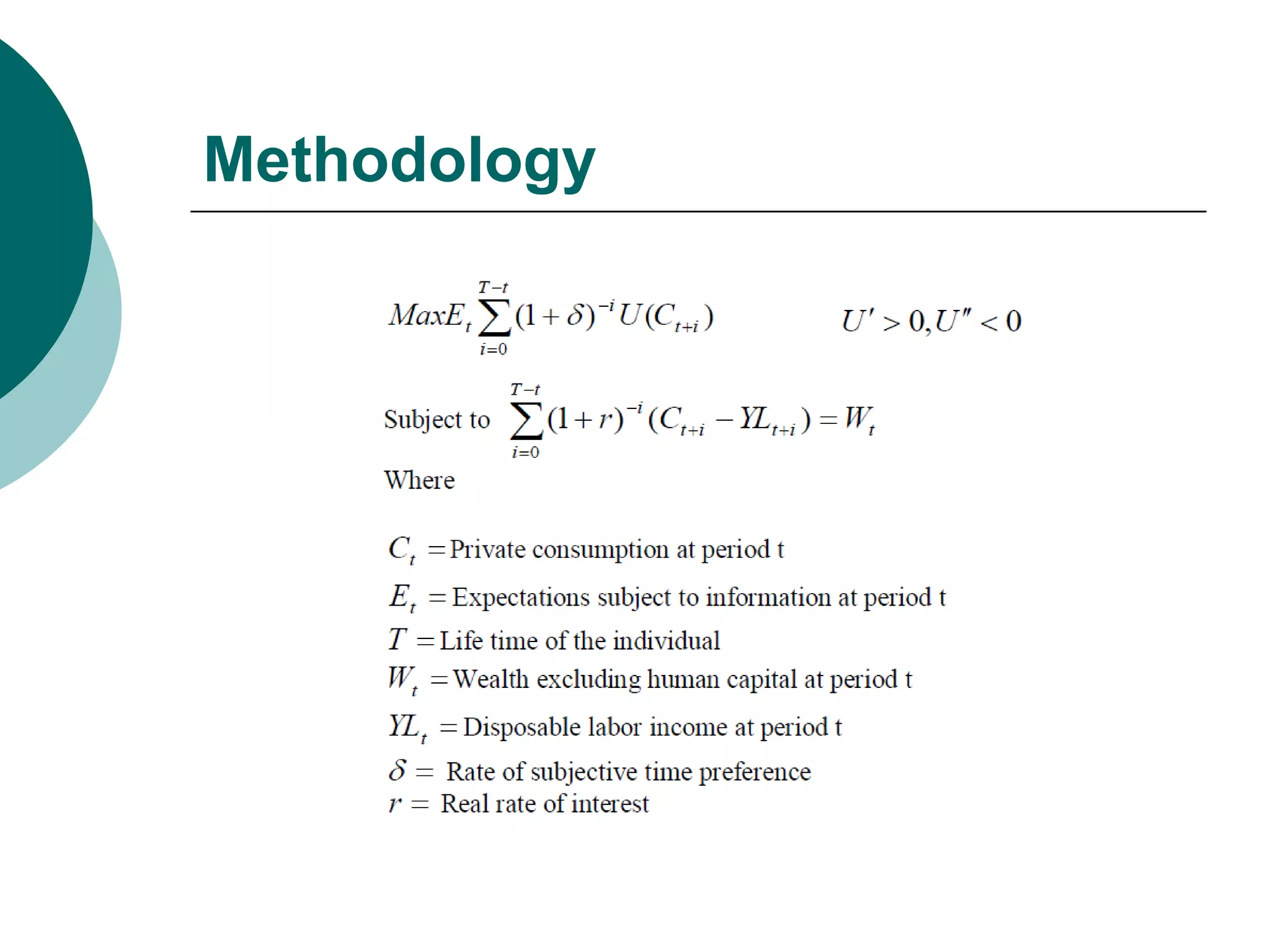
   HALL’S RANDOM WALK MODE
    According to PIH, it is usually assumed
    that aggregate consumption represents
    the individual decision, so the
    representative individual maximizes
Methodology
Methodology
Methodology

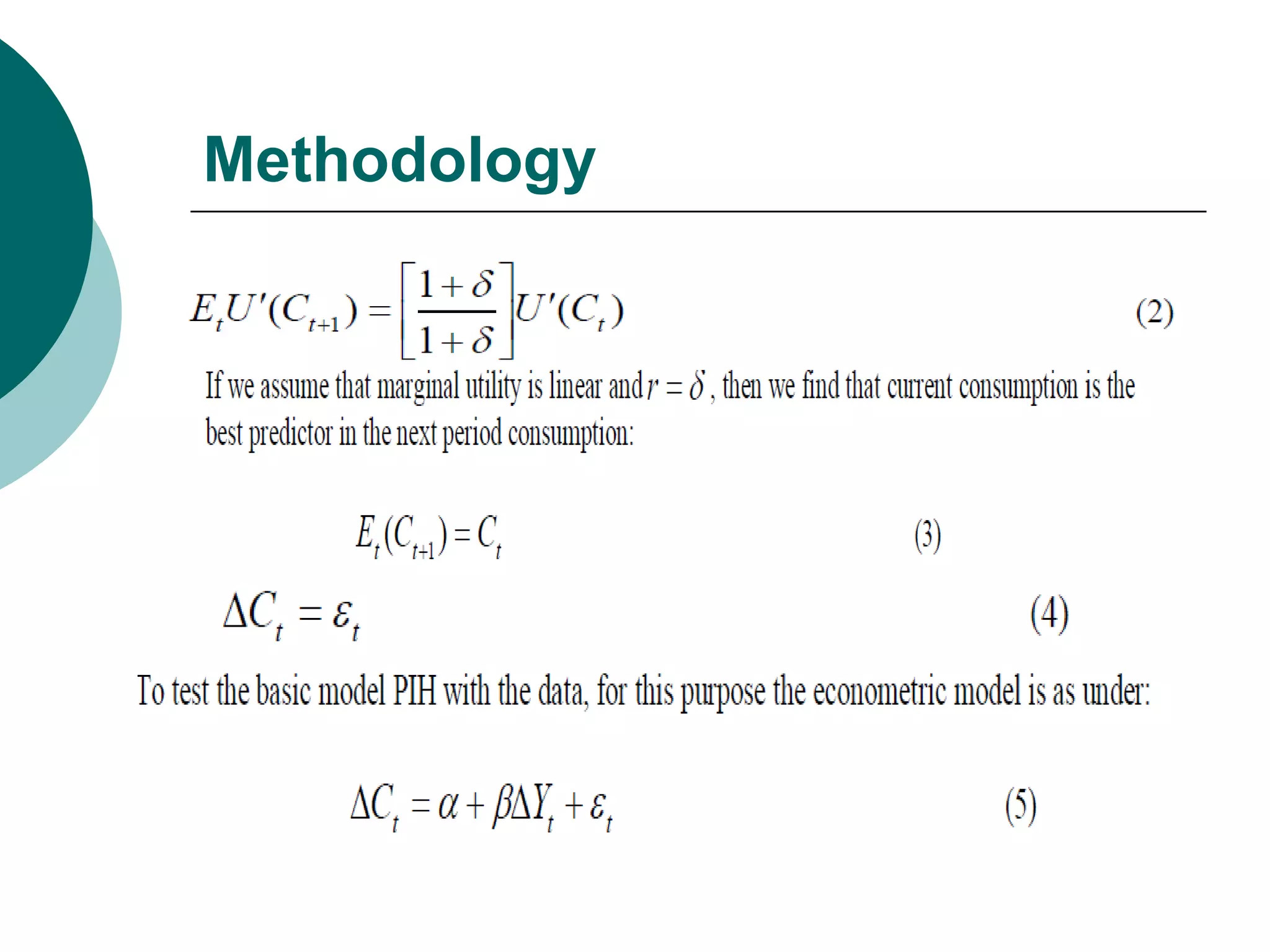
 With the help of above equation (5)
 we will test the permanent and
 income hypothesis and Absolute
 income hypothesis for Pakistan,
 simultaneously.
Methodology

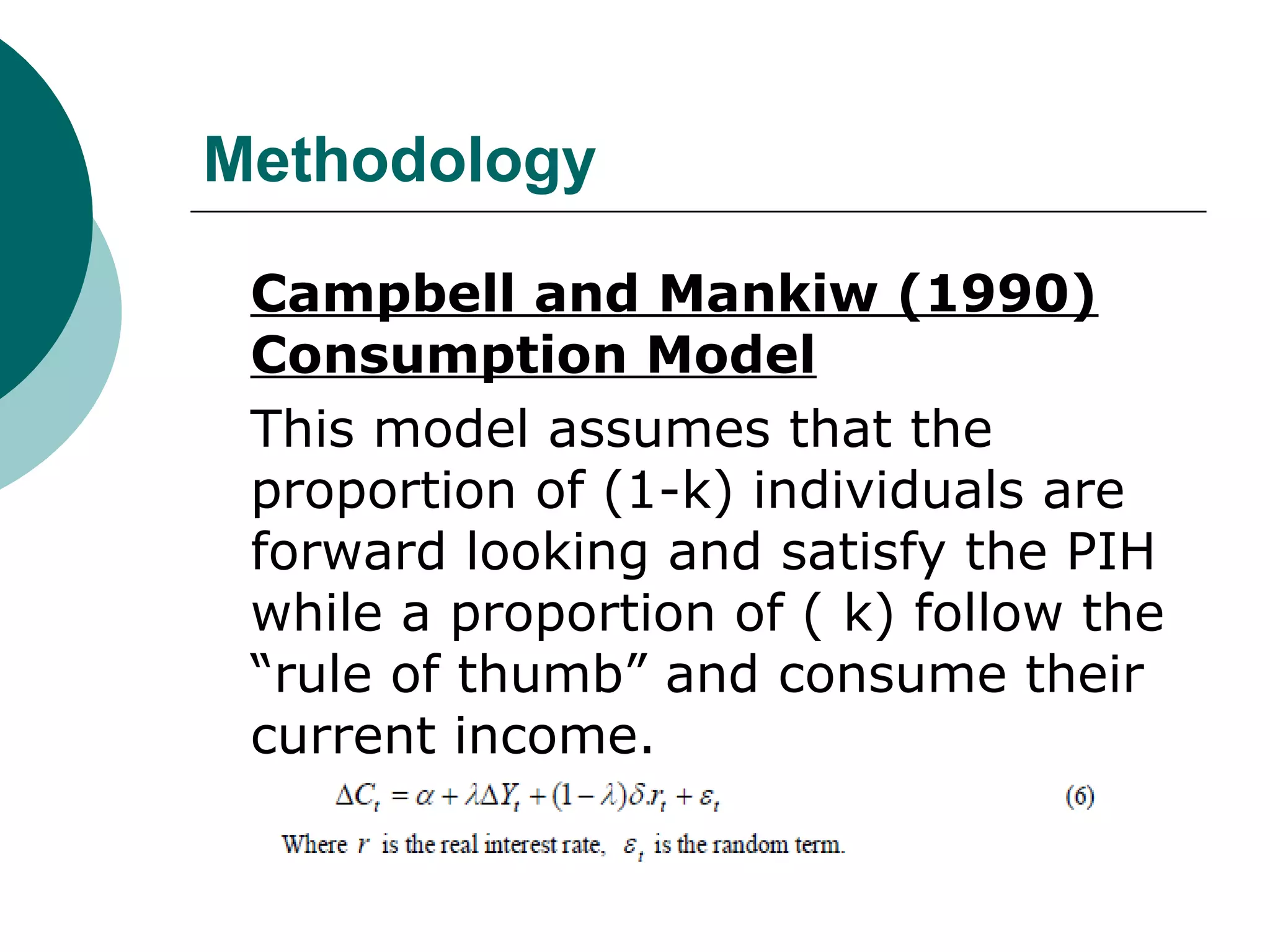
 Campbell and Mankiw (1990)
 Consumption Model
 This model assumes that the
 proportion of (1-k) individuals are
 forward looking and satisfy the PIH
 while a proportion of ( k) follow the
 “rule of thumb” and consume their
 current income.
Structure of Estimations
   Testing AIH and PIH at Macro level
   Testing AIH and PIH at Micro level
   Testing AIH and PIH for Urban
    Households and Rural Households
Sources of Data
    The data of the following variables are
    extracted from the international financial
    statistics and Household
    Integrated Economic
    Survey (HIES)
   Private consumption
   Income( GDP)
   Real interest rate
   Individual’s income
   Individual's consumption
Thanks

An Essay on Consumption Hypotheses by Mr. Khalid Khan, Lasbela University of Agriculture, Water and Marine Sciences, Quetta

  • 1.
    Essay on Consumption Hypotheses KhalidKhan Lasbela University of Agriculture, Water and Marine Sciences, Uthal, Lasbela, Balochistan
  • 2.
    Outline of Presentation  INTRODUCTION  Background of the Study  Statement of the Problem  Significance of the Study  LITERATURE REVIEW  METHODOLOGY  DATA
  • 3.
    Introduction  Background of the Study According to the simple Keynesian consumption function, consumption depends solely on disposable income in the current period. However, it does not consider individuals’ expected income or and time preference for consumption.
  • 4.
    Introduction Therefore, thereare contradictions between the simple Keynesian consumption function and empirical evidence. Friedman’s permanent income hypothesis (PIH) takes into account lifetime income and is more general and better than the Keynesian absolute income hypothesis (AIH). Many economists treat PIH and Life Cycle Hypothesis (LCH) equal.
  • 5.
    Introduction  Statement ofthe Problem Absolute Income Hypothesis Relative Income Hypothesis Permanent Income Hypothesis Life Cycle Income Hypothesis So, it is important for policy makers that what type of hypothesis is consistent with Pakistan
  • 6.
    Introduction  Significances of the Study  Consumption expenditure accounts for approximately sixty percent of GDP in Pakistan.  Critical determinant of aggregate demand.  Consumption is less volatile than investment.
  • 7.
    Introduction  Help us in the understanding of business cycle, and second, it is the basic determinant of economic welfare  Counterpart of consumption is saving
  • 8.
    Literature Review  The psychological law of consumption generally known as absolute income hypothesis (AIH) introduced by Keynes (1936)  Kuznets (1946) empirical puzzle.  Duesenberry (1948) relative income hypothesis (RIH).  Friedman (1957) Permanent Income Hypothesis s
  • 9.
    Literature Review  Modigliani and Brumbergh (1954) Life Cycle Income Hypothesis.  Hall (1978) developed new approach to test consumption hypothesis, he took life cycle permanent income hypothesis and applied rational expectation and he conclude that current consumption is sufficient for estimation of future consumption.
  • 10.
    Literature Review  Flavin (1981) tested the Hall REH by simple structural econometric model of consumption.  Campbell and Mankiw (1989) test the PIH they find that about fifty percent of individual’s consumption choices are based on the PIH while the remaining individual’s consumption choices are based on their current income.
  • 11.
    Literature Review  Hsich et al. (1994) tested the PIH and AIH for four Asian countries (Korea, Taiwan, Thailand, and India)  Shea (1995) tested the life cycle permanent income hypothesis for U.S economy  Drakos et al. (2002) investigated that the aggregate consumption in Greece used the aggregate data of consumption
  • 12.
    Literature Review  Manitsaris (2006) using annual data of fifteen European Union countries and estimate consumption function under the PIH.  Dejuan et al. (2006) tested the PIH for 11 states of West German.  Liu et al. (2007) tested PIH with Hong Kong’s consumption data from 1984 to 2006
  • 13.
    Methodology  There are several ways through which we estimate the consumption function. But the standard model is Euler equation approach. The pioneer of testing the PIH under the rational expectation with Euler equation was Hall (1978). Friedman (1947) estimated the permanent income by using the distributive lag of current income. Lucase (1976) postulates that the lags of current income did not explained the current consumption
  • 14.
    Methodology  In the response to Lucase (1976) critique, Hall (1978) showed that with out current consumption other variable have no explanatory power to forecast future consumption  HALL’S RANDOM WALK MODE According to PIH, it is usually assumed that aggregate consumption represents the individual decision, so the representative individual maximizes
  • 15.
  • 16.
  • 17.
    Methodology With thehelp of above equation (5) we will test the permanent and income hypothesis and Absolute income hypothesis for Pakistan, simultaneously.
  • 18.
    Methodology Campbell andMankiw (1990) Consumption Model This model assumes that the proportion of (1-k) individuals are forward looking and satisfy the PIH while a proportion of ( k) follow the “rule of thumb” and consume their current income.
  • 19.
    Structure of Estimations  Testing AIH and PIH at Macro level  Testing AIH and PIH at Micro level  Testing AIH and PIH for Urban Households and Rural Households
  • 20.
    Sources of Data The data of the following variables are extracted from the international financial statistics and Household Integrated Economic Survey (HIES)  Private consumption  Income( GDP)  Real interest rate  Individual’s income  Individual's consumption
  • 21.