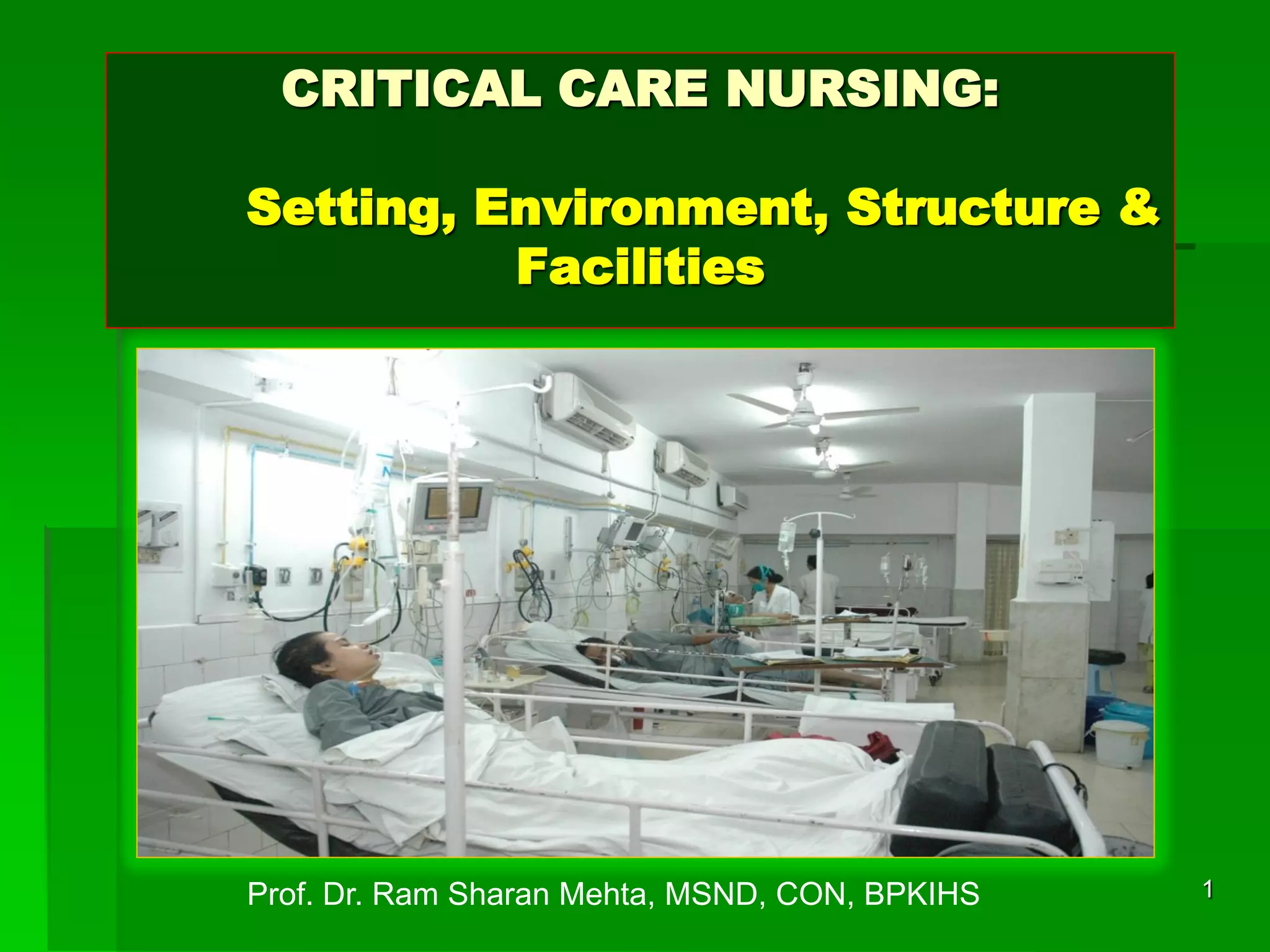
CRITICAL CARE NURSING:
Setting, Environment, Structure &
Facilities
1Prof. Dr. Ram Sharan Mehta, MSND, CON, BPKIHS
Setting, Environment,
Structure & Facilities
2Prof. Dr. R S Mehta, BPKIHS
Critical Care Beds,
Equipments, Supplies &
4
Prof. Dr. RS Mehta, BPKIHS
ICU BED
 Comfy ICU Bed (7 function) with
electrically operated back rest tilting 0-
80°, knee rest tilting 0-35°,
trendelenburg tilting 0-20°, Reverse
trendelenburg tilting 0-20°, mattress
base tilting to the left up to 40°, tilting to
the right up to 40°.
 Size: 2160 x 1100.
 All functions controlled with Power
Device . 5Prof. Dr. RS Mehta, BPKIHS
Contd….
 Four easy lifting guardrails (2 on each
side), which are safe and reliable, and
can be fixed upward and downward.
 Easy to operate built-in Control Panel on
both sides of guard rails.
6Prof. Dr. RS Mehta, BPKIHS
Contd….
 Foot Step Control Panel under the bed
frame.
 Removable & interchangeable high
quality ABS engineering plastic head
panel and foot panel.
 Head panel and foot panel equipped with
safety lock and roller bumpers.
7Prof. Dr. RS Mehta, BPKIHS
Contd…
 Epoxy coated mild steel frame work and
4 section perforated top.
 125mm dia noiseless castors with
simultaneous braking system which locks
/ unlocks 2 castors with single pedal
press.
 Provision for I.V. Rod on both sides of
the bed.
8Prof. Dr. RS Mehta, BPKIHS
Prof. Dr. R S Mehta, BPKIHS 9
10Prof. Dr. RS Mehta, BPKIHS
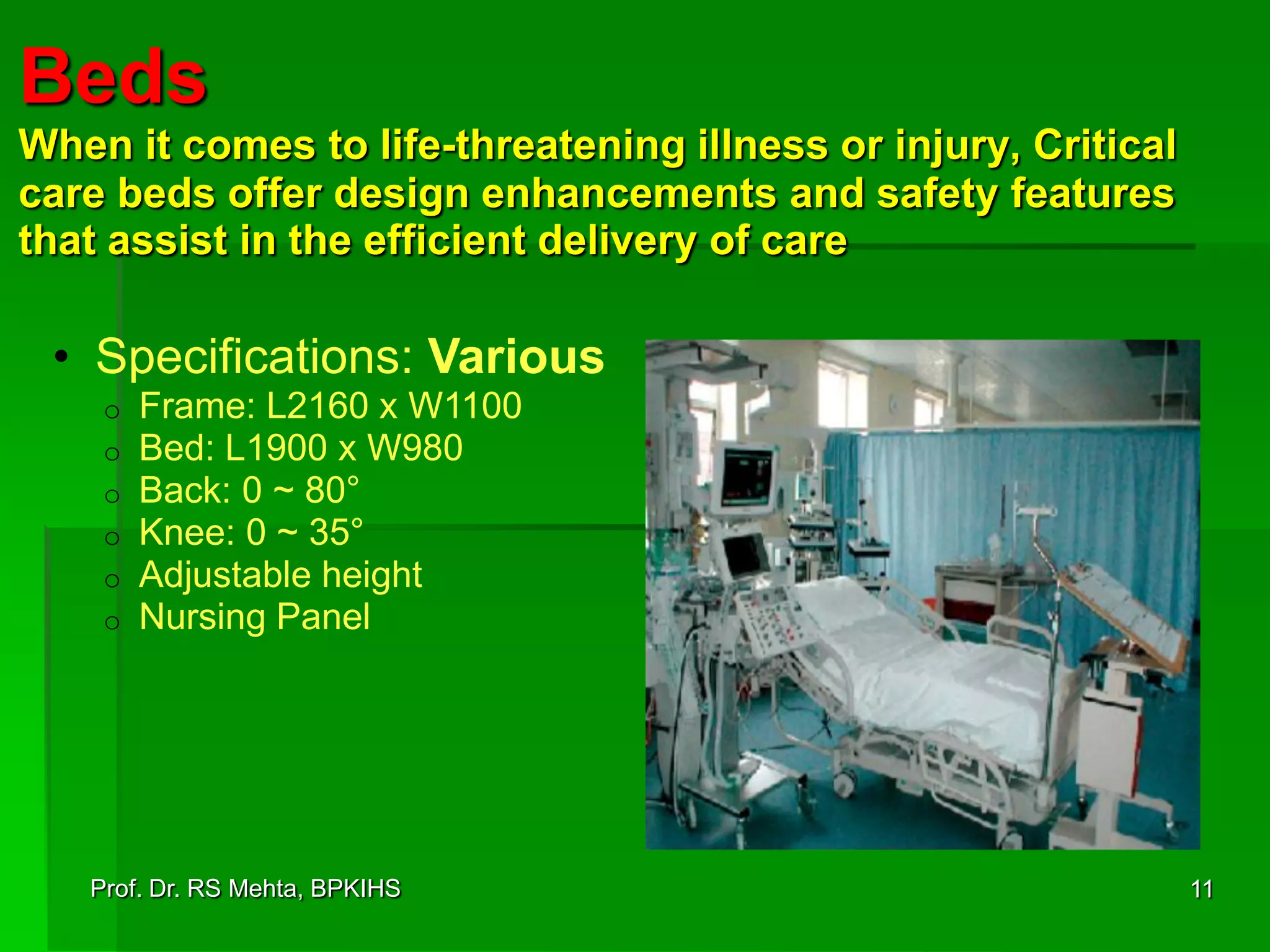
Beds
When it comes to life-threatening illness or injury, Critical
care beds offer design enhancements and safety features
that assist in the efficient delivery of care
• Specifications: Various
o Frame: L2160 x W1100
o Bed: L1900 x W980
o Back: 0 ~ 80°
o Knee: 0 ~ 35°
o Adjustable height
o Nursing Panel
11Prof. Dr. RS Mehta, BPKIHS
Types
• InTouch
o Benefits patient
o Benefits
caregiver
o Touch screen
pads
12Prof. Dr. RS Mehta, BPKIHS
• Lateral Tilting
o Prevents complication
o Assists treatment
• Impatient fall
protection
o Side rails
13Prof. Dr. RS Mehta, BPKIHS
• Recovery
o Mobilizing lifts & rails
o Ease on healthcare
staff
• Optimization of
heart and lung
performance
o Treatment positions
o Prevent complications
14Prof. Dr. RS Mehta, BPKIHS
Setup
15Prof. Dr. RS Mehta, BPKIHS
16Prof. Dr. RS Mehta, BPKIHS
17Prof. Dr. RS Mehta, BPKIHS
CLASSIFICATION OF
CRITICAL CARE PATIENTS
 Level O : normal ward care
 Level 1: at risk of deteriorating , support
from critical care team
 Level 2 : more observation or
intervention, single failing organ or post
operative care
 Level 3; advanced respiratory support or
basic respiratory support ,multiorgan
failure 18Prof. Dr. R S Mehta, BPKIHS
Types of ICU
 General
 Medical Intensive Care Unit(MICU)
 Surgical Intensive Care Unit
 Medical Surgical Intensive Care Unit(MSICU)
 Specialized
 Neonatal Intensive Care Unit(NICU)
 Special Care Nursery(SCN)
 Paediatric Intensive Care Unit(PICU)
 Coronary Care Unit(CCU)
 Cardiac Surgery Intensive Care Unit(CSICU)
 Neuro Surgery Intensive Care Unit(NSICU)
 Burn Intensive Care Unit(BICU)
 Trauma Intensive Care Unit
19Prof. Dr. R S Mehta, BPKIHS
DESIGN OF ICU
Prof. Dr. R S Mehta, BPKIHS 20
Prof. Dr. R S Mehta, BPKIHS 21
Prof. Dr. R S Mehta, BPKIHS 22
ORGANIZATION OF ICU
 DESIGN OF ICU :
1. Should be at a geographically distinct area
within the hospital, with controlled access.
2. There should be a single entry and exit.
However, it is required to have emergency exit
points in case of emergency and disaster.
3. There should not be any through traffic of
goods or hospital staff. Supply and professional
traffic should be separated from public/visitor
traffic. 23Prof. Dr. R S Mehta, BPKIHS
4. Safe, easy, fast transport of a critically sick pt
should be a priority in planning its location.
Therefore, the ICU should be located in close
proximity or ER, OT, trauma ward etc.
5. Corridors, lifts and ramps should be spacious
enough to provide easy movement of bed/trolley
of a critically sick patient.
6. Close, easy proximity is also desirable to
diagnostic facilities, blood bank, pharmacy etc.
 BED STRENGTH:
1. It is recommended that total bed strength in ICU
should be between 8-12 and not less than 6 or
not more than 24 in any case.
24Prof. Dr. R S Mehta, BPKIHS
2. 3-5 beds per 100 hospital beds for a Level III ICU
or 2 to 20% of the total no of hospital beds.
3. 1 isolation bed for every ICU beds.
 BED AND ITS SPACE:
1. 150-200 sq.ft per open bed with 8 ft in between
beds.
2. 225-250 sq.ft per bed if in a single room.
3. Beds should be adjustable, no head board, with
side rails and wheels.
4. Keep bed 2 ft away from head wall.
25Prof. Dr. R S Mehta, BPKIHS
 ACCESSORIES:
1. 3 O2 outlets, 3 suction outlets (gastric, tracheal
and underwater seal), 2 compressed air outlets
and 16 power outlets per bed.
2. Storage by each bedside.
3. Hand rinse solution by each bedside.
4. Equipment shelf at the head end.
5. Hooks and devices to hang infusions/ blood
bags, extended from the ceiling with a sliding rail
to position.
6. Infusion pumps to be mounted on stand or poles.
7. Level II ICUs may require multi channel invasive
monitors. 26Prof. Dr. R S Mehta, BPKIHS
8. ventilators, infusion pumps, portable X ray unit,
fluid and bed warmers, portable light,
defibrillators, anaesthesia machines and difficult
airway management equipments are necessary.
 STAFFING :
1. Medical Staff – the best senior medical staff to
be appointed as an Intensive Care Director or
Intensivist. Less preferred are other specialists
from anaesthesia / medicine who has clinical
commitment elsewhere. Junior staff are intensive
care trainers and trainees on deputation from
other disciplines.
2. Nursing staff – The major teaching tertiary care
ICU requires trained nurses in critical care. 27
The no of nurses ideally required for such unit is
1:1 ratio, however it might not be possible to have
such members in our set up. So 1 nurse for 2
patients is acceptable. The no of trained nurses
should also be worked out by the type of ICU, the
workload and work statistics and type of patient
load.
3.Allied Services – Respiratory services,
Nutritionist, Physiotherapist, Biomedical engineer,
technicians, computer programmer, clinical
pharmacist, social worker / counsellor and other
support staff, guards and grade IV workers.
28Prof. Dr. R S Mehta, BPKIHS
Design Summary:
 For critically ill: unstable patients
 Level: I II III
 Bed strength: ideal 8-12
 Each pt. > 100 sq. ft. ( 125-150 desirable)
 Additional space = 100%
 10% isolation bed
 At least 2 barriers to enter ICU
Prof. Dr. R S Mehta, BPKIHS 29
 Only one entry and exit, emergency exit
 Proper fire extinguisher
 At least 2 ft. away from head wall
 Central nursing station: all pt. visible
Environment requirements:
 Heating, ventilation, air-conditioning
system in ICU (HVAC system)
 Fully air-conditioned : 6 cycle/hr, 2 cycle
outside air
 Temperature = 16-25 oC
Prof. Dr. R S Mehta, BPKIHS 30
 Light: high illumination, 150 foot candle
(fc), overhead light = 20fc, floor light at
night = 10fc
 Noise control: Under 45 dBA in day, <40
in evening, <20 in night. (watch tick= 20
& normal conversation at 55)
 Furniture: solid, non-porous, stain
resistant.
 Floor: easy to clean and non-slippery
 Wall= 4-5 ft. finished with tiles
 Ceiling: paint with soft color, no wire lines
Prof. Dr. R S Mehta, BPKIHS 31
 Water disposal and pollution control:
Color coded buckets
 Hand Hygiene and prevention of
infection: central basin with foot operated,
alcohol base hand wash.
 Other Preparations:
 Fire, accidents, unforeseen incidents
 Emergency exit
 Fire extinguisher
Needs for Doctors and Nurses: Multi-purpose
rooms, Lockers, meeting rooms, communication
Prof. Dr. R S Mehta, BPKIHS 32
Thank you
33Prof. Dr. R S Mehta, BPKIHS

1.2. critical care setting, environment, sturcture and facilities

  • 1.
    CRITICAL CARE NURSING: Setting,Environment, Structure & Facilities 1Prof. Dr. Ram Sharan Mehta, MSND, CON, BPKIHS
  • 2.
    Setting, Environment, Structure &Facilities 2Prof. Dr. R S Mehta, BPKIHS
  • 4.
    Critical Care Beds, Equipments,Supplies & 4 Prof. Dr. RS Mehta, BPKIHS
  • 5.
    ICU BED  ComfyICU Bed (7 function) with electrically operated back rest tilting 0- 80°, knee rest tilting 0-35°, trendelenburg tilting 0-20°, Reverse trendelenburg tilting 0-20°, mattress base tilting to the left up to 40°, tilting to the right up to 40°.  Size: 2160 x 1100.  All functions controlled with Power Device . 5Prof. Dr. RS Mehta, BPKIHS
  • 6.
    Contd….  Four easylifting guardrails (2 on each side), which are safe and reliable, and can be fixed upward and downward.  Easy to operate built-in Control Panel on both sides of guard rails. 6Prof. Dr. RS Mehta, BPKIHS
  • 7.
    Contd….  Foot StepControl Panel under the bed frame.  Removable & interchangeable high quality ABS engineering plastic head panel and foot panel.  Head panel and foot panel equipped with safety lock and roller bumpers. 7Prof. Dr. RS Mehta, BPKIHS
  • 8.
    Contd…  Epoxy coatedmild steel frame work and 4 section perforated top.  125mm dia noiseless castors with simultaneous braking system which locks / unlocks 2 castors with single pedal press.  Provision for I.V. Rod on both sides of the bed. 8Prof. Dr. RS Mehta, BPKIHS
  • 9.
    Prof. Dr. RS Mehta, BPKIHS 9
  • 10.
    10Prof. Dr. RSMehta, BPKIHS
  • 11.
    Beds When it comesto life-threatening illness or injury, Critical care beds offer design enhancements and safety features that assist in the efficient delivery of care • Specifications: Various o Frame: L2160 x W1100 o Bed: L1900 x W980 o Back: 0 ~ 80° o Knee: 0 ~ 35° o Adjustable height o Nursing Panel 11Prof. Dr. RS Mehta, BPKIHS
  • 12.
    Types • InTouch o Benefitspatient o Benefits caregiver o Touch screen pads 12Prof. Dr. RS Mehta, BPKIHS
  • 13.
    • Lateral Tilting oPrevents complication o Assists treatment • Impatient fall protection o Side rails 13Prof. Dr. RS Mehta, BPKIHS
  • 14.
    • Recovery o Mobilizinglifts & rails o Ease on healthcare staff • Optimization of heart and lung performance o Treatment positions o Prevent complications 14Prof. Dr. RS Mehta, BPKIHS
  • 15.
    Setup 15Prof. Dr. RSMehta, BPKIHS
  • 16.
    16Prof. Dr. RSMehta, BPKIHS
  • 17.
    17Prof. Dr. RSMehta, BPKIHS
  • 18.
    CLASSIFICATION OF CRITICAL CAREPATIENTS  Level O : normal ward care  Level 1: at risk of deteriorating , support from critical care team  Level 2 : more observation or intervention, single failing organ or post operative care  Level 3; advanced respiratory support or basic respiratory support ,multiorgan failure 18Prof. Dr. R S Mehta, BPKIHS
  • 19.
    Types of ICU General  Medical Intensive Care Unit(MICU)  Surgical Intensive Care Unit  Medical Surgical Intensive Care Unit(MSICU)  Specialized  Neonatal Intensive Care Unit(NICU)  Special Care Nursery(SCN)  Paediatric Intensive Care Unit(PICU)  Coronary Care Unit(CCU)  Cardiac Surgery Intensive Care Unit(CSICU)  Neuro Surgery Intensive Care Unit(NSICU)  Burn Intensive Care Unit(BICU)  Trauma Intensive Care Unit 19Prof. Dr. R S Mehta, BPKIHS
  • 20.
    DESIGN OF ICU Prof.Dr. R S Mehta, BPKIHS 20
  • 21.
    Prof. Dr. RS Mehta, BPKIHS 21
  • 22.
    Prof. Dr. RS Mehta, BPKIHS 22
  • 23.
    ORGANIZATION OF ICU DESIGN OF ICU : 1. Should be at a geographically distinct area within the hospital, with controlled access. 2. There should be a single entry and exit. However, it is required to have emergency exit points in case of emergency and disaster. 3. There should not be any through traffic of goods or hospital staff. Supply and professional traffic should be separated from public/visitor traffic. 23Prof. Dr. R S Mehta, BPKIHS
  • 24.
    4. Safe, easy,fast transport of a critically sick pt should be a priority in planning its location. Therefore, the ICU should be located in close proximity or ER, OT, trauma ward etc. 5. Corridors, lifts and ramps should be spacious enough to provide easy movement of bed/trolley of a critically sick patient. 6. Close, easy proximity is also desirable to diagnostic facilities, blood bank, pharmacy etc.  BED STRENGTH: 1. It is recommended that total bed strength in ICU should be between 8-12 and not less than 6 or not more than 24 in any case. 24Prof. Dr. R S Mehta, BPKIHS
  • 25.
    2. 3-5 bedsper 100 hospital beds for a Level III ICU or 2 to 20% of the total no of hospital beds. 3. 1 isolation bed for every ICU beds.  BED AND ITS SPACE: 1. 150-200 sq.ft per open bed with 8 ft in between beds. 2. 225-250 sq.ft per bed if in a single room. 3. Beds should be adjustable, no head board, with side rails and wheels. 4. Keep bed 2 ft away from head wall. 25Prof. Dr. R S Mehta, BPKIHS
  • 26.
     ACCESSORIES: 1. 3O2 outlets, 3 suction outlets (gastric, tracheal and underwater seal), 2 compressed air outlets and 16 power outlets per bed. 2. Storage by each bedside. 3. Hand rinse solution by each bedside. 4. Equipment shelf at the head end. 5. Hooks and devices to hang infusions/ blood bags, extended from the ceiling with a sliding rail to position. 6. Infusion pumps to be mounted on stand or poles. 7. Level II ICUs may require multi channel invasive monitors. 26Prof. Dr. R S Mehta, BPKIHS
  • 27.
    8. ventilators, infusionpumps, portable X ray unit, fluid and bed warmers, portable light, defibrillators, anaesthesia machines and difficult airway management equipments are necessary.  STAFFING : 1. Medical Staff – the best senior medical staff to be appointed as an Intensive Care Director or Intensivist. Less preferred are other specialists from anaesthesia / medicine who has clinical commitment elsewhere. Junior staff are intensive care trainers and trainees on deputation from other disciplines. 2. Nursing staff – The major teaching tertiary care ICU requires trained nurses in critical care. 27
  • 28.
    The no ofnurses ideally required for such unit is 1:1 ratio, however it might not be possible to have such members in our set up. So 1 nurse for 2 patients is acceptable. The no of trained nurses should also be worked out by the type of ICU, the workload and work statistics and type of patient load. 3.Allied Services – Respiratory services, Nutritionist, Physiotherapist, Biomedical engineer, technicians, computer programmer, clinical pharmacist, social worker / counsellor and other support staff, guards and grade IV workers. 28Prof. Dr. R S Mehta, BPKIHS
  • 29.
    Design Summary:  Forcritically ill: unstable patients  Level: I II III  Bed strength: ideal 8-12  Each pt. > 100 sq. ft. ( 125-150 desirable)  Additional space = 100%  10% isolation bed  At least 2 barriers to enter ICU Prof. Dr. R S Mehta, BPKIHS 29
  • 30.
     Only oneentry and exit, emergency exit  Proper fire extinguisher  At least 2 ft. away from head wall  Central nursing station: all pt. visible Environment requirements:  Heating, ventilation, air-conditioning system in ICU (HVAC system)  Fully air-conditioned : 6 cycle/hr, 2 cycle outside air  Temperature = 16-25 oC Prof. Dr. R S Mehta, BPKIHS 30
  • 31.
     Light: highillumination, 150 foot candle (fc), overhead light = 20fc, floor light at night = 10fc  Noise control: Under 45 dBA in day, <40 in evening, <20 in night. (watch tick= 20 & normal conversation at 55)  Furniture: solid, non-porous, stain resistant.  Floor: easy to clean and non-slippery  Wall= 4-5 ft. finished with tiles  Ceiling: paint with soft color, no wire lines Prof. Dr. R S Mehta, BPKIHS 31
  • 32.
     Water disposaland pollution control: Color coded buckets  Hand Hygiene and prevention of infection: central basin with foot operated, alcohol base hand wash.  Other Preparations:  Fire, accidents, unforeseen incidents  Emergency exit  Fire extinguisher Needs for Doctors and Nurses: Multi-purpose rooms, Lockers, meeting rooms, communication Prof. Dr. R S Mehta, BPKIHS 32
  • 33.
    Thank you 33Prof. Dr.R S Mehta, BPKIHS