Performance Management
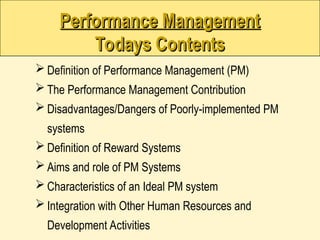
Todays Contents
Todays Contents
 Definition of Performance Management (PM)
 The Performance Management Contribution
 Disadvantages/Dangers of Poorly-implemented PM
systems
 Definition of Reward Systems
 Aims and role of PM Systems
 Characteristics of an Ideal PM system
 Integration with Other Human Resources and
Development Activities
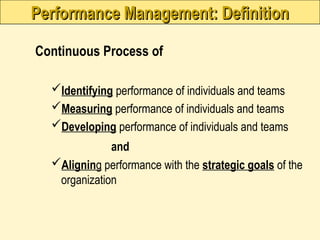
Performance Management: Definition
Continuous Process of
Identifying performance of individuals and teams
Measuring performance of individuals and teams
Developing performance of individuals and teams
and
Aligning performance with the strategic goals of the
organization
PM is NOT performance
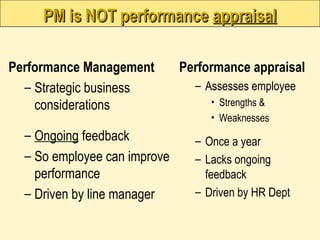
PM is NOT performance appraisal
appraisal
Performance Management
– Strategic business
considerations
– Ongoing feedback
– So employee can improve
performance
– Driven by line manager
Performance appraisal
– Assesses employee
• Strengths &
• Weaknesses
– Once a year
– Lacks ongoing
feedback
– Driven by HR Dept
Contributions of PM
Contributions of PM
For Employees
For Employees
The definitions of job and success are clarified
Motivation to perform is increased
Self-esteem is increased
Self-insight and development are enhanced
Contributions of PM
Contributions of PM
For Managers
For Managers
Supervisors’ views of performance are
communicated more clearly
Managers gain insight about subordinates
There is better and more timely differentiation
between good and poor performers
Employees become more competent
Contributions of PM
Contributions of PM
For Organization/HR Function
Organizational goals are made clear
Organizational change is facilitated
Administrative actions are more fair and
appropriate
There is better protection from lawsuits
Disadvantages/Dangers of
Poorly-implemented PM Systems
for Employees
for Employees
• Lowered self-esteem
• Employee burnout and job dissatisfaction
• Damaged relationships
• Use of false or misleading information
Disadvantages/Dangers of
Poorly-implemented PM Systems
for Managers
for Managers
• Increased turnover
• Decreased motivation to perform
• Unjustified demands on managers’ resources
• Varying and unfair standards and ratings
• Wasted time and money
• Unclear ratings system
• Emerging biases
• Increased risk of litigation
Disadvantages/Dangers of
Poorly-implemented PM Systems
for Organization
for Organization
Reward Systems: Definition
Set of mechanisms for distributing
Tangible returns
and
Intangible or relational returns
As part of an employment relationship
Tangible returns
Tangible returns
Cash Compensation
Base pay
Cost-of-Living & Contingent Pay
Incentives (short- and long-term)
Benefits, such as
Income Protection
Allowances
Work/life focus
Intangible returns
Intangible returns
 Relational returns, such as
Recognition and status
Employment security
Challenging work
Learning opportunities
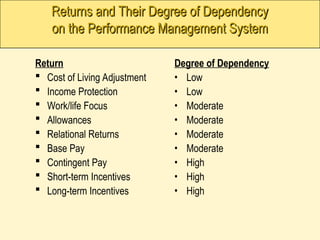
Returns and Their Degree of Dependency
on the Performance Management System
Return
 Cost of Living Adjustment
 Income Protection
 Work/life Focus
 Allowances
 Relational Returns
 Base Pay
 Contingent Pay
 Short-term Incentives
 Long-term Incentives
Degree of Dependency
• Low
• Low
• Moderate
• Moderate
• Moderate
• Moderate
• High
• High
• High
Purposes of PM Systems:
Overview
Overview
 Strategic
 Administrative
 Informational
 Developmental
 Organizational maintenance
 Documentation
Strategic Purpose
Strategic Purpose
Link employee behavior with organization’s
goals
Communicate most crucial business strategic
initiatives
Administrative Purpose
Provide information for making decisions related to:
 Salary adjustments
 Promotions
 Retention or termination
 Recognition of individual performance
 Layoffs
Informational Purpose
Communicate to Employees:
Expectations
What is important
How they are doing
How to improve
Developmental Purpose
 Performance feedback / coaching
 Identification of individual strengths and
weaknesses
 Causes of performance deficiencies
 Tailor development of individual career
path
Organizational Maintenance Purpose
 Plan effective workforce
 Assess future training needs
 Evaluate performance at organizational
level
 Evaluate effectiveness of HR interventions
Documentational Purpose
 Validate selection instruments
 Document administrative decisions
 Help meet legal requirements
Characteristics of an Ideal PM System
Congruent with organizational strategy
• Consistent with organization’s strategy
• Aligned with unit and organizational goals
Thorough
Thorough
• All employees are evaluated
• All major job responsibilities are evaluated
• Evaluations cover performance for entire
review period
• Feedback is given on both positive and
negative performance
Practical
Practical
• Available
• Easy to use
• Acceptable to decision makers
• Benefits outweigh costs
Meaningful
Meaningful
• Standards are important and relevant
• Results have consequences
• Evaluations occur regularly and at appropriate
times
• System provides for continuing skill
development of evaluators
Specific
Specific
Concrete and detailed guidance to employees
• What’s expected
• How to meet the expectations
Identifies effective and ineffective performance
• Distinguish between effective and ineffective
– Behaviors
– Results
• Provide ability to identify employees with
various levels of performance
Reliable
Reliable
• Consistent
• Free of error
• Inter-rater reliability
Valid
Valid
• Relevant (measures what is important)
• Not deficient (doesn’t measure
unimportant facets of job)
Acceptable and Fair
Acceptable and Fair
• Perception of Distributive Justice
– Work performed  evaluation received  reward
• Perception of Procedural Justice
– Fairness of procedures used to:
• Determine ratings
• Link ratings to rewards
Inclusive
Inclusive
• Represents concerns of all involved
– When system is created, employees should help
with deciding
• What should be measured
• How it should be measured
– Employee should provide input on performance
prior to evaluation meeting
Open (
Open (No
No Secrets)
Secrets)
• Frequent, ongoing evaluations and feedback
• 2-way communications in appraisal meeting
• Clear standards, ongoing communication
• Communications are factual, open, honest
Correctable
Correctable
• Recognizes that human judgment is fallible
• Appeals process provided
Standardized
Standardized
• Ongoing training of managers to provide
• Consistent evaluations across
– People
– Time
Ethical
Ethical
• Supervisor suppresses self-interest
• Supervisor rates only where he/she has
sufficient information about the performance
dimension
• Supervisor respects employee privacy
Integration with other Human Resources
and Development activities
PM provides information for:
Development of training to meet organizational
needs
Workforce planning
Recruitment and hiring decisions
Development of compensation systems
Question
Performance management plays a crucial role in organizations. It encompasses
various processes and activities aimed at maximizing individual and organizational
performance. One of the key purposes of performance management is to ensure
alignment between individual goals and organizational objectives. With this in mind,
which of the following statements best describes the purpose of performance
management in an organization?
A.To evaluate employee job satisfaction and overall happiness in the workplace, ensuring a positive work
environment.
B.To identify training and development needs, facilitating the enhancement of employee skills and
knowledge.
C.To establish a hierarchy of authority and clarify reporting lines to improve organizational structure.
D.To monitor employee attendance and punctuality, ensuring adherence to work schedules.
Please select the correct option (A, B, C, or D) and provide short justification
The best answer is:
(B)
To identify training and development needs, facilitating the enhancement of
employee skills and knowledge. Performance management is a
comprehensive process that involves setting clear performance expectations,
regularly assessing performance, providing feedback, and identifying areas
for improvement. One of the primary objectives of performance management
is to identify individual employee training and development needs. By
assessing performance and recognizing areas where employees may require
additional support or skill enhancement, organizations can design targeted
training programs to help employees improve their performance and
contribute to the overall success of the organization.
40
40

Lecture 6 - Performance Management in HR.ppt

  • 1.
  • 2.
    Performance Management Performance Management TodaysContents Todays Contents  Definition of Performance Management (PM)  The Performance Management Contribution  Disadvantages/Dangers of Poorly-implemented PM systems  Definition of Reward Systems  Aims and role of PM Systems  Characteristics of an Ideal PM system  Integration with Other Human Resources and Development Activities
  • 3.
    Performance Management: Definition PerformanceManagement: Definition Continuous Process of Identifying performance of individuals and teams Measuring performance of individuals and teams Developing performance of individuals and teams and Aligning performance with the strategic goals of the organization
  • 4.
    PM is NOTperformance PM is NOT performance appraisal appraisal Performance Management – Strategic business considerations – Ongoing feedback – So employee can improve performance – Driven by line manager Performance appraisal – Assesses employee • Strengths & • Weaknesses – Once a year – Lacks ongoing feedback – Driven by HR Dept
  • 5.
    Contributions of PM Contributionsof PM For Employees For Employees The definitions of job and success are clarified Motivation to perform is increased Self-esteem is increased Self-insight and development are enhanced
  • 6.
    Contributions of PM Contributionsof PM For Managers For Managers Supervisors’ views of performance are communicated more clearly Managers gain insight about subordinates There is better and more timely differentiation between good and poor performers Employees become more competent
  • 7.
    Contributions of PM Contributionsof PM For Organization/HR Function For Organization/HR Function Organizational goals are made clear Organizational change is facilitated Administrative actions are more fair and appropriate There is better protection from lawsuits
  • 8.
    Disadvantages/Dangers of Disadvantages/Dangers of Poorly-implementedPM Systems Poorly-implemented PM Systems for Employees for Employees • Lowered self-esteem • Employee burnout and job dissatisfaction • Damaged relationships • Use of false or misleading information
  • 9.
    Disadvantages/Dangers of Disadvantages/Dangers of Poorly-implementedPM Systems Poorly-implemented PM Systems for Managers for Managers • Increased turnover • Decreased motivation to perform • Unjustified demands on managers’ resources • Varying and unfair standards and ratings
  • 10.
    • Wasted timeand money • Unclear ratings system • Emerging biases • Increased risk of litigation Disadvantages/Dangers of Disadvantages/Dangers of Poorly-implemented PM Systems Poorly-implemented PM Systems for Organization for Organization
  • 11.
    Reward Systems: Definition RewardSystems: Definition Set of mechanisms for distributing Tangible returns and Intangible or relational returns As part of an employment relationship
  • 12.
    Tangible returns Tangible returns CashCompensation Base pay Cost-of-Living & Contingent Pay Incentives (short- and long-term) Benefits, such as Income Protection Allowances Work/life focus
  • 13.
    Intangible returns Intangible returns Relational returns, such as Recognition and status Employment security Challenging work Learning opportunities
  • 14.
    Returns and TheirDegree of Dependency Returns and Their Degree of Dependency on the Performance Management System on the Performance Management System Return  Cost of Living Adjustment  Income Protection  Work/life Focus  Allowances  Relational Returns  Base Pay  Contingent Pay  Short-term Incentives  Long-term Incentives Degree of Dependency • Low • Low • Moderate • Moderate • Moderate • Moderate • High • High • High
  • 15.
    Purposes of PMSystems: Purposes of PM Systems: Overview Overview  Strategic  Administrative  Informational  Developmental  Organizational maintenance  Documentation
  • 16.
    Strategic Purpose Strategic Purpose Linkemployee behavior with organization’s goals Communicate most crucial business strategic initiatives
  • 17.
    Administrative Purpose Administrative Purpose Provideinformation for making decisions related to:  Salary adjustments  Promotions  Retention or termination  Recognition of individual performance  Layoffs
  • 18.
    Informational Purpose Informational Purpose Communicateto Employees: Expectations What is important How they are doing How to improve
  • 19.
    Developmental Purpose Developmental Purpose Performance feedback / coaching  Identification of individual strengths and weaknesses  Causes of performance deficiencies  Tailor development of individual career path
  • 20.
    Organizational Maintenance Purpose OrganizationalMaintenance Purpose  Plan effective workforce  Assess future training needs  Evaluate performance at organizational level  Evaluate effectiveness of HR interventions
  • 21.
    Documentational Purpose Documentational Purpose Validate selection instruments  Document administrative decisions  Help meet legal requirements
  • 22.
    Characteristics of anIdeal PM System Characteristics of an Ideal PM System
  • 23.
    Congruent with organizationalstrategy Congruent with organizational strategy • Consistent with organization’s strategy • Aligned with unit and organizational goals
  • 24.
    Thorough Thorough • All employeesare evaluated • All major job responsibilities are evaluated • Evaluations cover performance for entire review period • Feedback is given on both positive and negative performance
  • 25.
    Practical Practical • Available • Easyto use • Acceptable to decision makers • Benefits outweigh costs
  • 26.
    Meaningful Meaningful • Standards areimportant and relevant • Results have consequences • Evaluations occur regularly and at appropriate times • System provides for continuing skill development of evaluators
  • 27.
    Specific Specific Concrete and detailedguidance to employees • What’s expected • How to meet the expectations
  • 28.
    Identifies effective andineffective performance Identifies effective and ineffective performance • Distinguish between effective and ineffective – Behaviors – Results • Provide ability to identify employees with various levels of performance
  • 29.
    Reliable Reliable • Consistent • Freeof error • Inter-rater reliability
  • 30.
    Valid Valid • Relevant (measureswhat is important) • Not deficient (doesn’t measure unimportant facets of job)
  • 31.
    Acceptable and Fair Acceptableand Fair • Perception of Distributive Justice – Work performed  evaluation received  reward • Perception of Procedural Justice – Fairness of procedures used to: • Determine ratings • Link ratings to rewards
  • 32.
    Inclusive Inclusive • Represents concernsof all involved – When system is created, employees should help with deciding • What should be measured • How it should be measured – Employee should provide input on performance prior to evaluation meeting
  • 33.
    Open ( Open (No NoSecrets) Secrets) • Frequent, ongoing evaluations and feedback • 2-way communications in appraisal meeting • Clear standards, ongoing communication • Communications are factual, open, honest
  • 34.
    Correctable Correctable • Recognizes thathuman judgment is fallible • Appeals process provided
  • 35.
    Standardized Standardized • Ongoing trainingof managers to provide • Consistent evaluations across – People – Time
  • 36.
    Ethical Ethical • Supervisor suppressesself-interest • Supervisor rates only where he/she has sufficient information about the performance dimension • Supervisor respects employee privacy
  • 37.
    Integration with otherHuman Resources Integration with other Human Resources and Development activities and Development activities PM provides information for: Development of training to meet organizational needs Workforce planning Recruitment and hiring decisions Development of compensation systems
  • 38.
    Question Performance management playsa crucial role in organizations. It encompasses various processes and activities aimed at maximizing individual and organizational performance. One of the key purposes of performance management is to ensure alignment between individual goals and organizational objectives. With this in mind, which of the following statements best describes the purpose of performance management in an organization? A.To evaluate employee job satisfaction and overall happiness in the workplace, ensuring a positive work environment. B.To identify training and development needs, facilitating the enhancement of employee skills and knowledge. C.To establish a hierarchy of authority and clarify reporting lines to improve organizational structure. D.To monitor employee attendance and punctuality, ensuring adherence to work schedules. Please select the correct option (A, B, C, or D) and provide short justification
  • 39.
    The best answeris: (B) To identify training and development needs, facilitating the enhancement of employee skills and knowledge. Performance management is a comprehensive process that involves setting clear performance expectations, regularly assessing performance, providing feedback, and identifying areas for improvement. One of the primary objectives of performance management is to identify individual employee training and development needs. By assessing performance and recognizing areas where employees may require additional support or skill enhancement, organizations can design targeted training programs to help employees improve their performance and contribute to the overall success of the organization.
  • 40.

Editor's Notes

  • #4 Line Manager, who directly manage the staff – called Direct Manager also
  • #5 SE - Believing in yourself and accepting yourself for who you are is an important factor in success, relationships, and happiness and that self-esteem plays an important role in living a flourishing life. It provides us with belief in our abilities and the motivation to carry them out, ultimately reaching fulfillment as we navigate life with a positive outlook.
  • #8 If a standardized system is not in place, there are multiple opportunities for fabricating information about an employee’s performance.
  • #9 2. Motivation may be lowered for many reasons, including the feeling that superior performance is not translated into meaningful tangible (e.g., pay increase) or intangible (e.g., personal recognition) rewards. 3. if not in place, Managers may simply choose to avoid the system altogether
  • #12 Base pay Base pay is given to employees in exchange for work performed Hourly wages Salary Cost-of-Living & Contingent Pay Usually permanent increases in pay based on either cost of living or performance Incentives (short- and long-term) Used to increase performance E.g., bonuses (short term) or stock options/ownership (long term) Income Protection Sometimes required under law, such as Social Security , Disability pay, Medical insurance, pension plans, savings plans Allowances E.g., housing transportation (e.g., company provides car) Work/life focus (to help employee balance work/home life) Such as vacation time, flextime and telecommuting, services (e.g., counseling, financial planning, fitness activities)
  • #13 Relational Returns Such as recognition, status, employment security, challenging work, opportunities to learn, opportunities to form personal relationships
  • #16 Links employee activities with organization’s mission and goals Identifies results and behaviors needed to carry out strategy Maximizes extent employees exhibit those behaviors and results Only 13% of organizations use PM to communicate organizational purpose and goals
  • #29 Inter-rater reliability measures the agreement between subjective ratings by multiple raters, inspectors, judges, or appraisers
  • #31 distributive, procedural, and interactional