Performance
A B C D of Performance
Actions
Assumption
Belief
Brining Together
Culture
Consistency
Decisions
Discipline
Purpose: Performance
• An Organization exists for a purpose and that
purpose is performance
• Performance defined as any outcome that is
deemed valuable by either an external or
internal customer
Performance for the Day
Thousand of tiny choices, in an endless
procession, that confronts us every minute,
unable to intellectualize, compelled us to react
instinctively (decisions), follows the path of
least resistance.
Sum of these tiny decisions is the performance of the day
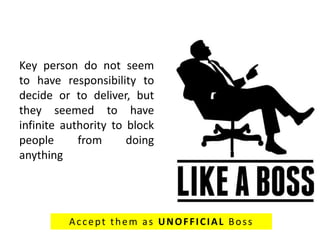
Key person do not seem
to have responsibility to
decide or to deliver, but
they seemed to have
infinite authority to block
people from doing
anything
Accept them as UNOFFICIAL Boss
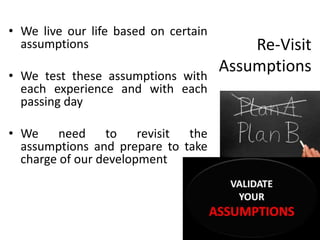
Re-Visit
Assumptions
• We live our life based on certain
assumptions
• We test these assumptions with
each experience and with each
passing day
• We need to revisit the
assumptions and prepare to take
charge of our development
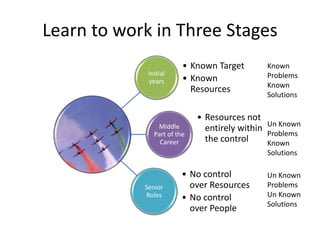
Learn to work in Three Stages
Initial
years
• Known Target
• Known
Resources
Middle
Part of the
Career
• Resources not
entirely within
the control
Senior
Roles
• No control
over Resources
• No control
over People
Known
Problems
Known
Solutions
Un Known
Problems
Known
Solutions
Un Known
Problems
Un Known
Solutions
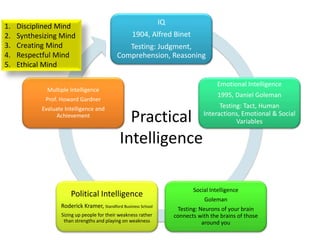
Practical
Intelligence
IQ
1904, Alfred Binet
Testing: Judgment,
Comprehension, Reasoning
Emotional Intelligence
1995, Daniel Goleman
Testing: Tact, Human
Interactions, Emotional & Social
Variables
Social Intelligence
Goleman
Testing: Neurons of your brain
connects with the brains of those
around you
Political Intelligence
Roderick Kramer, Standford Business School
Sizing up people for their weakness rather
than strengths and playing on weakness
Multiple Intelligence
Prof. Howard Gardner
Evaluate Intelligence and
Achievement
1. Disciplined Mind
2. Synthesizing Mind
3. Creating Mind
4. Respectful Mind
5. Ethical Mind
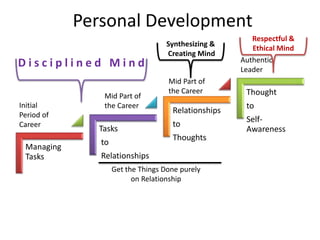
Personal Development
Managing
Tasks
Tasks
to
Relationships
Relationships
to
Thoughts
Thought
to
Self-
Awareness
Initial
Period of
Career
Mid Part of
the Career
Mid Part of
the Career
Authentic
Leader
Get the Things Done purely
on Relationship
D i s c i p l i n e d M i n d
Synthesizing &
Creating Mind
Respectful &
Ethical Mind
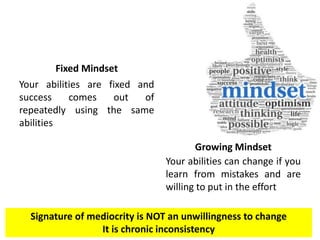
Fixed Mindset
Your abilities are fixed and
success comes out of
repeatedly using the same
abilities
Growing Mindset
Your abilities can change if you
learn from mistakes and are
willing to put in the effort
Signature of mediocrity is NOT an unwillingness to change
It is chronic inconsistency
Employees Expecting from Boss
1. Feedback
2. Empowerment
3. Coaching
4. Transparency
5. Recognition
6. Opportunity
7. Clear Tasks
8. Access
9. Respect for Personal Time
During a career, report to 10 direct bosses and 10 indirect bosses of those bosses
Boss expecting from Employees
1. 100% effort
2. Loyalty
3. Honesty
4. Get-it-done Results
Irrespective of what you think of the BOSS, you have to accept the BOSS
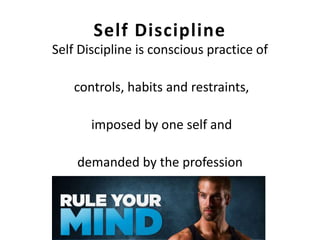
Self Discipline
Self Discipline is conscious practice of
controls, habits and restraints,
imposed by one self and
demanded by the profession
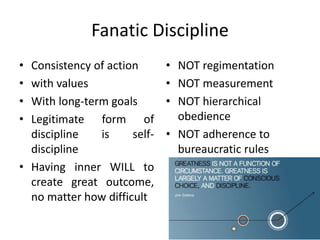
Fanatic Discipline
• Consistency of action
• with values
• With long-term goals
• Legitimate form of
discipline is self-
discipline
• Having inner WILL to
create great outcome,
no matter how difficult
• NOT regimentation
• NOT measurement
• NOT hierarchical
obedience
• NOT adherence to
bureaucratic rules
Responsibility Meter
Freedom
• Be Free
• Enjoy the moment
• Be widely passionate
• Have a fabulous time
• Live in the now
Responsibility
• Be Responsible
• Set your goals
• Keep your promises
• Get important things done
• Fulfill your duties
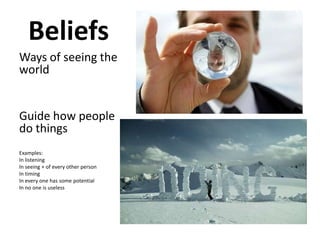
Beliefs
Ways of seeing the
world
Guide how people
do things
Examples:
In listening
In seeing + of every other person
In timing
In every one has some potential
In no one is useless
Limiting Beliefs
• Dominant belief : we are
not able to fulfill our
desires
• Common Belief: our
powerlessness
• BeliefCenter: Unworthiness
–we don not deserve to
have what we truly desire
As human beings
we all have
some
limiting beliefs
based on
industry best
practices
and
incidences of
failures
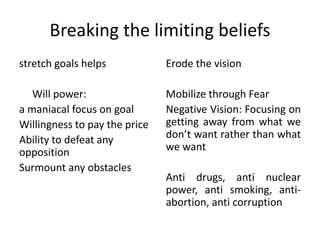
Breaking the limiting beliefs
stretch goals helps
Will power:
a maniacal focus on goal
Willingness to pay the price
Ability to defeat any
opposition
Surmount any obstacles
Erode the vision
Mobilize through Fear
Negative Vision: Focusing on
getting away from what we
don’t want rather than what
we want
Anti drugs, anti nuclear
power, anti smoking, anti-
abortion, anti corruption
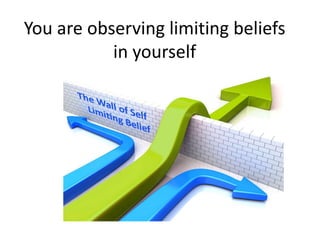
You are observing limiting beliefs
in yourself
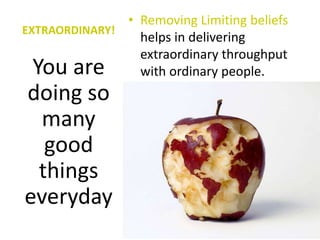
EXTRAORDINARY!
• Removing Limiting beliefs
helps in delivering
extraordinary throughput
with ordinary people.You are
doing so
many
good
things
everyday
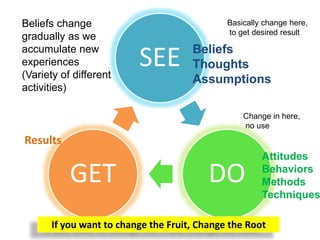
SEE
DOGET
Attitudes
Behaviors
Methods
Techniques
Beliefs
Thoughts
Assumptions
Results
If you want to change the Fruit, Change the Root
Change in here,
no use
Basically change here,
to get desired result
Beliefs change
gradually as we
accumulate new
experiences
(Variety of different
activities)
Power of powerlessness
• Dominant belief that we are not able to fulfill our
desires.
• Most of us hold one of two contradictory beliefs
that limit our ability to create what we really
want.
1. Belief in powerlessness – our inability to bring
into being all the things we really care about
2. Belief centers on unworthiness – that we do not
deserve to have what we truly desire.
At the age of 2
• As children, we learn our limitations are.
Children are rightfully taught limitations
essential to their survival.
• But too often this learning is generalized.
• We are constantly told we can’t have or can’t
do certain things and we may come to assume
that we have inability to have what we want.
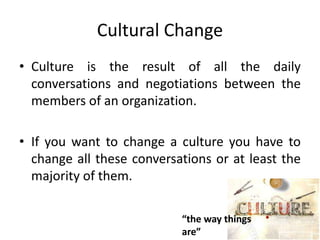
Cultural Change
• Culture is the result of all the daily
conversations and negotiations between the
members of an organization.
• If you want to change a culture you have to
change all these conversations or at least the
majority of them.
“the way things
are”
• Gradually creating an environment where the
wrong pepole felt incresingly uncomfortable
and evetually retired or decided to go
elsewhere
Synchronize
• If any organization was built for a purpose and
any organization is composed of more than
one person, then we must conclude that the
purpose of the organization requires the
synchronized effort of more than one person.
• Otherwise we would not create an
organization, the effort of individuals would
suffice.
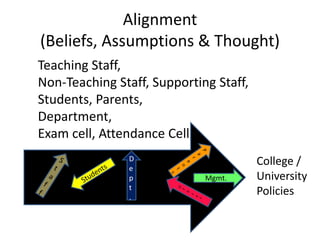
Alignment
(Beliefs, Assumptions & Thought)
College /
University
Policies
D
e
p
t
.
Mgmt.
Teaching Staff,
Non-Teaching Staff, Supporting Staff,
Students, Parents,
Department,
Exam cell, Attendance Cell
Players on the team constantly
make instant decisions about
the way the competition is
shaping itself and
intuitively pass the ball to a teammate to counter
the defense,
never worrying about who gets the credit.
Basket
Ball
• Basketball is a game
of
• speed,
• urgency, and
flexibility
• that demands a high
level of
synchronization.
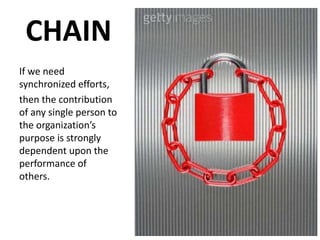
CHAIN
If synchronized efforts
If we need
synchronized efforts,
then the contribution
of any single person to
the organization’s
purpose is strongly
dependent upon the
performance of
others.
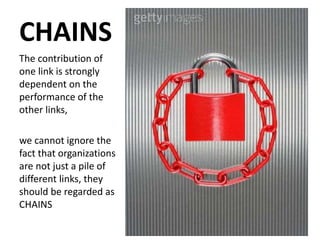
CHAINS
The contribution of
one link is strongly
dependent on the
performance of the
other links,
we cannot ignore the
fact that organizations
are not just a pile of
different links, they
should be regarded as
CHAINS
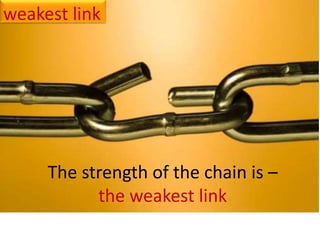
The strength of the chain is –
the weakest link
weakest link
Weakest link
• Every grid can be viewed as composed of
several independent chains.
• The more complex the organization- the more
interdependencies between the various links –
composed of smaller number of
dependent/independent chains.
The first step to improve an organization must be to identify the weakest link
Every link is important
If the links are different then we use
the principle of the twenty- eighty rule
(20-80).
20% of the variables are responsible
for 80% of the result.
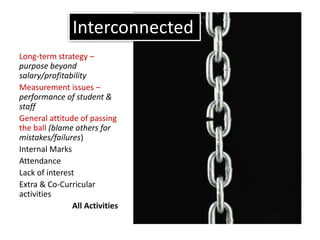
Long-term strategy –
purpose beyond
salary/profitability
Measurement issues –
performance of student &
staff
General attitude of passing
the ball (blame others for
mistakes/failures)
Internal Marks
Attendance
Lack of interest
Extra & Co-Curricular
activities
All Activities
Interconnected
Failure / Mistake
• It is, simply, a shortfall, evidence of the gap
between vision and current reality.
• It is an opportunity for learning about
inaccurate pictures of current reality
• About strategies that did not work as
expected
• About the clarity of vision
• They are NOT about our unworthiness or
powerlessness
A mistake is an event, the full benefit of which has not yet been turned to
your advantage
Work place involves
intense contacts with people,
practical experience,
working relationships with less
capable colleagues,
rivalry –driven people,
gossiping people,
self-centered people.
Behaviour is a planned
balance between
expressing your
personality and
managing the
impressions of those
whom you
wish to relate with
Every day work means that you
are taking number of
tiny decisions and
are swimming in an ocean
full of small mistakes
by you and by others
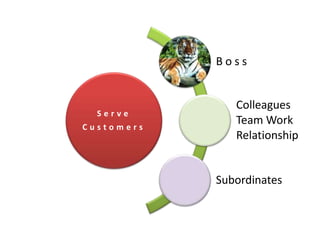
S e r v e
C u s t o m e r s
B o s s
Colleagues
Team Work
Relationship
Subordinates
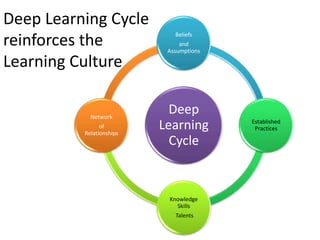
Deep Learning Cycle
reinforces the
Learning Culture
Deep
Learning
Cycle
Beliefs
and
Assumptions
Established
Practices
Knowledge
Skills
Talents
Network
of
Relationships
Excellence
• The desire to excel is exclusive of the fact
whether someone else
appreciates it or not. "Excellence" is a drive
from inside, not
outside. Excellence is not for someone else
to notice but for your
own satisfaction and efficiency
Excellence
• Excellence" is an inner call a passion once we
develop this as a HABIT as
a behaviour you need no
supervision. Happiness is a by product of such
performance.
Do not confuse growth with Excellence.
Big does not equal with Great
• “To look inward” to discover your own internal
standards
• Always aim for the “Perfection” rather than
just being “best”
• In the presence of greatness pettiness
disappears. In the absence of a great dream
pettiness prevails.
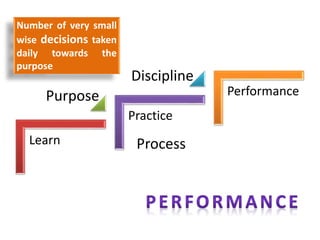
Learn
Practice
Performance
Discipline
Purpose
Number of very small
wise decisions taken
daily towards the
purpose
Process
Performance Management Routines
• Simple performance appraisal
• Recognition needs, Relationship needs, Goals
and Talent/Nontalents- Frequent interactions
• Focus on the future- achievement in next 3
months
• Self-discovery - Keep track record of own
performance and learning
Re- Visit
• We lost sight of what we are.
• You can not afford to leave yourself exposed
to unforseen events
• We have to reinvent ourselves continually
Re-visit Assumptions
• Volatility shortens the life span of any
business model
• Re-visit your goals and key performance
indicators, tracking progress toward them and
taking corrective actions more often.
• Increase your “frequency of controls”, setting
targets on a monthly/weekly basis.
Things that are bad for you seduce
you easily; you run towards them
impatiently.
But things are actually good for you
fail to attract you; you shun them
creatively, finding powerful excuses
to justify your procrastination.
1. Keep physically fit because it is linked to
emotional fitness
2. Accept uncertainty and ambiguity as natural
to the workplace
3. Confront reality
4. You are paid to solve problems
5. Lean from your and other’s mistakes
6. Develop the capacity to bounce back after
near death
7. Enjoy what you do and do what you enjoy
Happiness comes out of Good Health and Warm Relationships
Every day, are you
using your energy
OR
wasting you energy?
52
Thank you
Thank You

Performance

  • 1.
  • 2.
    A B CD of Performance Actions Assumption Belief Brining Together Culture Consistency Decisions Discipline
  • 3.
    Purpose: Performance • AnOrganization exists for a purpose and that purpose is performance • Performance defined as any outcome that is deemed valuable by either an external or internal customer
  • 4.
    Performance for theDay Thousand of tiny choices, in an endless procession, that confronts us every minute, unable to intellectualize, compelled us to react instinctively (decisions), follows the path of least resistance. Sum of these tiny decisions is the performance of the day
  • 5.
    Key person donot seem to have responsibility to decide or to deliver, but they seemed to have infinite authority to block people from doing anything Accept them as UNOFFICIAL Boss
  • 6.
    Re-Visit Assumptions • We liveour life based on certain assumptions • We test these assumptions with each experience and with each passing day • We need to revisit the assumptions and prepare to take charge of our development
  • 7.
    Learn to workin Three Stages Initial years • Known Target • Known Resources Middle Part of the Career • Resources not entirely within the control Senior Roles • No control over Resources • No control over People Known Problems Known Solutions Un Known Problems Known Solutions Un Known Problems Un Known Solutions
  • 8.
    Practical Intelligence IQ 1904, Alfred Binet Testing:Judgment, Comprehension, Reasoning Emotional Intelligence 1995, Daniel Goleman Testing: Tact, Human Interactions, Emotional & Social Variables Social Intelligence Goleman Testing: Neurons of your brain connects with the brains of those around you Political Intelligence Roderick Kramer, Standford Business School Sizing up people for their weakness rather than strengths and playing on weakness Multiple Intelligence Prof. Howard Gardner Evaluate Intelligence and Achievement 1. Disciplined Mind 2. Synthesizing Mind 3. Creating Mind 4. Respectful Mind 5. Ethical Mind
  • 9.
    Personal Development Managing Tasks Tasks to Relationships Relationships to Thoughts Thought to Self- Awareness Initial Period of Career MidPart of the Career Mid Part of the Career Authentic Leader Get the Things Done purely on Relationship D i s c i p l i n e d M i n d Synthesizing & Creating Mind Respectful & Ethical Mind
  • 10.
    Fixed Mindset Your abilitiesare fixed and success comes out of repeatedly using the same abilities Growing Mindset Your abilities can change if you learn from mistakes and are willing to put in the effort Signature of mediocrity is NOT an unwillingness to change It is chronic inconsistency
  • 11.
    Employees Expecting fromBoss 1. Feedback 2. Empowerment 3. Coaching 4. Transparency 5. Recognition 6. Opportunity 7. Clear Tasks 8. Access 9. Respect for Personal Time During a career, report to 10 direct bosses and 10 indirect bosses of those bosses
  • 12.
    Boss expecting fromEmployees 1. 100% effort 2. Loyalty 3. Honesty 4. Get-it-done Results Irrespective of what you think of the BOSS, you have to accept the BOSS
  • 13.
    Self Discipline Self Disciplineis conscious practice of controls, habits and restraints, imposed by one self and demanded by the profession
  • 14.
    Fanatic Discipline • Consistencyof action • with values • With long-term goals • Legitimate form of discipline is self- discipline • Having inner WILL to create great outcome, no matter how difficult • NOT regimentation • NOT measurement • NOT hierarchical obedience • NOT adherence to bureaucratic rules
  • 15.
    Responsibility Meter Freedom • BeFree • Enjoy the moment • Be widely passionate • Have a fabulous time • Live in the now Responsibility • Be Responsible • Set your goals • Keep your promises • Get important things done • Fulfill your duties
  • 16.
    Beliefs Ways of seeingthe world Guide how people do things Examples: In listening In seeing + of every other person In timing In every one has some potential In no one is useless
  • 17.
    Limiting Beliefs • Dominantbelief : we are not able to fulfill our desires • Common Belief: our powerlessness • BeliefCenter: Unworthiness –we don not deserve to have what we truly desire As human beings we all have some limiting beliefs based on industry best practices and incidences of failures
  • 18.
    Breaking the limitingbeliefs stretch goals helps Will power: a maniacal focus on goal Willingness to pay the price Ability to defeat any opposition Surmount any obstacles Erode the vision Mobilize through Fear Negative Vision: Focusing on getting away from what we don’t want rather than what we want Anti drugs, anti nuclear power, anti smoking, anti- abortion, anti corruption
  • 19.
    You are observinglimiting beliefs in yourself
  • 20.
    EXTRAORDINARY! • Removing Limitingbeliefs helps in delivering extraordinary throughput with ordinary people.You are doing so many good things everyday
  • 21.
    SEE DOGET Attitudes Behaviors Methods Techniques Beliefs Thoughts Assumptions Results If you wantto change the Fruit, Change the Root Change in here, no use Basically change here, to get desired result Beliefs change gradually as we accumulate new experiences (Variety of different activities)
  • 22.
    Power of powerlessness •Dominant belief that we are not able to fulfill our desires. • Most of us hold one of two contradictory beliefs that limit our ability to create what we really want. 1. Belief in powerlessness – our inability to bring into being all the things we really care about 2. Belief centers on unworthiness – that we do not deserve to have what we truly desire.
  • 23.
    At the ageof 2 • As children, we learn our limitations are. Children are rightfully taught limitations essential to their survival. • But too often this learning is generalized. • We are constantly told we can’t have or can’t do certain things and we may come to assume that we have inability to have what we want.
  • 24.
    Cultural Change • Cultureis the result of all the daily conversations and negotiations between the members of an organization. • If you want to change a culture you have to change all these conversations or at least the majority of them. “the way things are”
  • 25.
    • Gradually creatingan environment where the wrong pepole felt incresingly uncomfortable and evetually retired or decided to go elsewhere
  • 26.
    Synchronize • If anyorganization was built for a purpose and any organization is composed of more than one person, then we must conclude that the purpose of the organization requires the synchronized effort of more than one person. • Otherwise we would not create an organization, the effort of individuals would suffice.
  • 27.
    Alignment (Beliefs, Assumptions &Thought) College / University Policies D e p t . Mgmt. Teaching Staff, Non-Teaching Staff, Supporting Staff, Students, Parents, Department, Exam cell, Attendance Cell
  • 28.
    Players on theteam constantly make instant decisions about the way the competition is shaping itself and intuitively pass the ball to a teammate to counter the defense, never worrying about who gets the credit. Basket Ball
  • 29.
    • Basketball isa game of • speed, • urgency, and flexibility • that demands a high level of synchronization.
  • 30.
    CHAIN If synchronized efforts Ifwe need synchronized efforts, then the contribution of any single person to the organization’s purpose is strongly dependent upon the performance of others.
  • 31.
    CHAINS The contribution of onelink is strongly dependent on the performance of the other links, we cannot ignore the fact that organizations are not just a pile of different links, they should be regarded as CHAINS
  • 32.
    The strength ofthe chain is – the weakest link weakest link
  • 33.
    Weakest link • Everygrid can be viewed as composed of several independent chains. • The more complex the organization- the more interdependencies between the various links – composed of smaller number of dependent/independent chains. The first step to improve an organization must be to identify the weakest link
  • 34.
    Every link isimportant If the links are different then we use the principle of the twenty- eighty rule (20-80). 20% of the variables are responsible for 80% of the result.
  • 35.
    Long-term strategy – purposebeyond salary/profitability Measurement issues – performance of student & staff General attitude of passing the ball (blame others for mistakes/failures) Internal Marks Attendance Lack of interest Extra & Co-Curricular activities All Activities Interconnected
  • 36.
    Failure / Mistake •It is, simply, a shortfall, evidence of the gap between vision and current reality. • It is an opportunity for learning about inaccurate pictures of current reality • About strategies that did not work as expected • About the clarity of vision • They are NOT about our unworthiness or powerlessness A mistake is an event, the full benefit of which has not yet been turned to your advantage
  • 37.
    Work place involves intensecontacts with people, practical experience, working relationships with less capable colleagues, rivalry –driven people, gossiping people, self-centered people.
  • 38.
    Behaviour is aplanned balance between expressing your personality and managing the impressions of those whom you wish to relate with
  • 39.
    Every day workmeans that you are taking number of tiny decisions and are swimming in an ocean full of small mistakes by you and by others
  • 40.
    S e rv e C u s t o m e r s B o s s Colleagues Team Work Relationship Subordinates
  • 41.
    Deep Learning Cycle reinforcesthe Learning Culture Deep Learning Cycle Beliefs and Assumptions Established Practices Knowledge Skills Talents Network of Relationships
  • 42.
    Excellence • The desireto excel is exclusive of the fact whether someone else appreciates it or not. "Excellence" is a drive from inside, not outside. Excellence is not for someone else to notice but for your own satisfaction and efficiency
  • 43.
    Excellence • Excellence" isan inner call a passion once we develop this as a HABIT as a behaviour you need no supervision. Happiness is a by product of such performance. Do not confuse growth with Excellence. Big does not equal with Great
  • 44.
    • “To lookinward” to discover your own internal standards • Always aim for the “Perfection” rather than just being “best” • In the presence of greatness pettiness disappears. In the absence of a great dream pettiness prevails.
  • 45.
    Learn Practice Performance Discipline Purpose Number of verysmall wise decisions taken daily towards the purpose Process
  • 46.
    Performance Management Routines •Simple performance appraisal • Recognition needs, Relationship needs, Goals and Talent/Nontalents- Frequent interactions • Focus on the future- achievement in next 3 months • Self-discovery - Keep track record of own performance and learning
  • 47.
    Re- Visit • Welost sight of what we are. • You can not afford to leave yourself exposed to unforseen events • We have to reinvent ourselves continually
  • 48.
    Re-visit Assumptions • Volatilityshortens the life span of any business model • Re-visit your goals and key performance indicators, tracking progress toward them and taking corrective actions more often. • Increase your “frequency of controls”, setting targets on a monthly/weekly basis.
  • 49.
    Things that arebad for you seduce you easily; you run towards them impatiently. But things are actually good for you fail to attract you; you shun them creatively, finding powerful excuses to justify your procrastination.
  • 50.
    1. Keep physicallyfit because it is linked to emotional fitness 2. Accept uncertainty and ambiguity as natural to the workplace 3. Confront reality 4. You are paid to solve problems 5. Lean from your and other’s mistakes 6. Develop the capacity to bounce back after near death 7. Enjoy what you do and do what you enjoy Happiness comes out of Good Health and Warm Relationships
  • 51.
    Every day, areyou using your energy OR wasting you energy?
  • 52.