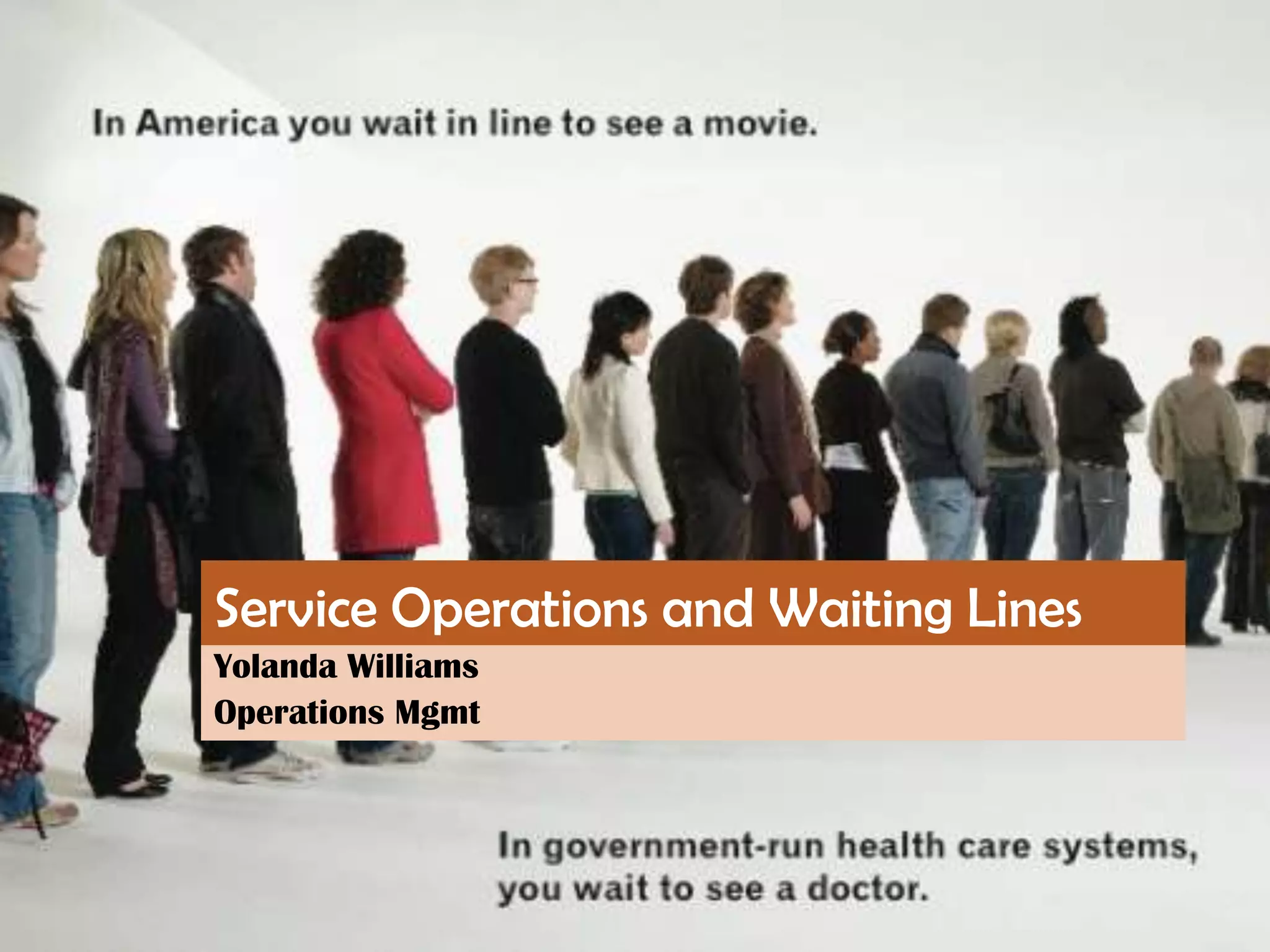
Service Operations and Waiting Lines
Yolanda Williams
Operations Mgmt
 An Overview of Service Operations
 Service Response Logistics
 Waiting…
 Discuss the psychology of waiting.
 Laws of Service.
 Describe how queues are managed.
 Describe the essential features of a queuing system.
Purpose and Objectives
3
What are services?
 Many services are pure services, offering few or no tangible
products to customers.
 Others may have end products with a larger tangible component
(e.g., restaurants & repair facilities).
 Customers are often involved in the production of the service.
 Services may provide state utility - they do something to things
owned by the customer (e.g., store supplies & repair machines).
4
More on Services
 Services cannot be inventoried.
 Services have high levels of customer interactions.
 Services are decentralized due to inability to
inventory & transport services
5
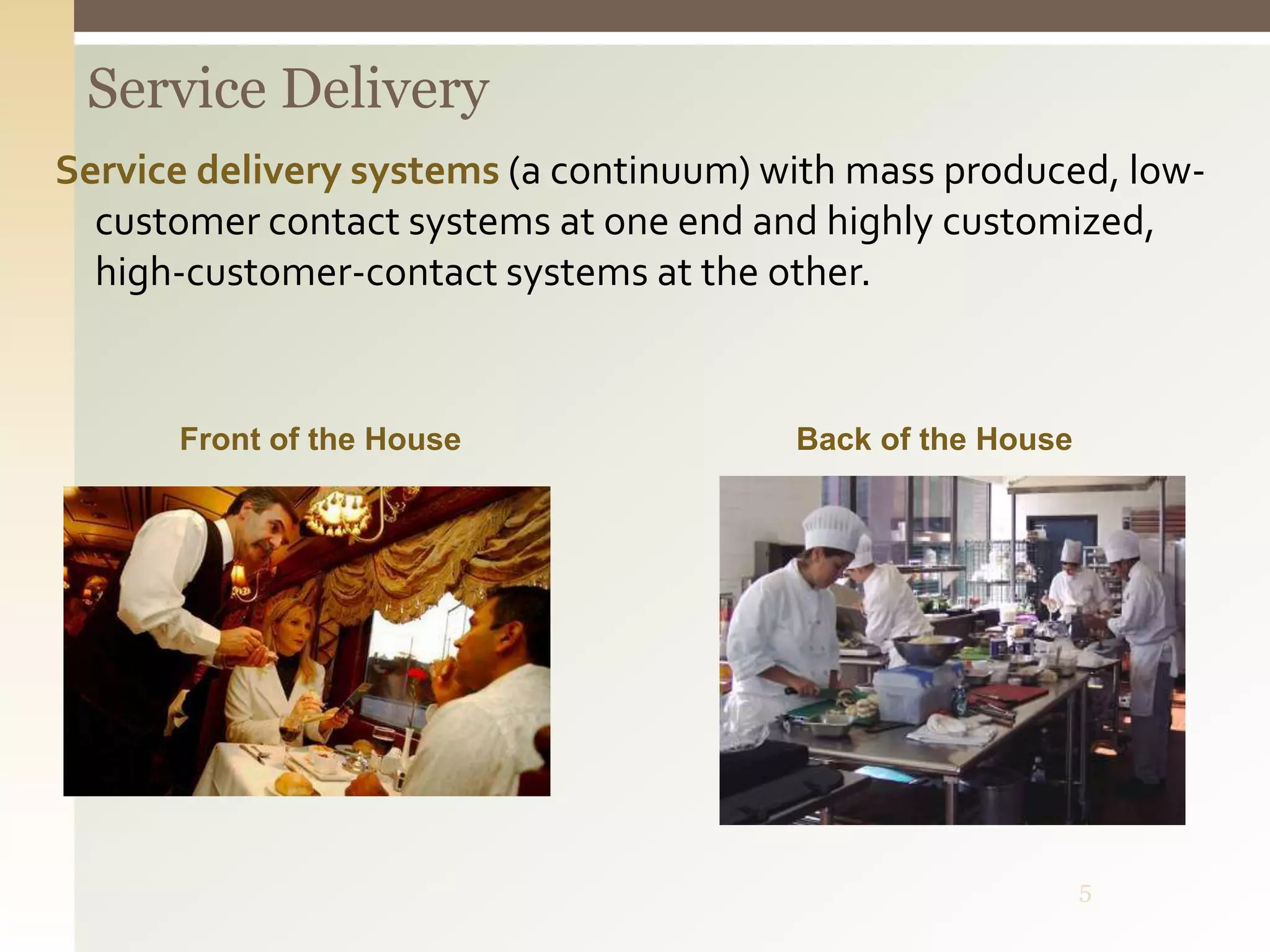
Service Delivery
Service delivery systems (a continuum) with mass produced, low-
customer contact systems at one end and highly customized,
high-customer-contact systems at the other.
Front of the House Back of the House
6
An Overview of Service Operations- Cont.
Service Strategy Development:
1. Cost LeadershipStrategy-The Low Cost
Provider – May require large capital
investment in automated, state-of-the art
equipment and significant efforts in the areas
of controlling and reducing costs.
2. DifferentiationStrategy- Service that is
considered unique. Differentiation is created
as companies listen to customers.
3. Focus Strategy- Serve a narrow niche better
than other firms
7
Service Response Logistics
Service Response Logistics (SRL)
The management and coordination of the organization’s activities while a service
is being performed for customers.
1. Service capacity
 The number of customers per day the firm’s service system is
designed to serve.
2. Distribution channels
 Distribution channels involve traditional methods & new channels that
incorporate new Internet technologies
3. Service quality
 Customer satisfaction--depends on ability to deliver what customers
want, meet customers’ perceptions and satisfying customers varying
expectations.
4. Waiting times
Psychology of Waiting
 That Old Empty Feeling:
 Unoccupied time goes slowly
 A Foot in the Door:
 Pre-service waits seem longer that in-service waits
 The Light at the End of theTunnel:
 Reduce anxiety with attention
 Excuse Me, But I Was First:
 Social justice with First Come First Serve queue discipline
 They Also Serve,Who Sit and Wait:
 Avoids idle service capacity
Cultural Attitudes
 “Americans hate to wait. So business is trying a trick or
two to make lines seem shorter…” The NewYorkTimes
 Standing in line – at the bank, the market, the movies –
is the time-waster everyone loves to hate. Stand in just
one 15-minute line a day, every day, and kiss goodbye to
almost four days of idle time by year’s end.—Kathleen Doheny
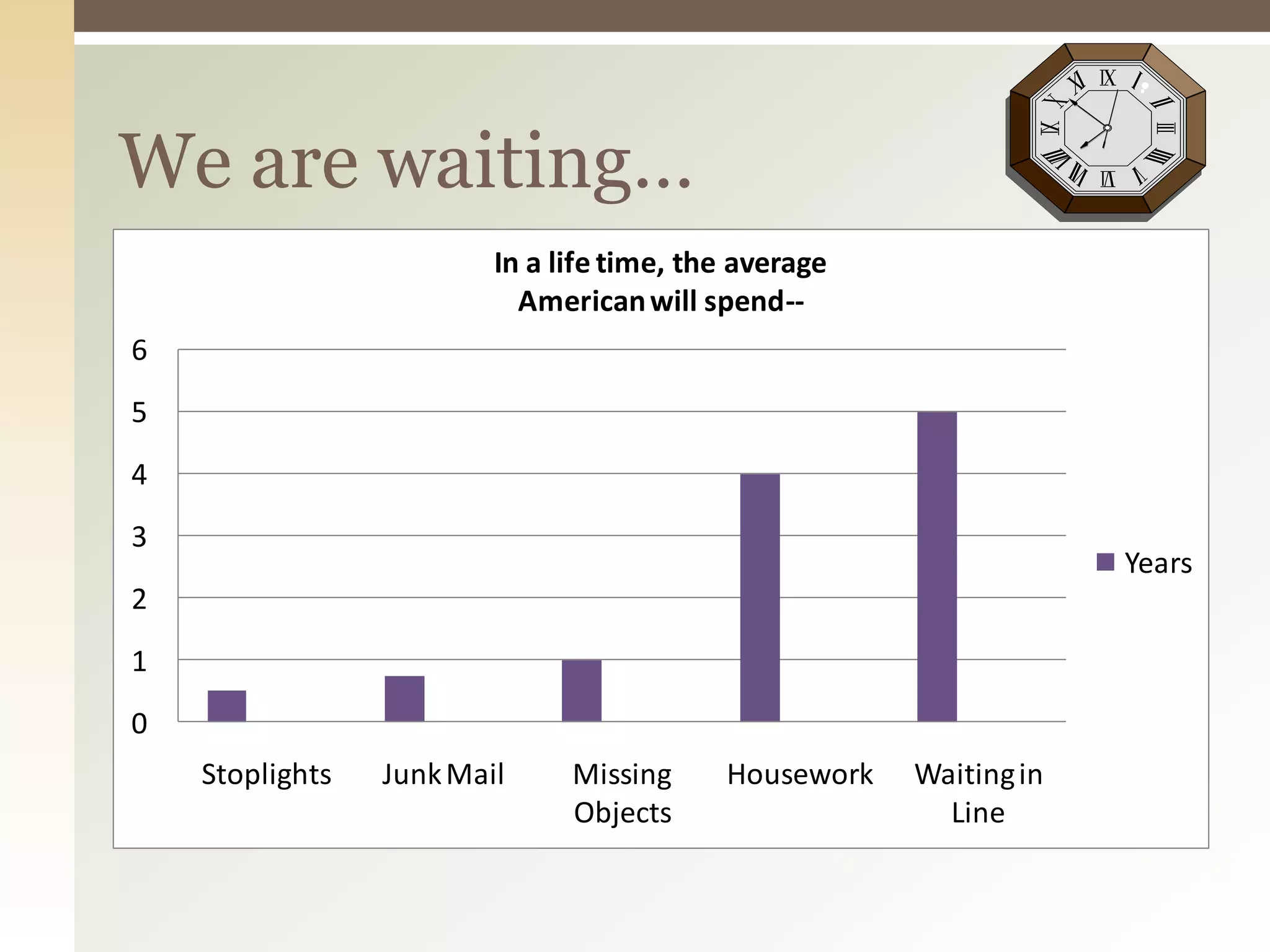
0
1
2
3
4
5
6
Stoplights JunkMail Missing
Objects
Housework Waitingin
Line
In a life time, the average
Americanwill spend--
Years
We are waiting…
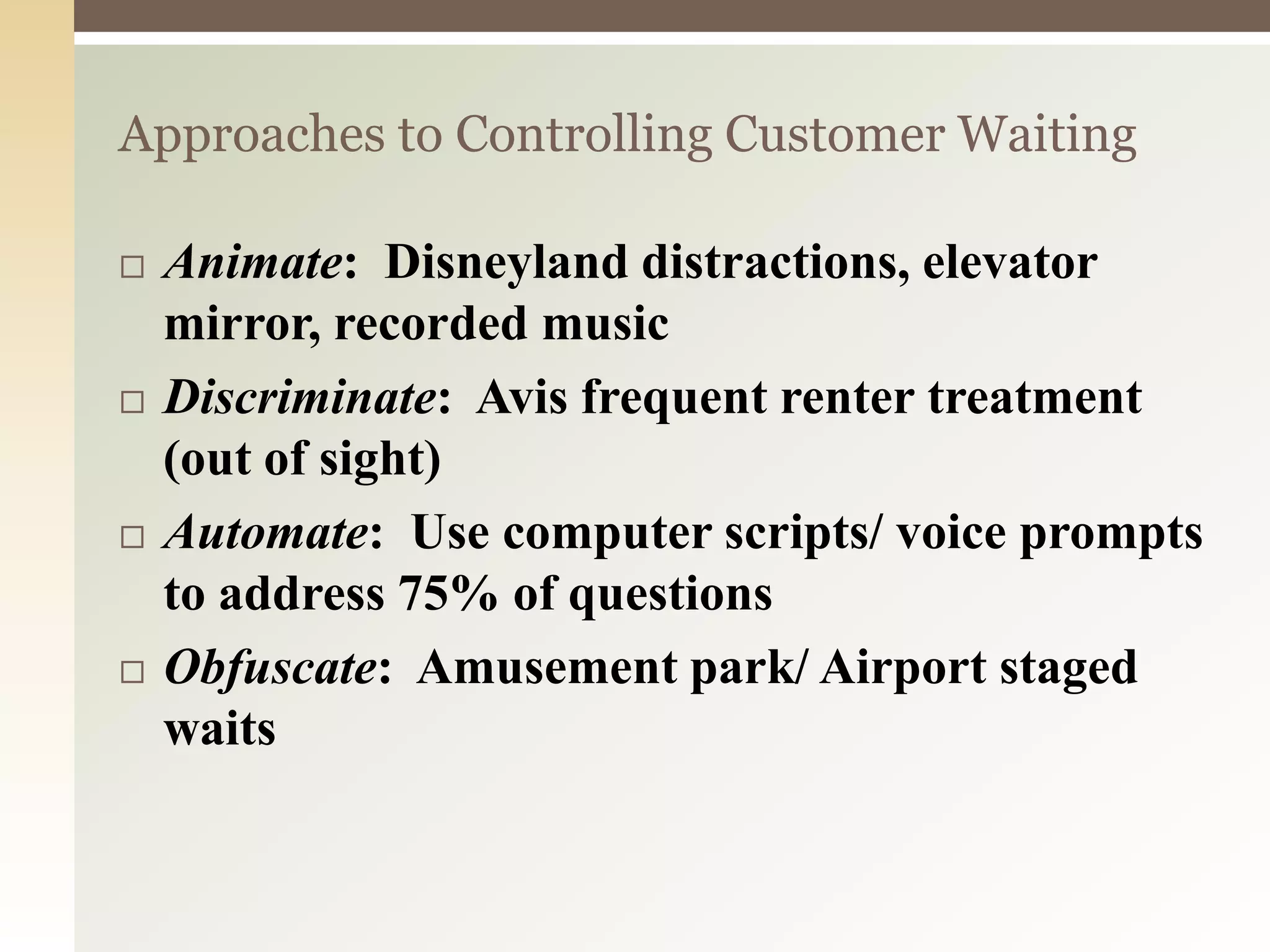
Approaches to Controlling Customer Waiting
 Animate: Disneyland distractions, elevator
mirror, recorded music
 Discriminate: Avis frequent renter treatment
(out of sight)
 Automate: Use computer scripts/ voice prompts
to address 75% of questions
 Obfuscate: Amusement park/ Airport staged
waits
Waiting…
 Waiting in lines does not add enjoyment
 Waiting in lines does not generate revenue
Waiting lines are non-value added occurrences
 Cost to provide waiting space
 Loss of business
 Customers leaving
 Customers refusing to wait
 Loss of goodwill
 Reduction in customer satisfaction
 Congestion may disrupt other business
operations
Implications of Waiting Lines
14
What is a Queue?
 A queue is a waiting line.
 A queuing system involves customers arriving for
service who sometimes have to wait.
 Queuing analysis provides:
 Summary measures for assessing a queuing system
in terms of customers and time.
 A way to balance the costs of providing service and
costs of congestion.
Queue Theory
 Queuing theory: Mathematical approach to the analysis of
waiting lines.
 Importance of Queuing Analysis:
 Servicing customers can be costly.
 Retail environments are plagued with customer congestion.
Managing that has benefits.
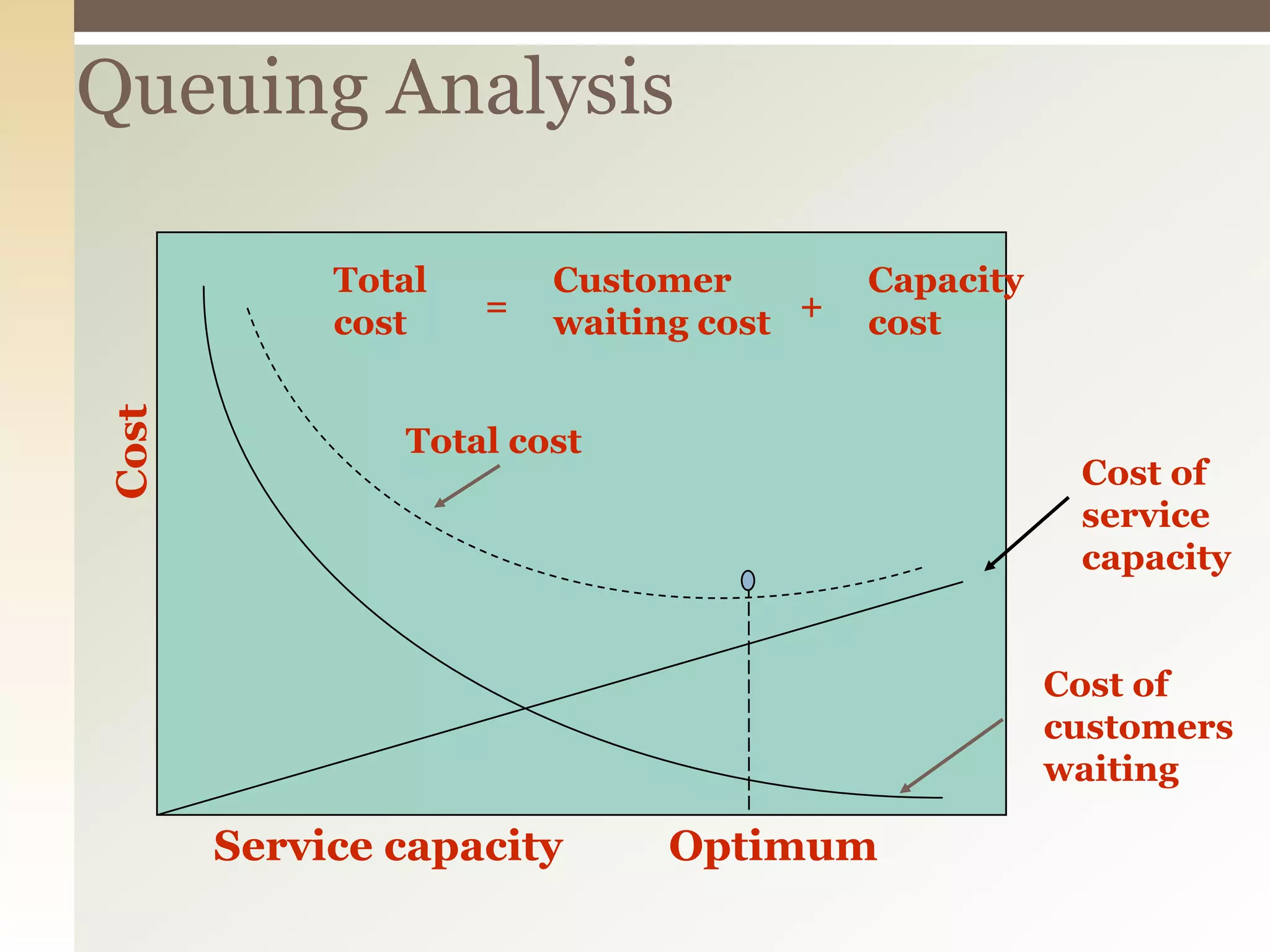
 Goal of queuing analysis is to minimize the sum of two costs
 Customer waiting costs
 Service capacity costs
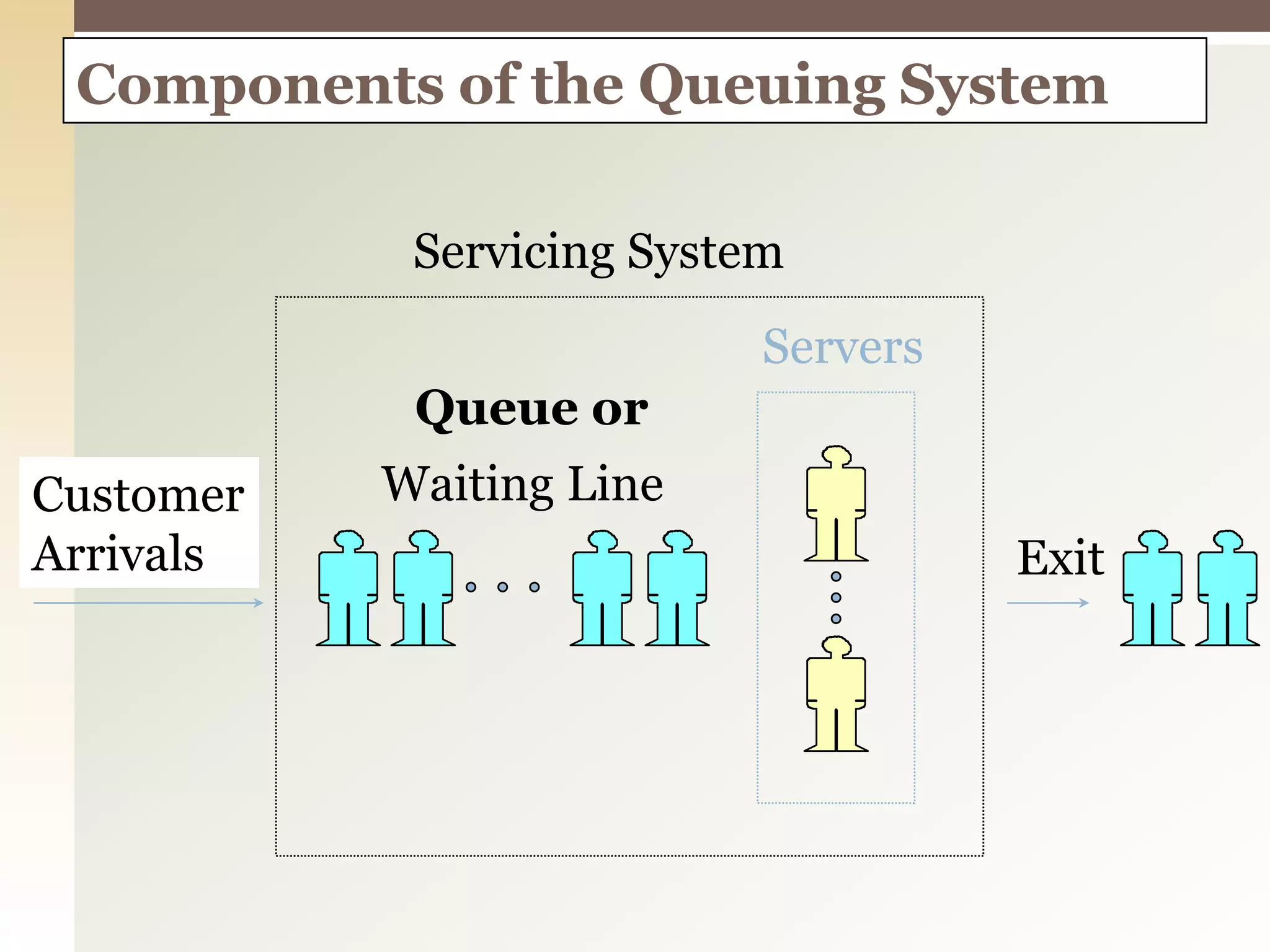
Components of the Queuing System
Customer
Arrivals
Servers
Waiting Line
Servicing System
Exit
Queue or
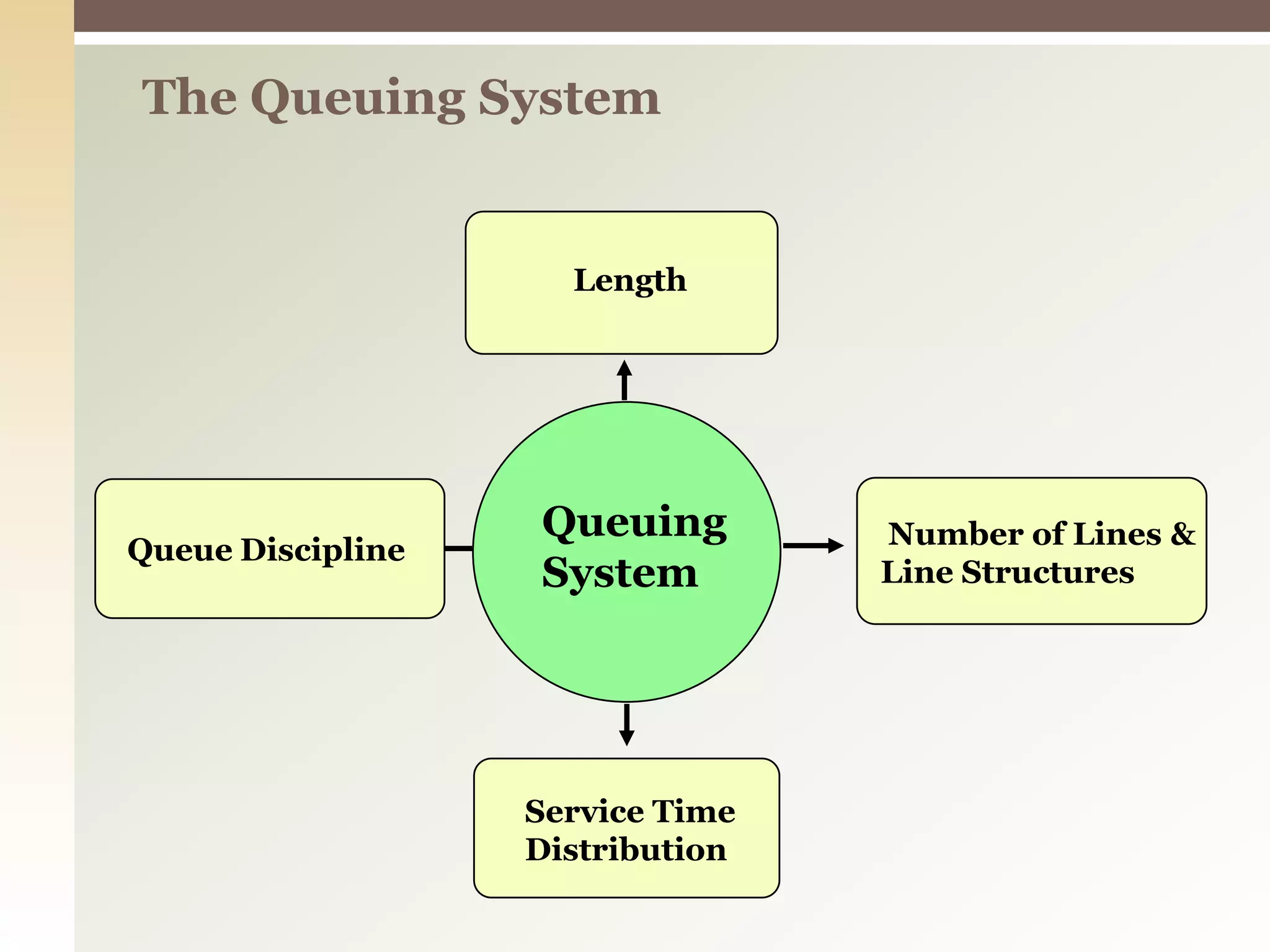
The Queuing System
Queue Discipline
Length
Number of Lines &
Line Structures
Service Time
Distribution
Queuing
System
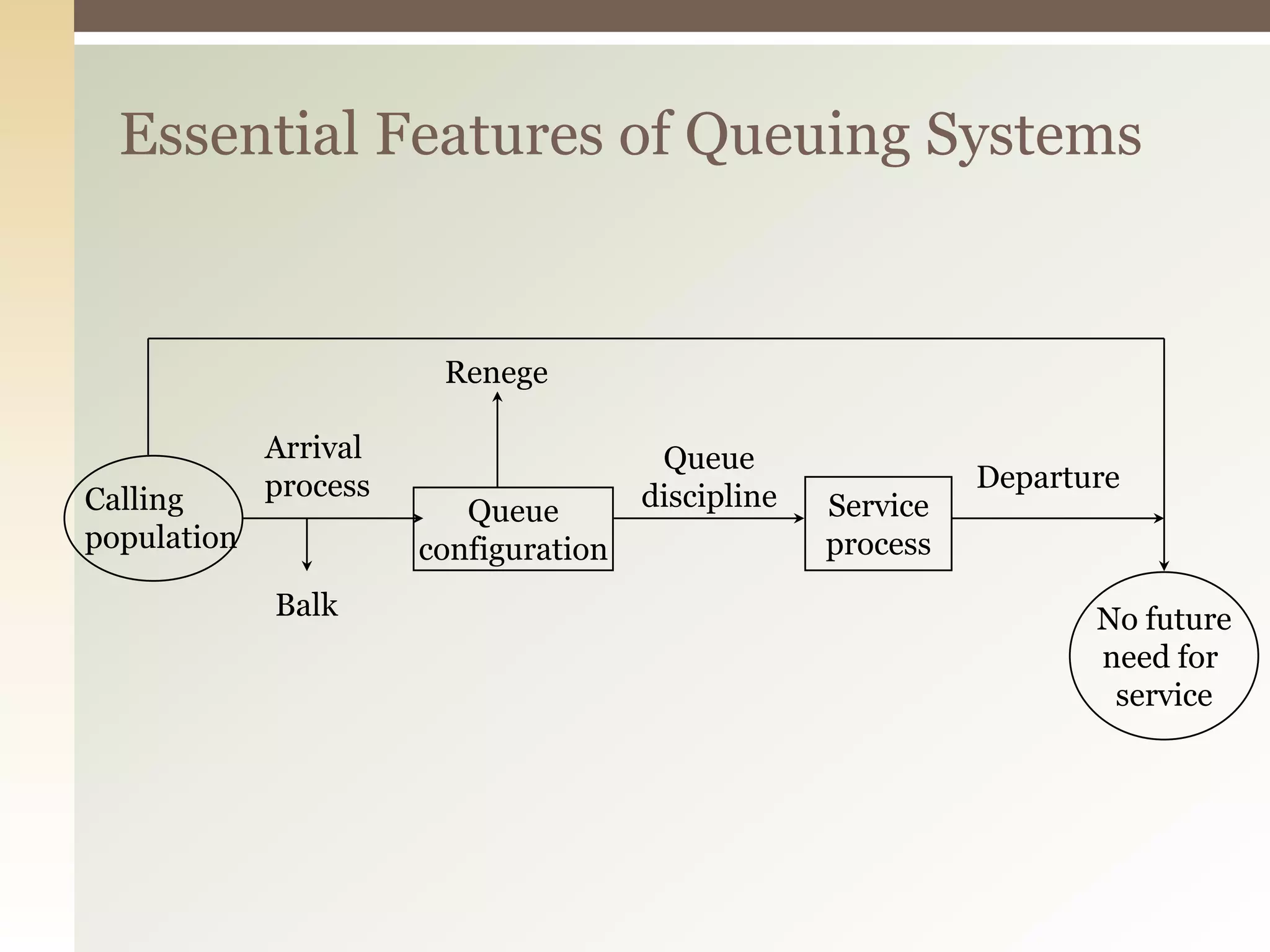
Essential Features of Queuing Systems
Departure
Queue
discipline
Arrival
process
Queue
configuration
Service
process
Renege
Balk
Calling
population
No future
need for
service
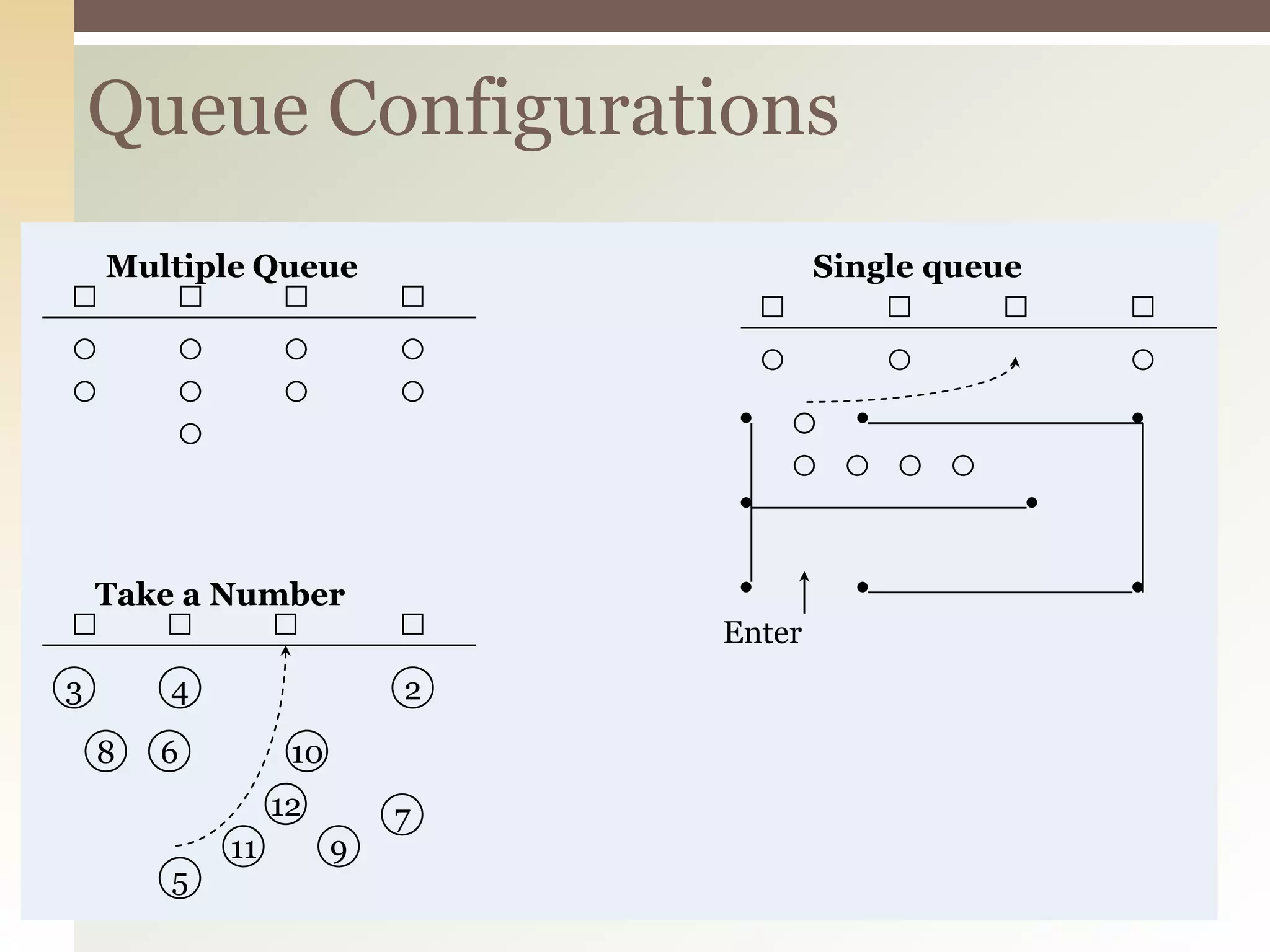
Queue Configurations
Multiple Queue Single queue
Take a Number
Enter
3 4
8
2
6 10
12
11
5
7
9
20
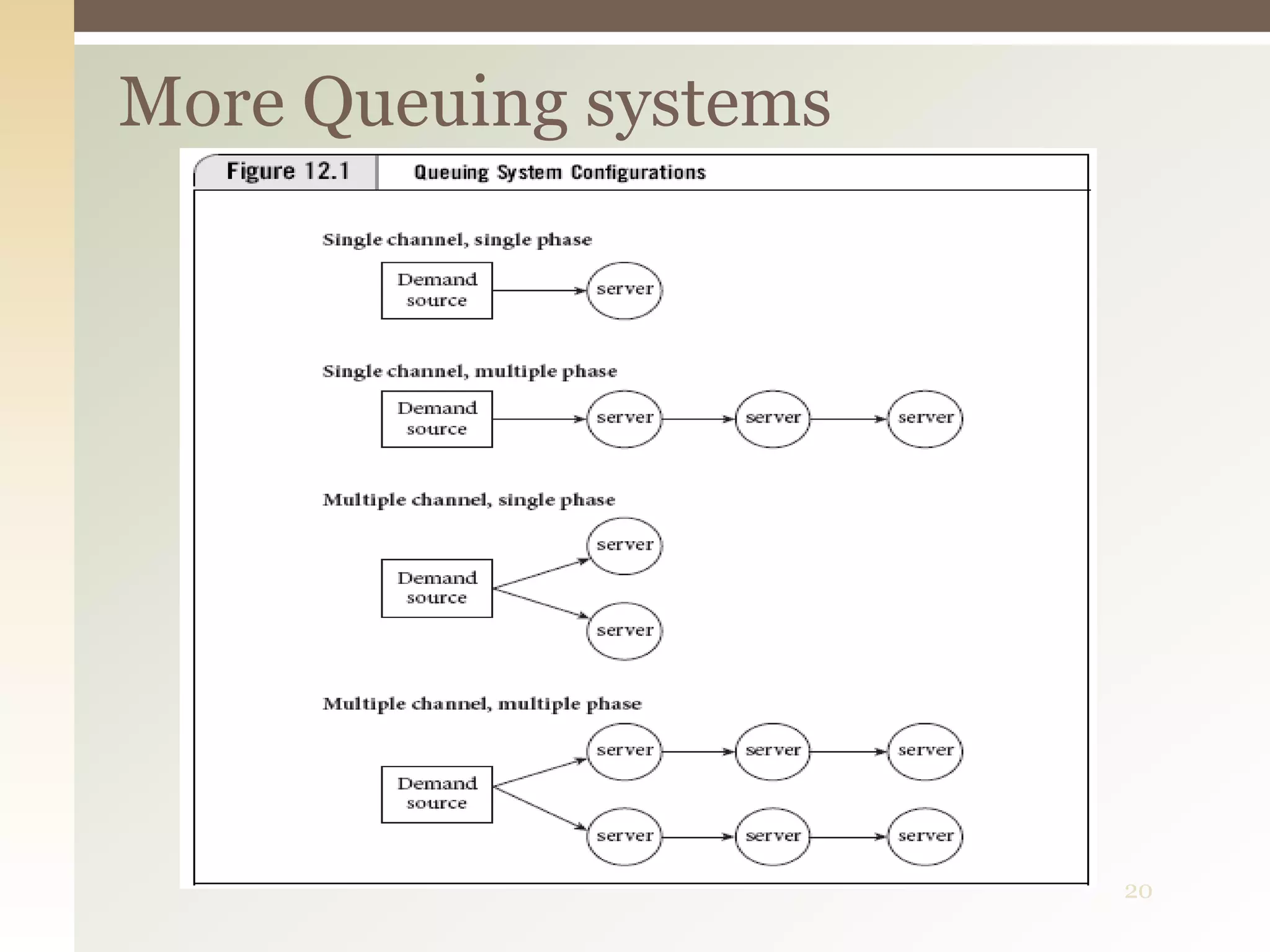
More Queuing systems
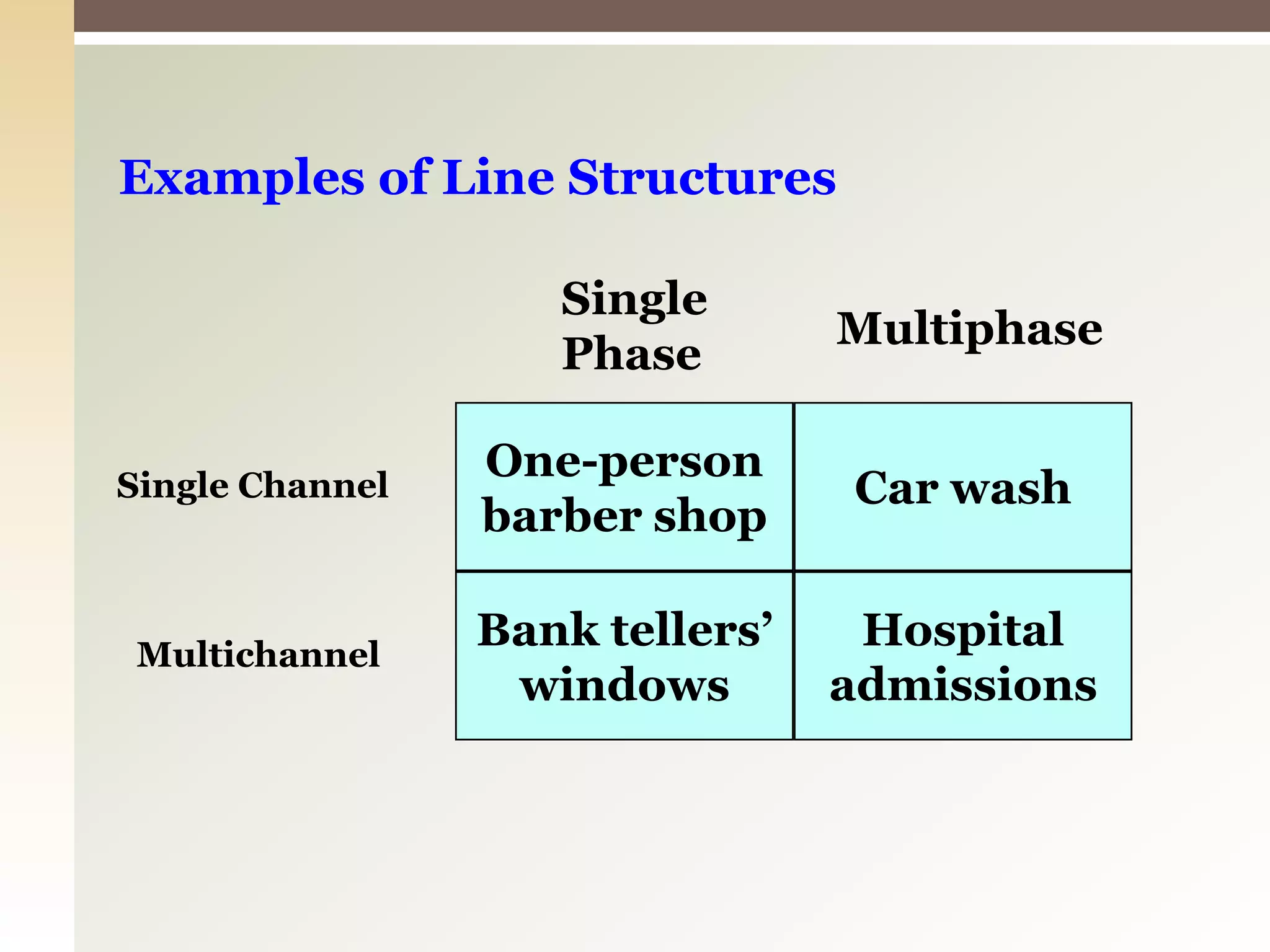
Examples of Line Structures
Single Channel
Multichannel
Single
Phase
Multiphase
One-person
barber shop
Car wash
Hospital
admissions
Bank tellers’
windows
Waiting Realities
 Inevitability of Waiting: Waiting results from
variations in arrival rates and service rates
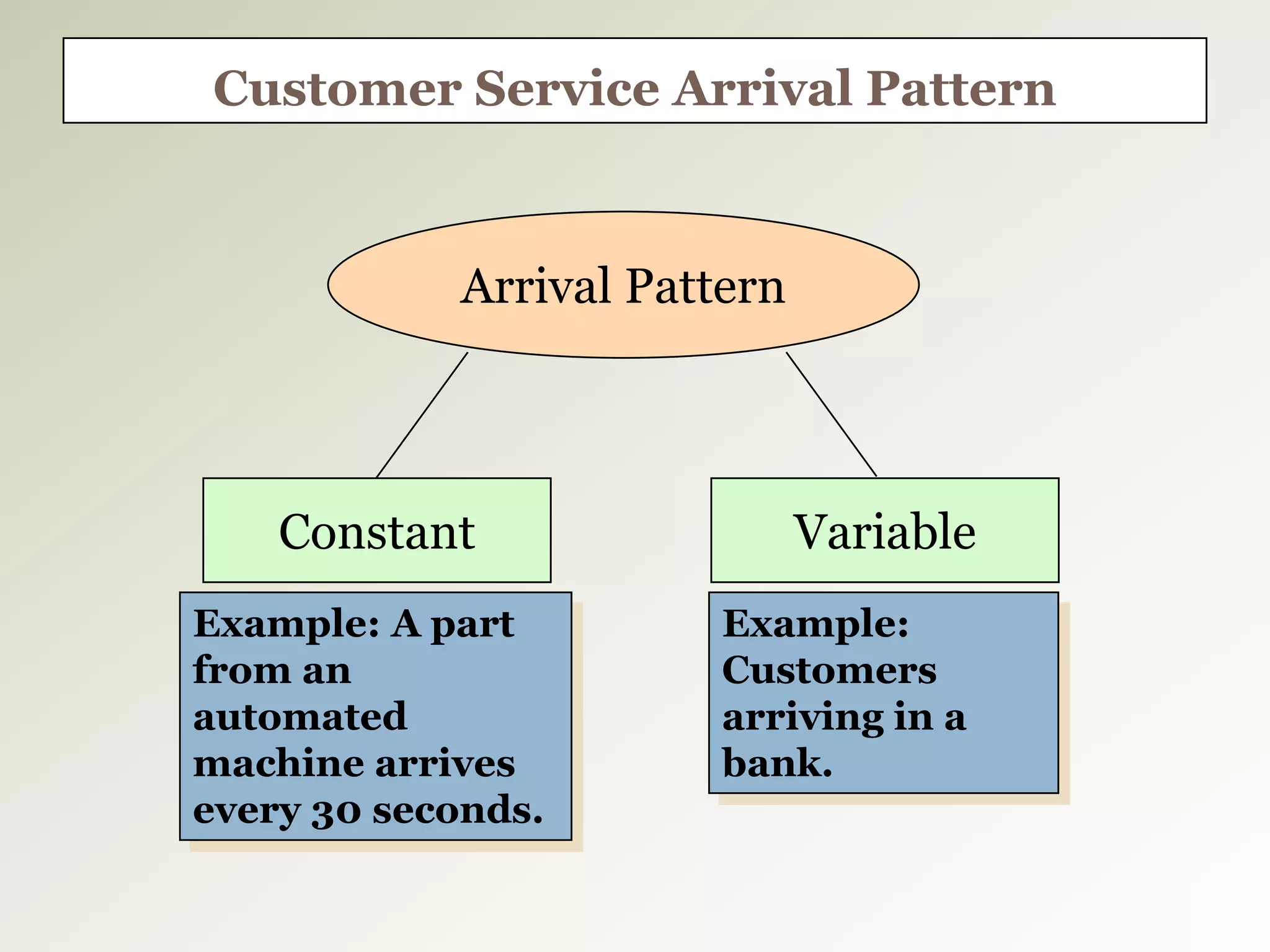
Customer Service Arrival Pattern
Arrival Pattern
Constant Variable
Example: A part
from an
automated
machine arrives
every 30 seconds.
Example:
Customers
arriving in a
bank.
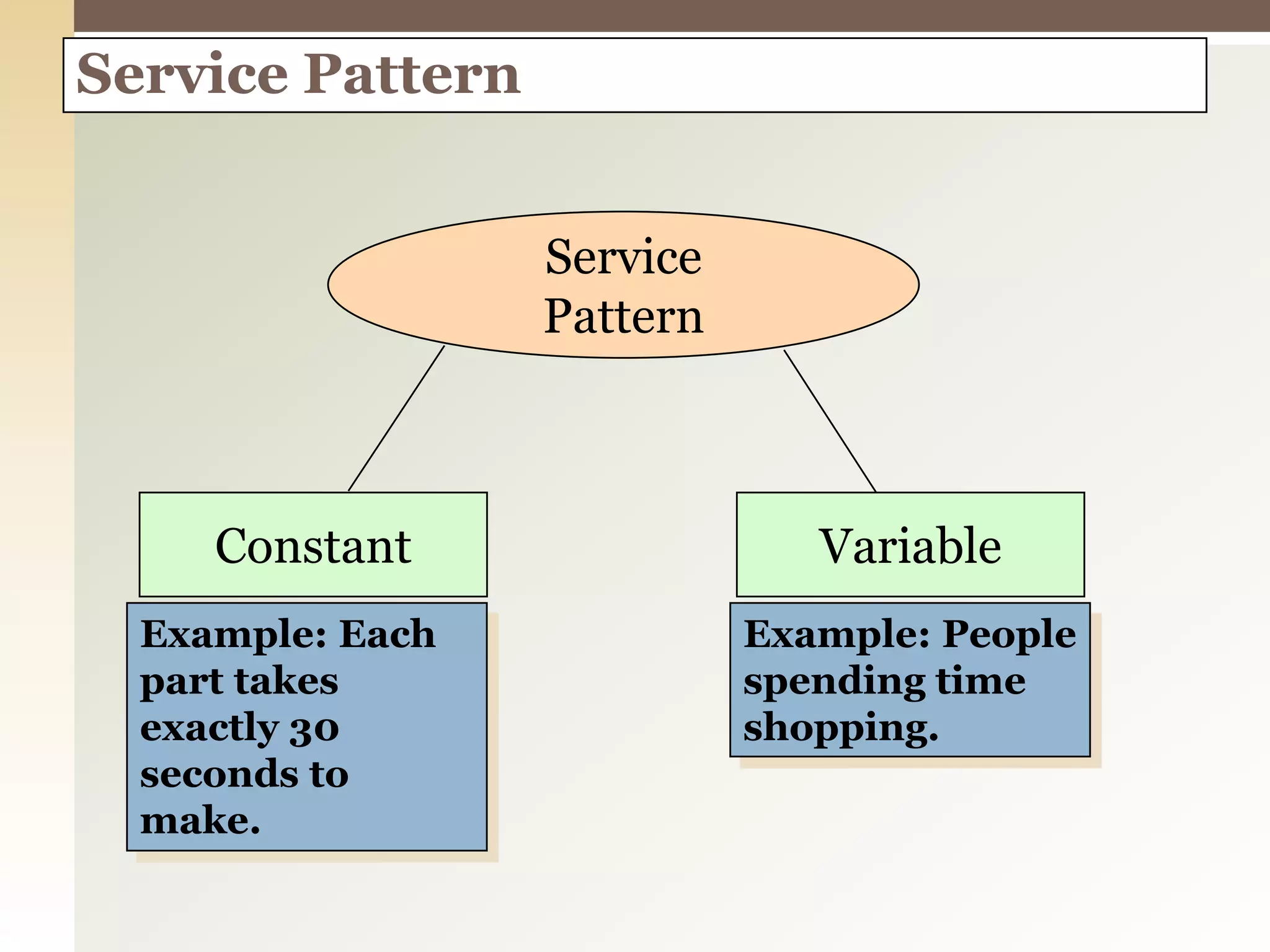
Service Pattern
Service
Pattern
Constant Variable
Example: Each
part takes
exactly 30
seconds to
make.
Example: People
spending time
shopping.
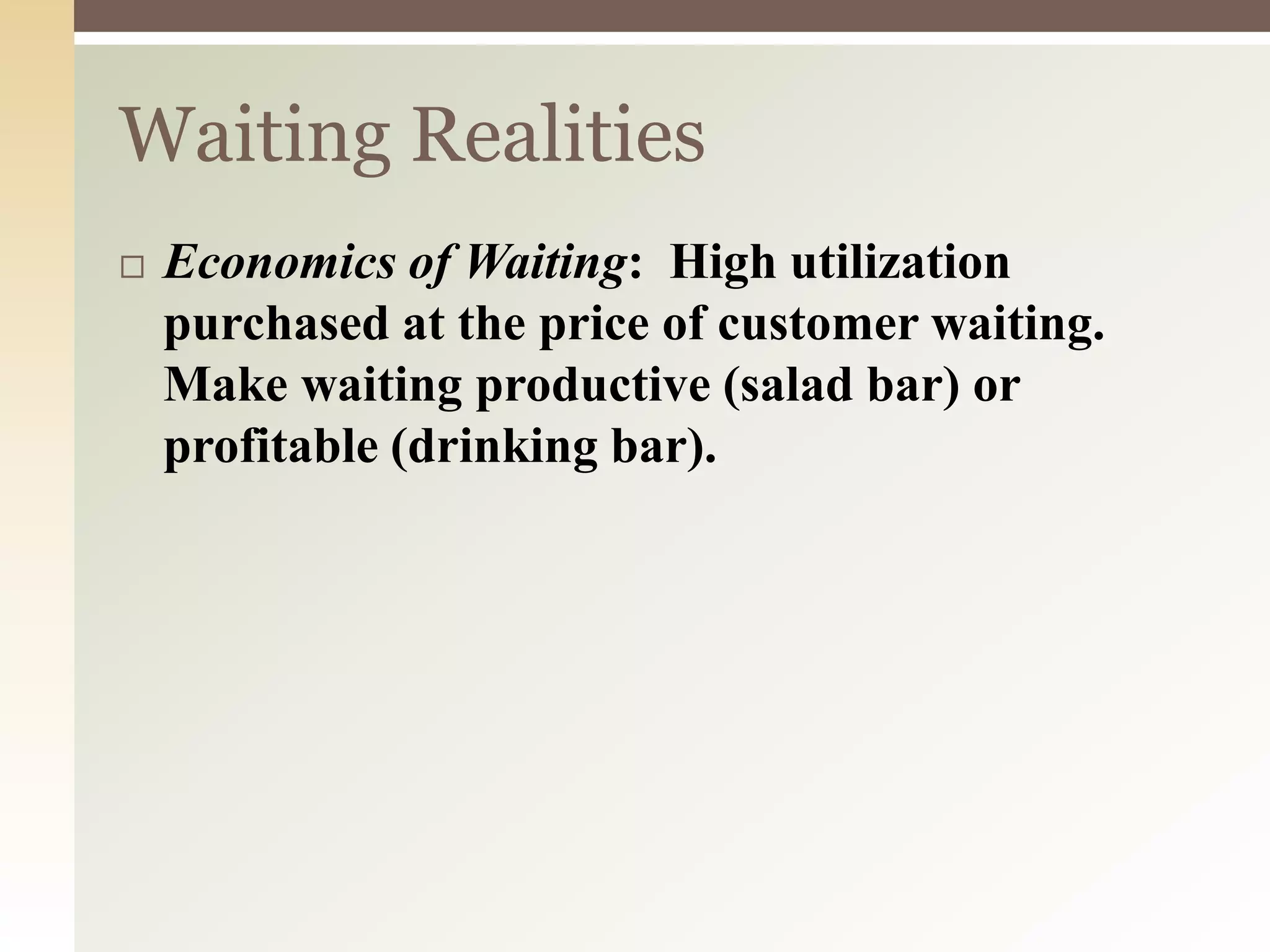
Waiting Realities
 Economics of Waiting: High utilization
purchased at the price of customer waiting.
Make waiting productive (salad bar) or
profitable (drinking bar).
Queuing Analysis
Optimum
Cost of
service
capacity
Cost of
customers
waiting
Total cost
Cost
Service capacity
Total
cost
Customer
waiting cost
Capacity
cost= +
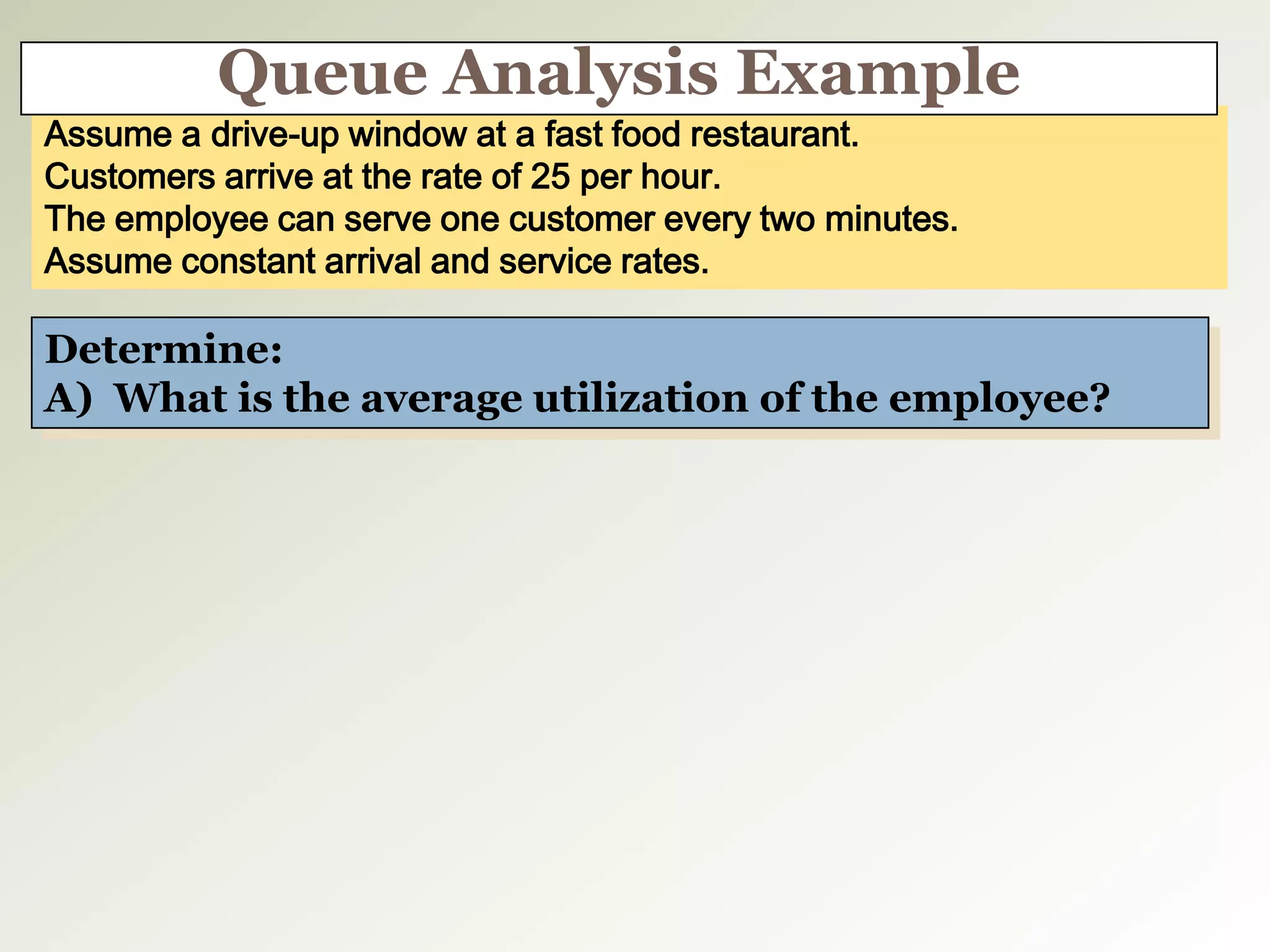
Assume a drive-up window at a fast food restaurant.
Customers arrive at the rate of 25 per hour.
The employee can serve one customer every two minutes.
Assume constant arrival and service rates.
Determine:
A) What is the average utilization of the employee?
Queue Analysis Example





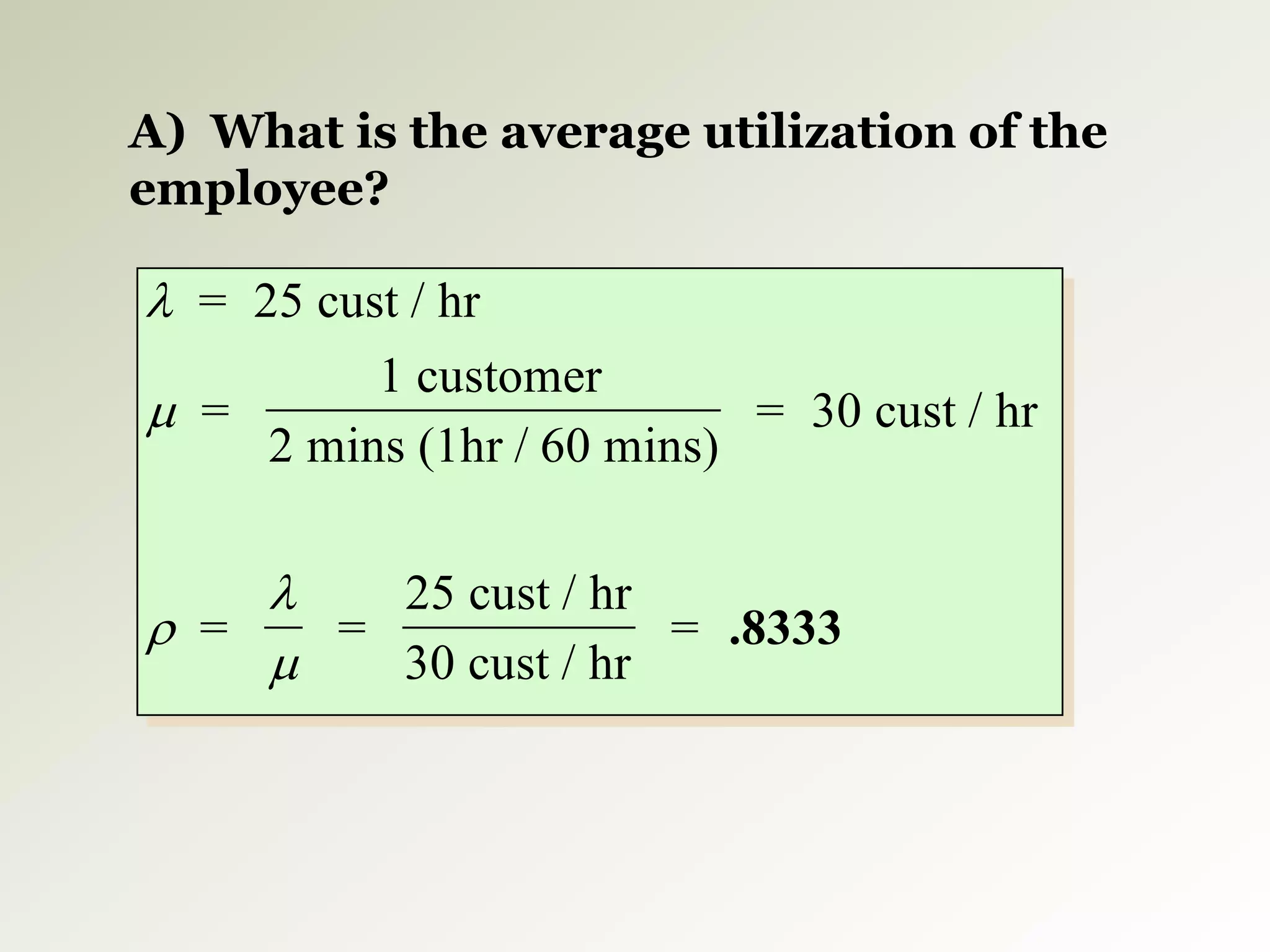
= 25 cust / hr
=
1 customer
2 mins (1hr / 60 mins)
= 30 cust / hr
= =
25 cust / hr
30 cust / hr
= .8333
A) What is the average utilization of the
employee?
29
Managing Wait Times - Quantity
Consists of the management of actual waiting time & perceived
waiting time.
Need to know:
 Average arrival rate of the customers
 Order in which customers will be serviced
 Average service rate of providers
 How long will customers wait
 Ways to make customers wait even longer without
lowering their perceptions of service quality
Laws of Service – Perception
 Maister’s First Law:
Customers compare expectations with perceptions.
 Maister’s Second Law:
Is hard to play catch-up ball.
 Skinner’s Law:
The other line always moves faster.
 Jenkin’s Corollary:
However, when you switch to another other line, the
line you left moves faster.
31
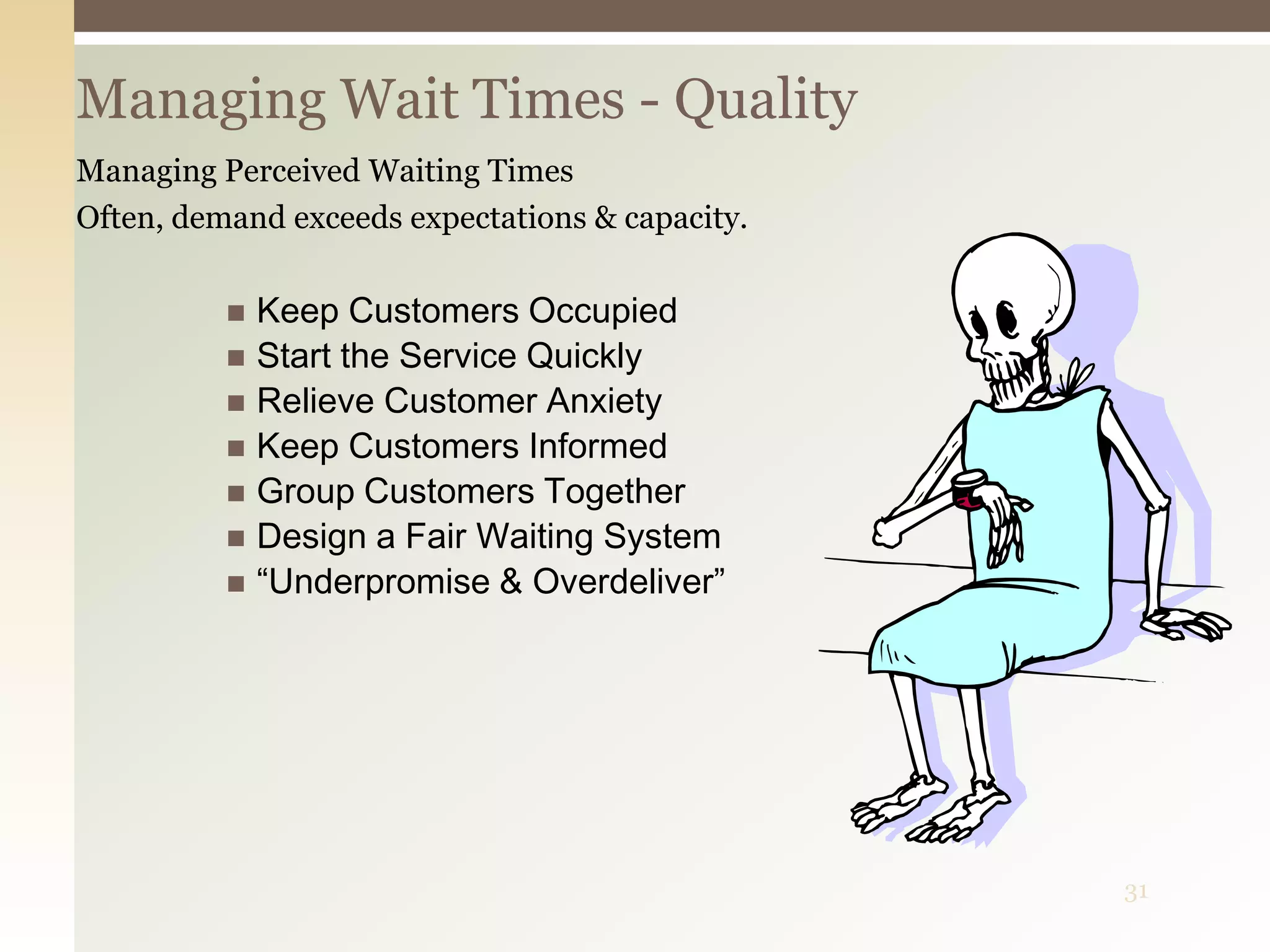
Managing Wait Times - Quality
Managing Perceived Waiting Times
Often, demand exceeds expectations & capacity.
 Keep Customers Occupied
 Start the Service Quickly
 Relieve Customer Anxiety
 Keep Customers Informed
 Group Customers Together
 Design a Fair Waiting System
 “Underpromise & Overdeliver”
Other Quality Approaches
 Reduce perceived waiting time
 Magazines in waiting rooms
 Radio/television
 In-flight movies
 Filling out forms
 Derive benefits from waiting
 Place impulse items near checkout
 Advertise other goods/services
Remember Me
 I am the person who goes into a restaurant, sits down, and patiently
waits while the wait-staff does everything but take my order.
 I am the person that waits in line for the clerk to finish chatting with
his buddy.
 I am the one who never comes back and it amuses me to see money
spent to get me back.
 I was there in the first place, all you had to do was show me some
courtesy and service.
The Customer
Topics for Discussion
 Suggest diversions that could make waiting less
painful.
 Give a bad and good waiting experience, and
contrast the situations with respect to the aesthetics
of the surroundings, diversions, people waiting, and
attitude of servers.
 Suggest ways that management can influence the
arrival times of customers.
 What are the benefits of a fast-food employee taking
your order while waiting in line?
 Are there any benefits to making the customer wait?

Customers Waiting in Lines - Service Operations - Yolanda Williams

  • 1.
    Service Operations andWaiting Lines Yolanda Williams Operations Mgmt
  • 2.
     An Overviewof Service Operations  Service Response Logistics  Waiting…  Discuss the psychology of waiting.  Laws of Service.  Describe how queues are managed.  Describe the essential features of a queuing system. Purpose and Objectives
  • 3.
    3 What are services? Many services are pure services, offering few or no tangible products to customers.  Others may have end products with a larger tangible component (e.g., restaurants & repair facilities).  Customers are often involved in the production of the service.  Services may provide state utility - they do something to things owned by the customer (e.g., store supplies & repair machines).
  • 4.
    4 More on Services Services cannot be inventoried.  Services have high levels of customer interactions.  Services are decentralized due to inability to inventory & transport services
  • 5.
    5 Service Delivery Service deliverysystems (a continuum) with mass produced, low- customer contact systems at one end and highly customized, high-customer-contact systems at the other. Front of the House Back of the House
  • 6.
    6 An Overview ofService Operations- Cont. Service Strategy Development: 1. Cost LeadershipStrategy-The Low Cost Provider – May require large capital investment in automated, state-of-the art equipment and significant efforts in the areas of controlling and reducing costs. 2. DifferentiationStrategy- Service that is considered unique. Differentiation is created as companies listen to customers. 3. Focus Strategy- Serve a narrow niche better than other firms
  • 7.
    7 Service Response Logistics ServiceResponse Logistics (SRL) The management and coordination of the organization’s activities while a service is being performed for customers. 1. Service capacity  The number of customers per day the firm’s service system is designed to serve. 2. Distribution channels  Distribution channels involve traditional methods & new channels that incorporate new Internet technologies 3. Service quality  Customer satisfaction--depends on ability to deliver what customers want, meet customers’ perceptions and satisfying customers varying expectations. 4. Waiting times
  • 8.
    Psychology of Waiting That Old Empty Feeling:  Unoccupied time goes slowly  A Foot in the Door:  Pre-service waits seem longer that in-service waits  The Light at the End of theTunnel:  Reduce anxiety with attention  Excuse Me, But I Was First:  Social justice with First Come First Serve queue discipline  They Also Serve,Who Sit and Wait:  Avoids idle service capacity
  • 9.
    Cultural Attitudes  “Americanshate to wait. So business is trying a trick or two to make lines seem shorter…” The NewYorkTimes  Standing in line – at the bank, the market, the movies – is the time-waster everyone loves to hate. Stand in just one 15-minute line a day, every day, and kiss goodbye to almost four days of idle time by year’s end.—Kathleen Doheny
  • 10.
    0 1 2 3 4 5 6 Stoplights JunkMail Missing Objects HouseworkWaitingin Line In a life time, the average Americanwill spend-- Years We are waiting…
  • 11.
    Approaches to ControllingCustomer Waiting  Animate: Disneyland distractions, elevator mirror, recorded music  Discriminate: Avis frequent renter treatment (out of sight)  Automate: Use computer scripts/ voice prompts to address 75% of questions  Obfuscate: Amusement park/ Airport staged waits
  • 12.
    Waiting…  Waiting inlines does not add enjoyment  Waiting in lines does not generate revenue Waiting lines are non-value added occurrences
  • 13.
     Cost toprovide waiting space  Loss of business  Customers leaving  Customers refusing to wait  Loss of goodwill  Reduction in customer satisfaction  Congestion may disrupt other business operations Implications of Waiting Lines
  • 14.
    14 What is aQueue?  A queue is a waiting line.  A queuing system involves customers arriving for service who sometimes have to wait.  Queuing analysis provides:  Summary measures for assessing a queuing system in terms of customers and time.  A way to balance the costs of providing service and costs of congestion.
  • 15.
    Queue Theory  Queuingtheory: Mathematical approach to the analysis of waiting lines.  Importance of Queuing Analysis:  Servicing customers can be costly.  Retail environments are plagued with customer congestion. Managing that has benefits.  Goal of queuing analysis is to minimize the sum of two costs  Customer waiting costs  Service capacity costs
  • 16.
    Components of theQueuing System Customer Arrivals Servers Waiting Line Servicing System Exit Queue or
  • 17.
    The Queuing System QueueDiscipline Length Number of Lines & Line Structures Service Time Distribution Queuing System
  • 18.
    Essential Features ofQueuing Systems Departure Queue discipline Arrival process Queue configuration Service process Renege Balk Calling population No future need for service
  • 19.
    Queue Configurations Multiple QueueSingle queue Take a Number Enter 3 4 8 2 6 10 12 11 5 7 9
  • 20.
  • 21.
    Examples of LineStructures Single Channel Multichannel Single Phase Multiphase One-person barber shop Car wash Hospital admissions Bank tellers’ windows
  • 22.
    Waiting Realities  Inevitabilityof Waiting: Waiting results from variations in arrival rates and service rates
  • 23.
    Customer Service ArrivalPattern Arrival Pattern Constant Variable Example: A part from an automated machine arrives every 30 seconds. Example: Customers arriving in a bank.
  • 24.
    Service Pattern Service Pattern Constant Variable Example:Each part takes exactly 30 seconds to make. Example: People spending time shopping.
  • 25.
    Waiting Realities  Economicsof Waiting: High utilization purchased at the price of customer waiting. Make waiting productive (salad bar) or profitable (drinking bar).
  • 26.
    Queuing Analysis Optimum Cost of service capacity Costof customers waiting Total cost Cost Service capacity Total cost Customer waiting cost Capacity cost= +
  • 27.
    Assume a drive-upwindow at a fast food restaurant. Customers arrive at the rate of 25 per hour. The employee can serve one customer every two minutes. Assume constant arrival and service rates. Determine: A) What is the average utilization of the employee? Queue Analysis Example
  • 28.
         = 25 cust/ hr = 1 customer 2 mins (1hr / 60 mins) = 30 cust / hr = = 25 cust / hr 30 cust / hr = .8333 A) What is the average utilization of the employee?
  • 29.
    29 Managing Wait Times- Quantity Consists of the management of actual waiting time & perceived waiting time. Need to know:  Average arrival rate of the customers  Order in which customers will be serviced  Average service rate of providers  How long will customers wait  Ways to make customers wait even longer without lowering their perceptions of service quality
  • 30.
    Laws of Service– Perception  Maister’s First Law: Customers compare expectations with perceptions.  Maister’s Second Law: Is hard to play catch-up ball.  Skinner’s Law: The other line always moves faster.  Jenkin’s Corollary: However, when you switch to another other line, the line you left moves faster.
  • 31.
    31 Managing Wait Times- Quality Managing Perceived Waiting Times Often, demand exceeds expectations & capacity.  Keep Customers Occupied  Start the Service Quickly  Relieve Customer Anxiety  Keep Customers Informed  Group Customers Together  Design a Fair Waiting System  “Underpromise & Overdeliver”
  • 32.
    Other Quality Approaches Reduce perceived waiting time  Magazines in waiting rooms  Radio/television  In-flight movies  Filling out forms  Derive benefits from waiting  Place impulse items near checkout  Advertise other goods/services
  • 33.
    Remember Me  Iam the person who goes into a restaurant, sits down, and patiently waits while the wait-staff does everything but take my order.  I am the person that waits in line for the clerk to finish chatting with his buddy.  I am the one who never comes back and it amuses me to see money spent to get me back.  I was there in the first place, all you had to do was show me some courtesy and service. The Customer
  • 34.
    Topics for Discussion Suggest diversions that could make waiting less painful.  Give a bad and good waiting experience, and contrast the situations with respect to the aesthetics of the surroundings, diversions, people waiting, and attitude of servers.  Suggest ways that management can influence the arrival times of customers.  What are the benefits of a fast-food employee taking your order while waiting in line?  Are there any benefits to making the customer wait?