DISCOVER . LEARN . EMPOWER
University Institute of Pharma
Sciences
B. Pharm
Course Name – Pathophysiology
Course Code -22 PHT-115
Faculty Name –Lovedeep Singh
2
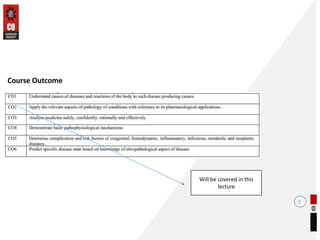
Course Outcome
Will be covered in this
lecture
.
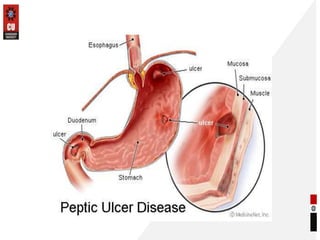
Peptic ulcer
Introduction
Erosion of GI mucosa resulting from digestive action of
HCl and pepsin
Site
• Lower esophagus
• Stomach
• Duodenum
• 10% of men, 4% of women
Types
Acute
• Superficial erosion
• Minimal erosion
Chronic
• Muscular wall erosion with formation of fibrous tissue
• Present continuously for many months or intermittently
Etiology and Pathophysiology
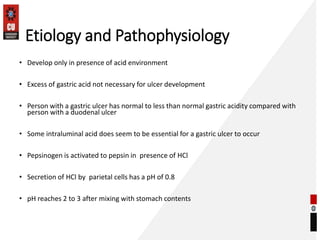
• Develop only in presence of acid environment
• Excess of gastric acid not necessary for ulcer development
• Person with a gastric ulcer has normal to less than normal gastric acidity compared with
person with a duodenal ulcer
• Some intraluminal acid does seem to be essential for a gastric ulcer to occur
• Pepsinogen is activated to pepsin in presence of HCl
• Secretion of HCl by parietal cells has a pH of 0.8
• pH reaches 2 to 3 after mixing with stomach contents
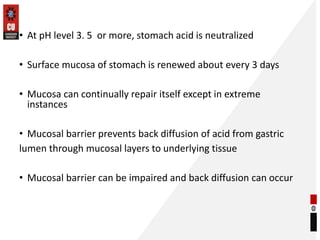
• At pH level 3. 5 or more, stomach acid is neutralized
• Surface mucosa of stomach is renewed about every 3 days
• Mucosa can continually repair itself except in extreme
instances
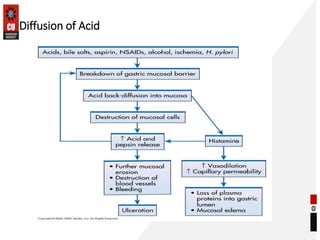
• Mucosal barrier prevents back diffusion of acid from gastric
lumen through mucosal layers to underlying tissue
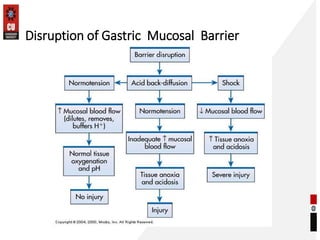
• Mucosal barrier can be impaired and back diffusion can occur
Diffusion of Acid
Disruption of Gastric Mucosal Barrier
Protective Mechanism
• Mucus forms a layer that entraps or slows diffusion of
hydrogen ions across mucosal barrier
• Bicarbonate secreted Neutralizes HCl acid in lumen of GI
tract
Gastric Ulcers
Characterized by
• A normal to low secretion of gastric acid
• Back diffusion of acid is greater (chronic )
• Critical pathologic process is amount of acid able to
penetrate mucosal barrier
• H pylori is present in 50% to 70%
• Drugs --- Aspirin, corticosteroids, N SAIDs, reserpine,
Chronic alcohol abuse, chronic gastritis
Duodenal Ulcers
• Between ages of 35 to 45 years
• Account for 8 0% of all peptic ulcers
• Associated with ↑HCl acid secretion
• H.pylori associated in 9 0- 9 5 % of cases
• Diseases with ↑risk of duodenal ulcers
COPD, cirrhosis of liver, chronic pancreatitis,
hyperparathyroidism, chronic renal failure
Clinical Features
• Common to have no pain or other symptoms
• Gastric and duodenal mucosa not rich in sensory pain
fibers
• Duodenal ulcer pain
• Burning, cramplike
• Gastric ulcer pain
• Burning, gaseous
Complications
• 3 major complications
Hemorrhage
Perforation
Gastric outlet obstruction
• Initially treated conservatively
• May require surgery at any time during course of
therapy
Diagnostic Studies
• Endoscopy procedure
• Determines degree of ulcer healing after treatment
• Tissue specimens can be obtained to identify H. pylori and to rule
out gastric cancer
• Tests for H.pylori
• Noninvasive tests
• Serum or whole blood antibody tests
• Immunoglobin G (I g G)
• Urea breath test
• C 14 breath test
• Invasive tests
• Biopsy of stomach
• Rapid urease test
• Barium contrast studies
• Widely used
• X- ray studies
• Ineffective in differentiating a peptic ulcer from a
malignant tumor
• Gastric analysis
• Lab analysis
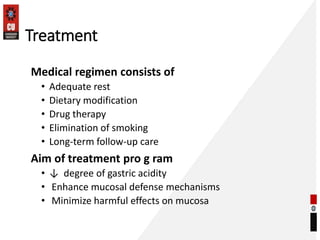
Treatment
Medical regimen consists of
• Adequate rest
• Dietary modification
• Drug therapy
• Elimination of smoking
• Long-term follow-up care
Aim of treatment pro g ram
• ↓ degree of gastric acidity
• Enhance mucosal defense mechanisms
• Minimize harmful effects on mucosa
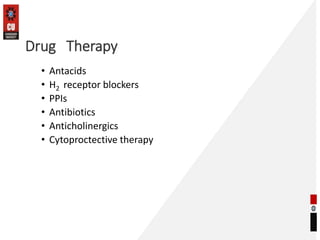
Drug Therapy
• Antacids
• H2 receptor blockers
• PPIs
• Antibiotics
• Anticholinergics
• Cytoproctective therapy
Histamine receptor blocks (H2 R blockers)
Used to manage peptic ulcer disease
Block action of histamine on H2 receptors
↓ HCl acid secretion
↓ conversion of pepsinogen to pepsin
↑ ulcer healing
Proton pump inhibitors
• Block ATPase en zyme that is important for secretion of HCl
acid
Antibiotic therapy
• Eradicate H. pylori infection
• No single agents have been effective in eliminating H.
pylori
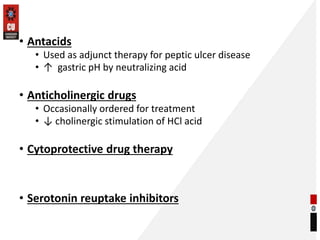
• Antacids
• Used as adjunct therapy for peptic ulcer disease
• ↑ gastric pH by neutralizing acid
• Anticholinergic drugs
• Occasionally ordered for treatment
• ↓ cholinergic stimulation of HCl acid
• Cytoprotective drug therapy
• Serotonin reuptake inhibitors
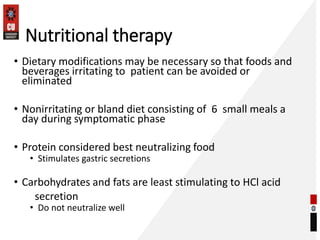
Nutritional therapy
• Dietary modifications may be necessary so that foods and
beverages irritating to patient can be avoided or
eliminated
• Nonirritating or bland diet consisting of 6 small meals a
day during symptomatic phase
• Protein considered best neutralizing food
• Stimulates gastric secretions
• Carbohydrates and fats are least stimulating to HCl acid
secretion
• Do not neutralize well
Surgical Treatment
• < 20% of patients with ulcers need surgical
intervention
• Indications for surgical interventions
Intractability
History of hemorrhage, ↑ risk of bleeding
Prepyloric or pyloric ulcers
Multiple ulcer sites
Drug-induced ulcers
Possible existence of a malignant ulcer
Obstruction
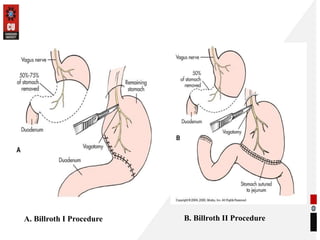
Surgical procedures
 Gastroduodenostomy
 Gastrojejunostomy
 Vagotomy
 Pyloroplasty
A. Billroth I Procedure B. Billroth II Procedure
Comply with prescribed therapeutic regimen
Experience a reduction or absence of discomfort related to
peptic ulcer disease
Exhibits no signs of GI complications
Have complete healing
Lifestyle changes to prevent recurrence
Goals
TEXTBOOKS
T1 Vinay Kumar, Abul K. Abas, Jon C. Aster; Robbins & Cotran
Pathologic Basis of Disease; South Asia edition; India; Elsevier; 2014.
T2 Harsh Mohan; Text book of Pathology; 6th edition; India; Jaypee
Publications; 2010.
REFERENCE BOOKS
R1Laurence B, Bruce C, Bjorn K. ; Goodman Gilman’s The
Pharmacological Basis of Therapeutics; 12th edition; New York;
McGrawHill; 2011.
R2Best, Charles Herbert 1899-1978; Taylor, Norman Burke 1885-1972;
West, John B (John Burnard); Best and Taylor’s Physiological
basis of medical practice; 12th ed; united states
R3William and Wilkins, Baltimorec 1991 [1990 printing]
chandigarh university
THANKS…
chandigarh university

Peptic ulcers.pptx

  • 1.
    DISCOVER . LEARN. EMPOWER University Institute of Pharma Sciences B. Pharm Course Name – Pathophysiology Course Code -22 PHT-115 Faculty Name –Lovedeep Singh
  • 2.
    2 Course Outcome Will becovered in this lecture
  • 3.
  • 4.
    Introduction Erosion of GImucosa resulting from digestive action of HCl and pepsin Site • Lower esophagus • Stomach • Duodenum • 10% of men, 4% of women
  • 5.
    Types Acute • Superficial erosion •Minimal erosion Chronic • Muscular wall erosion with formation of fibrous tissue • Present continuously for many months or intermittently
  • 6.
    Etiology and Pathophysiology •Develop only in presence of acid environment • Excess of gastric acid not necessary for ulcer development • Person with a gastric ulcer has normal to less than normal gastric acidity compared with person with a duodenal ulcer • Some intraluminal acid does seem to be essential for a gastric ulcer to occur • Pepsinogen is activated to pepsin in presence of HCl • Secretion of HCl by parietal cells has a pH of 0.8 • pH reaches 2 to 3 after mixing with stomach contents
  • 7.
    • At pHlevel 3. 5 or more, stomach acid is neutralized • Surface mucosa of stomach is renewed about every 3 days • Mucosa can continually repair itself except in extreme instances • Mucosal barrier prevents back diffusion of acid from gastric lumen through mucosal layers to underlying tissue • Mucosal barrier can be impaired and back diffusion can occur
  • 8.
  • 9.
    Disruption of GastricMucosal Barrier
  • 10.
    Protective Mechanism • Mucusforms a layer that entraps or slows diffusion of hydrogen ions across mucosal barrier • Bicarbonate secreted Neutralizes HCl acid in lumen of GI tract
  • 11.
    Gastric Ulcers Characterized by •A normal to low secretion of gastric acid • Back diffusion of acid is greater (chronic ) • Critical pathologic process is amount of acid able to penetrate mucosal barrier • H pylori is present in 50% to 70% • Drugs --- Aspirin, corticosteroids, N SAIDs, reserpine, Chronic alcohol abuse, chronic gastritis
  • 12.
    Duodenal Ulcers • Betweenages of 35 to 45 years • Account for 8 0% of all peptic ulcers • Associated with ↑HCl acid secretion • H.pylori associated in 9 0- 9 5 % of cases • Diseases with ↑risk of duodenal ulcers COPD, cirrhosis of liver, chronic pancreatitis, hyperparathyroidism, chronic renal failure
  • 13.
    Clinical Features • Commonto have no pain or other symptoms • Gastric and duodenal mucosa not rich in sensory pain fibers • Duodenal ulcer pain • Burning, cramplike • Gastric ulcer pain • Burning, gaseous
  • 14.
    Complications • 3 majorcomplications Hemorrhage Perforation Gastric outlet obstruction • Initially treated conservatively • May require surgery at any time during course of therapy
  • 16.
    Diagnostic Studies • Endoscopyprocedure • Determines degree of ulcer healing after treatment • Tissue specimens can be obtained to identify H. pylori and to rule out gastric cancer • Tests for H.pylori • Noninvasive tests • Serum or whole blood antibody tests • Immunoglobin G (I g G) • Urea breath test • C 14 breath test • Invasive tests • Biopsy of stomach • Rapid urease test
  • 17.
    • Barium contraststudies • Widely used • X- ray studies • Ineffective in differentiating a peptic ulcer from a malignant tumor • Gastric analysis • Lab analysis
  • 18.
    Treatment Medical regimen consistsof • Adequate rest • Dietary modification • Drug therapy • Elimination of smoking • Long-term follow-up care Aim of treatment pro g ram • ↓ degree of gastric acidity • Enhance mucosal defense mechanisms • Minimize harmful effects on mucosa
  • 19.
    Drug Therapy • Antacids •H2 receptor blockers • PPIs • Antibiotics • Anticholinergics • Cytoproctective therapy
  • 20.
    Histamine receptor blocks(H2 R blockers) Used to manage peptic ulcer disease Block action of histamine on H2 receptors ↓ HCl acid secretion ↓ conversion of pepsinogen to pepsin ↑ ulcer healing Proton pump inhibitors • Block ATPase en zyme that is important for secretion of HCl acid Antibiotic therapy • Eradicate H. pylori infection • No single agents have been effective in eliminating H. pylori
  • 21.
    • Antacids • Usedas adjunct therapy for peptic ulcer disease • ↑ gastric pH by neutralizing acid • Anticholinergic drugs • Occasionally ordered for treatment • ↓ cholinergic stimulation of HCl acid • Cytoprotective drug therapy • Serotonin reuptake inhibitors
  • 22.
    Nutritional therapy • Dietarymodifications may be necessary so that foods and beverages irritating to patient can be avoided or eliminated • Nonirritating or bland diet consisting of 6 small meals a day during symptomatic phase • Protein considered best neutralizing food • Stimulates gastric secretions • Carbohydrates and fats are least stimulating to HCl acid secretion • Do not neutralize well
  • 23.
    Surgical Treatment • <20% of patients with ulcers need surgical intervention • Indications for surgical interventions Intractability History of hemorrhage, ↑ risk of bleeding Prepyloric or pyloric ulcers Multiple ulcer sites Drug-induced ulcers Possible existence of a malignant ulcer Obstruction
  • 24.
    Surgical procedures  Gastroduodenostomy Gastrojejunostomy  Vagotomy  Pyloroplasty
  • 25.
    A. Billroth IProcedure B. Billroth II Procedure
  • 26.
    Comply with prescribedtherapeutic regimen Experience a reduction or absence of discomfort related to peptic ulcer disease Exhibits no signs of GI complications Have complete healing Lifestyle changes to prevent recurrence Goals
  • 27.
    TEXTBOOKS T1 Vinay Kumar,Abul K. Abas, Jon C. Aster; Robbins & Cotran Pathologic Basis of Disease; South Asia edition; India; Elsevier; 2014. T2 Harsh Mohan; Text book of Pathology; 6th edition; India; Jaypee Publications; 2010. REFERENCE BOOKS R1Laurence B, Bruce C, Bjorn K. ; Goodman Gilman’s The Pharmacological Basis of Therapeutics; 12th edition; New York; McGrawHill; 2011. R2Best, Charles Herbert 1899-1978; Taylor, Norman Burke 1885-1972; West, John B (John Burnard); Best and Taylor’s Physiological basis of medical practice; 12th ed; united states R3William and Wilkins, Baltimorec 1991 [1990 printing] chandigarh university
  • 28.