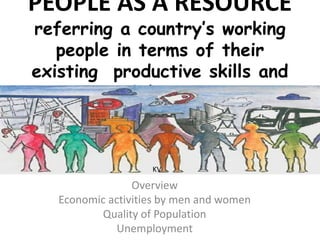
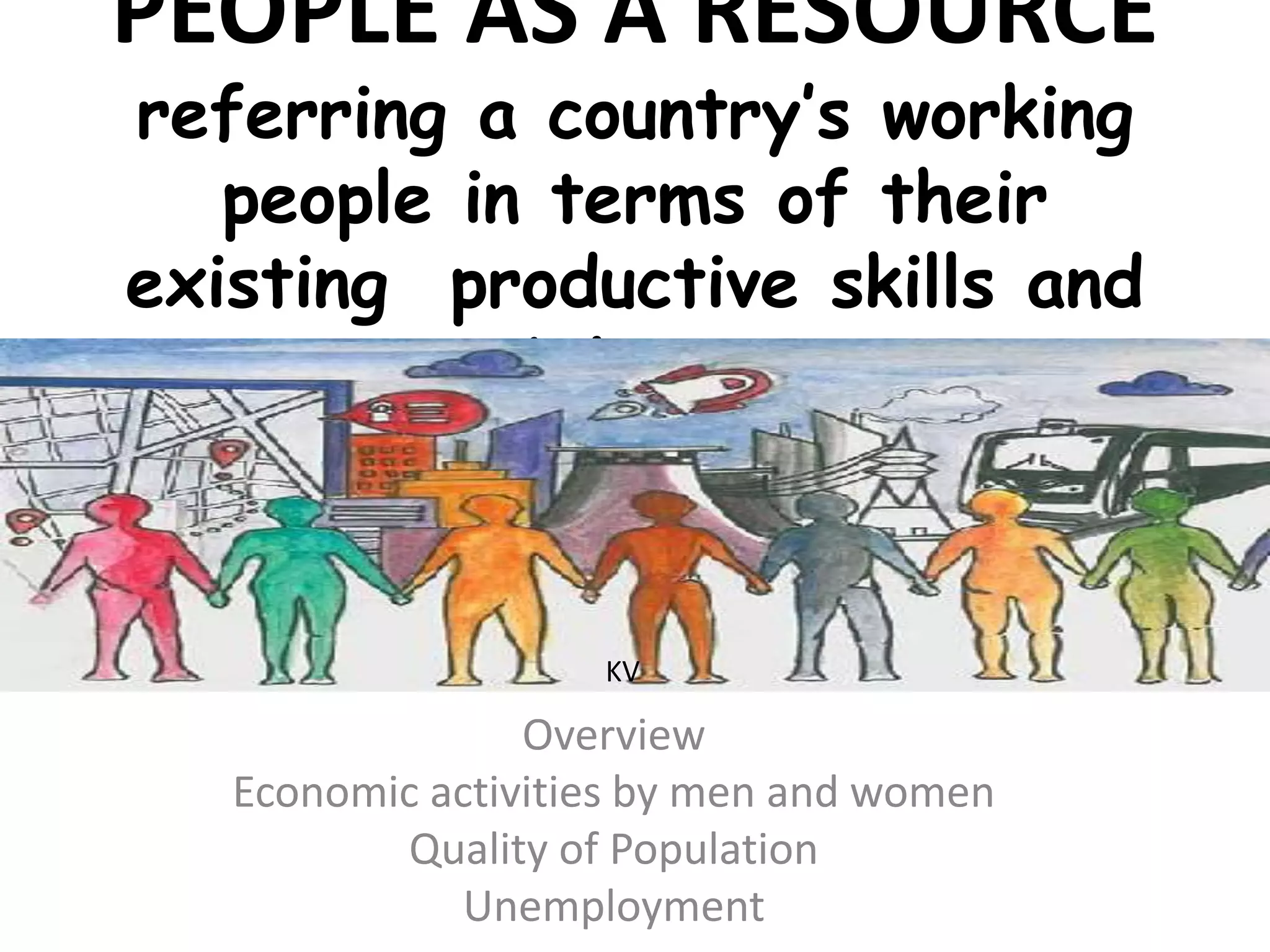
PEOPLE AS A RESOURCE
referring a country’s working
people in terms of their
existing productive skills and
abilities.
Overview
Economic activities by men and women
Quality of Population
Unemployment
KV
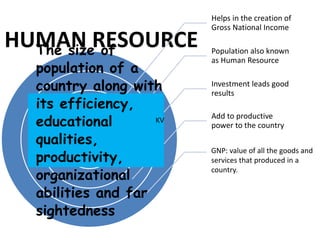
HUMAN RESOURCE
Helps in the creation of
Gross National Income
Population also known
as Human Resource
Investment leads good
results
Add to productive
power to the country
The size of
population of a
country along with
its efficiency,
educational
qualities,
productivity,
organizational
abilities and far
sightedness
GNP: value of all the goods and
services that produced in a
country.
KV
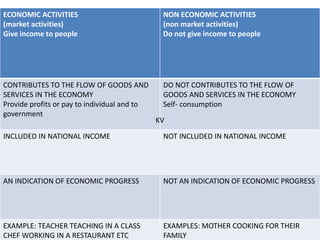
ECONOMIC ACTIVITIES
(market activities)
Give income to people
NON ECONOMIC ACTIVITIES
(non market activities)
Do not give income to people
CONTRIBUTES TO THE FLOW OF GOODS AND
SERVICES IN THE ECONOMY
Provide profits or pay to individual and to
government
DO NOT CONTRIBUTES TO THE FLOW OF
GOODS AND SERVICES IN THE ECONOMY
Self- consumption
INCLUDED IN NATIONAL INCOME NOT INCLUDED IN NATIONAL INCOME
AN INDICATION OF ECONOMIC PROGRESS NOT AN INDICATION OF ECONOMIC PROGRESS
EXAMPLE: TEACHER TEACHING IN A CLASS
CHEF WORKING IN A RESTAURANT ETC
EXAMPLES: MOTHER COOKING FOR THEIR
FAMILY
KV
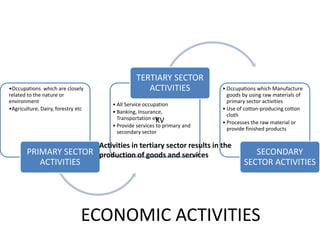
ECONOMIC ACTIVITIES
•Occupations which are closely
related to the nature or
environment
•Agriculture, Dairy, forestry etc
PRIMARY SECTOR
ACTIVITIES
• All Service occupation
• Banking, Insurance,
Transportation etc
• Provide services to primary and
secondary sector
TERTIARY SECTOR
ACTIVITIES • Occupations which Manufacture
goods by using raw materials of
primary sector activities
• Use of cotton-producing cotton
cloth
• Processes the raw material or
provide finished products
SECONDARY
SECTOR ACTIVITIES
KV
Activities in tertiary sector results in the
production of goods and services
KV
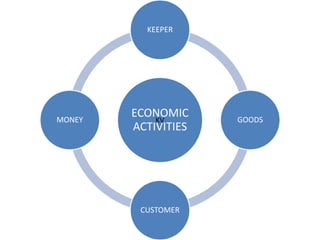
ECONOMIC
ACTIVITIES
KEEPER
GOODS
CUSTOMER
MONEY KV
CHECK POINT 01 (E2)
1. What do you understand by 'people as a resource'?
2. How is human resource different from other
resources like land and physical capital?
3. What are the various activities undertaken in the
primary sector, secondary sector and tertiary sector?
4. What is the difference between economic activities
and non-economic activities?
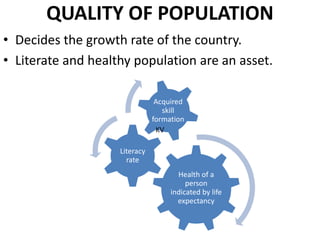
QUALITY OF POPULATION
• Decides the growth rate of the country.
• Literate and healthy population are an asset.
Health of a
person
indicated by life
expectancy
Literacy
rate
Acquired
skill
formation
KV
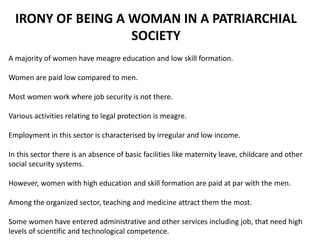
IRONY OF BEING A WOMAN IN A PATRIARCHIAL
SOCIETY
A majority of women have meagre education and low skill formation.
Women are paid low compared to men.
Most women work where job security is not there.
Various activities relating to legal protection is meagre.
Employment in this sector is characterised by irregular and low income.
In this sector there is an absence of basic facilities like maternity leave, childcare and other
social security systems.
However, women with high education and skill formation are paid at par with the men.
Among the organized sector, teaching and medicine attract them the most.
Some women have entered administrative and other services including job, that need high
levels of scientific and technological competence.
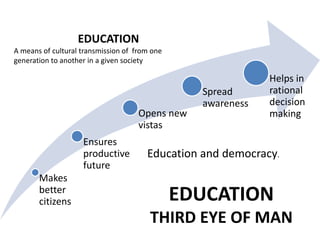
EDUCATION
THIRD EYE OF MAN
Makes
better
citizens
Ensures
productive
future
Opens new
vistas
Spread
awareness
Helps in
rational
decision
making
Education and democracy.
EDUCATION
A means of cultural transmission of from one
generation to another in a given society
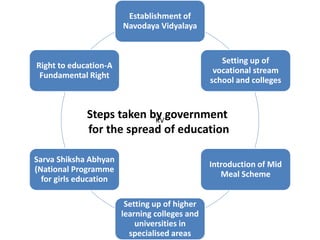
Steps taken by government
for the spread of education
Establishment of
Navodaya Vidyalaya
Setting up of
vocational stream
school and colleges
Introduction of Mid
Meal Scheme
Setting up of higher
learning colleges and
universities in
specialised areas
Sarva Shiksha Abhyan
(National Programme
for girls education
Right to education-A
Fundamental Right
KV
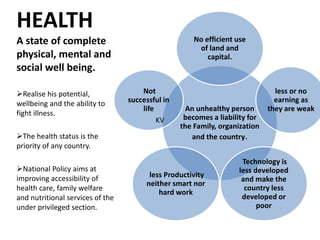
HEALTH
A state of complete
physical, mental and
social well being.
Realise his potential,
wellbeing and the ability to
fight illness.
The health status is the
priority of any country.
National Policy aims at
improving accessibility of
health care, family welfare
and nutritional services of the
under privileged section.
An unhealthy person
becomes a liability for
the Family, organization
and the country.
No efficient use
of land and
capital.
less or no
earning as
they are weak
Technology is
less developed
and make the
country less
developed or
poor
less Productivity
neither smart nor
hard work
Not
successful in
life
KV
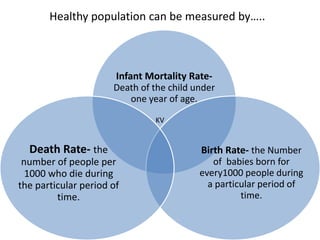
Healthy population can be measured by…..
Infant Mortality Rate-
Death of the child under
one year of age.
Birth Rate- the Number
of babies born for
every1000 people during
a particular period of
time.
Death Rate- the
number of people per
1000 who die during
the particular period of
time.
KV
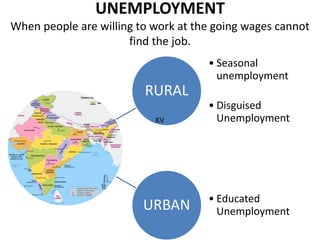
UNEMPLOYMENT
When people are willing to work at the going wages cannot
find the job.
RURAL
• Seasonal
unemployment
• Disguised
Unemployment
URBAN • Educated
Unemployment
KV
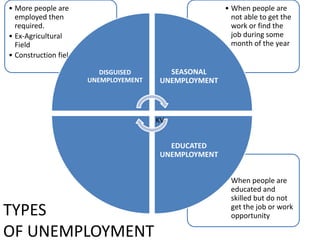
TYPES
OF UNEMPLOYMENT
• When people are
educated and
skilled but do not
get the job or work
opportunity
• When people are
not able to get the
work or find the
job during some
month of the year
• More people are
employed then
required.
• Ex-Agricultural
Field
• Construction field
DISGUISED
UNEMPLOYEMENT
SEASONAL
UNEMPLOYMENT
EDUCATED
UNEMPLOYMENT
KV
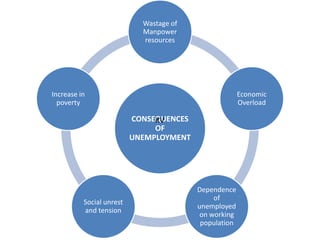
CONSEQUENCES
OF
UNEMPLOYMENT
Wastage of
Manpower
resources
Economic
Overload
Dependence
of
unemployed
on working
population
Social unrest
and tension
Increase in
poverty
KV
CHECK POINT 02 (E2)
1. What is the role of education in human
capital formation?
2. What is the role of health in human capital
formation?
3. What part does health play in the individual’s
working life?
4. Why are women employed in low paid work?
5. How will you explain the term
unemployment?
ASSIGNMENT 01 (E2)
1. Can you suggest some measures in the education
system to mitigate the problem of the educated
unemployed?
2. Which capital would you consider the best — land,
labour, physical capital and human capital? Why?
3. What is the difference between disguised
unemployment and seasonal unemployment?
4. Why is educated unemployed, a peculiar problem of
India?
5. In which field do you think India can build the
maximum employment opportunity?

People as a resource

  • 1.
    PEOPLE AS ARESOURCE referring a country’s working people in terms of their existing productive skills and abilities. Overview Economic activities by men and women Quality of Population Unemployment KV
  • 2.
    HUMAN RESOURCE Helps inthe creation of Gross National Income Population also known as Human Resource Investment leads good results Add to productive power to the country The size of population of a country along with its efficiency, educational qualities, productivity, organizational abilities and far sightedness GNP: value of all the goods and services that produced in a country. KV
  • 3.
    ECONOMIC ACTIVITIES (market activities) Giveincome to people NON ECONOMIC ACTIVITIES (non market activities) Do not give income to people CONTRIBUTES TO THE FLOW OF GOODS AND SERVICES IN THE ECONOMY Provide profits or pay to individual and to government DO NOT CONTRIBUTES TO THE FLOW OF GOODS AND SERVICES IN THE ECONOMY Self- consumption INCLUDED IN NATIONAL INCOME NOT INCLUDED IN NATIONAL INCOME AN INDICATION OF ECONOMIC PROGRESS NOT AN INDICATION OF ECONOMIC PROGRESS EXAMPLE: TEACHER TEACHING IN A CLASS CHEF WORKING IN A RESTAURANT ETC EXAMPLES: MOTHER COOKING FOR THEIR FAMILY KV
  • 4.
    ECONOMIC ACTIVITIES •Occupations whichare closely related to the nature or environment •Agriculture, Dairy, forestry etc PRIMARY SECTOR ACTIVITIES • All Service occupation • Banking, Insurance, Transportation etc • Provide services to primary and secondary sector TERTIARY SECTOR ACTIVITIES • Occupations which Manufacture goods by using raw materials of primary sector activities • Use of cotton-producing cotton cloth • Processes the raw material or provide finished products SECONDARY SECTOR ACTIVITIES KV Activities in tertiary sector results in the production of goods and services KV
  • 5.
  • 6.
    CHECK POINT 01(E2) 1. What do you understand by 'people as a resource'? 2. How is human resource different from other resources like land and physical capital? 3. What are the various activities undertaken in the primary sector, secondary sector and tertiary sector? 4. What is the difference between economic activities and non-economic activities?
  • 7.
    QUALITY OF POPULATION •Decides the growth rate of the country. • Literate and healthy population are an asset. Health of a person indicated by life expectancy Literacy rate Acquired skill formation KV
  • 8.
    IRONY OF BEINGA WOMAN IN A PATRIARCHIAL SOCIETY A majority of women have meagre education and low skill formation. Women are paid low compared to men. Most women work where job security is not there. Various activities relating to legal protection is meagre. Employment in this sector is characterised by irregular and low income. In this sector there is an absence of basic facilities like maternity leave, childcare and other social security systems. However, women with high education and skill formation are paid at par with the men. Among the organized sector, teaching and medicine attract them the most. Some women have entered administrative and other services including job, that need high levels of scientific and technological competence.
  • 9.
    EDUCATION THIRD EYE OFMAN Makes better citizens Ensures productive future Opens new vistas Spread awareness Helps in rational decision making Education and democracy. EDUCATION A means of cultural transmission of from one generation to another in a given society
  • 10.
    Steps taken bygovernment for the spread of education Establishment of Navodaya Vidyalaya Setting up of vocational stream school and colleges Introduction of Mid Meal Scheme Setting up of higher learning colleges and universities in specialised areas Sarva Shiksha Abhyan (National Programme for girls education Right to education-A Fundamental Right KV
  • 11.
    HEALTH A state ofcomplete physical, mental and social well being. Realise his potential, wellbeing and the ability to fight illness. The health status is the priority of any country. National Policy aims at improving accessibility of health care, family welfare and nutritional services of the under privileged section. An unhealthy person becomes a liability for the Family, organization and the country. No efficient use of land and capital. less or no earning as they are weak Technology is less developed and make the country less developed or poor less Productivity neither smart nor hard work Not successful in life KV
  • 12.
    Healthy population canbe measured by….. Infant Mortality Rate- Death of the child under one year of age. Birth Rate- the Number of babies born for every1000 people during a particular period of time. Death Rate- the number of people per 1000 who die during the particular period of time. KV
  • 13.
    UNEMPLOYMENT When people arewilling to work at the going wages cannot find the job. RURAL • Seasonal unemployment • Disguised Unemployment URBAN • Educated Unemployment KV
  • 14.
    TYPES OF UNEMPLOYMENT • Whenpeople are educated and skilled but do not get the job or work opportunity • When people are not able to get the work or find the job during some month of the year • More people are employed then required. • Ex-Agricultural Field • Construction field DISGUISED UNEMPLOYEMENT SEASONAL UNEMPLOYMENT EDUCATED UNEMPLOYMENT KV
  • 15.
  • 16.
    CHECK POINT 02(E2) 1. What is the role of education in human capital formation? 2. What is the role of health in human capital formation? 3. What part does health play in the individual’s working life? 4. Why are women employed in low paid work? 5. How will you explain the term unemployment?
  • 17.
    ASSIGNMENT 01 (E2) 1.Can you suggest some measures in the education system to mitigate the problem of the educated unemployed? 2. Which capital would you consider the best — land, labour, physical capital and human capital? Why? 3. What is the difference between disguised unemployment and seasonal unemployment? 4. Why is educated unemployed, a peculiar problem of India? 5. In which field do you think India can build the maximum employment opportunity?