WELCOME
SECTORS OF THE
INDIAN ECONOMY
INDIAN ECONOMY
BEFORE WE BEGIN THE CLASS PLEASE
NOTE THAT:
ECONOMIC ACTIVITIES ARE ACTIVITIES THAT
RESULT IN THE PRODUCTION OF GOODS AND
SERVICES.
SECTORS ARE GROUP OF ECONOMIC ACTIVITIES
CLASSIFIED ON THE BASIS OF SOME CRITERIA.
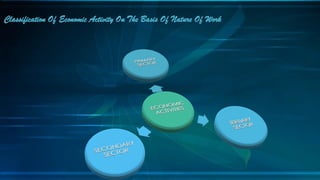
Classification Of Economic Activity On The Basis Of Nature Of Work
• Primary Sector contains the activities that are undertaken directly using
natural resources.
• The product of this activity is a natural product.
• When we produce a good by exploiting natural resources, it is an activity of the
primary sector.
• It forms the base of all other products that we subsequently make. E.g.
Agriculture, Mining, Dairy, Fishing, Forestry etc.
• This sector is also called agriculture related sector.
PRIMARY SECTOR
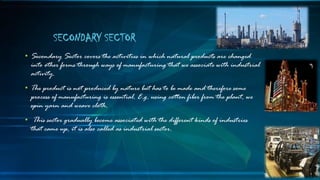
• Secondary Sector covers the activities in which natural products are changed
into other forms through ways of manufacturing that we associate with industrial
activity.
• The product is not produced by nature but has to be made and therefore some
process of manufacturing is essential. E.g. using cotton fiber from the plant, we
spin yarn and weave cloth.
• This sector gradually become associated with the different kinds of industries
that came up, it is also called as industrial sector.
SECONDARY SECTOR
• Tertiary Sector covers the activities that help in the development of the primary
and secondary sectors, do not produce a good but they are an aid or a support for
the production process.
• Transport, Storage, Communication, Banking, Trade are some examples of
tertiary activities.
• Since these activities generate services rather than goods, the tertiary sector is
also called the service sector.
• Service sector also includes some essential services that may not directly help in
the production of goods.
TERTIARY SECTOR
• The values of goods and services are used rather than adding up the actual
numbers.
• Not every good that is produced and sold is counted, it includes the final goods
and services.
• Intermediate goods are used up in producing final goods and services.
• The value of final goods already includes the value of all intermediate goods
that are used in making the final good.
• The value of final goods and services produced in each sector during a
particular year provides the total production of the sector for that year.
• The sum of production in the three sectors gives US what is called the Gross
Domestic Product of a country.
• It is the value of all final goods and services produced within a country during
a particular year. GDP shows how big the economy is.
• In India the mammoth task of measuring GDP is undertaken by a central
government ministry.
Comparing The Three Sector
How Do We Count The Various Goods And Services
And Know The Total Production In Each Sector? primary
secondary
tertiary
• At initial stages of development, primary sector was the most important sector of
economic activity.
• As the methods of farming changed and agricultural sector began to prosper, it
produced much more food than before, many people could now take up other activities,
and this gave rise to service sector.
• Over a long time, and especially because new methods of manufacturing were introduced,
factories came up and started expanding. Those people who had earlier worked on farms
now began to work in factories in large numbers.
• Secondary sector gradually became the most important in total production and
employment in the past 100 years, there has been a further shift from secondary to
tertiary sector in developed countries.
• The service sector has become the most important in terms of total production. Most of
the working people are also employed in the service sector. This is the general pattern
observed in developed countries.
Historical Changes In Sectors
In the year 2003, the tertiary sector has emerged as the largest producing sector
in India replacing the primary sector. There are several reasons for this –
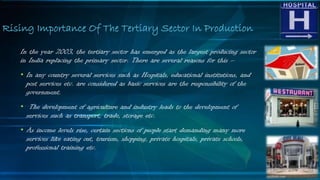
• In any country several services such as Hospitals, educational institutions, and
post services etc. are considered as basic services are the responsibility of the
government.
• The development of agriculture and industry leads to the development of
services such as transport, trade, storage etc.
• As income levels rise, certain sections of people start demanding many more
services like eating out, tourism, shopping, private hospitals, private schools,
professional training etc.
Rising Importance Of The Tertiary Sector In Production
• Over the past decades or so certain services such as those based on
information and communication technology have become important and
essential.
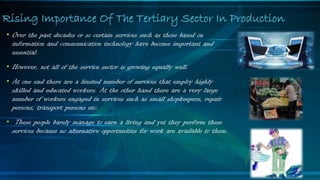
• However, not all of the service sector is growing equally well.
• At one end there are a limited number of services that employ highly
skilled and educated workers. At the other hand there are a very large
number of workers engaged in services such as small shopkeepers, repair
persons, transport persons etc.
• These people barely manage to earn a living and yet they perform these
services because no alternative opportunities for work are available to them.
Rising Importance Of The Tertiary Sector In Production
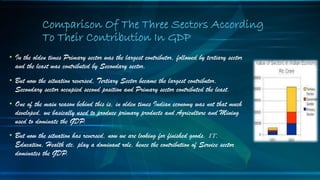
• In the olden times Primary sector was the largest contributor, followed by tertiary sector
and the least was contributed by Secondary sector.
• But now the situation reversed, Tertiary Sector became the largest contributor,
Secondary sector occupied second position and Primary sector contributed the least.
• One of the main reason behind this is, in olden times Indian economy was not that much
developed, we basically used to produce primary products and Agriculture and Mining
used to dominate the GDP.
• But now the situation has reversed, now we are looking for finished goods. IT,
Education, Health etc. play a dominant role, hence the contribution of Service sector
dominates the GDP.
Comparison Of The Three Sectors According
To Their Contribution In GDP
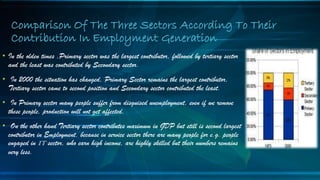
• In the olden times ,Primary sector was the largest contributor, followed by tertiary sector
and the least was contributed by Secondary sector.
• In 2000 the situation has changed, Primary Sector remains the largest contributor,
Tertiary sector came to second position and Secondary sector contributed the least.
• In Primary sector many people suffer from disguised unemployment, even if we remove
these people, production will not get affected.
• On the other hand Tertiary sector contributes maximum in GDP but still is second largest
contributor in Employment, because in service sector there are many people for e.g. people
engaged in IT sector, who earn high income, are highly skilled but their numbers remains
very less.
Comparison Of The Three Sectors According To Their
Contribution In Employment Generation
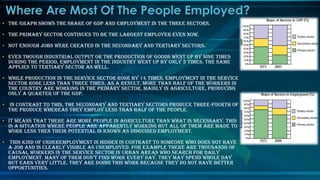
• The Graph shows the share of GDP and employment in the three sectors.
• The primary sector continues to be the largest employer even now.
• Not enough jobs were created in the secondary and tertiary sectors.
• Even though industrial output or the production of goods went up by nine times
during the period, employment in the industry went up by only 3 times. The same
applies to tertiary sector as well.
• While production in the service sector rose by 14 times, employment in the service
sector rose less than three times. As a result, more than half of the workers in
the country are working in the primary sector, mainly in agriculture, producing
only a quarter of the GDP.
• In contrast to this, the secondary and tertiary sectors produce three-fourth of
the produce whereas they employ less than half of the people.
• It means that there are more people in agriculture than what is necessary. This
IS A situation where people are apparently working but all of them are made to
work less then their potential is known as disguised employment.
• This kind of underemployment is hidden in contrast to someone who does not have
a job and is clearly visible as unemployed. FOR EXAMPLE there are thousands of
causal workers in the service sector in urban areas who search for daily
employment. many of them don’t find work every day. they may spend whole day
but earn very little. They are doing this work because they do not have better
opportunities.
Where Are Most Of The People Employed?
More Employment
Provision of
Education,
Health, and
Tourism etc.
Provision of
easy Credit
Promotion
of Irrigation
facilities
How to Create More Employment ?
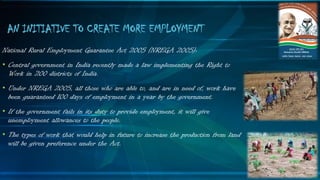
National Rural Employment Guarantee Act 2005 (NREGA 2005):
• Central government in India recently made a law implementing the Right to
Work in 200 districts of India.
• Under NREGA 2005, all those who are able to, and are in need of, work have
been guaranteed 100 days of employment in a year by the government.
• If the government fails in its duty to provide employment, it will give
unemployment allowances to the people.
• The types of work that would help in future to increase the production from land
will be given preference under the Act.
AN INITIATIVE TO CREATE MORE EMPLOYMENT
How To Create More Employment?
Classification Of Economic Activities On The Basis Of Conditions Of Work
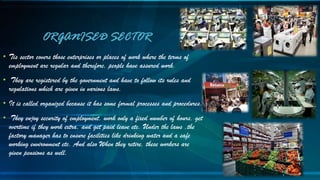
• Tis sector covers those enterprises or places of work where the terms of
employment are regular and therefore, people have assured work.
• They are registered by the government and have to follow its rules and
regulations which are given in various laws.
• It is called organized because it has some formal processes and procedures.
• They enjoy security of employment, work only a fixed number of hours, get
overtime if they work extra, and get paid leave etc. Under the laws ,the
factory manager has to ensure facilities like drinking water and a safe
working environment etc. And also When they retire, these workers are
given pensions as well.
ORGANISED SECTOR
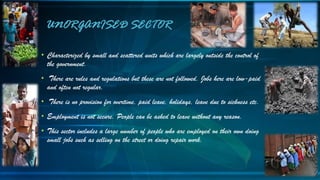
• Characterized by small and scattered units which are largely outside the control of
the government.
• There are rules and regulations but these are not followed. Jobs here are low-paid
and often not regular.
• There is no provision for overtime, paid leave, holidays, leave due to sickness etc.
• Employment is not secure. People can be asked to leave without any reason.
• This sector includes a large number of people who are employed on their own doing
small jobs such as selling on the street or doing repair work.
UNORGANISED SECTOR
• In the rural areas, the unorganized sector mostly comprises of landless agricultural laborer's, small and marginal farmers
and artisans (such as weavers, blacksmiths, carpenters and goldsmiths).
• Nearly 80 per cent of rural households in India are in small and marginal farmer category.
• These farmers need to be supported through adequate facility for timely delivery of seeds, agricultural inputs, credit,
storage facilities and marketing outlets.
• In the urban areas, unorganized sector comprises mainly of workers in small-scale industry, casual workers in
construction, trade and transport etc., and those who work as street vendors, head load workers, garment makers, rag
pickers etc.
• Small-scale industry also needs government’s support for procuring raw material and marketing of output. The casual
workers in both rural and urban areas need to be protected.
• We also find that the majority of workers from scheduled castes, tribes and backward communities find themselves in the
unorganized sector.
• Besides getting the irregular and low paid work, these workers also face social discrimination. Protection and support to the
unorganized sector workers is thus necessary for both economic and social development.
WHY SHOULD WE PROTECT WORKERS IN THE UNORGANISED SECTOR?
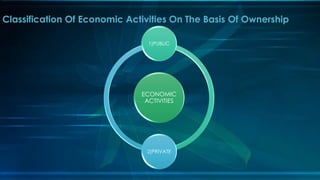
ECONOMIC
ACTIVITIES
1)PUBLIC
2)PRIVATE
Classification Of Economic Activities On The Basis Of Ownership
THEN LET’S GO FOR A JOURNEY
ARE YOU GETTING BORED ?
SO LETS CHOOSE ONE PATH
PUBLIC OR PRIVATE?
DECISION PENDING ……….
PRIVATE OR PUBLIC?
PUBLIC OR PRIVATE?
PRIVATE OR PUBLIC?
PUBLIC….PUBLIC….PUBLIC…..
PRIVATE….PRIVATE….PRIVATE…
PUBLIC OR PRIVATE ????????
AND THE FINAL DECISION IS
P IRATE
THAT IS RIGHT IT IS PRIVATE
SO LETS MOVE ON TO THAT PATH
• In the Private sector ownership of assets and delivery of services is in the hands of private
individuals or companies.
• Activities in the private sector are guided by the motive to earn profits.
• Companies like Tata Iron and Steel Company Limited or Reliance Industries Limited are privately
owned.
PRIVATE SECTOR
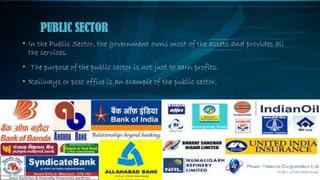
• In the Public Sector, the government owns most of the assets and provides all
the services.
• The purpose of the public sector is not just to earn profits.
• Railways or post office is an example of the public sector.
PUBLIC SECTOR
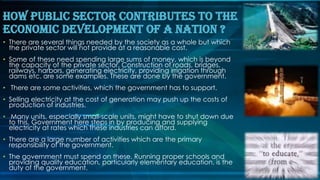
• There are several things needed by the society as a whole but which
the private sector will not provide at a reasonable cost.
• Some of these need spending large sums of money, which is beyond
the capacity of the private sector. Construction of roads, bridges,
railways, harbors, generating electricity, providing irrigation through
dams etc. are some examples. These are done by the government.
• There are some activities, which the government has to support.
• Selling electricity at the cost of generation may push up the costs of
production of industries.
• Many units, especially small-scale units, might have to shut down due
to this. Government here steps in by producing and supplying
electricity at rates which these industries can afford.
• There are a large number of activities which are the primary
responsibility of the government.
• The government must spend on these. Running proper schools and
providing quality education, particularly elementary education, is the
duty of the government.
How Public Sector Contributes To The
Economic Development Of A Nation ?
REVISION
1)Workers in the _________ sector do not produce goods.
ANS) tertiary sector
DON’T PANIC BECAUSE WE ARE GOING TO DO A SMALL EXERCISE
2) Most of the workers in the _________ sector enjoy job
security.
ANS)organized sector
3)A _________ proportion of labourers in India are working in
the unorganised sector.
ANS)large
4) Cotton is a _________ product and cloth is a _________
product.
ANS)natural /manufactured
5) The activities in primary, secondary and tertiary sectors
are_________
ANS)interdependent
THIS PRESENTATION HAD BEEN :
PREPARED BY MEGSVIN MATHEW
AND
PRESENTED BY JENSON JOHN BIJU
THANK YOU