NOTES FOR THE TEACHER
Most regions of the world are getting increasingly
interconnected. While this interconnectedness
across countries has many dimensions —
cultural, political, social and economic — this
chapter looks at globalisation in a more limited
sense. It defines globalisation as the integration
between countries through foreign trade and
foreign investments by multinational
corporations (MNCs). As you will notice, the more
complex issues of portfolio investment have been
left out.
If we look at the past thirty years or so, we
find that MNCs have been a major force in the
globalisation process connecting distant regions
of the world. Why are the MNCs spreading their
production to other countries and what are the
ways in which they are doing so? The first part
of the chapter discusses this. Rather than
relying on quantitative estimates, the rapid rise
and influence of the MNCs has been shown
through a variety of examples, mainly drawn
from the Indian context. Note that the examples
are an aid to explain a more general point. While
teaching, the emphasis should be on the ideas
and examples are to be used as illustrations.
You can also creatively use comprehension
passages like the one given after Section II to
test and reinforce new concepts.
Integration of production and integration of
markets is a key idea behind understanding the
process of globalisation and its impact. This has
been dealt with at length in this chapter,
highlighting the role of MNCs in the process. You
have to ensure that the students grasp this idea
with sufficient clarity, before moving on to the
next topic.
Globalisation has been facilitated by several
factors. Three of these have been highlighted:
rapid improvements in technology, liberalisation
of trade and investment policies and, pressures
from international organisations such as the
WTO. Improvement in technology is a fascinating
area for students and you may, with a few
directions, encourage them to do their own
explorations. While discussing liberalisation, you
have to keep in mind that the students are
unaware of what India was like in the
pre-liberalisation era. A role-play could be
conceived to compare and contrast the pre and
post-liberalisation era. Similarly, international
negotiations under WTO and the uneven
balances in power are interesting subjects that
can be covered in a discussion mode rather than
as lectures.
The final section covers the impact of
globalisation. To what extent has globalisation
contributed to the development process? This
section draws on the topics covered in Chapters
1 and 2 (for example, what is a fair development
goal), which you can refer to. Also, examples and
activities drawn from the local environment are
a must while discussing this section. This might
include contexts that have not been covered in
the chapter, such as the impact of imports on
local farmers, etc. Collective brainstorming
sessions can be conducted to analyse such
situations.
Sources for Information
The call for a fairer globalisation has been given,
among others, by the International Labour
Organisation — www.ilo.org. Another interesting
resource is the WTO website http://www.wto.org.
It gives access to the variety of agreements that
are being negotiated at the WTO. For company
related information, most MNCs have their own
websites. If you want to critically look at
the MNCs, one recommended website is
www.corporatewatch.org.uk.
CHAPTER 4 : GLOBALISATION AND THE INDIAN ECONOMY
54
54
54
54
54 U
U
U
U
UNDERST
NDERST
NDERST
NDERST
NDERSTANDING
ANDING
ANDING
ANDING
ANDING E
E
E
E
ECONOMIC
CONOMIC
CONOMIC
CONOMIC
CONOMIC D
D
D
D
DEVEL
EVEL
EVEL
EVEL
EVELOPMENT
OPMENT
OPMENT
OPMENT
OPMENT
2022-23
G
G
G
G
GL
L
L
L
LOBALISA
OBALISA
OBALISA
OBALISA
OBALISATION
TION
TION
TION
TION AND
AND
AND
AND
AND THE
THE
THE
THE
THE I
I
I
I
INDIAN
NDIAN
NDIAN
NDIAN
NDIAN E
E
E
E
ECONOMY
CONOMY
CONOMY
CONOMY
CONOMY 55
55
55
55
55
GLOBALISA
GLOBALISA
GLOBALISA
GLOBALISA
GLOBALISATION
TION
TION
TION
TION
AND THE INDIAN ECONOMY
CHAPTER 4
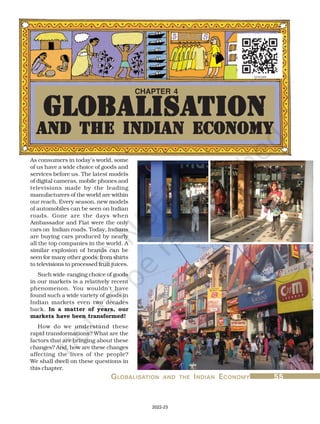
As consumers in today’s world, some
of us have a wide choice of goods and
services before us. The latest models
of digital cameras, mobile phones and
televisions made by the leading
manufacturers of the world are within
our reach. Every season, new models
of automobiles can be seen on Indian
roads. Gone are the days when
Ambassador and Fiat were the only
cars on Indian roads. Today, Indians
are buying cars produced by nearly
all the top companies in the world. A
similar explosion of brands can be
seen for many other goods: from shirts
to televisions to processed fruit juices.
Such wide-ranging choice of goods
in our markets is a relatively recent
phenomenon. You wouldn’t have
found such a wide variety of goods in
Indian markets even two decades
back. In a matter of years, our
markets have been transformed!
How do we understand these
rapid transformations? What are the
factors that are bringing about these
changes? And, how are these changes
affecting the lives of the people?
We shall dwell on these questions in
this chapter.
2022-23
56
56
56
56
56 U
U
U
U
UNDERST
NDERST
NDERST
NDERST
NDERSTANDING
ANDING
ANDING
ANDING
ANDING E
E
E
E
ECONOMIC
CONOMIC
CONOMIC
CONOMIC
CONOMIC D
D
D
D
DEVEL
EVEL
EVEL
EVEL
EVELOPMENT
OPMENT
OPMENT
OPMENT
OPMENT
Until the middle of the twentieth
century, production was largely
organised within countries. What
crossed the boundaries of these
countries were raw material, food stuff
and finished products. Colonies such
as India exported raw materials and
food stuff and imported finished
goods. Trade was the main channel
connecting distant countries. This was
before large companies called
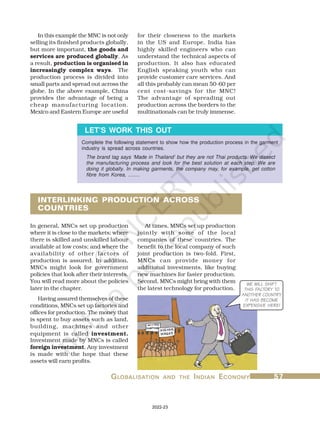
Spreading of Production
by an MNC
by an MNC
by an MNC
by an MNC
by an MNC
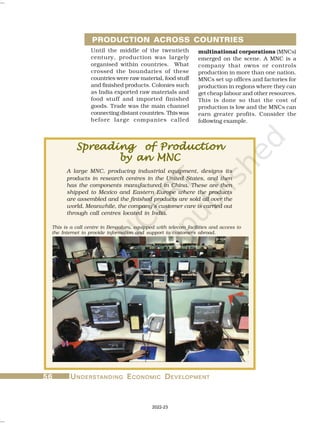
A large MNC, producing industrial equipment, designs its
products in research centres in the United States, and then
has the components manufactured in China. These are then
shipped to Mexico and Eastern Europe where the products
are assembled and the finished products are sold all over the
world. Meanwhile, the company’s customer care is carried out
through call centres located in India.
PRODUCTION ACROSS COUNTRIES
multinational corporations (MNCs)
emerged on the scene. A MNC is a
company that owns or controls
production in more than one nation.
MNCs set up offices and factories for
production in regions where they can
get cheap labour and other resources.
This is done so that the cost of
production is low and the MNCs can
earn greater profits. Consider the
following example.
This is a call centre in Bengaluru, equipped with telecom facilities and access to
the Internet to provide information and support to customers abroad.
2022-23
G
G
G
G
GL
L
L
L
LOBALISA
OBALISA
OBALISA
OBALISA
OBALISATION
TION
TION
TION
TION AND
AND
AND
AND
AND THE
THE
THE
THE
THE I
I
I
I
INDIAN
NDIAN
NDIAN
NDIAN
NDIAN E
E
E
E
ECONOMY
CONOMY
CONOMY
CONOMY
CONOMY 57
57
57
57
57
Complete the following statement to show how the production process in the garment
industry is spread across countries.
The brand tag says ‘Made in Thailand’ but they are not Thai products. We dissect
the manufacturing process and look for the best solution at each step. We are
doing it globally. In making garments, the company may, for example, get cotton
fibre from Korea, ........
LET’S WORK THIS OUT
In this example the MNC is not only
selling its finished products globally,
but more important, the goods and
services are produced globally. As
a result, production is organised in
increasingly complex ways. The
production process is divided into
small parts and spread out across the
globe. In the above example, China
provides the advantage of being a
cheap manufacturing location.
Mexico and Eastern Europe are useful
for their closeness to the markets
in the US and Europe. India has
highly skilled engineers who can
understand the technical aspects of
production. It also has educated
English speaking youth who can
provide customer care services. And
all this probably can mean 50-60 per
cent cost-savings for the MNC!
The advantage of spreading out
production across the borders to the
multinationals can be truly immense.
INTERLINKING PRODUCTION ACROSS
COUNTRIES
At times, MNCs set up production
jointly with some of the local
companies of these countries. The
benefit to the local company of such
joint production is two-fold. First,
MNCs can provide money for
additional investments, like buying
new machines for faster production.
Second, MNCs might bring with them
the latest technology for production.
In general, MNCs set up production
where it is close to the markets; where
there is skilled and unskilled labour
available at low costs; and where the
availability of other factors of
production is assured. In addition,
MNCs might look for government
policies that look after their interests.
You will read more about the policies
later in the chapter.
Having assured themselves of these
conditions, MNCs set up factories and
offices for production. The money that
is spent to buy assets such as land,
building, machines and other
equipment is called investment.
Investment made by MNCs is called
foreign investment. Any investment
is made with the hope that these
assets will earn profits.
WE WILL SHIFT
THIS FACTORY TO
ANOTHER COUNTRY.
IT HAS BECOME
EXPENSIVE HERE!
2022-23
58
58
58
58
58 U
U
U
U
UNDERST
NDERST
NDERST
NDERST
NDERSTANDING
ANDING
ANDING
ANDING
ANDING E
E
E
E
ECONOMIC
CONOMIC
CONOMIC
CONOMIC
CONOMIC D
D
D
D
DEVEL
EVEL
EVEL
EVEL
EVELOPMENT
OPMENT
OPMENT
OPMENT
OPMENT
But the most common route for
MNC investments is to buy up local
companies and then to expand
production. MNCs with huge wealth
can quite easily do so. To take an
example, Cargill Foods, a very large
American MNC, has bought over
smaller Indian companies such as
Parakh Foods. Parakh Foods had
built a large marketing network in
various parts of India, where its brand
was well-reputed. Also, Parakh Foods
had four oil refineries, whose control
has now shifted to Cargill. Cargill is
now the largest producer of edible oil
in India, with a capacity to make 5
million pouches daily!
In fact, many of the top MNCs
have wealth exceeding the entire
budgets of the developing country
governments. With such enormous
wealth, imagine the power and
influence of these MNCs!
There’s another way in which
MNCs control production. Large
MNCs in developed countries place
orders for production with small
producers. Garments, footwear,
sports items are examples of
industries where production is
carried out by a large number of
small producers around the world.
The products are supplied to the
MNCs, which then sell these under
their own brand names to the
customers. These large MNCs have
tremendous power to determine price,
quality, delivery, and labour
conditions for these distant
producers.
Thus, we see that there are a
variety of ways in which the MNCs are
spreading their production and
interacting with local producers in
various countries across the globe. By
setting up partnerships with local
companies, by using the local
companies for supplies, by closely
competing with the local companies
or buying them up, MNCs are exerting
a strong influence on production
at these distant locations. As a
result, production in these widely
dispersed locations is getting
interlinked.
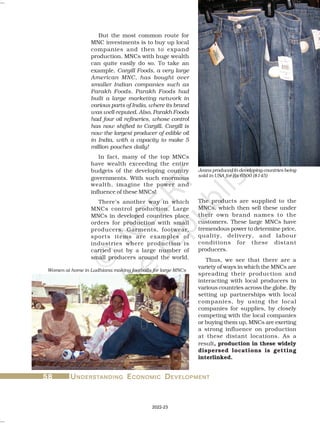
Women at home in Ludhiana making footballs for large MNCs
Jeans produced in developing countries being
sold in USA for Rs 6500 ($145)
2022-23
G
G
G
G
GL
L
L
L
LOBALISA
OBALISA
OBALISA
OBALISA
OBALISATION
TION
TION
TION
TION AND
AND
AND
AND
AND THE
THE
THE
THE
THE I
I
I
I
INDIAN
NDIAN
NDIAN
NDIAN
NDIAN E
E
E
E
ECONOMY
CONOMY
CONOMY
CONOMY
CONOMY 59
59
59
59
59
Read the passage on the left and answer the questions.
LET’S WORK THESE OUT
1. Would you say Ford Motors is a MNC? Why?
2. What is foreign investment? How much did Ford Motors invest in India?
3. By setting up their production plants in India, MNCs such as Ford
Motors tap the advantage not only of the large markets that countries
such as India provide, but also the lower costs of production. Explain
the statement.
4. Why do you think the company wants to develop India as a base for
manufacturing car components for its global operations? Discuss the
following factors:
(a) cost of labour and other resources in India
(b) the presence of several local manufacturers who supply auto-
parts to Ford Motors
(c) closeness to a large number of buyers in India and China
5. In what ways will the production of cars by Ford Motors in India lead to
interlinking of production?
6. In what ways is a MNC different from other companies?
7. Nearly all major multinationals are American, Japanese or European,
such as Nike, Coca-Cola, Pepsi, Honda, Nokia. Can you guess why?
For a long time foreign trade has been
the main channel connecting
countries. In history you would have
read about the trade routes
connecting India and South Asia to
markets both in the East and West
and the extensive trade that took place
along these routes. Also, you would
remember that it was trading interests
which attracted various trading
companies such as the East India
Company to India. What then is the
basic function of foreign trade?
To put it simply, foreign trade
creates an opportunity for the
producers to reach beyond the
domestic markets, i.e., markets of their
own countries. Producers can sell their
produce not only in markets located
within the country but can also
compete in markets located in other
countries of the world. Similarly, for the
buyers, import of goods produced in
another country is one way of
expanding the choice of goods beyond
what is domestically produced.
FOREIGN TRADE AND INTEGRATION OF
MARKETS
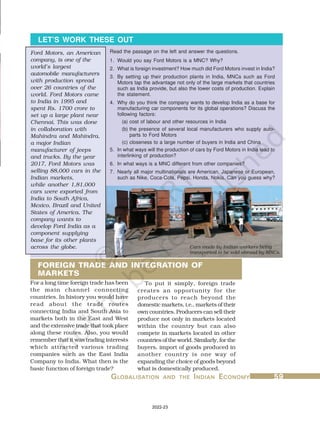
Ford Motors, an American
company, is one of the
world’s largest
automobile manufacturers
with production spread
over 26 countries of the
world. Ford Motors came
to India in 1995 and
spent Rs. 1700 crore to
set up a large plant near
Chennai. This was done
in collaboration with
Mahindra and Mahindra,
a major Indian
manufacturer of jeeps
and trucks. By the year
2017, Ford Motors was
selling 88,000 cars in the
Indian markets,
while another 1,81,000
cars were exported from
India to South Africa,
Mexico, Brazil and United
States of America. The
company wants to
develop Ford India as a
component supplying
base for its other plants
across the globe. Cars made by Indian workers being
transported to be sold abroad by MNCs.
2022-23
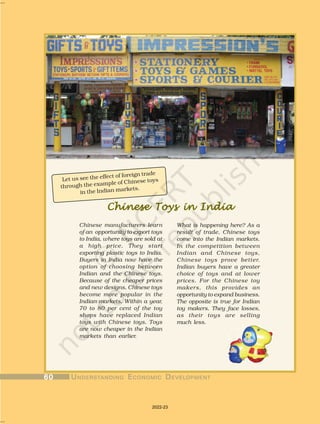
Chinese Toys in India
Chinese manufacturers learn
of an opportunity to export toys
to India, where toys are sold at
a high price. They start
exporting plastic toys to India.
Buyers in India now have the
option of choosing between
Indian and the Chinese toys.
Because of the cheaper prices
and new designs, Chinese toys
become more popular in the
Indian markets. Within a year,
70 to 80 per cent of the toy
shops have replaced Indian
toys with Chinese toys. Toys
are now cheaper in the Indian
markets than earlier.
Let us see the effect of foreign trade
through the example of Chinese toys
in the Indian markets.
What is happening here? As a
result of trade, Chinese toys
come into the Indian markets.
In the competition between
Indian and Chinese toys,
Chinese toys prove better.
Indian buyers have a greater
choice of toys and at lower
prices. For the Chinese toy
makers, this provides an
opportunity to expand business.
The opposite is true for Indian
toy makers. They face losses,
as their toys are selling
much less.
60
60
60
60
60 U
U
U
U
UNDERST
NDERST
NDERST
NDERST
NDERSTANDING
ANDING
ANDING
ANDING
ANDING E
E
E
E
ECONOMIC
CONOMIC
CONOMIC
CONOMIC
CONOMIC D
D
D
D
DEVEL
EVEL
EVEL
EVEL
EVELOPMENT
OPMENT
OPMENT
OPMENT
OPMENT
2022-23
G
G
G
G
GL
L
L
L
LOBALISA
OBALISA
OBALISA
OBALISA
OBALISATION
TION
TION
TION
TION AND
AND
AND
AND
AND THE
THE
THE
THE
THE I
I
I
I
INDIAN
NDIAN
NDIAN
NDIAN
NDIAN E
E
E
E
ECONOMY
CONOMY
CONOMY
CONOMY
CONOMY 61
61
61
61
61
1. What was the main channel connecting countries in the past? How is it different
now?
2. Distinguish between foreign trade and foreign investment.
3. In recent years China has been importing steel from India. Explain how the import
of steel by China will affect.
(a) steel companies in China.
(b) steel companies in India.
(c) industries buying steel for production of other industrial goods in China.
4. How will the import of steel from India into the Chinese markets lead to integration
of markets for steel in the two countries? Explain.
LET’S WORK THESE OUT
In general, with the opening of
trade, goods travel from one market
to another. Choice of goods in the
markets rises. Prices of similar goods
in the two markets tend to become
equal. And, producers in the two
countries now closely compete against
each other even though they are
separated by thousands of miles!
Foreign trade thus results in
connecting the markets or
integration of markets in different
countries.
In the past two to three decades, more
and more MNCs have been looking for
locations around the world which
would be cheap for their production.
Foreign investment by MNCs in these
countries has been rising. At the same
time, foreign trade between countries
has been rising rapidly. A large part
of the foreign trade is also controlled
by MNCs. For instance, the car
manufacturing plant of Ford Motors
in India not only produces cars for the
Indian markets, it also exports cars
to other developing countries and
exports car components for its many
factories around the world. Likewise,
activities of most MNCs involve
substantial trade in goods and also
services.
WHAT IS GLOBALISATION?
BE CAREFUL! THAT’S
OUR
OUR
OUR
OUR
OUR WORLD YOU’RE
PLAYING WITH!
SOMEDAY YOU’LL
HAVE TO PAY THE
PRICE!
GLOBALISATION
IS FUN!
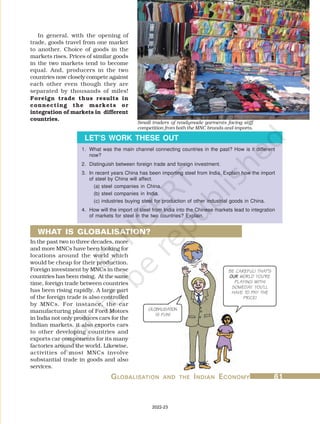
Small traders of readymade garments facing stiff
competition from both the MNC brands and imports.
2022-23
62
62
62
62
62 U
U
U
U
UNDERST
NDERST
NDERST
NDERST
NDERSTANDING
ANDING
ANDING
ANDING
ANDING E
E
E
E
ECONOMIC
CONOMIC
CONOMIC
CONOMIC
CONOMIC D
D
D
D
DEVEL
EVEL
EVEL
EVEL
EVELOPMENT
OPMENT
OPMENT
OPMENT
OPMENT
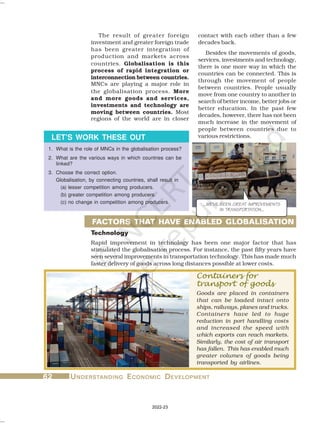
Technology
Rapid improvement in technology has been one major factor that has
stimulated the globalisation process. For instance, the past fifty years have
seen several improvements in transportation technology. This has made much
faster delivery of goods across long distances possible at lower costs.
The result of greater foreign
investment and greater foreign trade
has been greater integration of
production and markets across
countries. Globalisation is this
process of rapid integration or
interconnection between countries.
MNCs are playing a major role in
the globalisation process. More
and more goods and services,
investments and technology are
moving between countries. Most
regions of the world are in closer
1. What is the role of MNCs in the globalisation process?
2. What are the various ways in which countries can be
linked?
3. Choose the correct option.
Globalisation, by connecting countries, shall result in
(a) lesser competition among producers.
(b) greater competition among producers.
(c) no change in competition among producers.
LET’S WORK THESE OUT
contact with each other than a few
decades back.
Besides the movements of goods,
services, investments and technology,
there is one more way in which the
countries can be connected. This is
through the movement of people
between countries. People usually
move from one country to another in
search of better income, better jobs or
better education. In the past few
decades, however, there has not been
much increase in the movement of
people between countries due to
various restrictions.
Containers for
transport of goods
Goods are placed in containers
that can be loaded intact onto
ships, railways, planes and trucks.
Containers have led to huge
reduction in port handling costs
and increased the speed with
which exports can reach markets.
Similarly, the cost of air transport
has fallen. This has enabled much
greater volumes of goods being
transported by airlines.
FACTORS THAT HAVE ENABLED GLOBALISATION
...WE’VE SEEN GREAT IMPROVEMENTS
IN TRANSPORTATION...
2022-23
G
G
G
G
GL
L
L
L
LOBALISA
OBALISA
OBALISA
OBALISA
OBALISATION
TION
TION
TION
TION AND
AND
AND
AND
AND THE
THE
THE
THE
THE I
I
I
I
INDIAN
NDIAN
NDIAN
NDIAN
NDIAN E
E
E
E
ECONOMY
CONOMY
CONOMY
CONOMY
CONOMY 63
63
63
63
63
amazing world of internet, where you
can obtain and share information on
almost anything you want to know.
Internet also allows us to send instant
electronic mail (e-mail) and talk
(voice-mail) across the world at
negligible costs.
Even more remarkable have been
the developments in information and
communication technology. In
recent times, technology in the areas
of telecommunications, computers,
Internet has been changing rapidly.
Telecommunication facilities (tele-
graph, telephone including mobile
phones, fax) are used to contact one
another around the world, to access
information instantly, and to
communicate from remote areas. This
has been facilitated by satellite
communication devices. As you
would be aware, computers have now
entered almost every field of activity.
You might have also ventured into the
Using IT in
Using IT in
Using IT in
Using IT in
Using IT in
Globalisation
Globalisation
Globalisation
Globalisation
Globalisation
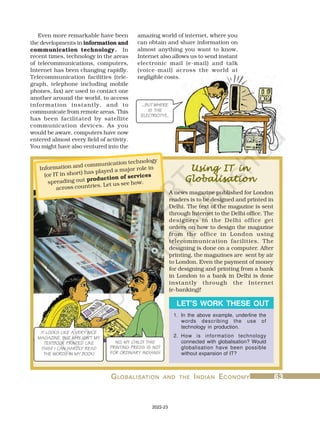
Information and communication technology
(or IT in short) has played a major role in
spreading out production of services
across countries. Let us see how.
1. In the above example, underline the
words describing the use of
technology in production.
2. How is information technology
connected with globalisation? Would
globalisation have been possible
without expansion of IT?
LET’S WORK THESE OUT
A news magazine published for London
readers is to be designed and printed in
Delhi. The text of the magazine is sent
through Internet to the Delhi office. The
designers in the Delhi office get
orders on how to design the magazine
from the office in London using
telecommunication facilities. The
designing is done on a computer. After
printing, the magazines are sent by air
to London. Even the payment of money
for designing and printing from a bank
in London to a bank in Delhi is done
instantly through the Internet
(e-banking)!
NO, MY CHILD! THIS
PRINTING PRESS IS NOT
FOR ORDINARY INDIANS!
IT LOOKS LIKE A VERY NICE
MAGAZINE. BUT WHY ISN’T MY
TEXTBOOK PRINTED LIKE
THIS? I CAN HARDLY READ
THE WORDS IN MY BOOK!
...BUT WHERE
IS THE
ELECTRICITY?...
2022-23
64
64
64
64
64 U
U
U
U
UNDERST
NDERST
NDERST
NDERST
NDERSTANDING
ANDING
ANDING
ANDING
ANDING E
E
E
E
ECONOMIC
CONOMIC
CONOMIC
CONOMIC
CONOMIC D
D
D
D
DEVEL
EVEL
EVEL
EVEL
EVELOPMENT
OPMENT
OPMENT
OPMENT
OPMENT
Liberalisation of foreign trade
and foreign investment
policy
Let us return to the example of imports
of Chinese toys in India. Suppose the
Indian government puts a tax on
import of toys. What would happen?
Those who wish to import these toys
would have to pay tax on this. Because
of the tax, buyers will have to pay a
higher price on imported toys. Chinese
toys will no longer be as cheap in the
Indian markets and imports from
China will automatically reduce.
Indian toy-makers will prosper.
Tax on imports is an example of
trade barrier. It is called a barrier
because some restriction has been set
up. Governments can use trade
barriers to increase or decrease
(regulate) foreign trade and to decide
what kinds of goods and how much
of each, should come into the country.
The Indian government, after
Independence, had put barriers to
foreign trade and foreign investment.
This was considered necessary to
protect the producers within the
country from foreign competition.
Industries were just coming up in the
1950s and 1960s, and competition
from imports at that stage would not
have allowed these industries to come
up. Thus, India allowed imports
of only essential items such as
machinery, fertilisers, petroleum
etc. Note that all developed
countries, during the early stages of
development, have given protection to
domestic producers through a variety
of means.
Starting around 1991, some far-
reaching changes in policy were made
in India. The government decided that
the time had come for Indian
producers to compete with producers
around the globe. It felt that
competition would improve the
performance of producers within the
country since they would have to
improve their quality. This decision
was supported by powerful
international organisations.
Thus, barriers on foreign trade and
foreign investment were removed to a
large extent. This meant that goods
could be imported and exported
easily and also foreign companies
could set up factories and offices
here.
Removing barriers or restrictions
set by the government is what is
known as liberalisation. With
liberalisation of trade, businesses are
allowed to make decisions freely
about what they wish to import or
export. The government imposes
much less restrictions than before
and is therefore said to be more
liberal.
1. What do you understand by liberalisation of foreign trade?
2. Tax on imports is one type of trade barrier. The government could also place a limit on
the number of goods that can be imported. This is known as quotas. Can you explain,
using the example of Chinese toys, how quotas can be used as trade barriers?
Do you think this should be used? Discuss.
LET’S WORK THESE OUT
2022-23
G
G
G
G
GL
L
L
L
LOBALISA
OBALISA
OBALISA
OBALISA
OBALISATION
TION
TION
TION
TION AND
AND
AND
AND
AND THE
THE
THE
THE
THE I
I
I
I
INDIAN
NDIAN
NDIAN
NDIAN
NDIAN E
E
E
E
ECONOMY
CONOMY
CONOMY
CONOMY
CONOMY 65
65
65
65
65
developed countries, WTO establishes
rules regarding international trade,
and sees that these rules are obeyed.
About 160 countries of the world are
currently members of the WTO.
Though WTO is supposed to allow
free trade for all, in practice, it is seen
that the developed countries have
unfairly retained trade barriers. On
the other hand, WTO rules have forced
the developing countries to remove
trade barriers. An example of this is
the current debate on trade in
agricultural products.
We have seen that the liberalisation
of foreign trade and investment in
India was supported by some very
powerful international organisations.
These organisations say that all
barriers to foreign trade and
investment are harmful. There
should be no barriers. Trade
between countries should be ‘free’.
All countries in the world should
liberalise their policies.
World Trade Organisation (WTO) is
one such organisation whose aim is
to liberalise international trade.
Started at the initiative of the
WORLD TRADE ORGANISATION
Debate on Trade Practices
Developing countries are, therefore, asking the
developed country governments, “We have
reduced trade barriers as per WTO rules. But you
have ignored the rules of WTO and have
continued to pay your farmers vast sums of
money. You have asked our governments to stop
supporting our farmers, but you are doing so
yourselves. Is this free and fair trade?
Is this free and fair trade?
Is this free and fair trade?”
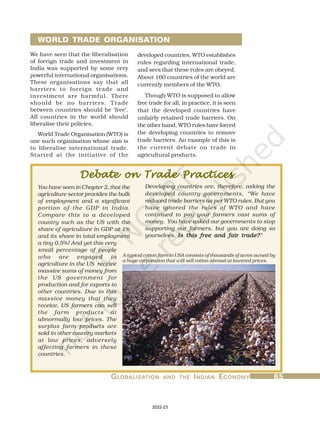
You have seen in Chapter 2, that the
agriculture sector provides the bulk
of employment and a significant
portion of the GDP in India.
Compare this to a developed
country such as the US with the
share of agriculture in GDP at 1%
and its share in total employment
a tiny 0.5%! And yet this very
small percentage of people
who are engaged in
agriculture in the US receive
massive sums of money from
the US government for
production and for exports to
other countries. Due to this
massive money that they
receive, US farmers can sell
the farm products at
abnormally low prices. The
surplus farm products are
sold in other country markets
at low prices, adversely
affecting farmers in these
countries.
A typical cotton farm in USA consists of thousands of acres owned by
a huge corporation that will sell cotton abroad at lowered prices.
2022-23
In the last twenty years, globalisation
of the Indian economy has come a
long way. What has been its effect on
the lives of people? Let us look at
some of the evidence.
Globalisation and greater
competition among producers - both
local and foreign producers - has been
of advantage to consumers,
particularly the well-off sections in the
urban areas. There is greater choice
before these consumers who now
enjoy improved quality and lower
prices for several products. As a result,
these people today, enjoy much
higher standards of living than was
possible earlier.
Among producers and workers,
the impact of globalisation has not
been uniform.
Firstly, MNCs have increased their
investments in India over the past 20
years, which means investing in India
has been beneficial for them. MNCs
have been interested in industries
such as cell phones, automobiles,
electronics, soft drinks, fast food or
services such as banking in urban
areas. These products have a large
number of well-off buyers. In these
industries and services, new jobs have
been created. Also, local companies
supplying raw materials, etc. to these
industries have prospered.
1. Fill in the blanks.
WTO was started at the initiative of __________countries. The aim of the WTO is to
____________________. WTO establishes rules regarding ________________ for
all countries, and sees that ___________________ In practice, trade between countries
is not ______________________________. Developing countries like India have
___________________, whereas developed countries, in many cases, have continued
to provide protection to their producers.
2. What do you think can be done so that trade between countries is more fair?
3. In the above example, we saw that the US government gives massive sums of money
to farmers for production.At times, governments also give support to promote production
of certain types of goods, such as those which are environmentally friendly. Discuss
whether these are fair or not.
LET’S WORK THESE OUT
IMPACT OF GLOBALISATION IN INDIA
2022-23
G
G
G
G
GL
L
L
L
LOBALISA
OBALISA
OBALISA
OBALISA
OBALISATION
TION
TION
TION
TION AND
AND
AND
AND
AND THE
THE
THE
THE
THE I
I
I
I
INDIAN
NDIAN
NDIAN
NDIAN
NDIAN E
E
E
E
ECONOMY
CONOMY
CONOMY
CONOMY
CONOMY 67
67
67
67
67
are some Indian companies which
are spreading their operations
worldwide.
Globalisation has also created
new opportunities for companies
providing services, particularly those
involving IT. The Indian company
producing a magazine for the London
based company and call centres are
some examples. Besides, a host of
services such as data entry, account-
ing, administrative tasks, engineering
are now being done cheaply in
countries such as India and are
exported to the developed countries.
Secondly, several of the top Indian
companies have been able to benefit
from the increased competition. They
have invested in newer technology and
production methods and raised their
production standards. Some have
gained from successful collaborations
with foreign companies.
Moreover, globalisation has
enabled some large Indian companies
to emerge as multinationals
themselves! Tata Motors (auto-
mobiles), Infosys (IT), Ranbaxy
(medicines), Asian Paints (paints),
Sundaram Fasteners (nuts and bolts)
1. How has competition benefited people in India?
2. Should more Indian companies emerge as MNCs? How would it benefit the people in
the country?
3. Why do governments try to attract more foreign investment?
4. In Chapter 1, we saw what may be development for one may be destructive for others.
The setting of SEZs has been opposed by some people in India. Find out who are
these people and why are they opposing it.
LET’S WORK THESE OUT
In recent years, the central and state
governments in India are taking special
steps to attract foreign companies to
invest in India. Industrial zones, called
Special Economic Zones (SEZs), are
being set up. SEZs are to have world class
facilities: electricity, water, roads,
transport, storage, recreational and
educational facilities. Companies who set
up production units in the SEZs do not
have to pay taxes for an initial period of
five years.
Government has also allowed
flexibility in the labour laws to attract
foreign investment. You have seen in
Chapter 2 that the companies in the
organised sector have to obey certain
rules that aim to protect the workers’
rights. In the recent years, the government
has allowed companies to ignore many of
these. Instead of hiring workers on a
regular basis, companies hire workers
‘flexibly’ for short periods when there is
intense pressure of work. This is done to
reduce the cost of labour for the company.
However, still not satisfied, foreign
companies are demanding more flexibility
in labour laws.
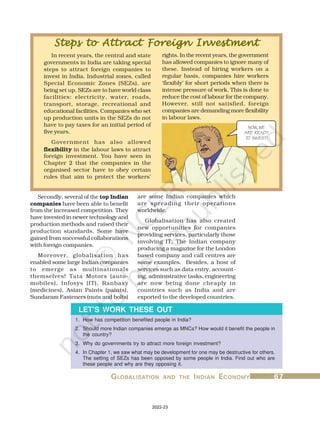
Steps to Attract Foreign Investment
NOW, WE
ARE READY
TO INVEST!
2022-23
Small producers: Compete or perish
For a large number of small producers and
workers globalisation has posed major
challenges.
Batteries, capacitors, plastics, toys, tyres, dairy products, and
vegetable oil are some examples of industries where the small
manufacturers have been hit hard due to competition. Several of the
units have shut down rendering many workers jobless. The small
industries in India employ the largest number of workers (20 million)
in the country, next only to agriculture.
1. What are the ways in which Ravi’s small production unit was affected by rising competition?
2. Should producers such as Ravi stop production because their cost of production is higher compared to
producers in other countries? What do you think?
3. Recent studies point out that small producers in India need three things to compete better in the market
(a) better roads, power, water, raw materials, marketing and information network (b) improvements and
modernisation of technology (c) timely availability of credit at reasonable interest rates.
l Can you explain how these three things would help Indian producers?
l Do you think MNCs will be interested in investing in these? Why?
l Do you think the government has a role in making these facilities available? Why?
l Can you think of any other step that the government could take? Discuss.
LET’S WORK THESE OUT
used to buy different components
including capacitors in bulk for the
manufacture of television sets.
However, competition from the MNC
brands forced the Indian television
companies to move into assembling
activities for MNCs. Even when some
of them bought capacitors, they would
prefer to import as the price of the
imported item was half the price
charged by people like Ravi.
Ravi now produces less than half the
capacitors that he produced in the year
2000 and has only seven workers
working for him. Many of Ravi’s friends
in the same business in Hyderabad
and Chennai have closed their units.
Ravi did not expect that he would have
to face a crisis in such a short period
of his life as industrialist. Ravi took a
loan from the bank to start his own
company producing capacitors in 1992
in Hosur, an industrial town in Tamil
Nadu. Capacitors are used in many
electronic home appliances including
tube lights, television etc. Within three
years, he was able to expand
production and had 20 workers
working under him.
His struggle to run his company started
when the government removed
restrictions on imports of capacitors as
per its agreement at WTO in 2001. His
main clients, the television companies,
Rising Competition
Rising Competition
Rising Competition
Rising Competition
Rising Competition
68
68
68
68
68 U
U
U
U
UNDERST
NDERST
NDERST
NDERST
NDERSTANDING
ANDING
ANDING
ANDING
ANDING E
E
E
E
ECONOMIC
CONOMIC
CONOMIC
CONOMIC
CONOMIC D
D
D
D
DEVEL
EVEL
EVEL
EVEL
EVELOPMENT
OPMENT
OPMENT
OPMENT
OPMENT
2022-23
Competition and Uncertain Employment
Globalisation and the pressure of competition have substantially changed the lives
of workers. Faced with growing competition, most employers these days prefer to
employ workers ‘flexibly’. This means that workers’ jobs are no longer secure.
A Garment Worker
A Garment Worker
A Garment Worker
A Garment Worker
A Garment Worker
35 year old Sushila has spent many
years as a worker in garment export
industry of Delhi. She was employed
as a ‘permanent worker’ entitled to
health insurance, provident fund,
overtime at a double rate, when
Sushila’s factory closed in the late
1990s. After searching for a job for
six months, she finally got a job 30
km. away from where she lives. Even
after working in this factory for
several years, she is a temporary
worker and earns less than half of
what she was earning earlier.
Sushila leaves her house every
morning, seven days a week at 7:30
a.m. and returns at 10 p.m. A day
off from work means no wage. She
has none of the benefits she used
to get earlier. Factories closer to her
home have widely fluctuating orders
and therefore pay even less.
Let us see how the workers in the garment export industry
in India are having to bear this pressure of competition.
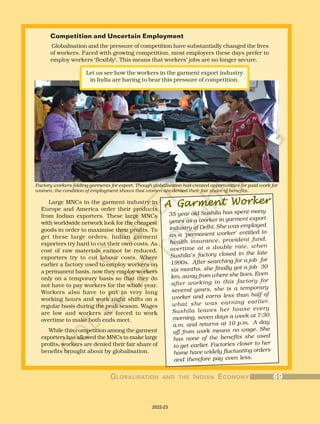
Large MNCs in the garment industry in
Europe and America order their products
from Indian exporters. These large MNCs
with worldwide network look for the cheapest
goods in order to maximise their profits. To
get these large orders, Indian garment
exporters try hard to cut their own costs. As
cost of raw materials cannot be reduced,
exporters try to cut labour costs. Where
earlier a factory used to employ workers on
a permanent basis, now they employ workers
only on a temporary basis so that they do
not have to pay workers for the whole year.
Workers also have to put in very long
working hours and work night shifts on a
regular basis during the peak season. Wages
are low and workers are forced to work
overtime to make both ends meet.
While this competition among the garment
exporters has allowed the MNCs to make large
profits, workers are denied their fair share of
benefits brought about by globalisation.
Factory workers folding garments for export. Though globalisation has created opportunities for paid work for
women, the condition of employment shows that women are denied their fair share of benefits.
G
G
G
G
GL
L
L
L
LOBALISA
OBALISA
OBALISA
OBALISA
OBALISATION
TION
TION
TION
TION AND
AND
AND
AND
AND THE
THE
THE
THE
THE I
I
I
I
INDIAN
NDIAN
NDIAN
NDIAN
NDIAN E
E
E
E
ECONOMY
CONOMY
CONOMY
CONOMY
CONOMY 69
69
69
69
69
2022-23
70
70
70
70
70 U
U
U
U
UNDERST
NDERST
NDERST
NDERST
NDERSTANDING
ANDING
ANDING
ANDING
ANDING E
E
E
E
ECONOMIC
CONOMIC
CONOMIC
CONOMIC
CONOMIC D
D
D
D
DEVEL
EVEL
EVEL
EVEL
EVELOPMENT
OPMENT
OPMENT
OPMENT
OPMENT
The conditions of work and the hardships of the workers described above
have become common to many industrial units and services in India. Most
workers, today, are employed in the unorganised sector. Moreover, increasingly
conditions of work in the organised sector have come to resemble the
unorganised sector. Workers in the organised sector such as Sushila no longer
get the protection and benefits that they enjoyed earlier.
that labour laws are properly
implemented and the workers get
their rights. It can support small
producers to improve their
performance till the time they become
strong enough to compete. If
necessary, the government can use
trade and investment barriers. It can
negotiate at the WTO for ‘fairer rules’.
It can also align with other developing
countries with similar interests to
fight against the domination of
developed countries in the WTO.
In the past few years, massive
campaigns and representation by
people’s organisations have
influenced important decisions
relating to trade and investments at
the WTO. This has demonstrated
that people also can play an
important role in the struggle for fair
globalisation.
The above evidence indicates that
not everyone has benefited from
globalisation. People with education,
skill and wealth have made the best
use of the new opportunities. On the
other hand, there are many people
who have not shared the benefits.
Since globalisation is now a
reality, the question is how to
make globalisation more ‘fair’?
Fair globalisation would create
opportunities for all, and also ensure
that the benefits of globalisation are
shared better.
The government can play a major
role in making this possible. Its
policies must protect the interests, not
only of the rich and the powerful, but
all the people in the country. You have
read about some of the possible steps
that the government can take. For
instance, the government can ensure
1. In what ways has competition affected workers, Indian exporters and foreign MNCs
in the garment industry?
2. What can be done by each of the following so that the workers can get a fair share
of benefits brought by globalisation?
(a) government
(b) employers at the exporting factories
(c) MNCs
(d) workers.
3. One of the present debates in India is whether companies should have flexible
policies for employment. Based on what you have read in the chapter, summarise
the point of view of the employers and workers.
LET’S WORK THESE OUT
THE STRUGGLE FOR A FAIR GLOBALISATION
2022-23
G
G
G
G
GL
L
L
L
LOBALISA
OBALISA
OBALISA
OBALISA
OBALISATION
TION
TION
TION
TION AND
AND
AND
AND
AND THE
THE
THE
THE
THE I
I
I
I
INDIAN
NDIAN
NDIAN
NDIAN
NDIAN E
E
E
E
ECONOMY
CONOMY
CONOMY
CONOMY
CONOMY 71
71
71
71
71
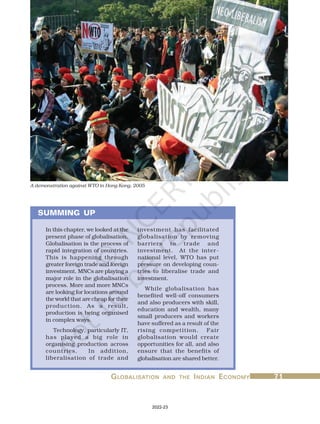
A demonstration against WTO in Hong Kong, 2005
In this chapter, we looked at the
present phase of globalisation.
Globalisation is the process of
rapid integration of countries.
This is happening through
greater foreign trade and foreign
investment. MNCs are playing a
major role in the globalisation
process. More and more MNCs
are looking for locations around
the world that are cheap for their
production. As a result,
production is being organised
in complex ways.
Technology, particularly IT,
has played a big role in
organising production across
countries. In addition,
liberalisation of trade and
SUMMING UP
investment has facilitated
globalisation by removing
barriers to trade and
investment. At the inter-
national level, WTO has put
pressure on developing coun-
tries to liberalise trade and
investment.
While globalisation has
benefited well-off consumers
and also producers with skill,
education and wealth, many
small producers and workers
have suffered as a result of the
rising competition. Fair
globalisation would create
opportunities for all, and also
ensure that the benefits of
globalisation are shared better.
2022-23
1 What do you understand by globalisation? Explain in your own words.
2. What were the reasons for putting barriers to foreign trade and foreign investment by
the Indian government? Why did it wish to remove these barriers?
3. How would flexibility in labour laws help companies?
4. What are the various ways in which MNCs set up, control or produce in other countries?
5. Why do developed countries want developing countries to liberalise their trade and
investment? What do you think should the developing countries demand in return?
6. “The impact of globalisation has not been uniform.” Explain this statement.
7. How has liberalisation of trade and investment policies helped the globalisation
process?
8. How does foreign trade lead to integration of markets across countries? Explain
with an example other than those given here.
9. Globalisation will continue in the future. Can you imagine what the world would be
like twenty years from now? Give reasons for your answer.
10.Supposing you find two people arguing: One is saying globalisation has hurt our
country’s development. The other is telling, globalisation is helping India develop.
How would you respond to these arguments?
11.Fill in the blanks.
Indian buyers have a greater choice of goods than they did two decades back. This
is closely associated with the process of ______________. Markets in India are selling
goods produced in many other countries. This means there is increasing
______________ with other countries. Moreover, the rising number of brands that we
see in the markets might be produced by MNCs in India. MNCs are investing in India
because _____________ ___________________________________________ . While
consumers have more choices in the market, the effect of rising _______________
and ______________has meant greater _________________among the producers.
12.Match the following.
(i) MNCs buy at cheap rates from small (a) Automobiles
producers
(ii) Quotas and taxes on imports are used to (b) Garments, footwear, sports
regulate trade items
(iii) Indian companies who have invested abroad (c) Call centres
(iv) IT has helped in spreading of (d) Tata Motors, Infosys, Ranbaxy
production of services
(v) Several MNCs have invested in setting (e) Trade barriers
up factories in India for production
EXERCISES
72
72
72
72
72 U
U
U
U
UNDERST
NDERST
NDERST
NDERST
NDERSTANDING
ANDING
ANDING
ANDING
ANDING E
E
E
E
ECONOMIC
CONOMIC
CONOMIC
CONOMIC
CONOMIC D
D
D
D
DEVEL
EVEL
EVEL
EVEL
EVELOPMENT
OPMENT
OPMENT
OPMENT
OPMENT
2022-23
ADDITIONAL ACTIVITY / PROJECT
13.Choose the most appropriate option.
(i) The past two decades of globalisation has seen rapid movements in
(a) goods, services and people between countries.
(b) goods, services and investments between countries.
(c) goods, investments and people between countries.
(ii) The most common route for investments by MNCs in countries around the
world is to
(a) set up new factories.
(b) buy existing local companies.
(c) form partnerships with local companies.
(iii) Globalisation has led to improvement in living conditions
(a) of all the people
(b) of people in the developed countries
(c) of workers in the developing countries
(d) none of the above
I. Take some branded products that we use everyday (soaps, toothpaste,
garments, electronic goods, etc.). Check which of these are produced by MNCs.
II. Take any Indian industry or service of your choice. Collect information and
photographs from newspapers, magazine clippings, books, television, internet,
interviews with people on the following aspects of the industry.
(i) Various producers/companies in the industry
(ii) Is the product exported to other countries?
(iii) Are there MNCs among the producers?
(iv) Competition in the industry
(v) Conditions of work in the industry
(vi) Has there been any major change in the industry in the past 15 years?
(vii) Problems that people in the industry face.
G
G
G
G
GL
L
L
L
LOBALISA
OBALISA
OBALISA
OBALISA
OBALISATION
TION
TION
TION
TION AND
AND
AND
AND
AND THE
THE
THE
THE
THE I
I
I
I
INDIAN
NDIAN
NDIAN
NDIAN
NDIAN E
E
E
E
ECONOMY
CONOMY
CONOMY
CONOMY
CONOMY 73
73
73
73
73
2022-23

globalisation project.pdf

  • 1.
    NOTES FOR THETEACHER NOTES FOR THE TEACHER NOTES FOR THE TEACHER NOTES FOR THE TEACHER NOTES FOR THE TEACHER Most regions of the world are getting increasingly interconnected. While this interconnectedness across countries has many dimensions — cultural, political, social and economic — this chapter looks at globalisation in a more limited sense. It defines globalisation as the integration between countries through foreign trade and foreign investments by multinational corporations (MNCs). As you will notice, the more complex issues of portfolio investment have been left out. If we look at the past thirty years or so, we find that MNCs have been a major force in the globalisation process connecting distant regions of the world. Why are the MNCs spreading their production to other countries and what are the ways in which they are doing so? The first part of the chapter discusses this. Rather than relying on quantitative estimates, the rapid rise and influence of the MNCs has been shown through a variety of examples, mainly drawn from the Indian context. Note that the examples are an aid to explain a more general point. While teaching, the emphasis should be on the ideas and examples are to be used as illustrations. You can also creatively use comprehension passages like the one given after Section II to test and reinforce new concepts. Integration of production and integration of markets is a key idea behind understanding the process of globalisation and its impact. This has been dealt with at length in this chapter, highlighting the role of MNCs in the process. You have to ensure that the students grasp this idea with sufficient clarity, before moving on to the next topic. Globalisation has been facilitated by several factors. Three of these have been highlighted: rapid improvements in technology, liberalisation of trade and investment policies and, pressures from international organisations such as the WTO. Improvement in technology is a fascinating area for students and you may, with a few directions, encourage them to do their own explorations. While discussing liberalisation, you have to keep in mind that the students are unaware of what India was like in the pre-liberalisation era. A role-play could be conceived to compare and contrast the pre and post-liberalisation era. Similarly, international negotiations under WTO and the uneven balances in power are interesting subjects that can be covered in a discussion mode rather than as lectures. The final section covers the impact of globalisation. To what extent has globalisation contributed to the development process? This section draws on the topics covered in Chapters 1 and 2 (for example, what is a fair development goal), which you can refer to. Also, examples and activities drawn from the local environment are a must while discussing this section. This might include contexts that have not been covered in the chapter, such as the impact of imports on local farmers, etc. Collective brainstorming sessions can be conducted to analyse such situations. Sources for Information The call for a fairer globalisation has been given, among others, by the International Labour Organisation — www.ilo.org. Another interesting resource is the WTO website http://www.wto.org. It gives access to the variety of agreements that are being negotiated at the WTO. For company related information, most MNCs have their own websites. If you want to critically look at the MNCs, one recommended website is www.corporatewatch.org.uk. CHAPTER 4 : GLOBALISATION AND THE INDIAN ECONOMY 54 54 54 54 54 U U U U UNDERST NDERST NDERST NDERST NDERSTANDING ANDING ANDING ANDING ANDING E E E E ECONOMIC CONOMIC CONOMIC CONOMIC CONOMIC D D D D DEVEL EVEL EVEL EVEL EVELOPMENT OPMENT OPMENT OPMENT OPMENT 2022-23
  • 2.
    G G G G GL L L L LOBALISA OBALISA OBALISA OBALISA OBALISATION TION TION TION TION AND AND AND AND AND THE THE THE THE THEI I I I INDIAN NDIAN NDIAN NDIAN NDIAN E E E E ECONOMY CONOMY CONOMY CONOMY CONOMY 55 55 55 55 55 GLOBALISA GLOBALISA GLOBALISA GLOBALISA GLOBALISATION TION TION TION TION AND THE INDIAN ECONOMY AND THE INDIAN ECONOMY AND THE INDIAN ECONOMY AND THE INDIAN ECONOMY AND THE INDIAN ECONOMY CHAPTER 4 As consumers in today’s world, some of us have a wide choice of goods and services before us. The latest models of digital cameras, mobile phones and televisions made by the leading manufacturers of the world are within our reach. Every season, new models of automobiles can be seen on Indian roads. Gone are the days when Ambassador and Fiat were the only cars on Indian roads. Today, Indians are buying cars produced by nearly all the top companies in the world. A similar explosion of brands can be seen for many other goods: from shirts to televisions to processed fruit juices. Such wide-ranging choice of goods in our markets is a relatively recent phenomenon. You wouldn’t have found such a wide variety of goods in Indian markets even two decades back. In a matter of years, our markets have been transformed! How do we understand these rapid transformations? What are the factors that are bringing about these changes? And, how are these changes affecting the lives of the people? We shall dwell on these questions in this chapter. 2022-23
  • 3.
    56 56 56 56 56 U U U U UNDERST NDERST NDERST NDERST NDERSTANDING ANDING ANDING ANDING ANDING E E E E ECONOMIC CONOMIC CONOMIC CONOMIC CONOMICD D D D DEVEL EVEL EVEL EVEL EVELOPMENT OPMENT OPMENT OPMENT OPMENT Until the middle of the twentieth century, production was largely organised within countries. What crossed the boundaries of these countries were raw material, food stuff and finished products. Colonies such as India exported raw materials and food stuff and imported finished goods. Trade was the main channel connecting distant countries. This was before large companies called Spreading of Production Spreading of Production Spreading of Production Spreading of Production Spreading of Production by an MNC by an MNC by an MNC by an MNC by an MNC A large MNC, producing industrial equipment, designs its products in research centres in the United States, and then has the components manufactured in China. These are then shipped to Mexico and Eastern Europe where the products are assembled and the finished products are sold all over the world. Meanwhile, the company’s customer care is carried out through call centres located in India. PRODUCTION ACROSS COUNTRIES multinational corporations (MNCs) emerged on the scene. A MNC is a company that owns or controls production in more than one nation. MNCs set up offices and factories for production in regions where they can get cheap labour and other resources. This is done so that the cost of production is low and the MNCs can earn greater profits. Consider the following example. This is a call centre in Bengaluru, equipped with telecom facilities and access to the Internet to provide information and support to customers abroad. 2022-23
  • 4.
    G G G G GL L L L LOBALISA OBALISA OBALISA OBALISA OBALISATION TION TION TION TION AND AND AND AND AND THE THE THE THE THEI I I I INDIAN NDIAN NDIAN NDIAN NDIAN E E E E ECONOMY CONOMY CONOMY CONOMY CONOMY 57 57 57 57 57 Complete the following statement to show how the production process in the garment industry is spread across countries. The brand tag says ‘Made in Thailand’ but they are not Thai products. We dissect the manufacturing process and look for the best solution at each step. We are doing it globally. In making garments, the company may, for example, get cotton fibre from Korea, ........ LET’S WORK THIS OUT In this example the MNC is not only selling its finished products globally, but more important, the goods and services are produced globally. As a result, production is organised in increasingly complex ways. The production process is divided into small parts and spread out across the globe. In the above example, China provides the advantage of being a cheap manufacturing location. Mexico and Eastern Europe are useful for their closeness to the markets in the US and Europe. India has highly skilled engineers who can understand the technical aspects of production. It also has educated English speaking youth who can provide customer care services. And all this probably can mean 50-60 per cent cost-savings for the MNC! The advantage of spreading out production across the borders to the multinationals can be truly immense. INTERLINKING PRODUCTION ACROSS COUNTRIES At times, MNCs set up production jointly with some of the local companies of these countries. The benefit to the local company of such joint production is two-fold. First, MNCs can provide money for additional investments, like buying new machines for faster production. Second, MNCs might bring with them the latest technology for production. In general, MNCs set up production where it is close to the markets; where there is skilled and unskilled labour available at low costs; and where the availability of other factors of production is assured. In addition, MNCs might look for government policies that look after their interests. You will read more about the policies later in the chapter. Having assured themselves of these conditions, MNCs set up factories and offices for production. The money that is spent to buy assets such as land, building, machines and other equipment is called investment. Investment made by MNCs is called foreign investment. Any investment is made with the hope that these assets will earn profits. WE WILL SHIFT THIS FACTORY TO ANOTHER COUNTRY. IT HAS BECOME EXPENSIVE HERE! 2022-23
  • 5.
    58 58 58 58 58 U U U U UNDERST NDERST NDERST NDERST NDERSTANDING ANDING ANDING ANDING ANDING E E E E ECONOMIC CONOMIC CONOMIC CONOMIC CONOMICD D D D DEVEL EVEL EVEL EVEL EVELOPMENT OPMENT OPMENT OPMENT OPMENT But the most common route for MNC investments is to buy up local companies and then to expand production. MNCs with huge wealth can quite easily do so. To take an example, Cargill Foods, a very large American MNC, has bought over smaller Indian companies such as Parakh Foods. Parakh Foods had built a large marketing network in various parts of India, where its brand was well-reputed. Also, Parakh Foods had four oil refineries, whose control has now shifted to Cargill. Cargill is now the largest producer of edible oil in India, with a capacity to make 5 million pouches daily! In fact, many of the top MNCs have wealth exceeding the entire budgets of the developing country governments. With such enormous wealth, imagine the power and influence of these MNCs! There’s another way in which MNCs control production. Large MNCs in developed countries place orders for production with small producers. Garments, footwear, sports items are examples of industries where production is carried out by a large number of small producers around the world. The products are supplied to the MNCs, which then sell these under their own brand names to the customers. These large MNCs have tremendous power to determine price, quality, delivery, and labour conditions for these distant producers. Thus, we see that there are a variety of ways in which the MNCs are spreading their production and interacting with local producers in various countries across the globe. By setting up partnerships with local companies, by using the local companies for supplies, by closely competing with the local companies or buying them up, MNCs are exerting a strong influence on production at these distant locations. As a result, production in these widely dispersed locations is getting interlinked. Women at home in Ludhiana making footballs for large MNCs Jeans produced in developing countries being sold in USA for Rs 6500 ($145) 2022-23
  • 6.
    G G G G GL L L L LOBALISA OBALISA OBALISA OBALISA OBALISATION TION TION TION TION AND AND AND AND AND THE THE THE THE THEI I I I INDIAN NDIAN NDIAN NDIAN NDIAN E E E E ECONOMY CONOMY CONOMY CONOMY CONOMY 59 59 59 59 59 Read the passage on the left and answer the questions. LET’S WORK THESE OUT 1. Would you say Ford Motors is a MNC? Why? 2. What is foreign investment? How much did Ford Motors invest in India? 3. By setting up their production plants in India, MNCs such as Ford Motors tap the advantage not only of the large markets that countries such as India provide, but also the lower costs of production. Explain the statement. 4. Why do you think the company wants to develop India as a base for manufacturing car components for its global operations? Discuss the following factors: (a) cost of labour and other resources in India (b) the presence of several local manufacturers who supply auto- parts to Ford Motors (c) closeness to a large number of buyers in India and China 5. In what ways will the production of cars by Ford Motors in India lead to interlinking of production? 6. In what ways is a MNC different from other companies? 7. Nearly all major multinationals are American, Japanese or European, such as Nike, Coca-Cola, Pepsi, Honda, Nokia. Can you guess why? For a long time foreign trade has been the main channel connecting countries. In history you would have read about the trade routes connecting India and South Asia to markets both in the East and West and the extensive trade that took place along these routes. Also, you would remember that it was trading interests which attracted various trading companies such as the East India Company to India. What then is the basic function of foreign trade? To put it simply, foreign trade creates an opportunity for the producers to reach beyond the domestic markets, i.e., markets of their own countries. Producers can sell their produce not only in markets located within the country but can also compete in markets located in other countries of the world. Similarly, for the buyers, import of goods produced in another country is one way of expanding the choice of goods beyond what is domestically produced. FOREIGN TRADE AND INTEGRATION OF MARKETS Ford Motors, an American company, is one of the world’s largest automobile manufacturers with production spread over 26 countries of the world. Ford Motors came to India in 1995 and spent Rs. 1700 crore to set up a large plant near Chennai. This was done in collaboration with Mahindra and Mahindra, a major Indian manufacturer of jeeps and trucks. By the year 2017, Ford Motors was selling 88,000 cars in the Indian markets, while another 1,81,000 cars were exported from India to South Africa, Mexico, Brazil and United States of America. The company wants to develop Ford India as a component supplying base for its other plants across the globe. Cars made by Indian workers being transported to be sold abroad by MNCs. 2022-23
  • 7.
    Chinese Toys inIndia Chinese Toys in India Chinese Toys in India Chinese Toys in India Chinese Toys in India Chinese manufacturers learn of an opportunity to export toys to India, where toys are sold at a high price. They start exporting plastic toys to India. Buyers in India now have the option of choosing between Indian and the Chinese toys. Because of the cheaper prices and new designs, Chinese toys become more popular in the Indian markets. Within a year, 70 to 80 per cent of the toy shops have replaced Indian toys with Chinese toys. Toys are now cheaper in the Indian markets than earlier. Let us see the effect of foreign trade through the example of Chinese toys in the Indian markets. What is happening here? As a result of trade, Chinese toys come into the Indian markets. In the competition between Indian and Chinese toys, Chinese toys prove better. Indian buyers have a greater choice of toys and at lower prices. For the Chinese toy makers, this provides an opportunity to expand business. The opposite is true for Indian toy makers. They face losses, as their toys are selling much less. 60 60 60 60 60 U U U U UNDERST NDERST NDERST NDERST NDERSTANDING ANDING ANDING ANDING ANDING E E E E ECONOMIC CONOMIC CONOMIC CONOMIC CONOMIC D D D D DEVEL EVEL EVEL EVEL EVELOPMENT OPMENT OPMENT OPMENT OPMENT 2022-23
  • 8.
    G G G G GL L L L LOBALISA OBALISA OBALISA OBALISA OBALISATION TION TION TION TION AND AND AND AND AND THE THE THE THE THEI I I I INDIAN NDIAN NDIAN NDIAN NDIAN E E E E ECONOMY CONOMY CONOMY CONOMY CONOMY 61 61 61 61 61 1. What was the main channel connecting countries in the past? How is it different now? 2. Distinguish between foreign trade and foreign investment. 3. In recent years China has been importing steel from India. Explain how the import of steel by China will affect. (a) steel companies in China. (b) steel companies in India. (c) industries buying steel for production of other industrial goods in China. 4. How will the import of steel from India into the Chinese markets lead to integration of markets for steel in the two countries? Explain. LET’S WORK THESE OUT In general, with the opening of trade, goods travel from one market to another. Choice of goods in the markets rises. Prices of similar goods in the two markets tend to become equal. And, producers in the two countries now closely compete against each other even though they are separated by thousands of miles! Foreign trade thus results in connecting the markets or integration of markets in different countries. In the past two to three decades, more and more MNCs have been looking for locations around the world which would be cheap for their production. Foreign investment by MNCs in these countries has been rising. At the same time, foreign trade between countries has been rising rapidly. A large part of the foreign trade is also controlled by MNCs. For instance, the car manufacturing plant of Ford Motors in India not only produces cars for the Indian markets, it also exports cars to other developing countries and exports car components for its many factories around the world. Likewise, activities of most MNCs involve substantial trade in goods and also services. WHAT IS GLOBALISATION? BE CAREFUL! THAT’S OUR OUR OUR OUR OUR WORLD YOU’RE PLAYING WITH! SOMEDAY YOU’LL HAVE TO PAY THE PRICE! GLOBALISATION IS FUN! Small traders of readymade garments facing stiff competition from both the MNC brands and imports. 2022-23
  • 9.
    62 62 62 62 62 U U U U UNDERST NDERST NDERST NDERST NDERSTANDING ANDING ANDING ANDING ANDING E E E E ECONOMIC CONOMIC CONOMIC CONOMIC CONOMICD D D D DEVEL EVEL EVEL EVEL EVELOPMENT OPMENT OPMENT OPMENT OPMENT Technology Rapid improvement in technology has been one major factor that has stimulated the globalisation process. For instance, the past fifty years have seen several improvements in transportation technology. This has made much faster delivery of goods across long distances possible at lower costs. The result of greater foreign investment and greater foreign trade has been greater integration of production and markets across countries. Globalisation is this process of rapid integration or interconnection between countries. MNCs are playing a major role in the globalisation process. More and more goods and services, investments and technology are moving between countries. Most regions of the world are in closer 1. What is the role of MNCs in the globalisation process? 2. What are the various ways in which countries can be linked? 3. Choose the correct option. Globalisation, by connecting countries, shall result in (a) lesser competition among producers. (b) greater competition among producers. (c) no change in competition among producers. LET’S WORK THESE OUT contact with each other than a few decades back. Besides the movements of goods, services, investments and technology, there is one more way in which the countries can be connected. This is through the movement of people between countries. People usually move from one country to another in search of better income, better jobs or better education. In the past few decades, however, there has not been much increase in the movement of people between countries due to various restrictions. Containers for transport of goods Goods are placed in containers that can be loaded intact onto ships, railways, planes and trucks. Containers have led to huge reduction in port handling costs and increased the speed with which exports can reach markets. Similarly, the cost of air transport has fallen. This has enabled much greater volumes of goods being transported by airlines. FACTORS THAT HAVE ENABLED GLOBALISATION ...WE’VE SEEN GREAT IMPROVEMENTS IN TRANSPORTATION... 2022-23
  • 10.
    G G G G GL L L L LOBALISA OBALISA OBALISA OBALISA OBALISATION TION TION TION TION AND AND AND AND AND THE THE THE THE THEI I I I INDIAN NDIAN NDIAN NDIAN NDIAN E E E E ECONOMY CONOMY CONOMY CONOMY CONOMY 63 63 63 63 63 amazing world of internet, where you can obtain and share information on almost anything you want to know. Internet also allows us to send instant electronic mail (e-mail) and talk (voice-mail) across the world at negligible costs. Even more remarkable have been the developments in information and communication technology. In recent times, technology in the areas of telecommunications, computers, Internet has been changing rapidly. Telecommunication facilities (tele- graph, telephone including mobile phones, fax) are used to contact one another around the world, to access information instantly, and to communicate from remote areas. This has been facilitated by satellite communication devices. As you would be aware, computers have now entered almost every field of activity. You might have also ventured into the Using IT in Using IT in Using IT in Using IT in Using IT in Globalisation Globalisation Globalisation Globalisation Globalisation Information and communication technology (or IT in short) has played a major role in spreading out production of services across countries. Let us see how. 1. In the above example, underline the words describing the use of technology in production. 2. How is information technology connected with globalisation? Would globalisation have been possible without expansion of IT? LET’S WORK THESE OUT A news magazine published for London readers is to be designed and printed in Delhi. The text of the magazine is sent through Internet to the Delhi office. The designers in the Delhi office get orders on how to design the magazine from the office in London using telecommunication facilities. The designing is done on a computer. After printing, the magazines are sent by air to London. Even the payment of money for designing and printing from a bank in London to a bank in Delhi is done instantly through the Internet (e-banking)! NO, MY CHILD! THIS PRINTING PRESS IS NOT FOR ORDINARY INDIANS! IT LOOKS LIKE A VERY NICE MAGAZINE. BUT WHY ISN’T MY TEXTBOOK PRINTED LIKE THIS? I CAN HARDLY READ THE WORDS IN MY BOOK! ...BUT WHERE IS THE ELECTRICITY?... 2022-23
  • 11.
    64 64 64 64 64 U U U U UNDERST NDERST NDERST NDERST NDERSTANDING ANDING ANDING ANDING ANDING E E E E ECONOMIC CONOMIC CONOMIC CONOMIC CONOMICD D D D DEVEL EVEL EVEL EVEL EVELOPMENT OPMENT OPMENT OPMENT OPMENT Liberalisation of foreign trade and foreign investment policy Let us return to the example of imports of Chinese toys in India. Suppose the Indian government puts a tax on import of toys. What would happen? Those who wish to import these toys would have to pay tax on this. Because of the tax, buyers will have to pay a higher price on imported toys. Chinese toys will no longer be as cheap in the Indian markets and imports from China will automatically reduce. Indian toy-makers will prosper. Tax on imports is an example of trade barrier. It is called a barrier because some restriction has been set up. Governments can use trade barriers to increase or decrease (regulate) foreign trade and to decide what kinds of goods and how much of each, should come into the country. The Indian government, after Independence, had put barriers to foreign trade and foreign investment. This was considered necessary to protect the producers within the country from foreign competition. Industries were just coming up in the 1950s and 1960s, and competition from imports at that stage would not have allowed these industries to come up. Thus, India allowed imports of only essential items such as machinery, fertilisers, petroleum etc. Note that all developed countries, during the early stages of development, have given protection to domestic producers through a variety of means. Starting around 1991, some far- reaching changes in policy were made in India. The government decided that the time had come for Indian producers to compete with producers around the globe. It felt that competition would improve the performance of producers within the country since they would have to improve their quality. This decision was supported by powerful international organisations. Thus, barriers on foreign trade and foreign investment were removed to a large extent. This meant that goods could be imported and exported easily and also foreign companies could set up factories and offices here. Removing barriers or restrictions set by the government is what is known as liberalisation. With liberalisation of trade, businesses are allowed to make decisions freely about what they wish to import or export. The government imposes much less restrictions than before and is therefore said to be more liberal. 1. What do you understand by liberalisation of foreign trade? 2. Tax on imports is one type of trade barrier. The government could also place a limit on the number of goods that can be imported. This is known as quotas. Can you explain, using the example of Chinese toys, how quotas can be used as trade barriers? Do you think this should be used? Discuss. LET’S WORK THESE OUT 2022-23
  • 12.
    G G G G GL L L L LOBALISA OBALISA OBALISA OBALISA OBALISATION TION TION TION TION AND AND AND AND AND THE THE THE THE THEI I I I INDIAN NDIAN NDIAN NDIAN NDIAN E E E E ECONOMY CONOMY CONOMY CONOMY CONOMY 65 65 65 65 65 developed countries, WTO establishes rules regarding international trade, and sees that these rules are obeyed. About 160 countries of the world are currently members of the WTO. Though WTO is supposed to allow free trade for all, in practice, it is seen that the developed countries have unfairly retained trade barriers. On the other hand, WTO rules have forced the developing countries to remove trade barriers. An example of this is the current debate on trade in agricultural products. We have seen that the liberalisation of foreign trade and investment in India was supported by some very powerful international organisations. These organisations say that all barriers to foreign trade and investment are harmful. There should be no barriers. Trade between countries should be ‘free’. All countries in the world should liberalise their policies. World Trade Organisation (WTO) is one such organisation whose aim is to liberalise international trade. Started at the initiative of the WORLD TRADE ORGANISATION Debate on Trade Practices Debate on Trade Practices Debate on Trade Practices Debate on Trade Practices Debate on Trade Practices Developing countries are, therefore, asking the developed country governments, “We have reduced trade barriers as per WTO rules. But you have ignored the rules of WTO and have continued to pay your farmers vast sums of money. You have asked our governments to stop supporting our farmers, but you are doing so yourselves. Is this free and fair trade? Is this free and fair trade? Is this free and fair trade? Is this free and fair trade? Is this free and fair trade?” You have seen in Chapter 2, that the agriculture sector provides the bulk of employment and a significant portion of the GDP in India. Compare this to a developed country such as the US with the share of agriculture in GDP at 1% and its share in total employment a tiny 0.5%! And yet this very small percentage of people who are engaged in agriculture in the US receive massive sums of money from the US government for production and for exports to other countries. Due to this massive money that they receive, US farmers can sell the farm products at abnormally low prices. The surplus farm products are sold in other country markets at low prices, adversely affecting farmers in these countries. A typical cotton farm in USA consists of thousands of acres owned by a huge corporation that will sell cotton abroad at lowered prices. 2022-23
  • 13.
    In the lasttwenty years, globalisation of the Indian economy has come a long way. What has been its effect on the lives of people? Let us look at some of the evidence. Globalisation and greater competition among producers - both local and foreign producers - has been of advantage to consumers, particularly the well-off sections in the urban areas. There is greater choice before these consumers who now enjoy improved quality and lower prices for several products. As a result, these people today, enjoy much higher standards of living than was possible earlier. Among producers and workers, the impact of globalisation has not been uniform. Firstly, MNCs have increased their investments in India over the past 20 years, which means investing in India has been beneficial for them. MNCs have been interested in industries such as cell phones, automobiles, electronics, soft drinks, fast food or services such as banking in urban areas. These products have a large number of well-off buyers. In these industries and services, new jobs have been created. Also, local companies supplying raw materials, etc. to these industries have prospered. 1. Fill in the blanks. WTO was started at the initiative of __________countries. The aim of the WTO is to ____________________. WTO establishes rules regarding ________________ for all countries, and sees that ___________________ In practice, trade between countries is not ______________________________. Developing countries like India have ___________________, whereas developed countries, in many cases, have continued to provide protection to their producers. 2. What do you think can be done so that trade between countries is more fair? 3. In the above example, we saw that the US government gives massive sums of money to farmers for production.At times, governments also give support to promote production of certain types of goods, such as those which are environmentally friendly. Discuss whether these are fair or not. LET’S WORK THESE OUT IMPACT OF GLOBALISATION IN INDIA 2022-23
  • 14.
    G G G G GL L L L LOBALISA OBALISA OBALISA OBALISA OBALISATION TION TION TION TION AND AND AND AND AND THE THE THE THE THEI I I I INDIAN NDIAN NDIAN NDIAN NDIAN E E E E ECONOMY CONOMY CONOMY CONOMY CONOMY 67 67 67 67 67 are some Indian companies which are spreading their operations worldwide. Globalisation has also created new opportunities for companies providing services, particularly those involving IT. The Indian company producing a magazine for the London based company and call centres are some examples. Besides, a host of services such as data entry, account- ing, administrative tasks, engineering are now being done cheaply in countries such as India and are exported to the developed countries. Secondly, several of the top Indian companies have been able to benefit from the increased competition. They have invested in newer technology and production methods and raised their production standards. Some have gained from successful collaborations with foreign companies. Moreover, globalisation has enabled some large Indian companies to emerge as multinationals themselves! Tata Motors (auto- mobiles), Infosys (IT), Ranbaxy (medicines), Asian Paints (paints), Sundaram Fasteners (nuts and bolts) 1. How has competition benefited people in India? 2. Should more Indian companies emerge as MNCs? How would it benefit the people in the country? 3. Why do governments try to attract more foreign investment? 4. In Chapter 1, we saw what may be development for one may be destructive for others. The setting of SEZs has been opposed by some people in India. Find out who are these people and why are they opposing it. LET’S WORK THESE OUT In recent years, the central and state governments in India are taking special steps to attract foreign companies to invest in India. Industrial zones, called Special Economic Zones (SEZs), are being set up. SEZs are to have world class facilities: electricity, water, roads, transport, storage, recreational and educational facilities. Companies who set up production units in the SEZs do not have to pay taxes for an initial period of five years. Government has also allowed flexibility in the labour laws to attract foreign investment. You have seen in Chapter 2 that the companies in the organised sector have to obey certain rules that aim to protect the workers’ rights. In the recent years, the government has allowed companies to ignore many of these. Instead of hiring workers on a regular basis, companies hire workers ‘flexibly’ for short periods when there is intense pressure of work. This is done to reduce the cost of labour for the company. However, still not satisfied, foreign companies are demanding more flexibility in labour laws. Steps to Attract Foreign Investment Steps to Attract Foreign Investment Steps to Attract Foreign Investment Steps to Attract Foreign Investment Steps to Attract Foreign Investment NOW, WE ARE READY TO INVEST! 2022-23
  • 15.
    Small producers: Competeor perish For a large number of small producers and workers globalisation has posed major challenges. Batteries, capacitors, plastics, toys, tyres, dairy products, and vegetable oil are some examples of industries where the small manufacturers have been hit hard due to competition. Several of the units have shut down rendering many workers jobless. The small industries in India employ the largest number of workers (20 million) in the country, next only to agriculture. 1. What are the ways in which Ravi’s small production unit was affected by rising competition? 2. Should producers such as Ravi stop production because their cost of production is higher compared to producers in other countries? What do you think? 3. Recent studies point out that small producers in India need three things to compete better in the market (a) better roads, power, water, raw materials, marketing and information network (b) improvements and modernisation of technology (c) timely availability of credit at reasonable interest rates. l Can you explain how these three things would help Indian producers? l Do you think MNCs will be interested in investing in these? Why? l Do you think the government has a role in making these facilities available? Why? l Can you think of any other step that the government could take? Discuss. LET’S WORK THESE OUT used to buy different components including capacitors in bulk for the manufacture of television sets. However, competition from the MNC brands forced the Indian television companies to move into assembling activities for MNCs. Even when some of them bought capacitors, they would prefer to import as the price of the imported item was half the price charged by people like Ravi. Ravi now produces less than half the capacitors that he produced in the year 2000 and has only seven workers working for him. Many of Ravi’s friends in the same business in Hyderabad and Chennai have closed their units. Ravi did not expect that he would have to face a crisis in such a short period of his life as industrialist. Ravi took a loan from the bank to start his own company producing capacitors in 1992 in Hosur, an industrial town in Tamil Nadu. Capacitors are used in many electronic home appliances including tube lights, television etc. Within three years, he was able to expand production and had 20 workers working under him. His struggle to run his company started when the government removed restrictions on imports of capacitors as per its agreement at WTO in 2001. His main clients, the television companies, Rising Competition Rising Competition Rising Competition Rising Competition Rising Competition 68 68 68 68 68 U U U U UNDERST NDERST NDERST NDERST NDERSTANDING ANDING ANDING ANDING ANDING E E E E ECONOMIC CONOMIC CONOMIC CONOMIC CONOMIC D D D D DEVEL EVEL EVEL EVEL EVELOPMENT OPMENT OPMENT OPMENT OPMENT 2022-23
  • 16.
    Competition and UncertainEmployment Globalisation and the pressure of competition have substantially changed the lives of workers. Faced with growing competition, most employers these days prefer to employ workers ‘flexibly’. This means that workers’ jobs are no longer secure. A Garment Worker A Garment Worker A Garment Worker A Garment Worker A Garment Worker 35 year old Sushila has spent many years as a worker in garment export industry of Delhi. She was employed as a ‘permanent worker’ entitled to health insurance, provident fund, overtime at a double rate, when Sushila’s factory closed in the late 1990s. After searching for a job for six months, she finally got a job 30 km. away from where she lives. Even after working in this factory for several years, she is a temporary worker and earns less than half of what she was earning earlier. Sushila leaves her house every morning, seven days a week at 7:30 a.m. and returns at 10 p.m. A day off from work means no wage. She has none of the benefits she used to get earlier. Factories closer to her home have widely fluctuating orders and therefore pay even less. Let us see how the workers in the garment export industry in India are having to bear this pressure of competition. Large MNCs in the garment industry in Europe and America order their products from Indian exporters. These large MNCs with worldwide network look for the cheapest goods in order to maximise their profits. To get these large orders, Indian garment exporters try hard to cut their own costs. As cost of raw materials cannot be reduced, exporters try to cut labour costs. Where earlier a factory used to employ workers on a permanent basis, now they employ workers only on a temporary basis so that they do not have to pay workers for the whole year. Workers also have to put in very long working hours and work night shifts on a regular basis during the peak season. Wages are low and workers are forced to work overtime to make both ends meet. While this competition among the garment exporters has allowed the MNCs to make large profits, workers are denied their fair share of benefits brought about by globalisation. Factory workers folding garments for export. Though globalisation has created opportunities for paid work for women, the condition of employment shows that women are denied their fair share of benefits. G G G G GL L L L LOBALISA OBALISA OBALISA OBALISA OBALISATION TION TION TION TION AND AND AND AND AND THE THE THE THE THE I I I I INDIAN NDIAN NDIAN NDIAN NDIAN E E E E ECONOMY CONOMY CONOMY CONOMY CONOMY 69 69 69 69 69 2022-23
  • 17.
    70 70 70 70 70 U U U U UNDERST NDERST NDERST NDERST NDERSTANDING ANDING ANDING ANDING ANDING E E E E ECONOMIC CONOMIC CONOMIC CONOMIC CONOMICD D D D DEVEL EVEL EVEL EVEL EVELOPMENT OPMENT OPMENT OPMENT OPMENT The conditions of work and the hardships of the workers described above have become common to many industrial units and services in India. Most workers, today, are employed in the unorganised sector. Moreover, increasingly conditions of work in the organised sector have come to resemble the unorganised sector. Workers in the organised sector such as Sushila no longer get the protection and benefits that they enjoyed earlier. that labour laws are properly implemented and the workers get their rights. It can support small producers to improve their performance till the time they become strong enough to compete. If necessary, the government can use trade and investment barriers. It can negotiate at the WTO for ‘fairer rules’. It can also align with other developing countries with similar interests to fight against the domination of developed countries in the WTO. In the past few years, massive campaigns and representation by people’s organisations have influenced important decisions relating to trade and investments at the WTO. This has demonstrated that people also can play an important role in the struggle for fair globalisation. The above evidence indicates that not everyone has benefited from globalisation. People with education, skill and wealth have made the best use of the new opportunities. On the other hand, there are many people who have not shared the benefits. Since globalisation is now a reality, the question is how to make globalisation more ‘fair’? Fair globalisation would create opportunities for all, and also ensure that the benefits of globalisation are shared better. The government can play a major role in making this possible. Its policies must protect the interests, not only of the rich and the powerful, but all the people in the country. You have read about some of the possible steps that the government can take. For instance, the government can ensure 1. In what ways has competition affected workers, Indian exporters and foreign MNCs in the garment industry? 2. What can be done by each of the following so that the workers can get a fair share of benefits brought by globalisation? (a) government (b) employers at the exporting factories (c) MNCs (d) workers. 3. One of the present debates in India is whether companies should have flexible policies for employment. Based on what you have read in the chapter, summarise the point of view of the employers and workers. LET’S WORK THESE OUT THE STRUGGLE FOR A FAIR GLOBALISATION 2022-23
  • 18.
    G G G G GL L L L LOBALISA OBALISA OBALISA OBALISA OBALISATION TION TION TION TION AND AND AND AND AND THE THE THE THE THEI I I I INDIAN NDIAN NDIAN NDIAN NDIAN E E E E ECONOMY CONOMY CONOMY CONOMY CONOMY 71 71 71 71 71 A demonstration against WTO in Hong Kong, 2005 In this chapter, we looked at the present phase of globalisation. Globalisation is the process of rapid integration of countries. This is happening through greater foreign trade and foreign investment. MNCs are playing a major role in the globalisation process. More and more MNCs are looking for locations around the world that are cheap for their production. As a result, production is being organised in complex ways. Technology, particularly IT, has played a big role in organising production across countries. In addition, liberalisation of trade and SUMMING UP investment has facilitated globalisation by removing barriers to trade and investment. At the inter- national level, WTO has put pressure on developing coun- tries to liberalise trade and investment. While globalisation has benefited well-off consumers and also producers with skill, education and wealth, many small producers and workers have suffered as a result of the rising competition. Fair globalisation would create opportunities for all, and also ensure that the benefits of globalisation are shared better. 2022-23
  • 19.
    1 What doyou understand by globalisation? Explain in your own words. 2. What were the reasons for putting barriers to foreign trade and foreign investment by the Indian government? Why did it wish to remove these barriers? 3. How would flexibility in labour laws help companies? 4. What are the various ways in which MNCs set up, control or produce in other countries? 5. Why do developed countries want developing countries to liberalise their trade and investment? What do you think should the developing countries demand in return? 6. “The impact of globalisation has not been uniform.” Explain this statement. 7. How has liberalisation of trade and investment policies helped the globalisation process? 8. How does foreign trade lead to integration of markets across countries? Explain with an example other than those given here. 9. Globalisation will continue in the future. Can you imagine what the world would be like twenty years from now? Give reasons for your answer. 10.Supposing you find two people arguing: One is saying globalisation has hurt our country’s development. The other is telling, globalisation is helping India develop. How would you respond to these arguments? 11.Fill in the blanks. Indian buyers have a greater choice of goods than they did two decades back. This is closely associated with the process of ______________. Markets in India are selling goods produced in many other countries. This means there is increasing ______________ with other countries. Moreover, the rising number of brands that we see in the markets might be produced by MNCs in India. MNCs are investing in India because _____________ ___________________________________________ . While consumers have more choices in the market, the effect of rising _______________ and ______________has meant greater _________________among the producers. 12.Match the following. (i) MNCs buy at cheap rates from small (a) Automobiles producers (ii) Quotas and taxes on imports are used to (b) Garments, footwear, sports regulate trade items (iii) Indian companies who have invested abroad (c) Call centres (iv) IT has helped in spreading of (d) Tata Motors, Infosys, Ranbaxy production of services (v) Several MNCs have invested in setting (e) Trade barriers up factories in India for production EXERCISES 72 72 72 72 72 U U U U UNDERST NDERST NDERST NDERST NDERSTANDING ANDING ANDING ANDING ANDING E E E E ECONOMIC CONOMIC CONOMIC CONOMIC CONOMIC D D D D DEVEL EVEL EVEL EVEL EVELOPMENT OPMENT OPMENT OPMENT OPMENT 2022-23
  • 20.
    ADDITIONAL ACTIVITY /PROJECT 13.Choose the most appropriate option. (i) The past two decades of globalisation has seen rapid movements in (a) goods, services and people between countries. (b) goods, services and investments between countries. (c) goods, investments and people between countries. (ii) The most common route for investments by MNCs in countries around the world is to (a) set up new factories. (b) buy existing local companies. (c) form partnerships with local companies. (iii) Globalisation has led to improvement in living conditions (a) of all the people (b) of people in the developed countries (c) of workers in the developing countries (d) none of the above I. Take some branded products that we use everyday (soaps, toothpaste, garments, electronic goods, etc.). Check which of these are produced by MNCs. II. Take any Indian industry or service of your choice. Collect information and photographs from newspapers, magazine clippings, books, television, internet, interviews with people on the following aspects of the industry. (i) Various producers/companies in the industry (ii) Is the product exported to other countries? (iii) Are there MNCs among the producers? (iv) Competition in the industry (v) Conditions of work in the industry (vi) Has there been any major change in the industry in the past 15 years? (vii) Problems that people in the industry face. G G G G GL L L L LOBALISA OBALISA OBALISA OBALISA OBALISATION TION TION TION TION AND AND AND AND AND THE THE THE THE THE I I I I INDIAN NDIAN NDIAN NDIAN NDIAN E E E E ECONOMY CONOMY CONOMY CONOMY CONOMY 73 73 73 73 73 2022-23