Pectic Enzymes
Industrial Microbiology
Presented by
Shirley Evangilene K
M.Sc Agrl.Microbiology
Pectinase:
• The Pectinases are a group of related enzymes capable of degrading pectin.
• Also known as pectic enzymes or pectolytic enzymes.
• Pectinases are synthesized by microorganisms which used in industrial
production.
• They are inexpensive and environmentally friendly.
• When compared with chemical methods they are
More specific
Less aggressive
Generates low toxicity
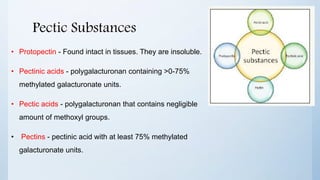
Pectic Substances
• Protopectin - Found intact in tissues. They are insoluble.
• Pectinic acids - polygalacturonan containing >0-75%
methylated galacturonate units.
• Pectic acids - polygalacturonan that contains negligible
amount of methoxyl groups.
• Pectins - pectinic acid with at least 75% methylated
galacturonate units.
Pectolytic Enzymes
I. Protopectinases - Solubilizes protopectin forming soluble pectin
II. Esterases
1. Pectin methyl esterases
2. Pectin acetyl esterases
• Eliminates methoxyl and acetyl residues from pectin giving rise to polygalacturonic acid.
III. Depolymerases - Breaks the glycosidic α-(1- 4) bonds between galacturonic residues.
1. Hydrolysis (polygalacturonases)
2. Transelimination (pectin lyases and pectate lyases)
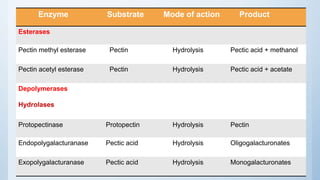
Enzyme Substrate Mode of action Product
Esterases
Pectin methyl esterase Pectin Hydrolysis Pectic acid + methanol
Pectin acetyl esterase Pectin Hydrolysis Pectic acid + acetate
Depolymerases
Hydrolases
Protopectinase Protopectin Hydrolysis Pectin
Endopolygalacturanase Pectic acid Hydrolysis Oligogalacturonates
Exopolygalacturanase Pectic acid Hydrolysis Monogalacturonates
Enzyme Substrate Mode of action Product
Lyases
Endopectate lyase Pectic acid Transelimination Unsaturated
oligogalacturonates
Exopectate lyase Pectic acid Transelimination Unsaturated
oligogalacturonates
Endopectin lyase Pectin Transelimination Unsaturated methyl
oligogalacturonates
Microorganisms involved
Aspergillus niger, Aspergillus
oryzae, Penicillium expansum,
are the types of fungi which
are considered as safe (GRAS)
by USFDA.
Fungi
• Aspergillus niger
• Aspergillus ficuum
• Penicillium frequentans
• Sclerotium rolfsii
Bacteria
• Bacillus licheniformis
• Chryseobacterium indologenes
Yeasts
• Saccharomyces cerevisiae
• Kluyveromyces maxianus
Production of pectinase
Submerged fermentation
• The process which uses liquid broth to culture organisms is called submerged
fermentation.
• The prerequisites for submerged fermentation are continuous agitation, provision of
large amount of water. A colossal amount of effluents is released in this process.
• After production of enzyme, it is easily extracted by using Whatman filter-paper 4.
• Biomass stays on the filter paper and liquid as supernatant passes through it.
• The broth is centrifuged for measuring activity of pectinase
Solid state fermentation
• The process in which growth is proceeded on a solid surface or particles, in the absence
or partial presence of water is termed as solid-state fermentation.
• For extraction of enzyme after fermentation, the particular amount of specific buffer and
water added into the fermented flask and allowed to mix well by using mechanical
stirring.
• Filtration and centrifugation was done after mixing and centrifugation was carried out for
obtaining the clear extract of enzyme .
 It allows the utilization of cost-effective agro-wastes as a substrate for the microorganism
to grow
 Solid-state fermented products possess better quality and improved characteristics in
comparison to products achieved through SmF
 Necessitating less input of energy
 Green and sustainable practice
 Hyper-production of microbial metabolites
Immobilized cell culture:
Entrapment of living cells to a certain region of space with preservation of their metabolic
or catabolic activity.
It has several benefits :
Reusabilty
Easy product separation without contamination
Easy biomass separation from product
Better catalytic stability
A great variety of support materials are used
Natural polymers: alginate, agar-agar, chitosan, collagen
Synthetic polymers: polyacrylamide, polyurethane, polyethylene glycol
Applications
Clarification of fruit juices
Boosts aroma and flavor in wine
Intensification and stabilization of colour
Alkaline pectinases
 Paper and pulp industry
 Waste water treatment
 Degumming of plant bast fibres
 Retting of plant fibres
 Bioscouring of cotton fibers and textile processing
 Coffee and tea fermentation
 Plant disease control
 Oil extraction
References:
• Kohli, P., & Gupta, R. (2015). Alkaline pectinases: A review. Biocatalysis and
Agricultural Biotechnology, 4(3), 279–285.
• Faiza amin, Haq Nawaz bhatti, Muhammed bilal(2019),recent advances in
the production strategies of microbial pectinaes- A review,International journal
of biological macromolecules,122,1017-1026.
• Javed R1, Nawaz A1*, Munir M2, Hanif MU1, Mukhtar H1, Ul Haq I1 and
Abdullah R, (2018),Extraction, Purification and Industrial Applications of
Pectinase: A Review, Journal of Biotechnology & Bioresearch,1,1-12
• Carmen siero, belen garcia fraga, abigail silva, jacoba lopez-seijas,(2012),
Microbial pectic enzymes in the food and wine industry,13,201-218
Thank You

Pectic enzymes

  • 1.
    Pectic Enzymes Industrial Microbiology Presentedby Shirley Evangilene K M.Sc Agrl.Microbiology
  • 2.
    Pectinase: • The Pectinasesare a group of related enzymes capable of degrading pectin. • Also known as pectic enzymes or pectolytic enzymes. • Pectinases are synthesized by microorganisms which used in industrial production. • They are inexpensive and environmentally friendly. • When compared with chemical methods they are More specific Less aggressive Generates low toxicity
  • 3.
    Pectic Substances • Protopectin- Found intact in tissues. They are insoluble. • Pectinic acids - polygalacturonan containing >0-75% methylated galacturonate units. • Pectic acids - polygalacturonan that contains negligible amount of methoxyl groups. • Pectins - pectinic acid with at least 75% methylated galacturonate units.
  • 4.
    Pectolytic Enzymes I. Protopectinases- Solubilizes protopectin forming soluble pectin II. Esterases 1. Pectin methyl esterases 2. Pectin acetyl esterases • Eliminates methoxyl and acetyl residues from pectin giving rise to polygalacturonic acid. III. Depolymerases - Breaks the glycosidic α-(1- 4) bonds between galacturonic residues. 1. Hydrolysis (polygalacturonases) 2. Transelimination (pectin lyases and pectate lyases)
  • 5.
    Enzyme Substrate Modeof action Product Esterases Pectin methyl esterase Pectin Hydrolysis Pectic acid + methanol Pectin acetyl esterase Pectin Hydrolysis Pectic acid + acetate Depolymerases Hydrolases Protopectinase Protopectin Hydrolysis Pectin Endopolygalacturanase Pectic acid Hydrolysis Oligogalacturonates Exopolygalacturanase Pectic acid Hydrolysis Monogalacturonates
  • 6.
    Enzyme Substrate Modeof action Product Lyases Endopectate lyase Pectic acid Transelimination Unsaturated oligogalacturonates Exopectate lyase Pectic acid Transelimination Unsaturated oligogalacturonates Endopectin lyase Pectin Transelimination Unsaturated methyl oligogalacturonates
  • 7.
    Microorganisms involved Aspergillus niger,Aspergillus oryzae, Penicillium expansum, are the types of fungi which are considered as safe (GRAS) by USFDA. Fungi • Aspergillus niger • Aspergillus ficuum • Penicillium frequentans • Sclerotium rolfsii Bacteria • Bacillus licheniformis • Chryseobacterium indologenes Yeasts • Saccharomyces cerevisiae • Kluyveromyces maxianus
  • 8.
    Production of pectinase Submergedfermentation • The process which uses liquid broth to culture organisms is called submerged fermentation. • The prerequisites for submerged fermentation are continuous agitation, provision of large amount of water. A colossal amount of effluents is released in this process. • After production of enzyme, it is easily extracted by using Whatman filter-paper 4. • Biomass stays on the filter paper and liquid as supernatant passes through it. • The broth is centrifuged for measuring activity of pectinase
  • 9.
    Solid state fermentation •The process in which growth is proceeded on a solid surface or particles, in the absence or partial presence of water is termed as solid-state fermentation. • For extraction of enzyme after fermentation, the particular amount of specific buffer and water added into the fermented flask and allowed to mix well by using mechanical stirring. • Filtration and centrifugation was done after mixing and centrifugation was carried out for obtaining the clear extract of enzyme .
  • 10.
     It allowsthe utilization of cost-effective agro-wastes as a substrate for the microorganism to grow  Solid-state fermented products possess better quality and improved characteristics in comparison to products achieved through SmF  Necessitating less input of energy  Green and sustainable practice  Hyper-production of microbial metabolites
  • 11.
    Immobilized cell culture: Entrapmentof living cells to a certain region of space with preservation of their metabolic or catabolic activity. It has several benefits : Reusabilty Easy product separation without contamination Easy biomass separation from product Better catalytic stability A great variety of support materials are used Natural polymers: alginate, agar-agar, chitosan, collagen Synthetic polymers: polyacrylamide, polyurethane, polyethylene glycol
  • 13.
    Applications Clarification of fruitjuices Boosts aroma and flavor in wine Intensification and stabilization of colour
  • 14.
    Alkaline pectinases  Paperand pulp industry  Waste water treatment  Degumming of plant bast fibres  Retting of plant fibres  Bioscouring of cotton fibers and textile processing  Coffee and tea fermentation  Plant disease control  Oil extraction
  • 15.
    References: • Kohli, P.,& Gupta, R. (2015). Alkaline pectinases: A review. Biocatalysis and Agricultural Biotechnology, 4(3), 279–285. • Faiza amin, Haq Nawaz bhatti, Muhammed bilal(2019),recent advances in the production strategies of microbial pectinaes- A review,International journal of biological macromolecules,122,1017-1026. • Javed R1, Nawaz A1*, Munir M2, Hanif MU1, Mukhtar H1, Ul Haq I1 and Abdullah R, (2018),Extraction, Purification and Industrial Applications of Pectinase: A Review, Journal of Biotechnology & Bioresearch,1,1-12 • Carmen siero, belen garcia fraga, abigail silva, jacoba lopez-seijas,(2012), Microbial pectic enzymes in the food and wine industry,13,201-218
  • 16.