Professional Learning Suite  |  Term Three 2011Implementing an eLearning CurriculumGrovedale College
Our Learning Intentions…Raise awareness of web based and other digital learning tools. (what’s available to us and the students)Build capacity to use various learning technologies to support student learningSharing of ideas and expertiseDesign a Learning Activity which uses learning technologies to implement in one of your classes. Increased use of the UltranetFocus is on the learning and how technology can be used to support the implementation of meaningful teaching and learning activities.
The taskThe task is to plan an eLearning activity to implement into one of your classes .Identify the subject and year levelIdentify the learning taskWhat will be the learning goals?What software / hardware will you utilise to enhance the teaching and learning?How will the task be assessed? What will be the success criteria?
Ask yourselfHow can I integrate learning technologies to support powerful learning in my classroom? How can learning technologies change the way I teach? How can I ensure that the way I teach with ICT promotes deep learning? How can I increase my skills when using the software? How can I increase my confidence in integrating ICT?
TerminologyIn pairs discuss the following terms ‘eLearning’‘Digital Literacy’‘Digital Native’
Experiences thus far…..With your partner , discuss:Have you ever planned and implemented an eLearning activity?Was it successful? How did you know?If not… Why? What are the challenges for us as a staff and you individually?
3 Basic Criteria forIntegrating TechnologyThe activity is well connected to the curriculumThe use of technology clearly enhances the lesson contentThe activity has students using higher order thinking skillsMike MuirHave you considered these criteria in the past?
One of the enduring difficulties about	technology and education is that a lot of	people think about the technology first and the education later” (Schacter, 1995, p. 11).• “…The true value of technology for learning	lies not in learning to use technology, but in	using technology to learn.” (Educational Research Service, 2001)
Our Resources (hardware)NetbooksNotebooksDesktopsIWBFlip Cams (x 11)
Still Cams
Web Cams (Class set)
Microphone Headsets (class set)Resources (Software)Too many to list(see link on our Collaborative Learning space)
Lets Get Started!Log onto the UltranetClick on the link to EduStar list and begin thinking about the ways that you could incorporate the technologies into your activityBrowse the tutorials to learn more about software that you think may be relevantNot logged onto the Ultranet?https://idam.education.vic.gov.au/ firstuse**Must have a complex 7 password (change on edumail login screen)
Week 2UltranetEdustar ImageIdentify the learning task
What are the Learning Intentions?The aim of today’s session is to identify what activity you will design.What are the key knowledge and skills that you want your students to demonstrate?How will the use of technology support this?
 Higher Order ThinkingWhat is Higher Order Thinking?Identify your eLearning task
What is Higher Order Thinking	“Higher-order thinking by students involves the transformation of information and ideas.  This transformation occurs when students combine facts and ideas and synthesise, generalise, explain, hypothesise or arrive at some conclusion or interpretation.  Manipulating information and ideas through these processes allows students to solve problems, gain understanding and discover new meaning.”
Continued…..	“When students engage in the construction of knowledge, an element of uncertainty is introduced into the instructional process and the outcomes are not always predictable; in other words, the teacher is not certain what the students will produce.  In helping students become producers of knowledge, the teacher’s main instructional task is to create activities or environments that allow them opportunities to engage in higher-order thinking.”
Higher Order Thinking is Not…regurgitationrote learningrecallremembering
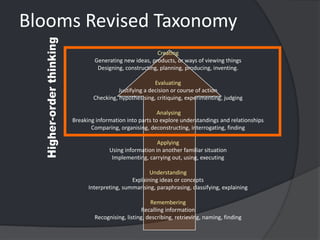
Blooms Revised Taxonomy	CreatingGenerating new ideas, products, or ways of viewing thingsDesigning, constructing, planning, producing, inventing. EvaluatingJustifying a decision or course of actionChecking, hypothesising, critiquing, experimenting, judging  AnalysingBreaking information into parts to explore understandings and relationshipsComparing, organising, deconstructing, interrogating, finding ApplyingUsing information in another familiar situationImplementing, carrying out, using, executing UnderstandingExplaining ideas or conceptsInterpreting, summarising, paraphrasing, classifying, explaining RememberingRecalling informationRecognising, listing, describing, retrieving, naming, findingHigher-order thinking
Identify your Learning TaskIdentify SubjectYear LevelTopicLearning GoalsResources requiredIn the next few weeks we will focus more heavily on assessment.
Week 3JCM – QuizletLearning GoalsPlanning TimeUltranet – Wiki, Resources

Grovedale College - elearning pd suite term three 2011

  • 1.
    Professional Learning Suite | Term Three 2011Implementing an eLearning CurriculumGrovedale College
  • 2.
    Our Learning Intentions…Raiseawareness of web based and other digital learning tools. (what’s available to us and the students)Build capacity to use various learning technologies to support student learningSharing of ideas and expertiseDesign a Learning Activity which uses learning technologies to implement in one of your classes. Increased use of the UltranetFocus is on the learning and how technology can be used to support the implementation of meaningful teaching and learning activities.
  • 3.
    The taskThe taskis to plan an eLearning activity to implement into one of your classes .Identify the subject and year levelIdentify the learning taskWhat will be the learning goals?What software / hardware will you utilise to enhance the teaching and learning?How will the task be assessed? What will be the success criteria?
  • 4.
    Ask yourselfHow canI integrate learning technologies to support powerful learning in my classroom? How can learning technologies change the way I teach? How can I ensure that the way I teach with ICT promotes deep learning? How can I increase my skills when using the software? How can I increase my confidence in integrating ICT?
  • 5.
    TerminologyIn pairs discussthe following terms ‘eLearning’‘Digital Literacy’‘Digital Native’
  • 6.
    Experiences thus far…..Withyour partner , discuss:Have you ever planned and implemented an eLearning activity?Was it successful? How did you know?If not… Why? What are the challenges for us as a staff and you individually?
  • 7.
    3 Basic CriteriaforIntegrating TechnologyThe activity is well connected to the curriculumThe use of technology clearly enhances the lesson contentThe activity has students using higher order thinking skillsMike MuirHave you considered these criteria in the past?
  • 8.
    One of theenduring difficulties about technology and education is that a lot of people think about the technology first and the education later” (Schacter, 1995, p. 11).• “…The true value of technology for learning lies not in learning to use technology, but in using technology to learn.” (Educational Research Service, 2001)
  • 9.
  • 10.
  • 11.
  • 12.
    Microphone Headsets (classset)Resources (Software)Too many to list(see link on our Collaborative Learning space)
  • 13.
    Lets Get Started!Logonto the UltranetClick on the link to EduStar list and begin thinking about the ways that you could incorporate the technologies into your activityBrowse the tutorials to learn more about software that you think may be relevantNot logged onto the Ultranet?https://idam.education.vic.gov.au/ firstuse**Must have a complex 7 password (change on edumail login screen)
  • 14.
  • 15.
    What are theLearning Intentions?The aim of today’s session is to identify what activity you will design.What are the key knowledge and skills that you want your students to demonstrate?How will the use of technology support this?
  • 16.
    Higher OrderThinkingWhat is Higher Order Thinking?Identify your eLearning task
  • 17.
    What is HigherOrder Thinking “Higher-order thinking by students involves the transformation of information and ideas. This transformation occurs when students combine facts and ideas and synthesise, generalise, explain, hypothesise or arrive at some conclusion or interpretation. Manipulating information and ideas through these processes allows students to solve problems, gain understanding and discover new meaning.”
  • 18.
    Continued….. “When students engagein the construction of knowledge, an element of uncertainty is introduced into the instructional process and the outcomes are not always predictable; in other words, the teacher is not certain what the students will produce. In helping students become producers of knowledge, the teacher’s main instructional task is to create activities or environments that allow them opportunities to engage in higher-order thinking.”
  • 19.
    Higher Order Thinkingis Not…regurgitationrote learningrecallremembering
  • 20.
    Blooms Revised Taxonomy CreatingGeneratingnew ideas, products, or ways of viewing thingsDesigning, constructing, planning, producing, inventing. EvaluatingJustifying a decision or course of actionChecking, hypothesising, critiquing, experimenting, judging  AnalysingBreaking information into parts to explore understandings and relationshipsComparing, organising, deconstructing, interrogating, finding ApplyingUsing information in another familiar situationImplementing, carrying out, using, executing UnderstandingExplaining ideas or conceptsInterpreting, summarising, paraphrasing, classifying, explaining RememberingRecalling informationRecognising, listing, describing, retrieving, naming, findingHigher-order thinking
  • 21.
    Identify your LearningTaskIdentify SubjectYear LevelTopicLearning GoalsResources requiredIn the next few weeks we will focus more heavily on assessment.
  • 22.
    Week 3JCM –QuizletLearning GoalsPlanning TimeUltranet – Wiki, Resources