








PHYSICAL
EDUCATION
3rd GRADING
PHYSICAL EDUCATION
FESTIVAL
DANCES
FESTIVAL DANCES
» cultural dances performed to the
strong beats of percussion
instruments by a community of
people sharing the same culture
usually done in honor of a Patron
Saint or in thanksgiving of a
bountiful harvest.
FESTIVAL DANCES
» it may be religious or secular in
nature
» it adds to the merry-making and
festivities where they are celebrated
» draw the people’s culture by
portraying the people’s ways of life
through movements, costumes and
implements inherent to their place
FESTIVAL DANCES
» draw the people’s culture by
portraying the people’s ways of life
through movements, costumes and
implements inherent to their place
of origin
FESTIVAL DANCES
» Filipinos do festivals primarily to
celebrate
» We celebrate our unity amidst the
diversity of cultures and we
celebrate our industry bringing
about a bountiful harvest
FESTIVAL DANCES
» Festivals have been a consistent
crowd-producing activity leading to
upliftment of a community’s
economy due to its tourism and
entertainment value
FESTIVAL DANCES
» Festivals are a form of
entertainment that attract foreign
and domestic tourists to visit a
place eventually leading to the
elevation of the Filipino’s quality of
life
FESTIVAL DANCES
RELIGIOUS – in honor of a certain
religious icon
SECULAR or NON-RELIGIOUS –
thanksgiving or celebration of
people’s industry and bountiful
harvest
FESTIVAL DANCES
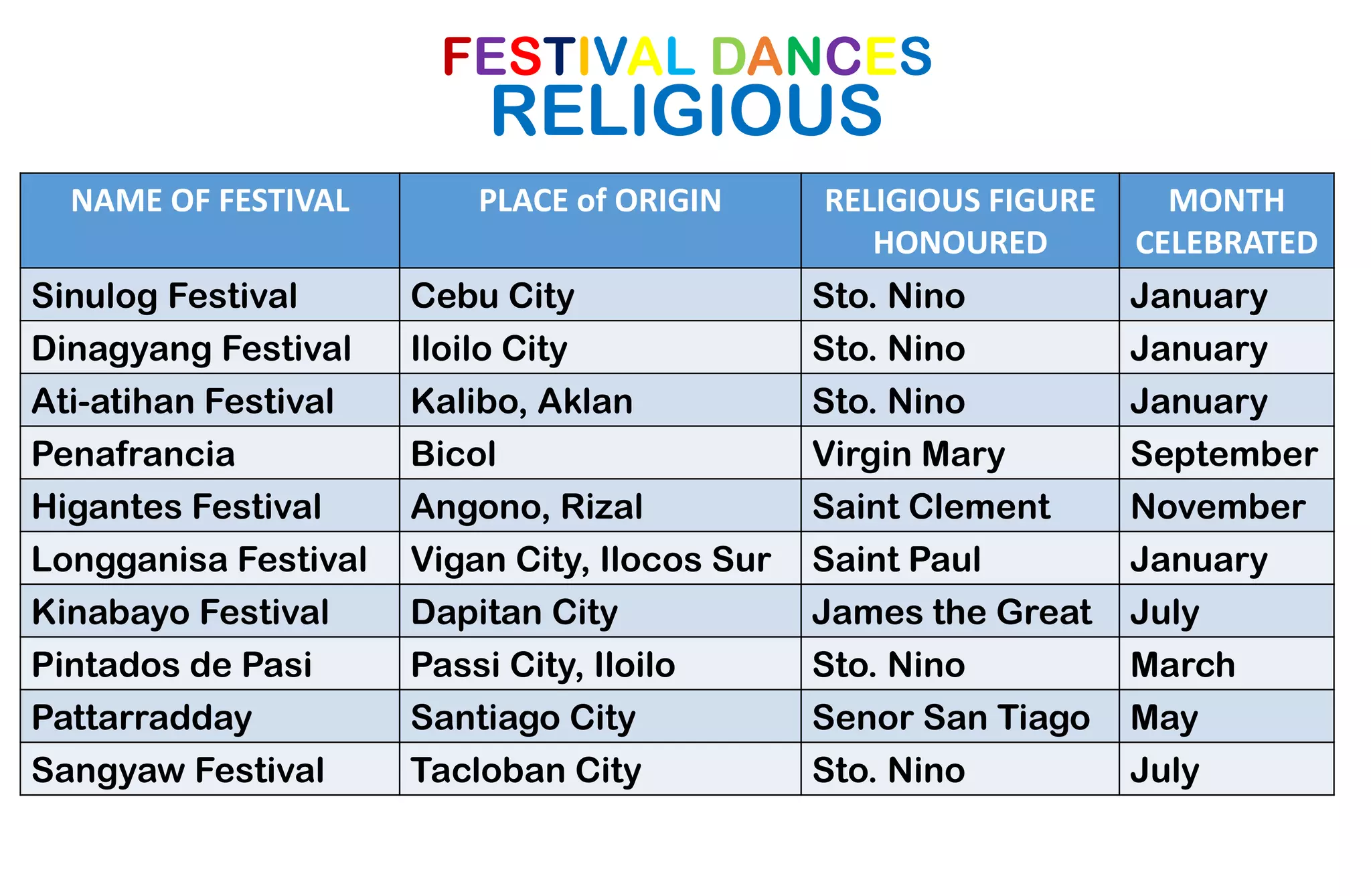
RELIGIOUS
NAME OF FESTIVAL PLACE of ORIGIN RELIGIOUS FIGURE
HONOURED
MONTH
CELEBRATED
Sinulog Festival Cebu City Sto. Nino January
Dinagyang Festival Iloilo City Sto. Nino January
Ati-atihan Festival Kalibo, Aklan Sto. Nino January
Penafrancia Bicol Virgin Mary September
Higantes Festival Angono, Rizal Saint Clement November
Longganisa Festival Vigan City, Ilocos Sur Saint Paul January
Kinabayo Festival Dapitan City James the Great July
Pintados de Pasi Passi City, Iloilo Sto. Nino March
Pattarradday Santiago City Senor San Tiago May
Sangyaw Festival Tacloban City Sto. Nino July
FESTIVAL DANCES
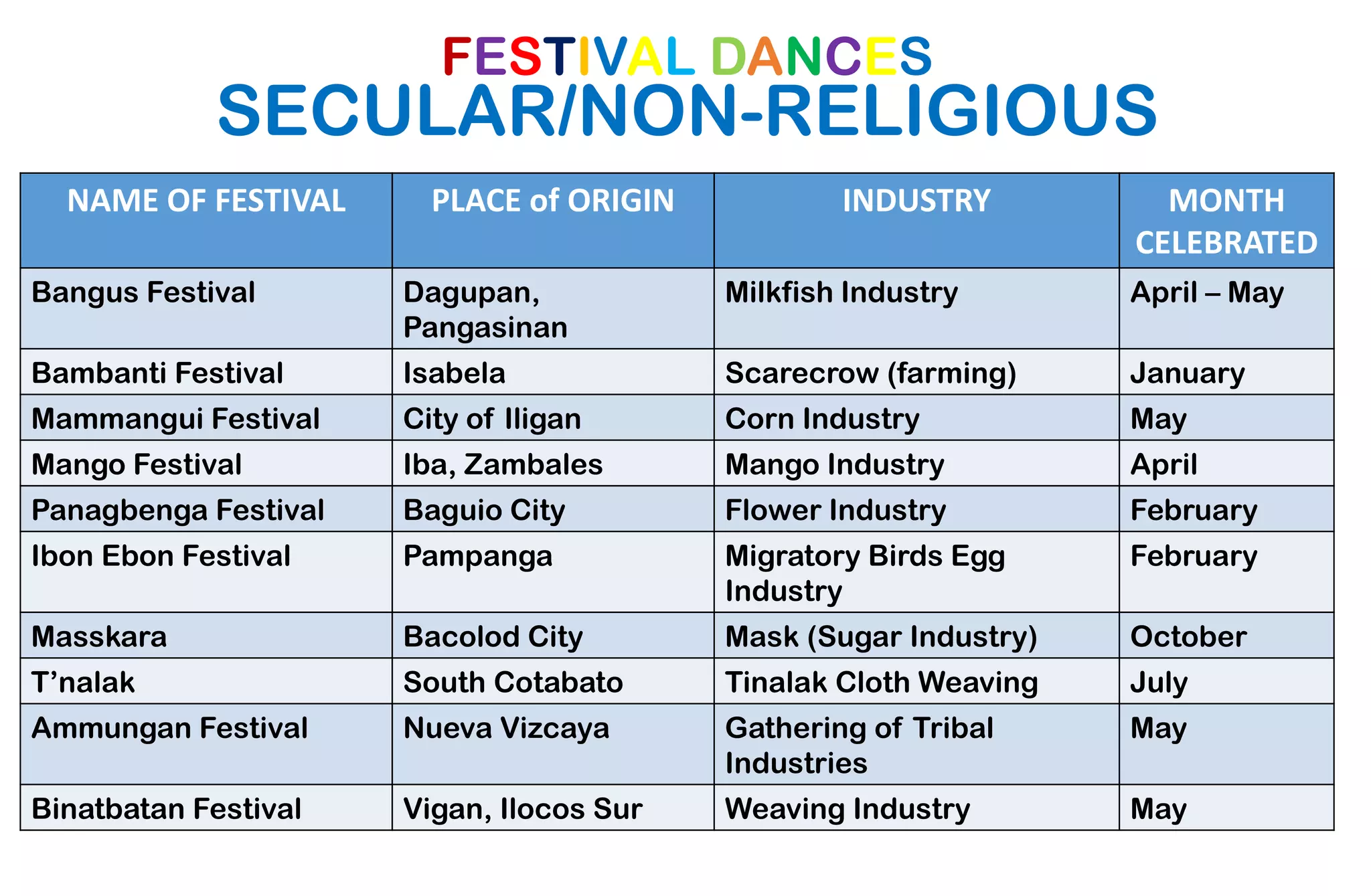
SECULAR/NON-RELIGIOUS
NAME OF FESTIVAL PLACE of ORIGIN INDUSTRY MONTH
CELEBRATED
Bangus Festival Dagupan,
Pangasinan
Milkfish Industry April – May
Bambanti Festival Isabela Scarecrow (farming) January
Mammangui Festival City of Iligan Corn Industry May
Mango Festival Iba, Zambales Mango Industry April
Panagbenga Festival Baguio City Flower Industry February
Ibon Ebon Festival Pampanga Migratory Birds Egg
Industry
February
Masskara Bacolod City Mask (Sugar Industry) October
T’nalak South Cotabato Tinalak Cloth Weaving July
Ammungan Festival Nueva Vizcaya Gathering of Tribal
Industries
May
Binatbatan Festival Vigan, Ilocos Sur Weaving Industry May
You will create your own
FESTIVAL
DANCE
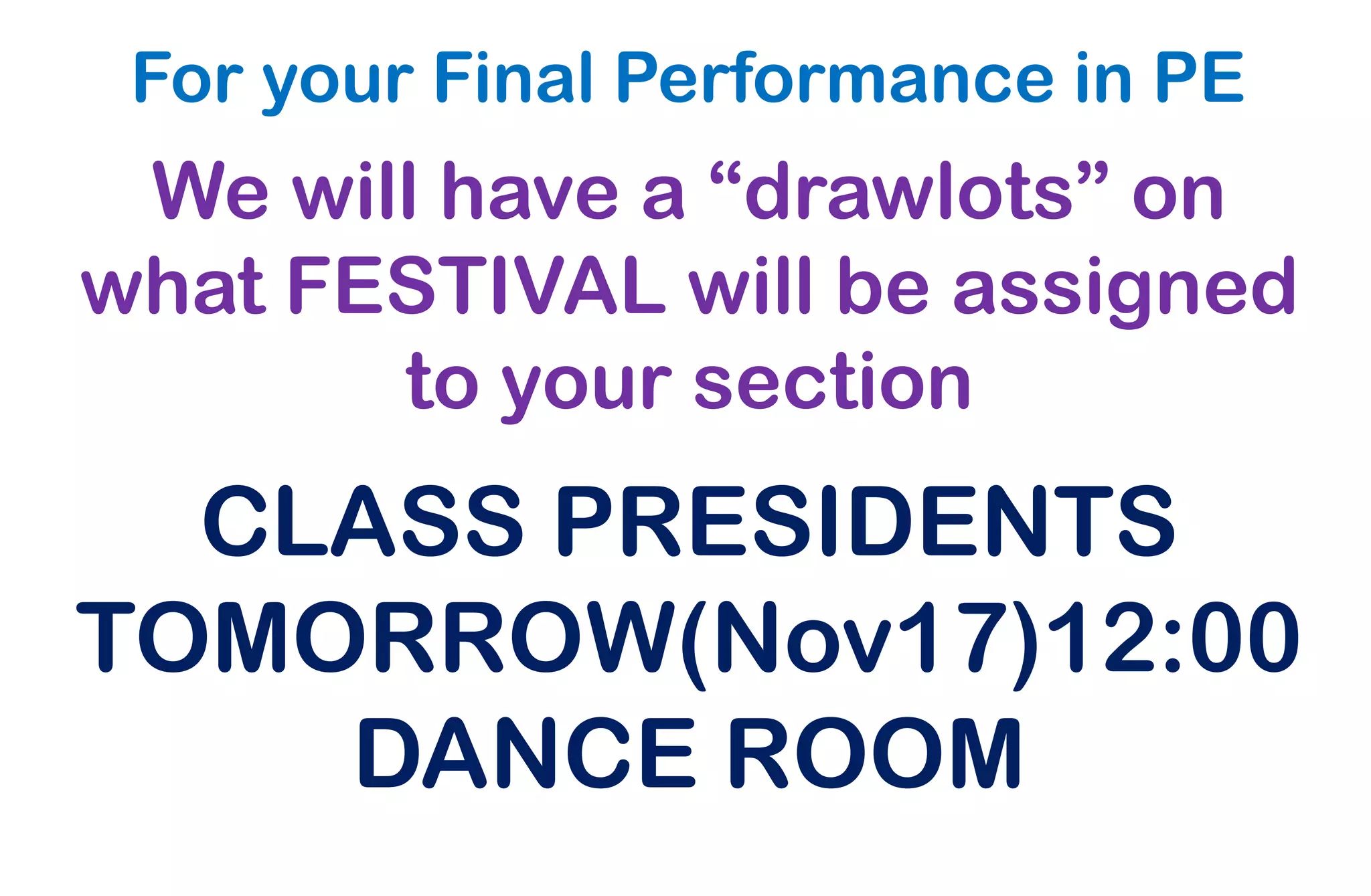
For your Final Performance in PE
We will have a “drawlots” on
what FESTIVAL will be assigned
to your section
CLASS PRESIDENTS
TOMORROW(Nov17)12:00
DANCE ROOM
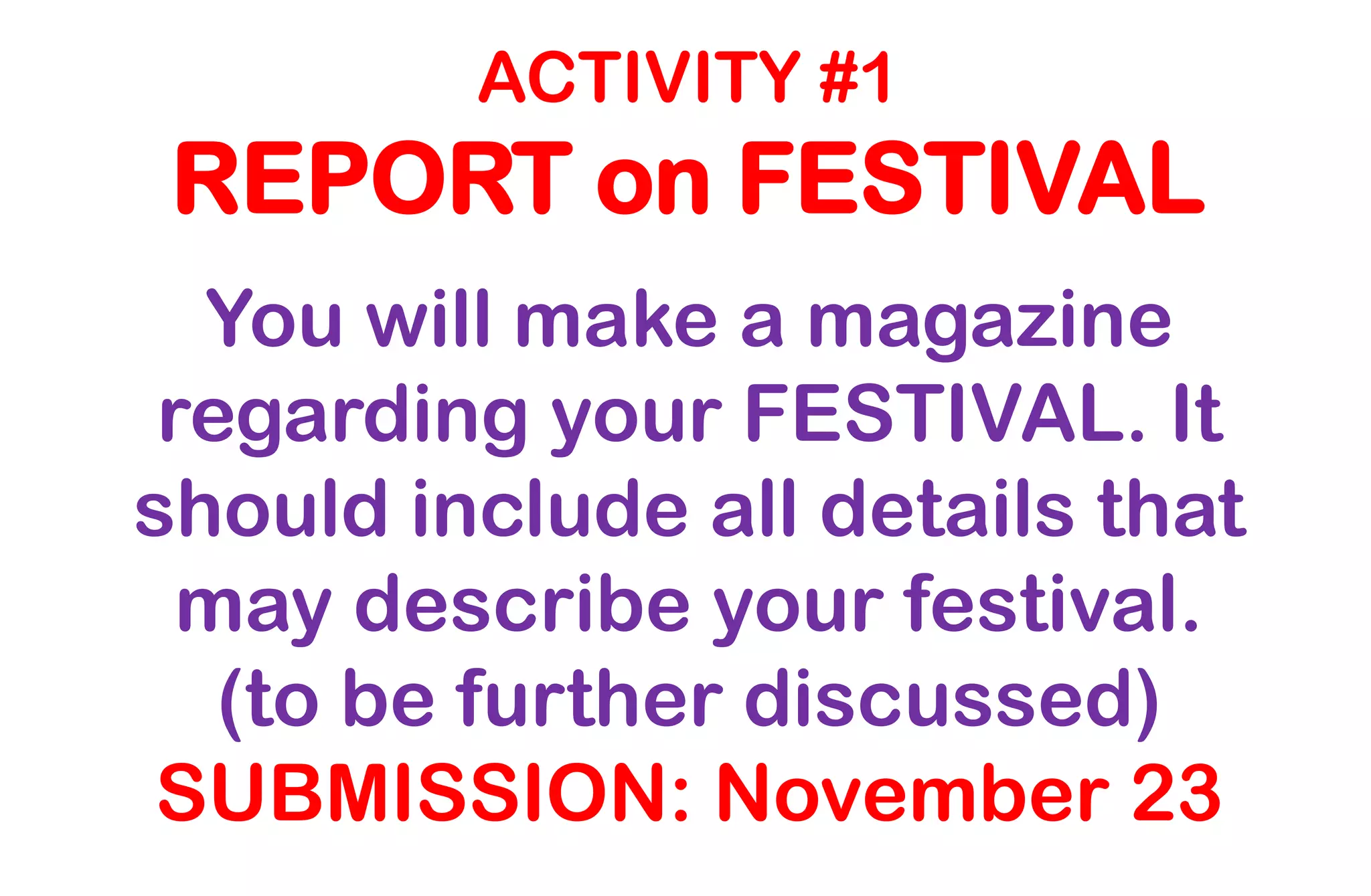
ACTIVITY #1
REPORT on FESTIVAL
You will make a magazine
regarding your FESTIVAL. It
should include all details that
may describe your festival.
(to be further discussed)
SUBMISSION: November 23
ACTIVITY #2
VIDEO DOCUMENTATION
(to be further
discussed)
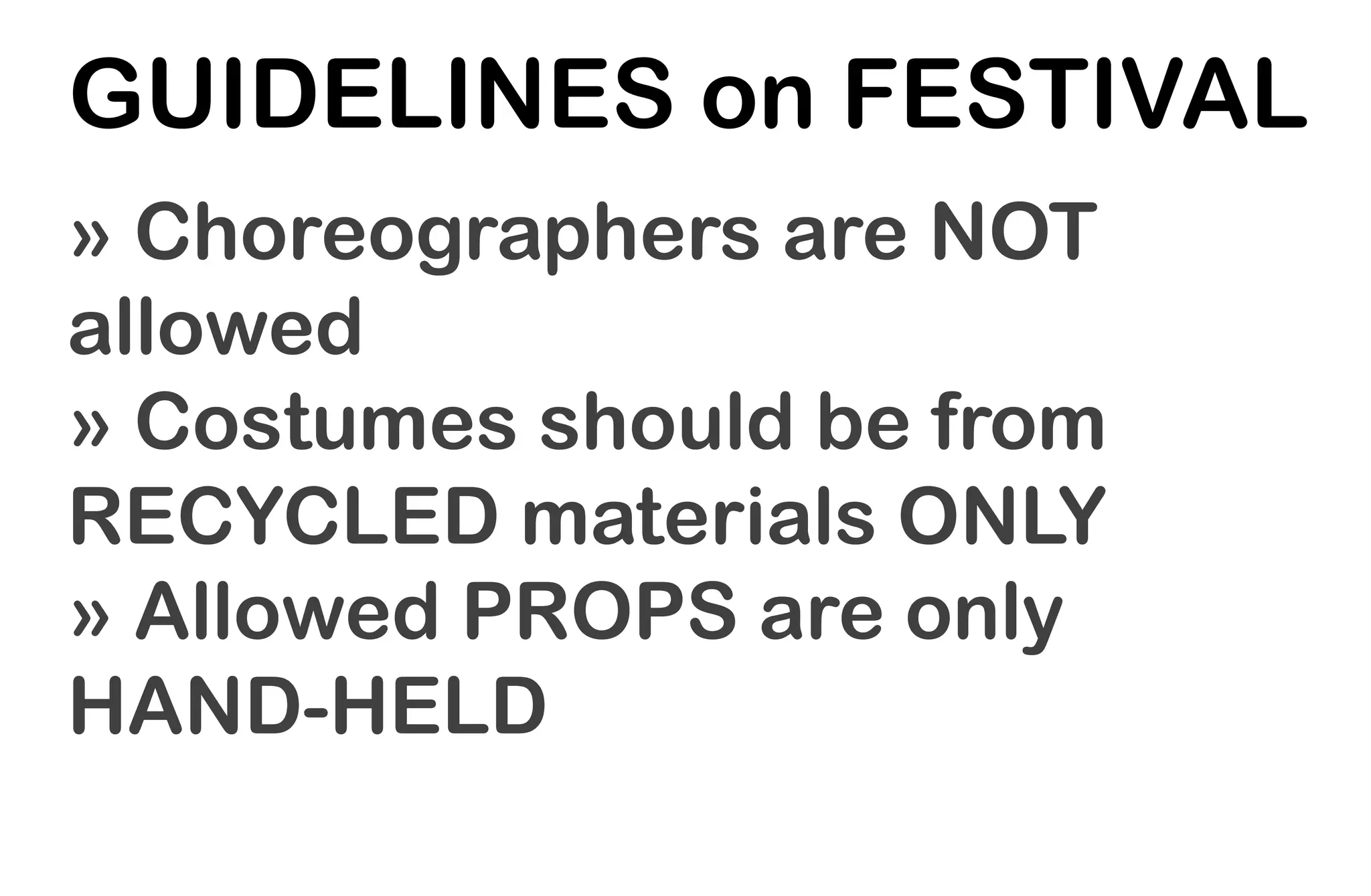
GUIDELINES on FESTIVAL
» Choreographers are NOT
allowed
» Costumes should be from
RECYCLED materials ONLY
» Allowed PROPS are only
HAND-HELD
Take note of these
concepts in
creating your
FESTIVAL
Review of Basic Movements
LOCOMOTOR
and
NON-LOCOMOTOR
LOCOMOTOR MOVEMENTS
Movements that allow you to
move from one point in space
to another. It is canned from
two words, “locos” which
means place and “motor”
which means movement.
LOCOMOTOR
MOVEMENTS
Step
Walk
Run
Jump
STEP
LOCOMOTOR MOVEMENTS
This is the basis of all locomotor
movements. It prepares you to move in
any direction you wish to go. It is
defined as a transfer of weight from one
foot to the other.
WALK
LOCOMOTOR MOVEMENTS
Series of steps executed by both of
your feet alternately in any direction. In
executing a walk, observe that there’s
this moment when both feet are in
contact with the ground while one foot
supports the weight and transfer it to
the other.
RUN
LOCOMOTOR MOVEMENTS
Series of walks executed quickly in any
direction wherein only one foot stays on
the ground while the other is off the
ground.
JUMP
LOCOMOTOR MOVEMENTS
This movement is simply described by
having both feet lose its contact with the
ground. There are five ways to do it:
» take off from one foot and land on the same
» take off from one foot and land on the other
» take off from one foot and land on both feet
» take off from both feet and land on one foot
» take off from both feet and land on both
NON-LOCOMOTOR MOVEMENTS
These are movements that are
performed in one point in
space without transferring to
another point. They don’t allow
you to move from one place to
the other.
NON-LOCOMOTOR
MOVEMENTS
Flexion & Extension
Contraction & Release
Collapse & Recover
Rotation & Twist (Pivot & Turn)
FLEXION
NON- LOCOMOTOR MOVEMENTS
It is the act of decreasing the angle of a
joint. Another term for flexion is to
bend. If you bend a joint, like your
elbow or knee, you are performing
flexion.
EXTENSION
NON- LOCOMOTOR MOVEMENTS
This is the opposite of flexion. You are
extending if you are increasing the
angle of a joint. Stretching is another
word for extension.
CONTRACTION
NON- LOCOMOTOR MOVEMENTS
A muscle movement done when it
shortens, narrows, and tightens using
sufficient amount of energy in the
execution.
RELEASE
NON- LOCOMOTOR MOVEMENTS
A muscle movement opposite to
contraction done when it let goes or let
looses of being held into a shortening
movement.
COLLAPSE
NON- LOCOMOTOR MOVEMENTS
To deliberately drop the exertion of
energy into a body segment.
RECOVER
NON- LOCOMOTOR MOVEMENTS
The opposite of collapse. This is to
regain the energy exerted into a body
segment.
ROTATION
NON- LOCOMOTOR MOVEMENTS
To rotate is to move a body segment
allowing it to complete a circle with its
motion. It’s not only limited to
circumduction which is done in ball and
socket joints. Rotation can also be done
in wrists, waist knees, and ankles.
TWIST
NON- LOCOMOTOR MOVEMENTS
To move a body segment from an axis
halfway front or back or quarter to the
right or left as in the twisting of the
neck allowing the head to face right or
left and the like.
PIVOT
NON- LOCOMOTOR MOVEMENTS
To change the position of the feet or
any body part that carries the body’s
weight allowing the body to face in a
less than 360 degrees turn.
TURN
NON- LOCOMOTOR MOVEMENTS
To move in a turning movement with the
base of support, usually a pointed foot,
the other raised, while equilibrium is
maintained until the completion of the
turn.
ELEMENTS OF
MOVEMENTS IN SPACE
Rhythm
Level
Range
Floor Pattern/Design
Direction
Focus
RHYTHM
ELEMENTS of MOVEMENTS in SPACE
Regular recurrence of a beat. It may be
regular. In basic music, rhythm is regular
and metered (24,34 or 44). They may be
slow, moderate or fast. This element of
rhythm is called TEMPO. Music dictates the
speed of movement we create.
LEVEL
ELEMENTS of MOVEMENTS in SPACE
This refers to the level of movement. It may
be low, when knees are fully or slightly bent
when executing movement; medium, if
knees are normally straight when executing
movement; high, if the heels are raised or
movements are done while off the floor.
RANGE
ELEMENTS of MOVEMENTS in SPACE
This element refers to the scope of
movement execution. It is dictated by the
space provided. If the space is wide then
movements shall be wide and big. If the
space is limited then movements shall be
small and limited too.
FLOOR
PATTERN
/DESIGN
ELEMENTS of MOVEMENTS in SPACE
This refers to the designs created on the
floor by the bodies of dancers. They may be
geometric or non-geometric formations
DIRECTION
ELEMENTS of MOVEMENTS in SPACE
This element adds to variety of movement.
They may be performed forward, backward,
sideward, or even upward.
FOCUS
ELEMENTS of MOVEMENTS in SPACE
This is the focal point of dancers attention
while moving in space.
And remember to do warm-ups
and have proper diets (EAT…) to
prevent injuries and illnesses in
preparing for you
FESTIVAL
Now for our QUIZ..
Prepare ½
crosswise
paper
READY??!!
For numbers 1-10: Identify
whether the festival given is
RELIGIOUS or SECULAR or
NON-RELIGIOUS
Write REL for Religious
and SEC for Secular
1. Higantes Festival
REL
or SEC
2. Penafrancia
REL or SEC
3. Ati-atihan
Festival
REL or SEC
4. Panagbenga
Festival
REL or SEC
5. Masskara
REL or SEC
6. Binatbatan
Festival
REL or SEC
7. Dinagyang
Fstival
REL or SEC
8. Longganisa
Festival
REL or SEC
9. Mango Festival
REL or SEC
10. Bangus Festival
REL or SEC
For numbers 11-14: Identify
which LOCOMOTOR
movement is described in
each number.
STEPor WALK or RUN or JUMP
11. Transfer of weight from
one foot to the other.
STEPor WALK or RUN or JUMP
12. Series of steps executed
by both feet alternately in any
direction.
STEP or WALK or RUN or JUMP
13. Series of walks executed
quickly in any direction
wherein only one foot stays on
the ground while the other is
off the ground.
STEPor WALK or RUN or JUMP
14. Described by having both
feet lose its contact with the
ground.
STEP or WALK or RUN or JUMP
For numbers 15-20: Identify
which NON-LOCOMOTOR
movement is described in
each number.
Choices are given in each
number
15. It is the act of decreasing
the angle of a joint.
FLEXIONor EXTENSION
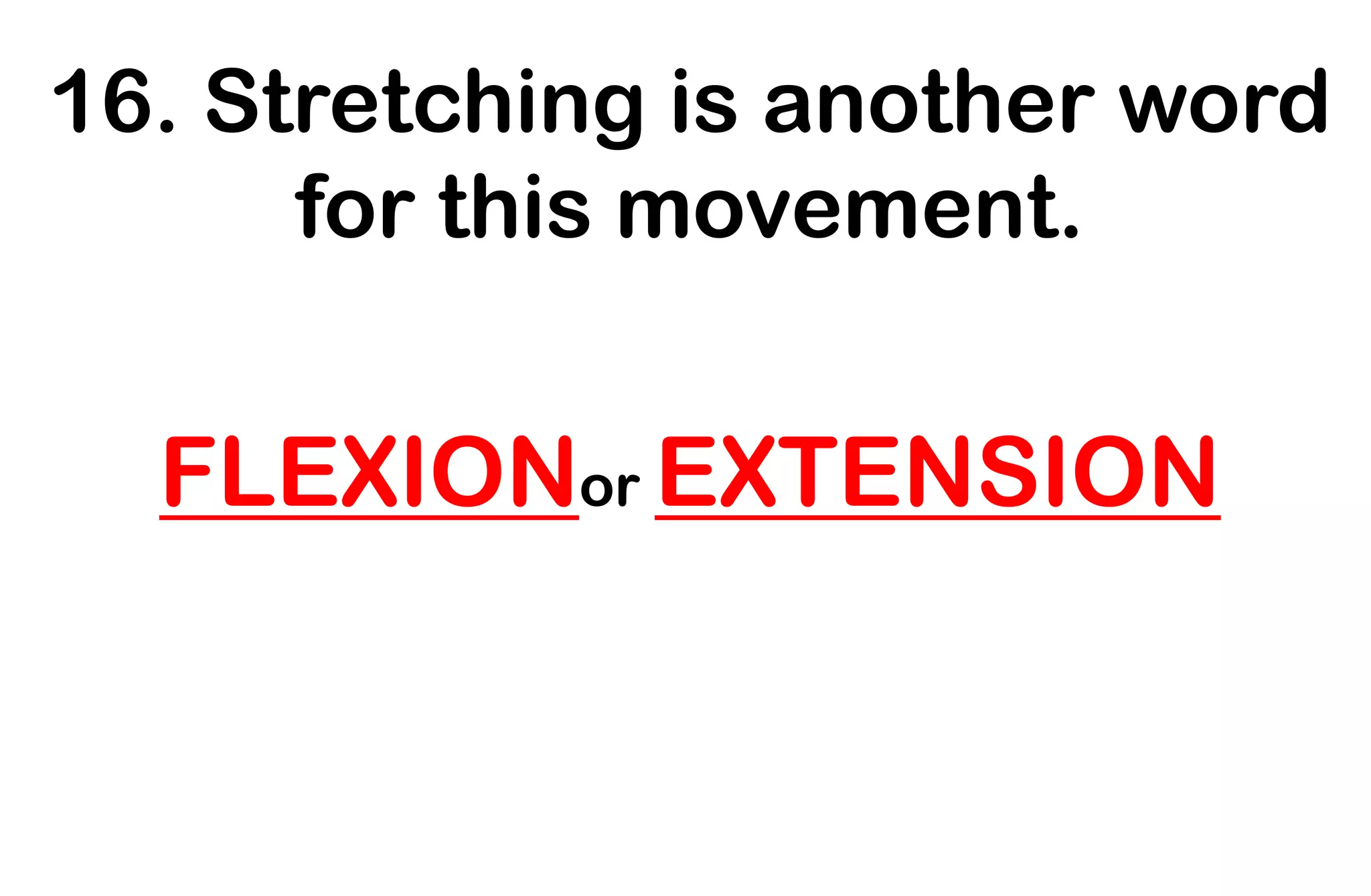
16. Stretching is another word
for this movement.
FLEXIONor EXTENSION
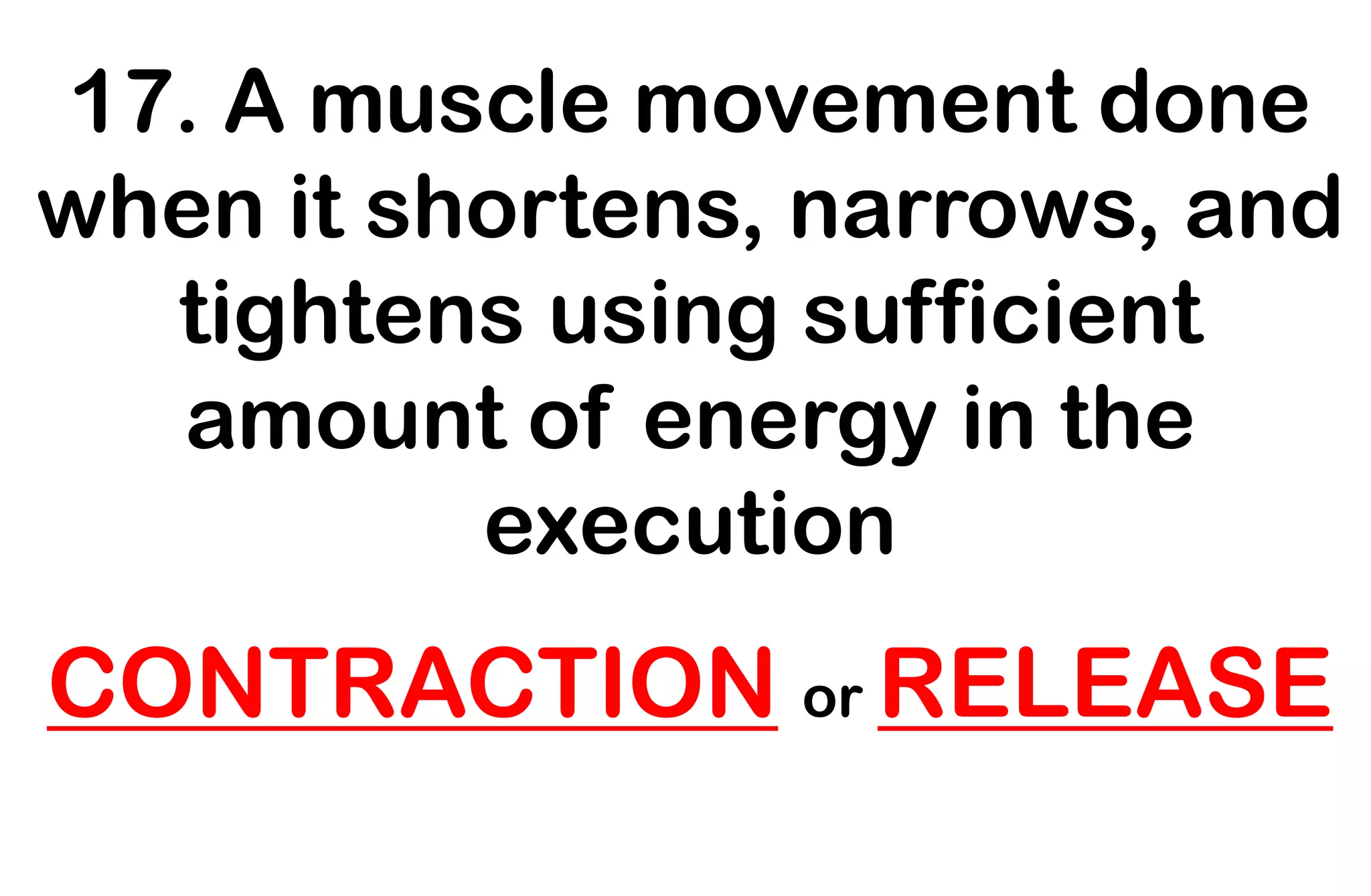
17. A muscle movement done
when it shortens, narrows, and
tightens using sufficient
amount of energy in the
execution
CONTRACTION or RELEASE
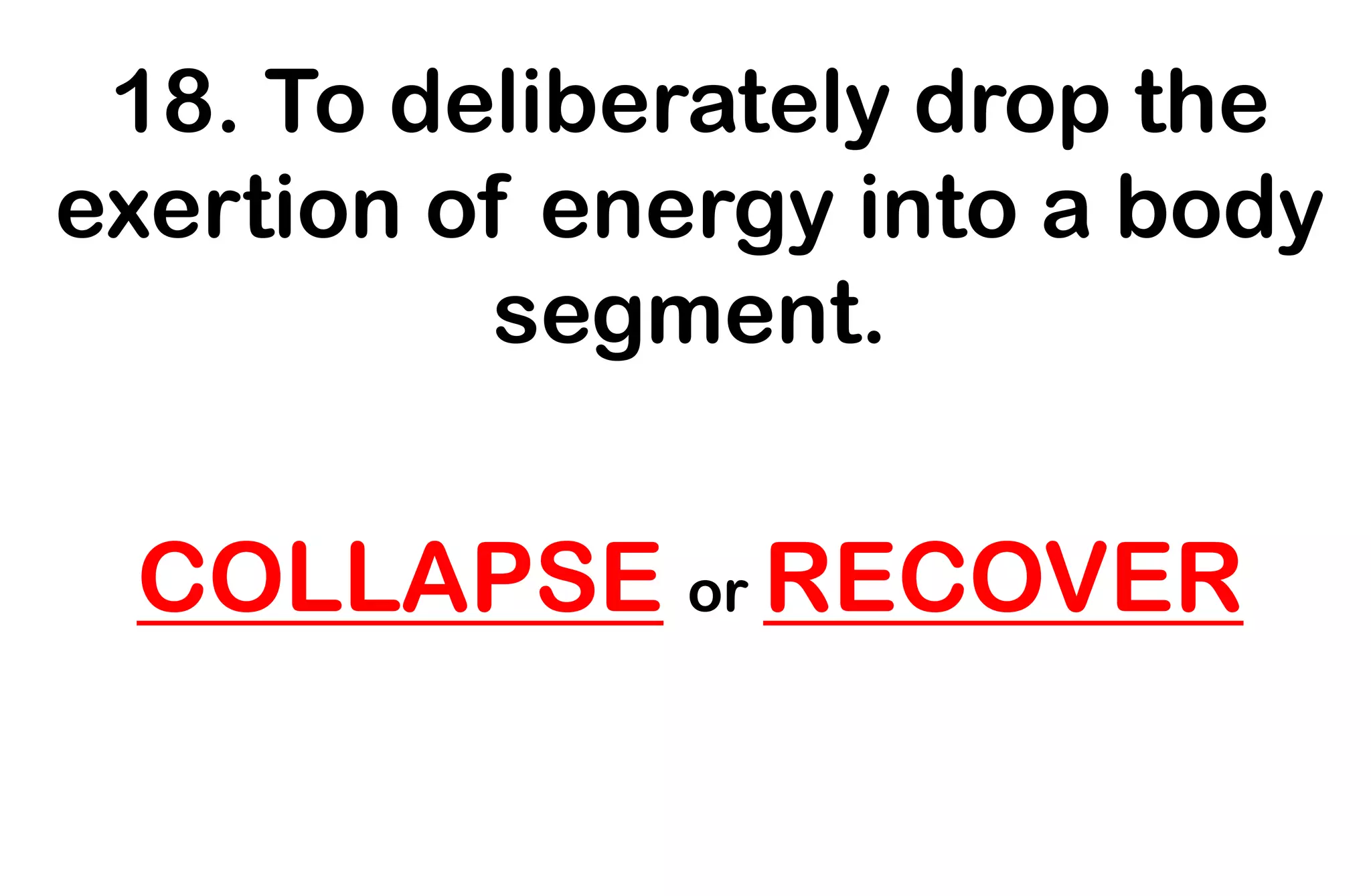
18. To deliberately drop the
exertion of energy into a body
segment.
COLLAPSE or RECOVER
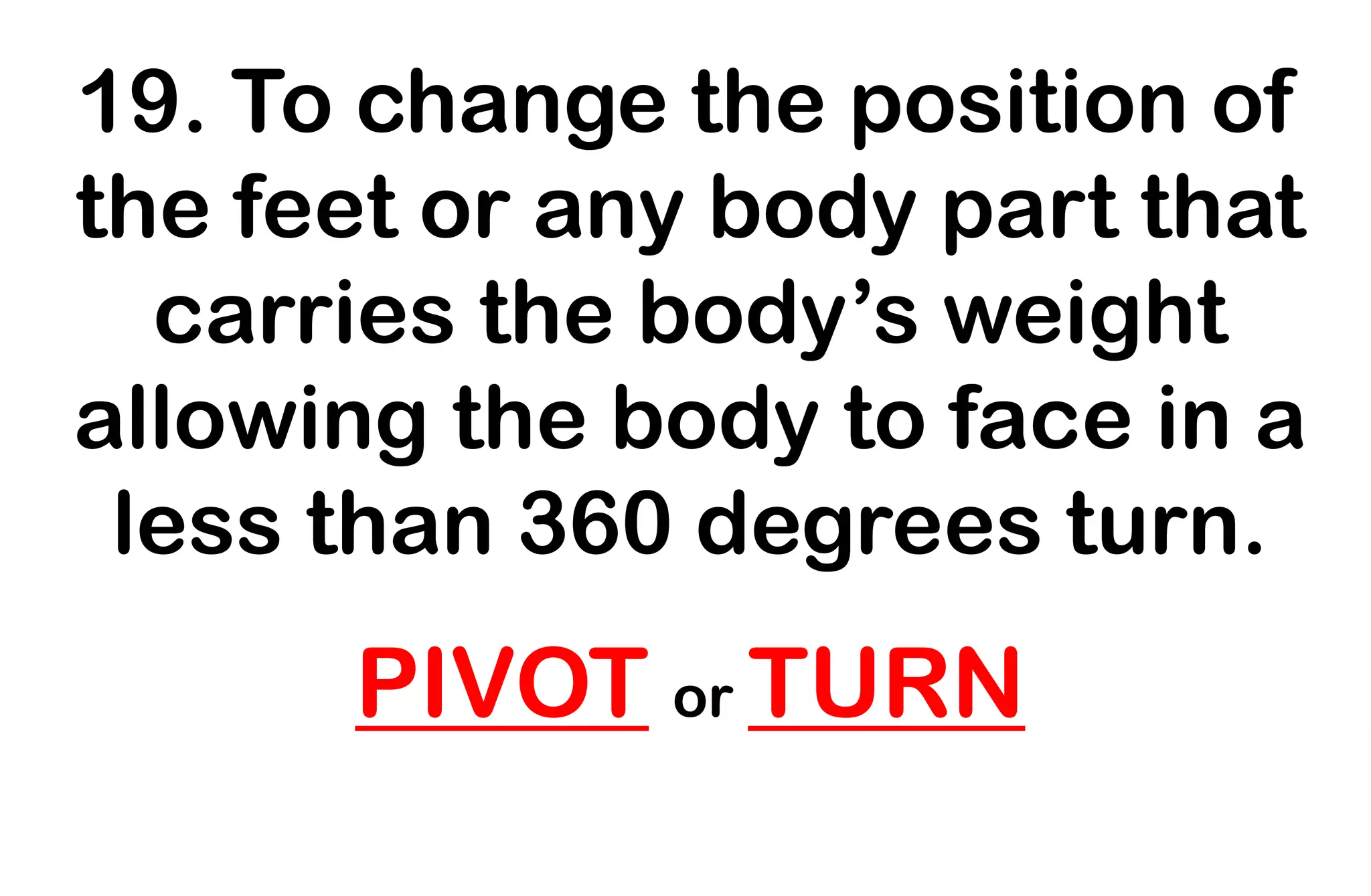
19. To change the position of
the feet or any body part that
carries the body’s weight
allowing the body to face in a
less than 360 degrees turn.
PIVOT or TURN
20. To move in a turning
movement with a base of
support, usually a pointed
foot, the other raised, while
equilibrium is maintained until
the completion of turn.
PIVOT or TURN
20. To move in a turning
movement with a base of
support, usually a pointed
foot, the other raised, while
equilibrium is maintained until
the completion of turn.
PIVOT or TURN
Finalize your
answers..
Exchange
papers..
READY?!
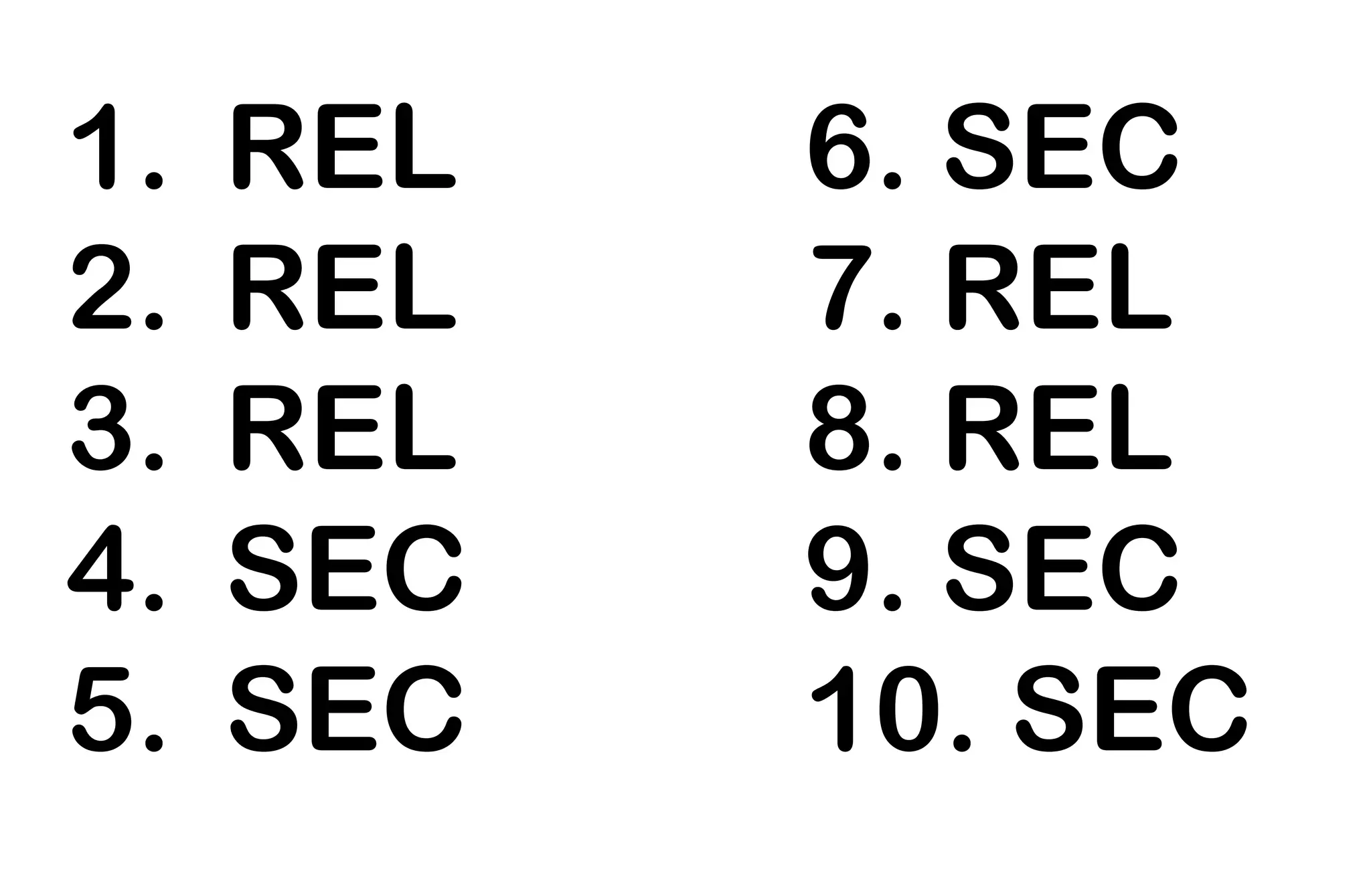
1. REL 6. SEC
2. REL 7. REL
3. REL 8. REL
4. SEC 9. SEC
5. SEC 10. SEC
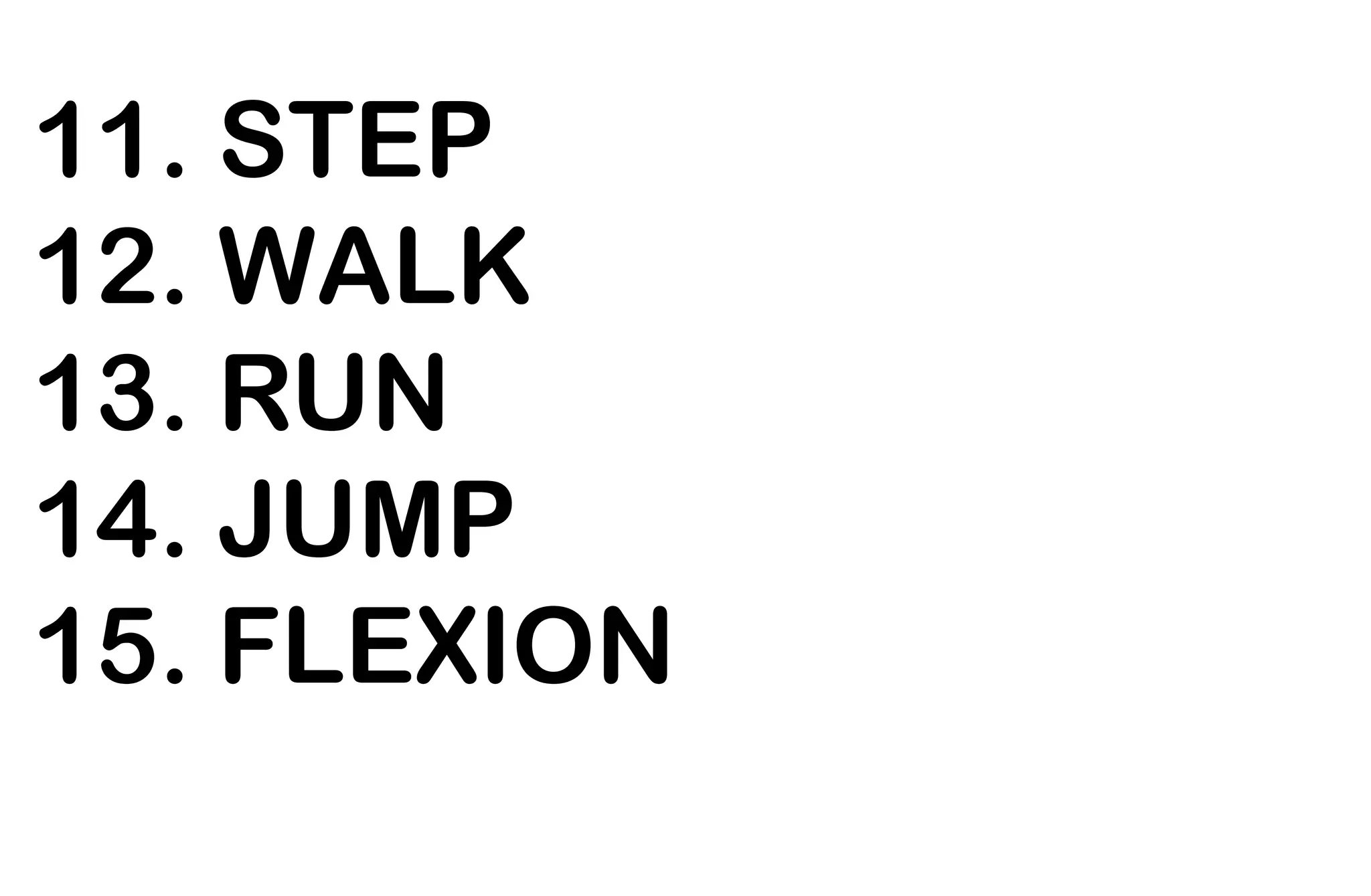
11. STEP
12. WALK
13. RUN
14. JUMP
15. FLEXION
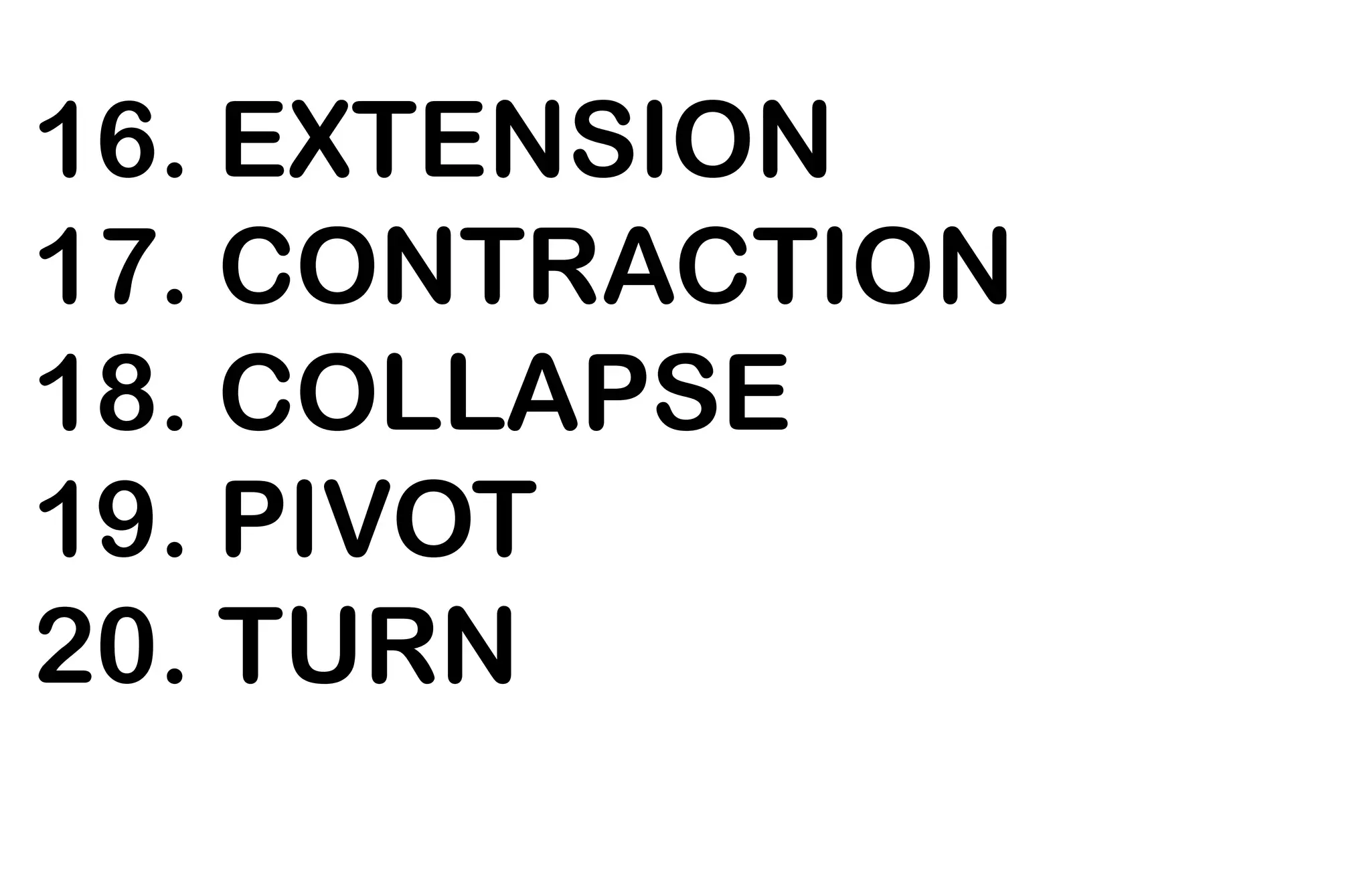
16. EXTENSION
17. CONTRACTION
18. COLLAPSE
19. PIVOT
20. TURN
COUNT THE NUMBER
OF CORRECTS..
GIVE BACK TO THE
OWNER..
RECHECK..
Pass to the PRESIDENT..
Have you learned
something today??!!
THANK YOU FOR
LISTENING!

Pe3rdgrading

  • 1.
  • 2.
  • 3.
    FESTIVAL DANCES » culturaldances performed to the strong beats of percussion instruments by a community of people sharing the same culture usually done in honor of a Patron Saint or in thanksgiving of a bountiful harvest.
  • 4.
    FESTIVAL DANCES » itmay be religious or secular in nature » it adds to the merry-making and festivities where they are celebrated » draw the people’s culture by portraying the people’s ways of life through movements, costumes and implements inherent to their place
  • 5.
    FESTIVAL DANCES » drawthe people’s culture by portraying the people’s ways of life through movements, costumes and implements inherent to their place of origin
  • 6.
    FESTIVAL DANCES » Filipinosdo festivals primarily to celebrate » We celebrate our unity amidst the diversity of cultures and we celebrate our industry bringing about a bountiful harvest
  • 7.
    FESTIVAL DANCES » Festivalshave been a consistent crowd-producing activity leading to upliftment of a community’s economy due to its tourism and entertainment value
  • 8.
    FESTIVAL DANCES » Festivalsare a form of entertainment that attract foreign and domestic tourists to visit a place eventually leading to the elevation of the Filipino’s quality of life
  • 9.
    FESTIVAL DANCES RELIGIOUS –in honor of a certain religious icon SECULAR or NON-RELIGIOUS – thanksgiving or celebration of people’s industry and bountiful harvest
  • 10.
    FESTIVAL DANCES RELIGIOUS NAME OFFESTIVAL PLACE of ORIGIN RELIGIOUS FIGURE HONOURED MONTH CELEBRATED Sinulog Festival Cebu City Sto. Nino January Dinagyang Festival Iloilo City Sto. Nino January Ati-atihan Festival Kalibo, Aklan Sto. Nino January Penafrancia Bicol Virgin Mary September Higantes Festival Angono, Rizal Saint Clement November Longganisa Festival Vigan City, Ilocos Sur Saint Paul January Kinabayo Festival Dapitan City James the Great July Pintados de Pasi Passi City, Iloilo Sto. Nino March Pattarradday Santiago City Senor San Tiago May Sangyaw Festival Tacloban City Sto. Nino July
  • 11.
    FESTIVAL DANCES SECULAR/NON-RELIGIOUS NAME OFFESTIVAL PLACE of ORIGIN INDUSTRY MONTH CELEBRATED Bangus Festival Dagupan, Pangasinan Milkfish Industry April – May Bambanti Festival Isabela Scarecrow (farming) January Mammangui Festival City of Iligan Corn Industry May Mango Festival Iba, Zambales Mango Industry April Panagbenga Festival Baguio City Flower Industry February Ibon Ebon Festival Pampanga Migratory Birds Egg Industry February Masskara Bacolod City Mask (Sugar Industry) October T’nalak South Cotabato Tinalak Cloth Weaving July Ammungan Festival Nueva Vizcaya Gathering of Tribal Industries May Binatbatan Festival Vigan, Ilocos Sur Weaving Industry May
  • 12.
    You will createyour own FESTIVAL DANCE For your Final Performance in PE
  • 13.
    For your FinalPerformance in PE We will have a “drawlots” on what FESTIVAL will be assigned to your section CLASS PRESIDENTS TOMORROW(Nov17)12:00 DANCE ROOM
  • 14.
    ACTIVITY #1 REPORT onFESTIVAL You will make a magazine regarding your FESTIVAL. It should include all details that may describe your festival. (to be further discussed) SUBMISSION: November 23
  • 15.
  • 16.
    GUIDELINES on FESTIVAL »Choreographers are NOT allowed » Costumes should be from RECYCLED materials ONLY » Allowed PROPS are only HAND-HELD
  • 18.
    Take note ofthese concepts in creating your FESTIVAL
  • 19.
    Review of BasicMovements LOCOMOTOR and NON-LOCOMOTOR
  • 20.
    LOCOMOTOR MOVEMENTS Movements thatallow you to move from one point in space to another. It is canned from two words, “locos” which means place and “motor” which means movement.
  • 21.
  • 22.
    STEP LOCOMOTOR MOVEMENTS This isthe basis of all locomotor movements. It prepares you to move in any direction you wish to go. It is defined as a transfer of weight from one foot to the other.
  • 23.
    WALK LOCOMOTOR MOVEMENTS Series ofsteps executed by both of your feet alternately in any direction. In executing a walk, observe that there’s this moment when both feet are in contact with the ground while one foot supports the weight and transfer it to the other.
  • 24.
    RUN LOCOMOTOR MOVEMENTS Series ofwalks executed quickly in any direction wherein only one foot stays on the ground while the other is off the ground.
  • 25.
    JUMP LOCOMOTOR MOVEMENTS This movementis simply described by having both feet lose its contact with the ground. There are five ways to do it: » take off from one foot and land on the same » take off from one foot and land on the other » take off from one foot and land on both feet » take off from both feet and land on one foot » take off from both feet and land on both
  • 26.
    NON-LOCOMOTOR MOVEMENTS These aremovements that are performed in one point in space without transferring to another point. They don’t allow you to move from one place to the other.
  • 27.
    NON-LOCOMOTOR MOVEMENTS Flexion & Extension Contraction& Release Collapse & Recover Rotation & Twist (Pivot & Turn)
  • 28.
    FLEXION NON- LOCOMOTOR MOVEMENTS Itis the act of decreasing the angle of a joint. Another term for flexion is to bend. If you bend a joint, like your elbow or knee, you are performing flexion.
  • 29.
    EXTENSION NON- LOCOMOTOR MOVEMENTS Thisis the opposite of flexion. You are extending if you are increasing the angle of a joint. Stretching is another word for extension.
  • 30.
    CONTRACTION NON- LOCOMOTOR MOVEMENTS Amuscle movement done when it shortens, narrows, and tightens using sufficient amount of energy in the execution.
  • 31.
    RELEASE NON- LOCOMOTOR MOVEMENTS Amuscle movement opposite to contraction done when it let goes or let looses of being held into a shortening movement.
  • 32.
    COLLAPSE NON- LOCOMOTOR MOVEMENTS Todeliberately drop the exertion of energy into a body segment.
  • 33.
    RECOVER NON- LOCOMOTOR MOVEMENTS Theopposite of collapse. This is to regain the energy exerted into a body segment.
  • 34.
    ROTATION NON- LOCOMOTOR MOVEMENTS Torotate is to move a body segment allowing it to complete a circle with its motion. It’s not only limited to circumduction which is done in ball and socket joints. Rotation can also be done in wrists, waist knees, and ankles.
  • 35.
    TWIST NON- LOCOMOTOR MOVEMENTS Tomove a body segment from an axis halfway front or back or quarter to the right or left as in the twisting of the neck allowing the head to face right or left and the like.
  • 36.
    PIVOT NON- LOCOMOTOR MOVEMENTS Tochange the position of the feet or any body part that carries the body’s weight allowing the body to face in a less than 360 degrees turn.
  • 37.
    TURN NON- LOCOMOTOR MOVEMENTS Tomove in a turning movement with the base of support, usually a pointed foot, the other raised, while equilibrium is maintained until the completion of the turn.
  • 38.
    ELEMENTS OF MOVEMENTS INSPACE Rhythm Level Range Floor Pattern/Design Direction Focus
  • 39.
    RHYTHM ELEMENTS of MOVEMENTSin SPACE Regular recurrence of a beat. It may be regular. In basic music, rhythm is regular and metered (24,34 or 44). They may be slow, moderate or fast. This element of rhythm is called TEMPO. Music dictates the speed of movement we create.
  • 40.
    LEVEL ELEMENTS of MOVEMENTSin SPACE This refers to the level of movement. It may be low, when knees are fully or slightly bent when executing movement; medium, if knees are normally straight when executing movement; high, if the heels are raised or movements are done while off the floor.
  • 41.
    RANGE ELEMENTS of MOVEMENTSin SPACE This element refers to the scope of movement execution. It is dictated by the space provided. If the space is wide then movements shall be wide and big. If the space is limited then movements shall be small and limited too.
  • 42.
    FLOOR PATTERN /DESIGN ELEMENTS of MOVEMENTSin SPACE This refers to the designs created on the floor by the bodies of dancers. They may be geometric or non-geometric formations
  • 43.
    DIRECTION ELEMENTS of MOVEMENTSin SPACE This element adds to variety of movement. They may be performed forward, backward, sideward, or even upward.
  • 44.
    FOCUS ELEMENTS of MOVEMENTSin SPACE This is the focal point of dancers attention while moving in space.
  • 45.
    And remember todo warm-ups and have proper diets (EAT…) to prevent injuries and illnesses in preparing for you FESTIVAL
  • 46.
  • 47.
  • 48.
  • 49.
    For numbers 1-10:Identify whether the festival given is RELIGIOUS or SECULAR or NON-RELIGIOUS Write REL for Religious and SEC for Secular
  • 50.
  • 51.
  • 52.
  • 53.
  • 54.
  • 55.
  • 56.
  • 57.
  • 58.
  • 59.
  • 60.
    For numbers 11-14:Identify which LOCOMOTOR movement is described in each number. STEPor WALK or RUN or JUMP
  • 61.
    11. Transfer ofweight from one foot to the other. STEPor WALK or RUN or JUMP
  • 62.
    12. Series ofsteps executed by both feet alternately in any direction. STEP or WALK or RUN or JUMP
  • 63.
    13. Series ofwalks executed quickly in any direction wherein only one foot stays on the ground while the other is off the ground. STEPor WALK or RUN or JUMP
  • 64.
    14. Described byhaving both feet lose its contact with the ground. STEP or WALK or RUN or JUMP
  • 65.
    For numbers 15-20:Identify which NON-LOCOMOTOR movement is described in each number. Choices are given in each number
  • 66.
    15. It isthe act of decreasing the angle of a joint. FLEXIONor EXTENSION
  • 67.
    16. Stretching isanother word for this movement. FLEXIONor EXTENSION
  • 68.
    17. A musclemovement done when it shortens, narrows, and tightens using sufficient amount of energy in the execution CONTRACTION or RELEASE
  • 69.
    18. To deliberatelydrop the exertion of energy into a body segment. COLLAPSE or RECOVER
  • 70.
    19. To changethe position of the feet or any body part that carries the body’s weight allowing the body to face in a less than 360 degrees turn. PIVOT or TURN
  • 71.
    20. To movein a turning movement with a base of support, usually a pointed foot, the other raised, while equilibrium is maintained until the completion of turn. PIVOT or TURN
  • 72.
    20. To movein a turning movement with a base of support, usually a pointed foot, the other raised, while equilibrium is maintained until the completion of turn. PIVOT or TURN
  • 73.
  • 74.
  • 75.
  • 76.
    1. REL 6.SEC 2. REL 7. REL 3. REL 8. REL 4. SEC 9. SEC 5. SEC 10. SEC
  • 77.
    11. STEP 12. WALK 13.RUN 14. JUMP 15. FLEXION
  • 78.
    16. EXTENSION 17. CONTRACTION 18.COLLAPSE 19. PIVOT 20. TURN
  • 79.
    COUNT THE NUMBER OFCORRECTS.. GIVE BACK TO THE OWNER..
  • 80.
  • 81.
  • 82.