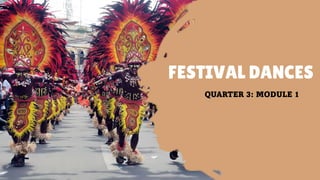
FESTIVAL DANCES
QUARTER 3: MODULE 1
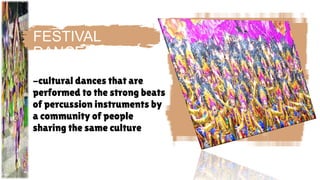
-cultural dances that are
performed to the strong beats
of percussion instruments by
a community of people
sharing the same culture
FESTIVAL
DANCES
2 KINDS OF FESTIVAL DANCES
-done in honor of a Patron Saint
RELIGIOUS FESTIVAL DANCES
01
-thanksgiving of a bountiful harvest.
SECULAR/NON RELIGIOUS FESTIVAL DANCES
02
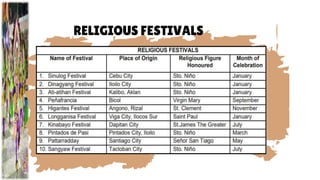
RELIGIOUS FESTIVALS
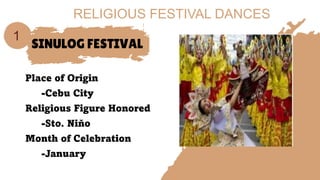
SINULOG FESTIVAL
Place of Origin
-Cebu City
Religious Figure Honored
-Sto. Niňo
Month of Celebration
-January
1
RELIGIOUS FESTIVAL DANCES
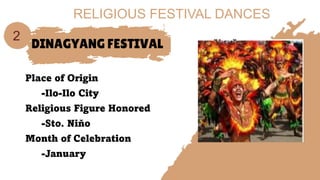
DINAGYANG FESTIVAL
Place of Origin
-Ilo-Ilo City
Religious Figure Honored
-Sto. Niňo
Month of Celebration
-January
2
RELIGIOUS FESTIVAL DANCES
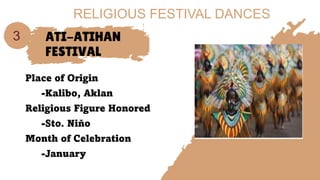
ATI-ATIHAN
FESTIVAL
Place of Origin
-Kalibo, Aklan
Religious Figure Honored
-Sto. Niňo
Month of Celebration
-January
3
RELIGIOUS FESTIVAL DANCES
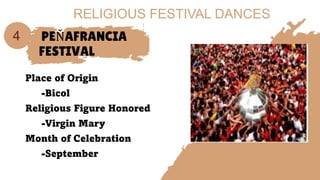
PEŇAFRANCIA
FESTIVAL
Place of Origin
-Bicol
Religious Figure Honored
-Virgin Mary
Month of Celebration
-September
4
RELIGIOUS FESTIVAL DANCES
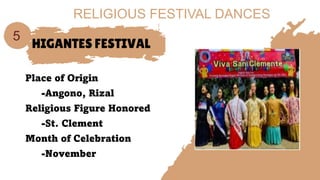
HIGANTES FESTIVAL
Place of Origin
-Angono, Rizal
Religious Figure Honored
-St. Clement
Month of Celebration
-November
5
RELIGIOUS FESTIVAL DANCES
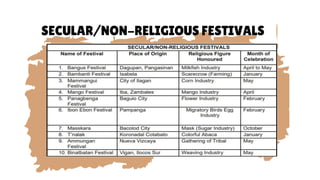
SECULAR/NON-RELIGIOUS FESTIVALS
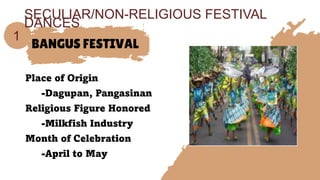
BANGUS FESTIVAL
Place of Origin
-Dagupan, Pangasinan
Religious Figure Honored
-Milkfish Industry
Month of Celebration
-April to May
1
SECULIAR/NON-RELIGIOUS FESTIVAL
DANCES
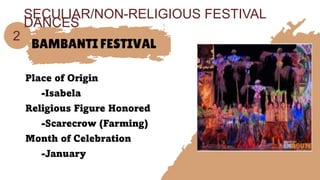
BAMBANTI FESTIVAL
Place of Origin
-Isabela
Religious Figure Honored
-Scarecrow (Farming)
Month of Celebration
-January
2
SECULIAR/NON-RELIGIOUS FESTIVAL
DANCES
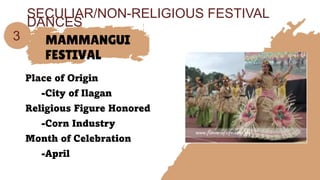
MAMMANGUI
FESTIVAL
Place of Origin
-City of Ilagan
Religious Figure Honored
-Corn Industry
Month of Celebration
-April
3
SECULIAR/NON-RELIGIOUS FESTIVAL
DANCES
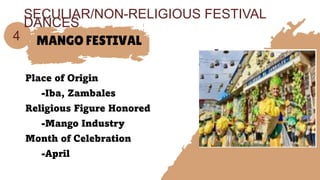
MANGO FESTIVAL
Place of Origin
-Iba, Zambales
Religious Figure Honored
-Mango Industry
Month of Celebration
-April
4
SECULIAR/NON-RELIGIOUS FESTIVAL
DANCES
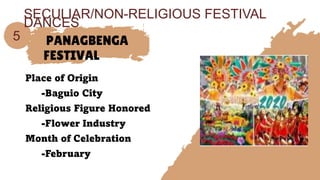
PANAGBENGA
FESTIVAL
Place of Origin
-Baguio City
Religious Figure Honored
-Flower Industry
Month of Celebration
-February
5
SECULIAR/NON-RELIGIOUS FESTIVAL
DANCES
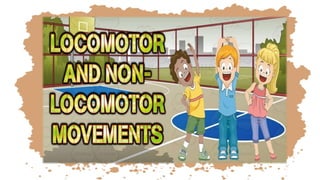
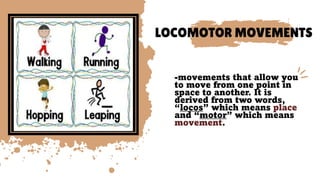
LOCOMOTOR MOVEMENTS
-movements that allow you
to move from one point in
space to another. It is
derived from two words,
“locos” which means place
and “motor” which means
movement.
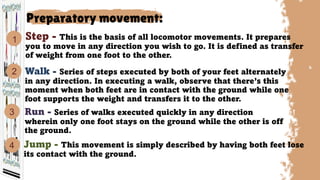
Step - This is the basis of all locomotor movements. It prepares
you to move in any direction you wish to go. It is defined as transfer
of weight from one foot to the other.
Run - Series of walks executed quickly in any direction
wherein only one foot stays on the ground while the other is off
the ground.
Walk - Series of steps executed by both of your feet alternately
in any direction. In executing a walk, observe that there’s this
moment when both feet are in contact with the ground while one
foot supports the weight and transfers it to the other.
Jump - This movement is simply described by having both feet lose
its contact with the ground.
Preparatory movement:
2
4
1
3
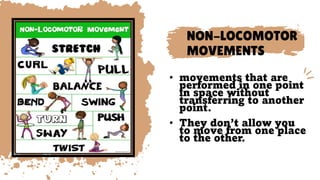
NON-LOCOMOTOR
MOVEMENTS
• movements that are
performed in one point
in space without
transferring to another
point.
• They don’t allow you
to move from one place
to the other.
Flexion - It is the act of decreasing the angle of a joint.
-bend
Contraction - A muscle movement done when it shortens,
narrows and tightens using sufficient amount of energy in the
execution.
Extension - This is the opposite of flexion. You are extending if
you are increasing the angle of a joint.
- stretching
Collapse - To deliberately drop the exertion of energy into a body
segment.
Non-locomotor movements
2
5
1
3
4 Release - A muscle movement opposite to contraction done when it
let goes or let looses of being held into a shortening movement.
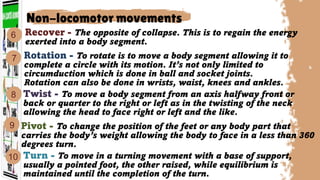
Recover - The opposite of collapse. This is to regain the energy
exerted into a body segment.
Twist - To move a body segment from an axis halfway front or
back or quarter to the right or left as in the twisting of the neck
allowing the head to face right or left and the like.
Rotation - To rotate is to move a body segment allowing it to
complete a circle with its motion. It’s not only limited to
circumduction which is done in ball and socket joints.
Rotation can also be done in wrists, waist, knees and ankles.
Turn - To move in a turning movement with a base of support,
usually a pointed foot, the other raised, while equilibrium is
maintained until the completion of the turn.
Non-locomotor movements
7
10
6
8
9 Pivot - To change the position of the feet or any body part that
carries the body’s weight allowing the body to face in a less than 360
degrees turn.
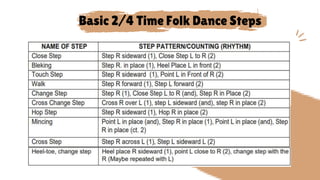
Basic 2/4 Time Folk Dance Steps
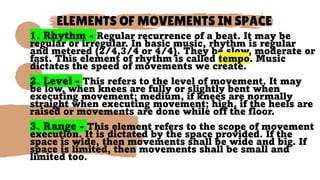
ELEMENTS OF MOVEMENTS IN SPACE
1. Rhythm - Regular recurrence of a beat. It may be
regular or irregular. In basic music, rhythm is regular
and metered (2/4,3/4 or 4/4). They be slow, moderate or
fast. This element of rhythm is called tempo. Music
dictates the speed of movements we create.
2. Level - This refers to the level of movement. It may
be low, when knees are fully or slightly bent when
executing movement; medium, if knees are normally
straight when executing movement; high, if the heels are
raised or movements are done while off the floor.
3. Range - This element refers to the scope of movement
execution. It is dictated by the space provided. If the
space is wide, then movements shall be wide and big. If
space is limited, then movements shall be small and
limited too.
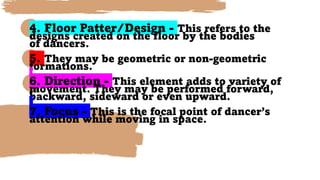
4. Floor Patter/Design - This refers to the
designs created on the floor by the bodies
of dancers.
5. They may be geometric or non-geometric
formations.
6. Direction - This element adds to variety of
movement. They may be performed forward,
backward, sideward or even upward.
7. Focus - This is the focal point of dancer’s
attention while moving in space.
THANK YOU
FOR LISTENING!

FESTIVAL-DANCES-Q3-M1.pptx

  • 1.
  • 2.
    -cultural dances thatare performed to the strong beats of percussion instruments by a community of people sharing the same culture FESTIVAL DANCES
  • 3.
    2 KINDS OFFESTIVAL DANCES -done in honor of a Patron Saint RELIGIOUS FESTIVAL DANCES 01 -thanksgiving of a bountiful harvest. SECULAR/NON RELIGIOUS FESTIVAL DANCES 02
  • 4.
  • 5.
    SINULOG FESTIVAL Place ofOrigin -Cebu City Religious Figure Honored -Sto. Niňo Month of Celebration -January 1 RELIGIOUS FESTIVAL DANCES
  • 6.
    DINAGYANG FESTIVAL Place ofOrigin -Ilo-Ilo City Religious Figure Honored -Sto. Niňo Month of Celebration -January 2 RELIGIOUS FESTIVAL DANCES
  • 7.
    ATI-ATIHAN FESTIVAL Place of Origin -Kalibo,Aklan Religious Figure Honored -Sto. Niňo Month of Celebration -January 3 RELIGIOUS FESTIVAL DANCES
  • 8.
    PEŇAFRANCIA FESTIVAL Place of Origin -Bicol ReligiousFigure Honored -Virgin Mary Month of Celebration -September 4 RELIGIOUS FESTIVAL DANCES
  • 9.
    HIGANTES FESTIVAL Place ofOrigin -Angono, Rizal Religious Figure Honored -St. Clement Month of Celebration -November 5 RELIGIOUS FESTIVAL DANCES
  • 10.
  • 11.
    BANGUS FESTIVAL Place ofOrigin -Dagupan, Pangasinan Religious Figure Honored -Milkfish Industry Month of Celebration -April to May 1 SECULIAR/NON-RELIGIOUS FESTIVAL DANCES
  • 12.
    BAMBANTI FESTIVAL Place ofOrigin -Isabela Religious Figure Honored -Scarecrow (Farming) Month of Celebration -January 2 SECULIAR/NON-RELIGIOUS FESTIVAL DANCES
  • 13.
    MAMMANGUI FESTIVAL Place of Origin -Cityof Ilagan Religious Figure Honored -Corn Industry Month of Celebration -April 3 SECULIAR/NON-RELIGIOUS FESTIVAL DANCES
  • 14.
    MANGO FESTIVAL Place ofOrigin -Iba, Zambales Religious Figure Honored -Mango Industry Month of Celebration -April 4 SECULIAR/NON-RELIGIOUS FESTIVAL DANCES
  • 15.
    PANAGBENGA FESTIVAL Place of Origin -BaguioCity Religious Figure Honored -Flower Industry Month of Celebration -February 5 SECULIAR/NON-RELIGIOUS FESTIVAL DANCES
  • 17.
    LOCOMOTOR MOVEMENTS -movements thatallow you to move from one point in space to another. It is derived from two words, “locos” which means place and “motor” which means movement.
  • 18.
    Step - Thisis the basis of all locomotor movements. It prepares you to move in any direction you wish to go. It is defined as transfer of weight from one foot to the other. Run - Series of walks executed quickly in any direction wherein only one foot stays on the ground while the other is off the ground. Walk - Series of steps executed by both of your feet alternately in any direction. In executing a walk, observe that there’s this moment when both feet are in contact with the ground while one foot supports the weight and transfers it to the other. Jump - This movement is simply described by having both feet lose its contact with the ground. Preparatory movement: 2 4 1 3
  • 19.
    NON-LOCOMOTOR MOVEMENTS • movements thatare performed in one point in space without transferring to another point. • They don’t allow you to move from one place to the other.
  • 20.
    Flexion - Itis the act of decreasing the angle of a joint. -bend Contraction - A muscle movement done when it shortens, narrows and tightens using sufficient amount of energy in the execution. Extension - This is the opposite of flexion. You are extending if you are increasing the angle of a joint. - stretching Collapse - To deliberately drop the exertion of energy into a body segment. Non-locomotor movements 2 5 1 3 4 Release - A muscle movement opposite to contraction done when it let goes or let looses of being held into a shortening movement.
  • 21.
    Recover - Theopposite of collapse. This is to regain the energy exerted into a body segment. Twist - To move a body segment from an axis halfway front or back or quarter to the right or left as in the twisting of the neck allowing the head to face right or left and the like. Rotation - To rotate is to move a body segment allowing it to complete a circle with its motion. It’s not only limited to circumduction which is done in ball and socket joints. Rotation can also be done in wrists, waist, knees and ankles. Turn - To move in a turning movement with a base of support, usually a pointed foot, the other raised, while equilibrium is maintained until the completion of the turn. Non-locomotor movements 7 10 6 8 9 Pivot - To change the position of the feet or any body part that carries the body’s weight allowing the body to face in a less than 360 degrees turn.
  • 22.
    Basic 2/4 TimeFolk Dance Steps
  • 23.
    ELEMENTS OF MOVEMENTSIN SPACE 1. Rhythm - Regular recurrence of a beat. It may be regular or irregular. In basic music, rhythm is regular and metered (2/4,3/4 or 4/4). They be slow, moderate or fast. This element of rhythm is called tempo. Music dictates the speed of movements we create. 2. Level - This refers to the level of movement. It may be low, when knees are fully or slightly bent when executing movement; medium, if knees are normally straight when executing movement; high, if the heels are raised or movements are done while off the floor. 3. Range - This element refers to the scope of movement execution. It is dictated by the space provided. If the space is wide, then movements shall be wide and big. If space is limited, then movements shall be small and limited too.
  • 24.
    4. Floor Patter/Design- This refers to the designs created on the floor by the bodies of dancers. 5. They may be geometric or non-geometric formations. 6. Direction - This element adds to variety of movement. They may be performed forward, backward, sideward or even upward. 7. Focus - This is the focal point of dancer’s attention while moving in space.
  • 25.