JENNY OBILLO DARANG
RPFDS
MRS. AMIHAN F. FENIS
ADVISER
RPFDS
FESTIVAL
WHAT IS A FESTIVAL?
 An annual celebration or anniversary (Google)
 An organized set of special events, usually
happening in one place in memory of religious event
with its own social activities, food, or ceremonies.
(American Dictionary)
 Is an event ordinarily celebrated by community and
centering on some characteristics aspect of that
community and its religion or traditions. ( Wikipedia)
WHAT IS A FESTIVAL DANCE?
Is a cultural dance performed to
the strong beats by a community of
people sharing the same culture
usually done in honor of a Patron
Saint or in thanksgiving of a
bountiful harvest.
WHAT ARE THE
NATURE OF FESTIVAL DANCES?
Festival dances may be:
 Religious
 Secular or Non-Religious
WHAT IS RELIGIOUS AND
SECULAR?
 religious, in honor of a
certain religious icon
 secular or non – religious,
thanksgiving or celebration
of peoples industry and
bountiful harvest
WHY WE FILIPINOS DO FESTIVALS?
•FILIPINOS do festivals primarily to
celebrate
•We celebrate our unity amidst the
diversity of cultures and;
•We celebrate our industry bringing about
a bountiful harvest.
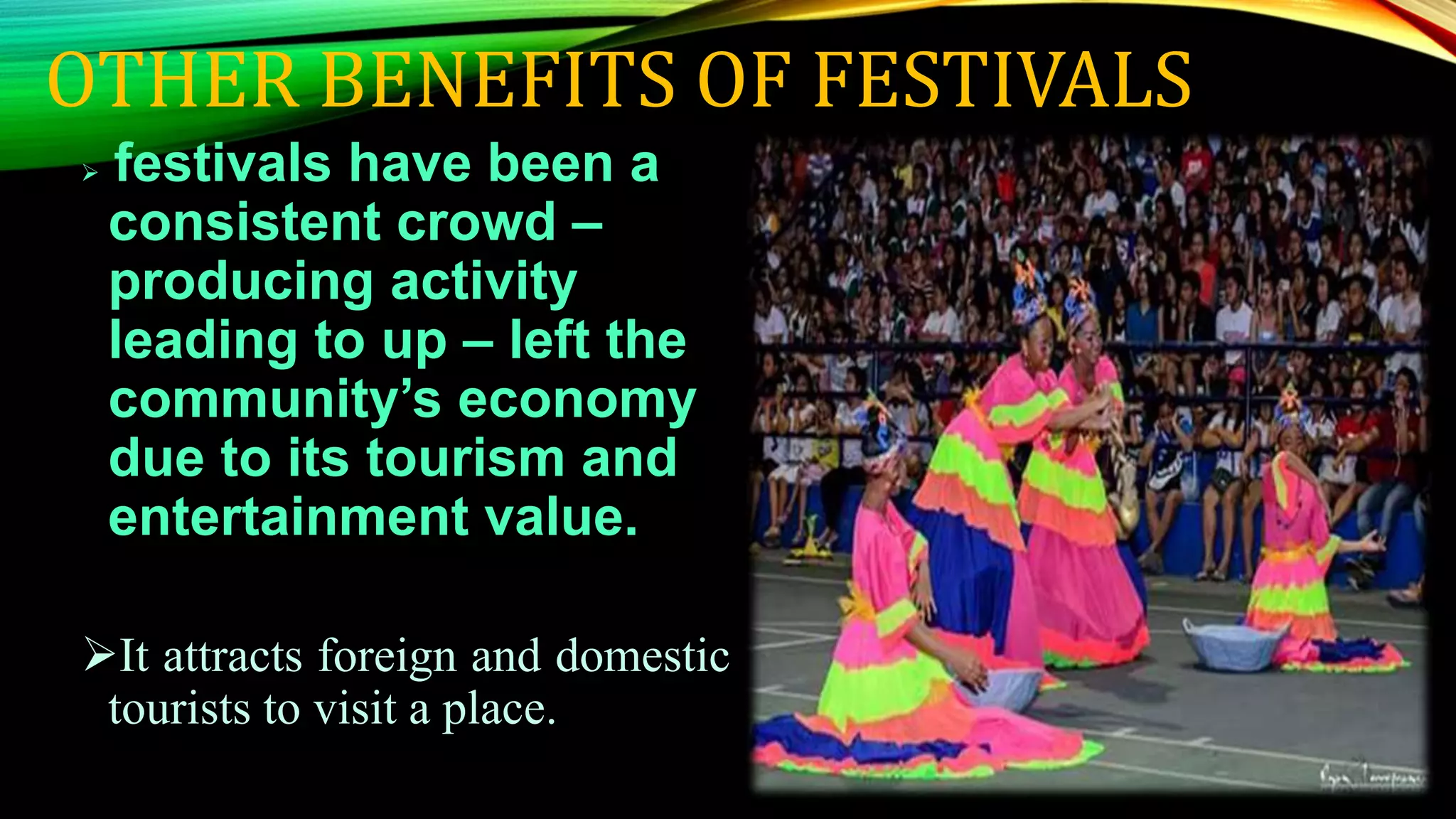
OTHER BENEFITS OF FESTIVALS
 festivals have been a
consistent crowd –
producing activity
leading to up – left the
community’s economy
due to its tourism and
entertainment value.
It attracts foreign and domestic
tourists to visit a place.
EXAMPLES OF DIFFERENT
FESTIVAL DANCES IN THE
PHILIPPINES
NAME OF FESTIVAL PLACE OF ORIGIN RELIGIOUS FIGURE MONTH
CELEBRATED
Sinulog Festival Cebu City Sto.Nino January
Dinagyang Festival Iloilo City Sto. Nino January
Ati-atihan Kalibo, Aklan Sto. Nino January
Penafrancia Bicol Virgin Mary September
Higantes Festival Angono, Rizal Saint Clement November
Longanisa Festival Vigan City, Ilocos Sur Saint Paul January
Kinabayo Festival Dapitan City James the Great July
Pintados de Pasi Passi City, Iloilo Sto Nino March
Pattarradday Santiago City Senor San Tiago May
Sangayaw Festival Tacloban City Sto. Nino July
NAME OF
FESTIVAL
PLACE OF ORIGIN INDUSTRY MONTH
CELEBRATED
Bangus Dagupan, Pangasinan Milkfish Industry April to May
Bambanti Isabela Scarecrow January
Mammangui Iligan Corn Industry May
Mango Iba, Zambales Mango Industry April
Panagbenga Baguio Flower Industry February
Ibon Ebon Pampanga Migratory Birds Egg
Industry
February
Masskara Bacolod City Mask (Sugar
Industry)
October
T’nalak South Cotabato Tinalak Cloth
Weaving
July
Ammungan Nueva Vizcaya Tribal Industries May
Binatbatan Vigan, Ilocos Sur Weaving Industry May
SOME FAMOUS
LOCAL FESTIVAL
SINULOG FESTIVAL Is an annual cultural &
religious festival held on
the 3rd Sunday of January
at Cebu City in honor to
Santo Ñino or the Child
Jesus.
 Sinulog is derived from
the cebuano word
“Sulog” means “flowing
water”.
DINAGYANG FESTIVAL Dinagyang is a
religious & cultural
festival of Iloilo City
held every 4th Sunday
of January.
 The word Dinagyang
is an Ilongggo term for
revelry or merry-
making.
 Dinagyang is Iloilo
HIGANTES FESTIVAL
This is a major festival in honor of San Clemente, the patron saint of
fishermen.
 Celebrated every 23rd of November in the town of Angono, Rizal
The image is carried by male devotees during procession
accompanied by “Pahadores” , devotees dressed in colorful local
costumes or fishermen’s clothes, wearing wooden shoes & carrying
boat paddles, fish nets, traps, etc. and with “Higantes”, paper –mache
giants measuring 10 – 12 feet in height and 4 – 5 in diameter
SOME FAMOUS
SECULAR FESTIVAL
MASSKARA FESTIVALIs an annual festival with
highlights held every 4th
Sunday of October.
The name of the festival is
derived from the word
“Mass” means “crowd” and
“Kara”, a local word that
translated to “face”
Smiling mask was adopted
by the organizers to
dramatize the Negrenses
happy spirit, despite periodic
economic downturns in the
sugar industry.
PANAGBENGA FESTIVAL
Panagbenga festival is a
month-long annual flower
festival occuring in Baguio.
The term is of Kankanaey
origin, meaning “season of
blooming”.
The festival held during the
month of February was
created as a tribute to the
city’s flowers and as a way to
rise up from the devastation
of the 1990 Luzon
earthquake.
FESTIVALIs an annual cultural festival
held on December 1 in Cainta,
Rizal, along the town’s
founding anniversary and
feast of Our Lady of Light.
The name sumbingtik is
derived from the different
town’s delicacies the Suman,
Bibingka, at Latik.
The houses are decorated
with the different delicacies
and the street is highlighted
with the performers using the
different huge props of
sumbingtik.
 ANGONO
 BARAS
 BINANGONAN
 CARDONA
 CAINTA
 JALA – JALA
 MORONG
 PILILLIA
 RODRIGUEZ
 SAN MATEO
 TANAY
 TAY TAY
 TERESA
DIFFERENT LOCAL DANCE FESTIVAL IN
PROVINCE OF RIZAL
 HIGANTES FESTIVAL
 SIKARAN / TURUMBA
 BINALAYAN FESTIVAL
 KALUSKOS BAMBOO ARCH FESTIVAL
 SUMBINGTIK FESTIVAL
 DALAY-DALAY
 PASLIT FESTIVAL
 PAMINTINAN (CAVE OF BERNARDO CARPIO)
 KAKANIN / SOMBRERO AT WALIS FESTIVAL
 HANE / RODEO FESTIVAL
 HAMAKA FESTIVAL
HOW TO CHOREOGRAPH?
1. GETTING STARTED
 Spend some thinking about your routine
 Make a journal or notes of your ideas or
thoughts
 Make time to watch other performances
through :
 videos
 youtube
2. CHOOSE A SONG OR MUSIC
 Finding the right song is either the easiest or
hardest part of choreography.
3. CREATING MOVEMENTS
 Start moving
 When creating your own steps, be sure to
give them names that won’t make it hard to
remember
 Experiment different steps, moves, &
sequences
 Makes sure your dance steps fit the song
 Incorporate props, costume and sounds
•4. PRACTICING, STAGING &
REVISING
 Practice makes perfect
 Practice your routine over & over & over again.
 Be patient with your dancers and remain positive
 Stay flexible and remain open
Stage your piece
 record your practice
 Revise your choreography
 After staging revise your choreography, perfect
the steps and transitions.
 Don’t make too many alterations to the
choreography, this can frustrate your dancers.
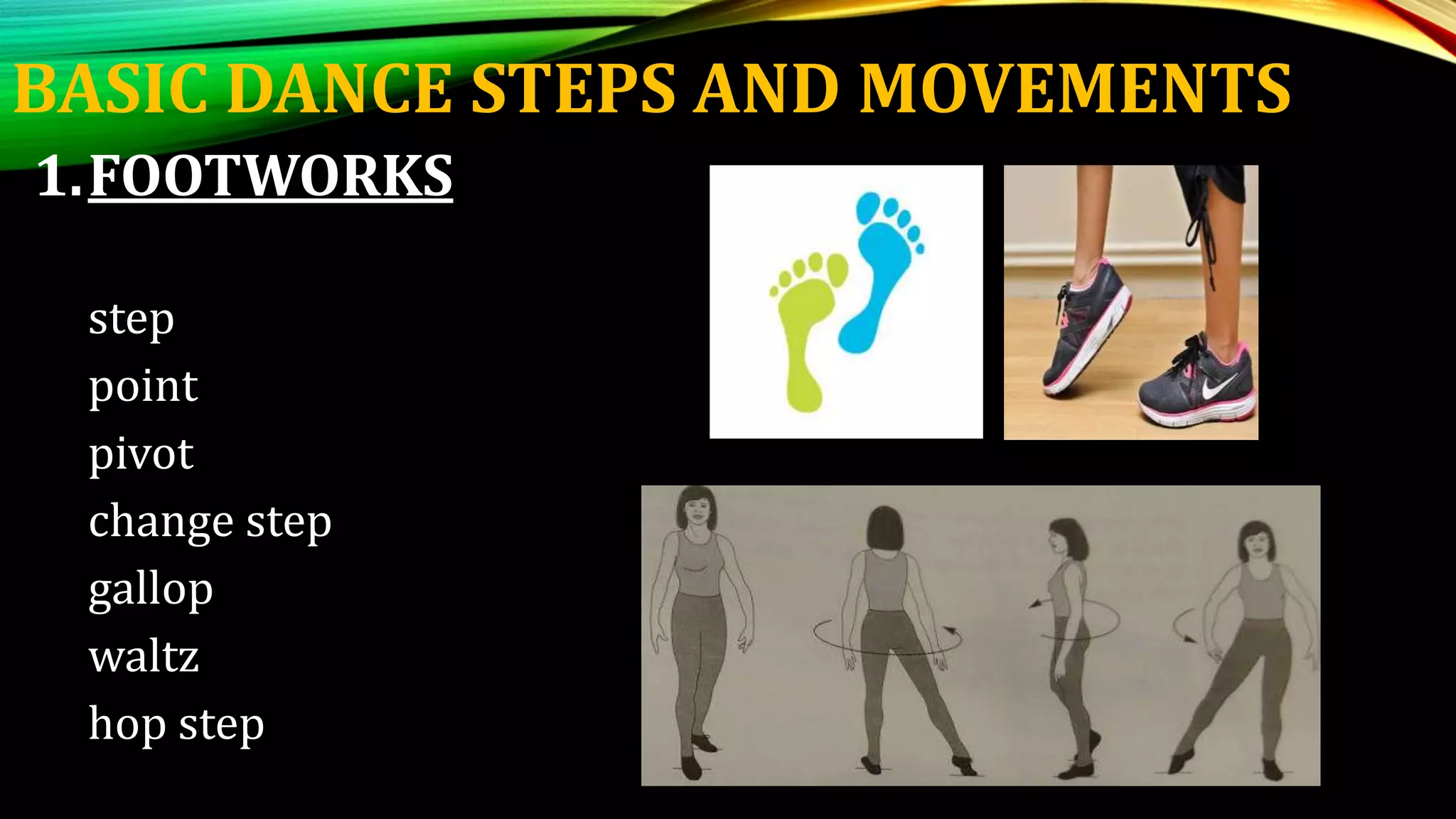
BASIC DANCE STEPS AND MOVEMENTS
1.FOOTWORKS
step
point
pivot
change step
gallop
waltz
hop step
HAND MOVEMENTS
lateral
salok
kumintang
T - position or reverse T position
hayon – hayon
forearm sarok
FESTIVAL DANCE STEPS
1. Sinulog basic dance step
kinampilan
 one step RF forward and one step backward
natural
 Two steps forward and one step backward
2. Masskara dance step
 side step / hop step
 head up and down / sideward / forward /upward
VIDEOS
FESTIVAL DANCES ARE A
REFLECTION OF THE
UNITY OF THE
FILIPINO COMMUNITY
THANK YOU
VERY MUCH!!

Festival DANCE

  • 2.
    JENNY OBILLO DARANG RPFDS MRS.AMIHAN F. FENIS ADVISER RPFDS
  • 3.
  • 4.
    WHAT IS AFESTIVAL?  An annual celebration or anniversary (Google)  An organized set of special events, usually happening in one place in memory of religious event with its own social activities, food, or ceremonies. (American Dictionary)  Is an event ordinarily celebrated by community and centering on some characteristics aspect of that community and its religion or traditions. ( Wikipedia)
  • 5.
    WHAT IS AFESTIVAL DANCE? Is a cultural dance performed to the strong beats by a community of people sharing the same culture usually done in honor of a Patron Saint or in thanksgiving of a bountiful harvest.
  • 6.
    WHAT ARE THE NATUREOF FESTIVAL DANCES? Festival dances may be:  Religious  Secular or Non-Religious
  • 7.
    WHAT IS RELIGIOUSAND SECULAR?  religious, in honor of a certain religious icon  secular or non – religious, thanksgiving or celebration of peoples industry and bountiful harvest
  • 8.
    WHY WE FILIPINOSDO FESTIVALS? •FILIPINOS do festivals primarily to celebrate •We celebrate our unity amidst the diversity of cultures and; •We celebrate our industry bringing about a bountiful harvest.
  • 9.
    OTHER BENEFITS OFFESTIVALS  festivals have been a consistent crowd – producing activity leading to up – left the community’s economy due to its tourism and entertainment value. It attracts foreign and domestic tourists to visit a place.
  • 10.
    EXAMPLES OF DIFFERENT FESTIVALDANCES IN THE PHILIPPINES
  • 11.
    NAME OF FESTIVALPLACE OF ORIGIN RELIGIOUS FIGURE MONTH CELEBRATED Sinulog Festival Cebu City Sto.Nino January Dinagyang Festival Iloilo City Sto. Nino January Ati-atihan Kalibo, Aklan Sto. Nino January Penafrancia Bicol Virgin Mary September Higantes Festival Angono, Rizal Saint Clement November Longanisa Festival Vigan City, Ilocos Sur Saint Paul January Kinabayo Festival Dapitan City James the Great July Pintados de Pasi Passi City, Iloilo Sto Nino March Pattarradday Santiago City Senor San Tiago May Sangayaw Festival Tacloban City Sto. Nino July
  • 12.
    NAME OF FESTIVAL PLACE OFORIGIN INDUSTRY MONTH CELEBRATED Bangus Dagupan, Pangasinan Milkfish Industry April to May Bambanti Isabela Scarecrow January Mammangui Iligan Corn Industry May Mango Iba, Zambales Mango Industry April Panagbenga Baguio Flower Industry February Ibon Ebon Pampanga Migratory Birds Egg Industry February Masskara Bacolod City Mask (Sugar Industry) October T’nalak South Cotabato Tinalak Cloth Weaving July Ammungan Nueva Vizcaya Tribal Industries May Binatbatan Vigan, Ilocos Sur Weaving Industry May
  • 13.
  • 14.
    SINULOG FESTIVAL Isan annual cultural & religious festival held on the 3rd Sunday of January at Cebu City in honor to Santo Ñino or the Child Jesus.  Sinulog is derived from the cebuano word “Sulog” means “flowing water”.
  • 15.
    DINAGYANG FESTIVAL Dinagyangis a religious & cultural festival of Iloilo City held every 4th Sunday of January.  The word Dinagyang is an Ilongggo term for revelry or merry- making.  Dinagyang is Iloilo
  • 16.
    HIGANTES FESTIVAL This isa major festival in honor of San Clemente, the patron saint of fishermen.  Celebrated every 23rd of November in the town of Angono, Rizal The image is carried by male devotees during procession accompanied by “Pahadores” , devotees dressed in colorful local costumes or fishermen’s clothes, wearing wooden shoes & carrying boat paddles, fish nets, traps, etc. and with “Higantes”, paper –mache giants measuring 10 – 12 feet in height and 4 – 5 in diameter
  • 17.
  • 18.
    MASSKARA FESTIVALIs anannual festival with highlights held every 4th Sunday of October. The name of the festival is derived from the word “Mass” means “crowd” and “Kara”, a local word that translated to “face” Smiling mask was adopted by the organizers to dramatize the Negrenses happy spirit, despite periodic economic downturns in the sugar industry.
  • 19.
    PANAGBENGA FESTIVAL Panagbenga festivalis a month-long annual flower festival occuring in Baguio. The term is of Kankanaey origin, meaning “season of blooming”. The festival held during the month of February was created as a tribute to the city’s flowers and as a way to rise up from the devastation of the 1990 Luzon earthquake.
  • 20.
    FESTIVALIs an annualcultural festival held on December 1 in Cainta, Rizal, along the town’s founding anniversary and feast of Our Lady of Light. The name sumbingtik is derived from the different town’s delicacies the Suman, Bibingka, at Latik. The houses are decorated with the different delicacies and the street is highlighted with the performers using the different huge props of sumbingtik.
  • 21.
     ANGONO  BARAS BINANGONAN  CARDONA  CAINTA  JALA – JALA  MORONG  PILILLIA  RODRIGUEZ  SAN MATEO  TANAY  TAY TAY  TERESA DIFFERENT LOCAL DANCE FESTIVAL IN PROVINCE OF RIZAL  HIGANTES FESTIVAL  SIKARAN / TURUMBA  BINALAYAN FESTIVAL  KALUSKOS BAMBOO ARCH FESTIVAL  SUMBINGTIK FESTIVAL  DALAY-DALAY  PASLIT FESTIVAL  PAMINTINAN (CAVE OF BERNARDO CARPIO)  KAKANIN / SOMBRERO AT WALIS FESTIVAL  HANE / RODEO FESTIVAL  HAMAKA FESTIVAL
  • 22.
    HOW TO CHOREOGRAPH? 1.GETTING STARTED  Spend some thinking about your routine  Make a journal or notes of your ideas or thoughts  Make time to watch other performances through :  videos  youtube
  • 23.
    2. CHOOSE ASONG OR MUSIC  Finding the right song is either the easiest or hardest part of choreography. 3. CREATING MOVEMENTS  Start moving  When creating your own steps, be sure to give them names that won’t make it hard to remember  Experiment different steps, moves, & sequences  Makes sure your dance steps fit the song  Incorporate props, costume and sounds
  • 24.
    •4. PRACTICING, STAGING& REVISING  Practice makes perfect  Practice your routine over & over & over again.  Be patient with your dancers and remain positive  Stay flexible and remain open Stage your piece  record your practice  Revise your choreography  After staging revise your choreography, perfect the steps and transitions.  Don’t make too many alterations to the choreography, this can frustrate your dancers.
  • 25.
    BASIC DANCE STEPSAND MOVEMENTS 1.FOOTWORKS step point pivot change step gallop waltz hop step
  • 26.
    HAND MOVEMENTS lateral salok kumintang T -position or reverse T position hayon – hayon forearm sarok
  • 27.
    FESTIVAL DANCE STEPS 1.Sinulog basic dance step kinampilan  one step RF forward and one step backward natural  Two steps forward and one step backward 2. Masskara dance step  side step / hop step  head up and down / sideward / forward /upward
  • 28.
  • 29.
    FESTIVAL DANCES AREA REFLECTION OF THE UNITY OF THE FILIPINO COMMUNITY
  • 30.