MUSIC 10
4th GRADING
20th and 21st Century
Multimedia Forms
Opera
- Part of western classical music
form & tradition
- Started in Italy at the end of the
16th century
- Italians were the most creative
of all
Opera in the PH
- Started at the mid of 19th
century
- Foreign ensembles
performed here in PH
- It exposed Filipinos to their
inner talents
Opera in the PH
- They voiced their sentiments
through opera
- Popular themes are romance,
deceit, murder, vendetta,
human fraility
Opera in the PH
Famous operas brought in
the PH are Lucia di
Lammermoor, La Bohome,
La Traviata, and Aida
Opera in the PH
Local theaters were venues
for the opera like Zorilla,
Principe Alfonso, Variedades,
Quiapo, and Tondo
Opera in the PH
Other Opera venues: Manila
Grand Opera House and
the Metropolitan Theater
(MET)
Opera in the PH
First Filipino Opera Sandugong
Panaginip by Pedo Paterno
(August 2,1902)
English translation
The Dreamed Alliance
Opera in the PH
First Filipino Opera Conductor
= Bonifacio Abdon
First Filipino Opera Impresario = Dr.
Ramon Javier
Opera in the PH
Orchestra Molina was
known for their
interpretation of operatic
works as well as other
classical compositions.
Opera in the PH
Noli Me Tangere and
El Filibusterismo
- Composed by National Artist Felipe
Padilla de Leon
- Presented at CCP Main Theater in
1970 and 1975
Opera in the PH
La Loba Negra
(The Black She-Wolf)
- Music composed by Franciso Feliciano
- Libretto by Fides Cuyugan Asensio
Ballet in the PH
- Dance and ballet interprets
novels, folktales, and stories
- Provides visual excitement
- Only body movements and
facial expressions
Ballet in the PH
- Creative steps and arm gestures
make up for lack of spoken words
or sung lyrics
- Enhanced by costumes, sets,
music, & choreography
Ballet in the PH
- Filipino ballets present folktales
based on local fables
- Example: Lola Basyang,
Ramayana, etc.
Ballet in the PH
- Nutcracker Suite, Swan Lake,
Giselle, and Sleeping Beauty are
adapted by the Filipinos.
Musical Play
- Popular and generally
lighter form of musical
drama than opera
Musical Play
Themes are more
contemporary and musical
melodies more manageable
Musical Play
Acting is less intense and
dramatic; choreography and
dance sequence provides
visual break from plot
Musical Play (Broadway)
- First major Broadway play was
SHOWBOAT
- Others: The King and I, My Fair Lady,
Sound of Music, Camelot, West Side
Story, Miss Saigon, Madame Butterfly,
Beauty and the Beast, Lion King, etc.
Musical Play in the PH
- Adaptation from novels,
literary works, o biographical
sketches of famous artists
Musical Play in the PH
- Andres Bonifacio: Ang Dakilang Anak-Pawis
- Atang – Dulang May Musika
- Katy! The Musical
- Florante at Laura, The Musical
- Daragang Magayon
- Noli Me Tangere, The Musical
- El Filibusterismo, The Musical
- Magsimula Ka, The Musical
ACTIVITY #1
- Choose 1 song from any BROADWAY
MUSICAL, write the lyrics
- Research on the background of the story and
how the ARIA’s lyrics relate to the story
- Record yourself explaining it and post in
MAPEH Americium
ACTIVITY #2 PROJECT
MUSICAL PLAY
- Choose 1 Musical Play/Movie and
perform an excerpt of it in class
- It should last for only 1 period maximum
TARGET DATE: February 5
ARTS 10
4th GRADING
Original Performance
with the Use of Media
Theater
One of the major art form that
brings together all the other art
forms – from painting and
sculpture, to installation art, to
music, to dance, to literature, even
to computer arts – in a single
production
Philippine Theater and
Performing Groups
Interpreted American and
European playwrights and
staged original Philippine
Zarzuelas
Philippine Theater and
Performing Groups
PETA (Philippine Educational Theater
Association); founded in 1967 by
Cecile Guidote-Alvarez
Philippine Theater and
Performing Groups
Tanghalang Pilipino, resident theater
company of the Cultural Center of the
Philippines, founded in 1987
Philippine Theater and
Performing Groups
Repertory Philippines
Trumpets
New Voice Company
Theater Down South
Philippine Opera Company
Roles in a Stage Production
Producer
Director
Playwright
Set Designer
Lighting Designer
Costume Designer
Sound Designer
Production Manager
Technical Director
Choreographer
Makeup Designer
PRODUCER
- Mere concept to an actual finished
presentation
- Creates the team
- Decides on major logistical matters,
production schedule, and other major
issues
DIRECTOR
- Over-all artistic coordinator of the
entire production
- Has a vision of the desired total effect
and impact
- Instructs and guides the actors
(dialogues, blocking, thought &
feelings, facial expression, gestures)
PLAYWRIGHT
- Writer of a script for stage
performance
- Script forms the basis of the entire
production
- Director collaborates on making
adjustments
SET DESIGNER
- Conceptualize and creates the physical
setup
- Builds the set/s and make it realistic
and appropriate for the scenes
LIGHTING DESIGNER
- Coordinates closely with the set
designer
- Creates the mood of each scene,
highlighting events, signaling
entrances, focusing attention, and
providing blanket of darkness for set
and prop change
COSTUME DESIGNER
- They study the general setting that the
play is meant to take place in, as well
as each character in the script
- Costumes maybe sewn or assembled
with additional touches
SOUND DESIGNER
- Creates and enhances the atmosphere
of the performance
- Includes music both on stage and as
background, which should suit the
general time and place of the play
- Also includes special sound effects
PRODUCTION MANAGER
- Coordinates all the complex behind-the-
scenes details of staging a play
- Tasked with overseeing the crews for the sets
and props, sound and music, lighting, and
costumes
- Includes ensuring that all the needed
elements, facilities, and equipment is
available and in good working condition
TECHNICAL DIRECTOR
- Shadows the play’s director
throughout the entire production
process
- Carefully notes each actor and every
member of the stage, sound, lighting,
and costume crews need to be
coordinated to bring the director’s
vision to life
CHOREOGRAPHER
- When dances are involved in certain
scenes, a choreographer is needed
- Plans the dance steps and rehearses
the actors
- Also during fight scenes
MAKEUP DESIGNER
- Plan the hairstyles and makeup to
complement the costumes
- Transform actors into mythical
creatures, animals, a different
nationality, or futuristic beings
PE 10
4th GRADING
Other Dance Forms
(Cheerdance &
Contemporary
Dance)
Review:
BODY MASS INDEX and
WEIGHT MANAGEMENT
BMI & WEIGHT Management
“Obesiogenic” – Western culture of
excessive intake of unhealthy, high-
calorie food coupled with physical
inactivity
(a tendency to have a fat citizenry)
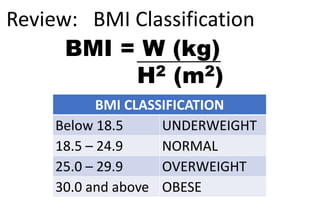
Review: BMI Classification
BMI CLASSIFICATION
Below 18.5 UNDERWEIGHT
18.5 – 24.9 NORMAL
25.0 – 29.9 OVERWEIGHT
30.0 and above OBESE
BMI = W (kg)
H2 (m2)
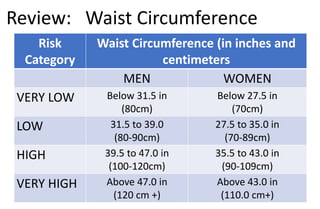
Review: Waist Circumference
Risk
Category
Waist Circumference (in inches and
centimeters
MEN WOMEN
VERY LOW Below 31.5 in
(80cm)
Below 27.5 in
(70cm)
LOW 31.5 to 39.0
(80-90cm)
27.5 to 35.0 in
(70-89cm)
HIGH 39.5 to 47.0 in
(100-120cm)
35.5 to 43.0 in
(90-109cm)
VERY HIGH Above 47.0 in
(120 cm +)
Above 43.0 in
(110.0 cm+)
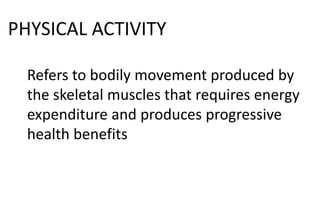
PHYSICAL ACTIVITY
Refers to bodily movement produced by
the skeletal muscles that requires energy
expenditure and produces progressive
health benefits
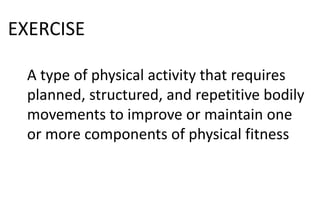
EXERCISE
A type of physical activity that requires
planned, structured, and repetitive bodily
movements to improve or maintain one
or more components of physical fitness
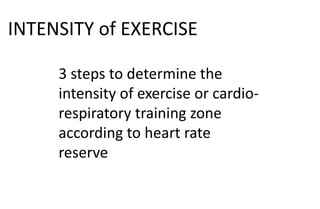
INTENSITY of EXERCISE
3 steps to determine the
intensity of exercise or cardio-
respiratory training zone
according to heart rate
reserve
INTENSITY of EXERCISE
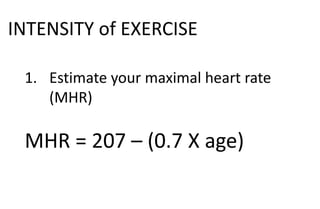
1. Estimate your maximal heart rate
(MHR)
MHR = 207 – (0.7 X age)
INTENSITY of EXERCISE
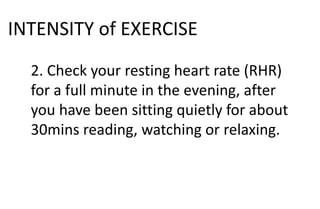
2. Check your resting heart rate (RHR)
for a full minute in the evening, after
you have been sitting quietly for about
30mins reading, watching or relaxing.
INTENSITY of EXERCISE
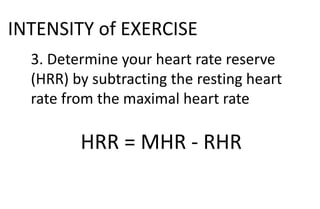
3. Determine your heart rate reserve
(HRR) by subtracting the resting heart
rate from the maximal heart rate
HRR = MHR - RHR
INTENSITY of EXERCISE
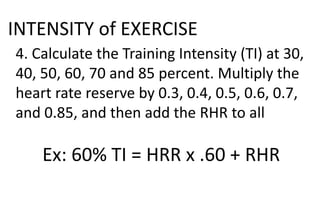
4. Calculate the Training Intensity (TI) at 30,
40, 50, 60, 70 and 85 percent. Multiply the
heart rate reserve by 0.3, 0.4, 0.5, 0.6, 0.7,
and 0.85, and then add the RHR to all
Ex: 60% TI = HRR x .60 + RHR
INTENSITY of EXERCISE
ACTIVITY
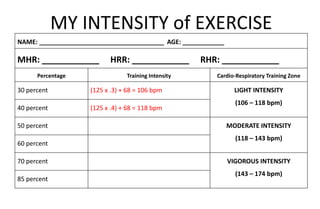
MY INTENSITY of EXERCISE
NAME: ____________________________________ AGE: ____________
MHR: ____________ HRR: ____________ RHR: ____________
Percentage Training Intensity Cardio-Respiratory Training Zone
30 percent (125 x .3) + 68 = 106 bpm LIGHT INTENSITY
(106 – 118 bpm)
40 percent (125 x .4) + 68 = 118 bpm
50 percent MODERATE INTENSITY
(118 – 143 bpm)
60 percent
70 percent VIGOROUS INTENSITY
(143 – 174 bpm)
85 percent
Review:
COMMON INJURIES and
FIRST AID INVOLVED in
RECREATION
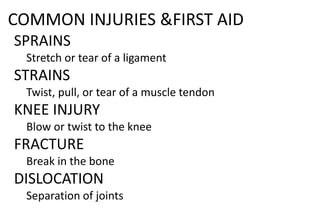
COMMON INJURIES &FIRST AID
SPRAINS
Stretch or tear of a ligament
STRAINS
Twist, pull, or tear of a muscle tendon
KNEE INJURY
Blow or twist to the knee
FRACTURE
Break in the bone
DISLOCATION
Separation of joints
COMMON INJURIES &FIRST AID
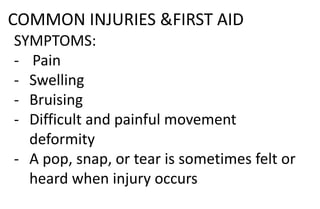
SYMPTOMS:
- Pain
- Swelling
- Bruising
- Difficult and painful movement
deformity
- A pop, snap, or tear is sometimes felt or
heard when injury occurs
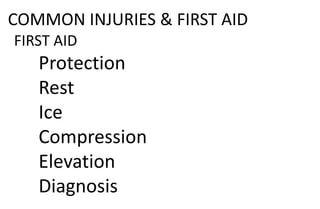
COMMON INJURIES & FIRST AID
FIRST AID
Protection
Rest
Ice
Compression
Elevation
Diagnosis
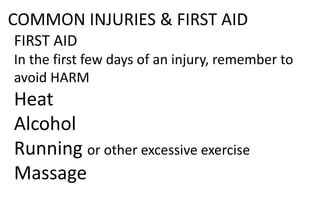
COMMON INJURIES & FIRST AID
FIRST AID
In the first few days of an injury, remember to
avoid HARM
Heat
Alcohol
Running or other excessive exercise
Massage
Review:
CHEERDANCE
CHEERDANCE
Coined from the words, cheer and dance
CHEER = to shout out words or phrases that
motivate and boost morale of a team
DANCE = physical activity that expresses
emotions or gestures while performing bodily
movements with rhythm
CHEERDANCING rooted from
CHEERLEADING
CHEERLEADING is the performance of a
routine, usually dominated by gymnastic skills
such as jumps, tumbling skills, lifts, tosses
combined with shouting of cheers and yells to
lead the crowd to cheer for a certain team
during a game or sport
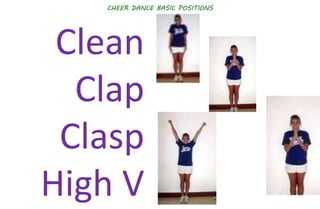
CHEER DANCE BASIC POSITIONS
Clean
Clap
Clasp
High V
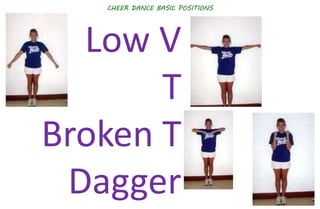
CHEER DANCE BASIC POSITIONS
Low V
T
Broken T
Dagger
CHEER DANCE BASIC POSITIONS
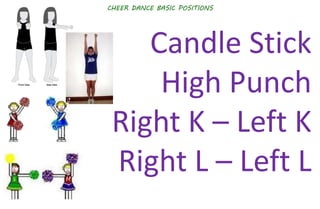
Candle Stick
High Punch
Right K – Left K
Right L – Left L
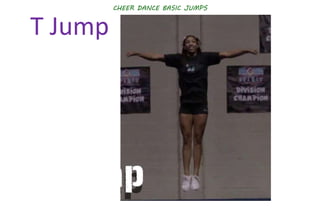
CHEER DANCE BASIC JUMPS
T Jump
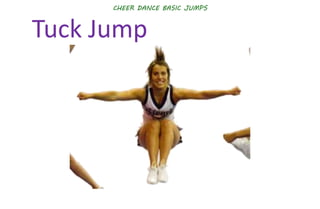
CHEER DANCE BASIC JUMPS
Tuck Jump
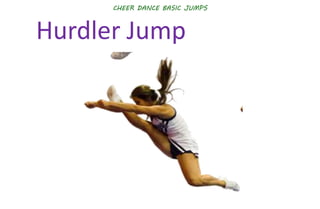
CHEER DANCE BASIC JUMPS
Hurdler Jump
CHEER DANCE BASIC JUMPS
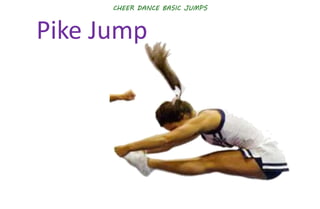
Pike Jump
CHEER DANCE BASIC JUMPS
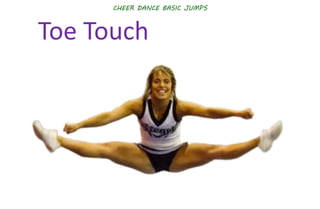
Toe Touch
Review:
NUTRITION for BETTER
HEALTH and FITNESS
NUTRIENT NEEDS
It includes Carbohydrates, Proteins, Fats,
Vitamins, Minerals, and Water.
MACRO = Carbo, Protein, Fats
MICRO = Vitamins and Minerals
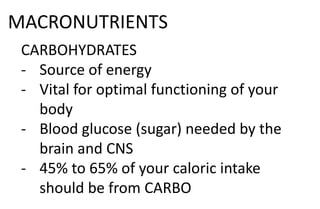
MACRONUTRIENTS
CARBOHYDRATES
- Source of energy
- Vital for optimal functioning of your
body
- Blood glucose (sugar) needed by the
brain and CNS
- 45% to 65% of your caloric intake
should be from CARBO
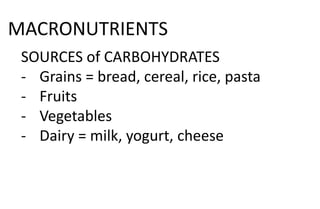
MACRONUTRIENTS
SOURCES of CARBOHYDRATES
- Grains = bread, cereal, rice, pasta
- Fruits
- Vegetables
- Dairy = milk, yogurt, cheese
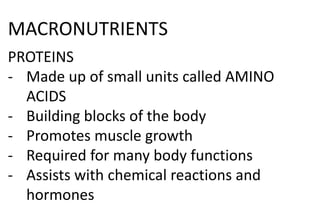
MACRONUTRIENTS
PROTEINS
- Made up of small units called AMINO
ACIDS
- Building blocks of the body
- Promotes muscle growth
- Required for many body functions
- Assists with chemical reactions and
hormones
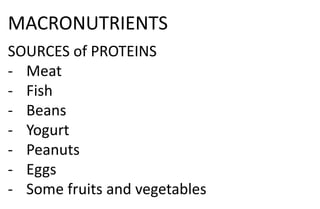
MACRONUTRIENTS
SOURCES of PROTEINS
- Meat
- Fish
- Beans
- Yogurt
- Peanuts
- Eggs
- Some fruits and vegetables
MACRONUTRIENTS
PROTEINS
- 10% to 15% of your calorie intake
- It can be increased for athletes and may
vary depending on the sport, intensity
and frequency of workout, and how
experienced the athlete is
MACRONUTRIENTS
FATS
- Also called lipids, provided in the diet
from such sources like animal protein,
butter, oils, nuts, and many refined
products
- Needed in appropriate amounts for
normal body functions
MACRONUTRIENTS
FATS
- Less than 10% of your calorie intake
- Saturated fats, monounsaturated fats, and
polyunsaturated fats
- Transfat, naturally found in some animal
products but also a result of
HYDROGENATION
MACRONUTRIENTS
HYDROGENATION
- Changes the structure of fat to make it
more stable but as a result produces
more saturated fats (solid at room
temperature)
- To increase the shelf life of product
MICRONUTRIENTS
VITAMINS
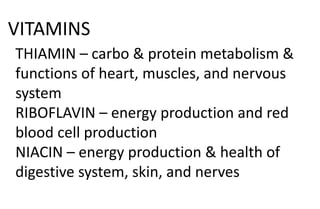
VITAMINS
THIAMIN – carbo & protein metabolism &
functions of heart, muscles, and nervous
system
RIBOFLAVIN – energy production and red
blood cell production
NIACIN – energy production & health of
digestive system, skin, and nerves
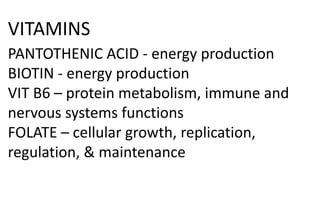
VITAMINS
PANTOTHENIC ACID - energy production
BIOTIN - energy production
VIT B6 – protein metabolism, immune and
nervous systems functions
FOLATE – cellular growth, replication,
regulation, & maintenance
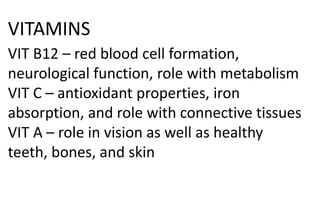
VITAMINS
VIT B12 – red blood cell formation,
neurological function, role with metabolism
VIT C – antioxidant properties, iron
absorption, and role with connective tissues
VIT A – role in vision as well as healthy
teeth, bones, and skin
VITAMINS
VIT D – calcium absorption and for bone
growth and remodeling
VIT E – antioxidant properties & important
role in immune function
VIT K – role in blood clotting
MINERALS
CALCIUM – bone growth and maintenance,
muscular contractions, cardiovascular &
nervous system functions, hormone &
enzyme secretion
IRON – major role in oxygen transports in
the blood
MINERALS
ZINC – major role in energy production,
immune function, and healing of wound
CHROMIUM – enhances the function of
insulin and involved with metabolism of fat
and carbohydrates
MINERALS
MAGNESIUM – major role in proper muscle
and nerve function
SELENIUM – helps with antioxidant function
to prevent cellular damage
COPPER – role in the formulation of red
blood cells as well as healthy blood vessels,
nerves, immune system, and bones
MINERALS
IODINE – major role in metabolism of cells
and in normal thyroid function
PHOSPHORUS – formulation of bones and
teeth, also involved in the utilization of fats,
carbo, and protein for growth &
maintenance of cells, and for energy
production
WATER
- Required nutrient for all human being
- Valuable for disease prevention
- Important for hydration
- Not only from drinking but as well as
from food
WATER
- Required nutrient for all human being
- Valuable for disease prevention
- Important for hydration
- Not only from drinking but as well as
from food
WATER
- EUHYDRATED (balanced) estate
- DRI (Daily Recommended Intake) of
water
MEN = 3.7 liters
WOMEN= 2.7 liters
- WATER BALANCE = replacing water lost
from sweating & urinating
ENERGY BALANCE
- Compares the amount of energy
consumed as food with the amount of
energy expended through metabolism,
daily activities, and voluntary physical
exercise
ENERGY BALANCE
POSITIVE EB = when you consume more
energy than you expend (WEIGHT GAIN)
NEGATIVE EB = when you expend more
calories than you consume (WEIGHT LOSS)
NEUTRAL EB = equal
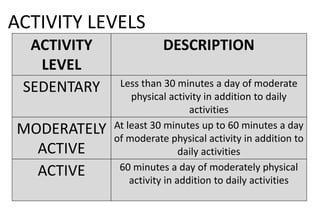
ACTIVITY LEVELS
ACTIVITY
LEVEL
DESCRIPTION
SEDENTARY Less than 30 minutes a day of moderate
physical activity in addition to daily
activities
MODERATELY
ACTIVE
At least 30 minutes up to 60 minutes a day
of moderate physical activity in addition to
daily activities
ACTIVE 60 minutes a day of moderately physical
activity in addition to daily activities
HEALTH 10
4th GRADING
Other Dance Forms
(Cheerdance &
Contemporary
Dance)
Review:
BODY MASS INDEX and
WEIGHT MANAGEMENT

Music10 4th grading

  • 1.
  • 2.
    20th and 21stCentury Multimedia Forms
  • 3.
    Opera - Part ofwestern classical music form & tradition - Started in Italy at the end of the 16th century - Italians were the most creative of all
  • 4.
    Opera in thePH - Started at the mid of 19th century - Foreign ensembles performed here in PH - It exposed Filipinos to their inner talents
  • 5.
    Opera in thePH - They voiced their sentiments through opera - Popular themes are romance, deceit, murder, vendetta, human fraility
  • 6.
    Opera in thePH Famous operas brought in the PH are Lucia di Lammermoor, La Bohome, La Traviata, and Aida
  • 7.
    Opera in thePH Local theaters were venues for the opera like Zorilla, Principe Alfonso, Variedades, Quiapo, and Tondo
  • 8.
    Opera in thePH Other Opera venues: Manila Grand Opera House and the Metropolitan Theater (MET)
  • 9.
    Opera in thePH First Filipino Opera Sandugong Panaginip by Pedo Paterno (August 2,1902) English translation The Dreamed Alliance
  • 10.
    Opera in thePH First Filipino Opera Conductor = Bonifacio Abdon First Filipino Opera Impresario = Dr. Ramon Javier
  • 11.
    Opera in thePH Orchestra Molina was known for their interpretation of operatic works as well as other classical compositions.
  • 12.
    Opera in thePH Noli Me Tangere and El Filibusterismo - Composed by National Artist Felipe Padilla de Leon - Presented at CCP Main Theater in 1970 and 1975
  • 13.
    Opera in thePH La Loba Negra (The Black She-Wolf) - Music composed by Franciso Feliciano - Libretto by Fides Cuyugan Asensio
  • 14.
    Ballet in thePH - Dance and ballet interprets novels, folktales, and stories - Provides visual excitement - Only body movements and facial expressions
  • 15.
    Ballet in thePH - Creative steps and arm gestures make up for lack of spoken words or sung lyrics - Enhanced by costumes, sets, music, & choreography
  • 16.
    Ballet in thePH - Filipino ballets present folktales based on local fables - Example: Lola Basyang, Ramayana, etc.
  • 17.
    Ballet in thePH - Nutcracker Suite, Swan Lake, Giselle, and Sleeping Beauty are adapted by the Filipinos.
  • 18.
    Musical Play - Popularand generally lighter form of musical drama than opera
  • 19.
    Musical Play Themes aremore contemporary and musical melodies more manageable
  • 20.
    Musical Play Acting isless intense and dramatic; choreography and dance sequence provides visual break from plot
  • 21.
    Musical Play (Broadway) -First major Broadway play was SHOWBOAT - Others: The King and I, My Fair Lady, Sound of Music, Camelot, West Side Story, Miss Saigon, Madame Butterfly, Beauty and the Beast, Lion King, etc.
  • 22.
    Musical Play inthe PH - Adaptation from novels, literary works, o biographical sketches of famous artists
  • 23.
    Musical Play inthe PH - Andres Bonifacio: Ang Dakilang Anak-Pawis - Atang – Dulang May Musika - Katy! The Musical - Florante at Laura, The Musical - Daragang Magayon - Noli Me Tangere, The Musical - El Filibusterismo, The Musical - Magsimula Ka, The Musical
  • 24.
    ACTIVITY #1 - Choose1 song from any BROADWAY MUSICAL, write the lyrics - Research on the background of the story and how the ARIA’s lyrics relate to the story - Record yourself explaining it and post in MAPEH Americium
  • 25.
    ACTIVITY #2 PROJECT MUSICALPLAY - Choose 1 Musical Play/Movie and perform an excerpt of it in class - It should last for only 1 period maximum TARGET DATE: February 5
  • 26.
  • 27.
  • 28.
    Theater One of themajor art form that brings together all the other art forms – from painting and sculpture, to installation art, to music, to dance, to literature, even to computer arts – in a single production
  • 29.
    Philippine Theater and PerformingGroups Interpreted American and European playwrights and staged original Philippine Zarzuelas
  • 30.
    Philippine Theater and PerformingGroups PETA (Philippine Educational Theater Association); founded in 1967 by Cecile Guidote-Alvarez
  • 31.
    Philippine Theater and PerformingGroups Tanghalang Pilipino, resident theater company of the Cultural Center of the Philippines, founded in 1987
  • 32.
    Philippine Theater and PerformingGroups Repertory Philippines Trumpets New Voice Company Theater Down South Philippine Opera Company
  • 33.
    Roles in aStage Production Producer Director Playwright Set Designer Lighting Designer Costume Designer Sound Designer Production Manager Technical Director Choreographer Makeup Designer
  • 34.
    PRODUCER - Mere conceptto an actual finished presentation - Creates the team - Decides on major logistical matters, production schedule, and other major issues
  • 35.
    DIRECTOR - Over-all artisticcoordinator of the entire production - Has a vision of the desired total effect and impact - Instructs and guides the actors (dialogues, blocking, thought & feelings, facial expression, gestures)
  • 36.
    PLAYWRIGHT - Writer ofa script for stage performance - Script forms the basis of the entire production - Director collaborates on making adjustments
  • 37.
    SET DESIGNER - Conceptualizeand creates the physical setup - Builds the set/s and make it realistic and appropriate for the scenes
  • 38.
    LIGHTING DESIGNER - Coordinatesclosely with the set designer - Creates the mood of each scene, highlighting events, signaling entrances, focusing attention, and providing blanket of darkness for set and prop change
  • 39.
    COSTUME DESIGNER - Theystudy the general setting that the play is meant to take place in, as well as each character in the script - Costumes maybe sewn or assembled with additional touches
  • 40.
    SOUND DESIGNER - Createsand enhances the atmosphere of the performance - Includes music both on stage and as background, which should suit the general time and place of the play - Also includes special sound effects
  • 41.
    PRODUCTION MANAGER - Coordinatesall the complex behind-the- scenes details of staging a play - Tasked with overseeing the crews for the sets and props, sound and music, lighting, and costumes - Includes ensuring that all the needed elements, facilities, and equipment is available and in good working condition
  • 42.
    TECHNICAL DIRECTOR - Shadowsthe play’s director throughout the entire production process - Carefully notes each actor and every member of the stage, sound, lighting, and costume crews need to be coordinated to bring the director’s vision to life
  • 43.
    CHOREOGRAPHER - When dancesare involved in certain scenes, a choreographer is needed - Plans the dance steps and rehearses the actors - Also during fight scenes
  • 44.
    MAKEUP DESIGNER - Planthe hairstyles and makeup to complement the costumes - Transform actors into mythical creatures, animals, a different nationality, or futuristic beings
  • 45.
  • 46.
    Other Dance Forms (Cheerdance& Contemporary Dance)
  • 47.
    Review: BODY MASS INDEXand WEIGHT MANAGEMENT
  • 48.
    BMI & WEIGHTManagement “Obesiogenic” – Western culture of excessive intake of unhealthy, high- calorie food coupled with physical inactivity (a tendency to have a fat citizenry)
  • 49.
    Review: BMI Classification BMICLASSIFICATION Below 18.5 UNDERWEIGHT 18.5 – 24.9 NORMAL 25.0 – 29.9 OVERWEIGHT 30.0 and above OBESE BMI = W (kg) H2 (m2)
  • 50.
    Review: Waist Circumference Risk Category WaistCircumference (in inches and centimeters MEN WOMEN VERY LOW Below 31.5 in (80cm) Below 27.5 in (70cm) LOW 31.5 to 39.0 (80-90cm) 27.5 to 35.0 in (70-89cm) HIGH 39.5 to 47.0 in (100-120cm) 35.5 to 43.0 in (90-109cm) VERY HIGH Above 47.0 in (120 cm +) Above 43.0 in (110.0 cm+)
  • 51.
    PHYSICAL ACTIVITY Refers tobodily movement produced by the skeletal muscles that requires energy expenditure and produces progressive health benefits
  • 52.
    EXERCISE A type ofphysical activity that requires planned, structured, and repetitive bodily movements to improve or maintain one or more components of physical fitness
  • 53.
    INTENSITY of EXERCISE 3steps to determine the intensity of exercise or cardio- respiratory training zone according to heart rate reserve
  • 54.
    INTENSITY of EXERCISE 1.Estimate your maximal heart rate (MHR) MHR = 207 – (0.7 X age)
  • 55.
    INTENSITY of EXERCISE 2.Check your resting heart rate (RHR) for a full minute in the evening, after you have been sitting quietly for about 30mins reading, watching or relaxing.
  • 56.
    INTENSITY of EXERCISE 3.Determine your heart rate reserve (HRR) by subtracting the resting heart rate from the maximal heart rate HRR = MHR - RHR
  • 57.
    INTENSITY of EXERCISE 4.Calculate the Training Intensity (TI) at 30, 40, 50, 60, 70 and 85 percent. Multiply the heart rate reserve by 0.3, 0.4, 0.5, 0.6, 0.7, and 0.85, and then add the RHR to all Ex: 60% TI = HRR x .60 + RHR
  • 58.
  • 59.
    MY INTENSITY ofEXERCISE NAME: ____________________________________ AGE: ____________ MHR: ____________ HRR: ____________ RHR: ____________ Percentage Training Intensity Cardio-Respiratory Training Zone 30 percent (125 x .3) + 68 = 106 bpm LIGHT INTENSITY (106 – 118 bpm) 40 percent (125 x .4) + 68 = 118 bpm 50 percent MODERATE INTENSITY (118 – 143 bpm) 60 percent 70 percent VIGOROUS INTENSITY (143 – 174 bpm) 85 percent
  • 60.
    Review: COMMON INJURIES and FIRSTAID INVOLVED in RECREATION
  • 61.
    COMMON INJURIES &FIRSTAID SPRAINS Stretch or tear of a ligament STRAINS Twist, pull, or tear of a muscle tendon KNEE INJURY Blow or twist to the knee FRACTURE Break in the bone DISLOCATION Separation of joints
  • 62.
    COMMON INJURIES &FIRSTAID SYMPTOMS: - Pain - Swelling - Bruising - Difficult and painful movement deformity - A pop, snap, or tear is sometimes felt or heard when injury occurs
  • 63.
    COMMON INJURIES &FIRST AID FIRST AID Protection Rest Ice Compression Elevation Diagnosis
  • 64.
    COMMON INJURIES &FIRST AID FIRST AID In the first few days of an injury, remember to avoid HARM Heat Alcohol Running or other excessive exercise Massage
  • 65.
  • 66.
    CHEERDANCE Coined from thewords, cheer and dance CHEER = to shout out words or phrases that motivate and boost morale of a team DANCE = physical activity that expresses emotions or gestures while performing bodily movements with rhythm
  • 67.
    CHEERDANCING rooted from CHEERLEADING CHEERLEADINGis the performance of a routine, usually dominated by gymnastic skills such as jumps, tumbling skills, lifts, tosses combined with shouting of cheers and yells to lead the crowd to cheer for a certain team during a game or sport
  • 68.
    CHEER DANCE BASICPOSITIONS Clean Clap Clasp High V
  • 69.
    CHEER DANCE BASICPOSITIONS Low V T Broken T Dagger
  • 70.
    CHEER DANCE BASICPOSITIONS Candle Stick High Punch Right K – Left K Right L – Left L
  • 71.
    CHEER DANCE BASICJUMPS T Jump
  • 72.
    CHEER DANCE BASICJUMPS Tuck Jump
  • 73.
    CHEER DANCE BASICJUMPS Hurdler Jump
  • 74.
    CHEER DANCE BASICJUMPS Pike Jump
  • 75.
    CHEER DANCE BASICJUMPS Toe Touch
  • 76.
  • 77.
    NUTRIENT NEEDS It includesCarbohydrates, Proteins, Fats, Vitamins, Minerals, and Water. MACRO = Carbo, Protein, Fats MICRO = Vitamins and Minerals
  • 78.
    MACRONUTRIENTS CARBOHYDRATES - Source ofenergy - Vital for optimal functioning of your body - Blood glucose (sugar) needed by the brain and CNS - 45% to 65% of your caloric intake should be from CARBO
  • 79.
    MACRONUTRIENTS SOURCES of CARBOHYDRATES -Grains = bread, cereal, rice, pasta - Fruits - Vegetables - Dairy = milk, yogurt, cheese
  • 80.
    MACRONUTRIENTS PROTEINS - Made upof small units called AMINO ACIDS - Building blocks of the body - Promotes muscle growth - Required for many body functions - Assists with chemical reactions and hormones
  • 81.
    MACRONUTRIENTS SOURCES of PROTEINS -Meat - Fish - Beans - Yogurt - Peanuts - Eggs - Some fruits and vegetables
  • 82.
    MACRONUTRIENTS PROTEINS - 10% to15% of your calorie intake - It can be increased for athletes and may vary depending on the sport, intensity and frequency of workout, and how experienced the athlete is
  • 83.
    MACRONUTRIENTS FATS - Also calledlipids, provided in the diet from such sources like animal protein, butter, oils, nuts, and many refined products - Needed in appropriate amounts for normal body functions
  • 84.
    MACRONUTRIENTS FATS - Less than10% of your calorie intake - Saturated fats, monounsaturated fats, and polyunsaturated fats - Transfat, naturally found in some animal products but also a result of HYDROGENATION
  • 85.
    MACRONUTRIENTS HYDROGENATION - Changes thestructure of fat to make it more stable but as a result produces more saturated fats (solid at room temperature) - To increase the shelf life of product
  • 86.
  • 87.
    VITAMINS THIAMIN – carbo& protein metabolism & functions of heart, muscles, and nervous system RIBOFLAVIN – energy production and red blood cell production NIACIN – energy production & health of digestive system, skin, and nerves
  • 88.
    VITAMINS PANTOTHENIC ACID -energy production BIOTIN - energy production VIT B6 – protein metabolism, immune and nervous systems functions FOLATE – cellular growth, replication, regulation, & maintenance
  • 89.
    VITAMINS VIT B12 –red blood cell formation, neurological function, role with metabolism VIT C – antioxidant properties, iron absorption, and role with connective tissues VIT A – role in vision as well as healthy teeth, bones, and skin
  • 90.
    VITAMINS VIT D –calcium absorption and for bone growth and remodeling VIT E – antioxidant properties & important role in immune function VIT K – role in blood clotting
  • 91.
    MINERALS CALCIUM – bonegrowth and maintenance, muscular contractions, cardiovascular & nervous system functions, hormone & enzyme secretion IRON – major role in oxygen transports in the blood
  • 92.
    MINERALS ZINC – majorrole in energy production, immune function, and healing of wound CHROMIUM – enhances the function of insulin and involved with metabolism of fat and carbohydrates
  • 93.
    MINERALS MAGNESIUM – majorrole in proper muscle and nerve function SELENIUM – helps with antioxidant function to prevent cellular damage COPPER – role in the formulation of red blood cells as well as healthy blood vessels, nerves, immune system, and bones
  • 94.
    MINERALS IODINE – majorrole in metabolism of cells and in normal thyroid function PHOSPHORUS – formulation of bones and teeth, also involved in the utilization of fats, carbo, and protein for growth & maintenance of cells, and for energy production
  • 95.
    WATER - Required nutrientfor all human being - Valuable for disease prevention - Important for hydration - Not only from drinking but as well as from food
  • 96.
    WATER - Required nutrientfor all human being - Valuable for disease prevention - Important for hydration - Not only from drinking but as well as from food
  • 97.
    WATER - EUHYDRATED (balanced)estate - DRI (Daily Recommended Intake) of water MEN = 3.7 liters WOMEN= 2.7 liters - WATER BALANCE = replacing water lost from sweating & urinating
  • 98.
    ENERGY BALANCE - Comparesthe amount of energy consumed as food with the amount of energy expended through metabolism, daily activities, and voluntary physical exercise
  • 99.
    ENERGY BALANCE POSITIVE EB= when you consume more energy than you expend (WEIGHT GAIN) NEGATIVE EB = when you expend more calories than you consume (WEIGHT LOSS) NEUTRAL EB = equal
  • 100.
    ACTIVITY LEVELS ACTIVITY LEVEL DESCRIPTION SEDENTARY Lessthan 30 minutes a day of moderate physical activity in addition to daily activities MODERATELY ACTIVE At least 30 minutes up to 60 minutes a day of moderate physical activity in addition to daily activities ACTIVE 60 minutes a day of moderately physical activity in addition to daily activities
  • 101.
  • 102.
    Other Dance Forms (Cheerdance& Contemporary Dance)
  • 103.
    Review: BODY MASS INDEXand WEIGHT MANAGEMENT