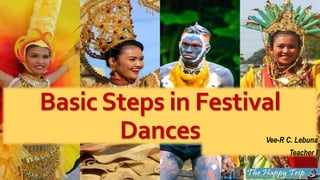
Basic Steps in Festival
Dances Vee-R C. Lebuna
Teacher I
Activity 1
“Raise Me Up!”
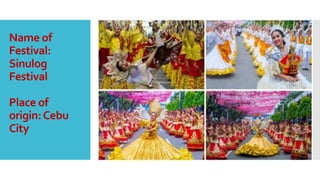
Name of
Festival:
Sinulog
Festival
Place of
origin:Cebu
City
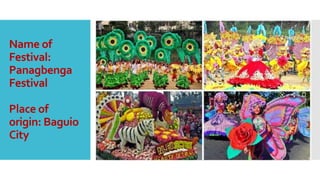
Name of
Festival:
Panagbenga
Festival
Place of
origin: Baguio
City
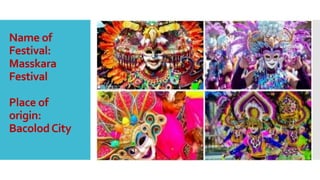
Name of
Festival:
Masskara
Festival
Place of
origin:
BacolodCity
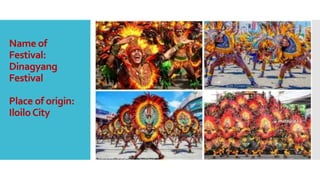
Name of
Festival:
Dinagyang
Festival
Place of origin:
IloiloCity
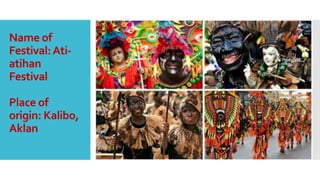
Name of
Festival:Ati-
atihan
Festival
Place of
origin: Kalibo,
Aklan
Specific Learning
Objectives:
Identify the basic dance
steps in Festival dances.
Perform the basic dance
steps in Festival dances.
Appreciate the importance
of Festival dances in this
time of pandemic.
Activity 2
“Watch Me”
FITNESS-
Basic
Movements
of Festival
Dance
Locomotor Movements
•movements that allow you to
move from one point in space
to another
canned from two words,
“locos” which means place
and “motor” which means
movement
Preparatory
movement
Step -This is the basis of all locomotor
movements. It prepares you to move in any
direction you wish to go. It is defined as
transfer of weight from one foot to the
other.
Walk - Series of steps executed by both of
your feet alternately in any direction. In
executing a walk, observe that there’s this
moment when both feet are in contact with
the ground while one foot supports the
weight and transfers it to the other.
Run - Series of walks executed quickly in any
direction wherein only one foot stays on the
ground while the other is off the ground.
Jump -This movement is simply
described by having both feet lose its
contact with the ground.There five ways
to do it:
1. Take off from one foot and land on the
same;
2. Take off from one foot and land on the
other;
3. Take off from one foot and land on
both feet;
4. Take off from both feet and land on one
foot; and
5. Take off from both feet and land on
both.
Non-Locomotor
Movements
These are movements that are
performed in one point in space without
transferring to another point.They don’t
allow you to move from one place to the
other.These movements include:
Flexion - It is the act of decreasing the
angle of a joint. Another term for flexion
is to bend. If you bend a joint, like your
elbow or knee, you are performing
flexion.
Extension -This is the opposite of
flexion.You are extending if you are
increasing the angle of a joint.
Stretching is another word for
extension.
Contraction - A muscle movement
done when it shortens, narrows and
tightens using sufficient amount of
energy in the execution.
Release - A muscle movement
opposite to contraction done when it
let goes or let looses of being held
into a shortening movement.
Collapse -To deliberately drop the
exertion of energy into a body
segment.
Recover -The opposite of collapse.
This is to regain the energy exerted
into a body segment.
Rotation -To rotate is to move a
body segment allowing it to
complete a circle with its motion. It’s
not only limited to circumduction
which is done in ball and socket
joints. Rotation can also be done in
wrists, waist, knees and ankles.
Twist -To move a body segment from an
axis halfway front or back or quarter to
the right or left as in the twisting of the
neck allowing the head to face right or
left and the like.
Pivot -To change the position of the feet
or any body part that carries the body’s
weight allowing the body to face in a less
than 360 degrees turn.
Turn -To move in a turning movement
with a base of support, usually a pointed
foot, the other raised, while equilibrium is
maintained until the completion of the
turn.
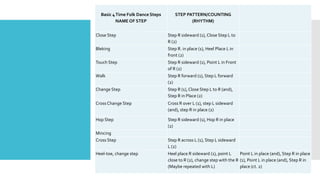
Basic 4Time Folk Dance Steps
NAME OF STEP
STEP PATTERN/COUNTING
(RHYTHM)
Close Step Step R sideward (1), Close Step L to
R (2)
Bleking Step R. in place (1), Heel Place L in
front (2)
Touch Step Step R sideward (1), Point L in Front
of R (2)
Walk Step R forward (1), Step L forward
(2)
Change Step Step R (1), Close Step L to R (and),
Step R in Place (2)
Cross Change Step Cross R over L (1), step L sideward
(and), step R in place (2)
Hop Step Step R sideward (1), Hop R in place
(2)
Mincing
Cross Step Step R across L (1), Step L sideward
L (2)
Heel-toe, change step Heel place R sideward (1), point L
close to R (2), change step with the R
(Maybe repeated with L)
Point L in place (and), Step R in place
(1), Point L in place (and), Step R in
place (ct. 2)
Activity 3
“Let’s Be Hot!”
Warm-Up (5 minutes)
Directions: This time you will be re-introduced to
the basic warm-up exercises that you have already
learned during your PE class in Grade 8.Try to
recall and do them with your class so that before
performing any physical activity in the succeeding
lessons, do the warm-up exercises first to
condition your body and prevent injuries from
happening.
• Inhale/ Exhale
• March
• Jump
• kick
• Rotation (head, shoulders, arms, hips, thigh,
feet)
• Inhale/ exhale
Activity 4
“Tiktokerist”
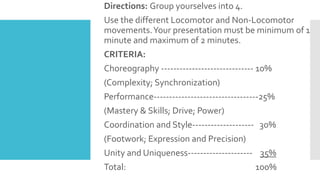
Directions: Group yourselves into 4.
Use the different Locomotor and Non-Locomotor
movements.Your presentation must be minimum of 1
minute and maximum of 2 minutes.
CRITERIA:
Choreography ------------------------------ 10%
(Complexity; Synchronization)
Performance----------------------------------25%
(Mastery & Skills; Drive; Power)
Coordination and Style-------------------- 30%
(Footwork; Expression and Precision)
Unity and Uniqueness--------------------- 35%
Total: 100%
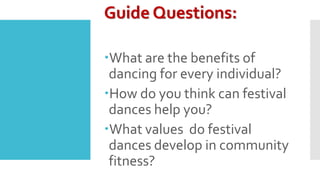
Guide Questions:
What are the benefits of
dancing for every individual?
How do you think can festival
dances help you?
What values do festival
dances develop in community
fitness?
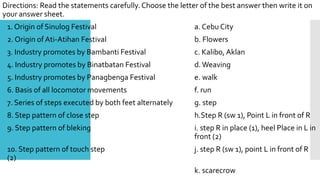
Directions: Read the statements carefully. Choose the letter of the best answer then write it on
your answer sheet.
 1. Origin of Sinulog Festival a. Cebu City
 2. Origin of Ati-Atihan Festival b. Flowers
 3. Industry promotes by Bambanti Festival c. Kalibo, Aklan
 4. Industry promotes by Binatbatan Festival d.Weaving
 5. Industry promotes by Panagbenga Festival e. walk
 6. Basis of all locomotor movements f. run
 7. Series of steps executed by both feet alternately g. step
 8. Step pattern of close step h.Step R (sw 1), Point L in front of R
 9. Step pattern of bleking i. step R in place (1), heel Place in L in
front (2)
 10. Step pattern of touch step j. step R (sw 1), point L in front of R
(2)
k. scarecrow
ASSIGNMENT.
Proud Netizens!
Direction:Write a 3 essays about
your famous Festival Dance on your
community, minimum of 5
sentences each essay, describe the
history of your chosen Festival
Dance; it can be Religious or Secular
Festival Dance.
THANKYOU!

Basic Steps in Festival Dances.pptx

  • 1.
    Basic Steps inFestival Dances Vee-R C. Lebuna Teacher I
  • 2.
  • 3.
  • 4.
  • 5.
  • 6.
  • 7.
  • 8.
    Specific Learning Objectives: Identify thebasic dance steps in Festival dances. Perform the basic dance steps in Festival dances. Appreciate the importance of Festival dances in this time of pandemic.
  • 9.
  • 10.
  • 11.
    Basic Movements of Festival Dance Locomotor Movements •movementsthat allow you to move from one point in space to another canned from two words, “locos” which means place and “motor” which means movement
  • 12.
    Preparatory movement Step -This isthe basis of all locomotor movements. It prepares you to move in any direction you wish to go. It is defined as transfer of weight from one foot to the other. Walk - Series of steps executed by both of your feet alternately in any direction. In executing a walk, observe that there’s this moment when both feet are in contact with the ground while one foot supports the weight and transfers it to the other. Run - Series of walks executed quickly in any direction wherein only one foot stays on the ground while the other is off the ground.
  • 13.
    Jump -This movementis simply described by having both feet lose its contact with the ground.There five ways to do it: 1. Take off from one foot and land on the same; 2. Take off from one foot and land on the other; 3. Take off from one foot and land on both feet; 4. Take off from both feet and land on one foot; and 5. Take off from both feet and land on both.
  • 14.
    Non-Locomotor Movements These are movementsthat are performed in one point in space without transferring to another point.They don’t allow you to move from one place to the other.These movements include: Flexion - It is the act of decreasing the angle of a joint. Another term for flexion is to bend. If you bend a joint, like your elbow or knee, you are performing flexion.
  • 15.
    Extension -This isthe opposite of flexion.You are extending if you are increasing the angle of a joint. Stretching is another word for extension. Contraction - A muscle movement done when it shortens, narrows and tightens using sufficient amount of energy in the execution. Release - A muscle movement opposite to contraction done when it let goes or let looses of being held into a shortening movement.
  • 16.
    Collapse -To deliberatelydrop the exertion of energy into a body segment. Recover -The opposite of collapse. This is to regain the energy exerted into a body segment. Rotation -To rotate is to move a body segment allowing it to complete a circle with its motion. It’s not only limited to circumduction which is done in ball and socket joints. Rotation can also be done in wrists, waist, knees and ankles.
  • 17.
    Twist -To movea body segment from an axis halfway front or back or quarter to the right or left as in the twisting of the neck allowing the head to face right or left and the like. Pivot -To change the position of the feet or any body part that carries the body’s weight allowing the body to face in a less than 360 degrees turn. Turn -To move in a turning movement with a base of support, usually a pointed foot, the other raised, while equilibrium is maintained until the completion of the turn.
  • 18.
    Basic 4Time FolkDance Steps NAME OF STEP STEP PATTERN/COUNTING (RHYTHM) Close Step Step R sideward (1), Close Step L to R (2) Bleking Step R. in place (1), Heel Place L in front (2) Touch Step Step R sideward (1), Point L in Front of R (2) Walk Step R forward (1), Step L forward (2) Change Step Step R (1), Close Step L to R (and), Step R in Place (2) Cross Change Step Cross R over L (1), step L sideward (and), step R in place (2) Hop Step Step R sideward (1), Hop R in place (2) Mincing Cross Step Step R across L (1), Step L sideward L (2) Heel-toe, change step Heel place R sideward (1), point L close to R (2), change step with the R (Maybe repeated with L) Point L in place (and), Step R in place (1), Point L in place (and), Step R in place (ct. 2)
  • 19.
  • 20.
    Warm-Up (5 minutes) Directions:This time you will be re-introduced to the basic warm-up exercises that you have already learned during your PE class in Grade 8.Try to recall and do them with your class so that before performing any physical activity in the succeeding lessons, do the warm-up exercises first to condition your body and prevent injuries from happening. • Inhale/ Exhale • March • Jump • kick • Rotation (head, shoulders, arms, hips, thigh, feet) • Inhale/ exhale
  • 21.
  • 22.
    Directions: Group yourselvesinto 4. Use the different Locomotor and Non-Locomotor movements.Your presentation must be minimum of 1 minute and maximum of 2 minutes. CRITERIA: Choreography ------------------------------ 10% (Complexity; Synchronization) Performance----------------------------------25% (Mastery & Skills; Drive; Power) Coordination and Style-------------------- 30% (Footwork; Expression and Precision) Unity and Uniqueness--------------------- 35% Total: 100%
  • 23.
    Guide Questions: What arethe benefits of dancing for every individual? How do you think can festival dances help you? What values do festival dances develop in community fitness?
  • 24.
    Directions: Read thestatements carefully. Choose the letter of the best answer then write it on your answer sheet.  1. Origin of Sinulog Festival a. Cebu City  2. Origin of Ati-Atihan Festival b. Flowers  3. Industry promotes by Bambanti Festival c. Kalibo, Aklan  4. Industry promotes by Binatbatan Festival d.Weaving  5. Industry promotes by Panagbenga Festival e. walk  6. Basis of all locomotor movements f. run  7. Series of steps executed by both feet alternately g. step  8. Step pattern of close step h.Step R (sw 1), Point L in front of R  9. Step pattern of bleking i. step R in place (1), heel Place in L in front (2)  10. Step pattern of touch step j. step R (sw 1), point L in front of R (2) k. scarecrow
  • 25.
    ASSIGNMENT. Proud Netizens! Direction:Write a3 essays about your famous Festival Dance on your community, minimum of 5 sentences each essay, describe the history of your chosen Festival Dance; it can be Religious or Secular Festival Dance.
  • 26.

Editor's Notes

  • #3 Let us have first a review of our past lesson. We are going to do this with an activity entitled “Raise Me Up!”. I will play a music and you are going to raise your hands. When the music stops, the student who raise her/his hand must identify the name of festival and its place of origin from the picture projected on the screen.
  • #10 (Teacher will present the video presentation of a certain group performing the Banigan Festival Dance) Guide Questions: What have you observed on the video?
  • #11 Fitness plays a very crucial role in our existence as human beings. It is a sustaining base of our physicality that allows us to overcome challenges of our daily living. It is with fitness that our eagerness to do things that we are capable of doing physically arise, which eventually leads us in making our own lives, including that of others, better and more productive.
  • #13 Try one! Stand with your weight equally distributed to both of your feet. Now, let your right foot carry it all. You got it! That’s what you call a step.
  • #20 After performing the given exercises, use the following rating scale to assess your performance: I - I can perform the exercises by myself O - I can perform the exercises with other’s help W - I will just wait for my next PE class So, which of the three reflects your performance a while ago?
  • #22 Tiktok is very popular in this time of Pandemic; using the different festival music popularized by tiktok, you can create your own tiktok dance using the guidelines below: