POWER ELECTRONICS
(BEE-603)
By
Dr Sarika Kalra
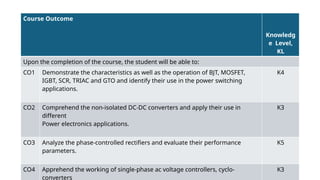
Course Outcome
Knowledg
e Level,
KL
Upon the completion of the course, the student will be able to:
CO1 Demonstrate the characteristics as well as the operation of BJT, MOSFET,
IGBT, SCR, TRIAC and GTO and identify their use in the power switching
applications.
K4
CO2 Comprehend the non-isolated DC-DC converters and apply their use in
different
Power electronics applications.
K3
CO3 Analyze the phase-controlled rectifiers and evaluate their performance
parameters.
K5
CO4 Apprehend the working of single-phase ac voltage controllers, cyclo-
converters
K3
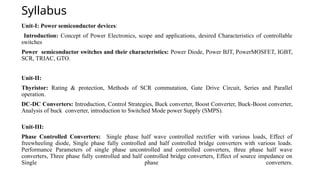
Syllabus
Unit-I: Power semiconductor devices:
Introduction: Concept of Power Electronics, scope and applications, desired Characteristics of controllable
switches
Power semiconductor switches and their characteristics: Power Diode, Power BJT, PowerMOSFET, IGBT,
SCR, TRIAC, GTO.
Unit-II:
Thyristor: Rating & protection, Methods of SCR commutation, Gate Drive Circuit, Series and Parallel
operation.
DC-DC Converters: Introduction, Control Strategies, Buck converter, Boost Converter, Buck-Boost converter,
Analysis of buck converter, introduction to Switched Mode power Supply (SMPS).
Unit-III:
Phase Controlled Converters: Single phase half wave controlled rectifier with various loads, Effect of
freewheeling diode, Single phase fully controlled and half controlled bridge converters with various loads.
Performance Parameters of single phase uncontrolled and controlled converters, three phase half wave
converters, Three phase fully controlled and half controlled bridge converters, Effect of source impedance on
Single phase converters.
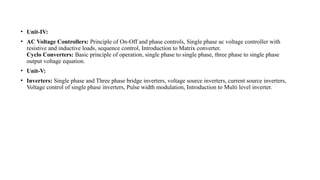
• Unit-IV:
• AC Voltage Controllers: Principle of On-Off and phase controls, Single phase ac voltage controller with
resistive and inductive loads, sequence control, Introduction to Matrix converter.
Cyclo Converters: Basic principle of operation, single phase to single phase, three phase to single phase
output voltage equation.
• Unit-V:
• Inverters: Single phase and Three phase bridge inverters, voltage source inverters, current source inverters,
Voltage control of single phase inverters, Pulse width modulation, Introduction to Multi level inverter.
UNIT –I
Power semiconductor devices
Unit-I: Power semiconductor devices:
Introduction:
Concept of Power Electronics, scope and applications, desired
Characteristics of controllable switches
Power semiconductor switches and their characteristics:
Power Diode, Power BJT, Power MOSFET, IGBT, SCR, TRIAC, GTO.
Concept of Power Electronics
• Power Electronics belongs partly to power engineers and
partly to electronics engineers
• It is define as a subject that are deal with the apparatus
and equipment working on the principle of electronics but
rated at Power Level rather than the signal level.
Advantages of Power Electronics
• High efficiency due to low loss in power semiconductor
devices
• High reliability
• Long life and less maintenance
• Fast Dynamic response
• Small size and less weight results in less floor area therefore
lower installation cost
Disadvantages
• Tendency to generate harmonics in the supply side as well
as load side
• Which increase motor heating and acoustical noise
• Power electronics Converters have low overload capacity
• AC to DC converter and AC to AC converter operate at a low
pf. In order to avoid low pf some special measure has to be
taken
Application of Power Electronics
• Aerospace :
Space Shuttle power supplies, Satellite power supply, aircraft power Systems
• Commercial :
Airconditioning , uninterruptible power supplies. Elevators, , light dimmer and
flashers, computer and office equipments
• Industrial :
pump compressors, Blowers & Fans, Inductrial lasers rolling milles, textile mills
• Residential :
Airconditioning , cooking , refrigerators, electric-Door openers, dryers,
vaccume cleaners washing , food mixer
• Telecommunication
• Transportation
• Utility Systems
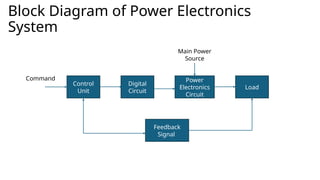
Block Diagram of Power Electronics
System
Control
Unit
Digital
Circuit
Power
Electronics
Circuit
Load
Feedback
Signal
Main Power
Source
Command
Power Semi Conductor Devices
Based upon
1. Turn on and turn off characteristics
2. gate signal requirements
3. Degree of controllability
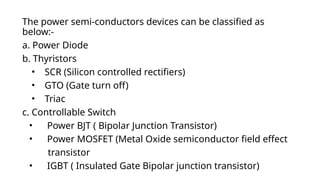
The power semi-conductors devices can be classified as
below:-
a. Power Diode
b. Thyristors
• SCR (Silicon controlled rectifiers)
• GTO (Gate turn off)
• Triac
c. Controllable Switch
• Power BJT ( Bipolar Junction Transistor)
• Power MOSFET (Metal Oxide semiconductor field effect
transistor
• IGBT ( Insulated Gate Bipolar junction transistor)
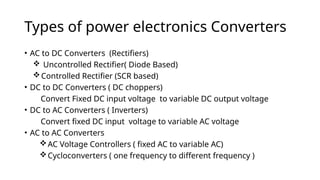
Types of power electronics Converters
• AC to DC Converters (Rectifiers)
 Uncontrolled Rectifier( Diode Based)
Controlled Rectifier (SCR based)
• DC to DC Converters ( DC choppers)
Convert Fixed DC input voltage to variable DC output voltage
• DC to AC Converters ( Inverters)
Convert fixed DC input voltage to variable AC voltage
• AC to AC Converters
AC Voltage Controllers ( fixed AC to variable AC)
Cycloconverters ( one frequency to different frequency )

power electronics, devices, power diodes

  • 1.
  • 2.
    Course Outcome Knowledg e Level, KL Uponthe completion of the course, the student will be able to: CO1 Demonstrate the characteristics as well as the operation of BJT, MOSFET, IGBT, SCR, TRIAC and GTO and identify their use in the power switching applications. K4 CO2 Comprehend the non-isolated DC-DC converters and apply their use in different Power electronics applications. K3 CO3 Analyze the phase-controlled rectifiers and evaluate their performance parameters. K5 CO4 Apprehend the working of single-phase ac voltage controllers, cyclo- converters K3
  • 3.
    Syllabus Unit-I: Power semiconductordevices: Introduction: Concept of Power Electronics, scope and applications, desired Characteristics of controllable switches Power semiconductor switches and their characteristics: Power Diode, Power BJT, PowerMOSFET, IGBT, SCR, TRIAC, GTO. Unit-II: Thyristor: Rating & protection, Methods of SCR commutation, Gate Drive Circuit, Series and Parallel operation. DC-DC Converters: Introduction, Control Strategies, Buck converter, Boost Converter, Buck-Boost converter, Analysis of buck converter, introduction to Switched Mode power Supply (SMPS). Unit-III: Phase Controlled Converters: Single phase half wave controlled rectifier with various loads, Effect of freewheeling diode, Single phase fully controlled and half controlled bridge converters with various loads. Performance Parameters of single phase uncontrolled and controlled converters, three phase half wave converters, Three phase fully controlled and half controlled bridge converters, Effect of source impedance on Single phase converters.
  • 4.
    • Unit-IV: • ACVoltage Controllers: Principle of On-Off and phase controls, Single phase ac voltage controller with resistive and inductive loads, sequence control, Introduction to Matrix converter. Cyclo Converters: Basic principle of operation, single phase to single phase, three phase to single phase output voltage equation. • Unit-V: • Inverters: Single phase and Three phase bridge inverters, voltage source inverters, current source inverters, Voltage control of single phase inverters, Pulse width modulation, Introduction to Multi level inverter.
  • 5.
  • 6.
    Unit-I: Power semiconductordevices: Introduction: Concept of Power Electronics, scope and applications, desired Characteristics of controllable switches Power semiconductor switches and their characteristics: Power Diode, Power BJT, Power MOSFET, IGBT, SCR, TRIAC, GTO.
  • 7.
    Concept of PowerElectronics • Power Electronics belongs partly to power engineers and partly to electronics engineers • It is define as a subject that are deal with the apparatus and equipment working on the principle of electronics but rated at Power Level rather than the signal level.
  • 8.
    Advantages of PowerElectronics • High efficiency due to low loss in power semiconductor devices • High reliability • Long life and less maintenance • Fast Dynamic response • Small size and less weight results in less floor area therefore lower installation cost
  • 9.
    Disadvantages • Tendency togenerate harmonics in the supply side as well as load side • Which increase motor heating and acoustical noise • Power electronics Converters have low overload capacity • AC to DC converter and AC to AC converter operate at a low pf. In order to avoid low pf some special measure has to be taken
  • 10.
    Application of PowerElectronics • Aerospace : Space Shuttle power supplies, Satellite power supply, aircraft power Systems • Commercial : Airconditioning , uninterruptible power supplies. Elevators, , light dimmer and flashers, computer and office equipments • Industrial : pump compressors, Blowers & Fans, Inductrial lasers rolling milles, textile mills • Residential : Airconditioning , cooking , refrigerators, electric-Door openers, dryers, vaccume cleaners washing , food mixer • Telecommunication • Transportation • Utility Systems
  • 11.
    Block Diagram ofPower Electronics System Control Unit Digital Circuit Power Electronics Circuit Load Feedback Signal Main Power Source Command
  • 12.
    Power Semi ConductorDevices Based upon 1. Turn on and turn off characteristics 2. gate signal requirements 3. Degree of controllability
  • 13.
    The power semi-conductorsdevices can be classified as below:- a. Power Diode b. Thyristors • SCR (Silicon controlled rectifiers) • GTO (Gate turn off) • Triac c. Controllable Switch • Power BJT ( Bipolar Junction Transistor) • Power MOSFET (Metal Oxide semiconductor field effect transistor • IGBT ( Insulated Gate Bipolar junction transistor)
  • 14.
    Types of powerelectronics Converters • AC to DC Converters (Rectifiers)  Uncontrolled Rectifier( Diode Based) Controlled Rectifier (SCR based) • DC to DC Converters ( DC choppers) Convert Fixed DC input voltage to variable DC output voltage • DC to AC Converters ( Inverters) Convert fixed DC input voltage to variable AC voltage • AC to AC Converters AC Voltage Controllers ( fixed AC to variable AC) Cycloconverters ( one frequency to different frequency )