POWER ELECTRONICS
Introduction
Engr.M Kashif Iqbal
DEPT. OF ELECTRICAL ENGINEERING,MNS UET MULTAN
Kashif.iqbaluet@gmail.com
Contents:
1. Definition
2. Rapid Growth
3. Comparison: PE & SP
4. Interdisciplinary Nature
5. ContributingAreas
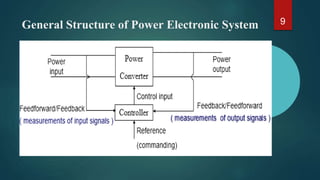
6. General Structure
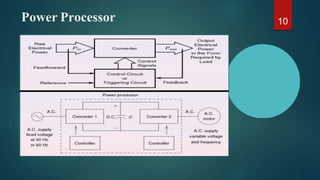
7. Power Processor
8. History of PE
9. Classification of PE devices
10. Power Semiconductor Switches
11. Symbolic Representation
2
Contents:
12. PE Switching Devices
13. PE System
14. Scope of PE
15. Power and Frequency Rating
16. Characteristics of Ideal Switch
17. Advantages of PE Converters
18. Drawbacks of PE
19. PEApplications
20. References
3
Definition:
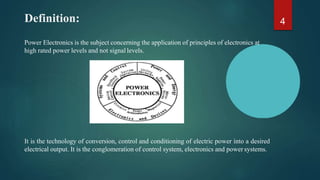
Power Electronics is the subject concerning the application of principles of electronics at
high rated power levels and not signal levels.
It is the technology of conversion, control and conditioning of electric power into a desired
electrical output. It is the conglomeration of control system, electronics and power systems.
4
Rapid Growth
Rapid growth of Power Electronics is due to:
– Advances in power (semiconductor) switches
–Advances in microelectronics (DSP, VLSI, microprocessor/microcontroller)
– New ideas in control algorithms
– Demand for new applications
5
Comparison: PE & Signal Processing
 In Power Electronics —
1. The focus is on power conversion at the highest possible efficiency using very small
control signals.
2. Semiconductor devices work as switches.
3. Power handled may range from a few watts to several mega-watts.
 In Signal Processing —
1. Semiconductor devices generally work as controlled sources in the linear region of
their characteristics.
2. The focus is on information processing with minimum loss of information.
3. Power handled will be of the order of few milli-watts or few watts.
6
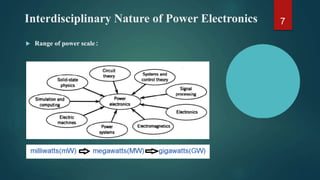
Interdisciplinary Nature of Power Electronics
 Range of power scale :
7
Contributing Areas
 Electronics –
Deals with solid – state devices and signal processing circuits.
 Power System –
Deals with static and rotating power equipment.
 Control System –
Deals with steady state and dynamic characteristics of closed – loop system.
8
General Structure of Power Electronic System 9
Power Processor 10
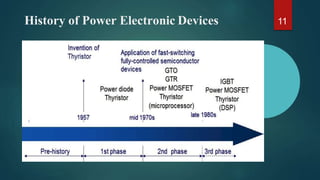
History of Power Electronic Devices 11
History of PE
 1882: J. Jasmin (French) discovered semiconductance.
 1892: L. Arons (German) invented the first mercury arc vacuumvalve.
 1901: P.C. Hewitt (U.S) developed the first arc valve.
 1906: J. A. Fleming (U.S) invented the first vacuumdiode.
 1907: L. Forest (U.S) invented vacuum triode.
 1921: F. W. Meyer (German) formulated the main principles of power electronics.
 1948: J. Bardeen, W. H. Brattain and W. B. Shockley (U.S) invented transistor.
 1960: J. Moll (U.S) & team invented silicon – based thyristors.
 1975 – 90: MOSFET, UJT, GTO were developed.
 1990s: IGBT was developed.
12
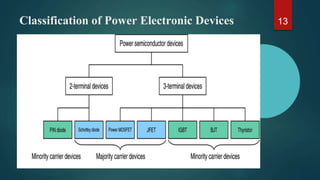
Classification of Power Electronic Devices 13
Classification by Control
Power Electronics
Uncontrolled device: diode
(2 terminals, uncontrolled
by control signal)
Half – controlled device:
thyristor
(turned on by control signal
but turned off by power
circuit)
Fully – controlled device:
Power MOSFET, IGBT,
GTO, IGCT
(on and off both by control
signals)
14
Other Category Classification 15
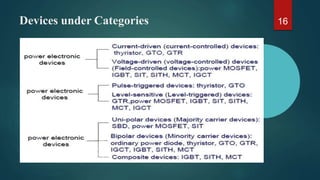
Devices under Categories 16
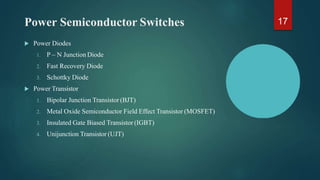
Power Semiconductor Switches
 Power Diodes
1. P – N Junction Diode
2. Fast Recovery Diode
3. Schottky Diode
 Power Transistor
1. Bipolar Junction Transistor (BJT)
2. Metal Oxide Semiconductor Field Effect Transistor (MOSFET)
3. Insulated Gate Biased Transistor (IGBT)
4. Unijunction Transistor (UJT)
17
Symbol Representation 18
Power Electronic Switching Devices
19
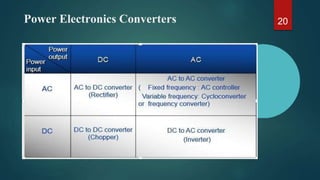
Power Electronics Converters 20
Types of Converters 21
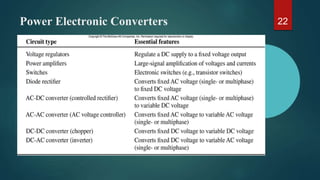
Power Electronic Converters 22
Power and Frequency Rating of Power Devices 23
Characteristics of Ideal Switch
 Turns On – Off in zero time.
 ON state, Zero voltage drop, High current.
 OFF state, Zero current flow. Withstand high voltage.
 Zero power dissipation.
 Little power for controlling.
 High reliability.
 Small size and weight.
 No maintenance.
24
Advantages of Power Electronic Converters
 High efficiency
 High reliability
 Long life and less maintenance
 Fast dynamic response
 Small size and less weight & cost.
25
Drawbacks of Power Electronics
 Harmonics generating tendency
 Power regeneration is difficult
 Low overload capacity.
 AC – DC & AC – AC converters operate at low i/p powerfactors.
26
Power Electronics Applications 27
Applications:
 Industrial
 Transportation
 Utility systems
 Power supplies for all kinds of electronic equipment
 Residential and home appliances
 Space technology
 Other applications
28
Sector wise Applications:
 Industrial applications
1. Motor drives
2. Electrolysis
3. Electroplating
4. Induction heating
 Transportation applications
1. Trains & locomotives
2. Magnetic levitation
3. Electric vehicles
4. Automotive electronics
29
Sector wise Applications:
 Utility systems
1. High-voltage dc transmission(HVDC)
2. Flexible ac transmission(FACTS)
3. Static VAR (volt-ampere reactive) compensation & harmonics suppression: TCR,
TSC, SVG,APF
4. Custom power & power quality control
 Power supplies for all kinds of electronic equipment
1. Telecommunications
2. Computers
3. Office equipment
4. Electronic instruments
30
Sector wiseApplications:
 Residential and home appliances
1. Lighting
2. Heating
3. Air conditioning
4. Refrigeration & freezers
5. Cooking
6. Cleaning
 Space Technology
1. Spaceship power systems
2. Satellite power systems
3. Space vehicle power systems
31
Sector wiseApplications:
 OtherApplications
1. Nuclear reactor control
2. Power systems for particle accelerators
3. Environmental engineering
32
References
1. Power Electronics by Daniel W.Hart
2. Power Electronics: Circuits, Devices and Applications 3rd Edition, Muhammad H.
Rashid.
3. Introduction to Modern Power Electronics,by Andrzej M.Trzynadlowski
33

powerelectronics-introduction-Final.pptx

  • 1.
    POWER ELECTRONICS Introduction Engr.M KashifIqbal DEPT. OF ELECTRICAL ENGINEERING,MNS UET MULTAN Kashif.iqbaluet@gmail.com
  • 2.
    Contents: 1. Definition 2. RapidGrowth 3. Comparison: PE & SP 4. Interdisciplinary Nature 5. ContributingAreas 6. General Structure 7. Power Processor 8. History of PE 9. Classification of PE devices 10. Power Semiconductor Switches 11. Symbolic Representation 2
  • 3.
    Contents: 12. PE SwitchingDevices 13. PE System 14. Scope of PE 15. Power and Frequency Rating 16. Characteristics of Ideal Switch 17. Advantages of PE Converters 18. Drawbacks of PE 19. PEApplications 20. References 3
  • 4.
    Definition: Power Electronics isthe subject concerning the application of principles of electronics at high rated power levels and not signal levels. It is the technology of conversion, control and conditioning of electric power into a desired electrical output. It is the conglomeration of control system, electronics and power systems. 4
  • 5.
    Rapid Growth Rapid growthof Power Electronics is due to: – Advances in power (semiconductor) switches –Advances in microelectronics (DSP, VLSI, microprocessor/microcontroller) – New ideas in control algorithms – Demand for new applications 5
  • 6.
    Comparison: PE &Signal Processing  In Power Electronics — 1. The focus is on power conversion at the highest possible efficiency using very small control signals. 2. Semiconductor devices work as switches. 3. Power handled may range from a few watts to several mega-watts.  In Signal Processing — 1. Semiconductor devices generally work as controlled sources in the linear region of their characteristics. 2. The focus is on information processing with minimum loss of information. 3. Power handled will be of the order of few milli-watts or few watts. 6
  • 7.
    Interdisciplinary Nature ofPower Electronics  Range of power scale : 7
  • 8.
    Contributing Areas  Electronics– Deals with solid – state devices and signal processing circuits.  Power System – Deals with static and rotating power equipment.  Control System – Deals with steady state and dynamic characteristics of closed – loop system. 8
  • 9.
    General Structure ofPower Electronic System 9
  • 10.
  • 11.
    History of PowerElectronic Devices 11
  • 12.
    History of PE 1882: J. Jasmin (French) discovered semiconductance.  1892: L. Arons (German) invented the first mercury arc vacuumvalve.  1901: P.C. Hewitt (U.S) developed the first arc valve.  1906: J. A. Fleming (U.S) invented the first vacuumdiode.  1907: L. Forest (U.S) invented vacuum triode.  1921: F. W. Meyer (German) formulated the main principles of power electronics.  1948: J. Bardeen, W. H. Brattain and W. B. Shockley (U.S) invented transistor.  1960: J. Moll (U.S) & team invented silicon – based thyristors.  1975 – 90: MOSFET, UJT, GTO were developed.  1990s: IGBT was developed. 12
  • 13.
    Classification of PowerElectronic Devices 13
  • 14.
    Classification by Control PowerElectronics Uncontrolled device: diode (2 terminals, uncontrolled by control signal) Half – controlled device: thyristor (turned on by control signal but turned off by power circuit) Fully – controlled device: Power MOSFET, IGBT, GTO, IGCT (on and off both by control signals) 14
  • 15.
  • 16.
  • 17.
    Power Semiconductor Switches Power Diodes 1. P – N Junction Diode 2. Fast Recovery Diode 3. Schottky Diode  Power Transistor 1. Bipolar Junction Transistor (BJT) 2. Metal Oxide Semiconductor Field Effect Transistor (MOSFET) 3. Insulated Gate Biased Transistor (IGBT) 4. Unijunction Transistor (UJT) 17
  • 18.
  • 19.
  • 20.
  • 21.
  • 22.
  • 23.
    Power and FrequencyRating of Power Devices 23
  • 24.
    Characteristics of IdealSwitch  Turns On – Off in zero time.  ON state, Zero voltage drop, High current.  OFF state, Zero current flow. Withstand high voltage.  Zero power dissipation.  Little power for controlling.  High reliability.  Small size and weight.  No maintenance. 24
  • 25.
    Advantages of PowerElectronic Converters  High efficiency  High reliability  Long life and less maintenance  Fast dynamic response  Small size and less weight & cost. 25
  • 26.
    Drawbacks of PowerElectronics  Harmonics generating tendency  Power regeneration is difficult  Low overload capacity.  AC – DC & AC – AC converters operate at low i/p powerfactors. 26
  • 27.
  • 28.
    Applications:  Industrial  Transportation Utility systems  Power supplies for all kinds of electronic equipment  Residential and home appliances  Space technology  Other applications 28
  • 29.
    Sector wise Applications: Industrial applications 1. Motor drives 2. Electrolysis 3. Electroplating 4. Induction heating  Transportation applications 1. Trains & locomotives 2. Magnetic levitation 3. Electric vehicles 4. Automotive electronics 29
  • 30.
    Sector wise Applications: Utility systems 1. High-voltage dc transmission(HVDC) 2. Flexible ac transmission(FACTS) 3. Static VAR (volt-ampere reactive) compensation & harmonics suppression: TCR, TSC, SVG,APF 4. Custom power & power quality control  Power supplies for all kinds of electronic equipment 1. Telecommunications 2. Computers 3. Office equipment 4. Electronic instruments 30
  • 31.
    Sector wiseApplications:  Residentialand home appliances 1. Lighting 2. Heating 3. Air conditioning 4. Refrigeration & freezers 5. Cooking 6. Cleaning  Space Technology 1. Spaceship power systems 2. Satellite power systems 3. Space vehicle power systems 31
  • 32.
    Sector wiseApplications:  OtherApplications 1.Nuclear reactor control 2. Power systems for particle accelerators 3. Environmental engineering 32
  • 33.
    References 1. Power Electronicsby Daniel W.Hart 2. Power Electronics: Circuits, Devices and Applications 3rd Edition, Muhammad H. Rashid. 3. Introduction to Modern Power Electronics,by Andrzej M.Trzynadlowski 33