Grades 1 to 12
DAILY LESSON LOG
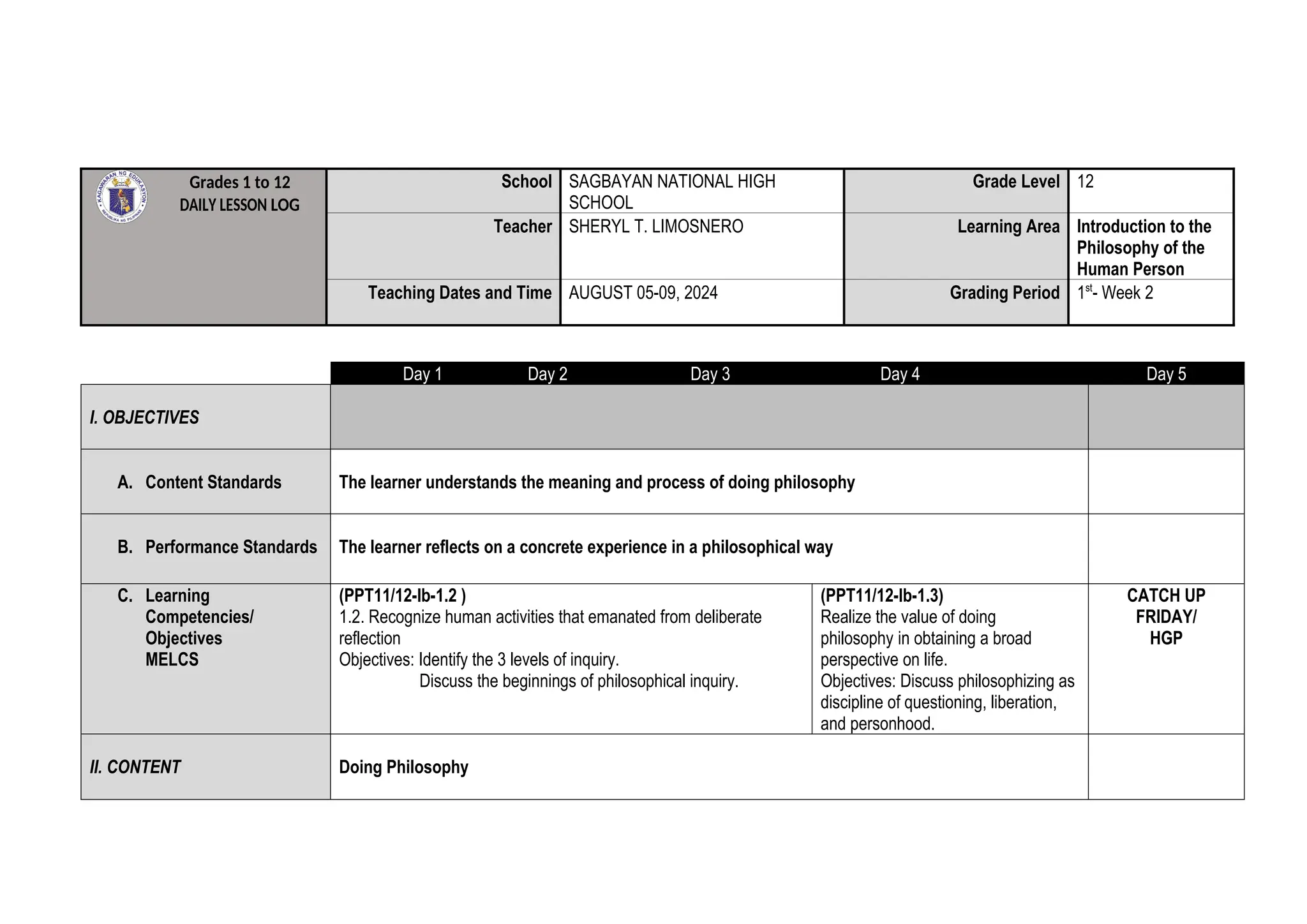
School SAGBAYAN NATIONAL HIGH
SCHOOL
Grade Level 12
Teacher SHERYL T. LIMOSNERO Learning Area Introduction to the
Philosophy of the
Human Person
Teaching Dates and Time AUGUST 05-09, 2024 Grading Period 1st
- Week 2
Day 1 Day 2 Day 3 Day 4 Day 5
I. OBJECTIVES
A. Content Standards The learner understands the meaning and process of doing philosophy
B. Performance Standards The learner reflects on a concrete experience in a philosophical way
C. Learning
Competencies/
Objectives
MELCS
(PPT11/12-Ib-1.2 )
1.2. Recognize human activities that emanated from deliberate
reflection
Objectives: Identify the 3 levels of inquiry.
Discuss the beginnings of philosophical inquiry.
(PPT11/12-Ib-1.3)
Realize the value of doing
philosophy in obtaining a broad
perspective on life.
Objectives: Discuss philosophizing as
discipline of questioning, liberation,
and personhood.
CATCH UP
FRIDAY/
HGP
II. CONTENT Doing Philosophy
III. LEARNING RESOURCES
A. References
1. Teacher’s Guide pages
2. Learner’s Materials
pages
3. Textbook pages
4. Additional Materials
from Learning
Resource (LR) portal
B. Other Learning
Resources
Dy, Manuel Jr. "Philosophy of Man", "The Philosophical Enterprise" by John Kavanaugh, S. J.
Introduction to the Philosophy of the Human Person, Brenda B. Corpuz, BSE, MAEd, PhD, et.al.
https://youtu.be/ZTy3qG_qInU
IV. PROCEDURES
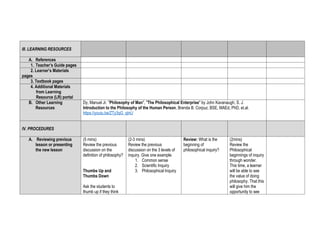
A. Reviewing previous
lesson or presenting
the new lesson
(5 mins)
Review the previous
discussion on the
definition of philosophy?
Thumbs Up and
Thumbs Down
Ask the students to
thumb up if they think
(2-3 mins)
Review the previous
discussion on the 3 levels of
inquiry. Give one example.
1. Common sense
2. Scientific Inquiry
3. Philosophical Inquiry
Review: What is the
beginning of
philosophical inquiry?
(2mins)
Review the
Philosophical
beginnings of inquiry
through wonder.
This time, a learner
will be able to see
the value of doing
philosophy. That this
will give him the
opportunity to see
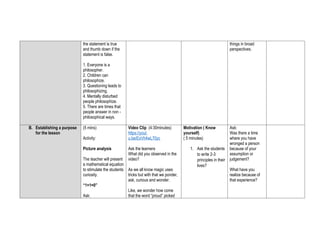
the statement is true
and thumb down if the
statement is false.
1. Everyone is a
philosopher.
2. Children can
philosophize.
3. Questioning leads to
philosophizing.
4. Mentally disturbed
people philosophize.
5. There are times that
people answer in non -
philosophical ways.
things in broad
perspectives.
B. Establishing a purpose
for the lesson
(5 mins)
Activity:
Picture analysis
The teacher will present
a mathematical equation
to stimulate the students
curiosity.
“1+1=0”
Ask:
Video Clip (4:30minutes)
https://yout
u.be/ExVh4wL70yc
Ask the learners
What did you observed in the
video?
As we all know magic uses
tricks but with that we ponder,
ask, curious and wonder.
Like, we wonder how come
that the word “proud” picked
Motivation ( Know
yourself)
( 5 minutes)
1. Ask the students
to write 2-3
principles in their
lives?
Ask:
Was there a time
where you have
wronged a person
because of your
assumption or
judgement?
What have you
realize because of
that experience?
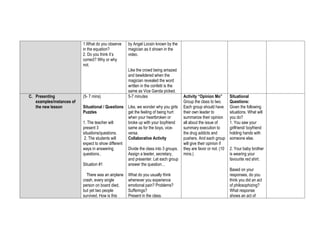
1.What do you observe
in the equation?
2. Do you think it’s
correct? Why or why
not.
by Angel Locsin known by the
magician as it shown in the
video.
Like the crowd being amazed
and bewildered when the
magician revealed the word
written in the confetti is the
same as Vice Ganda picked.
C. Presenting
examples/instances of
the new lesson
(5- 7 mins)
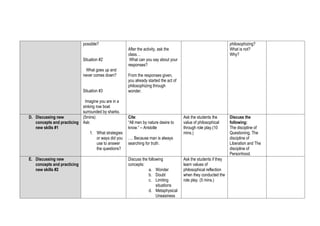
Situational / Questions
Puzzles
1. The teacher will
present 3
situations/questions.
2. The students will
expect to show different
ways in answering
questions..
Situation #1
There was an airplane
crash, every single
person on board died,
but yet two people
survived. How is this
5-7 minutes
Like, we wonder why you girls
get the feeling of being hurt
when your heartbroken or
broke up with your boyfriend
same as for the boys, vice-
versa.
Collaborative Activity
Divide the class into 3 groups.
Assign a leader, secretary,
and presenter. Let each group
answer the question…
What do you usually think
whenever you experience
emotional pain? Problems?
Sufferings?
Present in the class.
Activity “Opinion Mo”
Group the class to two.
Each group should have
their own leader to
summarize their opinion
all about the issue of
summary execution to
the drug addicts and
pushers. And each group
will give their opinion if
they are favor or not. (10
mins.)
Situational
Questions:
Given the following
situations. What will
you do?
1. You saw your
girlfriend/ boyfriend
holding hands with
someone else.
2. Your baby brother
is wearing your
favourite red shirt.
Based on your
responses, do you
think you did an act
of philosophizing?
What response
shows an act of
possible?
Situation #2
What goes up and
never comes down?
Situation #3
Imagine you are in a
sinking row boat
surrounded by sharks.
After the activity, ask the
class…
What can you say about your
responses?
From the responses given,
you already started the act of
philosophizing through
wonder.
philosophizing?
What is not?
Why?
D. Discussing new
concepts and practicing
new skills #1
(5mins)
Ask:
1. What strategies
or ways did you
use to answer
the questions?
Cite:
“All men by nature desire to
know.” – Aristotle
…. Because man is always
searching for truth.
Ask the students the
value of philosophical
through role play.(10
mins.)
Discuss the
following:
The discipline of
Questioning, The
discipline of
Liberation and The
discipline of
Personhood.
E. Discussing new
concepts and practicing
new skills #2
Discuss the following
concepts:
a. Wonder
b. Doubt
c. Limiting
situations
d. Metaphysical
Uneasiness
Ask the students if they
learn values of
philosophical reflection
when they conducted the
role play. (5 mins.)
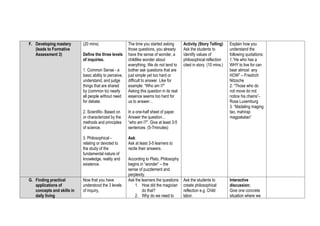
F. Developing mastery
(leads to Formative
Assessment 3)
(20 mins)
Define the three levels
of inquiries.
1. Common Sense - a
basic ability to perceive,
understand, and judge
things that are shared
by (common to) nearly
all people without need
for debate.
2. Scientific- Based on
or characterized by the
methods and principles
of science.
3. Philosophical -
relating or devoted to
the study of the
fundamental nature of
knowledge, reality and
existence.
The time you started asking
those questions, you already
have the sense of wonder, a
childlike wonder about
everything. We do not tend to
bother ask questions that are
just simple yet too hard or
difficult to answer. Like for
example: “Who am I?”
Asking this question in its real
essence seems too hard for
us to answer…
In a one-half sheet of paper.
Answer the question…
“who am I?”. Give at least 3-5
sentences. (5-7minutes)
Ask:
Ask at least 3-5 learners to
recite their answers.
According to Plato, Philosophy
begins in “wonder” – the
sense of puzzlement and
perplexity.
Activity (Story Telling)
Ask the students to
identify values of
philosophical reflection
cited in story. (10 mins.)
Explain how you
understand the
following quotations:
1.”He who has a
WHY to live for can
bear almost any
HOW” – Friedrich
Nitzsche
2. “Those who do
not move do not
notice his chains”-
Rosa Luxemburg
3. “Madaling maging
tao, mahirap
magpakatao”
G. Finding practical
applications of
concepts and skills in
daily living
Now that you have
understood the 3 levels
of inquiry,
Ask the learners the questions
1. How did the magician
do that?
2. Why do we need to
Ask the students to
create philosophical
reflection e.g. Child
labor.
Interactive
discussion:
Give one concrete
situation where we
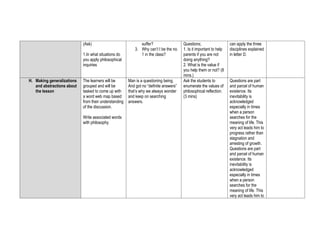
(Ask)
1.In what situations do
you apply philosophical
inquiries
suffer?
3. Why can’t I be the no.
1 in the class?
Questions;
1. Is it important to help
parents if you are not
doing anything?
2. What is the value if
you help them or not? (8
mins.)
can apply the three
disciplines explained
in letter D.
H. Making generalizations
and abstractions about
the lesson
The learners will be
grouped and will be
tasked to come up with
a word web map based
from their understanding
of the discussion.
Write associated words
with philosophy.
Man is a questioning being.
And got no “definite answers”
that’s why we always wonder
and keep on searching
answers.
Ask the students to
enumerate the values of
philosophical reflection.
(3 mins)
Questions are part
and parcel of human
existence. Its
inevitability is
acknowledged
especially in times
when a person
searches for the
meaning of life. This
very act leads him to
progress rather than
stagnation and
arresting of growth.
Questions are part
and parcel of human
existence. Its
inevitability is
acknowledged
especially in times
when a person
searches for the
meaning of life. This
very act leads him to
progress rather than
stagnation and
arresting of growth.
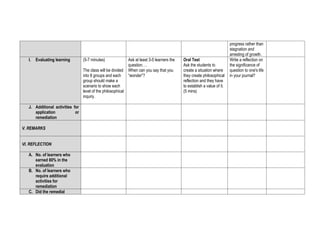
I. Evaluating learning (5-7 minutes)
The class will be divided
into 8 groups and each
group should make a
scenario to show each
level of the philosophical
inquiry.
Ask at least 3-5 learners the
question….
When can you say that you
“wonder”?
Oral Test
Ask the students to
create a situation where
they create philosophical
reflection and they have
to establish a value of it.
(5 mins)
Write a reflection on
the significance of
question to one's life
in your journal?
J. Additional activities for
application or
remediation
V. REMARKS
VI. REFLECTION
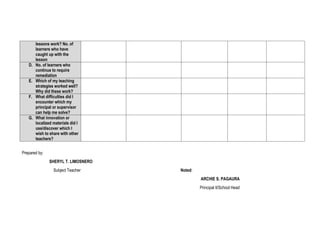
A. No. of learners who
earned 80% in the
evaluation
B. No. of learners who
require additional
activities for
remediation
C. Did the remedial
lessons work? No. of
learners who have
caught up with the
lesson
D. No. of learners who
continue to require
remediation
E. Which of my teaching
strategies worked well?
Why did these work?
F. What difficulties did I
encounter which my
principal or supervisor
can help me solve?
G. What innovation or
localized materials did I
use/discover which I
wish to share with other
teachers?
Prepared by:
SHERYL T. LIMOSNERO
Subject Teacher Noted:
ARCHIE S. PAGAURA
Principal II/School Head

PPT Week b - Philosophical Inquiry (1).docx

  • 1.
    Grades 1 to12 DAILY LESSON LOG School SAGBAYAN NATIONAL HIGH SCHOOL Grade Level 12 Teacher SHERYL T. LIMOSNERO Learning Area Introduction to the Philosophy of the Human Person Teaching Dates and Time AUGUST 05-09, 2024 Grading Period 1st - Week 2 Day 1 Day 2 Day 3 Day 4 Day 5 I. OBJECTIVES A. Content Standards The learner understands the meaning and process of doing philosophy B. Performance Standards The learner reflects on a concrete experience in a philosophical way C. Learning Competencies/ Objectives MELCS (PPT11/12-Ib-1.2 ) 1.2. Recognize human activities that emanated from deliberate reflection Objectives: Identify the 3 levels of inquiry. Discuss the beginnings of philosophical inquiry. (PPT11/12-Ib-1.3) Realize the value of doing philosophy in obtaining a broad perspective on life. Objectives: Discuss philosophizing as discipline of questioning, liberation, and personhood. CATCH UP FRIDAY/ HGP II. CONTENT Doing Philosophy
  • 2.
    III. LEARNING RESOURCES A.References 1. Teacher’s Guide pages 2. Learner’s Materials pages 3. Textbook pages 4. Additional Materials from Learning Resource (LR) portal B. Other Learning Resources Dy, Manuel Jr. "Philosophy of Man", "The Philosophical Enterprise" by John Kavanaugh, S. J. Introduction to the Philosophy of the Human Person, Brenda B. Corpuz, BSE, MAEd, PhD, et.al. https://youtu.be/ZTy3qG_qInU IV. PROCEDURES A. Reviewing previous lesson or presenting the new lesson (5 mins) Review the previous discussion on the definition of philosophy? Thumbs Up and Thumbs Down Ask the students to thumb up if they think (2-3 mins) Review the previous discussion on the 3 levels of inquiry. Give one example. 1. Common sense 2. Scientific Inquiry 3. Philosophical Inquiry Review: What is the beginning of philosophical inquiry? (2mins) Review the Philosophical beginnings of inquiry through wonder. This time, a learner will be able to see the value of doing philosophy. That this will give him the opportunity to see
  • 3.
    the statement istrue and thumb down if the statement is false. 1. Everyone is a philosopher. 2. Children can philosophize. 3. Questioning leads to philosophizing. 4. Mentally disturbed people philosophize. 5. There are times that people answer in non - philosophical ways. things in broad perspectives. B. Establishing a purpose for the lesson (5 mins) Activity: Picture analysis The teacher will present a mathematical equation to stimulate the students curiosity. “1+1=0” Ask: Video Clip (4:30minutes) https://yout u.be/ExVh4wL70yc Ask the learners What did you observed in the video? As we all know magic uses tricks but with that we ponder, ask, curious and wonder. Like, we wonder how come that the word “proud” picked Motivation ( Know yourself) ( 5 minutes) 1. Ask the students to write 2-3 principles in their lives? Ask: Was there a time where you have wronged a person because of your assumption or judgement? What have you realize because of that experience?
  • 4.
    1.What do youobserve in the equation? 2. Do you think it’s correct? Why or why not. by Angel Locsin known by the magician as it shown in the video. Like the crowd being amazed and bewildered when the magician revealed the word written in the confetti is the same as Vice Ganda picked. C. Presenting examples/instances of the new lesson (5- 7 mins) Situational / Questions Puzzles 1. The teacher will present 3 situations/questions. 2. The students will expect to show different ways in answering questions.. Situation #1 There was an airplane crash, every single person on board died, but yet two people survived. How is this 5-7 minutes Like, we wonder why you girls get the feeling of being hurt when your heartbroken or broke up with your boyfriend same as for the boys, vice- versa. Collaborative Activity Divide the class into 3 groups. Assign a leader, secretary, and presenter. Let each group answer the question… What do you usually think whenever you experience emotional pain? Problems? Sufferings? Present in the class. Activity “Opinion Mo” Group the class to two. Each group should have their own leader to summarize their opinion all about the issue of summary execution to the drug addicts and pushers. And each group will give their opinion if they are favor or not. (10 mins.) Situational Questions: Given the following situations. What will you do? 1. You saw your girlfriend/ boyfriend holding hands with someone else. 2. Your baby brother is wearing your favourite red shirt. Based on your responses, do you think you did an act of philosophizing? What response shows an act of
  • 5.
    possible? Situation #2 What goesup and never comes down? Situation #3 Imagine you are in a sinking row boat surrounded by sharks. After the activity, ask the class… What can you say about your responses? From the responses given, you already started the act of philosophizing through wonder. philosophizing? What is not? Why? D. Discussing new concepts and practicing new skills #1 (5mins) Ask: 1. What strategies or ways did you use to answer the questions? Cite: “All men by nature desire to know.” – Aristotle …. Because man is always searching for truth. Ask the students the value of philosophical through role play.(10 mins.) Discuss the following: The discipline of Questioning, The discipline of Liberation and The discipline of Personhood. E. Discussing new concepts and practicing new skills #2 Discuss the following concepts: a. Wonder b. Doubt c. Limiting situations d. Metaphysical Uneasiness Ask the students if they learn values of philosophical reflection when they conducted the role play. (5 mins.)
  • 6.
    F. Developing mastery (leadsto Formative Assessment 3) (20 mins) Define the three levels of inquiries. 1. Common Sense - a basic ability to perceive, understand, and judge things that are shared by (common to) nearly all people without need for debate. 2. Scientific- Based on or characterized by the methods and principles of science. 3. Philosophical - relating or devoted to the study of the fundamental nature of knowledge, reality and existence. The time you started asking those questions, you already have the sense of wonder, a childlike wonder about everything. We do not tend to bother ask questions that are just simple yet too hard or difficult to answer. Like for example: “Who am I?” Asking this question in its real essence seems too hard for us to answer… In a one-half sheet of paper. Answer the question… “who am I?”. Give at least 3-5 sentences. (5-7minutes) Ask: Ask at least 3-5 learners to recite their answers. According to Plato, Philosophy begins in “wonder” – the sense of puzzlement and perplexity. Activity (Story Telling) Ask the students to identify values of philosophical reflection cited in story. (10 mins.) Explain how you understand the following quotations: 1.”He who has a WHY to live for can bear almost any HOW” – Friedrich Nitzsche 2. “Those who do not move do not notice his chains”- Rosa Luxemburg 3. “Madaling maging tao, mahirap magpakatao” G. Finding practical applications of concepts and skills in daily living Now that you have understood the 3 levels of inquiry, Ask the learners the questions 1. How did the magician do that? 2. Why do we need to Ask the students to create philosophical reflection e.g. Child labor. Interactive discussion: Give one concrete situation where we
  • 7.
    (Ask) 1.In what situationsdo you apply philosophical inquiries suffer? 3. Why can’t I be the no. 1 in the class? Questions; 1. Is it important to help parents if you are not doing anything? 2. What is the value if you help them or not? (8 mins.) can apply the three disciplines explained in letter D. H. Making generalizations and abstractions about the lesson The learners will be grouped and will be tasked to come up with a word web map based from their understanding of the discussion. Write associated words with philosophy. Man is a questioning being. And got no “definite answers” that’s why we always wonder and keep on searching answers. Ask the students to enumerate the values of philosophical reflection. (3 mins) Questions are part and parcel of human existence. Its inevitability is acknowledged especially in times when a person searches for the meaning of life. This very act leads him to progress rather than stagnation and arresting of growth. Questions are part and parcel of human existence. Its inevitability is acknowledged especially in times when a person searches for the meaning of life. This very act leads him to
  • 8.
    progress rather than stagnationand arresting of growth. I. Evaluating learning (5-7 minutes) The class will be divided into 8 groups and each group should make a scenario to show each level of the philosophical inquiry. Ask at least 3-5 learners the question…. When can you say that you “wonder”? Oral Test Ask the students to create a situation where they create philosophical reflection and they have to establish a value of it. (5 mins) Write a reflection on the significance of question to one's life in your journal? J. Additional activities for application or remediation V. REMARKS VI. REFLECTION A. No. of learners who earned 80% in the evaluation B. No. of learners who require additional activities for remediation C. Did the remedial
  • 9.
    lessons work? No.of learners who have caught up with the lesson D. No. of learners who continue to require remediation E. Which of my teaching strategies worked well? Why did these work? F. What difficulties did I encounter which my principal or supervisor can help me solve? G. What innovation or localized materials did I use/discover which I wish to share with other teachers? Prepared by: SHERYL T. LIMOSNERO Subject Teacher Noted: ARCHIE S. PAGAURA Principal II/School Head