February 8th 2021
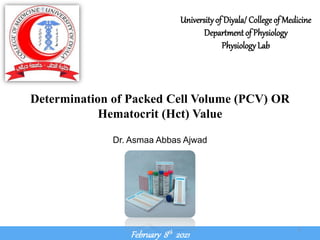
Determination of Packed Cell Volume (PCV) OR
Hematocrit (Hct) Value
Universityof Diyala/ College of Medicine
Department of Physiology
PhysiologyLab
Dr. Asmaa Abbas Ajwad
1
Outlines
• Introduction
• Objectives of PCV Experiment
• Methods and Procedure
• Observations and Reading PCV Value
• Some Clinical Implications
2
Introduction
3
Blood consists of a liquid plasma portion and a solid
cellular portion. The solid portion is comprised of
red blood cells (RBCs), white blood cells (WBCs),
and platelets.
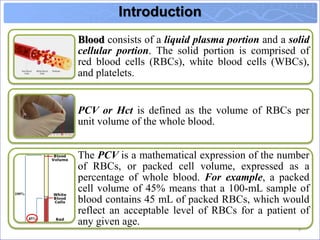
PCV or Hct is defined as the volume of RBCs per
unit volume of the whole blood.
The PCV is a mathematical expression of the number
of RBCs, or packed cell volume, expressed as a
percentage of whole blood. For example, a packed
cell volume of 45% means that a 100-mL sample of
blood contains 45 mL of packed RBCs, which would
reflect an acceptable level of RBCs for a patient of
any given age.
Introduction
4
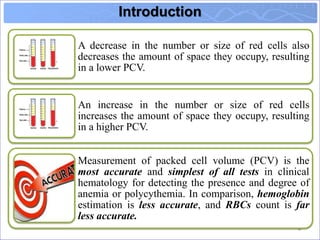
A decrease in the number or size of red cells also
decreases the amount of space they occupy, resulting
in a lower PCV.
An increase in the number or size of red cells
increases the amount of space they occupy, resulting
in a higher PCV.
Measurement of packed cell volume (PCV) is the
most accurate and simplest of all tests in clinical
hematology for detecting the presence and degree of
anemia or polycythemia. In comparison, hemoglobin
estimation is less accurate, and RBCs count is far
less accurate.
Introduction
5
 PCV depends primarily on the number of RBCs, however the
average size of the RBCs influences the PCV. Conditions that cause
RBC size to be increased (e.g. swelling of the RBC due to change in
osmotic pressure related to elevated sodium levels) may increase the
PCV while conditions that result in smaller than normal RBCs (e.g.
microcytosis related to iron deficiency anemia) decrease the PCV.
 In general, high PCV indicates either increase in the number of RBCs
or decrease in plasma volume as seen in cholera. On another hand, a
low PCV indicates either decrease in RBCs number or increase in
plasma volume.
The normal values of PCV vary according to the age and sex of
the individuals. The normal ranges are:
- Males: 40 %–54 %
- Females: 37 %–47 %
- Newborns: 53-65 %
 Critical value of PCV = <15 % or >60 %.
Purposes of PCV Experiment
To know : what is PCV, methods for determination
PCV value, and clinical importance of PCV.
To determine the volume or the amount of
RBCs in 100 ml of blood.
To assess whether there is a sufficient number
of circulating RBCs to transport the required
amount of oxygen throughout the body.
1
2
3
6
Principle of PCV
7
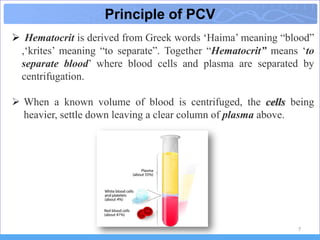
 Hematocrit is derived from Greek words ‘Haima’ meaning “blood”
,‘krites’ meaning “to separate”. Together “Hematocrit” means ‘to
separate blood’ where blood cells and plasma are separated by
centrifugation.
 When a known volume of blood is centrifuged, the cells being
heavier, settle down leaving a clear column of plasma above.
Methods
8
• Requires less blood and less time to get the
value of PCV (commonly used). It is the
method that we are going to use in today
lab.
Microhematocrit
Method
• Also known as a Wintrobe method.
• Time consuming, requires large amount of
blood, and has a higher degree of plasma
trapping.
Macrohematocrit
Method
• Automated hematology Analyzer.
Automated Method
Materials and Instruments
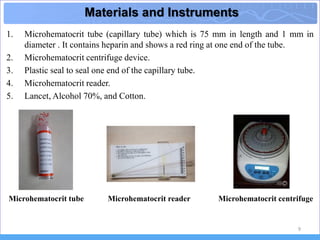
1. Microhematocrit tube (capillary tube) which is 75 mm in length and 1 mm in
diameter . It contains heparin and shows a red ring at one end of the tube.
2. Microhematocrit centrifuge device.
3. Plastic seal to seal one end of the capillary tube.
4. Microhematocrit reader.
5. Lancet, Alcohol 70%, and Cotton.
Microhematocrit tube Microhematocrit reader Microhematocrit centrifuge
9
Procedure and Observations
• Clean your finger with 70% alcohol and let it dry.
• Blood is drawn into the tube by capillary phenomenon. By holding the tube in a
horizontal manner and allow 2/3 to 3/4 of the tube to be filled with blood.
• Seal the dry end of the tube by plastic seal.
• The sealed tube then is placed in the radial grooves of the Microhematocrit
centrifuge for 5 min at 11000 R.P. m.
• Balance the tubes in the centrifuge with the clay ends facing the outside away
from the center(place the tubes opposite each other in the centrifuge). Looking at
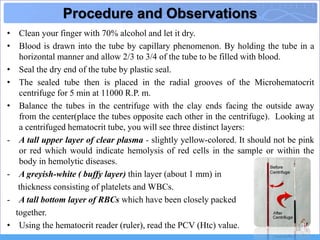
a centrifuged hematocrit tube, you will see three distinct layers:
- A tall upper layer of clear plasma - slightly yellow-colored. It should not be pink
or red which would indicate hemolysis of red cells in the sample or within the
body in hemolytic diseases.
- A greyish-white ( buffy layer) thin layer (about 1 mm) in
thickness consisting of platelets and WBCs.
- A tall bottom layer of RBCs which have been closely packed
together.
• Using the hematocrit reader (ruler), read the PCV (Htc) value. 10
Reading PCV Value
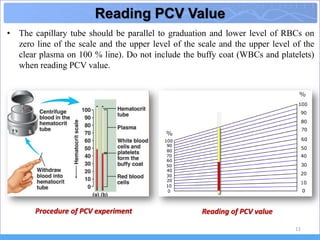
• The capillary tube should be parallel to graduation and lower level of RBCs on
zero line of the scale and the upper level of the scale and the upper level of the
clear plasma on 100 % line). Do not include the buffy coat (WBCs and platelets)
when reading PCV value.
11
Procedure of PCV experiment Reading of PCV value
Sources of Errors
• Improper sealing of the capillary tube.
• Time and speed of centrifugation.
• The buffy coat of the specimen should not be included in the PCV
reading, because its inclusion would falsely elevate the result.
• A decrease or increase in the readings may be seen if the micro-
hematocrit reader is not used properly.
• The microhematocrit centrifuge should never be forced to stop by
applying pressure to the metal cover plate. This will cause the RBCs
layer to “sling” forward and results in a falsely elevated value.
12
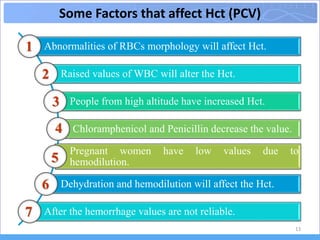
Some Factors that affect Hct (PCV)
13
Abnormalities of RBCs morphology will affect Hct.
Raised values of WBC will alter the Hct.
People from high altitude have increased Hct.
Chloramphenicol and Penicillin decrease the value.
Pregnant women have low values due to
hemodilution.
Dehydration and hemodilution will affect the Hct.
After the hemorrhage values are not reliable.
1
2
3
4
5
6
7
Clinical Implications
14
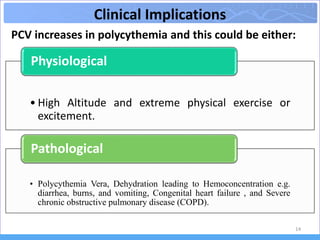
• High Altitude and extreme physical exercise or
excitement.
Physiological
• Polycythemia Vera, Dehydration leading to Hemoconcentration e.g.
diarrhea, burns, and vomiting, Congenital heart failure , and Severe
chronic obstructive pulmonary disease (COPD).
Pathological
PCV increases in polycythemia and this could be either:
Clinical Implications
15
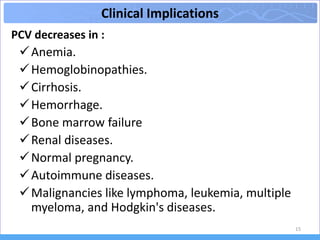
PCV decreases in :
Anemia.
Hemoglobinopathies.
Cirrhosis.
Hemorrhage.
Bone marrow failure
Renal diseases.
Normal pregnancy.
Autoimmune diseases.
Malignancies like lymphoma, leukemia, multiple
myeloma, and Hodgkin's diseases.
Advantages Versus Disadvantages of
Microhematocrit Method
16
Advantages Disadvantages
 Small sample volume
 Relatively fast analysis
 Hemolysis detected when result is
read
 No dilution needed
 Careful preparation required (sealing
of capillaries, etc)
 Leakage of sealing gives falsely low
results (more RBCs will be lost than
plasma).
 In blood with abnormally sized or
shaped RBCs, more plasma will be
trapped, causing a higher positive
bias of Hct.
 Clots will lead to false packing of the
cells, giving falsely high Hct.
17

PCV.pdf

  • 1.
    February 8th 2021 Determinationof Packed Cell Volume (PCV) OR Hematocrit (Hct) Value Universityof Diyala/ College of Medicine Department of Physiology PhysiologyLab Dr. Asmaa Abbas Ajwad 1
  • 2.
    Outlines • Introduction • Objectivesof PCV Experiment • Methods and Procedure • Observations and Reading PCV Value • Some Clinical Implications 2
  • 3.
    Introduction 3 Blood consists ofa liquid plasma portion and a solid cellular portion. The solid portion is comprised of red blood cells (RBCs), white blood cells (WBCs), and platelets. PCV or Hct is defined as the volume of RBCs per unit volume of the whole blood. The PCV is a mathematical expression of the number of RBCs, or packed cell volume, expressed as a percentage of whole blood. For example, a packed cell volume of 45% means that a 100-mL sample of blood contains 45 mL of packed RBCs, which would reflect an acceptable level of RBCs for a patient of any given age.
  • 4.
    Introduction 4 A decrease inthe number or size of red cells also decreases the amount of space they occupy, resulting in a lower PCV. An increase in the number or size of red cells increases the amount of space they occupy, resulting in a higher PCV. Measurement of packed cell volume (PCV) is the most accurate and simplest of all tests in clinical hematology for detecting the presence and degree of anemia or polycythemia. In comparison, hemoglobin estimation is less accurate, and RBCs count is far less accurate.
  • 5.
    Introduction 5  PCV dependsprimarily on the number of RBCs, however the average size of the RBCs influences the PCV. Conditions that cause RBC size to be increased (e.g. swelling of the RBC due to change in osmotic pressure related to elevated sodium levels) may increase the PCV while conditions that result in smaller than normal RBCs (e.g. microcytosis related to iron deficiency anemia) decrease the PCV.  In general, high PCV indicates either increase in the number of RBCs or decrease in plasma volume as seen in cholera. On another hand, a low PCV indicates either decrease in RBCs number or increase in plasma volume. The normal values of PCV vary according to the age and sex of the individuals. The normal ranges are: - Males: 40 %–54 % - Females: 37 %–47 % - Newborns: 53-65 %  Critical value of PCV = <15 % or >60 %.
  • 6.
    Purposes of PCVExperiment To know : what is PCV, methods for determination PCV value, and clinical importance of PCV. To determine the volume or the amount of RBCs in 100 ml of blood. To assess whether there is a sufficient number of circulating RBCs to transport the required amount of oxygen throughout the body. 1 2 3 6
  • 7.
    Principle of PCV 7 Hematocrit is derived from Greek words ‘Haima’ meaning “blood” ,‘krites’ meaning “to separate”. Together “Hematocrit” means ‘to separate blood’ where blood cells and plasma are separated by centrifugation.  When a known volume of blood is centrifuged, the cells being heavier, settle down leaving a clear column of plasma above.
  • 8.
    Methods 8 • Requires lessblood and less time to get the value of PCV (commonly used). It is the method that we are going to use in today lab. Microhematocrit Method • Also known as a Wintrobe method. • Time consuming, requires large amount of blood, and has a higher degree of plasma trapping. Macrohematocrit Method • Automated hematology Analyzer. Automated Method
  • 9.
    Materials and Instruments 1.Microhematocrit tube (capillary tube) which is 75 mm in length and 1 mm in diameter . It contains heparin and shows a red ring at one end of the tube. 2. Microhematocrit centrifuge device. 3. Plastic seal to seal one end of the capillary tube. 4. Microhematocrit reader. 5. Lancet, Alcohol 70%, and Cotton. Microhematocrit tube Microhematocrit reader Microhematocrit centrifuge 9
  • 10.
    Procedure and Observations •Clean your finger with 70% alcohol and let it dry. • Blood is drawn into the tube by capillary phenomenon. By holding the tube in a horizontal manner and allow 2/3 to 3/4 of the tube to be filled with blood. • Seal the dry end of the tube by plastic seal. • The sealed tube then is placed in the radial grooves of the Microhematocrit centrifuge for 5 min at 11000 R.P. m. • Balance the tubes in the centrifuge with the clay ends facing the outside away from the center(place the tubes opposite each other in the centrifuge). Looking at a centrifuged hematocrit tube, you will see three distinct layers: - A tall upper layer of clear plasma - slightly yellow-colored. It should not be pink or red which would indicate hemolysis of red cells in the sample or within the body in hemolytic diseases. - A greyish-white ( buffy layer) thin layer (about 1 mm) in thickness consisting of platelets and WBCs. - A tall bottom layer of RBCs which have been closely packed together. • Using the hematocrit reader (ruler), read the PCV (Htc) value. 10
  • 11.
    Reading PCV Value •The capillary tube should be parallel to graduation and lower level of RBCs on zero line of the scale and the upper level of the scale and the upper level of the clear plasma on 100 % line). Do not include the buffy coat (WBCs and platelets) when reading PCV value. 11 Procedure of PCV experiment Reading of PCV value
  • 12.
    Sources of Errors •Improper sealing of the capillary tube. • Time and speed of centrifugation. • The buffy coat of the specimen should not be included in the PCV reading, because its inclusion would falsely elevate the result. • A decrease or increase in the readings may be seen if the micro- hematocrit reader is not used properly. • The microhematocrit centrifuge should never be forced to stop by applying pressure to the metal cover plate. This will cause the RBCs layer to “sling” forward and results in a falsely elevated value. 12
  • 13.
    Some Factors thataffect Hct (PCV) 13 Abnormalities of RBCs morphology will affect Hct. Raised values of WBC will alter the Hct. People from high altitude have increased Hct. Chloramphenicol and Penicillin decrease the value. Pregnant women have low values due to hemodilution. Dehydration and hemodilution will affect the Hct. After the hemorrhage values are not reliable. 1 2 3 4 5 6 7
  • 14.
    Clinical Implications 14 • HighAltitude and extreme physical exercise or excitement. Physiological • Polycythemia Vera, Dehydration leading to Hemoconcentration e.g. diarrhea, burns, and vomiting, Congenital heart failure , and Severe chronic obstructive pulmonary disease (COPD). Pathological PCV increases in polycythemia and this could be either:
  • 15.
    Clinical Implications 15 PCV decreasesin : Anemia. Hemoglobinopathies. Cirrhosis. Hemorrhage. Bone marrow failure Renal diseases. Normal pregnancy. Autoimmune diseases. Malignancies like lymphoma, leukemia, multiple myeloma, and Hodgkin's diseases.
  • 16.
    Advantages Versus Disadvantagesof Microhematocrit Method 16 Advantages Disadvantages  Small sample volume  Relatively fast analysis  Hemolysis detected when result is read  No dilution needed  Careful preparation required (sealing of capillaries, etc)  Leakage of sealing gives falsely low results (more RBCs will be lost than plasma).  In blood with abnormally sized or shaped RBCs, more plasma will be trapped, causing a higher positive bias of Hct.  Clots will lead to false packing of the cells, giving falsely high Hct.
  • 17.