Hematocrit (PCV) and
Applications
Understanding Packed Cell Volume
and Its Medical Relevance
What is Hematocrit (PCV)?
• - Hematocrit, also called Packed Cell Volume
(PCV), is the percentage of red blood cells in
the blood.
• - It is measured using a centrifuge or
automated machines.
• - Helps assess the overall health and detect
various conditions.
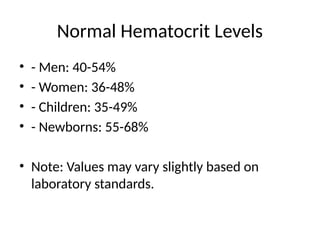
Normal Hematocrit Levels
• - Men: 40-54%
• - Women: 36-48%
• - Children: 35-49%
• - Newborns: 55-68%
• Note: Values may vary slightly based on
laboratory standards.
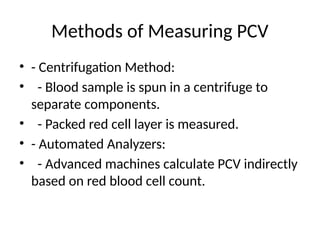
Methods of Measuring PCV
• - Centrifugation Method:
• - Blood sample is spun in a centrifuge to
separate components.
• - Packed red cell layer is measured.
• - Automated Analyzers:
• - Advanced machines calculate PCV indirectly
based on red blood cell count.
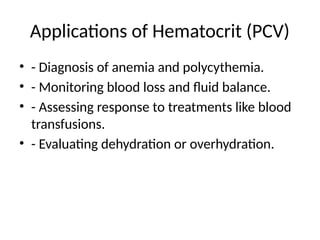
Applications of Hematocrit (PCV)
• - Diagnosis of anemia and polycythemia.
• - Monitoring blood loss and fluid balance.
• - Assessing response to treatments like blood
transfusions.
• - Evaluating dehydration or overhydration.
Conclusion
• - Hematocrit (PCV) is a vital diagnostic tool.
• - It provides insights into red blood cell health
and overall blood composition.
• - Essential for detecting and managing various
medical conditions.

Hematocrit_PCV_and_Applications (1).pptx

  • 1.
    Hematocrit (PCV) and Applications UnderstandingPacked Cell Volume and Its Medical Relevance
  • 2.
    What is Hematocrit(PCV)? • - Hematocrit, also called Packed Cell Volume (PCV), is the percentage of red blood cells in the blood. • - It is measured using a centrifuge or automated machines. • - Helps assess the overall health and detect various conditions.
  • 3.
    Normal Hematocrit Levels •- Men: 40-54% • - Women: 36-48% • - Children: 35-49% • - Newborns: 55-68% • Note: Values may vary slightly based on laboratory standards.
  • 4.
    Methods of MeasuringPCV • - Centrifugation Method: • - Blood sample is spun in a centrifuge to separate components. • - Packed red cell layer is measured. • - Automated Analyzers: • - Advanced machines calculate PCV indirectly based on red blood cell count.
  • 5.
    Applications of Hematocrit(PCV) • - Diagnosis of anemia and polycythemia. • - Monitoring blood loss and fluid balance. • - Assessing response to treatments like blood transfusions. • - Evaluating dehydration or overhydration.
  • 6.
    Conclusion • - Hematocrit(PCV) is a vital diagnostic tool. • - It provides insights into red blood cell health and overall blood composition. • - Essential for detecting and managing various medical conditions.