The ODYSSEY OUTCOMES Trial: Topline Results
Alirocumab in Patients After Acute Coronary Syndrome
Gregory G. Schwartz, Michael Szarek, Deepak L. Bhatt, Vera Bittner, Rafael Diaz, Jay Edelberg,
Shaun G. Goodman, Corinne Hanotin, Robert Harrington, J. Wouter Jukema,
Guillaume Lecorps, Angèle Moryusef, Robert Pordy, Matthew Roe, Harvey D. White, Andreas Zeiher,
Ph. Gabriel Steg
On behalf of the ODYSSEY OUTCOMES Investigators and Committees
American College of Cardiology – 67th Scientific Sessions
March 10, 2018
ClinicalTrials.gov: NCT01663402
ACC.18
2
Disclosures
• The trial was funded by Sanofi and Regeneron Pharmaceuticals
• Ph. Gabriel Steg discloses the following relationships:
- Research grants from Bayer, Merck, Sanofi, and Servier
- Speaking or consulting fees from Amarin, Amgen, AstraZeneca, Bayer/Janssen,
Boehringer Ingelheim, Bristol-Myers Squibb, Lilly, Merck, Novartis, Novo-
Nordisk, Pfizer, Regeneron Pharmaceuticals, Sanofi, and Servier
• Gregory G. Schwartz discloses research support to his institution
ACC.18
3
• Remains high despite evidence-based preventive therapies
• Is related, in part, to levels of low-density lipoprotein cholesterol
(LDL-C)
• Is reduced when LDL-C is lowered by
• Statin therapy, compared with placebo1
• High-intensity, compared with moderate-intensity statin therapy2
• Ezetimibe, compared with placebo, added to statin3
Residual Risk After Acute Coronary Syndrome
1. Schwartz GG, et al. JAMA 2001;285:1711-8. 2. Cannon CP, et al. NEJM 2004;350:1495-504.
3. Cannon CP, et al. NEJM 2015;372:2387-97.
ACC.18
4
Alirocumab
• A fully human monoclonal antibody against PCSK9
• Produces substantial and sustained reductions in LDL-C and
other atherogenic lipoproteins1
• Has been safe and well-tolerated in studies to date2
PCSK9, proprotein convertase subtilisin/kexin type 9
1. Robinson JG, et al. NEJM 2015;372:1489-99. 2. Robinson JG, et al. JACC 2017;69:471-82.
ACC.18
5
Study Hypothesis
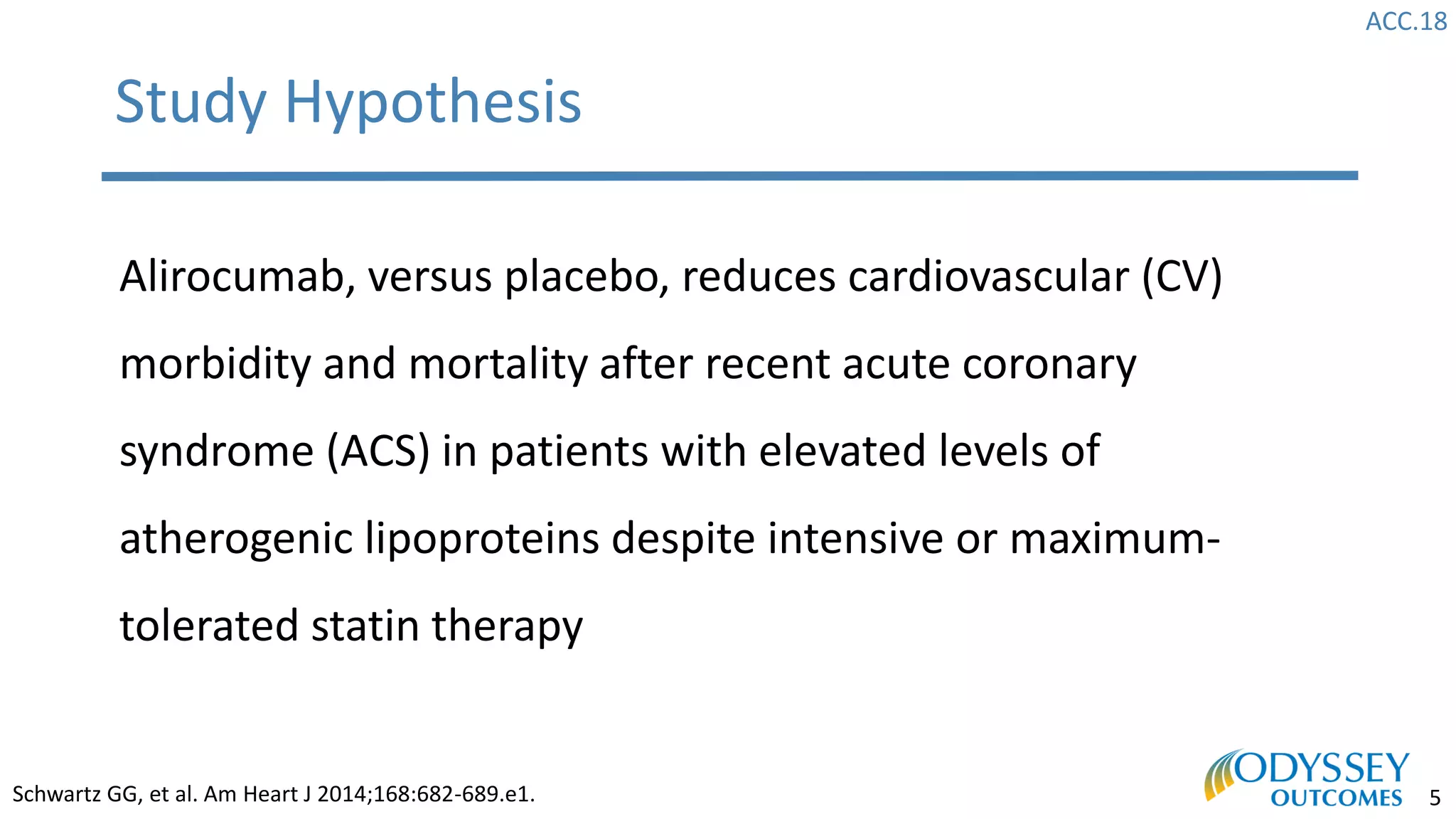
Alirocumab, versus placebo, reduces cardiovascular (CV)
morbidity and mortality after recent acute coronary
syndrome (ACS) in patients with elevated levels of
atherogenic lipoproteins despite intensive or maximum-
tolerated statin therapy
Schwartz GG, et al. Am Heart J 2014;168:682-689.e1.
ACC.18
6
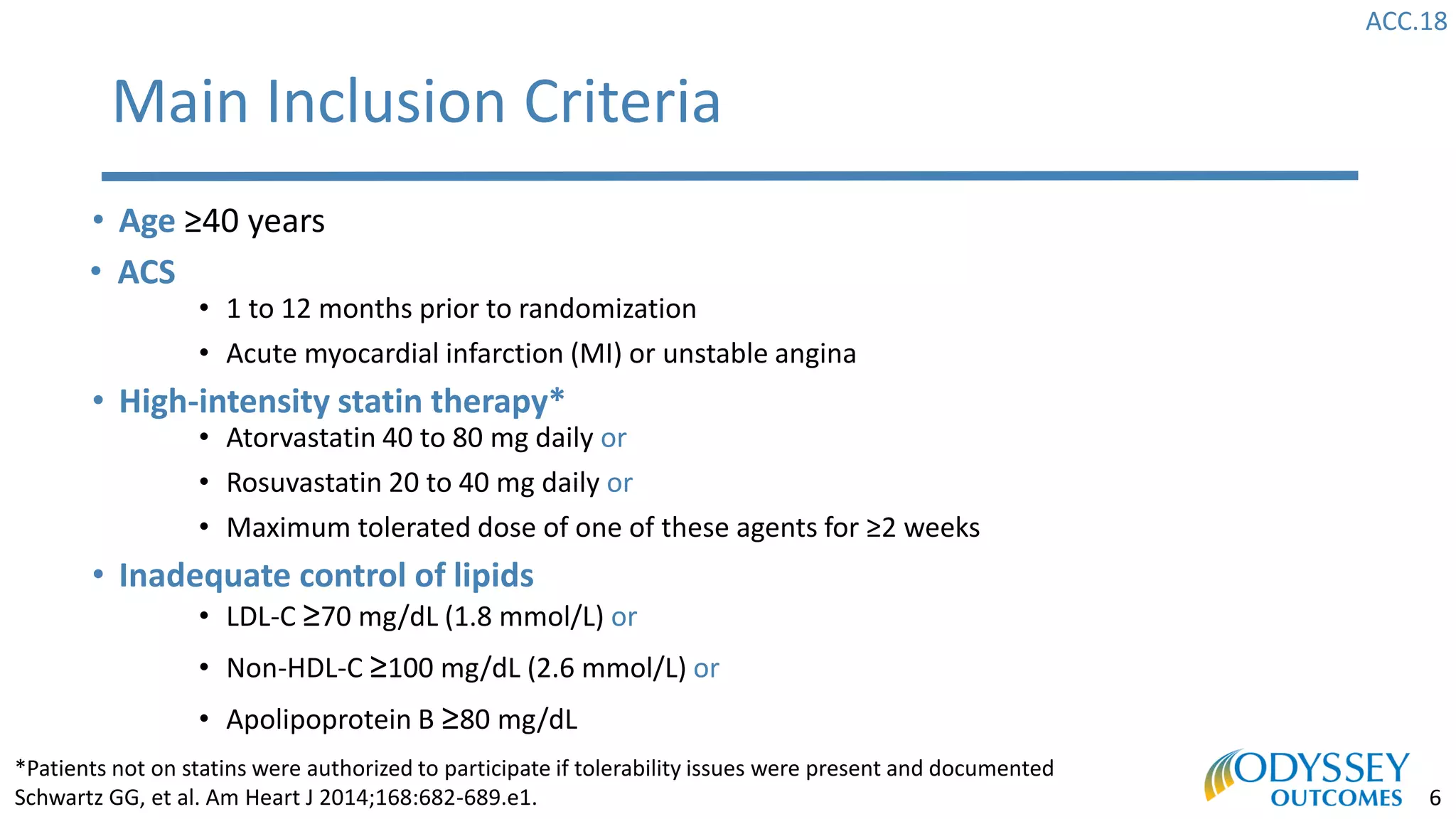
Main Inclusion Criteria
• Age ≥40 years
• ACS
• 1 to 12 months prior to randomization
• Acute myocardial infarction (MI) or unstable angina
• High-intensity statin therapy*
• Atorvastatin 40 to 80 mg daily or
• Rosuvastatin 20 to 40 mg daily or
• Maximum tolerated dose of one of these agents for ≥2 weeks
• Inadequate control of lipids
• LDL-C ≥70 mg/dL (1.8 mmol/L) or
• Non-HDL-C ≥100 mg/dL (2.6 mmol/L) or
• Apolipoprotein B ≥80 mg/dL
*Patients not on statins were authorized to participate if tolerability issues were present and documented
Schwartz GG, et al. Am Heart J 2014;168:682-689.e1.
ACC.18
7
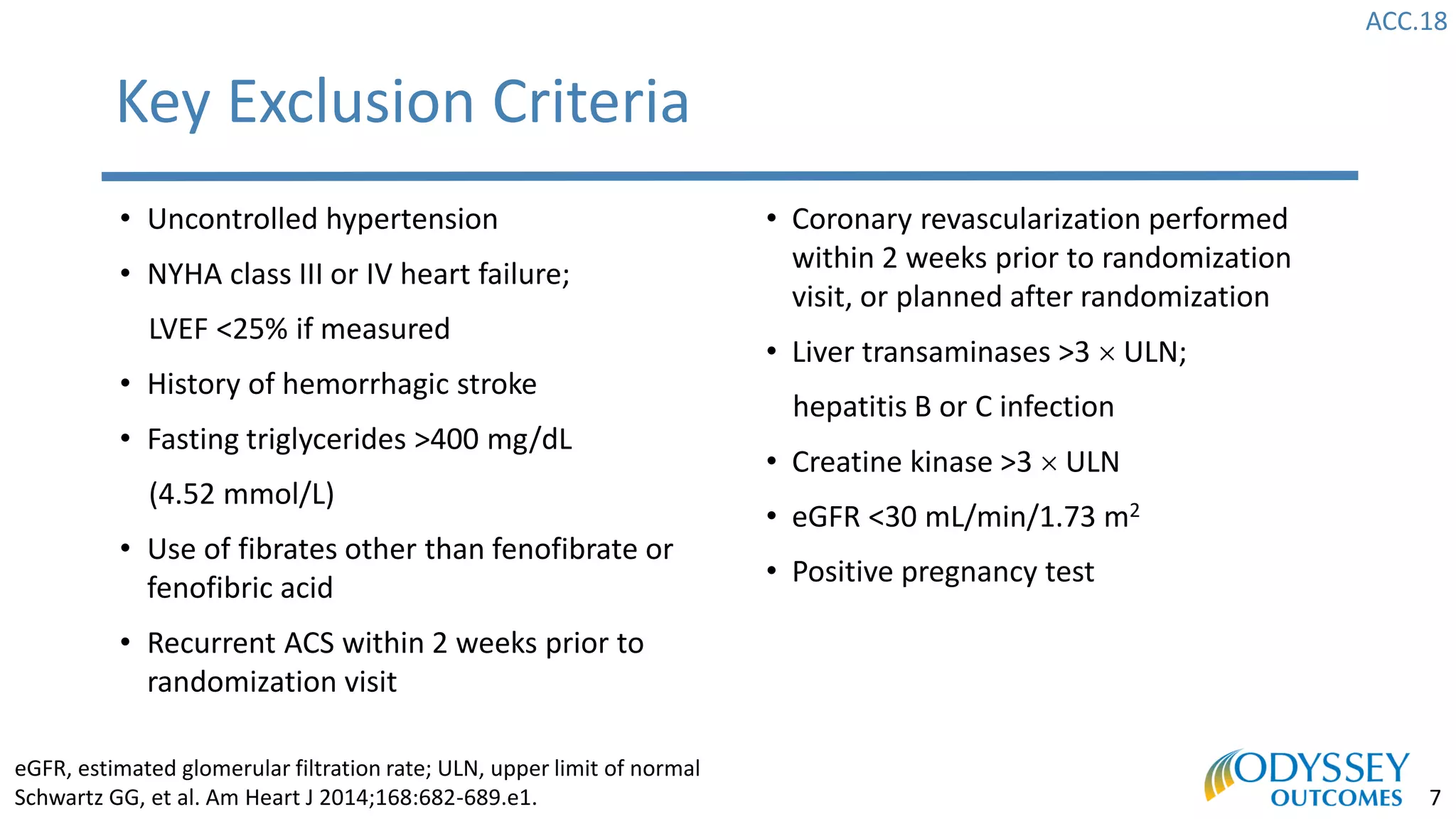
Key Exclusion Criteria
• Uncontrolled hypertension
• NYHA class III or IV heart failure;
LVEF <25% if measured
• History of hemorrhagic stroke
• Fasting triglycerides >400 mg/dL
(4.52 mmol/L)
• Use of fibrates other than fenofibrate or
fenofibric acid
• Recurrent ACS within 2 weeks prior to
randomization visit
• Coronary revascularization performed
within 2 weeks prior to randomization
visit, or planned after randomization
• Liver transaminases >3  ULN;
hepatitis B or C infection
• Creatine kinase >3  ULN
• eGFR <30 mL/min/1.73 m2
• Positive pregnancy test
eGFR, estimated glomerular filtration rate; ULN, upper limit of normal
Schwartz GG, et al. Am Heart J 2014;168:682-689.e1.
ACC.18
8
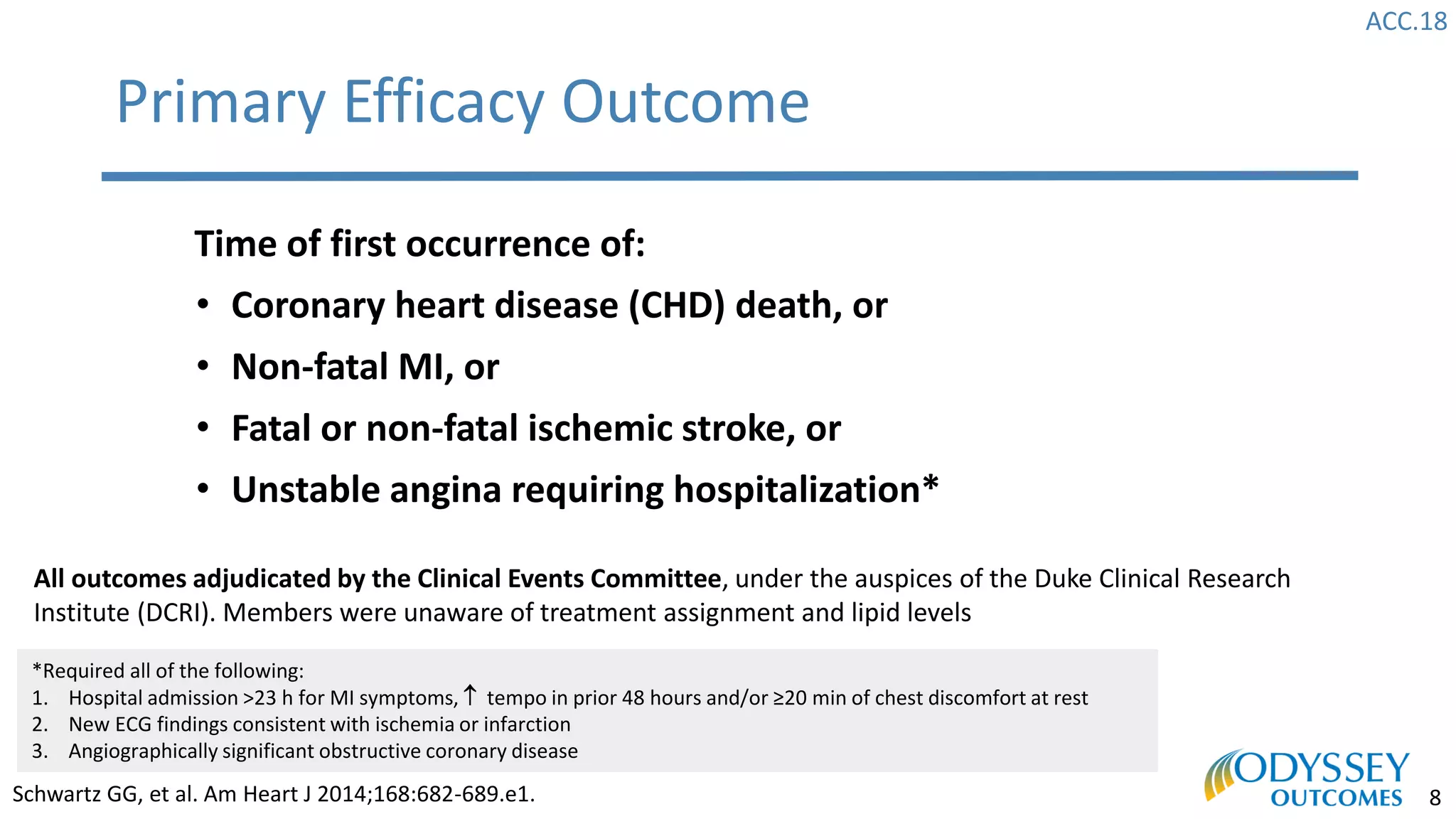
Time of first occurrence of:
• Coronary heart disease (CHD) death, or
• Non-fatal MI, or
• Fatal or non-fatal ischemic stroke, or
• Unstable angina requiring hospitalization*
Primary Efficacy Outcome
All outcomes adjudicated by the Clinical Events Committee, under the auspices of the Duke Clinical Research
Institute (DCRI). Members were unaware of treatment assignment and lipid levels
*Required all of the following:
1. Hospital admission >23 h for MI symptoms,  tempo in prior 48 hours and/or ≥20 min of chest discomfort at rest
2. New ECG findings consistent with ischemia or infarction
3. Angiographically significant obstructive coronary disease
Schwartz GG, et al. Am Heart J 2014;168:682-689.e1.
ACC.18
9
Major Secondary Efficacy Endpoints
Tested in the following hierarchical sequence:
• CHD event: CHD death, non-fatal MI, unstable angina requiring hospitalization, or
ischemia-driven coronary revascularization*
• Major CHD event: CHD death or non-fatal MI
• CV event: CV death, non-fatal CHD event, or non-fatal ischemic stroke
• All-cause death, non-fatal MI, non-fatal ischemic stroke
• CHD death
• CV death
• All-cause death
*Revascularization performed because of recurrent ACS, new or progressive symptoms of myocardial ischemia or new or
progressive abnormalities on functional testing, except revascularization due to restenosis at a prior coronary intervention site.
ACC.18
10
Other Secondary and Safety Endpoints
Other secondary endpoints
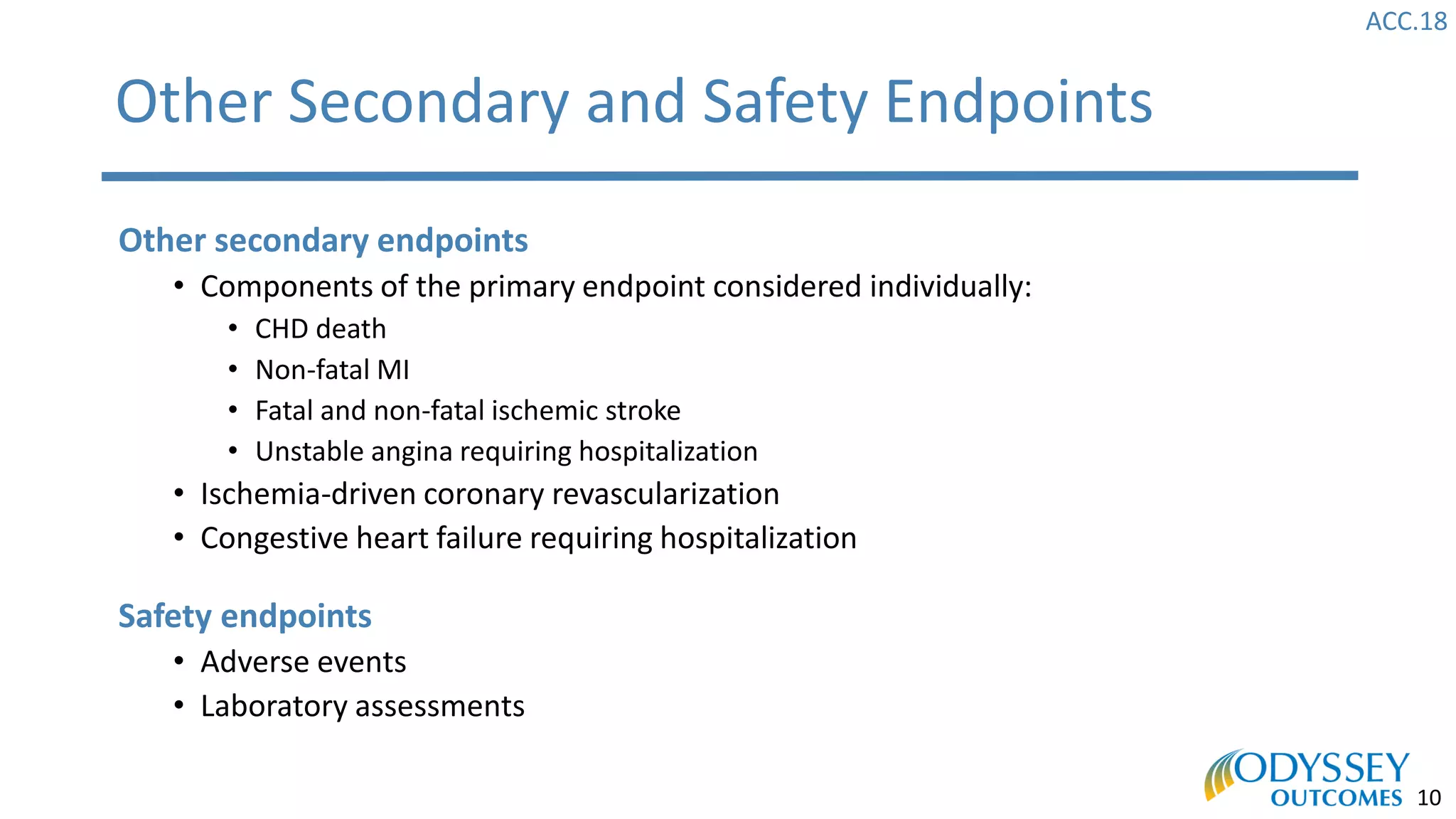
• Components of the primary endpoint considered individually:
• CHD death
• Non-fatal MI
• Fatal and non-fatal ischemic stroke
• Unstable angina requiring hospitalization
• Ischemia-driven coronary revascularization
• Congestive heart failure requiring hospitalization
Safety endpoints
• Adverse events
• Laboratory assessments
ACC.18
11
Treatment Assignment
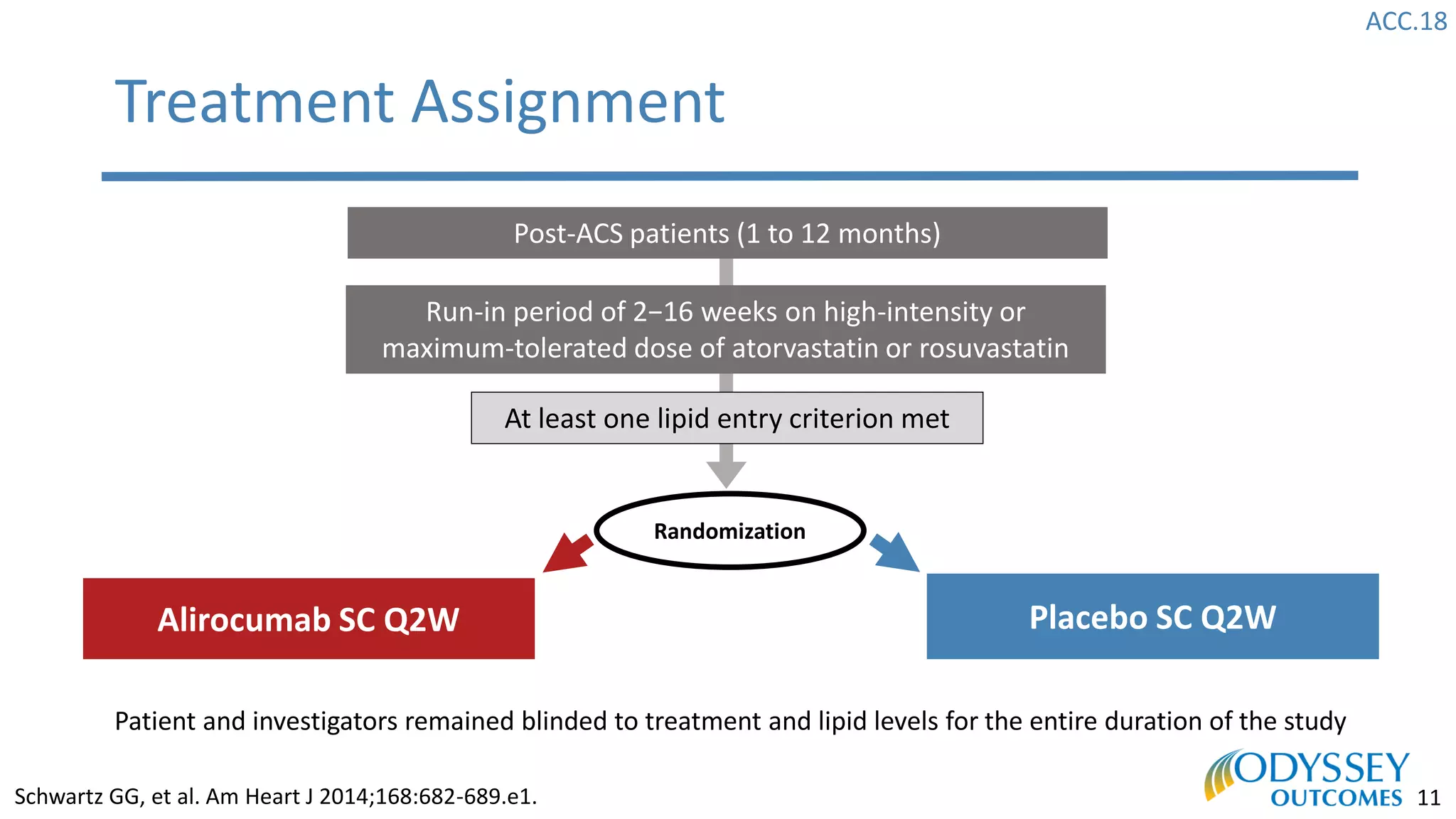
Post-ACS patients (1 to 12 months)
Run-in period of 2−16 weeks on high-intensity or
maximum-tolerated dose of atorvastatin or rosuvastatin
At least one lipid entry criterion met
Placebo SC Q2WAlirocumab SC Q2W
Randomization
Schwartz GG, et al. Am Heart J 2014;168:682-689.e1.
Patient and investigators remained blinded to treatment and lipid levels for the entire duration of the study
ACC.18
12
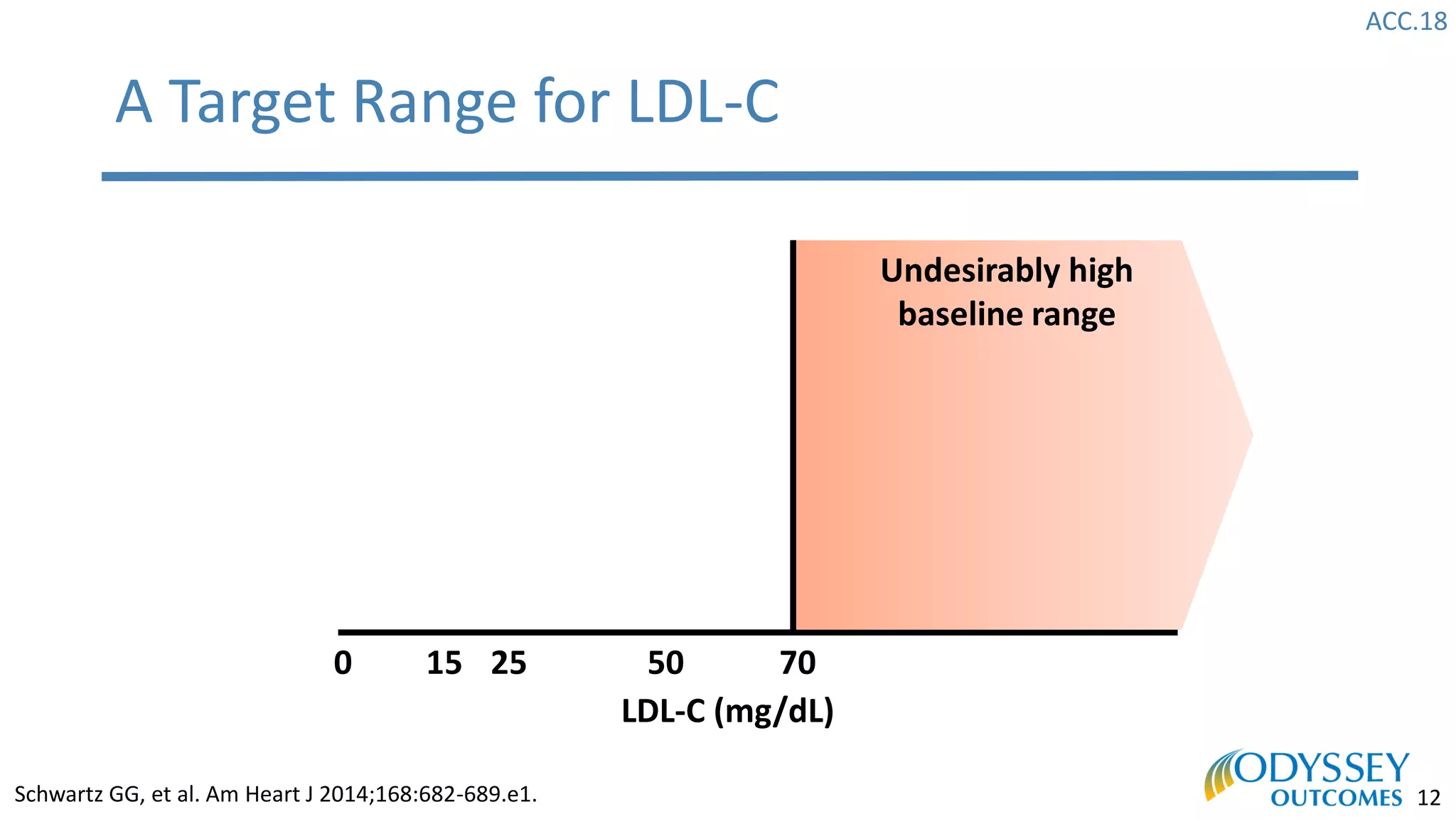
LDL-C (mg/dL)
705025150
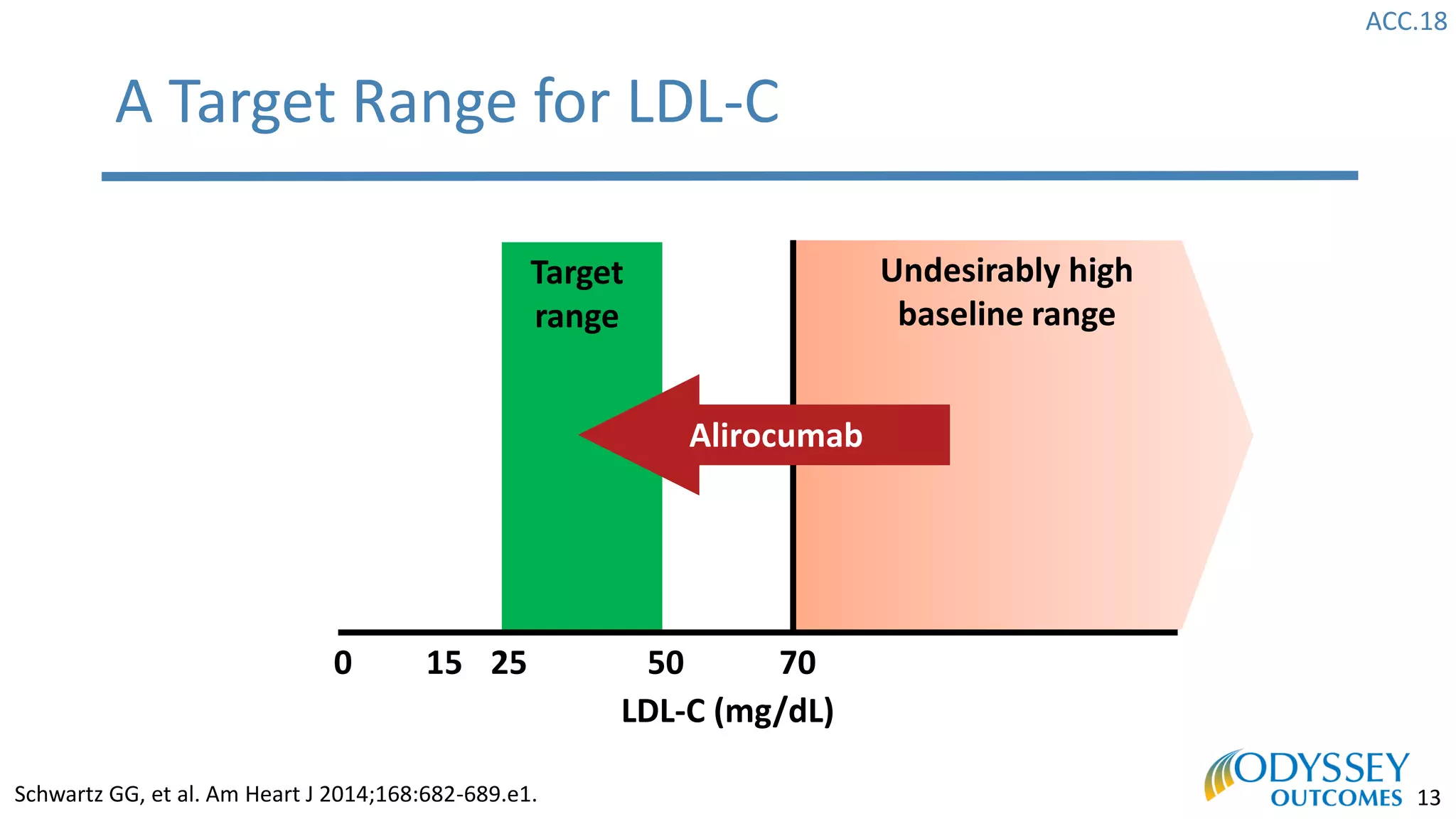
A Target Range for LDL-C
Schwartz GG, et al. Am Heart J 2014;168:682-689.e1.
Undesirably high
baseline range
ACC.18
13
Undesirably high
baseline range
LDL-C (mg/dL)
Target
range
705025150
A Target Range for LDL-C
Schwartz GG, et al. Am Heart J 2014;168:682-689.e1.
Alirocumab
ACC.18
14
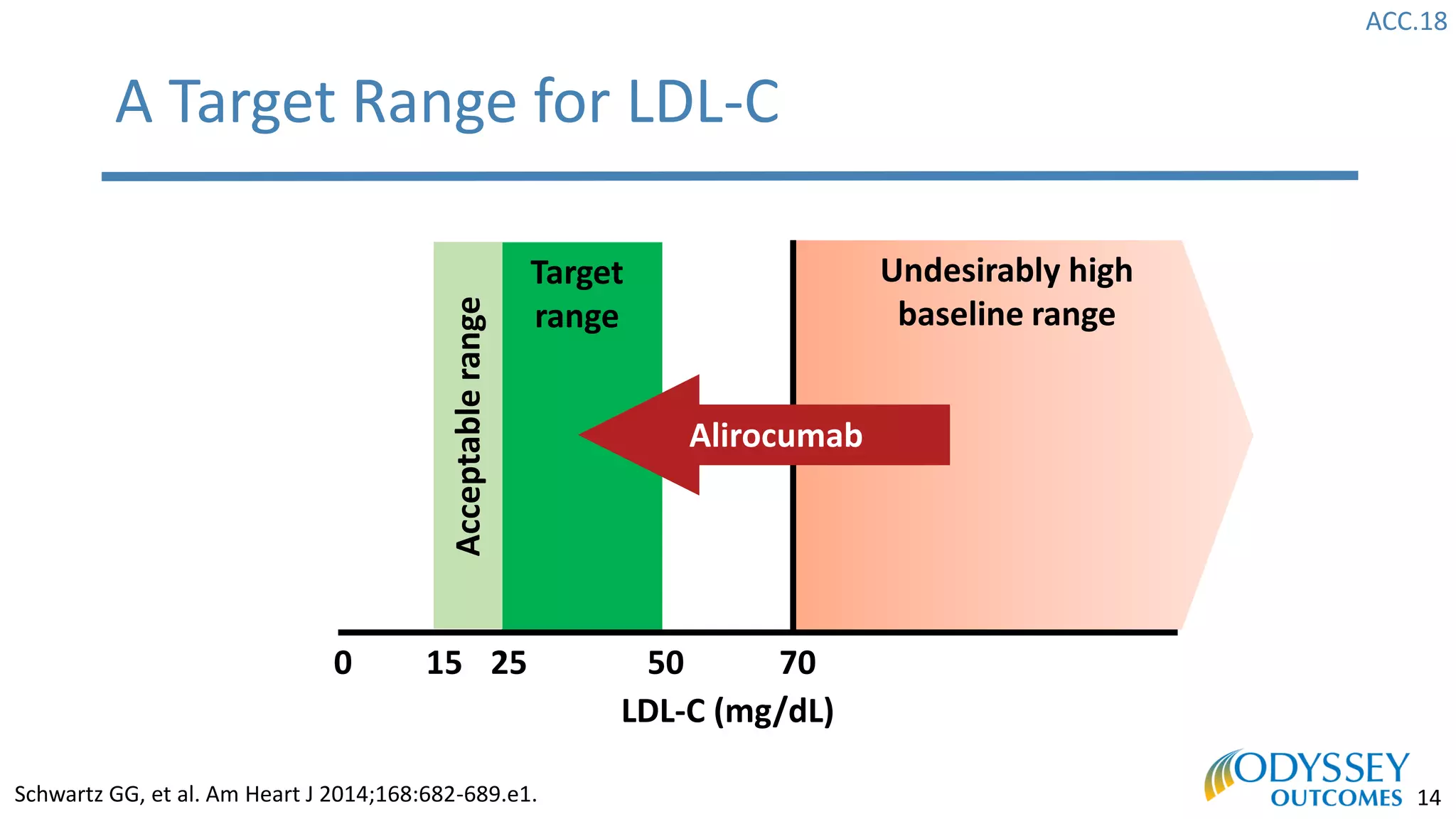
Undesirably high
baseline range
LDL-C (mg/dL)
Target
range
Alirocumab
705025150
A Target Range for LDL-C
Schwartz GG, et al. Am Heart J 2014;168:682-689.e1.
Acceptablerange
ACC.18
15
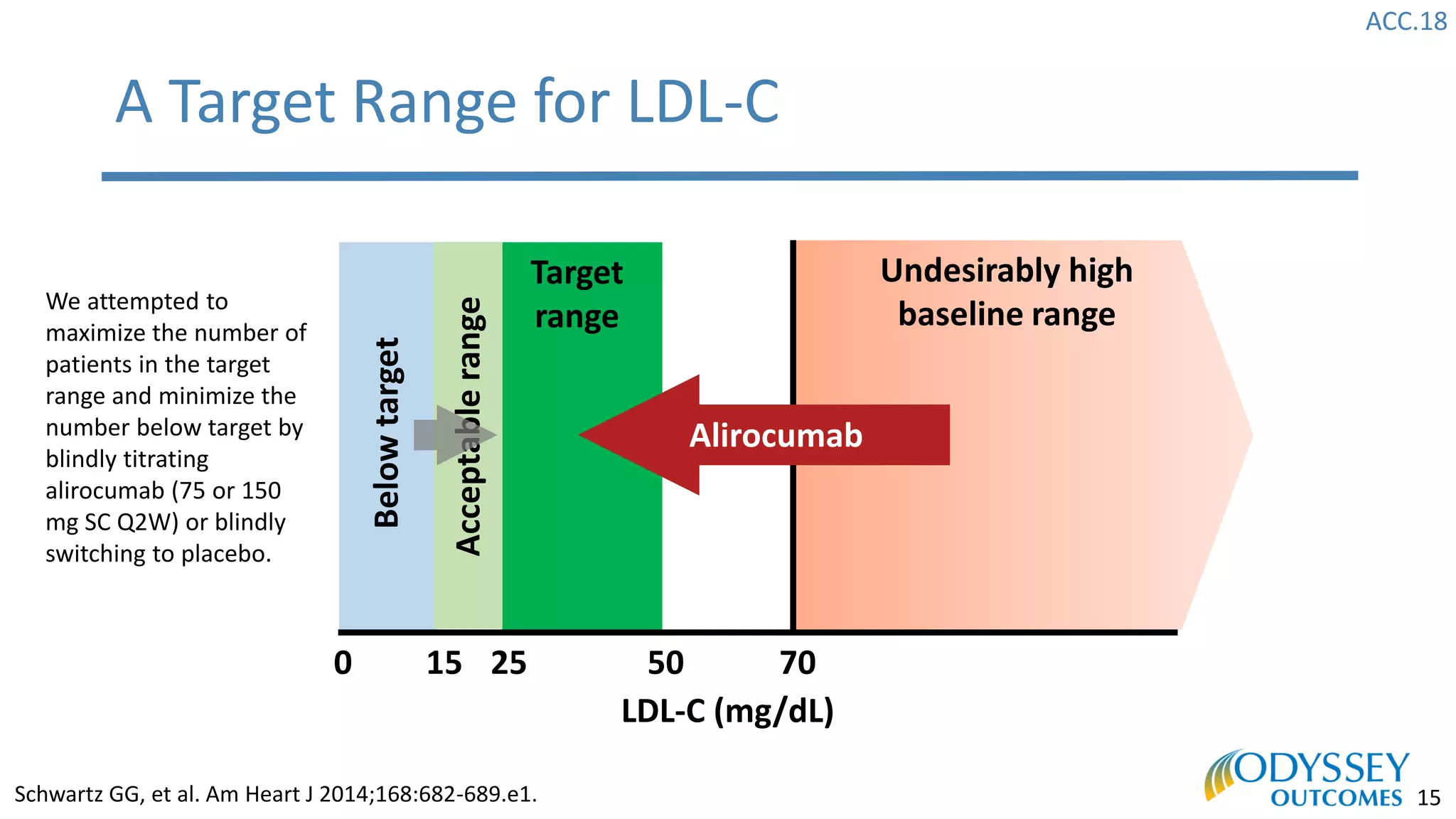
Undesirably high
baseline range
LDL-C (mg/dL)
Target
range
Alirocumab
Belowtarget
705025150
Acceptablerange
A Target Range for LDL-C
Schwartz GG, et al. Am Heart J 2014;168:682-689.e1.
We attempted to
maximize the number of
patients in the target
range and minimize the
number below target by
blindly titrating
alirocumab (75 or 150
mg SC Q2W) or blindly
switching to placebo.
ACC.18
16
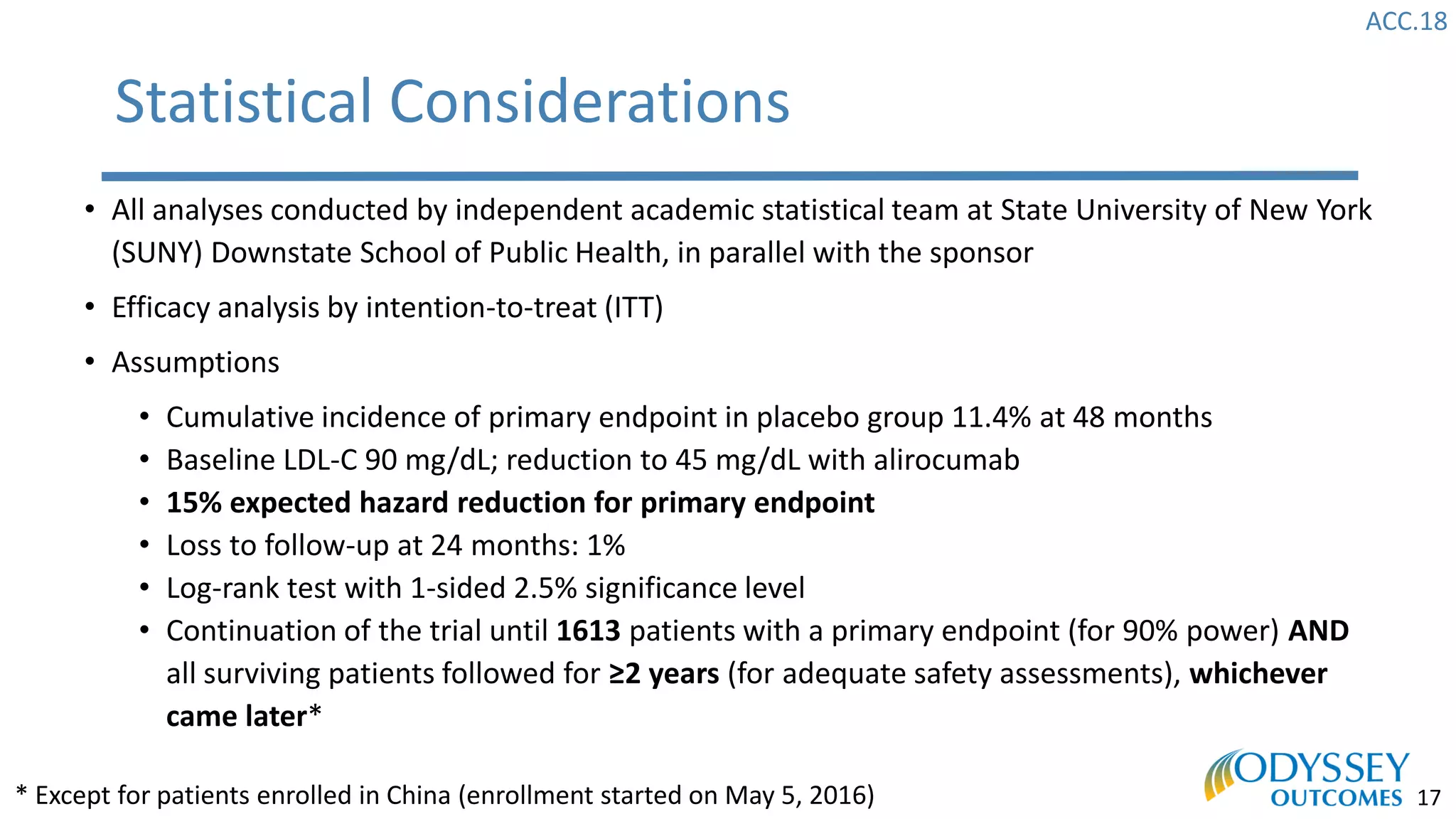
Statistical Considerations
• All analyses conducted by independent academic statistical team at State University of New York
(SUNY) Downstate School of Public Health, in parallel with the sponsor
• Efficacy analysis by intention-to-treat (ITT)
ACC.18
17
Statistical Considerations
• All analyses conducted by independent academic statistical team at State University of New York
(SUNY) Downstate School of Public Health, in parallel with the sponsor
• Efficacy analysis by intention-to-treat (ITT)
• Assumptions
• Cumulative incidence of primary endpoint in placebo group 11.4% at 48 months
• Baseline LDL-C 90 mg/dL; reduction to 45 mg/dL with alirocumab
• 15% expected hazard reduction for primary endpoint
• Loss to follow-up at 24 months: 1%
• Log-rank test with 1-sided 2.5% significance level
• Continuation of the trial until 1613 patients with a primary endpoint (for 90% power) AND
all surviving patients followed for ≥2 years (for adequate safety assessments), whichever
came later*
* Except for patients enrolled in China (enrollment started on May 5, 2016)
ACC.18
18
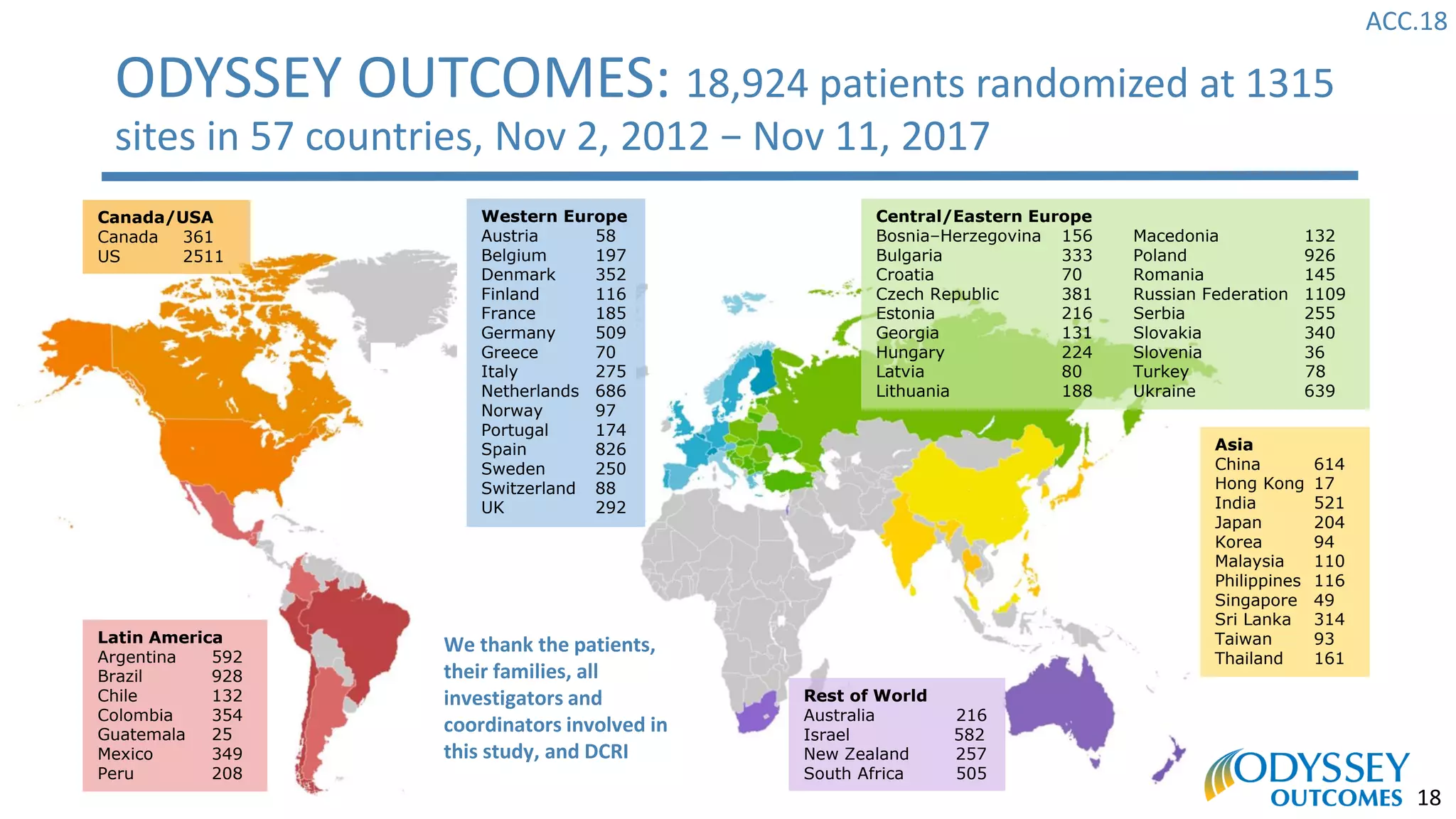
ODYSSEY OUTCOMES: 18,924 patients randomized at 1315
sites in 57 countries, Nov 2, 2012 − Nov 11, 2017
Canada/USA
Canada 361
US 2511
Latin America
Argentina 592
Brazil 928
Chile 132
Colombia 354
Guatemala 25
Mexico 349
Peru 208
Asia
China 614
Hong Kong 17
India 521
Japan 204
Korea 94
Malaysia 110
Philippines 116
Singapore 49
Sri Lanka 314
Taiwan 93
Thailand 161
Rest of World
Australia 216
Israel 582
New Zealand 257
South Africa 505
Western Europe
Austria 58
Belgium 197
Denmark 352
Finland 116
France 185
Germany 509
Greece 70
Italy 275
Netherlands 686
Norway 97
Portugal 174
Spain 826
Sweden 250
Switzerland 88
UK 292
Central/Eastern Europe
Bosnia–Herzegovina 156 Macedonia 132
Bulgaria 333 Poland 926
Croatia 70 Romania 145
Czech Republic 381 Russian Federation 1109
Estonia 216 Serbia 255
Georgia 131 Slovakia 340
Hungary 224 Slovenia 36
Latvia 80 Turkey 78
Lithuania 188 Ukraine 639
We thank the patients,
their families, all
investigators and
coordinators involved in
this study, and DCRI
ACC.18
19
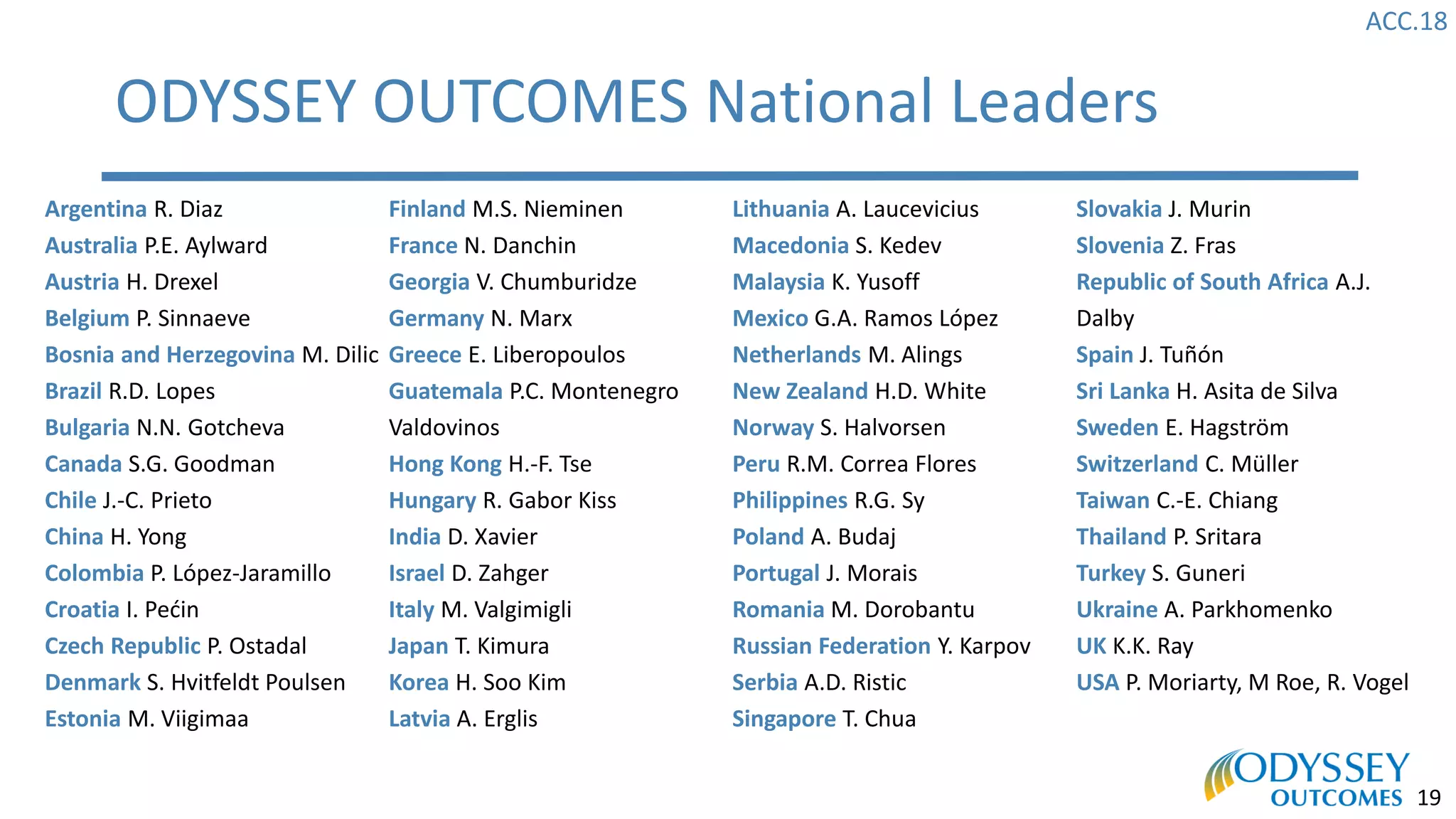
Argentina R. Diaz
Australia P.E. Aylward
Austria H. Drexel
Belgium P. Sinnaeve
Bosnia and Herzegovina M. Dilic
Brazil R.D. Lopes
Bulgaria N.N. Gotcheva
Canada S.G. Goodman
Chile J.-C. Prieto
China H. Yong
Colombia P. López-Jaramillo
Croatia I. Pećin
Czech Republic P. Ostadal
Denmark S. Hvitfeldt Poulsen
Estonia M. Viigimaa
Finland M.S. Nieminen
France N. Danchin
Georgia V. Chumburidze
Germany N. Marx
Greece E. Liberopoulos
Guatemala P.C. Montenegro
Valdovinos
Hong Kong H.-F. Tse
Hungary R. Gabor Kiss
India D. Xavier
Israel D. Zahger
Italy M. Valgimigli
Japan T. Kimura
Korea H. Soo Kim
Latvia A. Erglis
Lithuania A. Laucevicius
Macedonia S. Kedev
Malaysia K. Yusoff
Mexico G.A. Ramos López
Netherlands M. Alings
New Zealand H.D. White
Norway S. Halvorsen
Peru R.M. Correa Flores
Philippines R.G. Sy
Poland A. Budaj
Portugal J. Morais
Romania M. Dorobantu
Russian Federation Y. Karpov
Serbia A.D. Ristic
Singapore T. Chua
Slovakia J. Murin
Slovenia Z. Fras
Republic of South Africa A.J.
Dalby
Spain J. Tuñón
Sri Lanka H. Asita de Silva
Sweden E. Hagström
Switzerland C. Müller
Taiwan C.-E. Chiang
Thailand P. Sritara
Turkey S. Guneri
Ukraine A. Parkhomenko
UK K.K. Ray
USA P. Moriarty, M Roe, R. Vogel
ODYSSEY OUTCOMES National Leaders
ACC.18
20
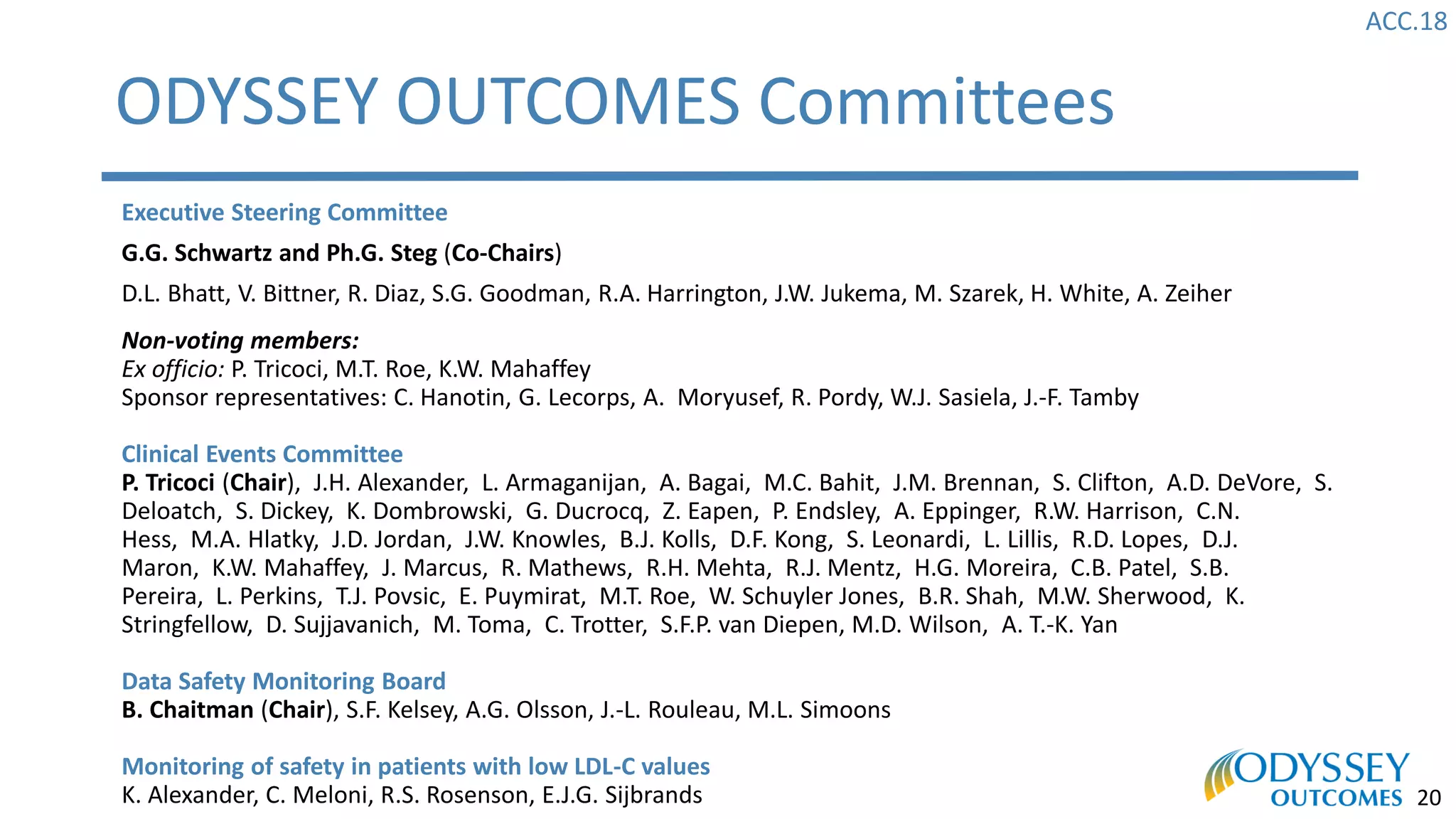
Executive Steering Committee
G.G. Schwartz and Ph.G. Steg (Co-Chairs)
D.L. Bhatt, V. Bittner, R. Diaz, S.G. Goodman, R.A. Harrington, J.W. Jukema, M. Szarek, H. White, A. Zeiher
Non-voting members:
Ex officio: P. Tricoci, M.T. Roe, K.W. Mahaffey
Sponsor representatives: C. Hanotin, G. Lecorps, A. Moryusef, R. Pordy, W.J. Sasiela, J.-F. Tamby
Clinical Events Committee
P. Tricoci (Chair), J.H. Alexander, L. Armaganijan, A. Bagai, M.C. Bahit, J.M. Brennan, S. Clifton, A.D. DeVore, S.
Deloatch, S. Dickey, K. Dombrowski, G. Ducrocq, Z. Eapen, P. Endsley, A. Eppinger, R.W. Harrison, C.N.
Hess, M.A. Hlatky, J.D. Jordan, J.W. Knowles, B.J. Kolls, D.F. Kong, S. Leonardi, L. Lillis, R.D. Lopes, D.J.
Maron, K.W. Mahaffey, J. Marcus, R. Mathews, R.H. Mehta, R.J. Mentz, H.G. Moreira, C.B. Patel, S.B.
Pereira, L. Perkins, T.J. Povsic, E. Puymirat, M.T. Roe, W. Schuyler Jones, B.R. Shah, M.W. Sherwood, K.
Stringfellow, D. Sujjavanich, M. Toma, C. Trotter, S.F.P. van Diepen, M.D. Wilson, A. T.-K. Yan
Data Safety Monitoring Board
B. Chaitman (Chair), S.F. Kelsey, A.G. Olsson, J.-L. Rouleau, M.L. Simoons
Monitoring of safety in patients with low LDL-C values
K. Alexander, C. Meloni, R.S. Rosenson, E.J.G. Sijbrands
ODYSSEY OUTCOMES Committees
ACC.18
21
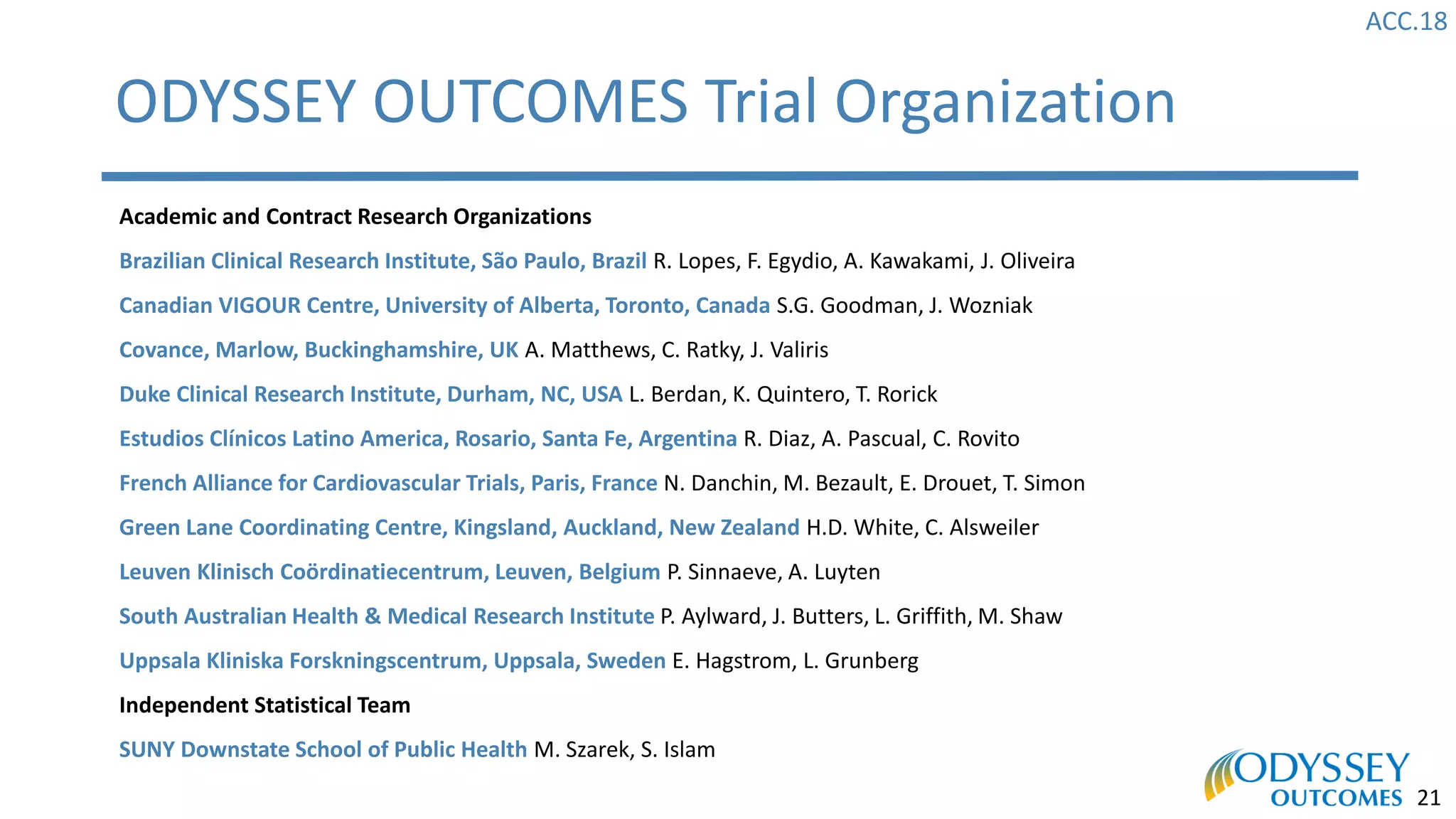
ODYSSEY OUTCOMES Trial Organization
Academic and Contract Research Organizations
Brazilian Clinical Research Institute, São Paulo, Brazil R. Lopes, F. Egydio, A. Kawakami, J. Oliveira
Canadian VIGOUR Centre, University of Alberta, Toronto, Canada S.G. Goodman, J. Wozniak
Covance, Marlow, Buckinghamshire, UK A. Matthews, C. Ratky, J. Valiris
Duke Clinical Research Institute, Durham, NC, USA L. Berdan, K. Quintero, T. Rorick
Estudios Clínicos Latino America, Rosario, Santa Fe, Argentina R. Diaz, A. Pascual, C. Rovito
French Alliance for Cardiovascular Trials, Paris, France N. Danchin, M. Bezault, E. Drouet, T. Simon
Green Lane Coordinating Centre, Kingsland, Auckland, New Zealand H.D. White, C. Alsweiler
Leuven Klinisch Coördinatiecentrum, Leuven, Belgium P. Sinnaeve, A. Luyten
South Australian Health & Medical Research Institute P. Aylward, J. Butters, L. Griffith, M. Shaw
Uppsala Kliniska Forskningscentrum, Uppsala, Sweden E. Hagstrom, L. Grunberg
Independent Statistical Team
SUNY Downstate School of Public Health M. Szarek, S. Islam
ACC.18
22
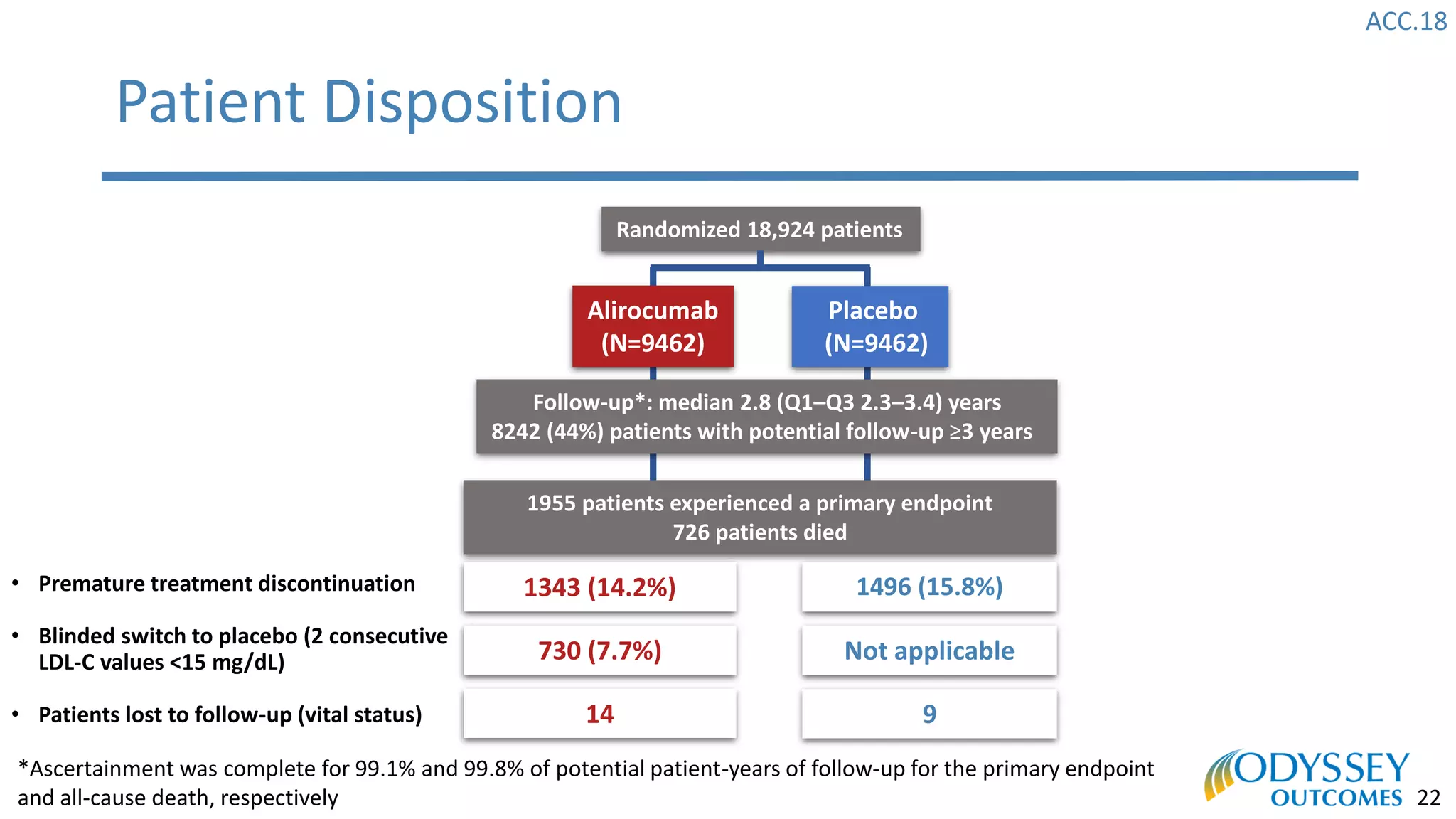
Patient Disposition
Randomized 18,924 patients
*Ascertainment was complete for 99.1% and 99.8% of potential patient-years of follow-up for the primary endpoint
and all-cause death, respectively
1955 patients experienced a primary endpoint
726 patients died
Follow-up*: median 2.8 (Q1–Q3 2.3–3.4) years
8242 (44%) patients with potential follow-up ≥3 years
Alirocumab
(N=9462)
Placebo
(N=9462)
1343 (14.2%) 1496 (15.8%)• Premature treatment discontinuation
• Blinded switch to placebo (2 consecutive
LDL-C values <15 mg/dL)
• Patients lost to follow-up (vital status)
730 (7.7%) Not applicable
14 9
ACC.18
23
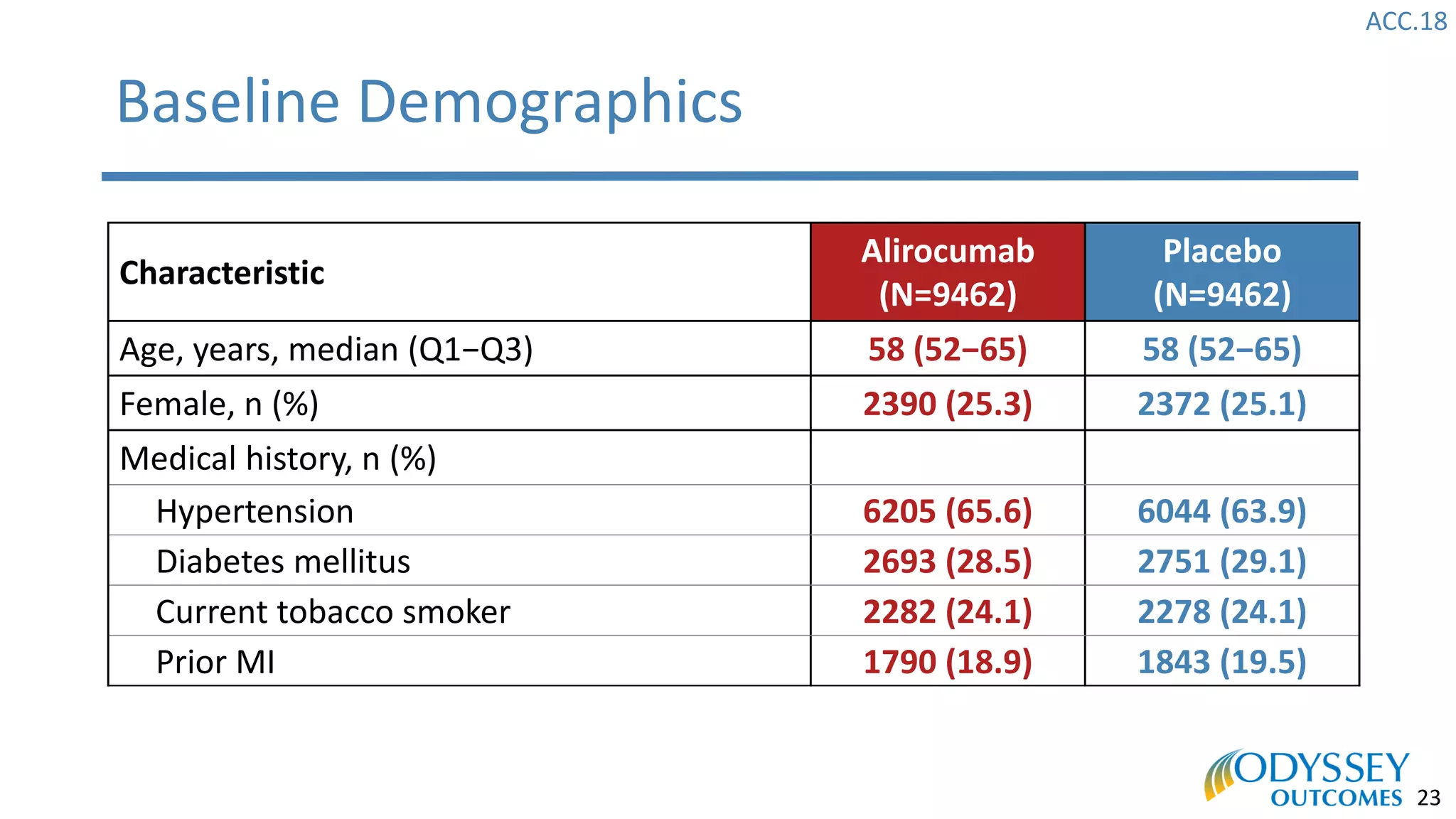
Baseline Demographics
Characteristic
Alirocumab
(N=9462)
Placebo
(N=9462)
Age, years, median (Q1−Q3) 58 (52−65) 58 (52−65)
Female, n (%) 2390 (25.3) 2372 (25.1)
Medical history, n (%)
Hypertension 6205 (65.6) 6044 (63.9)
Diabetes mellitus 2693 (28.5) 2751 (29.1)
Current tobacco smoker 2282 (24.1) 2278 (24.1)
Prior MI 1790 (18.9) 1843 (19.5)
ACC.18
24
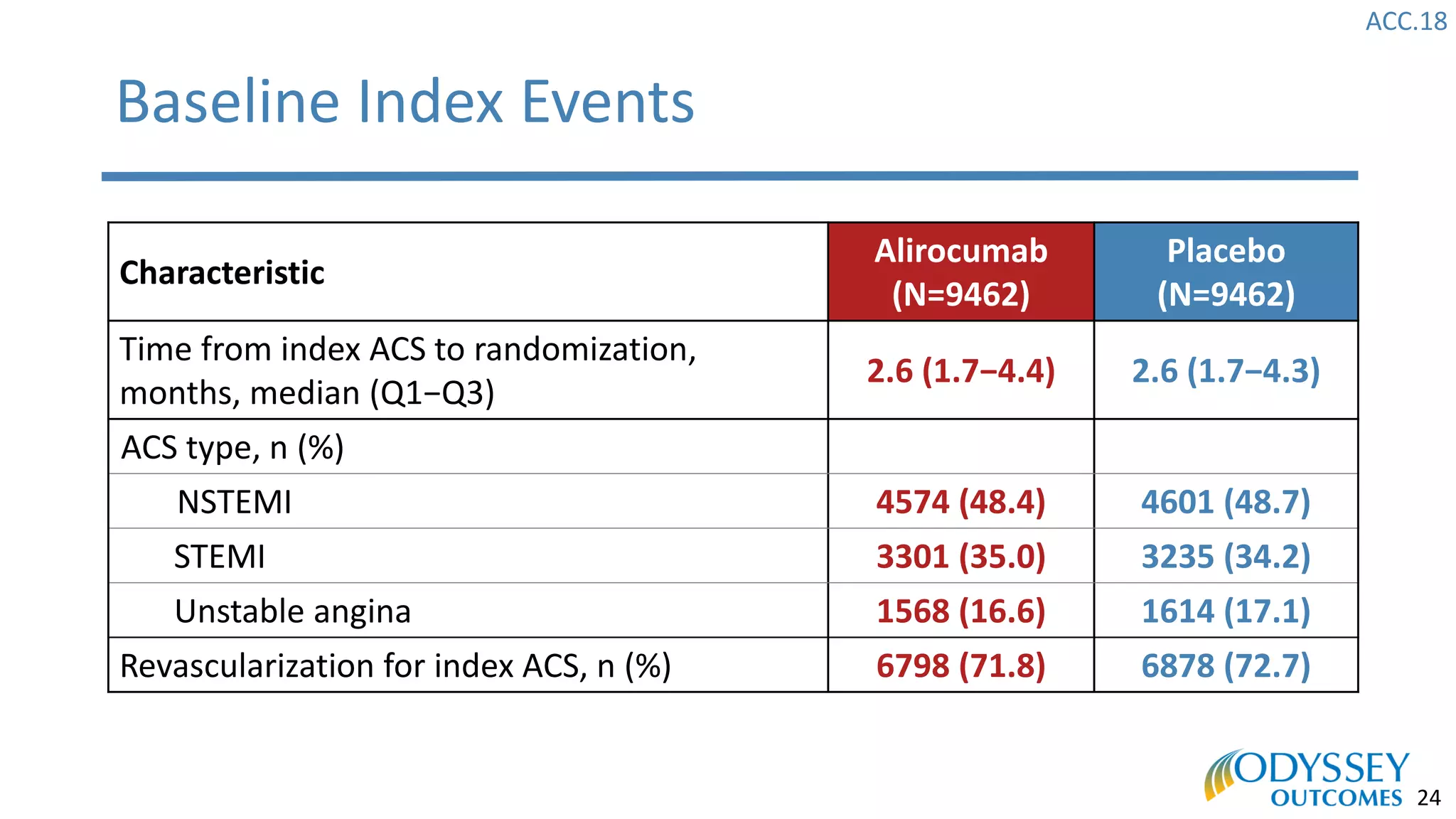
Characteristic
Alirocumab
(N=9462)
Placebo
(N=9462)
Time from index ACS to randomization,
months, median (Q1−Q3)
2.6 (1.7−4.4) 2.6 (1.7−4.3)
ACS type, n (%)
NSTEMI 4574 (48.4) 4601 (48.7)
STEMI 3301 (35.0) 3235 (34.2)
Unstable angina 1568 (16.6) 1614 (17.1)
Revascularization for index ACS, n (%) 6798 (71.8) 6878 (72.7)
Baseline Index Events
ACC.18
25
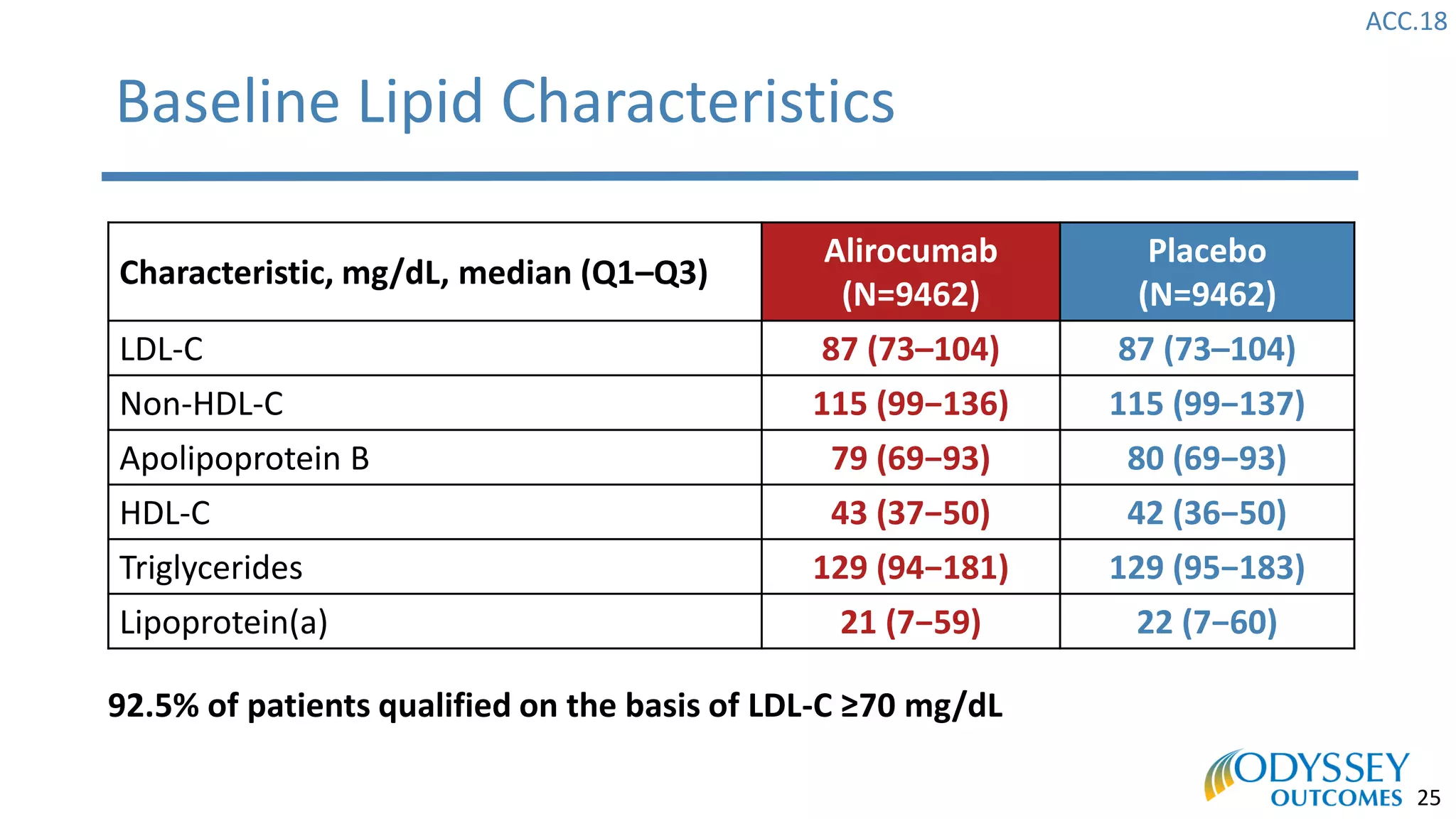
Baseline Lipid Characteristics
Characteristic, mg/dL, median (Q1–Q3)
Alirocumab
(N=9462)
Placebo
(N=9462)
LDL-C 87 (73–104) 87 (73–104)
Non-HDL-C 115 (99−136) 115 (99−137)
Apolipoprotein B 79 (69−93) 80 (69−93)
HDL-C 43 (37−50) 42 (36−50)
Triglycerides 129 (94−181) 129 (95−183)
Lipoprotein(a) 21 (7−59) 22 (7−60)
92.5% of patients qualified on the basis of LDL-C ≥70 mg/dL
ACC.18
26
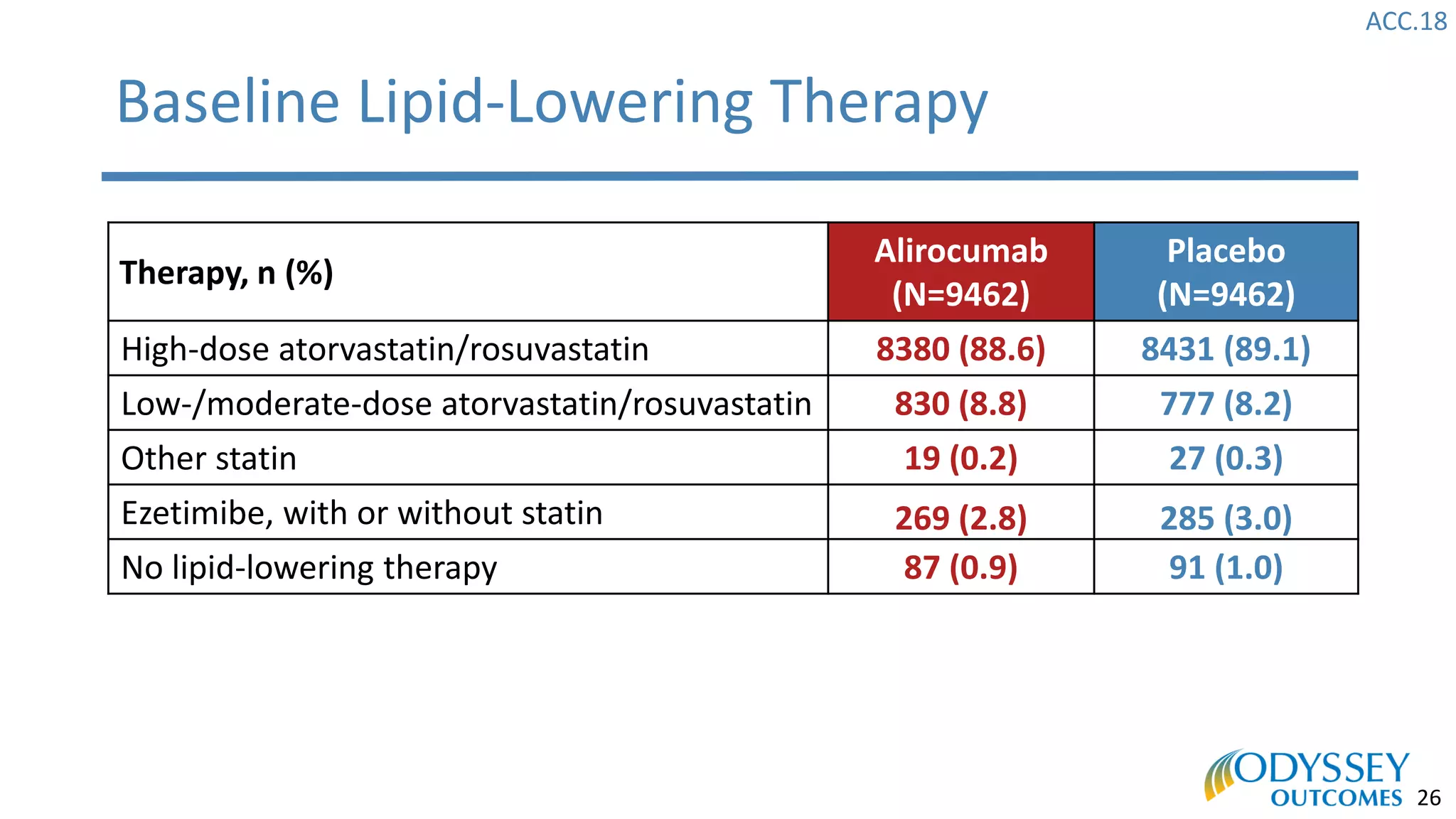
Therapy, n (%)
Alirocumab
(N=9462)
Placebo
(N=9462)
High-dose atorvastatin/rosuvastatin 8380 (88.6) 8431 (89.1)
Low-/moderate-dose atorvastatin/rosuvastatin 830 (8.8) 777 (8.2)
Other statin 19 (0.2) 27 (0.3)
Ezetimibe, with or without statin 269 (2.8) 285 (3.0)
No lipid-lowering therapy 87 (0.9) 91 (1.0)
Baseline Lipid-Lowering Therapy
ACC.18
27
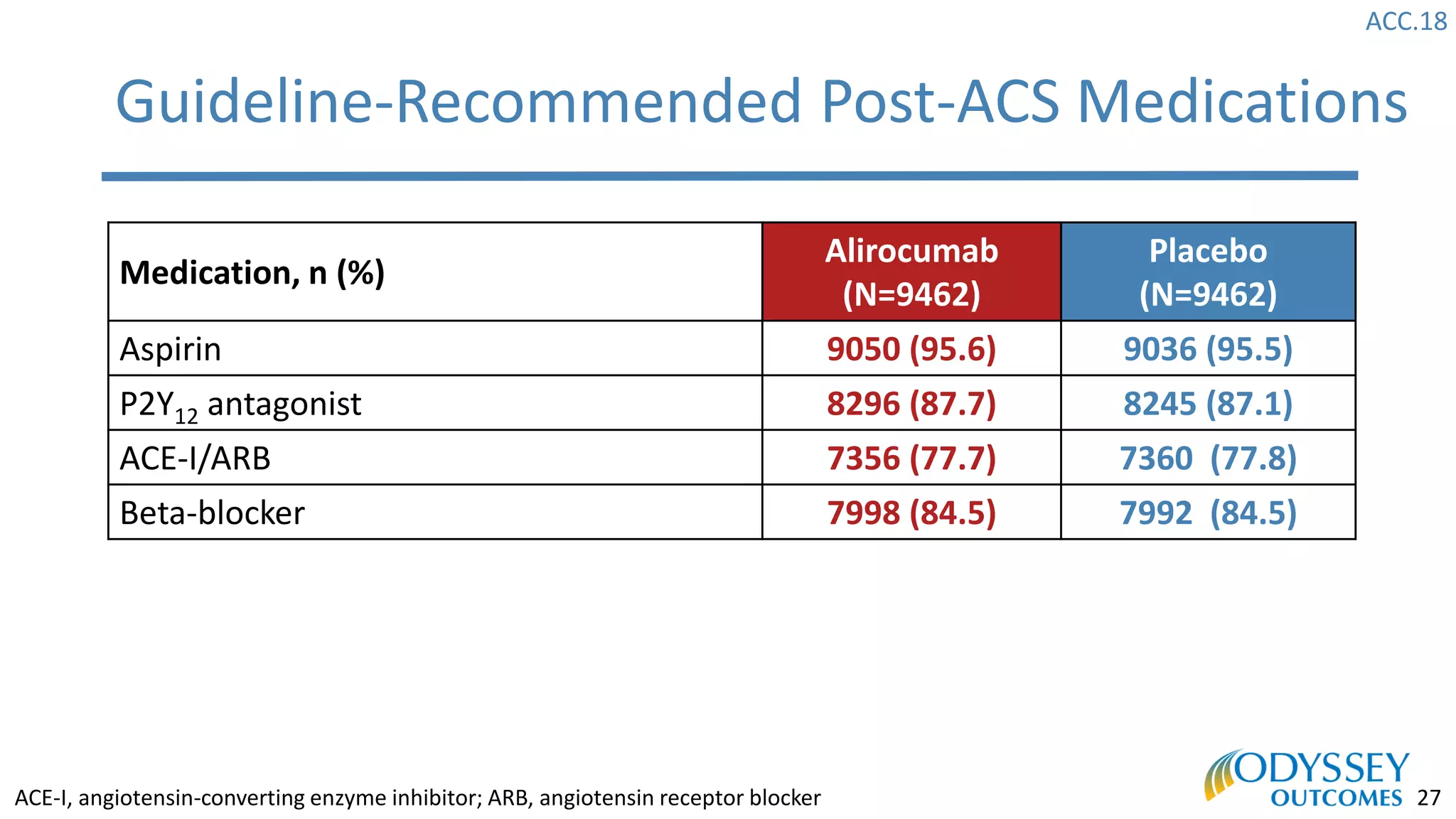
Guideline-Recommended Post-ACS Medications
Medication, n (%)
Alirocumab
(N=9462)
Placebo
(N=9462)
Aspirin 9050 (95.6) 9036 (95.5)
P2Y12 antagonist 8296 (87.7) 8245 (87.1)
ACE-I/ARB 7356 (77.7) 7360 (77.8)
Beta-blocker 7998 (84.5) 7992 (84.5)
ACE-I, angiotensin-converting enzyme inhibitor; ARB, angiotensin receptor blocker
ACC.18
28
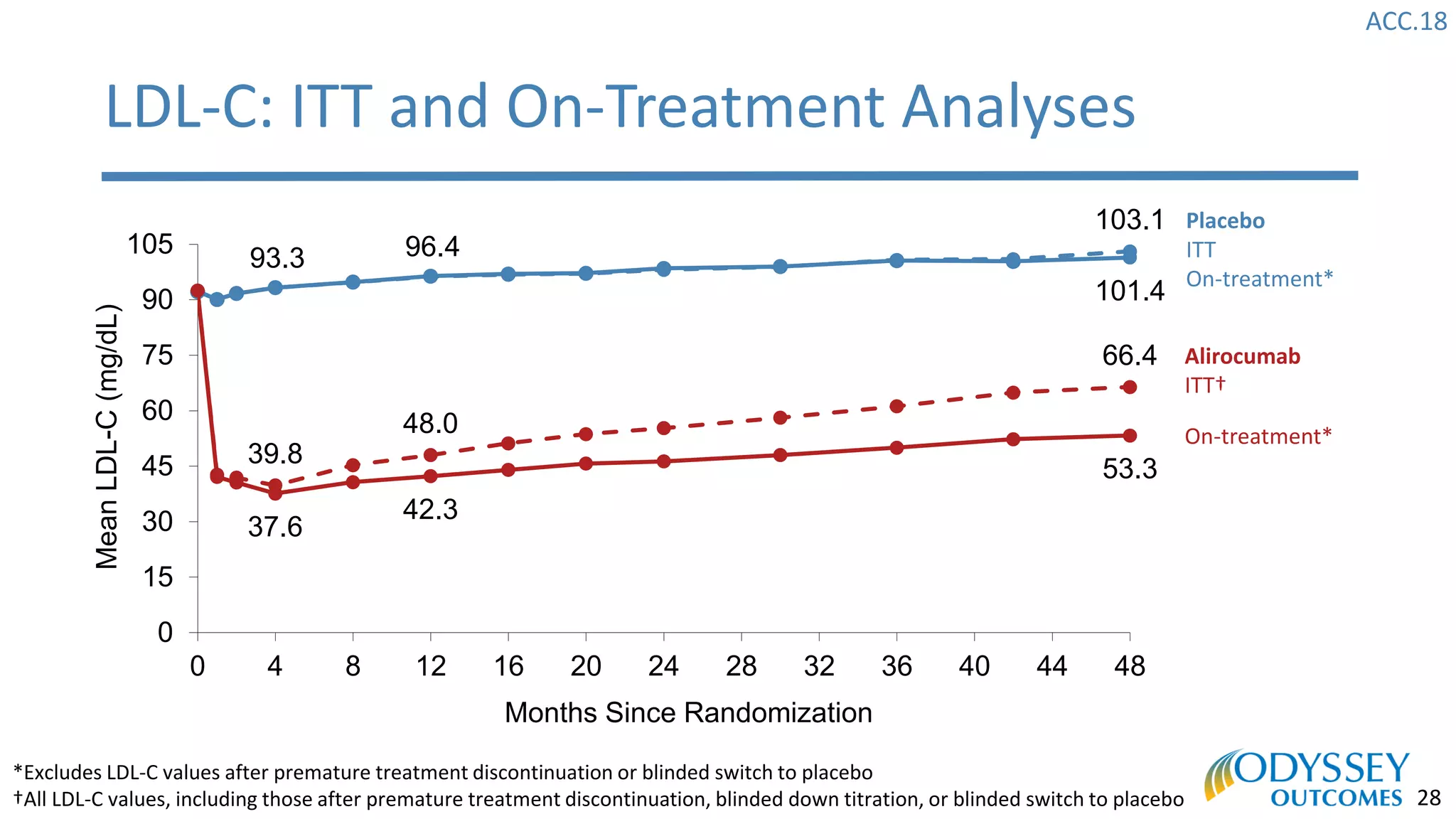
103.1
39.8
48.0
66.4
93.3 96.4
101.4
37.6
42.3
53.3
0
15
30
45
60
75
90
105
0 4 8 12 16 20 24 28 32 36 40 44 48
MeanLDL-C(mg/dL)
Months Since Randomization
LDL-C: ITT and On-Treatment Analyses
Placebo
ITT
On-treatment*
Alirocumab
ITT†
On-treatment*
*Excludes LDL-C values after premature treatment discontinuation or blinded switch to placebo
†All LDL-C values, including those after premature treatment discontinuation, blinded down titration, or blinded switch to placebo
ACC.18
29
93.3
96.4
101.4
37.6
42.3
53.3
0
15
30
45
60
75
90
105
0 4 8 12 16 20 24 28 32 36 40 44 48
MeanLDL-C(mg/dL)
Months Since Randomization
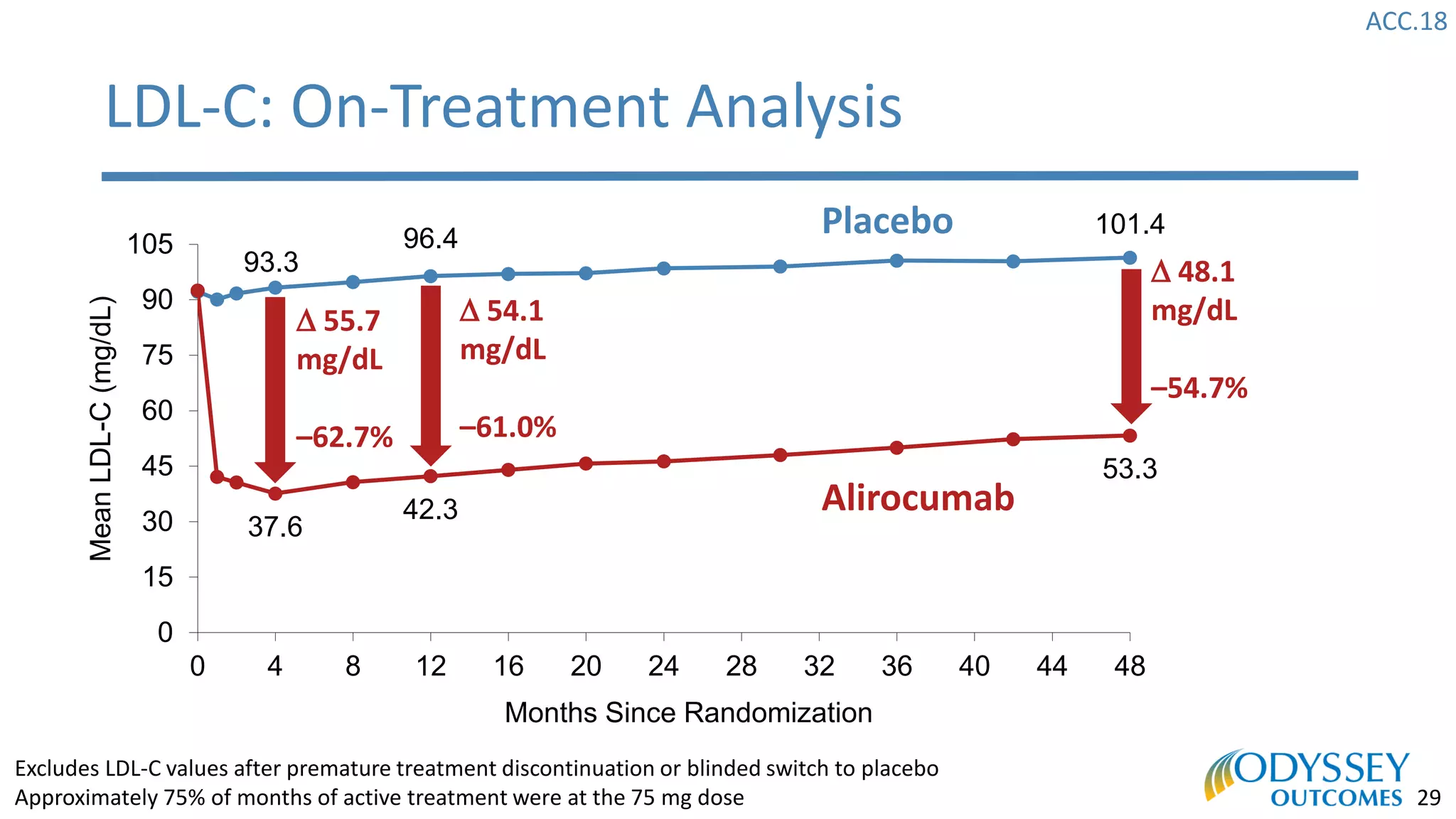
D 55.7
mg/dL
–62.7%
D 54.1
mg/dL
–61.0%
D 48.1
mg/dL
–54.7%
LDL-C: On-Treatment Analysis
Placebo
Alirocumab
Excludes LDL-C values after premature treatment discontinuation or blinded switch to placebo
Approximately 75% of months of active treatment were at the 75 mg dose
ACC.18
30
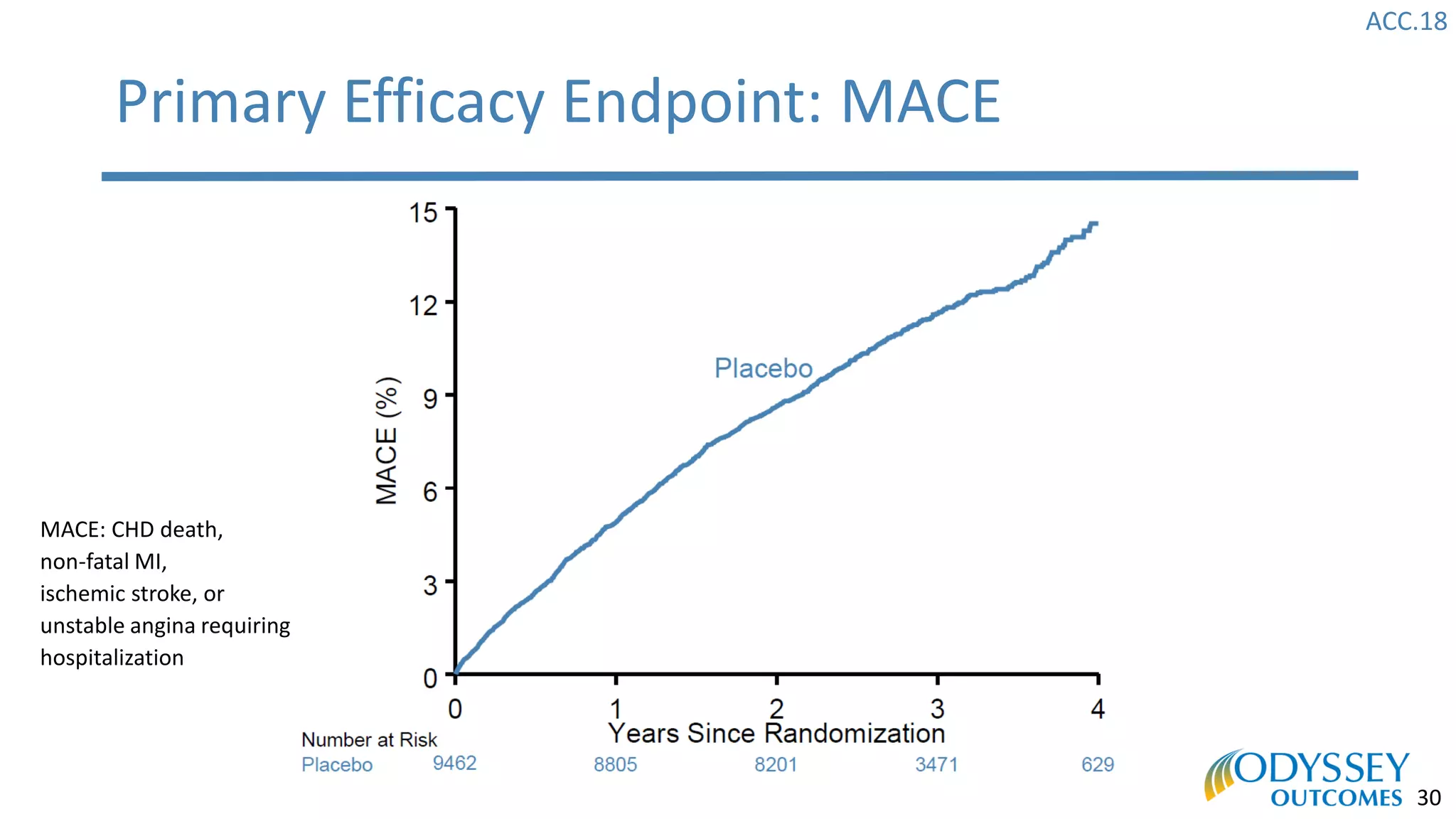
Primary Efficacy Endpoint: MACE
MACE: CHD death,
non-fatal MI,
ischemic stroke, or
unstable angina requiring
hospitalization
ACC.18
31
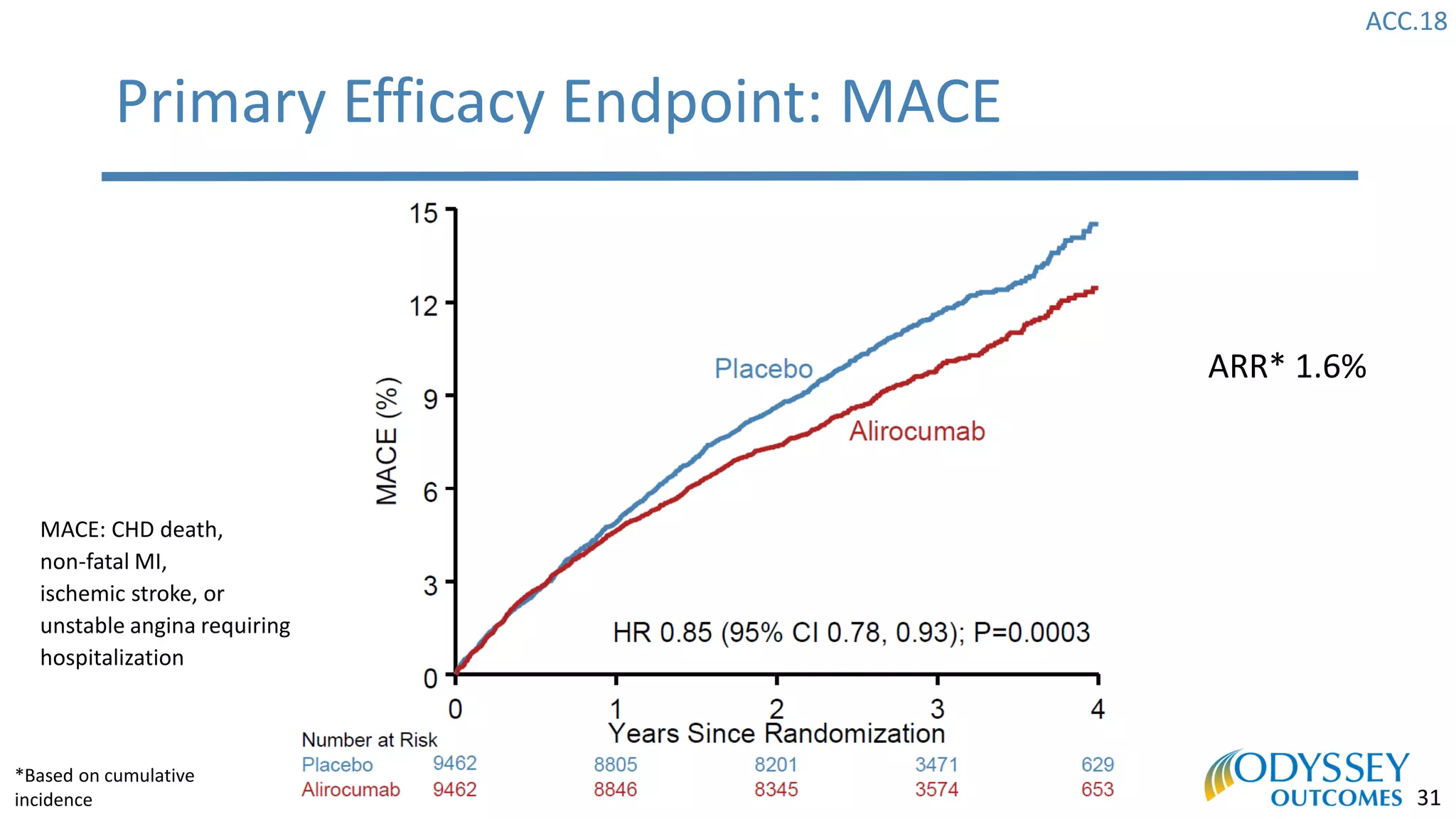
Primary Efficacy Endpoint: MACE
ARR* 1.6%
*Based on cumulative
incidence
MACE: CHD death,
non-fatal MI,
ischemic stroke, or
unstable angina requiring
hospitalization
ACC.18
32
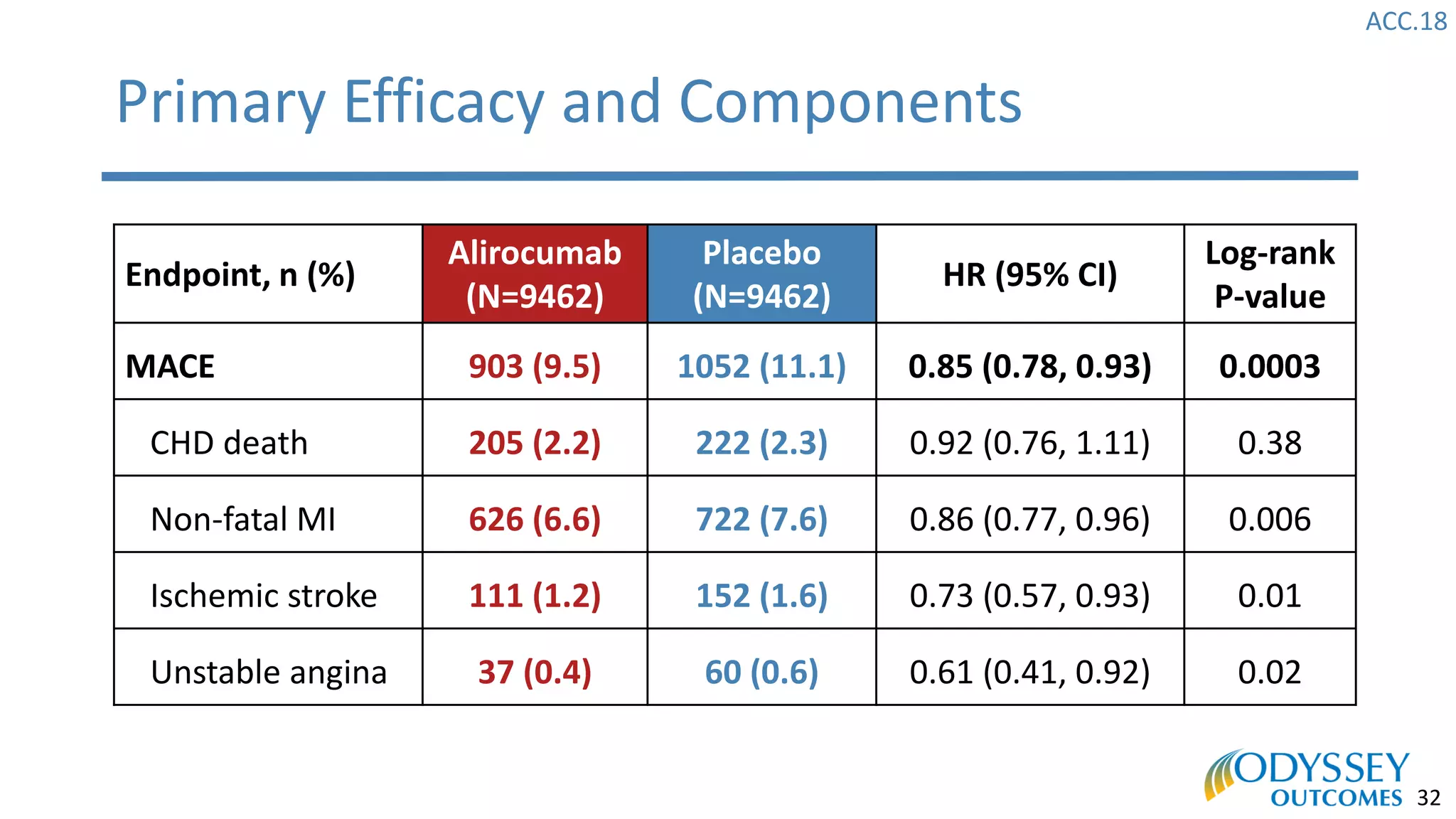
Primary Efficacy and Components
Endpoint, n (%)
Alirocumab
(N=9462)
Placebo
(N=9462)
HR (95% CI)
Log-rank
P-value
MACE 903 (9.5) 1052 (11.1) 0.85 (0.78, 0.93) 0.0003
CHD death 205 (2.2) 222 (2.3) 0.92 (0.76, 1.11) 0.38
Non-fatal MI 626 (6.6) 722 (7.6) 0.86 (0.77, 0.96) 0.006
Ischemic stroke 111 (1.2) 152 (1.6) 0.73 (0.57, 0.93) 0.01
Unstable angina 37 (0.4) 60 (0.6) 0.61 (0.41, 0.92) 0.02
ACC.18
33
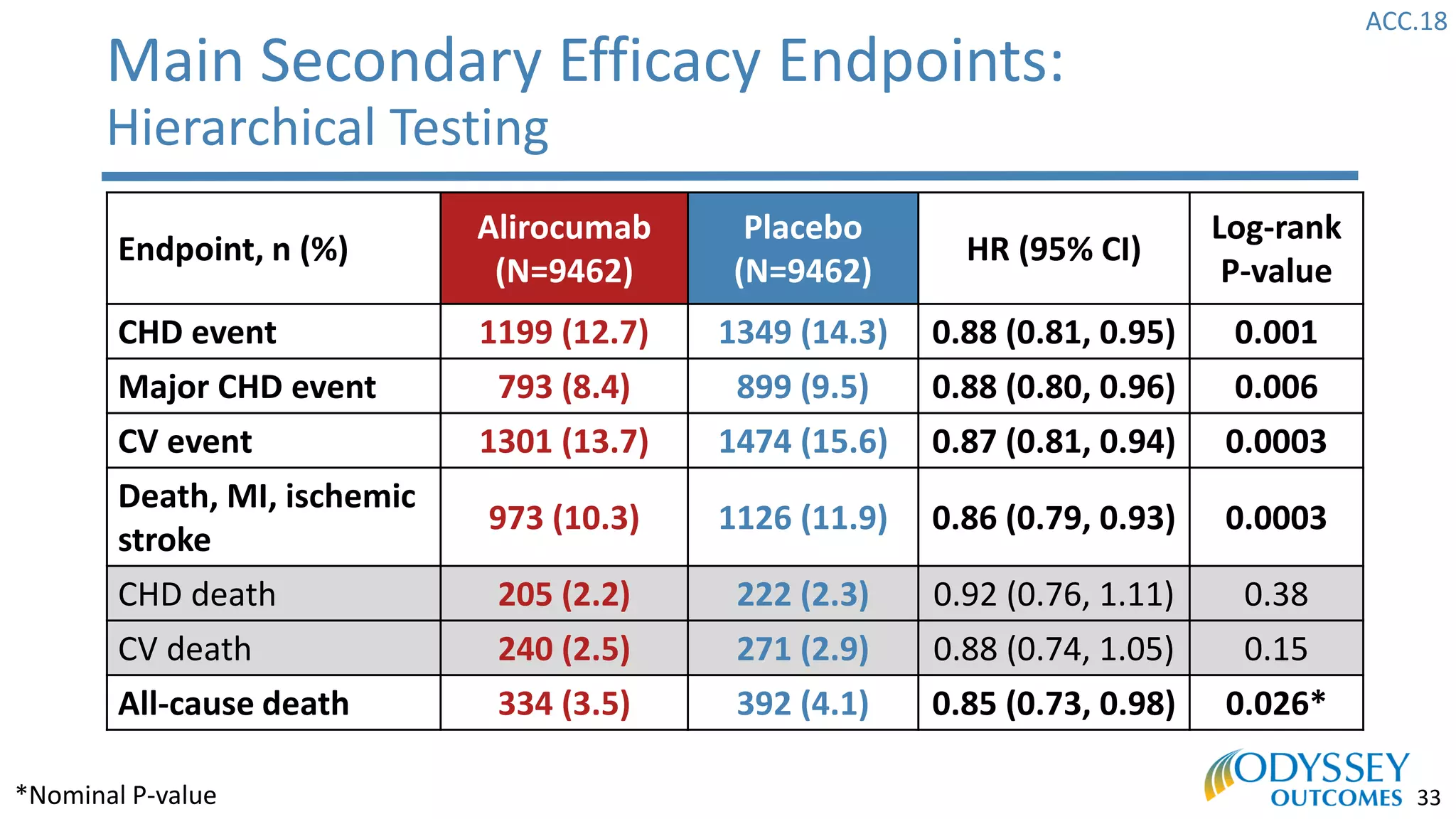
Main Secondary Efficacy Endpoints:
Hierarchical Testing
Endpoint, n (%)
Alirocumab
(N=9462)
Placebo
(N=9462)
HR (95% CI)
Log-rank
P-value
CHD event 1199 (12.7) 1349 (14.3) 0.88 (0.81, 0.95) 0.001
Major CHD event 793 (8.4) 899 (9.5) 0.88 (0.80, 0.96) 0.006
CV event 1301 (13.7) 1474 (15.6) 0.87 (0.81, 0.94) 0.0003
Death, MI, ischemic
stroke
973 (10.3) 1126 (11.9) 0.86 (0.79, 0.93) 0.0003
CHD death 205 (2.2) 222 (2.3) 0.92 (0.76, 1.11) 0.38
CV death 240 (2.5) 271 (2.9) 0.88 (0.74, 1.05) 0.15
All-cause death 334 (3.5) 392 (4.1) 0.85 (0.73, 0.98) 0.026*
*Nominal P-value
ACC.18
34
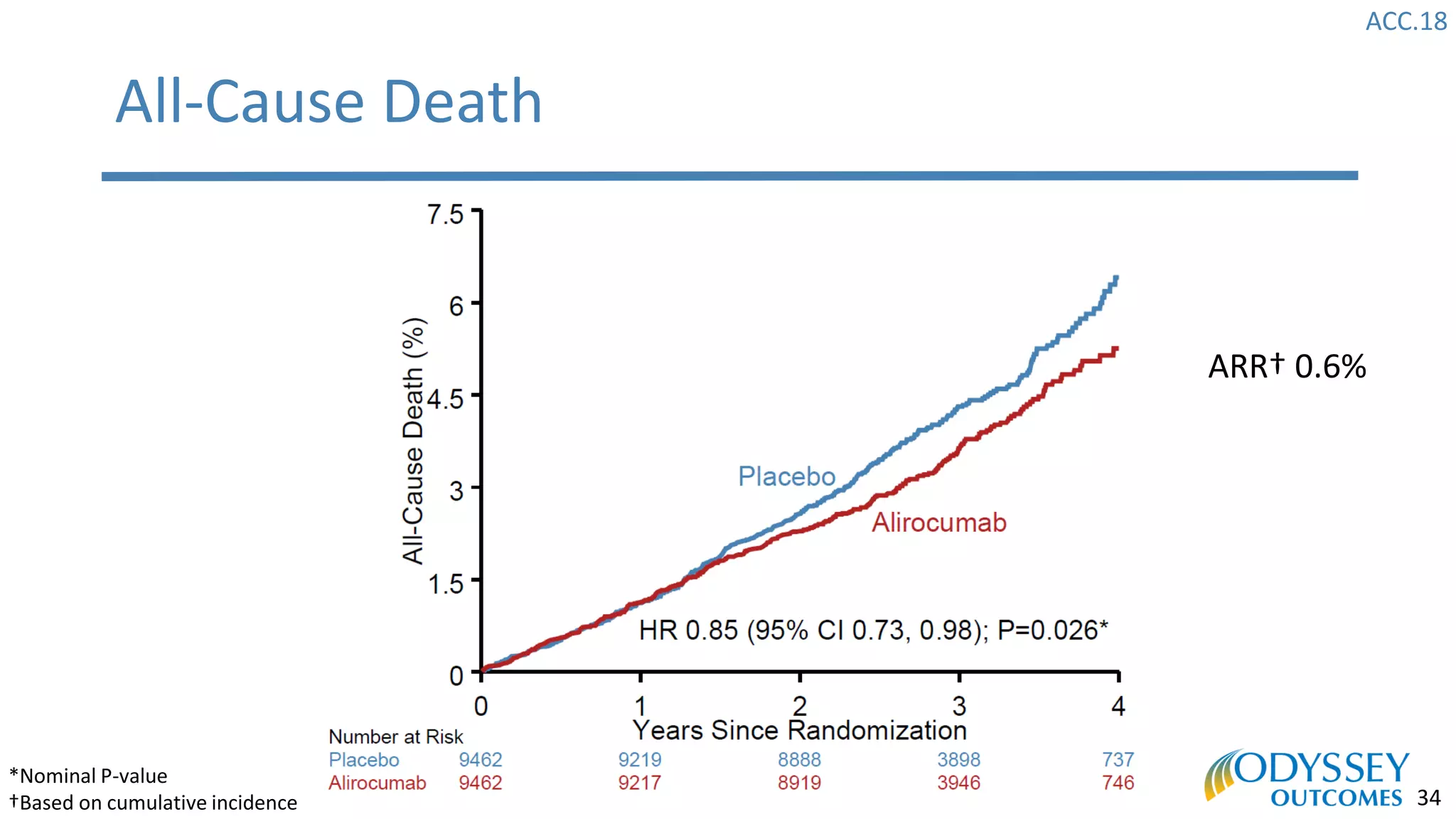
All-Cause Death
ARR† 0.6%
*Nominal P-value
†Based on cumulative incidence
ACC.18
35
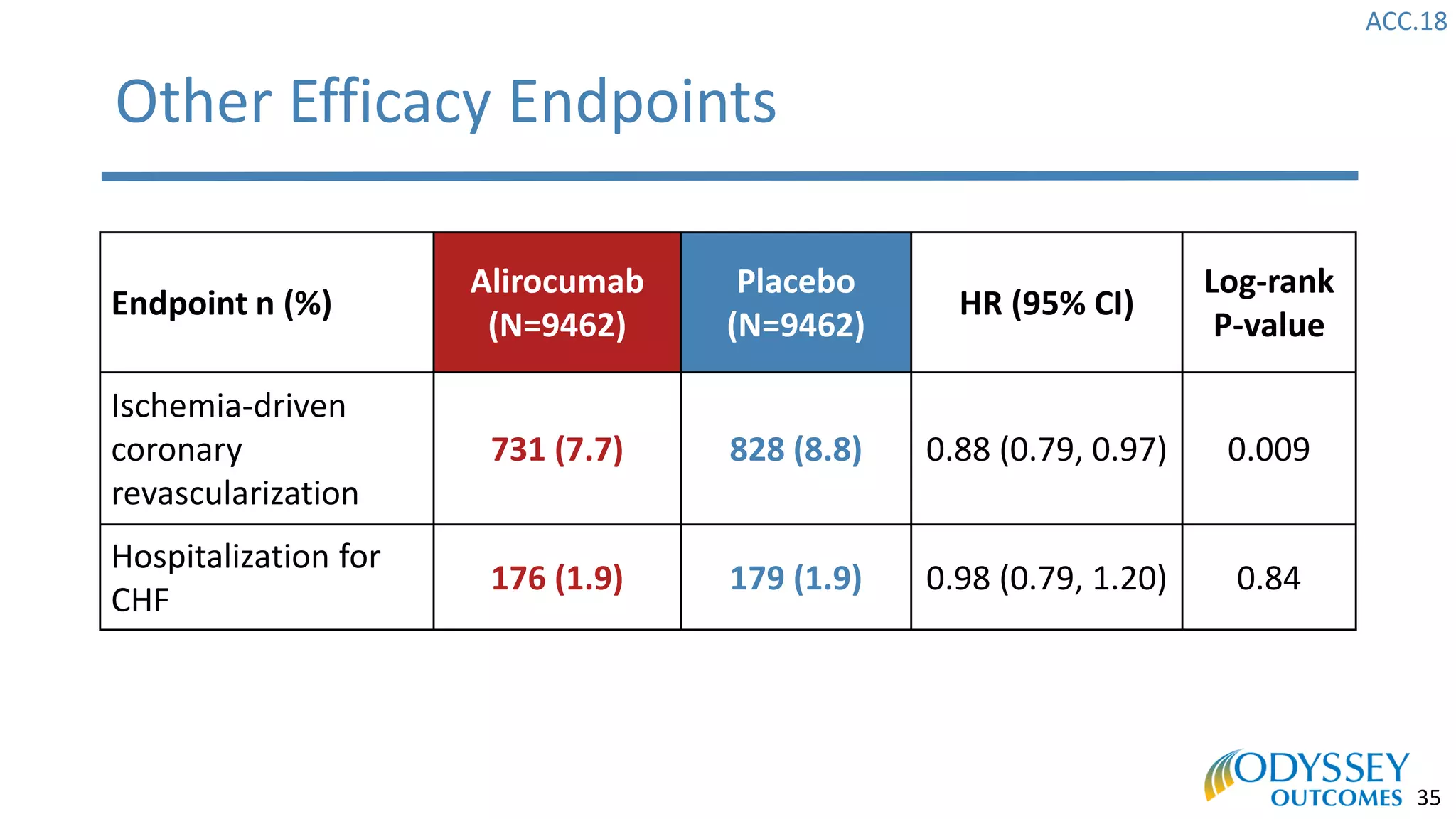
Other Efficacy Endpoints
Endpoint n (%)
Alirocumab
(N=9462)
Placebo
(N=9462)
HR (95% CI)
Log-rank
P-value
Ischemia-driven
coronary
revascularization
731 (7.7) 828 (8.8) 0.88 (0.79, 0.97) 0.009
Hospitalization for
CHF
176 (1.9) 179 (1.9) 0.98 (0.79, 1.20) 0.84
ACC.18
36
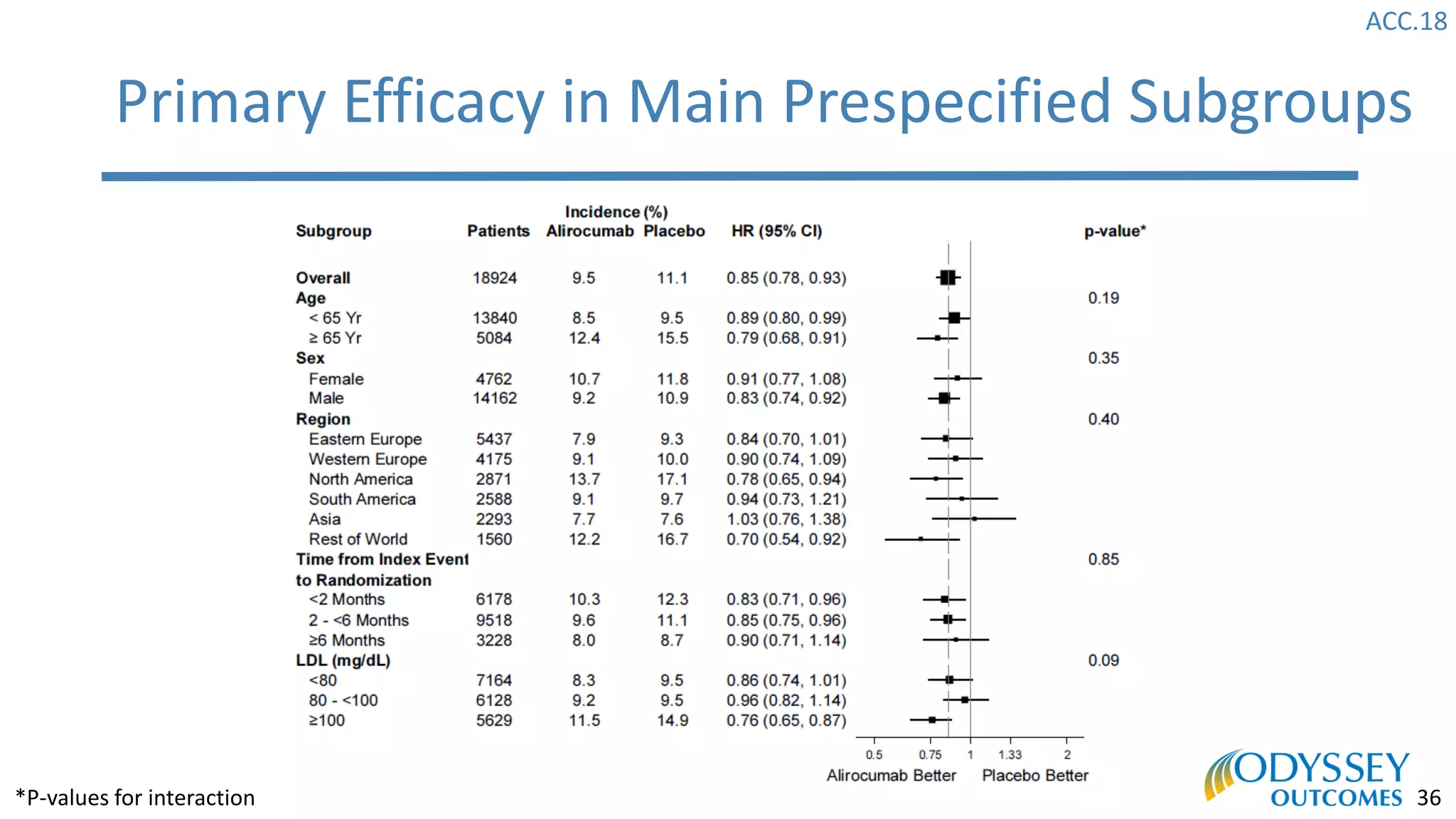
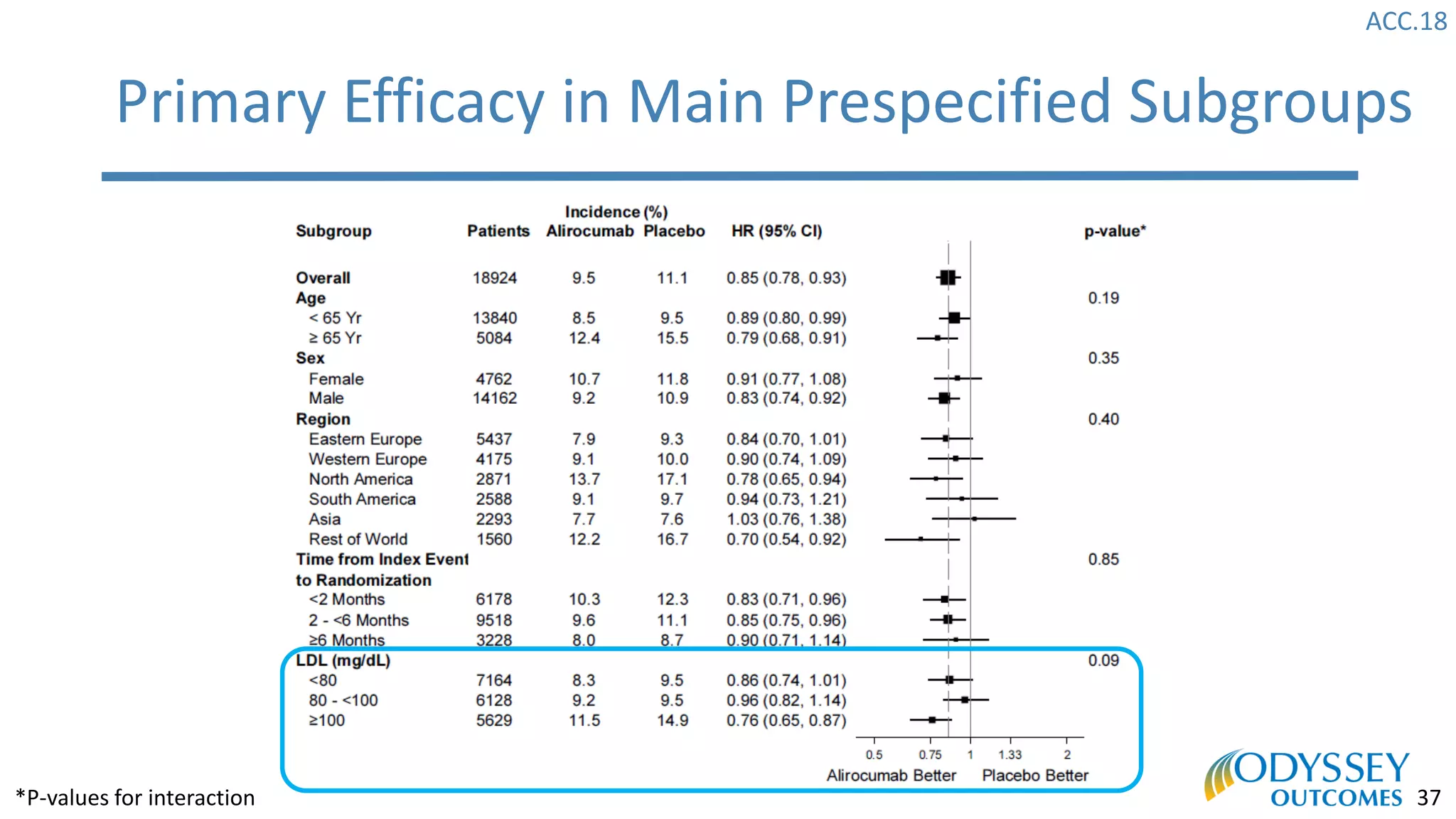
Primary Efficacy in Main Prespecified Subgroups
*P-values for interaction
ACC.18
37
Primary Efficacy in Main Prespecified Subgroups
*P-values for interaction
ACC.18
38
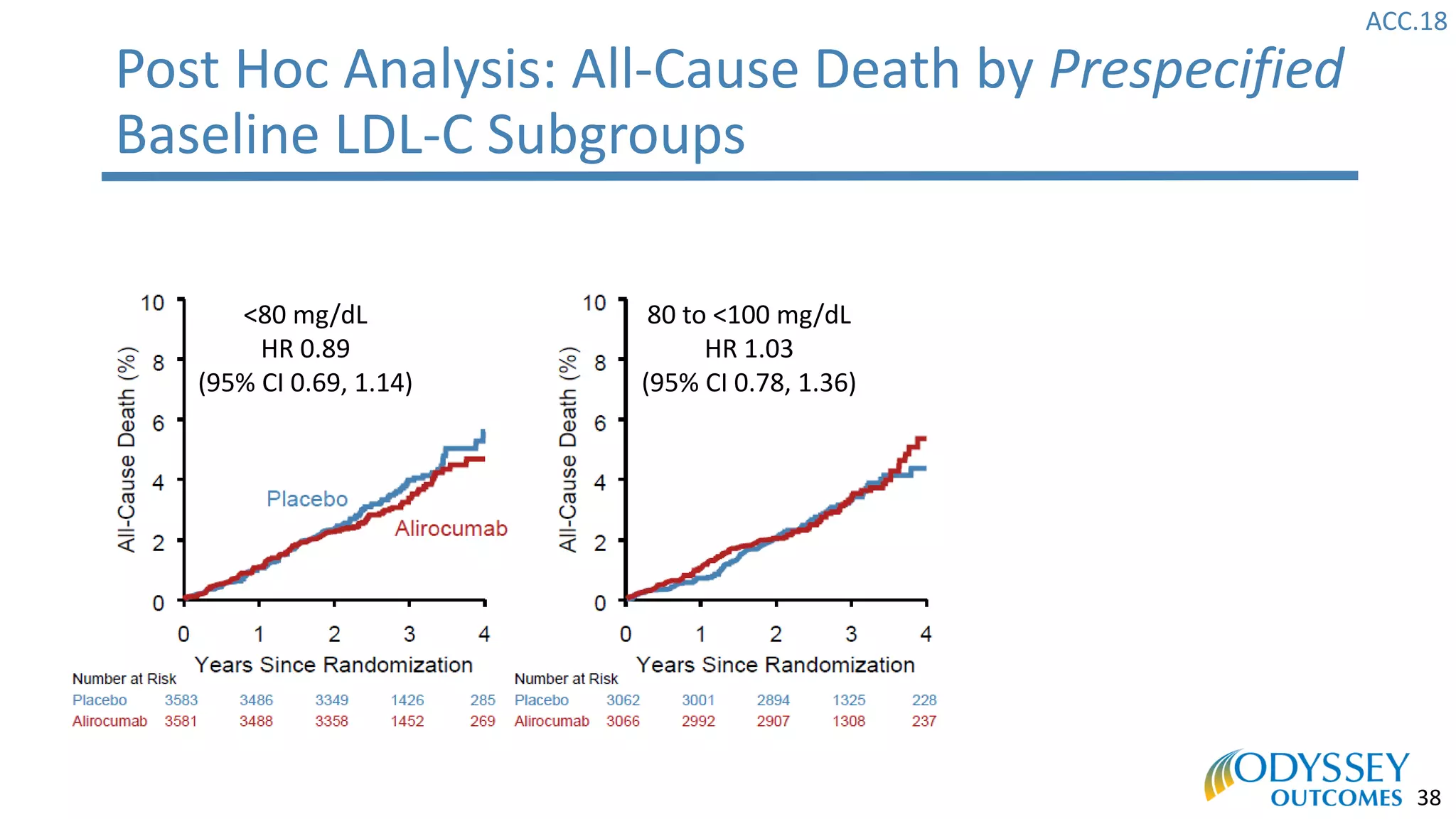
Post Hoc Analysis: All-Cause Death by Prespecified
Baseline LDL-C Subgroups
≥100 mg/dL
HR=0.71
<80 mg/dL
HR 0.89
(95% CI 0.69, 1.14)
80 to <100 mg/dL
HR 1.03
(95% CI 0.78, 1.36)
ACC.18
39
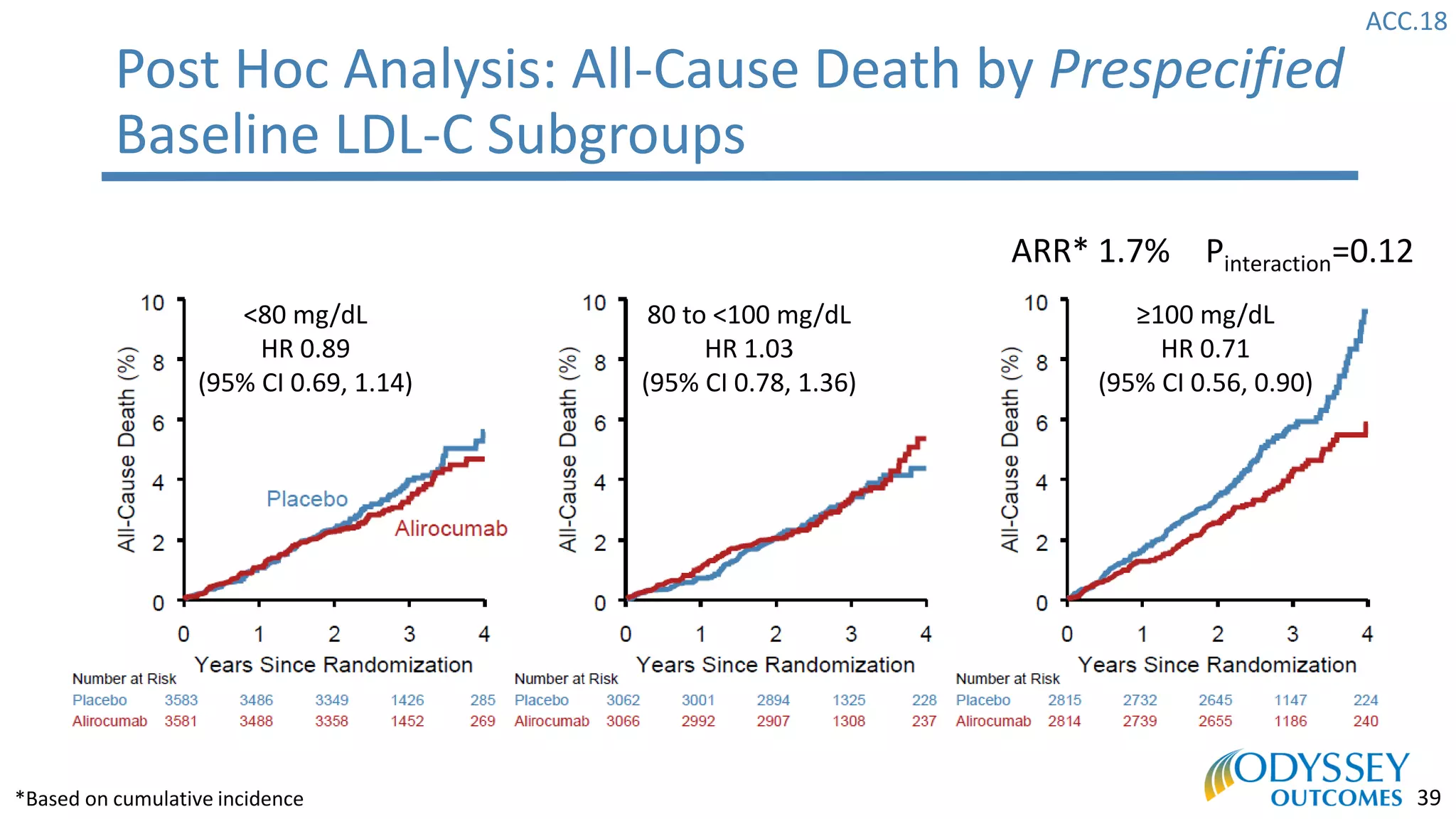
Post Hoc Analysis: All-Cause Death by Prespecified
Baseline LDL-C Subgroups
Pinteraction=0.12
≥100 mg/dL
HR 0.71
(95% CI 0.56, 0.90)
<80 mg/dL
HR 0.89
(95% CI 0.69, 1.14)
80 to <100 mg/dL
HR 1.03
(95% CI 0.78, 1.36)
ARR* 1.7%
*Based on cumulative incidence
ACC.18
40
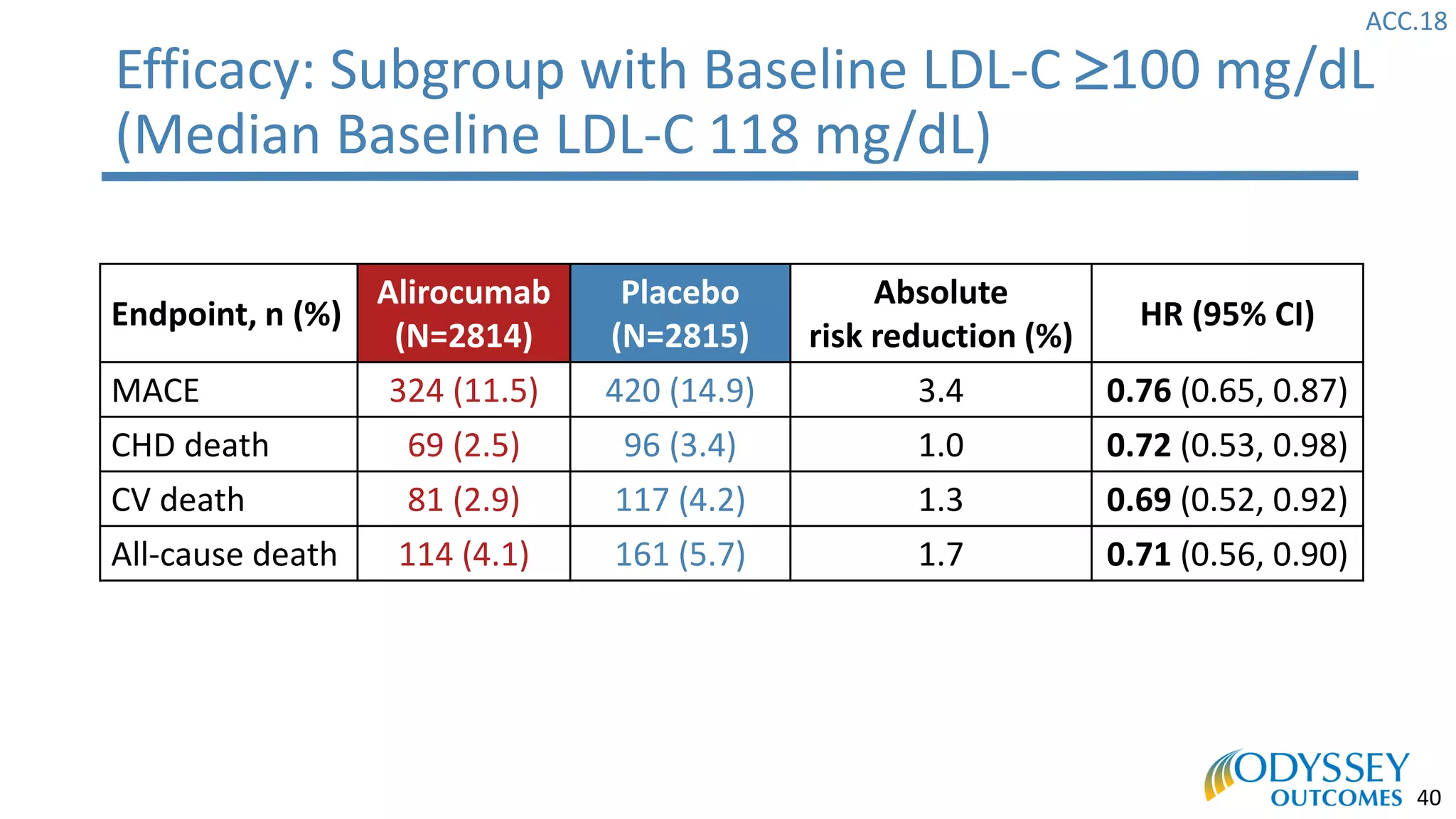
Efficacy: Subgroup with Baseline LDL-C 100 mg/dL
(Median Baseline LDL-C 118 mg/dL)
Endpoint, n (%)
Alirocumab
(N=2814)
Placebo
(N=2815)
Absolute
risk reduction (%)
HR (95% CI)
MACE 324 (11.5) 420 (14.9) 3.4 0.76 (0.65, 0.87)
CHD death 69 (2.5) 96 (3.4) 1.0 0.72 (0.53, 0.98)
CV death 81 (2.9) 117 (4.2) 1.3 0.69 (0.52, 0.92)
All-cause death 114 (4.1) 161 (5.7) 1.7 0.71 (0.56, 0.90)
ACC.18
41
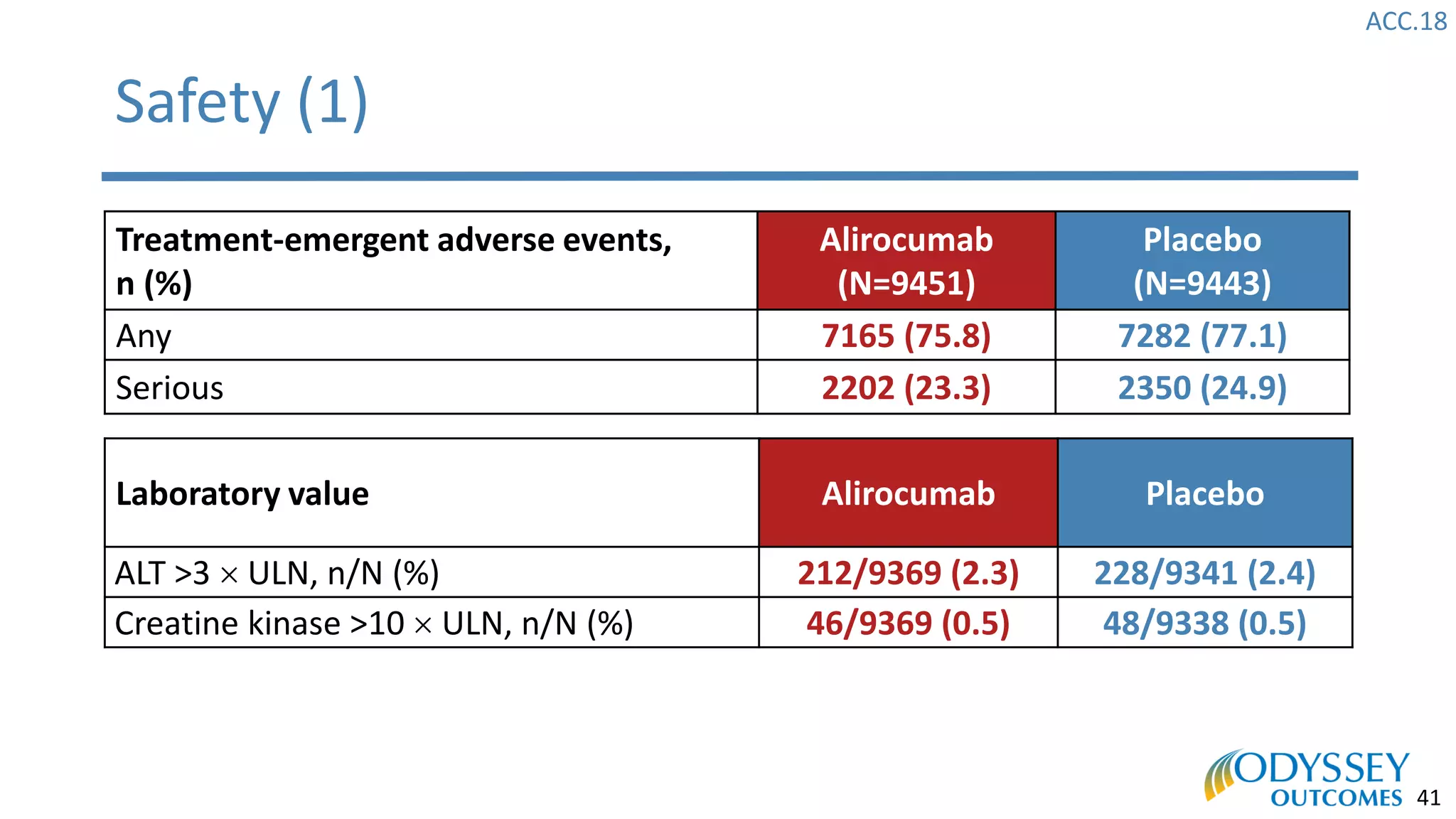
Safety (1)
Treatment-emergent adverse events,
n (%)
Alirocumab
(N=9451)
Placebo
(N=9443)
Any 7165 (75.8) 7282 (77.1)
Serious 2202 (23.3) 2350 (24.9)
Laboratory value Alirocumab Placebo
ALT >3  ULN, n/N (%) 212/9369 (2.3) 228/9341 (2.4)
Creatine kinase >10  ULN, n/N (%) 46/9369 (0.5) 48/9338 (0.5)
ACC.18
42
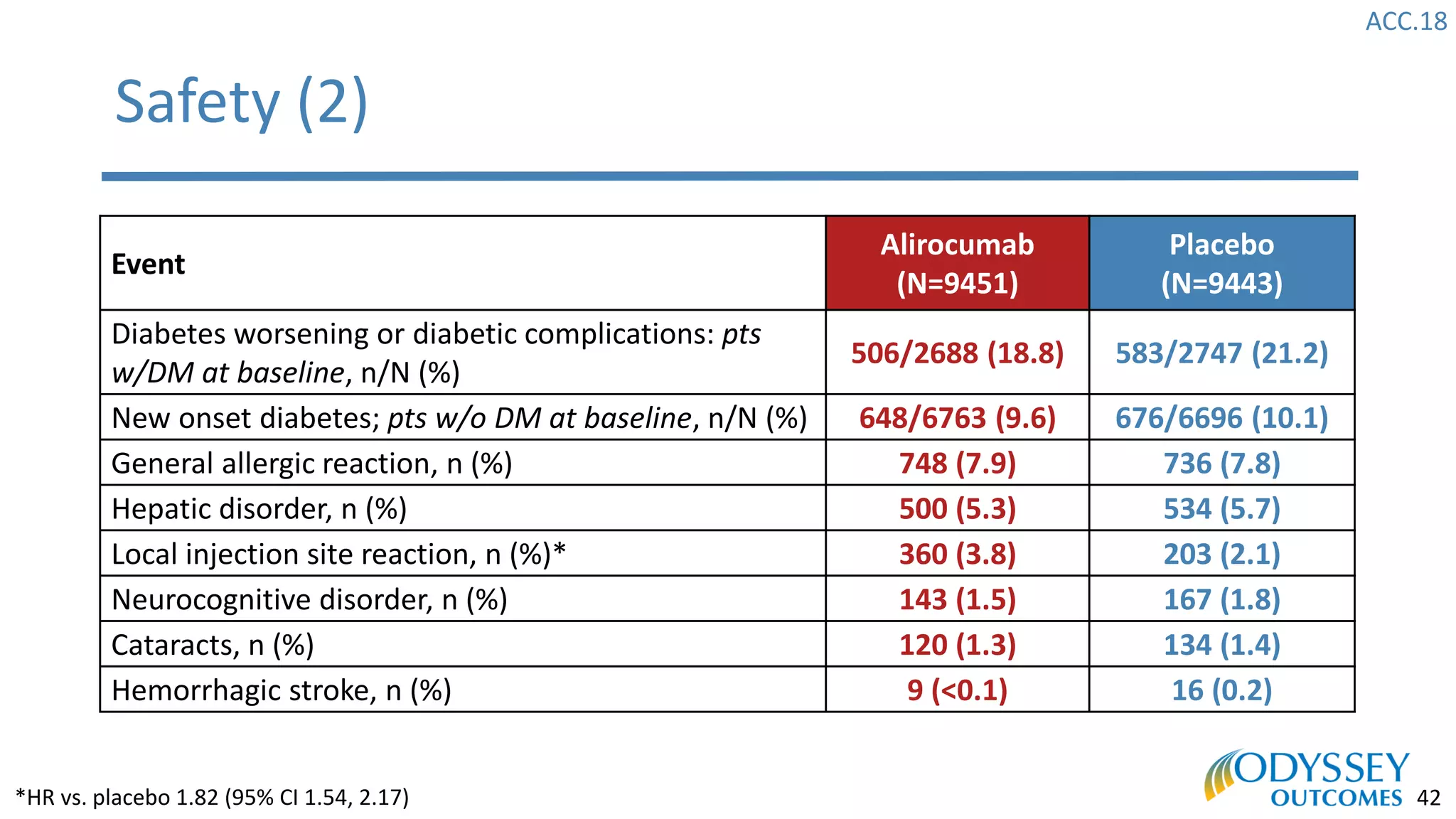
Safety (2)
Event
Alirocumab
(N=9451)
Placebo
(N=9443)
Diabetes worsening or diabetic complications: pts
w/DM at baseline, n/N (%)
506/2688 (18.8) 583/2747 (21.2)
New onset diabetes; pts w/o DM at baseline, n/N (%) 648/6763 (9.6) 676/6696 (10.1)
General allergic reaction, n (%) 748 (7.9) 736 (7.8)
Hepatic disorder, n (%) 500 (5.3) 534 (5.7)
Local injection site reaction, n (%)* 360 (3.8) 203 (2.1)
Neurocognitive disorder, n (%) 143 (1.5) 167 (1.8)
Cataracts, n (%) 120 (1.3) 134 (1.4)
Hemorrhagic stroke, n (%) 9 (<0.1) 16 (0.2)
*HR vs. placebo 1.82 (95% CI 1.54, 2.17)
ACC.18
43
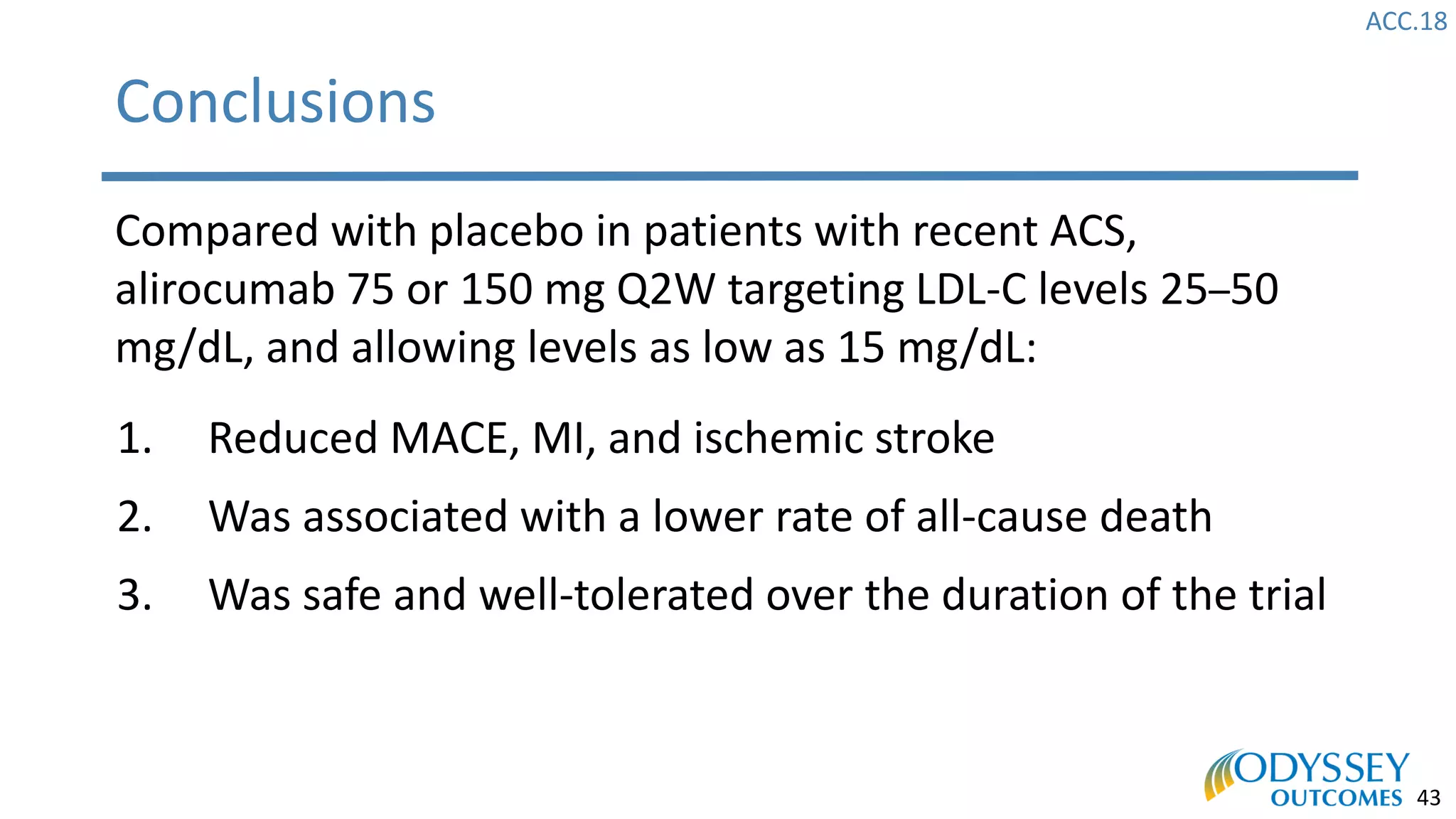
Conclusions
Compared with placebo in patients with recent ACS,
alirocumab 75 or 150 mg Q2W targeting LDL-C levels 25–50
mg/dL, and allowing levels as low as 15 mg/dL:
1. Reduced MACE, MI, and ischemic stroke
2. Was associated with a lower rate of all-cause death
3. Was safe and well-tolerated over the duration of the trial
ACC.18
44
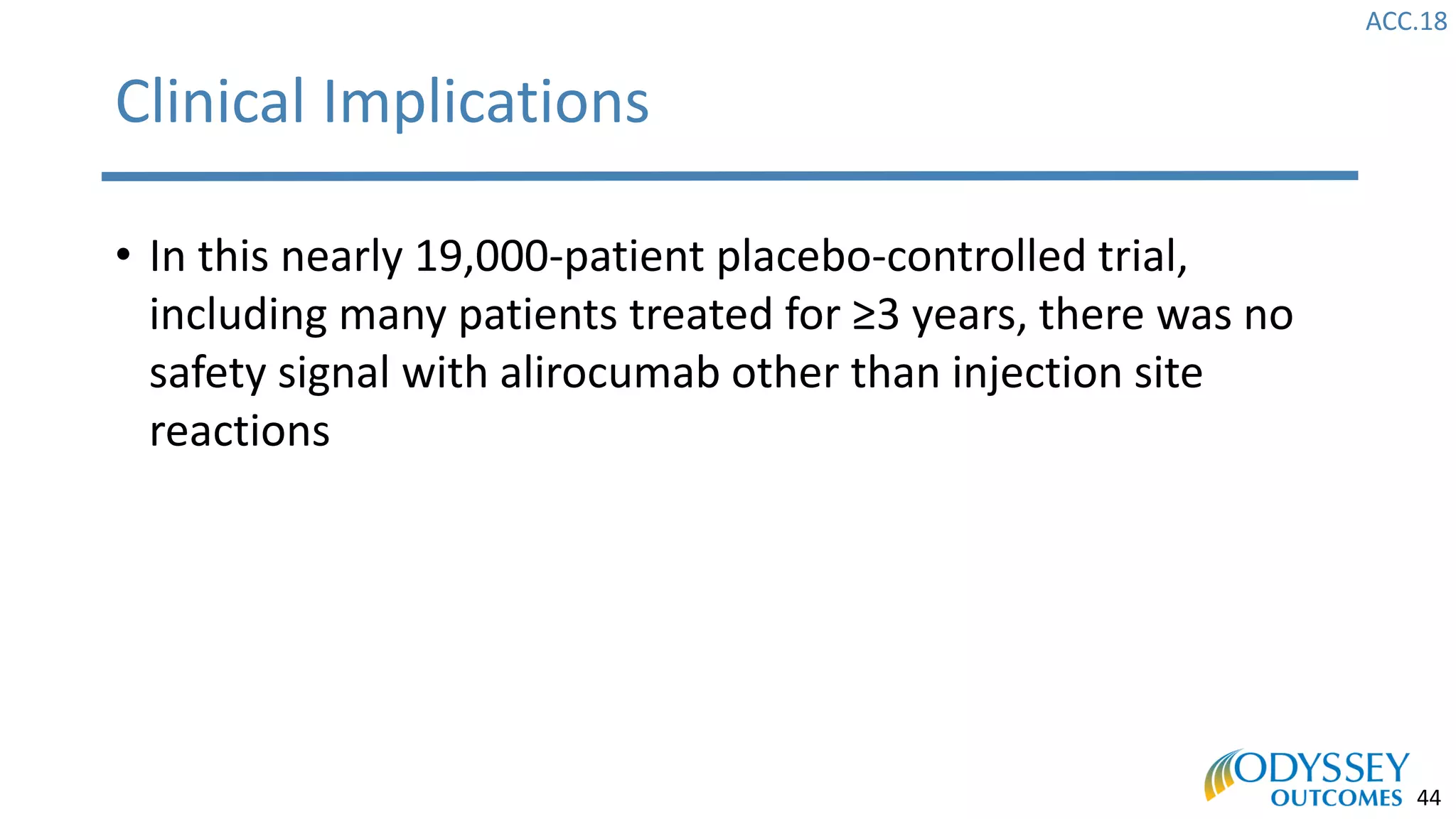
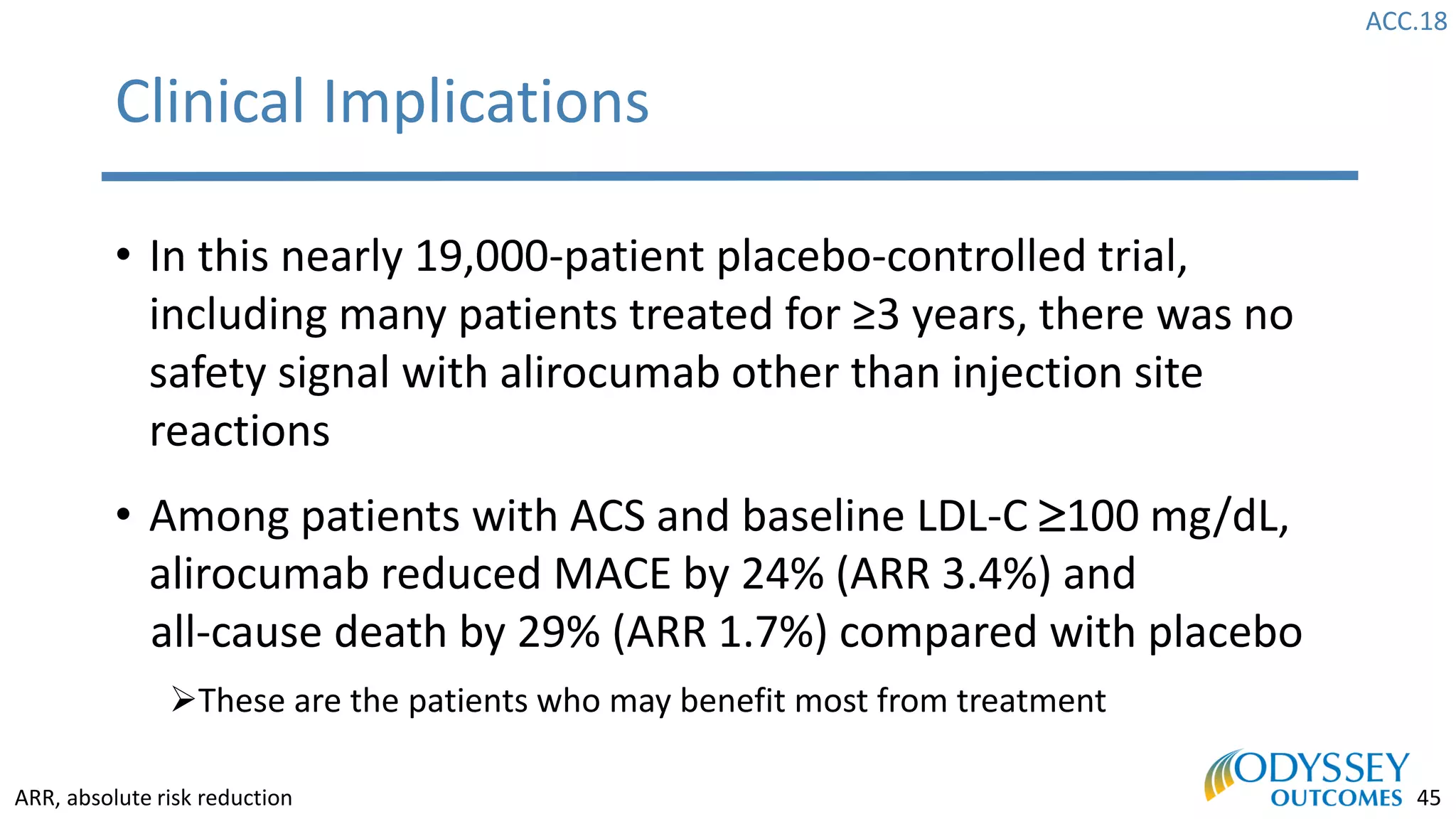
Clinical Implications
• In this nearly 19,000-patient placebo-controlled trial,
including many patients treated for ≥3 years, there was no
safety signal with alirocumab other than injection site
reactions
ACC.18
45
Clinical Implications
• In this nearly 19,000-patient placebo-controlled trial,
including many patients treated for ≥3 years, there was no
safety signal with alirocumab other than injection site
reactions
• Among patients with ACS and baseline LDL-C 100 mg/dL,
alirocumab reduced MACE by 24% (ARR 3.4%) and
all-cause death by 29% (ARR 1.7%) compared with placebo
➢These are the patients who may benefit most from treatment
ARR, absolute risk reduction
Backup
ACC.18
47
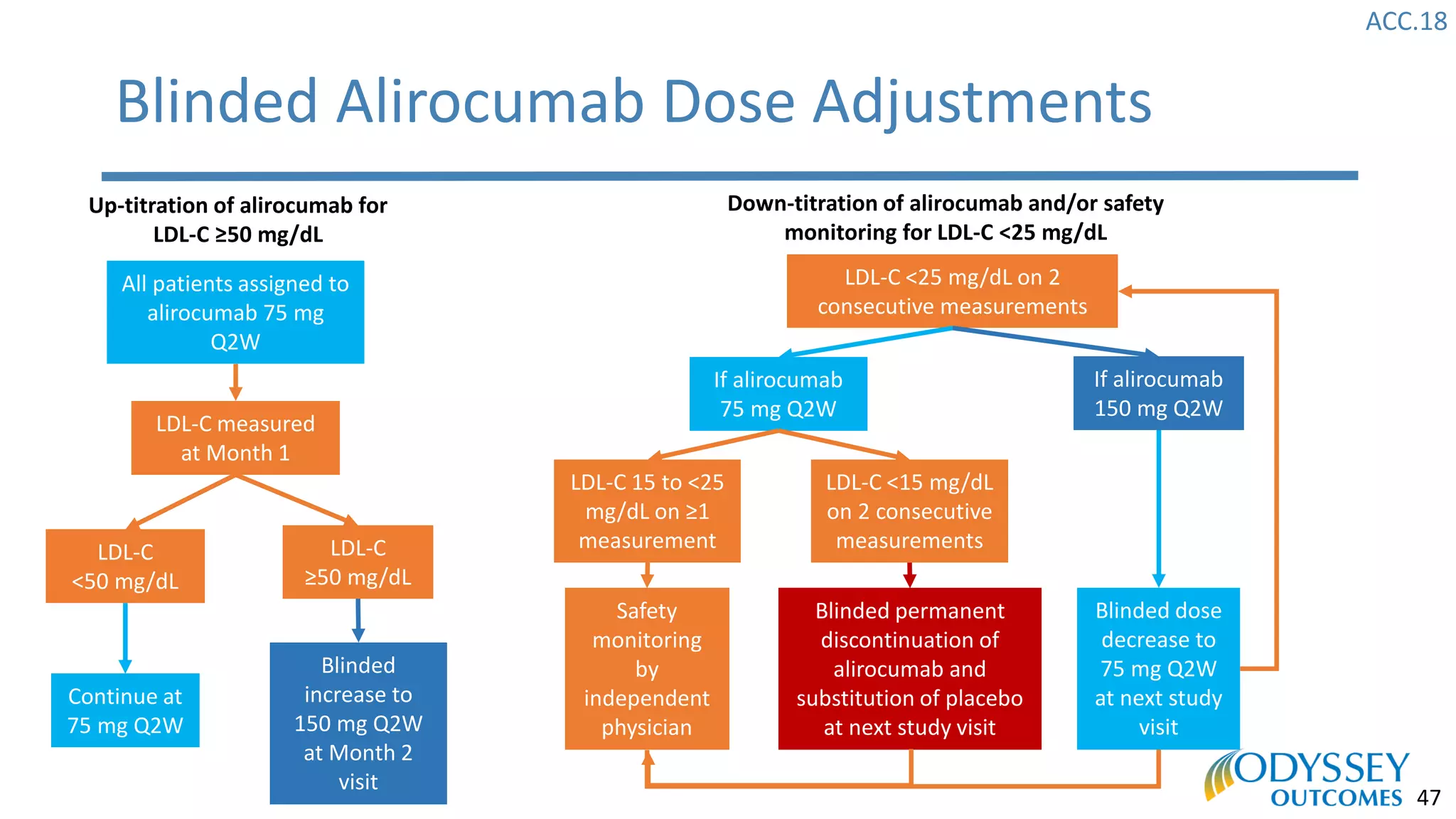
Blinded Alirocumab Dose Adjustments
All patients assigned to
alirocumab 75 mg
Q2W
LDL-C measured
at Month 1
Up-titration of alirocumab for
LDL-C ≥50 mg/dL
LDL-C
<50 mg/dL
Continue at
75 mg Q2W
LDL-C
≥50 mg/dL
Blinded
increase to
150 mg Q2W
at Month 2
visit
LDL-C <25 mg/dL on 2
consecutive measurements
Down-titration of alirocumab and/or safety
monitoring for LDL-C <25 mg/dL
If alirocumab
75 mg Q2W
LDL-C 15 to <25
mg/dL on ≥1
measurement
If alirocumab
150 mg Q2W
Blinded dose
decrease to
75 mg Q2W
at next study
visit
Safety
monitoring
by
independent
physician
LDL-C <15 mg/dL
on 2 consecutive
measurements
Blinded permanent
discontinuation of
alirocumab and
substitution of placebo
at next study visit
ACC.18
48
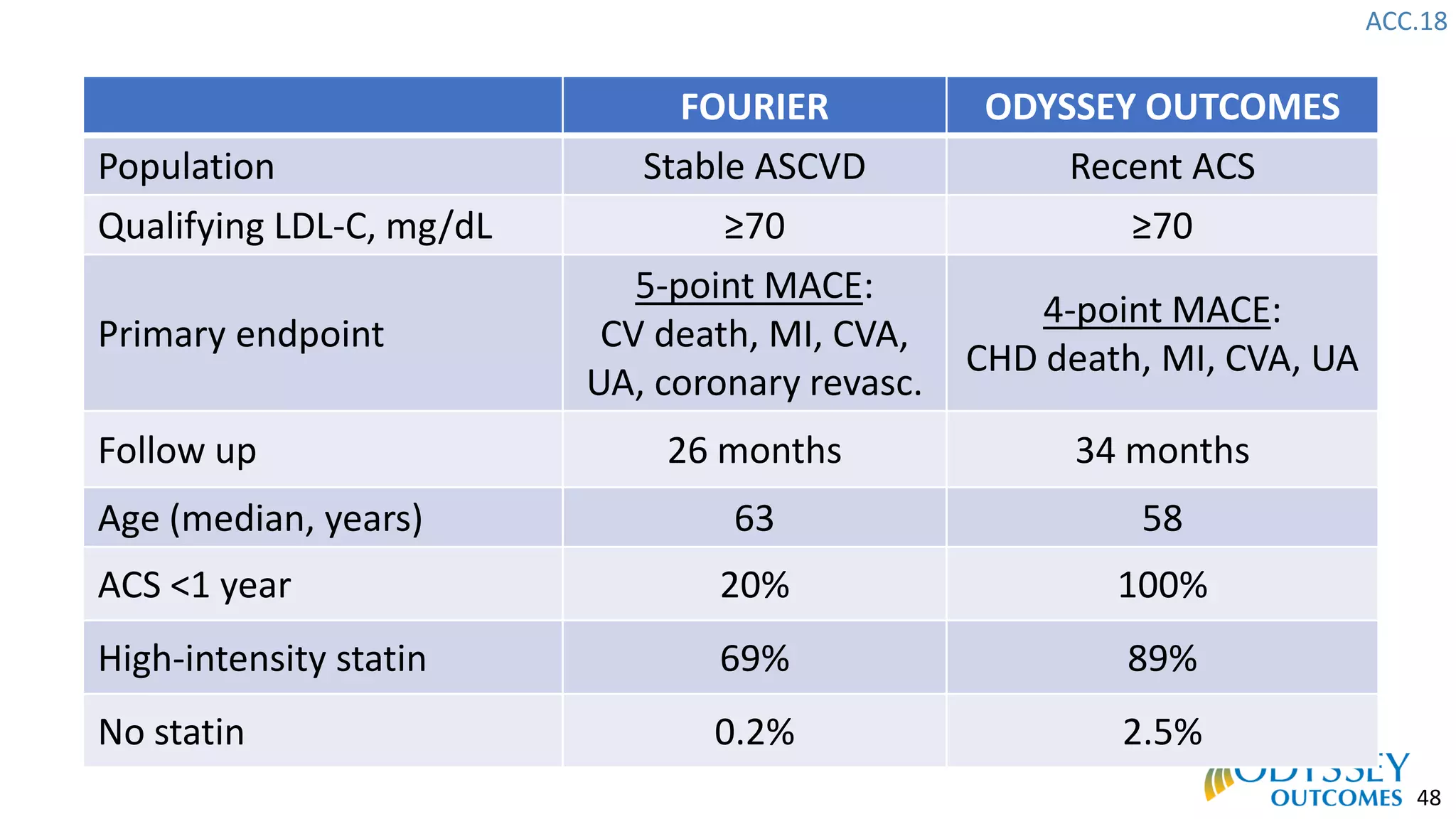
FOURIER ODYSSEY OUTCOMES
Population Stable ASCVD Recent ACS
Qualifying LDL-C, mg/dL ≥70 ≥70
Primary endpoint
5-point MACE:
CV death, MI, CVA,
UA, coronary revasc.
4-point MACE:
CHD death, MI, CVA, UA
Follow up 26 months 34 months
Age (median, years) 63 58
ACS <1 year 20% 100%
High-intensity statin 69% 89%
No statin 0.2% 2.5%
ACC.18
49
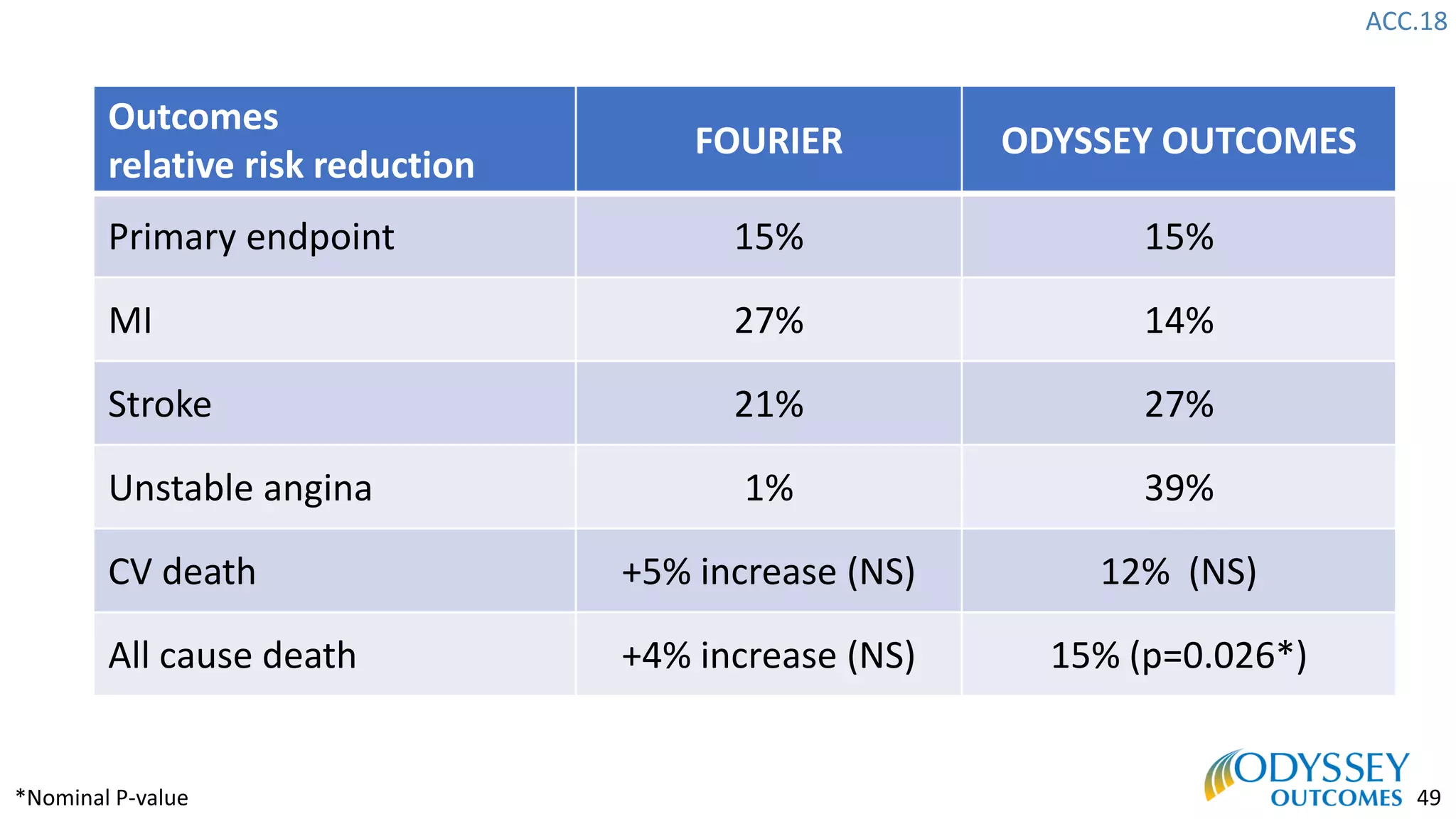
Outcomes
relative risk reduction
FOURIER ODYSSEY OUTCOMES
Primary endpoint 15% 15%
MI 27% 14%
Stroke 21% 27%
Unstable angina 1% 39%
CV death +5% increase (NS) 12% (NS)
All cause death +4% increase (NS) 15% (p=0.026*)
*Nominal P-value
ACC.18
50
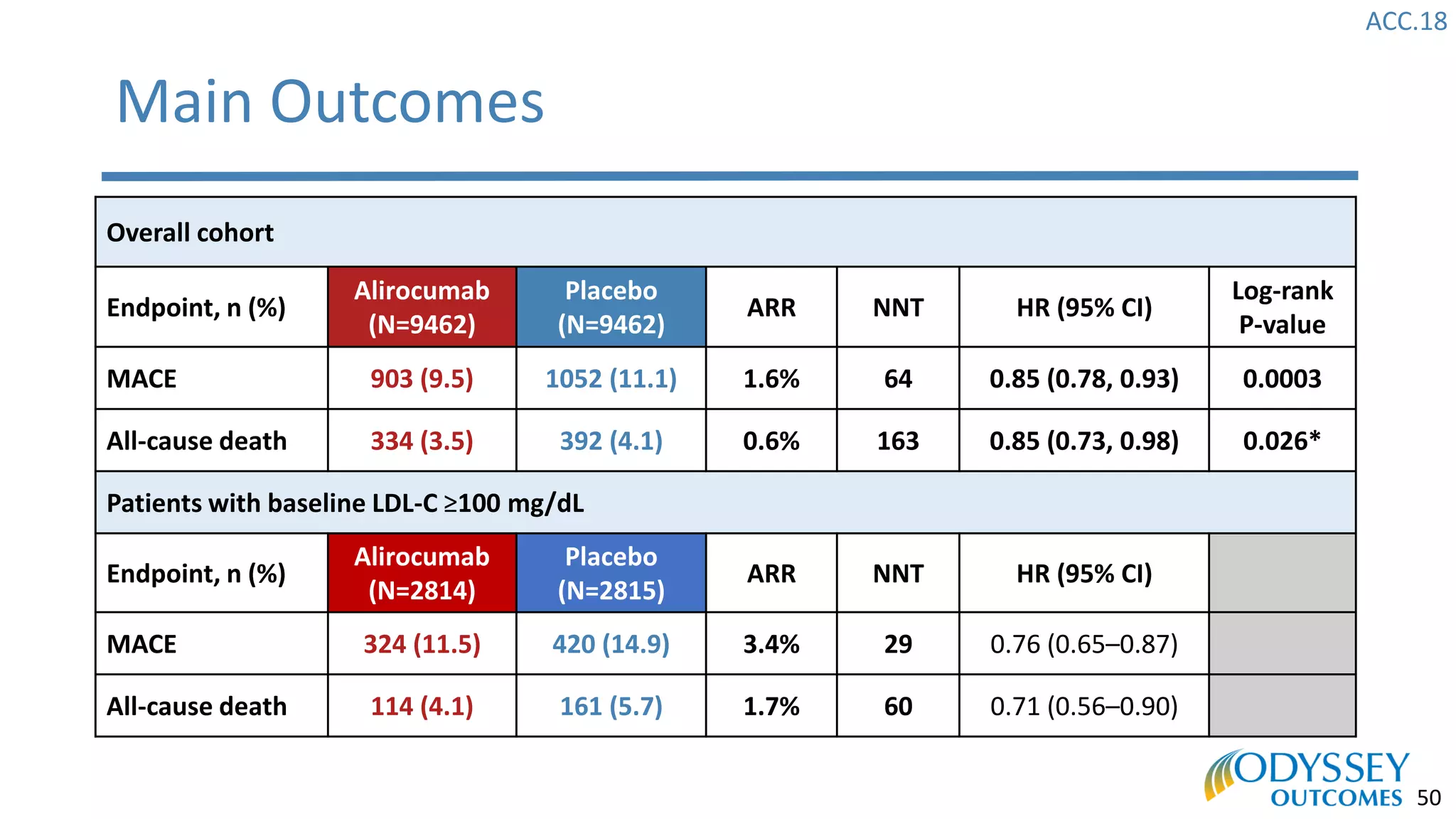
Main Outcomes
Overall cohort
Endpoint, n (%)
Alirocumab
(N=9462)
Placebo
(N=9462)
ARR NNT HR (95% CI)
Log-rank
P-value
MACE 903 (9.5) 1052 (11.1) 1.6% 64 0.85 (0.78, 0.93) 0.0003
All-cause death 334 (3.5) 392 (4.1) 0.6% 163 0.85 (0.73, 0.98) 0.026*
Patients with baseline LDL-C ≥100 mg/dL
Endpoint, n (%)
Alirocumab
(N=2814)
Placebo
(N=2815)
ARR NNT HR (95% CI)
MACE 324 (11.5) 420 (14.9) 3.4% 29 0.76 (0.65–0.87)
All-cause death 114 (4.1) 161 (5.7) 1.7% 60 0.71 (0.56–0.90)
ACC.18
51
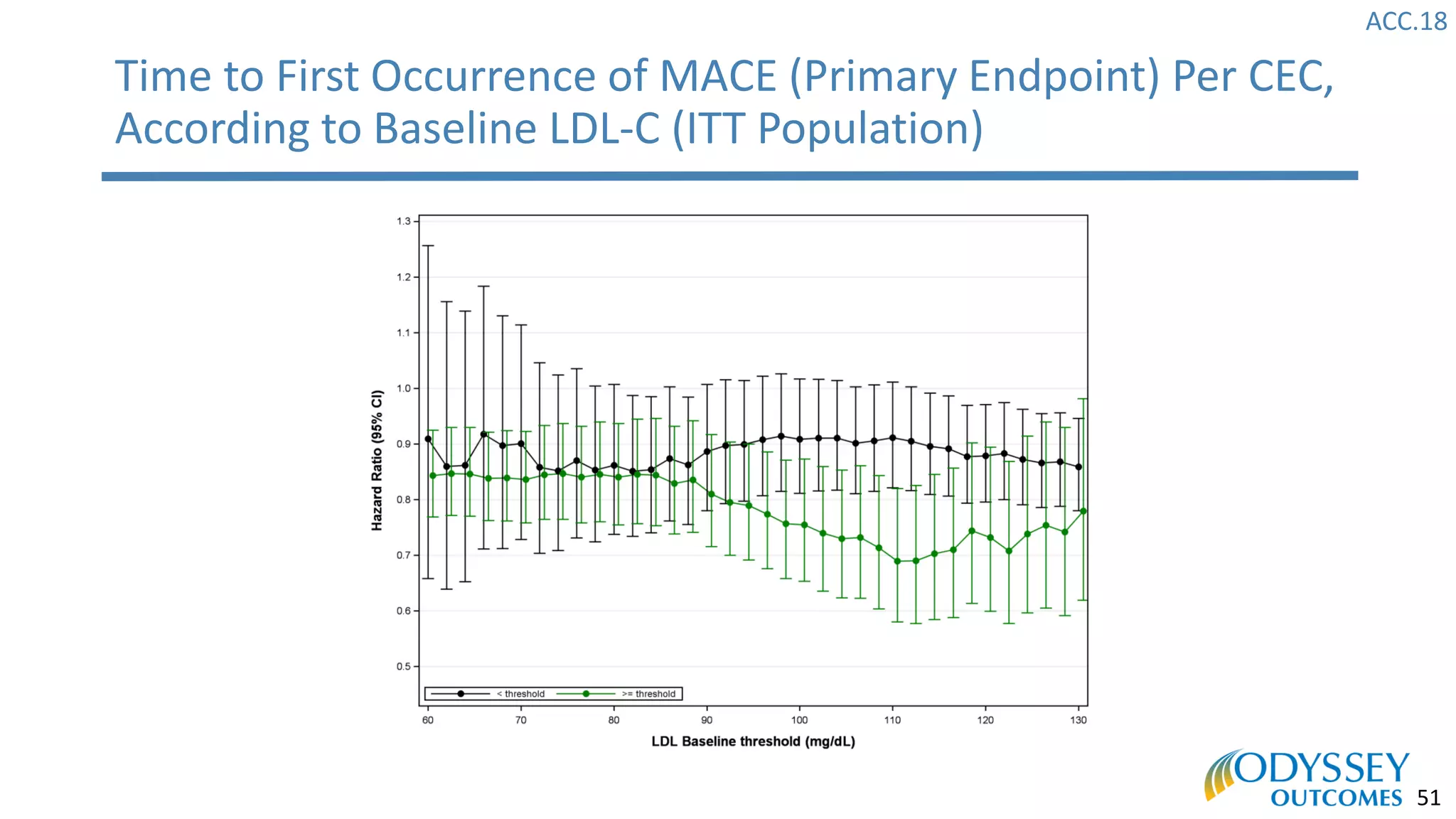
Time to First Occurrence of MACE (Primary Endpoint) Per CEC,
According to Baseline LDL-C (ITT Population)
ACC.18
52
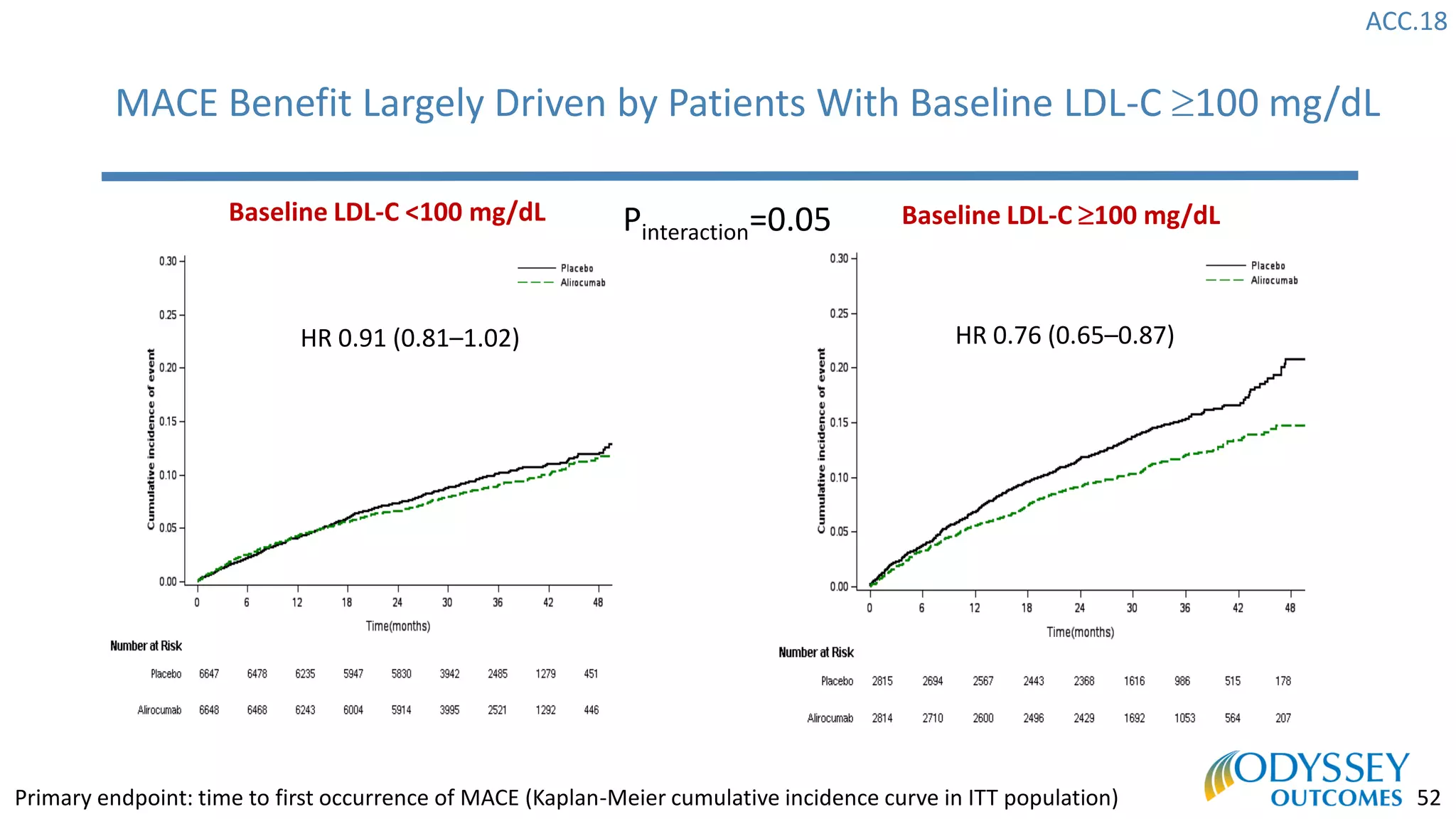
HR 0.76 (0.65–0.87)HR 0.91 (0.81–1.02)
Baseline LDL-C <100 mg/dL Baseline LDL-C 100 mg/dL
MACE Benefit Largely Driven by Patients With Baseline LDL-C 100 mg/dL
Pinteraction=0.05
Primary endpoint: time to first occurrence of MACE (Kaplan-Meier cumulative incidence curve in ITT population)
ACC.18
53
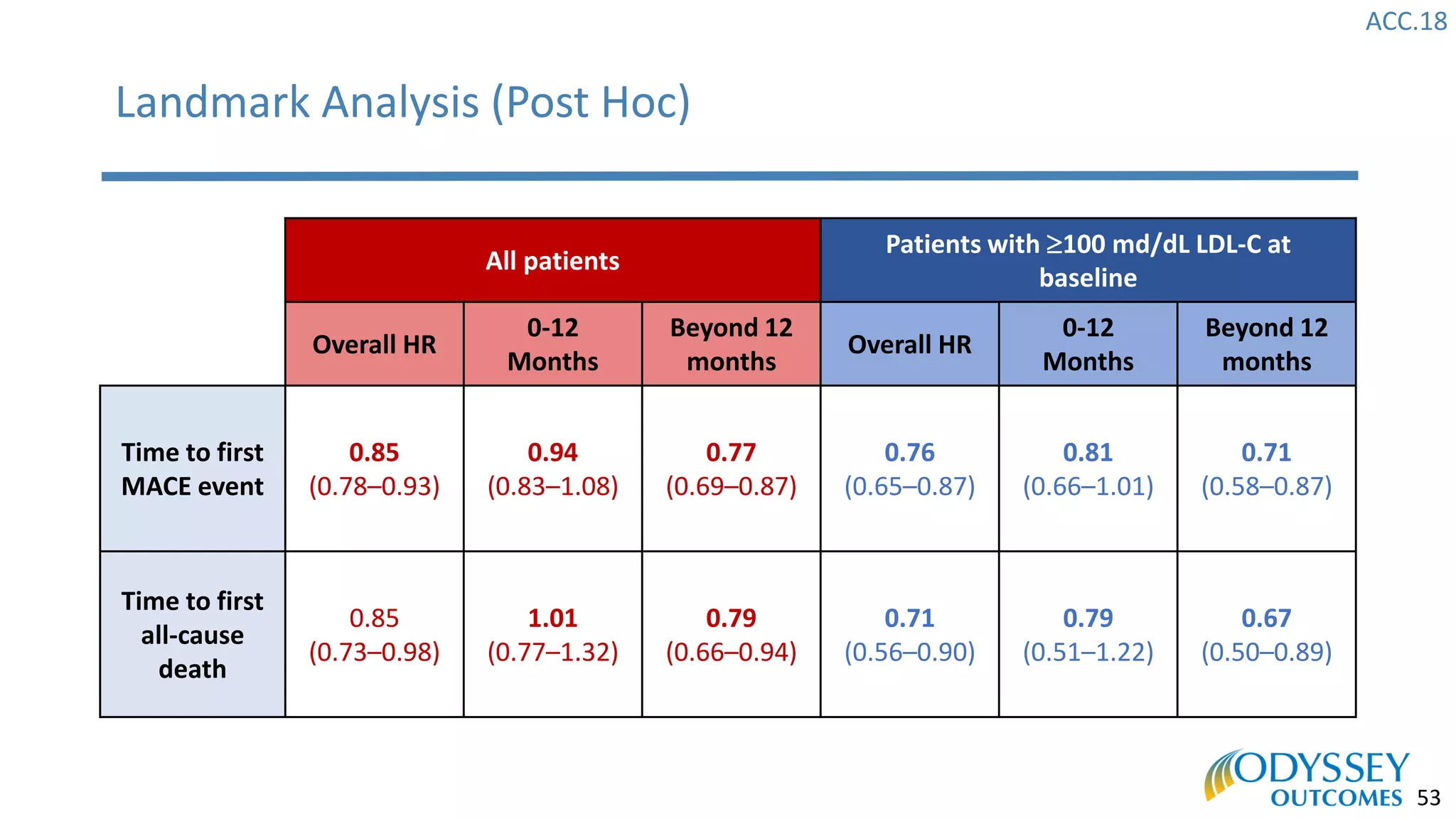
Landmark Analysis (Post Hoc)
All patients
Patients with 100 md/dL LDL-C at
baseline
Overall HR
0-12
Months
Beyond 12
months
Overall HR
0-12
Months
Beyond 12
months
Time to first
MACE event
0.85
(0.78–0.93)
0.94
(0.83–1.08)
0.77
(0.69–0.87)
0.76
(0.65–0.87)
0.81
(0.66–1.01)
0.71
(0.58–0.87)
Time to first
all-cause
death
0.85
(0.73–0.98)
1.01
(0.77–1.32)
0.79
(0.66–0.94)
0.71
(0.56–0.90)
0.79
(0.51–1.22)
0.67
(0.50–0.89)

ODYSSEY Outcomes: Cardiovascular Outcomes with Alirocumab after ACS

  • 1.
    The ODYSSEY OUTCOMESTrial: Topline Results Alirocumab in Patients After Acute Coronary Syndrome Gregory G. Schwartz, Michael Szarek, Deepak L. Bhatt, Vera Bittner, Rafael Diaz, Jay Edelberg, Shaun G. Goodman, Corinne Hanotin, Robert Harrington, J. Wouter Jukema, Guillaume Lecorps, Angèle Moryusef, Robert Pordy, Matthew Roe, Harvey D. White, Andreas Zeiher, Ph. Gabriel Steg On behalf of the ODYSSEY OUTCOMES Investigators and Committees American College of Cardiology – 67th Scientific Sessions March 10, 2018 ClinicalTrials.gov: NCT01663402
  • 2.
    ACC.18 2 Disclosures • The trialwas funded by Sanofi and Regeneron Pharmaceuticals • Ph. Gabriel Steg discloses the following relationships: - Research grants from Bayer, Merck, Sanofi, and Servier - Speaking or consulting fees from Amarin, Amgen, AstraZeneca, Bayer/Janssen, Boehringer Ingelheim, Bristol-Myers Squibb, Lilly, Merck, Novartis, Novo- Nordisk, Pfizer, Regeneron Pharmaceuticals, Sanofi, and Servier • Gregory G. Schwartz discloses research support to his institution
  • 3.
    ACC.18 3 • Remains highdespite evidence-based preventive therapies • Is related, in part, to levels of low-density lipoprotein cholesterol (LDL-C) • Is reduced when LDL-C is lowered by • Statin therapy, compared with placebo1 • High-intensity, compared with moderate-intensity statin therapy2 • Ezetimibe, compared with placebo, added to statin3 Residual Risk After Acute Coronary Syndrome 1. Schwartz GG, et al. JAMA 2001;285:1711-8. 2. Cannon CP, et al. NEJM 2004;350:1495-504. 3. Cannon CP, et al. NEJM 2015;372:2387-97.
  • 4.
    ACC.18 4 Alirocumab • A fullyhuman monoclonal antibody against PCSK9 • Produces substantial and sustained reductions in LDL-C and other atherogenic lipoproteins1 • Has been safe and well-tolerated in studies to date2 PCSK9, proprotein convertase subtilisin/kexin type 9 1. Robinson JG, et al. NEJM 2015;372:1489-99. 2. Robinson JG, et al. JACC 2017;69:471-82.
  • 5.
    ACC.18 5 Study Hypothesis Alirocumab, versusplacebo, reduces cardiovascular (CV) morbidity and mortality after recent acute coronary syndrome (ACS) in patients with elevated levels of atherogenic lipoproteins despite intensive or maximum- tolerated statin therapy Schwartz GG, et al. Am Heart J 2014;168:682-689.e1.
  • 6.
    ACC.18 6 Main Inclusion Criteria •Age ≥40 years • ACS • 1 to 12 months prior to randomization • Acute myocardial infarction (MI) or unstable angina • High-intensity statin therapy* • Atorvastatin 40 to 80 mg daily or • Rosuvastatin 20 to 40 mg daily or • Maximum tolerated dose of one of these agents for ≥2 weeks • Inadequate control of lipids • LDL-C ≥70 mg/dL (1.8 mmol/L) or • Non-HDL-C ≥100 mg/dL (2.6 mmol/L) or • Apolipoprotein B ≥80 mg/dL *Patients not on statins were authorized to participate if tolerability issues were present and documented Schwartz GG, et al. Am Heart J 2014;168:682-689.e1.
  • 7.
    ACC.18 7 Key Exclusion Criteria •Uncontrolled hypertension • NYHA class III or IV heart failure; LVEF <25% if measured • History of hemorrhagic stroke • Fasting triglycerides >400 mg/dL (4.52 mmol/L) • Use of fibrates other than fenofibrate or fenofibric acid • Recurrent ACS within 2 weeks prior to randomization visit • Coronary revascularization performed within 2 weeks prior to randomization visit, or planned after randomization • Liver transaminases >3  ULN; hepatitis B or C infection • Creatine kinase >3  ULN • eGFR <30 mL/min/1.73 m2 • Positive pregnancy test eGFR, estimated glomerular filtration rate; ULN, upper limit of normal Schwartz GG, et al. Am Heart J 2014;168:682-689.e1.
  • 8.
    ACC.18 8 Time of firstoccurrence of: • Coronary heart disease (CHD) death, or • Non-fatal MI, or • Fatal or non-fatal ischemic stroke, or • Unstable angina requiring hospitalization* Primary Efficacy Outcome All outcomes adjudicated by the Clinical Events Committee, under the auspices of the Duke Clinical Research Institute (DCRI). Members were unaware of treatment assignment and lipid levels *Required all of the following: 1. Hospital admission >23 h for MI symptoms,  tempo in prior 48 hours and/or ≥20 min of chest discomfort at rest 2. New ECG findings consistent with ischemia or infarction 3. Angiographically significant obstructive coronary disease Schwartz GG, et al. Am Heart J 2014;168:682-689.e1.
  • 9.
    ACC.18 9 Major Secondary EfficacyEndpoints Tested in the following hierarchical sequence: • CHD event: CHD death, non-fatal MI, unstable angina requiring hospitalization, or ischemia-driven coronary revascularization* • Major CHD event: CHD death or non-fatal MI • CV event: CV death, non-fatal CHD event, or non-fatal ischemic stroke • All-cause death, non-fatal MI, non-fatal ischemic stroke • CHD death • CV death • All-cause death *Revascularization performed because of recurrent ACS, new or progressive symptoms of myocardial ischemia or new or progressive abnormalities on functional testing, except revascularization due to restenosis at a prior coronary intervention site.
  • 10.
    ACC.18 10 Other Secondary andSafety Endpoints Other secondary endpoints • Components of the primary endpoint considered individually: • CHD death • Non-fatal MI • Fatal and non-fatal ischemic stroke • Unstable angina requiring hospitalization • Ischemia-driven coronary revascularization • Congestive heart failure requiring hospitalization Safety endpoints • Adverse events • Laboratory assessments
  • 11.
    ACC.18 11 Treatment Assignment Post-ACS patients(1 to 12 months) Run-in period of 2−16 weeks on high-intensity or maximum-tolerated dose of atorvastatin or rosuvastatin At least one lipid entry criterion met Placebo SC Q2WAlirocumab SC Q2W Randomization Schwartz GG, et al. Am Heart J 2014;168:682-689.e1. Patient and investigators remained blinded to treatment and lipid levels for the entire duration of the study
  • 12.
    ACC.18 12 LDL-C (mg/dL) 705025150 A TargetRange for LDL-C Schwartz GG, et al. Am Heart J 2014;168:682-689.e1. Undesirably high baseline range
  • 13.
    ACC.18 13 Undesirably high baseline range LDL-C(mg/dL) Target range 705025150 A Target Range for LDL-C Schwartz GG, et al. Am Heart J 2014;168:682-689.e1. Alirocumab
  • 14.
    ACC.18 14 Undesirably high baseline range LDL-C(mg/dL) Target range Alirocumab 705025150 A Target Range for LDL-C Schwartz GG, et al. Am Heart J 2014;168:682-689.e1. Acceptablerange
  • 15.
    ACC.18 15 Undesirably high baseline range LDL-C(mg/dL) Target range Alirocumab Belowtarget 705025150 Acceptablerange A Target Range for LDL-C Schwartz GG, et al. Am Heart J 2014;168:682-689.e1. We attempted to maximize the number of patients in the target range and minimize the number below target by blindly titrating alirocumab (75 or 150 mg SC Q2W) or blindly switching to placebo.
  • 16.
    ACC.18 16 Statistical Considerations • Allanalyses conducted by independent academic statistical team at State University of New York (SUNY) Downstate School of Public Health, in parallel with the sponsor • Efficacy analysis by intention-to-treat (ITT)
  • 17.
    ACC.18 17 Statistical Considerations • Allanalyses conducted by independent academic statistical team at State University of New York (SUNY) Downstate School of Public Health, in parallel with the sponsor • Efficacy analysis by intention-to-treat (ITT) • Assumptions • Cumulative incidence of primary endpoint in placebo group 11.4% at 48 months • Baseline LDL-C 90 mg/dL; reduction to 45 mg/dL with alirocumab • 15% expected hazard reduction for primary endpoint • Loss to follow-up at 24 months: 1% • Log-rank test with 1-sided 2.5% significance level • Continuation of the trial until 1613 patients with a primary endpoint (for 90% power) AND all surviving patients followed for ≥2 years (for adequate safety assessments), whichever came later* * Except for patients enrolled in China (enrollment started on May 5, 2016)
  • 18.
    ACC.18 18 ODYSSEY OUTCOMES: 18,924patients randomized at 1315 sites in 57 countries, Nov 2, 2012 − Nov 11, 2017 Canada/USA Canada 361 US 2511 Latin America Argentina 592 Brazil 928 Chile 132 Colombia 354 Guatemala 25 Mexico 349 Peru 208 Asia China 614 Hong Kong 17 India 521 Japan 204 Korea 94 Malaysia 110 Philippines 116 Singapore 49 Sri Lanka 314 Taiwan 93 Thailand 161 Rest of World Australia 216 Israel 582 New Zealand 257 South Africa 505 Western Europe Austria 58 Belgium 197 Denmark 352 Finland 116 France 185 Germany 509 Greece 70 Italy 275 Netherlands 686 Norway 97 Portugal 174 Spain 826 Sweden 250 Switzerland 88 UK 292 Central/Eastern Europe Bosnia–Herzegovina 156 Macedonia 132 Bulgaria 333 Poland 926 Croatia 70 Romania 145 Czech Republic 381 Russian Federation 1109 Estonia 216 Serbia 255 Georgia 131 Slovakia 340 Hungary 224 Slovenia 36 Latvia 80 Turkey 78 Lithuania 188 Ukraine 639 We thank the patients, their families, all investigators and coordinators involved in this study, and DCRI
  • 19.
    ACC.18 19 Argentina R. Diaz AustraliaP.E. Aylward Austria H. Drexel Belgium P. Sinnaeve Bosnia and Herzegovina M. Dilic Brazil R.D. Lopes Bulgaria N.N. Gotcheva Canada S.G. Goodman Chile J.-C. Prieto China H. Yong Colombia P. López-Jaramillo Croatia I. Pećin Czech Republic P. Ostadal Denmark S. Hvitfeldt Poulsen Estonia M. Viigimaa Finland M.S. Nieminen France N. Danchin Georgia V. Chumburidze Germany N. Marx Greece E. Liberopoulos Guatemala P.C. Montenegro Valdovinos Hong Kong H.-F. Tse Hungary R. Gabor Kiss India D. Xavier Israel D. Zahger Italy M. Valgimigli Japan T. Kimura Korea H. Soo Kim Latvia A. Erglis Lithuania A. Laucevicius Macedonia S. Kedev Malaysia K. Yusoff Mexico G.A. Ramos López Netherlands M. Alings New Zealand H.D. White Norway S. Halvorsen Peru R.M. Correa Flores Philippines R.G. Sy Poland A. Budaj Portugal J. Morais Romania M. Dorobantu Russian Federation Y. Karpov Serbia A.D. Ristic Singapore T. Chua Slovakia J. Murin Slovenia Z. Fras Republic of South Africa A.J. Dalby Spain J. Tuñón Sri Lanka H. Asita de Silva Sweden E. Hagström Switzerland C. Müller Taiwan C.-E. Chiang Thailand P. Sritara Turkey S. Guneri Ukraine A. Parkhomenko UK K.K. Ray USA P. Moriarty, M Roe, R. Vogel ODYSSEY OUTCOMES National Leaders
  • 20.
    ACC.18 20 Executive Steering Committee G.G.Schwartz and Ph.G. Steg (Co-Chairs) D.L. Bhatt, V. Bittner, R. Diaz, S.G. Goodman, R.A. Harrington, J.W. Jukema, M. Szarek, H. White, A. Zeiher Non-voting members: Ex officio: P. Tricoci, M.T. Roe, K.W. Mahaffey Sponsor representatives: C. Hanotin, G. Lecorps, A. Moryusef, R. Pordy, W.J. Sasiela, J.-F. Tamby Clinical Events Committee P. Tricoci (Chair), J.H. Alexander, L. Armaganijan, A. Bagai, M.C. Bahit, J.M. Brennan, S. Clifton, A.D. DeVore, S. Deloatch, S. Dickey, K. Dombrowski, G. Ducrocq, Z. Eapen, P. Endsley, A. Eppinger, R.W. Harrison, C.N. Hess, M.A. Hlatky, J.D. Jordan, J.W. Knowles, B.J. Kolls, D.F. Kong, S. Leonardi, L. Lillis, R.D. Lopes, D.J. Maron, K.W. Mahaffey, J. Marcus, R. Mathews, R.H. Mehta, R.J. Mentz, H.G. Moreira, C.B. Patel, S.B. Pereira, L. Perkins, T.J. Povsic, E. Puymirat, M.T. Roe, W. Schuyler Jones, B.R. Shah, M.W. Sherwood, K. Stringfellow, D. Sujjavanich, M. Toma, C. Trotter, S.F.P. van Diepen, M.D. Wilson, A. T.-K. Yan Data Safety Monitoring Board B. Chaitman (Chair), S.F. Kelsey, A.G. Olsson, J.-L. Rouleau, M.L. Simoons Monitoring of safety in patients with low LDL-C values K. Alexander, C. Meloni, R.S. Rosenson, E.J.G. Sijbrands ODYSSEY OUTCOMES Committees
  • 21.
    ACC.18 21 ODYSSEY OUTCOMES TrialOrganization Academic and Contract Research Organizations Brazilian Clinical Research Institute, São Paulo, Brazil R. Lopes, F. Egydio, A. Kawakami, J. Oliveira Canadian VIGOUR Centre, University of Alberta, Toronto, Canada S.G. Goodman, J. Wozniak Covance, Marlow, Buckinghamshire, UK A. Matthews, C. Ratky, J. Valiris Duke Clinical Research Institute, Durham, NC, USA L. Berdan, K. Quintero, T. Rorick Estudios Clínicos Latino America, Rosario, Santa Fe, Argentina R. Diaz, A. Pascual, C. Rovito French Alliance for Cardiovascular Trials, Paris, France N. Danchin, M. Bezault, E. Drouet, T. Simon Green Lane Coordinating Centre, Kingsland, Auckland, New Zealand H.D. White, C. Alsweiler Leuven Klinisch Coördinatiecentrum, Leuven, Belgium P. Sinnaeve, A. Luyten South Australian Health & Medical Research Institute P. Aylward, J. Butters, L. Griffith, M. Shaw Uppsala Kliniska Forskningscentrum, Uppsala, Sweden E. Hagstrom, L. Grunberg Independent Statistical Team SUNY Downstate School of Public Health M. Szarek, S. Islam
  • 22.
    ACC.18 22 Patient Disposition Randomized 18,924patients *Ascertainment was complete for 99.1% and 99.8% of potential patient-years of follow-up for the primary endpoint and all-cause death, respectively 1955 patients experienced a primary endpoint 726 patients died Follow-up*: median 2.8 (Q1–Q3 2.3–3.4) years 8242 (44%) patients with potential follow-up ≥3 years Alirocumab (N=9462) Placebo (N=9462) 1343 (14.2%) 1496 (15.8%)• Premature treatment discontinuation • Blinded switch to placebo (2 consecutive LDL-C values <15 mg/dL) • Patients lost to follow-up (vital status) 730 (7.7%) Not applicable 14 9
  • 23.
    ACC.18 23 Baseline Demographics Characteristic Alirocumab (N=9462) Placebo (N=9462) Age, years,median (Q1−Q3) 58 (52−65) 58 (52−65) Female, n (%) 2390 (25.3) 2372 (25.1) Medical history, n (%) Hypertension 6205 (65.6) 6044 (63.9) Diabetes mellitus 2693 (28.5) 2751 (29.1) Current tobacco smoker 2282 (24.1) 2278 (24.1) Prior MI 1790 (18.9) 1843 (19.5)
  • 24.
    ACC.18 24 Characteristic Alirocumab (N=9462) Placebo (N=9462) Time from indexACS to randomization, months, median (Q1−Q3) 2.6 (1.7−4.4) 2.6 (1.7−4.3) ACS type, n (%) NSTEMI 4574 (48.4) 4601 (48.7) STEMI 3301 (35.0) 3235 (34.2) Unstable angina 1568 (16.6) 1614 (17.1) Revascularization for index ACS, n (%) 6798 (71.8) 6878 (72.7) Baseline Index Events
  • 25.
    ACC.18 25 Baseline Lipid Characteristics Characteristic,mg/dL, median (Q1–Q3) Alirocumab (N=9462) Placebo (N=9462) LDL-C 87 (73–104) 87 (73–104) Non-HDL-C 115 (99−136) 115 (99−137) Apolipoprotein B 79 (69−93) 80 (69−93) HDL-C 43 (37−50) 42 (36−50) Triglycerides 129 (94−181) 129 (95−183) Lipoprotein(a) 21 (7−59) 22 (7−60) 92.5% of patients qualified on the basis of LDL-C ≥70 mg/dL
  • 26.
    ACC.18 26 Therapy, n (%) Alirocumab (N=9462) Placebo (N=9462) High-doseatorvastatin/rosuvastatin 8380 (88.6) 8431 (89.1) Low-/moderate-dose atorvastatin/rosuvastatin 830 (8.8) 777 (8.2) Other statin 19 (0.2) 27 (0.3) Ezetimibe, with or without statin 269 (2.8) 285 (3.0) No lipid-lowering therapy 87 (0.9) 91 (1.0) Baseline Lipid-Lowering Therapy
  • 27.
    ACC.18 27 Guideline-Recommended Post-ACS Medications Medication,n (%) Alirocumab (N=9462) Placebo (N=9462) Aspirin 9050 (95.6) 9036 (95.5) P2Y12 antagonist 8296 (87.7) 8245 (87.1) ACE-I/ARB 7356 (77.7) 7360 (77.8) Beta-blocker 7998 (84.5) 7992 (84.5) ACE-I, angiotensin-converting enzyme inhibitor; ARB, angiotensin receptor blocker
  • 28.
    ACC.18 28 103.1 39.8 48.0 66.4 93.3 96.4 101.4 37.6 42.3 53.3 0 15 30 45 60 75 90 105 0 48 12 16 20 24 28 32 36 40 44 48 MeanLDL-C(mg/dL) Months Since Randomization LDL-C: ITT and On-Treatment Analyses Placebo ITT On-treatment* Alirocumab ITT† On-treatment* *Excludes LDL-C values after premature treatment discontinuation or blinded switch to placebo †All LDL-C values, including those after premature treatment discontinuation, blinded down titration, or blinded switch to placebo
  • 29.
    ACC.18 29 93.3 96.4 101.4 37.6 42.3 53.3 0 15 30 45 60 75 90 105 0 4 812 16 20 24 28 32 36 40 44 48 MeanLDL-C(mg/dL) Months Since Randomization D 55.7 mg/dL –62.7% D 54.1 mg/dL –61.0% D 48.1 mg/dL –54.7% LDL-C: On-Treatment Analysis Placebo Alirocumab Excludes LDL-C values after premature treatment discontinuation or blinded switch to placebo Approximately 75% of months of active treatment were at the 75 mg dose
  • 30.
    ACC.18 30 Primary Efficacy Endpoint:MACE MACE: CHD death, non-fatal MI, ischemic stroke, or unstable angina requiring hospitalization
  • 31.
    ACC.18 31 Primary Efficacy Endpoint:MACE ARR* 1.6% *Based on cumulative incidence MACE: CHD death, non-fatal MI, ischemic stroke, or unstable angina requiring hospitalization
  • 32.
    ACC.18 32 Primary Efficacy andComponents Endpoint, n (%) Alirocumab (N=9462) Placebo (N=9462) HR (95% CI) Log-rank P-value MACE 903 (9.5) 1052 (11.1) 0.85 (0.78, 0.93) 0.0003 CHD death 205 (2.2) 222 (2.3) 0.92 (0.76, 1.11) 0.38 Non-fatal MI 626 (6.6) 722 (7.6) 0.86 (0.77, 0.96) 0.006 Ischemic stroke 111 (1.2) 152 (1.6) 0.73 (0.57, 0.93) 0.01 Unstable angina 37 (0.4) 60 (0.6) 0.61 (0.41, 0.92) 0.02
  • 33.
    ACC.18 33 Main Secondary EfficacyEndpoints: Hierarchical Testing Endpoint, n (%) Alirocumab (N=9462) Placebo (N=9462) HR (95% CI) Log-rank P-value CHD event 1199 (12.7) 1349 (14.3) 0.88 (0.81, 0.95) 0.001 Major CHD event 793 (8.4) 899 (9.5) 0.88 (0.80, 0.96) 0.006 CV event 1301 (13.7) 1474 (15.6) 0.87 (0.81, 0.94) 0.0003 Death, MI, ischemic stroke 973 (10.3) 1126 (11.9) 0.86 (0.79, 0.93) 0.0003 CHD death 205 (2.2) 222 (2.3) 0.92 (0.76, 1.11) 0.38 CV death 240 (2.5) 271 (2.9) 0.88 (0.74, 1.05) 0.15 All-cause death 334 (3.5) 392 (4.1) 0.85 (0.73, 0.98) 0.026* *Nominal P-value
  • 34.
    ACC.18 34 All-Cause Death ARR† 0.6% *NominalP-value †Based on cumulative incidence
  • 35.
    ACC.18 35 Other Efficacy Endpoints Endpointn (%) Alirocumab (N=9462) Placebo (N=9462) HR (95% CI) Log-rank P-value Ischemia-driven coronary revascularization 731 (7.7) 828 (8.8) 0.88 (0.79, 0.97) 0.009 Hospitalization for CHF 176 (1.9) 179 (1.9) 0.98 (0.79, 1.20) 0.84
  • 36.
    ACC.18 36 Primary Efficacy inMain Prespecified Subgroups *P-values for interaction
  • 37.
    ACC.18 37 Primary Efficacy inMain Prespecified Subgroups *P-values for interaction
  • 38.
    ACC.18 38 Post Hoc Analysis:All-Cause Death by Prespecified Baseline LDL-C Subgroups ≥100 mg/dL HR=0.71 <80 mg/dL HR 0.89 (95% CI 0.69, 1.14) 80 to <100 mg/dL HR 1.03 (95% CI 0.78, 1.36)
  • 39.
    ACC.18 39 Post Hoc Analysis:All-Cause Death by Prespecified Baseline LDL-C Subgroups Pinteraction=0.12 ≥100 mg/dL HR 0.71 (95% CI 0.56, 0.90) <80 mg/dL HR 0.89 (95% CI 0.69, 1.14) 80 to <100 mg/dL HR 1.03 (95% CI 0.78, 1.36) ARR* 1.7% *Based on cumulative incidence
  • 40.
    ACC.18 40 Efficacy: Subgroup withBaseline LDL-C 100 mg/dL (Median Baseline LDL-C 118 mg/dL) Endpoint, n (%) Alirocumab (N=2814) Placebo (N=2815) Absolute risk reduction (%) HR (95% CI) MACE 324 (11.5) 420 (14.9) 3.4 0.76 (0.65, 0.87) CHD death 69 (2.5) 96 (3.4) 1.0 0.72 (0.53, 0.98) CV death 81 (2.9) 117 (4.2) 1.3 0.69 (0.52, 0.92) All-cause death 114 (4.1) 161 (5.7) 1.7 0.71 (0.56, 0.90)
  • 41.
    ACC.18 41 Safety (1) Treatment-emergent adverseevents, n (%) Alirocumab (N=9451) Placebo (N=9443) Any 7165 (75.8) 7282 (77.1) Serious 2202 (23.3) 2350 (24.9) Laboratory value Alirocumab Placebo ALT >3  ULN, n/N (%) 212/9369 (2.3) 228/9341 (2.4) Creatine kinase >10  ULN, n/N (%) 46/9369 (0.5) 48/9338 (0.5)
  • 42.
    ACC.18 42 Safety (2) Event Alirocumab (N=9451) Placebo (N=9443) Diabetes worseningor diabetic complications: pts w/DM at baseline, n/N (%) 506/2688 (18.8) 583/2747 (21.2) New onset diabetes; pts w/o DM at baseline, n/N (%) 648/6763 (9.6) 676/6696 (10.1) General allergic reaction, n (%) 748 (7.9) 736 (7.8) Hepatic disorder, n (%) 500 (5.3) 534 (5.7) Local injection site reaction, n (%)* 360 (3.8) 203 (2.1) Neurocognitive disorder, n (%) 143 (1.5) 167 (1.8) Cataracts, n (%) 120 (1.3) 134 (1.4) Hemorrhagic stroke, n (%) 9 (<0.1) 16 (0.2) *HR vs. placebo 1.82 (95% CI 1.54, 2.17)
  • 43.
    ACC.18 43 Conclusions Compared with placeboin patients with recent ACS, alirocumab 75 or 150 mg Q2W targeting LDL-C levels 25–50 mg/dL, and allowing levels as low as 15 mg/dL: 1. Reduced MACE, MI, and ischemic stroke 2. Was associated with a lower rate of all-cause death 3. Was safe and well-tolerated over the duration of the trial
  • 44.
    ACC.18 44 Clinical Implications • Inthis nearly 19,000-patient placebo-controlled trial, including many patients treated for ≥3 years, there was no safety signal with alirocumab other than injection site reactions
  • 45.
    ACC.18 45 Clinical Implications • Inthis nearly 19,000-patient placebo-controlled trial, including many patients treated for ≥3 years, there was no safety signal with alirocumab other than injection site reactions • Among patients with ACS and baseline LDL-C 100 mg/dL, alirocumab reduced MACE by 24% (ARR 3.4%) and all-cause death by 29% (ARR 1.7%) compared with placebo ➢These are the patients who may benefit most from treatment ARR, absolute risk reduction
  • 46.
  • 47.
    ACC.18 47 Blinded Alirocumab DoseAdjustments All patients assigned to alirocumab 75 mg Q2W LDL-C measured at Month 1 Up-titration of alirocumab for LDL-C ≥50 mg/dL LDL-C <50 mg/dL Continue at 75 mg Q2W LDL-C ≥50 mg/dL Blinded increase to 150 mg Q2W at Month 2 visit LDL-C <25 mg/dL on 2 consecutive measurements Down-titration of alirocumab and/or safety monitoring for LDL-C <25 mg/dL If alirocumab 75 mg Q2W LDL-C 15 to <25 mg/dL on ≥1 measurement If alirocumab 150 mg Q2W Blinded dose decrease to 75 mg Q2W at next study visit Safety monitoring by independent physician LDL-C <15 mg/dL on 2 consecutive measurements Blinded permanent discontinuation of alirocumab and substitution of placebo at next study visit
  • 48.
    ACC.18 48 FOURIER ODYSSEY OUTCOMES PopulationStable ASCVD Recent ACS Qualifying LDL-C, mg/dL ≥70 ≥70 Primary endpoint 5-point MACE: CV death, MI, CVA, UA, coronary revasc. 4-point MACE: CHD death, MI, CVA, UA Follow up 26 months 34 months Age (median, years) 63 58 ACS <1 year 20% 100% High-intensity statin 69% 89% No statin 0.2% 2.5%
  • 49.
    ACC.18 49 Outcomes relative risk reduction FOURIERODYSSEY OUTCOMES Primary endpoint 15% 15% MI 27% 14% Stroke 21% 27% Unstable angina 1% 39% CV death +5% increase (NS) 12% (NS) All cause death +4% increase (NS) 15% (p=0.026*) *Nominal P-value
  • 50.
    ACC.18 50 Main Outcomes Overall cohort Endpoint,n (%) Alirocumab (N=9462) Placebo (N=9462) ARR NNT HR (95% CI) Log-rank P-value MACE 903 (9.5) 1052 (11.1) 1.6% 64 0.85 (0.78, 0.93) 0.0003 All-cause death 334 (3.5) 392 (4.1) 0.6% 163 0.85 (0.73, 0.98) 0.026* Patients with baseline LDL-C ≥100 mg/dL Endpoint, n (%) Alirocumab (N=2814) Placebo (N=2815) ARR NNT HR (95% CI) MACE 324 (11.5) 420 (14.9) 3.4% 29 0.76 (0.65–0.87) All-cause death 114 (4.1) 161 (5.7) 1.7% 60 0.71 (0.56–0.90)
  • 51.
    ACC.18 51 Time to FirstOccurrence of MACE (Primary Endpoint) Per CEC, According to Baseline LDL-C (ITT Population)
  • 52.
    ACC.18 52 HR 0.76 (0.65–0.87)HR0.91 (0.81–1.02) Baseline LDL-C <100 mg/dL Baseline LDL-C 100 mg/dL MACE Benefit Largely Driven by Patients With Baseline LDL-C 100 mg/dL Pinteraction=0.05 Primary endpoint: time to first occurrence of MACE (Kaplan-Meier cumulative incidence curve in ITT population)
  • 53.
    ACC.18 53 Landmark Analysis (PostHoc) All patients Patients with 100 md/dL LDL-C at baseline Overall HR 0-12 Months Beyond 12 months Overall HR 0-12 Months Beyond 12 months Time to first MACE event 0.85 (0.78–0.93) 0.94 (0.83–1.08) 0.77 (0.69–0.87) 0.76 (0.65–0.87) 0.81 (0.66–1.01) 0.71 (0.58–0.87) Time to first all-cause death 0.85 (0.73–0.98) 1.01 (0.77–1.32) 0.79 (0.66–0.94) 0.71 (0.56–0.90) 0.79 (0.51–1.22) 0.67 (0.50–0.89)