Percutaneous
Nephrostomy(PCN)
Introduction…
•An interventional procedure that is used mainly in
the decompression of the renal collecting system.
•Percutaneous nephrostomy catheter placement
for the temporary drainage of an obstructed
collecting system
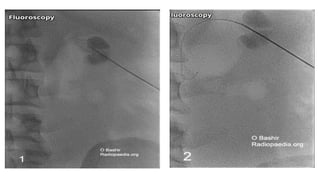
•Done under fluoroscopy, ultrasound or computed
tomography guidance
Indication
Obstructive Uropathy
Benign causes:
• Impacted Urecteric calculi/
Pelvic calculi with secondary
hydronephrosis
• Ureteric stricture
• Pelvic ureteric junction
obstruction
• Hydronephrosis associated
with pregnancy
• In transplant patients
• Retroperitoneal fibrosis
• Urosepsis
• Pyonephrosis
• Malignant Causes
•HN due to tumor of urinary tract
•HN secondary to carcinoma cervix/ prostate.
• Urinary diversion in an attempt to heal conditions like:
malignant/inflammatory fistula, urinary leak or
fistulas d/t trauma and hemorrhagic cyst.
• For providing route of
access:
• Chemotherapy
• Antifungal/antibiotic
therapy
• Benign stricture dilatation
• Stone retrieval
• Antegrade ureteral stent
placement
• Endopyelotomy
• For diagnostic procedures
• Antegrade pyelography
• Biopsy
• Whitaker test
Procedure
•Pre procedural evaluation
- Review all imaging available , assess renal anatomy and
safe route to kidney
- CBC and coagulation profile
- Informed consent
- Peripheral IV access
- Broad spectrum Abx 1-4 hours prior to procedure
- Positioning : Prone, prone oblique or lateral
Equipment
• USG or fluoroscopy guidance
• LA 1% or 2% lignocaine
• 18 gauge puncture needle
• 0.035 inch stiff guidewire
• Water soluble contrast media
• Dilators
• Pigtail drain (8 French)
Procedure
•
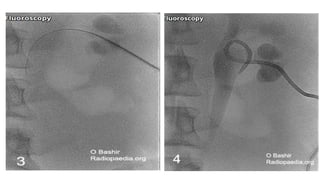
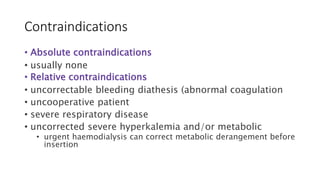
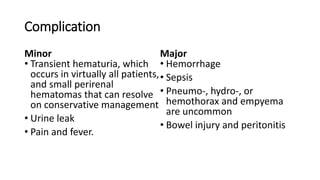
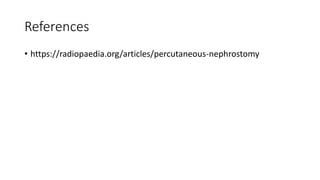
Key steps in PCN
Contd…
Contraindications
• Absolute contraindications
• usually none
• Relative contraindications
• uncorrectable bleeding diathesis (abnormal coagulation
• uncooperative patient
• severe respiratory disease
• uncorrected severe hyperkalemia and/or metabolic
• urgent haemodialysis can correct metabolic derangement before
insertion
Complication
Minor
• Transient hematuria, which
occurs in virtually all patients,
and small perirenal
hematomas that can resolve
on conservative management
• Urine leak
• Pain and fever.
Major
• Hemorrhage
• Sepsis
• Pneumo-, hydro-, or
hemothorax and empyema
are uncommon
• Bowel injury and peritonitis
References
• https://radiopaedia.org/articles/percutaneous-nephrostomy
THANK YOU

PCN Intervention Radiology.pptx

  • 1.
  • 2.
    Introduction… •An interventional procedurethat is used mainly in the decompression of the renal collecting system. •Percutaneous nephrostomy catheter placement for the temporary drainage of an obstructed collecting system •Done under fluoroscopy, ultrasound or computed tomography guidance
  • 3.
    Indication Obstructive Uropathy Benign causes: •Impacted Urecteric calculi/ Pelvic calculi with secondary hydronephrosis • Ureteric stricture • Pelvic ureteric junction obstruction • Hydronephrosis associated with pregnancy • In transplant patients • Retroperitoneal fibrosis • Urosepsis • Pyonephrosis
  • 4.
    • Malignant Causes •HNdue to tumor of urinary tract •HN secondary to carcinoma cervix/ prostate. • Urinary diversion in an attempt to heal conditions like: malignant/inflammatory fistula, urinary leak or fistulas d/t trauma and hemorrhagic cyst.
  • 5.
    • For providingroute of access: • Chemotherapy • Antifungal/antibiotic therapy • Benign stricture dilatation • Stone retrieval • Antegrade ureteral stent placement • Endopyelotomy • For diagnostic procedures • Antegrade pyelography • Biopsy • Whitaker test
  • 6.
    Procedure •Pre procedural evaluation -Review all imaging available , assess renal anatomy and safe route to kidney - CBC and coagulation profile - Informed consent - Peripheral IV access - Broad spectrum Abx 1-4 hours prior to procedure - Positioning : Prone, prone oblique or lateral
  • 7.
    Equipment • USG orfluoroscopy guidance • LA 1% or 2% lignocaine • 18 gauge puncture needle • 0.035 inch stiff guidewire • Water soluble contrast media • Dilators • Pigtail drain (8 French)
  • 8.
  • 9.
  • 10.
  • 11.
    Contraindications • Absolute contraindications •usually none • Relative contraindications • uncorrectable bleeding diathesis (abnormal coagulation • uncooperative patient • severe respiratory disease • uncorrected severe hyperkalemia and/or metabolic • urgent haemodialysis can correct metabolic derangement before insertion
  • 12.
    Complication Minor • Transient hematuria,which occurs in virtually all patients, and small perirenal hematomas that can resolve on conservative management • Urine leak • Pain and fever. Major • Hemorrhage • Sepsis • Pneumo-, hydro-, or hemothorax and empyema are uncommon • Bowel injury and peritonitis
  • 13.
  • 14.

Editor's Notes

  • #5 Hydronephrosis
  • #6 Endopyelotomy: Passing a small telescope up to the narrowed area between your kidney and ureter(Pelvic ureteric junction) Whitaker test: Measure the amount of pressure present in the bladder or kidneys
  • #13 Pneumotharax: During the procedure the renal upper-pole approach may accidently puncture is under GA Catheter encrustation: Usually calcium phosphate blocks catheter