Pedagogical Content
Knowledge – Elementary
Mathematics
NextGen STEM Teacher Preparation in WA State
PCK Working Group
March, 2019
Questions guiding this review
1. What mathematical knowledge does teaching elementary mathematics
require?
2. What is pedagogical content knowledge as it relates to elementary
mathematics?
3. How do prospective teachers acquire pedagogical content knowledge
through their coursework?
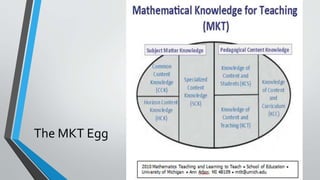
The MKT Egg
Subject Matter Knowledge
• Common Content Knowledge (CCK) – content knowledge that is common
to educated adults, not needed for teaching
• Specialized Content Knowledge (SCK) – content knowledge that is needed
for teaching
• Horizon Content Knowledge (HCK) – knowledge of how content connects
with mathematics on the horizon
Pedagogical Content Knowledge
• Knowledge of Content and Students (KCS) – combines knowledge of
students with knowledge of mathematics: challenges, confusions,
misconceptions, interests, motivations, strategies, interpretations
• Knowledge of Content and Teaching (KCT) – combines knowledge of
teaching with knowledge of mathematics: design of instruction, sequencing
content, examples, representations, “pedagogical issues that affect
students’ learning”
• Knowledge of Content and Curriculum (KCC) – knowledge of how content is
represented and sequenced in mathematics curriculum resources
Example: Multiplication of Whole Numbers
• Common Content Knowledge – how to multiply two whole numbers
• Specialized Content Knowledge – knowing and understanding multiple ways to
multiply; representations; assessing correct and incorrect answers
• PCK: Knowledge of Content and Students – knowing what misconceptions and
challenges students may face; assessing students’ strategies and thinking
• PCK: Knowledge of Content and Teaching – assessing a sequence of different
multiplication strategies; choosing representations that help students make sense
of the mathematics
• PCK: Knowledge of Content and Curriculum – knowing how and why a curriculum
has structured its content in a particular way
• Horizon Knowledge – knowing where this is going; why particular representations
may be important
Frequent Tasks of Teaching Mathematics
that use PCK:
• Posing mathematical questions
• Giving and appraising explanations
• Choosing or designing tasks
• Using and choosing representations
• Recording mathematical work on the board
• Selecting and sequencing examples
• Analyzing students’ errors
• Appraising students’ unconventional ideas
• Mediating a discussion
• Attending to and using math language
• Choosing or using math notation
Assessing Mathematical Knowledge for
Teaching
A common reason for isolating MKT and PCK is to find ways to assess it and connect
it to student learning.
Learning Mathematics for Teaching Project (LMT) - http://www.umich.edu/~lmtweb/
“What is LMT?
Our project investigates the mathematical knowledge needed for teaching. These
measures include items that reflect the real mathematics tasks teachers face in
classrooms - for instance, assessing student work, representing numbers and
operations, and explaining common mathematical rules or procedures. Assessments
composed of these problems can be used to measure the effectiveness of
mathematics-focused professional development.”
Reviews of literature focused on MKT and PCK:
• Matthews (2013): The Influence of the Pedagogical Content Knowledge
Framework on Research in Mathematics Education: A Review Across Grade
Bands, notes that many studies in mathematics education that are not
labeled PCK involve significant aspects of PCK.
• Mecoli (2013): The Influence of the Pedagogical Content Knowledge
Theoretical Framework on Research on Preservice Teacher Education,
suggests ways that preservice teachers develop PCK through their
ocursework.
From Matthews (2013)
• At the elementary level – Cognitively Guided Instruction,
MKT Framework (showed increase in student learning
from teachers’ increased PCK)
• Post-secondary level – “need for attention to the
mathematics learning of teacher preparation
candidates”; yet shifts to actual PCK of university
instructors
Studies explaining when PSTs learn PCK:
• Mecoli (2013) include two math-related studies:
• Kinach (2002) challenges the linearity of content knowledge, then pedagogical content
knowledge.
• Geddis and Wood (1997) examine a teacher educator’s self-study of developing
students’ PCK; how to balance PSTs’ immediate needs (e.g., classroom management)
with goals of mathematics teacher education
• Morris, A. K., Hiebert, J., & Spitzer, S. M. (2009). Mathematical knowledge for
teaching in planning and evaluating instruction: What can preservice teachers
learn? Results indicated that “preservice teachers can identify mathematical
sub-concepts of learning goals in supportive contexts but do not spontaneously
apply a strategy of unpacking learning goals to plan for, or evaluate, teaching
and learning. Implications for preservice education are discussed.”
PCK plays important roles in these frequent
Tasks of Teaching Mathematics:
• Posing mathematical questions
• Giving and appraising explanations
• Choosing or designing tasks
• Using and choosing representations
• Recording mathematical work on the board
• Selecting and sequencing examples
• Analyzing students’ errors
• Appraising students’ unconventional ideas
• Mediating a discussion
• Attending to and using math language
• Choosing or using math notation

PCK for Elementary Math teachers.pptx

  • 1.
    Pedagogical Content Knowledge –Elementary Mathematics NextGen STEM Teacher Preparation in WA State PCK Working Group March, 2019
  • 2.
    Questions guiding thisreview 1. What mathematical knowledge does teaching elementary mathematics require? 2. What is pedagogical content knowledge as it relates to elementary mathematics? 3. How do prospective teachers acquire pedagogical content knowledge through their coursework?
  • 3.
  • 4.
    Subject Matter Knowledge •Common Content Knowledge (CCK) – content knowledge that is common to educated adults, not needed for teaching • Specialized Content Knowledge (SCK) – content knowledge that is needed for teaching • Horizon Content Knowledge (HCK) – knowledge of how content connects with mathematics on the horizon
  • 5.
    Pedagogical Content Knowledge •Knowledge of Content and Students (KCS) – combines knowledge of students with knowledge of mathematics: challenges, confusions, misconceptions, interests, motivations, strategies, interpretations • Knowledge of Content and Teaching (KCT) – combines knowledge of teaching with knowledge of mathematics: design of instruction, sequencing content, examples, representations, “pedagogical issues that affect students’ learning” • Knowledge of Content and Curriculum (KCC) – knowledge of how content is represented and sequenced in mathematics curriculum resources
  • 6.
    Example: Multiplication ofWhole Numbers • Common Content Knowledge – how to multiply two whole numbers • Specialized Content Knowledge – knowing and understanding multiple ways to multiply; representations; assessing correct and incorrect answers • PCK: Knowledge of Content and Students – knowing what misconceptions and challenges students may face; assessing students’ strategies and thinking • PCK: Knowledge of Content and Teaching – assessing a sequence of different multiplication strategies; choosing representations that help students make sense of the mathematics • PCK: Knowledge of Content and Curriculum – knowing how and why a curriculum has structured its content in a particular way • Horizon Knowledge – knowing where this is going; why particular representations may be important
  • 7.
    Frequent Tasks ofTeaching Mathematics that use PCK: • Posing mathematical questions • Giving and appraising explanations • Choosing or designing tasks • Using and choosing representations • Recording mathematical work on the board • Selecting and sequencing examples • Analyzing students’ errors • Appraising students’ unconventional ideas • Mediating a discussion • Attending to and using math language • Choosing or using math notation
  • 8.
    Assessing Mathematical Knowledgefor Teaching A common reason for isolating MKT and PCK is to find ways to assess it and connect it to student learning. Learning Mathematics for Teaching Project (LMT) - http://www.umich.edu/~lmtweb/ “What is LMT? Our project investigates the mathematical knowledge needed for teaching. These measures include items that reflect the real mathematics tasks teachers face in classrooms - for instance, assessing student work, representing numbers and operations, and explaining common mathematical rules or procedures. Assessments composed of these problems can be used to measure the effectiveness of mathematics-focused professional development.”
  • 9.
    Reviews of literaturefocused on MKT and PCK: • Matthews (2013): The Influence of the Pedagogical Content Knowledge Framework on Research in Mathematics Education: A Review Across Grade Bands, notes that many studies in mathematics education that are not labeled PCK involve significant aspects of PCK. • Mecoli (2013): The Influence of the Pedagogical Content Knowledge Theoretical Framework on Research on Preservice Teacher Education, suggests ways that preservice teachers develop PCK through their ocursework.
  • 10.
    From Matthews (2013) •At the elementary level – Cognitively Guided Instruction, MKT Framework (showed increase in student learning from teachers’ increased PCK) • Post-secondary level – “need for attention to the mathematics learning of teacher preparation candidates”; yet shifts to actual PCK of university instructors
  • 11.
    Studies explaining whenPSTs learn PCK: • Mecoli (2013) include two math-related studies: • Kinach (2002) challenges the linearity of content knowledge, then pedagogical content knowledge. • Geddis and Wood (1997) examine a teacher educator’s self-study of developing students’ PCK; how to balance PSTs’ immediate needs (e.g., classroom management) with goals of mathematics teacher education • Morris, A. K., Hiebert, J., & Spitzer, S. M. (2009). Mathematical knowledge for teaching in planning and evaluating instruction: What can preservice teachers learn? Results indicated that “preservice teachers can identify mathematical sub-concepts of learning goals in supportive contexts but do not spontaneously apply a strategy of unpacking learning goals to plan for, or evaluate, teaching and learning. Implications for preservice education are discussed.”
  • 12.
    PCK plays importantroles in these frequent Tasks of Teaching Mathematics: • Posing mathematical questions • Giving and appraising explanations • Choosing or designing tasks • Using and choosing representations • Recording mathematical work on the board • Selecting and sequencing examples • Analyzing students’ errors • Appraising students’ unconventional ideas • Mediating a discussion • Attending to and using math language • Choosing or using math notation