PCI DSS  Education & Compliance Seminar Many card accepting businesses have felt the pain associated with a network penetration and data breach.   It can happen to you!   Learn how the bad guys are doing their dirty work and how you can protect your business!   David Frick, Phil Kluge and Jesse Snyder are Co-Founders of Transaction, Resources, Inc. (TRI)   TRI offers innovative payment processing solutions to merchants by combining the latest technologies with a passion for customer service and competitive rates.  Transaction Resources, Inc., doing business as TRI, is a registered ISO/MSP of Wells Fargo Bank, N.A., Walnut Creek, CA.
What is PCI DSS? P ayment  C ard  I ndustry  D ata  S ecurity  S tandard
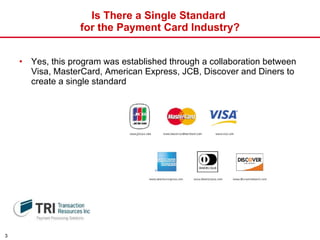
Is There a Single Standard  for the Payment Card Industry? Yes, this program was established through a collaboration between Visa, MasterCard, American Express, JCB, Discover and Diners to create a single standard
To Whom Does PCI DSS Apply? “ PCI DSS compliance is required of  all merchants   and service providers   that store, process, or transmit Visa cardholder data.   The program applies to  all payment channels, including retail (brick-and-mortar), mail/telephone order, and  e-commerce” no matter the size of the business All Merchants
How is Compliance Achieved?   Adherence to the requirements laid out under PCI DSS.   Identification and remediation of vulnerabilities through the  compliance validation process
Why Were the PCI Data Security Standards Established? Cyber crime is growing in diversity and sophistication Integrated POS Systems are increasingly targeted Frequently, magnetic stripe data is stolen from log files as opposed to traditional databases Sensitive data is often unknowingly stored leading to risk Hackers are targeting centralized servers with Internet connectivity, not just e-commerce merchants
What are the Account Data Compromise Impacts? Counterfeit cards and fraud Significant chargeback risk  Penalties, fines, losses  Negative media coverage Damage to reputation Re-issuance and monitoring of cards Impacts to consumer confidence Potential of new legislation
Fraud Loss Example SCENARIO: Merchant A is storing track data in its server.  Fraudster hacks into the system and steals cardholder track data.  Fraudster creates counterfeit plastics from stolen cardholder data and these plastics are subsequently used at Merchant A, B, C, and D QUESTIONS: Is Merchant A liable for losses that result from use  of the counterfeit cards at Merchant A?
Fraud Loss Example SCENARIO: Merchant A is storing track data in its server.  Fraudster hacks into the system and steals cardholder track data.  Fraudster creates counterfeit plastics from stolen cardholder data and these plastics are subsequently used at Merchant A, B, C, and D QUESTIONS: Is Merchant A liable for losses that result from use  of the counterfeit cards at Merchant A? Yes
Fraud Loss Example Is Merchant A liable for losses that result from use of the counterfeit cards at Merchant B, C, or D?
Fraud Loss Example Is Merchant A liable for losses that result from use of the counterfeit cards at Merchant B, C, or D?  Merchant A may become liable for the fraud losses which occurred from the compromised cards at Merchants B, C, and D through the compliance case process Yes
Fraud Loss Example EXAMPLE:  500,000 cards stolen.  10,000 cards used fraudulently at each of Merchant B, C, and D = 10,000 x 3 Merchants = 30,000 cards COMPLIANCE CASE PROCESS: 30,000 cards x $500 average ticket = $15,000,000 In addition, Merchant A will be responsible for fines and monitoring expenses
Example of Monetary Loss to Businesses  6 Credit Cards compromised Level 4 Merchant $36,000
Example of Monetary Loss to Businesses  6 Credit Cards compromised Level 4 Merchant $36,000   40 Million Credit Cards compromised Service Provider Put out of business
Example of Monetary Loss to Businesses  6 Credit Cards compromised Level 4 Merchant $36,000   40 Million Credit Cards compromised Service Provider Put out of business Laptop Stolen with card data Level 4 merchant $110,000
Example of Monetary Loss to Businesses  6 Credit Cards compromised Level 4 Merchant $36,000   40 Million Credit Cards compromised Service Provider Put out of business Laptop Stolen with card data Level 4 merchant $110,000  More Level 4 Merchants are compromised than any other group!
Fraud Costs Lost Goods & Services Investigation Costs Card Re-issuance Fines
Merchant Classifications Level 1 All Channels >6MM Visa or MC transactions per year Level 2 All Channels 1MM to 6MM Visa or MC transactions per year Level 3 20,000 - 999,999 e-commerce Visa or MC transactions per year Level 4 <20,000 Visa or MC e-commerce transactions per year or <1MM non-e-commerce transactions Visa or MC transaction per year
What is a Compromise? Incidents  involving an electronic or physical breach of cardholder information and/or card data
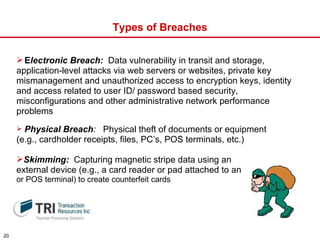
Types of Breaches E lectronic Breach:   Data vulnerability in transit and storage, application-level attacks via web servers or websites, private key mismanagement and unauthorized access to encryption keys, identity and access related to user ID/ password based security, misconfigurations and other administrative network performance problems   Physical Breach :  Physical theft of documents or equipment  (e.g., cardholder receipts, files, PC’s, POS terminals, etc.)  Skimming:   Capturing magnetic stripe data using an  external device (e.g., a card reader or pad attached to an  ATM  or POS terminal) to create counterfeit cards
Common Vulnerabilities 1)  Inappropriate data storage (e.g. full track, CVV2, PIN blocks) 2)  Insecure wireless 3)  Vendor default settings and passwords (PC Anywhere is  extremely vulnerable) 4)  Lack of network segmentation (POS system on PC with external  internet) 5)  Unnecessary and vulnerable services on servers 6)  Missing or Outdated Security Patches
PCI DSS Basic Requirements Build and Maintain a Secure Network 1.  Install and maintain a firewall configuration to protect data 2.   Do not use vendor-supplied defaults for systems passwords and  other security parameters Protect Cardholder Data 3.  Protect Stored Data 4.  Encrypt transmission of cardholder data and sensitive  information across public networks
PCI DSS Basic Requirements Maintain a Vulnerability Management Program 5.  Use and regularly update anti-virus software 6.  Develop and maintain secure systems and applications Implement Strong Access Control Measures 7.  Restrict access to data by business need-to-know 8.  Assign a unique ID to each person with computer access 9.  Restrict physical access to cardholder data
PCI DSS Basic Requirements Regularly Monitor and Test Networks 10.  Track and monitor all access to network resources  and cardholder data 11.  Regularly test security systems and processes Maintain an Information Security Policy 12.  Maintain a policy that addresses information  security that all employees are informed of  and adhere to
What Does Each Merchant Need to Provide to Their Credit Card Processing Bank? Complete and validate an Annual PCI Self-Assessment Questionnaire Complete Quarterly Network Scans to check your systems for vulnerabilities Do annual penetration testing to test that your systems are hacker-resistant Ensure that these security scans are performed by a qualified independent scan vendor
Safe Harbor Safe harbor provides members protection from fines and compliance exposure in the event a merchant or service provider experiences a compromise. To attain safe harbor status:  A member, merchant, or service provider must maintain full compliance at all times, including at the time of breach as demonstrated during a forensic investigation  A member must demonstrate that prior to the compromise their merchant had already met the compliance validation requirements, demonstrating full compliance It is important to note that the submission of compliance validation documentation, in and of itself, does not provide the member safe harbor status. The entity must have adhered to all the requirements at the time of the compromise
Keeping your Business Compliant DO NOT STORE TRACK, PIN OR CVV2 / CVC2 data.  Educate your employees on PCI DSS Compliance and associated risks Ensure your third party POS vendors are PCI DSS compliant (anyone touching your data for any purpose) Utilize a Qualified Data Security Assessment Firm
Websites for More Information www.visa.com/cisp   sdp.mastercardintl.com  for compliance tips and PCI DSS requirements www.pcisecuritystandards.org  www.transactionresources.com/pci/
QUESTIONS?

PCI Compliance Seminar

  • 1.
    PCI DSS Education & Compliance Seminar Many card accepting businesses have felt the pain associated with a network penetration and data breach.   It can happen to you!   Learn how the bad guys are doing their dirty work and how you can protect your business!   David Frick, Phil Kluge and Jesse Snyder are Co-Founders of Transaction, Resources, Inc. (TRI)   TRI offers innovative payment processing solutions to merchants by combining the latest technologies with a passion for customer service and competitive rates.  Transaction Resources, Inc., doing business as TRI, is a registered ISO/MSP of Wells Fargo Bank, N.A., Walnut Creek, CA.
  • 2.
    What is PCIDSS? P ayment C ard I ndustry D ata S ecurity S tandard
  • 3.
    Is There aSingle Standard for the Payment Card Industry? Yes, this program was established through a collaboration between Visa, MasterCard, American Express, JCB, Discover and Diners to create a single standard
  • 4.
    To Whom DoesPCI DSS Apply? “ PCI DSS compliance is required of all merchants and service providers that store, process, or transmit Visa cardholder data. The program applies to all payment channels, including retail (brick-and-mortar), mail/telephone order, and e-commerce” no matter the size of the business All Merchants
  • 5.
    How is ComplianceAchieved? Adherence to the requirements laid out under PCI DSS. Identification and remediation of vulnerabilities through the compliance validation process
  • 6.
    Why Were thePCI Data Security Standards Established? Cyber crime is growing in diversity and sophistication Integrated POS Systems are increasingly targeted Frequently, magnetic stripe data is stolen from log files as opposed to traditional databases Sensitive data is often unknowingly stored leading to risk Hackers are targeting centralized servers with Internet connectivity, not just e-commerce merchants
  • 7.
    What are theAccount Data Compromise Impacts? Counterfeit cards and fraud Significant chargeback risk Penalties, fines, losses Negative media coverage Damage to reputation Re-issuance and monitoring of cards Impacts to consumer confidence Potential of new legislation
  • 8.
    Fraud Loss ExampleSCENARIO: Merchant A is storing track data in its server. Fraudster hacks into the system and steals cardholder track data. Fraudster creates counterfeit plastics from stolen cardholder data and these plastics are subsequently used at Merchant A, B, C, and D QUESTIONS: Is Merchant A liable for losses that result from use of the counterfeit cards at Merchant A?
  • 9.
    Fraud Loss ExampleSCENARIO: Merchant A is storing track data in its server. Fraudster hacks into the system and steals cardholder track data. Fraudster creates counterfeit plastics from stolen cardholder data and these plastics are subsequently used at Merchant A, B, C, and D QUESTIONS: Is Merchant A liable for losses that result from use of the counterfeit cards at Merchant A? Yes
  • 10.
    Fraud Loss ExampleIs Merchant A liable for losses that result from use of the counterfeit cards at Merchant B, C, or D?
  • 11.
    Fraud Loss ExampleIs Merchant A liable for losses that result from use of the counterfeit cards at Merchant B, C, or D? Merchant A may become liable for the fraud losses which occurred from the compromised cards at Merchants B, C, and D through the compliance case process Yes
  • 12.
    Fraud Loss ExampleEXAMPLE: 500,000 cards stolen. 10,000 cards used fraudulently at each of Merchant B, C, and D = 10,000 x 3 Merchants = 30,000 cards COMPLIANCE CASE PROCESS: 30,000 cards x $500 average ticket = $15,000,000 In addition, Merchant A will be responsible for fines and monitoring expenses
  • 13.
    Example of MonetaryLoss to Businesses 6 Credit Cards compromised Level 4 Merchant $36,000
  • 14.
    Example of MonetaryLoss to Businesses 6 Credit Cards compromised Level 4 Merchant $36,000 40 Million Credit Cards compromised Service Provider Put out of business
  • 15.
    Example of MonetaryLoss to Businesses 6 Credit Cards compromised Level 4 Merchant $36,000 40 Million Credit Cards compromised Service Provider Put out of business Laptop Stolen with card data Level 4 merchant $110,000
  • 16.
    Example of MonetaryLoss to Businesses 6 Credit Cards compromised Level 4 Merchant $36,000 40 Million Credit Cards compromised Service Provider Put out of business Laptop Stolen with card data Level 4 merchant $110,000 More Level 4 Merchants are compromised than any other group!
  • 17.
    Fraud Costs LostGoods & Services Investigation Costs Card Re-issuance Fines
  • 18.
    Merchant Classifications Level1 All Channels >6MM Visa or MC transactions per year Level 2 All Channels 1MM to 6MM Visa or MC transactions per year Level 3 20,000 - 999,999 e-commerce Visa or MC transactions per year Level 4 <20,000 Visa or MC e-commerce transactions per year or <1MM non-e-commerce transactions Visa or MC transaction per year
  • 19.
    What is aCompromise? Incidents involving an electronic or physical breach of cardholder information and/or card data
  • 20.
    Types of BreachesE lectronic Breach: Data vulnerability in transit and storage, application-level attacks via web servers or websites, private key mismanagement and unauthorized access to encryption keys, identity and access related to user ID/ password based security, misconfigurations and other administrative network performance problems Physical Breach : Physical theft of documents or equipment (e.g., cardholder receipts, files, PC’s, POS terminals, etc.) Skimming: Capturing magnetic stripe data using an external device (e.g., a card reader or pad attached to an ATM or POS terminal) to create counterfeit cards
  • 21.
    Common Vulnerabilities 1) Inappropriate data storage (e.g. full track, CVV2, PIN blocks) 2) Insecure wireless 3) Vendor default settings and passwords (PC Anywhere is extremely vulnerable) 4) Lack of network segmentation (POS system on PC with external internet) 5) Unnecessary and vulnerable services on servers 6) Missing or Outdated Security Patches
  • 22.
    PCI DSS BasicRequirements Build and Maintain a Secure Network 1. Install and maintain a firewall configuration to protect data 2. Do not use vendor-supplied defaults for systems passwords and other security parameters Protect Cardholder Data 3. Protect Stored Data 4. Encrypt transmission of cardholder data and sensitive information across public networks
  • 23.
    PCI DSS BasicRequirements Maintain a Vulnerability Management Program 5. Use and regularly update anti-virus software 6. Develop and maintain secure systems and applications Implement Strong Access Control Measures 7. Restrict access to data by business need-to-know 8. Assign a unique ID to each person with computer access 9. Restrict physical access to cardholder data
  • 24.
    PCI DSS BasicRequirements Regularly Monitor and Test Networks 10. Track and monitor all access to network resources and cardholder data 11. Regularly test security systems and processes Maintain an Information Security Policy 12. Maintain a policy that addresses information security that all employees are informed of and adhere to
  • 25.
    What Does EachMerchant Need to Provide to Their Credit Card Processing Bank? Complete and validate an Annual PCI Self-Assessment Questionnaire Complete Quarterly Network Scans to check your systems for vulnerabilities Do annual penetration testing to test that your systems are hacker-resistant Ensure that these security scans are performed by a qualified independent scan vendor
  • 26.
    Safe Harbor Safeharbor provides members protection from fines and compliance exposure in the event a merchant or service provider experiences a compromise. To attain safe harbor status: A member, merchant, or service provider must maintain full compliance at all times, including at the time of breach as demonstrated during a forensic investigation A member must demonstrate that prior to the compromise their merchant had already met the compliance validation requirements, demonstrating full compliance It is important to note that the submission of compliance validation documentation, in and of itself, does not provide the member safe harbor status. The entity must have adhered to all the requirements at the time of the compromise
  • 27.
    Keeping your BusinessCompliant DO NOT STORE TRACK, PIN OR CVV2 / CVC2 data. Educate your employees on PCI DSS Compliance and associated risks Ensure your third party POS vendors are PCI DSS compliant (anyone touching your data for any purpose) Utilize a Qualified Data Security Assessment Firm
  • 28.
    Websites for MoreInformation www.visa.com/cisp sdp.mastercardintl.com for compliance tips and PCI DSS requirements www.pcisecuritystandards.org www.transactionresources.com/pci/
  • 29.