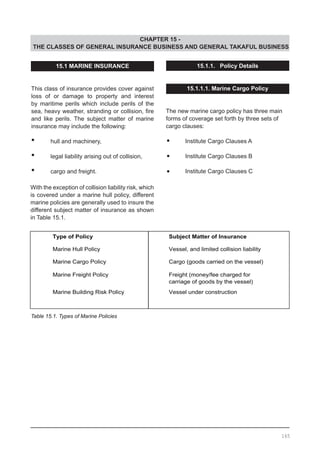
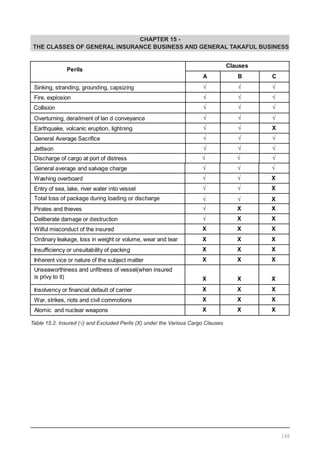
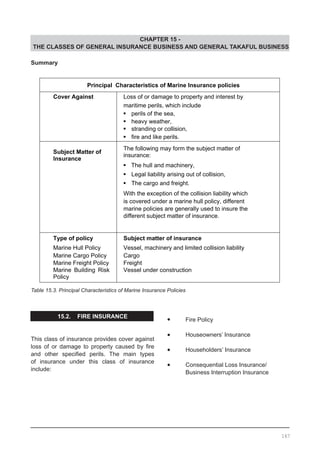
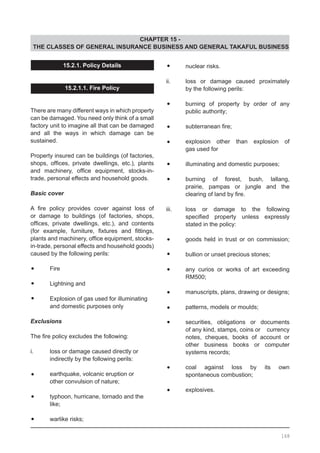
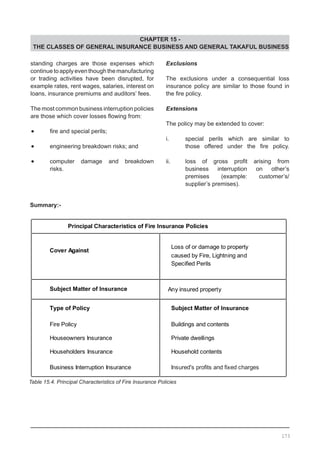
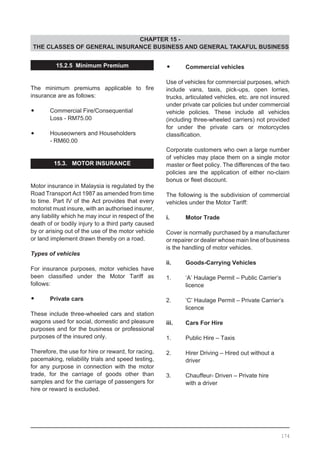
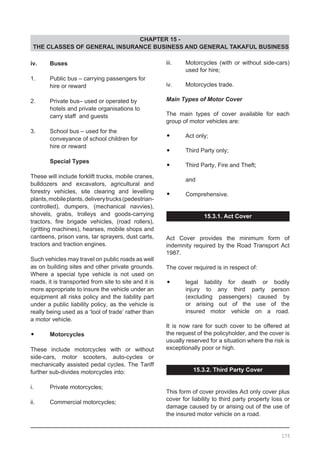
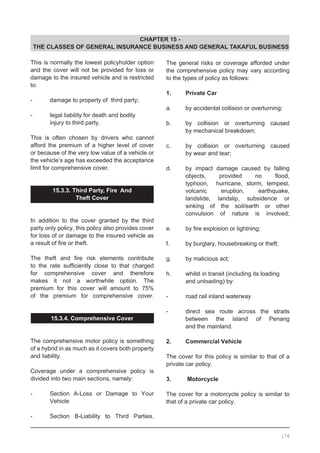
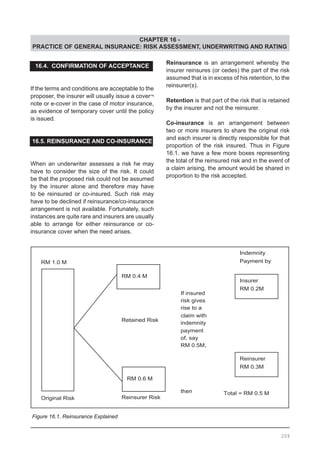
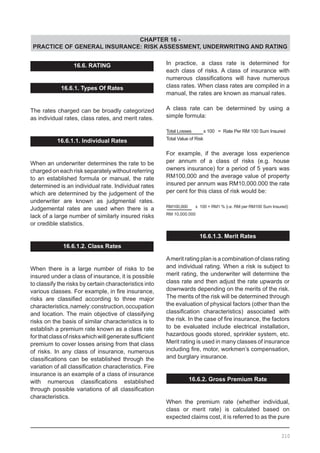
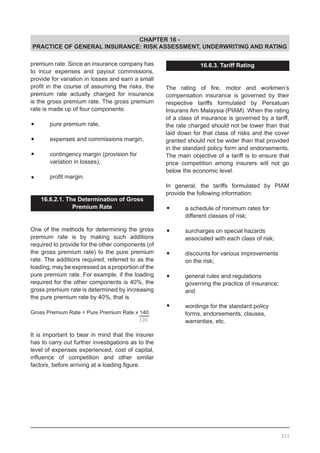
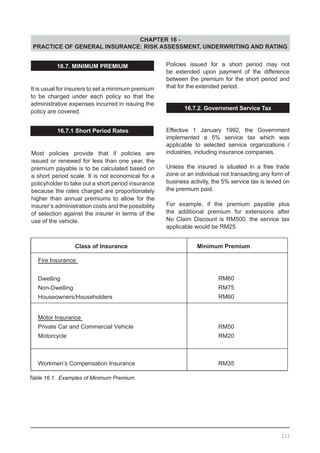
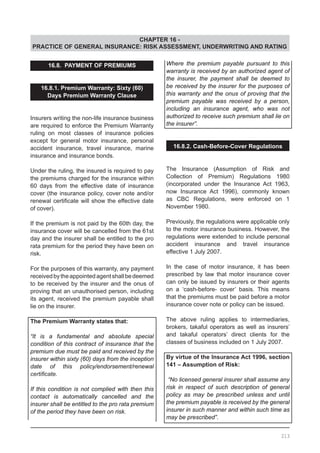
OVERVIEW
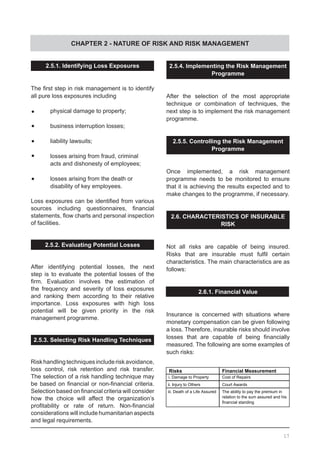
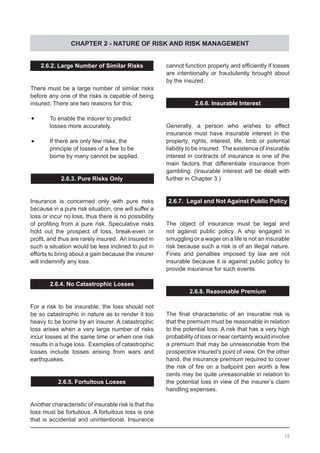
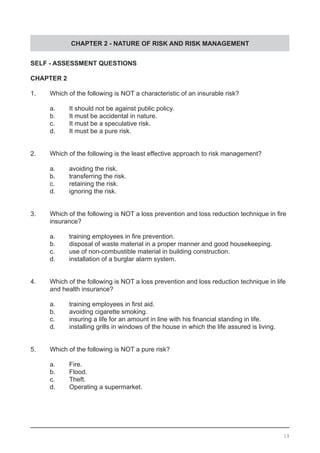
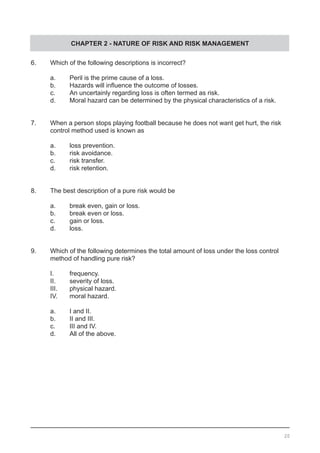
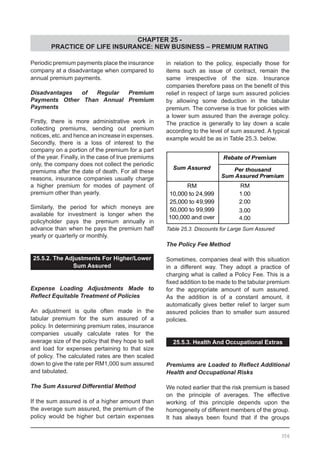
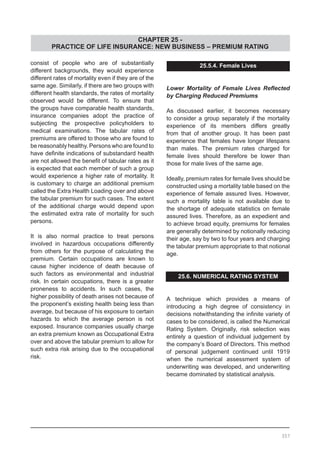
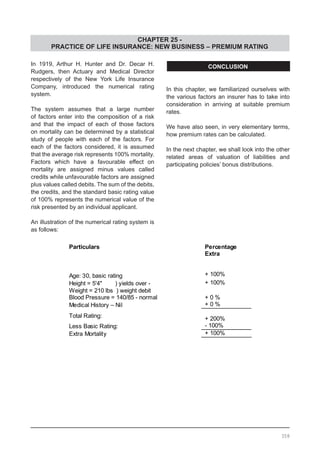
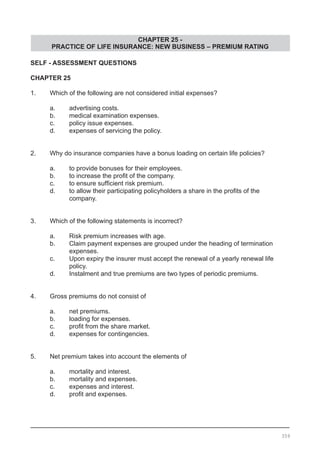
This chapter provides an introduction to the
wide range of topics which the book covers.
Emphasis is placed on the following areas:
•	 Importance of Insurance
•	 How Insurance Works
•	 What Insurance Is
•	 Functions of Insurance
•	 Classes of Insurance
•	 Historical Aspects of Insurance
•	 The Role of an Insurance Agent
1.1. INTRODUCTION
Human beings are exposed to various kinds of
risks in their daily lives and activities and have
to endure the consequences of such misfortune.
Misfortune can arise in many forms which,
inevitably, lead to different types and nature of
losses.
Some examples are:
	•	 A sole breadwinner of a family is
	 involved in an accident and dies
	 prematurely. Undoubtedly, the
	 dependents will face two immediate
	 obvious forms of losses – emotional
	 and financial.
	•	 The premises of a factory may be
	 destroyed by fire. The owners of the
	 factory will face, besides other losses,
	 the loss of income which the factory
	 Overview
1.1. 	 Introduction					
		
1.2.	 Importance of Insurance			
			
1.3.	 How Insurance Works			
			
1.4.	 What is Insurance?	
1.5.	 Functions of Insurance
1.6.	 Classes of Insurance
	
1.7.	 Historical Aspects of Insurance
1.8.	 The Role of an Insurance Agent
1
CHAPTER 1 - INTRODUCTION TO INSURANCE
would have been able to generate if
	 the fire had not occurred. On the
	 other hand, those employed by the
	 factory may face the prospect of
	 redundancy and unemployment.
We can give countless examples of events
which lead to human grievances and financial
losses.
The natural question to ask then is
“What arrangement(s) can be made to
overcome or at least reduce the consequences
of misfortune that may befall any one person?”
In answering the above question, we have to
admit that not all forms of loss can be made
good or be expressed in pecuniary terms. For
instance, the emotional trauma arising from the
death of loved one cannot be made good by
any conceivable compensatory system.
Perhaps, what can be done is to devise a
compensatory system which will at least seek
-	 to reduce the impact of financial
	 loss consequent to an unfortunate
	 event; and
-	 to prepare or free oneself for the
	 forthcoming and unexpected financial
	 burden or losses.
One such possible arrangement, whereby the
financiallossisinconsequenceofanunfortunate
incident such as death or a fire, can be through
the purchase of insurance.
1.2. IMPORTANCE OF INSURANCE
The Need for Income
Every moment, individuals, families and
business units are exposed to losses arising
from their property, occupations, activities and
responsibilities. Who will bear these financial
losses and where will the funds be obtained from
to offset such losses? Usually, in the absence
of legal remedies, contract arrangements
or cooperative efforts, losses will fall on the
individual or business unit concerned. To solve
this problem, an arrangement is introduced for
coping with some of the risks and possible losses
faced by individuals and business enterprises.
This arrangement works on the law of large
numbers, i.e. by spreading the risk of loss faced
by a specific person or enterprise to all parties
who pool their resources to pay for individual
losses. This loss sharing arrangement is called
insurance.
The insurer is the intermediary who manages
this risk pool. The insurer holds and invests the
premiums in trust for policyowners, and pays
them in the event that these losses for which
insurance protection is taken, occur.
Let us consider for a moment as to what would
happen in modern society without insurance
organization.
Living costs money. Money is required to
buy essential needs like food, clothing and
accommodation, as well as to acquire other
comforts of life. If one wants to have a decent
life, one should have a continuous flow of income
as long as one is alive. This continuous flow of
income can be ensured only in two ways.
Sources of Income
A person may create his source of income by
either setting up his own business or working
for other people where, upon completion for the
jobs done, he will receive payment in the form of
a salary, wages, allowances or commissions.
The other means is through investment income
by way of dividends, bonuses or interest on the
capital invested.
2
CHAPTER 1 - INTRODUCTION TO INSURANCE
However, both sources are always at the risk of
being affected by circumstances over which the
individual has no control.
Unfortunate Events or Risks
Earning capacity may be ended abruptly due to
death, old age, sickness or accident that may
result in disability (permanent or temporary).
Likewise, the investments may suddenly
depreciate in value or the goods in which capital
is invested may be destroyed by fire.
In any of these contingencies, the individual or
the dependents have to bear the consequences
of the financial or emotional losses. Those
affected have no other sources to which they
can look for relief for sharing part or all of the
loss.
The painful experience as a consequence of
losses is obvious to anyone.
1.3 HOW INSURANCE WORKS
Let us next understand how insurance works to
compensate for the financial losses consequent
to the occurrence of a risk or perils.
Rather than providing a more formal definition
of the terms “risk” and “peril” now (see Chapter
2), we shall look at some instances where we
can say that a risk or peril has occurred.
Some Forms of Risk
•	 Shipwreck at sea;
•	 An outbreak of fire resulting in
	 material damage;
•	 Loss of income due to disability or
	 premature death.
Pooling of Risks
It is not possible for an individual to predict or
preventsuchoccurrencesbutthroughinsurance,
arrangements can be made to provide against
their financial effects, i.e. loss of property and /
or earning.
Insurance in its various forms aims at
safeguarding the interest of the individuals
who are insured. This is achieved by having
losses experienced by the unfortunate few
compensated by the contributions, i.e. the
premium, of the many that are exposed to the
same risk.
The Concepts of Insurance Explained
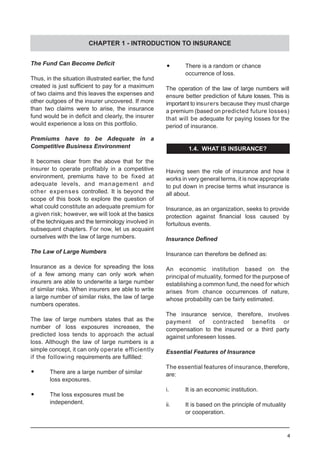
The concept of insurance is illustrated in
Figure 1.1 in relation to a house owner or a
term life insurance portfolio. For the purpose
of illustration, it is assumed that the portfolio
consists of 1000 houses of identical value, say
RM100,000 each or 1000 life assured with
identical capital sum, and a premium of RM200
is charged for each or life assured per year.
3
Figure 1.1. Concept of Insurance Illustrated
The Fund has to meet:
The contribution from the 1000 house owners
or life assured results in the creation of an
insurance fund of RM200,000. The insurer
uses this amount of money to pay for claims,
management expenses and other outgoes such
as commission, taxes, etc. The balance, if any,
constitutes the insurer’s profit.
#1 RM 200
RM 200
RM 200
RM 200
RM 200
House owners
or term life Premiums
1000
x
RM200
=RM200,000
Claims
Expenses
and other
Outgoes
Profits
#3
#2
# 999
# 1000
CHAPTER 1 - INTRODUCTION TO INSURANCE
4
The Fund Can Become Deficit
Thus, in the situation illustrated earlier, the fund
created is just sufficient to pay for a maximum
of two claims and this leaves the expenses and
other outgoes of the insurer uncovered. If more
than two claims were to arise, the insurance
fund would be in deficit and clearly, the insurer
would experience a loss on this portfolio.
Premiums have to be Adequate in a
Competitive Business Environment
It becomes clear from the above that for the
insurer to operate profitably in a competitive
environment, premiums have to be fixed at
adequate levels, and management and
other expenses controlled. It is beyond the
scope of this book to explore the question of
what could constitute an adequate premium for
a given risk; however, we will look at the basics
of the techniques and the terminology involved in
subsequent chapters. For now, let us acquaint
ourselves with the law of large numbers.
The Law of Large Numbers
Insurance as a device for spreading the loss
of a few among many can only work when
insurers are able to underwrite a large number
of similar risks. When insurers are able to write
a large number of similar risks, the law of large
numbers operates.
The law of large numbers states that as the
number of loss exposures increases, the
predicted loss tends to approach the actual
loss. Although the law of large numbers is a
simple concept, it can only operate efficiently
if the following requirements are fulfilled:
•	 There are a large number of similar
	 loss exposures.
•	 The loss exposures must be
	 independent.
•	 There is a random or chance
	 occurrence of loss.
The operation of the law of large numbers will
ensure better prediction of future losses. This is
important to insurers because they must charge
a premium (based on predicted future losses)
that will be adequate for paying losses for the
period of insurance.
1.4. WHAT IS INSURANCE?
Having seen the role of insurance and how it
works in very general terms, it is now appropriate
to put down in precise terms what insurance is
all about.
Insurance, as an organization, seeks to provide
protection against financial loss caused by
fortuitous events.
Insurance Defined
Insurance can therefore be defined as:
An economic institution based on the
principal of mutuality, formed for the purpose of
establishing a common fund, the need for which
arises from chance occurrences of nature,
whose probability can be fairly estimated.
The insurance service, therefore, involves
payment of contracted benefits or
compensation to the insured or a third party
against unforeseen losses.
Essential Features of Insurance
The essential features of insurance, therefore,
are:
i.	 It is an economic institution.
ii.	 It is based on the principle of mutuality
	 or cooperation.
CHAPTER 1 - INTRODUCTION TO INSURANCE
5
iii.	 Its objective is to accumulate funds to
	 pay for claims that arise as a result of
	 the operation of specific risks.
iv.	 Only certain risks can be insured
	 against, namely those whose
	 occurrence can be confidently
	 estimated with a certain degree of
	 accuracy.
1.5. FUNCTIONS OF INSURANCE
In this section we will look at the various
functions of insurance.
1.5.1. Primary Function
The primary function of insurance is the
equitable distribution of the financial losses
of the few who are insured among the many
insured. This immediately leads to the
secondary functions stated below.
1.5.2. Secondary Functions
•	 Stabilization of Costs
Through the purchase of insurance,
business enterprises avoid the necessity
of having to freeze capital to provide for
financial protection against losses. This
provides a means of stabilizing the costs
involved in managing risks.
•	 Stimulation of Business
	 Enterprise
The risk transfer mechanism provided
by insurance has made possible
the present-day large-scale commercial
and industrial enterprises. These large-
scale enterprises would not have started
if the owners were not able to transfer
their risks through insurance.
•	 Provision of Security for
	 Expansion of Business
Insurance helps to remove the fears
and worries of losses of individuals
and business executives. This removal
of fears and worries helps to establish
confidence and enables the forward-
planning of economic activities.
•	 Reduction of Losses
Insurers help to reduce losses (both
in frequency and security) through
their actions and recommendations in
rating, survey, inspection services and
salvage.
•	 Provision of a Means of Saving
Insurance functions as a means of
saving, primarily through the use of
endowment insurance.
An endowment insurance is a
combination of protection plus savings.
The investment part of the contract is a
savings accumulation. By combining the
two features in a single plan, endowment
assurance provides both protection and
savings to the insured.
•	 Provision of Sources of Capital for
	 Investment
Insurers accumulate large funds which
they hold as custodians and out of which
claims and losses are met. These funds
are usually invested (to earn interest)
in the public and private sectors. Such
investments help considerably in the
overall development of the economy.
CHAPTER 1 - INTRODUCTION TO INSURANCE
6
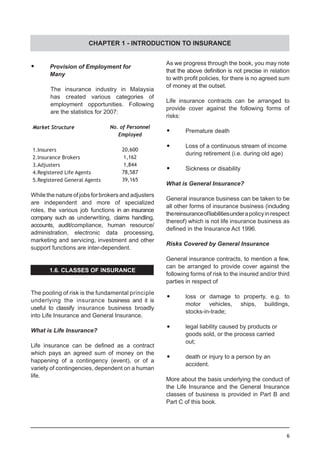
•	 Provision of Employment for
	 Many
The insurance industry in Malaysia
has created various categories of
employment opportunities. Following
are the statistics for 2007:
No. of Personnel
Employed
20,600
1,162
1,844
78,587
39,165
Market Structure
1.Insurers
2.Insurance Brokers	
3.Adjusters
4.Registered Life Agents
5.Registered General Agents
While the nature of jobs for brokers and adjusters
are independent and more of specialized
roles, the various job functions in an insurance
company such as underwriting, claims handling,
accounts, audit/compliance, human resource/
administration, electronic data processing,
marketing and servicing, investment and other
support functions are inter-dependent.
1.6. CLASSES OF INSURANCE
The pooling of risk is the fundamental principle
underlying the insurance business and it is
useful to classify insurance business broadly
into Life Insurance and General Insurance.
What is Life Insurance?
Life insurance can be defined as a contract
which pays an agreed sum of money on the
happening of a contingency (event), or of a
variety of contingencies, dependent on a human
life.
As we progress through the book, you may note
that the above definition is not precise in relation
to with profit policies, for there is no agreed sum
of money at the outset.
Life insurance contracts can be arranged to
provide cover against the following forms of
risks:
•	 Premature death
•	 Loss of a continuous stream of income
	 during retirement (i.e. during old age)
•	 Sickness or disability
What is General Insurance?
General insurance business can be taken to be
all other forms of insurance business (including
thereinsuranceofliabilitiesunderapolicyinrespect
thereof) which is not life insurance business as
defined in the Insurance Act 1996.
Risks Covered by General Insurance
General insurance contracts, to mention a few,
can be arranged to provide cover against the
following forms of risk to the insured and/or third
parties in respect of
	•	 loss or damage to property, e.g. to
	 motor vehicles, ships, buildings,
	 stocks-in-trade;
	
	•	 legal liability caused by products or
	 goods sold, or the process carried
	 out;
	•	 death or injury to a person by an
	 accident.
More about the basis underlying the conduct of
the Life Insurance and the General Insurance
classes of business is provided in Part B and
Part C of this book.
CHAPTER 1 - INTRODUCTION TO INSURANCE
7
1.7. HISTORICAL ASPECTS
OF INSURANCE
This section will provide a brief introduction to
the historical aspects of insurance.
The earliest beginnings of insurance were in
the field of marine insurance. Men engaged
in trade by sea attempted to minimize their
losses which resulted from the perils of the
sea, by spreading the losses amongst all who
were similarly engaged. In the normal course
of events, many ships arrived safely in port and
only a few suffered losses. The many who were
successful thus contributed to overcome the
suffering of those who were unsuccessful. In
other words, the misfortune of the unfortunate
few was borne by the many.
This was achieved by the payment of a premium
into a common fund.  So much benefit followed
this action that traders adopted the idea in
many countries and gradually there came into
existence groups of men who specialized in
managing the fund and who studied the rates
of loss which occurred in different types of
maritime adventure. This was the beginning of
marine insurance.
At a much later date came life insurance and
other modern forms of insurance, all of which
worked on the principle of spreading the
losses of the few over the fund created by the
contribution of the many.
Initially life insurance policies were sold as short-
term policies, cover being renewed at the option
of the insurer at the end of the period. Such an
approach had disadvantages and perhaps,
was the only possible one that could be adopted
when there were no mortality tables.
The year 1706 marked the emergence of the
Amicable Society for a Perpetual Assurance,
which adopted a scheme under which each
member was required to  contribute a fixed
sum annually. The accumulated contributions
were divided at the end of the year among
the dependents of the members who had died
during the year.
Membership was open to persons between
the ages of 12 and 45 and members’
contributions were uniformly fixed at £5 per
annum (which was increased to £6.20 later on).
In the early years of its operation the company
did not guarantee a definite sum assured but
after 1757 a minimum sum assured at death
was laid down. A variable premium based on
age was fixed only in 1807.
An important landmark in the development of life
insurance related to the use of the Mortality
Table in conjunction with compound interest
rates, when in 1762 The Equitable Assurance
for the first time fixed premium rates based
on modern lines, adopting the level premium
system.
1.7.1. Insurance in Malaysia
The beginning of insurance in Malaysia can be
traced to the colonial period between the 18th and
19th centuries when  British trading firms or agency
housesestablishedinthiscountryactedasagencies
for the UK-based insurance companies, among
which were Harrison & Crossfield, Boustead, and
Sime Darby.
The insurance industry in Malaysia had been
largely patterned on the British system whose
influence still continues to be felt. Even as late
as 1955, it was reported that foreign insurance
domination of the local insurance market was as
much as 95% of the total business transacted.
After independence in 1957, however, concerted
efforts were made to introduce domestic
insurance companies.   The early 1960s
witnessed the growth of a few life insurance
companies which wound up soon after because
of their unsound operations and inadequate
technical background.
CHAPTER 1 - INTRODUCTION TO INSURANCE
8
Control of Insurance Business
These unhealthy features culminated in
the Government’s intervention through the
enactment of the Insurance Act 1963 to regulate
the insurance industry. This 1963 Act has since
been replaced by the  Insurance Act 1996.
Since January 1997, the Insurance Act 1996
has become the principal legislation governing
the conduct of insurance business in Malaysia
1.8. THE ROLE OF AN INSURANCE AGENT
The roles of an insurance agent are:
		•	 to bring financial relief to aggrieved
	 dependents of insured people who
	 may meet with untimely death;
	•	 to bring financial relief in the event
	 of property loss;
	•	 to inculcate the discipline of saving
	 amongst the working population;
	•	 to provide other forms of
	 insurance-related services to the
	 public.
To be an effective agent, one should be able to
recognize the insuring needs of one’s clients.
Clients should be advised of the right type of
products so that they meet their insuring needs
and the policies do not lapse. Insurance agents
are expected to provide, in a sense, the best
possible advice to their clients.
It is greatly hoped that the reader will persevere
through the rest of this book and acquire the
technical and sales-related knowledge to
achieve success in his or her career.
CHAPTER 1 - INTRODUCTION TO INSURANCE
9
SELF - ASSESSMENT QUESTIONS
CHAPTER 1
1.	 Which of the following statements is NOT true about the law of large numbers?
	 a.	 The loss exposures must be independent.
	 b.	 There must be a large number of similar loss exposures.		
	 c. 	 There must be a random or chance occurrence of losses.
	 d. 	 There must be a large number of insureds experiencing the same loss at the
	 	 same time out of the same event.
2.	 Which of the following is NOT an essential feature of insurance?
	 a. 	 All risks can be insured.
	 b. 	 It is an economic institution.				
	 c. 	 It is based on the principle of mutuality.
	 d. 	 It is an accumulation of funds to pay for claims resulting from a specific 	
		 risk.
3.	 Which of the following is NOT a risk covered by insurance?
	 a.	 loss of life due to a motor accident.
	 b.	 loss or damage arising from a motor vehicle accident.
	 c.	 liability to third parties arising from the sale of products.
	 d.	 financial loss due to a drop in the market price of a company’s shares.
4.	 The secondary functions of insurance will include all of the following, EXCEPT
	 a.	 risk transfer mechanism.
	 b.	 means of savings.
	 c.	 cost stabilization.				
	 d.	 reducing losses.
CHAPTER 1 - INTRODUCTION TO INSURANCE
10
CHAPTER 1 - INTRODUCTION TO INSURANCE
5.	 Life insurance contracts can be arranged to provide cover against the following
	 forms of risk:
	 I.	 bank loans.
	 II.	 premature death.					
	 III.	 sickness or disability.
	 IV.	 continuous stream of income during retirement (i.e. old age).
	 a.	 I and II.
	 b.	 I, II and IV.
	 c.	 III and IV.
	 d.	 All of the above.	
6.	 Amongst many other risks, general insurance contracts will cover the following,
	 EXCEPT:
	 a.	 property.
	 b.	 accident.
	 c.	 natural death.					
	 d.	 legal liability.
	
7.	 Insurance, as an organization, seeks to provide protection against ___________
	 caused by fortuitous events.
	 a.	 emotional losses.
	 b.	 sentimental losses.				
	 c.	 financial losses.
	 d.	 non-financial losses.
8.	 Which ONE of the following facts is NOT true about both life and general
	 insurance?
	
	 a.	 Life insurance policies are subject to the principle indemnity whereas general
		 insurance policies are not.			
	 b.	 General insurance policies are subject to the principle of indemnity whereas life
		 insurance policies are not.
	 c.	 Life insurance policies and general insurance policies will both pay when a person
		 suffers permanent disablement due to an accident.
	 d.	 Life assurance is a long-term contract whereas general insurance is a yearly
		 renewable contract.
CHAPTER 1 - INTRODUCTION TO INSURANCE
11
9.	 The operation of the principle of the law of large numbers will ensure
	
	 a.	 better prediction of future losses.				
	 b.	 better understanding of the market.
	 c.	 better understanding of the customers.
	 d.	 better cash flow for the insurer.
	
10.	 The essential features of insurance are:
	 I.	 It is economic institution.
	 II.	 It is based on the principle of mutuality or co-operation.
	 III.	 Its objective is to accumulate funds to pay for claims that arise as a result of the
	 	 operation of specific risks.	 	 	 	 	
	 IV.	 Only certain risks can be insured against, namely those, whose occurrence can be
	 	 confidently estimated with a certain degree of accuracy.
	 a.	 I and II.
	 b.	 II and IV.
	 c.	 II, III and IV.
	 d.	 All of the above.
YOU WILL FIND THE ANSWERS AT THE BACK OF THE BOOK.
CHAPTER 2 - NATURE OF RISK AND RISK MANAGEMENT
12
	 Overview
2.1.	 Concepts of Risk				
			
2.2.	 Related Concepts				
			
2.3.	 Basic Categories of Risk	
2.4.	 Methods of Handling Risks		
				
2.5.	 Risk Management	
2.6.	 Characteristics of Insurable Risk
OVERVIEW
This chapter focuses on risk and a detailed
discussion of the following is provided:
•	 Characteristics of Risk
•	 Concepts Related to Risk
•	 The Measurement of Risk
•	 The Management of Risk
•	 The Characteristics of Insurable Risks
2.1. CONCEPTS OF RISK
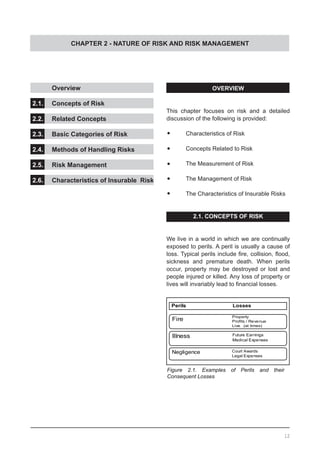
We live in a world in which we are continually
exposed to perils. A peril is usually a cause of
loss. Typical perils include fire, collision, flood,
sickness and premature death. When perils
occur, property may be destroyed or lost and
people injured or killed. Any loss of property or
lives will invariably lead to financial losses.
Figure 2.1. Examples of Perils and their
Consequent Losses
CHAPTER 2 - NATURE OF RISK AND RISK MANAGEMENT
Although we are continually exposed to
perils, we are uncertain as to when such loss-
producing events will occur. In other words, we
are uncertain about the losses we may suffer in
the future. An uncertainty regarding loss is often
termed as “risk”. Since risk exists whenever the
future is unknown, it can be said to be present
everywhere and in all circumstances. It is
present in human lives and in industry.
Measurement of Risk
Even though we are uncertain about a future
loss, it is possible to determine the chance of
loss using a branch of mathematics known as
the probability theory. The term “probability”
refers to an area of study which measures the
chance of occurrence of particular events. The
study of chance, events or probability can be
approached along three possible lines:  A priori,
empirical and judgmental.
Application of A Priori Probability
A priori probability is determined when the total
numbers of possible events are known. For
example, the probability of getting a five on a
roll of dice is 1/6 or 0.1666. The priori concept
has limited practical application in the study of
risk and insurance because situations where
the possible outcomes have an equal chance of
occurrence are very rare.
Application of Empirical Probability
Empirical probability is determined on the basis
of historical data. For example, a transport
company which operates a fleet of 1000
vehicles and experiences an average of 50
accidents over the previous year has a 50/1000
or 0.05 probability of an accident occurring the
next year. The underlying concept that makes it
possible for empirical probability to be measured
accurately is the law of large numbers. (See
1.3.)
Application of Judgmental Probability
Judgmental probability is determined based
on the judgment of the person predicting the
outcomes. Judgmental probability is used when
there is a lack of historical data or credible
statistics. For example, judgmental probability
is used in insurance of nuclear plants because
of a lack credible statistics.
In practice, actual outcomes differ from
expected outcomes
In practice, an insurance company, depending
on the availability and credibility of data, uses the
empirical or judgmental probability techniques
to predict future losses. In any events, either
technique provides an estimation of the future
loss. This implies that actual outcomes may
not be the same as the expected outcomes.
For example, an insurance company which has
predicted that 30 of its insured cars may be
destroyed next year faces the possibility that the
number of cars actually destroyed may be 20,
40 and 50 or even 100. Such random variations
from predicted outcomes arise because the
requirements of the law of large numbers are
seldom met in practice.
Other Possible Definitions of Risk
Even though an insurance company has a
large number of similar loss exposures and
therefore is able to predict an expected loss, it
is nevertheless subject to uncertainly because
the actual loss may not be the same as the
predicted loss. And when uncertainly exists, risk
remains. In this respect, we can take another
step further by defining risk as the variation in
outcomes in a given situation. In addition to the
two definitions given, the term “risk” has also
been loosely referred to as
•	 the possibility of loss;
•	 the exposure to danger;
•	 the subject matter of insurance.
13
CHAPTER 2 - NATURE OF RISK AND RISK MANAGEMENT
In conclusion, it can be said that risk has
several meanings and the meaning of risk will
therefore depend on the context in which it is
being used.
2.2. RELATED CONCEPTS
Before we consider the other aspects of risk, it
is important to distinguish risk from the following
concepts:
•	 Loss : a reduction or disappearance
	 of economic value.
•	 Peril : a cause of loss.
•	 Hazard: a condition that increases
	 the chance of loss.
There are two major types of hazards.
Physical Hazard Defined
Physical hazard is a physical characteristic that
increases the outcome of a loss. Examples
of physical hazards include the wooden
construction of building and the poor mechanical
condition of a motor car.
Moral Hazard Defined
Moral hazard is a character defect in an
individual that increase the outcome of a loss.
Examples of moral hazards include dishonesty,
carelessness and unreasonableness.
2.3. BASIC CATEGORIES OF RISK
Risk can be classified into two major
categories:
•	 Fundamental and particular risks;
•	 Pure and speculative risks.
2.3.1. Fundamental and Particular Risks
Fundamental Risks Defined
A fundamental risk affects the entire economy
or large numbers of persons / groups within
the economy. Examples include the risk of
property damage from earthquake, flood and
typhoon (forces of nature), the risk of damage
to property, the loss of lives arising out of war,
and the risk of mass unemployment.
Particular Risks Defined
A particular risk affects individuals and not the
entire community or country. Examples include
the risk of damage to property from fire and
the risk of death or injury resulting from road
accidents
Whose Responsibility?
Because of their difference in effects, particular
risks are the responsibility of individuals whereas
fundamental risks are the responsibility of the
government and society as a whole.
2.3.2. Pure and Speculative Risks
Pure Risks Defined
Pure risk exists when there is the possibility of
either loss or no loss. Examples include the risk
of damage to property resulting from fire and
the risk of premature death.
Speculative Risks Defined
Speculative risk exists when there is the
possibility of profit, loss or no loss. Examples
include investment in the stock market or real
estate, venturing into business, and betting in
a horse race.
14
CHAPTER 2 - NATURE OF RISK AND RISK MANAGEMENT
Figure 2.2. The Main Characteristics of Pure and
Speculative Risks
Other Characteristics of Pure Risks
In addition to the difference in outcome, pure
risks are more predictable because it is easier
to apply the law of large numbers to such risks.
This also implies that pure risks can generally
be handled by insurance techniques, while
speculative risks are rarely insured.
2.4. METHODS OF HANDLING RISKS
In this section we will look at the methods of
handling pure risks. Basically there are four
methods of handling risks:
•	 Risk avoidance
•	 Loss control
•	 Risk retention
•	 Risk transfer
2.4.1. Risk Avoidance
Risk avoidance involves avoiding the property,
person or activity, which produces the risk.
Examples:
i.	 A manufacturer who is worried about a
	 product liability lawsuit arising from
	 one of his products can avoid it by not
	 manufacturing that product.
ii.	 An individual who is worried about
	 health problems arising from lung
	 cancer can avoid them by not smoking.
2.4.2. Loss Control
Loss control aims to reduce the total amount of
loss. The total amount of loss is influenced by
the frequency and severity of loss.
Frequency of loss is the number of times a loss-
producing event will occur over a given period
of time.
Severity of loss is the cost or amount of loss,
in money terms, arising from loss- producing
events.
Loss control measures handle risks by:
•	 Loss Prevention
Loss prevention refers to reducing the
frequency of loss, say for example, by
the use of fire resistant material in the
construction of a building to help prevent
fire losses.
•	 Loss Minimization
Loss minimization refers to reducing
the severity or amount of loss, say
for example, by the installation of an
automatic fire sprinkler system to help
reduce the amount of fire losses when
a fire occurs.
15
Pure Risk
Speculative Risk
Loss
No Loss
Loss
Break-even
Gain
CHAPTER 2 - NATURE OF RISK AND RISK MANAGEMENT
2.4.3. Risk Retention
Risk retention involves the retaining of risks by
an individual or organization. When risks are
retained, the losses incurred are borne by the
party retaining the risks. Risk retention may
be planned or unplanned. When risk retention
is planned, risks are retained deliberately.
Unplanned risk retention involves the retaining
of risks unknowingly.
2.4.4. Risk Transfer
Risk transfer involves the transferring of risks
to an organization or individual. When a risk
is transferred, the loss will be paid for by the
organization or individual to whom the risk is
transferred. There are two ways of transferring
risks.
•	 Insurance Contract
Example: A house owner can transfer
the loss incurred when his house is
destroyed by fire by entering into a fire
insurance contract.
•	 Non Insurance Contract
Example: A supermarket can transfer
potential liability arising from the sale of
a defective product by entering into an
agreement whereby the manufacturer
agrees to compensate the supermarket
from any liability arising from the
defective product.
Figure 2.3. The Risk Management Process
Identification
Evaluation
Selection
Avoidance
Loss Control
Transfer
Retention
Implementation
Control
16
2.5. RISK MANAGEMENT
Earlier we learnt that risk is ever present in our
lives and that pure risks lead to financial losses.
In this section, we will look into how risks
are managed through a process called Risk
Management.
Risk management may be defined as a
systematic approach to dealing with risks that
threaten the assets and earnings of a business
or enterprise.
The risk management process involves the
following steps:
	•	 identifying loss exposures
	•	 evaluating potential losses
	•	 selecting techniques of risk
	 handling
	•	 implementing the risk management
	 programme
	•	 controlling the risk management
	 programme.
The process is represented schematically in
Figure 2.3.
CHAPTER 2 - NATURE OF RISK AND RISK MANAGEMENT
17
2.5.4. Implementing the Risk Management
Programme
After the selection of the most appropriate
technique or combination of techniques, the
next step is to implement the risk management
programme.
2.5.5. Controlling the Risk Management
Programme
Once implemented, a risk management
programme needs to be monitored to ensure
that it is achieving the results expected and to
make changes to the programme, if necessary.
2.6. CHARACTERISTICS OF INSURABLE
RISK
Not all risks are capable of being insured.
Risks that are insurable must fulfil certain
characteristics. The main characteristics are as
follows:
2.6.1. Financial Value
Insurance is concerned with situations where
monetary compensation can be given following
a loss. Therefore, insurable risks should involve
losses that are capable of being financially
measured. The following are some examples of
such risks:
2.5.1. Identifying Loss Exposures
The first step in risk management is to identify
all pure loss exposures including
	•	 physical damage to property;
	•	 business interruption losses;
	•	 liability lawsuits;
	•	 losses arising from fraud, criminal
	 acts and dishonesty of employees;
	•	 losses arising from the death or
	 disability of key employees.
Loss exposures can be identified from various
sources including questionnaires, financial
statements, flow charts and personal inspection
of facilities.
2.5.2. Evaluating Potential Losses
After identifying potential losses, the next
step is to evaluate the potential losses of the
firm. Evaluation involves the estimation of
the frequency and severity of loss exposures
and ranking them according to their relative
importance. Loss exposures with high loss
potential will be given priority in the risk
management programme.
2.5.3. Selecting Risk Handling Techniques
Riskhandlingtechniquesincluderiskavoidance,
loss control, risk retention and risk transfer.
The selection of a risk handling technique may
be based on financial or non-financial criteria.
Selection based on financial criteria will consider
how the choice will affect the organization’s
profitability or rate of return. Non-financial
considerations will include humanitarian aspects
and legal requirements.
Risks Financial Measurement
i. Damage to Property Cost of Repairs
ii. Injury to Others Court Awards
iii. Death of a Life Assured The ability to pay the premium in
relation to the sum assured and his
financial standing
CHAPTER 2 - NATURE OF RISK AND RISK MANAGEMENT
18
2.6.2. Large Number of Similar Risks
There must be a large number of similar risks
before any one of the risks is capable of being
insured. There are two reasons for this:
•	 To enable the insurer to predict
	 losses more accurately.
•	 If there are only few risks, the
	 principle of losses of a few to be
	 borne by many cannot be applied.
2.6.3. Pure Risks Only
Insurance is concerned only with pure risks
because in a pure risk situation, one will suffer a
loss or incur no loss, thus there is no possibility
of profiting from a pure risk. Speculative risks
hold out the prospect of loss, break-even or
profit, and thus are rarely insured.  An insured in
such a situation would be less inclined to put in
efforts to bring about a gain because the insurer
will indemnify any loss.
2.6.4. No Catastrophic Losses
For a risk to be insurable, the loss should not
be so catastrophic in nature as to render it too
heavy to be borne by an insurer. A catastrophic
loss arises when a very large number of risks
incur losses at the same time or when one risk
results in a huge loss. Examples of catastrophic
losses include losses arising from wars and
earthquakes.
2.6.5. Fortuitous Losses
Another characteristic of insurable risk is that the
loss must be fortuitous. A fortuitous loss is one
that is accidental and unintentional. Insurance
cannot function properly and efficiently if losses
are intentionally or fraudulently brought about
by the insured.
2.6.6. Insurable Interest
Generally, a person who wishes to effect
insurance must have insurable interest in the
property, rights, interest, life, limb or potential
liability to be insured. The existence of insurable
interest in contracts of insurance is one of the
main factors that differentiate insurance from
gambling. (Insurable interest will be dealt with
further in Chapter 3.)
2.6.7. Legal and Not Against Public Policy
The object of insurance must be legal and
not against public policy. A ship engaged in
smuggling or a wager on a life is not an insurable
risk because such a risk is of an illegal nature.
Fines and penalties imposed by law are not
insurable because it is against public policy to
provide insurance for such events.
2.6.8. Reasonable Premium
The final characteristic of an insurable risk is
that the premium must be reasonable in relation
to the potential loss. A risk that has a very high
probability of loss or near certainty would involve
a premium that may be unreasonable from the
prospective insured’s point of view. On the other
hand, the insurance premium required to cover
the risk of fire on a ballpoint pen worth a few
cents may be quite unreasonable in relation to
the potential loss in view of the insurer’s claim
handling expenses.
CHAPTER 2 - NATURE OF RISK AND RISK MANAGEMENT
SELF - ASSESSMENT QUESTIONS
CHAPTER 2
1.	 Which of the following is NOT a characteristic of an insurable risk?
	 a. 	 It should not be against public policy.
	 b.	 It must be accidental in nature.			
	 c.	 It must be a speculative risk.
	 d.	 It must be a pure risk.
2.	 Which of the following is the least effective approach to risk management?
	 a.	 avoiding the risk.
	 b.	 transferring the risk.				
	 c.	 retaining the risk.
	 d.	 ignoring the risk.
3.	 Which of the following is NOT a loss prevention and loss reduction technique in fire
	 insurance?
	 a.	 training employees in fire prevention.
	 b.	 disposal of waste material in a proper manner and good housekeeping.
	 c.	 use of non-combustible material in building construction. 	 	
	 d.	 installation of a burglar alarm system.
4.	 Which of the following is NOT a loss prevention and loss reduction technique in life
	 and health insurance?
	 a.	 training employees in first aid. 	 	 	
	 b.	 avoiding cigarette smoking.				
	 c.	 insuring a life for an amount in line with his financial standing in life.
	 d.	 installing grills in windows of the house in which the life assured is living.
5.	 Which of the following is NOT a pure risk?
	 a.	 Fire.
	 b.	 Flood.							
	 c.	 Theft. 								
	 d.	 Operating a supermarket.
19
CHAPTER 2 - NATURE OF RISK AND RISK MANAGEMENT
6.	 Which of the following descriptions is incorrect?
	 a.	 Peril is the prime cause of a loss.
	 b.	 Hazards will influence the outcome of losses.	 	
	 c.	 An uncertainly regarding loss is often termed as risk.
	 d.	 Moral hazard can be determined by the physical characteristics of a risk.
7.	 When a person stops playing football because he does not want get hurt, the risk
	 control method used is known as
	 a.	 loss prevention.
	 b.	 risk avoidance.						
	 c.	 risk transfer.
	 d.	 risk retention.
8.	 The best description of a pure risk would be
	 a.	 break even, gain or loss.	 	 	 	 	
	 b.	 break even or loss.
	 c.	 gain or loss.
	 d.	 loss.
9.	 Which of the following determines the total amount of loss under the loss control
	 method of handling pure risk?
	 I. 	 frequency.
	 II.	 severity of loss.			 							
	 III.	 physical hazard.
	 IV.	 moral hazard.
	 a.	 I and II.
	 b.	 II and III.
	 c.	 III and IV.
	 d.	 All of the above.
20
CHAPTER 2 - NATURE OF RISK AND RISK MANAGEMENT
10.	 The best definition of insurable interest would be
	 a.	 any form of relationship a proposer has with the subject matter of
		 insurance.
	 b.	 any future relationship that can come about between the proposer and
		 subject matter of insurance.							
	 c.	 an interest that is created by having the prospect of inheriting the subject
	 	 matter of insurance.
	 d.	 the legal right to insure arising from the legitimate financial interest,which
	 	 an insured has in a subject matter of insurance.
YOU WILL FIND THE ANSWERS AT THE BACK OF THE BOOK.
21
CHAPTER 3 -
THE BASIC PRINCIPLES OF INSURANCE AND AN INTRODUCTION TO TAKAFUL
22
	 Overview
			
3.1.	 Principles of Insurance
	
3.2.	 Takaful					
	
3.3.	 Shariah Supervisory Council		
3.4.	 Takaful and Insurance
3.5.	 Principles of Takaful Operation
3.6.	 Aspects of Takaful Operation		
				
3.7.	 Types of Takaful Business
OVERVIEW
The following basic principles of insurance are
covered in this chapter:-
•	 Insurable Interest
•	 Utmost Good Faith
•	 Indemnity
•	 Subrogation
•	 Contribution
•	 Proximate Cause
This chapter also provides an introduction to
takaful:
•	 An Introduction to Takaful
•	 The Shariah Supervisory Council
•	 Takaful and Insurance
•	 Principles of Takaful Operation
•	 Aspects of Takaful Operation
•	 Types of Takaful Business
3.1. PRINCIPLES OF INSURANCE
Insurance contracts are not only subject to the
general principles of the law of contract but
also certain special legal principles that are
embodied in insurance contracts.
Special Legal Principles Embodied in
Insurance Contracts
	•	 Insurable Interest,
	•	 Utmost Good Faith,
	•	 Indemnity,
	•	 Subrogation,
CHAPTER 3 -
THE BASIC PRINCIPLES OF INSURANCE AND AN INTRODUCTION TO TAKAFUL
Table 3.1. Subject Matter of Insurance
	•	 Contribution, and
	•	 Proximate Cause
3.1.1. Insurable Interest
Insurance must be supported by insurable
interest
Insurance is quite different from gambling. One
of the major differences between insurance and
gambling is that unlike the latter, insurance must
be supported by insurable interest.
Before looking at the concept of insurable
interest, it is important for readers to be familiar
with two related concepts, namely:
	•	 Subject matter of insurance, and
	•	 Subject matter of the insurance
	 contract.
3.1.1.1. Subject Matter of Insurance
In the insurance business, the subject matter of
insurance may be any property, potential legal
liability, rights, life or limbs insured under a policy.
The types of subject matter of insurance are as
varied as the types of insurance available. Some
examples of the subject matter of insurance
under the various types of insurance can be
found in Table 3.1 below.
3.1.1.2. Subject Matter of the Insurance
Contract
The subject matter of insurance should not
be confused with the subject matter of the
insurance contract, which is the financial
interest of an insured in the subject matter of
insurance. To distinguish between the two,
consider a person who has insured his house
valued at RM100,000 against fire or his own life
for RM100,000 against death. In this case, the
house or life is the subject matter of insurance
and the insured’s financial interest in the house
valued at RM 100,000 or his life is the subject
matter of the insurance contract.
3.1.1.3. What is Insurable Interest?
Insurable Interest Explained
Insurable interest is the legal right to insure
arising from the legitimate financial interest which
an insured has in a subject matter of insurance.
The phrase “legitimate financial interest” refers
to a financial interest which is recognized at
law. Thus, when a person’s financial interest
in a subject matter of insurance is not legally
recognized, he lacks the necessary insurable
interest to effect a valid insurance. It is for this
reason that a thief cannot effect a valid insurance
on the goods stolen by him nor can a person
effect a valid insurance on the life of another if he
has no financial relationship recognized by law to
that life as this would be considered wagering.
3.1.1.4. When Must Insurable Interest Exist?
For general insurance contracts, insurable
interest must exist at the beginning and
at the time of loss. Marine insurance is an
exception.
As a general rule, a person who effects a general
insurance contract must have insurable interest
at the time he enters into it and at the time of
23
CHAPTER 3 -
THE BASIC PRINCIPLES OF INSURANCE AND AN INTRODUCTION TO TAKAFUL
loss. Otherwise, the insurance effected is void.
However, this general rule does not apply to
marine insurance. In this class of insurance, the
insured needs only to have insurable interest at
the time a loss occurs to be able to enter into a
valid contract. For example, an importer of goods
will be able to validly arrange for insurance on the
goods he expects to import so long as he later
acquires insurable interest, that is by becoming
the owner before an insured peril happens. On
the other hand, a person cannot validly arrange
for motor insurance on a car which he anticipates
to own in the future.
Forlifeinsurancecontracts,insurableinterest
must exist at the beginning only.
In contrast, the application of insurable interest
to life insurance is quite straightforward. The
insured needs only to have insurable interest at
the time of effecting the life insurance contract.
Subsection 152(1) of the Insurance Act 1996
also makes provision for this.
Who Has Insurable Interest?
In property insurance, an owner, trustee, agent,
mortgagee or hirer has insurable interest in the
property owned, held in trust, held in commission,
mortgaged and hired respectively. On the other
hand, liability insurance can be effected by
anyone who has potential legal liability and legal
costs and expenses associated with it. With
respect to life and personal accident insurance,
a person has unlimited insurable interest in his
own life and limbs. Subsection 152(2) of the
Insurance Act 1996 provides that a person shall
be deemed to have insurable interest in relation
to another person who is
a.	 his spouse, child or ward being under
	 the age of majority at the time the
	 insurance is effected;
b. 	 his employee; or
c. 	 a person on whom he is at the time
	 the insurance is effected, wholly or
	 partly, dependent.
3.1.2. Assignment
Generally speaking, an assignment is the transfer
of rights and liabilities by one person to another.
In insurance, the transfer of all rights and liabilities
of the insured to a new insured is referred to as
an assignment of policy. An assignee, the person
who takes over the assigned rights, will have no
better rights than those enjoyed by the assignor.
Thus, if the insurer is able to repudiate liability
on any grounds against the assignor, the same
grounds may be used against the assignee.
3.1.2.1. Prior Consent
Prior consent of the insurer is needed for an
assignment to be valid.
Insurance contracts are generally referred to as
personalcontractsbecausetheinsurer’sdecision
to enter the contract depends very much on the
qualities of the insured. Thus, when an insurer
enters into a contract with a particular insured
that insured cannot assign his right in the policy
to another less prior consent of the insurer has
been obtained.
For example, the vendor of a house cannot
assign his fire policy to the purchaser unless the
insurer concerned agrees to the substitution of
the vendor to the purchaser as the new insured.
Legally, when an insurer gives consent to the
substitution of the insured by a new insured, a
new contract is created between the insurer and
the assignee of the original policy. This alteration
is termed “novation”.
3.1.2.2. Exception to the Rule
Although prior written consent of the insurer
is generally required before the assignment
of policies can be effected, there are three
exceptions to this rule.
24
CHAPTER 3 -
THE BASIC PRINCIPLES OF INSURANCE AND AN INTRODUCTION TO TAKAFUL
25
		•	 Marine policies
They are freely assignable by statutory
provision in the Marine Insurance Act
1906. In practice, only cargo policies
are freely assignable while hull policies
usually contain a clause which prohibits
the assignment of policies without the
insurer’s consent.
Cargo policies are freely assignable
because they are important documents
of overseas trade and provide collateral
security to the banks which finance the
overseas trade.
	•	 Life policies
Life policies are assignable by statutory
provisionunderthePoliciesofAssurance
Act 1867, subject to the conditions
outlined in section 23.3. of Chapter 23.
	•	 Transfer by will or operation of law
Certain policies, for example fire policies
provide for the automatic assignment of
a policy if the transfer of interest in the
subject matter of insurance is made by
a will or operation of law.
Assignment of Claim Amount.
In insurance, the term “assignment” is also
used in the context of the assignment of policy
proceeds. An assignment of policy proceeds
arises when the insured instructs his insurer
to pay the policy proceeds to a third party.
For example, there is an assignment of policy
proceeds when an insured instructs his fire
insurer to pay the amount of indemnity (for the
damage of his house) to which he is entitled to
the repairer. In life insurance, assignment of the
policy proceeds occurs when the policyowner
names a beneficiary to receive the death benefit
under his policy. In such an assignment, the
insured remains a party to the insurance contract
and continues to assume liabilities under it even
after the assignment of policy proceeds. All
policy proceeds are freely assignable unless the
contract provides otherwise.
Part XIII of the Insurance Act 1996 deals with
the payment of policy monies under a life policy,
including a life policy under section 23 of the
Civil Law Act 1956, and a personal accident
policy, effected by the policyowner upon his
own life providing for payment of policy monies
on his death. Section 163 of Part XIII provides
that a policyowner who has attained the age of
eighteen (18) years may nominate a person to
receive the policy monies upon his death under
the policy by notifying the insurer in writing the
following details of the nominee:
a.	 Name,
b.	 Date of birth,
c.	 Identity card number or birth
	 certificate number, and
d.	 Address.
Such nomination shall be witnessed by a person
of sound mind who has attained the age of 18
years and who is not a nominee named under
the policy.
3.1.3. The Principle Of Utmost Good Faith
3.1.3.1. Ordinary Commercial Contracts
In most commercial contracts, there is no
need for the parties to disclose information not
requested. Each party is expected to make the
best bargain for himself so long as he does not
mislead the others. The legal principle governing
such contracts is caveat emptor (let the buyer
beware).
CHAPTER 3 -
THE BASIC PRINCIPLES OF INSURANCE AND AN INTRODUCTION TO TAKAFUL
26
Subsection 150(2) continues that the duty of
disclosure does not require the disclosure of a
matter that
a.	 diminishes the risk to the insurer;
b.	 is of common knowledge;
c.	 the insurer knows or in the ordinary
	 course of his business ought to know; or
d.	 in respect of which the insurer has
	 waived any requirement for disclosure.
Subsection 150(3) further states that “Where a
proposer fails to answer or gives an incomplete
or irrelevant answer to a question contained
in the proposal form or asked by the insurer
and the matter was not pursued further by the
insurer, compliance with the duty of disclosure
in respect of the matter shall be deemed to have
been waived by the insurer”.
(Read also Chapter 7 Section 7.6.2. concerning
knowledge of, and statement, by an insurance
agent.)
3.1.3.4. Material Fact
Material facts are to be disclosed by the
insured.
A material fact is a fact which will influence a
prudent underwriter in deciding the acceptance
of the risk or the premium to be charged. The
materiality of a fact depends on the nature of the
proposed insurance. For example, the alcohol
consumption of a proposer may be a material fact
to either a motor or a personal accident insurer
but the same fact is not material to a marine cargo
insurer. The materiality of a fact also depends
on the circumstances surrounding a proposed
risk. Thus, a fact relating to alcoholism may not
be material in a motor insurance proposal if the
proposer is always chauffeured.
3.1.3.2. Insurance Contracts
The insured has to disclose all important
facts regarding the risk to be insured.
Different considerations apply to a contract
of insurance. When an insurer is assessing a
proposal he cannot examine all the material
aspects of the proposed insurance. On the
other hand, the proposer knows or should
know everything about the risk proposed. This
situation places the insurer at a disadvantage.
He is not able to make a complete assessment
of the risk unless the proposer is willing
to disclose information material to the risk
proposed. To remedy this inequitable situation,
the law imposes the duty of utmost good faith
on the parties to an insurance contract. Since
the insured knows more about the risk, the duty
of disclosure tends to be more onerous on the
insured than on the insurer.
This duty can be defined as the positive duty to
disclose fully and accurately all material facts
relating to the proposed risk that a proposer
knows or is reasonably expected to know,
whether asked or not.
3.1.3.3. Duty of Utmost Good Faith
Section 150 of the Insurance Act 1996 makes
emphasis on the duty of Utmost Good Faith, i.e.
the duty of disclosure, particularly on the part of
the proposer.
Subsection 150(1) states that “Before a contract
of insurance is entered into, a proposer shall
disclose to the insurer a matter that
a.	 he knows to be relevant to the
	 decision of the insurer on whether to
	 accept the risk or not and the rates
	 and terms to be applied; or
b.	 a reasonable person in the
	 circumstances could be expected to
	 know to be relevant.”
CHAPTER 3 -
THE BASIC PRINCIPLES OF INSURANCE AND AN INTRODUCTION TO TAKAFUL
Figure 3.1. Breaches of Utmost Good Faith
Non Disclosure Misrepresentation
Breach of Utmost Good Faith
Voidable Contract
27
3.1.3.5. Duration of Duty to Disclose
At common law, the proposer is required to
disclose material facts during negotiation. The
duty to disclose material facts lasts until the
insurance contract is effected.
In general insurance contracts, the duty to
disclose is frequently extended beyond the
inception of the contract. This is usually effected
by a policy condition or continuing warranty
requiring the insured to notify the insurer of any
material changes to the risk during the currency of
the policy. During renewal the duty of disclosure
is revived simply because a renewal of policy
constitutes a new contract.
Utmost good faith is breached when a proposer
who knows or is reasonably expected to know
a material fact
	•	 fails to disclose the material fact, or
	•	 misrepresents the material fact.
When an insured fails to disclose a material fact,
the breach of utmost good faith is termed either
as a “non-disclosure” or “concealment”, i.e. a
fraudulent non-disclosure. If he misrepresents
a material fact, the breach is termed either as
an “innocent misrepresentation” or “fraudulent
misrepresentation”. When a breach of utmost
good faith takes place the insurance contract
becomes voidable irrespective of whether
the breach has been committed innocently
or fraudulently. However, concealment and
fraudulent misrepresentation may further entitle
the insurer to sue for damages.
3.1.4. Indemnity
The Principle of Indemnity Explained
Insurance contracts promise “to make good the
insured loss or damage”. This promise is subject
to the principle of indemnity. The principle of
indemnity requires the insurer to restore the
insured to the same financial position as he had
enjoyed immediately before the loss. The object
of the principle is to ensure that the insured, after
being indemnified, shall not be better off than
before the loss. The effect of the principle is that
the insured cannot receive more than his loss
although he may receive less than his loss as a
result of policy limitations including inadequate
sum insured, application of average, excess
and limits.
3.1.4.1. Contracts of Indemnity
General insurance contracts are contracts
of indemnity.
General insurance contracts consist of
contracts of insurance where insurable interest
is measurable, for example property, pecuniary,
andliabilityinsurancecontracts.Whereinsurable
interest is unlimited as in the case of a personal
accident insurance contract on one’s own life,
limbs or other physical attributes, indemnity is
not possible.
Personal accident and life insurance
contracts are not strictly contracts of
indemnity.
Assuch, personal accident policies are generally
not considered contracts of indemnity. For the
same reasons, life insurance contracts are not
considered to be contracts of indemnity.
CHAPTER 3 -
THE BASIC PRINCIPLES OF INSURANCE AND AN INTRODUCTION TO TAKAFUL
28
3.1.4.2. Measure of Indemnity and Methods
of Indemnity
Themeasureofindemnitydependsonthenature
of insurance. Generally, indemnity in property
insurance is based on either replacement
cost less depreciation, or the market value,
while in liability insurance it is measured by
the amount of court award or negotiated out
of court settlement plus approved costs and
expenses. Indemnity in pecuniary insurance
is measured by the amount of financial loss
suffered by the insured, for example in a fidelity
guarantee insurance, indemnity is measured by
the amount of financial loss suffered as a result
of an employee’s dishonesty.
The methods of indemnity include payment by
cash, repair, replacement or reinstatement.
3.1.5. The Principle Of Subrogation
The principle of subrogation provides that an
insurer who has indemnified an insured for a loss
may exercise the insured’s rights to claim from
the third party in respect of the loss. The principle
of subrogation has been developed to prevent
the insured from getting more indemnity when
he has two or more avenues to recover his loss.
For example, when an insured object valued at
RMl,000 has been destroyed by a negligent third
party the insured may have two parties, in the
absence of subrogation, to recover his loss, that
is from the insurer and the negligent third party.
If the insured recovers his loss from both parties
he would be able to recover a total of RM2,000.
To prevent the insured from making a profit out
of his loss, the insurer who has indemnified
the insured would exercise the insured’s rights
under the principle of subrogation and attempt
to recover from the negligent third party the
amount paid to the insured. Subrogation is
considered as a corollary of indemnity, that is
it is a natural consequence of indemnity. Since
subrogation arises when indemnity arises, it is
not applicable to non-indemnity contracts.
3.1.5.1. How does Subrogation Arise?
Subrogation may arise in the following ways:
	•	 Subrogation arising out of tort
When a tort, for example an act of
negligence committed by a third party
damages or destroys a property insured
under a policy, the insured would have a
right to be indemnified under the policy,
as well as a right to recover the loss from
the negligent third party. If the insured
decides to recover his loss under his
policy, the insurer will have subrogation
right against the third party. Under these
circumstances, subrogation is said to
arise out of tort.
	•	 Subrogation arising out of contract
Alternatively, the insured may have
incurred a loss which is not only covered
under a policy, for example a money
policy, but is also covered under a
contract entered between the insured
and a third party, that is the security
company carrying the money. The
insured therefore may be able to recover
his loss from either the insurer or the
security company. If the insured decides
to recover his loss from the insurer, the
insurer may exercise the right of the
insured to recover under the contract
Table 3.2. Classes of Insurance and Methods of
Indemnity
CHAPTER 3 -
THE BASIC PRINCIPLES OF INSURANCE AND AN INTRODUCTION TO TAKAFUL
with the third party security company.
Under these circumstances, subrogation
is said to arise out of contract.
		•	 Subrogation arising out of statute
Occasionally a statute may grant a
person a right to recover a loss from a
third party. For example, the Innkeepers
Act 1952 provides that a hotel guest may
recover from the hotel owner the value
of the goods lost while in the custody of
the hotel. Assume that several valuables
belonging to a hotel guest have been
lost while in the custody of the hotel.
The valuables lost are covered under
an all risks policy owned by the hotel
guest. If the insured decides to recover
his loss from his insurer, his insurer may
exercise the insured’s right under the
statute against the hotel. Under these
circumstances, subrogation is said to
arise out of statute.
	•	 Subrogation arising out of the
	 subject matter
When an insured property is totally
destroyed, the insurer will usually make
a total loss payment to an insured. After
the insurer has made the payment, he is
entitled to exercise the insured’s right in
whatever remains of the subject matter
of insurance, that is the salvage. When
the insurer takes over the salvage he is
said to be exercising subrogation arising
from the subject matter of insurance.
3.1.5.2. Modification of  the Principle of
Subrogation
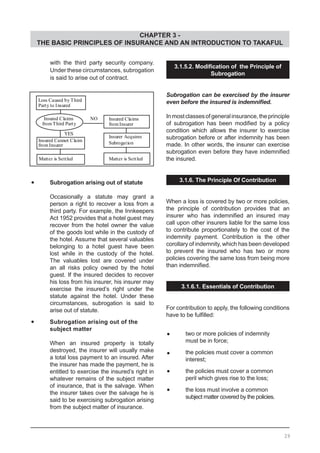
Subrogation can be exercised by the insurer
even before the insured is indemnified.
Inmostclassesofgeneralinsurance,theprinciple
of subrogation has been modified by a policy
condition which allows the insurer to exercise
subrogation before or after indemnity has been
made. In other words, the insurer can exercise
subrogation even before they have indemnified
the insured.
3.1.6. The Principle Of Contribution
When a loss is covered by two or more policies,
the principle of contribution provides that an
insurer who has indemnified an insured may
call upon other insurers liable for the same loss
to contribute proportionately to the cost of the
indemnity payment. Contribution is the other
corollary of indemnity, which has been developed
to prevent the insured who has two or more
policies covering the same loss from being more
than indemnified.
3.1.6.1. Essentials of Contribution
For contribution to apply, the following conditions
have to be fulfilled:
		•	 two or more policies of indemnity
	 must be in force;
		•	 the policies must cover a common
	 interest;
		•	 the policies must cover a common
	 peril which gives rise to the loss;
		•	 the loss must involve a common
	 subject matter covered by the policies.
29
Loss Caused by Third
Party to Insured
YES
NO Insured Claims
from Insurer
Insurer Acquires
Subrogation
Matter is Settled
Insured Cannot Claim
from Insurer
Insured Claims
from Third Party
Matter is Settled
CHAPTER 3 -
THE BASIC PRINCIPLES OF INSURANCE AND AN INTRODUCTION TO TAKAFUL
3.1.6.2. Modifications of  the Principle of
Contribution
The application of the principle of contribution
can also be modified by a policy condition. In
most classes of general insurance the policy
condition usually provides that when contribution
exists, the insurer would pay the proportion of
the loss for which he is liable.
3.1.7. The Principle Of Proximate Cause
3.1.7.1. Importance of the Principle of
Proximate Cause
Onus of proof of loss rests on the insured.
Which among the many causes of losses
can be taken to be the dominant cause of
loss? This cause is the proximate cause.
When a loss occurs, the onus is on the insured
to prove that the loss in respect of which a claim
is made has been caused by an insured peril. If
the loss is the result of one cause, it will not be
difficult to decide on the question of liability.
The insurer is not liable for an uninsured or
excluded peril.
An insurer is liable for a loss caused by an
insured peril. On the other hand, the insurer
will not be liable for a loss caused by either an
uninsured peril or excluded peril. A loss may be
the result of two or more causes occurring at
the same time or one after the other. A problem
arises when the two or more causes involved
are both insured perils and excluded perils.
In such a situation, it becomes difficult for an
insured to establish the actual cause of loss.
To resolve this difficulty, the law developed the
doctrine of proximate cause based on the Latin
maxim causa proxima non remota spectatur
which means that the proximate cause and not
the remote must be looked at. Thus, when a
loss is the result of many causes the proximate
cause, that is the dominant or effective cause,
30
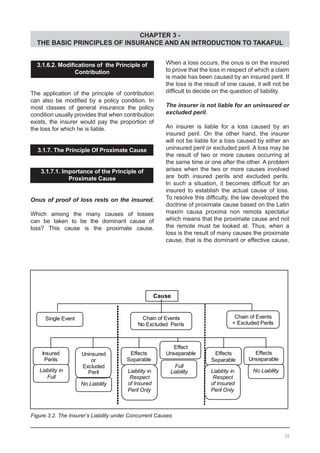
Figure 3.2. The Insurer’s Liability under Concurrent Causes
CHAPTER 3 -
THE BASIC PRINCIPLES OF INSURANCE AND AN INTRODUCTION TO TAKAFUL
must be identified and attributed as the cause
of the loss.
Points to remember:
Insured perils are perils which are expressly
covered by a policy.
Uninsured perils are perils not mentioned in the
policy and therefore not covered by the policy
unless they occur as a result of an insured peril.
Examples of uninsured perils in a fire policy are
smoke and water damage.
Excluded perils are perils which have been
expressly excluded from the policy.
3.1.7.2. Application of the Doctrine of
Proximate Cause
3.1.7.2.1. Concurrent Causes
When two or more perils including one that is
insured occur concurrently and the ensuing
loss can be separated according to their effects,
the insurer will be liable for the loss caused by
the insured peril. However, if the loss cannot
be separated the insurer will be liable for the
full amount provided there is no excluded peril
involved.
When an excluded peril is one of the concurrent
causes, the insurer is liable for the loss caused
by the insured peril only if the loss can be
separated. If the loss cannot be separated the
insurer will not be liable for the loss.
Figure 3.3 illustrates the points covered above.
3.1.7.2.2. Chain of Events
When there is an unbroken chain of events, the
insurer will be liable for the loss insured under the
policy from the insured peril onwards provided
no excluded peril precedes an insured peril.
Let us look at some examples which explain the
principles involved.
1.	 Examples of cases where no excluded
	 peril is involved:
a.	 A building is insured under a fire
	 insurance policy. The building catches
	 fire due to an electrical short circuit.
	 The local fire brigade is called and
	 the fire is put out within one hour
	 but the building and contents are
	 badly damaged by the fire and water
	 from the firefighters’ hoses.
	 While the electrical short circuit is
	 an uninsured peril, it is the proximate
	 cause of the loss. The insurer is
	 liable for any loss caused directly by
	 the fire and also for the losses resulting
	 from the water from the firefighters’
	 hoses because such loss is considered
	 a direct result of the fire.
b. 	 While crossing a road, a life assured
	 is knocked down by a vehicle and
	 dies. The accidental collision resulting
	 in the death is the proximate cause
	 of the loss and the insurer is liable.
2.	 Examples of cases where an excluded
	 peril is involved:
a. 	 A shop and its contents are insured
	 under a fire policy. A tank of acetylene
	 gas used for welding explodes and
	 causes fire to a motor repair shop.
	 The explosion of gas used for
	 commercial purposes is an excluded
	 peril. If the explosion (an excluded
	 peril) occurs before the fire (an
	 insured peril), the insurer will not
	 be liable for any loss caused by the
	 fire. However, if the explosion
	 happens after the fire, the insurer
	 will be liable for the fire loss before
	 the occurrence of the explosion.
b. 	 A life assured is greatly depressed
	 and throws himself over the balcony
	 of a ten-storeyed building, resulting
31
CHAPTER 3 -
THE BASIC PRINCIPLES OF INSURANCE AND AN INTRODUCTION TO TAKAFUL
	 in his death. His death occurs within
	 one year of taking out a whole life
	 assurance policy. As a result of the
	 exclusion of the suicide clause in the
	 policy, the insurer is not liable for
	 the death by suicide.
Broken Chain of Events
When there is a broken chain of events, the
proximate cause of loss is the one immediately
following the last interruption.
Example 1:
An insured has a personal accident policy. While
crossing a river he accidentally falls into it. He
then suffers a heart attack and subsequently
drowns. In this case, the drowning and not the
heart attack is the proximate cause because
there is a break in the chain of events between
the drowning and the heart attack. The insurer
is liable to pay the benefits under the personal
accident policy.
Example 2:
An insured is involved in an accident and
hospitalized but subsequently dies of a disease
unrelated to the accident. In this event the
insurer will only be liable to pay the weekly
hospital benefits arising out of the accident.
No death benefits will be payable under the
personal accident policy because the death is
caused by an excluded peril, that is a disease.
3.2. TAKAFUL
In this section we will discuss takaful, an
alternative to conventional insurance. Although
the objective of providing protection may be
similar, the actual workings of takaful differ from
conventional insurance.
3.2.1. Overview Of Takaful
All human beings are exposed to the possibility
of meeting with mishaps and disasters that
result in misfortune and suffering such as
death, destruction of property, loss of business
or wealth, etc.
Islamic teachings encourage peace,
brotherhood, and economic security of
humankind. Islam teaches us to help each
other regardless of religion. When one is facing
a misfortune others should come to help so as
to minimize the financial losses or emotional
distress. This also reflects the inherent nature
of mankind to find a solution collectively.
The same basis is used in insurance where
contribution from many help mitigate the
losses of the unfortunate few. This insurance
concept is generally accepted by Muslim jurists
and does not contradict with the Shariah or
Islamic religious laws. In essence, insurance is
synonymous to a system of mutual help.
What is Takaful?
Takaful is an alternative to the contemporary
insurance contract.Takaful is a form of insurance
based on the principle of mutual assistance.
Takaful is a noun stemming from the Arabic
verb kafala meaning to protect or to guarantee.
Essentially takaful means mutual help among
a group to support the needy within the group
through a fund contributed by group members.
The concept of takaful already existed during
the time of the Prophet when Muslims
contributed to a fund under the system of aqila
for the purpose of helping members of their
own community who were liable to pay “blood
money (diyat)” in a situation  where a person
is murdered unintentionally or to pay ransom to
release war prisoners.
32
CHAPTER 3 -
THE BASIC PRINCIPLES OF INSURANCE AND AN INTRODUCTION TO TAKAFUL
Essential Elements in Takaful
Within Islamic beliefs, the following are the
underlying concepts that drive the acceptance
of the takaful system:
•	 Piety or individual purification:
	 People are accountable to Allah and
	 their success in the hereafter
	 depends on their performance in this
	 life on earth.
•	 Brotherhood via ta’awun or mutual
	 assistance: Policyholders cooperate
	 among themselves for their common
	 good.
•	 Charity through tabarru’ or donation:
	 Every policyholder pays his contribution
	 to help those that need assistance.
•	 Mutual guarantee.
•	 Self-sustaining operations as
	 opposed to profit maximization:
	 Losses are divided and gains are
	 spread according to an agreed
	 takaful model.
The basis of mutual help in takaful is grounded
on the Islamic values of
1. 	 sincere intention (niat) to help and
	 support the needy by the group
	 members as well as the manager of
	 the fund; and
2.	 compliance to Shariah principles
	 whereby business is conducted openly
	 in accordance with utmost good
	 faith, honesty, full disclosure,
	 truthfulness and fairness in all
	 dealings as well as avoidance of unlawful
	 elements.
3.2.2. The Formation Of Takaful Companies
In Malaysia
Malaysia is a model of an Islamic country that
is serious in implementing an Islamic economy
parallel with the conventional economy. The
introduction of Islamic financial products in
Malaysia dates back to the 1980’s with the
introduction of the first Islamic bank in the
country, Bank Islam Malaysia Berhad. The
successful introduction of Islamic banking
products paved the way for other Islamic
products in the market. The formation of
takaful companies is part of the aspiration
of the Malaysian government to establish an
Islamic financial system in Malaysia. Takaful
companies play a major role in providing
insurance based on a system of operation that
is in accordance with Islamic law or Shariah.
The Takaful Act 1984, passed by Parliament
on 15 November 1984, was enacted to
regulate the operations of takaful in Malaysia
in compliance with Shariah principles. The first
takaful company in Malaysia, Syarikat Takaful
Malaysia Berhad, started its operations in
1984.
Takaful operations have been regulated and
supervised by Bank Negara Malaysia (BNM)
since 1988 with the appointment of the BNM
Governor as the Director General of Takaful.
3.2.3. Takaful Act 1984
The Takaful Act 1984 is the source of Takaful
legislation in Malaysia. The Insurance Act 1963
forms the basis of the Takaful Act 1984.
The Takaful Act 1984 is divided into four parts:
Part I: This provides for the interpretation,
classification and references to takaful
business. Takaful business is divided into two
broad categories, general takaful and family
takaful. Those who enter the plans are called
takaful participants. Any employee retirement
scheme which pays benefit at retirement, death
or disability shall not be treated as takaful
business.
Part II: This provides the mode and conduct
of takaful business such as restriction on
the usage of the word ‘takaful’, conditions of
registration, restrictions on takaful operators, the
33
CHAPTER 3 -
THE BASIC PRINCIPLES OF INSURANCE AND AN INTRODUCTION TO TAKAFUL
3.4. TAKAFUL AND INSURANCE
Insurance as a concept does not contradict
the practices and requirements of Shariah.
However, Muslim jurists generally view that
conventional insurance, which is based on
exchange transaction, does not conform to the
rules and requirements of Shariah because of
involvement in the following elements either
in its buy-and-sell agreement, operations or
investments:
1.	 Al-Gharar – uncertainty in the
	 contract of insurance.
2.	 Al-Maisir – gambling as the
	 consequence of the presence of
	 uncertainty.
3.	 Al-Riba – the existence of interest or
	 usury in its investment activities.
The takaful system, on the other hand, is
based on mutual cooperation among members,
where members contribute to a certain agreed
fund for the purpose of sharing responsibility,
assurance, protection and assistance between
group members or takaful participants. It is a
pact among a group of persons who agree to
jointly indemnify the loss or damage that may
inflict upon any of them, out of the collected
fund.
3.5. PRINCIPLES OF TAKAFUL
OPERATION
Takaful operation incorporates the concept
of takaful that applies the concept of
tabarru’ and the principle of mudharabah.
3.5.1. The Concept Of Takaful
Takaful is a method of joint guarantee among
a group of people in a scheme to share the
burden of unexpected financial losses that
establishment and maintenance of takaful funds
and allocation of surplus, the establishment and
maintenance of a takaful guarantee scheme
fund, requirements relating to takaful, and other
miscellaneous requirements on the conduct of
takaful business.
Part Ill: This part specifies the powers vested
in Bank Negara and the appointment of the
Governor as the Director General of Takaful
in regulating takaful business, the powers of
investigation of Bank Negara and provisions
for the winding-up and transfer of business of a
takaful operator.
Part IV: This provides for the administration
and enforcement of matters such as indemnity,
submission of annual reports and statistical
returns, offences and prosecution of offences.
3.3. THE SHARIAH SUPERVISORY
COUNCIL
One of the important features of the Takaful Act
1984 and which is not provided in conventional
insurance is a provision in the Articles of
Association of takaful operators for the
establishment of a Shariah Supervisory Council
or Shariah Supervisory Board.
The function of the Council is to advise the
takaful company on its operations in order to
ensure that it is not involved in any element
which is not approved by Shariah. Members
of the Council are Muslim jurists who are well
versed in Shariah matters.
The Council is not directly involved in the
management of the takaful company but only
decides whether the company’s activities
comply with Shariah. The auditor of the
company must ensure the decisions of the
Council are followed. Decisions of the Council
must always be according to ruling by shura or
mutual consultation and agreement, and not be
based on decision by majority.
34
CHAPTER 3 -
THE BASIC PRINCIPLES OF INSURANCE AND AN INTRODUCTION TO TAKAFUL
2.	 Takaful business is not a contractual
	 transfer of risk. The takaful company
	 does not assume the risk. It is the
	 group of members or participants of
	 takaful plans who agree to jointly
	 guarantee against loss or damage
	 that may fall upon any of them.
3.	 The takaful operator acts as asset
	 manager and profit distributor on
	 behalf of all the participants. In a
	 takaful business venture, profit-sharing
	 follows the principle of mudharabah.
	 The distribution of the profit follows
	 a pre-agreed ratio.
4.	 Participants of takaful plans make
	 donations (tabarru’) or installments
	 that will be accumulated in the
	 Takaful Fund. This fund may be
	 invested in areas acceptable to
	 Shariah. Payments of all takaful
	 benefits will be paid by the fund.
5.	 In order to fulfill the obligations of
	 mutual help in the concept of
	 takaful, participants make an aqad
	 (agreement) at the outset to pay part
	 or the whole of the takaful contributions
	 as tabarru’. The agreement shall be
	 an aqad of helping and cooperating
	 and not an aqad of buying and selling.
	 Nevertheless, the tabarru’ proportion
	 defines the participant’s share of the
	 risk, computed using the same
	 actuarial principles as in conventional
	 insurance.
The Takaful Act 1984 divides takaful into two
broad business categories, family takaful and
general takaful.
3.7. TYPES OF TAKAFUL BUSINESS
Takaful businesses carried on by Malaysian
takaful operators are broadly divided into family
takaful business (life insurance) and general
takaful business (general insurance).
may fall upon any of them. It is a scheme that
upholds the principles of shared responsibility,
mutual help and co-operation.
3.5.2. The Concept Of Tabarru’
Tabarru’ means donation, gift or contribution. By
definition, tabarru’ is the agreement  (aqad) by a
participant to hand over as donation, a certain
proportion of the takaful contribution that he
agrees or undertakes to pay, thus enabling him
to fulfill his obligation of mutual help and joint
guarantee should any of his fellow participants
suffer a defined loss. The concept of tabarru’
eliminates the element of uncertainty in the
takaful contract.
3.5.3. The Principle Of Mudharabah
Mudharabah(trusteeprofit-sharing)isdefinedas
a contractual agreement between the provider
of capital and the entrepreneur for the purpose
of business venture whereby both parties agree
on a profit-sharing arrangement.
The principle of mudharabah when applied to
the takaful contract defines the takaful company
as the entrepreneur who undertakes business
activities. The participants entrust funds to
the takaful company by means of takaful
contributions. The takaful contract specifies
the proportion of profit (surplus) to be shared
between the participants and the takaful
company.
3.6. ASPECTS OF TAKAFUL OPERATION
The important aspects of takaful operation are
as follows:
1.	 The takaful operator provides
	 various takaful plans to cover risks,
	 namely business risks and pure risks,
	 which are allowable by Shariah.
	 Those who enter the plans are called
	 takaful participants.
35
CHAPTER 3 -
THE BASIC PRINCIPLES OF INSURANCE AND AN INTRODUCTION TO TAKAFUL
3.7.1. Family Takaful Business
A family takaful plan is a combination of
long-term investment and a mutual financial
assistance scheme.
The objectives of the plan are:
1.	 to save regularly over a fixed period
	 of time;
2.	 to earn investment returns in
	 accordance with Islamic principles; and
3.	 to obtain coverage in the event of
	 death prior to maturity of the plan
	 from a mutual aid scheme.
Each contribution paid by the participant is
divided and credited into two separate accounts,
namely:
•	 The Participants’ Special Account
	 (PSA)
A certain proportion of the contribution
is credited into the PSA on the basis of
tabarru’. The amount depends on the
age of the participant and the cover
period.
•	 The Participants’ Account (PA)
The balance goes into the PA which
is meant for savings and investments
only.
Examples of covers available under the
family takaful business are:
•	 Individual family takaful plans;
•	 Takaful mortgage plans;
•	 Takaful plans for education;
•	 Group takaful plans; and
•	 Health/Medical takaful.
3.7.2. General Takaful Business
The general takaful scheme is purely for mutual
financial help on a short-term basis, usually 12
months, to compensate its participants for any
material loss, damage or destruction that any of
them might suffer arising from a misfortune that
might inflict upon their properties or belongings.
The contribution that a participant pays into the
general takaful fund is wholly on the basis of
tabarru’.
If at the end of the period of takaful there is a
net surplus in the general takaful fund, it shall
be shared between the participant and the
operator in accordance with the principle of al-
Mudharabah, provided that the participant has
not incurred any claim and/or not received any
benefits under the general takaful certificate.
The various types of general takaful schemes
provided by takaful operators include:
•	 Fire Takaful Scheme;
•	 Motor Takaful Scheme;
•	 Accident/Miscellaneous Takaful
	 Scheme;
•	 Marine Takaful Scheme; and
•	 Engineering Takaful Scheme.
36
CHAPTER 3 -
THE BASIC PRINCIPLES OF INSURANCE AND AN INTRODUCTION TO TAKAFUL
SELF - ASSESSMENT QUESTIONS
CHAPTER 3
1.	 Lack of insurable interest will
	 a. 	 render the contract void.					
	 b. 	 have no effect on the policy contract.
	 c. 	 render the contract unenforceable to certain extent.
	 d. 	 operate only when loss is caused by an insured peril.
2.	 In marine cargo insurance, insurable interest must exist
	 a. 	 at the time of loss.		
	 b. 	 before the ship sails.							
	 c. 	 at the time of effecting the insurance contract.
	 d. 	 at the inception of the contract and at the time of loss.
3.	 In life insurance, insurable interest must exist
	 a. 	 at the time of loss.
	 b. 	 during the currency of the policy. 				
	 c. 	 at the time of effecting the insurance contract.		
	 d. 	 at the inception of the contract and at the time of loss.
4.	 In case of breach of utmost good faith, the aggrieved party can
	 a. 	 void the contract.
	 b. 	 sue for damages.						
	 c. 	 waive the breach.
	 d. 	 do any one of the above.
5.	 Indemnity can be provided in the following ways:
	 a. 	 cash payment or repair only.					
	 b. 	 cash payment or replacement only.
	 c. 	 cash payment, repair or replacement only.
	 d. 	 cash payment, replacement, repair or reinstatement.
37
CHAPTER 3 -
THE BASIC PRINCIPLES OF INSURANCE AND AN INTRODUCTION TO TAKAFUL
6.	 The contribution condition requires the insured to claim from each underwriter
	 involved
	 a. 	 proportionally.
	 b. 	 in instaments.							
	 c. 	 periodically.
	 d. 	 annually.
7.	 Perils covered in the policy are known as
	 a. 	 insured perils.
	 b. 	 excluded perils.						
	 c. 	 uninsured perils.
	 d. 	 exception perils.
8.	 Which of the following does NOT constitute a breach of Utmost Good Faith?
	 a. 	 non-disclosure of material facts.
	 b. 	 deliberate concealment of facts.				
	 c. 	 fraudulent misrepresentation.
	 d. 	 claim for an insured item.
9.	 Which of the following is NOT an essential condition for the operation of
	 contribution?
	 a. 	 The policies must cover a common interest.					
	 b. 	 The policies must involve a common subject matter.
	 c. 	 There must be 2 or more policies covering different insureds.
	 d. 	 The policies must cover a common peril that gave rise to the loss.
10.	 The legislation in Malaysia that regulates Islamic insurance is the
	 a. 	 Takaful Act 1984.					
	 b. 	 Insurance Act 1996. 					
	 c. 	 Central Back of Malaysia Ordinance 1958.
	 d. 	 Muslim (Titles and Construction) Ordinance 1952.
YOU WILL FIND THE ANSWERS AT THE BACK OF THE BOOK.
38
CHAPTER 4 - THE INSURANCE MARKET
OVERVIEW
This chapter will cover:
•	 The Main Components of the
	 Insurance Market
•	 Other Components of the Insurance
	 Market
•	 Organization Structure of Insurance
	 Companies
•	 Centralization of Insurance Companies
	 as Compared to Decentralization
•	 Insurance Supervisory Authority and
	 Mandatory Associations
•	 Insurance Mediation Bureaus
•	 Other Associations
•	 Market Services
•	 Insurance Educational Institutions
4.1. THE INSURANCE MARKET
The term “market” is used for describing the
facilities for buying and selling a product. An
insurance market therefore refers to the facilities
for buying and selling insurance. Insurance, in
a broad sense, may include private insurance,
government compensatory schemes and takaful
business. In this chapter, the term insurance
shall, for practical purposes, be confined to the
market for private insurance.
	 	 Overview 				
				
4.1.	 The Insurance Market			
				
4.2.	 Other Market Components		
				
4.3.	 Organization Structure
	
4.4.	 Centralization Versus
	 Decentralization				
4.5.	 Insurance Supervisory Authority
	 and Mandatory Associations
4.6.	 Insurance Mediation Bureaus
4.7.	 Other Associations
4.8.	 Market Services
4.9.	 Insurance Educational
	 Institutions
39
CHAPTER 4 - THE INSURANCE MARKET
4.1.1. Main Components
Like any other market, the market for private
insurance comprises the following main
components:
•	 Buyers
•	 Sellers
•	 Intermediaries
4.1.1.1. Buyers
The buyers of private insurance include
individual persons, associations, societies,
small business enterprises, large national
and multinational corporations, and public
enterprises.
4.1.1.2. Sellers
The sellers of private insurance are the
insurance companies. In 2007, there were 41
directinsurersandsevenprofessionalreinsurers
carrying on insurance business in Malaysia.
Insurers carrying on life business only are the life
insurers; those carrying on general business are
the general insurers, and those carrying on both
life and general businesses are the composite
insurers. Of the 41 direct insurers, there were
six life insurers, 25 general insurers and 10
composite insurers. Of the seven professional
reinsurers, five   were registered to transact
general reinsurance business, one registered
for life only, and one for both general and life
reinsurance business in Malaysia.
In addition to classification by type of insurance
business transacted, insurance sellers can be
classified according to their legal forms. In this
respect, there are 48 proprietary companies
(including the seven professional reinsurance
companies) carrying on insurance business in
Malaysia.
A proprietary company is a limited liability
company with a subscribed or guaranteed
capital. Any profits made by the operations of
such a company belong to its shareholders
who are the ‘proprietors’ of the company.
The insurance business in Malaysia may
be transacted by a domestically Malaysian-
incorporated company or a foreign-
incorporated company that had an established
place of business at the time the InsuranceAct
1963 was implemented. Of the 48 proprietary
insurers and professional reinsurers operating
in Malaysia, 42 were Malaysian-incorporated
and six were foreign-incorporated.
With the enactment of the Insurance Act 1996
which came into force on 1 January 1997
(repealing the Insurance Act 1963), section 9 of
the Act provides that no person, unless he is
licensed under the Act (by the Finance Minister)
shall carry on insurance business. In addition,
section 14 of the Act provides that no person
shall apply for a licence to carry on insurance
business unless it is a public company.
If the insurance company is a private company,
it shall convert itself into a public company in
accordance with the Companies Act 1965 within
twelve months from 1 January 1997.
If the insurance company is a foreign insurer
other than a professional reinsurer, it shall
transfer its property, business and liabilities
to a public company incorporated under the
Companies Act 1965, in so far as they relate to
its insurance business in Malaysia, on or before
30 June 1998.
If the insurance company is a cooperative
society, it shall transfer its property, business
and liabilities to a public company incorporated
under the Companies Act 1965, in so far as they
relate to its insurance business, within twelve
months from 1 January 1997. Before January
40
CHAPTER 4 - THE INSURANCE MARKET
1998, there was one co-operative society
carrying on insurance business in Malaysia. It
transferred its business to a public company in
1998.
A cooperative society is owned by the
policyholders and profits earned may be shared
by policyholders in the form of lower premium
or policy bonus. Frequently, profits earned may
be used in building up surplus to strengthen the
financial position of the insurer.
A cooperative which is incorporated as a
company is referred to as a mutual company.
Mutual companies are owned by policyholders
and profits are shared among policyholders or
used to build up surplus. Mutual companies are
common in the United Kingdom and the United
States of America.
4.1.1.3. Intermediaries
The intermediaries or middlemen in the
insurance market are composed of insurance
agents and brokers. The intermediaries’ main
function is to match the needs of buyers with
the insurance product offered by sellers.
Section 184 of the Insurance Act 1996 provides
that no person shall act on behalf of a person
not licensed under the Act to carry on insurance
business in Malaysia unless approved in writing
by Bank Negara Malaysia. Penalties for such
breach include imprisonment for three years or
a fine of RM3 million or both.
Section 184 of the Act provides that no person
shall invite any person to make an offer or
proposal to enter into an insurance contract
without disclosing
•	 the name of the insurer,
•	 his relationship with the insurer, and
•	 the premium charged by the insurer.
Section 186 further provides that no person shall
arrange a group policy for persons in relation
to whom he has no insurable interest without
disclosing to each person
•	 the name of the insurer,
•	 his relationship with the insurer,
•	 the condition of the group policy,
	 including the remuneration payable
	 to him, and
•	 the premium charged by the insurer.
Penalty for breach of section 186 is RM 1
million.
4.1.2. Insurance Agents
Section 2 of the Insurance Act 1996 defines an
insurance agent to mean a person who does all
or any of the following:
a.	 solicits or obtains a proposal for
	 insurance on behalf of an insurer;
b.	 offers or assumes to act on behalf of
	 an insurer in negotiating a policy; or
c.	 does any other act on behalf of an
	 insurer in relation to the issuance,
	 renewal or continuance of a policy.
Depending on the terms of the agency
agreement, an insurance agent may be
authorized to solicit insurance business, collect
premiums, and issue cover notes on behalf
of the insurer and is remunerated through the
payment of commission.
Since Persatuan Insurance Am Malaysia’s
(PIAM) Inter-Company Agreement on Agencies
came into effect in 1988 (now incorporated
into the Inter-Company Agreement on General
Insurance Business 1992), a general insurance
41
CHAPTER 4 - THE INSURANCE MARKET
agent, whether individual or person or persons
corporate or incorporate, is required to pass
or be exempted from a qualifying examination
conducted by The Malaysian Insurance Institute
(MII) and be registered and licensed by PIAM
before dealing or engaging in any general
insurance business. In addition, a general
insurance agent may not at any time represent
more than two general insurance companies.
In the case of life insurance agents, they
must pass or be exempted from a qualifying
examination conducted by The Malaysian
Insurance Institute and be registered and
licensed by the Life Insurance Association of
Malaysia before dealing or engaging in any life
insurance business. It is also industry practice
that a life insurance agent may not represent
more than one life insurance company.
4.1.3. Insurance Brokers
The term “insurance broker” is defined under
section 2 of the Insurance Act 1996 to mean
a person who, as an independent contractor,
carries on insurance broking business and the
term includes a reinsurance broker.All insurance
brokers must be licensed under the Act by Bank
Negara Malaysia. In addition, section 14 of the
Act provides that no person shall apply for a
license to carry on insurance broking business
unless it is a company.
An insurance broker is an ‘agent’ who normally
acts on behalf on the insured and is normally
not tied to any one insurer. His job is to advise
his clients on the most suitable covers at the
most economic cost. Insurance brokers are
deemed to be knowledgeable in insurance
and they therefore are expected to possess in-
depth knowledge of the covers available and
the rates charged. In addition to advising clients
and placing business on their behalf, insurance
brokers may also help in presenting claims and
getting them settled. They are remunerated
through the payment of brokerage, which
is usually a percentage of the premium. All
insurance brokers operating in Malaysia must
be licensed by Bank Negara Malaysia.
4.1.4. Insurance Professionals
Underwriter
This term underwriter originated in Lloyd’s
Coffee House when merchants signed their
names at the foot of a slip to signify acceptance
of a part of a maritime risk. The term is used
to refer to an insurer or an individual skilled in
the process of selecting risks for an insurance
company.
Loss Adjuster
The term loss adjuster is interpreted under
section 2 of the Insurance Act 1996 to mean a
person who carries on the adjusting business
of investigating the cause and circumstances
of a loss and ascertaining the quantum of the
loss either for the insurer or the policyowner or
both. A loss adjuster is an independent party
appointed, usually by an insurer, when a loss
occurs.
Upon investigating the cause and extent of
the loss, a loss adjuster makes a report of
his findings and recommendations to the
principal, usually an insurer, who would then
decide whether the loss is covered and if so,
the amount of indemnity or compensation to be
paid. A loss adjuster is normally paid on a fee
or a time basis by the principal who engaged
him. All loss adjusters must be licensed under
the Insurance Act by Bank Negara Malaysia. In
addition, section 14 of the 1996 Act states that
‘No person shall apply for a license to carry on
adjusting business unless it is a company’.
42
CHAPTER 4 - THE INSURANCE MARKET
Loss Assessor
A loss assessor is generally employed by the
insured to assess the extent of the damage
or loss settlement, and frequently assists the
insured in the preparation and negotiation of
the claim.
Marine and Cargo Surveyor
A marine and cargo surveyor is a specialist
appointed by insurers to survey ships and cargo
that have been damaged and to report on the
cause and extent of loss.
Actuary
An actuary is a business professional who deals
with the financial impact of risk and uncertainty.  
He applies probability and other statistical
theories to insurance. His work covers rates,
reserves, dividends and other valuation, and he
also conducts statistical studies, makes reports
and advises on solvency.
An actuary is also skilled in the analysis,
evaluation and management of statistical
information. He evaluates insurance firms’
reserves, determines rates and rating methods,
and determines other business and financial
risks.
Risk Surveyor
Where a risk insured is substantial in amount,
insurance companies would normally engage
the services of a risk surveyor to become
its ‘eyes and ears’ in evaluating the risk. The
risk surveyor will prepare a survey report
detailing all the necessary information needed
by the underwriter in evaluating the risk. Risk
surveyors are normally employed by insurance
companies.
4.2. OTHER MARKET COMPONENTS
4.2.1. Reinsurers
Insurers frequently reinsure or cede part of each
risk underwritten by them so that the burden
of paying claims, particularly those involving
large amounts, will be shared by the reinsurers.
Reinsurance, therefore, is the insurance which
insurers purchase to cover risks underwritten
by them just as individuals purchase insurance
to cover risks they assume. An insurer can
purchase reinsurance from the following:
•	 professional reinsurance companies,
	 i.e. reinsurance companies that do
	 not accept business direct from the
	 general public, e.g. Malaysian
	 Reinsurance Berhad (Malaysian Re);
•	 direct insurers who underwrite
	 reinsurance business together with
	 direct business.
4.2.2. Service Specialists
Service specialists provide support services to
insureds and insurers. They include doctors,
hospitals, engineers, marine and cargo
surveyors, loss adjustors, investigators and
assessors.
Doctors
Where a medical examination is required before
a risk is accepted, it is usual for the insurer to
arrange for the life proposed to see a doctor
from the insurer’s panel of examiners.
43
CHAPTER 4 - THE INSURANCE MARKET
Hospitals
Where a life applicant has received treatment for
a condition, insurers may request directly from
the hospital reports of the treatment to assist
the insurers in the assessment of the risk.
Engineers
Technical engineering firms are generally
retained by insurance companies (who do not
have such specialists of their own) to report on
risk or claims on boilers, presses, lifts, cranes,
etc.
4.3. ORGANIZATION STRUCTURE
Insurance companies, like other business
organizations, can organize their operations
in various ways. They can organize their
operations on the basis of functions performed,
products sold, and territories (geographical).
4.3.1. Functional Structure
In Malaysia, most insurance companies are
organized on the basis of functions performed.
When an insurance company organizes its
departments by functions performed, the
following departments are commonly found:
administration, electronic data processing,
accounting, investing, marketing, underwriting,
claims, and others.
	•	 Administration Department
The administration department provides
and handles services commonly used
by many departments. These include
office services, building services and
personnel administration.
In particular, the personnel unit in the
administration department is responsible
for matters relating to the company’s
employees. It formulates company
policies with respect to the hiring, training
and dismissal of employees, determines
salary scales with labour unions, and
ensures compliance with relevant laws.
	•	 Electronic Data Processing (EDP)
	 Department
In a modern insurance company, the
EDP department function affects many
departments because computers
are used in their operations. The
EDP department serves the other
departments by establishing procedures
and programmes that enable them
to utilize computers in their work,
for instance computers for use in
underwriting and policy preparation,
performing calculation required by the
accountingandinvestmentdepartments,
maintainingallkindsofcompanyrecords,
and preparing financial statements and
management information reports.
	•	 Accounting Department
The accounting department is
responsible for billing and collecting
premium once the policy is issued. In
addition, the department is responsible
for the company’s general accounting
records, the preparation of financial
statements, the control of receipts and
disbursements, and the maintenance of
budgetary controls over departmental
expenses. This department is also
concerned with compliance with relevant
government regulations and tax laws.
44
CHAPTER 4 - THE INSURANCE MARKET
	•	 Investment Department
The main function of the investment
department is to invest all available
funds in a manner which ensures that
all investments yield sufficient return,
satisfy the company’s requirement for
liquidity and security, and comply with
relevant regulations. The investment
portfolio of an insurance company
comprises government securities,
shares and debentures, fixed deposits
with banks and finance companies, and
investments in land and buildings.
	•	 Agency or Sales Department
The agency or sales department
generally concentrates its efforts
on the identification of field officers,
recruitment of agents, and motivation
and supervision of the sales force.
	•	 Marketing Department
The marketing activities conducted by
the marketing department are usually
restricted to providing support to the
sales department in bringing in business.
These include the development of sales
promotion programmes, sales literature
and kits, as well as the training of the
sales force.
	•	 Underwriting Department
The underwriting department sets the
underwriting guidelines and selection
criteria, selects the risks and determines
the premiums, terms and conditions
of new business and renewals. The
department is also responsible for fixing
the amount for the insurer’s retention
and reinsurance.
	•	 Claims Department
The claims department processes
the claims on policies issued by the
company. When a claim is submitted
to the department, the claim official will
usually verify the validity of the claim
and, if the claim is valid, the benefits
and amount payable are determined
and authorized.
	•	 Customer Services Department
The customer service department is
charged with providing assistance
to the company’s policyowners and
beneficiaries. This assistance usually
takes the form of answering questions
concerning policy coverage and making
changes requested by policyowners.
Such changes often concern the
policyowner’s address, beneficiary
designations, mode of premium
payment, and the like.
	•	 Actuarial Department
In the actuarial department, the work
done is mainly related to life insurance.
The design and pricing of new products,
calculation of surrender values, paid-
up policy values and the bonus rate for
participating policies, and provision of
other advice of an actuarial nature are
the main functions of this department
Further, in order to appreciate how an
insurance company operates, it is also
helpful to look at the organization from
two particular aspects:
	•	 geographical division structure; and
	•	 personnel.
45
CHAPTER 4 - THE INSURANCE MARKET
4.3.2. Geographical Structure
There are two aspects to this: the organization
of a typical insurer within Malaysia, and the
organization of international operations.
International operations are many and varied,
ranging from one-person offices performing a
largely representative function to fully-staffed
offices transacting insurance business much
as they would in Malaysia. Country operations
may be grouped in obvious geographical
centres under the control of a senior manager,
for example General Manager for Asia.
We need to make a distinction between the
Head Office which is the location of the Board of
DirectorsandSeniorManagement,andtheHead
Office which carries out central administrative
and processing functions. These two aspects
may be combined at a single Head Office but
in many cases there will be a separate Head
Office presence (usually in  Kuala Lumpur) and
an administrative office in an area benefiting
from cheaper building costs, a less competitive
labour market, and more pleasant working
conditions.
Over the last 20 years the once extensive
network of branch offices has been greatly
reduced, with a consequent reduction in staff
numbers. As insurance company systems
become more sophisticated, more and more
of the simple processes can be handled
without the need for human intervention. Even
complex procedures such as large commercial
underwriting can be guided by some form of
computer template. To put it simply, insurance
companies can now do more with fewer people.
Of course, this increased productivity has
affected all types of businesses and not just
insurance companies.
In recent years, the insurance industry has
also experienced a period of acquisitions and
mergers, resulting in fewer but larger insurance
groups. This process is often referred to as
consolidation, and is by no means restricted to
the insurance industry. It has resulted in various
operational problems for insurers as they
determine which parts of their business will be
serviced at which location, and also which brand
names will be retained. These problems are
exemplified by the merger of General Accident
with Commercial Union, and their subsequent
merger with Norwich Union to form Aviva.
•	 Outsourcing
Many insurance companies are seeking to
focus on their core business and reduce costs
by outsourcing a range of activities to specialist
providers who are experts in those particular
areas. Parts of IT, accounts and management
services are now commonly outsourced. Some
insurers outsource helplines and elements of
the claims handling process. In the UK, most
outsourcing takes place within the UK, but
there is a growing tendency to use outsourcing
providers located abroad in lower cost countries
such as India and China. Outsourcing to
providers located abroad is often described as
offshoring.
4.3.3. Personnel
There is no uniformity of practice, or of titles,
within different companies, so the terminology
and structure of an individual company may
differ but all of the functions will be performed
under some title or other.
•	 Board of Directors
The function of the Board is to formulate the
overall plan of operation of the company in the
best interests of the owners (the shareholders),
taking into account the interests of policyholders,
staff, the public, other stakeholders and the
effect of market competition.
The Board comprises both executive and non-
executive directors. The former are involved in
46
CHAPTER 4 - THE INSURANCE MARKET
the day-to-day operation of the company, and
will be members of its senior management.
Non-executive directors come from many
other areas and are not involved in the day-
to-day running of the company. Non-executive
directors are chosen to provide the benefit of
their knowledge and expertise gained in other
businesses or occupations.
The Board of Directors is often referred to as the
Main Board to distinguish it from the Boards of
subsidiary companies or operating divisions.
•	 Company Secretary
The responsibilities of the Company Secretary
comprise the administration of the organization
as a registered company, and ensuring that the
company complies with company and insurance
company law.
•	 Chief Executive Officer
The Chief Executive Officer will usually also
be a member of the Main Board, and carry the
responsibility of implementing the decisions
which are made at that level. The Chief
Executive Officer will normally be assisted by
a number of General Managers or Assistant
General Managers, depending upon the size of
the company.
•	 General Managers
Each General Manager or Assistant General
Manager will have a specific area of
responsibility, for example finance, investment,
underwriting, claims, etc. General Managers
may also be on the Main Board according to
their experience and the importance of their
particular specialist function.
4.4. CENTRALIZATION VERSUS
DECENTRALIZATION
4.4.1. Centralization
When an insurance company organizes
its department on a functional basis, the
basic functions and decision-making tend
to be centralized at the head office.   When
this happens, underwriting, policy drafting,
renewals, claims, and accounting work will be
handled at the head office and the branches will
merely act as sales outlets. Centralization gives
rise to several advantages including uniformity
in practice and economics in administration. On
the other hand, one of the main disadvantages
of centralization is the slow service which
results from the administration being remote
from the customers. An example is the delay in
quotations given to customers.
4.4.2. Decentralization
When an insurance company expands its
business, some or all of the basic functions
may be carried out at branches. When
this happens, the branches will be granted
authority to make decisions. When complete
authority is given to branches to perform basic
functions, each branch will be responsible for
underwriting,issuingpoliciesandsettlingclaims.
Decentralization usually results in prompt
service rendered to customers. In addition, a
decentralized organization may be in a better
position to satisfy the needs of customers
because ‘locals’ tend to understand local
conditions better. Decentralization, however,
47
CHAPTER 4 - THE INSURANCE MARKET
results in several disadvantages. One of them
is the duplication of resources, particularly when
each branch performs all the basic functions.
More importantly, branches may be overloaded
with routine work instead of concentrating on
selling, which is the principal and core function
of branches.
4.4.3. Best Of Both Worlds
Many insurers may not adopt either of the two
extremes mentioned; instead, they may adopt
a ‘halfway’ position. When this happens, some
of the basic functions may be carried out by
branches, while the head office may maintain
overall control, guide the basic underwriting
policy, and perform services such as accounting,
printing and investment.
4.5. INSURANCE SUPERVISORY
AUTHORITY AND MANDATORY
ASSOCIATIONS
4.5.1. Roles And Functions
4.5.1.1. Bank Negara Malaysia (BNM)
Bank Negara Malaysia (Central Bank of
Malaysia) was established in January 1959, in
line with the Banking Ordinance 1958 (revised
to the Central Bank of Malaysia Act in 1994).
Bank Negara Malaysia also helps to develop
the institutions and infrastructure that are the
foundations of a modern and solid financial
system. BNM’s main function is committed to
excellence to promoting monetary and financial
system stability and fostering a sound and
progressivefinancialsectortoachievesustained
economic growth for the benefit of the nation.
Prior to April 1988, insurance regulation was
under the purview of the Ministry of Finance.
The regulatory and supervisory functions were
transferred to Bank Negara Malaysia when the
InsuranceAct 1963 was subsequently amended
and replaced by the Insurance Act 1996.
Under section 35 of the Act, the Central Bank
was made responsible for its administration
and the Governor to be the Director General
of Insurance. The move was made necessary
because of the need to exercise greater control
of the industry. In this respect, the objectives
have been somewhat achieved as evidenced
by the healthy growth and a more disciplined
environment. BNM is also responsible for the
resolution of complaints against insurers, which
are administered by Consumer and Market
Conduct (CMC).
Reasons for Insurance Regulation
The fundamental goal of insurance regulation
is to protect the public. As such, insurers are
regulated for the following reasons:
•	 to maintain insurer solvency
•	 to address inadequate insurance
	 knowledge
•	 to ensure reasonable rates
•	 to make insurance available.
CONSUMER EDUCATION PROGRAMME
(CEP)
The Consumer Education Programme
(CEP) on insurance and takaful is known as
InsuranceInfo and is a joint effort between
Bank Negara Malaysia and the insurance and
takaful industry. InsuranceInfo is designed as
a long-term programme to provide educational
information to enable consumers to make well-
informed decisions when purchasing insurance
or takaful products. InsuranceInfo aspires for
consumers to be in a better position to select
48
CHAPTER 4 - THE INSURANCE MARKET
insurance or takaful products that best meet
their needs as well as to understand their rights
and responsibilities as consumers of insurance
or takaful products and services.
InsuranceInfo aims at:
	•	 providing and disseminating
	 information on insurance and takaful
	 products and services, important
	 terms and conditions as well as
	 exclusions of insurance policies, and
	 the rights and responsibilities of
	 consumers, in a clear and simple
	 manner;
	•	 giving useful tips to consumers when
	 deciding to obtain insurance or
	 takaful products and services; and
	•	 advising consumers on how to seek
	 redress if consumers are not
	 satisfied with the services of an
	 insurance company or takaful
	 operator.
	 The information channels of
	 InsuranceInfo include the
	 following:
	 -	 General Information
	 -	 General Insurance
	 -	 Life Insurance
	 -	 General Takaful
	 -	 Family Takaful.
Several initiatives are being planned to
continuously enhance the level of consumer
awareness and knowledge of insurance and
takaful matters. The initiatives include:
•	 providing information on a wider
	 range of products and services as
	 well as the rights and obligations in
	 regard to these products and services;
•	 organising activities to disseminate
	 information to widen the
	 programme coverage; and
•	 carrying out programmes to improve
	 the level of awareness among
	 specific consumer groups such as
	 students and the newly employed.
The availability of more information and better
understanding of insurance and takaful matters
will enable consumers to make better decisions
in choosing the insurance and takaful products
and services that best suit their needs. Knowing
their rights and obligations under the policy
contract will also facilitate consumers in making
insurance claims and seeking redress through
the proper channels in the event of dispute with
their insurance company or takaful operator.
Better informed and active consumers will assist
in establishing a more effective and efficient
insurance and takaful industry.
4.5.1.2. Malaysian Reinsurance Berhad
(MRB)
In early 1965, the Malaysian government
conceived the idea of forming a national
reinsurance company in order to curtail the
ever-increasing premiums paid overseas.
The Malaysian National Reinsurance Berhad
(MNRB) was incorporated under the Companies
Act 1965 and commenced operations on 19
February 1973.
On 1 April 2005, the company completed its
restructuring exercise with the transfer of its
reinsurance business and license to its wholly-
owned subsidiary, Malaysian Reinsurance
Berhad   (Malaysian Re). The company then
changed its name from Malaysian National
Reinsurance Berhad to MNRB Holdings
Berhad to reflect its new principal activity of
an investment holding. As at 31 March 2006,
Malaysian Re had revenue of RM684.6 million
49
CHAPTER 4 - THE INSURANCE MARKET
while its profit before tax was RM137.7 million.
The group ventured into takaful business in 2004,
which is known as Takaful Ikhlas Sdn Bhd.
Objectives
The company’s business objectives are:
•	 to diversify the existing business in
	 order to achieve a better portfolio
	 mix and ensure sustainable growth;
•	 to continuously explore innovative
	 ways of doing business by taking
	 advantage of the latest trends in
	 Information Technology;
•	 to increase local retention and
	 reduce outflow of reinsurance
	 premium;
•	 to increase employment and training
	 opportunities in reinsurance,
	 particularly for bumiputera who are
	 lacking in this sector of the
	 industry; and
•	 to enhance the value of the
	 company through the creation of
	 favourable earnings prospects which
	 are sustainable in the long term.
(More information can be obtained from the
website: http//www.malaysian re.com.my)
Activities and Services
Business Unit - Reinsurance Facultative and
Treaty
Malaysian Re has been actively involved in
underwriting Treaty and Facultative Reinsurance
for the Malaysian market. It has expanded
its business internationally and is actively
underwriting business from the Asian, Middle
East, Africa and China markets. Malaysian Re
has also provided quotes for treaty business and
is a leader in various territories.
Market Services
The following services are available for the
insurance market:
Technical Services
Malaysian Re provides Fire Risk Inspection
services to the local insurance industry for the
purpose of special rating, underwriting and also
Probable Maximum Loss (PML) estimation.
Fire risk assessment and risk management
services tailored to meet the insured’s needs
are also provided through their insurers when
requested.
Central Administrative Bureau
Malaysian Re initiated the establishment of the
Central Administration Bureau (CAB). CAB is
a bureau that centrally administers and settles
facultative reinsurance transactions among
insurers and reinsurers operating in Malaysia.
Its mission is to eliminate administrative and
reconciliation problems and ensure efficient
settlement of balances and claims recovery.
Central to its operations is a computerized
system linking members via the Internet. The
cost of development and operation of the
system is funded jointly by its members. The
bureau, which is managed by Malaysian Re,
commenced online operations on 1 July 1998.
Inspection Task Force
Malaysian Re was given the mandate
by the General Insurance Association of
Malaysia (PIAM) to form an Inspection Task
Force to conduct inspections and carry out
investigations on the conduct and activities
of its members in accordance with the
terms and provisions of the various Inter-
Company Agreements, which have now been
amalgamated into a single agreement called
the Inter-Company Agreement on General
Insurance Business (ICAGIB).
50
CHAPTER 4 - THE INSURANCE MARKET
Malaysian Aviation Pool (MAP)
Malaysian Re assumed the role as Manager of
MAP effective 1 October 1996. Currently, its
membership comprises 14 local insurers and
three reinsurers with a total underwriting capacity
of RM7.3 million. The underwriting of risks is
by a Committee nominated by participating
companies. The business written by the pool is
primarily Malaysian risks and Malaysian interests
abroad.
Malaysian Energy Risks Consortium
(MERIC)
MERIC was established in March 1995
with the objective to maximize national
retention, promote wider interest and develop
underwriting skills in the specialized class
of the energy business. The Consortium
comprises 15 local general insurers and two
reinsurers, with Malaysian Re taking on the
role of Secretariat. MERIC has a capacity to
underwrite up to a combined single limit of
RM40 million for upstream risks and RM20
million for downstream risks, fully retained
by the Consortium. The underwriting of risks
is by a Committee nominated by participating
companies. The primary portfolio of the
business written by MERIC is Malaysian risks
and Malaysian interests abroad. However,
recognizing the need to develop a broader
spread of risk and premium base, the portfolio
has been extended to include risks within the
Asia-Pacific region, the Middle East, and North
African countries.
Malaysian Motor Insurance Pool (MMIP)
The MMIP was established in July 1992 to
provide motor insurance to vehicle owners who
cannotreadilyfindaninsurertoprovideinsurance
protection for their vehicles. Pool members
comprise all general insurance companies
registered under the Insurance Act 1996. In
accordance with the Collective Agreement
between the members and the Pool, members’
participation in the Pool is on an equal sharing
basis and Malaysian Re has been appointed  
the Administration Manager.
Market Training
Malaysian Re has and will always continue
to conduct various courses and seminars on
insurance and reinsurance subjects for the staff
of insurance companies to instil a higher degree
of professionalism in the industry.
Scheme for Insurance of Large and
Specialized Risks (SILSR)
The main objective of this scheme, which was
implemented on 1 January 1994, is to develop
technical expertise to enable insurers to be
active underwriters of large and specialized
risks. In turn, it will enable insurance companies
to have a better understanding of such risks
and optimize national retention capacity, thus
reducing the unnecessary outflow of premiums
abroad.  Malaysian Re has been appointed by
the Central Bank of Malaysia to manage the
scheme.
Sihat Malaysia
The Sihat Malaysia Scheme, which was
officially launched on 18 February 2000,
was developed by the National Insurance
Association of Malaysia (NIAM). Members
of NIAM subscribing to this scheme provide
a uniform health insurance programme
covering health care, including cashless
admission to hospitals, medical treatments,
surgeries as well as emergency assistance to
policyholders. Managed Care Organization has
been appointed under the scheme to provide
specialized services to both the policyholders
and NIAM members.  Malaysian Re has been
appointed Account Manager of the Scheme,
which is currently being subscribed by 11 NIAM
members.
51
CHAPTER 4 - THE INSURANCE MARKET
Special Rating
Malaysian Re was appointed by PIAM to
form a Rating Committee specifically for the
purpose of determining special rates for Fire
and Industrial All Risks (IAR) insurances, for
risks which qualify for special rating under the
Fire Tariff. This Committee comprises not less
than six qualified or experienced fire insurance
underwriters or risk surveyors from among
PIAM members, of whom not more than three
shall be from Malaysian Re. The Chairman of
the Rating Committee shall be a representative
from Malaysian Re. Malaysian Re also acts as
the Secretariat to this Committee as well as
handles the day-to-day operations of all matters
pertaining to special rating applications.
Voluntary Cessions
Malaysian Re accepts voluntary cessions (VC)
from all direct insurers carrying on general
insurance business under the Insurance Act
1996 and the level of percentage is subject to
review by the Bank Negara Malaysia.
The levels from January 2007 to end 2009 are
as follows:
•	 Motor and Personal Accident (including
	 Hospital and Surgical) classes: 4%
•	 Other classes: 5% (without any
	 cessions limit)
•	 Auto Treaties and Auto Facultative:
	 15% , subject to limits with 20%
	 retrocession.
4.5.1.3. Persatuan Insurans Am Malaysia
(PIAM)
Persatuan Insurans Am Malaysia (PIAM) was
formed in May 1976 in compliance with section
3(2) of the Insurance Act 1963. (This provision
has been superseded by section 22 of the
Insurance Act 1996)
By virtue of the Act, all general insurers shall
be members of an association of insurers
approved by the Central Bank of Malaysia, i.e.
Bank Negara Malaysia. PIAM is an association
of general insurers which has been approved
for this purpose. Thus, PIAM membership is
compulsory for all general insurers in Malaysia.
The main objectives of PIAM are:
•	 to promote the establishment of a
	 sound insurance structure in Malaysia
	 in cooperation and consultation with
	 Bank Negara Malaysia ;
•	 to promote and represent the interests
	 of members in or connected with
	 Malaysia by all means and methods
	 consistent with the laws and Constitution
	 of Malaysia;
•	 to render to members where possible
	 such advice or assistance as may be
	 deemed necessary and expedient;
•	 to take note of events, statements
	 and expressions of opinion affecting
	 members, to advise them thereon
	 and represent their interests by
	 expression of views thereon on their
	 behalf as may be deemed necessary
	 and expedient;
•	 to work as far as possible in cooperation
	 with other similar associations
	 elsewhere in the world;
•	 to circulate information likely to be
	 of interest to members and to
	 collect, collate and publish statistics
	 and any other relevant information
	 relating to general insurance;
•	 to work in conjunction with any
	 legal body or any chamber or
	 committee or commission appointed
	 or to be appointed for the consideration,
	 framing, amendment or alteration
	 of any law relating to insurance;
52
CHAPTER 4 - THE INSURANCE MARKET
•	 to organize and manage arrangements
	 and matters of common interest,
	 concern or benefit to members or
	 any group of members and to
	 collect and manage funds for the same;
•	 to make rules, regulations and
	 bye-laws in accordance with these
	 Articles in consultation with Bank
	 Negara Malaysia.
In the interest of the general insurance
business and also for the mutual benefits of
all its members, i.e. insurance companies, and
the public, PIAM has drawn up several Inter-
Company Agreements. Insurance companies,
which are signatories to these agreements,
have jointly and severally agreed to abide by the
terms and conditions stipulated therein. There
were three earlier agreements, which have
now been consolidated into one, i.e. the Inter-
Company Agreement on General Insurance
Business (ICAGIB).
Inter-Company Agreement on General
Insurance Business
The purpose of this agreement is to regulate and
control the conduct and activities of every person
engaged in general insurance business.
4.5.1.4. Life Insurance Association
Of Malaysia (LIAM)
The Life Insurance Association of Malaysia
(LIAM) or Persatuan Insurans Hayat Malaysia
is a trade association registered under the
Societies Act 1966. It was registered on 26
March 1968 as Life Insurance Association.
The name was changed to its current one, Life
Insurance Association of Malaysia, in 1977.
LIAM has initiated various efforts through
self-regulation, continuing education and
professional skills development to enhance
the professionalism of the agency force and
promote greater discipline and sound business
practices among member companies.
LIAM is the formation of Malaysian Life
Reinsurance Group Berhad (MLRe), the first
local life reinsurance company.  MLRe is a joint
venture between the members of LIAM and the
Reinsurance Group of America Incorporated,
making this a rather unique arrangement as the
life insurance companies participate both as
clients and shareholders of MLRe.
LIAM has a total of 18 members, of which 16
are life insurance companies and two are
life reinsurance companies. It is a statutory
requirement under section 22 (1) of the
Insurance Act 1996 (or section 3(2) (e) of
the repealed Insurance Act 1963) for all life
insurance/life reinsurance companies to be
members of LIAM.
Objectives of LIAM
•	 To promote public understanding
	 and appreciation of life insurance;
•	 To improve the image of the life
	 insurance industry through self-
	 regulation;
•	 To give support to the regulatory
	 authorities in developing a strong
	 and healthy industry;
•	 To enhance the professionalism
	 of staff and agents through continuous
	 training and education;
•	 To liaise and work with local and
	 foreign life insurance organizations
	 towards achieving common
53
CHAPTER 4 - THE INSURANCE MARKET
4.5.1.5. Malaysian Insurance And Takaful
	 Brokers Association (MITBA)
	 [Formerly Known As Insurance
	 Brokers Association Of Malaysia
	 (IBAM)]
	
The Malaysian Insurance and Takaful Brokers
Association (MITBA), previously known as The
Insurance Brokers Association of Malaysia
(IBAM), is the only national body of insurance
and takaful brokers, and was registered with the
Registrar of Societies on 3 December 1974.
The initial objective was to provide a means to
discuss members’ problems of common interest
and negotiate with other insurance associations,
regulatory bodies and authorities.
To reflect the inclusion of takaful brokers as
members of theAssociation, IBAM was renamed
Malaysian Insurance and Takaful Brokers
Association or MITBA on 1 August 2006.
MITBA is the collective voice of the industry,
advising members, regulators, consumers,
trade associations and other stakeholders on
key insurance issues.
MITBA also provides training, technical advice,
guidance on regulation and business support.
Its role is to elevate the status of insurance
and takaful brokers through professional
development and by establishing improved
standards of qualifications and ethical
practices.
The main objectives of the Association are:
•	 to elevate the status, safeguard and
	 advance the interests, procure the
	 general efficiency and proper professional
	 conduct of members. Towards achieving
	 these objectives the Association has
	 drawn up a Code of Ethics and Conduct,
	 Insurance Brokers’ Accounting Standards,
	 Brokerage / Fee Sharing Guidelines,
	 Client’s Charter, and the Insurance
	 Introducer Agreement for all members
	 to observe. All these documents
	 were drawn up under the guidance
	 of Bank Negara Malaysia and
	 approved by the Registrar of Societies.
	 With the implementation of the
	 above documents, the level of
	 professionalism of insurance and
	 takaful brokers in Malaysia has been
	 further improved;
•	 to ensure that employees of
	 members are professionally qualified,
	 conversant with insurance laws and
	 practices, and acquainted with
	 current developments as they affect
	 the insurance industry in general
	 and insurance brokers in particular;
•	 to provide a platform for the promotion
	 of discipline, professional conduct
	 and etiquette of members;
•	 to promote the healthy growth of
	 the insurance industry in line with
	 national objectives.
4.5.1.6. Association Of Malaysian Loss
	 Adjusters (AMLA)
The Association of Malaysian Loss Adjusters
(established in 1981) is the association of loss
adjusters approved by the Ministry of Finance
and is registered as a society under section II
of the Societies Act 1966. Membership of the
association is on a corporate basis, i.e. it is
confined to companies carrying on the business
of loss adjusting in Malaysia.
Section 10 of the Insurance Act 1996 provides
that no person shall hold himself out to be a
loss adjuster unless he is licensed under the Act
granted by the Central Bank, i.e. Bank Negara
Malaysia. By virtue of section 22 of the Act, a
licensed adjuster must also be a member of
an association of adjusters approved by the
Central Bank.
54
CHAPTER 4 - THE INSURANCE MARKET
The following persons are exempted from the
above ruling:
•	 advocates, solicitors and members
	 of any other professions who act or
	 assist in adjusting insurance claims
	 incidental to the practice of their
	 professions;
•	 adjusters of aviation or maritime
	 losses; and
•	 employees of insurance companies
	 who, in the course of their employment,
	 act or assist in adjusting insurance
	 claims but who do not hold
	 themselves out as adjusters.
The objectives of AMLA are:
	•	 to regulate the practice of insurance
	 loss adjusters in Malaysia;
	•	 to promote, develop and establish
	 a sound loss adjusting profession in
	 Malaysia;
	•	 to cooperate with other similar
	 associations in other parts of the world;
•	 	 to liaise with professional organizations
		 in the insurance industry in Malaysia;
	•	 to represent its members in matters
	 affecting their interests in the
	 insurance industry;
	•	 to monitor and regulate its
	 members to adhere to all articles
	 and rules of the association and to
	 comply with the provisions of all
	 laws in Malaysia, in particular, the
	 Insurance Act;
	•	 to work in conjunction with any
	 legal body or association for the
	 amendment or alteration of any law
	 relating to loss adjusting.
4.6. INSURANCE MEDIATION BUREAUS
4.6.1. Motor Insurers’ Bureau (MIB)
The Road Transport Act 1987 or RTA (which
replaced the Road Traffic Ordinance 1958)
requiresamotorvehicleusertobeinsuredagainst
liability in respect of death or personal injuries to
any person caused by or arising out of the use
of a motor vehicle on a road. The purpose of the
provision is to make motor insurance compulsory
for all motor vehicle users so that innocent victims
(or their dependents) of motor accidents would
not be deprived of compensation in respect of
death or personal injuries.
Despite the RTA, there are still some who
continue to use motor vehicles on the road
without the minimum insurance cover. This
means that there is still a possibility that some
careless motorists may not have the resources
to compensate their victims.
To plug such gaps in cover, the Motor Insurers’
Bureau (MIB) was set up in October 1967.
The reason for the formation of MIB was due
to the need to ensure that innocent victims of
road accidents involving uninsured drivers are
not deprived of the right to compensation. The
remedies under the RTA rely upon there being
an identified and negligent person which would
not be the case in a hit-and-run accident.
MIB entered into an agreement with the Ministry
of Transport, undertaking to compensate victims
of road accidents who cannot recover from
motorists responsible for accidents because at
the time of accident:
55
CHAPTER 4 - THE INSURANCE MARKET
1.	 the motorists did not have in force
	 a policy of insurance as required by
	 the RTA (absence of insurance); or
2.	 the policy was ineffective for any
	 reason (e.g. it had been cancelled
	 before the date the liability was
	 incurred); or
3.	 the insurer could prove the `Cover
	 Note/Certificate of Insurance was  
	 forged.’
The old agreement was mutually rescinded and
replaced with a new agreement signed by the
Chairman of MIB and the Minister of Transport
on 30 March 1992. Some of the provisions
under the new agreement are:
•	 All claims against MIB will be treated
	 on an ex gratia basis rather than as
	 a legal entitlement as was the case
	 under the old agreement.
•	 This means that compensation
	 payable to third parties will be
	 decided by MIB based on the merit
	 of each case. However, the claimant
	 still retains his legal rights to pursue
	 his case against the tortfeasor(s) to
	 its logical conclusion.
•	 The function of MIB is extended to
	 Sabah and Sarawak.
•	 MIB members will continue to
	 contribute RM2 million annually to
	 the MIB fund.
The main function of MIB is to provide
compensation to victims of motor accidents
in cases where uninsured drivers are unable
to meet their liability from their own personal
resources.
4.6.2. Financial Mediation Bureau (FMB)
The Financial Mediation Bureau was set up by
Bank Negara Malaysia in 2005 to replace the
Insurance Mediation Bureau (IMB) established
in 1991. FMB is an independent body set up
to help settle disputes between policyholders
and the financial service providers who
are its members. The independence of the
Mediator is guaranteed by the Council of the
Bureau whose membership consists of people
representing public and consumer interests, and
representatives of the members of the Bureau.
FMB provides a free, fast, convenient and
efficient avenue to refer disputes for resolution
as an alternative to the courts. These disputes
may be related to banking, insurance, takaful
and other financial services.
All general insurance companies are members
of PIAM or FMB, and all PIAM members are
members of FMB.
FMB deals with all complaints, disputes and
claims relating to insurance and takaful. In
addition, it can help with all disputes between
policyholders, certificate holders or claimants
and their own or third party insurers and takaful
operators.
4.7. OTHER ASSOCIATIONS
4.7.1. Actuarial Society Of Malaysia (ASM)
	
Actuarial Society of Malaysia (PersatuanAktuari
Malaysia) was founded on 5 October 1978.
ASM is the only representative body for the
actuarial profession in Malaysia. On 20 October
2003, it became a Full Member Association of
the International Actuarial Association.
56
CHAPTER 4 - THE INSURANCE MARKET
The objectives of the Society include:
a.	 to promote and maintain high
	 standards of competence and
	 conduct within the actuarial
	 profession in Malaysia and to be
	 guided by the Professional Code of
	 Conduct;
b.	 to promote the standing of the
	 actuarial profession in Malaysia,
	 and raise public esteem of the
	 profession;
c.	 to provide a source of reference on
	 actuarial matters for the Government of
	 Malaysia, regulatory authorities, and
	 other interested bodies;
d.	 to take such action as a Society as
	 may be agreed upon at a General
	 Meeting of the Society in respect of
	 any matters that are relevant to the
	 actuarial profession;
e.	 to promote the study and discussion
	 of, research into and the publication
	 of matters relating to
i.	 the application of economic, financial
	 and statistical principles to practical
	 problems, and
ii.	 the actuarial, economic and allied
	 aspects of life assurance, non-life
	 insurance, employee retirement
	 benefits, finance and investment;
f.	 to assist students in the course of
	 their actuarial studies;
g.	 to foster and encourage social
	 relationships amongst actuaries both
	 within Malaysia and internationally.
The society has also developed a Mortality
Table based on the mortality experience of
insured lives in Malaysia.
4.7.2. National Insurance Claims Society
(NICS)
The National Insurance Claims Society or NICS
was sponsored by NIAM and formally launched
on 15 December 1999. NICS membership is
open to all life and general insurance companies
as well as independent loss adjusters and loss
assessors.
NICS was formed to develop best practices
relating to insurance claims processes
of member companies and give greater
recognition to the services of claims
personnel in the industry. NICS will therefore
become an effective forum for members to
exchange information and provide a platform
for networking in the following areas of
importance:
•	 Best Claims Practice
•	 Fraud Alert
•	 Training in Claims Management
•	 Empowering and Awarding of
	 Recognition to Claims Personnel
4.7.3.	National Association Of
	 Malaysian Life Insurance And
	 Financial Advisors (NAMLIFA)
The National Association of Malaysian Life
Insurance and Financial Advisors (NAMLIFA),
since its change of name from NAMLIA in
February 2001, has been recognized and
respected as a forefront organization for
insurance and financial services professionals
in Malaysia.
57
CHAPTER 4 - THE INSURANCE MARKET
NAMLIFA is an association for life insurance
agents and their supervisors in Malaysia. It is
concerned with safeguarding the interests of
those engaged in life insurance selling and sales
management. The association also promotes
professionalism among its members through
collaboration with other similar organizations.
In line with Bank Negara’s Financial
Sector Master Plan, the Financial and Life
Practitioners’ Council (FLPC), under the
auspices of NAMLIFA, has initiated and
provided educational courses for members.
NAMLIFA has been steadfast in its commitment
to serve members through:
	•	 circulating Nada Practitioner, the
	 official publication of NAMLIFA
	 quarterly each year;
	•	 providing constant up-to-date
	 information on the industry and tips
	 on selling and agency management;
	•	 benefiting members with special
	 rates on FLPC courses conducted
	 in-house, conventions, seminars and
	 tea talks as well as members’
	 discount on merchandise material;
•	 	 being part of a worldwide family of life
	 	 insurance and financial practitioners,
	 	 e.g. MDRT,   APLIC and LUA;
	•	 consolidating members from the
	 insurance marketing and financial
	 services professions, looking into
	 their professional standing, improving
	 and regulating guidelines as set by
	 Bank Negara;
	•	 promoting knowledge of the value
	 and importance to the community
	 of the services of qualified life
	 insurance and financial services
	 providers;
	•	 providing opportunities for personal
	 growth, enhancing communication
	 between members, promoting and
	 protecting their mutual interests.
4.7.4. Malaysian Financial Planning Council
(MFPC)
The Malaysian Financial Planning Council
(MFPC) was established to promote the
development of financial planning as a
profession and to provide a strong self-
regulatory framework that supports the growth
of the financial planning industry in an orderly
manner.
The objectives of the council are to
certify financial planners and uplift their
professionalism; to enhance the image of the
financial planning profession; to set practice
standards; and to provide self-regulation to the
financial planning industry.
Under the umbrella of MFPC, the life
insurance industry has successfully adopted
the Registered Financial Planner (RFP)
designation as a common benchmark
qualification for financial planners within the
industry.
MFPC also aims to achieve the vision and
objectives of the Financial Sector Master Plan
and Capital Market Master Plan in improving
the professionalism, technical ability, financial
advice, productivity and quality of the agency
force.
The governing body of MFPC is the National
Council comprising office-bearers who are
responsible for leadership and direction.
58
CHAPTER 4 - THE INSURANCE MARKET
4.7.5. Malaysian Association Of Risk And
Insurance Management (MARIM)
MARIM is a non-profit trade association
incorporated on 19 March 1992, representing
corporations which practise Risk and Insurance
Management. The association is managed by
an Executive Committee which is elected by
its members. MARIM is dedicated to promoting
and raising the awareness and standard of risk
management in Malaysia. Members of MARIM
comprise a variety of organizations from
multinational corporations and public utilities
bodies, to small and medium industries.
The objectives of MARIM include:
•	 to promote, foster, encourage and
	 develop concepts and practice of
	 risk and insurance management in
	 all aspects;
•	 to promote education in risk and
	 insurance management;
•	 to consider and discuss any rules,
	 regulations or conditions imposed or
	 sought to be imposed by regulatory
	 bodies that have impact on
	 members;
•	 to promote special interaction
	 amongst members.
4.7.6. Fire Protection Association Of
Malaysia Berhad (FPAM)
The Fire Protection Association of Malaysia
Berhad (FPAM) was incorporated on 11 October
1976. The Association is an independent body
and a non-profit  organization.
The Association is managed by a Council of
Management comprising members elected from
ordinary members and the Council Members
who meet on a monthly basis at Wisma PIAM
in Kuala Lumpur.
The main objectives of FPAM are :
•	 to advance the science of and to
	 improve methods for the protection
	 of persons and property on land, sea
	 or air primarily against the risk of
	 fire;
•	 to disseminate advice for the
	 protection against, and the
	 prevention of fire and related risk,
	 and to publish information relating
	 to the same subjects;
•	 to formulate problems of protection
	 and prevention against fire and
	 other risks, as subjects of research,
	 and to cooperate in research and
	 to investigate the causes and spread
	 of fire;
•	 to undertake propagation to the
	 public of such knowledge as may be
	 considered desirable in connection
	 with the objectives of the
	 Association;
•	 to exchange information and
	 cooperate with other bodies or
	 persons, and to institute or receive
	 enquires in connection with the
	 objectives of the Association.
59
CHAPTER 4 - THE INSURANCE MARKET
4.8. MARKET SERVICES
4.8.1. Insurance Services Malaysia Berhad
(ISM)
Insurance Services Malaysia was initiated
in 2000 as the Malaysian Insurance Rating
Organization (MIRO) department in the General
Insurance Association of Malaysia (PIAM). The
MIRO project was conceptualized towards the
pricing mechanism and to build up a statistics
database for the insurance industry. ISM
commenced its operations on 1 April 2005 as a
corporate entity and offers a range of services
which include among others, insurance
anti-fraud, research and development, and
information technology to the insurance and
takaful industry in Malaysia.
Its strategic objectives are to:
•	 provide an infrastructure of
	 databases and reporting to support
	 a liberalized pricing environment;
•	 build competencies in technical
	 areas of non-life insurance pricing
	 and reserving;
•	 increase efficiencies in operations  by:
	•	 providing online access to shared
	 industry information,
	•	 Increasing utilization of information
	 in insurance operations,
	•	 providing world-class fraud detection
	 systems and capabilities.
4.9. INSURANCE EDUCATIONAL
INSTITUTIONS
4.9.1. The Malaysian Insurance Institute
(MII)
The insurance industry, with the support of the
regulator, established The Malaysian Insurance
Institute in 1968 as the body to develop and
implement the necessary human capital
development framework for the industry. In
driving this human capital development, MII is
entrusted with two key roles, i.e. as a training
provider and as an examination centre.
To achieve this alignment of training and
education needs, MII works closely with the
regulator and all the associations. It also
collaborates with established local and foreign
institutions and works with specialist partners.
Having been established for over 40 years, MII
has developed maturity as the custodian of
professional insurance education standards in
Malaysia and as a regional centre.
MII has also been successful in promoting
its education and training services to less
established insurance markets, with the
objective of assisting these countries in
upgrading the education, knowledge and
skills of their human capital.
MII Education and Training Programmes
As a training and education provider, MII has
developed a structured education and training
framework for all levels of staff in all sectors of
the industry and the agency force. MII takes
into consideration the technical knowledge, key
competencies and the necessary professional
qualifications required by the industry in
developing a structured development path for
its employees.
60
CHAPTER 4 - THE INSURANCE MARKET
MII education and training courses and
programmes are thus designed to support the
urgentneedofinsurancecompaniestodevelop
employees with high level competencies
to enhance their level of preparedness to
meet the challenges of operating in today’s
globalised environment.
MII’s commitment to providing excellence in
insurance education has led to tremendous
growth in the number of educational
programmes and activities being offered. MII
now leads in providing training and education
in Insurance, Risk Management, Actuarial
Science, General Management, Investment,
Life Insurance, Marketing and Financial
Services
MII offers a comprehensive range of
programmes covering technical subjects
such as insurance underwriting and
claims, risk surveys and assessments, loss
adjusting, broking, business communication,
salesmanship and many others to promote
the professional development of individuals.
Speakers and course leaders comprise
practitioners, experts and academicians, local
and from overseas
MII requires all its trainers to undergo and
pass the Trainer Certification Programme.
This ensures the maintenance of a high
standard in the conduct of its education and
training programmes. In addition, to ensure
credibility, MII also works with the Malaysian
Examination Council, the national examination
authority for examination standards, to certify
those involved in question setting and the
marking of MII examinations.
Industry Links
MII interacts extensively with the industry to
ensure that its programmes reflect the current
and relevant knowledge/competency required.
The Institute’s active engagement with
the industry is also reflected in the many
international seminars conducted by MII to
facilitate focused discussion on various current
issues, subjects of interest and industry
development. One of the main advantages of
studying at MII is the exposure that students
get to these contemporary developments and
the opportunities to meet and network with the
many industry practitioners and experts who
come from all over the world to participate in
the Institute’s activities.
International Collaboration
MII’s commitment to deliver the best standards
in education is reflected in its international
links with renowned insurance institutions,
universities and relevant organizations. Among
its collaborations established are with
•	 The Chartered Insurance Institute
	 (CII,UK)
•	 Life Office Management Association
	 (LOMA, USA)
•	 Life Insurance Marketing and
	 Research Association (LIMRA,USA)
•	 The Institute of Risk Management
	 (IRM,UK)
•	 The American College (USA)
•	 Australasian Institute of Chartered
	 Loss Adjusters (AICLA, Australia)
•	 Chartered Institute of Loss Adjusters
	 (CILA,UK)
•	 The Australian and New Zealand
	 Institute of Insurance and Finance
	 (ANZIIF)
•	 University of Indonesia
•	 Oriental Life Insurance Cultural
	 Development Centre (Japan)
61
CHAPTER 4 - THE INSURANCE MARKET
Examination Centre
As an examination centre, MII is the custodian
of industry standards and has a high volume
of candidates sitting for a series of local and
external examinations every year.
MII is also the regional examination centre for
international examining bodies. It facilitates
examinations offered by established examining
bodies such as The Society of Actuaries (SOA,
USA): The Institute of Risk Management (IRM,
UK); The Chartered Institute of Loss Adjusters
(CILA, UK); and Casualty Actuarial Society
(CAS, UK).
Vision
To be the preferred insurance institute for
human capital development and professional
standards in insurance in Malaysia and
emerging markets.
Mission
Strengthening the industry and adding value as
strategic partners with the insurance community
by:
•	 raising the level of professional
	 standards
•	 delivering effective human capital
	 development programmes
•	 promoting insurance related
	 knowledge and information
•	 providing a platform for social and
	 networking opportunities
•	 supporting the national agenda
	 in promoting insurance training and
	 education.
Core Values
	
1.	 Resourceful
We are solution-oriented by exploring
possibilities to achieve objectives.
2.	 Speed
We strive to be fast and accurate at all
times.			
3.	 Customer
We benchmark against best practices
to meet and exceed the needs of our
customers.
4.	 Integrity
We inspire trust and confidence among
customers and partners by upholding
good corporate governance. 	
5.	 Learning
We play a more effective role by
continuously striving for knowledge and
skills enhancement.
International Award
MII won the prestigious International Award
in London from The Review Worldwide
Reinsurance Award as the Professional Service
Provider for 2007. This was an honour not only
for MII and the insurance industry, but also for
Malaysia.
International Recognition
MII has been given recognition by the Federation
of Afro-Asian Insurers and Reinsurers (FAIR) by
being appointed as a member of its Education
Board. FAIR is represented by 51 member
countries from Asia and Africa. One of the
objectives of FAIR is to offer quality education,
62
CHAPTER 4 - THE INSURANCE MARKET
•	 providing training for insurance
	 regulators,
•	 providing training for the insurance
	 industry, and
•	 conducting research studies for the
	 insurance industry.
To facilitate the growth of a stable, transparent
and competitive insurance market, AITRI has
been vigorously pushing for the adoption of
the International Association of Insurance
Supervisors’(IAIS) core principles. The adoption
will ensure the implementation of standardized
regulations and practices in the region’s
markets, consequently smoothing cross-border
collaboration and discussion.
As a research body, AITRI undertakes regional
study projects on a collective need basis for
member countries, in which general assistance
is extended to students who are conducting
research in insurance. The research carried out
by AITRI so far are “A Comparative Analysis
of Current Insurance Law and Its Supervision
in the ASEAN Region” and “Study on Human
Resource Development Needs for ASEAN
Insurance Regulators and Insurance Industry”.
AITRI continues to strive in assisting ASEAN
countries (with special attention paid to its less
developed members) improve and enhance
their capabilities and technical knowledge
in insurance so as to build an ASEAN where
the individual insurance industries continue to
compete with and help each other grow on a
level playing field. This is done through bringing
in experts and funding from donor bodies for
training and education programmes for the
regulators, private sector and researchers.
training, seminars and e-learning to its member
companies. MII is offering its programmes to the
Global Takaful Group through its website link.
Secretariat for ASEAN Insurance Training
and Research Institute (AITRI)
In recognition of its contribution to the ASEAN
insurance industry, MII was appointed the
Secretariat for the formation and operation of
AITRI.
(For more information on AITRI, please refer to
section 4.9.2 of this chapter)
Membership
MII provides its members rights and privileges
based on four categories of membership:
Ordinary, Associate, Fellow and Institutional.
The Associate and Fellow are professional
membership categories and these members
carry the AMII and AFII designations
respectively.
4.9.2. Asean Insurance Training And
Research Institute (AITRI)
	
The ASEAN Insurance Training and Research
Institute (AITRI) was officially incorporated on
1st December 2004 in Malaysia. It consists
of 10 ASEAN member countries, namely
Brunei, Cambodia, Indonesia, Laos, Malaysia,
Myanmar, Philippines, Singapore, Thailand and
Vietnam.
The head office is located at Wisma IBI and
The Malaysian Insurance Institute (MII) was
appointed as the Secretariat.
AITRI, a non-profit organization was set up
exclusively to serve and facilitate the human
resource development in the ASEAN region.
AITRI has since been an important player
towards a rapid and equitable development
of intellectual capital in the ASEAN insurance
market through its three-pronged activities:
63
CHAPTER 4 - THE INSURANCE MARKET
64
SELF - ASSESSMENT QUESTIONS
CHAPTER 4
1.	 Which of the following association does NOT deal with life insurance?
	 a.	 NAMLIFA.					
	 b. 	 LIAM.							
	 c.	 ASM.
	 d.	 PIAM.
2.	 The department that concentrates its efforts on identification of field officers and
	 recruiting of the sales force is the.
a.	 EDP Department.
b.	 Agency Department.					
c.	 Underwriting Department.
d.	 Claims Department.
3.	 Which of the following is NOT an intermediary?
a.	 a broker. 							
b.	 a reinsurer.						
c.	 a life insurance agent.
d.	 a general insurance agent.
4.	 One of the disadvantage of decentralization is
a.	 prompt services can be rendered to customers.		
b.	 branches are granted authority to make decisions.
c.	 staff are in a better position to satisfy needs of local customers.
d.	 duplication of resources, particularly when each branch performs all the
	 basic functions.
5.	 Which of the following facts is NOT true of insurance brokers?
a.	 Insurance brokers are professionals.						
b.	 Insurance brokers represent the proposer.
c.	 Insurance brokers must be members of MITBA.
d.	 Insurance brokers can only represent two insurance companies.
CHAPTER 4 - THE INSURANCE MARKET
65
6.	 Which of the following statements are true of loss assessors?
	 I.	 They are generally employed by the insured to assess the extent of the
		 damage or loss settlement.
	 II.	 They frequently assists the insured in the preparation and negotiation of
		 the claim.
	 III.	 They carry on the adjusting business of investigating the cause and
		 circumstances of a loss and ascertaining the quantum of the loss either for
		 the insurer or the policyowner or both.
	 IV.	 They are independent parties appointed usually by an insurer when a loss
	 	 occurs. 								
	 a.	 I and II.
	 b.	 II and III.
	 c.	 III and IV.
	 d.	 All of the above.	
7.	 Insurers are regulated for the following reasons, EXCEPT
	 a.	 to maintain insurer solvency.
	 b.	 to make insurance available.				
	 c.	 to address the issue of inadequate insurance knowledge.
	 d.	 to ensure reasonable rates.
8.	 What is the main role of a loss adjuster?
	 a.	 determining how much to pay in the event of a claim.	
	 b.	 investigating the cause and circumstances of a loss for the insurer.
	 c.	 influencing the decision of the insurer on the amount to pay for the claim.
	 d.	 representing the insured and making sure that the insured is able to get
		 his claim.
9.	 Which of the following definition best suits an actuary?	
	 a.	 a professional who is a skilled underwriter and claims handler.
	 b.	 a professional person who controls the accounts department.
	 c.	 a professional who applies probability and other statistical theories to 	
		 insurance.
	 d.	 a professional who manages the common pool and does risk profiling.
CHAPTER 4 - THE INSURANCE MARKET
66
10.	 What is the main purpose of the Inter-Company Agreements on General Insurance
	 Business (ICAGIB)?	
	 a.	 to regulate and control the conduct and activities of every person engaged
		 in general insurance business. 				
	 b.	 to regulate and control the conduct and activities of every insurer engaged in
	 general insurance business.
	 c.	 to regulate and control the conduct and activities of every insurer engaged in
	 	 life insurance business.
	 d.	 to regulate and control the conduct and activities of all PIAM members.
YOU WILL FIND THE ANSWERS AT THE BACK OF THE BOOK.
CHAPTER 5 - CONSUMER PROTECTION AND STATUTORY REGULATIONS
OVERVIEW
In this chapter the focus is on:
•	 Consumer Protection
•	 Aspects of Statutory Regulations
	 Aimed at Protecting Consumers
5.1. INSURANCE INDUSTRY AND THE
CONSUMER
In the past, the insurance industry avoided
consumer pressures mainly because insurance
is a very complex product which only a handful
could understand. And this was probably
the reason why the majority of insurance
consumers were quite ‘blissfully ignorant’ about
insurance. The situation, however, has changed
in recent years and the insurance industry has
become the target of consumer pressures.
The change in consumer attitude towards the
insurance industry can be attributed to several
developments. Firstly, Malaysian consumers
are now more educated and knowledgeable.
Furthermore, they are more aware of their
rights and are less hesitant to pursue their rights
whenever the occasion arises. According to the
International Consumer Movement, consumers
have eight basic rights:
•	 the right to satisfaction,
•	 	 the right to information,
•	 	 the right to choose,
•	 	 the right to basic goods and
	 services,
•	 	 the right to be heard,
	 Overview 					
			
5.1.	 Insurance Industry and the
	 Consumer				
5.2.	 Self-Regulation	
5.3.	 Statutory Regulation			
			
5.4.	 The Companies Act, 1965
67
CHAPTER 5 - CONSUMER PROTECTION AND STATUTORY REGULATIONS
	•	 the right to redress,
	•	 the right to consumer education,
	 and
	•	 the right to a safe and clean
	 environment.
Another factor which has contributed to the
change in consumer attitude relates to the
problem of insolvent insurers and unfair trade
practices. In 1987, nine insurance companies
were found to have failed to meet the minimum
solvency requirements. Since 1998 this figure
has been reduced to one insurance company.
This one insurer is in the process of providing
Bank Negara Malaysia (BNM) its proposed
business plan to restore its solvency margin.
The solvency issue coupled with the problems of
unfair trade practices and inefficient operations
has generated adverse publicity for the industry
and subsequently fuelled consumer criticisms
and pressures against the insurance industry.
In this regard, the industry has, among other
things, been criticized for:
	•	 unreasonable delay in the settlement
	 of claims;
	•	 unfair claims settlement;
	•	 operating at high marketing costs,
	 collusion and price-fixing;
	•	 poor service;
	•	 providing incomplete and false
	 information;
	•	 resorting to pressure selling; and
	•	 lack of professionalism.
Clearly there is considerable consumer
dissatisfaction with the local insurance industry
and the number of complaints against insurance
companies received by Bank Negara Malaysia
merely confirms this state of affairs. In this
regard, it is interesting to note that of the 1,325
written complaints received by Bank Negara
Malaysia in 1999, 82.9% were related to general
insurance business and 17.1 % were related
to life insurance business. In 1997, the total
number of written complaints totalled 1,259,
the lowest received by the authority since BNM
assumed supervision of the insurance industry
in 1988. When comparing the 1999 figure
with the 1998 figure, the number of written
complaints increased at a rate of 6.4% in 1999,
continuing to be on an upward trend.
The complaints made in 1999 against general
insurance companies related mainly to delay
in settling claims, dispute in claims amount
offered, delay in replying to correspondence,
repudiation of liability with reference to policy
conditions,andagencymatters.Thecomplaints
made against life insurance companies related
mainly to agency matters, delay in settling
claims, dispute in claims amount offered, delay
in replying to correspondence, repudiation of
liability with reference to policy conditions, and
policy cancellation issues..
On 1 July 1998, BNM established a dedicated
Customer Services Bureau (CSB) within the
Insurance Regulation Department to act as a
central point of reference for all complaints and
enquiries on insurance matters received from
the public. Apart from working with insurers and
insurance associations to resolve complaints,
CSB analyses significant trends to identify
and address persistent problems in insurance
practices in an effort to raise the standard of
service provided by insurers. CSB, now known
as Consumer and Market Conduct (CMC),
is an independent department and no longer
under the Insurance Regulation Department.
68
CHAPTER 5 - CONSUMER PROTECTION AND STATUTORY REGULATIONS
5.2. SELF-REGULATION
In general, consumer pressures and criticisms
tend to exercise a strong influence on the ‘modus
operandi’ of the business sector. The insurance
industry is no exception and has responded to
consumer pressures and criticisms to some
extent through self-regulatory measures.
Self-regulation has been introduced by the
insurance industry with the two-fold objective
of:
	•	 instilling discipline and promoting
	 healthy competition in the industry;
	 and
	•	 providing some element of
	 protection to insurance consumers.
Self-regulation with respect to the transaction of
insurance business has mainly been achieved
through insurance associations.
For general insurance business, the main
associations are:
	•	 General Insurance Association of
	 Malaysia (commonly known as PIAM);
	•	 Malaysian Insurance and Takaful
	 Brokers Association (MITBA). This
	 was formerly known as Insurance
	 Brokers’ Association Of Malaysia
	 (IBAM); and
	•	 Association of Malaysian Loss
	 Adjusters (AMLA).
For life insurance business, the main association
is:
	•	 Life Insurance Association of Malaysia
	 (LIAM).
To facilitate self-regulatory measures taken
by these associations, the Director General
of Insurance has made membership of these
associations mandatory. In addition, these
associations are vested with powers to enforce
the rules and regulations formulated to ensure,
among others, professional conduct of their
respective businesses.
PIAM and LIAM are most actively involved in the
self-regulation of general insurance business
and life insurance business respectively. Other
than rules and regulations which control the
conduct of their members, the associations
have initiated self- regulatory measures such
as the various inter-company agreements and
guidelines.
The basic objective of these agreements and
guidelines is to regulate the proper conduct of
the business, ensure ethical and professional
being of the insurers and agents. Details of the
inter-company agreements and guidelines are
provided in Chapter 20 and Chapter 30.
5.2.1. Code Of Ethics
To instil an improved level of discipline and
professionalism in the workforce in the general
insurance industry, PIAM established a Code of
Ethics and Conduct in 1991.
LIAM has also formulated a Code of Ethics and
Conduct for its member companies. The Code
of Ethics and Conduct deals with, among other
things, the following aspects of life insurance
business:
	•	 life insurance selling; and
	•	 life insurance practice.
Details of the codes of ethics and conduct are
provided in Chapters 20 (for general insurance)
and 30 (for life insurance).
69
CHAPTER 5 - CONSUMER PROTECTION AND STATUTORY REGULATIONS
5.2.2. Advantages Of Self-Regulation
•	 	 It helps to instil self-discipline among 	
	 insurance companies.
	•	 It avoids the need to introduce
	 legislation to regulate the industry.
	•	 When laws are passed, bureaucratic
	 backup will be required to enforce
	 them.
•	 	 Self-regulatory measures can respond
		 to changing needs faster than legislation.
5.2.3. Disadvantages Of Self-Regulation
	
	•	 Voluntary codes of practice do not
	 have the power of law. In the
	 event of breach by member
	 companies, consumers would not be
	 able to bring any action against them.
	•	 The statements of practice and
	 inter-company agreements drawn up
	 by insurance companies view
	 consumers’ needs from their own
	 perspective; and
	•	 While laws are interpreted by
	 the court, statements of practice are
	 interpreted by the drafters
	 (insurance companies).
5.2.4. Insurer And Takaful Mediation
Bureaus
The establishment of insurer and takaful
mediation bureaus represents a self-regulatory
measure taken in response to the increasing
number of insurance disputes and complaints
against insurance and takaful companies,
including other financial services providers.
In Malaysia, there are two mediation bureaus
for insurance and takaful companies. However,
their purposes and benefits are not aligned
altogether. The two mediation bureaus related
to the insurance and the financial sector are:
	
	•	 Motor Insurers’ Bureau (MIB)
	•	 Financial Mediation Bureau (FMB)
The Motor Insurers’ Bureau was set up with
the aim to compensate innocent victims of road
accidents who cannot recover from negligent
motorists while the Financial Mediation
Bureau was set up with the purpose to provide
dispute resolution procedures for consumers,
policyholders and insurers. The bureaus,
however, do not serve to exclude reference to
legal process provided by the law.
For elaboration, please refer Chapter 4 –
Sections 4.6.1 and 4.6.2.
5.3. STATUTORY REGULATION
5.3.1. Need For Regulation
All businesses are subject to some form of
control either by consumers, self-regulation,
or government regulation. However, there
are some businesses which are subject to all
three forms of regulation, with the degree of
control by each form varying from one type of
business to another. The insurance business
is largely controlled by government regulation
and to a lesser extent, by consumers and self-
regulation. The insurance business is subject
to greater government regulation because of
certain inherent characteristics of the insurance
business.
Firstly, when a buyer purchases an insurance
cover, he is buying an intangible product, which
is a promise by the insurer to pay the insured
upon a certain event occurring. The value of the
70
CHAPTER 5 - CONSUMER PROTECTION AND STATUTORY REGULATIONS
‘promise’ will depend on the ability of the insurer
to fulfil its obligations. The ability to fulfil such
obligations will in turn depend on the integrity
and financial stability of the insurer. It is mainly
because of this reason that insurance has been
placed under strict government regulation.
Further, insurance is a complex product which
few can understand. This is because the
insurance policy, being the evidence of contract,
is usually written in legal terms and phrases,
and is difficult to understand. The inability of
policyholders to interpret and understand the
policy may provide an opportunity for unfair
trade practices. Such a situation also calls for
insurers to be placed under strict government
regulation.
In addition, the insurance business is considered
to be effected ‘with a public interest’ because
it plays an important role in society. Insurance
provides financial protection to individuals,
families, and business enterprises. If insurers
fail to honour their promises, the well-being
of the economy and the welfare of the public
will be adversely affected. This characteristic
of insurance has also contributed to the strict
regulation imposed on the insurance business.
5.3.2. Purpose Of Regulation
In Malaysia, regulation of the insurance
business is achieved through the administration
and enforcement of the Insurance Act 1996
(which replaced the 1963 Act from 1 January
1997). The 1996 Act sets out only the broad
standards and policies, leaving the detailed
requirements to be prescribed by regulations
(such as the Insurance Regulations 1996
which came into effect on 1 January 1997) or
specified by way of guidelines, circulars, and
codes of good business practice.
The main purposes of regulation include:
	•	 The protection of public interest
Public interest is protected by ensuring
that the insurer is financially solvent
and able to meet its obligations to its
policyowners and claimants.
	•	 The promotion of fairness and equity
By ensuring that insurers, insurance
brokers and adjusters (collectively
known as licensees under the Act) are
fair and equitable in their dealings with
their clients and claimants, fairness and
equity is promoted.
	•	 The fostering of competence
Competence is fostered by the
insistence placed on a high level of
professional competence and integrity
of insurers, insurance brokers and
adjusters.
	•	 The playing of a developmental role
By encouraging the insurance industry
to take an active part in the economic
development of the country, regulation
plays a developmental role.
5.3.3. Scope Of Regulation
5.3.3.1. Insurance Act 1967
	•	 Part I: Preliminary
Part I deals with matters such as the definitions
of the terms used in the 1996 Act and empowers
Bank Negara Malaysia (BNM) with all the
functions conferred on it by the 1996 Act. In
addition, the Governor of BNM shall perform the
functions of BNM on its behalf and BNM may
authorize an officer of BNM or appoint any other
person to perform any of its functions.
71
CHAPTER 5 - CONSUMER PROTECTION AND STATUTORY REGULATIONS
	•	 Part II: Licensing of Insurer,
	 Insurance Broker and Adjuster
Part II provides for the licensing and revocation
of licensing of persons carrying on insurance,
insurance broking or loss adjusting business.
Among the requirements are provisions to
regulate the paid-up capital of a licensee, in
that a licensee for insurance business has to be
a public company, while an insurance broking
or adjusting business has to be conducted by
a licensed company. Part II also lays down the
responsibilities of a licensee in order to protect
policyowners’ interests during the period of
winding-down of the business.
	•	 Part III: Subsidiary and Office of
	 Licensee
Part III deals with subsidiaries and offices
of insurance companies, insurance brokers
and loss adjusters. It requires these parties
incorporated in Malaysia to obtain the prior
written approval of BNM before they can be
established within or outside Malaysia.
	•	 Part IV: Insurance Funds and
	 Shareholders’ Fund
Part IV requires an insurer to establish separate
insurance funds for its Malaysian and foreign
policies and for its life and general business
as well as to maintain adequate assets in its
insurance funds to meet its insurance funds
liabilities. It also regulates the manner of
withdrawal from the insurance funds, valuing
assets and determining liabilities, maintenance
of solvency margins as well as registering of
policies and claims.
	•	 Part V: Direction and Control of
	 Defaulting Insurer
Part V provides for the setting up of an early
warning system.An insurer that is just complying
with the minimum solvency margin but having
adverse business results or that is deficient in
its solvency margin is required to notify and
submit to BNM a plan to improve its financial
condition.
	•	 Part VI: Management of Licensee
Part VI makes it necessary to secure the
approval of the Finance Minister (in the case of
an insurer) and BNM (in the case of an insurance
broker and loss adjuster) before a person can
enter into an agreement or arrangement to
acquire or dispose of any interest in shares
of more than 5% in an insurance company,
an insurance broking firm or a loss adjusting
firm incorporated in Malaysia. This part also
requires an insurer, an insurance broker or a
loss adjuster to seek and obtain BNM approval
before appointing a director or chief executive
officer. A director, chief executive officer or
manager to be appointed must be a “fit and
proper person” and also a resident in Malaysia
during the period of his appointment.
The criteria for a “fit and proper person” are
prescribed by way of regulations.
	•	 Part VII: Auditor, Actuary and
	 Accounts
Part VII deals with matters relating to the auditor,
actuary, and the accounts of a licensee.
The 1996 Act also places a responsibility on the
licensee, its director, controller or employee to
cooperatewiththeauditorandappointedactuary
by furnishing information requested by them
and by ensuring that the information furnished
is complete and not false or misleading.
	•	 Part VIII: Examination
Part VIII makes provisions with regard to the
examination of insurers, insurance brokers, and
loss adjusters. BNM is accorded the power to
examine, from time to time without giving prior
notice, the documents of these companies,
or their agents, in or outside Malaysia. It also
empowersBNMtoexaminethedirectorsofthese
companies or their agents, the policyowners
72
CHAPTER 5 - CONSUMER PROTECTION AND STATUTORY REGULATIONS
or any person who has dealings with the
companies or their agent, the policyowners
or any person whom BNM believes to be
acquainted with the facts and circumstances
of the case.
	•	 Part IX: Investigation, Search and
	 Seizure
Part IX provides for an employee of BNM
or any other person to be appointed as an
investigating officer. The powers accorded
to the investigating officer include entry,
search, seizure, detention and examination of
suspects and their business associates.
	•	 Part X: Winding-Up of Insurer
Part X deals with matters relating to the winding-
up of insurers, including the provision that
liabilities of policyowners and claimants shall
have priority over all unsecured liabilities other
than preferential debts under the Companies
Act 1965, to the extent that they are apportioned
to the insurance fund.
	•	 Part XI: Transfer of Business
Part XI provides explicitly for the need for
BNM approval to be obtained on any scheme
of transfer of an insurer’s business prior to its
submission to the High Court. An insurance
broker or an adjuster is also prohibited from
transferring its business whether wholly or partly
without the prior approval of BNM.
	•	 Part XII: Provisions Relating to
	 Policies
Part XII makes provisions relating to policies
issued by insurers. It has retained most of the
provisions of the 1963 Act, supplemented with
a number of new provisions. Among the new
provisions are:
a.	 the requirement for insurances of
	 liability to be purchased in Malaysia,
	 unless otherwise approved by BNM;
b.	 the control over the sale of new
	 life products which has been
	 tightened whereby life insurers
	 are now required to lodge with BNM
	 particulars of a new life policy before
	 offering the life policy to the public;
c.	 general insurers or an association of
	 licensed general insurers are
	 prohibited from adopting a tariff
	 of premium rates, policy terms and
	 conditions for a description of
	 policy, which are obligatorily
	 applicable to a general insurer,
	 except with the approval of BNM;
d.	 a policyowner is allowed to return
	 a life policy within 15 days after
	 its delivery, without having to give
	 any reason and the insurer has
	 to refund the premium subject to
	 the deduction of medical examination
	 expenses it has incurred;
e.	 the condition that a policyowner
	 has to object to specific terms and
	 conditions of the life policy to
	 be eligible for a refund of premium
	 as contained in the 1963 Act has
	 been removed to make it easier for
	 the policyowner to obtain a refund;
f.	 the duty on the part of a proposer
	 for insurance to disclose matters
	 which would affect the decision
	 of the insurer for his underwriting
	 consideration;
g.	 the entitlement of a policyowner
	 who surrenders his policy are more
	 well defined under the new law;
h.	 the provision for the payment of a
	 minimum compound interest rate
	 of 4% per annum or such other rate
	 as may be prescribed on the amount
	 of life insurance or personal accident
	 death benefit policy moneys upon
73
CHAPTER 5 - CONSUMER PROTECTION AND STATUTORY REGULATIONS
	 the expiry of 60 days from the date
	 of the insurer’s receipt of the claim
	 intimation until the date of payment.
	•	 Part XIII: Payment of Policy Moneys
	 Under a Life Policy or Personal
	 Accident Policy
Part XIII provides for the expeditious payment
of policy moneys under a life policy or a
personal accident policy. It also provides for the
creation of a trust in favour of a nominee who is
a spouse, child or parent of the policyowner (in
the case of an unmarried policyowner only); for
a nominee who is not a spouse, child or parent
of the policyowner to receive the policy moneys
as an executor and not solely as a beneficiary;
for the claim of an assignee and pledge to have
priority over the claim of a nominee; and for the
payment of policy moneys where there is no
nomination.
	•	 Part XIV: Insurance Guarantee
	 Scheme Fund
Part XIV provides for the establishment and
utilization of the insurance guarantee scheme
funds (IGSFs). It authorizes BNM to establish
separate IGSFs for Malaysian life policies and
Malaysian general policies and sets out the
amounts payable into these funds.
	•	 Part XV: Miscellaneous
Part XV sets out certain rules to govern the
conduct of business by an agent, insurance
broker and any other intermediary involved
in insurance transactions. It also sets out the
responsibilities of a life insurer under a group
policy where the policyowner has no insurable
interest in the lives of the persons insured.
	•	 Part VXVI: General Provisions
Part XVI contains general provisions most of
which relate to the powers given to BNM to
facilitate its administration of the 1996 Act.
	•	 Part XVII: Offences
The provisions relating to offences are
contained in Part XVII of the 1996 Act. It
provides for a general penalty of RM500, 000
and/or imprisonment for a term of six months
for any offence committed where no penalty is
expressly provided. There is also a provision
in relation to fraudulent entries in books,
documents and policies. A director, controller,
officer, partner or person concerned in the
management of a corporate entity shall be
liable for offences committed by the corporate
entity. Similarly, a corporate entity is also liable
for the action of its director, controller, employee
or agent. All offences under the 1996 Act are
deemed seizeable offences.
5.3.3.2. Insurance Regulations 1996
	•	 Part I: Preliminary
This part cites the name of the insurance
regulations and their commencement date.
	•	 Part II: Insurance Qualification
Section 11(2)(a) of the 1996 Act provides
that a person may use the word “insurance”,
“assurance” or “underwriter” or any of its
derivatives by way of appending to his name
an insurance qualification conferred on him
by a prescribed body, where the qualification
so appended is followed with the initials of
the name of that body. Part II of the Insurance
Regulations 1996 also prescribes the names
of the various bodies, which include institutes
of actuaries, The Malaysian Insurance Institute
(and qualifications of certain institutes identified
in consultation with MII).
74
CHAPTER 5 - CONSUMER PROTECTION AND STATUTORY REGULATIONS
	•	 Part III: Minimum Paid-up Share
	 Capital or Surplus of Assets over
	 Liabilities
Part III prescribes the minimum amount of
paid-up share capital, surplus of assets over
liabilities, or paid-up share capital unimpaired
by losses required to be maintained by
insurance companies, insurance brokers and
loss adjusters.
A local insurer is required to have a minimum
paid-up capital of RM100 million with effect
from June 2001.
A foreign insurer is required to maintain an
equivalent amount in the form of net working
funds held in Malaysia.
A local professional reinsurer carrying on life
reinsurance business and general reinsurance
business is required to maintain a minimum
paid-up capital of RM50 million and RM100
million respectively by 31 December 1997, while
the minimum net working funds requirement for
a foreign professional reinsurer is RM10 million
by 31 December 1997 and RM20 million by 31
December 1998.
An insurance broker is required to maintain a
minimum paid-up capital unimpaired by losses
of RM300, 000 by end-1997 and RM500, 000
by end-1998. A takaful insurance broker is
required to maintain a minimum paid up capital
of RM600, 000.
The minimum unimpaired capital requirement
for a loss adjuster is RM100, 000 and RM150,
000 by end-1997 and end-1998 respectively.
	•	 Part IV: Licence Fees
Part IV prescribes the amount of fees payable
by an insurance company, an insurance broker
and a loss adjuster upon being licensed as well
as the annual fees payable.
	•	 Part V: Withdrawal from Life
	 Insurance Fund
Pursuant to section 43(2) of the 1996 Act, a
life insurer may allocate a part of the surplus of
assets over liabilities in its life insurance funds,
by way of bonus to participating policies and
for transfer out of those life insurance funds to
shareholders’ funds. Among others, Part V of
the Insurance Regulations 1996 stipulates the
maximum proportion of the aggregate of the
surplus, which can be allocated for transfer to
shareholders’ funds.
	•	 Part VI: Valuation of Assets
Part VI is prescribed pursuant to section 44(a)
of the 1996 Act and sets out the valuation
basis for various categories of assets such as
immovable properties, corporate securities,
loans, Malaysian Government securities
and other bonds, deposits and negotiable
instruments of deposits, outstanding premiums,
investment incomes, furniture and fittings
	•	 Part VII: Provision for General
	 Insurance Claims
Part VII is prescribed pursuant to subsection
44(b) of the 1996 Act and sets out the basis for
a more uniform, structured and detailed method
of providing for insurance claims to be adopted
by general insurers. It empowers BNM to review
the provision for Incurred But Not Reported
(IBNR) claims made by insurers.
	•	 Part VIII: Reserve for Unexpired 	 	
	 Risks (General Business)
Part VIII sets out the basis for providing reserves
for unexpired risks in respect of general
insurance policies.
75
CHAPTER 5 - CONSUMER PROTECTION AND STATUTORY REGULATIONS
	•	 Part IX: Margin of Solvency
Part IX is prescribed pursuant to subsection
46(1) of the 1996 Act and sets out the solvency
margin requirement as well as the manner in
which the solvency margin has to be maintained
by an insurer in respect of its life and general
business.
The solvency margin, which is the surplus of
assets over liabilities, acts as a cushion against
unexpected fluctuations in claims, underwriting
and investment losses, and under-reserving
for claims against the insurer. The minimum
solvency margin as prescribed has been
increased from RM5 million in the 1963 Act
to RM50 million for each class of business, in
line with the increase in the minimum capital
requirement.
	•	 Part X: Register of Policies and
	 Register of Claims
Part X requires an insurer to establish and to
maintain a register for policies and a register for
claims and specifies the minimum information
which needs to be entered into these registers.
	•	 Part XI: Guarantee and Security for
	 Credit Facility
Section 50 of the 1996 Act provides that no
insurer or insurance broker, except in such
special circumstance and in such amounts as
BNM may approve, shall give to a person any
credit facility unless the credit facility is fully
guaranteed or secured against property of a
value which is not less than such proportion of
the credit facility as BNM may prescribe. The
regulations under Part XI seek to ensure that in
the event of default on the part of borrowers, the
insurerorinsurancebrokerwillbeabletorecover
the amounts outstanding under the credit facility
from the security or the guarantee.
	•	 Part XII: Minimum Criteria of a “Fit
	 and Proper Person”
Part XII is prescribed pursuant to section
70 of the 1996 Act and sets out the criteria a
person must fulfil in order to be appointed
as a director or chief executive officer of an
insurance company, an insurance broker or
a loss adjuster. The criteria stipulated include
appropriate educational qualifications and
experience, ability to contribute to the company,
and propriety of conduct such as no past record
of breaches of law or involvement in doubtful
business practices.
	•	 Part XIII: Valuation of Life Business
	 Liabilities
Section 85 of the 1996 Act requires a life insurer
to value the liabilities of its life business at each
financial year on a basis prescribed by BNM.
Part XIII sets out the valuation basis to be
used.
	•	 Part XIV: Inspection Fees
Part XIV prescribes the fees that are payable
for the inspection and making of copies of
documents lodged by an insurer with BNM
under subsections 85(4) and 87(1) of the 1996
Act.
	•	 Part XV: Assumption of Risk
Pursuant to section 141 of the 1996 Act, no
general insurer shall assume any risk in respect
of such description of general policy as may
be prescribed unless and until the premium
payable is received by the general insurer.
Part XV of the Insurance Regulation 1996
prescribes the manner and time frame for the
payment of premiums for motor policies, which
are similar to that under the repealed Insurance
(Assumption of Risk and Collection of Premium)
Regulations 1980. (See Chapter 20 section
20.3.- Cash-Before-Cover.)
76
CHAPTER 5 - CONSUMER PROTECTION AND STATUTORY REGULATIONS
	•	 Part XVI: Surrender of Life Policy	
Part XVI provides for a new basis for computing
the surrender value of a policy, following the
change in the basis for reserving life insurance
liabilities.
	•	 Part XVII: Election for Paid-up
	 Policy
Part XVII sets out the manner of determining
the sum insured for a paid-up life policy.
	•	 Part XVIII: Home Service Life
	 Policy
Part XVIII prescribes the manner in which a
life insurer shall carry on home service life
business. Among others, it requires additional
information to be incorporated in the premium
receipt book in order to bring to the attention
of the policyowner the grace period for the
payment of premium due, the consequences
of failure to pay the premium within the grace
period, and the procedure for reinstating the
home service life policy, after the policyowner
has defaulted on the payment of premium. This
requirement serves to educate policyowners on
the importance of paying premium in a timely
manner in order to reduce the high forfeiture
rate for home service business.
	•	 Part XIX: Miscellaneous
This regulation specifies the subsidiary
legislations which are repealed.
5.4. THE COMPANIES ACT 1965
The Insurance Act 1996 is the principal piece of
legislation which insurance companies have to
abide by.
Besides the Insurance Act, one other piece of
legislative control on insurance companies is
the Companies Act 1965.
It must be noted that the requirements of the
Companies Act 1965 are in addition to those of
the Insurance Act 1996 and regulations thereto.
The principal requirements of the Companies
Act 1965 affecting insurance companies can be
summarized under the following headings:
	•	 Preparation and submission of annual
	 accounts and accompanying
	 statements
	•	 Method of valuing assets and the
	 provision for depreciation
	•	 Method of valuing liabilities.
77
CHAPTER 5 - CONSUMER PROTECTION AND STATUTORY REGULATIONS
SELF - ASSESSMENT QUESTIONS
CHAPTER 5
1.	 Which of the following is NOT a provision of the Insurance Act?	
	 a.	 All insurers must be registered.			
	 b.	 All training programmes of an insurance company must be approved by the
		 Governor of BNM.
	 c.	 Every insurer is required to maintain a specified solvency margin at all
		 times.
	 d.	 Only fit and proper persons can be appointed as managing director, chief
	 	 executive or principal officer of an insurance company.
2.	 The principal requirements of the Companies Act affecting insurance companies
	 exclude
	 a.	 the preparation and submission of annual accounts.
	 b.	 restrictions on investments instruments.		
	 c.	 the method of valuing liabilities.				
	 d.	 the method of valuing assets.
3.	 BNM currently does NOT license
	 a.	 agents.
	 b.	 brokers. 						
	 c.	 loss adjusters. 					
	 d.	 insurance companies.
4.	 If BNM is satisfied that an insurer is not conducting his business in accordance with
	 the provisions of the Insurance Act, the authority can
	 a.	 issue directions regarding the conduct of the insurer’s business.
	 b.	 assume control over the property, business and affairs of the insurer.
	 c.	 apply to the court to appoint a receiver or manager to manage the affairs
		 and property of the insurer.						
	 d.	 do all of the above.
	
78
CHAPTER 5 - CONSUMER PROTECTION AND STATUTORY REGULATIONS
5.	 The objective of self-regulation includes
a.	 to introduce statutory regulations to discipline the industry.
b.	 to put in place measures that do not respond quickly to changing needs.
c.	 to implement codes of practice that have the power of law.		
d.	 to instil discipline and promote healthy competition in the industry.
6.	 The advantages of self-regulation would, amongst others, include
	 I.	 it helps to instill self-discipline among insurance companies.
	 II.	 it avoids the need to introduce legislation to regulate the industry.
	 III.	 when laws are passed, bureaucratic back-up will be required to enforce
		 them.
	 IV.	 self-regulatory measures can respond to changing needs faster than
		 legislation.
	 a.	 I, II and III.
	 b.	 II, III and IV.
	 c.	 I, III and IV.	
	 d.	 All of the above.
7.	 The following are the main purposes of having regulation, EXCEPT
	 a.	 to protect the public interest.
	 b.	 to protect the insurer’s interest.			
	 c.	 to maintain competency.
	 d.	 to promote fairness and equity.
8.	 In simple terms, the solvency margin can be defined as
	 a.	 claims over reserves.					
	 b.	 surplus assets over liabilities.	
	 c.	 liabilities over assets.
	 d.	 gross premium over net premium.
9.	 A local general insurer in Malaysia is required to have a minimum paid-up capital
	 of
	 a.	 RM 50 million.				
	 b.	 RM 150 million.				
	 c.	 RM 100 million.
	 d.	 RM 200 million.
79
CHAPTER 5 - CONSUMER PROTECTION AND STATUTORY REGULATIONS
10.	 The ruling of 60 days premium warranty is applicable to the following classes of
	 business, EXCEPT
	 a.	 motor insurance.			
	 b.	 marine insurance.
	 c.	 personal accident insurance.
	 d.	 miscellaneous accident insurance.
YOU WILL FIND THE ANSWERS AT THE BACK OF THE BOOK.
80
CHAPTER 6 - THE INSURANCE CONTRACT
OVERVIEW
The various legal aspects governing an
insurance contract are covered in this chapter.
6.1. LAW OF CONTRACT
A contract is said to be entered into every time
an insurance policy is sold. An appreciation of
the law of contract is therefore necessary for a
better understanding of insurance transactions.
All contracts are governed by the general
principle of the law of contract as specified in
the Contracts Act 1950.
6.1.1. What Is A Contract?
A contract may be defined as a legally binding
agreement made between two or more parties,
that is one which the law will enforce and
recognize in some way. Agreements which are
not legally binding are therefore not contracts.
6.1.2. Essentials Of An Insurance
Contract
An insurance contract is a legally binding
agreement between an insured and his insurer.
Insurance contracts, like other commercial
contracts, are subject to the general principles
of the law of contract. As in other commercial
agreements, certain essential requirements
have to be satisfied before the insurance
agreement can be legally binding.
		 Overview				
				
6.1.	 Law of Contract
81
CHAPTER 6 - THE INSURANCE CONTRACT
Essential Legal Requirements of Insurance
Contracts
	•	 Intention to create legal
	 relationship
	
	•	 Offer and acceptance
	•	 Consent - consensus ad idem
	•	 Consideration
	•	 Legal capacity to contract
	•	 Legality of the contract
6.1.2.1. Intention to Create a Legal
Relationship
It is essential that parties to an agreement intend
to be legally bound; otherwise, there would not
be a contract between them. This intention may
be inferred from the terms of their agreement,
their conduct and surrounding circumstances.
The law generally presumes that agreements
entered into a business environment are
intended to be legally binding. Thus, insurance
agreements are presumed to be legally binding
on the insureds and the insurers.
6.1.2.2. Offer and Acceptance
An offer must be made by one party to another.
The other party may accept or reject the offer.
The offer and acceptance must be voluntary.The
offer and acceptance may be made expressly in
writing or orally, or they may be implied from
conduct. In insurance, the offer is usually made
by a proposer when he proposes for insurance
by submitting a completed and signed proposal
form to an insurer or his agent. The insurer
may accept the proposal after assessing the
proposed risk carefully. In some instances, the
insurer may not accept a proposal on its original
terms but may offer to provide insurance on
different terms. This constitutes a counter-offer
from the insurer. In such circumstances the
acceptance will be made by the proposer.
6.1.2.3. Consent
An acceptance will be of no effect in law unless
the parties are in total agreement. In other words,
parties to the agreement must agree upon every
material term of the agreement. When this
happens, the parties to the agreement are said
to be consensus ad idem, that is of one mind.
6.1.2.4. Consideration
The Insured Pays Premium
The parties must give consideration before
an agreement can be legally binding. A
consideration is a benefit which one party gives
to another or a burden which one undertakes
for the other.
The Insurer Indemnifies or Pays the Agreed
Sum Assured
In general and life insurance contracts, the
insured’s consideration is to pay or promise to
pay premium.
The consideration by the insurer in the case of
	•	 a general insurance policy is to
	 promise to indemnify the insured
	 when an insured loss occurs;
	•	 a life insurance policy is to promise
	 to pay the insured the sum assured
	 and additional benefits, if any, when
	 an insured event occurs.
82
CHAPTER 6 - THE INSURANCE CONTRACT
Policies may be In Force before Premiums
are Paid in General Insurance Business
When the consideration of an insured is to
pay or promise to pay, policies may be in force
before premium is paid.
However, in cash-before-cover policies,
for example motor policies, the insured’s
consideration is to pay premium in accordance
with the laws of Malaysia, which is to pay
premium to his motor insurer/agent/broker on
the day he is given insurance cover. A risk is not
assumed unless and until the premium payable
is received by the insurer. Once a cover note
or a policy has been issued, the insurer cannot
repudiate liability on the grounds that premium
has not been paid.
With effect from July, 2007, the cash-before-
cover ruling has now included personal accident
and travel insurances and the requirement is
applicable to intermediaries, brokers, takaful
operators, as well as the direct clients of insurers
and takaful operators.
Other than the above classes of insurance,
the cash-before-cover ruling does not apply
in other general insurance and life insurance
businesses.
6.1.2.5. Legal Capacity to Contract
Who has Legal Capacity to Enter into a
Contract?
A party to an insurance contract must have
legal capacity to enter into the contract. The
general rule is everyone, except minors and
people of unsound mind, has legal capacity to
enter into contracts. Although minors (persons
below the age of 18) are not legally competent
to enter into contracts, Part XII section 153 of
the Insurance Act 1996 provides that a minor
who has attained the age of 16 may effect a life
policy on his own life or on the life of another in
which he has an insurable interest. In addition,
he may assign the life policy on his own life.
Section 153 further provides that a minor aged
10 to 16 may also effect a life policy on his own
life or on the life of another in which he has an
insurable interest as well as may assign the life
policy on his own life with the written consent of
his parent or guardian.
6.1.2.6. Legality of a Contract
Illegal Contracts
An agreement should be created for a legal
purpose. It should not promote things that
are either illegal or against public policy. An
agreementwhichisillegaloragainstpublicpolicy
would not be legally binding. Illegal contracts
include, for example, an agreement to commit
robbery and share the loot, or an insurance
policy effected on a ship engaged in smuggling,
or a person insuring on the life of another for
wagering. An example of an agreement against
public policy is an insurance policy providing
indemnity against fines imposed by a statute or
court of law.
6.1.3. Defective Contracts
Void, Voidable or Unenforceable Contracts
When contracts are tainted by defects at the
time they are being made, their validity may be
questioned. A contract tainted by defects may
be void, voidable or unenforceable depending
on the nature of the defects.
6.1.4. Void Contracts
Void contracts are simply those which the law
holds to be no contracts at all, a nullity from
the beginning. They are totally invalid and are
83
CHAPTER 6 - THE INSURANCE CONTRACT
nothing more than mere agreements. Void
contracts are not enforceable in a court of law.
Examples of void contracts include a contract
which has no consideration.
6.1.5. Voidable Contracts
Unlike a void contract, a voidable contract will
remain valid until the aggrieved party exercises
the option to treat it void. An insurance contract
is voidable if the insured fails to observe the duty
of disclosure during negotiation or breaches a
warranty. In this case, the contract is valid until
the insurer exercises the option to treat it void.
6.1.6. Unenforceable Contracts
Non-Compliance with Legal Formalities
Results in an Unenforceable Contract
Although void contracts are unenforceable,
not all contracts which are unenforceable
are void contracts. Contracts which are
unenforceable without being void are often
referred to as unenforceable contracts. In
general, unenforceable contracts usually arise
out of failure to comply with legal formalities,
for example the need for certain contracts to be
in writing. A marine insurance contract which is
not in writing is an example of an unenforceable
contract because it fails to comply with the
statutoryprovisionrequiringallmarineinsurance
contracts to be in writing.
84
CHAPTER 6 - THE INSURANCE CONTRACT
SELF - ASSESSMENT QUESTIONS
CHAPTER 6
1.	 For a contract to be valid,
	 a.	 it must have consideration.				
	 b.	 it should not be against public policy.
	 c.	 the parties to it must have intention to create a legal relationship.
	 d.	 all of the above.
2.	 Which of the following is considered to be an illegal contract?
	 a.	 an agreement to sell a house.			
	 b.	 a policy to insure the person’s own life against accidental death.
	 c.	 an agreement to share the profits from the sale of goods.
	 d.	 an agreement to enter a third party property without permission and remove
		 property therefrom.
3.	 In cash-before-cover policies, for example motor policies, the insured’s
	 consideration is
	 a.	 to pay premium as and when he feels like it.		
	 b.	 to pay premium one week after he is given insurance cover.
	 c.	 to pay premium on the day he is given insurance cover.
	 d.	 to promise to pay the premium due.
4.	 Which of the following statements is NOT true about void contracts?
	 a.	 Void contracts are not enforceable in a court of law.
	 b.	 Void contracts are simply those which the law holds to be no contracts at all,
		 a nullity from the beginning. 			
	 c.	 They are totally invalid and are nothing more than mere agreements.
	 d.	 Void contracts will remain valid until the aggrieved party exercises the option
	 	 to treat them void.	
85
CHAPTER 6 - THE INSURANCE CONTRACT
5.	 In general and life insurance contracts, the insured’s consideration is to pay or
	 promise to pay premium, while in the case of general insurance policies, the
	 consideration by the insurer is to
	 a.	 promise to indemnify the insured when an insured loss occurs.
	 b.	 promise to pay the total sum insured irrespective of the amount of loss.
	 c.	 promise to pay the insured the sum assured and additional benefits, if any,
		 when an insured event occurs.		
	 d.	 promise to give a refund to the insured at the end of the policy term if no loss
	 	 takes place during the period of insurance.
6.	 With effect from July 2007, the cash-before-cover ruling includes
	 a.	 personal accident and travel insurances.
	 b.	 miscellaneous accident insurance.				
	 c.	 personal accident insurance.
	 d.	 travel insurance.
7.	 Which of the following are essential legal requirements of insurance contracts?
	 I.	 intention to create legal relationship.		
	 II.	 offer and acceptance and consideration.
	 III.	 consent - consensus ad idem.			
	 IV.	 legal capacity to contract.
	 a.	 All of the above.
	 b.	 None of the above.
	 c.	 I, II and III.
	 d.	 II, III and IV.
8.	 Which of the following is NOT true about void contracts?
	 a.	 The law holds them to be no contracts at all, a nullity from the beginning.
	 b.	 They are totally invalid and are nothing more than mere agreements.
	 c.	 Void contracts are not enforceable in a court of law.
	 d.	 They are contracts which have consideration.			
86
CHAPTER 6 - THE INSURANCE CONTRACT
9.	 Before a contract can be considered valid, an offer must be matched with ____
	 a.	 acknowledgement.					
	 b.	 consideration.					
	 c.	 acceptance.
	 d.	 conditions.	
10.	 The best definition for an insurance contract would be as follows:
	
	 a.	 A legally binding agreement between two or more parties, that can be
		 enforced by law.
	 b.	 A legally binding contract that is legally binding but not recognized in
	 	 any way.
	 c.	 A form of agreement between two or more parties with sound frame of mind.	
	 d.	 A form of agreement between the proposer and the insurer.
YOU WILL FIND THE ANSWERS AT THE BACK OF THE BOOK.
87
CHAPTER 7 - LAW OF AGENCY
OVERVIEW
In this chapter, we shall focus on :-
•	 Legal Provisions Governing the Law
	 of Agency
•	 Duties and Responsibilities of the
	 Insurance Agent
7.1. LEGAL PROVISIONS GOVERNING
THE LAW OF AGENCY
Beforebeginningourstudyofthelegalprovisions
governing the law of agency, let us look at the
meanings of some key words and some other
relevant matters.-
Some Key Words
•	 Agent, Principal
An agent is a person who acts on behalf of
anotherperson.Thepersonwhomherepresents
is called the principal.
•	 Intermediaries
The middlemen or intermediaries in the
insurance market may be termed insurance
agents or insurance brokers. Although they
are both considered agents in the legal sense,
there are differences between them. (Read also
Chapter 4.)
•	 Agency
Agency can be defined as the relationship which
arises when one person - called the agent - is
engaged by another person - called the principal
- and the agent is given power to effect the
principal’s relationship with third parties.
		 Overview				
				
7.1.	 Legal Provisions Governing the
	 Law of Agency			
7.2.	 Duties of an Agent				
			
7.3. Rights of an Agent				
			
7.4.	 Obligations of the Principal		
				
7.5.	 Termination of Agency			
			
7.6.	 Characteristics of Insurance
	 Agents					
7.7.	 Conclusion
88
CHAPTER 7 - LAW OF AGENCY
Thus, it can be seen that the agent’s most
important function is the making of contracts
on behalf of his principal. After having given the
agent such authority, the principal is responsible
for all contracts entered into by his agent as if
he had himself entered into the contract.
So, the act of the agent affects the principal’s
rights and duties in relation to third parties, i.e.
the principal is brought into a legal relationship
with the third parties.
•	 Relationships
The relationships in connection with an agency
are:
i.	 the relationship between the
	 principal and the agent;
ii.	 the relationship between the
	 principal and a third party; and
iii.	 the relationship between the agent
	 and a third party.
Some Relevant Matters
Although a large portion of general and life
insurance businesses are placed through
insurance agents, the public can seek the
assistance of insurance brokers who, in the
majority of cases, are general insurance
brokers.
It is also quite possible to approach an insurance
company directly. However, insurance is sold
and not bought like other products. It is rare that
members of the public approach an insurance
company on their own to buy an insurance policy.
Therefore, insurance companies, especially life
insurance companies, are avowed practitioners
of the agency system
We will now look at the legal provisions relating
to agents.
7.1.1. Authority Of An Agent
An agent can act only within the authority
granted to him by the principal. The authority
given to an agent may be expressed, implied or
apparent. It is also necessary to understand the
authority of the agent and the related ratification
thereof.
7.1.1.1. Express Authority
Expressauthoritymaybegiventoanagentorally
or in writing. The most important factor is that
the written authority given has to be expressly
stated in writing. The written authority may or
may not be under seal. Hence, if the writing
is ambiguous, i.e. open to misinterpretation,
no liability can fall on the agent, provided he
interprets the ambiguity in a way in which it can
reasonably be construed, even though it was
not the way the principal intended.
7.1.1.2. Implied Authority
Implied authority is not expressed to the agent
either orally or in writing.
However, such authority can be implied from
the circumstances concerning the relationship
between the principal and the agent, and it is
implied that the agent
•	 can carry out acts which are within
	 the terms of his express authority;
•	 has the authority to do anything
	 which is necessary for, or incidental
	 to the carrying out of his expressed
	 authority.
89
CHAPTER 7 - LAW OF AGENCY
When an agent carries on a particular trade or
profession, his express and implied authority
carry with them a usual authority.
Such authority enables the agent to perform
acts which are usual in the particular trade or
profession. On the other hand, if there are certain
customs of a trade, he has a usual authority to
comply with such customs. Examples of usual
authority are:
•	 An investment manager with
	 instructions to sell has a usual
	 authority to sign a memorandum
	 of the contract of sale on behalf of
	 the vendor.
•	 A property agent who has authority
	 to sell property on behalf of his
	 principal has a usual authority to
	 sign a contract on behalf of the
	 owner.
7.1.1.3. Apparent or Ostensible
Authority
Any representation made by the principal that
induces a third party to reasonably believe that
a particular person is an agent of the principal
makes the principal liable for the agent’s
actions.
This is known as apparent authority. The
representation may be by words or by conduct;
it must clearly indicate that the agent has
authority to carry out a particular act on behalf
of his principal, and the representation must be
made to the person seeking to hold the principal
liable.
Apparent authority is also known as authority
by estoppel. Where one has so acted that from
his conduct he leads another to believe that
he has appointed someone to act as his agent
and knows that the other person is about to act
on that belief, he is estopped from denying the
existence of the agency. An apparent authority
is based on the belief that the agent had the
authority. Therefore, a third party cannot rely
on this plea if he had actual or constructive
notice that in fact the agent had no authority, or
if the circumstances should have aroused his
suspicions.
A principal can be held liable on the grounds
of apparent authority even if the agent acted
fraudulently and for his own benefit.
7.1.1.4. Ratification
This occurs when an agent performs an act
which is not within his actual authority, but
which later becomes binding on the principal
because the principal agrees to accept the act
as having been done on his behalf. This may be
expressed or it may be implied.
A principal may ratify an act which was carried
out by a person who was in fact his agent but who
was exceeding his authority, or even by a person
who at the time the act was carried out was in
no sense an agent of the principal. In choosing
to adopt the contract, the principal agrees to
bind himself as a party to the contract.
Classes of Agent
Every agent falls into one of three categories
classified in accordance with the authority
provided to them.
•	 Special Agent
A special agent is one who is appointed to carry
out a specific act or transaction, for example a
person appointed as a proxy to attend an annual
general meeting of a company on behalf of the
shareholder.
•	 General Agent
A general agent is one who may do anything
for his principal within the limits of a general
90
CHAPTER 7 - LAW OF AGENCY
authority conferred upon him, for example an
insurance agent who is authorized to canvass
for new business but who cannot normally grant
policy loans and bind his principal.
•	 Universal Agent
A universal agent is one who has unlimited
authority. He may do anything for his principal
which the principal himself was competent to
do.
7.2. DUTIES OF AN AGENT
The contract of agency between the principal
and the agent is normally in writing, though it
may also be verbal. It contains the terms and
conditions relating to the conduct of the agency
and the remuneration payable to the agent.
Unlike an employee, the agent is an independent
businessman who is not required to devote any
specified time to the amount of business he has
transacted.
Frequently, a considerable amount of time is
spent on agency business outside the normal
business hours.
An agent is under a duty to perform his work
with care, skill and diligence and also to comply
with the terms of his agency agreement.
Some of the duties imposed on an agent in
addition to his express contractual obligations
are as follows:
•	 to render accounts to the principal
	 as required;
•	 not to let his own interest conflict
	 with his obligations to the principal;
•	 not to disclose confidential
	 information obtained during the
	 course of his duties as an agent
	 to other parties except the
	 principal insurance company;
•	 not to take any secret profit or bribe
	 from any party with whom he deals
	 on behalf of the principal;
•	 not to delegate his duties to a sub-
	 agent without authority, express or
	 implied;
•	 to comply with his principal’s
	 instructions and to notify him when
	 compliance becomes impossible.
7.3. RIGHTS OF AN AGENT
The agent’s most important right is the right to
receive payment for his services, usually in the
form of a commission.
The agent is also entitled to reimbursement of
moneys that he has expended with the express
authority of his principal. However, these
expenses have to be reasonable and within
acceptable limits.
The agent has the right to perform his duties
in the manner which he considers to be
appropriate. He may reject any attempt by his
principal to control the manner in which he
works.
7.4. OBLIGATIONS OF THE PRINCIPAL
The principal always has the following duties
towards his agents:
•	 to pay remuneration and expenses
	 as agreed or failing agreement, as
	 is customary or failing a custom, to
	 pay what is reasonable;
•	 to indemnify the agent against the
	 consequences of any act lawfully
	 done, within his authority, on behalf
	 of his principal.
91
CHAPTER 7 - LAW OF AGENCY
7.5. TERMINATION OF AGENCY
The principal and agent relationship may be
terminated by act of the parties or by operation
of law as follows:
•	 by notice of revocation given by the
	 principal to the agent;
•	 by notice of renunciation given to
	 the principal by the agent;
•	 by the completion of the transaction
	 where the authority was given for
	 that transaction only;
•	 by expiration of the period stipulated
	 in the contract of agency;
•	 by mutual agreement;
•	 generally, by death, lunacy or
	 bankruptcy of the principal or the
	 agent; or
•	 by operation of any law which
	 renders the contract of an agent illegal.
7.6. CHARACTERISTICS OF INSURANCE
AGENTS
The essential characteristic of an insurance
agent is that he is vested with legal power to
establish contractual relations between the
insurance company and the policyholders.
The fact that the majority of insurance agents
are recruited by field supervisors or managers
who, in turn, hold agency contracts with
insurance companies does not change this basic
characteristic as in the ultimate analysis, such
insurance agents hold contracts for services
with the insurance companies and not with their
recruiters.
7.6.1. Agents Of Whom?
The legal maxim applicable to agency generally
is qui facit per alium facit per se which means “he
who acts through another is himself performing
the act.”	
Thus, a duly appointed insurance agent acting
withinthescopeofhisauthoritybindshisprincipal
by his actions just as though the principal had
performed them personally. Because of this, it
is particularly important in respect of any given
action to decide for whom the insurance agent
acts at any relevant time. It is therefore quite
possible for an agent of the insurer to be legally
regarded as agent of the insured for a given act,
and vice versa.
7.6.2.	Implications Of The
	 Insurance Act 1996
An agent has to understand the implication of
section 151 of the Insurance Act 1996 on the
imputed knowledge of insurance agents to the
principal insurers.
The crucial situation is at the time when the
proposal form is signed. Proposal forms may
be completed by either the proposer himself or
with the assistance of the insurance agent.
Before the passing of the Insurance Act 1963
(now replaced by the Insurance Act 1996), if the
insurance agent helped the proposer by filling
up the proposal form or personal statement,
then at that particular point in time, he was
acting as the agent of the proposer or the
policyholder and not the insurance company.
Therefore, if the insurance agent committed
any mistake whether innocently or wilfully by
providing misleading information, he was doing
it on behalf of the policyholder. If the policy was
voided or repudiated on the grounds of such
misrepresentation, the policyholder could not
plead that the insurance agent had filled up
92
CHAPTER 7 - LAW OF AGENCY
the form without his knowledge. Because of its
adverse consequences, the insurance agent
had to be highly responsible when he was
completing the proposal form on behalf of the
life to be insured or the proposer.
However, by virtue of section 151 of the
Insurance Act 1996 (which replaced section
44Aof the 1963Act), a person who is authorised
by an insurer to be its insurance agent and who
solicits or negotiates a contract of insurance in
that capacity shall be deemed, for the purpose of
the formation of the contract, to be the agent of
the insurer and the knowledge of that insurance
agent shall be deemed to be the knowledge of
the insurer.
A statement made, or an act done, by the
insurance agent shall be deemed, for the
purpose of the formation of the contract,
to be a statement made or act done by the
insurer notwithstanding the insurance agent’s
contravention of subsection 150(4) (which
replaced section 16A of the 1963 Act) or any
other provision of the Insurance Act 1996.
Section 151 shall not apply:
•	 where there is collusion or connivance
	 between the insurance agent and the
	 proposer in the formation of the
	 contract of insurance;
	
	 or
•	 where a person has ceased to be
	 an insurance agent of an insurer and
	 it has taken reasonable steps to
	 inform, or bring to the knowledge of
	 potential policyowners and the
	 public in general of the fact of such
	 cessation.
7.6.3. Premium Collections
When payment of premium is made to an
authorized insurance agent by the policyholder,
such payment is deemed to be payment to
the insurer. Even if the insurance agent does
not remit the said premium to the insurer, the
insured would still be on cover. On the other
hand, if an unauthorized agent receives money
from the insured or the general public, he does
not make the insurer liable for his misdeed. It
is important to note that as long as the agent
has not deposited the money with the insurance
company, he continues to be responsible to the
policyholder.
Section 160 of the Insurance Act 1996
makes specific provisions for the collection of
premiums at the policyowner’s address, e.g.
in the case of a home service life policy. BNM
may prescribe the manner in which a life insurer
carries on life business in respect of life policies
where premiums are ordinarily collected at the
policyowner’s address by a person whom the
life insurer employs for this purpose. In respect
of such a life policy, payment to that person so
employed shall be deemed to be payment to
the life insurer.
7.6.3.1. Payment of Premiums for General
Insurance Business
PremiumWarranty–Sixty(60)DaysPremium
Warranty Clause
Insurers writing the non-life insurance business
are required to enforce the Premium Warranty
ruling on most classes of insurance policies
except for motor insurance, personal accident
insurance, travel insurance, marine insurance
and insurance bonds.
93
CHAPTER 7 - LAW OF AGENCY
Under the ruling, the insured is required to pay
the premiums charged for the insurance within
60 days from the effective date of insurance
cover (the insurance policy, cover note and/or
renewal certificates will show the effective date
of cover).
If the premium is not paid by the 60th day, the
insurance cover will be cancelled from the 61st
day and the insurer shall be entitled to the pro
rata premium for the period they have been on
risk.
For the purposes of this warranty, any payment
receivedbytheappointedagentshallbedeemed
to be received by the insurer. On the other hand,
if the payment was paid to an unauthorized
person including its agent the insurer will be
responsible to prove such remittance.
The Premium Warranty states that:
“It is a fundamental and absolute special
condition of this contract of insurance that the
premium due must be paid and received by the
insurer within sixty (60) days from the inception
date of this policy/endorsement/renewal
certificate.
If this condition is not complied with then this
contract is automatically cancelled and the
insurer shall be entitled to the pro rata premium
of the period they have been on risk.
Where the premium payable pursuant to this
warranty is received by an authorized agent of
the insurer, the payment shall be deemed to
be received by the insurer for the purposes of
this warranty and the onus of proving that the
premium payable was received by a person
including an insurance agent who was not
authorized to receive such premium shall lie on
the insurer”.
Cash-Before-Cover Regulations
The Insurance (Assumption of Risk and
Collection of Premium) Regulations 1980
(incorporated under the Insurance Act 1963,
now Insurance Act 1996), is commonly known
as CBC Regulations and was enforced on 1
November 1980.
For the motor insurance business, it has been
prescribed by law that motor insurance cover
can only be issued by insurers or their agents
on a cash-before-cover basis. This means that
the premiums must be paid before a motor
insurance cover note or policy can be issued.
Section 141 of Insurance Act 1996 –
Assumption of Risk:
“No licensed general insurer shall assume any
risk in respect of such description of general
policy as may be prescribed unless and until
the premium payable is received by the general
insurer in such manner and within such time as
may be prescribed”.
Pursuant to section 141 of the Insurance Act
1996 regarding assumption of risk, Part XV
Regulation 65 of the Insurance Regulations
1996 identifies the policies of motor insurance
as that which an insurer or its insurance agent
shall not assume unless the premium for the
policies has been paid (cash-before-cover)
•	 to the insurer or its agent; or
•	 is secured by an irrevocable bank
	 guarantee and is paid by the end of
	 the month following the month in
	 which risk is assumed, failing which a
	 demand is made on the bank
	 guarantee.
Regulation 65 also provides that where the
premium in respect of a motor policy covering
a commercial vehicle is more that RM5,000 an
insurer may assume risk upon the payment to
its account or the account of its insurance agent
94
CHAPTER 7 - LAW OF AGENCY
whom it authorizes, an amount of an least 30%
of the premium, with the balance being secured
for payment within 45 days of the assumption
or risk.
Part XV Regulation 66 provides that an
insurance agent receiving payment of premium
for a motor policy shall pay the amount into the
insurer’s account within 7 working days from the
date of assumption of risk. Penalty for breach
is RM500,000.
In this regard, an agent shall maintain a bank
account designated in the name of the general
insurance company which he represents and
shall deposit into such account all premiums
and/or monies collected on behalf of his principal
insurance company (in gross before deducting
any commissions).
The definition of “payment” under Part XV of the
Insurance Regulations 1996 has been extended
to include payment by way of credit/debit or
charge cards and electronic fund transfers
in the purchase of motor insurance. The old
regulations provide only for payment by way of
cash, cheque, money order or postal and bank
draft/cashier’s order.
An agent must ensure that all cheques or drafts
from the insured are drawn in favour of the
principal insurance company.
In July 2007, the agreement between
Persatuan Insurans Am Malaysia (PIAM),
Malaysian Insurance and Takaful Brokers
Association (MITBA), and Malaysian Takaful
Association (MTA) in consultation with Bank
Negara Malaysia agreed to enforce the Cash-
Before-Cover ruling to personal accident and
travel insurances and the requirement is now
applicable to intermediaries, brokers, takaful
operators as well as insurers’ and takaful
operators’ direct clients.
Modality for Suspension/Deregistration of
Agents
In line with the action framework for compliance
with Cash-Before-Cover (CBC) regulatory
requirements issued by BNM, PIAM ‘s Agency
Board formulated a modality for the suspension/
deregistration of agents for non-compliance with
CBC requirements.
Under these guidelines, general insurance
agents are required to ensure that all premiums
for CBC policies (i.e. motor insurance policies)
are collected in full before the commencement
of the assumption of risk. Furthermore, CBC
premiums must be remitted to the principal
insurer within 7 working days from the date of
the assumption of risk.
Failure to comply with these requirements would
result in suspension/deregistration penalties
being imposed on agents for non-compliance.
7.6.4. The Creation Of The
Relationship
The relationship of insurer and insurance agent
may be created in the following ways:
•	 by express appointment;
•	 by implication of the law, which may
	 arise
1.	 from the conduct of the parties, or
2.	 from the necessity of the case;
•	 by subsequent ratification of an
	 unauthorized act;
•	 by statute (Section 151, Insurance
	 Act 1996).
95
CHAPTER 7 - LAW OF AGENCY
Although there is no law specifically for the
conduct of insurance agents, subsection 150(4),
section 151 and section 160 (both sections
explained in detail earlier) of the Insurance Act
1996 specify activities of insurance agents in
the field.
Subsection 150(4) is reproduced below:
“No licensed insurer or insurance agent, in
order to induce a person to enter into or offer
to enter into a contract of insurance with it or
through him
a.	 shall make a statement which is
	 misleading, false or deceptive,
	 whether fraudulently or otherwise;
b.	 shall fraudulently conceal a
	 material fact; or
c.	 in the case of an insurance agent,
	 use sales brochures or sales
	 illustrations not authorized by the
	 licensed insurer.
Penalty: One million Ringgit”
7.7. CONCLUSION
It is foreseeable that with the rapid development
of the insurance business in Malaysia, more
regulations will come into force, aimed generally
at protecting policyholders
7.6.5. The Extent Of The Agent’s
Authorityty
Underthecommonagencysystem,aninsurance
agent is appointed by the insurer:-
a.	 for the primary purpose of canvassing
	 for new business;
	 and
b.	 for carrying out other tasks or duties
	 as may be required by the insurer
	 from time to time and for no other
	 purpose.
As in other agency agreements, an insurance
agent also has his own limits of authority.
Insurance agents are not permitted to act on
certain matters on behalf of the insurer. In most
agency agreements between insurance agents
and insurers, an insurance agent is expressly
not allowed to perform the following acts:-
•	 to represent more than one life
	 insurance company and/or more than
	 two general insurance companies,
	 other than the company/companies
	 which appointed him, during the
	 continuance of the agency agreement;
•	 to incur any forms of liability on
	 behalf of the insurer in respect of
	 any debt whether personal or
	 official, accept risks, reinstate
	 lapsed policies, alter the policy
	 contract, waive any premium
	 payment, extend the period of
	 payments or issue official receipts
	 unless permission has otherwise
	 been granted by the insurer;
96
CHAPTER 7 - LAW OF AGENCY
SELF - ASSESSMENT QUESTIONS
CHAPTER 7
1.	 The agency relationship can be created by
a.	 express appointment.				
b.	 implication of the law.
c.	 subsequent ratification.	 	 	
d.	 all of the above.
2.	 In insurance, the agent is acting on behalf of or is an agent of
a.	 the proposer/policyholder.
b.	 the insurance company.
c.	 both a and b .			
d.	 none of the above.
3.	 An agent is not allowed to
I.	 let his own interest conflict with his obligation to the principal.
II.	 take any secret profit or bribe from any party with whom he deals on behalf
	 of the principal.
III.	 disclose confidential information obtained in the course of his duties as an
	 agent to other parties except the principal insurance company.
IV.	 delegate his duties to a sub-agent without authority, expressed or implied.
a.	 I and II only.				
b.	 II and IV only.
c.	 III and IV only.
d.	 All of the above.
4.	 Under the Agency Agreement, agents are allowed to do the following, EXCEPT
a.	 solicit insurance business on behalf of the insurer.	
b.	 represent more than two general insurance companies.
c.	 act on behalf of the insurer in relation to the issuance and renewal of the
	 continuance of a policy.
d.	 negotiate terms and conditions for a policy under delegated authority from
	 the insurer.
97
CHAPTER 7 - LAW OF AGENCY
5.	 Which of the following is NOT true about the Premium Warranty?	
	 a.	 The insured is required to pay the premiums charged for the insurance
		 within 60 days from the effective date of insurance cover.
	 b.	 If the premium is not paid by the 60th day, the insurance cover will be
		 cancelled from the 61st day.
	 c.	 The insurer shall be entitled to short period premium for the period they have
		 been on risk.			
	 d.	 Any payment received by the appointed agent shall be deemed to be
		 received by the insurer.
6.	 The relationship of insurer and insurance agent may be created in the following
	 ways:
	 I.	 by express appointment.
	 II.	 by implication of the law, which may arise from the conduct of the parties
		 or from the necessity of the case.
	 III.	 by subsequent ratification of an unauthorized act.	
	 IV.	 by statute (section 151, Insurance Act 1996).
	 a.	 I and II.
	 b.	 II and III.
	 c.	 III and IV.
	 d.	 All of the above.
	
7.	 Insurance regulations are generally implemented to protect the
	
	 a.	 insurance associations.
	 b.	 policyholders.
	 c.	 reinsurers.						
	 d.	 insurers.
8.	 An agent who is authorized to assess a risk, and impose terms and conditions for
	 the acceptance of that risk on behalf of his principal is known as
	 a.	 a special agent.
	 b.	 a general agent.
	 c.	 a universal agent.					
	 d.	 an underwriting agent.
98
CHAPTER 7 - LAW OF AGENCY
9.	 The relationships which have connection with an agency are as follows, EXCEPT
	 a.	 the relationship between a principal and an agent.
	 b.	 the relationship between a principal and a third party.
	 c.	 the relationship between an agent and a third party.	
	 d.	 the relationship between a husband and wife.
10.	 Which of the following statement is NOT true about express authority?
	 a.	 Express authority may be given to an agent orally or in writing.
	 b.	 The most important factor is that the written authority given has to be
	 	 expressly stated in writing.
	 c.	 It needs not be in writing but concerns the relationship between the
		 principle and the agent.
	 d.	 The written authority may or may not be under seal.
YOU WILL FIND THE ANSWERS AT THE BACK OF THE BOOK.
99
CHAPTER - 8 INSURANCE MARKETING AND AFTER-SALES SERVICES
OVERVIEW
This chapter covers:
•	 Marketing
•	 After-Sales Services
8.1. SALES
In this section, we shall look at the basic
considerations which form a prerequisite to the
process of selling insurance policies.
8.1.1. Sales Versus Marketing
“Marketing” is defined by the Institute of
Marketing as-
“the management process responsible for
identifying, anticipating and satisfying customer
requirements profitably.”
Although the development of marketing was
associated with the selling of physical products,
marketing has become an essential function for
service industries including insurance.
Sales-Oriented Products Often Don’t Meet
Consumer Needs
In the past, insurance companies tended to be
sales-oriented organizations. In a sales-oriented
insurance company, the sales and marketing
department’s role is strictly to sell policies which
the company has developed. Owing to the
emphasis on sales, hard sales techniques are
frequently used to stimulate customers’ interest
in the company’s policies. Customers who have
purchased policies from such an organization
	 	 Overview 				
				
8.1.	 Sales						
			
8.2.	 After-Sales Services
	
8.3.	 General Features of General 	
	 Insurance Renewal Process
8.4.	 Policy Register
100
CHAPTER - 8 INSURANCE MARKETING AND AFTER-SALES SERVICES
usually end up buying policies that they do not
understand, that do not meet their need or that
they cannot afford.
Market-Oriented Products are Developed
and Marketed with Consumer Needs In
Mind
Owing to important changes in the market
environment, many insurance companies have
become market-oriented. In a market-oriented
insurance company, the role of the sales and
marketing department is to determine the
needs of customers and satisfy these needs
by developing and distributing appropriate
policies. In general, the marketing department
of a market-oriented insurance company should
undertake the functions stated below.
Functions of the Marketing Department
•	 Planning and Controlling
Planning is needed to develop the marketing
plan while controlling involves the measuring of
results against the plan and making necessary
changes. A marketing plan is a document which
sets out the company’s marketing objectives,
and the sales goal for each product or line.
•	 Market Identification
This involves the selection of segments of the
market which have needs that can be met
by the policies developed by the company. A
market segment is a group of customers with
similar needs.
•	 Product Development
After the department has identified the market
segments, the company would develop
appropriate policies to meet market segment
needs.
•	 Pricing
This involves the determination of premium and
how it should be paid.
•	 Selection of Distribution Channel
This involves the identification and selection
of suitable channels for distributing policies
to customers. The channels of distribution
used by insurance companies may include
agents, brokers, salaried employees, mass
mailing, vending machines, banks, credit card
companies and discount card companies.
•	 Promotion
This involves the identification and selection
of suitable promotional activities, including
advertising, sales promotion and personal
selling which will support distribution.
8.1.2. Agent’s Role In Marketing
Agents can Help in Developing Products
that Meet Consumer Needs
Insurance agents are frequently involved with
someaspectsofmarketing.Agentscaninfluence
product design because their views are usually
sought by insurers before they embark on the
development of new policies. More significantly,
agents constitute the most important channel of
distribution. While the other marketing factors
(marketing plan, market identification, product
development, pricing and promotion) may affect
how much insurance is sold, the agents are the
main force behind most insurance sales. The
success of an insurance company’s marketing
efforts therefore depends on the extent to which
its agents are market-oriented. In other words,
to ensure success in its marketing efforts, a
market oriented insurance company must be
complemented with a market-oriented agency
force.
101
CHAPTER - 8 INSURANCE MARKETING AND AFTER-SALES SERVICES
8.1.3. What Is A Market- Oriented Agent?
Market-Oriented Agent’s Principal Aim: Meet
His Client’s Insuring Needs
As stated earlier, insurance agents constitute an
important channel of distribution. Since an agent
has been engaged by the insurer to distribute
policies to customers, a market-oriented agent
is one who distributes policies with the objective
of satisfying customers’ requirements. This
means that a market-oriented agent should aim
to satisfy the needs of customers and at the
same time make a profit for himself.
Means of Achieving the Aim
Since an agent distributes policies through
personal selling, the objective of satisfying
customers’ requirements profitably can be
achieved through the use of a sales plan, where
sales goals, strategies and objectives are
coordinated with market analysis, segmentation
and targeting.
The Importance of a Sales Plan, Setting
Objectives, and Measuring Performance
against Objectives
A sales plan is important because it allows
an agent to perform the function of planning
and controlling. When an agent is involved
in planning, he is establishing a goal for the
agency and the ways to achieve it. A sales
plan is equally useful for controlling, that is for
measuring results against the plan and making
necessary changes. For example, an agency
may set as its goal the production of enough
business during a year to generate RM 100,000
in premium income.Asales plan is subsequently
prepared and it includes the following:
•	 Sales Goal
To generate RM100,000 in premium income.
•	 Objectives
Objectives are more specific than sales goals.
They contribute to the achievement of the overall
goal. For example, the objectives that have
been set to achieve the RM 100,000 premium
income are:
a.	 In General Insurance Business
-	 RM20,000 premium income from
	 motor insurance;
-	 RM20,000 premium income from fire
	 insurance;
-	 RM20,000 premium engineering
	 insurance;
-	 RM20,000 premium income from
	 marine cargo insurance.
-	 RM20,000 premium income from
	 business interruption insurance.
b.	 In Life Insurance Business
-	 RM70,000 first year premium income
	 from basic life;
-	 RM10,000 first year premium income
	 from PA riders;
-	 RM10,000 first year premium income
	 from critical illness riders;
-	 RM10,000 first year premium income
	 from hospital and surgical riders.
These objectives can be further broken into
sub-objectives, which can be in terms of time
(monthly or quarterly objectives) or target
market (personal or commercial market).
•	 Sales Strategy
A sales strategy is a way of achieving the sales
goal. Some examples of strategy are:
-	 selling a wider range of policies to
	 existing clients;
102
CHAPTER - 8 INSURANCE MARKETING AND AFTER-SALES SERVICES
-	 expanding the agency’s clientele;
-	 selling policies to specific market
	 segments.
The sales strategy or strategies adopted to
achieve the sales goal of RM100,000 may be
one or more of the above examples. Sales
strategies can be more specific than those
mentioned. To sell personal insurance to staff
of corporate clients is an example of a more
specific sales strategy.
Market Analysis and its Uses
It was emphasized earlier that the sales plan
has to be coordinated with market analysis,
segmentation and targeting. Market analysis,
segmentation and targeting are important
marketing efforts that have to be undertaken
by agents. Market analysis assists agents to
determine the segments of population (market
segments) which they can serve most profitably.
A market segment is a group of customers with
similar needs. Once the market segments have
been selected, the agents may focus on target
marketing to determine the marketing efforts
that will appeal to a specific segment of the
market. For an agent with limited resources,
target marketing can be a simple process of
identifying the types of policies and the sales
approach that are appropriate for the selected
market segments.
•	 Implementing and Controlling the
	 Sales Plan
Continuous monitoring of performance against
objectives is important.
To ensure that the objectives are achieved as
scheduled, the sales plan has to be implemented
promptly. A critical part of any planning is
controlling the plan. Controlling involves making
adjustments to objectives and the schedule if
they are found to be unrealistic.
8.1.4. Personal Selling
Expertise Agents have to Gain
It was mentioned earlier that agents distribute
policies through personal selling. An agent who
engages in personal selling requires product
knowledge, market knowledge, knowledge
of buying and selling processes, and selling
techniques.
Product Knowledge
Product knowledge is important because
insurance consumers usually depend on agents
to guide them on the selection of appropriate
policies that meet their needs and in matters
relating to claims whenever a loss occurs.
Market Knowledge
Market knowledge is particularly important
because an agent’s ability to satisfy his
customers’ needs depends to a large extent on
his knowledge of the market. An agent with in-
depth knowledge of the market would be able to
identify the market segments which could best
satisfy the customers’ needs and at the same
time earn himself a reasonable profit.
Selling Techniques
Last but not least, a successful agent will
need to have knowledge of buying and selling
processes as well as the selling techniques
used in the sales of insurance.
8.1.5. Consumer Buying Decision Process
Knowledge of the consumer buying decision
process is important to an agent because it
helps the agent to adjust to the buyer and as
a consequence the sales process will be more
pleasant.
103
CHAPTER - 8 INSURANCE MARKETING AND AFTER-SALES SERVICES
There are five stages in the consumer buying
decision process:
•	 Problem Recognition
At this stage, the consumer becomes aware of
the threat of risk and feels the need for insurance
to protect him from financial difficulties.
Information Search
Once the need has been perceived, the
consumer searches for information or ‘shops
around’. The intensity of the search efforts
depends on factors such as:
-	 consumer’s experience in purchasing
	 the product;
-	 importance of the purchase (benefits
	 derived from the purchase); and
-	 the value involved.
•	 Evaluation of Alternative Policies
From the information obtained, the consumer will
evaluate the policies based on a set of criteria.
The criteria are characteristics or features that
are desired (or not desired) by the consumer.
The consumer then decides on which insurer
to buy from. Studies conducted in the U.S.A.
indicate that the most important factors for the
selection of a particular insurer are:
-	 reputation of the insurer (60%);
-	 quality of coverage and services
	 provided (26% ); and
-	 policy benefits (14%).
Other factors which may influence the consumer
buying decision are:
-	 agent’s personality and
	 friendliness;
-	 agent’s professional capability;
-	 premium and other terms.
•	 Purchase
After evaluating the alternative policies based
on criteria and factors set by the consumer
himself, the consumer makes the decision to
purchase one of the alternative policies.
•	 Post-Purchase Evaluation
After the purchase has been made, the buyer
begins to evaluate his purchase. The agent who
delivers a policy promptly, keeps in contact with
his clients, and provides important information
on risk evaluation will have a better chance of
securing the loyalty of his client at the time of
renewal.
8.1.6. The Selling Process
The selling process in personal selling involves
five basic steps:
•	 Locating the Prospective
	 Customer
A salesperson’s potential customers are called
prospects. In some businesses, salespersons
are supplied with a list of prospects. In others,
potential customers must be discovered by the
salesperson.
•	 Creating a Sales Presentation
The sales presentation may be informal or
highly structured. Many salespersons use
visual aids (brochures, charts or graphs) in
their presentations. The presentation should
be flexible so that it can be adapted to various
situations. It is important, however, to note
that section 150(4) of the Insurance Act 1996
provides that insurance agents must use
sales brochures or sales illustrations that are
104
CHAPTER - 8 INSURANCE MARKETING AND AFTER-SALES SERVICES
authorized by the insurer. (See also Chapter 7
Section 7.6.5.)
•	 Conducting the Sales Interview
Asales person must first gain the attention of the
potential customer. After gaining the prospect’s
attention, the presentation must develop his or
her interest. Product samples or models are
affective in doing this. After creating an interest
in the prospect, the sales person must create a
desire for the product in the prospect.
•	 Handling Objectives
The success of the sales interview may hinge
on the effectiveness of the salesperson’s skill
in handling objections. The customer may want
time to think the idea over, or may not agree
with the price. The quality of the item may also
be questioned. The salesperson must learn
how to answer questions and handle objections
in a manner which helps to pave the way for
successful completion of the interview.
•	 Closing The Sales
At some point, the customer will reach a decision
whether to buy or not to buy. If the presentation
is successful, the sales will be made. Sales
are not always closed at the end of the first
presentation. If more meetings are required, the
salesperson should try to set a date for a follow-
up interview.
8.1.7. Selling Techniques
A successful agent also requires knowledge of
selling techniques. This section will introduce
the three different selling techniques used in
insurance selling.
•	 Order Processing
This technique is particularly useful in situations
where the customer is able to recognize his
need immediately. In order processing, the
agent identifies a need, draws the customer’s
attention to this need and makes the sale. Order
processing is the selling technique commonly
used during renewal of insurance.
•	 Creative Selling
This technique is used when the customer
is unaware of his or her needs. Basically
the technique involves the agent helping
the customer to uncover his needs and
recommending policies to meet those needs.
Creative selling is frequently used by agents.
•	 Missionary Selling
Missionary selling is a selling technique where
selling is done indirectly by establishing goodwill
between the agent and his customers. In
general, an agency can create goodwill through
the provision of technical assistance and good
after-sales service.
As it is beyond the scope of this book to discuss
selling techniques in greater detail, readers
are encouraged to improve their knowledge by
enrolling for courses on selling techniques.
8.2. AFTER-SALES SERVICES
The successful sale of an insurance contract
does not free the agent from further interaction
with his client. In fact, insurance contracts, more
so in the case of life insurance policies, may
require the agent to provide after-sales services
on a continuous basis.
105
CHAPTER - 8 INSURANCE MARKETING AND AFTER-SALES SERVICES
This is mutually beneficial. From the agent’s
point of view the following could be stated:-
•	 the chance of lapse or business
	 flowing 	 elsewhere could be
	 minimized;
•	 the client’s new needs for insurance
	 coverage could be recognized and
	 a sale quickly made, thus enhancing
	 the agent’s business;
	
	 and
•	 the reputation of the insurer as
	 a service-oriented organization is
	 enhanced.
In this respect, an agent’s service would be
greatly required under the   circumstances
stated below.
8.2.1. Policyholder Service
Premium constitutes the consideration paid
by the insured to the insurer in return for the
promise of insurance coverage provided.
In order that the insurance contract may remain
in force, the premium must be paid in the
manner provided whenever it falls due or within
the grace period allowed for late payments.
For various practical reasons, some
policyholders may overlook paying premiums
due.
Helping their clients to remember to pay their
premiums is one aspect of service that the
agents can perform throughout the duration of
the policy.
8.2.2. Mode and Methods of Payment
Except when it is a single premium policy, the
policyholder may pay premiums by yearly, half-
yearly, quarterly or monthly instalments. These
are known as modes of payment.
Premiums paid under modes other than yearly
are slightly higher per year. There are two
reasons for this.
First, there is more administrative work involved
in the collection and consequently more
expenses are incurred.
Secondly, since premiums are calculated on the
assumption that they will be paid at the beginning
of a policy year and invested immediately,
the insurer suffers a loss of interest earnings
whenever premiums are paid by modes other
than yearly.
Generally, the monthly mode of payment is
discouraged unless the premiums are paid by
banker’s order or under home service or payroll
deduction schemes. These methods of monthly
premium payments are outlined below:-
•	 Banker’s Order
In this method of premium payment, the
policyholder authorizes his banker to remit to
the insurer the appropriate amount of premium,
which is then debited against his account.
The bank charges the policyholder a fee for
this service. Obviously, the policyholder must
ensure that there is a sufficient amount in his
account for regular remittances to be made to
the insurer.
•	 Home Service
The home service scheme operates in
connection with industrial life insurance which
usually provides coverage for those who can
affordtopurchaseonlylowamountsofinsurance.
Examples of such insurance purchasers are low-
106
CHAPTER - 8 INSURANCE MARKETING AND AFTER-SALES SERVICES
paid industrial workers - hence the classification
Industrial Life Insurance.
The premiums for industrial life insurance
are paid weekly, fortnightly or monthly. These
are usually collected at the homes of the
policyholders by    authorized collectors who
may be insurance agents, but could also be
employees of the insurer. The insured is
supplied with a premium receipt book (pass
book) in which the collector makes an entry
on receiving each premium. Part XVIII of the
Insurance Regulations 1996, among other
things, requires additional information to be
incorporated in the premium receipt book in
order to bring to the attention of the policyowner
the grace period for the payment of premium
due and the consequences of failure to pay
premium within the grace period. (See also
Chapter 5 Section 5.3.3.2)
•	 Payroll Deduction Scheme
Such schemes are based on an agreement
between the insurer and the employer whereby
the employer deducts the premium from the
employee’s salary and remits it to the insurer
every month. The employer can make the
deductions only with the written consent
(authorization) of the employee.
8.2.3. Premium Notice
To ensure that the policyholder pays premiums
on time the insurer usually sends out a Premium
Notice three or four weeks before the due date.
If the premium is still not paid two to three weeks
after the due date, a Premium Notice Reminder
is sent to the policyholder.
It should however be understood that the insurer
undertakes to issue a Premium Notice purely as
a matter of courtesy to remind the policyholder,
who is actually under a contractual obligation to
pay the premiums regularly as and when they
fall due. However, the insurer also attaches
importance to the issue of premium notice
since it may actively help to realize adequate
premium income for the company. Hence this
has become an established business practice.
8.2.4. Grace Period
Generally, it is a term of the contract that a due
premium shall be paid on the date specified in
the policy. However, most contracts provide that
such payments can be made within a specified
number of days, usually 30 days from the due
date. This period is known as the grace period
or days of grace.
There are two important benefits from this
provision.
Firstly, premiums received late within the
grace period are accepted without any interest
charge.
Secondly, and more important, if the insured
dies during this period while the due premium
remains unpaid, the death claim will be paid
after deduction of the due premium and any
other outstanding or indebtedness.
There are occasions when policyholders pay
premiums after the expiry of the grace period.
Such premiums may still be accepted under
certain conditions (for example, submission
of a Health Warranty form) and a late fee
may be charged. This late fee, however, will
be calculated not from the expiry of the days
of grace, but from the due date to the date of
payment.
8.2.5. Premium Receipt
The insurer will issue an official receipt upon
receiving the premiums. An official receipt
will often bear the printed reproduction of the
signature of the Chief Executive or any other
107
CHAPTER - 8 INSURANCE MARKETING AND AFTER-SALES SERVICES
authority, and with the counter signature of
the cashier, etc. The official receipt provides
the policyholder with evidence of premium
payment.
8.3. GENERAL FEATURES OF GENERAL
INSURANCE RENEWAL PROCESS
The vast majority of non-life policies will be for
periods of twelve months. Insurers are obviously
anxious to have policyholders insure for a
further year; in other words, for them to renew
the contract. There is no obligation on either
side to renew, but in most cases the insurer will
take steps to secure the business for another
year. In periods of soft market conditions when
there is stiff competition for business, this can
be difficult.
In the normal course of events, the insurer will
issue renewal papers to the insured. These
renewal papers take the form of a renewal
notice which brings to the attention of the
insured the fact that the period of insurance is
nearly at an end, and that the premium to renew
the policy is as shown. There is no obligation on
the insurer to issue this notice, but it is clearly in
their interest to do so in order to try and secure
renewal of the policy.
If the insured wishes to renew the policy, he then
sends the premium to the insurer or arranges
for the premium to be paid and receives a
confirmation of renewal together with any
certificate which may be appropriate to the form
of insurance.
8.4. POLICY REGISTER
It is a legal requirement in terms of section 47
of the Insurance Act 1996 and Part X of the
Insurance Regulations 1996 that every insurer
shall establish and maintain an up-to-date
register of all policies issued and none of these
policies shall be removed from this register as
long as the insurer is still liable for these policies.
The policy register serves as an official record
of policies issued by the insurer.
The policy register must contain the minimum
information which is required to be entered
as specified by the Act and the Regulations.
The register could be kept in either card form,
ledger sheet form or even as computer printout
form, since the Insurance Act has not indicated
any specific form for this purpose.
108
CHAPTER - 8 INSURANCE MARKETING AND AFTER-SALES SERVICES
SELF - ASSESSMENT QUESTIONS
CHAPTER 8
1.	 A market segment refers to
	 a.	 a group of consumers with similar needs.
	 b.	 consumers with different requirements.		
	 c.	 producers of a particular product.
	 d.	 agents of a particular insurance company.
2.	 Selling techniques used in insurance selling exclude
	 a.	 assisting customer fulfil a recognized need.
	 b.	 helping a customer become aware of his needs.
	 c.	 establishing goodwill with the customer.		
	 d.	 none of the above.
3.	 Payment of premiums can be in the form of
	 a.	 cash or cheque direct to the insurance company.
	 b.	 direct debit against the policyholder’s bank account.	 	
	 c.	 payroll deductions.
	 d.	 all of the above.
4.	 A sales strategy is a way of achieving the sales goal.  The following is NOT an
	 example of such a strategy:
	 a.	 selling a wider range of policies to existing clients.		
	 b.	 expanding the agency’s clientele.
	 c.	 selling policies to specific market segments.
	 d.	 selling products to customers who do not need the product or cannot
		 afford them.
5.	 In general, the marketing department of a market-oriented insurance company
	 should undertake the following functions, EXCEPT
	 a.	 planning and controlling.
	 b.	 market identification.	 	
	 c.	 pricing and promotionp.
	 d.	 agent selection.
109
CHAPTER - 8 INSURANCE MARKETING AND AFTER-SALES SERVICES
6.	 An agent who engages in personal selling requires the following, EXCEPT
	 a.	 pricing ability.
	 b.	 product knowledge.
	 c.	 market knowledge.	
	 d.	 selling techniques.
7.	 Among others, the factors which may influence the consumer buying decision will
	 include the following EXCEPT
	 I.	 the agent’s personality and friendliness.
	 II.	 the agent’s professional capability.
	 III.	 the reputation of the insurer.					
	 IV.	 the premium and other terms.			
	
	 a.	 I, II and III.	
	 b.	 II, III and IV.
	 c.	 I, III and IV.	
	 d.	 All of the above.
8.	 Under what circumstances would the agent use the creative selling technique?
	 a.	 when the customer is unaware of his or her needs.
	 b.	 in situations where the customer is able to recognize his need immediately.
	 c.	 where selling is done indirectly by establishing goodwill between the agent
		 and his customers.
	 d.	 when the customer may want time to think the idea over, or may not agree
	 with the price.
9.	 Why is post-purchase evaluation an important factor for an agent?
	 a.	 The agent will have a better chance of securing the loyalty of his client at the
		 time of renewal.			
	 b.	 The agent will understand the needs of his client better.
	 c.	 The agent can recommend the right cover for his clients.
	 d.	 None of the above.
10.	 Which of the following is NOT true about instalment premiums?	
	 a.	 Instalment premiums are helpful to the insurer’s cash flow and are cost
		 effective.
	 b.	 Instalment premiums tend to improve the retention rate of the insurer.	
	 c.	 A charge is made by the insurer for offering instalments.	
	 d.	 Instalment premiums and annual premiums are the same.
YOU WILL FIND THE ANSWERS AT THE BACK OF THE BOOK.
110
CHAPTER 9 - INTRODUCTION TO MEDICAL AND HEALTH INSURANCE
OVERVIEW
This chapter serves as an introduction to
medical and health insurance discussed under
the following headings:
•	 Introduction to Medical and Health
	 Insurance
•	 Principles and Practices Applicable
	 to Medical and Health Insurance
•	 Legislations and Regulations
	 Applicable to Medical and Health
	 Insurance
•	 The Duty of Disclosure
•	 Categories of Medical and Health
	 Insurance
•	 Non-Termination of Coverage with
	 Payment of Claims
•	 Increase of Risk with Time in Medical
	 and Health Insurance
•	 Cost Containment Measures
•	 “Cashless” Hospital Admission
9.1 INTRODUCTION TO MEDICAL AND
HEALTH INSURANCE (MHI)
Statistically, a person is very likely to require
some form of medical treatment in his or her
lifetime. The medical cost of a catastrophic
illness or an accident can be astronomical and
few may be able to afford such cost. Medical
and health insurance is one way people can
reasonably afford to pay for the cost of such
treatment by pooling resources in an insurance
fund with other policyholders.
	 Overview
9.1	 Introduction to Medical and
	 Health Insurance (MHI)
9.2.	 Principles and Practices
	 Applicable to Medical and Health
	 Insurance
9.3.	 Legislation and Regulations
	 Applicable to Medical and
	 Health Insurance
9.4.	 The Duty of Disclosure
9.5.	 Categories of Medical and Health
	 Insurance
9.6.	 Non-Termination of Coverage
	 with Claim Payment
9.7.	 Increase of Risk with Time in
	 Medical and Health Insurance
9.8.	 Cost Containment Measures
9.9.	 “Cashless” Hospital Admission
111
CHAPTER 9 - INTRODUCTION TO MEDICAL AND HEALTH INSURANCE
Medical and health insurance (sometimes called
health insurance or medical insurance) is thus
designed to ease the financial burden caused
by adverse changes in health. It is usually
administered through the Accident and Health
Department or Group Insurance Department of
an insurance company.
Medicalandhealthinsurancecomprisesmedical
expenses insurance, critical illness insurance,
disability income insurance, hospitalisation
cash benefit insurance and other types of
insurance products that provide some benefit
or compensation in the event of ill health.
This text will only cover private medical and
healthinsuranceanddisabilityincomeinsurance
plans.
9.2.	 PRINCIPLES AND PRACTICES 	
	 APPLICABLE TO MEDICAL AND
	 HEALTH INSURANCE
The principles of insurance apply to medical and
health insurance in the same manner in which
they are applicable to non-medical and health
insurance. They are:
a.	 Insurable interest
b.	 Utmost good faith
c.	 Proximate cause
d.	 Indemnity
e.	 Contribution
f.	 Subrogation
The practice of insurance involves the following
processes:
a.	 Offer and acceptance
b.	 Underwriting
c.	 Policy processing
d.	 Claim administration
e.	 Reinsurance
9.3.	 LEGISLATION AND REGULATIONS
	 APPLICABLE TO MEDICAL AND
	 HEALTH INSURANCE
Medical and health insurance involves the
management of risks by an insurer through
the pooling of resources from all policyholders.
However, unlike life assurance, the certainty
of an eventual claim in medical and health
insurance is not present as the policy may
actually pay for more than one claim in the
same period of insurance.
9.3.1. Insurance Act 1996
The Insurance Act 1996 which came into force
on 1 January 1997 stipulates in section 12 the
following:
1.	 A licensed insurer, other than a
	 licensed professional reinsurer,
	 shall not carry on both life business
	 and general business;
2.	 Notwithstanding subsection (1), a
	 licensed life insurer may carry on
	 the business of insuring solely
	 against disease or sickness or solely
	 against medical expenses, subject
	 to such requirement and condition
	 as the Bank may prescribe; and
3.	 Subsection (1) shall not apply to
	 an insurer lawfully carrying on both
	 businesses on the effective date.
112
CHAPTER 9 - INTRODUCTION TO MEDICAL AND HEALTH INSURANCE
9.3.2. JPI/GPI 16 (Revised)
Bank Negara Malaysia (BNM), on 26 August
2005, pursuant to section 201 of the Insurance
Act 1996, issued the revised Guidelines on
Medical and Health Insurance Business - JPI/
GPI 16 (Revised). The guidelines replace the
existing JPI/GPI 16 - Guidelines on Medical
and Health Insurance Business issued by BNM
on 24 December 1998, and are to be read in
conjunction with:
•	 relevant provisions under Parts XII
	 and XV of the Insurance Act 1996;
•	 JPI: I2/12003 - Minimum Standard on
	 Product Disclosure and Transparency
	 in the Sale of Medical and Health
	 Insurance Policies; and
•	 JPI/GPI 28 - Guidelines on Unfair
	 Practices in Insurance Business.
Effective 1 January 2006, all matters pertaining
to medical and health insurance policies sold or
renewed on or after the date are subject to the
revised Guidelines.
The guidelines define a medical and health
policy as “a policy of insurance on disease,
sickness or medical expense that provides
specified benefits against risks of persons
becoming totally or partially incapacitated as a
result of sickness or infirmity”.
The benefits may be payable in the following
forms:
•	 reimbursement of medical expenses
	 incurred,
•	 a lump sum payment of the sum
	 insured, or
•	 payment of an allowance or income
	 stream at regular intervals for
	 the period that the policyowner is
	 incapacitated and/or hospitalised.
The guidelines are applicable to all types of
medical and health insurance products falling
within the above definition including but not
limited to the following:
a. 	 medical expense or hospital and
	 surgical insurance (HSI);
b.	 critical illness or dread disease
	 insurance;
c. 	 long-term care insurance;
d. 	 hospital income insurance; and
e. 	 dental insurance.
9.3.3.	 JPI: I2/2003 - Minimum Standards
on Product Disclosure and
Transparency in the Sale of
Medical and Health Isurance
Policies
On 5 May 2003, JPI 12/2003 entitled
“Minimum Standard on Product Disclosure and
Transparency in the Sale of Medical and Health
Insurance Policies Business” was issued.
Application
The minimum standard is applicable to all
types of individual medical and health policies,
including medical and health insurance riders
attached to individual life policies, and group
medical and health insurance policies and to
all channels through which medical and health
insurance products are distributed.
All materials for promotion, marketing and sales
provided at the point of sale of a medical and
health insurance product must provide sufficient,
clear, fair and not misleading information to the
prospective policyowners.
113
CHAPTER 9 - INTRODUCTION TO MEDICAL AND HEALTH INSURANCE
For group policies, where the group
policyowners have no insurable interest in the
life of persons insured under the policies, the
disclosure requirements must be made to all
individuals covered as required by section 186
of the Insurance Act 1996.
Explanation to Customers
a.	 Specific Disclosure Requirements
Following are the important and specific features
of medical and health insurance products and
policy contracts where intermediaries must
disclose and provide full and clear explanation
to their prospective policyowners pertaining to:
•	 Policy benefits,
•	 Exclusions and limitations of
	 benefits,
•	 Pre-existing conditions,
•	 Specified illnesses,
•	 Qualifying period,
•	 Deductibles,
•	 Co-insurance,
•	 Residence overseas,
•	 Overseas treatment, and
•	 Circumstances in which the
	 limitations and exclusions apply.
Policyowners must also be made aware they
would not be able to receive full payment
as specified under their medical and health
insurance policy benefits as result of the above
application.
b.	 Premiums
The specific information that should be disclosed
regarding premiums comprises:
•	 the amount, frequency of payment
	 and the term over which the
	 premiums are payable to secure the
	 benefits;
•	 the premium rates table for all
	 ages;
•	 the possible conditions that would
	 lead to the following scenarios on
	 policy renewals:
•	 a policy is renewed with a level
	 premium,
•	 a policy is renewed with an increased
	 premium, or
•	 a policy is not renewed.
•	 whether the premiums are level or
	 may vary on renewal;
•	 the insurer’s right to revise the
	 premiums on policy renewals.
Checklist
The checklist indicates confirmation that the
intermediary has clearly highlighted important
aspects of the product to the proposer.
Lodgement of all MHI products with the
Bank
Insurers who launch new medical and health
insurance policies or make amendments to
existing products effective 1 October 2003 are
required to lodge with Bank Negara Malaysia
an actuarial certificate for such products at least
thirty (30) days before offering the products to
the public.
114
CHAPTER 9 - INTRODUCTION TO MEDICAL AND HEALTH INSURANCE
9.3.4.	 JPI/GPI 28 - Guidelines on Unfair
	 Practices in Insurance Business
The guidelines are issued pursuant to
Recommendation 4.27 of the Financial
Sector Master Plan which provides for the
strengthening of market conduct regulations in
order to promote fair treatment to consumers.
Among the measures implemented include
promoting higher standards of transparency,
professionalism and accountability in the
conduct of insurance business. With the
framework in place, this will further support a
strong foundation for the orderly development
of the insurance industry in the increasingly
competitive environment emerging within the
financial sector.
9.4. THE DUTY OF DISCLOSURE
The principle of utmost good faith applies to
medical and health insurance. Section 150 of
the Insurance Act 1996 stipulates the following:
1.	 Before a contract of insurance is
	 entered into, a proposer shall
	 disclose to the licensed insurer a
	 matter that
a.	 he knows to be relevant to the
	 decision of the licensed insurer on
	 whether to accept the risk or not
	 and the rates and terms to be
	 applied; or
b.	 a reasonable person in the
	 circumstances could be expected to
	 know to be relevant.
2.	 The duty of disclosure does not
	 require the disclosure of a matter
	 that
a.	 diminishes the risk to the licensed
	 insurer;
b.	 is of common knowledge;
c.	 the licensed insurer knows or in the
	 ordinary course of his business ought
	 to know;
d.	 in respect of which the licensed
	 insurer has waived any requirement
	 for disclosure.
3.	 Where a proposer fails to answer or
	 gives an incomplete or irrelevant
	 answer to a question contained
	 in the proposal form or asked by the
	 licensed insurer and the matter
	 was not pursued further by the
	 licensed insurer, compliance with
	 the duty of disclosure in respect
	 of the matter shall be deemed
	 to have been waived by the licensed
	 insurer.
4.	 No licensed insurer or insurance
	 agent, in order to induce a person
	 to enter into or offer to enter into a
	 contract of insurance with it or
	 through him
a.	 shall make a statement which
	 is misleading, false or deceptive,
	 whether fraudulently or otherwise;
b.	 shall fraudulently conceal a material
	 fact; or
c.	 in the case of an insurance agent, use
	 sales brochure or sales illustration
	 not authorized by the licensed
	 insurer.
5.	 Where a person is induced to enter
	 into a contract of insurance in a
	 manner described in subsection
	 (4), the contract of insurance shall
	 be voidable and the person shall be
	 entitled to rescind it.
115
CHAPTER 9 - INTRODUCTION TO MEDICAL AND HEALTH INSURANCE
The following changes are most likely to affect
the premium rates applicable at renewal:
1.	 a change in the nature of the
	 individual risk to be insured; and/
	 or
2.	 an overall change in the premium
	 rates for that particular class/
	 portfolio owing to, for example,
	 an overall worsening of the risk of
	 the entire class of insured.
9.5. CATEGORIES OF MEDICAL AND
HEALTH INSURANCE
Medical and health insurance policies may be
divided into the following two categories:
1.	 Indemnity policies: An indemnity
	 policy places the insured in the
	 same financial position as before the
	 occurrence of the insured risk,
	 subject to maximum limits of the
	 insured amount. An example of an
	 indemnity policy is hospitalisation
	 and surgical insurance where a
	 policyholder will be reimbursed
	 for the costs of medical treatment
	 and services which he or she has
	 incurred.
2.	 Benefit policies: A benefit policy
	 pays a pre-determined sum of
	 money if an insured event occurs
	 during the policy period. Examples of
	 benefit policies are hospitalisation
	 cash benefit plans, critical illness
	 insurance, and disability income
	 insurance.
9.6. NON-TERMINATION OF COVERAGE
WITH CLAIM PAYMENT
A medical and health insurance policy usually
provides payment of claims up to the limits
stipulated in the insurance policy. Such limits
could be one or a combination of the following:
1.	 Per disability limit
2.	 Overall annual limit
3.	 Lifetime limit
The payment of a claim does not result in a
termination of the policy except in the event of
a death claim.
9.7.	 INCREASE OF RISK WITH TIME IN
	 MEDICAL AND HEALTH INSURANCE
Medical and health insurance involves morbidity
(probability of a disability resulting from an
accident or illness). Generally, risks increase
with age. Other external factors such as
occupation and environmental factor also affect
the risk.
9.8. COST CONTAINMENT MEASURES
To contain costs and abuses arising from inflated
claims, various methods are used by insurers,
which include the following:
1.	 Inner limits
2.	 Schedule of surgical procedures
3.	 Maximum period of compensation
4.	 Timeframe during which expenses
	 are payable
116
CHAPTER 9 - INTRODUCTION TO MEDICAL AND HEALTH INSURANCE
5.	 Co-payment for upgraded rooms
6.	 Deductibles
7.	 Panel of hospitals
9.9. “CASHLESS” HOSPITAL ADMISSION
Under the “cashless” hospital admission
arrangement, admission to a panel hospital is
by the issuance of a letter of guarantee and
the hospital deposit may be eliminated. Upon
discharge from hospital, the claimant only pays
for non-reimbursable charges. All the eligible
benefits will be taken care of by the insurer.
It is important to note that “cashless” hospital
admission arrangements are usually non-
contractual unless specifically mentioned in the
insurance contract. Usually, they are merely
value added services provided by insurers to
certain eligible policyholders.
117
CHAPTER 9 - INTRODUCTION TO MEDICAL AND HEALTH INSURANCE
SELF- ASSESSMENT QUESTIONS
CHAPTER 9
1.	 Which of the following does NOT come under medical and health insurance?
	 a.	 medical expense insurance.
	 b.	 long-term insurance.
	 c.	 dread diseases insurance.
	 d.	 disability income insurance.
	
2.	 With the _____________ issued on ___________, all matters pertaining to
	 medical and health insurance policies sold or renewed on or after ___________
	 must be subject to these revised guidelines.
	 a.	 JPI/GPI 16 (Revised) / 26th August 2005 / 1st January 2007.
	 b.	 JPI/GPI 16 (Revised) / 26th August 2005 / 1st January 2006.
	 c.	 JPI/GPI 16 / 26th August 2005 / 1st January 2007.
	 d.	 JPI/GPI 16 / 26th August 2005 / 1st January 2006.
	
3.	 Insurers who launch new medical and health insurance products must lodge the
	 actuarial certificate for the products  with BNM at least _______ days before  the
	 products are offered to the public.
	 a.	 31 days.
	 b.	 30 days.
	 c.	 60 days.
	 d.	 90 days.
4.	 Medical and health insurance is usually divided into the following two categories:
	 a.	 indemnity policies and long-term policies.
	 b.	 benefit policies and yearly renewable policies.
	 c.	 indemnity policies and comprehensive personal accident policies.
	 d.	 benefit policies and indemnity policies.
118
CHAPTER 9 - INTRODUCTION TO MEDICAL AND HEALTH INSURANCE
5.	 A hospitalisation cash benefits policy is  _____________ because its pays a pre-
	 determined sum of money if an insured event occurs during the period of
	 coverage.
	 a.	 an indemnity policy.
	 b.	 a benefit policy.
	 c.	 a hospital and surgical policy.
	 d.	 disability income policy.
6.	 A medical and health insurance policy claims payment limit could be a combination
	 of the following:
	 I.	 per disability limit.
	 II.	 per admission limit.
	 III.	 lifetime limit.
	 IV.	 overall annual limit.
	 a.	 I and II.
	 b.	 I and III.
	 c.	 I, III and IV.
	 d.	 All of the above.
7.	 In medical and health insurance, the payment of a claim does not result in a
	 termination of the policy except in the event of a
	 a.	 total and permanent disability claim.
	 b.	 temporary and partial disability claim.
	 c.	 death claim.
	 d.	 change of risk.
8.	 Morbidity is defined as the
	 a.	 probability of a person dying.
	 b.	 probability of a disability resulting from an accident or illness.
	 c.	 probability of a death resulting from an accident or illness.
	 d.	 probability of a person dying due to illnesses.
119
CHAPTER 9 - INTRODUCTION TO MEDICAL AND HEALTH INSURANCE
9.	 Methods used by Insurer to contain costs and abuses arising from escalated
	 medical claims comprise the following:
	 I.	 deductibles.
	 II.	 file and claim reimbursement.
	 III.	 schedule of surgical procedures.
	 IV.	 co-payment for upgraded rooms.
	 a.	 I and II.
	 b.	 I and III.
	 c.	 I, III and IV.
	 d.	 All of the above.
10.	 A hospital and surgical policy that places the insured in the same financial position
	 as before the occurrence of the insured risk, subject to maximum limits of the
	 insured amount is known as.
	 a.	 a lifetime limit policy.
	 b.	 an indemnity policy.
	 c.	 a benefit policy.
	 d.	 a per maximum limit policy.
YOU WILL FIND THE ANSWERS AT THE BACK OF THE BOOK.
120
CHAPTER 10 - TYPES OF MEDICAL AND HEALTH INSURANCE
OVERVIEW
In this chapter we will look at the following:
•	 Types of Medical and Health
	 Insurance
•	 Medical Expenses Insurance
•	 Group Medical and Health Insurance
•	 Hospitalisation Cash Benefit
	 Insurance
•	 Critical Illness Insurance
•	 Disability Income Insurance
10.1. TYPES OF MEDICAL AND HEALTH
INSURANCE
Medical and health insurance products can
be sold as individual or group policies. For
individual policies, premiums are usually age
banded and increase with age. Group policies
refer to policies issued to groups of three or
more persons.
Medical and health insurance policies generally
comprise the following:
1.	 Medical Expenses Insurance,
	 comprising:
	
a.	 Hospitalisation and Surgical
	 Insurance, and/or
	
b.	 Major Medical Expenses
	 Insurance
	 Overview
10.1.	 Types of Medical and Health
	 Insurance
10.2.	 Medical Expenses Insurance
10.3.	 Group Medical and Health
	 Insurance
10.4.	 Hospitalisation Cash Benefit
	 Insurance
10.5.	 Critical Illness Insurance
10.6.	 Disability Income Insurance
121
CHAPTER 10 - TYPES OF MEDICAL AND HEALTH INSURANCE
2.	 Hospitalisation Cash Benefit
	 Insurance
3.	 Critical Illness Insurance
4.	 Disability Income Insurance
Some insurers may extend their medical
expenses insurance policies to cover the
following:
1.	 Clinical Insurance (primary care)
2.	 Dental Insurance
3.	 Maternity Insurance
10.2. MEDICAL EXPENSES INSURANCE
A medical expenses insurance policy is
designed to pay for the treatment cost of a
disability, subject to the limits and conditions
stipulated in the policy. Sometimes, additional
benefits such as Daily Hospital Cash Benefit
may be provided.
Medical expenses insurance policies may pay
for expenses from first dollar or may impose
some form of deductible or co-sharing. A basic
hospitalisation and surgical insurance policy
usually pays from the first dollar. Major medical
expenses policies generally pay amounts above
a pre-agreed deductible.
10.2.1. Hospitalisation and Surgical
Insurance
Hospitalisation and surgical insurance policies
are designed to pay for treatment costs when
an insured person is treated as an inpatient
(hospitalisation) or is surgically treated. Surgical
treatment in the form of a day surgery may also
be covered.
Benefits provided by a hospitalisation and
surgical insurance policy generally include the
following:
1.	 Hospital Room and Board
2.	 Intensive Care Unit
3.	 Hospital Supplies and Services
4.	 Anaesthetist’s Fees
5.	 Surgeon’s Fees
6.	 Operating Theatre Fees
7.	 In-hospital Physician’s Visits
8.	 Pre-Hospitalisation Diagnostic Tests
9.	 Pre-Hospitalisation Specialist
	 Consultation
10.	 Post-Hospitalisation Treatment
11.	 Emergency Accidental Outpatient
	 Treatment
12.	 Ambulance Fees
Some policies may be extended to cover the
following:
1.	 Daily Cash Allowance at 			
	 Government Hospital
2.	 Outpatient Cancer Treatment
3.	 Outpatient Kidney Dialysis
4.	 Organ Transplant
5.	 Insured Child’s Daily Guardian
	 Allowance
Government service tax is generally not payable
unless stipulated as payable in the policy.
122
CHAPTER 10 - TYPES OF MEDICAL AND HEALTH INSURANCE
10.2.2. Major Medical Expenses Insurance
Major medical expenses insurance policies
provide broad coverage and substantial
protection from large and unpredictable
healthcare expenses. They cover a wide range
of medical care charges with few internal limits
and a high overall maximum benefit and may
take the following forms:
1.	 Supplemental Major Medical
	 Insurance
2.	 Comprehensive Major Medical
	 Insurance
3.	 Excess Major Medical Insurance
A supplemental major medical insurance cover
is usually an extension to a basic hospitalisation
and surgical insurance policy. Generally, the
basic policy benefits should be exhausted
before this cover makes payment. Payment
is usually 80% of the incurred expenses, 20%
being borne by the policyholder.
Comprehensive major medical insurance cover
is similar to a basic hospitalisation and surgical
insurance policy except for the imposition of
a substantial deductible. Incurred expenses
exceeding the agreed deductible is payable in
the event of a claim.
Excess major medical insurance cover is
normally sold as a top-up of a major medical
insurance policy. However, such policies which
are readily available in the USA are rarely sold
in Malaysia.
Thetwocommonexpenseparticipationmethods
are:
1.	 Deductibles: A policy issued with a
	 deductible requires the
	 policyholder to pay a pre-agreed
	 amount first before the balance of
	 eligible expenses are reimbursed or
	 paid by the insurance policy. This
	 deductible may be in the following
	 forms:
a.	 A fixed amount: For example, a
	 deductible of RM300 for each claim
b.	 A percentage: For example, 10% of
	 all eligible expenses
c.	 A combination of percentage and
	 fixed amount: For example, 10%
	 of all eligible expenses, subject to
	 a maximum (or minimum) of RM500
2.	 Co-payments: Co-payment refers
	 to a sharing of expenses between
	 the policyholder and the insurer.
	 With co-payment, the insured pays
	 a specified percentage of all the
	 eligible medical expenses. For
	 example, co-payment for an
	 upgraded room requires the
	 policyholder to share a percentage
	 of all eligible expenses if treatment
	 is received while staying in a more
	 expensive room than that provided
	 by the policy.
10.2.3. Basis of Insurance Coverage
Comprehensive hospitalisation and surgical
insurance policies are also called “As Charged”
policies in Malaysia. Other than room and board,
the policy generally pays the actual amounts
charged by medical providers. However, such
policies may impose Per Disability Limits and
Overall Annual Limits.
Inner limits hospitalisation and surgical
insurance policies are traditional forms of
policies sold in Malaysia since the early years.
The policies generally fix separate limits of
compensation for each benefit. The policies
may sometimes be subjected to Per Disability
Limits or Overall Annual Limits. An example of
an Inner Limits Coverage is found below:-
123
CHAPTER 10 - TYPES OF MEDICAL AND HEALTH INSURANCE
10.3. GROUP MEDICAL AND HEALTH
INSURANCE
Group medical and health insurance is similar in
cover to individual medical and health insurance.
However, a single policy is usually issued to
cover many different members belonging to a
common entity such as an employer.
Unlike individual medical and health insurance
where each person’s risk potential is evaluated
to determine insurability, all eligible members
can be covered by a group policy regardless
of age or physical condition. The premium
for group medical and health insurance is
calculated based on the characteristics of the
group as a whole, such as average age and
degree of occupational hazard. Much of this
group medical and health insurance coverage
is issued to employer-employee groups as an
employee benefits scheme.  
A group medical and health insurance may be
on a contributory or non-contributory basis.
Non-contributory group medical and health
insurance plans must cover all eligible members
of the group. However, contributory group
medical and health insurance usually requires
participation of at least seventy-five per cent
(75%) of the eligible members of the group.
Unless specifically exempted, government
service tax is applicable to group policies. In
contributory policies, government service tax is
applicable to the employer’s contribution only.
Typically, the benefits, rights and obligations
of the insured group members are stated in a
master policy issued by the insurer to a single
entity, the policyholder.
BENEFITS (Limit Per Disability) RM
Hospital Room and Board (daily maximum up to 120 days) 300
Intensive Care Unit (daily maximum up to 20 days) 400
Hospital Supplies & Services 4,000
Pre-Surgical Diagnosis & Consultation 600
Surgical Fees (including Anaesthetist Fees & Operating Theatre
Fees)
Subject to Schedule of Surgical Procedures
31,000
Pre-Hospitalisation Diagnosis & Consultation 600
In-hospital Physician’s Visits (daily maximum up to 60 days) 200
Post-Hospitalisation Follow-up (within 31 days following
discharge)
600
Ambulance Fees 250
124
CHAPTER 10 - TYPES OF MEDICAL AND HEALTH INSURANCE
10.3.1. Section 186 Of The Insurance Act
1996
Apolicy can only be issued to a policyholder who
has insurable interest in the insured persons.
Section 152 of the Insurance Act 1996 defines
insurable interest as follows:
1.	 Policy payment should not exceed
	 insurable interest.
2.	 A person is deemed to have insurable
	 interest in relation to another person if
	 that other person is:
a.	 his spouse, child or ward being
	 under the age of majority at the
	 time the insurance is effected;
b.	 his employee; or
c.	 notwithstanding paragraph (a), a
	 person on whom he is at the time
	 the insurance is effected, wholly or
	 partly dependent.
A single policy may be issued to the group
policyholder to cover a group of individuals
who have a defined relationship (other than
insurance) to the policyholder, such as
employer-employee, association/cooperative/
union – members, and debtor-creditor. Other
than the employer-employee relationship,
the others do not fall within the definition of
insurable interest as defined by the Insurance
Act 1996. Therefore, for the policy to be legally
constituted, section 186 of the Insurance Act
1996 must be complied with.
Section 186 of the InsuranceAct 1996 stipulates
the conditions under which a policy may be
issued as follows:
1.	 No person shall invite any person to
	 make an offer or proposal to enter
	 into a contract of insurance
	 without disclosing
a.	 the name of the licensed insurer;
b.	 his relationship with the licensed
	 insurer; and
c.	 the premium charged by the licensed
	 insurer.
2.	 No person shall arrange a group
	 policy for persons in relation to
	 whom he has no insurable interest
	 without disclosing to each person
a.	 the name of the licensed insurer;
b.	 his relationship with the licensed
	 insurer;
c.	 the conditions of the group policy
	 including the remuneration payable
	 to him; and
d.	 the premium charged by the licensed
	 insurer.
3.	 A licensed insurer shall be liable to
	 the person insured under a group
	 policy if the group policyowner has
	 no insurable interest in the life of
	 the person insured and if the
	 person insured has paid the
	 premium to the group policyowner
	 regardless that the licensed insurer
	 has not received the premium from
	 the group policyowner.
4.	 The licensed insurer of a group
	 policy, where the group policyowner
	 has no insurable interest in the
	 lives of the persons insured, shall
	 pay the monies due under the
	 policy to the person insured or any
	 person entitled through him.
125
CHAPTER 10 - TYPES OF MEDICAL AND HEALTH INSURANCE
10.4. HOSPITALISATION CASH BENEFIT
INSURANCE
Hospitalisation cash benefit insurance may
be sold as stand-alone policies or as riders to
life insurance or medical and health insurance
policies. This insurance pays a pre-agreed
amount for each day the insured person is
hospitalised.
10.5. CRITICAL ILLNESSES INSURANCE
Critical illnesses insurance is also
known as dread diseases insurance. The
policy pays a lump sum upon the insured
person being diagnosed as having any
one of the specified critical illness. The
insurance may be sold as a stand-alone
policy or as a rider to a life insurance policy.
10.6. DISABILITY INCOME INSURANCE
Disability income insurance is also known as
permanent health insurance. It is a form of
medical and health insurance that provides
periodic payments when the insured is unable
to work as a result of illness, disease, or injury.
Although common in the USA and the United
Kingdom, such policies are rarely sold on a
stand-alone basis in Malaysia.
126
CHAPTER 10 - TYPES OF MEDICAL AND HEALTH INSURANCE
SELF - ASSESSMENT QUESTIONS
CHAPTER 10
1.	 Conventionally, medical and health insurance products are normally sold as
	 a.	 individual or group policies.
	 b.	 term or multiple policies.
	 c.	 cashless or group policies.
	 d.	 multiple or direct mail policies.
2.	 A major medical expenses policy generally pays amounts
	 a.	 for expenses from first dollar.
	 b.	 for daily hospital cash benefit.
	 c.	 for co-sharing.
	 d.	 above a pre-agreed deductible.
3.	 The four main classes of medical and health insurance policies generally sold by
	 Insurers would include
	 a.	 dental expenses, hospitalisation cash benefit, critical illness, and disability
	 	 income insurance.
	 b.	 medical expenses, hospitalisation cash benefit, critical illness, and
		 disability income insurance.
	 c.	 dental expenses, hospitalization cash benefit, clinical insurance, and
		 disability income insurance.
	 d.	 medical expenses, maternity cash benefit, critical illness, and disability
		 income insurance.
4.	 Some of the supplementary covers insurers may incorporate into their medical
	 insurance policies are
	 I.	 eye care insurance.
	 II.	 maternity insurance.
	 III.	 clinical insurance.
	 IV.	 dental insurance.
	 a.	 I and II.
	 b.	 I, II and IV.
	 c.	 II, III and IV.
	 d.	 All of the above.
127
CHAPTER 10 - TYPES OF MEDICAL AND HEALTH INSURANCE
5.	 The two most common expense participation methods found in major medical
	 expenses insurance policies are:
	 a.	 deductibles and co-insurance.
	 b.	 co-insurance and co-payment.
	 c.	 co-payment and deductibles.
	 d.	 cashless and reimbursement.
6.	 Major medical expenses insurance policy deductibles may be in the following
	 forms:
	 a.	 a fixed amount for each claim or a percentage of all eligible expenses or a
	 	 combination of per disability and a fixed amount.
	 b.	 a fixed amount for each claim, or a percentage of all eligible expenses or a
	 combination of per disability and percentage.
	 c.	 a fixed amount for each claim, a percentage of all eligible expenses or a
		 combination of per disability and annual overall limit.
	 d.	 a fixed amount for each claim, or a percentage of all eligible expenses or a
	 	 combination of a percentage and a fixed amount.
7.	 The parties to the contract under a group health and medical insurance scheme
	 are
	 a.	 the employees and the employer.
	 b.	 the employees,the employer and the insurance company.
	 c.	 the employer and the insurance company.	
	 d.	 the beneficiary, the employees, the employer and the insurance company.
8.	 ___________ pay a lump sum assured upon the insured person being diagnosed
	 as having any one of the specified critical illness stated in the policy schedule.
	 a.	 Investment-linked policies.
	 b.	 Permanent health insurance policies.
	 c.	 Permanent disability insurance policies.
	 d.	 Dread disease insurance.
	
9.	 Premium for individual medical and health insurance policies are usually
	 a.	 age banded and increase with age.
	 b.	 age specified and decrease with age.
	 c.	 age banded and decrease with age.
	 d.	 age specified and increase with age.
128
CHAPTER 10 - TYPES OF MEDICAL AND HEALTH INSURANCE
10.	 A non-contributory group medical and health insurance scheme must cover
	 a.	 all eligible members of the group.
	 b.	 at least seventy five per cent (75%) of the eligible members of the group.
	 c.	 at least fifty per cent (50%) of the eligible members of the group.
	 d.	 at least ninety per cent (90%) of the eligible members of the group.
YOU WILL FIND THE ANSWERS AT THE BACK OF THE BOOK.
129
CHAPTER 11 - UNDERWRITING MEDICAL AND HEALTH INSURANCE
	 Overview
11.1.	 The Purpose of Underwriting
11.2.	 Anti-Selection
11.3.	 Adequacy of Premiums
11.4.	 The Risk Selection Process
11.5.	 Medical Underwriting
11.6.	 Sources of Underwriting
	 Information
11.7.	 Underwriting Decisions
11.8.	 Issuing Modified Coverage
11.9.	 Renewal of Medical and Health
	 Insurance
11.10.	Payment of Premium
11.11.	Termination of Policy
OVERVIEW
In this chapter we will discuss underwriting
medical and health insurance. We will look into
the subject as in the headings:
•	 The Purpose of Underwriting
•	 Anti-Selection
•	 Adequacy of Premiums
•	 The Risk Selection Process
•	 Medical Underwriting
•	 Sources of Underwriting
	 Information
•	 Underwriting Decisions
•	 Issuing Modified Coverage
•	 Renewal of Medical and Health
	 Insurance
•	 Payment of Premium
•	 Termination of Policy
11.1. THE PURPOSE OF UNDERWRITING
“Underwriting” can be defined as a process
of assessment and selection of risks, and
the determination of premium, terms and
conditions.
In any insurance plan, the insured is required
to make a contribution known as premium into
a common fund which is used to pay losses. To
ensure that sufficient funds will be available to
pay claims, the insurer has to:
130
CHAPTER 11 - UNDERWRITING MEDICAL AND HEALTH INSURANCE
1.	 guard against anti-selection;
2.	 charge a premium that is commensurate
	 with the risk assumed.
11.2. ANTI-SELECTION
Anti-selection refers to a situation where more
sub-standard risks are accepted for insurance
resulting in a less favourable underwriting result.
This occurs when an applicant who knows that
he or she has a very high probability of loss
submits a proposal for insurance.
Usually, insurance premiums are based on a
sample representing the overall market profile
of risks. With anti-selection, an insurer that
lacks good underwriting controls ends up with
a portfolio that contains a higher proportion of
less favourable risks.
To prevent anti-selection, underwriters should
carefully assess all applications and charge an
appropriate premium commensurate with the
risk and impose exclusions, where necessary.
11.3. ADEQUACY OF PREMIUM
Insurance, in its basic form, is a plan where a
group of persons facing similar risks contributes
an equal amount into a common fund which is
usedtopayforlossesincurredbytheunfortunate
few. In reality, applicants for insurance have
varying loss probabilities.
To ensure that premiums collected from a
class of risks are sufficient, insurers would
have to charge the applicant a premium rate
commensurate with the risk transferred. In
other words, insurers will charge a higher
premium rate to an applicant with a more than
average loss probability. In practice, insurers,
through their underwriters, carry out a process
called underwriting to ensure that they will not
be selected against and the rates charged are
equitable for all concerned.
11.4. THE RISK SELECTION PROCESS
In medical and health insurance risk,
underwriters consider the following in risk
selection:
1.	 Medical factors: Medical
	 considerations are important in
	 underwriting both disability income
	 and medical expense coverage.  
	 Medical history and current
	 physical conditions such as height
	 and weight are basic indicators of
	 the probability of future problems
	 that may cause disability or result
	 in medical expenses for
	 hospitalisation and treatment.
2.	 Financial factors: A person’s overall
	 financial situation is an important
	 consideration in determining the
	 amount and level of appropriate
	 insurance coverage required. This
	 consideration is more critical
	 in disability income insurance than
	 in medical expense insurance as an
	 exceptionally high disability
	 income cover may discourage a
	 disabled policyholder from returning
	 to work. The tendency of extending
	 the period of disability for the
	 purpose of receiving more insurance
	 compensation is known as malingering.
3.	 Occupational factors: The
	 likelihood of occupational injury
	 helps to determine premium rates
	 on disability, accident and medical
	 expense insurance coverage.  
	 Occupational disability resulting
	 from relatively minor impairments
	 is a factor in evaluating disability
	 income applications.
131
CHAPTER 11 - UNDERWRITING MEDICAL AND HEALTH INSURANCE
4.	 Age and sex: Medical problems are
	 likely to increase as a person grows
	 older. Also, statistics show different
	 trends in medical utilisation for
	 males and females. Therefore, age
	 and gender are important
	 considerations in medical and health
	 insurance underwriting.
Underwriting also considers other factors such
as aviation risks, an insured’s avocations, moral
character and habits, and special aspects in
underwriting cases involving multiple lives.  
Each of these factors takes on a greater or
lesser degree of importance depending on the
type and amount of coverage applied for.
11.5. MEDICAL UNDERWRITING
Medical underwriting of an applicant for medical
and health insurance requires considerations
of both medical history and current physical
condition to determine on what basis insurance
can be offered or if it should be refused.
Underwriters evaluate a risk primarily by
estimating the probable influence of current
impairments and previous medical histories on
future claim.
From an underwriting viewpoint, applicants
are considered impaired risks if they have or
have had a medical condition or history that
could either contribute to future injuries or
sicknesses or create complications that prolong
a disability.
Underwriters classify applicants according to
the extent that their health history and current
physical condition differs from that of unimpaired
lives.
11.5.1. Medical History
Medical evaluation begins with a review of
statements on the application form. Medical
histories listed may require further investigation.  
For example, if the applicant admits receiving
treatment for elevated blood pressure, an
attending physician’s statement will usually
be required. In addition to obtaining general
medical information, the underwriter will ask
the attending physician about blood pressure
readings recorded, medication prescribed,
and the degree of control achieved.    On the
other hand, a statement on the application
form indicating treatment and subsequent full
recovery from a broken arm will not require
additional information.
Insurers review histories of previous conditions
to determine the:
1.	 possibility of recurrence;
2.	 effect of a medical history on the
	 applicant’s general health;
3.	 complications that may develop at a
	 later date;
4.	 normal progression of any
	 impairments; and
5.	 possible interaction of this normal
	 progression with a future disability
	 from an unrelated cause.
Some diseases have a tendency to recur.  An
applicant with a recent history of a peptic ulcer,
for example, is more likely to be admitted to
hospital from ulcers in the future than someone
who has never had a history of ulcer.
Many acute disorders can be disregarded if
recovery has been prompt and complete and
without evidence of any residual impairment.  
Examples include an appendectomy or bone
fractures.
132
CHAPTER 11 - UNDERWRITING MEDICAL AND HEALTH INSURANCE
Latent complications, or the progression of an
existing impairment to the point of hospitalisation
or disability, are possible with many conditions.
For example, overweight, and elevated blood
pressure, while normally not disabling of
themselves, are considered indicators of a higher
future incidence of cardiovascular impairment.
11.5.2. Current Physical Condition
Applicants’ statements on an application form
and medical examination results (if applicable)
are the first indicators of present physical
condition. Underwriters may add requirements
to evaluate further a given history or impairment.  
For example, they may require a blood sugar
tolerance test if a urinalysis finds sugar, or
request an analysis of a blood sample for various
chemicals to evaluate a history of liver or kidney
disease.
11.5.3. Family History
In contrast to life insurance underwriting,
family history is not a very significant factor in
underwriting medical and health insurance.
Morbidity statistics have not shown family history
to be important except in specific instances.  For
example, strong family histories of such diseases
asdiabetesorhaemophiliamaypromptadditional
tests or adverse action.
11.5.4. Financial Factors
The financial status of the applicant is a prime
consideration in underwriting disability income
coverage.
An insurer limits the amount of disability income
coverage it will issue to any applicant to a
specified percentage of the applicant’s earned
income.
Many insurers will not issue any disability
income coverage to people who earn less than
a specified yearly income or whose salary is
seasonal or cyclical in nature. This requirement
tends to screen out those risks who may find
premium payments unduly burdensome,
resulting in unprofitable early lapses.
Furthermore, insurers usually will not issue
disability income coverage to applicants whose
total income consists of a high percentage of
“unearned” income such as interest income,
because such income will continue during the
insured’s disability. For these reasons, medical
and health insurance underwriters need
information relating to the sources and amount
of an applicant’s income.
An applicant’s financial status is of less
importance in the underwriting of medical
expense insurance than it is for disability income
insurance. Generally, an insurer will issue the
maximum amount of coverage if it decides
an insured should have to cover hospital and
medical expenses.
For group hospitalisation and surgical insurance
policies, a company facing financial difficulties
may be a less favourable risk as there may be
higher incidence of claims due to a demotivated
workforce. There may also be problems in
collection of insurance premium as well as a
possibility of fraudulent claims.
11.5.5. Occupational Factors
Morbidity rates vary considerably according to
a person’s occupation. These rates reflect the
hazards inherent in the occupation, the stability
of the occupation and the amount of recovery
time usually needed by people in that occupation
to resume their normal duties.
Insurersusetheclassifyingofrisksbyoccupation
primarily for disability income and accidental
death insurance. Occupational considerations
133
CHAPTER 11 - UNDERWRITING MEDICAL AND HEALTH INSURANCE
are relatively unimportant in underwriting
medical expense coverage.  Most insurers will
refuse to issue coverage to people engaged
in extremely hazardous occupations such as
professional boxers or deep-sea divers.
An insurer might use the following typical
occupational classification schedule for health
insurance:
Class 1 -	 Least hazardous occupations,
including persons with primarily executive,
administrative or clerical duties. Frequently,
professional people are taken out from this
category and considered as preferred risks,
thus qualifying for higher coverage limits.
Class 2 -	 Occupations that require more
physical activity than Class 1 and certain
occupations that may not be hazardous but
where the claim	 experience has not been
as good as Class 1.  Typical examples of such
occupations are second-hand car dealers or
restaurant owners.
Class 3 -	 Occupations in which light
manual duties or skilled work is involved,
including small businesses where the proprietor
has specialized skills. Some examples are
electricians, plumbers and mechanics.
Class 4 -	 Occupations that require heavy
manual duties or where there are accidental
hazards. Some examples are construction
workers and agricultural labourers.
11.5.6. Age and Sex
Medical problems tend to increase with
increasing age. Like mortality rates, morbidity
rates generally increase with the age of the
population. As people grow older, they are more
likely to become ill, and the average duration
of their illnesses increases. The probability
that a person will be injured due to accident
also generally increases with age, as does the
length of the period required to recuperate from
any injury.  Hence, premium rates for individual
medical and health insurance policies are higher
for older people than for younger people.
Also, the underwriter reviewing an individual
application is inclined to investigate medical
histories of older applicants more thoroughly
because of the increased possibility of related
problems that may not be disclosed in the
application.
Disability income insurers often reduce their
maximum indemnity limit for applicants aged 50
and above because of apparent poor experience
on applicants who buy insurance at older ages.
11.6. SOURCES OF UNDERWRITING
INFORMATION
The underwriter must select those risks that
are within the insurer’s range of acceptability,
as determined by the underwriting objectives
of the insurer for types of policies issued and
claim experience anticipated. In the process of
selecting and classifying the risk, the medical
and health insurance underwriter uses many of
the same information gathering tools that the life
insurance underwriter uses. These include:
1.	 Application form,
2.	 Agent’s statement,
3.	 Medical or paramedical
	 examinations,
4.	 Attending physician’s statements
	 (APS), and
5.	 Hospital medical records.
134
CHAPTER 11 - UNDERWRITING MEDICAL AND HEALTH INSURANCE
11.7. UNDERWRITING DECISIONS
Underwriters assess risks based on the
proposal (application) forms and other relevant
sources of information to determine the
underwriting decision. The following are three
categories of underwriting decisions:
1.	 standard (issued exactly as applied
	 for)
2.	 sub-substandard/modified (issued
	 on other-than-applied-for basis)
3.	 declined
11.7.1. Standard (Issued Exactly as
Applied For)
The usual underwriting decision is to approve
as applied for. The standard risk classification
in medical and health insurance underwriting
corresponds to the standard risk classifications
in life insurance underwriting. An applicant who
is classified as a standard risk will be issued a
policy at standard premium rates. The policy will
not contain any special exclusion or reductions
in benefits.
11.7.2. Sub-standard/Modified (Issued on
Other-Than-Applied-For Basis)
Modified underwriting approval is perhaps the
most difficult aspect of medical and health
insurance underwriting.  The modification may
be an exclusion rider, extra premium, a change
in benefits, or some combination of these
approaches.
11.7.3. Declined
The most drastic underwriting action is to
decline acceptance of a risk. This decision
applies to applicants who may be uninsurable
because they engage in extremely dangerous
occupations or hobbies or because they have
very poor health.
11.8. ISSUING MODIFIED COVERAGE
Medical and health insurers use various
methods to address substandard risks. They
include the following:
1.	 Exclusion Endorsements
2.	 Extra Premiums (Premium Loadings)
3.	 Change of Benefits (Modified
	 Benefits)
11.8.1. Exclusion Endorsements
Medical and health insurers have long used
exclusion endorsements as a means of issuing
coverage to persons who would otherwise have
to be declined. Such endorsements state that
the insurer will not pay for disability or medical
expenses resulting from a particular medical
problem (such as hypertension) or an unusually
hazardous activity (such as deep sea diving).  
The endorsements may be worded to exclude
coverage for only a specific disorder such as
“hypertension” or they may exclude an entire
system or part of the anatomy such as “disease
or disorder of the heart”. The actual wording
is determined by the nature and severity of the
applicant’s medical history or impairment as well
as by the insurer’s underwriting philosophy.
135
CHAPTER 11 - UNDERWRITING MEDICAL AND HEALTH INSURANCE
The disadvantages of using exclusion
endorsements are as follows:
1.	 The excluded condition presenting
	 the greatest threat to the person’s
	 health and security is not covered.
2.	 The exclusion may not be fully
	 understood by the insured resulting
	 in the policyholder’s dissatisfaction,
	 loss of goodwill, increased cost of
	 claim administration and
	 discontinuance of the policy.
On the other hand, the use of exclusion
endorsements is beneficial in the following
ways:
1.	 Instead of charging an extra
	 premium, an exclusion may be
	 imposed.
2.	 It permits coverage for an applicant
	 with a known serious impairment
	 for which an extra premium might
	 not be suitable.
11.8.2. Extra Premiums (Premium
loadings)
Some medical conditions, such as
cardiovascular disorders, are too broad in
scope and too difficult to define to be extended
cover adequately by an exclusion rider.  
Many other conditions, such as high blood
pressure, diabetes or obesity, have too many
complications that would have to be excluded.  
For such conditions the rider would be too
broad to protect the insured or too narrow
to protect the insurer. The solution to the
dilemma of using exclusion riders too broad or
too narrow in scope is to give the policyholder
full protection through the use of the extra-
premium approach.
Payment of additional premium, which allows
the insured to have full coverage, is usually
more acceptable to the applicant than an
exclusion rider. The insurer places the insured
in a special rating class and charges an extra
premium that is expressed as a percentage of
the standard premium. The additional premium
usually ranges from 25 to 100 percent of the
standard premium, although some insurers will
use even higher ratings.
11.8.3. Change of Benefits (Modified
Benefits)
Another method of modification is to change
the benefits to something other than what
the applicant requested. Examples of such
modifications are a smaller amount of indemnity,
a longer elimination period or shorter benefit
period on a disability income policy, or a larger
deductible on a medical expense policy.
These modifications are often used when
finances, business situation or borderline
medical problems indicate that standard
coverage is available but some question exists
regarding the overall desirability of the risk.  
Sometimes modifications on change of benefits
will be used in conjunction with extra premium
or exclusion riders.
11.9. RENEWAL OF MEDICAL AND
HEALTH INSURANCE
Renewal conditions may vary from one policy
to another. Generally, the following types of
policies are commonly available:
1.	 Optional Renewable Policies
2.	 Guaranteed Renewal Policies
3.	 Conditional Renewal (Non-Renewal
	 for Stated Reasons Only Policies)
4.	 Non-Cancellable Policies
136
CHAPTER 11 - UNDERWRITING MEDICAL AND HEALTH INSURANCE
11.9.1. Optionally Renewable Policies
When policies are renewable at the option of the
insurer, they can be cancelled during the policy
term by the policyholder with an appropriate
refund of premium. The insurer reserves the
right to non-renew a policy on any premium at
the due date or the policy anniversary, but not to
cancel between these dates.
The insurer of an optionally renewable policy
may choose to modify the policy rather than
non-renew. The modifications may be:
a.	 an exclusion endorsement or a
	 special-class premium because of a
	 given impairment;
b.	 an increase in the basic premium
	 because of a change to a more
	 hazardous occupation;
c.	 an increase in elimination periods
	 to avoid small, repetitious claims.
11.9.2. Guaranteed Renewable Policies
The renewal underwriting of a guaranteed
renewable policy is limited to the rescission
of the policy during the contestable period
or the refusal to accept an application for
reinstatement.
When the insurer discovers a material
misinterpretation within the contestable period,
the policy may be rescinded if the omission on
the application materially affected the risk and
the insurer would not have issued the policy had
the correct information been known. The insurer
may refuse to reinstate a policy in accordance
with its current underwriting practices.
Guaranteed renewable coverages may be
subject to premium rate changes if the insurer
has had to pay out more claims than it expected
fortheparticularproductportfolio.Suchpremium
changes cannot be made on an individual basis,
but only on a block of policies within a given
class.
11.9.3. Conditional Renewal (Non-Renewal
	 for Stated Reasons Only Policies)
Some medical and health policies are non-
renewable only for stated reasons, such as:
1.	 when an insured obtains additional
	 coverage that exceeds the insurer’s
	 underwriting limits;
2.	 change to an unacceptable
	 occupation;
3.	 discontinuation of employment with
	 a certain employer or membership
	 in a certain association;
4.	 when an insurer is having adverse
	 claim experience on a particular
	 product portfolio.
These policies are usually renewable on a yearly
basis, except that the insurer cannot refuse to
renew the policy on its existing coverage for
reasons other than those stipulated in the policy.
However, the premium rates can be changed at
the time of renewal.
Insurers usually incorporate the Portfolio
Withdrawal Condition in conditional renewable
policies to define clearly the circumstances
under which the insurer can non-renew a
product portfolio.
11.9.4. Non-Cancellable Policies
Except for periodic review of the experience
of a given block of business for continued
marketing, the renewal underwriting of non-
137
CHAPTER 11 - UNDERWRITING MEDICAL AND HEALTH INSURANCE
cancellable coverage is limited to the rescission
of contracts during the contestable period in
cases of material misrepresentation on the
application and the refusal to reinstate a lapsed
policy. Since the coverage must be renewed at
the stated age and stipulated premium, the only
other action that can be taken is to discontinue
further sale of the product. The insurer is
contractually bound to renew existing policies.
11.10. PAYMENT OF PREMIUM
Some policies may be issued on “cash-before-
cover” basis, whereas other policies may be
subject to the 60 days premium warranty.
For guaranteed renewable policies, conditional
renewal policies and non-cancellable policies, a
“grace period” may be allowed for the payment
of premium. If payments are made during the
grace period, the insurer will not consider the
policy as having lapsed. Although the policy is
considered as having been renewed, any claim
occurring during the grace period is not payable.
If the premium is not paid before the end of the
warranty period or the grace period, the policy
lapses, that is it ceases to be effective.  
11.11. TERMINATION OF A POLICY
A medical and health insurance policy is
automatically terminated on the earliest
happening of the following events:
1.	 on the death of an insured person;
2.	 on the policy anniversary
	 immediately following the insured’s
	 maximum eligibility age;
3.	 if the total benefits paid under the
	 policy since the last policy
	 anniversary exceeds the maximum
	 limit specified in the benefits
	 schedule for the respective policy
	 year.
138
CHAPTER 11 - UNDERWRITING MEDICAL AND HEALTH INSURANCE
SELF - ASSESSMENT QUESTIONS
CHAPTER 11
1.	 Anti-selection refers to a situation where
	 a.	 more standard risks are accepted for insurance resulting in a less favourable 	
		 underwriting result.
	 b.	 more sub-standard risks are accepted for insurance resulting in a less
	 	 favourable underwriting result.
	 c.	 more standard risks are accepted for insurance resulting in a more
	 	 favourable underwriting result.
	 d.	 more sub-standard risks are accepted for insurance resulting in a more
	 	 favourable underwriting result.
2.	 What are the common factors that medical and health insurance underwriters 		
	 usually look into while performing risk selection?
	 I.	 medical factors.
	 II.	 financial factors.
	 III.	 age and sex factors.
	 IV.	 occupational factors.
	 a.	 I and II.
	 b.	 I and III.
	 c.	 I, III and IV.
	 d.	 All of the above.
	
3.	 Mortality and morbidity rates generally increase with
	 a.	 the age of the population.
	 b.	 the increase in income of the population.
	 c.	 the length of period required to recuperate from any injury.
	 d.	 economic downturn.
4.	 Which of the following is an important consideration when underwriting disability 		
	 income coverage?
	 a.	 friends.
	 b.	 age.
	 c.	 sex.
	 d.	 financial status.
	
139
CHAPTER 11 - UNDERWRITING MEDICAL AND HEALTH INSURANCE
5.	 Underwriting is referred to as the process of
	 a.	 the quoting of premium rates and terms, and issuance of the policy.
	 b.	 the assessment and selection of risks, and the determination of premium,
		 terms and conditions.	
	 c.	 the determination of premium rates only.
	 d.	 the assessment of the possibility of recurrence of an illness.
6.	 The most drastic underwriting action of a medical and health insurance underwriter is
	 a.	 to accept a risk as standard.
	 b.	 to decline acceptance of a risk.
	 c.	 to offer premium loading.
	 d.	 to issue modified coverage.
7.	 Which of the following is not considered a very significant factor in underwriting 	 	
	 medical and health insurance?
	 a.	 current physical condition.
	 b.	 medical history.
	 c.	 family history.
	 d.	 occupational factor.
8.	 Medical and health insurers have long used ___________ as a mean of issuing 	 	
	 coverage to person whom would otherwise have to be declined.
	 a.	 exclusion endorsements.
	 b.	 premium loadings.
	 c.	 modified benefits.
	 d.	 waiting period.
9.	 The renewal underwriting of  ___________ policy is limited to the rescission of
	 the policy during the contestable period or the refusal to accept an application for 		
	 reinstatement.
	 a.	 an optional renewable.
	 b.	 a guaranteed renewable.
	 c.	 a conditional renewable.
	 d.	 a non- cancellable.
140
CHAPTER 11 - UNDERWRITING MEDICAL AND HEALTH INSURANCE
10.	 An applicant’s ___________ is of less importance in the underwriting of medical
	 expenses insurance than it is for ____________.
	 a.	 family history status/ endowment policy.
	 b.	 medical history/disability income insurance.
	 c.	 financial status/ disability income insurance.
	 d.	 occupational considerations/critical illness insurance.
11.	 Three methods use by medical and health insurance underwriters to address sub-
	 standard risks are:
	
	 a.	 exclusion endorsement,  extra premium and change in benefits.
	 b.	 elimination period, change of benefits and standard issuance.
	 c.	 qualifying period, change of risk and exclusion endorsement.
	 d.	 change of risk, exclusion endorsement and postponement .
12.	 From an underwriter’s perspective, applicants are considered ___________
	 if they have or have had a medical condition or history that could either
	 contribute to future injuries or sicknesses or create complications that prolong
	 a disability.
	 a.	 preferred risks.
	 b.	 subjective risks.
	 c.	 objective risks.
	 d.	 impaired risks.
YOU WILL FIND THE ANSWERS AT THE BACK OF THE BOOK.
141
CHAPTER 12 - POLICY ADMINISTRATION
	 	 Overview
12.1.	 Overview of Medical and Health
	 Insurance Policy Administration
12.2.	 The Proposal Form
12.3.	 The Policy Form
12.4.	 Endorsements
12.5.	 Renewal Notices
12.6.	 Documents for Tax Relief for
	 Medical and Health Insurance
	 Premium Payments
OVERVIEW
In this chapter issues concerning medical and
health insurance policy administration will be
discussed under the following headings:
•	 Overview ol Medical and Health
	 Insurance Policy Administration
•	 The Proposal Form
•	 The Policy Form
•	 Endorsements
•	 Renewal Notices
•	 Documents for Tax Relief for
	 Medical and Health Insurance
	 Premium Payments
12.1. 	OVERVIEW OF MEDICAL AND
	 HEALTH INSURANCE POLICY
	 ADMINISTRATION
Policy administration involves the exchange
and issuance of documents to evidence the
existence of a valid contract of insurance. Such
documents include the following:
1.	 Proposal Form
2.	 Policy
3.	 Endorsement
4.	 Renewal Notice
5.	 Proof of medical and health insurance
	 premium payment for tax relief
142
CHAPTER 12 - POLICY ADMINISTRATION
Section 149 of the Insurance Act 1996 provides
for control by and the lodgement of proposal
forms, policies and brochures of insurers with
Bank Negara Malaysia. In addition, section
149 also provides that Bank Negara Malaysia
may specify a code of good practice in relation
to any description of proposal form, policy or
brochure.
12.2. THE PROPOSAL FORM
Like other contracts, an insurance contract
becomes effective when the offer made by
one party (the proposer) is accepted by the
other party (the insurer). In insurance, the
offer is typically submitted on a proposal form
completed and signed by the proposer.
12.2.1. The Usefulness of Proposal
Forms
A proposal form is a document drafted by the
insurer in the form of a questionnaire for each
class of insurance to assist the insurer in
gathering information required to assess a risk
being proposed. The use of a proposal form
enables the insurer to consider the application
speedily and accurately because information
regarding the risk being proposed for a
particular class of insurance is furnished in a
uniform manner. In practice, proposal forms are
frequently used in relation to simple risks where
information can be furnished in a structured
format.
12.2.2. The Structure of a Proposal
Form
It is important to note that the questions in the
proposal form are not exhaustive and if full
answers to these questions still leave some
material facts undisclosed, the proposer is
bound to disclose them.
12.2.3. Contents of a Proposal Form
A proposal form generally contains the following
items:
1.	 Disclosure statement as required
	 under the Insurance Act 1996: There
	 is invariably a statement regarding
	 sufficient disclosure of facts by the
	 proposer pursuant to section 149(4)
	 of the Insurance Act 1996. The
	 statement reads as follows: “You are
	 to disclose in the proposal form,
	 fully and faithfully all the facts
	 which you know or ought to know,
	 otherwise the policy issued
	 hereunder may be invalidated”.
2. 	 Questions of a general nature: The
	 medical and health insurance
	 proposal form would contain general
	 questions which are common to all
	 insurance proposal forms and relate
	 to seeking details on the following:
a.	 Proposer’s Name - This is required
	 for identification purposes but it
	 may also indicate an aspect of the
	 risk proposed. For example, the
	 name of a company may indicate
	 the nature of their trade. The
	 name of a person who is known to
	 be disreputable may prompt the
	 insurer to decline the risk.
b.	 Proposer’s Address - This is required
	 for correspondence purposes.
c.	 Risk Address - This information is
	 important because a high risk
	 location tends to increase not only
	 the chance of loss occurring but also
	 the severity of loss. For example,
	 a person living near a chemical
	 factory may be exposed to a higher
	 risk due to chemical pollution and
	 possible explosions.
143
CHAPTER 12 - POLICY ADMINISTRATION
d.	 Proposer’s Occupation - This is of
	 special importance because certain
	 occupations present higher risks
	 than others. For instance, a
	 construction worker is considered a
	 high-risk occupation from a medical
	 and health insurance perspective.
3. 	 Previous and present insurance:
	 Information on previous and current
	 insurers, the adverse terms 	 imposed 	
	 by them, together with information
	 gathered directly from former insurers
	 will throw light on the moral and
	 physical hazards of the proposed risk.
4.	 Specific questions relating to
	 medical and health insurance:
	 These would include the following:
a.	 Family and Medical History
b.	 Smoking and Drinking Habits
c.	 Hazardous Pursuits/Avocation
d.	 AIDS-Related Questions
5.	 Declaration: The majority of
	 proposal forms used by insurers
	 contain a declaration clause which
	 requires the proposer to
a.	 warrant the answers are true;
b.	 warrant that the information is
	 complete;
c.	 agree that the proposal becomes
	 the basis of contract; and
d.	 accept the usual form of policy for
	 that class of business.
The declaration clause in effect changes the
proposer’s common law duty to disclose all
material facts into a contractual obligation. In
consequence all representations made in the
proposal are converted to warranties.
6. 	 Signature: Below the declaration
	 clause, there is a provision for the
	 signature of the proposer and date.
	 The proposer should always sign the
	 proposal form since it represents
	 the offer in the contract.
12.3. THE POLICY FORM
A policy is a document drafted by the insurers.
It is not the contract of insurance but represents
the written evidence of it. A policy has to be
stamped in accordance with the provisions of
the Stamp Act; otherwise, it cannot be used as
evidence in court. The policy forms frequently
used by insurers are of the scheduled type. A
scheduled policy form is divided into several
distinct sections with the details of the particular
risk insured inserted in one section of the policy
form issued by the insurer.
12.3.1. The Structure of a Medical and
	 Health Insurance Policy Form
The scheduled policy form is divided into the
following sections:
1.	 Heading: This section provides the
	 full name and the registered
	 address of the insurance company
	 at the top of the front page.
2.	 The Preamble or Recital Clause:
	 This clause introduces or recites
	 theparties in the contract- the
	 insurer and the insured. If the
	 insurance is based on a proposal
	 form with a declaration, the
144
CHAPTER 12 - POLICY ADMINISTRATION
	 preamble may make a reference to
	 this. This clause also refers to the
	 premium as having been paid or
	 agreed to be paid by the insured as
	 consideration.
3.	 The Operative or Insurance Clause
	 (The Essence of the Contract):
	 This clause sets out the essence
	 of the contract. It specifies the
	 perils insured under the policy and
	 the circumstances in which the
	 insurer will become responsible to
	 make payment or its equivalent to
	 the insured.
4.	 Exclusions (Excluded Perils Are
	 Not Covered by The Policy):
	 Exclusions are restrictions on the
	 scope of the insurance. Exclusions
	 are inserted in a policy because
	 certain perils and losses cannot be
	 covered under the policy. Before
	 the scheduled policy form was
	 introduced, exclusions were
	 frequently incorporated in the
	 operative clause and conditions.
	 With the introduction of the
	 scheduled policy form, it is the
	 general practice to place all the
	 exclusions under one distinct
	 section in the policy.
5.	 The Schedule of Benefits: This
	 section contains all the typewritten
	 information applicable to the
	 particular contract.   The benefits
	 provided by a policy must be
	 clearly spelled out in a manner that
	 affords the policyholder easy
	 reference and understanding. This
	 is customarily done on a separate
	 schedule of benefits or policy
	 specification page. For example, in
	 a standard individual medical and
	 health insurance policy, the
	 schedule of benefit provides for the
	 following information:
a.	 insured name and address
b.	 premium
c.	 policy number
d.	 date of issue
e.	 agency
f.	 date of birth of the policyholder
g.	 period of insurance
h.	 occupation of the policyholder
i.	 specific exclusion clause
j.	 various types and amounts of
	 benefits
6.	 Attestation or Signature Clause:
	 This clause is called the attestation
	 clause because it makes provision
	 for the insurer to attest his
	 undertakings. The policy is signed
	 by an authorized official of the
	 insurer.
7.	 Conditions: Conditions may be
	 express or implied.
Express conditions are printed on the policy
document. These express conditions regulate
the insurance contract. In the absence of
express conditions, the contract of insurance
would be subject only to implied conditions.
Implied conditions relate to the duty of utmost
good faith, existence of insurable interest,
existence of subject matter of insurance, and
identification of subject matter of insurance.
In addition to classifying conditions in terms of
whether they are express or implied, conditions
can be classified in terms of the time they need
to be fulfilled, namely:
145
CHAPTER 12 - POLICY ADMINISTRATION
•	 Condition Involving Time as an
	 Element
•	 Condition Precedent to Contract
These are conditions that have to be fulfilled
before the contract can be valid. Examples
include all implied conditions.
•	 Conditions Subsequent to
	 Contract
These are conditions that have to be fulfilled if
the contract is to remain valid. Policy conditions
which require the insured to inform the insurers
of any changes or alterations in the risk are
conditions subsequent to contract.
•	 Conditions Precedent to Liability
These are conditions which must be fulfilled
before the insurance company is liable for
a claim.   The notification condition and the
subrogation condition in a fire policy are
conditions precedent to liability.
8.	 Policy Register: It is a legal
	 requirement in terms of section
	 47 of the Insurance Act 1996 that
	 the insurer shall maintain an up-to-
	 date register of all policies issued
	 and none of these policies shall be
	 removed from this register as long
	 as the insurer is still liable for
	 these policies. The policy register
	 serves as an official record of
	 policies issued by the insurer. The
	 policy register could be kept in
	 either card form or ledger sheet
	 form or even in the form of a
	 computer printout, since the
	 Insurance Act has not indicated any
	 specific form for this purpose.
12.4. ENDORSEMENTS
It is the practice of insurers to issue policies in
a standard form covering certain specific perils
and excluding others. If it is intended at the time
of issuing the policy to modify the terms and
conditions of the policy, insurers usually attach
one or more memorandums or endorsements
to the policy. The endorsements form part of the
policy. Both the endorsements and the policy
constitute the evidence of contract.
Endorsements may also be issued during the
currency of the policy to record alterations to
the contract. The alterations to be made may
relate to any of the following:
a.	 variation in amount of benefits;
b.	 change in any maximum benefit
	 period;
c.	 extension of insurance to cover
	 additional members of the family;
d.	 change in occupation risk;
e.	 cancellation of insurance;
f.	 change in name and address.
12.5. RENEWAL NOTICES
Stand-alone medical and health insurance
products are typically sold on an annually
renewable basis and are thus subject to
renewal by the insurers at the end of the policy
period. Although there is no legal obligation on
the part of insurers to advise the insured that
his policy is due to expire on a particular date,
insurers usually issue a renewal notice one or
two months in advance of the date of expiry,
reminding the insured that his policy expires on
a certain date.
146
CHAPTER 12 - POLICY ADMINISTRATION
The notice incorporates all relevant particulars
of the policy including the insured’s name,
policy number, expiry date of policy, annual
premium and revision of renewal terms (if any).
It is also the practice to include a note advising
the insured to disclose any material alterations
in the risk since the inception of policy (or last
renewal date).
Unlike general insurance contracts, life
insurance contracts are long-term contracts
and premiums are usually payable based on
a pre-agreed payment frequency. This may be
monthly, quarterly, semi-annually or annually.
Thus, to ensure that the policyholder pays
premiums on time the insurer usually sends
out a premium notice three or four weeks prior
to the due date. If the premium is still not paid
two to three weeks after the due date, the usual
business practice is to send a Premium Notice
Reminder to the policyholder. Unlike in general
insurance, there is usually no requirement to
disclose material alterations to the risk insured.
12.6. DOCUMENTS FOR TAX RELIEF
FOR MEDICAL AND HEALTH
INSURANCE PREMIUM PAYMENTS
Tax regulations currently allow an individual tax
resident of Malaysia an additional deduction
from taxable income of up to a maximum of
RM 3,000 for premiums paid for education
or medical insurance. This is over and above
the RM 6,000 deduction from taxable income
already allowed for premiums paid in respect
of life insurance policies and contributions to
approved retirement schemes.
Based on current tax guidelines, the following
concerning medical and health insurance
policies qualify for tax allowance:
a.	 Medical and health insurance policy
	 coverage should be for a period of
	 12 months or more.
b.	 Expenses should be related to the
	 medical treatment resulting from a
	 disease or an accident or a disability.
c.	 The policy can be a stand-alone
	 policy or as a rider to a life
	 insurance policy. If it is a rider, only
	 the rider premium can qualify for
	 deduction.
To qualify for the tax allowance, proof of such
premium payment is required by the Inland
Revenue Board. Previously, when making the
claim for the first time, a copy of the medical
and health insurance policy and receipt had
to be submitted with the Tax Return Form.
However, under the current self assessment on
tax return, this requirement is no longer needed.
The policyholder is instead advised to file away
all these documents for future tax auditing and
verification purposes.
147
CHAPTER 12 - POLICY ADMINISTRATION
SELF - ASSESSMENT QUESTIONS
CHAPTER 12
1.	 __________ is a document drafted by the insurer in the form of questionnaires for
	 each class of insurance to assist the insurer in gathering information required to
	 assess a risk being proposed.
	 a.	 A medical questionnaire form.
	 b.	 A proposal form.
	 c.	 An underwriting sheet.
	 d.	 A health declaration form.
	
2.	 _____________________ requires the lodgement of proposal forms, policies and
	 brochures of insurers with Bank Negara Malaysia.
	 a.	 Section 149 of the Insurance Act 1996.
	 b.	 Section 159 of the Insurance Act 1996.
	 c.	 Section 139 of the Insurance Act 1996.
	 d.	 Section 148 of the Insurance Act 1996.
3.	 _________ is a document drafted by insurers. It is not the contract of insurance but
	 represents the written evidence of it.
	 a.	 A medical questionnaire form.
	 b.	 A policy.
	 c.	 An underwriting sheet.
	 d.	 A health declaration form.
	
4.	 Which of the following conditions fall under the category of implied conditions?	
	
	 I.	 the duty of utmost good faith.
	 II.	 the existence of insurable interest.
	 III.	 the existence of the subject matter of insurance.
	 IV.	 identification of the subject matter of insurance.
	
	 a.	 I and II.
	 b.	 I, II and III.
	 c.	 II, III and IV.
	 d.	 All the above.
148
CHAPTER 12 - POLICY ADMINISTRATION
5.	 The clause that specifies the perils insured under the policy and the circumstances
	 in which the insurer will become responsible to make payment is known as
	 a.	 the operative or insurance clause.	
	 b.	 the recital clause.
	 c.	 the exclusion clause.
	 d.	 the attestation clause.
	
6.	 Which of the following clause introduces or recites the parties in the contract?
	 a.	 the operative or insurance clause.
	 b.	 the preamble or recital clause.
	 c.	 the exclusion clause .
	 d.	 the schedule of benefits clause.
7.	 Stand-alone medical and health insurance products are typically sold on
	 a.	 a half yearly renewable basis.
	 b.	 a yearly renewable basis.
	 c.	 a monthly renewable basis.
	 d.	 a quarterly renewable basis.
8.	 Under _________________ it is a legal requirement that insurer shall maintain an
	 ___________ of all policies issued and none of these policies shall be removed
	 from this register as long as the insurer is still liable for these policies.
	 a.	 Section 54 of the Insurance Act 1996/ up-to-date register.
	 b.	 Section 47 of the Insurance Act 1996 /up-to-date register.
	 c.	 Section 55 of the Insurance Act 1996/ up-to-date register.
	 d.	 Section 46 of the Insurance Act 1996/ up-to-date register.
9.	 ___________ are policy conditions which require the insured to inform the insurers
	 of any changes or alterations in the risk.
	 a.	 Conditions precedent to contract.
	 b.	 Conditions precedent to liability.
	 c.	 Condition subsequent to contract.
	 d.	 Condition subsequent to liability.
149
CHAPTER 12 - POLICY ADMINISTRATION
10.	 An “offer” under medical and health insurance is typically the
	 a.	 submission of a completed Request for Change form and signed by the
		 proposer.
	 b.	 submission of a completed medical questionnaire and signed by
		 the proposer.
	 c.	 submission of a completed Disclosure Statement form and signed by
		 the proposer.
	 d.	 submission of a completed proposal form and signed by the
		 proposer together with the initial premium consideration.
11.	 Under current tax regulations, an additional tax relief of maximum RM 3000 is
	 allowed for premium paid for
	 a.	 education or medical insurance policies.
	 b.	 investment-linked policies.
	 c.	 capital guarantee investment policies.
	 d.	 endowment and unit-linked policies.
12.	 The full name and the registered address of the insurance company are contained
	 in.
	 a.	 the preamble of a scheduled policy.
	 b.	 the exclusions of a scheduled policy.
	 c.	 the heading of a scheduled policy.
	 d.	 the schedule of benefits of a scheduled policy.
YOU WILL FIND THE ANSWERS AT THE BACK OF THE BOOK.
150
CHAPTER 13 - MEDICAL AND HEALTH INSURANCE CLAIMS
	 Overview
13.1.	 Notification of Loss
13.2.	 Proof of Loss/Claim
13.3.	 Checking Coverage
13.4.	 Claim Investigation
13.5.	 Medical and Health Insurance
	 Claim Forms
13.6.	 Settlement of Medical andHealth
	 Insurance Claims
13.7.	 Repudiation of Liability by
	 Insurers
13.8.	 Disputes	
13.9.	 Claims Example
OVERVIEW
Chapter 13 will deal with the issues concerning
medical and health insurance claims:
•	 Notification of Loss
•	 Proof of Loss/Claim
•	 Checking Coverage
•	 Claim Investigation
•	 Medical and Health Insurance Claim
	 Forms
•	 Repudiation of Liability by Insurers
•	 Disputes
13.1.  NOTIFICATION OF LOSS
Insurance policies require the policyholder to
inform the insurer in writing of any claim within
a reasonable period. Such period, which is
stipulated in the policy, is usually between 14
days to 30 days.
The claimant is required to furnish the insurer
with all supporting documents to substantiate the
claim. In addition, a duly completed claim form
accompanied by a medical report is required.
All these documents are to be provided at the
claimant’s own expense. Should an insurer
require further investigations, such additional
cost of investigation would be at the insurer’s
expense.
151
CHAPTER 13 - MEDICAL AND HEALTH INSURANCE CLAIMS
13.2.  PROOF OF LOSS/CLAIM
The proof of loss provision requires the insured
to furnish written proof of loss in the case of a
claim for disability benefits within a stipulated
time frame after the termination of the period for
which the insurer is liable.
In the case of a claim for hospital or medical
expenses benefit, affirmative proof of hospital
confinement (original hospitalization bill and
claim form) must be furnished within a stipulated
timeframe of the date of loss. Failure to furnish
such proof within the time provided shall not
invalidate any claim if it can be shown not to
have been reasonably possible to furnish such
proof and that such proof was furnished as soon
as it was reasonably possible.  
13.3. CHECKING COVERAGE
Once notice of loss is received the claim official
makes a preliminary check to see if a valid
claim exists. When making a preliminary check
on a claim, the claim official may, among others,
check the following:
1.	 Conditions for a valid claim:
a.	 Is the policy in force?
b.	 Has premium been paid?
c.	 Is the loss caused by an insured
	 peril?
d.	 Is the subject matter affected by
	 the loss the same as that insured
	 under the policy?
e.	 Has notice of loss been given
	 without undue delay?
2.	 Claim Form: After the claim official
	 has made the preliminary check
	 and if the information indicates
	 that a valid claim exists, the
	 claimant will be given a claim form
	 or accident report form including
	 clear instructions on the correct
	 procedures to be taken in making a
	 claim and a list of documents that
	 need to be submitted with the
	 claim form. However, if the claim
	 official finds that a claim does not
	 exist, the claimant will be informed
	 of the decision and settlement
	 proceeding will not continue.
3.	 Claims Register: It is a legal
	 requirement under section 47 of
	 the Insurance Act 1996, that every
	 insurer shall maintain an up-to-
	 date register of all insurance claims
	 immediately upon the insurer
	 becoming aware of it.   None of
	 these claims shall be removed from
	 this register as long as the insurer
	 is still liable for the claims.
	 The claims register serves
	 as an official record of claims
	 notified to the insurer.
13.4. CLAIM INVESTIGATION
When a claim form is issued it does not mean
that the insurer is admitting liability. On the
contrary, it implies that the insurer after making a
preliminary investigation, has not found anything
to disqualify the claim. To determine whether
an insurer is liable for the loss, a thorough
investigation may be necessary. However, the
extent and manner of investigation will vary
according to the size and complexity of the
claim. A small claim will usually be paid on the
basis of documents submitted by the claimant.
Claims above a certain level will be investigated
in more detail by a claim official employed by
the insurer.
152
CHAPTER 13 - MEDICAL AND HEALTH INSURANCE CLAIMS
In general, claim investigation involves
ascertaining the following:
1.	 The Validity of a Claim – This
	 involves determining :
a.	 the existence of loss;
b.	 if loss is caused by a peril insured
	 under the policy;
c.	 if loss does not fall within the
	 scope of an exclusion of the   policy;
d.	 if the person making the claim is
	 the rightful claimant.
2.	 Claims Documentation - Claim
	 forms are documents drafted by
	 insurers to gather information
	 relevant to assessing claims. In
	 general all claim forms seek
	 information on the identity of the
	 insured, the insured’s interest in
	 the loss, the circumstances of and
	 the extent of loss.
The issuance of a claim form does not
constitute an admission of liability on the part
of the insurers. The insurers make this position
very clear by making a remark on the form to
that effect. All letters that insurers send to the
insureds in connection with the claim are also
sent without prejudice to their rights.   Thus,
claim forms are issued without prejudice, which
means that issuance of the claim form does not
mean liability is admitted under the policy.
13.5. MEDICAL AND HEALTH INSURANCE
CLAIM FORMS
Proof of loss is usually submitted together
with claim forms supplied by the insurer.  The
medical and health insurance claim form usually
comprises a claimant’s or insured’s statement
and an attending physician’s statement.   The
format of the insured’s statement may vary with
each insurer.
The questions on the statement are designed to
elicit only the information needed to determine
the insurer’s liability under the policy.   On a
typical insured’s statement, the claimant is
asked to furnish identifying information such
as the name, age and address of the insured,
and the name of the sick or injured person if
the claimant is a family member other than
the insured.   In addition, the form calls for a
description of the injury or sickness that caused
the loss and an indication of when, where, and
how the sickness began or the injury occurred.  
The names of hospitals where the patient was
confined and the names of the physicians who
treated the patient are also requested.
The claim form also contains an authorization
from the insured or other covered person
permitting any medical provider, physician,
or employer to release records or information
concerning the insured’s medical history or
employment status.  This authorization is very
important to the insurer because with it the
insurer can obtain records for a thorough review
of the claim.   Without this authorization, the
claim could be delayed.
13.6.  SETTLEMENT OF MEDICAL AND
HEALTH INSURANCE CLAIMS
Having reviewed the considerations applicable
to a particular claim and having made the
decision to pay a claim, the remaining major
function is to compute the amount payable and
to issue the claim payment.  
153
CHAPTER 13 - MEDICAL AND HEALTH INSURANCE CLAIMS
13.7.  REPUDIATION OF LIABILITY BY
INSURERS
Not every claim filed by an insured will result
in payment because insurers may be able to
repudiate liability on several grounds. These
include the following:
	
a.	 there was no loss or damage as
	 reported;
b.	 the loss or damage for which a
	 claim has been made was not
	 caused by a peril or was excluded
	 by the policy;
c.	 the policy has been rendered void
	 as a result of a breach in condition;
	 (implied or express) or warranty.
Usually there are two ways in which rejections
are normally handled. They are:
a.	 by letter to the policyholder from
	 the claim office;
b.	 by letter from the claim office to
	 the agent, instructing the agent to
	 contact the insured personally and
	 to notify the insured of the
	 rejection and explain the reason.
If the rejection is one that may require
detailed knowledge of policy provisions
and an interpretation of insurer practices, it
may be advantageous to have a field claim
representative to call on the insured.
13.8. DISPUTES
Of the many claims settled each year by
insurers, only a small proportion usually end
up in disputes. Disputes between claimants
and insurers generally may involve one of  two
issues:
a.	 the question of whether the insurer
	 is liable;
b.	 the quantum of loss, if the insurer
	 is liable.
When a dispute arises, it may be resolved
through the following channels:
a.	 Negotiation and Compromise
	 Settlement: When there is a
	 dispute, the claimant is usually
	 seen by a claim official who will try
	 to settle the dispute through
	 discussion. If the dispute relates to
	 a claim that has been rejected by
	 the insurer, the claim official will
	 try to explain why the claim was
	 rejected. On the other hand, if the
	 dispute is on the quantum of loss,
	 the official may try to negotiate for
	 an amicable compromise.
However, there will be some claims rejected
legitimately where, for a variety of reasons, a
claimant might sincerely believe that he or she
is entitled to some payment and where a contest
over the issue would be time-consuming and
expensive for both the insurer and the claimant.  
For claims in this small group, a compromise
settlement is sometimes the most satisfactory
solution.
Compromise settlement usually results where a
substantial question exists about the degree of
disability; a question as to the cause of death
where the accidental death benefit is involved
(for example, a question of suicide); or in the
case of major medical policies, a question about
the appropriateness or reasonableness of a
particular charge.  The compromise settlement
will usually result in the insurer paying something
more than its interpretation of the facts would
warrant – and the claimant accepting payment
for less than that claimed.  
b.	 Litigation: When a claimant is
	 unhappy with the outcome of his
154
CHAPTER 13 - MEDICAL AND HEALTH INSURANCE CLAIMS
	 discussion/negotiation with the
	 claim official, he may take court
	 action against the insurer. The
	 insurer normally considers litigation
	 as a last resort and therefore
	 would try to bring about an out-
	 of-court settlement unless it
	 involves a huge claim or an
	 important point of principle.
c.	 Arbitration: In practice, most
	 general insurance policies have an
	 arbitration clause which may either
	 provide that all disputes or disputes
	 relating to quantum only will have
	 to be referred for arbitration
	 before court action can be taken by
	 the insured. Generally arbitration
	 is preferred to litigation because
	 the former is speedier and less
	 costly than court action, and
	 hearing is in private rather than in
	 an open court.
d.	 Mediation: The Financial Mediation
Bureau (FMB) serves as a centre for
the resolution of a broad range of retail
consumercomplaintsagainstallfinancial
institutions regulated by Bank Negara
Malaysia. For the insurance industry, the
scope of complaints mediated by FMB
includes complaints from individuals,
corporate complainants and “third party”
claims (property damages only). The
limit for cases to be mediated by FMB is
set at RM200,000 for all motor and fire
insurance classes of business and
RM100,000 for others. Claims by “third
party” claimants are limited to RM5,000.
FMB offers free investigation and
mediation services to policyholders.
Decisions made by FMB in favour of
the complainant are binding towards the
insurance company. Complainants who
are not satisfied with FMB’s decisions
may refer the case to a court of law.
The address for FMB is;
Financial Mediation Bureau
Level 25 Darul Takaful
4 Jln Sultan Sulaiman
50000 Kuala Lumpur
13.9. CLAIMS EXAMPLE
	
Ali bought a medical insurance policy on 2
January 2004.  He was admitted into hospital
on 28 December 2004.   He was discharged
from hospital three days later.  His total hospital
bill amounted to RM 2,780.  Ali had not been
admitted into hospital prior to this date.   His
medical insurance policy provides for an
annual limit of RM 100,000 and a lifetime limit
of RM 300,000.  Ali’s medical insurance policy
provisions also stipulate a 20% co-payment
requirement.  
Firstly, asAli’s policy annual and lifetime limit has
not been breached yet, this particular claim may
be considered by the insurer for reimbursement.   
In most cases, the medical insurance policy will
not pay for the full hospital bill as there will be
amounts for which the medical insurance policy
will define as being ineligible for insurance
policy reimbursement.
Assuming that, say only RM 2,300 out of the
RM 2,780 hospital bill is considered eligible for
reimbursement, Ali will have to bear RM 460 as
his 20% share of the eligible expenses.  After
adding the portion of the total bill being ineligible
for insurance reimbursement, Ali will end up
having to pay RM940 out of his own pocket, out
of the RM2,780 bill for his hospitalisation while
the balance will be paid by the insurer.
155
CHAPTER 13 - MEDICAL AND HEALTH INSURANCE CLAIMS
SELF - ASSESSMENT QUESTIONS
CHAPTER 13
1.	 ___________ is a document drafted by insurers to gather information relevant to
	 assess a medical and health insurance claim.
a.	 The request for change form.
b.	 The agent’s confidential report.
c.	 The claim form.
d.	 The reinstatement form.
2.	 The reasonable timeframe for notification of loss under a medical and health
	 insurance claim is usually between
a.	 14 days to 60 days.
b.	 14 days to 30 days.
c.	 14 days to 45 days.
d.	 14 days to 90 days.
3.	 The following conditions have to be met before a medical and health claim can be
	 paid, EXCEPT
a.	 policy  lapse.
b.	 no outstanding premium.
c.	 the loss was caused by the insured peril.
d.	 notification of loss was given without undue delay.
4.	 _______________  are usually considered as affirmative proof of hospital
	 confinement under a hospital or medical expenses benefit claim assessment.
a.		 The policy document and a claim form.
b.		 The original hospitalisation bill and the policy document.
c.		 The indemnity letter and the policy document.
d.		 The original hospitalisation bills and the claim form.
156
CHAPTER 13 - MEDICAL AND HEALTH INSURANCE CLAIMS
5.	 In the event of a claim dispute, arbitration is preferred to litigation because
	 a.	 litigation is speedier, less costly and hearing is in an open rather than a
	 	 private court.	
	 b.	 arbitration is speedier, less costly and hearing is in an open rather than a
	 	 private court. 	
	 c.	 arbitration is speedier, less costly and hearing is in a private rather
	 	 than an open court.
	 d.	 arbitration is slower and less costly and hearing is in a private rather
	 	 than an open court.
6.	 Which of the following channels are used in a claims dispute resolutions?
	 a.	 negotiation and compromise settlement.
	 b.	 litigation.
	 c.	 arbitration and mediation.
	 d.	 all of the above.
7.	 The issuance of a medical and health insurance claim form by the insurer does not
	 constitute
	 a.	 an admission of liability on the part of the insurers.
	 b.	 an admission of postponement on the part of the insurer.
	 c.	 an admission of  repudiation on the part of the insurer.
	 d.	 an admission of re-endorsement of liability on the part of the insurer.
8.	 The validity of a claim under the claim investigation process involves determining
	 the following, EXCEPT
	 a.	 the existence of loss.
	 b.	 that the loss is caused by a peril not insured under the policy.
	 c.	 that the loss does not fall within the scope of an exclusion of the policy.
	 d.	 that the person making the claim is the rightful claimant.
9.	 Usually disputes between claimants and insurers generally arise due to the
	 question of
	
	 a.	 liability of the insurer and the premium method.
	 b.	 liability of the  insured and the quantum of loss.
	 c.	 liability of the insurer and the quantum of loss.
	 d.	 stability of the insurer and the premium method.
157
CHAPTER 13 - MEDICAL AND HEALTH INSURANCE CLAIMS
10.	 ______________ requires the insured to furnish written proof of loss within a
	 stipulated timeframe after the termination of loss of the period for which the
	 insurer is liable.
	 a.	 Proof of documentation.
	 b.	 Proof of hosptialisation.
	 c.	 Proof age admission.
	 d.	 The proof of loss provision.
11.	 The medical and health insurance claim form usually comprises a claimant’s
	 statement and
	 a.	 the attending physician’s statement.
	 b.	 the agent’s declaration.
	 c.	 a disclaimer statement by the attending physician.
	 d.	 a statement of loss by the hospital.
12.	 _____________ will usually result in the insurer paying something more than its
	 interpretation of the facts would warrant and the claimant accepting payment for
	 less than that claimed.
	 a.	 Arbitration.
	 b.	 Litigation.
	 c.	 Mediation.
	 d.	 A compromise settlement.
YOU WILL FIND THE ANSWERS AT THE BACK OF THE BOOK.
158
CHAPTER 14 - CHARACTERISTICS OF GENERAL INSURANCE PRODUCTS
OVERVIEW
This chapter serves as an Introduction to
General Insurance with an emphasis on:
•	 The Characteristics of General
	 Insurance Products
14.1 INTRODUCTION
General insurance provides cover against risks
usually not covered by life assurance.As we saw
in Chapter 1, a life assurance contract secures
the payment of an agreed sum of money on
the happening of a contingency or a variety of
contingencies dependent on a human life.
At times, the distinction mentioned above
is blurred. For instance, death could be the
outcome of an injury caused by, say a vehicle
which is the subject matter of a general
insurance contract, hitting a third party passer-
by, thus bringing a claim under the general
insurance contract.
In life insurance, every policy (if premiums are
paid), except for term insurances covering the
risk of death for a limited period, will eventually
become a claim. In general insurance, this is
not so. An accident under a motor policy or a
fire under a fire policy may or may not happen.
Besides the above, general insurance contracts
have other characteristics which we shall
examine in the subsequent sections of this
chapter.
	 Overview					
			
14.1.	 Introduction					
			
14.2.	 Characteristics of General
	 Insurance Products
14.3.	 The Basic Principles of
	 Insurance as Applied to General
	 Insurance
159
CHAPTER 14 - CHARACTERISTICS OF GENERAL INSURANCE PRODUCTS
14.2. CHARACTERISTICS OF GENERAL
INSURANCE PRODUCTS
14.2.1. Annual/Short-Term Contracts
	 with, Generally, Varying Premiums
	 bat Renewal
Contracts renewable by mutual consent
General insurance contracts are usually made
for a period of one year or less and at the end of
the period are renewable by mutual consent of
the insurer and the insured.
Other implications
The short-term nature of the contracts has
other implications for the conduct of this class
of business.
a. Premium charged may vary.
At the end of the period of the contract, the
insurer reassesses the risk. Based on this
reassessment, a possibly different premium
rate may be charged. The difference in the rate
could be due to two basic causes:-
•	 there is a change in the nature of
	 the individual risk to be insured;
	
	 and
•	 there is an overall change in the
	 premium rates for that particular
	 class of business owing to, for
	 example, an overall worsening of
	 the risk to be insured.
b. Utmost good faith on the part of the
insured requires notification to the insurer
of changes in the risk to be insured.
The principle of uberrima fides, i.e. utmost
good faith, has to be observed by both parties,
the insured and the insurer. However, at each
renewal, there is an onus on the insured to
inform the insurer of any material changes in the
risk to be insured. This is to enable the insurer
to carry out an appropriate assessment of the
risk so that a premium commensurate with the
risk accepted can be charged.
14.2.2. Contracts of Indemnity
Most general insurance contracts are
contracts of indemnity.
In life insurance (especially for non-with-profit
policies) and some general insurance contracts,
for example personal accident policies, the claim
amount is determined at the very beginning of
the contract.
However, in general insurance, the aim is to
place the insured in the same financial position
(i.e. to indemnify the insured) as that occupied
immediately before the occurrence of the
insured risk, subject to maximum limits of the
insured amount.
Indemnifying losses leads to a wide
dispersion in the claim amounts.
For the majority of general insurance contracts,
the process of indemnifying a loss leads to
the claim amount per unit of premium varying
considerably even within the same class of
business, which can be considered to be fairly
homogeneous in relation to the insured risk.
160
CHAPTER 14 - CHARACTERISTICS OF GENERAL INSURANCE PRODUCTS
Usually, there will be a large number of
small claims and a very few extremely large
claims.
Thus, when we consider a portfolio of general
insurance contracts, the claim amounts would
be found to differ widely and there would usually
be a large number of small claims and a few
extremely large claims.
(Read also Chapter 3 section 3.1.4.-
Indemnity.)
14.2.3. Payment of a Claim does not
Terminate the Contract
More than one claim can be made in each year
of insurance under the same policy.
In life insurance, the settlement of a claim
terminates the contract. However, in the case
of a general insurance contract, provided there
is no total loss claim paid, the contract is not
terminated by the payment of a claim. In fact,
further claims can be made within the period of
the contract for the balance of the sum insured.
(Read also Chapter 18 section 18.9.2.)
14.2.4. Risk to be Insured does not
Necessarily Increase with Time
The insured risk may not rise in line with the
duration of insurance.
For life insurance contracts, the mortality risk
increases with age and hence with the duration
of the contract.
In general insurance, the insured risk may not
increase with duration and in fact, may decrease
due to better safety measures taken by the
insured (e.g. installation of water sprinklers).
14.3. THE BASIC PRINCIPLES OF
INSURANCE AS APPLIED
TO GENERAL INSURANCE
We discussed in Chapter 3 the basic principles
governing the conduct of insurance business
under the following headings:
•	 Insurable Interest
•	 Utmost Good Faith
•	 Subrogation
•	 Contribution
•	 Proximate Cause
It is obvious from what has been said that all
of the above have greater relevance to the
conduct of general insurance business than for
life insurance business. The student is strongly
recommended to review the above principles to
get a good feel for what is yet to be covered in
the rest of the book.
161
CHAPTER 14 - CHARACTERISTICS OF GENERAL INSURANCE PRODUCTS
SELF - ASSESSMENT QUESTIONS
CHAPTER 14
1.	 Which of the following facts is true about life and personal accident policies?
	 a.	 They are contracts of indemnity.
	 b.	 They can only be purchased by individuals.			
	 c.	 They are not subject to the principle of indemnity.
	 d.	 They are not subject to the principle of insurable interest.
2.	 Which of the following facts is true about travel insurance?
	 a.	 This insurance is not subject to the principle of indemnity.
	 b.	 This insurance is subject to the cash-before-cover ruling.		
	 c.	 This insurance is suitable for corporations only. 		
	 d.	 This insurance is only for domestic travel.
3.	 Based on the reassessment of a general insurance risk at renewal, a different
	 premium rate may be charged due to which two of the following basic causes?
	 I.	 The risk will usually deteriorate with time. 			
	 II.	 There is a change in the nature of the individual risk to be insured.
	 III.	 The premium rates must always be increased on renewal in order to
	 	 increase the profit margin.
	 IV.	 There is an overall change in the premium rates for that particular class of
		 business owing to an overall worsening of the risk to be insured.
	 a.	 I and II.
	 b.	 II and III.
	 c.	 II and IV.
	 d.	 I and IV.
4.	 On the payment of a claim, which of the following type of insurance policies will
	 terminate automatically?
	 a. property.
	 b. liability.				
	 c. marine. 					
	 d. life.
162
CHAPTER 14 - CHARACTERISTICS OF GENERAL INSURANCE PRODUCTS
5.	 The principle of Utmost Good Faith has to be exercised by
	 a.	 the insured.
	 b.	 the insurer. 		
	 c.	 the proposer.		
	 d.	 the insured and the insurer.
6.	 The principle of indemnity requires the insurer to
	 a.	 restore the insured to the same financial position as he enjoyed immediately
		 before the loss.		 	
	 b.	 restore the insured to the same financial position as he enjoyed after the
		 loss.
	 c.	 restore the insured to the same financial position when he purchased the   
		 insurance.
	 d.	 restore the insured item with a new one.
7.	 For life insurance contracts, the mortality risk ________with age and hence with
	 the duration of the contract.
	 a.	 decreases.
	 b.	 increases.					
	 c.	 diminishes.
	 d.	 enhances.
8.	 Which of the following statement is NOT true about general insurance contracts?
	
	 a.	 General insurance contracts are annual/short-term contracts.
	 b.	 General insurance contracts usually have varying premiums at renewal.
	 c.	 General insurance contracts are renewable by mutual consent.
	 d.	 General Insurance contracts must be renewed with the same insurer.	
YOU WILL FIND THE ANSWERS AT THE BACK OF THE BOOK.
163
CHAPTER 15 -
THE CLASSES OF GENERAL INSURANCE BUSINESS AND GENERAL TAKAFUL BUSINESS
OVERVIEW
The main classes of General Insurance
Business are covered in this chapter as
below:
•	 Marine Insurance
•	 Fire Insurance
•	 Motor Insurance
•	 Miscellaneous Accident Insurance
•	 Liability Insurance
•	 Personal Accident Insurance
•	 Fidelity Guarantee and Bonds
•	 Engineering Insurance
•	 Aviation Insurance
The following details for each of the
above classes will also be covered, where
appropriate:-
•	 Scope of Cover
•	 Exclusions
•	 Extensions
In addition, this chapter covers the Types of
General Takaful Business as follows:
•	 Types of General Takaful Schemes
•	 Principles and Operation of General
	 Takaful
	 Overview					
			
15.1.	 Marine Insurance				
			
15.2.	 Fire Insurance				
				
15.3.	 Motor Insurance				
			
15.4.	 Miscellaneous Accident
	 Insurance					
15.5.	 Types of General Takaful
	 Business
164
CHAPTER 15 -
THE CLASSES OF GENERAL INSURANCE BUSINESS AND GENERAL TAKAFUL BUSINESS
Table 15.1. Types of Marine Policies
15.1 MARINE INSURANCE
This class of insurance provides cover against
loss of or damage to property and interest
by maritime perils which include perils of the
sea, heavy weather, stranding or collision, fire
and like perils. The subject matter of marine
insurance may include the following:
•	 hull and machinery,
•	 legal liability arising out of collision,
•	 cargo and freight.
With the exception of collision liability risk, which
is covered under a marine hull policy, different
marine policies are generally used to insure the
different subject matter of insurance as shown
in Table 15.1.
15.1.1. Policy Details
15.1.1.1. Marine Cargo Policy
The new marine cargo policy has three main
forms of coverage set forth by three sets of
cargo clauses:
•	 Institute Cargo Clauses A
•	 Institute Cargo Clauses B
•	 Institute Cargo Clauses C
165
CHAPTER 15 -
THE CLASSES OF GENERAL INSURANCE BUSINESS AND GENERAL TAKAFUL BUSINESS
Table 15.2. Insured (√) and Excluded Perils (X) under the Various Cargo Clauses
Perils
Clauses
A B C
Sinking, stranding, grounding, capsizing
Fire, explosion
Collision
Overturning, derailment of lan d conveyance
Earthquake, volcanic eruption, lightning X
General Average Sacrifice
Jettison
Discharge of cargo at port of distress
General average and salvage charge
Washing overboard X
Entry of sea, lake, river water into vessel X
Total loss of package during loading or discharge X
Pirates and thieves X X
Deliberate damage or destruction X X
Wilful misconduct of the insured X X X
Ordinary leakage, loss in weight or volume, wear and tear X X X
Insufficiency or unsuitability of packing X X X
Inherent vice or nature of the subject matter X X X
Unseaworthiness and unfitness of vessel(when insured
is privy to it) X X X
Insolvency or financial default of carrier X X X
War, strikes, riots and civil commotions X X X
Atomic and nuclear weapons X X X
166
CHAPTER 15 -
THE CLASSES OF GENERAL INSURANCE BUSINESS AND GENERAL TAKAFUL BUSINESS
Summary
15.2. FIRE INSURANCE
This class of insurance provides cover against
loss of or damage to property caused by fire
and other specified perils. The main types
of insurance under this class of insurance
include:
Table 15.3. Principal Characteristics of Marine Insurance Policies
•	 Fire Policy
•	 Houseowners’ Insurance
•	 Householders’ Insurance
•	 Consequential Loss Insurance/
	 Business Interruption Insurance
167
CHAPTER 15 -
THE CLASSES OF GENERAL INSURANCE BUSINESS AND GENERAL TAKAFUL BUSINESS
15.2.1. Policy Details
15.2.1.1. Fire Policy
There are many different ways in which property
can be damaged. You need only think of a small
factory unit to imagine all that can be damaged
and all the ways in which damage can be
sustained.
Property insured can be buildings (of factories,
shops, offices, private dwellings, etc.), plants
and machinery, office equipment, stocks-in-
trade, personal effects and household goods.
Basic cover
A fire policy provides cover against loss of
or damage to buildings (of factories, shops,
offices, private dwellings, etc.), and contents
(for example, furniture, fixtures and fittings,
plants and machinery, office equipment, stocks-
in-trade, personal effects and household goods)
caused by the following perils:
•	 Fire
•	 Lightning and
•	 Explosion of gas used for illuminating
	 and domestic purposes only
Exclusions
The fire policy excludes the following:
i.	 loss or damage caused directly or
	 indirectly by the following perils:
•	 earthquake, volcanic eruption or
	 other convulsion of nature;
•	 typhoon, hurricane, tornado and the
	 like;
•	 warlike risks;
•	 nuclear risks.
ii.	 loss or damage caused proximately
	 by the following perils:
•	 burning of property by order of any
	 public authority;
•	 subterranean fire;
•	 explosion other than explosion of
	 gas used for
•	 illuminating and domestic purposes;
•	 burning of forest, bush, lallang,
	 prairie, pampas or jungle and the
	 clearing of land by fire.
iii.	 loss or damage to the following
	 specified property unless expressly
	 stated in the policy:
•	 goods held in trust or on commission;
•	 bullion or unset precious stones;
•	 any curios or works of art exceeding
	 RM500;
•	 manuscripts, plans, drawing or designs;
•	 patterns, models or moulds;
•	 securities, obligations or documents
	 of any kind, stamps, coins or currency
	 notes, cheques, books of account or
	 other business books or computer
	 systems records;
•	 coal against loss by its own
	 spontaneous combustion;
•	 explosives.
168
CHAPTER 15 -
THE CLASSES OF GENERAL INSURANCE BUSINESS AND GENERAL TAKAFUL BUSINESS
iv.	 specified losses by policy condition:
•	 loss by theft during or after occurrence
	 of fire;
•	 loss or damage to property resulting
	 from its own fermentation, natural
	 heating or spontaneous combustion.
Extensions
	
Property can be damaged in other ways, and
to meet this need a number of additional or
special perils can be added on to the basic
policy. The fire policy can be extended to
cover one or more of the following at additional
premiums:
i.	 Special perils include:
•	 riot, strike and malicious damage;
•	 earthquake, and volcanic eruption;
•	 explosion;
•	 bush/lallang fire;
•	 storm, tempest;
•	 aircraft damage;
•	 impact damage by road vehicles,
	 horses and cattle;
•	 bursting or overflowing of water tanks,
	 apparatus or pipes;
•	 subsidence or landslip;
•	 spontaneous combustion;
•	 flood; and
•	 electrical installation.
ii.	 Loss of rent
iii.	 Others such as:
•	 removal of debris,
•	 architects’ and surveyors’ fees, and
•	 sprinkler leakage.
15.2.2. Houseowners Insurance
Policy
Basic cover
A houseowners insurance policy is specially
designed for those who wish to insure their
private dwellings (houses, flats or apartments).
The policy provides cover against several
risks:
i.	 loss or damage to the home building
	 (including fixtures and fittings,
	 garages, out-buildings, walls, gates
	 and fences) by the following insured
	 perils:
•	 fire, lightning, thunderbolt and
	 subterranean fire;
•	 explosion;
•	 aircraft and other aerial devices
	 and/or articles dropped therefrom;
•	 impact damage by road vehicles,
	 horses and cattle;
•	 bursting and overflowing of water
	 tanks, apparatus or pipes excluding
	 first RM50 of every loss and
	 destruction or damage while the
	 insured building is left unfurnished;
169
CHAPTER 15 -
THE CLASSES OF GENERAL INSURANCE BUSINESS AND GENERAL TAKAFUL BUSINESS
•	 theft accompanied by actual forcible
	 and violent breaking into or out of
	 the building or any attempt thereat;
•	 hurricane, cyclone, typhoon, windstorm;
•	 earthquake, volcanic eruption;
•	 flood (including overflow of the sea).
ii.	 loss of rent (not exceeding 10% of
	 the total sum insured) in the event
	 of the building being damaged as to
	 be rendered uninhabitable.
iii.	 liability of the insured to the public
	 as owner of the premises (this would
	 include liability arising from defects
	 in buildings, fixtures and fittings
	 or in the walls, gates, fences and
	 trees around) up to a limit of RM
	 10,000 plus legal costs subject to
	 the consent of the insurer.
Exclusions
This policy excludes the following:
i.	 loss or damage arising from
•	 war, riot and kindred risks; and
•	 contamination by radioactivity;
ii.	 loss or damage caused by hurricane,
	 cyclone, typhoon, or windstorm to
	 the following:
•	 any building under construction,
	 reconstruction or repair;
•	 metal smoke stacks, awnings,
	 blinds, signs and other outdoor
	 fixtures and fittings including gates
	 and fences;
•	 loss or damage caused by subsidence
	 and landslip except where it is
	 occasioned by earthquake or
	 volcanic eruption.
Extensions
The houseowners insurance policy can be
extended to include the following perils at
additional premiums:
•	 riot, strike and malicious damage;
•	 subsidence and landslip;
•	 plate glass exceeding RM500 per
	 piece.
A houseowners policy provides cover on the
building only.  As compared to a standard fire
policy that has standard covers restricted to
fire or lightning, a houseowners policy covers
additional perils that include explosion (caused
by gas for domestic use), aircraft and other
aerial devices dropped therefrom, impact
damage by road vehicles, bursting of pipes,
theft, hurricane, cyclone, typhoon, windstorm,
earthquake, volcanic eruption and flood.
Under Section 1, this policy will cover loss or
damage caused by the abovementioned perils
to the insured building. The term “insured
building” shall include all domestic offices,
stables, garages and out-buildings, including
fixtures and fittings, walls, gates and fences.
Section 2 of the policy covers loss or damage
to Contents, i.e. household goods and personal
effects of every description being the property
of the insured or any member of his family
normally residing with him.
A person may opt for a houseowners policy
that only covers the building, or a householders
policy that covers contents, or both.
170
CHAPTER 15 -
THE CLASSES OF GENERAL INSURANCE BUSINESS AND GENERAL TAKAFUL BUSINESS
15.2.3. Householders Insurance
Policy
Basic cover
The householders insurance policy is designed
for those who wish to insure their home contents
against loss or damage. The policy provides
cover against several risks:
i.	 loss or damage to contents (including
	 furniture, furnishings, household
	 goods, personal effects and
	 valuables) caused by:
•	 fire, lightning, thunderbolt,
	 subterranean fire;
•	 explosion;
•	 aircraft and other aerial devices
	 and/or articles dropped therefrom;
•	 impact damage by road vehicles,
	 horses and cattle;
•	 bursting or overflowing of water
	 tanks, apparatus or pipes (excluding
	 damage caused thereto );
•	 theft accompanied by actual
	 forcible and violent breaking into
	 or out of a building, or any attempt
	 thereat. (In the event of the building
	 being left unoccupied for more
	 than 90 days, the insurance against
	 this peril will be suspended unless
	 agreed otherwise in writing by the
	 insurer);
•	 hurricane, cyclone, typhoon, windstorm;
•	 earthquake, volcanic eruption;
•	 flood (including overflow of the sea).
Property temporarily removed but remaining
in Malaysia will be covered against the above
perils. Property in transit or on the persons
will not be covered against loss or damage
by earthquake, volcanic eruption, hurricane,
cyclone, typhoon, windstorm and flood. Liability
under this extension is limited to 15% of the
sum insured.
ii.	 loss of rent (similar to the
	 houseowners 	insurance policy).
iii.	 breakage of mirrors (other than hand
	 mirrors) whilst in the private
	 dwelling only.
iv.	 fatal injury to the insured occurring
	 in the private dwelling occasioned
	 by outward and visible violence
	 caused by thieves or   by fire. The
	 insurers will pay RM 10,000 or one-
	 half of the total sum insured,
	 whichever is less.
v.	 loss or damage caused by any of the
	 insured perils to servants’ clothing
	 and personal effects.
vi.	 liability of the insured to the public
	 in respect of accidental occurrence
	 in or about the insured premises
	 as a private householder occupying
	 the private dwelling up to a limit of
	 RM50,000 plus legal costs subject to
	 the consent of the insurer.
Exclusions
This policy excludes the following:
i.	 loss or damage arising from:
•	 war, riot and kindred risks;
•	 order of government, public
	 municipal or local authority;
•	 nuclear risks;
171
CHAPTER 15 -
THE CLASSES OF GENERAL INSURANCE BUSINESS AND GENERAL TAKAFUL BUSINESS
•	 subsidence or landslip except if
	 occasioned by earthquake or
	 volcanic eruption;
•	 loss or damage to contents resulting
	 from its own fermentation, natural
	 heating and spontaneous combustion.
Extensions
The policy may be extended to include the
following perils at additional premiums:
•	 full theft (without the limitation of
	 being accompanied by actual
	 forcible and violent breaking into or
	 out of the building);
•	 riot, strike and malicious damage;
•	 plate glass exceeding RM500 per
	 piece.
15.2.4. Business Interruption
Insurance (BI)
Business interruption insurance is really not
a class of property insurance but is usually
underwritten in the commercial property
department. It may be called consequential
loss, loss of profits or, more usually, business
interruption insurance because the policies
cover the loss of profits resulting from a physical
property having been damaged.
The fire policy provides protection only against
material loss or loss of capital, i.e. it deals with
the value of the property damaged or destroyed,
but not with related losses or additional
costs incurred during the repair period and
immediately thereafter until full operations are
restored. These losses come about because:
•	 certain overhead costs in the form of
	 standing charges or fixed costs   such
	 as salaries, rental, bank charges/
	 interest, etc. will remain at their full
	 level even though sales may be
	 reduced;
•	 if stock or production has been lost,
	 the profit achievable on that  stock may
	 be lost if the customer goes elsewhere;
	 and
•	 there may be increases in costs
	 incurred to keep the business going
	 in a temporary manner (e.g. temporary
	 accommodation) or other expediency
	 costs that increase the cost of working.
Basic cover
Business interruption insurance provides cover
for the following which may be suffered as a
result of an interruption to the insured’s business
following damage at the insured premises
by fire, lightning or explosion of gas used for
illuminating and domestic purposes:
i.	 loss of gross profit due to reduction in
	 turnover; and
ii.	 additional expenses incurred in
	 minimizing the loss of turnover.
The policy is normally issued in conjunction
with fire insurance on the business premises to
ensure that funds are available for the repair of
material damage and that the insured’s business
will be reverted to normal without delay.
In this regard, the business interruption
insurance policy contains a material damage
warranty which provides that at the time of the
happening of the damage, the insured must
have an insurance covering his interest in the
property at the premises against such damage
and that payment has been made or liability
admitted under such insurance.
By making good the loss of gross profit, the
insurer provides cover for the standing charges
of the business and also its net profit. The
172
CHAPTER 15 -
THE CLASSES OF GENERAL INSURANCE BUSINESS AND GENERAL TAKAFUL BUSINESS
Table 15.4. Principal Characteristics of Fire Insurance Policies
standing charges are those expenses which
continue toapplyeventhoughthemanufacturing
or trading activities have been disrupted, for
example rates, rent wages, salaries, interest on
loans, insurance premiums and auditors’ fees.
The most common business interruption policies
are those which cover losses flowing from:
•	 fire and special perils;
•	 engineering breakdown risks; and
•	 computer damage and breakdown
	 risks.
Exclusions
The exclusions under a consequential loss
insurance policy are similar to those found in
the fire policy.
Extensions
The policy may be extended to cover:
i.	 special perils which are similar to
	 those offered under the fire policy.
ii.	 loss of gross profit arising from
	 business interruption on other’s
	 premises (example: customer’s/
	 supplier’s premises).
Summary:-
173
CHAPTER 15 -
THE CLASSES OF GENERAL INSURANCE BUSINESS AND GENERAL TAKAFUL BUSINESS
15.2.5 Minimum Premium
The minimum premiums applicable to fire
insurance are as follows:
	
•	 Commercial Fire/Consequential
	 Loss - RM75.00
•	 Houseowners and Householders
	 - RM60.00
15.3. MOTOR INSURANCE
Motor insurance in Malaysia is regulated by the
Road Transport Act 1987 as amended from time
to time. Part IV of the Act provides that every
motorist must insure, with an authorised insurer,
any liability which he may incur in respect of the
death of or bodily injury to a third party caused
by or arising out of the use of the motor vehicle
or land implement drawn thereby on a road.
Types of vehicles
For insurance purposes, motor vehicles have
been classified under the Motor Tariff as
follows:
•	 Private cars
These include three-wheeled cars and station
wagons used for social, domestic and pleasure
purposes and for the business or professional
purposes of the insured only.
Therefore, the use for hire or reward, for racing,
pacemaking, reliability trials and speed testing,
for any purpose in connection with the motor
trade, for the carriage of goods other than
samples and for the carriage of passengers for
hire or reward is excluded.
•	 Commercial vehicles
Use of vehicles for commercial purposes, which
include vans, taxis, pick-ups, open lorries,
trucks, articulated vehicles, etc. are not insured
under private car policies but under commercial
vehicle policies. These include all vehicles
(including three-wheeled carriers) not provided
for under the private cars or motorcycles
classification.
	
Corporate customers who own a large number
of vehicles may place them on a single motor
master or fleet policy. The differences of the two
policies are the application of either no-claim
bonus or fleet discount.
The following is the subdivision of commercial
vehicles under the Motor Tariff:
		
i.	 Motor Trade
Cover is normally purchased by a manufacturer
or repairer or dealer whose main line of business
is the handling of motor vehicles.
ii.	 Goods-Carrying Vehicles
1.	 ‘A’ Haulage Permit – Public Carrier’s
	 licence
2.	 ‘C’ Haulage Permit – Private Carrier’s
	 licence
iii. 	 Cars For Hire
1.	 Public Hire – Taxis
2.	 Hirer Driving – Hired out without a
	 driver
3.	 Chauffeur- Driven – Private hire
	 with a driver
174
CHAPTER 15 -
THE CLASSES OF GENERAL INSURANCE BUSINESS AND GENERAL TAKAFUL BUSINESS
iv. 	 Buses
1.	 Public bus – carrying passengers for
	 hire or reward
2.	 Private bus– used or operated by
	 hotels and private organisations to
	 carry staff and guests
3.	 School bus – used for the
	 conveyance of school children for
	 hire or reward
	 Special Types
These will include forklift trucks, mobile cranes,
bulldozers and excavators, agricultural and
forestry vehicles, site clearing and levelling
plants,mobileplants,deliverytrucks(pedestrian-
controlled), dumpers, (mechanical navvies),
shovels, grabs, trolleys and goods-carrying
tractors, fire brigade vehicles, (road rollers),
(gritting machines), hearses, mobile shops and
canteens, prison vans, tar sprayers, dust carts,
tractors and traction engines.
Such vehicles may travel on public roads as well
as on building sites and other private grounds.
Where a special type vehicle is not used on
roads, it is transported from site to site and it is
more appropriate to insure the vehicle under an
equipment all risks policy and the liability part
under a public liability policy, as the vehicle is
really being used as a ‘tool of trade’ rather than
a motor vehicle.
•	 Motorcycles
These include motorcycles with or without
side-cars, motor scooters, auto-cycles or
mechanically assisted pedal cycles. The Tariff
further sub-divides motorcycles into:
i.	 Private motorcycles;
ii.	 Commercial motorcycles;
iii.	 Motorcycles (with or without side-cars)
	 used for hire;
iv.	 Motorcycles trade.
Main Types of Motor Cover
The main types of cover available for each
group of motor vehicles are:
•	 Act only;
•	 Third Party only;
•	 Third Party, Fire and Theft;
	
	 and
•	 Comprehensive.
15.3.1. Act Cover
Act Cover provides the minimum form of
indemnity required by the Road Transport Act
1987.
The cover required is in respect of:
•	 legal liability for death or bodily
	 injury to any third party person
	 (excluding passengers) caused by
	 or arising out of the use of the
	 insured motor vehicle on a road.
It is now rare for such cover to be offered at
the request of the policyholder, and the cover is
usually reserved for a situation where the risk is
exceptionally poor or high.
15.3.2. Third Party Cover
This form of cover provides Act only cover plus
cover for liability to third party property loss or
damage caused by or arising out of the use of
the insured motor vehicle on a road.
175
CHAPTER 15 -
THE CLASSES OF GENERAL INSURANCE BUSINESS AND GENERAL TAKAFUL BUSINESS
This is normally the lowest policyholder option
and the cover will not be provided for loss or
damage to the insured vehicle and is restricted
to:
-	 damage to property of third party;
-	 legal liability for death and bodily
	 injury to third party.
This is often chosen by drivers who cannot
afford the premium of a higher level of cover
or because of the very low value of a vehicle or
the vehicle’s age has exceeded the acceptance
limit for comprehensive cover.
15.3.3. Third Party, Fire And
Theft Cover
In addition to the cover granted by the third
party only policy, this policy also provides cover
for loss of or damage to the insured vehicle as
a result of fire or theft.
The theft and fire risk elements contribute
to the rate sufficiently close to that charged
for comprehensive cover and therefore
makes it not a worthwhile option. The
premium for this cover will amount to 75%
of the premium for comprehensive cover.
15.3.4. Comprehensive Cover
The comprehensive motor policy is something
of a hybrid in as much as it covers both property
and liability.
Coverage under a comprehensive policy is
divided into two main sections, namely:
-	 Section A-Loss or Damage to Your
	 Vehicle
-	 Section B-Liability to Third Parties.
The general risks or coverage afforded under
the comprehensive policy may vary according
to the types of policy as follows:
1. 	 Private Car
a.	 by accidental collision or overturning;
b.	 by collision or overturning caused
	 by mechanical breakdown;
c.	 by collision or overturning caused
	 by wear and tear;
d.	 by impact damage caused by falling
	 objects, provided no flood,
	 typhoon, hurricane, storm, tempest,
	 volcanic eruption, earthquake,
	 landslide, landslip, subsidence or
	 sinking of the soil/earth or other
	 convulsion of nature is involved;
e.	 by fire explosion or lightning;
f.	 by burglary, housebreaking or theft;
g.	 by malicious act;
h.	 whilst in transit (including its loading
	 and unloading) by:
-	 road rail inland waterway
-	 direct sea route across the straits
	 between the island of Penang
	 and the mainland.
2.	 Commercial Vehicle
	
The cover for this policy is similar to that of a
private car policy.
	
3. 	 Motorcycle 	
The cover for a motorcycle policy is similar to
that of a private car policy.
176
CHAPTER 15 -
THE CLASSES OF GENERAL INSURANCE BUSINESS AND GENERAL TAKAFUL BUSINESS
4. 	 Motor Trade
1.	 Unlike in all classes of motor
	 insurance, a motor trade policy
	 provides indemnity only whilst the
	 motor vehicle is:
- 	 on the road or
- 	 temporarily garaged during the
	 course of a journey elsewhere than
	 in or on any premises owned by or
	 in the occupation of the Insured.
2.	 Cover is similar to that of a private
	 car policy except for items (d),
	 (g) and (h) where cover will not be
	 afforded.
15.3.5. Exclusions
The following are exclusions to Section A (cover
explained above), which are found in almost all
motor policies:
Private Car
a.	 consequential losses of any nature.
b.	 the loss of use of the insured
	 vehicle.
c.	 depreciation, wear and tear, rust and
	 corrosion, mechanical or electrical or
	 electronic breakdowns, equipment or
	 computer malfunction, failures or
	 breakages to the insured vehicle except
	 breakage of windscreen, window or
	 sunroof including lamination/tinting film,
	 if any.
d.	 damage to the insured vehicle’s
	 tyres unless the insured motor
	 vehicle is damaged at the same time.
e.	 any loss or damage caused by or
	 attributed to the act of cheating /
	 criminal breach of trust by any person
	 within the meaning of the definition of
	 the offence of cheating/criminal breach
	 of trust set out in the Penal Code.
f.	 the Excess stated in the Schedule.
g.	 the failure or inability of any equipment
	 or any computer programme to
	 recognise or correctly to interpret or
	 process any data as the true or correct
	 data or to continue to function correctly
	 beyond that data.
	
Motorcycle
The policy exclusions for a motorcycle policy
are similar to that of a private car policy.
Commercial Vehicle
For a commercial vehicle policy, the policy
exclusions are similar to those of a private
vehicle policy with two additional exclusions as
follows:
1.	 damage caused by overloading or
	 strain.
2.	 damage caused by explosion of any
	 boiler forming part of or attached
	 to or on the insured vehicle.
Motor Trade
The motor trade policy has similar policy
exclusions to that of a private vehicle policy with
three additional exclusions as follows:
1.	 damage caused by overloading or
	 strain.
2.	 malicious act.
3.	 loss of or damage to accessories or
	 spare parts by burglary, house-
177
CHAPTER 15 -
THE CLASSES OF GENERAL INSURANCE BUSINESS AND GENERAL TAKAFUL BUSINESS
Table 15.5. Principal Characteristics of Motor Insurance Policies
Summary:
	 breaking or theft unless the motor
	 vehicle is stolen at the same time.
15.4. MISCELLANEOUS ACCIDENT
INSURANCE
The miscellaneous accident class of insurance
comprises all the types of insurance that do not
fall within the Marine, Fire and Motor classes.
They can be categorized under the following
headings:
•	 Theft Insurance
•	 Liability Insurance
•	 Personal Accident Insurance
•	 Fidelity Guarantee and Bonds
•	 Engineering Insurance
•	 Aviation Insurance
15.4.1. Theft Insurance
The main types of insurance falling under this
heading include:
•	 Burglary Insurance,
•	 All Risks Insurance,
•	 Goods in Transit Insurance, and
•	 Money Insurance.
Principal Characteristics of Motor Insurance Policies
Types of Cover Scope of Cover Provided
Act Cover Legal liability for death or bodily injury to
third parties
Third Party Act Cover plus damage to third party
property
Third Party Fire and Theft Third Party Cover plus loss/damage to
insured’s vehicle due to fire and theft
Comprehensive Third Party Fire and Theft Cover plus
accidental damage to insured vehicle
178
CHAPTER 15 -
THE CLASSES OF GENERAL INSURANCE BUSINESS AND GENERAL TAKAFUL BUSINESS
•	 damage to stained or plate glass or
	 any decoration or lettering thereon;
•	 loss or damage occasioned by any
	 person lawfully on the premises or
	 brought about with the connivance
	 of an employee or any member of
	 the insured’s household;
•	 loss of or damage to deeds, bonds,
	 bills of exchange, promissory notes,
	 money or securities of money, coins,
	 stamps, precious stones, documents of
	 title to property, business books,
	 manuscripts, computer systems,
	 records, curios, sculptures, rare books,
	 plans, patterns, moulds, models or
	 designs unless same be specially
	 insured hereunder;
•	 riot, strike, war and kindred risks
	 or confiscation or destruction by
	 order of any government or public
	 authority;
•	 loss occasioned by forces of nature
	 such as volcanic eruption,
	 subterranean fire, earthquake and
	 the like; and
•	 nuclear risks.
15.4.1.2. All Risks Insurance
Basic Cover
Uncertainty of losses is restricted neither to
events brought about by fire or theft nor are
they limited to events occurring on the insured’s
premises.Thisrealisationledtothedevelopment
of a wider form of cover known as ‘all risks’.
The scope of cover for an all risks policy is very
wide and it covers against all risks, namely fire,
theft and all accidental causes other than those
excluded from the policy.
15.4.1.1. Burglary Insurance (Business
premises)
Basic Cover
A burglary insurance policy provides cover
against loss of or damage to the contents on
a business premises (for example, stocks and
materials-in-rade, furniture, office equipment,
plants and machinery, household goods and
personal effects of employees) following theft
involving entry to or exit from the insured
premises by forcible and violent means.
In addition to the theft losses, the policy covers
damage to the insured building and contents
consequent upon such theft or attempt thereat.
Types of cover available:
1. 	 Full Value Basis – The total value of
	 the property/goods will be
	 declared as the sum insured. This
	 basis is adopted when there is a
	 possibility of the entire property
	 being stolen at any one time.
2. 	 First Loss Basis – This basis is
	 adopted when the insured decides
	 that it is not possible for the entire
	 property to be stolen at any one
	 time. Therefore, a percentage of
	 the total value of the risk would be
	 taken as the sum insured. It is usual
	 to take at least 20% of the total
	 value declared.
Note: Theft cover for contents in private
dwellings is provided under a householders
policy.
Exclusions
The common exclusions are:
•	 loss or damage by fire however
	 caused;
179
CHAPTER 15 -
THE CLASSES OF GENERAL INSURANCE BUSINESS AND GENERAL TAKAFUL BUSINESS
The all risks policy is normally issued to cover
for valuables such as jewelleries, watches,
cameras, paintings and works of art. The
amount to be insured should be based on the
market value or an agreed value.
The term ‘all risks’ is unfortunate in the sense
that it does not provide cover against all risks as
there are a number of exceptions/exclusions.
Exclusions
The common exclusions are:
•	 loss or damage consequent upon
	 riot, strike, civil commotion, earthquake
	 or volcanic eruption;
•	 war and kindred risks;
•	 loss or damage arising from wear and
	 tear, depreciation, gradual
	 deterioration, moth, vermin or from any
	 process of cleaning or restoring any
	 article;
•	 scratching and breakage of lenses,
	 glass or other brittle substances,
	 mechanical or electrical breakdown
	 or derangement of any mechanical
	 or electrical equipment;
•	 loss or damage arising from
	 confiscation or detention by customs or
	 other official authorities; and
•	 nuclear risks.
15.4.1.3. Money Insurance
Basic Cover
A money insurance policy provides cover for
loss of money against all risks, subject to certain
specified exclusions, while:
•	 in transit between the insured’s
	 premises and the bank;
•	 on the insured’s premises during
	 business hours;
•	 in a locked safe or strongroom on
	 the insured’s premises out of
	 business hours;
•	 in the private residence of any
	 principal or director of the insured;
•	 other specified situations.
The policy also provides cover for:
1.	 the cost of repair or replacement
	 of the safe or strongroom if the
	 items are not specifically insured
	 and as a result of theft or
	 attempted theft;
2.	 compensation to employees who
	 may be injured during a robbery
	 whilst accompanying or carrying/
	 transit of monies.
Usually, a limit of liability against a specified sum
is normally imposed for any one loss in respect
of the said situations.
The term “money” includes cash, bank and
currency notes, cheques, postal orders,
currency, postage and revenue stamps
belonging to the insured or for which he is
legally responsible.
Exclusions
The policy is not liable for any loss arising
from :
a.	 the dishonesty of an employee;
b.	 confiscation, nationalization, requisition
	 or wilful destruction by any government
	 authorities;
180
CHAPTER 15 -
THE CLASSES OF GENERAL INSURANCE BUSINESS AND GENERAL TAKAFUL BUSINESS
•	 radioactive contamination;
•	 war, riot and civil commotion;
•	 earthquake and subterranean fire;
•	 moth, vermin, insects, damp, mildew or
	 rust;
•	 delay, loss of market, consequential
	 loss of any kind;
•	 deterioration and changes by natural
	 cause;
•	 theft or pilferage which involves
	 the insured’s employees;
•	 goods accompanying commercial
	 travellers;
•	 property not covered, for example
	 explosives, acids, cash, bank and
	 currency notes, securities, jewellery,
	 and business books.
15.4.2. Liability Insurance
Generally, liability policies provide protection to
the insured for claims made against him by a
third party for bodily injury, or loss of or damage
to third party’s property for which the insured is
legally liable.
The main forms of liability insurance are:
•	 Workmen’s Compensation Insurance
•	 Foreign Workers’ Compensation
	 Scheme (FWCS)
•	 Employers’ Liability Insurance
•	 Public Liability Insurance
•	 Professional Indemnity Insurance
•	 Product Liability Insurance.
c.	 shortages due to error and omission;
d.	 outside the territorial limits;
e.	 safe or strongroom following the use of
	 key;
f.	 nuclear risks;
g.	 depreciation in value; and
h.	 riot, strike, war and associated risks.
15.4.1.4. Goods in Transit
Basic Cover
A goods in transit policy provides cover on an
all risks basis, indemnifying the insured for loss
of or damage to goods by fire, accident, theft
or pilferage while being loaded on, carried by,
or unloaded from the motor vehicles and their
trailers, and while temporarily garaged during
transit anywhere in Malaysia.
Different policies can be taken out depending
upon whether the goods are carried by the
owners’ own vehicles or by a firm of carriers. In
the same way, the carrier can effect a policy as
they are often responsible for the goods while
they are in their custody.
The policy usually offers annual renewals or
short period cover in respect of goods in transit
by road or rail within Peninsular Malaysia and
Singapore.
Where transit is carried out on an international
basis, or where any sea or air transit is involved,
the goods should appropriately be covered
under marine insurance.
Exclusions
The common exclusions are:
181
CHAPTER 15 -
THE CLASSES OF GENERAL INSURANCE BUSINESS AND GENERAL TAKAFUL BUSINESS
15.4.2.1. Workmen’s Compensation
Insurance
A workmen’s compensation policy covers the
liability of employers under the Workmen’s
Compensation (W.C.) Ordinance 1952, i.e.
to provide compensation to their workers in
respect of death or injuries due to accidents or
occupational diseases arising out of and in the
course of employment, according to the scale
of compensation as laid out by the Ordinance.
The Workmen’s Compensation Act 1952
By virtue of the Workmen’s Compensation
Act, it is a mandatory requirement for every
employer to provide such compensation to his
workers through the purchase of cover afforded
under workmen’s compensation insurance.
In the event the employee or worker dies
due to fatal accident or occupational disease
contracted arising out of his course of
employment, the Workmen’s Compensation
Act 1952 provides compensation to the
worker’s dependants. This Act is administered
by the Department of Labour and applies
throughout Malaysia.
This insurance policy is important for each and
every employer, either as the principal or the
contractor, who engages “workmen” (within
the meaning as defined under the Workmen’s
Compensation Act) to cover his liability towards
the workers under statutory and common law.
Effective 1 July 1992, Malaysian workers
are no longer subject to the Workmen’s
Compensation Act 1952. Instead, they now
contribute to the Social Security Organization,
i.e. SOCSO, which is an organization set up
to administer and enforce the implementation
of the Employees’ Social Security Act 1969
and the Employees’ Social Security (General)
Regulations 1971.
Exclusions
1.	 Any employee who is not a “workman”
	 within the meaning of the Law(s).
2.	 Liability to employees of contractors to
	 the insured.
3.	 War and kindred risks.
4.	 Any contractual liability.
5.	 Any sum which the insured would
	 have been entitled to recover from
	 any party but for an agreement
	 between the insured and such
	 party.
6.	 Any liability caused by or contributed to
	 by nuclear weapon materials, ionising,
	 radiations or radioactivity contamination.
	
15.4.2.1. Foreign Workers’ Compensation
Scheme (FWCS)
	
Effective 1 November 1996, all legal foreign
workers (excluding expatriates) must be
covered under a separate Foreign Workers’
Compensation Scheme Policy.
The Foreign Workers’ Compensation
Scheme (Insurance) 1998 issued under
the Workmen’s Compensation Act 1952
requires every employer employing foreign
workers to insure with the panel of insurance
companies appointed under this order and to
effect payment of compensation for injuries
sustained from accidents during and outside
working hours.
The Workmen’s Compensation Act 1952 was
amended in August 1996. Section 26(2) of the
Amended Act deems it mandatory for each
employer to insure all foreign workers employed
by him in respect of any liability he may incur
under the Workmen’s Compensation Act 1952.
182
CHAPTER 15 -
THE CLASSES OF GENERAL INSURANCE BUSINESS AND GENERAL TAKAFUL BUSINESS
Basic Cover
FWCS was created to protect the interest and
welfare of all foreign workers in Malaysia.
This policy provides for the payment of
compensation benefits to a foreign worker who
possesses valid employment documents, for
personal injury sustained due to accident or
disease contracted which arise out of or in the
course of employment or if the death results
from the accident.
Briefly, the policy provides the following
benefits in respect of:
•	 death, permanent total or partial
	 disablement resulting from any
	 injury arising out of and in the
	 course of employment
•	 hospitalisation and medical expenses
•	 occupational diseases, e.g. lung
	 cancer caused by asbestos
•	 repatriation expenses – compensation
	 payable to repatriate remains to
	 the country of origin of the worker
	 in the event of death or permanent
	 total disablement
•	 personal accident insurance (off -
	 work hours)
Exclusions
1.	 Compensations brought in the Courts
	 of Law of any territory outside Malaysia
2.	 Any employee who is not a “workman”
	 within the meaning of the Law(s)
3.	 Liability to employees of contractors to
	 the insured
4.	 War and kindred risks
5.	 Any contractual liability
6.	 Any sum which the insured would
	 have been entitled to recover from
	 any party but for an agreement
	 between the insured and such party
7.	 Any liability caused by or
	 contributed to by nuclear weapon
	 materials, ionising radiations or
	 radioactivity contamination
15.4.2.2. Employers’ Liability Insurance
Basic Cover
An employers’ liability policy provides protection
to the insured against his legal liability at
common law of damages and costs for bodily
injury or diseases to employees arising out of
and in the course of their employment.
When an employer is held legally liable to
pay damages to an injured employee or the
representatives of someone fatally injured, the
employer can claim against the employers’
liability policy which will provide him with exactly
the same amount he himself would have had
to pay out. In addition, the policy will also pay
certain expenses by way of lawyers’ fees or
doctors’ charges where an injured person has
been medically examined.
The intention is to ensure that the employer
does not suffer financially, but is compensated
for any money he may have to pay in respect of
a claim.
The policy is restricted to damages payable in
respect of injury and does not pay for damage
to an employee’s property.
If it can be proved that the employer is liable
at common law for a workman’s injury, the
workman may prefer to take court action to
secure higher damages instead of accepting
183
CHAPTER 15 -
THE CLASSES OF GENERAL INSURANCE BUSINESS AND GENERAL TAKAFUL BUSINESS
the compensation laid down by the Workmen’s
Compensation Ordinance.
Employers’ liability insurance covers the liability
of an employer under common law or statutes
(other than the Workmen’s Compensation
Ordinance and the Employees’ Social Security
Act) for occupational injury sustained or disease
contracted by any of his employees.
Under section 42 of the Employees’ Social
Security Act 1969 (SOCSO) Act, when a person
is entitled to any of the benefits provided by
this Act, he shall not be entitled to receive any
similar benefit admissible under the provision of
any other written laws.
In the light of the above section, it is not
advisable to provide employers’ liability
insurance to employers who are bound by
the Social Security Act to contribute towards
SOCSO.
Exclusions
The common exclusions are:
a.	 insured’s liability to employees of
	 contractors;
b.	 contractual liability;
c.	 injury sustained outside geographical
	 area covered by policy;
d.	 liability under the Workmen’s
	 Compensation Ordinance 1952;
e.	 war risks; and
f.	 nuclear risks.
15.4.2.3. Public Liability Insurance
Every business organization is exposed to
the risk of incurring legal liability due to its
operations. The public may be in contact with
the firm in its offices, or the firm may be on the
premises of others, in the street, or on various
sites.
Basic Cover
Public liability insurance is designed to cover
the legal liability of the insured in respect of
accidental bodily injuries and / or property
damage to third parties arising in connection
with the insured’s business.
This policy also provides for all costs and
expenses of litigation incurred with the insurer’s
consent.
Exclusions
The common exclusions include:
a.	 liability that can be insured under
	 a Workmen’s Compensation Policy,
	 an Employers’ Liability Policy and
	 the SOCSO scheme (established
	 under the Employees’ Social
	 Security Act 1969);
b.	 loss or damage to property belonging
	 to the insured or under the insured’s
	 charge or control;
c.	 loss or damage to property associated
	 with steam boiler or any boiler vessel or
	 apparatus;
d.	 liability in respect of injury or damage
	 caused by:
i.	 passenger lift or escalator owned
	 by or in possession of the insured;
	 and
184
CHAPTER 15 -
THE CLASSES OF GENERAL INSURANCE BUSINESS AND GENERAL TAKAFUL BUSINESS
ii.	 mechanically propelled vehicle
	 licensed for road use;
e.	 professional liability;
f.	 contractual liability;
g.	 nuclear risks;
h.	 war and warlike risks; and
i.	 sonic boom.
15.4.2.4. Professional Indemnity
Insurance
In general, a public liability policy excludes
liability arising out of professional negligence.
This can arise where ‘professional persons’ may
fail to exercise the skill and care that is expected
of them – this skill and care is above and beyond
the ‘normal’ duty of care as opposed to if they
are ordinary persons or laymen.
Under a normal circumstance of contract
services between a professional and client, it is
an implied condition that reasonable care and
skill will be exercised in rendering the services. It
is the consequences of a failure to exercise that
care and skill, resulting in loss to the client that
is insured by professional indemnity insurance.
Examples of the type of professions afforded
coverage under the policy are solicitors,
accountants, architects and surveyors,
insurance brokers, doctors, dentists and other
medical practitioners.
Basic Cover
The policy covers the insured for breach of
professional duty by reason of any negligent
act, negligent error or negligent omission
committed by the insured, his predecessors
and any persons employed by the insured in
his professional capacity. The cover includes
legal costs incurred by the professional with the
insurer’s prior consent.
Exclusions
Aprofessional indemnity policy usually excludes
claims:
a.	 for libel or slander;
b.	 arising out of dishonesty, fraud,
	 criminal, or malicious act or omission
	 by the insured, or his predecessors or
	 employees;
c.	 arising from contamination by
	 radioactivity;
	 and
d.	 which the insured is entitled to be
	 indemnified under any other policy.
15.4.2.5. Directors’ and Officers’ Liability
Insurance (D&O)
Over the past decade, there has been an
increasing tendency for courts to hold company
directors, and their senior officers personally
responsible for their negligence in the running
of their company. Legislation has also made
directors liable for the behaviour of a company,
and in this way, shareholders, creditors,
customers, employees and others can now take
action against directors as individuals.
Basic Cover
A directors’ and officers’ liability policy provides
cover for:
185
CHAPTER 15 -
THE CLASSES OF GENERAL INSURANCE BUSINESS AND GENERAL TAKAFUL BUSINESS
•	 an indemnity to the company
	 in respect of the costs it incurs in
	 indemnifying a director against the
	 successful defence of a claim;
•	 an indemnity to the director
	 in circumstances where this cannot be
	 obtained from the company
	 because the defence has not been
	 successful.
	
Liability may arise out of lack of care or skill
in the performance of the duties, for example
negligent advice or misstatement, particularly in
the context of a merger or takeover when failure
to understand economic trends results in a poor
forecast of the company’s performance.
	
As with other liability policies, this policy pays
only for damages and for defence costs in
relation to claims.
Exclusions
The policy excludes:
•	 Claims for bodily injury or damage;
•	 Action brought against individual
	 directors as result of their own
	 dishonesty, fraudulent or malicious
	 conduct;
•	 Claims arising from improper
	 personal gain, profit or advantage;
•	 Breaches of professional duty.
15.4.2.6. Product Liability Insurance
Basic Cover
An exception on most business public liability
policies is one relating to liability arising out
of goods sold. This is a very onerous liability
and one that insurers would prefer to deal with
separately. If a person is injured by any product
he purchases, e.g. foodstuffs, and can show that
the seller, or in some cases the manufacturer,
is to blame, he could succeed in a claim for
damages.
The product liability policy provides cover to a
manufacturer or seller against his legal liability
for death or injury or damage to property caused
by defects in the goods supplied or sold by
him. Examples of products that may give rise
to product liability include electrical appliances,
machinery, pharmaceutical products, cosmetics
and toys.
The cover includes legal costs incurred by the
firm with the insurer’s prior consent.
Exclusions
The common exclusions are:
a.	 injury to employees;
b.	 contractual liability unless such liability
	 would have attached in the absence of
	 any contract;
c.	 liability arising in respect of wrong
	 formula or specification of products;
	 and
d.	 loss or damage to products supplied
	 or sold arising out of repairs or
	 alteration works on the products.
15.4.3. Personal Accident Insurance
Basic Cover
A personal accident insurance policy provides
benefits in the event the insured person suffers
bodily injury resulting solely and directly from
accident by outward violent and visible means.
The benefits provided under the policy are in
respect of death, disablement and/or medical
186
CHAPTER 15 -
THE CLASSES OF GENERAL INSURANCE BUSINESS AND GENERAL TAKAFUL BUSINESS
expenses arising from the injury. (See Table
15.6)
The policy is usually extended to include a
weekly benefit up to a maximum of 104 weeks;
or compensation if the insured is temporarily
totally disabled due to an accident; and a
reduced weekly benefit if he is temporarily only
partially disabled from carrying out his usual
duties.
In addition to the purchase of personal
accident insurance by individuals, it is also
possible for companies to arrange cover
on behalf of their employees. It is now an
emerging trend for banks, hypermarkets and
other service providers to offer free PA cover
for their individual accountholders, debit/
credit cardholders or purchasers as part of
the loyalty membership programme.
It is important to note that this personal accident
insurance is one of the two classes of insurance
that are not governed by the insurance principle
of indemnity. This means that the cover provided
is a ‘benefit’, not an ‘indemnity’ and the pertinent
points are:
-	 There can be no contribution
	 from any other policy or
	 compensated payment.
-	 There is no subrogated right of
	 recovery.
Exclusions
The policy does not cover:
a.	 death, disablement or medical
	 expenses caused by:
•	 war, warlike operations, strike, riot, civil
	 commotion;
•	 insanity, suicide or any attempt thereat;
•	 venereal disease, infection or parasites;
•	 intoxication by alcohol or drugs;
	
	 and
•	 childbirth, miscarriage or pregnancy;
b. 	 death, disablement or medical
	 expenses sustained by the insured:
•	 while travelling in an aircraft as a
	 member of the crew;
•	 while engaging in motor cycling,
	 hunting, mountaineering, polo playing,
	 steeplechasing, water-ski jumping,
	 underwater activities; and
•	 while committing or attempting to
	 commit any unlawful act.
187
CHAPTER 15 -
THE CLASSES OF GENERAL INSURANCE BUSINESS AND GENERAL TAKAFUL BUSINESS
Table 15.6. Typical Benefits Provided by a Personal Accident Insurance Policy
15.4.4. Fidelity Guarantee And Bonds
15.4.4.1. Fidelity Guarantee
Basic Cover
A fidelity guarantee policy provides cover to
an employer against loss of money or stocks
resulting from dishonest or fraudulent acts of
any of his employees.
Fidelity guarantees relate to situations where
employees handle their employer’s money or
other property, for example either by way of
handling cash (for example, cashiers or sales
assistants) or being involved in record-keeping
(for example, accountants, computer operators
or purchase managers).
The insurer becomes a guarantor in respect of
the insured person and if the insured person
commits a fraud or acts dishonestly against the
employer, the guarantor, i.e. the insurer, will
make a payment to make good that fraud or
dishonesty.
The dishonest or fraudulent acts must be
committed during:
a.	 the period of insurance;
b.	 the employee’s uninterrupted service of
	 employment; and
188
CHAPTER 15 -
THE CLASSES OF GENERAL INSURANCE BUSINESS AND GENERAL TAKAFUL BUSINESS
c.	 the ‘discovery period’, i.e.
	 discovered up to six months after the
	 resignation, death, dismissal,
	 retirement of the guilty party/
	 employee or after the termination
	 of the policy, whichever happens first
Exclusions
In general, exclusions are rarely found in a
fidelity guarantee policy.
Types of Fidelity Policies
The types of fidelity policies issued by insurers
are as follows:
a.	 Individual Policy
	 An individual policy covers a named
	 employee for a stated amount.
	
b.	 Collective Policy
•	 Named Collective: This policy
	 incorporates a schedule containing
	 names and duties of guarantee
	 individuals. The amount of guarantee
	 is set against each name, and this
	 can be an individual sum or a floating
	 sum over the whole schedule.
•	 Unnamed Collective: This policy
	 covers the employer against loss
	 arising from dishonest or fraudulent
	 acts committed by employees
	 belonging to certain specified
	 categories, for example managers,
	 cashiers, store-keepers and clerks.
c.	 Blanket Policy
A blanket policy covers employers
against loss arising from dishonest or
fraudulent acts of all employees, without
showing names or positions.
15.4.4.2. Bonds
Insurance companies frequently issue bonds in
addition to insurance policies. Insurers are not
the only organisations that can issue bonds; any
person or organization (such as a bank) that is
prepared to stand surety for someone else can
issue bonds.
It is important to distinguish between a bond
and an insurance policy:
•	 Bonds are speciality contracts issued
	 under seal, and usually involve a
	 three party relationship.
•	 Insurance policies are legally
	 called simple contracts and involve
	 a relationship between two parties,
	 the insured and the insurer.
In Malaysia, the majority of the bonds issued by
insurance companies consist of performance
bonds, while the other types of bonds issued
include tender bonds, advanced payment
bonds, maintenance bonds and supply bonds.
Bond businesses are generally not written on
their own without the other project insurances
like contractors’ all risks and erection all risks
insurances.
Performance bonds are used predominantly in
relation to building or engineering projects where
the contractor is often required by the principal
to furnish a performance bond to guarantee
itself against the failure of the contractor to
perform satisfactorily according to the terms
and conditions of the contract.
A performance bond, therefore, involves three
parties:
1.	 The principal: A party that awards
	 the contract work and who will
	 be indemnified under the policy
	 if the contractor defaults or fails to
189
CHAPTER 15 -
THE CLASSES OF GENERAL INSURANCE BUSINESS AND GENERAL TAKAFUL BUSINESS
15.4.5.1. Boiler Explosion Policy
Basic Cover
The cover afforded by a boiler explosion policy
is intended to provide compensation to the
insured in the event of the insured plant being
damaged by some extraneous causes or its
own breakdown.
The policy incorporates an inspection service
and provides cover against:
a.	 damage to the insured plants;
b.	 damage to the insured’s surrounding
	 property; and
c.	 property damage and bodily injury
	 to third parties, caused by explosion
	 and collapse of boilers and pressure
	 plants.
Basically, there are only two categories of
boilers:
i.	 steam boilers;
ii.	 hot water boilers.
Examples of boilers are steam receivers, steam
engines, economizers, super heaters and the
like, and other pressure vessels. All plants
operate under some degree of pressure and
are, therefore, subject to the risks of explosion
or collapse.
Exclusions
The common exclusions are:
a.	 wear and tear but explosion or
	 collapse arising from wearing away
	 of boiler and pressure plant is
	 covered;
	 perform a specific duty or to perform
	 a duty properly.
2.	 The contractor: A person who has
	 accepted the contract award and
	 is obligated to perform the works
	 under the contract.
3.	 The surety (insurer): The provider,
	 i.e. the insurer, who agrees to pay
	 a sum of money if the contractor
	 fails to perform his obligation under
	 the contract.
15.4.5. Engineering Insurance
The major types of policies issued under the
engineering class of insurance include:
-	 Boiler Explosion Policies
-	 Machinery Breakdown Policies
-	 Electronic Equipment/Computer
	 Policies
-	 Contractors’ All Risks Policies
-	 Erection All Risks Policies
These are specialised classes of insurance
and can be divided into renewable and non-
renewable policies.
	
Thenon-renewablepolicies,namelycontractors’
all risks and erection all risks are policies which
provide cover for the duration of projects only
and will lapse once the projects are completed.
190
CHAPTER 15 -
THE CLASSES OF GENERAL INSURANCE BUSINESS AND GENERAL TAKAFUL BUSINESS
b.	 failure of expendable parts (that is,
	 parts requiring routine maintenance)
	 unless such defects result in explosion
	 or collapse;
c.	 damage caused by fire to property
	 belonging to the insured;
d.	 damage or liability caused by wilful
	 act or neglect by the insured;
e.	 loss sustained by stoppage of work;
f.	 loss or damage caused by :
•	 typhoon, hurricane, volcanic eruption,
	 earthquake and the like,
•	 war and warlike operations, civil
	 commotion and strike; and
g.	 loss, damage or liability arising from
	 nuclear risks.
15.4.5.2. Machinery Breakdown Policy
Basic Cover
A machinery breakdown insurance policy
covers accidental, unforeseen and sudden
physical loss of or damage to the insured items,
necessitating their repair or replacement.
The main elements of this insurance are thus
electrical and mechanical breakdown and
accidental damage from extraneous causes.
The cover applies within the premises specified
in the policy while the insured plant is:
1.	 at work or at rest; or
2.	 being dismantled (for the purpose
	 of cleaning, inspection, overhauling),
	 moved around or re-sited on the
	 same premises or in the course
	 of these operations or subsequent
	 re-erection.
The loss or damage covered under the policy is
mainly due to one of the following causes:
a.	 faulty material, design, construction,
	 and erection;
b.	 accidents arising from working
	 conditions;
c.	 excessive electrical pressure;
d.	 failure of insulation;
e.	 short circuits, open circuits or arcing;
f.	 failure of other connected machinery
	 or protective devices;
g.	 lack of skill, carelessness of insured
	 employees or others;
h.	 damage from outside sources.
Exclusions
The principal exclusions include:
a.	 normal wear and tear;
b.	 loss or damage arising from:
•	 fire and explosion,
•	 inundation, subsidence, earthquake
	 and the like,
•	 war, riot and similar risks; and
c.	 nuclear risks.
191
CHAPTER 15 -
THE CLASSES OF GENERAL INSURANCE BUSINESS AND GENERAL TAKAFUL BUSINESS
15.4.5.3. Electronic Equipment/Computer
Insurance
The term “electronic equipment” in the context
of electronic equipment/computer insurance
comprises all electrical systems which generally
have only moderate power requirement.
	
Equipment considered as having low and
medium power requirement includes but is not
limited to:
-	 electronic data processing systems
	 and equipment;
-	 electrical and radiation equipment
	 (electro-medical) such as body
	 scanners;
-	 communication facilities – media
	 equipment, telephone exchanges
	 and the like.
Basic Cover
The policy provides cover against physical loss
or damage to the insured electrical equipment
by any cause other than those specifically
excluded by the policy.
There are three sections of cover afforded under
the policy:
Section I – Material Damage (Hardware)
This section provides cover on an all risks basis
to any physical loss or damage to the items
insured unless specifically excluded.
Section II – External Data Media (Software)
In this section, cover is provided on a first
loss basis for both the material value of the
data media and the costs of reprocessing and
restoring lost information.
Section III – Increased Costs of Working
	
Thissectionprovidescoverforexpensessuchas
hire charges, transport charges for data media
and personnel, expenses for accommodation
away from base, ‘out of business hours’ charges
or work on holidays and the like.
Exclusions
The principal exclusions are:
a.	 deductibles;
b.	 loss by theft;
c.	 loss arising from:
•	 earthquake, volcanic eruption,
	 hurricane, cyclone or typhoon,
•	 faults or defects existing at the
	 commencement of policy within the
	 knowledge of the insured,
•	 failure or interruption of any gas,
	 water or electricity supply,
•	 atmospheric conditions;
d.	 maintenance costs;
e.	 loss or damage for which the supplier
	 or manufacturer is responsible by
	 law or contract;
f.	 loss or damage to hired equipment
	 for which the owner is responsible
	 by law or contract; and
g.	 consequential loss or liability.
192
CHAPTER 15 -
THE CLASSES OF GENERAL INSURANCE BUSINESS AND GENERAL TAKAFUL BUSINESS
15.4.5.4. Contractors’ All Risks (CAR)
Insurance
		
Contractors’ all risks insurance is a form of
insurance that has been developed to meet
the specific needs of the construction industry.
When new buildings are being constructed or
civil engineering projects such as motorways or
bridges are being undertaken, a great deal of
money is invested before the work is finished.
The risk is that the particular building or bridge
may sustain severe damage at some point
during construction, prolonging the construction
time and delaying the eventual completion date.
The risk is all the more acute as the completion
date draws near, and there are many examples
of buildings and other projects sustaining severe
damage and even total destruction, only days
before they are due to be handed over to the
new owners.
Basic Cover
	
The contractors’ all risks policy provides a
wide coverage for civil and structural projects,
usually one-off in nature. It covers the duration
of the project, including the maintenance, and is
divided into two sections, namely:
Section 1 – Material Damage
•	 loss or damage to the works, plants
	 and machinery under construction/
	 erection
•	 loss or damage to contractor’s plant,
	 machinery and equipment
•	 loss or damage to existing property
	 of principal
•	 clearance of debris
Section 2 – Third Party Liability
•	 loss or damage to property of and
	 death or bodily injury to third party
Further, there are two types of maintenance
visits cover:
1.	 Maintenance Visits
The insurer’s liability during the maintenance
period is limited to loss or damage caused
by the insured in the course of the operations
carried out for the purpose of complying with the
obligations under the maintenance provisions
of the contract.
2.	 Extended Maintenance
In addition to the first, this coverage includes
loss or damage during the construction work.
Exclusions
The common exclusions include the following;
a.	 loss or damage due to faulty design;
b.	 cost of replacement of defective
	 material and/or workmanship;
c.	 wear and tear, corrosion, and
	 deterioration;
d.	 loss or damage due to mechanical
	 and/or electrical breakdown of
	 construction plant and machinery;
e.	 loss or damage to vehicles licensed
	 for general road use or waterborne
	 vessels or aircraft;
f.	 loss or damage to files, drawings,
	 accounts, bills, currency, notes,
	 securities and cheques;
g.	 loss discovered at time of taking
	 inventory;
193
CHAPTER 15 -
THE CLASSES OF GENERAL INSURANCE BUSINESS AND GENERAL TAKAFUL BUSINESS
h.	 excess to be borne by insured;
i.	 consequential loss;
j.	 loss due to wilful acts of any director,
	 manager or site official of insured;
k.	 nuclear risks; and
l.	 loss due to war, warlike operations,
	 strike and civil commotion.
15.4.5.5. Erection All Risks (EAR)
Insurance
Basic Cover
An erection all risks policy provides cover
against accidental damage to actual works being
installed and any temporary works carried on
in connection with the erection, testing of plant
and machinery.
The Third Party Liability Section of the EAR
policy, like that of the CAR policy, provides
cover against liability for property damage and
bodily injury to third parties.
Briefly, the EAR insurance policy provides cover
for:
1.	 Site erection and testing of all kinds of:
•	 Individual machines, apparatus and
	 assemblies,
•	 Complete power facilities and
	 production plants where the above-
	 said items are used.
2.	 Civil engineering works necessary for
	 the project to be erected may be
	 included in the cover, provided the
	 nature of the project is predominantly
	 that of erection work.
3.	 In addition, the cover may include:
•	 Machinery, plant and equipment
	 required for erection;
•	 Property located on the site,
	 belonging to or held in care, custody
	 or control of the insured;
•	 Expenses incurred for the clearance
	 of debris following a loss;
•	 Additional expenses incurred for
	 overtime, as well as for express freight;
•	 Legal liability arising out of property
	 damage or bodily injury suffered by
	 third parties and occurring in
	 connection with the erection work
	 or near the erection site.
Exclusions
The principal exclusions are quite similar to
those found in a CAR Policy.
15.4.6. Aviation Insurance
Most aviation policies are issued on an all risks
basis subject to certain restrictions. The buyers
of these policies are aircraft owners or operators
for either commercial (e.g. airlines) or private
use (e.g. flying clubs). Other forms of aircraft
that can also be covered under the aviation
class are helicopters, hang gliders, micro light
aircraft, hot air balloons.
Besides airlines, other groups of persons
requiring aviation insurance cover are operators
of corporate aircraft, private operators, airport
authorities, and manufacturers of aircraft and
aircraft equipment.
194
CHAPTER 15 -
THE CLASSES OF GENERAL INSURANCE BUSINESS AND GENERAL TAKAFUL BUSINESS
Following are the types of policies and coverage
available connected with aviation insurance:
1.	 Aircraft Hull and Liability Insurance
		
Basic Cover
An aviation hull and liability policy indemnifies
the insured to pay for, replace or make good
accidental loss or damage to aircraft (including
disappearance) and his legal liability to third
parties and passengers.
Exclusions:
		
General exclusions
The common exclusions include the following:
•	 war, hijacking, and other perils;
•	 use of the aircraft for illegal
	 purpose or for purpose not stated in
	 the schedule;
•	 contractual liability;
•	 nuclear risks.
Exclusions applicable to cover in respect of
loss or damage to aircraft:
•	 wear and tear, deterioration, breakdown,
	 defect or failure however caused in any
	 unit of the aircraft;
•	 damage to any unit by anything
	 which has a progressive or cumulative
	 effect.
Exclusions applicable to cover in respect of
legal liability to third parties:
•	 injury to director, employee and
	 others while acting in the course of
	 employment or duties for the
	 insured;
•	 member of the flight, cabin or other
	 crew while engaged in the operation
	 of the aircraft:
•	 loss or damage to property belonging
	 to or in the care, custody or control
	 of the insured:
•	 noise and pollution and other
	 perils.
Exclusions applicable to cover in respect of
legal liability to passengers:
•	 injury to director, employee and
	 others while acting in the course of
	 employment or duties for the insured;
•	 member of the flight, cabin or other
	 crew while engaged in the operation
	 of the aircraft.
2.	 Aviation Products Liability Insurance
	
There are two main coverages under an aviation
products liability insurance policy:
Coverage A – Bodily Injury and Property
Damage Liability
The policy indemnifies the insured for sums that
they become legally liable to pay as damages for
bodily injury, damage, or prejudice to property,
arising out of the use of any aircraft or aviation
product manufactured by them.
‘Product’ in this context means whatever the
insured makes, handles or sells, whether it is
a complete aircraft or a component for use in
aircraft or work done on an aircraft (e.g. repairs
or servicing).
‘Manufacture extends to include assembly,
repair and design activities.
195
CHAPTER 15 -
THE CLASSES OF GENERAL INSURANCE BUSINESS AND GENERAL TAKAFUL BUSINESS
Coverage B – Grounding Liability
The policy further will indemnify the insured for
the loss of use of completed aircraft caused by
grounding resulting from an occurrence of event
or accident that arises out of the product hazard
under Coverage A.
‘Grounding’ means when an accident to a
particular aircraft reveals a defect in all aircraft
of the same design so serious that the civil
aviation authority requires all of them to be
grounded until the defect is rectified.
Exclusions
General exclusions
The common exclusions are similar to those of
an Aircraft Hull and Liability insurance policy.
Exclusions applicable to Category A:
•	 costs and expenses incurred by the
	 insured or damages arising from
	 aircraft products or work completed
	 by or for the insured or property
	 already withdrawn from the market
	 because of defect or deficiency
	 therein;
•	 damage, destruction of or loss of
	 use of military aviation product.
Exclusions applicable to Category B:
•	 any aircraft removed from flight
	 operations due to the withdrawal
	 of its certificate of airworthiness by
	 the civil authority;
•	 military aircraft products;
•	 any aircraft removed from primary
	 service for maintenance, routine,
	 overhaul, alteration or modification
	 of the aircraft.
3.	 Airport Owners and Operators
	 Liability Insurance
		
Basic cover:
The risks under an airport owners and operators
liability policy are normally associated with
airport operation. The policy provides cover
for bodily injury to any person on or about the
airport or to passengers or crews in aircraft who
are injured in circumstances in which the airport
operator is liable.
The policy also includes cover for damage to the
property of others. This may be aircraft parked
at or using the airport or under the control of
airport services or under the control of the airport
owner for shelter, maintenance or repair.
		
Below, in brief, is the coverage afforded under
the respective policy type and the specific
exclusions applicable:
				
Section 1 (Premises Liability)
Underthissection,thepolicycoverstheinsured’s
liability for bodily injury and property damage to
any person caused by the fault or negligence
of the insured or any of their employees or by a
defect in the insured’s premises or machinery,
Exclusions:
•	 Loss or damage to property owned
	 by, rented or occupied by or while in
	 the care, custody or control of
	 or while being serviced, handled or
	 maintained by the insured;
•	 Loss caused by any mechanically
	 propelled vehicle insured under RTA
	 requirements;
•	 Loss caused by ships, vessels, craft
	 or aircraft owned, chartered, used
	 or operated by or on account of the
	 insured;
196
CHAPTER 15 -
THE CLASSES OF GENERAL INSURANCE BUSINESS AND GENERAL TAKAFUL BUSINESS
•	 Air meets, air races, air shows or
	 stands used in connection with these
	 events;
•	 Loss or damage arising from
	 construction, demolition or alterations
	 of buildings, runways or installations by
	 the insured or subcontractors;
•	 Loss or damage from products
	 exposure; however, loss or damage
	 from the sale of food or drink on the
	 premises specified is not excluded.
Section 2 (Hangar Keepers’ Liability)
This section covers the insured’s liability for
loss or damage to non-owned aircraft or aircraft
equipment while on the ground in the care,
custody or control of the insured or while being
serviced, handled, or maintained by the insured
or their servants.
Exclusions:
•	 Loss or damage to clothes, personal
	 effects and merchandise;
•	 Loss or damage to aircraft or aircraft
	 equipment hired, leased by or
	 loaned to the insured;
•	 Loss or damage to any aircraft while
	 in flight.
Section 3 (Product Liability)
The section covers owner insured’s liability for
bodily injury or property damage arising out of the
possession, use, consumption or handling of any
goods or products manufactured, constructed,
altered, repaired, serviced, treated, sold, supplied
or distributed by the insured or their employees
Exclusions:
•	 Damage to the insured’s property
	 or property in their care, custody or
	 control;
•	 Cost of repairing or replacing any
	 defective goods or products or parts
	 thereof;
•	 Loss arising from improper or
	 inadequate design, performance or
	 specification;
•	 Loss of use of any aircraft not or
	 damaged in an accident.
4.	 Aviation Hull War and Allied Perils
	
Basic Cover
The policy provides hull cover (i.e. write-back
parts of the exclusion) for some of the excluded
perils, namely war, hijacking, strike and
malicious damage and other perils.
	
Exclusions:
	
•	 War between the five major powers;
•	 Confiscation by the government of
	 registry of the aircraft;
•	 Any debt;
•	 Repossession (or attempted
	 repossession) by any title-holder or
	 arising out of a contractual agreement;
•	 Delay and loss of use;
•	 Loss arising out of the detonation of
	 any nuclear weapon.
In addition, the following policies are also
available:
197
CHAPTER 15 -
THE CLASSES OF GENERAL INSURANCE BUSINESS AND GENERAL TAKAFUL BUSINESS
a.	 Freight Liability Policy - this protects
	 the aircraft operator against legal
	 liability to refund freight to cargo
	 owners.
b.	 Personal Accident Policy - this
	 protects pilots and crew members
	 in the event of personal injury or
	 death arising out of an accident.
c.	 Loss of Licence Policy - this protects
	 pilots, flight navigators, flight engineers
	 against financial losses as a result of
	 the loss of their licences.
15.4.7. Medical And Health Insurance
(MHI)
	
A medical and health insurance policy is defined
as a policy of insurance on disease, sickness
or medical expense that provides specified
benefits against risks of persons becoming
totally or partially incapacitated as a result of
sickness or accident.
The policy benefits are usually paid out in the
manner according to the policy type or cover
purchased as follows:
-	 reimbursement of medical expenses
	 incurred by the policyowner,
-	 a lump sum payment of the sum
	 insured, or
-	 an allowance or income stream at
	 regular intervals for the period that
	 the policyowner is incapacitated
	 and/or hospitalized.
The MHI policy will pay for the various
hospitalization and medical expenses that
one incurs, if one becomes ill or injured due to
covered illnesses or an accident. Some types of
MHI policies will include payment for when one
is not able to work.
Basic Cover
The types of medical and health insurance
policy available in the market are:
1. Hospitalization and Surgical
Insurance
This is the most popular type of policy
underwritten by many of our local insurers.
The policy provides for hospitalization and
surgical expenses incurred due to illnesses
covered under the policy. It usually covers
hospitalization accommodation and nursing
expenses; surgical expenses; physician’s
expenses; and in-patient tests. Some products
may provide benefit for accidental death and
cover for out-patient tests or consultations.
Common Policy Extensions/Benefits:
Outpatient Clinical Insurance
This is an extension cover or benefit under the
hospital and surgical insurance policy usually
offered to group policies. This means that
the policy will pay for the medical expenses
incurred when the policyholder seeks treatment
at outpatient clinics in which case the treatment
sought is neither as a result of an accident nor
does it require the policyholder to be admitted
into hospital.
Maternity Benefit
Maternity benefit is offered to female employees
or employees’ wives in the case of a group
policy. The benefit will be in the form of either
reimbursement of expenses incurred for
deliveries; or token, which means for a limited
and fixed amount only.
198
CHAPTER 15 -
THE CLASSES OF GENERAL INSURANCE BUSINESS AND GENERAL TAKAFUL BUSINESS
2. Major Medical Insurance
Amajormedicalinsurancepolicyisdesignedwith
high overall limits to cater for major surgeries.
It is usually purchased as a supplement (top-
up) to the basic hospital and surgical insurance
policy, subject to co-insurance and/or deductible
to be borne by the policyholder.
3. Dread Disease or Critical Illness 		
Insurance
In contrast to major medical insurance, the
cover afforded by dread disease or critical
illness insurance provides a lump sum benefit
upon the diagnosis of any of the 36 dread
diseases or specified illnesses. Typical diseases
specified include cancer, heart attack, stroke,
kidney failure, multiple sclerosis, Alzheimer’s
disease, Parkinson’s disease and motor neuron
disease.
4. Disability Income Insurance
Disability income insurance provides a stream
of income to replace a portion of the insured’s
pre-disability income when the insured is unable
to work because of illnesses or injury.
5. Hospital Income Insurance
A hospital income insurance policy pays a
specified sum of money on a daily, weekly or
monthly basis, subject to an annual limit, if a
policyholder has to stay in a hospital due to any
covered illness, sickness or injury.
Policy Benefit Limitations
Medical and health policies, however, do not
provide immediate or full-fledged cover due
to the application of policy conditions or the
clauses below:
a. General Waiting Period
During this period the policyowner is not covered
for any illness or sickness that may occur. The
restriction, however, shall not exceed 30 days
from the policy effective date and will also not
apply to any injuries arising from an accident.
b. Specified Illnesses
Certain identified illnesses may be excluded
from the policy cover during this waiting period,
which generally does not exceed 120 days from
the policy effective date.
c. Co-payments
This clause means that the policyowner will bear
or self-insure a portion of the expenses under
cost-sharing or coinsurance terms, which shall
not exceed 20% of the claimable expenses (i.e.
excluding deductibles) per disability, subject
to an absolute maximum limit of RM3,000
(inclusive of deductibles) per disability.
Exclusions
Following are some of the common exclusions
found under a medical and health policy where
the costs of treatment or charges will not be
covered:
1.	 Pre-existing conditions;
2.	 Congenital abnormalities or deformities
	 including hereditary conditions;
3.	 Plastic/Cosmetic surgery,
	 circumcision, and eye examination;
4.	 Pregnancy, childbirth (including
	 surgical delivery), miscarriage and
	 abortion;
199
CHAPTER 15 -
THE CLASSES OF GENERAL INSURANCE BUSINESS AND GENERAL TAKAFUL BUSINESS
by violent accidental external and visible means
which directly and independently of any other
cause results in his death or disablement.
3. Golfing Equipment/Golf Clubs
The policy covers accidental damage to or
breakage of golf clubs including club bags, ball,
caddie cars and umbrellas belonging to the
insured while he is in the course of playing or
practising on any recognized golf course.
4. Hole-In-One Expense
The policy covers out-of-pocket expenses
incurred up to a certain fixed amount arising
from the insured holding out his tee shot while
playing golf on any recognized golf course.
Exclusions
•	 War risks and riot strike and civil
	 commotion;
•	 Wear and tear, depreciation, gradual
	 deterioration or any process of
	 repairing;
•	 In respect of loss destruction or
	 damage directly caused by or
	 contributed to by or arising from
	 radioactive or nuclear risks;
•	 Terrorism risk.
15.5. TYPES OF GENERAL TAKAFUL
BUSINESS
Introduction
General takaful business comprises all takaful
insurance under the heading of general
insurance business excluding family takaful.
The general takaful scheme is basically a short-
term tabarru’ contract that provides cover to
participants against loss or damages due to a
5.	 Disabilities arising out of duties of
	 employment or profession that are
	 covered under workmen’s compensation
	 insurance;
6.	 Psychotic, mental or nervous disorders;
7.	 Sickness or Injury arising from racing
	 of any kind (except foot racing);
8.	 Expenses incurred for sex changes;
9.	 Investigation and treatment of sleep
	 and snoring disorders, hormone
	 replacement therapy and alternative
	 therapy;
10.	 Costs/expenses of services of a non-
	 medical nature, such as television,
	 telephones, telex services, radios or
	 similar facilities;
11.	 Private flying other than as a fare-
	 paying passenger.
15.4.8. Golfers Insurance
Basic Cover
There are four main sections under a golfers
insurance policy, namely:
1. Liability to the Public
Under this section, the policy provides cover for
the legal liability of the insured for accidental
bodily injury to any person or damage to property
in respect of accidents caused by him while
playing or practising golf of on any recognised
golf course.
2. Personal Accident
The policy provides cover if the insured while
playing or practising golf in a golf course
sustains bodily injury caused solely and directly
200
CHAPTER 15 -
THE CLASSES OF GENERAL INSURANCE BUSINESS AND GENERAL TAKAFUL BUSINESS
catastrophe or disaster, usually inflicted upon
their properties or assets.
15.5.1. Types Of General Takaful
Schemes
The main types of general takaful schemes
include the following:
1.	 Fire takaful schemes such as:
	 a.	 basic fire,
	 b.	 houseowners,
	 c.	 householders, and
	 d.	 industrial all risks.
2.	 Motor takaful scheme for motor cars
	 and motorcycles.
3.	 Accident miscellaneous takaful
	 schemes which include:
	 a.	 personal accident,
	 b.	 personal accident for pilgrims,
	 c.	 all risks,
	 d.	 workmen’s compensation,
	 e.	 public liability,
	 f.	 money,
	 g.	 equipment all risks, and
	 h.	 employers’ liability.
4.	 Marine takaful scheme for cargo.
5.	 Engineering takaful schemes which
	 cover:
	 a.	 machinery breakdown,
	 b.	 erection all risks,
	 c.	 boiler,
	 d.	 pressure vessel,
	 e.	 contractors all risks, and
	 f.	 bonds.
15.5.2. Principles And Operation Of
General Takaful
As mentioned earlier, the general takaful
scheme is a contract of tabarru’. Participants
in the scheme agree to pay the entire
contributions/instalments as tabarru’ for
the purpose of creating a fund (General
Takaful Fund). In determining the amount of
contributions, the same principle is applied as
in the case of conventional insurance.
The general takaful fund would be used to pay
compensation or indemnity to any participant
who suffers a defined loss. If there is a surplus
to the fund after deducting all operational
costs, the surplus shall be shared between
the participants and the takaful company in
accordance with the principle of mudharabah.
The sharing of the surplus will be based on
an agreed ratio such as 60:40 as defined in
the contract. Payments of participants’ share
are made at the conclusion of the scheme,
provided participants have not made and
received any claims during the period of
participation.
201
CHAPTER 15 -
THE CLASSES OF GENERAL INSURANCE BUSINESS AND GENERAL TAKAFUL BUSINESS
SELF - ASSESSMENT QUESTIONS
CHAPTER 15
1.	 All risks insurance provides cover for
	 a.	 loss, damage or destruction of the insured property by fire and theft.  
	 b.	 loss, damage or destruction of the insured property by wear and tear.
	 c.	 loss, damage or destruction of the insured property by moth and vermin.
	 d.	 loss, damage or destruction of the insured property by fire, theft or any
	 	 accident or misfortune not specifically excluded.
2.	 Which of the following are the revised new Marine Cargo Clauses?
	 a.	 Institute Cargo Clauses A, All Risks.
	 b.	 Institute Cargo Clauses WA, FPA.			
	 c.	 Institute Cargo Clauses B,C.
	 d.	 Institute Cargo Clauses M.
3.	 The fire policy does not cover ____________
	 a.	 lightning damage.					
	 b.	 war and its kindred perils.
	 c.	 fire caused by negligence of employees.
	 d.	 fire as a result of the explosion of a domestic boiler.
4.	 A personal accident policy does not cover death, disablement and/or medical
	 expenses caused
	 a.	 by suicide.
	 b.	 while committing an unlawful act.
	 c.	 by childbirth, miscarriage, or pregnancy.		
	 d.	 all of the above.
5.	 The houseowners insurance policy can be extended to include the following perils
	 at additional premiums, EXCEPT
	 a.	 riot, strike and malicious damage. 			
	 b.	 subsidence and landslip.					
	 c.	 plate glass exceeding rm500 per piece.
	 d.	 bursting of water pipes.
202
CHAPTER 15 -
THE CLASSES OF GENERAL INSURANCE BUSINESS AND GENERAL TAKAFUL BUSINESS
6.	 A business interruption policy will pay for all the following losses, EXCEPT
	 a.	 certain overhead costs in the form of standing charges or fixed charges.
	 b.	 material damage to property as a result of an insured peril.
	 c.	 the profit achievable on that stock that may be lost if customer goes
		 elsewhere.
	 d.	 increased cost of working to keep the business going in a temporary manner.
7.	 The motor third party fire theft policy will provide additional protection against
	 fire and theft to
	 a.	 third party vehicle.
	 b.	 third party property damage. 				
	 c.	 insured’s vehicle.					
	 d.	 insured’s property damage.
8.	 The standard theft/burglary policy will compensate for the following loss and
	 damages:
	 a.	 theft of insured items as a result of violent and forcible entry.
	 b.	 damage to insured property and premises as a result of violent and forcible
		 entry.		
	 c.	 theft of insured items including damage to insured property and premises as
		 a result of theft.
	 d.	 theft of insured items including damage to insured property and premises as
		 a result of theft due to violent and forcible entry.
9.	 The money insurance policy provides cover for loss or money against all risks,
	 whilst
	 I.	 in transit between the insured’s premises and the bank and vice-versa.
	 II.	 on the insured’s premises during business hours.
	 III.	 in a locked safe or strongroom on the insured’s premises out of business
		 hours.		
	 IV.	 in the private residence of any principal or director of the insured.
	 a.	 All of the above.
	 b.	 I, II and III.
	 c.	 II, III and IV.
	 d.	 I, II and IV.
203
CHAPTER 15 -
THE CLASSES OF GENERAL INSURANCE BUSINESS AND GENERAL TAKAFUL BUSINESS
10.	 The intention of product liability insurance is to
	 a.	 protect a manufacturer/supplier in respect of third party claims for bodily
		 injury and property damage as a consequence of using the product. 		
	 b.	 protect a professional against professional negligence claims from third
		 parties.
	 c.	 protect employers against claims from employees.
	 d.	 protect corporate customers against third party claims from the public.
YOU WILL FIND THE ANSWERS AT THE BACK OF THE BOOK.
204
CHAPTER 16 -
PRACTICE OF GENERAL INSURANCE: RISK ASSESSMENT, UNDERWRITING AND RATING
OVERVIEW
The following aspects of the practice of general
insurance are covered in this chapter:
•	 Underwriting
•	 The Underwriting Process
•	 Determination of Premiums, Terms
	 and Conditions
•	 Confirmation of Acceptance
•	 Reinsurance and Co-Insurance
•	 Rating
•	 Minimum Premium
•	 Payment of Premiums
•	 Refund of Premium
•	 Using the Fire Tariff
•	 Using the Motor Tariff
•	 Using the Workmen’s Compensation
	 Tariff
16.1. UNDERWRITING
16.1.1. The Purpose Of Underwriting
In any insurance plan, the insured is required
to make a contribution known as premium into
a common fund that is used to pay losses. To
ensure that sufficient funds will be available to
pay claims, the insurer must:
	 Overview					
			
16.1.	 Underwriting				
				
16.2.	 The Underwriting Process		
				
16.3.	 Determination of Premium,
	 Terms and Conditions			
16.4.	 Confirmation of Acceptance	 	
				
16.5.	 Reinsurance and Co-insurance		
			
16.6.	 Rating					
				
16.7.	 Minimum Premium				
			
16.8.	 Payment of Premiums			
			
16.9.	 Refund of Premium
16.10.	Using the Fire Tariff			
			
16.11.	Using the Motor Tariff			
		
16.12.	The Workmen’s Compensation
	 Tariff
205
CHAPTER 16 -
PRACTICE OF GENERAL INSURANCE: RISK ASSESSMENT, UNDERWRITING AND RATING
•	 guard against anti-selection; and
•	 charge a premium commensurate
	 with the risk transferred.
16.1.2. Anti-Selection
This occurs when an applicant who knows that
he has a very high probability of loss submits
a proposal for insurance. When anti-selection
exists within a class of risks, the actual loss will
be greater than the expected loss because the
class of risks does not represent a randomly
selected group (refer to the law of large
numbers). Since the premium charged is based
on the expected loss of the randomly selected
group, the amount collected will not be adequate
to pay claims if anti-selection exists.
16.1.3. Adequacy Of Premiums Charged
Insurance, in its basic form, is a plan where a
group of persons facing similar risks contribute
an equal amount into a common fund that is used
to pay for losses incurred by the unfortunate few.
In reality, applicants for insurance have varying
loss probabilities. To ensure that the premiums
collected from a class of risks are sufficient,
insurers would have to charge the applicant a
premium rate that is commensurate with the
risk transferred. In other words, insurers will
charge a higher premium rate to an applicant
with a more than average loss probability
In practice, insurers, through their underwriters,
carry out a process called underwriting to ensure
that they will not be selected against and the
rates charged are equitable.
16.2. THE UNDERWRITING PROCESS
“Underwriting” can be defined as a process
of assessment and selection of risks, and
the determination of premium, terms and
conditions.
The underwriting process for all classes of
insurance has certain common features. These
features are considered under the following
headings:
16.2.1. Identification And Evaluation
Of Risk
When a proposal is submitted for insurance, the
underwriter will need to identify and evaluate
the physical and moral hazards associated with
the proposed risk. The information relating to
the hazards can be obtained from the proposal
form completed by the proposer. However, if
additionalinformationisrequired,theunderwriter
may take one or more of the following actions:
•	 request for a survey report, and
•	 make direct enquiries.
The following are some factors that may reveal
physical hazards in the various classes of
insurance:
Fire Insurance
•	 type of construction,
•	 height of building,
•	 nature of flooring,
•	 type of occupancy,
•	 nature of goods stored, and
•	 situation of risk.
206
CHAPTER 16 -
PRACTICE OF GENERAL INSURANCE: RISK ASSESSMENT, UNDERWRITING AND RATING
Motor Insurance
•	 type of vehicle,
•	 cubic capacity,
•	 age and condition of vehicle,
•	 use of vehicle,
•	 modification of vehicle,
•	 age of policyholder/driver, and
•	 occupation of policyholder/driver.
Burglary Insurance
•	 nature of stock,
•	 situation of risk,
•	 type of construction (premises),
	 and
•	 security precautions.
Personal Accident Insurance
•	 age of person,
•	 type of occupation,
•	 health and physical condition, and
•	 hobbies.
While physical hazards are tangible elements,
moral hazards, which are associated with moral
character, are subtle and therefore more difficult
to observe and measure.
The following are some forms of moral
hazards:
•	 Carelessness
This is the most common form of moral hazard.
Carelessness may arise from the insured
himself, his employees or third parties.
•	 Unreasonableness
This form of moral hazard arises during claims
settlement when the insured attempts to make
unreasonable demand for compensation.
•	 Fraud
This is the worst form of moral hazard. Examples
of fraud in insurance include:
-	 deliberate destruction or faking of
	 a loss by the insured who is in financial
	 difficulties; and
-	 exaggeration of claims amount with
	 the intention of cheating the insurers.
16.2.2. Selection Of Risks
After the underwriter has identified and
evaluated the hazards associated with the
proposed risk, he is ready to decide on whether
to accept or reject the proposal. In general, an
underwriter will not reject a proposal unless the
physical and/or moral hazards associated with
it are considerably bad so as to render the risk
uninsurable.
However, he is less willing to accept risk with
poor moral hazards because they are more
difficult to deal with. For instance, when fraud
exists, no increase in premium will be adequate
to cover the risk. Carelessness, on the other
hand, can be handled to some extent by the
imposition of excess and warranties (these will
be discussed later in the chapter).
207
CHAPTER 16 -
PRACTICE OF GENERAL INSURANCE: RISK ASSESSMENT, UNDERWRITING AND RATING
16.3. DETERMINATION OF PREMIUMS,
TERMS AND CONDITIONS
Premium is the price for insurance. For the
majority of classes of insurance, the premium
charged is the premium rate per unit of coverage
multiplied by the number of units of coverage
required.
The rate per unit of coverage can be expressed
either in terms of RM X per cent (RM X per
RM100 coverage) or RM X per mille (RM X
per RM1000 coverage). The unit of coverage
is measured differently according to the type of
insurance.
In determining the premium for a risk, the
underwriter should ensure that the rate charged
reflects the degree of hazard, and the total units
of coverage required reflect the value of risk
transferred; otherwise, the premium charged
will be inadequate to pay for losses.
Thus, when two risks of equal value are
submitted for insurance, the risk with normal
hazards will be charged a normal or standard
premium rate, while the risk with abnormal or
poor hazards will be charged a higher premium
rate.
The terms and conditions to be imposed will
depend on whether the risk accepted presents
normal or abnormal hazards. Risks with normal
hazards are accepted on the standard terms
and conditions for each particular class of
insurance. Risks with abnormal hazards are
acceptable subject to the following underwriting
measures:
•	 Risk Improvement
Risk improvement requires the proposer to
undertake certain improvements (for example,
the installation of a fire alarm, an automatic
sprinkler system, etc.) on the risk before it is
acceptable to the underwriter.
•	 Warranties
Warranties are imposed to control hazards and
to ensure that:
-	 new/additional hazards are not
	 introduced during the currency of
	 the policy; or
-	 recommendations made by the
	 insurer are carried out by the
	 insured.
•	 Exclusion
Exclusion is effected by inserting a clause to
exclude the insurer’s liability from certain losses
that otherwise and under normal circumstances
would be covered under the standard policy
cover.
•	 Restricted Cover
With restricted cover, the proposer is offered a
lower insurance coverage than the one that he
originally requested. For example, under motor
insurance cover, instead of being provided
comprehensive cover, the proposer may only
be granted third party cover.
•	 Excess
When excess is applied, the insured is required
to bear a specified amount or portion of every
loss.
•	 Franchise
Similar to excess, in the case of franchise, the
insured will not be able to claim if the loss amount
is lower than the franchise amount. However,
unlike excess, if the loss exceeds the franchise
amount, the insured will not be required to bear
the franchise amount.
Apart from its use in marine insurance, franchise
is rarely used in general insurance.
208
CHAPTER 16 -
PRACTICE OF GENERAL INSURANCE: RISK ASSESSMENT, UNDERWRITING AND RATING
16.4. CONFIRMATION OF ACCEPTANCE
If the terms and conditions are acceptable to the
proposer, the insurer will usually issue a cover¬
note or e-cover in the case of motor insurance,
as evidence of temporary cover until the policy
is issued.
16.5. REINSURANCE AND CO-INSURANCE
When an underwriter assesses a risk he may
have to consider the size of the risk. It could
be that the proposed risk could not be assumed
by the insurer alone and therefore may have
to be reinsured or co-insured. Such risk may
have to be declined if reinsurance/co-insurance
arrangement is not available. Fortunately, such
instances are quite rare and insurers are usually
able to arrange for either reinsurance or co-
insurance cover when the need arises.
Reinsurance is an arrangement whereby the
insurer reinsures (or cedes) the part of the risk
assumed that is in excess of his retention, to the
reinsurer(s).
Retention is that part of the risk that is retained
by the insurer and not the reinsurer.
Co-insurance is an arrangement between
two or more insurers to share the original risk
and each insurer is directly responsible for that
proportion of the risk insured. Thus in Figure
16.1. we have a few more boxes representing
the total of the reinsured risk and in the event of
a claim arising, the amount would be shared in
proportion to the risk accepted.
Figure 16.1. Reinsurance Explained
209
CHAPTER 16 -
PRACTICE OF GENERAL INSURANCE: RISK ASSESSMENT, UNDERWRITING AND RATING
In practice, a class rate is determined for
each class of risks. A class of insurance with
numerous classifications will have numerous
class rates. When class rates are compiled in a
manual, the rates are known as manual rates.
A class rate can be determined by using a
simple formula:
Total Losses x 100 = Rate Per RM 100 Sum Insured
Total Value of Risk
For example, if the average loss experience
per annum of a class of risks (e.g. house
owners insurance) for a period of 5 years was
RM100,000 and the average value of property
insured per annum was RM10,000.000 the rate
per cent for this class of risk would be:
RM100,000 x 100 = RM1 % (i.e. RM per RM100 Sum Insured)
RM 10,000.000
16.6.1.3. Merit Rates
Ameritrating plan is acombination of class rating
and individual rating. When a risk is subject to
merit rating, the underwriter will determine the
class rate and then adjust the rate upwards or
downwards depending on the merits of the risk.
The merits of the risk will be determined through
the evaluation of physical factors (other than the
classification characteristics) associated with
the risk. In the case of fire insurance, the factors
to be evaluated include electrical installation,
hazardous goods stored, sprinkler system, etc.
Merit rating is used in many classes of insurance
including fire, motor, workmen’s compensation,
and burglary insurance.
16.6.2. Gross Premium Rate
When the premium rate (whether individual,
class or merit rate) is calculated based on
expected claims cost, it is referred to as the pure
16.6. RATING
16.6.1. Types Of Rates
The rates charged can be broadly categorized
as individual rates, class rates, and merit rates.
16.6.1.1. Individual Rates
When an underwriter determines the rate to be
charged on each risk separately without referring
to an established formula or manual, the rate
determined is an individual rate. Individual rates
which are determined by the judgement of the
underwriter are known as judgmental rates.
Judgemental rates are used when there is a
lack of a large number of similarly insured risks
or credible statistics.
16.6.1.2. Class Rates
When there is a large number of risks to be
insured under a class of insurance, it is possible
to classify the risks by certain characteristics into
various classes. For example, in fire insurance,
risks are classified according to three major
characteristics,namely:construction,occupation
and location. The main objective of classifying
risks on the basis of similar characteristics is to
establish a premium rate known as a class rate
forthatclassofriskswhichwillgeneratesufficient
premium to cover losses arising from that class
of risks. In any class of insurance, numerous
classifications can be established through the
variation of all classification characteristics. Fire
insurance is an example of a class of insurance
with numerous classifications established
through possible variations of all classification
characteristics.
210
CHAPTER 16 -
PRACTICE OF GENERAL INSURANCE: RISK ASSESSMENT, UNDERWRITING AND RATING
premium rate. Since an insurance company has
to incur expenses and payout commissions,
provide for variation in losses and earn a small
profit in the course of assuming the risks, the
premium rate actually charged for insurance
is the gross premium rate. The gross premium
rate is made up of four components:
•	 pure premium rate,
•	 expenses and commissions margin,
•	 contingency margin (provision for
	 variation in losses),
•	 profit margin.
16.6.2.1. The Determination of Gross
Premium Rate
One of the methods for determining the gross
premium rate is by making such additions
required to provide for the other components (of
the gross premium rate) to the pure premium
rate. The additions required, referred to as the
loading, may be expressed as a proportion of the
pure premium rate. For example, if the loading
required for the other components is 40%, the
gross premium rate is determined by increasing
the pure premium rate by 40%, that is
Gross Premium Rate = Pure Premium Rate x 140
It is important to bear in mind that the insurer
has to carry out further investigations as to the
level of expenses experienced, cost of capital,
influence of competition and other similar
factors, before arriving at a loading figure.
16.6.3. Tariff Rating
The rating of fire, motor and workmen’s
compensation insurance is governed by their
respective tariffs formulated by Persatuan
Insurans Am Malaysia (PIAM). When the rating
of a class of insurance is governed by a tariff,
the rate charged should not be lower than that
laid down for that class of risks and the cover
granted should not be wider than that provided
in the standard policy form and endorsements.
The main objective of a tariff is to ensure that
price competition among insurers will not go
below the economic level.
In general, the tariffs formulated by PIAM
provide the following information:
•	 a schedule of minimum rates for
	 different classes of risk;
•	 surcharges on special hazards
	 associated with each class of risk;
•	 discounts for various improvements
	 on the risk;
•	 general rules and regulations
	 governing the practice of insurance;
	 and
•	 wordings for the standard policy
	 forms, endorsements, clauses,
	 warranties, etc.100
211
CHAPTER 16 -
PRACTICE OF GENERAL INSURANCE: RISK ASSESSMENT, UNDERWRITING AND RATING
Table 16.1. Examples of Minimum Premium
16.7.1 Short Period Rates
Most policies provide that if policies are
issued or renewed for less than one year, the
premium payable is to be calculated based on
a short period scale. It is not economical for a
policyholder to take out a short period insurance
because the rates charged are proportionately
higher than annual premiums to allow for the
insurer’s administration costs and the possibility
of selection against the insurer in terms of the
use of the vehicle.
Class of Insurance Minimum Premium
Fire Insurance
Dwelling
Non-Dwelling
Houseowners/Householders
RM60
RM75
RM60
Motor Insurance
Private Car and Commercial Vehicle
Motorcycle
RM50
RM20
Workmen’s Compensation Insurance RM35
16.7. MINIMUM PREMIUM
It is usual for insurers to set a minimum premium
to be charged under each policy so that the
administrative expenses incurred in issuing the
policy are covered.
Policies issued for a short period may not
be extended upon payment of the difference
between the premium for the short period and
that for the extended period.
16.7.2. Government Service Tax
Effective 1 January 1992, the Government
implemented a 5% service tax which was
applicable to selected service organizations /
industries, including insurance companies.
Unless the insured is situated in a free trade
zone or an individual not transacting any form of
business activity, the 5% service tax is levied on
the premium paid.
For example, if the premium payable plus
the additional premium for extensions after
No Claim Discount is RM500, the service tax
applicable would be RM25.
212
CHAPTER 16 -
PRACTICE OF GENERAL INSURANCE: RISK ASSESSMENT, UNDERWRITING AND RATING
16.8. PAYMENT OF PREMIUMS
16.8.1. Premium Warranty: Sixty (60)
Days Premium Warranty Clause
Insurers writing the non-life insurance business
are required to enforce the Premium Warranty
ruling on most classes of insurance policies
except for general motor insurance, personal
accident insurance, travel insurance, marine
insurance and insurance bonds.
Under the ruling, the insured is required to pay
the premiums charged for the insurance within
60 days from the effective date of insurance
cover (the insurance policy, cover note and/or
renewal certificate will show the effective date
of cover).
If the premium is not paid by the 60th day, the
insurance cover will be cancelled from the 61st
day and the insurer shall be entitled to the pro
rata premium for the period they have been on
risk.
For the purposes of this warranty, any payment
receivedbytheappointedagentshallbedeemed
to be received by the insurer and the onus of
proving that an unauthorised person, including
its agent, received the premium payable shall
lie on the insurer.
The Premium Warranty states that:
“It is a fundamental and absolute special
condition of this contract of insurance that the
premium due must be paid and received by the
insurer within sixty (60) days from the inception
date of this policy/endorsement/renewal
certificate.
If this condition is not complied with then this
contact is automatically cancelled and the
insurer shall be entitled to the pro rata premium
of the period they have been on risk.
Where the premium payable pursuant to this
warranty is received by an authorized agent of
the insurer, the payment shall be deemed to
be received by the insurer for the purposes of
this warranty and the onus of proving that the
premium payable was received by a person,
including an insurance agent, who was not
authorized to receive such premium shall lie on
the insurer”.
16.8.2. Cash-Before-Cover Regulations
The Insurance (Assumption of Risk and
Collection of Premium) Regulations 1980
(incorporated under the Insurance Act 1963,
now Insurance Act 1996), commonly known
as CBC Regulations, were enforced on 1
November 1980.
Previously, the regulations were applicable only
to the motor insurance business. However, the
regulations were extended to include personal
accident insurance and travel insurance
effective 1 July 2007.
In the case of motor insurance, it has been
prescribed by law that motor insurance cover
can only be issued by insurers or their agents
on a ‘cash-before- cover’ basis. This means
that the premiums must be paid before a motor
insurance cover note or policy can be issued.
The above ruling applies to intermediaries,
brokers, takaful operators as well as insurers’
and takaful operators’ direct clients for the
classes of business included on 1 July 2007.
By virtue of the Insurance Act 1996, section
141 – Assumption of Risk:
“No licensed general insurer shall assume any
risk in respect of such description of general
policy as may be prescribed unless and until
the premium payable is received by the general
insurer in such manner and within such time as
may be prescribed”.
213
CHAPTER 16 -
PRACTICE OF GENERAL INSURANCE: RISK ASSESSMENT, UNDERWRITING AND RATING
16.9. REFUND OF PREMIUM
According to common law, once a risk has
attached, the insured is presumed to have no
right to a refund of the premium paid or for any
part of it. This is so, even if the property insured
under a policy has been sold or the risk has
been in force for a very short time. However, the
premiumisrefundableforfailureofconsideration
or through a provision in the policy.
16.9.1. Failure Of Consideration
Failure of consideration arises when the liability
which the insurer assumed or agreed to assume
has not attached or commenced, such that the
insurer has not been on risk at all. Total failure
of consideration exists under the following
situations:
•	 where a vessel is insured for twelve
	 months from a date and becomes a
	 total loss before that date;
	 or
•	 where a cargo policy has been issued
	 but the contract of sale is cancelled
	 and no shipment takes place.
Premium is refundable for partial failure of
consideration. For example, if part of the goods
insured under a marine insurance policy is not
shipped, part of the premium is refundable
because the insurer has not assumed any risk
on that part of the goods not shipped.
16.9.2. Provision In The Policy
Premium is refundable if it is provided for under
the policy condition or warranty/clause when
the policy is either cancelled upon request
by the insurer or the insured. The basis of
calculation of the refund will depend mainly on
the situations (reasons) and on who requested
the cancellation of the policy
16.10. USING THE FIRE TARIFF
The rating of fire insurance is governed by
the Fire Tariff. The rating plan provided under
the Fire Tariff is similar to the merit rating plan
mentioned earlier. Thus, when a proposal
for coverage under a standard fire policy is
submitted for rating, the underwriter will have
to determine the classification of the proposed
risk in order to determine the class rate and
warranties (if any) applicable for that class of
risk as provided under the Fire Tariff.
Table 16.2. Extract from Fire Tariff
214
CHAPTER 16 -
PRACTICE OF GENERAL INSURANCE: RISK ASSESSMENT, UNDERWRITING AND RATING
Table 16.3. Examples of Favourable and
Unfavourable Physical Risk Factors
After determining the class rate, the next step
involves the evaluation of physical factors/
hazards (other than construction, location
and occupation) associated with the risk. This
‘discrimination’ process ensures that risks with
poor physical factors will be charged a higher
premium rate while discounts are granted to
risks with favourable physical factors.
The premium rate determined by the above
steps is the rate applicable for the basic cover
under a standard fire policy. If one or more
special perils are to be covered, the premium
rate will be increased accordingly.
16.10.1. An Example:
Aproposal for fire insurance (fire policy extended
to cover special perils - flood, riot, strike and
malicious damage) is submitted for rating.
The proposal is of Class lA Construction and
Occupation - Dry Cleaning, with RM300,000
sum insured. The survey report reveals that
the proposed risk has poor wiring installation
but is equipped with several approved fire
extinguishing appliances.
# Five (5) per cent Service tax is only applicable to insurance effected on business firms.
Premium Calculations:
215
CHAPTER 16 -
PRACTICE OF GENERAL INSURANCE: RISK ASSESSMENT, UNDERWRITING AND RATING
Table 16.4. Short Period Scale
16.11. USING THE MOTOR TARIFF
As for fire insurance, the rating of motor insurance
in Malaysia is governed by the PIAM Motor Tariff.
The Motor Tariff is classified under three broad
categories, namely the Private Car Tariff, the
Motorcycle Tariff, and the Commercial Vehicles
Tariff.
ThePrivateCarTariffisapplicabletocarsofprivate
type including three-wheeled cars and station
wagons, used for social, domestic and pleasure
purposes and for the business or professional
purposes (excluding use for the carriage of goods,
other than samples) of the insured. It excludes the
use for hire or reward or for racing, pacemaking,
reliability trial, speed testing or use for any purpose
in connection with the motor trade.
The Motorcycle Tariff is applicable to
motorcycles (with or without sidecars)
including motor scooters and autocycles.
The Motorcycle Tariff further sub-divides the
vehicles into private motorcycles, commercial
motorcycles, motor- cycles used for hire and
motorcycle trade, for rating and insurance
purposes.
The Commercial Vehicles Tariff is applicable to
all vehicles (including 3-wheeled carriers) not
provided for under the Private Car Tariff and
the Motorcycle Tariff. The Commercial Vehicles
Tariff further sub-divides the vehicles into motor
trade (road risks), goods-carrying vehicles, hire
cars, omnibuses and special types for rating
and insurance purposes.
Under each broad category of the Motor Tariff,
the basic rating factors generally considered
include the following:
a.	 Scope of insurance cover required,
	 e.g. Comprehensive, Third Party
	 Fire and Theft, Third Party only, or
	 Act only
b.	 Cubic capacity of the vehicle
c.	 The estimated value of the vehicle
When the cover required does not include
‘own damage’, then a and b as above are
usually used to ascertain the premium amount
in the Tariff. When the cover required is on
comprehensive basis, then a, b and c as above
would be used.
16.10.2. Short Period Premium Rate
When a proposal for fire insurance is for a
period of less than 12 months, a short period
premium rate as provided under the Fire Tariff
will be charged.
216
CHAPTER 16 -
PRACTICE OF GENERAL INSURANCE: RISK ASSESSMENT, UNDERWRITING AND RATING
16.11.1. Example: How Premium For Private Motor Insurance Is Determined
217
CHAPTER 16 -
PRACTICE OF GENERAL INSURANCE: RISK ASSESSMENT, UNDERWRITING AND RATING
16.11.2 Specimen Premium Computation Table For Private Motor Insurance
218
CHAPTER 16 -
PRACTICE OF GENERAL INSURANCE: RISK ASSESSMENT, UNDERWRITING AND RATING
16.11.3. Short Period Premium
When motor policies are issued for a period of
less than 12 months, the following short period
premium rates are applicable:
Table 16.5 Short Period Premium Rates
Policies issued for a short period may not be
extended upon payment of the difference
between the premium for the short period and
that for the extended period.
16.11.4. Unplaced Motor Pool
The Unplaced Motor Pool was established to
provide motor insurance coverage to certain
classes of vehicles which are considered “sub-
standard” risks by the insurance market and
where vehicle owners are not able to readily
find an insurer to provide insurance protection
for their vehicles. This measure provides for an
element of protection to consumers in relation
to their rights to insurance coverage.
The function was taken over by the High
Risks Motor Insurance Pool (administered by
Malaysian National Reinsurance Bhd, now
known as Malaysian Re Bhd) on 24 July 1992.
The High Risks Motor Insurance Pool changed
its name to Malaysian Motor Insurance Pool
(MMIP) on 1 October 1995. Pool members
comprise all general insurance companies
registered under the Insurance Act 1996. In
accordance with the Collective Agreement
between the members and the Pool, members’
participation in the Pool is on an equal sharing
basis and Malaysian Re has been appointed as
the Administration Manager.
16.12. THE WORKMEN’S COMPENSATION
TARIFF
The Workmen’s Compensation (W.C.) Tariff
governs the rating of workmen’s compensation
insurance. The W. C. Tariff applies to all policies
in respect of accidents or diseases of occupation
issued to employers that
a.	 provide compensation to their
	 employees according to the scales
	 stated in the relevant Workmen’s
	 Compensation Laws, and
b.	 provide indemnity against liability
	 to their employees at common law.
Under the W.C. Tariff, the premium rate is
dependent on the following factors:
a.	 Occupation (nature of work) of the
	 employees classified under the
	 trade or business of the employer, and
b.	 Earnings of the employees.
Further, the W. C. Tariff provides for the following
three classes of scope of policy indemnities:
i.	 Table ‘A’ Policy indemnifies employers
	 in respect of :-
•	 their liability to compensate ‘workmen’
	 under the W. C. Act, and
219
CHAPTER 16 -
PRACTICE OF GENERAL INSURANCE: RISK ASSESSMENT, UNDERWRITING AND RATING
16.12.1. Example: Calculation Of Premium
For Workmen’s Compensation Insurance
Proposer	 	 : Ahmad Ali
Address	 	 : No.15 Jln Selamat,
	 	 	   Section 2, Shah Alam
Trade/Occupation	 : Retailer (Sundry Shop)
Particulars of Work	 : Retailing foodstuff and
			 other sundry items
Place of Employment	: Same as above
Period of Cover	 : 1/10/07 – 30/9/08
Premium Calculations
•	 liability at common law to compensate
	 ‘workmen’ for death, injury or
	 illness sustained in the course of
	 their employment.
ii.	 Table ‘B’ Policy indemnifies employers
	 in respect of their liability at common
	 law to compensate employees (who
	 are not ‘workmen’ as defined by the
	 W.C. Act) for death, injury and illness
	 sustained in the course of their
	 employment.
iii.	 Table ‘C’ Policy is issued in respect of
	 employees who are not ‘workmen’
	 as defined by the W.C. Act but the
	 coverage provided is similar to that
	 found in Table ‘A’ Policy. Table ‘C’
	 Policy therefore provides indemnity to
	 the employer in respect of his legal
	 liability at common law or those
	 compensations made based on the
	 scale prescribed by the W. C. Act, to
	 ‘non-workmen’ employees. In other
	 words, employees who are not
	 ‘workmen’ are deemed to be ‘workmen’
	 for the purpose of the insurance
	 provided under Table ‘C’ Policy.
Policies under Table ‘A’ must include all
employees who come within the scope of
workmen’s compensation laws, and the tariff
rate is applied upon the total earnings of the
workmen.
ForTable‘B’policies,only25%oftheappropriate
tariff rate is applied, subject to a minimum rate
of 0.10%.
The Tariff rate is applied to the earnings of all
employees for policies under Table ‘C’ cover.
RM
Premium 300.00
Service Tax 15.00
Stamp Duty 10.00
Total Premium 325.00
Employee Details and Premium Rates
220
CHAPTER 16 -
PRACTICE OF GENERAL INSURANCE: RISK ASSESSMENT, UNDERWRITING AND RATING
SELF - ASSESSMENT QUESTIONS
CHAPTER 16
1.	 Which of the following is NOT part of the Gross Premium Rate?
	 a.	 office expenses and other overheads of the insurer.
	 b.	 commissions payable to the agent.
	 c.	 office expenses of the agent.	 	 	
	 d.	 profit margin of the insurer.	
2.	 Underwriting is the process of
	 a.	 determination of the premium.				
	 b.	 assessment and selection of risks.			
	 c.	 determination of the terms and conditions of the policy.
	 d.	 all of the above.
3.	 The end result of risk assessment is
	 a.	 issuance of the policy.					
	 b.	 issuance of the policy with relevant terms, warranties and conditions.
	 c.	 the quoting of premium rates and terms.
	 d.	 all of the above.			
4.	 If the risk is abnormal, poor or sub-standard, underwriters will
	 a.	 reject the risk.
	 b.	 charge standard rates.
	 c.	 charge increased rates.				
	 d.	 impose special conditions.
5.	 When underwriting an extra-hazardous risk, the following will be required,
	 EXCEPT
	 a.	 a completed proposal form.
	 b.	 a risk inspection report.
	 c.	 information on past loss experience.
	 d.	 a new cover note.					
221
CHAPTER 16 -
PRACTICE OF GENERAL INSURANCE: RISK ASSESSMENT, UNDERWRITING AND RATING
6.	 Which of the following is NOT a factor in the underwriting of a fire insurance risk?
	 a.	 situation of risk.
	 b.	 type of construction.
	 c.	 nature of goods stored.				
	 d.	 correspondence address. 	
			
7.	 Which of the following is NOT a desirable physical risk factor for fire insurance?
	 a.	 sprinkler system.			
	 b.	 fireproof doors. 	 	 	 	 	
	 c.	 fire extinguishers.
	 d.	 open fire burning in the vicinity.
8.	 The following are some forms of moral hazard, EXCEPT
	 a.	 carelessness.
	 b.	 ignorance.				
	 c.	 unreasonableness.					
	 d.	 fraud.
9.	 If policies are issued or renewed for less than one year, the premium payable is to
	 be calculated based on a
	 a.	 short period basis.					
	 b.	 pro-rata basis.
	 c.	 monthly basis.
	 d.	 weekly basis.
10.	 The rating of fire and motor insurance is governed by their respective tariffs
	 formulated by
	 a.	 Persatuan Insurans Am Malaysia (PIAM).
	 b.	 Bank Negara Malaysia (BNM).		
	 c.	 NAMLIFA.
	 d.	 AMLA.	
222
CHAPTER 16 -
PRACTICE OF GENERAL INSURANCE: RISK ASSESSMENT, UNDERWRITING AND RATING
11.	 Which of the following best describes merit rates?
	 a.	 The underwriter will determine the class rate and adjust it upwards or
		 downwards depending on merits of rating.	
	 b.	 When there is a large number of risks to be insured under a class of
		 insurance it is possible to classify the risks by certain merits into various
		 classes.
	 c.	 The underwriter determines the rate to be charged on each risk separately
	 without referring to a manual.
	 d.	 The rating is governed by respective tariffs formulated by Persatuan Insuran
	 	 Am Malaysia.
YOU WILL FIND THE ANSWERS AT THE BACK OF THE BOOK.
223
CHAPTER 17 - INSURANCE DOCUMENTS
	 Overview					
			
17.1.	 Proposal Form				
				
17.2.	 The Cover Note				
			
17.3.	 The Certificate of Insurance	 	
				
17.4.	 The Policy Form	 	 	 	
			
17.5.	 Endorsements	 	 	 	
				
17.6.	 Renewal Notice	 	 	 	
		
17.7.	 Renewal Certificate	 	 	
				
17.8.	 Claim Form					
			
17.9.	 Discharge Form
224
OVERVIEW
In this chapter, we shall study in detail the
following documents used in the conduct of
insurance business:
•	 The Proposal Form
•	 The Cover Note
•	 The Certificate of Insurance
•	 The Policy Form
•	 Endorsement
•	 Renewal Notice
•	 Renewal Certificate
•	 Claim Form
•	 Discharge Form
Section 149 of the Insurance Act 1996
provides for the control by and the lodgement
of proposal forms, policies and brochures of
insurers with Bank Negara Malaysia (BNM). In
addition, section 149 also provides that BNM
may specify a code of good practice in relation
to any description of proposal form, policy or
brochure.
17.1. PROPOSAL FORM
Like other commercial contracts, an insurance
contract is effected when the offer made by one
party (the proposer) is accepted by the other
party (the insurer). In insurance, the offer is
usually submitted on a proposal form completed
and signed by the proposer.
CHAPTER 17 - INSURANCE DOCUMENTS
225
The Usefulness of Proposal Forms
Proposal forms are documents drafted by the
insurerintheformofquestionnairesforeachclass
of insurance to assist the insurer in gathering
information required to assess a risk being
proposed. The use of proposal forms enable
the insurer to consider applications speedily
and accurately because information regarding
the risk being proposed for a particular class of
insurance is furnished in a uniform manner. In
practice, proposal forms are frequently used in
relation to simple risks where information can
be furnished in a structured format.
Proposal Forms are not Used in Marine
Cargo Insurance and for Large Risks.
Proposal forms are rarely used in marine cargo
insurance where the information required
varies from one risk to another, thus making it
impractical to gather information in a structured
format. For the same reason, proposal forms
are not used in insurance involving large risks.
In such instances a survey is normally carried
out.
17.1.1. The Structure Of A Proposal Form
It is important to note that the questions in the
proposal form are not exhaustive and if full
answers to these questions still leave some
material facts undisclosed, the proposer is
bound to disclose them.
Contents of a Proposal Form
A proposal form generally contains the
following:
1. Requirements of Insurance Act 1996
•	 This is a statement pursuant to sub
	 section 149(4) of the Insurance Act
	 1996 as follows:-
	 “You are to disclose in the proposal
	 form, fully and faithfully all the
	 facts which you know or ought to
	 know, otherwise the policy issued
	 hereunder may be invalidated.”
2. Questions of a General Nature
•	 Questions which are common to all
	 proposal forms and relating to
	 details on the following:
a. Proposer’s Name
This is required for identification purposes
but it may also indicate an aspect of the risk
proposed. For example, the name of a company
may indicate the nature of their trade. Further,
the name of a person who is known to be
disreputable may prompt the insurer to decline
the risk.
b. Proposer’s Address
This is required for correspondence purposes.
c. Risk Address
Risk often depends on the location.
Information concerning the risk address is
important because a high risk location tends to
increase not only the chance of loss occurring,
but also the severity of loss. For example, a
factory located in a congested area is subject
to a greater chance of fire loss while a factory
located in a remote area may tend to suffer
greater losses because the nearest fire brigade
station may be 50 miles away.
d. Proposer’s Occupation
Occupation is an important risk factor.
The proposer’s occupation is of special
importance because certain occupations
present higher risk than others. For instance, a
plastic manufacturer is considered a high risk
CHAPTER 17 - INSURANCE DOCUMENTS
226
3. Insurance-Related Questions.
•	 The questions here are specific to
	 the type of insurance and usually
	 concern hazards that are commonly
	 associated with the type of 	
	 insurance proposed.
Some examples are as follows:-
Fire Insurance
-	 type of construction and use of the
	 building;
-	 whether building is detached or ad
	 joined to another;
-	 type of power used;
-	 occupation of adjoining buildings
	 (to the left and the right).
Motor Insurance
-	 cubic capacity of the vehicle,
-	 year of manufacture,
-	 driving offences,
-	 cover required.
Marine Cargo Insurance
-	 method of packing;
-	 port of discharge;
-	 name, age, class, gross tonnage of
	 vessel;
-	 cover required.
occupation by fire insurers. On the other hand,
a goldsmith is a high risk occupation for theft
insurance.
e. Previous and Present Insurance
Insurance history can provide useful
information on moral and physical hazard.
What is required here concerns information on
previous and current insurers, the adverse terms
imposed by them, together with information
gathered directly from former insurers. This will
throw light on the moral and physical hazards of
the proposed risk.
f. Loss Experience
Information on loss experience provides
an indication of the quality of the risk
proposed.
The information required here includes details
of all losses suffered by the proposer, whether
insured or uninsured. Furthermore, it should
include information on losses for which the
proposer has not made claims against any
insurers.
g. Sum Insured
Information concerning the sum insured
provides an indication of the insurer’s
liability and premium income.
This information gives an indication of the
maximum liability of the insurer and is an
important factor in the calculation of premium
for many types of insurance including fire, motor
and theft insurance.
h. Subject Matter
This provides a description of the subject matter
to be insured.
CHAPTER 17 - INSURANCE DOCUMENTS
227
Life Insurance
-	 family and medical history;
-	 smoking and drinking habits;
-	 hazardous pursuits;
-	 AIDS- related questions.
4. Declaration
The majority of the proposal forms used by
general insurers contain a declaration clause
which requires the proposer to:
-	 warrant the answers are true;
-	 warrant that the information is
	 complete;
-	 agree that the proposal becomes
	 the basis of contract; and
-	 accept the usual form of policy for
	 that class of business.
The declaration clause in effect changes the
proposer’s common law duty to disclose all
material facts into a contractual obligation. In
consequence, all representations made in the
proposal are converted to warranties.
5. Signature
Below the declaration clause, there is a
provision for the signature of the proposer and
the date. The proposer should always sign the
proposal form since it represents the offer in the
contract.
17.2. THE COVER NOTE
Uses and Limitations of the Cover Note
When negotiation is completed, a cover note is
usually issued in advance of a policy. Pending
the preparation of the policy, the cover note
is the evidence of protection for a temporary
period of time. Alternatively, cover may be
provided by the insurer during the course of
negotiation or when a survey has to be carried
out. In each instance, a cover note is issued to
provide provisional cover to the proposer, with
the insurer reserving the right to withdraw the
cover if the negotiation fails or the survey report
proves to be unsatisfactory.
A cover note is a temporary policy and it is the
evidence of the insurance contract between the
insured and the insurer. A cover note provides
the usual coverage found in a standard policy
for a class of insurance and is subject to the
usual terms and conditions of the policy. In
addition, the cover note would provide that the
insurance is subject to tariff warranties if the risk
proposed is governed by a tariff. A cover note
can also be subject to special clauses whenever
applicable.
Contents of a Cover Note
The contents commonly found in a cover note
include:
•	 Name and address of the insured;
•	 Time and date of commencement of
	 cover;
•	 Period of insurance;
•	 Description of risk covered;
•	 Sum insured;
•	 Rate and premium (if rate is not known,
	 the provisional premium will be shown);
CHAPTER 17 - INSURANCE DOCUMENTS
228
•	 Any special terms;
•	 Serial number of the cover note;
•	 Date of issue;
•	 Signature of the authorized signatory;
•	 Terms of cancellation (usually 24 hours
	 upon written notice) ; and
•	 A statement to the effect that the
	 insured is held covered in terms of
	 the company’s usual form of policy
	 for the risk, subject to any special
	 terms noted on the cover note.
17.2.1. E – Cover
Under the motor insurance business, the
issuance of physical cover notes and the manual
method of renewing road tax are no longer in
use effective 1 January 2005. The process has
now been replaced by the e-JPJ or electronic
cover notes system. The electronic cover notes
system is part of the e-government initiative
undertaken by the Ministry of Transport. It has
been agreed by all the parties involved that:
1.	 Insurance companies and takaful
	 operators must transmit motor
	 insurance/takaful information
	 electronically to JPJ.
2.	 Policyowners would receive a
	 confirmation slip from their insurers/
	 takaful operators/agents as proof of
	 insurance/takaful purchase (confir
	 mation of purchase of insurance).
3.	 Policyowners would proceed to JPJ
	 or Pos Malaysia offices for road tax
	 renewal only upon confirmation of
	 successful transmission by the insurer/
	 takaful operator/agent concerned.
17.3. THE CERTIFICATE OF INSURANCE
A certificate of insurance is normally issued
when insurance is made compulsory by law.
The certificate certifies that the insurance is
issued by an authorized insurer in accordance
with the requirements of the respective law. For
example, a certificate of insurance is issued
in compliance with the Road Transport Act
1987, and it provides evidence of insurance
to the police and motor vehicle registration
authorities.
While the certificates of insurance are generally
issued in relation to insurance made compulsory
by law, marine certificates are issued by mutual
agreement between the insured and the insurer.
Marine certificates are usually issued in relation
to floating policies. When all cargo shipments
are insured under a floating policy, a certificate
of insurance will be issued when a shipment is
declared by the insured. The marine certificate
is important as it provides evidence of insurance
to interested parties, including banks and
consignees.
17.4. THE POLICY FORM
A policy is a document drafted by the insurers.
It is not the contract of insurance but represents
the written evidence of it. A policy has to be
stamped in accordance with the provisions of
the Stamp Act; otherwise, it cannot be used as
evidence in the court. Where the insurance is
governed by a tariff and the policy wording is
prescribed, it becomes obligatory for insurers to
use the wording provided by the tariff.
The policy forms frequently used by insurers
are of the scheduled type. A scheduled policy
form is divided into several distinct sections with
the details of the particular risk insured inserted
in one section of the policy form issued by the
insurer.
CHAPTER 17 - INSURANCE DOCUMENTS
229
17.4.1. The Structure Of A Scheduled
Policy Form
The scheduled policy form is divided into the
following sections:
17.4.1.1. Heading
This section provides the full name and the
registered address of the insurance company
at the top of the front page.
17.4.1.2. The Preamble or Recital Clause
This clause introduces or recites the parties in
the contract: the insurer and the insured. If the
insurance is based on a proposal form with a
declaration, the preamble may make a reference
to this. This clause also refers to the premium
as having been paid or agreed to be paid by the
insured as consideration. (It should be noted,
however, that in accordance with the provisions
of the Insurance Act 1996, no motor insurance
risk can be assumed by an insurer unless the
premium has been paid in advance. (See also
Chapter 5 Section 5.3.3.2 - Assumption of
Risk)
17.4.1.3. The Operative or
Insurance Clause
The Essence of the Contract
This clause sets out the essence of the contract.
It specifies the perils insured under the policy
and the circumstances in which the insurer will
become responsible to make payment or its
equivalent to the insured.
17.4.1.4. Exclusions
Excluded perils are not covered by the
policy.
Exclusions are restrictions on the scope of the
insurance. Exclusions are inserted in a policy
because certain perils and losses cannot be
covered under the policy. Before the scheduled
policy form was introduced, exclusions were
frequently incorporated in the operative clause
and conditions. With the introduction of the
scheduled policy form, it is the general practice
to place all the exclusions under one distinct
section in the policy. In instances where the
operative clause is divided into various sections,
as in the case of the motor insurance policy,
exclusions that are peculiar to a section may be
inserted against the section to which they apply,
while the exclusions that are applicable to the
whole policy may be grouped together in one
section of the policy and referred to as General
Exclusions.
17.4.1.5. The Schedule
This section contains all the typewritten
information applicable to the particular contract.
For example, in a standard fire policy, the
schedule provides for the following information:
•	 insured name and address
•	 premium
•	 policy number
•	 date of issue
•	 agency
•	 risk covered
•	 period of insurance
CHAPTER 17 - INSURANCE DOCUMENTS
230
•	 property insured
•	 sum insured
•	 warranties applicable
17.4.1.6. Attestation or Signature Clause
This clause is called the attestation clause
because it makes provision for the insurer to
attest his undertakings. The policy is signed by
an authorized official of the insurer.
17.4.1.7. Conditions
Express conditions are printed on the policy
document. These regulate the contract.
All policies contain conditions which are printed
on the policy. These are express conditions and
they regulate the insurance contract. Express
conditions, as the name implies, are conditions
that appear on the policy document. In the
absence of express conditions, the contract
of insurance would be subject only to implied
conditions.
Implied conditions relate to:-
•	 the duty of utmost good faith,
•	 the existence of insurable interest,
•	 the existence of the subject matter
	 of insurance, and
•	 identification of the subject matter
	 of insurance.
In addition to classifying conditions in terms of
whether they are express or implied, conditions
can be classified in terms of the time they need
to be fulfilled, namely:
Conditions Involving Time as an Element:
•	 Conditions Precedent to Contract
These are conditions that have to be fulfilled
before the contract can be valid. Examples
include all implied conditions.
•	 Conditions Subsequent to Contract
These are conditions that have to be fulfilled if
the contract is to remain valid. A policy condition
which requires the insured to inform the insurers
of any changes or alterations in the risk is a
condition subsequent to contract.
•	 Conditions Precedent to Liability	
These are conditions which must be fulfilled
before the insurance company is liable for
a claim. The notification condition and the
subrogation condition in the fire policy are
conditions precedent to liability.
17.4.2. Policy Register
It is a legal requirement in terms of section 47
of the Insurance Act 1996 that every insurer
shall maintain an up-to-date register of all
policies issued and none of these policies shall
be removed from this register as long as the
insurer is still liable for these policies. The policy
register serves as an official record of policies
issued by the insurer.
The policy register could be kept in either a card
form or ledger sheet form or even in computer
printout form, since the Insurance Act has not
indicated any specific form for this purpose.
CHAPTER 17 - INSURANCE DOCUMENTS
231
17.5. ENDORSEMENTS
Endorsements are used to modify the policy
terms and the standard policy document.
It is the practice of insurers to issue policies in
a standard form covering certain specific perils
and excluding others. If it is intended at the time
of issuing the policy to modify the terms and
conditions of the policy, insurers usually attach
one or more memorandums or endorsements
to the policy. These endorsements form part of
the policy. Both the endorsements and policy
constitute the evidence of contract.
In certain classes of business, the attachment of
endorsements to the policy is compulsory. For
example, the Workmen’s Compensation Tariff
provides that if a particular rate is charged the
relevant endorsement(s) must be incorporated
in the policy. Similarly, the Motor Tariff provides
that certain endorsements will have to be used
under specific circumstances.
Endorsements may incorporate alterations
to an existing policy.
Endorsements may also be issued during the
currency of the policy to record alterations to
the contract. The alterations to be made may
relate to any of the following:
•	 variation in sum insured;
•	 change of insurable interest by way
	 of sale, mortgage, etc.;
•	 extension of insurance to cover
	 additional perils;
•	 change in risk;
•	 transfer of property to another
	 location;
•	 cancellation of insurance; and
•	 change in name and address.
17.6. RENEWAL NOTICE
The Practice In Relation to General
Insurance
Most general insurance policies are granted
on an annual basis and are subject to renewal
by the insurers at the end of the policy period.
Although there is no legal obligation on the part
of insurers to advise the insured that his policy
is due to expire on a particular date, insurers
usually issue a renewal notice one month in
advance of the date of expiry, reminding the
insured that his policy expires on a certain date.
The notice incorporates all relevant particulars
of the policy including the insured’s name, policy
number, expiry date of policy, sums insured and
premium. It is also the practice to include a note
advising the insured to disclose any material
alterations in the risk since the inception of
policy (or last renewal date). Renewal notices
issued by motor insurers further advise the
insured to revise the sum insured (that is the
insured’s estimated value of the vehicle) to
reflect the current market value and draw the
insured’s attention to the need to comply with the
statutory provision that ‘no risk can be assumed
unless the premium is paid in advance’.
The Practice In Relation to Life Insurance
Unlike general insurance contracts, life
insurance contracts are long-term contracts,
and often premiums are payable for the
duration of the contract. Thus, to ensure that
the policyholder pays premiums on time, the
insurer usually sends out a premium notice
three or four weeks prior to the due date. If the
premium is still not paid two to three weeks
after the due date, a Premium Notice Reminder
is sent to the policyholder.
CHAPTER 17 - INSURANCE DOCUMENTS
232
It should however be understood that the insurer
undertakes to issue Premium Notices purely as
a matter of courtesy to remind the policyholder
who is actually under a contractual obligation to
pay the premiums regularly as and when they
fall due. However, the insurer also attaches
importance to the issue of premium notices,
since this may actively help realize adequate
premium income for the company. Hence, this
has become an established business practice.
Unlike as in the case of general insurance, there
is usually no requirement to disclose material
alterations to the risk insured.
17.7. RENEWAL CERTIFICATE
Renewal may be effected on altered terms.
Whenever a general insurance policy is
renewed for a further period, a new contract
is formed. If the renewal is on similar terms as
the original contract, insurers frequently confirm
the renewal by issuing a document called a
renewal certificate. On the other hand, if the
renewal is on different terms, a fresh policy is
usually issued. A renewal certificate contains
information similar to that found in schedule of
a policy. It also states the changes, if any, to the
policy.
Life insurance policies are automatically
renewed as long as the insured keeps paying
the required premiums without any undue
delay.
17.8. CLAIM FORM
General Information Required in all Claim
Forms
Claim forms are documents drafted by insurers
to gather information relevant to assessing
claims. In general, all claim forms seek
information on the identity of the insured, the
insured’s interest in the loss, the circumstances
of and extent of loss.
The issue of a claim form does not constitute an
admission of liability on the part of the insurers.
Insurers make this position very clear by making
a remark on the form to that effect.All letters that
the insurers send to the insured in connection
with the claim are also sent without prejudice
to their rights, and hence they carry the words
‘Without Prejudice’. These words are intended
to make it clear that although the insurers are
engaged in correspondence and the processing
of the loss, the question of liability under the
policy is left open. Thus, claim forms are issued
without prejudice, which means that issuance of
the claim form does not mean liability is admitted
under the policy.
Claim forms are invariably used in fire and
accident insurances. They are not used in
marine insurance, except in respect of inland
transit claims.
Type of Insurance-Specific Information
The other questions vary from one class of
insurance to another. For instance, motor
insurance claim forms provide for a rough
sketch of the accident whereas burglary
insurance claim forms contain a question on
whether a police report has been made. Where
the insurance is subject to pro rata average, a
question is asked on the value of the property
at the time of loss. Claim forms drafted for
classes of insurance which provide cover on
an indemnity basis frequently contain questions
pertaining to any other insurance effected on
the subject matter and whether any third party is
responsible for the loss. The information sought
is necessary for the enforcement of contribution
and subrogation rights of insurers.
CHAPTER 17 - INSURANCE DOCUMENTS
17.9.   DISCHARGE FORM
Claims Settlement Methods
Claims settled by an insurer may be one of two
kinds, namely:
1.	 settlement with an insured in respect of
	 an insured loss; or
2.	 settlement with a third party on behalf
	 of an insured in respect of the insured’s
	 liability for loss caused to the third
	 party.
Purpose of a Discharge Form
In both cases, upon the settlement of a claim,
the insurer would require the claimant to
execute a discharge. This avoids the possibility
of any further claims being made in relation
to the loss, either against the insurer or the
insured.
The Declaration Section of the Discharge
Form
The discharge form issued in respect of
settlement with an insured in respect of an
insured loss would include a declaration stating
that the insured claimant:
•	 has received a sum of money from the
	 insurer,and
•	 the money received is in full
	 satisfaction of his claim under the
	 policy in relation to that loss.
In the case of settlement with a third party on
behalf of an insured in respect of the insured’s
liability for loss caused to the third party, the
discharge form would include a declaration
stating that the third party claimant:
•	 has received a sum of money from
	 the insurer,
•	 the money received is paid by the
	 insurer on behalf of the insured, and
•	 the money received is in full
	 satisfaction of the third party’s
	 right to claim from the insured person in
	 respect of the loss.
Settlement Not by Cash
Occasionally, the settlement of a claim may not
be in terms of cash but by other means such
as repair, reinstatement and/or replacement,
which is carried out by another person on behalf
of the insurer. In such cases, the insurers would
issue a discharge form known as completion/
satisfaction note which usually incorporates a
declaration stating that:
•	 the repair, reinstatement and/or
	 replacement has been effected by a
	 person (on behalf of the insurer), and
•	 it has been carried out to the satisfaction
	 of the claimant.
Other Information Provided by a Discharge
Form
In addition to the declaration, a discharge
usually provides the following information:
•	 name and identity of the claimant, 		
	 and
•	 details of the loss (in respect of which a
	 claim is made) including:
-	 date and time of loss,
-	 place of loss,
-	 parties affected,
-	 subject matter of loss,
-	 signature of attesting witness, if
	 required.
233
CHAPTER 17 - INSURANCE DOCUMENTS
SELF - ASSESSMENT QUESTIONS
CHAPTER 17
1.	 Which of the following is NOT commonly found in a fire proposal form?
	 a.	 amount to be insured.					
	 b.	 name of the proposer.
	 c.	 situation of the risk to be insured.
	 d.	 number of family members of the insured.
2.	 Which of the following is NOT commonly found in a motor proposal form?
	 a.	 cubic capacity of the vehicle.	
	 b.	 proposer’s name.					
	 c.	 driving offences.
	 d.	 weight of driver.
3.	 The issuance of a Motor Certificate of Insurance is required by the
	 a.	 Insurance Act.
	 b.	 Malaysian Penal Code.				
	 c.	 Road Transport Act.
	 d.	 Office of the Director General of Insurance.
4.	 The policy form is
	 a.	 the insurance contract.				
	 b.	 the evidence of the insurance contract.
	 c.	 a record of the subject matter insured.
	 d. 	 a note of the amount of premium due.
5.	 In general, all claim forms seek the following information except
	 a.	 the identity of the insured and claimant.		
	 b.	 the identity of the claimant’s solicitors.
	 c.	 the insured’s interest in the loss.
	 d.	 the extent of the loss.
234
CHAPTER 17 - INSURANCE DOCUMENTS
6.	 Which of the following does NOT relate to an implied condition?
	 a. 	 arbitration.					
	 b. 	 the duty of utmost good faith.
	 c. 	 the existence of insurable interest.
	 d. 	 the existence of subject matter of insurance.
7.	 Which of the following is a condition precedent to liability?
	 a. 	 Notification condition.
	 b. 	 Subrogation condition.					
	 c. 	 Contribution condition.
	 d.	 Cancellation condition.
8.	 Why do insurers issue renewal notices?
	 a.	 Insurers are obliged to issue renewal notices.
	 b.	 Insurers issue them to secure renewals. 	
	 c. 	 Insurers are required by BNM to issue renewal notices.
	 d.	 Insurers want to fulfil their responsibility.
9.	 Which of the following is NOT required when assessing the hazards that are
	 commonly associated with the life proposed?
	 a.	 family and medical history.
	 b.	 smoking and drinking habits. 				
	 c. 	 driving offences.
	 d. 	 AIDS-related questions.
10.	 The majority of the proposal forms used by general insurers contain a declaration
	 clause which requires the proposer to
	 I. 	 warrant the answers are true.				
	 II.	 warrant that the information is complete.
	 III.	 agree that the proposal becomes the basis of contract.
	 IV.	 accept the usual form of policy for that class of business.
	 a.	 I, II and III.
	 b.	 I III and IV.
	 c.	 II,IIIand IV.
	 d.	 All of the above.
YOU WILL FIND THE ANSWERS AT THE BACK OF THE BOOK.
235
CHAPTER 18 - PRACTICE OF GENERAL INSURANCE: CLAIMS
	 Overview					
			
18.1.	 Claims Procedure		 		
			
18.2.	 Claim Documents	 			
			
18.3.	 Settlement of Claims			
				
18.4.	 Recoveries from Reinsurers,
	 Co-Insurers, Subrogation and
	 Contribution	
	
18.5.	 Repudiation of Liability by
	 Insurers	 				
18.6.	 Average					
			
18.7.	 Claims Settlement: Market
	 Agreements	
		
18.8. Disputes					
			
18.9. Post-Settlement Action
OVERVIEW
An insurance contract is a document with a
promise to pay if certain events happen. Since
paying of claims is what insurance is all about,
the ultimate test of a responsible and efficient
insurer is the promptness and fairness with
which it compensates the economic loss of
insureds, and effectively indemnifies them for
third party liabilities.
This chapter covers the various matters that
arise in the settling of a claim, namely:-
•	 Claims Procedure
•	 Claims Documentation
•	 Claims Settlement
•	 Recoveries from Reinsurers,
	 Co-Insurers, Subrogation, and
	 Contribution
•	 Repudiation of Liability by Insurers
•	 Average
•	 Claims Settlement Agreement
•	 Disputes
•	 Post-Settlement Action
236
CHAPTER 18 - PRACTICE OF GENERAL INSURANCE: CLAIMS
18.1. CLAIMS PROCEDURE
18.1.1. Notification Of Loss
Immediate notification of loss is expected.
Whenever a loss occurs, it will be a condition of
most policies that the insurer be given notice of
the loss immediately. Depending on the wording
of the notification condition, notice may be verbal
or written and it may require the insured to
furnish full particulars if the loss occurs within a
stipulated period. In addition to the requirement
to notify the insurer immediately, the insured
is bound by the duty of good faith to act as if
uninsured, including taking steps to minimize a
loss.
Pursuant to the General Insurance Business
Code of Practice for All Intermediaries other
than Registered Insurance Brokers under
the Inter-Company Agreement on General
Insurance Business, if a policyholder advises
the intermediary of an incident which might give
rise to a claim, the intermediary shall inform
the insurance company without delay, and
in any event within three working days. The
intermediary shall also give prompt advice to
the policyholder of the insurance company’s
requirements concerning the claim, including
the provision as soon as possible of information
required to establish the nature and extent of the
loss. Information received from the policyholder
shall be passed to the insurance company
without delay. (Please refer to Chapter 20
section 20.1.5.)
The Duty of Good Faith Requires the Insured
to Minimize the Loss.
This duty of good faith may be incorporated in
the policy. For example, the comprehensive
motor policy has a clause which provides that the
insured shall take reasonable steps to safeguard
the motor car from loss or damage, and in the
event of any accident or breakdown, the motor
vehicle should not be left unattended.
18.1.2. Checking Coverage
Once notice of loss is received, the claim official
makes a preliminary check to see if a valid claim
exists. When making a preliminary check on
a claim, the claim official may, among others,
check the following:
Conditions for a Valid Claim
•	 Is the policy in force?
•	 Has premium been paid?
•	 Is the loss caused by an insured peril?
•	 Is the subject matter affected by the
	 loss the same as that insured under the
	 policy?
•	 Has notice of loss been given with
	 out undue delay?
After the claim official has made the preliminary
check and if the information indicates that a valid
claim exists, the claimant will be given a claim
form or accident report form, including clear
instructions on the correct procedures to be
taken in making a claim and a list of documents
that need to be submitted with the claim form.
However, if the claim official finds that a claim
does not exist, the claimant will be informed of
the decision and settlement proceedings will
not continue.
18.1.3. Claims Register
It is a legal requirement in terms of section 47 of
the Insurance Act 1996 that every insurer shall
maintain an up-to-date register of all insurance
claims immediately upon the insurer becoming
237
CHAPTER 18 - PRACTICE OF GENERAL INSURANCE: CLAIMS
aware of them. None of these claims shall be
removed from this register as long as the insurer
is still liable for the claims. The claims register
serves as an official record of claims notified to
the insurer.
The claims register could be kept in either a card
form or ledger sheet form or even in computer
print outform, since the Insurance Act has not
indicated any specific form for this purpose.
18.1.4. Investigation Of Claims
When a claim form is issued, it does not mean
that the insurer is admitting liability. On the
contrary, it implies that the insurer, after making
a preliminary check, has not found anything
to disqualify the claim. To determine whether
an insurer is liable for the loss, a thorough
investigation may be necessary. However, the
extent and manner of investigation will vary
according to the size and complexity of the
claim. A small claim will usually be paid on the
basis of documents submitted by the claimant.
Claims above a certain level will be investigated
in more detail by a claim official employed by
the insurer or by an independent expert known
as a loss adjuster.
Advice is sought from loss adjusters in
settling large and complicated claims.
Insurers usually appoint loss adjusters to
investigate and report on claims which are large
and complicated.
In general, claim investigation involves
ascertaining the following:
The Validity of a Claim
This involves ensuring whether:
-	 there is the existence of loss;
-	 the loss is caused by a peril insured
	 under the policy;
-	 the loss does not fall within the
	 scope of an exclusion of the policy;
-	 the subject matter affected by the
	 loss is the same as is insured under
	 the policy;
-	 the loss occurred within the location
	 / geographical area mentioned in
	 the policy;
-	 the person making the claim is the
	 rightful claimant;
-	 there are any breach of condition/
	 warranties by the insured which may
	 invalidate the claim.
The Amount of Loss
This involves determining the amount or
quantum of the loss.
18.1.5. Ascertaining The Amount Of Loss
Where property is damaged or lost, the amount
of loss is ascertained from proof of the value of
lost items or estimates of repair, replacement
or reinstatement. In liability claims, the amount
to be paid to the insured is the subject of
negotiation between the insurance company
and the person who has suffered injury or
property damage. Frequently, a solicitor will act
on behalf of the claimant, while a claim official
(or solicitor appointed by the insurer) will act on
behalf of the insured in the negotiation of the
claim. When the solicitor and the claim official
fail to reach an agreement, the dispute may be
resolved by arbitration as provided under the
policy. However, if the insured is not satisfied
with the decision made by the arbitrator, he may
go to court.
238
CHAPTER 18 - PRACTICE OF GENERAL INSURANCE: CLAIMS
18.1.6. Ascertaining Subrogation Rights
And Contribution Duties
If it can be ascertained that subrogation rights
exist, the insurer will be able to take action to
make appropriate recoveries from third parties.
On the other hand, if contribution exists, the
insurer may be required by policy condition to
pay a proportion of the loss.
18.2. CLAIM DOCUMENTS
In addition to the completed claim form or
accident report form and loss adjuster’s report,
certain other documents are required to be
submitted by the claimant or secured by the
claim official to substantiate the claim. The
documents required vary with the type and
nature of the claim.
The additional documents required under the
following classes of general insurance claims
include:
•	 Fire Insurance
	 -	 photographs
	 -	 technician’s report (where
		 applicable)
	 -	 purchase invoices, repair bills,
		 sales record, and other related
		 documents
	 -	 police report (where damage is
		 extensive)
	 -	 fire brigade report (where
		 damage is extensive)
•	 Burglary Insurance
	 -	 police report
	 -	 photographs
	 -	 purchase invoices, repair bills,
		 sales record, and other related
		 documents
•	 Public Liability (Third Party)
	 Insurance
-	 third party official letter
-	 photographs or sketch of the
	 scene of the incident
-	 specialists’ report (where
	 appropriate)
-	 police report (where
	 appropriate)
-	 medical report and/or death
	 certificate and post-mortem
	 report where bodily injuries are
	 sustained
-	 discharge receipt and indemnity
	 form or court order
Note:All third party claims must be referred to the
insurance company for immediate attention.
•	 Personal Accident Insurance
i.	 Bodily Injury Claims
•	 medical leave chit
•	 medical report
•	 salary slip
•	 photographs depicting injury
		 sustained ( where applicable)
ii.	 Death Claims
•	 post-mortem report
•	 death certificate
239
CHAPTER 18 - PRACTICE OF GENERAL INSURANCE: CLAIMS
•	 burial certificate
•	 police report
•	 letter of employment
•	 certified copy of identity card
•	 Motor Insurance
i.	 Own damage claims
•	 police report
•	 certified copy of registration
	 card and road tax
•	 certified copy of driving license
	 and identity card of driver
•	 repairer’s estimate (where
	 applicable)
•	 adjuster’s report on
	 recommendation of cost of
	 repairs
•	 adjuster’s report on
	 circumstances of accident and
	 other relevant details for fatal or
	 serious injuries
•	 repairer’s final bill for payment
•	 satisfaction note
ii.	 Own damage - total loss/theft
	 claims
In addition to the documents in i) above but
excluding the satisfaction note:
•	 original registration card
•	 duly signed MV3 form
•	 keys
•	 statement from finance
	 company on the outstanding
	 amount due to
	 them (where applicable)
•	 release letter from hire
	 purchase company (where
	 applicable)
•	 certified copy of Certificate of
	 Business Registration (applicable
	 to company registered vehicles)
•	 valuation letter from franchise
	 dealers or adjuster’s
	 confirmation of market value
•	 acceptance and discharge
	 vouchers
iii.	 Windscreen damage only claims
•	 photographs of damage
•	 police report (if any lodged)
•	 original repair bill and receipt
iv.	 Third party vehicle damage claims
•	 third party official letter
•	 police report
•	 police sketch plan, key and
	 police photographs
•	 certified copy of third party
	 insured’s driver’s identification
	 card and driving license
•	 copy of third party policy
•	 certified copy of vehicle
	 registration card and road tax
	 disc
240
CHAPTER 18 - PRACTICE OF GENERAL INSURANCE: CLAIMS
•	 adjuster’s recommendation
	 based on report forwarded by
	 third party
•	 knock-for-knock confirmation
	 and approval (where applicable)
•	 third party discharge voucher
v.	 Third party bodily injury claims
	
•	 third party official letter
•	 police report
•	 police sketch plan, key and
	 police photographs
•	 certified copy of third party
	 insured’s driver’s identity card
	 and driving licence (where
	 appropriate)
•	 adjuster’s report
•	 specialist’s report (where
	 appropriate)
•	 medical report and/or death
	 certificate and post-mortem
	 report
•	 discharge receipt and indemnity
	 form or court order
Note:	 All third party claims must be referred
	 to the insurance company for
	 immediate attention.
18.3. CLAIMS SETTLEMENT
When the insurer is satisfied that the claim is in
order, settlement would be effected by any of
the following methods:
Methods of Settling a Claim
•	 cash payment of claim by
	 cheque, or
•	 repair, or
•	 replacement,or
•	 reinstatement.
Documentary evidence is needed to
determine the rightful claimant.
When settlement is effected by cheque, it is
important to ascertain that payment is made to
the right claimant. Documents may be required
to validate the claimant. For example, a letter
of probate or administration may have to be
produced by the legal representative. In the
case of marine insurance, the claimant has
to produce a marine policy which has been
endorsed in his favour before payment would be
made. In practice, a claimant is usually required
to execute a proper discharge under the policy
before settlement is effected by the insurer.
Interest on Claims Amount for Personal
Accident Policies
In respect of a personal accident policy effected
by a policyowner upon his own life providing for
payment of policy monies on the policyowner’s
death, Section 161 of the Insurance Act 1996
provides that where a claim upon the death of
the policyowner is not paid within sixty (60) days
of receipt of intimation of the claim, the insurer
shall pay a minimum compound of 4% per
annum or such other rate as may be prescribed
on the amount of policy monies upon expiry of
the 60 days until the date of payment.
241
CHAPTER 18 - PRACTICE OF GENERAL INSURANCE: CLAIMS
18.4. RECOVERIES FROM REINSURERS,
CO-INSURERS, SUBROGATION, AND
CONTRIBUTION
The claim settlement process will also involve
making appropriate recoveries from co-
insurers and/or reinsurers, third parties under
subrogation rights, and other insurers under
contribution rights, if such rights exist.
18.5. REPUDIATION OF LIABILITY BY
INSURERS
Not every claim filed by an insured will result
in payment because insurers may be able to
repudiate liability on several grounds. These
include the following:-
•	 there was no loss or damage as
	 reported;
•	 the loss or damage for which a claim
	 has been made was not caused by a
	 peril or was excluded by the policy; or
•	 the policy had been rendered void
	 as a result of a breach in condition
	 (implied or express) or warranty.
18.6. AVERAGE
When under-insurance exists and the policy
is subject to average, a claim under the policy
will only be met in the proportion which the sum
insured bears to the full value of the property at
the time of loss. In other words, the amount to
be paid when average applies can be arrived at
as follows:
Amount Payable =
When a property is underinsured, the premium
paid by the insured is based on the sum insured
instead of its full value. This means the insured
will be making a contribution to the general fund
(for payment of losses) which is less than the
risk transferred to the insurer. The principle of
average is therefore applied to penalize the
insured who has underinsured his property.
When a loss is subject to average, the insured
will be considered the insurer for the proportion
underinsured and therefore has to contribute to
the loss.
It is the duty of the agent to recognize under-
insurance.
To avoid disputes arising from the application
of average, agents should draw their clients’
attention to the principle of average at the outset
and ensure that the sum proposed for insurance
is adequate not only at the commencement of
the insurance but also throughout the currency
of the policy.
18.7. CLAIMS SETTLEMENT: MARKET
AGREEMENTS
18.7.1. Motor Insurers’ Bureau (MIB)
The Motor Insurance Bureau shall be interpreted
under Section 89 of the Road Transport Act
1987(RTA) as the bureau which has executed
an agreement with the Minister of Transport
to secure compensation to third party victims
of road accidents in cases where such victims
are denied compensation by the absence of
insurance or of effective insurance as required
under section 90 of the same Act.
Section 89 further provides the statutory
definition for “authorised insurer” as used in
the context of this Part of the Act:
“Authorised insurer” means a person lawfully
carrying on motor vehicle insurance business
242
Sum Insured
Value of Property
x Amount of Loss
CHAPTER 18 - PRACTICE OF GENERAL INSURANCE: CLAIMS
in Malaysia who is a member of the Motor
Insurers’ Bureau.
By virtue of the above, every insurer carrying
on insurance business in Malaysia must be
authorised and a member of the Motor Insurers’
Bureau.
It should be noted that MIB has a unique
position, having been established following
an agreement between the motor insurance
industry and the Government.
By making specified levels of insurance
compulsory and by limiting the ways in which
insurers can escape liability to compensate,
the RTA goes a very long way to establishing
this ideal. It is a general desire to ensure that
innocent victims of road traffic accidents should
not go uncompensated.
However, where a motorist ignores the legal
requirement to insure or where the defect in an
existing insurance contract is sufficient for the
insurer to escape responsibility under the RTA,
then some further safeguards are required. In
addition, the remedies under the RTA rely upon
there being a negligent person to sue, which
would not be the case, for example, in a hit-and-
run accident.
MIB is a company limited by guarantee; this
means that MIB holds no assets to cover
its potential liabilities, but that its members
guarantee that they will pay its liabilities as and
when the need arises.
18.7.2. Revised Knock-for-Knock
Agreement (KfK)
By a Revised Knock-for-Knock Agreement
dated 18 March 1987 (hereinafter referred to as
the PrincipalAgreement) and made between the
insurance companies who are the signatories,
the insurance companies agree to the terms,
conditions, procedures and practices set out
under section 1 of the said Principal Agreement
and incorporated in the Malaysian Motor Tariff.
Most motor insurers subscribe to the KfK claims
settlement agreement whereby each insurer
dealswiththedamagetotheirownpolicyholder’s
vehicle, if such damage is comprehensively
insured, irrespective of who was responsible for
the accident.
The knock-for-knock agreement works on
the principle of swings and roundabouts with
each motor insurer agreeing not to exercise
subrogation rights against each other and if this
is arranged on a long-term basis, no one insurer
will gain or lose from participating in such a
scheme.
Further, it is a device which enables motor
insurers to speed up the settlement of claims
and reduce legal and administrative expenses.
The agreement applies to damage being caused
to vehicles in connection with which indemnity
is granted against damage and/or third party
risks by parties hereto:
•	 as a result of collision or attempt to
	 avoid collision, or
•	 by the loading or unloading of a
	 vehicle, or
•	 by goods falling from a vehicle.
Each party shall bear its own loss within the
limits of its policy, in respect of such damage,
irrespective of legal liability.
The main provisions under the agreement are:
1.	 the application of excess (if any);
2.	 the exclusion of the following
	 vehicles:
-	 any vehicle licensed or insured for
	 the carriage of passengers for hire
243
CHAPTER 18 - PRACTICE OF GENERAL INSURANCE: CLAIMS
	 or reward. Examples: taxis, public
	 buses, stage buses, school buses and
	 factory buses for hire,
-	 any vehicle licensed or insured by
	 the owner for purposes which
	 include driving by a hirer. Examples:
	 chauffeur- driven taxis, hire cars
	 with hirer driving;
3.	 non-application of the agreement to
	 loss or damage covered by a policy
	 for Fire only;
4.	 application of the agreement only
	 to accidents for which indemnity is
	 provided under policies issued in
	 Malaysia, Republic of Singapore, and
	 Brunei Darussalam.
The knock-for-knock agreement was further
revised in June 2001 (Supplemental Agreement
- Revised Knock-For- Knock Agreement).
This provides that in the event of an accident
involving the insured and a Third Party vehicle,
the insured, under a comprehensive policy of
insurance, has an option to make a claim for
damage to his own vehicle to his own insurer –
if the insured or his authorized driver is deemed
not to be at fault and opts to make a claim for the
damage to his vehicle under his own insurance
policy instead of making a claim against the
Third Party insurer, the insured’s NCD shall not
be forfeited.
A “knock-for-knock claim” (Own Damage KfK)
means a claim for damage to the vehicle made
by an insured against his own insurer instead of
to the insurer of a third party vehicle and which
shall not affect the insured’s no claim discount,
if the insurer decides that the insured is not at
fault. Such determination of fault shall be at the
discretion of the insurer.
18.7.3. Motordata Research Consortium
Sdn Bhd ( MRC)
With the support of Bank Negara Malaysia, the
insurance industry implemented the centralised
database for motor repairs estimation,
developed by Motordata Research Consortium
Sdn Bhd (MRC), in 2001. While the database
has the objective of minimising subjectivity in
motor repairs estimation, it also has the added
benefit of improving transparency in claims
estimation and anti-fraud properties.
The diagram below shows the information and
workflow in the processing of a motor insurance
claim.
244
CHAPTER 18 - PRACTICE OF GENERAL INSURANCE: CLAIMS
Centralized Database for Motor Repairs
Estimation
The repairer will assess the damage to the
vehicle and pictures of the damaged vehicle
are taken as supporting documents for the
insurer’s reference. Repairers will then
create the estimates electronically, itemising
every part to be repaired or replaced and
the labour time needed to complete the job.
The estimate, complete with images of the
damaged vehicles and scanned documents
will then be sent to the insurer, through the
Claims Processing Centre (CPC). In the
event that the same claim (identified through
the vehicle registration number) appears
more than once, MRC will alert both insurers
on the possibility of fraudulent claims. The
insurer will access the claim electronically
and assign it to an adjuster, if necessary,
before approving the claims electronically.
All claim transactions are electronically
recorded and duplicate claims will be
highlighted immediately. There is definitely
scope for insurers to further leverage on this
industry database for fraud detection and
prevention, for example for tell-tale signs of
fraud resulting from collusion between vehicle
owners and repairers.
18.8. DISPUTES
Of the many claims settled each year by
insurers, only a small proportion usually end
up in disputes. Disputes between claimants
and insurers may generally involve one of two
issues:
245
CHAPTER 18 - PRACTICE OF GENERAL INSURANCE: CLAIMS
18.8.3. Arbitration
In practice, most general insurance policies
have an arbitration clause which may provide
that all disputes or disputes relating to quantum
only will have to be referred for arbitration
before court action can be taken by the insured.
Generally, arbitration is preferred to litigation
because it is speedier and less costly than court
action, and hearing is in private rather than in
open court.
18.8.4. Mediation
Mediation is an alternative to the traditional
litigation process, also known as an alternative
dispute resolution process. The Mediator
facilitates both the complainant and the financial
service provider institution concerned to resolve
the complaint by first investigating the complaint
including all the issues involved, by a process.
The mediation process includes investigating
the complaint through various sources based
on the facts presented, having face-to-face
discussions, having meetings with all the parties
concerned or conducting an enquiry, taking into
account industry practices, and consulting
legal basis/sources before a decision is made.
In some complaints, this process also enables
both the complainant and the relevant financial
institution to discuss the issue raised, clear
up misunderstandings, identify the underlying
interests and concerns, find areas of agreement,
and agree to resolve the issue raised.
The central person in this process is the
Mediator. In the event both the parties involved
in the complaint cannot reach an amicable
settlement, the Mediator will make a decision
based on the investigation, industry practices
and the relevant applicable law.
•	 the question of whether the insurer
	 is liable; or
•	 the quantum of loss, if the insurer is
	 liable.
When a dispute arises, it may be resolved
through the following channels:
•	 negotiation,
•	 litigation,
•	 arbitration, or
•	 mediation.
18.8.1. Negotiation
When there is a dispute, the claimant is usually
seen by a claim official who will try to settle the
dispute through discussion. If the dispute relates
to a claim that has been rejected by the insurer,
the claim official will try to explain why the claim
was rejected. On the other hand, if the dispute
concerns the quantum of loss, the official may
try to negotiate for an amicable compromise.
18.8.2. Litigation
When a claimant is unhappy with the outcome of
his discussion/negotiation with the claim official,
he may take court action against the insurer.
The insurer normally considers litigation as a
last resort and therefore would try to bring about
an out-of-court settlement unless it involves a
huge claim or an important point of principle.
246
CHAPTER 18 - PRACTICE OF GENERAL INSURANCE: CLAIMS
18.9.2. Reduction Of Sum Insured And
Reinstatement, If Requested
When a claim for partial loss is paid, the amount
of loss paid will be deducted from the sum
insured. This rule, however, does not apply to
marine policies and policies where there is no
sum insured, for example glass policies, money
policies and motor policies.
When the sum insured under a policy is
reduced by the amount of partial loss paid by
the insurer, the insured will be underinsured if
the sum insured is not reinstated. The insured
would therefore be advised to reinstate the sum
insured by payment of pro rata premiums.
18.9.3. Imposition Of New Terms And
Conditions
In certain instances, a claim may reveal
adverse features which warrant new terms
and conditions to be imposed by the insurer. In
such situations, it is up to the insured whether
to accept the new terms and conditions or to
decline the insurance.
At the mediation, it is not usual to present
witnesses and it may be sufficient to produce
copies of documents and correspondence.
For complaints, disputes or claims involving a
financial loss, usually there shall be a limit set.
18.9. POST-SETTLEMENT ACTION
When a claim has been paid, the insurer may
take one of the following actions:
•	 terminate the policy; or
•	 reduce the sum insured, and reinstate if
	 requested by the insured, in which
	 event new terms and conditions may
	 be imposed.
18.9.1. Termination Of Policy
	
A policy is automatically terminated when an
insurer has paid:
•	 a total loss arising under the poli ; 		
	 or
•	 the full sum insured under the
	 policy; or
•	 a capital sum benefit under a
	 personal accident policy; or
•	 any claim under a fidelity guarantee
	 policy.
247
CHAPTER 18 - PRACTICE OF GENERAL INSURANCE: CLAIMS
SELF - ASSESSMENT QUESTIONS
CHAPTER 18
1.	 On receipt of an intimation of a fire loss, the insurer needs NOT ascertain
	 a.	 whether the policy is in force.
	 b.	 the perils causing the loss or damage. 			
	 c. 	 the occupation of the policyholder.	
	 d.	 whether the premium due has been paid.
2.	 Arbitration is concerned with dispute between the claimant and the insurer over
	 a.	 the facts of law.						
	 b.	 the amount of the loss.
	 c.	 the circumstances of the loss.
	 d.	 the property which was the subject matter of the insurance.
3.	 Assessment of the amount of loss is carried out by
	 a.	 a solicitor.
	 b.	 the agent.							
	 c.	 the adjuster.	
	 d.	 the underwriter.
4.	 Under a motor policy, the insurer can repudiate liability for a third party property
	 damage claim if
	 a.	 the insured and the claimant are two different persons. 		
	 b.	 there was no loss or damage reported by the insured.
	 c.	 the loss or damage was caused by a peril specifically excluded from the 	
		 policy.
	 d.	 the policy was rendered void due to a breach of policy condition or warranty.
5.	 What is the purpose of maintaining the claims register?
	 a.	 The claims register serves as an official record of claims notified to the
		 insurer.
	 b.	 The claims register serves as a reminder of the number of claims.
	 c.	 The claims register gives the details of all insureds.
	 d.	 The claims register acts as a monitoring tool.
248
CHAPTER 18 - PRACTICE OF GENERAL INSURANCE: CLAIMS
6.	 The principle of average will be used by an insurer when
	 a.	 proper documentation is not provided to the insurer.
	 b.	 there is more than one policy covering the same risk.
	 c.	 a third party was the cause of the loss. 		
	 d.	 the sum insured is inadequate.
7.	 Under which of the following circumstances may insurers repudiate liability?
	 I.	 when there was no loss or damage as reported.
	 II.	 when the insured is fatally injured in the accident.
	 III.	 when the loss or damage for which a claim has been made was not caused
		 by a peril or was excluded by the policy.			
	 IV.	 when the policy has been rendered void as a result of a breach in condition
	 	 (implied) or express) or warranty.
	 a.	 I, II, and IV.	
	 b.	 I, III and IV.
	 c.	 II, III and IV.	
	 d.	 I, II and III.
8.	 The Knock-for-Knock Agreement applies to damage being caused to vehicles in
	 connection with which indemnity is granted against damage and/or third party
	 risks by parties hereto
	 I.	 as a result of collision or attempt to collision.
	 II.	 by the loading or unloading of a vehicle.
	 III.	 by goods falling from a vehicle.
	 IV.	 by towing a vehicle.
	 a. 	 I, III and IV.			
	 b. 	 I, II and III.					
	 c.	 I, II and IV.
	 d.	 All of the above.
9.	 The main aim of the Motor Insurers’ Bureau is to
	 a.	 compensate victims of drivers under the influence of alcohol.
	 b.	 compensate victims of untraced and uninsured drivers.
	 c.	 compensate victims of uninsured and unlicensed drivers.
	 d.	 compensate victims of untraced and unlicensed drivers.	
249
CHAPTER 18 - PRACTICE OF GENERAL INSURANCE: CLAIMS
10.	 The Motordata Research Consortium Sdn Bhd has enhanced the way motor claims
	 are settled in the following ways, EXCEPT
	 a.	 improving transparency in claims estimation and anti-fraud properties.
	 b.	 preventing fraudulent claims made on the same vehicle number.
	 c.	 implementing faster and costlier methods of repairing motor vehicles.
	 d.	 improving fraud detection and prevention.
YOU WILL FIND THE ANSWERS AT THE BACK OF THE BOOK.
250
CHAPTER 19 - PRACTICE OF GENERAL INSURANCE: POLICY FORMS
OVERVIEW
It is common knowledge that few policyholders
and perhaps even agents, read the policy. This
is not surprising because an insurance policy
is a very complex legal document. This chapter
provides a detailed descripton of the policy
forms of a fire insurance policy and a private
motor car insurance policy.
19.1. FIRE POLICY
Heading
This consists of the insurance company’s name
and the address of its registered office.
Recital Clause
Thewordingintherecitalclauseisnotprescribed
by the tariff and may state the following:
1.	 the insured has proposed to the
	 company;
2.	 the proposal and declaration shall
	 be the basis of contract between
	 the insured and the insurer;
3.	 the insured has paid or agreed to pay
	 the first premium stated in the
	 schedule as consideration.
In some instances, only 3 above is stated in the
recital clause.
	 Overview 					
			
19.1. Fire Policy					
			
19.2. Private Motor Car Policy
251
CHAPTER 19 - PRACTICE OF GENERAL INSURANCE: POLICY FORMS
Operative Clause
This clause states, among others, the
following:
•	 coverage is in respect of damage or
	 destruction described in the schedule
	 during the period of insurance or
	 renewal period, subject to the
	 payment of first premium or renew
	 al premium, whichever is applicable;
	
•	 the payment of loss is further subject to
	 the limitations, exclusions and
	 conditions in the policy;
•	 the conditions which are deemed to
	 be conditions precedent to liability
	 must be complied with before the
	 insured can enforce a claim; the
	 amount the company would pay is
	 the value of the property at the
	 time of the happening of the loss;
•	 the company has the option to pay
	 cash, repair, reinstate or replace the
	 property damaged or destroyed; and
•	 the maximum liability of the company
	 is the policyholder’s estimated value
	 of the property stated in the schedule.
Conditions (Including Exclusions)
This section states the conditions the insured
must observe, the limitations to the cover
provided, the exclusions and other terms which
affect the contract.
1.	 If there is any material
	 misrepresentation or omission of :
-	 property insured; or
-	 building in which such property is
	 kept; or
-	 any fact necessary for risk assessment.
The insured must ensure that the proposal form
is fully and correctly answered and provide any
other material facts not asked for in the proposal
form.
2.	 Premium will be considered paid
	 only if a printed form of receipt
	 signed by an official or an appointed
	 agent of the company is given to the
	 insured.
3.	 The insured must notify the com
	 pany of any other insurance on the
	 same property effected before or
	 after effecting the policy. Failure to
	 notify the company of this can result
	 in the forfeiture of all benefits under
	 the policy.
The insurer needs to know the extent to which
the property is insured so that the insured does
not make a profit out of a loss and that subsisting
policies contribute to the loss.
4.	 If any fall or displacement of the
	 building (partial or total) occurs,
	 the insurance cover ceases. The fall
	 or displacement should be such that
	 the risk of fire to the building or the
	 contents is increased. Such fall
	 or displacement should not have
	 been caused by fire. The burden of
	 proof as to the cause of the fall or
	 displacement rests upon the insured.
	 (Conditions 5,6,7 and 8 below state
	 the exclusions.)
5.	 The insurance does not cover:
-	 loss by theft, during or after fire;
-	 loss proximately caused by burning
	 of the property on the order of any
	 public authority;
-	 loss proximately caused by
	 subterranean fire.
252
CHAPTER 19 - PRACTICE OF GENERAL INSURANCE: POLICY FORMS
	 amount exceeds RM 500;
-	 manuscripts, plans, drawings,
	 design, patterns, models and
	 moulds;
-	 securities, obligations, documents
	 of any kind, stamps, money, cheques,
	 business books including books of ac
	 counts, and computer systems records;
-	 explosives;
-	 property damaged or destroyed by
	 its own spontaneous fermentation,
	 heating or combustion or by its
	 undergoing the application of heat.
This insurance does not cover loss proximately
caused by the following perils:
a.	 explosion except explosion of gas
	 used for lighting or domestic
	 purposes provided the building is
	 not part of any gas works used for
	 generating gas; and
b.	 the burning of forests, bush, lallang,
	 prairie, pampas or jungles and the
	 clearing of land by fire.
Reasons for Exclusions
The reasons for exclusions are:
-	 Cover can be provided under more
	 appropriate policies.
-	 The insurer is not prepared to grant
	 cover without making further inquiry
	 on the risk.
-	 The insurer is not prepared to grant
	 cover unless additional premium is
	 paid.
This insurance does not cover any loss arising
directly or indirectly from a nuclear weapon,
nuclear contamination and radiation.
6.	 This insurance does not cover any loss
	 directly or indirectly by:
a.	 earthquake, volcanic eruption or other
	 convulsion of nature;
b.	 typhoon, hurricane, tornado, cyclone or
	 other atmospheric disturbance;
c.	 war, invasion, act of foreign enemy
	 hostilities or warlike operations
	 (whether war be declared or not),
	 civil war;
d.	 mutiny, riot, military or popular
	 rising, insurrection, rebellion,
	 revolution, military or usurped power,
martial law or state of siege, or any
other events or causes which determine
the proclamation, or maintenance
of martial law or state of siege.
If any loss is caused by any of the perils stated
in a to d above, the burden of proof is on the
insured to prove that such loss occurred
independently of the existence of such perils.
7.	 This insurance does not cover any
	 liability for loss or damage caused
	 by pollution or contamination
	 unless it occurs under the
	 circumstances covered by the policy.
8.	 The following property is not
	 covered unless expressly stated in
	 the policy:
-	 other people’s goods held by the
	 insured for reward or otherwise;
-	 bullion, unset precious stones;
-	 any curios or works of art where the
253
CHAPTER 19 - PRACTICE OF GENERAL INSURANCE: POLICY FORMS
-	 The risks are uninsurable (e.g. war
	 and nuclear risks).
It is important that the agent draws the
policyholder’s attention to the exclusions so
that he becomes aware that the policy effected
by him merely covers certain risks and excludes
many others. Some of the excluded risks can be
incorporated into the cover upon request and it is
the agent’s duty to find out whether the insured
needs the additional cover or extension.
9.	 If any of the following were to occur
	 on any of the property insured, the
	 cover ceases immediately on the
	 property so affected unless the
	 insurer is notified and their approval
	 obtained prior to any loss or damage:
-	 if the purpose for which the building
	 is occupied is altered, thereby
	 increasing the risk of fire;
-	 if the building is left unoccupied for
	 a period exceeding 30 days;
-	 if the property insured is removed
	 to any other location not stated in
	 the policy;
-	 if the insured passes his interest in
	 the property to anyone else as a
	 result of the policyholder’s death
	 or the operation of law, then the
	 policy continues to provide cover to
	 the new owner(s);
-	 if a notice to quit the land on which
	 the policyholder’s property is
	 situated is issued by the local
	 authorities.
10.	 If any of the property insured is also
	 insured under a marine policy, then
	 the fire policy will not pay for any
	 loss.
However, if the marine policy is inadequate,
then the fire policy will pay the excess amount
not covered by the marine policy.
11.	 The insured can request for the
	 cover to be cancelled and the insurer
	 would then refund the premium for
	 the unexpired period. The insurer
	 would calculate and refund the
	 premium for the period which is the
	 difference between the premium
	 paid and the short period premium
	 for the period the cover has been in
	 force.
The insurer can also cancel the cover, in which
case the insurer has to:
-	 send 14 days’ notice to the insured
	 by registered letter to his last known
	 address; and
-	 refund to the insured a pro rata
	 premium on demand.
12.	 On the happening of any loss or
	 damage, the insured should:
-	 notify the company immediately;
-	 within 15 days of the loss, deliver a
	 detailed claim in writing stating
	 all particulars of items damaged or
	 destroyed, the value of such items,
	 and of any other insurance.
The insurer may ask for proof of the origin
and cause of fire and value of items lost or
damaged and further particulars. The insured
should provide these at his own expense and if
necessary a declaration of oath on the truth of
the claim.
If the insured fails to comply with the terms of
this condition, no claim will be payable under
the policy.
254
CHAPTER 19 - PRACTICE OF GENERAL INSURANCE: POLICY FORMS
The agent must know and understand what
is required of the insured when submitting a
claim and ensure its compliance. Most of the
problems associated with claims arise out of
non-compliance with this condition. No insurer
can process a claim unless they are told when
the loss occurred, how it occurred, what was lost
or damaged, its value, together with reasonable
proof to substantiate the claim.
13.	 The insurance under this policy
	 is extended to cover the wages of
	 the policyholder’s employees, cost
	 of the replacement of firefighting
	 appliances and fire brigade charges
	 incurred in extinguishing fire at or
	 adjoining the situation of the property.
14.	 Once there is a loss or damage to
	 the property of the insured, the
	 insurer has the following rights:
-	 to enter the building, take and keep
	 possession of it;
-	 either take possession of any property
	 or require such property to be delivered
	 to them;
-	 keep such property and examine,
	 sort, arrange, remove or deal with
	 it in any other manner; and
-	 sell such property for the account of
	 the owner.
These rights can be exercised by the company
even before the insured lodges a claim and until
such time as:
-	 the insured gives written notice that he
	 makes no claim, or
-	 if a claim is made, such claim is
	 finally determined or withdrawn.
The mere fact that the insurer has exercised
any of the above rights does not mean the
insured can hold the insurer liable for the loss
or damage, or that the insurer’s right to rely
on any of the policy conditions is diminished.
Neither can the insured abandon any property
to the insurer even though it is in the insurer’s
possession.
If the insured, his servants or agents obstruct
the insurer in the exercise of their rights or fail
to comply with their requirements, all benefits
under the policy shall be forfeited.
This condition spells out the rights of the insurer
after a loss has occurred even though liability
has not been determined.
15.	 All benefits under the policy will be
	 forfeited if
-	 the claim is fraudulent in any respect;
-	 false declarations are made to support
	 a claim;
-	 any fraudulent means or devices are
	 used to obtain benefit under the
	 policy;
-	 the loss is occasioned by wilful act
	 or with the connivance of the
	 insured; and
-	 no action or suit is commenced
	 within three months after the claim
	 has been rejected or if arbitration
	 had taken place, within three
	 months after the arbitrator(s) or
	 umpire has made the award.
16.	 The insurer has the option to
	 reinstate or replace the property
	 damaged instead of paying cash. If
	 they elect to reinstate, they are not
	 bound to reinstate exactly or
	 completely. In any event, they are
	 not required to expend more than
	 the cost of reinstatement at the
255
CHAPTER 19 - PRACTICE OF GENERAL INSURANCE: POLICY FORMS
	 time of loss or damage nor more
	 than the sum insured.
If the insurer does elect to reinstate or replace,
the insured, at hisown expense, has to provide
plans, specifications, etc. to the insurer.
Nothing that the insurer does or causes to be
donewithaviewtoreinstatementorreplacement
can be taken as an election by the insurer to
reinstate or replace.
If after electing to reinstate, the insurer is unable
to do so because of local authority regulations,
the insurer is only liable to pay a sum computed
as adequate to reinstate the property to its
former condition.
17.	 Where any right of recovery against
	 third parties exists, the insurer is
	 subrogated to it even before
	 indemnifying the insured.
18.	 If at the time of loss there is any
	 other subsisting insurance covering
	 the property, the insurer is liable
	 only to contribute their proportion
	 of the loss.
19.	 If at the time of loss the value of
	 property is higher than the sum
	 insured, average will apply. As
	 adequacy of sum insured is
	 adequacy at the time of loss and not
	 at the time of effecting cover, agents
	 have to explain to clients the effect
	 of this condition and the importance
	 of ensuring adequate sum insured
	 throughout the period of insurance.
20.	 In the event of a loss, the insurance
	 should be reinstated to the full sum
	 insured and the insured shall be
	 liable to pay additional premium on
	 a pro rata basis.
21.	 Whenever there is a dispute between
	 the insurer and the insured regarding
	 the amount of claim, the dispute
	 has to be referred for arbitration
	 before any court action can be taken
	 by the insured. This clause also pro
	 vides that disputing parties will have
	 to appoint a single arbitrator who
	 will hear and determine the dispute.
	 When the disputing parties
	 concerned cannot agree on the
	 arbitrator to be appointed, each
	 party may have to appoint an
	 arbitrator and the arbitrators so ap
	 pointed will in turn appoint an
	 umpire who has a casting vote on
	 the decision.
22.	 Unless a claim is the subject of pending
	 action or arbitration, the insurer
	 will not be liable for any loss or
	 damages after 12 months from the
	 happening of the loss.
23.	 Any notice or communication to the
	 company required by the above
	 conditions must be written or printed.
Schedule
This section contains the following particulars:
a.	 the name of the insurer;
b.	 the name and address of the insured;
c.	 the business / occupation of the
	 insured;
d.	 the location of property insured;
e.	 the period of insurance;
f.	 the amount of premium;
g.	 the details of the property insured
	 and the respective sums insured,
	 together with the total sum insured;
	 and
256
CHAPTER 19 - PRACTICE OF GENERAL INSURANCE: POLICY FORMS
h.	 the endorsements, warranties, etc.
	 which may be inserted or attached.
Attestation
This has the effect of binding the insurer.
19.2. PRIVATE MOTOR CAR POLICY
In this section, we will present the generalities
in the context of a private motor car policy.
Heading
This provides the insurance company’s name
and registered address at the top of the front
page.
Recital Clause or Preamble
The recital clause states that:
a.	 the insured has proposed to the
	 insurer;
b.	 the proposal is in the form of a
	 written proposal and declaration
	 (made by the proposer);
c.	 the written proposal and declaration
	 shall be the basis of contract
	 between the insured and the insurer;
	 and
d.	 the insured has paid or agreed to pay
	 the premium stated in accordance
	 with the laws of Malaysia as
	 consideration for the insurance.
Pursuant to Section 141 of the Insurance Act
1996 and Part XV of the Insurance Regulations
1996 regarding assumption of risk, no insurer
shall assume any motor risk unless and until the
premium is received by the insurer. An insured
is thus required to pay the motor premium on or
before the commencement date of the insurance
cover. An insurer cannot subsequently deny
the validity of the contract on the basis that
no consideration has been furnished by the
insured. (See also Chapter 5 section 5.3.3.2.-
Assumption of Risk and Chapter 7 section
7.6.3.)
Operative Clause
The operative clause is divided into several
sections and the cover under each section is
subject to the exceptions and conditions stated
in the policy.
Section A
Loss or Damage to the Insured Vehicle
1.	 Under this section, the insurer
	 undertakes to indemnify the insured
	 against loss or damage to the motor
	 vehicle caused by:
a.	 accidental collision or overturning;
	 collision or overturning as a result
	 of wear and tear or mechanical
	 breakdown;
b.	 fire, explosion, lightning, burglary,
	 housebreaking or theft;
c.	 impact damage caused by falling
	 objects, provided no flood,
	 typhoon, hurricane, storm,
	 tempest, volcanic eruption,
	 earthquake, landslide, landslip or
	 other convulsion of nature is
	 involved;
d.	 malicious act;
e.	 while in transit (including its loading
	 and unloading) by:
i.	 road, rail, inland waterway;
ii.	 direct sea route across the straits
	 between the island of Penang and
	 the mainland.
257
CHAPTER 19 - PRACTICE OF GENERAL INSURANCE: POLICY FORMS
In providing indemnity to the insured, the insurer
has the option to :
i.	 pay cash,
ii.	 repair,
iii.	 replace, or
iv.	 reinstate.
In this respect, the insurer’s maximum liability
is the market value of the insured vehicle at the
time of the loss or the sum insured in the policy,
whichever is the lower figure.
2.	 The cost of repairs to the vehicle shall
	 be the expenses necessarily
	 incurred to restore the damaged
	 vehicle to its pre-accident condition
	 (or as near its pre-accident condition
	 as is reasonably possible). If new
	 franchise parts are used, the insured
	 will have to bear the betterment
	 portion of the franchise parts re
	 placed in accordance with the
	 following scale:
The application of betterment shall be at the
insurer’s discretion. The scale of betterment
represents the maximum rates of betterment
that can be applied.
3.	 If the vehicle is unable to move as a
	 result of loss or damage covered by
	 the policy, the insurer will pay the
	 reasonable cost of transportation of
	 the damaged vehicle either to the
	 nearest repairer or to a secure place
	 for garage or delivery to the insured
	 address, subject to a maximum
	 amount of RM200 as the towing
	 charges.
Exceptions to Section A
The insurer will not be liable for:
a.	 consequential losses of any nature;
b.	 the loss of use of the insured vehicle;
c.	 depreciation, wear and tear, rust
	 and corrosion, mechanical or
	 electrical breakdowns, failures or
	 breakages to the insured vehicle
	 except breakage of windscreen or
	 windows;
Age of vehicle based on:
New vehicles
Local second-hand/used vehicles
Imported second-hand/used vehicles
Imported reconditioned vehicles
Date of registration
Date of original registration
Year of manufacture
Year of manufacture
The following basis shall be used in determining the age of vehicles:
258
CHAPTER 19 - PRACTICE OF GENERAL INSURANCE: POLICY FORMS
d.	 damage to the insured vehicle’s
	 tyres unless the motor vehicle is
	 damaged at the same time;
e.	 any loss or damage caused by or
	 attributed to the act of cheating/
	 criminal breach of trust by any person
	 within the meaning of the definition
	 of the offence of cheating/criminal
	 breach of trust set out in the Penal
	 Code;
f.	 the Excess stated in the Schedule.
Section B
Liability to Third Parties
1.	 The insurer will indemnify the insured,
	 in the event of an accident caused
	 by or arising out of the motor vehicle,
	 against all sums (including claimants’
	 costs and expenses) for:
a.	 death or bodily injury to any person
	 except where death or injury is
	 sustained by:
i.	 a person in the course of his
	 employment by the insured;
ii.	 a member of the policyholder’s
	 household who is a passenger in the
	 vehicle unless such person is carried
	 by reason of or pursuant to a contract
	 of employment;
iii.	 a passenger being carried for hire or
	 reward.
b.	 damage to property as a result of an
	 accident arising out of the use of
	 the insured vehicle excluding :
i.	 property held in trust by or in the
	 custody or control of the insured;
	 and
ii.	 property belonging to any member
	 of the policyholder’s household.
The insurer’s total liability under section B1a
is unlimited whereas the insurer’s total liability
under section B1b is limited to RM3 million in
respect of any one claim or series of claims
arising out of one event.
2.	 In addition to the insured, the other
	 persons covered under this section
	 include:
a.	 any authorized driver, provided he
	 is not entitled to indemnity in any
	 other policy; and
b.	 the personal representative (if
	 either the insured or any authorized
	 driver is deceased).
These persons shall act as though they are the
insured, fulfil and be subject to the terms of the
policy.
3.	 The insured can request the insurer
	 to arrange and pay for the legal
	 services for the defence of any
	 charge of causing death other than
	 murder. The maximum sum payable
	 by the insurer is RM2000.
Exceptions to Section B
The insurer shall not be liable to pay for:
a.	 any claims brought against any
	 person in any country in courts
	 outside Malaysia, the Republic of
	 SingaporeorNegaraBruneiDarussalam;
b.	 all legal costs and expenses which
	 are not incurred in or recoverable in
	 Malaysia, the Republic of Singapore
	 and Negara Brunei Darussalam.
259
CHAPTER 19 - PRACTICE OF GENERAL INSURANCE: POLICY FORMS
No Claim Discount
This section states the percentage discount
granted on renewal where no claim is made
under the policy. The discount ranges from 25%
to 55%.
Avoidance of Certain Terms and Right of
Recovery
The Road Transport Act 1987 makes it
compulsory for any motorist to insure against
liability in respect of death or bodily injury to
third parties caused by or arising out of the use
of a motor vehicle. If the insured has committed
or omitted something which invalidates the
policy or claim, the insurer will still be liable for
the liability spelt out in the Act. When the insurer
makes a payment under such circumstances,
he can recover the amount from the insured.
Similarly, if the insurer were to make any
payment by virtue of the agreement between
the Minister of Transport and the Motor Insurers’
Bureau, he could recover the amount from the
insured.
General Exclusions
a.	 Any loss, damage or liability arising:
•	 outside the geographical area;
•	 whilst the motor vehicle is driven
	 by any person who has not obtained
	 a licence to drive;
•	 whilst the motor vehicle is driven by
	 any person other than authorized
	 driver;
•	 whilst the motor vehicle is used
	 otherwise than stated in the
	 limitations as to use;
•	 whilst the motor vehicle is being
	 driven under the influence of alcohol
	 or drug to such an extent as to be
	 incapable of having control;
•	 whilst being used for an unlawful
	 purpose;
•	 whilst being tested in preparation
	 for any motor sport or competition
	 (other than treasure hunts). This
	 includes (but is not limited to)
	 reliability trials, hill-climbing tests
	 and rallies;
•	 whilst being left unattended with
	 out proper precautions being taken
	 to prevent further loss or damage
	 and is being driven in an unroad
	 worthy condition before the necessary
	 repairs are effected, any extensions
	 of the damage or any further dam
	 age to the insured vehicle;
•	 from flood, typhoon, hurricane,
	 storm, tempest, volcanic eruption,
	 earthquake, landslide, landslip or
	 other convulsion of nature.
b.	 Any loss, damage or liability caused
	 directly or indirectly by:
•	 invasion, war, foreign hostilities;
•	 strike riots and civil commotion;
•	 mutiny, rebellion, revolution,
	 insurrection, military or usurped power.
c.	 Liability arising out of an agreement
	 entered by the insured and which
	 would not exist in the absence of
	 the agreement.
d.	 Nuclear risks.
260
CHAPTER 19 - PRACTICE OF GENERAL INSURANCE: POLICY FORMS
Conditions
1.	 Duty of Disclosure
The insured must disclose fully and faithfully,
all the facts which he knows or ought to
know. The insured must observe and fulfil the
Terms, Conditions, Endorsements, Clauses or
Warranties of the Policy.
2.	 Accidents and Claims Procedures
a.	 In the event of any occurrence which
	 may give rise to a claim under the
	 policy, the insured must as soon as
	 possible give written notice thereof
	 to the Company, with full particulars.
b.	 In the event that the insured vehicle
	 is collided into by a third party vehicle,
	 the insured may refer the claim for
	 cost of repairs to the company. The
	 insured’s NCD entitlement will continue
	 unaffected if the insurer decides
	 that the insured is not at fault. Such
	 determination of fault shall be at
	 the company’s entire discretion.
	 Provided always that such third party
	 vehicle is insured, identifiable and/
	 or not a vehicle used for the carriage
	 of passengers for hire or reward (for
	 example taxis, hire cars, public buses,
	 stage buses, school buses and factory
	 buses for hire), not a vehicle insured
	 by non-Malaysian insurers and there
	 is no personal injury claim involved.
c.	 All accidents must be reported to
	 the police as required by law.
d.	 Every letter, claim, writ summons
	 and process shall be notified or
	 forwarded to the company immediately
	 on receipt. Notice shall also be given
	 to the company immediately the
	 insured has knowledge of any im
	 pending prosecution, inquest or fatal
	 enquiry in connection with any such
	 occurrence. In case of theft or other
	 criminal act which may give rise to a
	 claim under the policy, the insured
	 shall give immediate notice to the
	 police and cooperate with the company
	 in securing the conviction of the of
	 fender.
e.	 The insured cannot make any
	 negotiation, admission or
	 repudiation of any claim without
	 prior written consent from the
	 insurer.
f.	 The insurer has full discretion in the
	 conduct, defence and/or settlement
	 of any claim.
g.	 No repairs may be authorized to the
	 insured vehicle without prior writ
	 ten consent from the insurer.
h.	 In the event of an accident which
	 gives rise to a claim, the vehicle
	 must be removed to a PIAM
	 Approved Repairer for repairs. Failure
	 to do so would result in breach of
	 the condition and the insurer has
	 the right to decline liability under
	 Section A of the policy.
i.	 In any event giving rise to a claim or
	 series of claims under Section B1b
	 of the policy, the insurer may pay
	 the insured the full amount of the
	 iInsurer’s liability under Section
	 B1b and relinquish the conduct of
	 any defence, settlement or
	 proceeding and the insurer shall not
	 be responsible for any damage
	 alleged to have been caused to the
	 insured in consequence of any alleged
	 action or omission by the insurer in
	 connection with such defence,
	 settlement or proceeding or by the
	 insurer relinquishing such conduct
	 nor shall the insurer be liable for
	 any cost or expenses how whatsoever
261
CHAPTER 19 - PRACTICE OF GENERAL INSURANCE: POLICY FORMS
	 incurred by the insurer or any claimant
	 or any person after the insurer has
	 relinquished such conduct.
1.	 Cancellation
a.	 The insured may cancel the policy
	 at any time by giving the insurer a
	 written notice and is entitled to a
	 refund of premium based on the
	 company short period rates, provided
	 no claim has arisen.
b.	 The insurer can cancel the policy by:
•	 giving 14 days’ notice by registered
	 post to the insured’s last known ad
	 dress;
•	 Refunding the premium at a pro rata
	 rate (provided no claim has arisen
	 during the then current period of
	 insurance).
c.	 The insured shall within 7 days
	 from the date of cancellation under
	 paragraph a or b above, surrender
	 the certificate of insurance to the
	 company or, if it has been lost or
	 destroyed or it is not received by
	 the company, to provide a statutory
	 declaration to that effect.
2.	 Other Insurance
The insured must give the insurer a written
notice if there is other insurance covering the
same vehicle. If there is subsisting insurance,
the insurer is liable only for his rateable
proportion of any loss, damage, compensation
costs or expenses.
3.	 Subrogation
The insurer can take over and conduct in the
insured’s name the defence and settlement of
any claim or prosecute for his own benefit any
claimforindemnityordamagesorotherwise.The
insurer has absolute discretion in the conduct or
settlement of any claim and the insured should
give all information and assistance the insurer
requires.
4.	 Arbitration Clause
This states the arbitration procedure. It also
spells out that a claim which has been rejected
by the insurer will be deemed to be abandoned
and not recoverable if it is not referred to
arbitration within one year from the date of the
disclaimer.
5.	 Other Matters
The policy will only be operative if:
a.	 Any person claiming protection has
	 complied with all its Terms, Conditions,
	 Endorsements, Clauses or Warranties.
b.	 The insured has taken all reasonable
	 precaution to maintain the vehicle
	 in an efficient roadworthy condition.
c.	 The insured has taken all reasonable
	 precautions to safeguard the vehicle
	 from loss or damage.
d.	 The insured must grant free access
	 at all reasonable times for the
	 insurer to examine the vehicle.
Schedule
The following particulars are stated in the
Schedule:
1.	 name of insurer;
2.	 name, identity card number, address
	 and occupation of the insured;
3.	 period of insurance;
4.	 description of motor vehicle:
262
CHAPTER 19 - PRACTICE OF GENERAL INSURANCE: POLICY FORMS
•	 registration mark,
•	 make,
•	 type of body,
•	 engine number,
•	 chassis number,
•	 cubic capacity,
•	 year of manufacture,
•	 seating capacity, and
•	 policyholder’s estimated value
	 including accessories;
5.	 cover granted;
6.	 excess applicable;
7.	 geographical area;
8.	 legislation;
9.	 authorised driver;
10.	 limitations as to use;
11.	 premium; and
12.	 date of signature of the proposal
	 and the declaration.
Attestation
This has the effect of binding the insurer to the
contract
263
CHAPTER 19 - PRACTICE OF GENERAL INSURANCE: POLICY FORMS
SELF - ASSESSMENT QUESTIONS
CHAPTER 19
1.	 Exclusions are inserted into policies for the following reasons, EXCEPT
	 a.	 cover can be provided under more appropriate policies.
	 b.	 the risks are uninsurable. 					
	 c.	 the cover is not demanded by insureds.
	 d.	 tnsurer requires additional premium for such cover.
2.	 A claim notification from the insured under a fire policy must be done
	 a.	 immediately.							
	 b.	 immediately, and in writing.
	 c.	 immediately,and followed by a notice in writing within 15 days.
	 d.	 immediately, followed by a written notice with all relevant details of the
		 claim.
3.	 The following persons are covered under a motor third party policy:
	 a.	 any drivers.							
	 b.	 the insured.
	 c.	 the insured and any authorized drivers.
	 d.	 none of the above.
4.	 The wording in the recital clause of a fire policy is not prescribed by the tariff and
	 may state the following, EXCEPT
	 a.	 the insured has proposed to the company.			
	 b.	 the proposal and declaration shall be the basis of contract between the
		 insured and the insurer.
	 c.	 the premium must be paid before the risk commencement or acceptance by
		 the insurer.
	 d.	 the insured has paid or agreed to pay the first premium stated in the
		 schedule as consideration.
264
CHAPTER 19 - PRACTICE OF GENERAL INSURANCE: POLICY FORMS
5.	 Failure to notify the company of any other insurance effected on the same property
	 before or after effecting the policy will allow the insurer to
	 a.	 forfeit all benefits under the policy.
	 b.	 pay only their portion of the claim.			
	 c.	 ask for written clarification from the insured.
	 d.	 pay only for certain benefits and not the full sum insured.
6.	 The final component of the policy is/are the
	 a.	 policy jacket.
	 b.	 policy schedule.					
	 c.	 exclusions.
	 d.	 conditions.
7.	 The item that is not covered under the Preamble of a motor policy is
	 a.	 the cover note should be read together with the policy.
	 b.	 the proposal form is the basis of the contract.	
	 c.	 mention of the premium as being paid or having been agreed to be paid.
	 d.	 the insurer will provide the cover detailed in the policy.	
8.	 Which of the following is NOT an exclusion under a standard comprehensive motor 	
	 policy?
	 a.	 death or bodily injury to policyholder due to motor accident.
	 b.	 liability against claims from passengers in the insured’s vehicle.
	 c.	 damage to windscreen of insured’s vehicle due to an accident.
	 d.	 own damage to the insured vehicle due to an accident.
9.	 Premium will be considered paid only if
	 a.	 a printed form of receipt signed by an official or an appointed agent of the
		 company is given to the insured. 			
	 b.	 the policyholder gives a written statement to say that he has paid the 	
		 premium.
	 c.	 the policyholder is able to produce a copy of the cheque given to the insurer.
	 d.	 the policyholder has a copy of the cover note.
265
CHAPTER 19 - PRACTICE OF GENERAL INSURANCE: POLICY FORMS
10.	 The fire insurance policy is extended to cover the following, EXCEPT
	 a.	 wages of the policyholder’s employees.
	 b.	 cost of replacement of fire fighting appliances. 		
	 c.	 expenses incurred in preparing the claims documents.
	 d.	 fire brigade charges incurred in extinguishing fire at or adjoining the situation
		 of the property.
YOU WILL FIND THE ANSWERS AT THE BACK OF THE BOOK.
266
CHAPTER 20 -
PRACTICE OF GENERAL INSURANCE: ETHICS AND CODE OF CONDUCT
	 Overview					
			
20.1.	 The Essentials of the
	 Inter-Company Agreement
	 on General Insurance Business		
			
20.2.	 Commission				
				
20.3. Cash-Before-Cover				
			
20.4.	 Guidelines on Claims Settlement
	 Practices
OVERVIEW
In this chapter, we shall look at the self-regulatory
aspects of the general insurance industry in
Malaysia. These will be considered under the
following headings:-
•	 The Essentials of the Inter-Company
	 Agreement on General Insurance
	 Business
•	 Commission
•	 Cash-Before-Cover
•	 Guidelines on Claim Settlement
	 Practices
20.1. THE ESSENTIALS OF THE INTER-
COMPANY AGREEMENT ON GENERAL
INSURANCE BUSINESS (ICAGIB)
The Inter-Company Agreement on General
Insurance Business was made on 24 April 1992.
It superseded the three earlier Inter-Company
Agreements on Motor Tariff, on Fire Tariff and
on Agencies.
The Inter-Company Agreement on General
InsuranceBusiness,likethethreepreviousInter-
Company Agreements stated earlier, was made
amongst all members of Persatuan Insuran Am
Malaysia (PIAM) with the objectives of:-
•	 promoting and protecting the interests
	 of the general insurance industry,
	 for the mutual benefits of all the
	 members of PIAM and the public, in
	 connection with general insurance
	 business;
267
CHAPTER 20 -
PRACTICE OF GENERAL INSURANCE: ETHICS AND CODE OF CONDUCT
•	 regulating and controlling the conduct
	 and activities of every person
	 transacting general insurance business
	 in Malaysia;
•	 monitoring the tariffs, commissions
	 and remuneration applicable to general
	 insurance business.
For the purposes of regulating and controlling
the conduct and activities of all registered agents
and to ensure compliance with the Regulations,
a Board is appointed by the Management
Committee of PIAM with the expressed
acceptance of all members of PIAM.
The powers of the Board, amongst others,
include the following:-
a.	 to receive and to consider applications
	 for registrations of any person or
	 persons as registered agents in order
	 to deal, sell, transact, negotiate
	 and/or procure general insurance
	 business for and on behalf of any insurer;
b.	 to issue, renew or extend certificates
	 of registration to approved persons;
c.	 to approve and certify the appointment
	 by any registered agents of any
	 corporate nominees;
d.	 to monitor and to control the conduct
	 and activities of registered agents
	 to ensure compliance in accordance
	 with the Regulations and/or Guidelines;
e.	 to recommend to the Management
	 Committee the appointment of a
	 Registrar or any other person for the
	 administration of the functions of
	 the Board;
f.	 to notify the Management Committee
	 of any breach or foreseeable breach
	 of the Regulations and/or Guidelines
	 committed or to be committed by
	 any registered agents or any other
	 person or persons;
g.	 to consider and to approve appeals
	 for exemptions from the terms of
	 the Regulations and/or Guidelines;
h.	 to consider and to approve the
	 appointment and removal of motor
	 vehicle franchise holders in the
	 Second Schedule.
Interested readers are directed to refer to Article
VII of the Inter-Company Agreement on General
Insurance Business for further details on this
subject of Power of the Board.
Enforcement of the ICAGIB is provided under
Article VIII of the Agreement which provides,
among other matters, for the formation and
appointment of an Inspection Task Force. The
Task Force is given the authority to conduct
inspections and carry out investigation on the
conduct and activities of any member of PIAM
in accordance with the manner provided in
the Agreement. This includes the authority to
enter any of the member’s premises and the
inspection of documents on the premises.
Article IX of the ICAGIB provides for disciplinary
procedures, penalties and appeals. It states
that any alleged breach of the Agreement
and/or the regulations thereunder shall be
dealt with by the Management Committee
of PIAM in accordance with Article 18 of the
Constitution of the Association. Article 18 of
the Constitution provides for the formation of
a Disciplinary Committee by the Management
Committee. When a breach is admitted or when
the Disciplinary Committee has established
positively that a breach has been committed,
appropriate penalties (including the imposition
of fines) or a combination thereof shall apply.
268
CHAPTER 20 -
PRACTICE OF GENERAL INSURANCE: ETHICS AND CODE OF CONDUCT
-	 settle or approve insurance claims.
Suspension of Registered Agent
•	 Members of PIAM shall suspend
	 immediately the operation of a
	 registered agent found, by the
	 Board after due investigations, to
	 have breached the Regulations. The
	 suspension is to be in force until further
	 notice from the Board.
Cancellation of Certificate of Registration
•	 Members of PIAM shall terminate
	 the appointment of a registered
	 agent within thirty days of receipt of
	 a notice from the Board that the
	 agent’s certificate has been revoked,
	 cancelled or refused renewal by the
	 Board.
Information
•	 Members of PIAM shall :-
-	 keep a complete and up-to-date
	 record of all their agents, including
	 their corporate agents, directors,
	 shareholders and corporate nominees;
-	 maintain proper and accurate
	 accounts showing the amounts
	 of commission paid by them to their
	 agents;
-	 provide the Board with any information
	 concerning any of their agents as and
	 when requested.
20.1.2. Motor Tariff
Article V of the Inter-Company Agreement on
General Insurance Business makes provisions
for the following:
20.1.1. Dealings with Agents
Article IV of the Inter-Company Agreement on
General Insurance Business provides for the
following:
Authorized Agents
•	 In dealings involving intermediaries,
	 all members of PIAM shall only
	 authorize, deal and/or transact general
	 insurance business with registered
	 agents or brokers (Registered agents
	 are to have prescribed qualifications
	 and are to be registered with the
	 Registrar of PIAM.)
Restriction on Payments
•	 No commission of whatsoever nature
	 shall be paid to anyone who is not
	 a registered agent or broker whether
	 directly or indirectly for procuring,
	 selling, transacting, dealing or
	 negotiating any general insurance
	 business.
Compliance with Regulations
•	 All members of PIAM shall ensure
	 that their registered agents comply
	 with all the rules for the registration
	 and regulation of general insurance
	 agents provided under the Third
	 Schedule of the ICAGIB (see below
	 20.1.4.).
Scope of Agency
•	 Members of PIAM shall not permit or
	 authorize their agents to :-
-	 issue or complete insurance policies;
-	 conduct a loss survey or make loss
	 adjustments;
269
CHAPTER 20 -
PRACTICE OF GENERAL INSURANCE: ETHICS AND CODE OF CONDUCT
Malaysian Motor Tariff
The Malaysian Motor Tariff applies to all classes
ofmotorinsurancevehiclesgaragedinMalaysia,
Brunei and the Republic of Singapore.
The Motor Tariff provides:
1.	 the premium rates chargeable for
	 the various classes of motor vehicles
	 according to the different uses and
	 covers provided;
2.	 standard and simplified wordings
	 for the policy, endorsements and
	 warranties;
3.	 specimen documents of the Policy
	 Schedule, Certificate of Insurance
	 and cover note;
4.	 general rules and regulations governing
	 the conduct of motor insurance
	 business in Malaysia.
The Motor Tariff further provides that:
a. 	 There is no Motor Business which is
	 non-Tariff unless specifically published
	 and for cases not provided for,
	 application for them must be
	 submitted to PIAM.
b.	 This Tariff does not apply to any motor
	 vehicle which is not licensed and
	 used on the road.
c.	 Any cover in respect of use on the road
	 of any motor vehicle may not be
	 insured otherwise than under a Motor
	 policy.”
There are two segments in the Tariff, one is to
cater for risks underwritten in West Malaysia
and the other is for East Malaysia. The coverage
afforded and the like are similar to one another
except for the premium/rates which are lower in
East Malaysia. Traditionally, East Malaysia has
had a better claims experience owing to the fact
that it has less roads and vehicles compared to
West Malaysia.
All insurance policies covering motor risks in
Malaysia issued, accepted and endorsed by
members of PIAM shall be applied at least
the minimum rates stipulated in the Malaysian
Motor Tariff.
The Motor Tariff is divided into 11 sections,
namely:
1.	 Knock-for-Knock Agreement (KfK)
2.	 General Regulations
3.	 Guide to Completion of Policy
	 Schedules
4.	 Guide to Completion of Certificate
5.	 Private Car Tariff
6.	 Commercial Vehicle Tariff
7.	 Motor Cycle Tariff
8.	 Endorsements
9.	 Warranties
The Rules and Regulations under the Malaysian
Motor Tariff include those relating to the
following:
		
•	 Business Not Provided For
•	 Policy Forms (inclusive of
	 Endorsements, Clauses and
	 Warranties)
•	 Cover Available
•	 Value of Vehicles
•	 Period of Insurance
270
CHAPTER 20 -
PRACTICE OF GENERAL INSURANCE: ETHICS AND CODE OF CONDUCT
•	 Short Period Rates
•	 Premium – Payment, Computation,
	 Reduction and Premium to be shown
	 in Policies
•	 Hire Purchase
•	 Change of or Additional Vehicles
•	 Transfer of Interest in a Policy and
	 Transfer Fee
•	 Cancellation of Policies (inclusive of
	 Extra Benefits)
•	 Announcements to Public regarding
	 “Act” Policies
•	 Cover Permissible and Discounts under
	 “Act” Policies
•	 Cover Notes
•	 Certificate of Insurance - Original Issue,
	 Return, Cancellation or Duplicates
•	 No Claim Discount
•	 Fleet Ratings
•	 Joint Policies (Policies Issued in Joint
	 Names)
•	 Vehicles Laid Up in a Public or Private
	 Garage
•	 Strike, Riot and Civil Commotion
•	 Minimum Premium
•	 Warranty on Overloading of Vehicle
Equipment All Risks
Insurance policies in respect of all motor vehicles
licensed for road use by the Road Transport
Department shall be rated and comply strictly
with the Malaysian Motor Tariff.
No Rebate or Discounting
No member of PIAM, agent or broker shall give
to any insured or policyholder, any discount or
rebate whatsoever on any commission paid
or payable or on part or parts thereof under a
motor insurance policy.
20.1.3. Fire Tariff
Article VI of the Inter-Company Agreement on
General Insurance Business makes provision
for the following:
Revised Fire Tariff
All insurance policies covering loss of profits,
fire and allied perils risks in Malaysia issued,
accepted and endorsed by members of PIAM
shall be applied at least the minimum rates
stipulated in the Revised Fire Tariff. Members
shall also comply with the rules and regulations
provided under the Revised Fire Tariff.
The Rules and Regulations under the Revised
Fire Tariff include those relating to the
following:
•	 Application and interpretation of the Tariff
•	 Fire policies, conditions and information
	 to be shown
•	 Company responsibility
•	 Reinsurance
•	 Commission/brokerage/co-insurance
	 cost
271
CHAPTER 20 -
PRACTICE OF GENERAL INSURANCE: ETHICS AND CODE OF CONDUCT
•	 Notification of losses
•	 Submission of statistics
•	 Floating policies.
•	 Basis of settlement
•	 Special perils
•	 Temporary removal
•	 Removal of debris
•	 Architect’s, surveyor’s and consulting
	 engineer’s fees
•	 Other contents
•	 Capital additions
•	 Mortgagees/ Chargees
•	 Term of insurance
•	 Reinstatement
•	 Declaration policies
•	 Building in the course of construction
•	 Stamp duties
•	 Rates and special rating
•	 Electrical plant and installations
•	 Short period insurance
•	 Long-term insurances and agreements
•	 Cancellation
•	 Premium - return, minimum and
	 instalment
•	 Warranties, clauses and endorsements
•	 Package or combined policies
•	 Fire consequential loss policies
•	 All risks policies
•	 Non-permissibility of discounts
	 except as specifically provided in
	 the Tariff relating to special features
•	 Insurance of growing trees
•	 Temporary storage
•	 Sprinkler leakage
•	 Subsidence and landslip
•	 Construction, and trade/occupation
	 classifications
20.1.4. General Insurance Agents
Registration Regulations (GIARR)
The rules for the registration and regulation of
general insurance agents are enacted under
the Third Schedule of the ICAGIB. The rules,
known as the General Insurance Agents
Registration Regulations, were formulated in
consultation with BNM to provide the method
of recruitment and supervision of intermediaries
with a view to regulate, monitor and control
the intermediaries’ professional conduct, work
and activities and thereby create a cadre of
dedicated and disciplined intermediaries with
high professional standards.
The provisions under the Regulations, among
others, include the following:
i.	 The definition of corporate agency;
ii.	 The appointment of a General
	 Insurance Agents’ Registrar who shall
	 administer GIARR;
272
CHAPTER 20 -
PRACTICE OF GENERAL INSURANCE: ETHICS AND CODE OF CONDUCT
iii.	 The keeping of a Register containing
	 the names, addresses and such other
	 subscribed particulars of all persons
	 registered pursuant to GIARR;
iv.	 The procedures for application for
	 registration to be a general insurance
	 agent;
v.	 The requirement for every applicant
	 to be registered to have first
	 obtained the necessary written
	 examination qualification, such as
	 the Pre-Contract Examination for
	 Insurance Agents of The Malaysia
	 Insurance Institute;
vi.	 The disclosure and restriction of
	 other interest(s) of the applicant
	 for registration, including the
	 restriction that an insurance agent
	 or any person employed or engaged
	 by a corporate agency shall not be
	 an employee or a director of or a
	 shareholder or debenture holder
	 in or have any interest in an insurance
	 company, an insurance broking firm
	 and/or a loss adjusting firm without
	 the prior written approval of the
	 Board appointed under the ICAGIB.
	 The prohibition shall not apply where
	 the shares of the company(ies) are
	 listed on the Kuala Lumpur Stock
	 Exchange;
vii.	 The cancellation or suspension of
	 registration or refusal to register
	 by the Board of any person applying
	 for registration or already registered
	 in the Register who
•	 is found to be of unsound mind;
•	 has been convicted of criminal
	 misappropriation, criminal breach of
	 trust, cheating or forgery or abetment
	 of or attempt to commit any such
	 offence;
•	 has been convicted of fraud, dishonesty
	 or misrepresentation against any
	 member of PIAM or against any person
	 having official dealings with any
	 member of PIAM;
•	 has been declared a bankrupt or
	 insolvent;
•	 has outstanding premium debts or
	 other financial obligations with an
	 other insurer with whom he previously
	 had an agency agreement;
•	 has had his registration terminated
	 by PIAM;
•	 is subject to the restriction of other
	 interest(s) mentioned in vi) above;
•	 has obtained registration by a fraudulent
	 or an incorrect statement;
•	 has no subsisting agency agreement
	 with any general insurance
	 company or companies he purports
	 to represent;
viii.	 The compliance with the
	 enforcement of the Cash-Before-
	 Cover (CBC) Regulations) issued by
	 Bank Negara Malaysia in relation to
	 any agent, including any requirement
	 by Bank Negara Malaysia for the
	 suspension or cancellation of a
	 Certificate or Registration issued to
	 an agent;
ix.	 The issue of a Certificate of
	 Registration, valid for a period of two
	 years (unless earlier cancelled), to a
	 person registered in the Register;
x.	 The display at all times by an insurance
	 agent of his Certificate of Registration
	 at his place of business, and at each
273
CHAPTER 20 -
PRACTICE OF GENERAL INSURANCE: ETHICS AND CODE OF CONDUCT
	 branch office of the Certificate of
	 Registration for the branch office;
xi.	 The requirement that an insurance
	 agent shall at all times ensure that each
	 branch office has
•	 proper office premises to transact
	 general insurance business;
•	 a valid licence obtained from the local
	 authorities/municipality to operate
	 such business;
•	 a proper signboard on display indicating
	 the name of the agent and the company
	 or companies that he represents;
•	 at least one qualified staff who is a
	 holder of an approved written
	 examination qualification, such as
	 the Pre-Contract Examination for
	 Insurance Agents of The Malaysian
	 Insurance Institute, stationed at
	 the branch office to attend to the
	 daily transactions of general insurance
	 business at the branch office;
xii.	 The functions of a registered general	
	 insurance agent:
	 Every general insurance agent shall
	 solicit and procure new insurance
	 business in the terms of his appointment
	 as agent and shall endeavour to
	 conserve the business already secured.
In procuring new business the insurance agent
shall:
•	 take into consideration the needs of
	 the proposers for general insurance
	 and their capacity to pay premiums;
•	 make all reasonable enquires in
	 regard to the risks and to bring to
	 the notice of his principal any
	 circumstances which may adversely
	 affect the risk to be written:
•	 take all reasonable steps to ensure
	 that the necessary proposal forms
	 are fully and accurately completed
	 by each proposer of insurance.
With a view to instilling a higher level of
professionalism and commitment amongst
agents,
a.	 every registered general insurance
	 agent shall ensure that he procures
	 sufficient general insurance business
	 (be it new general insurance business
	 or renewals of existing policies)
	 which results in the actual receipt
	 of gross premiums totalling at least
	 RM20,000 for each agency (the
	 “Minimum Maintenance Requirement”);
b.	 the Minimum Maintenance Requirement
	 shall be achieved during either the
	 first or second years of the two (2)
	 year period of validity of the
	 Certificate of Registration. For the
	 purposes of achieving the Minimum
	 Maintenance Requirement, the
	 agent shall not be entitled to take
	 the cumulative amount of the gross
	 premiums as actually received during
	 the validity period of the Certificate
	 of Registration;
c.	 the Minimum Maintenance
	 Requirement shall apply to all
	 agents registered or whose
	 Certificate of Registration is
	 renewed after the amendments
	 to GIARR to incorporate the Minimum
	 Maintenance Requirement;
d.	 any agent who fails to meet the
	 Minimum Maintenance Requirement
	 shall not be entitled to renew his
	 Certificate of Registration or apply for
	 registration as an agent for a period of
	 twelve (12) months.
274
CHAPTER 20 -
PRACTICE OF GENERAL INSURANCE: ETHICS AND CODE OF CONDUCT
In conserving the business already secured, the
insurance agent shall endeavour to maintain
contact with all persons who have become
policyholders through him and shall render
all reasonable assistance to the claimants in
filing claim forms and generally in complying
with the requirements laid down in relation to
the settlement of claims. Insurance agents,
however, are not permitted to perform the
functions pertaining to loss surveys, loss
adjustment or the settling or approving of any
insurance claims;
xiii.	 The conduct of a general insurance
	 agent shall be guided by the General
	 Insurance Business Code of Practice
	 for All Intermediaries Other than
	 Registered Insurance Brokers included
	 as Appendix III of the ICAGIB. (See
	 20.1.5. of this chapter). A declaration
	 of observance of this Code is signed
	 by every registered general insurance
	 agent. Insurance brokers in Malaysia
	 are exempted from this Code as
	 they are more specifically governed
	 by the Code of Ethics and Conduct
	 issued by the Insurance Brokers
	 Association of Malaysia. In addition
	 to being guided by the General
	 Insurance Business Code of Practice
	 for All Intermediaries Other than
	 Registered Insurance Brokers, an
	 insurance agent
a.	 shall not make or issue or cause to
	 be made or issue any written or oral
	 statement misrepresenting or making
	 misleading, unfair or biased
	 comparison regarding the terms,
	 conditions or benefits in any policy;
b.	 shall not prevent the person effecting
	 insurance from stating material facts
	 to the insurance company or induce
	 the person not to state them;
c.	 shall not induce the person effecting
	 insurance to make a misrepresentation
	 to the general insurance company in
	 regard to material facts;
d.	 may not at any time represent more
	 than two general insurance companies;
e.	 shall not engage any person to solicit
	 for insurance on his behalf and shall
	 not pay to such person any commission
	 or any other compensation in
	 respect thereof. This prohibition
	 does not apply to corporate agencies
	 engaging full-time employees for
	 functions other than for soliciting
	 insurance;
f.	 shall comply in all material respects
	 with the terms and conditions of the
	 ICAGIB made between and amongst
	 the members of PIAM (as amended
	 and as may be amended from time
	 to time) and all rules and regulations
	 issued thereunder:
•	 that such agent conduct himself in any
	 manner as may be required,
•	 that the principal of such agent
	 ensure that such agent conducts
	 himself in any manner as may be
	 required.
xiv. 	 Premiums or Monies Collected on
	 Behalf of Principal
a.	 An agent shall remit direct to to his
	 principal or remit/deposit into a
	 bank account designated by the
	 principal in the name of the principal,
	 all premiums and/or monies collected
	 on behalf of his principal.
275
CHAPTER 20 -
PRACTICE OF GENERAL INSURANCE: ETHICS AND CODE OF CONDUCT
b.1.	 An agent shall ensure that in the case
	 of:
aa. 	 cash-before-cover motor policies,
	 all premiums must be collected in
	 full before the commencement of
	 the assumption of risk and remitted
	 to his principal within seven (7)
	 working days from the date of
	 collection or inception of the policy,
	 whichever is earlier;
	
bb.	 cash-before-cover for individual
	 personal accident and individual
	 travel insurance, all premiums
	 must be collected in full before the
	 commencement of the assumption
	 of risk and remitted to his principal
	 within fifteen (15) calendar days
	 from the date of receipt of the
	 premium or inception of the policy,
	 whichever is earlier;
cc. 	 other classes of business with the
	 exception of marine cargo, marine	
	 hull, bonds, contractors’ all risks
	 and erection all risks policies, the
	 agent may offer credit to his client
	 for a maximum period of sixty (60)
	 days from the date of inception of
	 the policy and on such terms as are
	 approved by his principal in writing.
	 All premiums collected by the agent
	 must be remitted to the principal
	 within fifteen (15) calendar days from
	 the date of collection.
b.2. Pursuant to the revised Guide
	 lines on CBC Requirements issued by
	 Persatuan Insurans Am Malaysia
	 under Members Circular No 187 of
	 2008 dated 15 September 2008
	 (“Guidelines on CBC Requirements”),
	 each insurer is required to:
aa.	 monitor compliance of their respective
	 Agents with the requirements of
	 cash-before-cover (motor) policies
	 (“CBC Requirements”);
bb.	 monitor compliance with CBC
	 Requirements by their agents on a
	 quarterly basis (“Reporting Quarters”)
	 in respect of each period of two (2)
	 calendar years (“Period”).   The first
	 of such two (2) calendar year periods
	 shall commence from 1 July 2005
	 and expire on 31 December 2006.
The monitoring of compliance with CBC
Requirements shall start afresh for each
Period;
cc.	 submit a report to the Board within
	 fourteen (14) days of each
	 Reporting Quarter (“Report”) on
	 any non-compliance with CBC
	 Requirements by their agents;
dd.	 notify the Board of a Suspension
	 Event in relation to any of their
	 agents.   This notification is to be
	 in writing (“Notification of
	 Suspension Event”) and is to be
	 issued to the Board not later than
	 fourteen (14) days after the expiry
	 of the Reporting Quarter when the
	 Suspension Event took place;
ee.	 suspend the relevant agent, upon
	 a Suspension Event, from conducting
	 any CBC business for a period of six
	 (6) months (“the Suspension”) with
	 the Suspension to commence fourteen
	 (14) days from the date of issue of
	 the Notification of Suspension Event;
ff.	 immediately shut down computer
	 access to the relevant agent, upon a
	 Suspension Event, to stop the conduct
	 of any CBC business.
276
CHAPTER 20 -
PRACTICE OF GENERAL INSURANCE: ETHICS AND CODE OF CONDUCT
b.3.	 A “Suspension Event ” for the
	 purposes of the Guidelines on CBC
	 Requirements and for these
	 Regulations is:
aa.	 where the agent has one (1)
	 principal, when the agent is not in
	 compliance with CBC Requirements
	 for any three (3) Reporting Quarters
	 (whether consecutive Reporting
	 Quarters or otherwise) within the
	 Period;
bb.	 where the agent has two (2) principals,
	 when the agent is not in
	 compliance with CBC Requirements
	 for three (3) Reporting Quarters
	 (whether consecutive Reporting
	 Quarters or otherwise) within the
	 Period for one or both principals.
b.4.	 The Board shall notify and
	 require the principal or all the other
	 principals of the agent who has
	 committed the Suspension Event to
	 effect the Suspension within
	 fourteen (14) days from the date of
	 issue of the notification by the Board.
b.5.	 Where an agent has been Suspended,	
	 the agent concerned is not allowed
	 to appoint a new principal (if the
	 agent has 1 principal only) and/or
	 change his principal during the period
	 the agent is suspended.
b.6.	 Upon expiry of the suspension
	 and where based on a Report the
	 relevant agent is again in breach of
	 CBC Requirements for any
	 subsequent Reporting Quarter with
	 any one principal, the Board shall
	 cancel the certificate of registration
	 issued to the agent. The cancellation
	 of the certificate of registration shall
	 be final and binding upon the agent.  
	 The agent is also barred from
	 conducting any general insurance
	 business for a period of twelve (12)
	 months.
b.7.	 The Reports and the Notification
	 of Suspension Event issued pursuant
	 to the Guidelines on CBC Requirements
	 shall be treated as final and conclusive
	 by the Board.
b.8.	 The requirements of Regulations
	 9(iii), 19, 20 and 21 of these Regulations
	 shall not apply in relation to the
	 matters covered by the Regulations
	 including the exercise of the powers
	 of the Board conferred by this
	 Regulation.   The terms as defined
	 in the Guidelines on CBC
	 Requirements shall apply for the
	 purposes of these Regulations.
xivi.	 Effective 1 January 2005, all
	 practitioners in the general insurance
	 agency force must comply with the
	 Guidelines on Continuing Professional
	 Development (CPD) Programme.
The objective of the CPD Programme is
to raise the standard of competency and
professionalism of the general insurance
agency force. The CPD will serve as a
guide as to what training programme the
agency force should pursue in order to
stayupdatedandcontinuouslyupgraded,
keeping the agency force abreast of the
latest development and demands of the
financial services industry.
There are four (4) Sections in the CPD
Programme:
Section 1
Minimum CPD Training Hours
All registered agents are required to complete
the minimum 20 CPD training hours annually.
277
CHAPTER 20 -
PRACTICE OF GENERAL INSURANCE: ETHICS AND CODE OF CONDUCT
Section 2
CPD - Syllabus and Scope
The credit points can be earned either
through attendance of the programme or its
assessment such as assignment, evaluation
test, examination, etc.
The training initiatives must be skills and
knowledge-based programmes and purely
motivational programmes are not encouraged.
The breakdown of the 20 CPD training hours
awarded for the various structured and
unstructured courses will be as follows:
i.	 Technical Training	 - minimum of 		
	 60% (12 hours)
ii. 	 Non-Technical Training - maximum of 	
	 40% (8 hours)
The approved training programmes are
categorized as follows:
•	 Technical Subjects
i. 	 Property/Engineering
ii. 	 Liability
iii. 	 Marine
iv.	 Healthcare/Medical
v.	 Miscellaneous
vi.	 Motor
•	 Non-Technical Subjects
i.	 Sales and Marketing
ii.	 Computer Literacy
iii.	 People Management
iv.	 Personal Development
v.	 General Knowledge
•	 Seminars/Congresses and
	 Conferences
Seminars/Congresses and Conferences
should not exceed 20% of CPD hours
for a particular year. This 20% of CPD
hours may be divided into technical or
non-technical training, depending on the
topics covered.
List of Approved Providers
The CPD hours will be awarded for attending
seminars/ congresses/ lectures/ conferences/
coaching conducted by the following list of
providers or insurance companies:
i.	 Courses conducted by approved
	 industry education providers like
	 MII, CII, AII and other general
	 insurance-related bodies;
ii.	 MII Annual Lectures;
iii.	 Annual General Insurance Agency
	 Conventions, National Achievers
	 Congress, company conventions and
	 congresses;
iv.	 In-house training on new products
	 launched by insurers;
v.	 Technical Courses provided by
	 relevant institutions, e.g. The
	 Inland Revenue Board, Actuarial
	 Society, MIA, ACCA, ICMA, MICPA,
	 etc.
vi. 	 Coaching of agents by principals.
278
CHAPTER 20 -
PRACTICE OF GENERAL INSURANCE: ETHICS AND CODE OF CONDUCT
279
Section 3
Credit Hours and Accreditation
The rules and regulations governing credit
hours accreditation:
CHAPTER 20 -
PRACTICE OF GENERAL INSURANCE: ETHICS AND CODE OF CONDUCT
The following conditions will apply in awarding
the credit points:
•	 Credit points for CPD can be earned
	 only once for the same programme,
	 i.e. every individual can earn credit
	 from the same programme only
	 once per agency contract.
•	 Credit points awarded through the
	 first Principal are transferable to
	 the second Principal under which
	 the agent is registered with PIAM.
•	 Extra credit points earned in a year
	 cannot be carried forward to the
	 following year.
Section 4
Compliance
The individual insurers shall be responsible to
monitor the compliance with, to keep track of and
to record all CPD requirements of their agents,
and to submit them annually in a prescribed
form to the PIAM Agency Board.
In a situation where the agent has two principals,
it would be the responsibility of the respective
principals to ensure that their agent complies
with CPD requirements.
Penalties
The following penalties will be imposed on
general insurance agents who do not meet the
20 CPD training hours requirement:
•	 First time offence: Letter of
	 Warning to be issued to the agent
	 by the insurer.
•	 Subsequent offence(s): Suspension
	 Letter to be issued to the agent
	 by the insurer (commencing year
	 2006) and the agent would also be
	 required to make up the shortfall
	 of the 20 CPD hours in the following
	 year.
Section 4 also covers:
The disciplinary and inquiry measures that the
Board may take in cases of contravention of
GIARR; and
The powers of the Board to make rules to carry
out the objectives and purposes of GIARR.
20.1.5. General Insurance Business for
All Intermediaries Other than Registered
Insurance Brokers
Under Appendix III of the ICAGIB, PIAM has
formulated the following:-
•	 It is to be an overriding obligation
	 of an intermediary at all times to
	 conduct business with the utmost
	 good faith and integrity.
•	 The intermediary involved in a
	 complaint from a policyholder is
	 to cooperate fully with the
	 insurance company concerned with
	 a view towards establishing the
	 relevant facts. The intermediary is
	 also required to inform the
	 policyholder of his rights to take
	 the matter of dispute direct to the
	 insurance company.
a.	 The following general sales
	 principles are to be abided by an
	 intermediary :-
The intermediary shall
i.	 where appropriate, make prior
	 appointment to call. Unsolicited or
	 unarranged calls shall be made
280
CHAPTER 20 -
PRACTICE OF GENERAL INSURANCE: ETHICS AND CODE OF CONDUCT
	 at an hour likely to be suitable to the
	 prospective policyholder;
ii.	 on contact with the prospective
	 policyholder:-
-	 identify himself;
-	 inform the prospective policyholder
	 that he wishes to discuss insurance;
-	 make it known to the prospective
	 policyholder the company/ies for
	 which he is acting as an agent and
	 that the company/ies concerned
	 accept responsibility for his
	 conduct.
iii.	 ensure as far as possible that the
	 policy proposed is suitable to the
	 needs and resources of the
	 prospective policyholder;
iv.	 give advice only on those insurance
	 matters in which he is
	 knowledgeable and seek or
	 recommend other specialist advice
	 when necessary;
v.	 treat all information supplied by
	 the prospective policyholder as
	 completely confidential to himself
	 and the insurance company.
The intermediary shall not
i.	 inform the prospective policyholder
	 that his name has been given by
	 another person unless he is
	 prepared to disclose that person’s
	 name if requested to do so by the
	 prospective policyholder and
	 has that person’s consent to make
	 that disclosure;
ii.	 make inaccurate or unfair criticisms of
	 any insurer;
iii.	 make comparisons with other types
	 of policies unless he makes clear
	 the differing characteristics of each
	 policy;
iv.	 prevent the prospective policyholder
	 from stating material facts to the
	 insurance company or induce the
	 person not to state them;
v.	 induce the prospective policyholder
	 to make a misrepresentation to the
	 insurance company in regard to
	 material facts.
Factors to be Observed when Explaining a
Contract:
b.	 The following factors should be
	 borne in mind when explaining the
	 contract :
The intermediary shall :
i.	 identify the insurance company;
ii.	 explain all the essential provisions
	 of he cover provided by the policy
	 or policies which he is
	 recommending, so as to ensure as
	 far as possible that the prospective
	 policyholder understands what he/
	 she is buying;
iii.	 draw attention to any restrictions
	 and exclusions applying to the
	 policy;
iv.	 if necessary, obtain specialist
	 advice from the insurance company
	 in relation to ii) and iii) above; and
v.	 not to impose any additional
	 charges to those of the premiums
	 required by the insurance company
	 without disclosing the amount and
	 purpose of such charges.
281
CHAPTER 20 -
PRACTICE OF GENERAL INSURANCE: ETHICS AND CODE OF CONDUCT
c.	 The following shall be observed
	 in the disclosure of underwriting
	 information:-
The intermediary shall, on obtaining the
completed proposal form or any other material,
-	 take all reasonable steps to ensure
	 that the necessary proposal forms
	 are fully and accurately completed
	 by each prospective policyholder;
-	 avoid influencing the prospective
	 policyholder and make it clear that
	 all the answers or statements are
	 the prospective policyholder’s own
	 responsibility;
-	 ensure that the consequences of
	 non disclosure and inaccuracies are
	 pointed out to the prospective
	 policyholder by drawing his attention to
	 the relevant statement in the
	 proposal form and by explaining
	 them himself to the prospective
	 policyholder; and
-	 make all reasonable inquiries in
	 regard to the risks and to bring to
	 the notice of his Principal any
	 circumstances which may adversely
	 affect the risk to be underwritten.
d.	 The following are to be observed
	 in relation to accounts and
	 financial aspects:-
The intermediary shall, if authorized to collect
monies in accordance with the terms of his
agency appointment,
-	 keep proper accounts of all
	 financial transactions with his
	 prospective policyholders, which
	 involve transmission of money in
	 respect of insurance;
-	 acknowledge receipt of all money
	 received in connection with an
	 insurance policy and shall
	 distinguish the premium from any
	 other payment included in the
	 money; and
-	 remit any such monies so collected
	 in strict conformity with his agency
	 appointment.
e.	 With regard to documentation:
The intermediary shall not withhold from
the policyholder any written evidence or
documentation relating to the contract of
insurance (including any endorsements or
discounts or monies due to the policyholder
thereon that are allowed by the insurance
company).
f.	 With regard to existing
	 policyholders:-
The intermediary shall:
•	 abide by the principles set out in
	 the code of conduct for
	 intermediaries to the extent that
	 these are relevant to his dealings
	 with existing policy holders;
•	 with a view to conserving the
	 business already secured render
	 appropriate after-sales service.
g.	 With regard to claims :
The intermediary shall:
i.	 on being informed by a policyholder
	 of an incident which may give rise
	 to a claim,
-	 inform the insurance company
	 without delay (i.e. within three working
	 days);
282
CHAPTER 20 -
PRACTICE OF GENERAL INSURANCE: ETHICS AND CODE OF CONDUCT
-	 thereafter give prompt advice to
	 the policyholder of the insurance
	 company’s requirements concerning
	 the claim, including the provision
	 as soon as possible of information
	 required to establish the nature
	 and extent of the loss;
-	 pass the information received
	 from the policyholder to the
	 insurance company without delay.
ii.	 take note that the Code specifically
	 forbids an intermediary from
	 performing the function of a loss
	 adjuster or surveyor or settling or
	 approving any insurance claims.
20.2. COMMISSION
An efficient and responsible insurer is one that
conducts its business in a prudent manner which
includes the exercise of control over collection
of premiums, expenses and its business
development strategies
The Guidelines to Control Operating Costs
of General Insurance Business issued by
BNM, revised on 31 December 1993, provide
amongst other matters for the maximum
gross commissions and agency-related
expenses for the following classes of insurance
business written within Malaysia to be limited
to the following percentages of gross direct
premiums:
The maximum limits should apply on a policy
by policy basis from the date of commencement
of risk. In respect of a package policy, the
maximum is that applicable to the cover with the
largest proportion of the premium.
The Inter-Company Agreement on General
Insurance Business further provides that no
discount or rebate whatsoever shall be given to
any insured or policyholder on any commission
paid or payable under a motor insurance policy.
(See section 20.1.2. of this chapter - No Rebate
or Discounting.)
The limit on commission for the fire classes
of insurance under the BNM Guidelines
is reiterated under the Revised Fire Tariff
which states that the maximum amount
payable by way of commission to agents,
underwriting agents and brokers is 15%. It
further provides that where the client deals
with the insurer directly without an agent or
broker as intermediary, the insurer may allow
a discount not exceeding 15% on the premium
receivable.
20.3. CASH-BEFORE-COVER
Pursuant to section 141 of the Insurance Act
1996 regarding the assumption of risk, Part
XV Regulation 65 of the Insurance Regulations
1996 identifies the policies of motor insurance
as that which an insurer or its insurance agent
shall not assume unless the premium for the
policies
•	 has been paid to the insurer or its
	 agent (cash-before-cover); or
•	 is secured by an irrevocable bank
	 guarantee and is paid by the end of
	 the month following the month in
	 which the risk is assumed, failing
	 which a demand is made on the bank
	 guarantee.
283
CHAPTER 20 -
PRACTICE OF GENERAL INSURANCE: ETHICS AND CODE OF CONDUCT
Regulation 65 also provides that where the
premium in respect of a motor policy covering
a commercial vehicle is more than RM5,000 an
insurer may assume risk upon the payment to
its account or the account of its insurance agent
whom it authorizes, an amount of at least 30%
of the premium, with the balance being secured
for payment within 45 days of the assumption
of risk.
Part XV Regulation 66 provides that an
insurance agent receiving payment of premium
for a motor policy shall pay the amount into the
insurer’s account within seven (7) working days
from the date of assumption of risk. Penalty for
breach is RM500,000.
In this regard, an agent shall maintain a bank
account designated in the name of the general
insurance company which he represents and
shall deposit into such account all premiums
and/or monies collected on behalf of his
principal insurance company (in gross before
deducting any commission).
The definition of “payment” has under Part XV of
the Insurance Regulations 1996 been extended
to include payment by way of credit/debit or
charge cards and electronic fund transfers
in the purchase of motor insurance. The old
regulations provide only for payment by way of
cash, cheque, money order or postal and bank
draft/cashier’s order.
In other classes of business with the exception
of marine cargo, marine hull, bonds, contractors’
all risks and erection all risks policies, the agent
may offer credit to his client for a maximum
period of sixty (60) days from the date of the
inception of the policy and on such terms as are
approved by his principal in writing.
An agent must ensure that all cheques or drafts
from the insured are drawn in favour of the
principal insurance company.
20.4. GUIDELINES ON CLAIMS
SETTLEMENT PRACTICES
An efficient and responsible insurer is one
that conducts its business in an equitable and
prudent manner and this includes meeting
claims promptly and in a fair manner. If claims
services and payments are delayed or withheld
without satisfactory reasons, policyholders will
lose confidence in the insurer and the insurance
industry. With this in consideration, BNM
issued the Guidelines on Claims Settlement
Practices in February 1995, which laid down
the basic principles of claims processing which
need to be followed by the insurance industry
The Guidelines are the minimum standards
prescribed for handling general insurance
claims and do not restrict or replace the sound
judgment of insurers aimed at maintaining the
goodwill and trust of customers. The Guidelines
are divided into two parts: Part I deals with
claims other than motor, while Part 11 covers
motor insurance claims. The Guidelines
also provide for the maintenance of a claims
register and files which must be complete and
updated at all times and containing at least the
subscribed information of each claim.
In Part I (Claims other than Motor), among
others, the Guidelines deal with:
i.	 Claims procedures
•	 Notification of claims	
•	 Verification of facts
•	 Assessment of claims
•	 Settlement
•	 Payment of claims
284
CHAPTER 20 -
PRACTICE OF GENERAL INSURANCE: ETHICS AND CODE OF CONDUCT
ii.	 Disclosure of material fact
In Part II (Motor Insurance Claims), among
others, the Guidelines deal with
i.	 Own damage claims
•	 Notification of claims
•	 Assessment of claims
•	 Settlement
ii.	 Total loss claims
iii.	 Theft claims
•	 Notification
•	 Settlement
iv.	 Subrogation agreements
v.	 Third Party claims
•	 Property damage claims
•	 Knock-for-Knock Agreement
•	 Excess clause
•	 Non/Late reporting of motor third
	 party property damage claims
•	 Loss of use
•	 Bodily injury claims
•	 Notification of claim
•	 Investigation of claim
•	 Processing for settlement.
285
CHAPTER 20 -
PRACTICE OF GENERAL INSURANCE: ETHICS AND CODE OF CONDUCT
SELF - ASSESSMENT QUESTIONS
CHAPTER 20
1.	 Under the Inter-Company Agreement, agents are allowed to
	 a.	 issue or complete insurance policies.
	 b.	 settle and approve claims.				
	 c.	 conduct a loss survey.
	 d.	 collect premiums.
2.	 When approaching a prospective policyholder, the agent must NOT
	 a.	 surprise the prospective policyholder by calling when he is unprepared.
	 b.	 explain fully the essential provisions of the cover.
	 c.	 draw attention to any restrictions and exclusions. 	
	 d.	 identify the insurer.
3.	 When informed of a claim by the policyholder, the agent must NOT
	 a.	 inform the insurer immediately.
	 b.	 pass on to the insurer all information received from the policyholder..
	 c.	 assess the loss and advise the policyholder of the amount of settlement.	
	 d.	 advise the policyholder of the requirements of the insurer in order to file a
		 proper claim.
4.	 JPI/GPI (Revised) Guidelines on Claims Settlement Practices does NOT allow an
	 insurer to repudiate a claim as a consequence of
	 a.	 technical breaches of warranty or policy conditions which are not connected
		 to the loss.
	 b.	 breach of a warranty which has prejudiced the interest of the insurer.
	 c.	 breach of a warranty which affects the loss amount.
	 d.	 innocent misrepresentation of a material fact.
286
CHAPTER 20 -
PRACTICE OF GENERAL INSURANCE: ETHICS AND CODE OF CONDUCT
5.	 The objective of the Continuing Professional Development programme is
	 I.	 to raise the standard of competency and professionalism of the general
		 insurance agency force.
	 II.	 to make sure that the number of agents in the market is limited.
	 III.	 to serve as a guide as to what training programme the agency force should
		 pursue in order to stay updated and continuously upgraded.
	 IV.	 keep the agency force abreast of the latest development and demands of the
	 	 financial services industry. 		 	
	 a.	 I II and III.
	 b.	 II, III and IV.
	 c.	 I, III and IV.	
	 d.	 All of the above.
6.	 All registered agents are required to complete the minimum of
	 a.	 20 CPD training hours annually.			
	 b.	 25 CPD training hours annually.
	 c.	 20 CPD training hours half-yearly.
	 d.	 25 CPD training hours half-yearly.
7.	 Members of PIAM shall NOT permit or authorize their agents to do the following,
	 EXCEPT-
	 a.	 issue or complete insurance policies.
	 b.	 conduct a loss survey or make loss adjustments. 	
	 c.	 settle or approve insurance claims.
	 d.	 solicit business on their behalf.
8.	 Which one of the following statement is NOT true about Cash-Before-Cover  
	 regulations?
	 a.	 Insurers or their agents shall not resume cover unless premium is collected.
	 b.	 Insurers or their agents can resume cover once the promise to pay is made
		 by proposer.					
	 c.	 If premium of a commercial vehicle exceeds RM5,000, risk may be assumed
		 once 30% of premium is paid.
	 d.	 Insurance agents receiving payment of premium for a motor policy shall pay
		 the amount into the insurer’s account within 7 working days from date of
		 assumption of risk.
287
CHAPTER 20 -
PRACTICE OF GENERAL INSURANCE: ETHICS AND CODE OF CONDUCT
9.	 Persatuan Insurans Am Malaysia directs the way that insurers do their business by
	 implementing guidelines, agreements and manuals, which include the following,
	 EXCEPT the
	 a.	 Inter-Company Agreement on General Insurance Business.
	 b.	 Inter-Company Agreement on Life Insurance Business.
	 c.	 Malaysian Motor Tariff. 				
	 d.	 Revised Fire Tariff.
10.	 Which of the following statement is NOT true about members of PIAM?  
a.	 They must keep a complete and up-to-date record of all their agents,
	 including their corporate agents the directors, shareholders and corporate
	 nominees.
b.	 They must maintain proper and accurate accounts showing the amounts of
	 commission paid by them to their agents.
c.	 They must provide the Board with any information concerning any of their
	 agents as and when requested. 					
d.	 They may conceal information about CBC breaches by agent to PIAM.
YOU WILL FIND THE ANSWERS AT THE BACK OF THE BOOK.
288
CHAPTER 21 - LIFE INSURANCE PRELIMINARIES
	 Overview					
			
21.1.	 Introduction					
			
21.2. 	 Characteristics of Life Insurance
	 Products
21.3.	 Basic Principles of Insurance as
	 Applied to Life Insurance 		
		
21.4.	 Risks Covered By Life Insurance
	 Policies
289
OVERVIEW
This chapter serves as an introduction to Life
Insurance. We shall familiarise ourselves with
the:-
•	 Characteristics of Life Insurance
	 Products
•	 Basic Principles of Life Insurance
•	 Risks Covered by Life Insurance
	 Policies
21.1. INTRODUCTION
The first known case of a life insurance policy
dated back to 1583 in England on the life of
William Gybbon. The lack of mortality statistics
then led to the issuance of life insurance policies
on a short-term basis.
This had many serious disadvantages. Principal
amongst these were
•	 cover was often denied when it was
	 most needed;
•	 the premiums tended to increase with
duration to reflect the increasing risk
undertaken.
With the passage of time, reliable mortality
tables based on assured lives were obtained
and mathematical techniques were developed
to deal with life insurance on a scientific basis.
This paved the way in 1762 for the Equitable
Society to issue life insurance policies based on
the following principles:
CHAPTER 21 - LIFE INSURANCE PRELIMINARIES
290
•	 cover was available to anyone who
	 satisfied the initial health requirements
	 and continued to pay the contractual
	 premiums;
•	 once accepted for insurance,
	 further proof of continuing good
	 health was not needed;
•	 level premiums were to be payable
	 throughout the term of the contract;
	 these were determined at entry
	 according to the insured’s age and
	 the period for which the assurance
	 was required; and
•	 extra premiums were chargeable
	 for special occupational risks and
	 sub-standard health risks.
It is remarkable to note that many of these
principles are still in use and a modern life
insurance contract may be defined as one
‘which secures the payment of an agreed sum
of money on the happening of a contingency, or
of a variety of contingencies, dependent on a
human life’ [Fisher & Young, Actuarial Practice
of Life Assurance, Cambridge University Press,
1971].
The transaction of life insurance business
on the basis of the above principles poses
many technical and administrative problems.
In this part of the book we shall deal with the
technical and administrative matters which are
of relevance to a life insurance agent.
21.2. CHARACTERISTICS OF LIFE
INSURANCE PRODUCTS
LONG-TERM CONTRACTS WITH USUALLY
LEVEL PREMIUMS
Life insurance contracts are long-term contracts
with usually level premiums. The usual
requirements of level premiums have other
implications for the conduct of this class of
business.
The long-term nature of the contract requires
the insurer to adopt a cautious view of the
many factors which enter into the premium rate
calculations. Principal amongst these factors
are:-
•	 mortality
•	 expenses
•	 rate of investment returns
•	 tax
The insurer has to maintain sufficient reserves
(i.e. assets) in respect of the contracts still in
force. Legislative requirements in the form
of minimum statutory reserves and solvency
margins must be maintained.
The insurer will usually operate in a competitive
commercial environment. This essentially limits
the premiums which can be charged and also
the market share for the individual classes of
business.
OBSERVATION OF THE PRINCIPLE OF
UBERRIMA FIDES BY BOTH PARTIES
The principle of uberrima fides, i.e. utmost good
faith, has to be observed by both the insured
and the insurer. However, for life insurance
contracts, there is generally no obligation on
the part of the insured to report any changes
of circumstances once the contract has been
in force, except in respect of occupation and
change of address. (Read also Chapter 3.1.3. -
The Principle of Utmost Good Faith.)
ALEATORY CONTRACTS
In an aleatory contract, one party provides
something of value to another party in exchange
for a promise that the other party will perform
a stated act if a specified, uncertain event
occurs.
CHAPTER 21 - LIFE INSURANCE PRELIMINARIES
291
In life insurance (especially for non-participating
policies) and some general insurance contracts,
for example personal accident insurance,
the claim amount is determined at the very
beginning of the contract. Thus such contracts
are aleatory contracts.
In distinct contrast, however, in general
insurance, the aim is to place the insured in
the same financial position (i.e. indemnify the
insured), subject to the maximum limits of the
insured amount, as before the occurrence of
the insured risk.
INSURABLE INTEREST
Existence of insurable interest is a prerequisite
for a life insurance contract.To have an insurable
interest, the purchaser of a life insurance policy
must stand to suffer a financial loss on the death
of the person on whose life the life insurance
policy has been bought.
To elaborate the above, we have the following
situations where insurable interest exists:-
•	 every person is considered to have
	 an unlimited interest in his or her own
	 life; his or her spouse’s life;
•	 a parent has an insurable interest in
	 the life of a child below the age of
	 majority;
•	 a creditor has an insurable interest in
	 the life of a debtor to the extent of the
	 debt;
•	 an employer has an insurable interest
	 in the lives of key personnel, such
	 as a managing director or a manager;
•	 a partner in a business has an insurable
interest in his other partner(s), especially
if there is an agreement to buy out the
share of a deceased partner.
It is important to note that for life insurance
policies, insurable interest needs to exist only
at the inception of the insurance, i.e. when the
policy is being effected. At the time of a claim
arising, the absence of such an interest will not
void the contract.
Section 152 of the Insurance Act, 1996
elaborates on the principle of insurable interest.
This section specifically voids any policy
effected without an insurable interest. (Read
also Chapter 3.1.1.- Insurable Interest.)
TERMINATION OF CONTRACT WITH
PAYMENT OF A CLAIM
In life insurance, with the exception of permanent
health insurance policies, the settlement of a
claim ceases or terminates the contract.
However, in the case of a general insurance
contract, the contract is not terminated by the
payment of a claim, and in fact, further claims
can be made within the period of the contract,
although once the total sum insured in respect
of any part of the cover provided by a contract
has been paid, that part of the contract would
terminate.
CONTRACT CANNOT BE CANCELLED
UNILATERALLY BY THE INSURER
Boththeinsurerandthepolicyholderhavecertain
rights and obligations. However, it is important to
note that during the term of the policy or before
the maturity of the policy, the insurer has no
right to invalidate or cancel the contract except
due to non-payment of premium or if the policy
is contested due to the suppression of material
facts, and the policyholder is under no obligation
to continue the payment of premiums. This is
in keeping with the the principle of unilateral
contracts.
CHAPTER 21 - LIFE INSURANCE PRELIMINARIES
292
RISK TO BE INSURED INCREASES WITH
TIME
For life insurance contracts, the mortality risk
increases with age and hence with the duration
of the contract. In general insurance the insured
risk may not increase with duration, and in fact,
may decrease due to better safety measures
taken by the insured (e.g. installation of water
sprinklers).
21.3. THE BASIC PRINCIPLES OF
INSURANCE AS APPLIED TO
LIFE INSURANCE
We discussed in Chapter 3 the basic principles
governing the conduct of insurance business
under the following headings:-
•	 Insurable Interest,
•	 Utmost Good Faith,
•	 Indemnity,
•	 Subrogation,
•	 Contribution, and
•	 Proximate Cause.
It is obvious from what has been said that
the principles of indemnity, subrogation and
contribution have greater relevance to the
conduct of general insurance business than to
life insurance business.
21.4. RISKS COVERED BY LIFE
INSURANCE POLICIES
The risks covered by life insurance can be
grouped under the following headings:-
•	 Premature Death
•	 Total Permanent Disability
•	 Old Age
A discussion of the main features of the above
is provided next.
PREMATURE DEATH
Mankind is subject to the risk of premature death
at all times. Thus, it becomes essential to protect
the monetary value of our lives.
In a large majority of families very little risk
exists by way of property loss or other income-
producing assets. It is only the current earning
power of the breadwinner which represents the
financial foundation of the family.
Premature death of the breadwinner would result
in financial loss to the family. Life insurance is
therefore the only effective answer to provide
some measure of financial security in such a
contingency.
TOTAL PERMANENT DISABILITY
This situation is often referred to as economic
death since the affected life ceases to be a
productive force and the living expenses and
medical attention required may pose increased
demands on the slender resources of the
individual.
Provision could be made in life insurance policies
for ensuring disablement income or lump sum
payment in the event of disability and for relieving
the disabled person from the burden of premium
payment subsequent to the event.
CHAPTER 21 - LIFE INSURANCE PRELIMINARIES
293
OLD AGE
On attaining the age of retirement, a person
ceases to be gainfully employed but there is a
continuing need for income.
It is important for the retired individual to be
financially self-sufficient and be able to support
himself and his wife during the remaining years
of their lives.
Although retirement is a known phenomenon,
most people do not prepare for it in advance.
Life insurance is a suitable means of providing
against the inevitable loss of earning capacity
on retirement, while ensuring protection against
another economic hazard, i.e. premature
death.
Life insurance policies, especially endowment
policies, incorporate the savings element as
an essential feature. These policies provide
for the payment of the sum assured and other
additional benefits, if any, if the policyholders
survive to the end of the term of the policies.
The amounts payable, especially the basic sum
assured, are often guaranteed. By providing
this guarantee the insurer is accepting a certain
level of investment risk that the performance of
the underlying assets would not fall below the
returns implicit in the guarantees provided.
CHAPTER 21 - LIFE INSURANCE PRELIMINARIES
294
SELF - ASSESSMENT QUESTIONS
CHAPTER 21
1.	 Which section of the Insurance Act 1996 elaborates the principle of insurable
	 interest?
	 a.	 Section 144 of the Insurance Act 1996.
	 b.	 Section 152 of the Insurance Act 1996.
	 c.	 Section 142 of the Insurance Act 1996.
	 d.	 Section 151 of the Insurance Act 1996.
2.	 The earliest life insurance contract was found in England in 1583 on the life of
a.	 Edmund Halley.
b.	 William Gybbon.
c.	 William Cybban.
d.	 William Halley.
3.	 For life insurance, insurable interest needs to exist only
a.	 at the time of claim.
b.	 at the time of surrender.
c.	 at the time of inception of the insurance.
d.	 at the time of changing the beneficiary.
4.	 A life insurance contract is a contract of
a.	 premature death.
b.	 financial guarantees.
c.	 permanent disability.
d.	 uberrima fides (utmost good faith).
5.	 The basic assumptions that are used in the life insurance premium rate calculations
	 are
a.	 rate of mortality, rate of interest, rate of expenses and rate of taxation.
b.	 rate of mortality, rate of lapsation, rate of interest and rate of taxation.
c.	 rate of mortality, rate of surrender, rate of lapsation and rate of taxation.
d.	 rate of mortality, rate of paid-up, rate of surrender and rate of taxation.
CHAPTER 21 - LIFE INSURANCE PRELIMINARIES
295
6.	 _____________ is defined as the method of changing a uniform premium
	 throughout the duration of the policy irrespective of the increase in the risk due to
	 increase in the age of the life assured.
a.	 Level premium system.
b.	 Level payment system.
c.	 Level term system.
d.	 Increasing premium system.
7.	 The risks covered by life insurance include the following, EXCEPT
a.	 retirement benefit.
b.	 premature death.
c.	 financial loss.
d.	 permanent disability.
8. The following are characteristics of life insurance contracts, EXCEPT
a.	 these are aleatory contracts.
b.	 these are long-term contracts.
c.	 these contracts cannot be cancelled unilaterally by the life companies.
d.	 none of the above.
9.	 Life insurance policies which were issued on a short-term basis in the past had
	 many disadvantages. What was/were they?
a.	 Premium tended to increase with duration of time.
b.	 Proposal for insurance was declined when it was most needed.
c.	 a and b.
d.	 None of the above.
10.	 Which of the following principle(s) of insurance has/have greater relevance to the
	 conduct of general insurance business than for life insurance business?
a.	 insurable interest.				
b.	 indemnity.
c.	 subrogation.					
d.	 b and c.
YOU WILL FIND THE ANSWERS AT THE BACK OF THE BOOK
CHAPTER 22 - LIFE INSURANCE PRODUCTS AND FAMILY TAKAFUL BUSINESS
	 Overview 					
				
22.1.	 Introduction
22.2.	 Types of Life Insurance Policies	
						
22.3.	 Description of Life Insurance
	 Contracts					
	
22.4.	 Types of Family Takaful Business
OVERVIEW
In this chapter, we will focus on the main forms of
life assurance products and family takaful plans,
and their characteristics offered by insurers in
Malaysia under the following headings:
•	 Types of Life Policies
•	 Description of Life Insurance Contracts
•	 Term Insurance Policies
•	 Whole Life Policies
•	 Endowment Policies
•	 Annuities
•	 Permanent Health Insurance Policies
•	 Dread Disease Cover
•	 Investment-Linked Policies
•	 Miscellaneous Policies
•	 Types of Family Takaful Business
22.1. INTRODUCTION
Life insurance is a voluntary method by which
a large number of people jointly contribute to a
common fund, so that a specified sum of money
willbepaidonthedeathoranyothercontingency
dependent on human life. The life office agrees
to pay the assured a certain sum (known as
the sum assured) and any accrued bonus on
the happening of some specified contingencies
such as the early death of the life assured or
his survival to the end of the contract. The
policyholder, on the other hand, agrees to pay a
296
CHAPTER 22 - LIFE INSURANCE PRODUCTS AND FAMILY TAKAFUL BUSINESS
regular sum (known as the premium) periodically
to the life office for a specified term or until the
death of the life assured; alternatively, he may
pay a lump sum (known as single premium) at
the inception of the contract.
22.2 TYPES OF LIFE POLICIES
Events occurring during the span of human life
are the concern of life insurance. These may
be early death, disability or prolonged old age.
Each of these situations creates a need. It is
the aim of life insurance to meet these needs.
For this purpose, life insurance companies
have devised many types of policies. Each is
designed to meet one or more of the needs
created by these contingencies.
There are mainly three kinds of life insurance
contracts, namely:
•	 ordinary;
•	 home service, and
•	 group insurance.
Ordinary life insurance forms the bulk of life
insurance written in this part of the world.
The basic life assurance contracts are term
insurance, whole-life insurance, endowment
insurance and annuities. Companies often offer
various combinations of these basic contracts
to suit the varying needs of individuals, like the
period of coverage, the method of premium
payment, and the distribution of proceeds.
Home service insurance brings life insurance
to the lower income class of the population,
comprising most of those who would not
normally be interested in ordinary life insurance.
Premium payments are made at more frequent
intervals, usually weekly, so that the amount
payable is small.
The payment of premium is made convenient
by home service representatives collecting
the premium at the homes of policyholders so
that there is less likelihood of the policyholders
allowing the policies to lapse. Whole-life and
endowment insurances with low sum assured
are the most popular forms of contract in the
home service sector.
Products offered by insurers can be broadly
categorized further into the following:-
•	 Non-Participating Contracts
Non-participating contracts are mainly
for protection purposes. The main
benefit, i.e. sum assured, is generally
guaranteed. Non-participating contracts
are often simple and easily compared;
this means competition on premium
rates is keen.
	
•	 Participating Contracts
Participating contracts are mainly used
for saving. The benefit is generally
made up of guaranteed benefits such as
sum assured and cash value, projected
bonuses and a projected final bonus.
Thus, the final benefit payable depends
to a great extent on the investment policy
and its success or otherwise, pursued
by the insurer. In the following sections,
we shall look with greater detail at the
characteristics of the main products
offered by insurers in Malaysia.
297
CHAPTER 22 - LIFE INSURANCE PRODUCTS AND FAMILY TAKAFUL BUSINESS
22.3. DESCRIPTION OF LIFE INSURANCE
CONTRACTS
22.3.1. Term Insurance
Level Term Insurance
This is the earliest and simplest form of a
life insurance contract. It is also known as
temporary insurance. The sum assured under
the policy is payable only in the event of death
of the life assured within the stipulated term
of the policy, and nothing is payable if the life
assured survives the term. This nature of the
policy enables for the provision of maximum life
cover at minimum cost.
The period of insurance may be anything from
one year, two years, five years or  in some cases,
as long as 20 or 25 years or until the age of 55
or 75 of the life assured. These policies, prior to
the advent of AIDS, usually carried guaranteed
insurability options. Thus, these policies may
be renewed for successive term periods at the
option of the assured and without evidence of
insurability. Term insurance applications are
carefully underwritten, and various restrictions
are imposed by many companies on the
issuance of term contracts, such as limiting the
size of the policy to a certain amount or the age
beyond which it can be issued.
A term insurance policy does not provide for
any payment if death does not take place within
the contract period. It can be likened to other
property and liability insurance like fire, motor
and accident insurance, where the cover is
provided only if the insured event occurs within
the contract period. The premium payable on
a term insurance contract is consequently
cheaper as compared to a permanent insurance
contract. Since only death risk within a specified
term is covered, this policy does not confer the
benefit of cash surrender value, paid-up value,
loan facility, etc. or non-forfeiture provisions to
the policyholder. This policy is generally issued
on a without-participating basis.
•	 Renewable Term Insurance
	 (Guaranteed Insurability Option)
Generally five-year and ten-year term policies
contain an option to renew for a limited number of
additional periods ofprotection.The policyholder
is allowed an option either at the expiry of the
first term or at the end of any subsequent term
period, to renew the policy without evidence of
continued good health (i.e. irrespective of the
state of health of the life assured at the time
of renewal). Increased premium will be charged
based on the attained age of the life assured
at the time of further continuance of the policy.
Usually, however, companies limit the age
(generally 60 or 65, at the latest) at which
such renewal term policies may be issued.
The renewal option is a valuable privilege
from the standpoint of the insured since in the
absence of this option, poor physical condition
or a hazardous occupation may pose problems
while applying for a fresh insurance policy.
•	 Convertibility Feature (Guaranteed
	 Convertibility Option)
Most term insurance policies also include a
convertible feature, that is the privilege on the
part of the insured to opt to convert the policy
into a permanent insurance like whole-life or
endowment insurance without evidence of
insurability but subject only to proper adjustment
in the premium charged. Some companies
extend this privilege throughout the term of the
policy. However, some other companies permit
conversion for only a limited number of years,
such as the first four or seven years of the term
(for five- and ten-year policies respectively) or
in the case of longer term policies, to a date
several years before the expiry of the term. The
use of restriction of this type is to discourage
adverse selection. The conversion, when
permitted, may be effected on the Attained Age
or the Original Age basis.
298
CHAPTER 22 - LIFE INSURANCE PRODUCTS AND FAMILY TAKAFUL BUSINESS
Under the attained age basis, the term policy
is replaced by a permanent policy of the form
current at the date of conversion. The premium
rate for the new policy is equal to that required
or the attained age of the life assured.
Under the original age basis, the term policy
is replaced by a permanent policy of the form
which would have been issued had the life
assured opted for the permanent policy in the
first instance. The premium payable is that
applicable to this policy at the original age.
However, the premium charged for a term policy
at the original age will be lower than that of the
permanent policy. Accordingly, most companies
require the insured to pay the difference
between the premium which would have been
paid had the policy been issued at the same
time as the original policy. Generally, this type
of conversion is allowable only within five years
of the date of issue of the term insurance policy.
The purpose of the adjustment in premium is to
place the life insurance company in the same
financial position it would have held, had the
permanent policy been issued in the first place.
This type of policy is designed for young people
with a moderate income but having good
prospects for increased income later. These
policies provide maximum protection at a low
cost with guaranteed renewability or conversion
options.
Decreasing Term Insurance
This type of insurance is an ordinary term
insurance with a sum assured which decreases
in amount at periodic intervals. It is generally
utilized to cover loans which are gradually being
repaid. This form of insurance is widely used
as a rider for permanent contracts and as a
separate policy to provide mortgage protection.
Decreasing term insurance contracts are
generally issued as mortgage policies for the
purpose of mortgage protection. It generally
happens when a person secures a mortgage
loan to purchase a house, he repays the loan
by instalments.
Therefore, the amount needed to settle the
outstanding loan in the event of the death of the
borrower would also reduce with the passage
of time. In such circumstances a level term
insurance policy with a fixed sum assured may
not be suitable and it may be worthwhile to have
a policy where the sum assured is reducing to
keep in step with the repayments of the loan.
The major advantage of a decreasing term
insuranceoverlevelterminsuranceformortgage
protection is the lower cost of premium due to
the progressive reduction of the sum assured.
For decreasing term insurance, it is not possible
to charge a level annual premium over the
whole term as the insurance cover would be
obtained at an uneconomic rate if the contract
was discontinued during the early stages.
Instead, a single premium at inception or a level
annual premium limited to a somewhat shorter
period than the term of the policy is charged
to discourage policyholders from dropping the
protection during the last few years when the
amount of protection is quite low.
Uses and Suitability of Term Insurance
Policies
Term insurance policies are especially designed
to afford protection against contingencies that
either require only the taking out of temporary
insurance or call for the largest amount of
insurance protection for the time being at the
lowest possible cost.
Term insurance is suitable for persons with small
incomes for the present, with family obligations,
but with good prospects for the development of
a successful career.
It is also suitable for persons who have placed
substantial resources in the material assets of a
new business that is still in its formative stages,
and where premature death of the key personnel
in that business would result in serious loss, if
not destruction, to the invested capital.
299
CHAPTER 22 - LIFE INSURANCE PRODUCTS AND FAMILY TAKAFUL BUSINESS
As many young persons recognize the need
for additional life insurance, especially as their
incomes and families grow and the need for
life insurance becomes greater, term insurance
through its conversion feature, if provided, can
serve as a hedge.
Asadditionalprotectionforloans,terminsurance
has been a boon to many borrowers as a means
of protecting mortgage obligations.
	 Summary: Term Insurance
Premiums
•	 Level monthly, quarterly, semi-annually
or annual premium.
•	 Occasionally single premium,
especially short-term business and
decreasing term insurance.
•	 Decreasing term insurance normally
has premiums payable over a shorter
period than the cover.
Benefits
•	 Payment of the sum assured on death.
•	 No surrender or maturity value.
•	 Provides cheap guaranteed protection.
•	 Exclusions are rare, although some
recent policies have an AIDS exclusion.
Guarantees
•	 Guaranteed payment of sum assured
on death within the term of the contract.
Options
•	 Term insurance can be renewable for
a limited number of periods at the option
of the assured and can also be converted
into a permanent life insurance policy.
Other Features
•	 Non-smoker discounts are normally
given.
•	 Policies are subjected to strict
underwriting.
22.3.2. Whole Life Assurance
•	 Ordinary Life Policy
Whole life insurance is a policy under which life
insurance protection is provided for the whole
duration of life with the sum assured including
any accrued bonuses, becoming payable only
upon the death of the life assured. It is the
purest form of a permanent contract. It can
be issued with or without participating, and if
without participating, there is very little element
of investment. The sum assured is payable at
death and the premiums continue until a claim
arises. This type of insurance provides a larger
amount of life cover than any other permanent
type of life insurance and it is therefore the
cheapest form of permanent protection for
dependants. It has the disadvantage that
premiums continue even in old age when the
ability to pay may be reduced by a reduction in
income.
These days most policies provide for payment
of the sum assured upon the death of the
life assured or upon his attaining of a certain
advanced age such as 85, 90 or 100 years. In
some cases, even the premiums cease upon
reaching a specified age, e.g. 85 or more.
300
CHAPTER 22 - LIFE INSURANCE PRODUCTS AND FAMILY TAKAFUL BUSINESS
The ordinary life insurance policy is a very
flexiblecontractandtheinsuredisnotirrevocably
committed to paying premiums as long as he
lives. During the earlier years of the insured’s
life, this policy provides permanent protection
for dependents at the lowest possible premium
outlay. In the later years of life, when the need
for change in the programme is felt necessary
because of change in family circumstances, this
policy provides a degree of flexibility to meet
the different situations. Since the policy has
a systematic saving element, if premiums are
discontinued after a minimum number of years,
the policy will be eligible for the benefits of non-
forfeiture regulations, cash surrender value,
loan, paid-up value, etc.
•	 Limited Payment Whole Life Policy
Under the terms of the limited payment whole-
life policy, the sum assured is payable only
upon death, but premiums are payable for a
limited number of years only, after which the
policy becomes paid-up for its full amount. The
limitation may be expressed in terms of the
number of annual premiums or the age up to
which the annual premiums must be paid. The
objective is to appeal to the assured with the idea
of paying up the premiums during his working
lifetime. It naturally follows that the annual level
premium under this plan must be larger than
that payable when premium payment continues
throughout the life of the policy. The purpose
of the plan is to have the policyholder pay an
extra amount annually during the fixed premium
paying period so that after the expiry of this
period, the policy may remain in force and be
carried to successful completion without further
financial obligation on the part of the assured.
Owing to the higher premium, the limited
payment plan may not be convenient to those
whose income is small and who are in need
of a high insurance protection rather than the
accumulation of a fund with the company.
However, this disadvantage of higher premium
is offset by the availability of a large savings or
investment element. The greater cash value
provided for under the policy may come in handy
in times of emergency and at retirement for
raising a loan thereunder. In addition, the policy
is eligible for non-forfeiture privileges, surrender
value, paid-up value, settlement options, etc.
It is also possible to pay a single premium at
the outset. Under this form of payment, the
savings element is the predominating feature,
and the protection element is substantially less.
Consequently, such contracts are purchased
primarily for investment purposes. Under an
annual premium plan, as the number of premium
payments increases, the annual premium and
consequently the cash value or savings element
becomes correspondingly smaller. The choice
depends upon the circumstances and personal
preference of the assured.
•	 Whole Life Endowment Policy
A whole-life endowment policy is a modified
whole life policy and premiums are payable
throughout the insured’s life. Usually, it is
issued as a non-participating policy. It is a
combination of a whole life and an endowment
contract where the policyholder is offered an
option of withdrawing a guaranteed cash bonus
equivalent to 15% of the face amount of the
policy.
In most companies, the cash bonus is payable at
the end of each 5th policy year. However, some
companies also allow such withdrawal at each
3rd anniversary of the policy. The policyholder
may opt to obtain the bonus to be paid in cash
or deposit the amount with the company to
accumulate with interest.
Because of this special feature where the
policyholder could withdraw some cash bonus
at some specified period, the premium is higher
when compared to the other two whole-life
policies discussed earlier. The savings element
is also greater, but immediately after the cash
bonus is taken out, the reserve held back
decreases substantially and accumulates again
until the next period of payment of the cash
bonus.
301
CHAPTER 22 - LIFE INSURANCE PRODUCTS AND FAMILY TAKAFUL BUSINESS
As the premium is so much higher than for other
whole life policies, it is therefore not suitable
for people who need the greatest protection
from their premium outlay. On the other hand,
it will meet the needs of those who require a
lump sum of money at each period specified
for business purposes or for travelling or other
forms of needs.
•	 Summary: Whole Life Assurance
Premiums
•	 Level monthly, quarterly, semi-annually
or annual premium.
•	 Premiums might cease at a certain
age (e.g. 55 or 60) or after a certain
term. This helps reduce premium
collection costs. This is particularly
relevant for small policies.
Benefits
•	 Payment of the sum assured on death.
•	 Usually a minimum guaranteed
surrender value available, typically after
three years.
•	 Minimum guaranteed paid-up values
available.
Guarantees
•	 Guaranteed payment of total sum
assured on death.
Options
•	 Normally there are none.
Uses
•	 This is the cheapest form of permanent
	 protection.
•	 Policy will be eligible for the benefits
of non-forfeiture regulations, cash
surrender value, loan, paid-up value,
etc. after a minimum number of years.
22.3.3. Endowment Assurance
Endowment policies provide not only for the
payment of the face value of the policy upon
the death of the life assured during a fixed term
of years, but also for the payment of the full-
face amount at the end of the said term if the
life assured is living. Whereas policies payable
only in the event of death are taken out chiefly
for the benefit of others, endowment policies,
although affording protection to others against
the death of the life assured during the fixed
term, usually reverts to the assured if the life
assured survives the endowment period. This
additional feature accounts for insurance which
is a convenient means of accumulating a fund
that will become available later for the use of
the policyholder.
Thus endowment insurance can be viewed as
a decreasing term insurance and an increasing
investment component. The investment part
of the contract is considered as a gradually
increasing savings accumulation available
throughout the term except the initial two years
or so through surrender or loan under the
policy.
In short-term endowments, the investment
element predominates and the life insurance
element is relatively unimportant. In long-term
endowments the reverse is the case.
302
CHAPTER 22 - LIFE INSURANCE PRODUCTS AND FAMILY TAKAFUL BUSINESS
Uses of Endowment Insurance
Endowment insurance is useful in very many
ways. Short-term endowments are mostly
effected with the idea of investment or to
provide for the education of children but long-
term endowments are used for the dual purpose
of providing for old age or augmenting pension
and for protection of the family’s interests.
Usually the contracts are paid for by premiums
payable throughout the term but, if desired, the
premiums may be paid on the limited payment
plan, as for example, a thirty-year endowment
policy paid up in twenty years.
Endowment insurance serves as an effective
means to accumulate (save) a specific sum of
money over a period of time, with the benefit of
an insurance protection.
The semi-compulsory nature of the premium
serves as an incentive to saving.
The greatest advantage of endowment
insurance is that it provides a reasonable means
of saving and a sure method of providing for old
age or some other specific contingency within a
specific timeframe.
To summarize, endowment insurance may be
useful in four main ways:
•	 as an incentive to save in a systematic
	 manner;
•	 as a convenient and easy means of
	 providing for old age;
•	 as a means of hedging against the
	 possibility of untimely death;
•	 as a means of accumulating a fund
	 for specific purposes.
•	 Anticipated Endowment Insurance
Anticipated endowment insurance is essentially
an endowment policy with instalment cash
payments, also known as survival benefits,
by the insurers to the policyholder, payable at
regular intervals during the term of the policy.
This policy provides an additional benefit in
that the full sum assured shall be payable in
the event of the life assured’s death at any time
during the term of the policy. However, if the life
assured survives until the end of the term, he
will be paid only the balance of the instalment
payments, usually 50% of the sum insured.
Most companies issue this policy for terms of
15, 20 or 25 years. A typical example of this
plan can be as follows:
20-Year Anticipated Endowment Policy
Schedule of Payments
Summary: Endowment Insurance
Premiums
•	 Level monthly, quarterly, semi-annually
or annual premium.
Benefits
•	 For non-participating policies, payment
of the sum assured on death or at
maturity.
•	 For participating policies, payment of
the sum assured plus bonuses on death
within the term of the policy.
303
CHAPTER 22 - LIFE INSURANCE PRODUCTS AND FAMILY TAKAFUL BUSINESS
•	 Usually a minimum guaranteed
surrender value available, typically after
three years.
•	 Minimum guaranteed paid-up values
	 available.
Guarantees
•	 Guaranteed payment of total sum
assured on death or at maturity.
•	 Premiums are not reviewable.
Options
•	 Normally there are none.
22.3.4. Level Life Annuity Contracts
Anannuitymaybedefinedasaperiodicpayment
made during a fixed period of time or for the
duration of the survival of a designated life (the
annuitant) or lives. If the annuity payments are
made during the lifetime of the annuitant, the
contract is known as a life annuity.
Life insurance has as its principal aim the
creating of an estate, or accumulation of a lump
sum fund. The annuity, on the contrary, has as
its basic function the systematic liquidation of
that which has been created. In that sense, the
life annuity may be described as the opposite of
insurance protection against death. In its purest
form, a life annuity is a contract whereby for a
cash consideration, the insurer agrees to pay
the named life annuitant a stipulated sum (the
annuity) periodically throughout life, with the
understanding that the principal sum standing
to the credit of the annuitant shall be considered
liquidated immediately upon the death of the
annuitant.
The purpose of the annuity is to protect against
the risk of outliving one’s income, which is
just the opposite of that confronting a person
who desires life insurance as protection
against the loss of income through premature
death. Experience has proved that females
have a longer life expectancy and hence it is
usual practice to give less favourable terms to
women.
There are many types of annuity contracts.
The following explains the features of the main
types:
•	 Single Life Immediate Annuity
In consideration of the purchase money paid,
the life office undertakes to make a periodic
payment for the remainder of the lifetime of
a named life. The recipient is usually called
the annuitant, and the annuity payments start
immediately.
•	 Guaranteed Immediate Annuity
Under a normal life annuity, the annuity payment
will cease on the death of the annuitant. Hence,
if death should occur soon after the annuity has
commenced, a loss would result. To overcome
this objection, a guaranteed annuity has been
designed. This contract provides guaranteed
payments over a fixed period and thereafter
until death. If the annuitant dies during the
fixed period, the annuity payments will continue
to be paid until the end of the guaranteed
period. Alternatively, provision may be made
for the return to the annuitant’s legal personal
representativesofthedifference(ifany)between
the purchase price and the sum already paid
out as annuity instalments.
304
CHAPTER 22 - LIFE INSURANCE PRODUCTS AND FAMILY TAKAFUL BUSINESS
•	 Deferred Annuity
In a deferred annuity, the annuitant pays a
lump sum at entry or a periodic premium for
a defined period. In return, it is provided that
on the attainment of a specified age, or on the
survival by the annuitant of a defined period, the
office will pay an annuity of a specified amount
until death.
If death should occur before the annuity
payment commences (i.e. during the period of
deferment) the premiums paid are returned with
or without interest, according to the terms of
the policy. Surrender values are also allowable
during this period.
•	 Joint Life Annuity
A joint life annuity is a contract that provides
a specified amount of income for two or more
persons named in the contract, with the annuity
ceasing on the first death among the covered
lives.
•	 Last Survivor Annuity
Unlike the joint life annuity explained above,
this contract provides that the annuity payments
continue as long as either of two or more
persons lives. Since the annuity provides for
payment until the last death among the covered
lives, it will pay to a later date on average and
hence is naturally more expensive than other
annuity forms.
In its normal form, the joint last survivor annuity
continues the same amount of annuity until the
death of the last survivor. However, provision
can be made for the income to be reduced
following the death of the first annuitant to two-
thirds or one-half (depending upon the contract)
of the original income. These contracts are
usually issued to a husband and wife or other
family relationships.
•	 Reversionary Annuity
The simplest type of reversionary annuity is that
in which the annuity commences at the death of
the assured person, provided that the annuitant
(or nominee) is then alive. The annuitant
instalments will continue throughout the lifetime
of the annuitant. The most popular use of this
form of annuity is to provide an income for a wife
on the death of her husband. If the annuitant
should die before the life assured, nothing is
payable and the premiums are forfeited to the
company.
In this contract, the health of the life assured
is of interest to the company and medical
examination is often required. The premium
can be paid either in a lump sum or by periodic
amounts during the joint lifetime of both the
annuitant and the life assured.
•	 Annuity Certain
An annuity certain is not a life annuity. In return
for the payment of a certain sum, known as the
purchase money, the office makes a series of
yearly, half-yearly or quarterly payments for
a specified number of years. Each payment
represents a repayment of a portion of the
purchase money and also an instalment of
interest.
This annuity is not dependent on the death or
survival of the individual but is a contract for a
fixed term.
It must be noted that Section 7 of the Insurance
Act 1996 provides that no insurer shall carry on
annuity certain business in Malaysia unless it
has the prior written approval of Bank Negara
Malaysia and subject to such conditions as the
Bank may specify.
305
CHAPTER 22 - LIFE INSURANCE PRODUCTS AND FAMILY TAKAFUL BUSINESS
Summary: Annuities
Premiums
•	 Single premium or periodic premiums
Benefits
•	 An income for life. Surrender values are
not normally available for immediate
annuities.
Guarantees
•	 Guaranteed payment of income.
Options
•	 None.
Features
•	 Annuities are mainly bought by older
people seeking to convert capital from,
e.g. a gratuity fund, and policy-maturing
benefit into income for life.
22.3.5. Permanent Health
Insurance (PHI)
This type of policy provides for an income
during periods of sickness or disability on a
long-term basis. The income provided during
total incapacity terminates at an age chosen
by the insured when the insurance is effected.
The income provided is limited to a maximum
of two-thirds or three-fourths of the insured’s
earnings. An important feature of such policies
is that these cannot be cancelled by the insurer
solely on the grounds of an adverse claims
experience.
Since the benefits payable are an income during
total incapacity, the definition of “incapacity”
must be tightly worded. A great deal depends
on the reputation of the insurer as to whether its
definition is accepted by the insured.
The policies are usually arranged with a
deferred period. During this period of disability
no benefits are payable. The usual deferred
periods are the first month, six months or twelve
months of disablement. The deferred period has
the effect of reducing the premiums payable
on these policies. The deferred period is a
feasible proposition since people may receive
a substantial part of their salaries for a certain
period when off work.
Summary: Permanent Health Insurance
Premiums
•	 Level monthly, quarterly, semi-annually
	 or annual premium.
•	 Sometimes the premiums may
increasein a fixed manner (e.g. if   the
sum assured also increases).
Benefits
•	 The benefit is an income during
“sickness” as defined by the policy.
•	 The income starts some time after
the insured falls ill (the deferred period)
and continues until recovery or reaches
a certain chosen age (e.g. 55).
•	 Policies normally do not acquire a
surrender or maturity value.
•	 The income might be level, or
increasing in payment at a rate
determined at the outset.
•	 Premiums may be waived during
periods of sickness.
306
CHAPTER 22 - LIFE INSURANCE PRODUCTS AND FAMILY TAKAFUL BUSINESS
Guarantees
•	 Guaranteed payment of income on
	 terms described.
Options
•	 Normally there are none.
Other Features
•	 Competition is in terms of premium and
definition of “sickness” and reputation
for paying claims.
•	 Underwriting is strict.
•	 Terms vary a lot for different
occupations and risks.
22.3.6. Dread Disease Or Critical
Illness Covers
A dread disease plan, or commonly known as a
critical illness plan, can be marketed as a rider to
a life plan or as a basic life plan. A basic critical
illness plan provides cover against loss of life,
total permanent disability or upon diagnosis of
suffering from any one of the 36 types of dread
diseases when a lump sum payment is payable.
The 36 common types of critical illness insured
or covered events are :
•	 Heart attack
•	 Stroke
•	 Coronary artery disease requiring
	 surgery
•	 Cancer
•	 Kidney failure
•	 Fulminant virual hepatitis
•	 Major organ transplant
•	 Paralysis/paraplegia
•	 Multiple sclerosis,
•	 Primary pulmonary arterial hypertension
•	 Blindness
•	 Heart valve replacement
•	 Loss of hearing/deafness
•	 Surgery to aorta
•	 Loss of speech
•	 Alzheimer’s disease / irreversible
	 organic degenerative brain disorders
•	 Major burns
•	 Coma
•	 Terminal illness
•	 Motor neurone disease
•	 AIDS due to blood transfusion
•	 Parkinson’s disease
•	 Chronic liver disease
•	 Chronic lung disease
•	 Major head trauma
•	 Aplastic anaemia
•	 Muscular dystrophy
•	 Benign brain tumour
•	 Encephalitis
307
CHAPTER 22 - LIFE INSURANCE PRODUCTS AND FAMILY TAKAFUL BUSINESS
•	 Poliomyelitis
•	 Brain surgery
•	 Bacterial meningitis
•	 Other serious coronary artery diseases
•	 Appallic syndrome
•	 AIDS cover of medical staff
•	 Full blown AIDS
The benefit can take either of two main forms:
•	 it may provide an acceleration of all or
	 part of any death benefit, or
•	 It may be a stand-alone benefit.
Critical illness plans have become increasingly
popular nowadays, especially among the health-
conscious group of customers, as it provides
a lump sum of ready cash to the policyholder
for seeking treatments and for health recovery
purposes.
22.3.7. Investment-Linked Policies
Section 7 of the Insurance Act 1996 describes
investment-linked insurance policies as
contracts of insurance on human life or annuities
where the benefits are, wholly or partly, to be
determined by reference to the value of, or the
income from, property of any description or by
reference to fluctuations in, or in an index of, the
value of property of any description.
Investment-linked policies are an entirely
different breed of insurance policies and operate
on principles similar to those of unit trusts. A
major portion of the insurance premium paid is
used to purchase units in the investment-linked
funds managed by the life offices. A lesser
part is allocated for the purchase of mortality
308
protection, i.e. a sum assured selected by the
policyholder and the expenses of managing the
contract. The benefits such as death benefit and
policy value upon maturity are not fixed at the
outset as for the usual insurance policies that
we have seen. This is because the investment
returns fluctuate in value as market prices rise
and fall and thus are not guaranteed.
The great attraction of this class of policies
lies in the manner the premiums paid are
treated. Premium is divided into the following
components:
•	 expense-related,
•	 mortality and/or morbidity cost-related,
	 and
•	 investments-related.
For investment-linked policies, this division of
premium components is made known to the
policyowner, resulting in a more transparent
operation of such policies. However, in an effort
to protect the interest of the policyholder, the
maximum amount allowed as basic insurance
premium for protection under investment-linked
policies is limited to RM5,000 per annum per
insured life.
The practical implementation of such contracts
requires the insurer to maintain individual
accounting records in respect of each
policyholder. Statements showing the progress
of the policyholder’s investment are furnished at
regular intervals. It is obvious that the availability
of an efficient IT system is a prerequisite for the
conduct of this class of business.
Having said all that we need to point out that the
Insurance Act 1996 (Sec. 7) prohibits an insurer
from carrying on investment-linked insurance
business except with the prior written approval
of Bank Negara Malaysia and subject to such
conditions as the authority may specify.
CHAPTER 22 - LIFE INSURANCE PRODUCTS AND FAMILY TAKAFUL BUSINESS
In essence, investment-linked life insurance is
equivalent to unit trust investment plus term life
assurance.
22.3.8. Group Insurance
The basis of a group insurance scheme is
that, subject to certain conditions, it is possible
to insure lives in large groups at low rates of
premium and often without medical examination.
This insurance covers all or a certain class or
classes of employees of a company. Group life
insurance is yearly renewable term insurance.
It can also be issued to unions, associations,
trusts and other entities. Coverage may extend
to cover employees’ spouses and eligible
children.
Although it may appear that to insure a group of
lives without medical examination would result
in the inclusion of an unduly high proportion of
bad lives with disastrous consequences due to
adverse mortality experience for the insurance
company, in practice, selection against the
office is avoided to a large extent in the following
ways:
•	 The group of lives to be insured must
exist for some purpose other than for the
insurance, e.g. employees of industrial
or commercial establishment or other
organizations.
•	 A stipulated percentage of all the lives
in the group must be included, to enable
the office to secure an average mortality
experience in accordance with the basis
of calculation.
•	 The group must consist of a minimum
number of lives if medical examination
is to be exempted or waived, and
some insurers name as few as 10 as a
minimum number.
•	 The lives assured must be in the
regular employment of the assured
employer, and casual employees will be
excluded. Employees who are absent
from work at the inception of some
schemesarenotincludeduntiltheyreturn
to work but this stipulation is sometimes
not required at the commencement of a
scheme.
The contract of group insurance is solely
between the insurance company and the
employer who is named in the Master Policy
as the ‘Grantee’. The policy is issued to the
grantee, and by it the insurance company
guarantees to pay a certain sum in respect of
each employee dying during the term of the
policy while in the employer’s service. The
employees are incorporated by reference in
the policy, but it is important to note that the
individual employees have no right of action
against the insurance company in respect of
the insurance.
The individual employee’s sum assured is
determined in such a way that individual
selection of risks is precluded. The insurance
policy is designed to replace temporarily an
employee’s earnings in the event of death
during the course of his employment.
Section 186 of the Insurance Act 1996 provides
that no person shall arrange a group policy for
persons in relation to whom he has no insurable
interest without disclosing to each person:
•	 the name of the insurer;
•	 his relationship with the insurer;
•	 the conditions of the group policy,
including the remuneration payable to
him; and
•	 the premium charged by the insurer.
309
CHAPTER 22 - LIFE INSURANCE PRODUCTS AND FAMILY TAKAFUL BUSINESS
Section 186 further provides that an insurer shall
be liable to the person insured under a group
policy if the group policyowner has no insurable
interest in the life of the person insured and if
the person insured has paid the premium to the
group policyowner regardless that the insurer
has not received the premium from the group
policyowner.
Section 186 also states that the insurer of a
group policy, where the group policyowner has
no insurable interest in the lives of the persons
insured, shall pay the monies due under the
policy to the person insured or any person
entitled through him. Penalty for default of
section 186 is RM1 million.
Minimum Requirements
The minimum number of employees to
be covered must be 10, although special
consideration may be possible in certain cases
where the number is between five and 10.
If the employer pays all the cost or, in other
words, the plan is non-contributory, 100% of
all eligible employees must join the plan. If the
employer and employees share the cost (or the
plan is contributory), at least 75% of all eligible
employees must join the plan.
Eligibility
All full-time employees between the ages of
16 and 55 and actively at work on the effective
date of the plan are eligible to join the plan.
Sometimes the maximum age for joining the
plan may be extended to 59. Those who are not
actively at work on the effective date shall be
eligible to join the plan on the first day of the
month after their return to active work.
New employees will be eligible to join the plan
on the first day of the month following the
completion of a period called the waiting period.
The employer will decide on the length of the
waiting period.
Evidence of Insurability
If individual amounts of insurance are less than
the Free Cover Limit, no medical underwriting
is necessary. ‘Free Cover’ is the amount of
insurance that can be applied for and for which
insurance cover is given by the insurer without
medical evidence. If an employee does not
join the plan within 31 days from the date of
eligibility, evidence of insurability satisfactory to
the insurer must be furnished by the employee
at his own expense when he decides to join
the scheme at a later date. The free cover limit
is determined each year and is revised when
necessary.
Amount of Insurance
There are various ways in which the amount of
insurance can be fixed. One simple method is
to fix the same amount for all employees. As
an example, a flat sum assured of RM10,000
may be fixed for each employee. Obviously, no
consideration is given to the number of years of
service, salary, job classification, sex or age.
Another method is to classify employees
according to salary or occupation. An amount
of insurance may be fixed for various salary
brackets and each employee is covered for the
sum assured fixed for each salary bracket. The
occupation classification system is used for
salespersons working on commission or factory
workers paid on a piece work basis. An example
of grading according to occupation is to classify
personnel by managerial, supervisory and other
employees, and fix different amounts of cover
for each group.
Calculation of Premiums
Group term life premium may be calculated
according to age if the number of employees
to be covered is small. If the number is large,
an average premium depending on age and
sex distribution of the group may be worked
out, allowing for occupational rating where
applicable. Such calculations are repeated
310
CHAPTER 22 - LIFE INSURANCE PRODUCTS AND FAMILY TAKAFUL BUSINESS
each year and unless there is a change in age
and sex distribution of the group, the average
premium may remain unaltered.
Premium is paid annually though other modes
of payment are allowed. Premium must be
paid within the 60-day premium warranty
period effective from the date of the policy
commencement date.
Extension of Insurance on Disability
This provision extends the death benefit under
thecontractifparticipatinginthegroupinsurance
terminates due to total disability arising from
accident or sickness.
Application, Master Contract and
Certificates
An employer must make an application on a
form to be supplied by the company and which
should be signed by an authorized officer.
Each employee will fill up a card which will
include information about name, date of birth,
beneficiary and relationship to beneficiary.
A master policy is issued to the employer, which
evidences the contract between him and the
company. A certificate of insurance is issued
to each employee. This contains information
about his name and the amount for which he is
covered.
Other Features
‘Experience Rating’ is applied for large schemes
of 2000 lives or more. It is defined as the
general process whereby the premium charged
during the first policy year is adjusted upwards
and downwards for subsequent policy years, on
the basis of the actual claim experience of the
group. The rates of premium are representative
of the experience of the group and provide a
better net cost to the employer.
Coverage provided under group insurance
includes:
•	 Group term life
•	 Group personal accident
•	 Group critical illness
•	 Group hospitalization and surgical
•	 Group endowment.
A group insurance policy could be issued to
include any one or two or more of the above
coverage in any combination. The commission
for new group and renewal business
underwritten by a life insurer is 10% of the
annual gross premium.
22.3.9. Supplementary Benefits
A basic contract of life insurance generally
provides for cash benefits to the beneficiaries
in the event of death of the life assured or
survival to the end of a selected term of years.
There are a number of supplementary benefits
that may be attached to a life insurance policy,
which provide other benefits to the policyholder
on the occurrence of specific events. The
common ones are those relating to accidental
death, disability and sickness. These benefits
are attached to the basic policy (through the
payment of extra premium) as riders.
•	 Accidental Death Benefits
Personal Accident Benefit Cover
This rider provides for the payment of specified
sums if the life assured should sustain any
bodily injury solely and directly caused through
external, violent and visible means. In view
of the importance of the terms mentioned,
the following explanations should be borne in
mind:
311
CHAPTER 22 - LIFE INSURANCE PRODUCTS AND FAMILY TAKAFUL BUSINESS
Class 2
Persons engaged in wholesale or retail trade,
sales, marketing or work of a supervisory
nature and whose duties involve travelling in
connection with their profession or business
purposes but not involving manual labour or the
use of tools and machinery or exposure to any
special hazard.
Class 3
Persons either occasionally or generally
engaged in manual work not of a particularly
hazardous nature but involving the use of tools
and machinery.
Common exclusions for personal accident
covers are:
a.	 War, terrorism, civil war, riot and civil
	 commotion.
b.	 Suicide; self-injury; diseases,
	 parasitic, bacterial or viral infection;
	 pre-existing physical or mental
	 defect or infirmity; pregnancy;
	 childbirth; miscarriage or any
	 complications of pregnancy; HIV
	 and or related HIV-related illness
	 including AIDS; provoked murder or
	 assault; drugs; and alcoholism.
c.	 Professional or semi-professional
	 sports, flying as a pilot or air crew
	 member of any aircraft,
	 mountaineering, skiing, polo,
	 sledging, racing of any kind or
	 steeple chasing, boxing, wrestling,
	 parachuting, hang-gliding,
	 skydiving, sea-angling , boating or
	 yachting, motor sports rallies or
	 competitions, speed testing,
	 reliability trials or racing of any
	 kind other than on foot.
d.	 Air travel other than as a fare-paying
	 passenger.
“Accident” has been defined as an unlooked-for
mishap or untoward event which is not expected
or designed.
“Bodily Injury” includes nervous shock and is
not limited to the fracture of bones, bruising or
organic injury.
“Violence”: The smallest degree of violence
is sufficient to satisfy the requirements of the
contract.
“External”: The cause must operate from
outside the body, but internal injury is sufficient
to give rise to a valid claim if caused by external
means.
“Visible”: An accident which is seen and can
be confirmed by witnesses if there were any
present at the time. The term was probably
introduced to assist proof of accident.
Life insurance companies offer usually cash
payments on a predetermined scale for the
various eventualities like death; loss of both eyes
or two limbs or one eye and one limb; loss of one
eye or one limb; permanent total disablement
(other than those stated earlier); and temporary
total disablement (up to 52 weeks).
The capital sums in this regard are fixed in
accordance with the sum assured under the
basic life policy and the weekly benefits adjusted
proportionately. The extra premium charged is
determined with reference to the occupation
of the insured and the claim experience. The
benefits are usually not available beyond a
specified age (varying from 60 or 65 years).
An example of the occupation classification is
as follows:
Class 1
Persons whose occupation is generally
sedentary in nature, that is persons engaged
in professional, managerial, administrative and
clerical positions.
312
CHAPTER 22 - LIFE INSURANCE PRODUCTS AND FAMILY TAKAFUL BUSINESS
Double Accident Benefit
This benefit provides for the payment of double
(or even treble) the sum assured under the basic
policy in the event of death of the life assured as
a direct result of bodily injury caused by violent,
accidental, external and visible means.
As with personal accident benefit, the extra
premium charged will vary with different classes
of occupation and an age limit also applies.
Death arising from suicide, self-inflicted injuries,
alcoholism, drug-taking, illness and disease are
normally excluded.
•	 Disability Benefits
Permanent Disability Benefit
This benefit provides that should the life
assured, before the attainment of the age of 65,
become disabled to such an extent that there
is no prospect that at any future date he will be
able to engage in any occupation or perform any
work for remuneration or profit, the company
will:
a.	 waive all future premiums; and
b.	 pay the sum assured together with
	 any bonus attaching thereto in
	 ten equal annual instalments. Upon
	 the death of the life assured or
	 maturity date before he has
	 received the full ten instalment
	 payments, the balance shall be paid
	 in one lump sum.
There are many variations to the definition of
“permanent disability” and there are different
exclusion clauses. Normally the exclusion
clauses are consistent with those given in the
accidental death benefits.
There are other variations too, for example,
advance payment of benefit if claim arises
because of permanent disablement or extended
payment should disablement continue after a
certain period.
•	 Waiver of Premium Benefit
This form of supplementary benefit allows
the company to waive the payments of future
premiums falling due after the insured has
sufferedtotalpermanentdisabilityforaprolonged
period and proof of continued disability has been
given to the company. Many companies grant
this benefit without charging any extra premium
on total and permanent disability.
“Total permanent disability” means the
complete inability of the life assured due to
bodily injury or disease/illness, to engage
in any occupation and to perform any work
for remuneration or profit. The company
reserves the right to call for proof of continued
disablement. If no proof is forthcoming, or if
the assured recovers sufficiently to be able
to engage in remunerative work, the benefit
is withdrawn and future premiums become
payable as originally provided.
•	 Sickness Benefits
Hospitalization Benefit
This supplementary benefit provides the insured
some protection from financial loss arising from
confinement to a hospital due to illness or injury
and is usually available to those who are free
from any physical defect or infirmity at the time
when the insurance is effected.
Some offices limit the payment of such benefit
to the actual expenses incurred, i.e. on a
reimbursement basis, while others offer this
benefit at daily or weekly rates, subject to certain
maximum limits which depend on the age of the
life assured and the sum assured of the basic
life policy.
313
CHAPTER 22 - LIFE INSURANCE PRODUCTS AND FAMILY TAKAFUL BUSINESS
Surgical and Nursing Fees Benefit
Another variation of the sickness benefit is the
surgical and nursing fees benefit. This benefit
takes the form of an immediate advance
against the sum assured to pay surgeon’s fees
for and nursing fees occasioned by any surgical
operation undergone by the life assured during
the currency of the policy.
The advance under such benefit is free of
interest and will be deducted in full from the
sum assured on death or maturity of the policy.
The advance will not reduce the premium or
affect any right to participate in any future
bonus distributions. There are limitations in the
minimum and maximum amount of the advance,
the latter in proportion to the sum assured. In
order to guard against abuses of such benefit,
certain exclusions are imposed.
Due to the complexity of the medical health
insurance business, Bank Negara Malaysia, on
26 August 2005, issued JPI/GPI16, Guidelines
on Medical and Health Insurance Business. It
provides forthe standardization ofmedical policy
wording, and guidelines for medical policies. All
medical policies sold or renewed on 1 January
2006 and thereafter shall be subjected to JPI/
GPI16.
For takaful operators writing medical policies,
JPIT 11 is applicable for medical policies sold
or renewed on 3 January 2008 and thereafter.
22.3.10. Miscellaneous Policies
Joint Life Insurance
Although the great majority of life insurance
is written on the life of one person (single-life
insurance), it is theoretically possible to issue
life insurance contracts on any number of lives.
Where a contract is written on two or more
lives, it is known as a joint life policy. The joint
life policy promises to pay the sum assured in
the event of the first death among the two or
more lives covered under the contract. If the
sum assured is payable upon the death of the
last of two or more lives, it is known as a last
survivor policy.
A joint life policy may be issued under any of
the permanent policies such as whole life or
endowment but it is never written on a term
basis except for mortgage reducing term
assurance. The premium under a joint life policy
for a given sum assured would be smaller than
the total of the separate premiums involved
if individual policies were to be issued on the
same joint lives concerned. However, following
the death of one of the joint lives insured, the
contract ceases and the survivors would have
no further protection under an ordinary joint life
policy. There are two main uses of this type of
assurance:
a.	 On the lives of a husband and wife.
	 The policy moneys are usually
	 payable to the survivor.
b.	 On the lives of business partners.
The object in the second case may be to replace
the capital that may be withdrawn on the death
of a partner. Generally upon the death of a
partner, the partnership is dissolved and the
surviving partners will be required to wind up
the business and pay over to the estate of the
deceased partner a fair share of the liquidated
value of the business. Liquidation of a business
which involves the forced sale of assets most
invariably results in severe shrinkage of the
value of the assets. From the viewpoint of the
survivors, liquidation not only produces losses
to them through a reduction in the value of the
assets, but more importantly, it destroys the
very means of earning a living. The seriousness
of the consequences often leads survivors to
an attempt to continue the business by buying
out the interest of the deceased partner and
reorganizing the partnership. A joint life policy
will provide for the proceeds to be payable to
the survivors on the first death and thus the
survivors would be able to use the proceeds to
purchase the deceased partner’s share.
314
CHAPTER 22 - LIFE INSURANCE PRODUCTS AND FAMILY TAKAFUL BUSINESS
•	     Children’s Insurances
The business of life assurance has adapted
itself to meet the new needs brought into being
by changing social conditions. Among the
more complex varieties of policies which have
evolved from the first simple forms, the various
types of children’s policies are of interest and
importance. The issue of these policies fall into
two main groups:
i.	 the insurances which provide for
	 education and for starting a child in
	 life when he or she reaches the age
	 of majority; and
ii.	 deferred insurances which have
	 as their object to start a permanent
	 insurance programme for a child at a
	 low premium rate and to ensure
	 that the child will have some life
	 insurance even if he or she later
	 becomes uninsurable.
a.	 Protected Education Policies
One of the most onerous responsibilities of
parentsistheprovisionofanadequateeducation
for their children. The increasing facilities for
higher education and the enhanced cost of
taking advantage of those facilities involve a
very heavy financial outlay during the school-
going period and during the period their children
undergo professional training. It is therefore
of the greatest possible significance for the
parents and guardians to have machinery at
their service by means of which money may be
safely and profitably set aside over a period of
years to provide for a future need.
A protected education policy is issued on the life
of one of the parents. The child is designated
as the beneficiary and the policy moneys are
payable on the child attaining a specified age
mentioned in the policy. The policy proceeds are
intended to provide funds to meet the expenses
of providing higher education for a child. This
amount can be paid on maturity, either in
one lump sum or in instalments spread over
a certain number of years to meet the actual
requirements. Generally, if the parent’s death
occurs during the term, the premium ceases but
the policy moneys will be payable at the end
of the specified term, namely the attainment of
the specified age by the designated child. The
advantage of this policy is that the premiums
payable may be eligible for relief under the
Income Tax Act.
b.	 Children’s Deferred Assurance
Under children’s deferred assurance plans,
the policy is generally effected by one of the
parents on the life of a child. This policy looks
ahead to the time when the child will attain
adulthood. Parents normally desire that their
children shall commence active life in the world
either with a certain amount of capital at their
disposal or with the security of life assurance
already provided for them. In such cases, the
parent may effect a deferred assurance on the
life of the child during the child’s early years.
The premiums are generally paid by the parent
under the policy until the child attains the
specified vesting age (normally 18 or 21) and
can earn an income of his own. On attaining
the vesting age, the child adopts the policy and
future premiums may be paid by him. The risk
cover or insurance protection usually begins at
the chosen vesting age of the child, irrespective
of the state of his health then. If the child were
to die before reaching the vesting age, only
a refund of premiums will be allowed. Once
the policy vests in the child and the same is
continued beyond the vesting age, any claim
becomes payable. Normally, before the vesting
age, the policy does not participate in profits
but after the vesting age, it becomes eligible for
bonus if it is a participating policy.
The premiums are expected to be paid
throughout the term, even if the parent happens
to die before the policy vests in the child.
However, an additional provision can be made
(called ‘Premium Waiver Benefit’) in the policy
whereby the office will agree to waive the future
315
CHAPTER 22 - LIFE INSURANCE PRODUCTS AND FAMILY TAKAFUL BUSINESS
premiums from the date of death of the parent
until the specified vesting age. The additional
feature amounts to insuring the life of the
parent and as such the life office will assess the
risk involved independently, even requiring a
medical examination of the parent if necessary.
The premium payable for this additional benefit
will vary according to the age, occupational risk
and health condition of the parent.
It can be seen that this type of insurance is a
pure endowment contract up to the time the
child attains the vesting age and, after adoption,
can be continued as whole life or endowment
assurance as planned. Under the existing
laws governing the Income Tax Act 1967, the
premiums payable under child education plans
and medical benefit policies are eligible for tax
relief not exceeding RM 3,000 per annum. An
education policy must satisfy the following;
1.	 The beneficiary should be the child;
2.	 If the insured is the parent, the child must
be the nominee;
3.	 If the insured is the child, the life of the
payor must be covered; and
4.	 Maturity benefits must be payable when
the child is between the ages of 13 to
25.
22.4. TYPES OF FAMILY
TAKAFUL BUSINESS
A family takaful plan is basically a long-term
protection and investment plan. The plan
provides protection in the form of mutual
financial assistance to participants against the
misfortune of their untimely death or as an
investment to provide for some future financial
need if they survive the plan.
Any individual between the age of eighteen
and fifty-five years can participate in the plan.
However, the plan must mature before the
participant attains the age of sixty-five. In
addition, participants in family takaful plans
may elect to incorporate any of the following
supplementary benefits:
1.	 Permanent Total Disability
2.	 Personal Accident
3.	 Hospitalization Benefit
22.4.1. Types Of Family Takaful
Plans
Takaful companies provide the following types
of family takaful plans for participation by both
individuals and corporate bodies:
1.	 Family Takaful Plans with terms of :
a.	 ten years,
b.	 fifteen years,
c.	 twenty years,
d.	 twenty-five years,
e.	 thirty years,
f.	 thirty-five years.
2.	 Takaful Mortgage Plans.
3.	 Takaful Plans for Education.
4.	 Group Takaful Plans.
5.	 Health and Medical Takaful Plans.
316
CHAPTER 22 - LIFE INSURANCE PRODUCTS AND FAMILY TAKAFUL BUSINESS
22.4.2. Operation Of Family
Takaful Plans
A person who joins any of the family takaful
plans and becomes a participant signs a takaful
contract with the takaful company based on the
principle of mudharabah. The contract shows
clearly the rights and obligations of the parties
involved in the contract.
Upon joining the plan, the participant decides on
the amount of takaful instalment which includes
the proportion of tabarru’ to be paid regularly
to the company. These instalments are then
credited into a fund known as the Family Takaful
Fund.
22.4.3. Participant’s Account (PA) And
Participant’s Special Account (PSA)
Each takaful instalment made by the participants
shall be divided and credited by the company
into two separate accounts, namely:
1.	 Participant’s Account (PA)
317
Table 1
Amount of Tabarru’ for Family Takaful Plan
(per RM1,000 Family Takaful Death Benefit)Term in Years
CHAPTER 22 - LIFE INSURANCE PRODUCTS AND FAMILY TAKAFUL BUSINESS
2.	 Participant’s Special Account
	 (PSA)
The division of the takaful instalment depends
on the family takaful plan as suggested by the
takaful company. For example, fifty per cent of
the instalment goes to the PA and the rest to the
PSA. The amount that is credited into the PSA is
made with the intention of tabarru’ to be pooled
into a risk fund. The takaful company shall use
the fund to make payment of takaful benefits to
the heir of any participant who may die before
reaching the term of the plan. The remaining
proportion of the instalment is credited into the
PA. The main function of the PA is for saving
and investments.
It also important to observe that the amount
credited into the PSA which comprises the
participant’s tabarru’ reflects the annual cost
of takaful against the covered risk. The factors,
such as age of participant and term of plan, are
similar to those determining the annual cost of
a term policy in conventional assurance. Table
1 shows the amount of tabarru’ to be credited
into the PSA.
Contribution = PA + PSA
= (saving/investment) + tabaru’
= (saving/investment) + risk premium
The PA and the PSA are then pooled into the
Family Takaful Fund to be managed by the
company. The company will invest the fund in
areas acceptable to the Syariah. Investment
profits and underwriting surplus are then shared
between the participant and the company
according to the mudharabah agreement.
For example, the division would be 20% to
company and 80% to participant.
22.4.4. Family Takaful Benefits
Family takaful benefits are divided into the
following:
•	 death benefit
•	 maturity benefit
•	 surrender value
These benefits depend on an agreed ratio of
participant’s PSA and the PA. For instance,
the participant agrees to contribute 50% of
his takaful contributions as his tabaru’, i.e. his
PSA, and the rest of the contribution into his
PA. The participant’s insurance benefit will
then be calculated according to his PSA. The
investment benefits will be the accumulated
value of his PA.
Family takaful benefits shall be paid to
participant depending on three cases:
Case 1: The participant dies before the term of
	 the takaful plan:
This is the death benefit where the amount is
equal to the amount of death benefit defined by
the plan, together with the accumulated value of
the participant’s PA.
Case 2: The participant survives to the end of
	 the full term of the takaful plan:
As for the maturity benefit, the amount to be paid
out would be the total of the accumulated value
of the participant’s PA and the share of surplus
from the risk fund at the time of maturity.
Case 3: The participant terminates the contract:
This benefit amounts to only the accumulated
value of the participant’s PA.
318
CHAPTER 22 - LIFE INSURANCE PRODUCTS AND FAMILY TAKAFUL BUSINESS
SELF - ASSESSMENT QUESTIONS
CHAPTER 22
1.	 An option that allows the insured of a term assurance to convert the policy into permanent
assurance like whole life or endowment assurance without evidence of insurability but subject
only to proper adjustment in the premium charged is known as
a. 	 guaranteed insurability option.
b. 	 guaranteed convertibility option.
c.	 guaranteed suitability option.
d.	 guaranteed permanent option.
2.	 The three main classes of life insurance contracts are
a. 	 ordinary, short-term and home service insurance.
b. 	 ordinary, group and health insurance.
c. 	 ordinary, home service and group insurance.
d. 	 short-term, home service and health insurance.
3.	 What are the features of a term assurance policy?
a. 	 Payment of the sum assured is only in the event of death, there is no surrender or maturity
	 value and it provides cheap guaranteed protection.
b.	 Payment of the sum assured is at the end of the said term if the life assured is living,
	 surrender or maturity value is applicable and premiums are reviewable.
c.	 Payment of the sum assured is only in the event of death, the suicide exclusion is
	 uncommon and premiums are reviewable.
d. 	 Payment of the sum assured is at the end of the said term if the life assured is living,
	 paid-up value is applicable and premiums are not normally reviewable.
4.	 An agreement under which the life office, in return for the payment of a certain sum of
money known as the purchase price, makes a series of payment at regular intervals from a
fixed date until the death of the annuitant or at some other specified time is known as
a. 	 a superannuation scheme.
b. 	 an annuity.
c.	 a family income benefit.
d.	 an endowment insurance.
319
CHAPTER 22 - LIFE INSURANCE PRODUCTS AND FAMILY TAKAFUL BUSINESS
5.	 Under the group insurance scheme the parties to the contract are the ______
a.	 employers and the employees.
b.	 employees, the employer and the insurance company.
c.	 employer and the insurance company.
d.	 beneficiary, the employees, the employer and the insurance company.
6.	 The type of policies that provides for an income during periods of sickness or
	 disability on a long-term basis are known as __________
a.	 dread disease policies.
b.	 Investment-linked policies.
c.	 permanent health insurance policies.
d. 	 permanent disability insurance policies.
7.	 Which of the following plans is not provided for by takaful companies?
a. 	 takaful mortgage plans.
b. 	 health and medical takaful plans.
c. 	 investment-linked plans.
d.	 group takaful plans.
8.	 An education policy must satisfy the following conditions so as to eligible for the tax
	 relief, EXCEPT
a.	 the beneficiary should be the parent.
b.	 if the insured is the child, the life of the payor must be covered.
c.	 if the insured is the parent, the child must be the nominee.
d.	 maturity  benefits must be payable when the child is at aged 13 to 25.
9.	 The coverage provided by the group insurance department of life insurer does not
	 include the following;
a.	 group term life.
b. 	 group personal accident.
c.	 group householders.
d.	 group endowment.
320
CHAPTER 22 - LIFE INSURANCE PRODUCTS AND FAMILY TAKAFUL BUSINESS
10.	 The maximum amount allowed as basic insurance premium for protection under the
	 investment-linked policy is limited to _________ a year for each policyholder.
a.	 RM 4,000.				
b.	 RM 5,000.
c.	 RM 6,000.				
d.	 RM 7,000.
YOU WILL FIND THE ANSWERS AT THE BACK OF THE BOOK.
321
CHAPTER 23 - POLICY CONDITONS
OVERVIEW
In this chapter we shall look at the various policy
conditions attaching to a life insurance policy
under the headings:
•	 Definition of “Policy”
•	 Privileges and Conditions
•	 Policy Transactions
•	 Policy Alterations
23.1. DEFINITION OF “LIFE POLICY”
A “life policy” may be defined as:
“ any instrument by which the payment of money
is assured on death (except death by accident
only) or the happening of any contingency
dependent on human life, or any instrument
evidencing a contract which is subject to
payment of premiums for a term dependent
on human life.” (Section 33 of the Insurance
Companies Act 1958, UK).
“Policy” and “Contract” Distinguished
It is important to understand that the words
“policy” and “contract” are not synonymous. The
contract is an intangible thing, a legally binding
agreement between the concerned parties.
On the other hand, the policy is the written
document which embodies that agreement is in
concrete form.
	 Overview					
			
23.1.	 Definition of “ Life Policy”	 	
					
23.2.	 Privileges and Conditions	 	
				
23.3.	 Policy Transactions	 	 	
				
23.4.	 Policy Alterations
322
CHAPTER 23 - POLICY CONDITONS
23.2. PRIVILEGES AND CONDITIONS
The payment of the sum assured is subject to
fulfilment of certain conditions included in the
life policy. The conditions in the policy can be
broadly classified under three groups:
i.	 Those adding to the benefits of
	 the assurance. Such conditions are
	 also known as privileges;
ii.	 Those limiting the scope of
	 assurance. These are called
	 restrictive conditions and generally
	 involve those risks which are not
	 taken into account in the calculation
	 of premium rates;
iii.	 Those explaining the nature of the
	 contract.
23.2.1. Privileges
Days of Grace
Thirty days (or one calendar month) are allowed
as days of grace for the payment of the yearly,
half yearly, quarterly and monthly premiums.
The cover under the policy continues during the
days of grace for the full sum assured, but if
the renewal premium is not paid within the days
of grace, the policy ceases to have any further
cover, subject to any non-forfeiture provisions,
if applicable.
Surrender Value
Surrender value is the value which attaches to
a policy of life insurance after premiums have
been paid for a certain minimum number of
years.
Section 155 of the Insurance Act 1996 regulates
the basis of surrender values as applicable in
Malaysia.
Accordingly, the Insurance Act provides that at
any time after the inception of a single premium
life insurance policy or in respect of other life
insurance policy after it has been in force for
three years or more, the policyowner on the
surrender of the life policy becomes entitled to
receive the surrender value of the life policy.
Policy Loans
Loans are generally granted up to 92% of the
acquired cash value of a policy.
The governing rate of interest on the loan shall
be fixed by the company granting the loan.
Normally the interest rate is higher than that of
a fixed deposit rate .
Such loans may be repaid during the currency
of the policy or may remain as a charge on
the policy money until a claim arises, provided
interest is paid as and when due.
The policyholder becomes entitled to a loan
only after his policy has acquired a cash value,
i.e. after the premiums have been paid for the
minimum period of at least three years. Interest
on loans advanced generally depends on the
mode of payment.
The amount of loan available will be quoted on
application to the company. The loan together
with accrued and outstanding interest will form
the first charge in favour of the life company and
will be deductible before any payment is made
under the policy.
Paid-Up Policy
A paid-up policy (also known as a free policy)
is a policy under which the cash value available
is used as a single premium to provide for
an insurance on the original terms, but for a
reduced sum assured.
323
CHAPTER 23 - POLICY CONDITONS
Under endowment and whole life insurances
with a limited premium-paying term, the paid-
up policy is often that portion of the original
sum assured which the number of premiums
paid bears to the total number payable. If there
is a policy loan taken, indebtedness should
be recovered before conversion to a paid-up
policy.
Where the original policy is a participating policy,
on conversion as a paid-up policy, it may cease
to participate in future profits, subsequent to
conversion. However, the bonus accrued prior
to conversion may continue to remain attached
to the sum assured.
Non-Forfeiture Conditions
The non-forfeiture conditions constitute a very
valuable privilege to the assured who overlooks
the payment of the premium or is temporarily
unable to meet it.
The non-forfeiture provision comes into play
only after the policy has acquired a cash value.
It is the cash value which is used to provide the
non-forfeiture benefit.
Section 156 of the Insurance Act 1996 provides
that where a life policy has been in force for three
years or more, it shall not lapse or be forfeited
by reason of non-payment of premiums but shall
have effect subject to such modification as to
the period for which the policy is to be in force,
or of the benefits receivable under it, or both.
Although the three years’ period is imposed by
law, the Act does give insurers the option to
reduce the period the policy has to be in force
to less than three years, as this would benefit
the policyowner more.
The following plans are generally in use as non-
forfeiture provisions:
•	 Automatic Premium Loan
Under this plan, each premium is paid
automatically as it falls due after the grace
period, by the creation of a loan which, with
interest, becomes a lien upon the insurance
until paid.
Premiums may be thus paid until the cash value
has been entirely utilized, at which time the
insurance cover ceases. Insurance companies
make this provision in their contracts.
The automatic premium loan provides for a
continuation of the insurance cover in cases
where the assured, through either carelessness
or inability, fails to pay a premium, and it also
allows the assured at any time the right to restore
the original status by repaying the amount owed
to the company.
No evidence of insurability is necessary in
bringing the policy to its original status. In
addition, the use of the automatic premium loan
allows continuity of supplementary benefits
such as waiver of premium and accidental
death benefits.
This method of using cash values has some
drawbacks. Policyholders may take advantage
of this method of paying premiums even when
they are able to meet their payments, because
of the feature that it works automatically. The
insurance protection decreases each time the
amount of loan increases, as the money thus
advanced is a lien (charge) against the policy.
The object of the non-forfeiture clause is thus
to protect the interests of the assured who has
omitted to pay a premium or who is temporarily
unable to pay under a permanent insurance
policy. It is not intended to enable an assured to
obtain life insurance cover at minimum cost.
•	 Paid-Up Policy
The paid-up policy option permits the assured
to elect to exchange the net amount of the
cash value for a paid-up insurance of the same
type as the original policy for a reduced face
amount.
324
CHAPTER 23 - POLICY CONDITONS
Once the policy is converted into paid-up policy,
no further premiums are payable, and all riders
and supplementary benefits such as for disability
and accidental death are cancelled. Generally,
a participating policy will cease to participate in
future profits after such conversion.
For some assured, this stopping payment
of premium may be particularly attractive,
especially as the assured approaches
retirement, when an individual’s income would
normally be reduced.
Section 158 of the Insurance Act 1996 provides
that a paid-up policy shall be treated as having
come into force on the date the earlier life policy
came into force.
•	 Extended Term Assurance
The third option of extended term assurance
permits the assured to exchange the acquired
cash value for a paid-up term insurance for the
full sum assured but with a shorter duration
of cover. The length of the term insurance
depends on the available amount of the cash
value applied as a net single premium at the
time of conversion.
This option would be more appropriate where
the need for insurance protection continues, but
where the financial capacity to meet payment of
premiums becomes impaired.
In the case of endowment policies, term
insurance is not generally provided beyond the
maturity date of the policy.
Reinstatement Condition
The reinstatement condition enables a person
to apply for the reinstatement of the contract,
notwithstanding that the days of grace and the
period of non-forfeiture have both expired.
Medical and/or other evidence may be required
and the company usually reserves the right to
impose its own terms on which reinstatement of
the policy will be considered.
Besides the days of grace and the period of
non-forfeiture, there is usually a further period
during which reinstatement of the policy can
take place. During the period covered by the
non-forfeiture clause, it is normally possible
to continue the policy cover in full by paying
the overdue premiums with interest, which
is charged by some companies. Policies are
reinstated subject to evidence of health.
Reinstatement is normally not allowed for the
following situations:
•	 A policy which has lapsed for more
	 than three years for whole life and
	 endowment policies, and six months
	 for term policies.
•	 A female life assured who is pregnant
	 8 months and above.
•	 A life assured who has attained age
	 60 age and above next birthday.
A lapsed policy is only effectively reinstated
when the reinstatement application has
been duly approved, all premiums due to the
company have been received, and notification
has been given by the company. It is vital to
point out here that for any reinstated policy, the
effective date of the (i) incontestability clause
and suicide provision contained in the Privilege
and Conditions of the policy; and (ii) waiting
period stipulated in the policy or riders shall
commence from the date the policy is reinstated
by the company.
325
CHAPTER 23 - POLICY CONDITONS
23.2.2. Restrictive Conditions
Suicide Clause
If the insured commits suicide within a stated
period of time (usually one year to two years)
from the date of inception or reinstatement of
the policy, the policy becomes void and the
insurer is not liable to pay the claim except to
refund all premiums paid.
Foreign Travel and Residence
Most policies do not impose any restriction on
travel or foreign residence.
Occupation and Dangerous Hobbies
Additional premiums may be charged for
occupational or avocation risks, for example
motor racing, hang gliding, quarry workers, oil
riggers, policemen, etc.
Incontestability Clause
An incontestability clause is commonly
included in most insurance policies, which
is in accordance with section 147 (4) of the
Insurance Act 1996 which stipulates that no life
policy after the expiry of two years from the date
on which it was effected or reinstated, be called
in question by the insurer on the grounds that
a statement made or omitted to be made in the
proposal for insurance or in a medical report or
in a document which led to the issue of the policy
was inaccurate or false or misleading, unless the
insurer can show that such statement was made
on a material fact which was fraudulently made
or omitted to be made by the policyholder.
This means that the insurer cannot deny
liability on a policy after two years of its issue
on the grounds of misrepresentation or non-
disclosure alone unless he can prove that such
misrepresentation or non-disclosure was made
fraudulently by the insured.
23.2.3. Conditions Explaining The Contract
Admission of Age
The age of the life assured must be admitted
during his or her life, on the production of
satisfactory documentary evidence acceptable
to a company.
The following documents are generally
acceptable as proof of age by life offices in
Malaysia:
•	 Official certificate of birth;
•	 School leaving certificate from a
government or government-aided
school;
•	 Extract from the service record of
government, semi-government, public
sector undertakings, and reputed
commercial firms;
•	 Certified extract from baptism register;
•	 Identify Card issued by the Malaysian
Government (the most commonly used
document);
•	 International passport;
•	 Statutory declaration by the life assured
or by an elderly relative where the birth
certificate has been lost or destroyed or a
duplicate copy is not obtained.
Misrepresentation of Age
If the age of the life assured is not admitted at
entry, proof of age will be required before any
payment can be made by a company under the
policy.
326
CHAPTER 23 - POLICY CONDITONS
Section 146 of the Insurance Act 1996 provides
that where proof of age of the life assured is a
condition precedent to the payment of benefits
under a life policy, the insurer shall issue on or
with the life policy, a printed notice stating that
proof of age of the life insured may be required
prior to the payment.
If there has been a misrepresentation of age,
the following measures could be adopted:
•	 If the age has been understated, the
	 amount of money payable would
	 be such sum as the premium paid
	 would purchase according to the
	 true age; and
•	 excess premium paid could be refunded
	 if the age has been overstated.
	 Alternatively, the sum assured and
	 bonuses could be proportionately
	 increased to correspond with those for
	 the true age.
Section 147 (1) of the Insurance Act 1996
stresses that an insurer shall not dispute liability
by reason only of a misstatement of the age of
the life assured.
This reverses the position at common law where
the age of the life assured is a material fact and
a misstatement in this regard by the assured
may be used by the insurer as valid grounds to
avoid liability under the policy.
23.3. POLICY TRANSACTIONS
Policy transactions can be considered under
the following headings:-
•	 Duplicate policy, and
•	 Assignment of a life policy.
DUPLICATE POLICY
When a policy document is lost, a replacement
policy may be issued by the life insurance
company. The insurer would normally require
from the insured, amongst other things, the
following before issuing the replacement
policy:-
i.	 a letter of request;
ii.	 an undertaking to indemnify the
	 insurer against any eventual loss
	 due 	 to the issuance of a duplicate
	 policy.
The replacement policy would be stamped
“Duplicate Policy”.
ASSIGNMENT OF A LIFE POLICY
The legal rights vested under a life insurance
policy may be transferred by an assignment (see
section 3.1.2. of Chapter 3). Assignment can
either be absolute or conditional. An absolute
assignment is one which does not leave any
rights with the assignor except the payment of
premiums if he chooses to pay. On the other
hand, a conditional assignment provides that
the assignor can revoke all the rights if the
assignee dies before the payment of the policy
money becomes due under the policy or if the
life assured survives until the maturity date of an
endowment policy. The process of assignment
can be carried out by following the procedures
listed below:
•	 the assignment shall be in writing.
	 In the absence of a written notice,
	 the insurer cannot be held liable for
	 payments made to a person other
	 than the assignee;
•	 the assignment may be effected by
	 an endorsement or a separate deed;
327
CHAPTER 23 - POLICY CONDITONS
•	 a written notice of the assignment
	 must be served to the principal
	 office of the insurer;
•	 upon receipt of an assignment
	 notice, the insurer should register
	 it. This is necessary to establish the
	 order of priority in a claim when
	 a policy has multiple assignments.
	 It is essential to note that earlier
	 dated assignments rank ahead of
	 later dated assignments.
(Read also Chapter 6.1.2.5. - Legal Capacity to
Contract.)
REASSIGNMENT
The assignee, having acquired the legal rights
under the policy, is free to reassign these rights
to the original policyholder or to some other
party.
23.4. POLICY ALTERATIONS
Life insurance contracts are long-term contracts,
often extending over 20 or more years. It is
conceivable that during this long period the
policyholder’s circumstances might change.
Flexibility in the structure of the contract is
provided by allowing for certain forms of
alterations to the policy. It is worthwhile to note
that the insurer permits only alterations which
are not damaging to his own interests. To this
extent, if an alteration is allowed at all, the
insurer would protect his interests by charging,
say an additional premium for the costs incurred
in carrying out the alteration.
The most common forms of alterations are:
•	 change of address. This form of
	 alteration does not involve a change
	 in the terms of the contract and
	 is readily accepted by the insurer. An
	 alteration to the records of
	 the insurer would be made and the
	 policyholder would be duly
	 informed;
•	 change of name   (same original
	 applicant / policyholder ). The change
	 is effected through an endorsement.
	 Documentary evidence would be
	 required for this;
•	 change in the mode of payment;
•	 change in the sum insured. Insurers
	 usually allow a reduction in the sum
	 insured provided the reduced
	 amount does not fall below the
	 minimum sum insured for that
	 category of business. However,
	 insurers are usually reluctant to
	 allow an increase in the sum
	 insured for fear of anti-selection. In
	 this situation,, a medical report
	 proving good health would be
	 required and the premium would be
	 adjusted upwards to reflect the
	 increase in the sum insured.
	 Alternatively, the policyholder is
	 encouraged to take up a fresh policy
	 for the increased sum assured;
•	 change in beneficiary;
•	 change in the term of insurance, e.g.
	 change from ten years to five years;
•	 alteration of policy to a paid-up policy;
•	 change of class of policy;
•	 removal of extra premium when the
	 life assured is no longer exposed
	 to an extra risk, say a hazardous
	 hobby, pastime or occupation.
Each company has its own procedures for
policy alterations. In general, the policy and the
policyholder’s written instructions must be sent
to the office, as the alteration is endorsed on
328
CHAPTER 23 - POLICY CONDITONS
the policy. When the office receives the written
application, it usually checks its records of
notices of assignment to discover whether or
not there is a third party who has an interest in
the policy, and whose consent to the alteration
is essential. The company then updates its
records.
Replacement  of Life Insurance Policies
Replacement of policies are detrimental to
the policyowner’s interest and if allowed to
perpetuate, will adversely affect the company’s
long-term profit and the image of the insurance
industry.
Definition of “Replacement of Policies”
BNM JPI : 2/2005 states that “any transaction
involving purchase of life insurance policy is
construed as a replacement of policy if within 12
months before or after a new policy is effected,
an existing policy has been:
•	 lapsed, surrendered, partially
	 surrendered or forfeited;
•	 changed or modified into paid-up
	 insurance policy, continued as
	 extended term insurance or
	 automatic premium loan, or under
	 another form of non-forfeiture
	 benefit or otherwise reduced in value
	 by the use of non-forfeiture benefits,
	 dividend accumulations, dividend
	 cash values or other cash values; or
•	 changed or modified so as to effect
	 a reduction in the amount of
	 premiums paid arising from the
	 reduction of sum insured and/or
	 rider or removal of rider, or in the
	 period of time the existing life
	 insurance will continue in force”.
Measure for Detection of Replacement of
Policies
In order to effectively detect and curb internal
and external replacement of policies, BNM
JPI : 2/2005 requires insurers to put in place the
following:
•	 an effective control mechanism,
	 preferably an automated system, to
	 detect internal replacement of
	 policies whereby both the existing
	 and new policies are issued by the
	 same insurer;
•	 to include a question in the
	 proposal form on whether the
	 proposal is to replace or intended
	 to replace any existing policy with
	 the insurer or any other insurance
	 company; and
•	 set up a Conservation Unit with a
	 designated policy conservation
	 officer within the company.   The
	 officer will follow up and advise
	 the policyowners in writing on the
	 disadvantages of replacing an
	 insurance policy and the alternative
	 options available, within 7 days
	 from the date a replacement of the
	 policy is detected.   In the letter to
	 be issued to the policyowner on
	 discovery of replacement, the
	 insurer is required to show the
	 total cash value accumulated under
	 the existing policy and the number
	 of years required to build up this
	 amount of cash value under the new
	 policy as well as the net loss to
	 the policy owner as a result of this
	 replacement.
329
CHAPTER 23 - POLICY CONDITONS
SELF - ASSESSMENT QUESTIONS
CHAPTER 23
1.	 Regulations pertaining to the basis of surrender values as applicable in Malaysia
	 can be found  in
a.	 Section 155 of the Insurance Act 1996.
b.	 Section 156 of the Insurance Act  1996.
c.	 Section 157 of the Insurance Act  1996.
d.	 Section 158 of the Insurance Act  1996.
2.	 The period after the due date, which allows the policyholders of an ordinary life
	 policy to pay premium without any forfeiture or penalty is known as the
a.	 days of privileges.
b.	 days of grace.
c.	 days of non-forfeiture.
d.	 days of renewal.
3.	 A policy under which the surrender value is used as a single premium to provide for
	 an assurance on the original terms, but for a reduced sum assured is known as
a.	 an extended policy.
b.	 a paid-up policy.
c.	 a term policy.
d.	 a fees policy.
4.	 The transfer of legal rights under life insurance is called
a.	 a trust policy.
b.	 a  CLA Section 23 policy.
c.	 an assignment.
d.	 a free policy.
5.	 Surrender value is granted if a life policy has been in force for
a.	 six years or more.
b.	 three years or more.
c.	 five years or more.
d.	 four years of more.
330
CHAPTER 23 - POLICY CONDITONS
6.	 Which of the following documents are generally acceptable to the insurer as proof
	 of age of the life assured?
a.	 birth certificate, burial certificate and identity card.
b.	 death certificate, citizenship certificate and passport.
c.	 school leaving certificate, driving licence and ATM card.
d.	 passport, birth certificate and baptism certificate.
7.	 Reference to the incontestability clause can be  found in
a.	 Section 147(1) of the Insurance Act 1996.
b.	 Section 147(2) of the Insurance Act 1996.
c.	 Section 147(4) of the Insurance Act 1996.
d.	 Section 147(5) of the Insurance Act 1996.
8.       In general, the loans are granted up to _______ of the acquired cash value of a life
	 policy.
a.	 85 %. 		 	 	 	 	
b.	 90 %.
c.	 92 %.	 	 	 	 	 	
d.	 95 %.
9. 	 What is the document most commonly used as an evidence of proof of age and is
	 acceptable to life insurers?
a.	 identity card.		 	 	
b.	 international passport.
c.	 school leaving certificate.	
d.	 birth certificate.
10.  	 Which section of the Insurance Act 1996 states that an insurer shall not dispute
	 liability by reason only of a misstatement of the age of the life assured?
a.	 Section 145 (1).	 	 	 	
b.	 Section 146 (1).
c.	 Section 147 (1).	 	 	 	
d.	 Section 148 (1).
YOU WILL FIND THE ANSWERS AT THE BACK OF THE BOOK.
331
CHAPTER 24 -
PRACTICE OF LIFE INSURANCE: – NEW BUSINESS – PREMIUM RATING
OVERVIEW
In this chapter, we shall concern ourselves with
the following aspects of new business:-
•	 Underwriting and Selection of Lives
•	 Premium Accounting
•	 Life Insurance and Income Tax
24.1. INTRODUCTION
As we have seen, life insurance contracts are
long-term contracts and premiums are fixed at
the outset. Thus, unlike in the case of general
insurance contracts, the premiums for life
insurance contracts cannot be revised during
the term of the contract. In addition, the contracts
cannot be cancelled unilaterally by the insurer.
This necessarily means that the life insurer
has to take a long-term view of those factors,
namely mortality, investment returns, and the
effect of inflation on expenses, tax rates, etc.,
which have a bearing on premium rates and the
consequent ability to meet contractual liabilities
and the expenses of management.
We shall explore some aspects of the process of
risk management in the practice of life insurance
in this and the following chapters.
24.2. RISK MANAGEMENT
For the life insurance business, the process of
risk management can be considered under the
following headings:-
•	 Identifying the risk factors;
	 Overview					
			
24.1.	 Introduction					
			
24.2.	 Risk Management				
			
24.3.	 New Business Premium
	 Accounting					
24.4.	 Life Insurance and Income Tax
332
CHAPTER 24 -
PRACTICE OF LIFE INSURANCE: – NEW BUSINESS – PREMIUM RATING
•	 The selection of lives to be insured;
•	 Quantifying risk;
•	 Costing risk;
•	 Monitoring the insurance fund.
In this chapter, we shall next explore the first
two elements of risk management in some
detail. The remaining elements form the subject
matter of the following two chapters.
24.2.1. The Risk Factors: Mortality
The major factors which influence mortality are:-
age, sex, occupation, social status, ethnicity,
geographical location, marital status, personal
habits, avocation, and foreign residence.
We shall provide a brief discussion of each of
the factors.
•	   Age
It is a well-known fact that mortality increases
with age. The progress of mortality rates, q ,
with age x is shown below in Figure 24.1.
More deaths due to accidents with increased
age
Therateofmortalityincreasesimmediatelyafter
birth (the infant mortality rate) and thereafter
decreases sharply to a level which remains
fairly constant over much of the younger age.
This level progression is somewhat disturbed
by the hump found around the ages of 18 to
24. This is attributed to the increased number
of accidental deaths at these ages. Mortality
rates increase sharply at the more advanced
ages.
It needs to be appreciated that Fig 24.1.
provides a general feature the mortality
characteristics of many populations, i.e. the
scales of both the axes vary for different
populations.
Insured lives experience lower mortality than
the population mortality
The mortality rates of insured lives are lower
than the population mortality rates. This is due
to the fact that life insurance companies select
the lives to be insured, and lives that have a
slim chance of surviving even for a short period
would be definitely excluded.
The well-to-do generally buy insurance
Furthermore, life insurance is bought by the
more affluent sectors of the population who
generally have access to better medical and
other social amenities.
333
CHAPTER 24 -
PRACTICE OF LIFE INSURANCE: – NEW BUSINESS – PREMIUM RATING
334
Figure 24.1.The Progress of Mortality Rates with Age
•	 Sex
Female mortality is lower than male
mortality
Population and insured lives mortality statistics
reveal that females experience lower rates of
mortality than males. This phenomenon is true
for all ages.
Lower life insurance premiums for females
The lower level of mortality experienced
by females is reflected in slightly lower life
insurance premiums for females than for males
of equal age. The converse, however, is true for
annuities.
Female morbidity is higher than male
morbidity
However, in the case of morbidity, females
experience higher rates of diseases and
sickness than males, and accordingly, females
are charged higher premiums for health and
sickness related insurance.
•	 Occupation
Another important factor influencing mortality
rates is occupation. Life insurance companies
use broad categories of occupation to arrive at a
loading to the normal premium rates due to the
additional risk posed by different occupations.
It is obvious that an executive and an oil-
rig worker are exposed to different levels of
occupational risk and thus it becomes essential
to categorize insured lives according to their
occupations. This will enable the office to
charge a premium commensurate with the risk
undertaken.
As a simplified example, an office could adopt
the following categories of employment:-
Managerial, Executive, Clerical and Manual,
and probably load its premiums for the Manual
CHAPTER 24 -
PRACTICE OF LIFE INSURANCE: – NEW BUSINESS – PREMIUM RATING
335
category, the loading for the Manual category
being heavier than for the other categories of
employees.
•	 Social Status
This factor is closely tied with the occupational
factor. A person’s social status is largely
determined by his/her income. This again is
largely determined by the person’s occupation.
•	 Ethnicity
The ethnicity of an individual also has an
important bearing on mortality and morbidity,
e.g. in the case of aborigines. This can be largely
attributed to cultural heritage, eating habits and
attitude towards other aspects of life.
•	 Geographical Location
Here the distinction is primarily between rural
and urban areas. Those staying in urban areas
usually have easy access to better medical
facilities, while those in rural areas may not
be fortunate to have these facilities readily
available.
•	 Marital Status
Statistics have shown that single males
experience higher mortality than married
males.
•	 Personal Habits and Family History
Personal habits such as smoking and the
consumption of alcohol have a definite influence
on mortality and morbidity.
In addition, some forms of ailments are
hereditary, and to this extent the family medical
history is an important factor.
•	 Avocation
Some forms of avocation, such as motor
racing, hang gliding, etc. are dangerous and
those involved in such sport can be expected
to experience a higher than average mortality
rate.
•	 Foreign Residence
Residences in unhealthy areas or in areas
prone to civil strife naturally have the effect of
increasing mortality and morbidity.
24.2.2. Selection Of Lives To Be Insured
As we saw in chapter 2, the insurer has to select
the lives to be insured to avoid anti-selection.
This is principally done through the process of
underwriting. Life insurance contracts are not
contracts of indemnity. The full sum insured
has to be paid if the insured event occurs. Thus
the underwriting process should also identify,
besides the usual risk factors associated with a
proposer’shealth,casesofoverinsurance.Thus,
underwriting for life insurance contracts can be
considered under two specific headings:-
•	 Financial Underwriting
The proposal form will be scrutinized for the
following:-
•	 the existence of insurable interest;
•	 whether the amount of insurance
applied for is commensurate with the
financial standing, for example the
earning capacity, of the proposer;
•	 whether the insured maintains multiple
insurancepolicieswithotherinsurers;and
•	 whether other insurers have turned
down the proposer’s application for
insurance coverage, and if so, the
reasons for this.
CHAPTER 24 -
PRACTICE OF LIFE INSURANCE: – NEW BUSINESS – PREMIUM RATING
336
In brief, financial underwriting seeks to discover
the presence of moral hazard.
•	 Medical Underwriting
If financial underwriting does not reveal any odd
features in the application, the next stage in the
underwriting process is medical underwriting.
The answers provided in the proposal form to
questions concerning the proposer’s height,
weight, personal and family medical history,
and lifestyle form the starting point of the
underwriting process.
If the above reveal any unusual features,
then the proposer may be required to answer
supplementary questions, furnish medical
reports or go for a further medical examination.
If the answers provided, together with the
medical report and examinations, if any, indicate
that the proposer is in good health, the process
of underwriting ends here, and the proposer
would be offered coverage at normal terms.
If the tests indicate that the proposed life is
not in good health, it would be considered as
a sub-standard life or as an impaired life. In
this situation, the underwriter has to decide on
the extent of the extra risk the insurer would be
exposed to in accepting the proposal.
The insurer usually employs any one of the
following methods to deal with sub-standard
lives:-
•	 charge an extra premium;
•	 charge a debt or a lien, i.e. reduce
	 the amount payable in the event
	 of death (Note: In this arrangement
	 the insured pays the same premium
	 as a normal or standard life, for a
	 given sum insured.);
•	 offer an alternate form of contract;
	 or
•	 decline or postpone coverage.
In brief, medical underwriting seeks to assess
the extent of physical hazard in connection
with the applicant, when providing insurance
coverage.
•	 Non-Medical Underwriting
Before the advent of AIDS, the mortality of
assured lives showed continuous improvement.
The improvement was mainly brought about by
medical advances. This, together with the rising
costs of obtaining medical evidence and the
need to process increasing volumes of business
quickly, led to the issuance of policies for which
medical evidence was not required. However,
this was done under some tightly drawn
circumstances to protect the offices against any
severe form of anti-selection. The privilege was
usually given only to the permanent forms of
insurance, namely whole life and endowment
insurances, and age-related limits on the sums
insured were imposed. The limits varied among
individual offices and table 24.2. indicates the
limits:-
Table 24.2. Non-Medical Limit
Underwriting for Life Assurance
CHAPTER 24 -
PRACTICE OF LIFE INSURANCE: – NEW BUSINESS – PREMIUM RATING
337
It is important to note that the proposer still has
to complete a proposal form which is carefully
designed to elicit information on personal and
family history, weight, height and habits. If the
answers provided show any adverse features,
the insurer retains the right to request the
proposer to go for a medical examination.
Prior to the advent of AIDS, there was a trend
towards shorter non-medical proposal forms, i.e.
limiting the number of health-related questions,
which diminished the role of underwriting in the
selection process. However, the real possibility
of anti-selection due to AIDS has reversed this
trend and underwriting has been given its due
recognition.
•	 The Role of the Agent in the
	 Underwriting Process of Non-Medical
	 Insurance
It is vital to point out that insurers rely on
the integrity, loyalty and good judgement of
their agents to ensure that the proposers for
non-medical coverage disclose all material
information honestly.
•	 Objective of Selection
The main purpose of selection is to decide
whether the risk the life office is asked to cover
is:-
a.	 within normal limits and acceptable
	 to the office on payment of the
	 standard premium rates for the life
	 insured’s age under the table
	 proposed, such a life being referred
	 to as “first-class”, “select” or “standard”;
b.	 below average but still acceptable
	 to the office, subject to some
	 form of restriction to cover the
	 extra risk, the life being referred to
	 as “sub-standard”;
c.	 below average to the extent that
	 it is not acceptable to the office at
	 the time of consideration, though
	 lapse of time without further
	 incident may allow for acceptance
	 at a later date, i.e. the application
	 is “deferred” for a specific period;
	 or
d.	 below average to the extent that the
	 applicant cannot be accepted under
	 any conditions , the life in this case
	 being “declined” .
Those risks which fall under (b) or (c) would
require further information on build, family or
personal history, race, occupation or residence
before a final assessment can be made.
MODES OF ACCEPTING SUB¬STANDARD
LIVES
Having determined from the evidence submitted
that an applicant cannot be classified as
“standard”, it is then necessary for the office to
decide to what extent the degree of extra risks
exist (assuming, of course, that the life is not
uninsurable) and to determine the cost of this
additional risk.
Extra risks are classified generally as falling into
three main groups:
a.	 Increasing Extra Mortality
An impairment which causes increasing extra
mortality is one which, with increasing duration,
becomes an increasingly potent factor in the
failure to survive. For example, being overweight
places strain on the heart and other organs.
b.	 Level Extra Mortality
Level extra mortality refers to the type of extra
risk that will remain constant from year to year.
Some hazardous or unhealthy occupations (for
example, liquor trade) are generally assumed to
produce this type of extra mortality.
CHAPTER 24 -
PRACTICE OF LIFE INSURANCE: – NEW BUSINESS – PREMIUM RATING
338
c.	 Decreasing Extra Mortality
Decreasing extra mortality describes the types
of risk which are present at the younger ages
but which will lessen in later life. For example, a
young person who suffered from tuberculosis but
has been pronounced cured may tend to be less
liable to a recurrence with the passage of time.
The extra risks may be allowed for in several
ways according to the group into which the extra
mortality falls.
i.	 Increasing Premium
This is termed “loading” or “extra premium”. The
standard rate of premium may be increased by a
stated amount based on the expected increased
rate of mortality, or the loading may be prescribed
by charging a premium appropriate to a life of an
age of a number of years greater than the actual
age of the proposed.
A flat rate of extra premium is usually applied to
level extra risks whilst “age loading” is suitable
for some types of increasing extra mortality. A
rapidly decreasing extra risk may be acted upon
by charging a temporary extra premium.
ii.	 Decreasing Death Benefit
In lieu of a cash loading, the additional risk may
be covered by a provision to the effect that
the sum insured shall be reduced by a stated
percentage should death occur during a period
named. This is known as a “contingent debt” or
“lien”. The premium charged is the standard rate
and should the life survive beyond the period
during which the debt operates, the policy is
then treated as though it had been issued on a
standard life.
A contingent debt may be constant or may
decrease with time over a named period. Where
the debt is constant, it may be called a “level”
contingent debt and where it is decreasing it may
be referred to as “decreasing” contingent debt.
iii.	 Bonus Adjustment
The adjusting of bonuses in a participating
policy is a method seldom used.
iv.	 Alternative Policy Plan
Suggesting another policy arrangement may
provide an acceptable solution. For example,
an impairment may be met by restricting the
term of the contract to be issued.
v.	 Exclusion of a Particular Hazard
The policy may carry a clause limiting the
liability of the life office if death occurs directly or
indirectly as the result of a particular impairment
or participation in a specific form of activity.
A combination of these methods may be used if
necessary to cover the additional risk.
COMMENCEMENT OF RISK
Where a proposal is submitted to the insurance
company without the initial premium and the
proposal is approved by the company, a letter of
acceptance is issued to the proposer requesting
him to make the necessary payment of premium
within a certain number of days (often 30 days). If
the premium is not paid within the stated period,
the acceptance shall have to be reconfirmed by
the company. The company may call for a health
declaration report on continued good health
before re-confirming the acceptance. The letter
of acceptance must also mention that the offer
stands cancelled if there is any change in the
health, occupation and other circumstances of
the person since the date of proposal. If there is
any adverse change, the proposer is expected
to notify this to the insurance company and
they may or may not re-confirm acceptance
on getting this information. The insurer will be
on risk immediately upon receipt of the first
instalment premium after the issuance of the
acceptance letter.
CHAPTER 24 -
PRACTICE OF LIFE INSURANCE: – NEW BUSINESS – PREMIUM RATING
339
Where a proposal is submitted together with
the initial premium and a binding premium
receipt is issued, the applicant is insured for
accidental death only and only for a short,
stated period of time. The insurance coverage
begins immediately and remains in effect until
the insurer either rejects the application or
approves it and issues a policy.
Within 15 days of receipt of the policy, the
insured can return the policy without giving any
reason and the insurer then has to refund the
premium which has been paid, subject only to
the deduction of the expenses incurred for the
medical examination of the life insured. This is
known as the “cooling off” period.
LOADING LETTER
In the case when there is an extra loading on
the proposal, a letter indicating the loading is
issued to the proposer as a counter-offer. If the
proposer agrees to the terms and conditions
imposed on his application, he will be required
to return a copy of the signed letter of consent
to the company.
BACKDATING OF COMMENCEMENT DATE
Sometimes, commencement of the policy may
be backdated to an earlier date, usually up to
a maximum of six months. The purpose of this
exercise is to benefit the proposer by paying the
lower premium applicable to a lower age.
24.3. NEW BUSINESS PREMIUM
ACCOUNTING
METHODS OF PAYMENT
Premium payments of single premium policies,
and yearly and half-yearly payment policies
may be by
a.	 cash, money order or postal order;
b.	 current dated valid cheque, bank
	 draft, cashier’s order, electronic
	 fund transfer or any other mode of
	 payment provided by a licensed
	 financial institution, or
c.	 charge to a valid payment card such
	 as credit card, debit card and charge
	 card.
Other than the above, the other modes of
premium payment are:
i.	 by banker’s order;
ii.	 by home service payment scheme;
iii.	 by payroll deduction scheme.
Details of i), ii) and iii) are provided under
Chapter 8.2.2.
PREMIUM RECEIPT
The insurer will issue an official receipt upon
receiving the premiums. An official receipt
will often bear the printed reproduction of
the signature of the Chief Executive or any
other authority with the counter-signature of
the cashier, etc. The official receipt provides
the policyholder with evidence of premium
payment.
POLICY REGISTER
It is a legal requirement in terms of section 47
of the Insurance Act 1996 that every insurer
shall maintain an up-to-date register of all
policies issued and none of these policies shall
be removed from this register as long as the
insurer is still liable for these policies. The policy
register serves as an official record of policies
issued by the insurer.
The policy register could be kept in either a card
form, or ledger sheet form or even in computer
printout form, since the Insurance Act has not
indicated any specific form for this purpose.
CHAPTER 24 -
PRACTICE OF LIFE INSURANCE: – NEW BUSINESS – PREMIUM RATING
340
24.4. LIFE INSURANCE AND INCOME TAX
24.4.1.Taxation Of Life Insurance
Premiums
In order to encourage national thrift and promote
individual financial independence, particularly in
old age, the government allows some tax relief
in respect of premiums paid on life insurance
policies and deferred annuities. This is a valid
point of sale for life insurance policies.
Thepremiumisallowablewhenthelifeinsurance
or deferred annuity is:
a.	 on the individual’s life;
b.	 on the life of the spouse of the
	 individual;
c.	 on the joint lives of the individual
	 and his/her spouse.
The total relief allowable for all insurance
premiums on the life of the individual or his/her
spouse and on contribution to approved funds,
e.g. to EPF, in the basis year is RM6,000. In
the case of combined assessments for married
couples, the total relief is the same, i.e. RM
6,000.
Effective from the year of assessment 1997, the
sum of relief allowable in respect of the payment
of life insurance premiums for a life insurance
policy is no longer subject to the limit of 7%
of the capital sum insured of the respective
policy.
Premium paid by an employer for purposes of
purchasing life policies which are expressly for
thebenefitsoftheemployeesortheirdependents
upon the occurrence of some definite events are
usually treated as	 allowable deductions.
Contributions made by an employer towards
an approved provident, pension or other funds
are allowed as expenses and the necessary tax
relief is provided. Employers, however, must
write to the Director General of Inland Revenue
for prior approval.
Some personal income tax basics are provided
below:
•	 Income Tax Rates and Relief
The principal legal document regulating income
tax in Malaysia is the Income Tax Act 1967.
The rates of tax and relief are usually reviewed
annually when the Finance Minister proposes
the Budget for the year. These rates are then
incorporated in the Finance Act for that year.
•	 The Year of Assessment
The year of assessment is the period from 1
January to 31 December. For taxation purposes,
the Income Tax Act states that the income of the
year of assessment shall be the income for the
current year of assessment. As an example,
the taxable income for the year 2008 shall be
the actual income earned during the period 1
January 2008 to 31 December 2008.
•	 Taxable/Assessable Income
This is income derived in respect of a business,
employment, dividend, interest, pension,
annuity, etc. and any profit of a capital nature
during a year of assessment.
For those in employment, taxable/assessable
income constitutes such items as:
•	 salary;
•	 leave pay;
•	 commissions;
•	 bonuses/dividends;
•	 gratuity;
•	 fees and allowances.
CHAPTER 24 -
PRACTICE OF LIFE INSURANCE: – NEW BUSINESS – PREMIUM RATING
341
•	 Allowable Deductions
For businesses and those who are self-
employed, the allowable deductions are
generally those items of expenses incurred
in the course of running the business. Thus,
for an employer contributing to a group life
insurance, the premiums towards this policy will
be considered as an allowable deduction.
For those gainfully employed, the allowable
deductions are generally:-
-	 contributions to approved funds such
	 as the EPF, life insurance premiums,
	 approved charity organizations;
-	 personal relief;
-	 medical expenses for parents;
-	 supporting equipment for disabled
	 dependent person;
-	 purchase of books, journals , magazines
and other publications;
-	 full medical check-up;
-	 purchase of personal computer for
	 personal use;
-	 deduction up to RM3000 per year for
	 saving under the National Education
	 Saving Scheme (SSPN).
•	 Chargeable Income
This represents the income on which tax is
chargeable. It is arrived at after deducting all
the allowable deductions from the assessable
income for the year of assessment.
Thus, for an individual, we have the following
broad equation:
CHAPTER 24 -
PRACTICE OF LIFE INSURANCE: – NEW BUSINESS – PREMIUM RATING
342
Example:
The following example illustrates the tax benefits of purchasing an approved life insurance policy
for an individual whose personal details are as below:
Age					 :	 30 years
Annual Income			 :	 RM 42,000
Dependents				 :	 Wife (unemployed), 1 child
Approved Contributions		 i)	 RM 4,620 to EPF @ 11%
					 ii)	 Premiums of RM1,400 (if purchased)
						 towards a life policy with a
						 sum insured of RM 100,000.
CHAPTER 24 -
PRACTICE OF LIFE INSURANCE: – NEW BUSINESS – PREMIUM RATING
343
24.4.2. Taxation Of Life Insurance
Proceeds
The following broad principles hold as regards
the taxation of the proceeds from a life insurance
policy:-
•	 At present, the proceeds from a
	 life insurance policy are not taxed,
	 as these are not regarded as earned
	 income. This also applies to dividends
	 and bonuses in respect of the
	 proceeds from participating policies.
•	 However, if the proceeds are in the
	 form of an employment benefit
	 arising from an employer’s insurance
	 policy (for example, from a group
	 disability insurance policy), the
	 proceeds are regarded as earned
	 income, and are taxable.
•	 If the policy proceeds are deposited
	 with the insurer as part of a
	 settlement option, the resulting
	 interest income is considered to
	 be earned income and accordingly,
	 is taxable.
CHAPTER 24 -
PRACTICE OF LIFE INSURANCE: – NEW BUSINESS – PREMIUM RATING
344
SELF - ASSESSMENT QUESTIONS
CHAPTER 24
1.	 Which is not a major factor that influences mortality?
	 a.	 age.
	 b.	 sex.
	 c.	 friends.
	 d.	 avocation.
2.	 Financial underwriting involves
	 a.	 determining the amount of debts a person has.
	 b.	 calculating the number of credit cards a person owns.
	 c.	 determining the existence of insurable interest.
	 d.	 determining the types of vehicles a person owns.
3.	 Which of the following methods is not used by insurers when dealing with
	 sub-standard lives?
	 a.	 charging an extra premium.
	 b.	 offering an alternative form of contract.
	 c.	 imposing a debt or a lien.
	 d.	 providing a premium discount.
4.	 When a loading letter is issued by the insurer it is considered
	 a.	 an offer to the insured.
	 b.	 a rejection to the insured.
	 c.	 a counter offer to the insured.
	 d.	 a bonus declaration.
5.	 In respect of income tax for gainfully employed individuals, which are not
	 allowable deductions?
	 a.	 contributions to EPF.
	 b.	 life insurance premium.
	 c.	 dependent children’s support.
	 d.	 personal medical bills.
CHAPTER 24 -
PRACTICE OF LIFE INSURANCE: – NEW BUSINESS – PREMIUM RATING
345
6.	 Which of the following statement is true?
	 a.	 Female mortality is lower than male mortality.
	 b.	 Female mortality is higher than male mortality.
	 c.	 Female mortality is the same as male mortality.
	 d.	 Female morbidity is higher than male morbidity.
7.	 What is the allowable deduction for savings under the National Education
	 Saving Scheme (SSPN)?
	 a.	 RM 2,000.				
	 b.	 RM 3,000.
	 c.	 RM 4,000.				
	 d.	 RM 5,000.
8. Jamie Kong works for a multi-national company in Kuala Lumpur. Which of
	 the following is/are taxable or assessable income(s) in his case?
	 a.	 leave pay.				
	 b.	 commissions.
	 c.	 gratuity.				
	 d.	 all of the above.
9.	 For married couples under combined assessment in the basis year, the total
	 tax relief allowable for life insurance premiums and EPF contribution is
	 a.	 RM 5,000.				
	 b.	 RM 6,000.
	 c.	 RM 8,000.				
	 d.	 RM 12,000.
10.	 The commencement date of a life policy is usually allowed to be backdated up
	 to a maximum of
	 a.	 3 months.				
	 b.	 4 months.
	 c.	 6 months.				
	 d.	 8 months.
YOU WILL FIND THE ANSWERS AT THE BACK OF THE BOOK.
CHAPTER 25 -
PRACTICE OF LIFE INSURANCE: NEW BUSINESS – PREMIUM RATING
OVERVIEW
An insurer has to charge adequate premiums
so that the emerging claims and expenses can
be met. In this chapter, we shall look at the
following elements of risk management in the
practice of life insurance:
•	 Quantifying Risk
•	 Costing Risk
•	 Calculation of Premium Rates
•	 Other Considerations
•	 Adjustments to Gross Premiums in
	 the Rate Book
•	 Numerical Rating System
25.1. QUANTIFYING THE RISK
Pooling of similar risks
The basic principle recognized in life and general
insurance is that when a large number of similar
risks are combined into a group, there will be
less uncertainty about the amount of loss likely
to be incurred within a certain period.
Law of large numbers
If, say a single life alone is to be insured against
deathduringtheyear,itwillnodoubtbeagamble.
But if a considerably large number of lives are
insured, the fluctuation in the rate of death from
year to year, under normal circumstances, i.e.
excluding war, epidemics and the like, will not
be very significant.
	 Overview 					
			
25.1.	 Quantifying the Risk			
				
25.2.	 Costing the Risk				
			
25.3.	 Calculation of Premium Rates		
			
25.4.	 Other Considerations			
				
25.5.	 The Adjustments to Gross
	 Premiums in the Rate Book		
25.6.	 Numerical Rating System		
				
	 Conclusion
346
CHAPTER 25 -
PRACTICE OF LIFE INSURANCE: NEW BUSINESS – PREMIUM RATING
Thus, an insurance company could safely
and confidently determine in advance the
approximate amount of probable death claims
arising, say in respect of a group of life insurance
policies. In order to conduct the business on a
sound basis, the experience as to the rate of
death in the past needs to be studied.
The past forms a guide to the future
The mortality statistics of insured lives give the
results of the experience of the past, and these
are used as a guide to chart the mortality trend
for the future.
In determining a premium rate for life insurance
it is assumed that the deaths among a group
of insured people of the same age will, in the
future, follow a pattern similar to that of an
identical known group in the past.
The proportion of lives insured dying in a year
varies as the age of the life insured increases.
For example, consider a group of 100,000
lives insured all aged forty, 562 die during the
year; and a group of 100,000 lives insured all
aged sixty, 2415 die during the year. Hence,
we may say that the chance of dying within
one year is 562/100,000 (or 0.00562) at age
40, 2415/100,000 (or 0.02415) at age 60. This
explains the chance of dying in a year. In life
insurance, this is commonly termed as the rate
of mortality.
Table 25.1 below shows a typical mortality
table.
347
CHAPTER 25 -
PRACTICE OF LIFE INSURANCE: NEW BUSINESS – PREMIUM RATING
348
CHAPTER 25 -
PRACTICE OF LIFE INSURANCE: NEW BUSINESS – PREMIUM RATING
Table 25.1. A Typical Mortality Table
349
CHAPTER 25 -
PRACTICE OF LIFE INSURANCE: NEW BUSINESS – PREMIUM RATING
25.2. COSTING THE RISK
25.2.1. Mortality
We have seen an extensive treatment of this
factor in the previous chapter. Here, it would be
sufficient to introduce ourselves to the mortality
table, which is the practical tool the insurer
employs in the estimation of mortality for groups
of lives.
What are Standard Mortality Tables?
The insurer often uses Standard Mortality
Tables, or a modification thereof, for premium
calculation purposes. Standard Mortality
Tables are derived from the combined mortality
experience of life insurers operating in a territory
and usually different standard tables are
prepared for different types of policies, giving
recognition to the fact that mortality rates also
vary in accordance with the type of policy.
How Mortality Tables are prepared
In the preparation of mortality tables, statistical
techniques are used to obtain the rates of
mortality, first at each age, and these are
then used, with an arbitrary figure (100,000 in
Table 25.1.) at the youngest age to derive the
other columnar values. It is essential that you
appreciate this fact and that the mortality table
is not prepared by observing a given cohort of
lives of the same age from birth to death, as
implied elsewhere.
25.2.2. Investment Returns
This is another important factor which has to be
taken into consideration for premium calculation
purposes.
What gives rise to the need for investment?
Basically the balance of the premiums
received, after paying for expenses, tax,
claims, shareholders’ profits and so forth, are
invested in income and capital-bearing assets.
Though the investment of current receipts of
this balance can be made at known investment
return rates, the future receipts, however, have
to be invested at rates prevailing then. Future
investment returns are subjected to a whole
host of factors, economic, political and social.
These factors are impossible to predict within
any degree of accuracy except possibly over
the immediate short term. Thus, the insurer has
to make prudent estimates of the likely rates of
returns from investments over the medium to
long term, for premium calculating purposes.
Consequences of ignoring investment
returns
In view of the above fact, you may argue that
it is better for the insurer to ignore this factor
in the premium rating exercise. However, if the
insurer chooses to ignore this factor, the ensuing
premium rates would be higher than those of his
competitors who take into consideration the rate
of investment returns factor in their premium
calculation exercises.
The prudent estimate of this factor is usually
expressed as a level per cent per annum figure,
say 7 % p.a., and is often referred to as the
interest rate assumption.
25.2.3. Expenses
An insurance company, likes every other
business organization, incurs expenses in
running its business. Broadly speaking, the
expenses that a life insurance company incurs
in respect of each policy will fall into three
categories:
350
CHAPTER 25 -
PRACTICE OF LIFE INSURANCE: NEW BUSINESS – PREMIUM RATING
Categories of expenses
•	 Initial expenses
Initial expenses, which are high, are expenses
incurred in the first year of the policy in order
to place it on the books. These are significantly
large in relation to the renewal expenses.
Some examples are:-
•	 advertising costs;
•	 first year commission;
•	 medical examination expenses;
•	 policy issue expenses, etc.
•	 Renewal expenses
These are expenses incurred (not necessarily)
every year throughout the duration of the
policy.
Some examples are:-
•	 renewal commissions;
•	 expenses of collecting the
	 premiums;
•	 expenses of servicing the policy, etc.
•	 Termination expenses
These are expenses incurred when the policy
leaves the office.
Some examples are:
•	 claims payment expenses;
•	 litigation expenses.
Treatment of initial expenses
While calculating the premium, the expense
factor has to be taken into consideration. The
heavier initial expenses are normally spread
over the term of the policy and, together with
the renewal expenses, are added to the net
premium.
25.2.4. Tax
Taxation is a complex area
Aninsurancecompany,likeeveryotherbusiness
organization, incurs tax liabilities. The subject of
life office taxation is a very complex area which
will not be covered at this level.
25.2.5. Other Factors
The above four factors of mortality, interest,
expenses and tax are central to the fixing of
premium rates. However, it is sufficient here
to mention some of the other relevant factors
which go into the premium calculation process:
-	 financing costs;
-	 reinsurance costs;
-	 bonus loadings (for participating
	 policies);
-	 cost for options and guarantees, if
	 any;
-	 cost of maintaining statutory re
	 serves and solvency margins.
351
CHAPTER 25 -
PRACTICE OF LIFE INSURANCE: NEW BUSINESS – PREMIUM RATING
25.3. CALCULATION OF PREMIUM RATES
Section 142 of the Insurance Act 1996 provides
that a life insurer shall not issue a life policy
unless the premium rate chargeable under
that policy has been certified by its appointed
actuary as suitable. The actuary, in certifying the
premium rates, must be satisfied that they are
suitable and in accordance with sound insurance
principles consistent with the experience of the
insurer and comply with such code of good
practice as may be specified with regard to the
actuarial basis for the determination of premium
rates. In addition, the actuary shall have regard
to the maximum rate of commission or discount
proposed to be paid or allowed to a person for
that description of policy.
In the following sections, we shall explore
the techniques by which premium rates are
calculated.
25.3.1. The One-Year Pure Premium Or The
One-Year Risk Premium
Calculation of the pure or the risk premium
With the introduction of the principle of the Rate
of Mortality, it became possible for insurers to
determine the cost of offering life cover to a
person for a period of one year.
Taking as an example a life aged 37, the rate
of mortality at age 37 is 4.74 per thousand
lives (see Table 25.1.). Let us assume that an
insurance company has 100,000 persons all
aged exactly 37 proposing for life insurance of
one year.
The company can expect to have 474 deaths
(4.74 x 100,000 / 1,000) in one year. In other
words, the company will receive premiums
from 100,000 lives and will have to pay claims
for 474 cases. For the sake of simplicity, let us
assume that the company does not incur any
expenses nor does it desire to make any profit.
If the company intends to pay the claim amount
(called the sum assured) of RM1,000 in each
case, it must raise RM474.000 from all the
100,000 persons proposing insurance. In other
words, it will have to collect RM4. 74 per person
as the basic cost of offering insurance (called
the premium) for one year. You will notice that
the amount required to be collected from each
person is identical to the rate of mortality. If each
death claim is to be of an amount of RM5,000,
the charge for each person would have to be
five times RM4.74, i.e. RM 23.70.
Risk Premium Increases with Age
The basic cost of death risk is called the Risk
Premium or the Natural Premium. The Risk
Premium increases with the age of the insured.
If the insurance company decides to charge
premiums on the Risk Premium basis, it would
have to charge increasing premiums for the
same insured person for each following year.
Early insurance contracts were of this nature
but it was found that this method led to a lot
of practical difficulties in running the insurance
business.
Disadvantages of a Yearly Renewable Life
Policy
Under yearly renewable policy contracts, both
the insurer and the insured had the option to
renew the contract or not to. If the contract got
renewed the risk premium charged would be
higher than that in the preceding year. If the
insured was in bad health the insurer would not
renew the contract. This deprived the insured
of the benefit of insurance protection when he
needed it most.
352
CHAPTER 25 -
PRACTICE OF LIFE INSURANCE: NEW BUSINESS – PREMIUM RATING
25.3.2. The Level (Uniform) Pure Premium
Or Level Risk Premium
Level Premiums
Most of the individual insurance policies sold
nowadays provide for the payment of a level
amount of premium over a predetermined term.
The contracts issued now are usually long-term
contracts but the premium remains constant
throughout. However, the basic principle of the
Risk Premium varying with age is behind the
concept of level premium.
Let us assume that a level premium life
insurance policy is to be given to a person
aged 37 years for a period of five years and
the sum assured amount is RM5,000. With the
Risk Premium method, the insurance company,
using the mortality table (Table 25.1.), would
have charged the following varying amounts of
basic premium at the beginning of each of the
five years.
Table 25.2. Calculation for Level Premiums
For an Initial Period Level Premiums are In
Excess of Yearly Renewable Premiums
In the above example, in all, the insured would
have paid a total amount of RM133.35 over a
period of five years. Ignoring the interest rate
and the other relevant factors, if the insurance
company had wanted to charge a uniform
premium, it would levy an amount of RM26.67
(133.35 / 5) per year. The uniform amount of
RM26.67 per year works out to be higher than
the risk premium required for the 1st, 2nd,
and 3rd years (viz. RM23.70, RM25.10 and
RM26.55) and less than the risk premium
required for the 4th and 5th years (viz. RM28.10
and RM29.90).
The illustration given above is a simplified one
and does not take into account all the factors
which usually go into the calculation of level
premiums. However, the illustration establishes
the basic principle involved in determining the
level premium to cover a risk that increases with
the passage of time.
For Policies Providing Benefits on Survival
The discussion so far has only covered the
charge for covering the mortality risk (i.e. the
risk of death). Often life insurance policies
provide for survival benefits in addition to the
death benefits. Survival benefits usually take
the form of payments at specific interval(s)
during the term of the policy, provided that the
insured is alive at that time. For example, under
an endowment insurance policy for 10 years the
sum assured is payable in the event of death at
any time during the 10 years or at maturity at
the end of the 10 year period. These survival
benefits require additional premiums over and
above what is required for the provision of death
benefits. Such additional premiums would also
be in the form of uniform additions to the level
premiums levied for covering the death risk.
25.3.3. The Gross Premium
What Are Gross Premiums?
For the purpose of administrative convenience,
insurance companies prepare tables of
gross premium rates varying according to
age and term for different types of policies.
The premium rates quoted in such a table of
premium rates are different from the basic
level pure premiums mentioned earlier in this
chapter. While determining the gross premium
rates, the insurance company has not only to
take into account the cost of mortality but also
other factors, the most important of which are
353
CHAPTER 25 -
PRACTICE OF LIFE INSURANCE: NEW BUSINESS – PREMIUM RATING
the interest element and the expense element.
Thus, in very general terms, we have the
following relationship:-
Gross Premium =	 Net Premium (see below)
+ Loading for expenses +Loading for profits and
contingencies
The Interest Rate Factor Revisited
•	 Initial Excess is Accumulated to
	 Meet Subsequent Shortfalls
We have seen earlier that if a level annual
premium is charged instead of a varying risk
premium, the amount per year (known as the
annual premium) works out to a figure higher
than what is strictly required to cover the risk
in the earlier years of the contract and less
in the later years. The excess of the annual
premium in the earlier years is therefore
utilized to support the shortfall in the later
years. This excess is invested by insurance
companies to earn investment income until
such time when it is required for making good
the shortfall. In computing the level annual
premium, the insurance company makes an
explicit (and conservative) estimate of these
future investment earnings, thereby reducing
the premium that has to be paid.
As stated earlier, life insurance policies
nowadays often provide for survival benefits in
addition to the death benefits. The additional
premium payable for the survival benefits is
also calculated taking into account the future
investment income on it.
•	 The Net Premium
The charge for covering the cost of mortality
alone is called the Risk Premium. When the
charge is computed after taking into account
the elements of mortality and interest, it is called
the Net Premium.
However, the net premium does not provide for
expenses.
•	 The Bonus Loading
What are Bonus Loadings?
Participating policies enjoy the right to
share in the profits of the operations of a life
insurance company in the form of bonuses.
For this privilege they are charged a slightly
higher premium than their non-participating
counterparts and this additional premium is
known as the Bonus Loading.
25.3.4. The Provision For Profits
It is customary for insurance companies not to
make any specific provision for profits in working
out tabular premiums. While making provision
for mortality, interest and expenses, insurance
companies have to make broad estimates of the
likely impact of these factors on future profits
and these estimates tend to be cautious ones.
What are a Life Office’s Profits?
In actual practice, the experience in respect of
these elements would invariably turn out to be
different from what has been provided for and if
the experience is found to be better than what
is allowed for, the difference becomes available
for the benefit of both the policyholders and the
insurance companies. What becomes available
for the benefit of the insurance company is its
source of profit.
25.3.5. Summary
In calculating the tabular (gross) premiums for
non-participating policies, the elements normally
taken into account are mortality, interest
and expenses. In determining the tabular
(gross) premium for participating policies, the
354
CHAPTER 25 -
PRACTICE OF LIFE INSURANCE: NEW BUSINESS – PREMIUM RATING
corresponding elements are mortality, interest,
expenses and bonus loading.
25.4. OTHER CONSIDERATIONS
The tabular (gross) premiums calculated taking
into account the elements of mortality, interest,
expenses and bonus loading (for participating
policies only) have to be further tested to ensure
that they are adequate, competitive, equitable,
consisitent, and profitable. Thus, a satisfactory
premium rate structure is one which is all of the
following:
•	 Adequate:
The premiums charged, together with the
investment income that they yield, must be
adequate to meet all the outgoes of the office in
the form of claims, expenses of management,
commissions, etc.
•	 Competitive:
The premiums must not differ greatly from those
of other offices operating in the same area for
similar types of policies.
•	 Equitable:
The premiums must be fair in the apportionment
of claims and expenses to each policyholder.
For example, it would not be correct to charge
one class of policies a disproportionate share of
the expenses of management.
•	 Consistent:
The premiums charged for different classes
of policies and for different ages at entry must
not contain any obvious inconsistencies.
For example, the premium charged for an
endowment insurance policy for a particular age
at entry and a specific term must be slightly less
than that for a combination of term and pure
endowment insurance for the same entry age
and term, even though both provide identical
benefits.
•	 Profitable:
The premiums charged must broadly satisfy
the office’s profit criterion under varying
circumstances
25.5. THE ADJUSTMENTS TO GROSS
PREMIUMS IN THE RATE BOOK
25.5. 1 The Premium Payment Mode
Policyholders normally desire to have a choice
regarding the mode of premium payment. Some
would like to pay annually, while some others
would like to pay more frequently, such as half
yearly, quarterly or monthly.
Insurance companies therefore have to allow
for this benefit of choice to the policyholders
and such choice is given at the beginning of
the contract and once the choice is made, the
policyholder is expected to continue paying
accordingly.
Types of Regular Premiums
There are, in effect, two types of periodic
premiums:
•	 Instalment Premiums
In the case of instalment premiums, in the
event of death occurring before all the premium
payments for that particular policy year have
been paid, the remaining instalments of that
year are deducted from the claim amount
payable under the policy.
•	 True Premiums
With true premiums, the premium payments
cease on death and no deduction is made from
the claim amount as with instalment premiums.
355
CHAPTER 25 -
PRACTICE OF LIFE INSURANCE: NEW BUSINESS – PREMIUM RATING
Periodic premium payments place the insurance
company at a disadvantage when compared to
annual premium payments.
Disadvantages of Regular Premium
Payments Other Than Annual Premium
Payments
Firstly, there is more administrative work in
collecting premiums, sending out premium
notices, etc. and hence an increase in expenses.
Secondly, there is a loss of interest to the
company on a portion of the premium for a part
of the year. Finally, in the case of true premiums
only, the company does not collect the periodic
premiums after the date of death. For all these
reasons, insurance companies usually charge
a higher premium for modes of payment of
premium other than yearly.
Similarly, the period for which moneys are
available for investment is longer when the
policyholder pays the premium annually in
advance than when he pays the premium half
yearly or quarterly or monthly.
25.5.2. The Adjustments For Higher/Lower
Sum Assured
Expense Loading Adjustments Made to
Reflect Equitable Treatment of Policies
An adjustment is quite often made in the
tabular premium for the sum assured of a
policy. In determining premium rates, insurance
companies usually calculate rates for the
average size of the policy that they hope to sell
and load for expenses pertaining to that size
of policy. The calculated rates are then scaled
down to give the rate per RM1,000 sum assured
and tabulated.
The Sum Assured Differential Method
If the sum assured is of a higher amount than
the average sum assured, the premium of the
policy would be higher but certain expenses
in relation to the policy, especially those for
items such as issue of contract, remain the
same irrespective of the size. Insurance
companies therefore pass on the benefit of this
relief in respect of large sum assured policies
by allowing some deduction in the tabular
premium. The converse is true for policies with
a lower sum assured than the average policy.
The practice is generally to lay down a scale
according to the level of sum assured. A typical
example would be as in Table 25.3. below.
Table 25.3. Discounts for Large Sum Assured
The Policy Fee Method
Sometimes, companies deal with this situation
in a different way. They adopt a practice of
charging what is called a Policy Fee. This is a
fixed addition to be made to the tabular premium
for the appropriate amount of sum assured.
As the addition is of a constant amount, it
automatically gives better relief to larger sum
assured policies than to smaller sum assured
policies.
25.5.3. Health And Occupational Extras
Premiums are Loaded to Reflect Additional
Health and Occupational Risks
We noted earlier that the risk premium is based
on the principle of averages. The effective
working of this principle depends upon the
homogeneity of different members of the group.
It has always been found that if the groups
356
CHAPTER 25 -
PRACTICE OF LIFE INSURANCE: NEW BUSINESS – PREMIUM RATING
25.5.4. Female Lives
Lower Mortality of Female Lives Reflected
by Charging Reduced Premiums
As discussed earlier, it becomes necessary
to consider a group separately if the mortality
experience of its members differs greatly
from that of another group. It has been past
experience that females have longer lifespans
than males. The premium rates charged for
female lives should therefore be lower than
those for male lives of the same age.
Ideally, premium rates for female lives should be
constructed using a mortality table based on the
experience of female assured lives. However,
such a mortality table is not available due to
the shortage of adequate statistics on female
assured lives. Therefore, as an expedient and
to achieve broad equity, premiums for females
are generally determined by notionally reducing
their age, say by two to four years and charging
the tabular premium appropriate to that notional
age.
25.6. NUMERICAL RATING SYSTEM
A technique which provides a means of
introducing a high degree of consistency in
decisions notwithstanding the infinite variety of
cases to be considered, is called the Numerical
Rating System. Originally, risk selection was
entirely a question of individual judgement by
the company’s Board of Directors. This method
of personal judgement continued until 1919
when the numerical assessment system of
underwriting was developed, and underwriting
became dominated by statistical analysis.
consist of people who are of substantially
different backgrounds, they would experience
different rates of mortality even if they are of the
same age. Similarly, if there are two groups with
different health standards, the rates of mortality
observed would be different. To ensure that
the groups have comparable health standards,
insurance companies adopt the practice of
subjecting the prospective policyholders to
medical examinations. The tabular rates of
premiums are offered to those who are found to
be reasonably healthy. Persons who are found to
have definite indications of substandard health
are not allowed the benefit of tabular rates as it
is expected that each member of such a group
would experience a higher rate of mortality. It
is customary to charge an additional premium
called the Extra Health Loading over and above
the tabular premium for such cases. The extent
of the additional charge would depend upon
the estimated extra rate of mortality for such
persons.
It is also normal practice to treat persons
involved in hazardous occupations differently
from others for the purpose of calculating the
premium. Certain occupations are known to
cause higher incidence of death because of
such factors as environmental and industrial
risk. In certain occupations, there is a greater
proneness to accidents. In such cases, the
higher possibility of death arises not because of
the proponent’s existing health being less than
average, but because of his exposure to certain
hazards to which the average person is not
exposed. Insurance companies usually charge
an extra premium known as Occupational Extra
over and above the tabular premium to allow for
such extra risk arising due to the occupational
risk.
357
CHAPTER 25 -
PRACTICE OF LIFE INSURANCE: NEW BUSINESS – PREMIUM RATING
In 1919, Arthur H. Hunter and Dr. Decar H.
Rudgers, then Actuary and Medical Director
respectively of the New York Life Insurance
Company, introduced the numerical rating
system.
The system assumes that a large number
of factors enter into the composition of a risk
and that the impact of each of those factors
on mortality can be determined by a statistical
study of people with each of the factors. For
each of the factors considered, it is assumed
that the average risk represents 100% mortality.
Factors which have a favourable effect on
mortality are assigned minus values called
credits while unfavourable factors are assigned
plus values called debits. The sum of the debits,
the credits, and the standard basic rating value
of 100% represents the numerical value of the
risk presented by an individual applicant.
An illustration of the numerical rating system is
as follows:
CONCLUSION
In this chapter, we familiarized ourselves with
the various factors an insurer has to take into
consideration in arriving at suitable premium
rates.
We have also seen, in very elementary terms,
how premium rates can be calculated.
In the next chapter, we shall look into the other
related areas of valuation of liabilities and
participating policies’ bonus distributions.
358
CHAPTER 25 -
PRACTICE OF LIFE INSURANCE: NEW BUSINESS – PREMIUM RATING
SELF - ASSESSMENT QUESTIONS
CHAPTER 25
1.	 Which of the following are not considered initial expenses?
	 a.	 advertising costs.
	 b.	 medical examination expenses.
	 c.	 policy issue expenses.
	 d.	 expenses of servicing the policy.
2.	 Why do insurance companies have a bonus loading on certain life policies?
	 a.	 to provide bonuses for their employees.
	 b.	 to increase the profit of the company.
	 c.	 to ensure sufficient risk premium.
	 d.	 to allow their participating policyholders a share in the profits of the
		 company.
3.	 Which of the following statements is incorrect?
	 a.	 Risk premium increases with age.
	 b.	 Claim payment expenses are grouped under the heading of termination
		 expenses.
	 c.	 Upon expiry the insurer must accept the renewal of a yearly renewal life
		 policy.
	 d.	 Instalment and true premiums are two types of periodic premiums.
4.	 Gross premiums do not consist of
	 a.	 net premiums.
	 b.	 loading for expenses.
	 c.	 profit from the share market.
	 d.	 expenses for contingencies.
5.	 Net premium takes into account the elements of
	 a.	 mortality and interest.
	 b.	 mortality and expenses.
	 c.	 expenses and interest.
	 d.	 profit and expenses.
359
CHAPTER 25 -
PRACTICE OF LIFE INSURANCE: NEW BUSINESS – PREMIUM RATING
6.	 A satisfactory premium rate structure is one which has to be
	 a.	 adequate.
	 b.	 profitable.
	 c.	 competitive.
	 d.	 all of the above.
7.	 Which of the following is an example of renewal expenses?
	 a.	 advertising costs.
	 b.	 medical examination test.
	 c.	 renewal commission.
	 d.	 litigation expenses.
8.	 _________ is one where the premium payment ceases on death and no
	 deduction on the remaining premium is made from the claim payment.
	 a.	 True premium.			
	 b.	 Instalment premium.
	 c.	 One- off premium.			
	 d.	 Full premium.
9. 	 The following are expenses incurred by life insurers in running their
	 business, EXCEPT
	
	 a.	 initial expenses.			
	 b.	 renewal expenses.
	 c.	 termination expenses.
	 d.	 profit share expenses.
10. 	 Who introduced the numerical rating system in 1919?
	 a.	 Arthur H. Hunter . 		
	 b.	 Dr Decar H. Rudger.
	 c.	 William Gybbon.			
	 d.	 a and b.
YOU WILL FIND THE ANSWERS AT THE BACK OF THE BOOK.
360
CHAPTER 26 -
PRACTICE OF LIFE INSURANCE: MONITORING THE INSURANCE FUND
OVERVIEW
In this chapter, we shall focus our attention
on the last element of risk management in the
practice of life insurance, namely:
•	 Monitoring the Insurance Fund.
The subject is considered under the following
headings:-
•	 Valuation of Liabilities
•	 Valuation of Assets
•	 The Distribution of Surplus
26.1. INTRODUCTION
It was explained earlier how the premium
charged for a life policy is based, amongst
other factors, on expected mortality, interest
and expenses. It is very unlikely that the actual
experience in respect of each of these elements
would be exactly as expected. It could be better
or worse. Whichever the case, it is necessary to
monitor the actual experience from time to time.
This periodic investigation into the financial
position of a life office is in the nature of a
stocktaking, the principal feature of which is the
actuarial valuation of assets and liabilities.
The actuarial valuation of a life office consists
of calculating the present value of the liabilities
under all policies in force on the valuation date
and comparing this with the present value of
the income and capital gains produced by the
assets in the Life Fund. If the latter is greater
than the former, the office is said to be solvent.
	 Overview 					
			
26.1.	 Introduction					
			
26.2.	 Valuation of Liabilities
26.3.	 Valuation of Assets			
			
26.4.	 Surplus
361
CHAPTER 26 -
PRACTICE OF LIFE INSURANCE: MONITORING THE INSURANCE FUND
Risk-Based Capital Framework for Insurers
The Risk-Based Capital (RBC) Framework is
a capital adequacy framework for all insurers
licensed under the Insurance Act 1996. The
proposed Framework requires each insurer to
maintainacapitaladequacylevelcommensurate
with its risk profiles.
The insurer is required to compute its Capital
Adequacy Ratio (CAR), which measures
the adequacy of the capital available in the
insurance and shareholders’ funds of the
insurer to support its Total Capital Required
(TCR). CAR serves as a major indicator of
the insurer’s financial resilience, and will be an
input to determine the appropriate progressive
supervisory interventions on the insurer by Bank
Negara Malaysia.
The RBC Framework is applicable to business
generated both within and outside Malaysia
by all insurers, including a branch of foreign
insurers licensed under the Insurance Act
1996. Business generated outside Malaysia
by a branch of foreign professional reinsurers
may be exempted from the requirements of
the Framework if the specified conditions are
fulfilled.
Insurance companies must implement the RBC
Framework by 1 January 2009. Insurers who
have the capacity to adapt the framework earlier
can migrate to it in 2008.
THE PURPOSE OF A VALUATION
EXERCISE
An actuarial valuation of a life office may be
conducted for several reasons. The more
common of these are to:
•	 test whether the company is solvent;
•	 determine the amount of surplus, if
	 any, that is available for distribution
	 in the form of dividends or bonuses
	 to the shareholders;
•	 test the adequacy of the existing
	 premium scales;
•	 determine if any changes in the
	 company’s operations are necessary;
•	 comply with the statutory requirements.
26.2. VALUATION OF LIABILITIES
The liabilities of a life insurance company are its
contractual obligations to its policyholders, e.g.
under a 10-year non-participating endowment
policy, the office’s obligation is to pay the sum
assured on death or at the end of the 10 year
period, whichever occurs first, in return for
regular premium payments by the policyholder.
The present value of the liability under a life
assurance policy can therefore be expressed
generally as:
Liability  = The present value of the benefits
	 payable
			 plus
	 The present value of expenses
			 less
	 The present value of the future
	 premiums receivable
The problem is to find the present values of
the benefits payable and the future premiums
receivable, at the company’s valuation date,
taking into account any statutory valuation basis
that the company may be governed by.
26.3. VALUATION OF ASSETS
The assets of a life assurance company are the
investments that it has made from the premiums
it has received after meeting its outgoes in the
form of claims and expenses. The assets may
consist of some or all of the following:
362
CHAPTER 26 -
PRACTICE OF LIFE INSURANCE: MONITORING THE INSURANCE FUND
•	 Cash in hand and at the bank;
•	 Investments in government and
	 semi-government securities;
•	 Shares in corporate bodies;
•	 Loans and debentures in corporate
	 bodies;
•	 Properties, land and building;
•	 Loans to policyholders;
•	 Furniture, fittings, motor cars and
	 other office equipment.
The assets may be valued in several ways,
depending on the purpose of the valuation.
Some of the more common methods of valuing
assets are:
-	 Cost Price
This is the price at which the asset was
acquired.
-	 Book Value
This is the value placed on the assets in the
company’s accounts books. When an asset is
originally acquired its book value will normally
be its cost price. However, with time its value
may appreciate or depreciate and the original
book value may be increased or decreased,
depending on the company’s accounting
practices.
For example, the company may have invested
in a computer system five years ago at a cost
of RM1 million. It may now be worth only
RM100,000. When purchased, the book value
of this asset would have been RM1 million and
this value would have been gradually written
down over the years to its present book value of
RM100,000 if the company had been adopting
a prudent accounting practice.
-	 Market Value
This is the value for which the assets can be
sold in the open market. Whichever method
is used, the assets of the company have to
be valued on the same valuation date as the
liabilities. The company’s valuation date would
normally coincide with the end of the company’s
financial year.
26.4. SURPLUS
Surplus is the difference between the value
placed on the assets and the value of the
liabilities and it will vary according to the bases
chosen for these valuations. It is derived mainly
as a result of the actual experience in mortality,
interest, expenses and asset values being more
favourable than the experience assumed in the
valuation.
SOURCES OF SURPLUS
Under current conditions, the main sources of
surplus are:
•	 Interest:
This represents the excess interest (after tax)
earned on the life fund over and above that
assumed in the valuation, and is a major source
of surplus, particularly when market rates of
interest are high.
•	 Mortality:
Mortality surplus arises because of the
difference between the actual mortality
experienced by the office and the mortality
basis assumed in the valuation.
363
CHAPTER 26 -
PRACTICE OF LIFE INSURANCE: MONITORING THE INSURANCE FUND
•	 Expense:
The excess, if any, of the allowance made
for expenses in the valuation over the actual
expenses incurred determines the amount of
expense surplus.
•	 Miscellaneous:
Some surplus arises from sources such
as surrenders, lapses, new business and
alterations. Further contributions to surplus
come from margins in the premium rates, and
realized appreciation of assets.
DISTRIBUTION OF SURPLUS
The entire surplus disclosed by an actuarial
valuation is not necessarily divisible. It may
be felt desirable that a portion of the surplus
should be applied to the strengthening of the
valuation basis in certain respects. Some of
the surplus may be transferred to contingency
reserves. It may be deemed prudent to carry
forward a small portion of the unappropriated
surplus. The amount of surplus that remains
is the divisible surplus, to be shared by
the participating policyholders and the
shareholders, in a proprietary company. The
portion of the surplus that may be passed to
the shareholders in the form of dividends is
normally stated in the company’s Memorandum
or Articles of Association or by registration and
is in the region of 10% - 25% of the divisible
surplus.
The bulk of the surplus is reserved for
participating policyholders and is distributed to
them in the form of bonuses.
Methods of Distributing Surplus
There are various ways in which the
policyholder’s share of surplus is distributed.
Some of the methods are described below.
•	 Simple Reversionary Bonus
Under this method, the bonus is declared as a
proportion of the sum assured and is payable
in the same circumstances as the original sum
assured, i.e. on death under a whole life policy or
on maturity or earlier death under an endowment
policy. The bonus is normally expressed as a
rate per 1000 sum assured and once declared,
becomes the property of the policyholder. The
bonus may also be surrendered for cash (at a
discounted rate) while the policy is still in force.
364
CHAPTER 26 -
PRACTICE OF LIFE INSURANCE: MONITORING THE INSURANCE FUND
•	 Compound Reversionary Bonus
Under this method, the bonus allotted is in
proportion to the sum assured and the bonuses
accumulated under the policy. Again, the
bonus amount would be payable in the same
circumstances as the original policy.
Example :
•	 Cash Bonus
Under this method, the bonus usually takes
the form of a cash distribution and is usually
contingent upon the payment of the next
premium. A distribution of surplus by way of
reduction of premium is essentially the same as
a cash bonus and also when reversionary bonus
is surrendered for immediate cash payment.
365
CHAPTER 26 -
PRACTICE OF LIFE INSURANCE: MONITORING THE INSURANCE FUND
•	 Maturity or Terminal Bonus
This is a method of passing on to the
policyholders some of the benefits of the
unrealized capital appreciation of ordinary
shares and property holdings of the company.
The rate of bonus declared on each valuation is
valid for the period up to the next valuation only
and does not create any right to bonus beyond
the next valuation date.
Terminal bonus is only paid on policies resulting
into claims either by maturity or death, provided
the policies concerned had been kept fully in
force by payment of premiums until such date of
claim. Where premiums had been discontinued
this bonus would not be payable.
Also it is normal to prescribe a minimum period
for which the policy should have been in force
at the time payment becomes due, say 15 or 20
years. Any policy which has not been in force
for this stipulated period may not be entitled to
this bonus.
The bonus is usually expressed as a percentage
of the attaching reversionary bonuses, say
25% of all existing bonuses. It could even be
expressed as a percentage of the basic sum
assured for each year the policy has been in
force.
•	 Interim Bonus
Bonuses are normally declared at the valuation
date for the policy year preceding that date,
i.e. in arrears. A question therefore arises as to
what happens to policies which result in claims
in between valuation dates. In these cases,
bonuses are paid at an interim rate and are
called Interim Bonuses.
The rate of such bonuses is decided in advance
and though in principle, it should be at the rate
expected to be declared at the next valuation
date, it usually is equal to the bonus last
declared.
•	 Guaranteed Bonus
Some life insurance policies provide for a
guaranteed bonus each year. Since the bonus
is guaranteed, such policies are strictly non-
participating policies with the sum assured
increasing automatically each year at a
predetermined rate.
366
CHAPTER 26 -
PRACTICE OF LIFE INSURANCE: MONITORING THE INSURANCE FUND
SELF - ASSESSMENT QUESTIONS
CHAPTER 26
1.	 The purpose of an actuarial valuation of a life office is to test and determine
	 a.	 if any changes in the company’s operations are necessary.
	 b.	 compliance with the statutory requirements.
	 c.	 the adequacy of the existing premium scales.
	 d.	 all of the above.
2.	 The investment that a life office has made from the premiums it has received
	 after meeting its outgoes in the form of claims and expenses is called
	 a.	 book value.
	 b.	 surplus.
	 c.	 assets.
	 d.	 liability.
3.	 What type of bonus is only paid on in-force policies, which result in claims
	 either by maturity or death?
	 a.	 interim bonus.
	 b.	 terminal bonus.
	 c.	 cash bonus.
	 d.	 guaranteed bonus.
4.	 Assets of a life office consist of the following, EXCEPT ______________
	 a.	 loans to policyholders.
	 b.	 motor cars and office equipment.
	 c.	 cash in hand.
	 d.	 guaranteed bonus.
5.	 Identify the main feature(s) of a life insurance policy which provides for a
	 guaranteed bonus each year.
	 a.	 The bonus is guaranteed.
	 b.	 The sum assured increases automatically each year at a predetermined rate.
	 c.	 The policy is strictly a non-participating policy.
	 d.	 All of the above.
367
CHAPTER 26 -
PRACTICE OF LIFE INSURANCE: MONITORING THE INSURANCE FUND
6.	 All life insurance companies must implement the risk-based framework on
	 a.	 Jan 1 2008.				
	 b.	 July 1 2008.
	 c.	 Jan 1 2009. 	
	 d.	 July 1 2009.
7. 	 A life policy which provides guaranteed bonus each year is strictly a
	 a.	 with-profit policy.	 	 	
	 b.	 participating policy.
	 c.	 non-participating policy.	
	 d.	 b and c.
8. 	 The policyholder’s share of surplus could be distributed in the following
	 ways, EXCEPT
	 a.	 simple reversionary bonus.			
	 b.	 maturity bonus.
	 c.	 interim bonus.						
	 d.	 all of the above.
9. 	 The assets of life insurance company may be valued in several ways.
	 What are they?
	 I.	 Cost price.	
	 II.	 Book price.
	 III.	 Market price.
	 a.	 I and II.			
	 b.	 II and III.
	 c.	 I and III.			
	 d.	 All of the above.
10. 	 The portion of the surplus that may be passed to the shareholders in the
	 form of dividends is in the region of __________ of the divisible surplus.
	 a.	 10 % - 15 %.				
	 b.	 10 % - 20 %.
	 c.	 10 % - 25 %.
	 d.	 15 % - 25 %.
YOU WILL FIND THE ANSWERS AT THE BACK OF THE BOOK.
368
CHAPTER 27 - PRACTICE OF LIFE INSURANCE: POLICY DOCUMENTS
OVERVIEW
In this chapter, we shall provide a detailed
description of the life insurance documents:-
•	 Proposal Form
•	 Medical Report
•	 Policy Form
•	 Endorsements
Section 149 of the Insurance Act 1996 provides
for the control by and lodgement of proposal
forms, policies and brochures of insurers with
Bank Negara Malaysia (BNM). In addition,
Section 149 also provides that BNM may
specify a code of good practice in relation to
any description of proposal form, policy or
brochure.
27.1. SOURCES OF INFORMATION FOR
RISK ASSESSMENT
A proper assessment of risk - moral and
physical hazards - is an important prerequisite
in the granting of life insurance coverage to an
applicant.
Informationnecessaryfortheproperassessment
of risk is generally obtained from different
sources. These include:
•	 The Proposal Form
•	 Medical Report / Special Investigations,
	 such as X-ray, ECG, etc.
•	 Attending Physician’s Statement
•	 Agent’s Report
•	 Previous Records.
	 Overview					
			
27.1.	 Sources of Information for Risk
	 Assessment	
			
27.2.	 The Proposal Form
27.3.	 The Medical Report/Special
	 Examinations
27.4.	 Policy Form and Its Structure		
			
27.5.	 Endorsements
369
CHAPTER 27 - PRACTICE OF LIFE INSURANCE: POLICY DOCUMENTS
27.2. THE PROPOSAL FORM
A major portion of the information relating to the
applicant is furnished by the applicant himself.
An insurer, in pursuance of Subsection 149(4)
of the Insurance Act 1996, shall prominently
display a warning in the proposal form that if
a proposer does not fully and faithfully give the
facts as he knows them or ought to know them,
the policy may be invalidated.
The proposal form completed by the applicant
contains:-
•	 personal particulars:-
1.	 name in full;
2.	 address;
3.	 occupation or profession;
4.	 place and country of birth, date of birth;
5.	 identity card number, etc.;
6.	 whether any proposal has ever been
declined, deferred, withdrawn or
accepted on special terms.
•	 details of insurance:-
1.	 type of insurance required;
2.	 term of policy;
3.	 sum insured;
4.	 participating or non-participating;
5.	 additional benefits/riders;
6.	 frequency and method of premium
	 payment.
•	 occupation, residence, travel, and
	 hazardous pursuits:
1.	 any change in occupation in the
	 recent past, or change anticipated
	 in the near future;
2.	 provision of full particulars of
	 intention as to flying other than
	 as a fare-paying passenger, or other
	 hazardous pursuits;
3.	 provision of full particulars of
	 intention as to engaging in sporting
	 activities which involve additional
	 risk of death by accident.
•	 personal and family history :-
1.	 the particulars of medical treatment,
	 names of physicians consulted in
	 recent years;
2.	 date and reason for last consultation
	 with a doctor;
3.	 current height and weight;
4.	 daily consumption of cigarettes,
	 intoxicants. If a non-smoker or non-
	 drinker, to state for how long;
5.	 any deaths occurred among the
	 applicant’s parents, brothers or
	 sisters. If so, to state age at death
	 and cause of death;
6.	 whether the applicant has ever suffered
	 from :-
i.	 mental or nervous state, debility or
	 breakdown
ii.	 blackouts, fits or paralysis
iii.	 asthma, bronchitis, tuberculosis or
	 diseases of the chest
370
CHAPTER 27 - PRACTICE OF LIFE INSURANCE: POLICY DOCUMENTS
iv.	 heart trouble, chest pain, or raised
	 blood pressure
v.	 liver, kidney, or prostate trouble
vi.	 rheumatism or arthritis
vii.	 indigestion, peptic ulcer or
	 abdominal disease
viii.	 growths or glandular trouble
ix.	 any other illness, deformity or
	 injuries;
-	 if the applicant has had any medical
	 or surgical investigations, check-ups
	 or X-rays;
-	 if the applicant is now under medical
	 care, receiving treatment, taking
	 medication or on a special diet or
	 under supervision at a hospital or clinic.
•	 Declaration and authorization
This section contains the applicant’s:
1.	 declaration that the above
	 statements are, to the best of his
	 knowledge, true and complete and
	 that he has not withheld any material
	 information;
2.	 permission authorizing the insurer
	 to seek information from any doctor
	 who has ever attended to him and
	 any life office to which he has at any
	 time proposed for insurance coverage.
27.3. THE MEDICAL REPORT/SPECIAL
EXAMINATIONS
Besides recording the applicant’s answers
concerning his medical history, the examining
doctor reports his findings. The examinations
include:-
-	 height and weight;
-	 pulse and blood-pressure readings;
-	 chest and abdomen measurements;
-	 condition of the:
i.	 heart,
ii.	 lungs,
iii.	 nervous system, and
iv.	 urine analysis.
In some cases, especially for large sums
assured or advanced age or previous adverse
history, more detailed examinations involving
blood tests, chest X-ray, electrocardiogram are
required. The medical examiner is asked to state
whether he suspects that the applicant appears
to have indulged in excessive drinking, etc. He
also certifies the apparent age of the applicant
besides reporting his findings on the physical
examination and expressing his opinion on the
insurability/or further requirements if any.
ATTENDING PHYSICIAN’S STATEMENT
When any adverse history of health is
revealed, the insurer may call for the attending
physician’s statement. For this purpose, the
consent of the applicant is obtained beforehand
while completing the proposal form/personal
statement. The attending physician is required
to give specific answers to the queries relating
to the treatment given to the applicant in the
past, the duration, diagnosis and his observation
thereon.
AGENT’S REPORT
This report furnishes the agent’s impression
about the applicant’s habits, appearance,
character and financial status. (Read also
Chapter 7.6.)
371
CHAPTER 27 - PRACTICE OF LIFE INSURANCE: POLICY DOCUMENTS
PREVIOUS RECORDS
The insurance company can make a reference
to previous records on the same life, if any, in
the event of adverse features being present.
27.4. THE POLICY FORM AND ITS
STRUCTURE
The policy, as the instrument evidencing
the contract of insurance, must be clear in
its wording and in such a form that it can be
easily understood by any person of average
intelligence. It is a rule of law that any ambiguity
in the document shall be construed against
the insurer since the insurer is responsible for
drawing it up.
Two main forms of policy are in use, i.e. the
narrative type and the schedule type. The
narrative form, although formerly used, is now
practically obsolete and the schedule type is
very simple, readily understood and elastic in
adaptability.
The Main Sections
The main sections found in most policies are
described below:
•	 The Heading
•	 The Preamble
•	 The Operative Clause
•	 The Proviso
•	 The Schedule
•	 Attestation
•	 Conditions and Privileges.
THE HEADING
At the head of the policy form there usually
appears the name of the company and the
address of its registered office, to which all
notices of assignment of the policy must be
served.
THE PREAMBLE
The preamble is the section which introduces
the parties to the contract and states that the
proposer has submitted an application for
insurance including statements concerning the
health of the life assured and that the assured
has paid the first premium and agrees to pay
subsequent premiums as they fall due.
THE OPERATIVE CLAUSE
The purpose of the operative clause is to state
the event(s) upon which the policy becomes
operative, i.e. when a claim is initiated.
Thus, it usually mentions that the insurance
company agrees to make payment of the sum
stated in the schedule (referred to as the Sum
Assured) upon the happening of the insured
event mentioned in the operative clause, to the
proper claimant or beneficiaries.
The insurer will usually require the claimant to
furnish proof of death to the insurer’s satisfaction
before they meet the claim.
THE PROVISO
This section includes a declaration that answers
given in the proposal and medical report forms
shall form the basis of the contract. Further, the
conditions endorsed on the policy are deemed
to be incorporated in the contract, and the
contract is subject to those conditions.
THE SCHEDULE
The following particulars are usually mentioned
in the schedule:
372
CHAPTER 27 - PRACTICE OF LIFE INSURANCE: POLICY DOCUMENTS
•	 Name and address of the assured/
	 life assured;
•	 Date of commencement of insurance;
•	 Date of proposal;
•	 Sum assured – amount, to whom and
	 when payable, whether participating
	 or non-participating, the event on
	 which payable;
•	 Types of insurance;
•	 The premium - amount per annum,
	 how payable, due date, period during
	 which payable, date of final payment;
•	 Date of birth/age of the life assured
	 whether admitted or not;
•	 Date of maturity;
•	 Special conditions (if any).
ATTESTATION
This refers to the final portion of the policy.
The policy is signed by certain officers of the
company authorized to do so.
CONDITIONS AND PRIVILEGES
The conditions and privileges of a life policy can
be divided into the following categories:
a.	 Conditions limiting the scope of
	 contract, e.g. suicide or incontestability
	 clause.
b.	 Conditions enlarging the scope of
	 the contract, e.g. days of grace,
	 non-forfeiture conditions, etc.
c.	 Conditions explaining the scope of
	 the contract, e.g. conditions which
	 avoid the contract if the premiums
	 are not paid in time or there is any
	 misrepresentation of materials facts.
Details on Conditions and Privileges can be
found in Chapter 23.2.
27.5. ENDORSEMENTS
The standard policy documents are often
endorsed to take into account the differing
aspects of individual circumstances and needs.
Endorsements can be done either at :
•	 the time of issue of the policy, or
•	 after issue of the policy.
27.5.1. Endorsements At The Time Of Issue
Of Policy
In general, the following four special conditions
need endorsement: -
•	 those affecting the premium, or its
	 frequency of payment. As an
	 example, if instalment premiums
	 are involved, then a suitable
	 condition is necessary to provide for
	 the deduction of any unpaid balance
	 in the year of death;
•	 those affecting the sum insured, or
	 its mode of payment. As an example,
	 if a settlement option to leave
	 the policy proceeds as a deposit
	 with the office is requested , then a
	 special condition is necessary to
	 provide for this;
•	 those incorporating special benefits,
	 e.g. options to convert to contracts
	 of a different type;
•	 those incorporating special restrictions.
373
CHAPTER 27 - PRACTICE OF LIFE INSURANCE: POLICY DOCUMENTS
27.5.2. Endorsements After
Issue Of Policy
These give effect mainly to changes in the
•	 mode of premium payment;
•	 alterations to the form of the contract;
•	 imposition or removal of extra
	 premiums; or
•	 surrender of bonus.
The above may broadly be classified into the
following groups relating to changes in the:
•	 name or age of the insured life;
•	 premiums to be paid - mode and
	 date(s) of payment;
•	 sum insured and premiums;
•	 types of insurance;
•	 attaching bonuses which can be
	 either surrendered or used to reduce
	 future premiums.
374
CHAPTER 27 - PRACTICE OF LIFE INSURANCE: POLICY DOCUMENTS
SELF - ASSESSMENT QUESTIONS
CHAPTER 27
1.	 Which of the following statement is incorrect?
	 a.	 The attestation clause requires the policyholder to sign in good faith.
	 b.	 Blasters and parachutists are considered hazardous occupations.
	 c.	 The premiums charged to policyholders vary with their ages.
	 d.	 Proof of age must be submitted by the policyholder before any claim can
		 be paid under the life policy.
2.	 Which of the following details appear in the proposal form?
	 a.	 with or without profits.
	 b.	 frequency and method of premium payment.
	 c.	 sum assured and additional riders/benefits.
	 d.	 all of the above.
3.	 ‘No life policy after the expiry of two years from the date on which it was effected be
	 called in question by an insurer on the ground that there is a misrepresentation
	 made in the proposal for insurance, or in a medical report or in a document which
	 led to the issue of the policy. The above description is recited under the
	 a.	 operative clause.
	 b.	 suicide clause.
	 c.	 incontestability clause.
	 d.	 provisos.
4.	 Name, age, sex, occupation and address of the life assured are contained in
	
	 a.	 the preamble.
	 b.	 the schedule.
	 c.	 the heading.
	 d.	 attestation.
375
CHAPTER 27 - PRACTICE OF LIFE INSURANCE: POLICY DOCUMENTS
5.	 This embodies the answers to the questions in the proposal form and the personal
	 statements as the basis of contract. It also subjects the policy to the conditions and
	 privileges printed in the policy document. What does this refer to?
	 a.	 the preamble.
	 b.	 the proviso.
	 c.	 the operative clause.
	 d.	 conditions and privileges.
6.	 Which of the following is a restrictive condition that appears in the
	 policy document?
	 a.	 suicide.
	 b.	 days of grace.
	 c.	 cash surrender.
	 d.	 revival of lapsed policies.
7.	 Information necessary for the proper assessment of risk could be obtained
	 from the following sources, EXCEPT the
	 a.	 agent’s report.
	 b.	 proposal form.
	 c.	 medical report.
	 d.	 police report.
8. Endorsements can be done either
	 a.	 at the time of issue of the policy.	
	 b.	 at the time of submission of the proposal.
	 c.	 after issuance of the policy.		
	 d.	 a and c.
9. The agent’s report furnishes the agent’s impression about the life proposer’s
	 a.	 character.			
	 b.	 financial status.
	 c.	 habits and appearance .
	 d.	 all of the above.
376
CHAPTER 27 - PRACTICE OF LIFE INSURANCE: POLICY DOCUMENTS
10. Which Section of the Insurance Act 1996 provides for the control by and
	 lodgement of proposal forms, policies and brochures of insurers with BNM?
	 a.	 Section 147.			
	 b.	 Section 148.
	 c.	 Section 149.			
	 d.	 Section 150.
YOU WILL FIND THE ANSWERS AT THE BACK OF THE BOOK.
377
CHAPTER 28 - PRACTICE OF LIFE INSURANCE: CLAIMS
	 Overview 					
			
28.1.	 Introduction				
				
28.2.	 Death Claims				
				
28.3.	 Maturity Claims
28.4.	 Total Permanent Disability
	 Claims					
		
28.5.	 Claims Arising Under Personal
	 Accident, Sickness and
	 Permanent Health Insurance
	 Policies					
28.6.	 Claims Register
OVERVIEW
In this chapter, the focus is on claim settlement
procedures. The following claim procedures are
described:
•	 Death Claims
•	 Maturity Claims
•	 Claims Arising under Personal
	 Accident, Sickness and Permanent
	 Health Insurance Policies
28.1. INTRODUCTION
The termination of a life insurance contract is
usually marked by the settlement of a claim. A
claim can arise under any one of the following
situations:-
•	 death of the insured;
•	 maturity of the insurance policy;
•	 sickness or disability benefits
	 claims;
•	 claims arising under supplementary
	 contracts.
It is expected of the agent and the insurer to
service the claim promptly. The reputation of an
insurer often lies on the promptness with which
claims are settled. Thus, it is important for the
agent to be well versed with the procedures
and documents needed for a claim to be settled
promptly.
378
CHAPTER 28 - PRACTICE OF LIFE INSURANCE: CLAIMS
28.2. DEATH CLAIMS
28.2.1. Notification Of Death
On the death of the policyholder, the beneficiary
or claimant should notify the life insurance
company and provide all of the following
details:-
•	 Policyholder’s name and identity
	 card number
•	 Policy number and policyholder’s
	 address
•	 Date and cause of death
The life insurance company would then advise
the beneficiary or claimant on the procedures to
be followed and the necessary documentation
needed to provide proof of death.
28.2.2. Proof Of Death
The claimant has to provide the insurer with
documentary evidence which establishes the
death of the policyholder beyond any doubt.
For the above purpose, the insurer would accept
any one of the following documents as proof of
death:
•	 a death certificate;
•	 a coroner’s report;
•	 an order pronouncing a statutory
	 presumption of death, say in the
	 case of a person who has gone missing
	 for more than 7 years;
•	 a certificate evidencing the death
	 of service personnel and war death;
•	 a certificate showing that death has
	 occurred at sea;
•	 medical certificate by last medical
	 attendant.
28.2.3. Proof Of Age
The insurer would also request for proof of age
of the deceased policyholder. See 23.2.3. for
what can be accepted as proof of age.
28.2.4. Proof Of Title And Ownership
The insurer has to ensure that the claim
proceeds on a death are paid to the person
entitled to receive them. For this purpose, any
one of the following documents are acceptable
to the insurer as proof of title and ownership:-
•	 a deed of assignment;
•	 a probate of the will obtained from
	 a court of law;
•	 a letter of administration issued by
	 a court of law;
•	 for a policy effected under section
	 23 of the Civil Law Act, the money
	 would be paid to the trustees.
28.2.5. Concessions Under The Insurance
Act 1996
Section 169 of the Insurance Act 1996 provides
for the payment of claim proceeds to the
proper claimant without letters of probate or
administration.
379
CHAPTER 28 - PRACTICE OF LIFE INSURANCE: CLAIMS
Specifically, it provides that the insurer may
pay:
•	 the full amount if the policy proceeds
	 do not exceed RM100,000;
•	 RM100,000 if the policy proceeds
	 exceed RM100,000;
without a letter of probate or administration.
28.2.6. Interest On Claim Amount
In respect of a life policy, including a life policy
under Section 23 of the Civil Law Act 1956
and a personal accident policy, effected by
a policyowner upon his own life providing for
payment of policy monies on the policyowner’s
death, Section 161 of the Insurance Act 1996
provides that where a claim upon the death of
the policyowner is not paid within sixty (60) days
of receipt of intimation of the claim, the insurer
shall pay a minimum compound of 4% per
annum or such other rate as may be prescribed
on the amount of policy monies upon the expiry
of the 60 days until the date of payment.
28.3. MATURITY CLAIMS
In the case of endowment insurances and pure
endowments, the maturity amount is payable in
the event the policyholder survives to the end of
the term of the contract.
28.3.1. Notification To Policyholder
Theinsurerwouldusuallyinformthepolicyholder
of the impending maturity of the policy and
would request the policyholder to comply with
the procedures to be followed.
The insurer would forward an identify form,
the survival form and a discharge form for
completion to be returned with the policy.
28.3.2. Proof Of Claim
The following are usually required in settling
maturity claims:-
•	 when the policyholder is the life
	 insured
1.	 proof of age;
2.	 proof of survival;
3.	 discharge voucher completed by the
	 policyholder; and
4.	 the policy document.
•	 when the policyholder is not the
	 life insured
1.	 a deed of assignment or any other
	 title document; and
2.	 a simple statement that the insured
	 is alive if he is unable or not available
	 to sign the survival certificate.
28.3.3. Settlement Options
Endowment insurance policies normally
incorporate settlement options which can
be exercised on their maturity. The following
options are common:-
1.	 cash maturity proceeds;
2.	 conversion of the maturity proceeds
	 into an annuity - an annuity certain
	 or a life annuity;
380
CHAPTER 28 - PRACTICE OF LIFE INSURANCE: CLAIMS
3.	 leaving the maturity proceeds as
	 a deposit with the insurer on agreed
	 terms;
4.	 drawing the cash by instalments
	 over a number of years. Interest will
	 be credited for the outstanding
	 balances.
28.4. TOTAL PERMANENT DISABILITY
CLAIMS
There are two types of total permanent disability
claims; one is due to natural causes or illness
and the other is due to accidental causes.
1. 	 Documents required for total
	 permanent disability claim due to
	 natural causes or illness are:
•	 medical certification to be completed
	 by the attending doctor after the
	 life assured’s disability;
•	 certified true copy of the life
	 assured’s identification card; and
•	 completed claim form.
2.	 Documents required for total permanent
	 disability claim due to accident
	 are:
•	 medical certification to be completed
	 by the attending doctor after the
	 life assured’s disability;
•	 certified true copy of the life
	 assured’s identification card;
•	 completed claim form; and
•	 certified true copy of the police
	 report.
28.5. CLAIMS ARISING UNDER
	 PERSONAL ACCIDENT, SICKNESS 	
	 AND PERMANENT HEALTH 	
	 INSURANCE POLICIES
The insured must prove his claim to the
satisfaction of the insurer, and comply with all
the other conditions of the contract.
For personal accident policies, the doctrine of
proximate cause is important as more than one
condition can operate leading to a claim. It is
important to note that if the insurer considers
that the claim is brought about by an excluded
peril, then the onus is on the insurer to establish
this.
It is customary for insurers to issue printed forms
which, if properly filled, usually supply all the
immediately needed information. These forms,
in addition to requiring details of the accident or
illness, also contain other questions which aim
to establish whether or not the original basis of
insurance has changed.
If the insurer is satisfied as to the validity of all
the documents furnished and any other inquiries
which he may have conducted and there is no
breach of the various policy conditions, the
insurer will then pay the claim amount. However,
where anything is in doubt or is subject to
special consideration, the insurer may carry out
an investigation.
381
CHAPTER 28 - PRACTICE OF LIFE INSURANCE: CLAIMS
28.6. CLAIMS REGISTER
It is a legal requirement in terms of Section 47 of
the Insurance Act 1996 that every insurer shall
maintain an up-to-date register of all insurance
claims immediately upon the insurer becoming
aware of it. None of these claims shall be
removed from this register as long as the insurer
is still liable for the claims. The claims register
serves as an official record of claims notified to
the insurer.
The claims register could be kept in either a card
form or ledger sheet form or even in computer
printout form, since the Insurance Act has not
indicated any specific form for this purpose.
382
CHAPTER 28 - PRACTICE OF LIFE INSURANCE: CLAIMS
SELF - ASSESSMENT QUESTIONS
CHAPTER 28
1.	 Where the policy money becomes payable in consequence of the death of
	 the life insured, who is the person entitled to claim?
	 a.	 the person who originally effected the policy.
	 b.	 a trustee.
	 c.	 a surviving co-tenant.
	 d.	 all of the above.
2.	 A notice of death should quote ____________ where possible.
	 a.	 the policy number.
	 b.	 the deceased’s full name and address.
	 c.	 the name and address of the claimant and of his/her solicitor.
	 d.	 all of the above.
3.	 Where a person has disappeared without trace for more than seven years,
	 the Courts may presume death in the light of inquiries made in likely
	 places of interested people who could be expected to have heard of him.
	 This refers to
	
	 a.	 presumption of death from circumstantial evidence.
	 b.	 statutory presumption of death.
	 c.	 unregistered death.
	 d.	 false death.
4.	 If death occurs accidentally or suddenly without known cause or prior
	 medical attention, what would be most useful as proof of death?
	 a.	 medical certificate.
	 b.	 certificate of death.
	 c.	 coroner’s inquest.
	 d.	 Commissioner of Oaths.
5. 	 Before paying the maturity claim under an endowment insurance, the life
	 office requires the following basic proofs, EXCEPT
	 a.	 proof of age of the life assured.
	 b.	 proof of death of the life assured.
	 c.	 identity of the person entitled to the policy moneys.
	 d.	 title of the payee.
383
CHAPTER 28 - PRACTICE OF LIFE INSURANCE: CLAIMS
6.	 Proof of age is usually in the form of the	
	 a.	 birth certificate.
	 b.	 baptism certificate.
	 c.	 passport.
	 d.	 all of the above.
7.	 A claim can arise under any one of the following situations, EXCEPT
	 a.	 death of the beneficiary.
	 b.	 maturity of the policy.
	 c.	 sickness.
	 d.	 disability benefit.
8.	 What is the interest rate payable by the insurer on the claim amount if a claim upon
	 the death of the policyholder is not paid within 60 days of receipt of intimation of the
	 claim?
	 a.	 4 % per annum.					
	 b.	 5 % per annum.
	 c.	 6 % per annum.					
	 d.	 8% per annum.
9. 	 The following documents are required for a total permanent disability claim due
	 to accidents, EXCEPT
	 a.	 the completed claim form.
	 b.	 a certified true copy of the police report.
	 c.	 medical certification by the attending doctor.
	 d.	 a certified true copy of the attending doctor’s identity card.
10. 	 Which of the following is not required for settling maturity claim when
	 the policyholder is the life insured?
	 a.	 proof of age.			
	 b.	 proof of survival.
	 c.	 death certificate.     
	 d.	 policy document.
YOU WILL FIND THE ANSWERS AT THE BACK OF THE BOOK.
384
CHAPTER 29 - LIFE INSURANCE: SOME MATHEMATICS
OVERVIEW
As a Life Insurance Agent, you may be asked to
provide advice on various matters. One of them
may be on the sums of money involved when
a certain course of action is pursued. In this
chapter, we shall pay attention to the following
aspects:-
•	 Calculation of Age According to
	 Various Definitions
•	 Using the Rate Book For Premium
	 Calculations
•	 Interest Charges
•	 Guaranteed Surrender Value
	 Calculations
29.1. CALCULATION OF AGE
Age is a key factor in many of the calculations
undertaken in life insurance. Companies adopt
different bases for arriving at the age of an
individual. The most common are:-
•	 Age last birthday
•	 Age next birthday
•	 Age nearest birthday.
We shall illustrate the calculation of the above
with reference to a life born on, say 21 March
1965.
Age last birthday calculations:
The technique here is to obtain the date of
the last birthday and perform the necessary
subtraction as shown in the table below.
	 Overview					
			
29.1.	 Calculation of Age				
			
29.2.	 Using the Rate Book for Premium
	 Calculations			
29.3.	 Interest Charges				
			
29.4.	 Guaranteed Surrender Value
	 Calculations
385
CHAPTER 29 - LIFE INSURANCE: SOME MATHEMATICS
Age next birthday calculations:
The technique here is to obtain the date of the next birthday and perform the necessary subtraction
as shown in the table below.
Age nearest birthday calculations:
The technique here is to obtain the date of the nearest birthday and perform the necessary subtraction
as shown in the table below.
Reference Date
(Date of submission of the
proposal)
Last Birthday Age Last Birthday
20 May 2005 21 March 2005 2005 -1965 = 40
1 January 2005 21 March 2004 2004 – 1965 = 39
31 December 2006 21 March 2006 2006 – 1965= 41
386
Reference Date
(Date of submission of the
proposal)
Nearest Birthday Nearest Age Birthday
20 May 2005 21 March 2005 2005 – 1965 = 40
1 January 2005 21 March 2005 2005 – 1965 = 40
31 December 2006 21 March 2007 2007 – 1965 = 42
CHAPTER 29 - LIFE INSURANCE: SOME MATHEMATICS
29.2. USING THE RATE BOOK FOR
PREMIUM CALCULATIONS
As you are aware, the premiums charged for
life insurance policies usually vary in relation to
all of the following factors:-
1.	 the age and sex of the proposer;
2.	 the current state of health of the
	 proposer;
3.	 the type of policy required;
4.	 the sum assured;
5.	 the term of the policy;
6.	 the premium payment mode.
The premiums to be charged for the various
policies and terms are summarized in tabular
form in the Rate Book. It is important to note
that these rates are applicable only to standard
lives, i.e. lives found to be in good health by the
underwriting process. Impaired or sub-standard
lives may be subjected to extra premiums; and
a quotation for this category of lives can only be
obtained after a detailed underwriting has been
done.
In this section, we shall show the use of the
Rate Book in relation to the calculation of annual
instalment premiums.
If the life office provides discounts for large sums
assured, then this must be taken into account in
arriving at the premium rates. A typical situation
might be as suggested by Table 29.2. shown
below.
Table 29.2. Discounts For Large SumsAssured:
25-Year Endowment Insurance on Male Lives
Table 29.1. shows a section of the tabular
premiums in respect of 25-year endowment
policies issued to male lives for sum assured of
RM 1,000.
Table 29.1. Premium Rates for 25-Year
Endowment Insurance on Male Lives (Treat
Female Lives As 3 Years Younger)
387
CHAPTER 29 - LIFE INSURANCE: SOME MATHEMATICS
Example 1:
388
CHAPTER 29 - LIFE INSURANCE: SOME MATHEMATICS
Example 2:
389
CHAPTER 29 - LIFE INSURANCE: SOME MATHEMATICS
Example 3:
390
CHAPTER 29 - LIFE INSURANCE: SOME MATHEMATICS
More Frequent Premiums:-
If premiums are payable more frequently than
annually, further adjustments would be made
to the above calculations before arriving at the
premiums payable.
29.3. INTEREST CHARGES
These calculations usually arise under the
following circumstances:-
-	 Outstanding premium charges;
-	 Policy loan repayments;
-	 Policy revival.
A lapsed policy may be reinstated on the
provision of evidence of continued good health
and the payment of the outstanding premiums
together with the accumulated interest
charges.
As an example, consider the following insurance
policy:-
Sum insured		 :	 RM 100,000
Policy Type		 :	 Whole Life
Annual Premium	 :	 RM 650
Premium Payment 	 :	 27 March
Dates	
Last Premium Paid	 : 	 27 March 2004
Application for
Reinstatement		 :	 15 March 2007
Interest Charge	 :	 6% per annum
391
Policies which accumulate cash values often
carry the right to a policy loan. In the event of
a claim arising under a policy on which a loan
has been granted and if the loan has not been
settled, the policy proceeds would be reduced
accordingly.
The reduction in the benefits payable would
reflect the amount of the outstanding loan and
interest thereon.
29.4. GUARANTEED SURRENDER
VALUE CALCULATIONS
Policies which carry the right to a guaranteed
surrender value would normally incorporate a
table of such values in their Schedules.
It then becomes a straightforward exercise
to calculate such values, given a particular
duration at which surrender occurs.
However, when surrender values are not
guaranteed, the determination of such values
requires actuarial considerations. It is beyond
the scope of this book to deal with such issues.
Calculation of Outstanding Premiums and
Interest Charges:-
RM
Due 27 March 2005 650.00
Interest 650 x 6% x 1 39.00
689.00
Due 27 March 2006 650.00
1339.00
Interest charge from 27 March to 15 March
1,339 x 6% x 353/365 77.69
1416.69
CHAPTER 29 - LIFE INSURANCE: SOME MATHEMATICS
SELF - ASSESSMENT QUESTIONS
CHAPTER 29
1.	 Among other factors, the premiums charged for life insurance policies usually
	 vary in relation to
	 a.	 the age, sex and number of children of the proposer.
	 b.	 the state of health and wealth of the proposer.
	 c.	 the age and sex of the proposer, type of policy required and the sum
		 assured.
	 d.	 the term of the policy, premium payment mode and the social environment,
2.	 What is the age last birthday, if the life assured was born on 21 March 1965 and
	 the date of the proposal submitted was 1 January 1998?
	 a.	 31 years old.
	 b.	 32 years old.
	 c.	 33 years old.
	 d.	 30 years old.
3.	 What are the outstanding premium charges for the following situation?
Sum Assured 			 :	 RM100,000
Policy Type				 :	 Whole life
Half-yearly premium			 :	 RM600.00
Premium Payment Dates		 :	 1 April and 1 October
Last Premium Paid			 :	 1 October 1993
Application for Reinstatement	 :	 1 July 1995
Interest Charge			 :	 6% per annum
a.	 RM1,882.58.
b.	 RM1,889.86.
c.	 RM1,890.40.
d.	 RM1,908.93.
392
CHAPTER 29 - LIFE INSURANCE: SOME MATHEMATICS
393
4.	 The proposer’s particulars:
		
Sex				 :	 Male
Date of Birth			 :	 14 July 1970
Cover to commence		 :	 31 December 1995
Policy Details :
Term 				 :	 25-Year Endowment
Sum Assured			 :	 RM30,000
The annual premium for the proposer is
a.	 RM1,035.00.
b.	 RM1,095.00.
c.	 RM1,140.00.
d.	 RM1,200.00.
5.	 The proposer’s particulars:
			
Sex				 :	 Female
Date of Birth			 :	 30 March 1968
Cover to commence		 :	 31 January 1996
Policy Details :
Term 				 :	 25-Year Endowment
Sum Assured			 :	 RM5,000
The annual premium for the proposer is
a.	 RM192.50.
b.	 RM197.50.
c.	 RM206.25.
d.	 RM218.00.
Use the tables below for questions 4, 5 and 6
CHAPTER 29 - LIFE INSURANCE: SOME MATHEMATICS
6.	 The proposer’s particulars:
Sex				 :	 Male
Date of Birth			 :	 3 November 1969
Cover to commence		 :	 31 December 1995
Policy Details :
Term 				 :	 25-Year Endowment
Sum Assured			 :	 RM50,000
The annual premium for the proposer is
a.	 RM1,850.00.
b.	 RM1,875.00.
c.	 RM2,000.00.
d.	 RM2,025.00.
7.	 Life insurance companies adopt the following bases for arriving at the age
	 of the proposer:,
a.	 age next birthday.		
b.	 age this year.
c.	 age last birthday.			
d.	 any one of the above.
8. 	 The premium rate stated in the rate book is only applicable to
a.	 sub-standard lives.				
b. 	 standard lives.
c. 	 outstanding lives.				
d. 	 a and b.
9. 	 A lapsed policy may be reinstated provided that there is
a. 	 evidence of continued good health.
b. 	 payment of outstanding premiums.
c. 	 settlement of outstanding premiums including interest charges.
d. 	 a and c.
394
CHAPTER 29 - LIFE INSURANCE: SOME MATHEMATICS
395
10. 	 Life insurance companies will impose interest charges in the following
	 circumstance(s):
a.	 outstanding premium.			
b.	 policy loan.
c.	 service fees.					
d.	 a and b.
YOU WILL FIND THE ANSWERS AT THE BACK OF THE BOOK.
CHAPTER 30 - PRACTICE OF LIFE INSURANCE: ETHICS AND CODE OF CONDUCT
OVERVIEW
We acquainted ourselves with the need for self-
regulation in Chapter 5: Consumer Protection
and Statutory Regulations. In this chapter, we
shall look at the self-regulatory aspects of the life
insurance industry in Malaysia. The guidelines
on this subject matter are formulated by the Life
Insurance Association of Malaysia (LIAM) under
the following headings:
•	 Part I : Guidelines on the Code of
	 Conduct
•	 Part II : Life Insurance Selling
•	 Part III : Statement of Life Insurance
	 Practice
30.1. PART I: GUIDELINES ON THE
CODE OF CONDUCT
This part deals with the following aspects:
•	 Code of Ethics (Statement of
	 Philosophy)
•	 Coverage
•	 Monitoring Devices
•	 Seven Principles of the Guidelines
•	 Code of Conduct - Only a Guide
We shall next familiarize ourselves with the
relevant matters covered under the above.
	 Overview					
			
30.1.	 Part I: Guidelines on the Code of
		 Conduct				
30.2.	 Part II: Life Insurance Selling		
				
30.3.	 Part III: Statement of Life
		 Insurance Practice		
		
30.4.	 Sales Materials/Advertisements
396
CHAPTER 30 - PRACTICE OF LIFE INSURANCE: ETHICS AND CODE OF CONDUCT
30.1.1. Code Of Ethics (Statement
Of Philosophy)
The guidelines hinge on the following statement
of philosophy:
1.	 The Life Insurance Business is based
	 on the philosophy of risk sharing. It
	 is universal that such business be
	 operated and administered with the
	 highest degree of integrity and ethics.
2.	 It is a business based on trust and
	 honesty, requiring a high degree of
	 responsibility and professionalism.
3.	 The confidence of policyowners and
	 members of the public in the integrity
	 and honesty of life insurers shall be
	 safeguarded and enhanced.
4.	 Life insurers shall at all times see
	 that their business is soundly managed
	 to ensure the safety of policyowners’
	 savings and the credibility of their
	 companies.
5.	 Life insurers shall maintain a policy
	 of efficient and prompt service to
	 policy- owners and, to assist and
	 advise them where necessary, with
	 the aim of promoting goodwill.
In pursuance of the above objectives and
philosophy, the life insurance industry has
endeavoured to codify the ethics to provide
guidance to those employed in the industry
to promote and maintain uniform ethical
standards, and to uphold the trust and welfare
of policyowners at all times.
It is evident from the above statement of
philosophy that the life insurance business
should be conducted in a responsible and
professional manner with a high degree of
integrity. This then will enable the commitments
to the policy- owners, in the various forms of
financial guarantees provided, to be met at all
times. It is thus a natural requirement that those
involved, including the agency force, conduct
their affairs in a responsible manner so that any
one insurer in particular, and the life insurance
industry in general, can meet the objectives
formulated in the Statement of Philosophy.
The sections that follow provide summaries of
the codified ethical rules which the employees
of an insurer are expected to abide by at all
times.
30.1.2. Coverage
The guidelines cover all employees of an insurer
operating in Malaysia. The guidelines set out
the minimum standards of conduct expected
of all employees of an insurer. Insurers, if
they so desire, are free to formulate more
comprehensive sets of rules for maintaining
ethical standards amongst their employees.
30.1.3. Monitoring Devices
To ensure adherence to the guidelines, the
management of a life insurance company is
required to establish the following minimal
procedures: -
i.	 require all employees (existing and
	 upon appointment in the case of
	 new employees) to sign a declaration
	 to observe the guidelines;
ii.	 require all intermediaries (existing
	 and upon appointment in the case of
	 new intermediaries) to sign a
	 declaration to observe the guidelines;
iii.	 assign responsibility to the heads of
	 department to ensure compliance
	 with the guidelines on a day-to-
	 day basis and to handle enquiries
397
CHAPTER 30 - PRACTICE OF LIFE INSURANCE: ETHICS AND CODE OF CONDUCT
	 from employees on matters relating
	 to the code of conduct;
iv.	 breaches observed are to be reported
	 to an Audit / Disciplinary committee
	 which reports directly to the Board
	 of Directors. In addition, the committee
	 is required to submit quarterly reports
	 to Bank Negara, the supervisory
	 authority for insurance companies, on
	 breaches observed and the actions
	 taken on these, during the quarter;
v.	 maintain centralised records of breaches;
vi.	 report immediately cases of fraud to the
	 Police and Bank Negara.
30.1.4. The Seven Principles
Underlying The Guidelines
The document on the Code of Ethics and
Conduct dwells at length on the following
principles. It is sufficient at this juncture to state
these; the interested reader is encouraged to
refer to the document.
i.	 To avoid conflict of interest;
ii.	 To avoid misuse of position;
iii.	 To prevent misuse of information;
iv.	 To ensure completeness and accuracy
	 of relevant records;
v.	 To ensure confidentiality of
	 communication and transactions
	 between the life insurance company
	 and its policyholders and clients;
vi.	 To ensure fair and equitable treatment
	 of all policyowners and others who rely
	 on or who are associated with the life
	 insurance company;
vii.	 To conduct business with the utmost
	 good faith and integrity.
30.1.5. Code Of Conduct Only A Guide
This section places emphasis on the following
matters:
i.	 The guidelines are intended to serve
	 as a guide for
•	 the promotion of proper standards of
	 conduct; and
•	 the establishment of sound and
	 prudent business practices amongst
	 life insurance companies.
ii.	 It is not the intention of the guidelines
	 to restrict or replace the matured
	 judgment of employees in conducting
	 their day-to-day business.
iii.	 When in doubt as to the implications
	 of the code of conduct, employees
	 are to seek guidance from their
	 respective heads of department,
	 who may, if necessary, seek guidance
	 from their company management or
	 from Bank Negara Malaysia.
30.2. PART II: LIFE INSURANCE
SELLING
This part deals with the following aspects:
•	 Introduction
•	 General Sales Principles
•	 Explanation of the Contract
•	 Disclosure of Underwriting Information
•	 Accounts and Financial Aspects
398
CHAPTER 30 - PRACTICE OF LIFE INSURANCE: ETHICS AND CODE OF CONDUCT
30.2.1. Introduction
The following generalities are introduced:
i.	 The term “life insurance” used in the
	 Code of Ethics and Conduct covers all
	 types of:
•	 Home Service
•	 Ordinary Life Insurance
•	 Annuities
•	 Pension Contracts
•	 Investment-Linked Insurances and
•	 Permanent Health Insurance.
ii.	 The Code applies to intermediaries,
	 i.e. all those persons, including
	 employees of a life insurance company,
	 selling life insurance. Registered
	 insurance brokers are specifically
	 excluded, as they are subject to a
	 separate professional code of conduct.
iii.	 The onus is placed on the member
	 companies of LIAM to enforce the
	 code and to use their best endeavours
	 to ensure compliance with the various
	 provisions of the code, by all those
	 involved in selling their policies.
	 The Audit/Disciplinary Committee of the
	 insurer is responsible for monitoring
	 compliance by life insurance
	 intermediaries. The Committee is also
	 responsible for the submission of the
	 quarterly report to Bank Negara
	 Malaysia on breaches observed in a
	 quarter and the corrective or punitive
	 actions taken.
iv.	 In the case of complaints from
	 policyowners that an intermediary
	 has acted in breach of the code, the
	 intermediary shall be required to
	 cooperate with the life insurance
	 company concerned in establishing
	 the facts. The complainant shall be
	 informed that he can refer the
	 complaint to the relevant life insurance
	 company, if not so referred.
v.	 It is stressed that an overriding
	 obligation of an intermediary is to
	 conduct business at all times with
	 the utmost good faith and integrity.
30.2.2. General Sales Principles
This and the following sections are reproduced
from the Code of Ethics and Conduct to maintain
the full spirit of the codes.
1.	 The intermediary shall:
i.	 when he makes contact with the
	 prospective policyowner, make it known
	 that he is an agent of which insurance
	 company and produce his Registered
	 Intermediary Authorisation Card to
	 identify himself;
ii.	 ensure as far as possible that the
	 policy proposed is suitable to the needs
	 and not beyond the resources of the
	 prospective policyowner;
iii.	 give advice only on those matters in
	 which he is competent to deal with and
	 seek or recommend other specialist
	 advice if this seems appropriate;
iv.	 treat all information supplied by the
	 prospective policyowner as completely
	 confidential to himself and the life office
	 which he represents;
399
CHAPTER 30 - PRACTICE OF LIFE INSURANCE: ETHICS AND CODE OF CONDUCT
v.	 in making comparisons with other
	 types of policies or other forms of
	 investment, make clear the different
	 characteristics of each policy /
	 investment;
vi.	 render continuous service to the
	 policyholder.
2.	 The intermediary shall not:
i.	 make inaccurate or unfair criticisms of
	 any insurers;
ii.	 attempt to persuade a prospective
	 policyowner to cancel any existing
	 policies unless these are clearly
	 unsuited to the policyowner’s needs.
It has been agreed by all member companies
of the Life Insurance Association of Malaysia
(LIAM) that all agents are made fully aware that
it is against the interests of a policy owner and
the life insurance industry to practise twisting.
The member companies have also agreed to
cooperate to eliminate twisting. Appropriate
action will be taken if twisting is proved.
Definition of “twisting”: To discontinue a policy
or to have a policy made paid-up and then to
effect a new one in another company or the
same company.
The detriments that arise from twisting are:
a.	 Every time a policyholder moves his
	 basic assurance from one life office to
	 another, he must commence again the
	 qualifying period (usually two or three
	 years) before this assurance will
	 become eligible for a surrender value
	 and come under the non-forfeiture
	 system (i.e. the protection he is
	 afforded against lapse of his policy and
	 loss of its death cover should he
	 accidentally or deliberately fail to pay a
	 premium within the days of grace).
b.	 The amount of the annual premium
	 under an existing policy may be lower
	 than that called for by a new policy
	 having the same or similar benefits.
	 Any replacement of the same type of
	 policy will normally be at a higher
	 premium rate based upon the insured’s
	 then attained age.
c.	 Since the initial costs of life insurance
	 policies are charged against the cash
	 value in the earlier policy years, the
	 replacement of an old policy by a new
	 one results in the policyholder
	 sustaining the burden of these costs
	 twice.
d.	 The suicide clause and the
	 incontestible clause (if any) begin
	 anew in a new policy being denied
	 by the company which would have
	 been paid under the policy which
	 was replaced.
30.2.3. Explanation Of The Contract
1.	 The intermediary shall:
i.	 explain all the essential provisions
	 of the contract, or contracts which
	 he is recommending so as to ensure
	 as far as possible that the prospective
	 policyowner understands what he is
	 committing himself to;
ii.	 draw attention to any restriction
	 including exclusions applying to the
	 policy;
iii.	 draw attention to the long-term nature
	 of the policy and to the consequent
	 effects of early discontinuance and
	 surrender.
400
CHAPTER 30 - PRACTICE OF LIFE INSURANCE: ETHICS AND CODE OF CONDUCT
2.	 Where a policy offers participation in
	 profits, or otherwise depends on
	 variable factors such as investment
	 performance, descriptions of the
	 benefits shall distinguish between fixed
	 and projected benefits. In the case of
	 a collateral policy where the maturity
	 proceeds are for loan settlement but
	 which are dependant on non-guaranteed
	 benefits, the sales illustration should
	 mention that “there is no guarantee that
	 the full loan amount will be available on
	 maturity”.
3.	 Where projected benefits are illustrated,
	 it should be made clear where
	 applicable, that they are based on
	 certain assumptions, for example future
	 bonus declarations, and hence are not
	 guaranteed, and these benefits
	 declared in the future may be lower or
	 higher than those presumed, (past
	 performance may not necessarily be
	 repeated in the future). In the case of
	 investment-linked policies, it should be
	 made clear that unit values may
	 fluctuate up or down depending on the
	 value of the underlying investments.
4.	 When an intermediary has been
	 supplied with an illustration by the life
	 office, he shall use the whole illustration
	 in respect of the contract which he is
	 discussing with the prospective
	 policyowner, and no other, and shall not
	 add to it or select only the most
	 favourable aspects of it. If the
	 intermediary is authorised by the life
	 office to prepare illustrations himself,
	 he shall prepare them in accordance
	 with the recommendations for bonus
	 / interest / dividend / yield illustrations
	 outlined in Appendix 1. (The interested
	 reader can refer to the Code of Ethics
	 and Conduct for further details on this.)
30.2.4. Disclosure Of Underwriting
Information
The intermediary shall on obtaining the
completed proposal form or any other
material: -
i.	 avoid influencing the proposer and
	 make it clear that all the answers
	 or statements are the proposer’s
	 own responsibility;
ii.	 ensure that the consequences of
	 non-disclosure and inaccuracies are
	 pointed out to the proposer by drawing
	 his attention to the relevant statements
	 in the proposal form and by explaining
	 them himself to the proposer.
30.2.5. Accounts And Financial Aspects
The intermediary shall:-
i.	 acknowledge receipt (which unless
	 the intermediary has been otherwise
	 authorised by the office shall be on his
	 own behalf) and maintain a proper
	 account of all moneys received in
	 connection with an insurance policy
	 and shall distinguish the premium from
	 any other payment included in the
	 moneys;
ii.	 forward to the company without delay
	 any moneys received for life insurance.
401
CHAPTER 30 - PRACTICE OF LIFE INSURANCE: ETHICS AND CODE OF CONDUCT
30.3. PART III: STATEMENT OF LIFE
INSURANCE PRACTICE
This part deals with the following aspects:
•	 Introduction
•	 Claims
•	 Proposal Forms
•	 Policies and Accompanying Documents
•	 Sales Materials / Advertisements
30.3.1. Introduction
The aim of this part is to reduce the formalities
involved in the issue of new policies and
payment of a claim. In addressing these, the
guidelines recognize the problems posed by
non-disclosures and improper claims, albeit by
a few policyholders. Due to these and possibly
other reasons, the Statement of Practice is not
made mandatory.
The Audit/Disciplinary Committee of the insurer
is responsible for monitoring compliance with the
guidelines by the insurer. It is also responsible
for submitting reports to Bank Negara Malaysia
on the breaches and the corrective or punitive
actions taken.
30.3.2. Claims
i.	 The guidelines require that an insurer
	 may not unreasonably reject a claim.
	 In particular, an insurer may not reject a
	 claim on the grounds of non-disclosure
	 or misrepresentation of a matter that
	 was outside the knowledge of the
	 proposer. The exceptions to this are
	 those circumstances mentioned in the
	 policy provisions or the provisions of
	 the Insurance Act 1996.
ii.	 If there is a time limit for the notification
	 of a claim, the claimant will not be
	 expected to do more than to report a
	 claim and subsequent developments as
	 soon as reasonably possible.
iii.	 On the claimant proving the insured
	 event and the right to receive the claim,
	 the claim has to be settled without
	 undue delay.
iv.	 The insurer shall not collect any claim
	 processing fees from the policyholder
	 or the beneficiary.
30.3.3. Proposal Forms
a.	 If the proposal form requires the
	 disclosure of material facts, then a
	 statement should be included
	 in the declaration or prominently
	 displayed elsewhere on the form or
	 in the document of which it forms a
	 part.
i.	 drawing attention to the consequences
	 of failure to disclose all material facts.
ii.	 warning that if the signatory is in any
	 doubt about whether certain facts are
	 material, these facts should be
	 disclosed.
b.	 A life insurer shall provide a copy of
	 the proposal form relating to the
	 policy to the policyowner together
	 with the policy.
402
CHAPTER 30 - PRACTICE OF LIFE INSURANCE: ETHICS AND CODE OF CONDUCT
30.3.4. Policies And Accompanying
Documents
a.	 Insurers will continue to develop
	 clearer proposal forms and policy
	 documents taking into consideration
	 the legal nature of insurance contracts.
	 In addition to proposal form, the client
	 must also sign the “Customer Fact-
	 Finding” during the process of
	 concluding the purchase of a life
	 insurance.
b.	 The policy and accompanying
	 documents must indicate whether
	 there are rights to a surrender value.
	 If the policy carries a right to a
	 surrender value then this right must
	 be indicated.
In respect of a proposal for whole life or
endowment assurance, the sales literature
should bring out the following features of these
contracts:
i.	 these are long-term contracts;
ii.	 surrender values, especially in the
	 early years, are often less than the
	 total premiums paid.
30.4. SALES MATERIALS AND
ADVERTISEMENTS
Insurers will ensure that information contained
in the sales materials and advertisements is
correct and truthful and thus not misleading to
the public.
403
CHAPTER 30 - PRACTICE OF LIFE INSURANCE: ETHICS AND CODE OF CONDUCT
SELF - ASSESSMENT
CHAPTER 30
1.	 The following are the principles underlying the guidelines on the Code of Ethics
	 and Conduct, EXCEPT
a.	 to avoid conflict of interest.
b.	 to avoid misuse of position.
c.	 to prevent transmission of information.
d.	 to ensure completeness and accuracy of relevant records.
2.	 The following statements are true pertaining to the Code of Conduct, EXCEPT
a.	 it serves as a guide for establishing sound and prudent business practices
	 amongst life insurances companies.
b.	 it intends to replace the judgment of employees in conducting their day-to-
	 day business.
c.	 it serves as a guide for the promotion of proper standards of conduct.
d.	 none of the above.
3.	 The Code of Ethics and Conduct does NOT apply to
a.	 those who sell life insurance.
b. 	 employees of a life insurance company.
c. 	 registered insurance brokers.
d. 	 none of the above.
4.	 When in doubt as to the implication of the Code at Conduct an employee
	 should seek guidance from
a.	 his head of department.
b.	 the company’s Board of Directors.
c.	 the Director General of Insurance.
d.	 the Audit/Disciplinary Committee.
404
CHAPTER 30 - PRACTICE OF LIFE INSURANCE: ETHICS AND CODE OF CONDUCT
5.	 Who are the parties involved in the case of a complaint from a policyholder
	 that an intermediary has acted in breach of the Code of Conduct?
I. 	 the policyholder.
II.	 the intermediary.
III.	 the life insurance company.
a.	 I and II only.
b.	 I and III only.
c.	 II and III only.
d.	 I, II and III only.
6.	 The intermediary should
a.	 make it clear that the projected benefits shown in the sales illustrations are
	 not guaranteed.
b.	 make clear the different characteristics of each policy in making 	
	 comparisons.
c.	 treat all information supplied by the prospective policyholder as completely
	 confidential to himself and the life office which he represents.
d.	 all of the above.
YOU WILL FIND THE ANSWERS AT THE BACK OF THE BOOK.
405
ANSWERS TO SELF-ASSESSMENT QUESTIONS
CHAPTER 1
Answers : 1-D, 2-A, 3-D, 4-A, 5-D, 6-C, 7-C, 8-A, 9-A, 10-D
CHAPTER 2
Answers : 1-C, 2-D, 3-D, 4-D, 5-D, 6-D, 7-B, 8-B, 9-A, 10-D
CHAPTER 3
Answers : 1-A, 2-A, 3-C, 4-A, 5-D, 6-A, 7-A, 8-D, 9-C, 10-A
CHAPTER 4
Answers : 1-D, 2-B, 3-B, 4-D, 5-D, 6-D, 7-C, 8-B, 9-C, 10-D
CHAPTER 5
Answers : 1-B, 2-B, 3-A, 4-D, 5-D, 6-D, 7-B, 8-B, 9-C, 10-A
CHAPTER 6
Answers : 1-D, 2-D, 3-C, 4-D, 5-A, 6-A, 7-A, 8-B, 9-B, 10-D
	
CHAPTER 7
Answers : 1-D, 2-C, 3-D, 4-B, 5-C, 6-D, 7-B, 8-C, 9-D, 10-C
CHAPTER 8
Answers : 1-A, 2-D, 3-D, 4-D, 5-D, 6-A, 7-D, 8-A, 9-A, 10-D
CHAPTER 9
Answers : 1-B, 2-B, 3-B, 4-D, 5-B, 6-C, 7-C, 8-B, 9-C, 10-B
CHAPTER 10
Answers : 1-A, 2-D, 3-B, 4-C, 5-C, 6-D, 7-C, 8-D, 9-A, 10-A
CHAPTER 11
Answers : 1-B, 2-D, 3-A, 4-D, 5-B, 6-B, 7-C, 8-A, 9-B, 10-C, 11-A, 12-D
CHAPTER 12
Answers : 1-B, 2-A, 3-B, 4-D, 5-A, 6-B, 7-B, 8-B, 9-C, 10-D, 11-A, 12-C
CHAPTER 13
Answers : 1-C, 2-B, 3-A, 4-D, 5-C, 6-D, 7-A, 8-B, 9-C, 10-D, 11-A, 12-D
CHAPTER 14
Answers : 1-C, 2-B, 3-C, 4-D, 5-D, 6-A, 7-B, 8-D
CHAPTER 15
Answers : 1-D, 2-A, 3-B, 4-D, 5-D, 6-B, 7-C, 8-D, 9-A, 10-A
CHAPTER 16
Answers : 1-C, 2-D, 3-D, 4-D, 5-D, 6-D, 7-D, 8-B, 9-A, 10-A, 11-A
406
ANSWERS TO SELF-ASSESSMENT QUESTIONS
CHAPTER 17
Answers : 1-D, 2-D, 3-C, 4-B, 5-B, 6-A, 7-A, 8-B, 9-C, 10-D
CHAPTER 18
Answers : 1-C, 2-B, 3-C, 4-D, 5-A, 6-D, 7-B, 8-B, 9-B, 10-C
CHAPTER 19
Answers : 1-B, 2-D, 3-C, 4-A, 5-B, 6-B, 7-D, 8-D, 9-A, 10-C
CHAPTER 20
Answers : 1-D, 2-A, 3-C, 4-A, 5-A, 6-A, 7-D, 8-B, 9-B, 10-D
CHAPTER 21
Answers : 1-B, 2-B, 3-C, 4-D, 5-A, 6-A, 7-C, 8-D, 9-C, 10-D
CHAPTER 22
Answers : 1-B, 2-C, 3-A, 4-B, 5-C, 6-C, 7-C, 8-A, 9-C, 10-B
CHAPTER 23
Answers : 1-A, 2-B, 3-B, 4-C, 5-B, 6-D, 7-C, 8-C, 9-A, 10-C
CHAPTER 24
Answers : 1-C, 2-C, 3-D, 4-C, 5-D, 6-A, 7-B, 8-D, 9-B, 10-C
CHAPTER 25
Answers : 1-D, 2-D, 3-C, 4-C, 5-A, 6-D, 7-C, 8-A, 9-D, 10-D
CHAPTER 26
Answers : 1-D, 2-C, 3-B, 4-D, 5-A, 6-C, 7-C, 8-D, 9-D, 10-C
CHAPTER 27
Answers : 1-A, 2-D, 3-C, 4-B, 5-B, 6-A, 7-D, 8-D, 9-D, 10-C
CHAPTER 28
Answers : 1-B, 2-D, 3-B, 4-C, 5-B, 6-D, 7-A, 8-A, 9-D, 10-C
CHAPTER 29
Answers : 1-C, 2-B, 3-A, 4-C, 5-B, 6-B, 7-D, 8-B, 9-D, 10-D
CHAPTER 30
Answers : 1-C, 2-B, 3-C, 4-A, 5-D, 6-D
407

PCEIA English Version

  • 1.
    OVERVIEW This chapter providesan introduction to the wide range of topics which the book covers. Emphasis is placed on the following areas: • Importance of Insurance • How Insurance Works • What Insurance Is • Functions of Insurance • Classes of Insurance • Historical Aspects of Insurance • The Role of an Insurance Agent 1.1. INTRODUCTION Human beings are exposed to various kinds of risks in their daily lives and activities and have to endure the consequences of such misfortune. Misfortune can arise in many forms which, inevitably, lead to different types and nature of losses. Some examples are: • A sole breadwinner of a family is involved in an accident and dies prematurely. Undoubtedly, the dependents will face two immediate obvious forms of losses – emotional and financial. • The premises of a factory may be destroyed by fire. The owners of the factory will face, besides other losses, the loss of income which the factory Overview 1.1. Introduction 1.2. Importance of Insurance 1.3. How Insurance Works 1.4. What is Insurance? 1.5. Functions of Insurance 1.6. Classes of Insurance 1.7. Historical Aspects of Insurance 1.8. The Role of an Insurance Agent 1 CHAPTER 1 - INTRODUCTION TO INSURANCE
  • 2.
    would have beenable to generate if the fire had not occurred. On the other hand, those employed by the factory may face the prospect of redundancy and unemployment. We can give countless examples of events which lead to human grievances and financial losses. The natural question to ask then is “What arrangement(s) can be made to overcome or at least reduce the consequences of misfortune that may befall any one person?” In answering the above question, we have to admit that not all forms of loss can be made good or be expressed in pecuniary terms. For instance, the emotional trauma arising from the death of loved one cannot be made good by any conceivable compensatory system. Perhaps, what can be done is to devise a compensatory system which will at least seek - to reduce the impact of financial loss consequent to an unfortunate event; and - to prepare or free oneself for the forthcoming and unexpected financial burden or losses. One such possible arrangement, whereby the financiallossisinconsequenceofanunfortunate incident such as death or a fire, can be through the purchase of insurance. 1.2. IMPORTANCE OF INSURANCE The Need for Income Every moment, individuals, families and business units are exposed to losses arising from their property, occupations, activities and responsibilities. Who will bear these financial losses and where will the funds be obtained from to offset such losses? Usually, in the absence of legal remedies, contract arrangements or cooperative efforts, losses will fall on the individual or business unit concerned. To solve this problem, an arrangement is introduced for coping with some of the risks and possible losses faced by individuals and business enterprises. This arrangement works on the law of large numbers, i.e. by spreading the risk of loss faced by a specific person or enterprise to all parties who pool their resources to pay for individual losses. This loss sharing arrangement is called insurance. The insurer is the intermediary who manages this risk pool. The insurer holds and invests the premiums in trust for policyowners, and pays them in the event that these losses for which insurance protection is taken, occur. Let us consider for a moment as to what would happen in modern society without insurance organization. Living costs money. Money is required to buy essential needs like food, clothing and accommodation, as well as to acquire other comforts of life. If one wants to have a decent life, one should have a continuous flow of income as long as one is alive. This continuous flow of income can be ensured only in two ways. Sources of Income A person may create his source of income by either setting up his own business or working for other people where, upon completion for the jobs done, he will receive payment in the form of a salary, wages, allowances or commissions. The other means is through investment income by way of dividends, bonuses or interest on the capital invested. 2 CHAPTER 1 - INTRODUCTION TO INSURANCE
  • 3.
    However, both sourcesare always at the risk of being affected by circumstances over which the individual has no control. Unfortunate Events or Risks Earning capacity may be ended abruptly due to death, old age, sickness or accident that may result in disability (permanent or temporary). Likewise, the investments may suddenly depreciate in value or the goods in which capital is invested may be destroyed by fire. In any of these contingencies, the individual or the dependents have to bear the consequences of the financial or emotional losses. Those affected have no other sources to which they can look for relief for sharing part or all of the loss. The painful experience as a consequence of losses is obvious to anyone. 1.3 HOW INSURANCE WORKS Let us next understand how insurance works to compensate for the financial losses consequent to the occurrence of a risk or perils. Rather than providing a more formal definition of the terms “risk” and “peril” now (see Chapter 2), we shall look at some instances where we can say that a risk or peril has occurred. Some Forms of Risk • Shipwreck at sea; • An outbreak of fire resulting in material damage; • Loss of income due to disability or premature death. Pooling of Risks It is not possible for an individual to predict or preventsuchoccurrencesbutthroughinsurance, arrangements can be made to provide against their financial effects, i.e. loss of property and / or earning. Insurance in its various forms aims at safeguarding the interest of the individuals who are insured. This is achieved by having losses experienced by the unfortunate few compensated by the contributions, i.e. the premium, of the many that are exposed to the same risk. The Concepts of Insurance Explained The concept of insurance is illustrated in Figure 1.1 in relation to a house owner or a term life insurance portfolio. For the purpose of illustration, it is assumed that the portfolio consists of 1000 houses of identical value, say RM100,000 each or 1000 life assured with identical capital sum, and a premium of RM200 is charged for each or life assured per year. 3 Figure 1.1. Concept of Insurance Illustrated The Fund has to meet: The contribution from the 1000 house owners or life assured results in the creation of an insurance fund of RM200,000. The insurer uses this amount of money to pay for claims, management expenses and other outgoes such as commission, taxes, etc. The balance, if any, constitutes the insurer’s profit. #1 RM 200 RM 200 RM 200 RM 200 RM 200 House owners or term life Premiums 1000 x RM200 =RM200,000 Claims Expenses and other Outgoes Profits #3 #2 # 999 # 1000 CHAPTER 1 - INTRODUCTION TO INSURANCE
  • 4.
    4 The Fund CanBecome Deficit Thus, in the situation illustrated earlier, the fund created is just sufficient to pay for a maximum of two claims and this leaves the expenses and other outgoes of the insurer uncovered. If more than two claims were to arise, the insurance fund would be in deficit and clearly, the insurer would experience a loss on this portfolio. Premiums have to be Adequate in a Competitive Business Environment It becomes clear from the above that for the insurer to operate profitably in a competitive environment, premiums have to be fixed at adequate levels, and management and other expenses controlled. It is beyond the scope of this book to explore the question of what could constitute an adequate premium for a given risk; however, we will look at the basics of the techniques and the terminology involved in subsequent chapters. For now, let us acquaint ourselves with the law of large numbers. The Law of Large Numbers Insurance as a device for spreading the loss of a few among many can only work when insurers are able to underwrite a large number of similar risks. When insurers are able to write a large number of similar risks, the law of large numbers operates. The law of large numbers states that as the number of loss exposures increases, the predicted loss tends to approach the actual loss. Although the law of large numbers is a simple concept, it can only operate efficiently if the following requirements are fulfilled: • There are a large number of similar loss exposures. • The loss exposures must be independent. • There is a random or chance occurrence of loss. The operation of the law of large numbers will ensure better prediction of future losses. This is important to insurers because they must charge a premium (based on predicted future losses) that will be adequate for paying losses for the period of insurance. 1.4. WHAT IS INSURANCE? Having seen the role of insurance and how it works in very general terms, it is now appropriate to put down in precise terms what insurance is all about. Insurance, as an organization, seeks to provide protection against financial loss caused by fortuitous events. Insurance Defined Insurance can therefore be defined as: An economic institution based on the principal of mutuality, formed for the purpose of establishing a common fund, the need for which arises from chance occurrences of nature, whose probability can be fairly estimated. The insurance service, therefore, involves payment of contracted benefits or compensation to the insured or a third party against unforeseen losses. Essential Features of Insurance The essential features of insurance, therefore, are: i. It is an economic institution. ii. It is based on the principle of mutuality or cooperation. CHAPTER 1 - INTRODUCTION TO INSURANCE
  • 5.
    5 iii. Its objectiveis to accumulate funds to pay for claims that arise as a result of the operation of specific risks. iv. Only certain risks can be insured against, namely those whose occurrence can be confidently estimated with a certain degree of accuracy. 1.5. FUNCTIONS OF INSURANCE In this section we will look at the various functions of insurance. 1.5.1. Primary Function The primary function of insurance is the equitable distribution of the financial losses of the few who are insured among the many insured. This immediately leads to the secondary functions stated below. 1.5.2. Secondary Functions • Stabilization of Costs Through the purchase of insurance, business enterprises avoid the necessity of having to freeze capital to provide for financial protection against losses. This provides a means of stabilizing the costs involved in managing risks. • Stimulation of Business Enterprise The risk transfer mechanism provided by insurance has made possible the present-day large-scale commercial and industrial enterprises. These large- scale enterprises would not have started if the owners were not able to transfer their risks through insurance. • Provision of Security for Expansion of Business Insurance helps to remove the fears and worries of losses of individuals and business executives. This removal of fears and worries helps to establish confidence and enables the forward- planning of economic activities. • Reduction of Losses Insurers help to reduce losses (both in frequency and security) through their actions and recommendations in rating, survey, inspection services and salvage. • Provision of a Means of Saving Insurance functions as a means of saving, primarily through the use of endowment insurance. An endowment insurance is a combination of protection plus savings. The investment part of the contract is a savings accumulation. By combining the two features in a single plan, endowment assurance provides both protection and savings to the insured. • Provision of Sources of Capital for Investment Insurers accumulate large funds which they hold as custodians and out of which claims and losses are met. These funds are usually invested (to earn interest) in the public and private sectors. Such investments help considerably in the overall development of the economy. CHAPTER 1 - INTRODUCTION TO INSURANCE
  • 6.
    6 • Provision ofEmployment for Many The insurance industry in Malaysia has created various categories of employment opportunities. Following are the statistics for 2007: No. of Personnel Employed 20,600 1,162 1,844 78,587 39,165 Market Structure 1.Insurers 2.Insurance Brokers 3.Adjusters 4.Registered Life Agents 5.Registered General Agents While the nature of jobs for brokers and adjusters are independent and more of specialized roles, the various job functions in an insurance company such as underwriting, claims handling, accounts, audit/compliance, human resource/ administration, electronic data processing, marketing and servicing, investment and other support functions are inter-dependent. 1.6. CLASSES OF INSURANCE The pooling of risk is the fundamental principle underlying the insurance business and it is useful to classify insurance business broadly into Life Insurance and General Insurance. What is Life Insurance? Life insurance can be defined as a contract which pays an agreed sum of money on the happening of a contingency (event), or of a variety of contingencies, dependent on a human life. As we progress through the book, you may note that the above definition is not precise in relation to with profit policies, for there is no agreed sum of money at the outset. Life insurance contracts can be arranged to provide cover against the following forms of risks: • Premature death • Loss of a continuous stream of income during retirement (i.e. during old age) • Sickness or disability What is General Insurance? General insurance business can be taken to be all other forms of insurance business (including thereinsuranceofliabilitiesunderapolicyinrespect thereof) which is not life insurance business as defined in the Insurance Act 1996. Risks Covered by General Insurance General insurance contracts, to mention a few, can be arranged to provide cover against the following forms of risk to the insured and/or third parties in respect of • loss or damage to property, e.g. to motor vehicles, ships, buildings, stocks-in-trade; • legal liability caused by products or goods sold, or the process carried out; • death or injury to a person by an accident. More about the basis underlying the conduct of the Life Insurance and the General Insurance classes of business is provided in Part B and Part C of this book. CHAPTER 1 - INTRODUCTION TO INSURANCE
  • 7.
    7 1.7. HISTORICAL ASPECTS OFINSURANCE This section will provide a brief introduction to the historical aspects of insurance. The earliest beginnings of insurance were in the field of marine insurance. Men engaged in trade by sea attempted to minimize their losses which resulted from the perils of the sea, by spreading the losses amongst all who were similarly engaged. In the normal course of events, many ships arrived safely in port and only a few suffered losses. The many who were successful thus contributed to overcome the suffering of those who were unsuccessful. In other words, the misfortune of the unfortunate few was borne by the many. This was achieved by the payment of a premium into a common fund. So much benefit followed this action that traders adopted the idea in many countries and gradually there came into existence groups of men who specialized in managing the fund and who studied the rates of loss which occurred in different types of maritime adventure. This was the beginning of marine insurance. At a much later date came life insurance and other modern forms of insurance, all of which worked on the principle of spreading the losses of the few over the fund created by the contribution of the many. Initially life insurance policies were sold as short- term policies, cover being renewed at the option of the insurer at the end of the period. Such an approach had disadvantages and perhaps, was the only possible one that could be adopted when there were no mortality tables. The year 1706 marked the emergence of the Amicable Society for a Perpetual Assurance, which adopted a scheme under which each member was required to contribute a fixed sum annually. The accumulated contributions were divided at the end of the year among the dependents of the members who had died during the year. Membership was open to persons between the ages of 12 and 45 and members’ contributions were uniformly fixed at £5 per annum (which was increased to £6.20 later on). In the early years of its operation the company did not guarantee a definite sum assured but after 1757 a minimum sum assured at death was laid down. A variable premium based on age was fixed only in 1807. An important landmark in the development of life insurance related to the use of the Mortality Table in conjunction with compound interest rates, when in 1762 The Equitable Assurance for the first time fixed premium rates based on modern lines, adopting the level premium system. 1.7.1. Insurance in Malaysia The beginning of insurance in Malaysia can be traced to the colonial period between the 18th and 19th centuries when British trading firms or agency housesestablishedinthiscountryactedasagencies for the UK-based insurance companies, among which were Harrison & Crossfield, Boustead, and Sime Darby. The insurance industry in Malaysia had been largely patterned on the British system whose influence still continues to be felt. Even as late as 1955, it was reported that foreign insurance domination of the local insurance market was as much as 95% of the total business transacted. After independence in 1957, however, concerted efforts were made to introduce domestic insurance companies. The early 1960s witnessed the growth of a few life insurance companies which wound up soon after because of their unsound operations and inadequate technical background. CHAPTER 1 - INTRODUCTION TO INSURANCE
  • 8.
    8 Control of InsuranceBusiness These unhealthy features culminated in the Government’s intervention through the enactment of the Insurance Act 1963 to regulate the insurance industry. This 1963 Act has since been replaced by the Insurance Act 1996. Since January 1997, the Insurance Act 1996 has become the principal legislation governing the conduct of insurance business in Malaysia 1.8. THE ROLE OF AN INSURANCE AGENT The roles of an insurance agent are: • to bring financial relief to aggrieved dependents of insured people who may meet with untimely death; • to bring financial relief in the event of property loss; • to inculcate the discipline of saving amongst the working population; • to provide other forms of insurance-related services to the public. To be an effective agent, one should be able to recognize the insuring needs of one’s clients. Clients should be advised of the right type of products so that they meet their insuring needs and the policies do not lapse. Insurance agents are expected to provide, in a sense, the best possible advice to their clients. It is greatly hoped that the reader will persevere through the rest of this book and acquire the technical and sales-related knowledge to achieve success in his or her career. CHAPTER 1 - INTRODUCTION TO INSURANCE
  • 9.
    9 SELF - ASSESSMENTQUESTIONS CHAPTER 1 1. Which of the following statements is NOT true about the law of large numbers? a. The loss exposures must be independent. b. There must be a large number of similar loss exposures. c. There must be a random or chance occurrence of losses. d. There must be a large number of insureds experiencing the same loss at the same time out of the same event. 2. Which of the following is NOT an essential feature of insurance? a. All risks can be insured. b. It is an economic institution. c. It is based on the principle of mutuality. d. It is an accumulation of funds to pay for claims resulting from a specific risk. 3. Which of the following is NOT a risk covered by insurance? a. loss of life due to a motor accident. b. loss or damage arising from a motor vehicle accident. c. liability to third parties arising from the sale of products. d. financial loss due to a drop in the market price of a company’s shares. 4. The secondary functions of insurance will include all of the following, EXCEPT a. risk transfer mechanism. b. means of savings. c. cost stabilization. d. reducing losses. CHAPTER 1 - INTRODUCTION TO INSURANCE
  • 10.
    10 CHAPTER 1 -INTRODUCTION TO INSURANCE 5. Life insurance contracts can be arranged to provide cover against the following forms of risk: I. bank loans. II. premature death. III. sickness or disability. IV. continuous stream of income during retirement (i.e. old age). a. I and II. b. I, II and IV. c. III and IV. d. All of the above. 6. Amongst many other risks, general insurance contracts will cover the following, EXCEPT: a. property. b. accident. c. natural death. d. legal liability. 7. Insurance, as an organization, seeks to provide protection against ___________ caused by fortuitous events. a. emotional losses. b. sentimental losses. c. financial losses. d. non-financial losses. 8. Which ONE of the following facts is NOT true about both life and general insurance? a. Life insurance policies are subject to the principle indemnity whereas general insurance policies are not. b. General insurance policies are subject to the principle of indemnity whereas life insurance policies are not. c. Life insurance policies and general insurance policies will both pay when a person suffers permanent disablement due to an accident. d. Life assurance is a long-term contract whereas general insurance is a yearly renewable contract.
  • 11.
    CHAPTER 1 -INTRODUCTION TO INSURANCE 11 9. The operation of the principle of the law of large numbers will ensure a. better prediction of future losses. b. better understanding of the market. c. better understanding of the customers. d. better cash flow for the insurer. 10. The essential features of insurance are: I. It is economic institution. II. It is based on the principle of mutuality or co-operation. III. Its objective is to accumulate funds to pay for claims that arise as a result of the operation of specific risks. IV. Only certain risks can be insured against, namely those, whose occurrence can be confidently estimated with a certain degree of accuracy. a. I and II. b. II and IV. c. II, III and IV. d. All of the above. YOU WILL FIND THE ANSWERS AT THE BACK OF THE BOOK.
  • 12.
    CHAPTER 2 -NATURE OF RISK AND RISK MANAGEMENT 12 Overview 2.1. Concepts of Risk 2.2. Related Concepts 2.3. Basic Categories of Risk 2.4. Methods of Handling Risks 2.5. Risk Management 2.6. Characteristics of Insurable Risk OVERVIEW This chapter focuses on risk and a detailed discussion of the following is provided: • Characteristics of Risk • Concepts Related to Risk • The Measurement of Risk • The Management of Risk • The Characteristics of Insurable Risks 2.1. CONCEPTS OF RISK We live in a world in which we are continually exposed to perils. A peril is usually a cause of loss. Typical perils include fire, collision, flood, sickness and premature death. When perils occur, property may be destroyed or lost and people injured or killed. Any loss of property or lives will invariably lead to financial losses. Figure 2.1. Examples of Perils and their Consequent Losses
  • 13.
    CHAPTER 2 -NATURE OF RISK AND RISK MANAGEMENT Although we are continually exposed to perils, we are uncertain as to when such loss- producing events will occur. In other words, we are uncertain about the losses we may suffer in the future. An uncertainty regarding loss is often termed as “risk”. Since risk exists whenever the future is unknown, it can be said to be present everywhere and in all circumstances. It is present in human lives and in industry. Measurement of Risk Even though we are uncertain about a future loss, it is possible to determine the chance of loss using a branch of mathematics known as the probability theory. The term “probability” refers to an area of study which measures the chance of occurrence of particular events. The study of chance, events or probability can be approached along three possible lines: A priori, empirical and judgmental. Application of A Priori Probability A priori probability is determined when the total numbers of possible events are known. For example, the probability of getting a five on a roll of dice is 1/6 or 0.1666. The priori concept has limited practical application in the study of risk and insurance because situations where the possible outcomes have an equal chance of occurrence are very rare. Application of Empirical Probability Empirical probability is determined on the basis of historical data. For example, a transport company which operates a fleet of 1000 vehicles and experiences an average of 50 accidents over the previous year has a 50/1000 or 0.05 probability of an accident occurring the next year. The underlying concept that makes it possible for empirical probability to be measured accurately is the law of large numbers. (See 1.3.) Application of Judgmental Probability Judgmental probability is determined based on the judgment of the person predicting the outcomes. Judgmental probability is used when there is a lack of historical data or credible statistics. For example, judgmental probability is used in insurance of nuclear plants because of a lack credible statistics. In practice, actual outcomes differ from expected outcomes In practice, an insurance company, depending on the availability and credibility of data, uses the empirical or judgmental probability techniques to predict future losses. In any events, either technique provides an estimation of the future loss. This implies that actual outcomes may not be the same as the expected outcomes. For example, an insurance company which has predicted that 30 of its insured cars may be destroyed next year faces the possibility that the number of cars actually destroyed may be 20, 40 and 50 or even 100. Such random variations from predicted outcomes arise because the requirements of the law of large numbers are seldom met in practice. Other Possible Definitions of Risk Even though an insurance company has a large number of similar loss exposures and therefore is able to predict an expected loss, it is nevertheless subject to uncertainly because the actual loss may not be the same as the predicted loss. And when uncertainly exists, risk remains. In this respect, we can take another step further by defining risk as the variation in outcomes in a given situation. In addition to the two definitions given, the term “risk” has also been loosely referred to as • the possibility of loss; • the exposure to danger; • the subject matter of insurance. 13
  • 14.
    CHAPTER 2 -NATURE OF RISK AND RISK MANAGEMENT In conclusion, it can be said that risk has several meanings and the meaning of risk will therefore depend on the context in which it is being used. 2.2. RELATED CONCEPTS Before we consider the other aspects of risk, it is important to distinguish risk from the following concepts: • Loss : a reduction or disappearance of economic value. • Peril : a cause of loss. • Hazard: a condition that increases the chance of loss. There are two major types of hazards. Physical Hazard Defined Physical hazard is a physical characteristic that increases the outcome of a loss. Examples of physical hazards include the wooden construction of building and the poor mechanical condition of a motor car. Moral Hazard Defined Moral hazard is a character defect in an individual that increase the outcome of a loss. Examples of moral hazards include dishonesty, carelessness and unreasonableness. 2.3. BASIC CATEGORIES OF RISK Risk can be classified into two major categories: • Fundamental and particular risks; • Pure and speculative risks. 2.3.1. Fundamental and Particular Risks Fundamental Risks Defined A fundamental risk affects the entire economy or large numbers of persons / groups within the economy. Examples include the risk of property damage from earthquake, flood and typhoon (forces of nature), the risk of damage to property, the loss of lives arising out of war, and the risk of mass unemployment. Particular Risks Defined A particular risk affects individuals and not the entire community or country. Examples include the risk of damage to property from fire and the risk of death or injury resulting from road accidents Whose Responsibility? Because of their difference in effects, particular risks are the responsibility of individuals whereas fundamental risks are the responsibility of the government and society as a whole. 2.3.2. Pure and Speculative Risks Pure Risks Defined Pure risk exists when there is the possibility of either loss or no loss. Examples include the risk of damage to property resulting from fire and the risk of premature death. Speculative Risks Defined Speculative risk exists when there is the possibility of profit, loss or no loss. Examples include investment in the stock market or real estate, venturing into business, and betting in a horse race. 14
  • 15.
    CHAPTER 2 -NATURE OF RISK AND RISK MANAGEMENT Figure 2.2. The Main Characteristics of Pure and Speculative Risks Other Characteristics of Pure Risks In addition to the difference in outcome, pure risks are more predictable because it is easier to apply the law of large numbers to such risks. This also implies that pure risks can generally be handled by insurance techniques, while speculative risks are rarely insured. 2.4. METHODS OF HANDLING RISKS In this section we will look at the methods of handling pure risks. Basically there are four methods of handling risks: • Risk avoidance • Loss control • Risk retention • Risk transfer 2.4.1. Risk Avoidance Risk avoidance involves avoiding the property, person or activity, which produces the risk. Examples: i. A manufacturer who is worried about a product liability lawsuit arising from one of his products can avoid it by not manufacturing that product. ii. An individual who is worried about health problems arising from lung cancer can avoid them by not smoking. 2.4.2. Loss Control Loss control aims to reduce the total amount of loss. The total amount of loss is influenced by the frequency and severity of loss. Frequency of loss is the number of times a loss- producing event will occur over a given period of time. Severity of loss is the cost or amount of loss, in money terms, arising from loss- producing events. Loss control measures handle risks by: • Loss Prevention Loss prevention refers to reducing the frequency of loss, say for example, by the use of fire resistant material in the construction of a building to help prevent fire losses. • Loss Minimization Loss minimization refers to reducing the severity or amount of loss, say for example, by the installation of an automatic fire sprinkler system to help reduce the amount of fire losses when a fire occurs. 15 Pure Risk Speculative Risk Loss No Loss Loss Break-even Gain
  • 16.
    CHAPTER 2 -NATURE OF RISK AND RISK MANAGEMENT 2.4.3. Risk Retention Risk retention involves the retaining of risks by an individual or organization. When risks are retained, the losses incurred are borne by the party retaining the risks. Risk retention may be planned or unplanned. When risk retention is planned, risks are retained deliberately. Unplanned risk retention involves the retaining of risks unknowingly. 2.4.4. Risk Transfer Risk transfer involves the transferring of risks to an organization or individual. When a risk is transferred, the loss will be paid for by the organization or individual to whom the risk is transferred. There are two ways of transferring risks. • Insurance Contract Example: A house owner can transfer the loss incurred when his house is destroyed by fire by entering into a fire insurance contract. • Non Insurance Contract Example: A supermarket can transfer potential liability arising from the sale of a defective product by entering into an agreement whereby the manufacturer agrees to compensate the supermarket from any liability arising from the defective product. Figure 2.3. The Risk Management Process Identification Evaluation Selection Avoidance Loss Control Transfer Retention Implementation Control 16 2.5. RISK MANAGEMENT Earlier we learnt that risk is ever present in our lives and that pure risks lead to financial losses. In this section, we will look into how risks are managed through a process called Risk Management. Risk management may be defined as a systematic approach to dealing with risks that threaten the assets and earnings of a business or enterprise. The risk management process involves the following steps: • identifying loss exposures • evaluating potential losses • selecting techniques of risk handling • implementing the risk management programme • controlling the risk management programme. The process is represented schematically in Figure 2.3.
  • 17.
    CHAPTER 2 -NATURE OF RISK AND RISK MANAGEMENT 17 2.5.4. Implementing the Risk Management Programme After the selection of the most appropriate technique or combination of techniques, the next step is to implement the risk management programme. 2.5.5. Controlling the Risk Management Programme Once implemented, a risk management programme needs to be monitored to ensure that it is achieving the results expected and to make changes to the programme, if necessary. 2.6. CHARACTERISTICS OF INSURABLE RISK Not all risks are capable of being insured. Risks that are insurable must fulfil certain characteristics. The main characteristics are as follows: 2.6.1. Financial Value Insurance is concerned with situations where monetary compensation can be given following a loss. Therefore, insurable risks should involve losses that are capable of being financially measured. The following are some examples of such risks: 2.5.1. Identifying Loss Exposures The first step in risk management is to identify all pure loss exposures including • physical damage to property; • business interruption losses; • liability lawsuits; • losses arising from fraud, criminal acts and dishonesty of employees; • losses arising from the death or disability of key employees. Loss exposures can be identified from various sources including questionnaires, financial statements, flow charts and personal inspection of facilities. 2.5.2. Evaluating Potential Losses After identifying potential losses, the next step is to evaluate the potential losses of the firm. Evaluation involves the estimation of the frequency and severity of loss exposures and ranking them according to their relative importance. Loss exposures with high loss potential will be given priority in the risk management programme. 2.5.3. Selecting Risk Handling Techniques Riskhandlingtechniquesincluderiskavoidance, loss control, risk retention and risk transfer. The selection of a risk handling technique may be based on financial or non-financial criteria. Selection based on financial criteria will consider how the choice will affect the organization’s profitability or rate of return. Non-financial considerations will include humanitarian aspects and legal requirements. Risks Financial Measurement i. Damage to Property Cost of Repairs ii. Injury to Others Court Awards iii. Death of a Life Assured The ability to pay the premium in relation to the sum assured and his financial standing
  • 18.
    CHAPTER 2 -NATURE OF RISK AND RISK MANAGEMENT 18 2.6.2. Large Number of Similar Risks There must be a large number of similar risks before any one of the risks is capable of being insured. There are two reasons for this: • To enable the insurer to predict losses more accurately. • If there are only few risks, the principle of losses of a few to be borne by many cannot be applied. 2.6.3. Pure Risks Only Insurance is concerned only with pure risks because in a pure risk situation, one will suffer a loss or incur no loss, thus there is no possibility of profiting from a pure risk. Speculative risks hold out the prospect of loss, break-even or profit, and thus are rarely insured. An insured in such a situation would be less inclined to put in efforts to bring about a gain because the insurer will indemnify any loss. 2.6.4. No Catastrophic Losses For a risk to be insurable, the loss should not be so catastrophic in nature as to render it too heavy to be borne by an insurer. A catastrophic loss arises when a very large number of risks incur losses at the same time or when one risk results in a huge loss. Examples of catastrophic losses include losses arising from wars and earthquakes. 2.6.5. Fortuitous Losses Another characteristic of insurable risk is that the loss must be fortuitous. A fortuitous loss is one that is accidental and unintentional. Insurance cannot function properly and efficiently if losses are intentionally or fraudulently brought about by the insured. 2.6.6. Insurable Interest Generally, a person who wishes to effect insurance must have insurable interest in the property, rights, interest, life, limb or potential liability to be insured. The existence of insurable interest in contracts of insurance is one of the main factors that differentiate insurance from gambling. (Insurable interest will be dealt with further in Chapter 3.) 2.6.7. Legal and Not Against Public Policy The object of insurance must be legal and not against public policy. A ship engaged in smuggling or a wager on a life is not an insurable risk because such a risk is of an illegal nature. Fines and penalties imposed by law are not insurable because it is against public policy to provide insurance for such events. 2.6.8. Reasonable Premium The final characteristic of an insurable risk is that the premium must be reasonable in relation to the potential loss. A risk that has a very high probability of loss or near certainty would involve a premium that may be unreasonable from the prospective insured’s point of view. On the other hand, the insurance premium required to cover the risk of fire on a ballpoint pen worth a few cents may be quite unreasonable in relation to the potential loss in view of the insurer’s claim handling expenses.
  • 19.
    CHAPTER 2 -NATURE OF RISK AND RISK MANAGEMENT SELF - ASSESSMENT QUESTIONS CHAPTER 2 1. Which of the following is NOT a characteristic of an insurable risk? a. It should not be against public policy. b. It must be accidental in nature. c. It must be a speculative risk. d. It must be a pure risk. 2. Which of the following is the least effective approach to risk management? a. avoiding the risk. b. transferring the risk. c. retaining the risk. d. ignoring the risk. 3. Which of the following is NOT a loss prevention and loss reduction technique in fire insurance? a. training employees in fire prevention. b. disposal of waste material in a proper manner and good housekeeping. c. use of non-combustible material in building construction. d. installation of a burglar alarm system. 4. Which of the following is NOT a loss prevention and loss reduction technique in life and health insurance? a. training employees in first aid. b. avoiding cigarette smoking. c. insuring a life for an amount in line with his financial standing in life. d. installing grills in windows of the house in which the life assured is living. 5. Which of the following is NOT a pure risk? a. Fire. b. Flood. c. Theft. d. Operating a supermarket. 19
  • 20.
    CHAPTER 2 -NATURE OF RISK AND RISK MANAGEMENT 6. Which of the following descriptions is incorrect? a. Peril is the prime cause of a loss. b. Hazards will influence the outcome of losses. c. An uncertainly regarding loss is often termed as risk. d. Moral hazard can be determined by the physical characteristics of a risk. 7. When a person stops playing football because he does not want get hurt, the risk control method used is known as a. loss prevention. b. risk avoidance. c. risk transfer. d. risk retention. 8. The best description of a pure risk would be a. break even, gain or loss. b. break even or loss. c. gain or loss. d. loss. 9. Which of the following determines the total amount of loss under the loss control method of handling pure risk? I. frequency. II. severity of loss. III. physical hazard. IV. moral hazard. a. I and II. b. II and III. c. III and IV. d. All of the above. 20
  • 21.
    CHAPTER 2 -NATURE OF RISK AND RISK MANAGEMENT 10. The best definition of insurable interest would be a. any form of relationship a proposer has with the subject matter of insurance. b. any future relationship that can come about between the proposer and subject matter of insurance. c. an interest that is created by having the prospect of inheriting the subject matter of insurance. d. the legal right to insure arising from the legitimate financial interest,which an insured has in a subject matter of insurance. YOU WILL FIND THE ANSWERS AT THE BACK OF THE BOOK. 21
  • 22.
    CHAPTER 3 - THEBASIC PRINCIPLES OF INSURANCE AND AN INTRODUCTION TO TAKAFUL 22 Overview 3.1. Principles of Insurance 3.2. Takaful 3.3. Shariah Supervisory Council 3.4. Takaful and Insurance 3.5. Principles of Takaful Operation 3.6. Aspects of Takaful Operation 3.7. Types of Takaful Business OVERVIEW The following basic principles of insurance are covered in this chapter:- • Insurable Interest • Utmost Good Faith • Indemnity • Subrogation • Contribution • Proximate Cause This chapter also provides an introduction to takaful: • An Introduction to Takaful • The Shariah Supervisory Council • Takaful and Insurance • Principles of Takaful Operation • Aspects of Takaful Operation • Types of Takaful Business 3.1. PRINCIPLES OF INSURANCE Insurance contracts are not only subject to the general principles of the law of contract but also certain special legal principles that are embodied in insurance contracts. Special Legal Principles Embodied in Insurance Contracts • Insurable Interest, • Utmost Good Faith, • Indemnity, • Subrogation,
  • 23.
    CHAPTER 3 - THEBASIC PRINCIPLES OF INSURANCE AND AN INTRODUCTION TO TAKAFUL Table 3.1. Subject Matter of Insurance • Contribution, and • Proximate Cause 3.1.1. Insurable Interest Insurance must be supported by insurable interest Insurance is quite different from gambling. One of the major differences between insurance and gambling is that unlike the latter, insurance must be supported by insurable interest. Before looking at the concept of insurable interest, it is important for readers to be familiar with two related concepts, namely: • Subject matter of insurance, and • Subject matter of the insurance contract. 3.1.1.1. Subject Matter of Insurance In the insurance business, the subject matter of insurance may be any property, potential legal liability, rights, life or limbs insured under a policy. The types of subject matter of insurance are as varied as the types of insurance available. Some examples of the subject matter of insurance under the various types of insurance can be found in Table 3.1 below. 3.1.1.2. Subject Matter of the Insurance Contract The subject matter of insurance should not be confused with the subject matter of the insurance contract, which is the financial interest of an insured in the subject matter of insurance. To distinguish between the two, consider a person who has insured his house valued at RM100,000 against fire or his own life for RM100,000 against death. In this case, the house or life is the subject matter of insurance and the insured’s financial interest in the house valued at RM 100,000 or his life is the subject matter of the insurance contract. 3.1.1.3. What is Insurable Interest? Insurable Interest Explained Insurable interest is the legal right to insure arising from the legitimate financial interest which an insured has in a subject matter of insurance. The phrase “legitimate financial interest” refers to a financial interest which is recognized at law. Thus, when a person’s financial interest in a subject matter of insurance is not legally recognized, he lacks the necessary insurable interest to effect a valid insurance. It is for this reason that a thief cannot effect a valid insurance on the goods stolen by him nor can a person effect a valid insurance on the life of another if he has no financial relationship recognized by law to that life as this would be considered wagering. 3.1.1.4. When Must Insurable Interest Exist? For general insurance contracts, insurable interest must exist at the beginning and at the time of loss. Marine insurance is an exception. As a general rule, a person who effects a general insurance contract must have insurable interest at the time he enters into it and at the time of 23
  • 24.
    CHAPTER 3 - THEBASIC PRINCIPLES OF INSURANCE AND AN INTRODUCTION TO TAKAFUL loss. Otherwise, the insurance effected is void. However, this general rule does not apply to marine insurance. In this class of insurance, the insured needs only to have insurable interest at the time a loss occurs to be able to enter into a valid contract. For example, an importer of goods will be able to validly arrange for insurance on the goods he expects to import so long as he later acquires insurable interest, that is by becoming the owner before an insured peril happens. On the other hand, a person cannot validly arrange for motor insurance on a car which he anticipates to own in the future. Forlifeinsurancecontracts,insurableinterest must exist at the beginning only. In contrast, the application of insurable interest to life insurance is quite straightforward. The insured needs only to have insurable interest at the time of effecting the life insurance contract. Subsection 152(1) of the Insurance Act 1996 also makes provision for this. Who Has Insurable Interest? In property insurance, an owner, trustee, agent, mortgagee or hirer has insurable interest in the property owned, held in trust, held in commission, mortgaged and hired respectively. On the other hand, liability insurance can be effected by anyone who has potential legal liability and legal costs and expenses associated with it. With respect to life and personal accident insurance, a person has unlimited insurable interest in his own life and limbs. Subsection 152(2) of the Insurance Act 1996 provides that a person shall be deemed to have insurable interest in relation to another person who is a. his spouse, child or ward being under the age of majority at the time the insurance is effected; b. his employee; or c. a person on whom he is at the time the insurance is effected, wholly or partly, dependent. 3.1.2. Assignment Generally speaking, an assignment is the transfer of rights and liabilities by one person to another. In insurance, the transfer of all rights and liabilities of the insured to a new insured is referred to as an assignment of policy. An assignee, the person who takes over the assigned rights, will have no better rights than those enjoyed by the assignor. Thus, if the insurer is able to repudiate liability on any grounds against the assignor, the same grounds may be used against the assignee. 3.1.2.1. Prior Consent Prior consent of the insurer is needed for an assignment to be valid. Insurance contracts are generally referred to as personalcontractsbecausetheinsurer’sdecision to enter the contract depends very much on the qualities of the insured. Thus, when an insurer enters into a contract with a particular insured that insured cannot assign his right in the policy to another less prior consent of the insurer has been obtained. For example, the vendor of a house cannot assign his fire policy to the purchaser unless the insurer concerned agrees to the substitution of the vendor to the purchaser as the new insured. Legally, when an insurer gives consent to the substitution of the insured by a new insured, a new contract is created between the insurer and the assignee of the original policy. This alteration is termed “novation”. 3.1.2.2. Exception to the Rule Although prior written consent of the insurer is generally required before the assignment of policies can be effected, there are three exceptions to this rule. 24
  • 25.
    CHAPTER 3 - THEBASIC PRINCIPLES OF INSURANCE AND AN INTRODUCTION TO TAKAFUL 25 • Marine policies They are freely assignable by statutory provision in the Marine Insurance Act 1906. In practice, only cargo policies are freely assignable while hull policies usually contain a clause which prohibits the assignment of policies without the insurer’s consent. Cargo policies are freely assignable because they are important documents of overseas trade and provide collateral security to the banks which finance the overseas trade. • Life policies Life policies are assignable by statutory provisionunderthePoliciesofAssurance Act 1867, subject to the conditions outlined in section 23.3. of Chapter 23. • Transfer by will or operation of law Certain policies, for example fire policies provide for the automatic assignment of a policy if the transfer of interest in the subject matter of insurance is made by a will or operation of law. Assignment of Claim Amount. In insurance, the term “assignment” is also used in the context of the assignment of policy proceeds. An assignment of policy proceeds arises when the insured instructs his insurer to pay the policy proceeds to a third party. For example, there is an assignment of policy proceeds when an insured instructs his fire insurer to pay the amount of indemnity (for the damage of his house) to which he is entitled to the repairer. In life insurance, assignment of the policy proceeds occurs when the policyowner names a beneficiary to receive the death benefit under his policy. In such an assignment, the insured remains a party to the insurance contract and continues to assume liabilities under it even after the assignment of policy proceeds. All policy proceeds are freely assignable unless the contract provides otherwise. Part XIII of the Insurance Act 1996 deals with the payment of policy monies under a life policy, including a life policy under section 23 of the Civil Law Act 1956, and a personal accident policy, effected by the policyowner upon his own life providing for payment of policy monies on his death. Section 163 of Part XIII provides that a policyowner who has attained the age of eighteen (18) years may nominate a person to receive the policy monies upon his death under the policy by notifying the insurer in writing the following details of the nominee: a. Name, b. Date of birth, c. Identity card number or birth certificate number, and d. Address. Such nomination shall be witnessed by a person of sound mind who has attained the age of 18 years and who is not a nominee named under the policy. 3.1.3. The Principle Of Utmost Good Faith 3.1.3.1. Ordinary Commercial Contracts In most commercial contracts, there is no need for the parties to disclose information not requested. Each party is expected to make the best bargain for himself so long as he does not mislead the others. The legal principle governing such contracts is caveat emptor (let the buyer beware).
  • 26.
    CHAPTER 3 - THEBASIC PRINCIPLES OF INSURANCE AND AN INTRODUCTION TO TAKAFUL 26 Subsection 150(2) continues that the duty of disclosure does not require the disclosure of a matter that a. diminishes the risk to the insurer; b. is of common knowledge; c. the insurer knows or in the ordinary course of his business ought to know; or d. in respect of which the insurer has waived any requirement for disclosure. Subsection 150(3) further states that “Where a proposer fails to answer or gives an incomplete or irrelevant answer to a question contained in the proposal form or asked by the insurer and the matter was not pursued further by the insurer, compliance with the duty of disclosure in respect of the matter shall be deemed to have been waived by the insurer”. (Read also Chapter 7 Section 7.6.2. concerning knowledge of, and statement, by an insurance agent.) 3.1.3.4. Material Fact Material facts are to be disclosed by the insured. A material fact is a fact which will influence a prudent underwriter in deciding the acceptance of the risk or the premium to be charged. The materiality of a fact depends on the nature of the proposed insurance. For example, the alcohol consumption of a proposer may be a material fact to either a motor or a personal accident insurer but the same fact is not material to a marine cargo insurer. The materiality of a fact also depends on the circumstances surrounding a proposed risk. Thus, a fact relating to alcoholism may not be material in a motor insurance proposal if the proposer is always chauffeured. 3.1.3.2. Insurance Contracts The insured has to disclose all important facts regarding the risk to be insured. Different considerations apply to a contract of insurance. When an insurer is assessing a proposal he cannot examine all the material aspects of the proposed insurance. On the other hand, the proposer knows or should know everything about the risk proposed. This situation places the insurer at a disadvantage. He is not able to make a complete assessment of the risk unless the proposer is willing to disclose information material to the risk proposed. To remedy this inequitable situation, the law imposes the duty of utmost good faith on the parties to an insurance contract. Since the insured knows more about the risk, the duty of disclosure tends to be more onerous on the insured than on the insurer. This duty can be defined as the positive duty to disclose fully and accurately all material facts relating to the proposed risk that a proposer knows or is reasonably expected to know, whether asked or not. 3.1.3.3. Duty of Utmost Good Faith Section 150 of the Insurance Act 1996 makes emphasis on the duty of Utmost Good Faith, i.e. the duty of disclosure, particularly on the part of the proposer. Subsection 150(1) states that “Before a contract of insurance is entered into, a proposer shall disclose to the insurer a matter that a. he knows to be relevant to the decision of the insurer on whether to accept the risk or not and the rates and terms to be applied; or b. a reasonable person in the circumstances could be expected to know to be relevant.”
  • 27.
    CHAPTER 3 - THEBASIC PRINCIPLES OF INSURANCE AND AN INTRODUCTION TO TAKAFUL Figure 3.1. Breaches of Utmost Good Faith Non Disclosure Misrepresentation Breach of Utmost Good Faith Voidable Contract 27 3.1.3.5. Duration of Duty to Disclose At common law, the proposer is required to disclose material facts during negotiation. The duty to disclose material facts lasts until the insurance contract is effected. In general insurance contracts, the duty to disclose is frequently extended beyond the inception of the contract. This is usually effected by a policy condition or continuing warranty requiring the insured to notify the insurer of any material changes to the risk during the currency of the policy. During renewal the duty of disclosure is revived simply because a renewal of policy constitutes a new contract. Utmost good faith is breached when a proposer who knows or is reasonably expected to know a material fact • fails to disclose the material fact, or • misrepresents the material fact. When an insured fails to disclose a material fact, the breach of utmost good faith is termed either as a “non-disclosure” or “concealment”, i.e. a fraudulent non-disclosure. If he misrepresents a material fact, the breach is termed either as an “innocent misrepresentation” or “fraudulent misrepresentation”. When a breach of utmost good faith takes place the insurance contract becomes voidable irrespective of whether the breach has been committed innocently or fraudulently. However, concealment and fraudulent misrepresentation may further entitle the insurer to sue for damages. 3.1.4. Indemnity The Principle of Indemnity Explained Insurance contracts promise “to make good the insured loss or damage”. This promise is subject to the principle of indemnity. The principle of indemnity requires the insurer to restore the insured to the same financial position as he had enjoyed immediately before the loss. The object of the principle is to ensure that the insured, after being indemnified, shall not be better off than before the loss. The effect of the principle is that the insured cannot receive more than his loss although he may receive less than his loss as a result of policy limitations including inadequate sum insured, application of average, excess and limits. 3.1.4.1. Contracts of Indemnity General insurance contracts are contracts of indemnity. General insurance contracts consist of contracts of insurance where insurable interest is measurable, for example property, pecuniary, andliabilityinsurancecontracts.Whereinsurable interest is unlimited as in the case of a personal accident insurance contract on one’s own life, limbs or other physical attributes, indemnity is not possible. Personal accident and life insurance contracts are not strictly contracts of indemnity. Assuch, personal accident policies are generally not considered contracts of indemnity. For the same reasons, life insurance contracts are not considered to be contracts of indemnity.
  • 28.
    CHAPTER 3 - THEBASIC PRINCIPLES OF INSURANCE AND AN INTRODUCTION TO TAKAFUL 28 3.1.4.2. Measure of Indemnity and Methods of Indemnity Themeasureofindemnitydependsonthenature of insurance. Generally, indemnity in property insurance is based on either replacement cost less depreciation, or the market value, while in liability insurance it is measured by the amount of court award or negotiated out of court settlement plus approved costs and expenses. Indemnity in pecuniary insurance is measured by the amount of financial loss suffered by the insured, for example in a fidelity guarantee insurance, indemnity is measured by the amount of financial loss suffered as a result of an employee’s dishonesty. The methods of indemnity include payment by cash, repair, replacement or reinstatement. 3.1.5. The Principle Of Subrogation The principle of subrogation provides that an insurer who has indemnified an insured for a loss may exercise the insured’s rights to claim from the third party in respect of the loss. The principle of subrogation has been developed to prevent the insured from getting more indemnity when he has two or more avenues to recover his loss. For example, when an insured object valued at RMl,000 has been destroyed by a negligent third party the insured may have two parties, in the absence of subrogation, to recover his loss, that is from the insurer and the negligent third party. If the insured recovers his loss from both parties he would be able to recover a total of RM2,000. To prevent the insured from making a profit out of his loss, the insurer who has indemnified the insured would exercise the insured’s rights under the principle of subrogation and attempt to recover from the negligent third party the amount paid to the insured. Subrogation is considered as a corollary of indemnity, that is it is a natural consequence of indemnity. Since subrogation arises when indemnity arises, it is not applicable to non-indemnity contracts. 3.1.5.1. How does Subrogation Arise? Subrogation may arise in the following ways: • Subrogation arising out of tort When a tort, for example an act of negligence committed by a third party damages or destroys a property insured under a policy, the insured would have a right to be indemnified under the policy, as well as a right to recover the loss from the negligent third party. If the insured decides to recover his loss under his policy, the insurer will have subrogation right against the third party. Under these circumstances, subrogation is said to arise out of tort. • Subrogation arising out of contract Alternatively, the insured may have incurred a loss which is not only covered under a policy, for example a money policy, but is also covered under a contract entered between the insured and a third party, that is the security company carrying the money. The insured therefore may be able to recover his loss from either the insurer or the security company. If the insured decides to recover his loss from the insurer, the insurer may exercise the right of the insured to recover under the contract Table 3.2. Classes of Insurance and Methods of Indemnity
  • 29.
    CHAPTER 3 - THEBASIC PRINCIPLES OF INSURANCE AND AN INTRODUCTION TO TAKAFUL with the third party security company. Under these circumstances, subrogation is said to arise out of contract. • Subrogation arising out of statute Occasionally a statute may grant a person a right to recover a loss from a third party. For example, the Innkeepers Act 1952 provides that a hotel guest may recover from the hotel owner the value of the goods lost while in the custody of the hotel. Assume that several valuables belonging to a hotel guest have been lost while in the custody of the hotel. The valuables lost are covered under an all risks policy owned by the hotel guest. If the insured decides to recover his loss from his insurer, his insurer may exercise the insured’s right under the statute against the hotel. Under these circumstances, subrogation is said to arise out of statute. • Subrogation arising out of the subject matter When an insured property is totally destroyed, the insurer will usually make a total loss payment to an insured. After the insurer has made the payment, he is entitled to exercise the insured’s right in whatever remains of the subject matter of insurance, that is the salvage. When the insurer takes over the salvage he is said to be exercising subrogation arising from the subject matter of insurance. 3.1.5.2. Modification of the Principle of Subrogation Subrogation can be exercised by the insurer even before the insured is indemnified. Inmostclassesofgeneralinsurance,theprinciple of subrogation has been modified by a policy condition which allows the insurer to exercise subrogation before or after indemnity has been made. In other words, the insurer can exercise subrogation even before they have indemnified the insured. 3.1.6. The Principle Of Contribution When a loss is covered by two or more policies, the principle of contribution provides that an insurer who has indemnified an insured may call upon other insurers liable for the same loss to contribute proportionately to the cost of the indemnity payment. Contribution is the other corollary of indemnity, which has been developed to prevent the insured who has two or more policies covering the same loss from being more than indemnified. 3.1.6.1. Essentials of Contribution For contribution to apply, the following conditions have to be fulfilled: • two or more policies of indemnity must be in force; • the policies must cover a common interest; • the policies must cover a common peril which gives rise to the loss; • the loss must involve a common subject matter covered by the policies. 29 Loss Caused by Third Party to Insured YES NO Insured Claims from Insurer Insurer Acquires Subrogation Matter is Settled Insured Cannot Claim from Insurer Insured Claims from Third Party Matter is Settled
  • 30.
    CHAPTER 3 - THEBASIC PRINCIPLES OF INSURANCE AND AN INTRODUCTION TO TAKAFUL 3.1.6.2. Modifications of the Principle of Contribution The application of the principle of contribution can also be modified by a policy condition. In most classes of general insurance the policy condition usually provides that when contribution exists, the insurer would pay the proportion of the loss for which he is liable. 3.1.7. The Principle Of Proximate Cause 3.1.7.1. Importance of the Principle of Proximate Cause Onus of proof of loss rests on the insured. Which among the many causes of losses can be taken to be the dominant cause of loss? This cause is the proximate cause. When a loss occurs, the onus is on the insured to prove that the loss in respect of which a claim is made has been caused by an insured peril. If the loss is the result of one cause, it will not be difficult to decide on the question of liability. The insurer is not liable for an uninsured or excluded peril. An insurer is liable for a loss caused by an insured peril. On the other hand, the insurer will not be liable for a loss caused by either an uninsured peril or excluded peril. A loss may be the result of two or more causes occurring at the same time or one after the other. A problem arises when the two or more causes involved are both insured perils and excluded perils. In such a situation, it becomes difficult for an insured to establish the actual cause of loss. To resolve this difficulty, the law developed the doctrine of proximate cause based on the Latin maxim causa proxima non remota spectatur which means that the proximate cause and not the remote must be looked at. Thus, when a loss is the result of many causes the proximate cause, that is the dominant or effective cause, 30 Figure 3.2. The Insurer’s Liability under Concurrent Causes
  • 31.
    CHAPTER 3 - THEBASIC PRINCIPLES OF INSURANCE AND AN INTRODUCTION TO TAKAFUL must be identified and attributed as the cause of the loss. Points to remember: Insured perils are perils which are expressly covered by a policy. Uninsured perils are perils not mentioned in the policy and therefore not covered by the policy unless they occur as a result of an insured peril. Examples of uninsured perils in a fire policy are smoke and water damage. Excluded perils are perils which have been expressly excluded from the policy. 3.1.7.2. Application of the Doctrine of Proximate Cause 3.1.7.2.1. Concurrent Causes When two or more perils including one that is insured occur concurrently and the ensuing loss can be separated according to their effects, the insurer will be liable for the loss caused by the insured peril. However, if the loss cannot be separated the insurer will be liable for the full amount provided there is no excluded peril involved. When an excluded peril is one of the concurrent causes, the insurer is liable for the loss caused by the insured peril only if the loss can be separated. If the loss cannot be separated the insurer will not be liable for the loss. Figure 3.3 illustrates the points covered above. 3.1.7.2.2. Chain of Events When there is an unbroken chain of events, the insurer will be liable for the loss insured under the policy from the insured peril onwards provided no excluded peril precedes an insured peril. Let us look at some examples which explain the principles involved. 1. Examples of cases where no excluded peril is involved: a. A building is insured under a fire insurance policy. The building catches fire due to an electrical short circuit. The local fire brigade is called and the fire is put out within one hour but the building and contents are badly damaged by the fire and water from the firefighters’ hoses. While the electrical short circuit is an uninsured peril, it is the proximate cause of the loss. The insurer is liable for any loss caused directly by the fire and also for the losses resulting from the water from the firefighters’ hoses because such loss is considered a direct result of the fire. b. While crossing a road, a life assured is knocked down by a vehicle and dies. The accidental collision resulting in the death is the proximate cause of the loss and the insurer is liable. 2. Examples of cases where an excluded peril is involved: a. A shop and its contents are insured under a fire policy. A tank of acetylene gas used for welding explodes and causes fire to a motor repair shop. The explosion of gas used for commercial purposes is an excluded peril. If the explosion (an excluded peril) occurs before the fire (an insured peril), the insurer will not be liable for any loss caused by the fire. However, if the explosion happens after the fire, the insurer will be liable for the fire loss before the occurrence of the explosion. b. A life assured is greatly depressed and throws himself over the balcony of a ten-storeyed building, resulting 31
  • 32.
    CHAPTER 3 - THEBASIC PRINCIPLES OF INSURANCE AND AN INTRODUCTION TO TAKAFUL in his death. His death occurs within one year of taking out a whole life assurance policy. As a result of the exclusion of the suicide clause in the policy, the insurer is not liable for the death by suicide. Broken Chain of Events When there is a broken chain of events, the proximate cause of loss is the one immediately following the last interruption. Example 1: An insured has a personal accident policy. While crossing a river he accidentally falls into it. He then suffers a heart attack and subsequently drowns. In this case, the drowning and not the heart attack is the proximate cause because there is a break in the chain of events between the drowning and the heart attack. The insurer is liable to pay the benefits under the personal accident policy. Example 2: An insured is involved in an accident and hospitalized but subsequently dies of a disease unrelated to the accident. In this event the insurer will only be liable to pay the weekly hospital benefits arising out of the accident. No death benefits will be payable under the personal accident policy because the death is caused by an excluded peril, that is a disease. 3.2. TAKAFUL In this section we will discuss takaful, an alternative to conventional insurance. Although the objective of providing protection may be similar, the actual workings of takaful differ from conventional insurance. 3.2.1. Overview Of Takaful All human beings are exposed to the possibility of meeting with mishaps and disasters that result in misfortune and suffering such as death, destruction of property, loss of business or wealth, etc. Islamic teachings encourage peace, brotherhood, and economic security of humankind. Islam teaches us to help each other regardless of religion. When one is facing a misfortune others should come to help so as to minimize the financial losses or emotional distress. This also reflects the inherent nature of mankind to find a solution collectively. The same basis is used in insurance where contribution from many help mitigate the losses of the unfortunate few. This insurance concept is generally accepted by Muslim jurists and does not contradict with the Shariah or Islamic religious laws. In essence, insurance is synonymous to a system of mutual help. What is Takaful? Takaful is an alternative to the contemporary insurance contract.Takaful is a form of insurance based on the principle of mutual assistance. Takaful is a noun stemming from the Arabic verb kafala meaning to protect or to guarantee. Essentially takaful means mutual help among a group to support the needy within the group through a fund contributed by group members. The concept of takaful already existed during the time of the Prophet when Muslims contributed to a fund under the system of aqila for the purpose of helping members of their own community who were liable to pay “blood money (diyat)” in a situation where a person is murdered unintentionally or to pay ransom to release war prisoners. 32
  • 33.
    CHAPTER 3 - THEBASIC PRINCIPLES OF INSURANCE AND AN INTRODUCTION TO TAKAFUL Essential Elements in Takaful Within Islamic beliefs, the following are the underlying concepts that drive the acceptance of the takaful system: • Piety or individual purification: People are accountable to Allah and their success in the hereafter depends on their performance in this life on earth. • Brotherhood via ta’awun or mutual assistance: Policyholders cooperate among themselves for their common good. • Charity through tabarru’ or donation: Every policyholder pays his contribution to help those that need assistance. • Mutual guarantee. • Self-sustaining operations as opposed to profit maximization: Losses are divided and gains are spread according to an agreed takaful model. The basis of mutual help in takaful is grounded on the Islamic values of 1. sincere intention (niat) to help and support the needy by the group members as well as the manager of the fund; and 2. compliance to Shariah principles whereby business is conducted openly in accordance with utmost good faith, honesty, full disclosure, truthfulness and fairness in all dealings as well as avoidance of unlawful elements. 3.2.2. The Formation Of Takaful Companies In Malaysia Malaysia is a model of an Islamic country that is serious in implementing an Islamic economy parallel with the conventional economy. The introduction of Islamic financial products in Malaysia dates back to the 1980’s with the introduction of the first Islamic bank in the country, Bank Islam Malaysia Berhad. The successful introduction of Islamic banking products paved the way for other Islamic products in the market. The formation of takaful companies is part of the aspiration of the Malaysian government to establish an Islamic financial system in Malaysia. Takaful companies play a major role in providing insurance based on a system of operation that is in accordance with Islamic law or Shariah. The Takaful Act 1984, passed by Parliament on 15 November 1984, was enacted to regulate the operations of takaful in Malaysia in compliance with Shariah principles. The first takaful company in Malaysia, Syarikat Takaful Malaysia Berhad, started its operations in 1984. Takaful operations have been regulated and supervised by Bank Negara Malaysia (BNM) since 1988 with the appointment of the BNM Governor as the Director General of Takaful. 3.2.3. Takaful Act 1984 The Takaful Act 1984 is the source of Takaful legislation in Malaysia. The Insurance Act 1963 forms the basis of the Takaful Act 1984. The Takaful Act 1984 is divided into four parts: Part I: This provides for the interpretation, classification and references to takaful business. Takaful business is divided into two broad categories, general takaful and family takaful. Those who enter the plans are called takaful participants. Any employee retirement scheme which pays benefit at retirement, death or disability shall not be treated as takaful business. Part II: This provides the mode and conduct of takaful business such as restriction on the usage of the word ‘takaful’, conditions of registration, restrictions on takaful operators, the 33
  • 34.
    CHAPTER 3 - THEBASIC PRINCIPLES OF INSURANCE AND AN INTRODUCTION TO TAKAFUL 3.4. TAKAFUL AND INSURANCE Insurance as a concept does not contradict the practices and requirements of Shariah. However, Muslim jurists generally view that conventional insurance, which is based on exchange transaction, does not conform to the rules and requirements of Shariah because of involvement in the following elements either in its buy-and-sell agreement, operations or investments: 1. Al-Gharar – uncertainty in the contract of insurance. 2. Al-Maisir – gambling as the consequence of the presence of uncertainty. 3. Al-Riba – the existence of interest or usury in its investment activities. The takaful system, on the other hand, is based on mutual cooperation among members, where members contribute to a certain agreed fund for the purpose of sharing responsibility, assurance, protection and assistance between group members or takaful participants. It is a pact among a group of persons who agree to jointly indemnify the loss or damage that may inflict upon any of them, out of the collected fund. 3.5. PRINCIPLES OF TAKAFUL OPERATION Takaful operation incorporates the concept of takaful that applies the concept of tabarru’ and the principle of mudharabah. 3.5.1. The Concept Of Takaful Takaful is a method of joint guarantee among a group of people in a scheme to share the burden of unexpected financial losses that establishment and maintenance of takaful funds and allocation of surplus, the establishment and maintenance of a takaful guarantee scheme fund, requirements relating to takaful, and other miscellaneous requirements on the conduct of takaful business. Part Ill: This part specifies the powers vested in Bank Negara and the appointment of the Governor as the Director General of Takaful in regulating takaful business, the powers of investigation of Bank Negara and provisions for the winding-up and transfer of business of a takaful operator. Part IV: This provides for the administration and enforcement of matters such as indemnity, submission of annual reports and statistical returns, offences and prosecution of offences. 3.3. THE SHARIAH SUPERVISORY COUNCIL One of the important features of the Takaful Act 1984 and which is not provided in conventional insurance is a provision in the Articles of Association of takaful operators for the establishment of a Shariah Supervisory Council or Shariah Supervisory Board. The function of the Council is to advise the takaful company on its operations in order to ensure that it is not involved in any element which is not approved by Shariah. Members of the Council are Muslim jurists who are well versed in Shariah matters. The Council is not directly involved in the management of the takaful company but only decides whether the company’s activities comply with Shariah. The auditor of the company must ensure the decisions of the Council are followed. Decisions of the Council must always be according to ruling by shura or mutual consultation and agreement, and not be based on decision by majority. 34
  • 35.
    CHAPTER 3 - THEBASIC PRINCIPLES OF INSURANCE AND AN INTRODUCTION TO TAKAFUL 2. Takaful business is not a contractual transfer of risk. The takaful company does not assume the risk. It is the group of members or participants of takaful plans who agree to jointly guarantee against loss or damage that may fall upon any of them. 3. The takaful operator acts as asset manager and profit distributor on behalf of all the participants. In a takaful business venture, profit-sharing follows the principle of mudharabah. The distribution of the profit follows a pre-agreed ratio. 4. Participants of takaful plans make donations (tabarru’) or installments that will be accumulated in the Takaful Fund. This fund may be invested in areas acceptable to Shariah. Payments of all takaful benefits will be paid by the fund. 5. In order to fulfill the obligations of mutual help in the concept of takaful, participants make an aqad (agreement) at the outset to pay part or the whole of the takaful contributions as tabarru’. The agreement shall be an aqad of helping and cooperating and not an aqad of buying and selling. Nevertheless, the tabarru’ proportion defines the participant’s share of the risk, computed using the same actuarial principles as in conventional insurance. The Takaful Act 1984 divides takaful into two broad business categories, family takaful and general takaful. 3.7. TYPES OF TAKAFUL BUSINESS Takaful businesses carried on by Malaysian takaful operators are broadly divided into family takaful business (life insurance) and general takaful business (general insurance). may fall upon any of them. It is a scheme that upholds the principles of shared responsibility, mutual help and co-operation. 3.5.2. The Concept Of Tabarru’ Tabarru’ means donation, gift or contribution. By definition, tabarru’ is the agreement (aqad) by a participant to hand over as donation, a certain proportion of the takaful contribution that he agrees or undertakes to pay, thus enabling him to fulfill his obligation of mutual help and joint guarantee should any of his fellow participants suffer a defined loss. The concept of tabarru’ eliminates the element of uncertainty in the takaful contract. 3.5.3. The Principle Of Mudharabah Mudharabah(trusteeprofit-sharing)isdefinedas a contractual agreement between the provider of capital and the entrepreneur for the purpose of business venture whereby both parties agree on a profit-sharing arrangement. The principle of mudharabah when applied to the takaful contract defines the takaful company as the entrepreneur who undertakes business activities. The participants entrust funds to the takaful company by means of takaful contributions. The takaful contract specifies the proportion of profit (surplus) to be shared between the participants and the takaful company. 3.6. ASPECTS OF TAKAFUL OPERATION The important aspects of takaful operation are as follows: 1. The takaful operator provides various takaful plans to cover risks, namely business risks and pure risks, which are allowable by Shariah. Those who enter the plans are called takaful participants. 35
  • 36.
    CHAPTER 3 - THEBASIC PRINCIPLES OF INSURANCE AND AN INTRODUCTION TO TAKAFUL 3.7.1. Family Takaful Business A family takaful plan is a combination of long-term investment and a mutual financial assistance scheme. The objectives of the plan are: 1. to save regularly over a fixed period of time; 2. to earn investment returns in accordance with Islamic principles; and 3. to obtain coverage in the event of death prior to maturity of the plan from a mutual aid scheme. Each contribution paid by the participant is divided and credited into two separate accounts, namely: • The Participants’ Special Account (PSA) A certain proportion of the contribution is credited into the PSA on the basis of tabarru’. The amount depends on the age of the participant and the cover period. • The Participants’ Account (PA) The balance goes into the PA which is meant for savings and investments only. Examples of covers available under the family takaful business are: • Individual family takaful plans; • Takaful mortgage plans; • Takaful plans for education; • Group takaful plans; and • Health/Medical takaful. 3.7.2. General Takaful Business The general takaful scheme is purely for mutual financial help on a short-term basis, usually 12 months, to compensate its participants for any material loss, damage or destruction that any of them might suffer arising from a misfortune that might inflict upon their properties or belongings. The contribution that a participant pays into the general takaful fund is wholly on the basis of tabarru’. If at the end of the period of takaful there is a net surplus in the general takaful fund, it shall be shared between the participant and the operator in accordance with the principle of al- Mudharabah, provided that the participant has not incurred any claim and/or not received any benefits under the general takaful certificate. The various types of general takaful schemes provided by takaful operators include: • Fire Takaful Scheme; • Motor Takaful Scheme; • Accident/Miscellaneous Takaful Scheme; • Marine Takaful Scheme; and • Engineering Takaful Scheme. 36
  • 37.
    CHAPTER 3 - THEBASIC PRINCIPLES OF INSURANCE AND AN INTRODUCTION TO TAKAFUL SELF - ASSESSMENT QUESTIONS CHAPTER 3 1. Lack of insurable interest will a. render the contract void. b. have no effect on the policy contract. c. render the contract unenforceable to certain extent. d. operate only when loss is caused by an insured peril. 2. In marine cargo insurance, insurable interest must exist a. at the time of loss. b. before the ship sails. c. at the time of effecting the insurance contract. d. at the inception of the contract and at the time of loss. 3. In life insurance, insurable interest must exist a. at the time of loss. b. during the currency of the policy. c. at the time of effecting the insurance contract. d. at the inception of the contract and at the time of loss. 4. In case of breach of utmost good faith, the aggrieved party can a. void the contract. b. sue for damages. c. waive the breach. d. do any one of the above. 5. Indemnity can be provided in the following ways: a. cash payment or repair only. b. cash payment or replacement only. c. cash payment, repair or replacement only. d. cash payment, replacement, repair or reinstatement. 37
  • 38.
    CHAPTER 3 - THEBASIC PRINCIPLES OF INSURANCE AND AN INTRODUCTION TO TAKAFUL 6. The contribution condition requires the insured to claim from each underwriter involved a. proportionally. b. in instaments. c. periodically. d. annually. 7. Perils covered in the policy are known as a. insured perils. b. excluded perils. c. uninsured perils. d. exception perils. 8. Which of the following does NOT constitute a breach of Utmost Good Faith? a. non-disclosure of material facts. b. deliberate concealment of facts. c. fraudulent misrepresentation. d. claim for an insured item. 9. Which of the following is NOT an essential condition for the operation of contribution? a. The policies must cover a common interest. b. The policies must involve a common subject matter. c. There must be 2 or more policies covering different insureds. d. The policies must cover a common peril that gave rise to the loss. 10. The legislation in Malaysia that regulates Islamic insurance is the a. Takaful Act 1984. b. Insurance Act 1996. c. Central Back of Malaysia Ordinance 1958. d. Muslim (Titles and Construction) Ordinance 1952. YOU WILL FIND THE ANSWERS AT THE BACK OF THE BOOK. 38
  • 39.
    CHAPTER 4 -THE INSURANCE MARKET OVERVIEW This chapter will cover: • The Main Components of the Insurance Market • Other Components of the Insurance Market • Organization Structure of Insurance Companies • Centralization of Insurance Companies as Compared to Decentralization • Insurance Supervisory Authority and Mandatory Associations • Insurance Mediation Bureaus • Other Associations • Market Services • Insurance Educational Institutions 4.1. THE INSURANCE MARKET The term “market” is used for describing the facilities for buying and selling a product. An insurance market therefore refers to the facilities for buying and selling insurance. Insurance, in a broad sense, may include private insurance, government compensatory schemes and takaful business. In this chapter, the term insurance shall, for practical purposes, be confined to the market for private insurance. Overview 4.1. The Insurance Market 4.2. Other Market Components 4.3. Organization Structure 4.4. Centralization Versus Decentralization 4.5. Insurance Supervisory Authority and Mandatory Associations 4.6. Insurance Mediation Bureaus 4.7. Other Associations 4.8. Market Services 4.9. Insurance Educational Institutions 39
  • 40.
    CHAPTER 4 -THE INSURANCE MARKET 4.1.1. Main Components Like any other market, the market for private insurance comprises the following main components: • Buyers • Sellers • Intermediaries 4.1.1.1. Buyers The buyers of private insurance include individual persons, associations, societies, small business enterprises, large national and multinational corporations, and public enterprises. 4.1.1.2. Sellers The sellers of private insurance are the insurance companies. In 2007, there were 41 directinsurersandsevenprofessionalreinsurers carrying on insurance business in Malaysia. Insurers carrying on life business only are the life insurers; those carrying on general business are the general insurers, and those carrying on both life and general businesses are the composite insurers. Of the 41 direct insurers, there were six life insurers, 25 general insurers and 10 composite insurers. Of the seven professional reinsurers, five were registered to transact general reinsurance business, one registered for life only, and one for both general and life reinsurance business in Malaysia. In addition to classification by type of insurance business transacted, insurance sellers can be classified according to their legal forms. In this respect, there are 48 proprietary companies (including the seven professional reinsurance companies) carrying on insurance business in Malaysia. A proprietary company is a limited liability company with a subscribed or guaranteed capital. Any profits made by the operations of such a company belong to its shareholders who are the ‘proprietors’ of the company. The insurance business in Malaysia may be transacted by a domestically Malaysian- incorporated company or a foreign- incorporated company that had an established place of business at the time the InsuranceAct 1963 was implemented. Of the 48 proprietary insurers and professional reinsurers operating in Malaysia, 42 were Malaysian-incorporated and six were foreign-incorporated. With the enactment of the Insurance Act 1996 which came into force on 1 January 1997 (repealing the Insurance Act 1963), section 9 of the Act provides that no person, unless he is licensed under the Act (by the Finance Minister) shall carry on insurance business. In addition, section 14 of the Act provides that no person shall apply for a licence to carry on insurance business unless it is a public company. If the insurance company is a private company, it shall convert itself into a public company in accordance with the Companies Act 1965 within twelve months from 1 January 1997. If the insurance company is a foreign insurer other than a professional reinsurer, it shall transfer its property, business and liabilities to a public company incorporated under the Companies Act 1965, in so far as they relate to its insurance business in Malaysia, on or before 30 June 1998. If the insurance company is a cooperative society, it shall transfer its property, business and liabilities to a public company incorporated under the Companies Act 1965, in so far as they relate to its insurance business, within twelve months from 1 January 1997. Before January 40
  • 41.
    CHAPTER 4 -THE INSURANCE MARKET 1998, there was one co-operative society carrying on insurance business in Malaysia. It transferred its business to a public company in 1998. A cooperative society is owned by the policyholders and profits earned may be shared by policyholders in the form of lower premium or policy bonus. Frequently, profits earned may be used in building up surplus to strengthen the financial position of the insurer. A cooperative which is incorporated as a company is referred to as a mutual company. Mutual companies are owned by policyholders and profits are shared among policyholders or used to build up surplus. Mutual companies are common in the United Kingdom and the United States of America. 4.1.1.3. Intermediaries The intermediaries or middlemen in the insurance market are composed of insurance agents and brokers. The intermediaries’ main function is to match the needs of buyers with the insurance product offered by sellers. Section 184 of the Insurance Act 1996 provides that no person shall act on behalf of a person not licensed under the Act to carry on insurance business in Malaysia unless approved in writing by Bank Negara Malaysia. Penalties for such breach include imprisonment for three years or a fine of RM3 million or both. Section 184 of the Act provides that no person shall invite any person to make an offer or proposal to enter into an insurance contract without disclosing • the name of the insurer, • his relationship with the insurer, and • the premium charged by the insurer. Section 186 further provides that no person shall arrange a group policy for persons in relation to whom he has no insurable interest without disclosing to each person • the name of the insurer, • his relationship with the insurer, • the condition of the group policy, including the remuneration payable to him, and • the premium charged by the insurer. Penalty for breach of section 186 is RM 1 million. 4.1.2. Insurance Agents Section 2 of the Insurance Act 1996 defines an insurance agent to mean a person who does all or any of the following: a. solicits or obtains a proposal for insurance on behalf of an insurer; b. offers or assumes to act on behalf of an insurer in negotiating a policy; or c. does any other act on behalf of an insurer in relation to the issuance, renewal or continuance of a policy. Depending on the terms of the agency agreement, an insurance agent may be authorized to solicit insurance business, collect premiums, and issue cover notes on behalf of the insurer and is remunerated through the payment of commission. Since Persatuan Insurance Am Malaysia’s (PIAM) Inter-Company Agreement on Agencies came into effect in 1988 (now incorporated into the Inter-Company Agreement on General Insurance Business 1992), a general insurance 41
  • 42.
    CHAPTER 4 -THE INSURANCE MARKET agent, whether individual or person or persons corporate or incorporate, is required to pass or be exempted from a qualifying examination conducted by The Malaysian Insurance Institute (MII) and be registered and licensed by PIAM before dealing or engaging in any general insurance business. In addition, a general insurance agent may not at any time represent more than two general insurance companies. In the case of life insurance agents, they must pass or be exempted from a qualifying examination conducted by The Malaysian Insurance Institute and be registered and licensed by the Life Insurance Association of Malaysia before dealing or engaging in any life insurance business. It is also industry practice that a life insurance agent may not represent more than one life insurance company. 4.1.3. Insurance Brokers The term “insurance broker” is defined under section 2 of the Insurance Act 1996 to mean a person who, as an independent contractor, carries on insurance broking business and the term includes a reinsurance broker.All insurance brokers must be licensed under the Act by Bank Negara Malaysia. In addition, section 14 of the Act provides that no person shall apply for a license to carry on insurance broking business unless it is a company. An insurance broker is an ‘agent’ who normally acts on behalf on the insured and is normally not tied to any one insurer. His job is to advise his clients on the most suitable covers at the most economic cost. Insurance brokers are deemed to be knowledgeable in insurance and they therefore are expected to possess in- depth knowledge of the covers available and the rates charged. In addition to advising clients and placing business on their behalf, insurance brokers may also help in presenting claims and getting them settled. They are remunerated through the payment of brokerage, which is usually a percentage of the premium. All insurance brokers operating in Malaysia must be licensed by Bank Negara Malaysia. 4.1.4. Insurance Professionals Underwriter This term underwriter originated in Lloyd’s Coffee House when merchants signed their names at the foot of a slip to signify acceptance of a part of a maritime risk. The term is used to refer to an insurer or an individual skilled in the process of selecting risks for an insurance company. Loss Adjuster The term loss adjuster is interpreted under section 2 of the Insurance Act 1996 to mean a person who carries on the adjusting business of investigating the cause and circumstances of a loss and ascertaining the quantum of the loss either for the insurer or the policyowner or both. A loss adjuster is an independent party appointed, usually by an insurer, when a loss occurs. Upon investigating the cause and extent of the loss, a loss adjuster makes a report of his findings and recommendations to the principal, usually an insurer, who would then decide whether the loss is covered and if so, the amount of indemnity or compensation to be paid. A loss adjuster is normally paid on a fee or a time basis by the principal who engaged him. All loss adjusters must be licensed under the Insurance Act by Bank Negara Malaysia. In addition, section 14 of the 1996 Act states that ‘No person shall apply for a license to carry on adjusting business unless it is a company’. 42
  • 43.
    CHAPTER 4 -THE INSURANCE MARKET Loss Assessor A loss assessor is generally employed by the insured to assess the extent of the damage or loss settlement, and frequently assists the insured in the preparation and negotiation of the claim. Marine and Cargo Surveyor A marine and cargo surveyor is a specialist appointed by insurers to survey ships and cargo that have been damaged and to report on the cause and extent of loss. Actuary An actuary is a business professional who deals with the financial impact of risk and uncertainty. He applies probability and other statistical theories to insurance. His work covers rates, reserves, dividends and other valuation, and he also conducts statistical studies, makes reports and advises on solvency. An actuary is also skilled in the analysis, evaluation and management of statistical information. He evaluates insurance firms’ reserves, determines rates and rating methods, and determines other business and financial risks. Risk Surveyor Where a risk insured is substantial in amount, insurance companies would normally engage the services of a risk surveyor to become its ‘eyes and ears’ in evaluating the risk. The risk surveyor will prepare a survey report detailing all the necessary information needed by the underwriter in evaluating the risk. Risk surveyors are normally employed by insurance companies. 4.2. OTHER MARKET COMPONENTS 4.2.1. Reinsurers Insurers frequently reinsure or cede part of each risk underwritten by them so that the burden of paying claims, particularly those involving large amounts, will be shared by the reinsurers. Reinsurance, therefore, is the insurance which insurers purchase to cover risks underwritten by them just as individuals purchase insurance to cover risks they assume. An insurer can purchase reinsurance from the following: • professional reinsurance companies, i.e. reinsurance companies that do not accept business direct from the general public, e.g. Malaysian Reinsurance Berhad (Malaysian Re); • direct insurers who underwrite reinsurance business together with direct business. 4.2.2. Service Specialists Service specialists provide support services to insureds and insurers. They include doctors, hospitals, engineers, marine and cargo surveyors, loss adjustors, investigators and assessors. Doctors Where a medical examination is required before a risk is accepted, it is usual for the insurer to arrange for the life proposed to see a doctor from the insurer’s panel of examiners. 43
  • 44.
    CHAPTER 4 -THE INSURANCE MARKET Hospitals Where a life applicant has received treatment for a condition, insurers may request directly from the hospital reports of the treatment to assist the insurers in the assessment of the risk. Engineers Technical engineering firms are generally retained by insurance companies (who do not have such specialists of their own) to report on risk or claims on boilers, presses, lifts, cranes, etc. 4.3. ORGANIZATION STRUCTURE Insurance companies, like other business organizations, can organize their operations in various ways. They can organize their operations on the basis of functions performed, products sold, and territories (geographical). 4.3.1. Functional Structure In Malaysia, most insurance companies are organized on the basis of functions performed. When an insurance company organizes its departments by functions performed, the following departments are commonly found: administration, electronic data processing, accounting, investing, marketing, underwriting, claims, and others. • Administration Department The administration department provides and handles services commonly used by many departments. These include office services, building services and personnel administration. In particular, the personnel unit in the administration department is responsible for matters relating to the company’s employees. It formulates company policies with respect to the hiring, training and dismissal of employees, determines salary scales with labour unions, and ensures compliance with relevant laws. • Electronic Data Processing (EDP) Department In a modern insurance company, the EDP department function affects many departments because computers are used in their operations. The EDP department serves the other departments by establishing procedures and programmes that enable them to utilize computers in their work, for instance computers for use in underwriting and policy preparation, performing calculation required by the accountingandinvestmentdepartments, maintainingallkindsofcompanyrecords, and preparing financial statements and management information reports. • Accounting Department The accounting department is responsible for billing and collecting premium once the policy is issued. In addition, the department is responsible for the company’s general accounting records, the preparation of financial statements, the control of receipts and disbursements, and the maintenance of budgetary controls over departmental expenses. This department is also concerned with compliance with relevant government regulations and tax laws. 44
  • 45.
    CHAPTER 4 -THE INSURANCE MARKET • Investment Department The main function of the investment department is to invest all available funds in a manner which ensures that all investments yield sufficient return, satisfy the company’s requirement for liquidity and security, and comply with relevant regulations. The investment portfolio of an insurance company comprises government securities, shares and debentures, fixed deposits with banks and finance companies, and investments in land and buildings. • Agency or Sales Department The agency or sales department generally concentrates its efforts on the identification of field officers, recruitment of agents, and motivation and supervision of the sales force. • Marketing Department The marketing activities conducted by the marketing department are usually restricted to providing support to the sales department in bringing in business. These include the development of sales promotion programmes, sales literature and kits, as well as the training of the sales force. • Underwriting Department The underwriting department sets the underwriting guidelines and selection criteria, selects the risks and determines the premiums, terms and conditions of new business and renewals. The department is also responsible for fixing the amount for the insurer’s retention and reinsurance. • Claims Department The claims department processes the claims on policies issued by the company. When a claim is submitted to the department, the claim official will usually verify the validity of the claim and, if the claim is valid, the benefits and amount payable are determined and authorized. • Customer Services Department The customer service department is charged with providing assistance to the company’s policyowners and beneficiaries. This assistance usually takes the form of answering questions concerning policy coverage and making changes requested by policyowners. Such changes often concern the policyowner’s address, beneficiary designations, mode of premium payment, and the like. • Actuarial Department In the actuarial department, the work done is mainly related to life insurance. The design and pricing of new products, calculation of surrender values, paid- up policy values and the bonus rate for participating policies, and provision of other advice of an actuarial nature are the main functions of this department Further, in order to appreciate how an insurance company operates, it is also helpful to look at the organization from two particular aspects: • geographical division structure; and • personnel. 45
  • 46.
    CHAPTER 4 -THE INSURANCE MARKET 4.3.2. Geographical Structure There are two aspects to this: the organization of a typical insurer within Malaysia, and the organization of international operations. International operations are many and varied, ranging from one-person offices performing a largely representative function to fully-staffed offices transacting insurance business much as they would in Malaysia. Country operations may be grouped in obvious geographical centres under the control of a senior manager, for example General Manager for Asia. We need to make a distinction between the Head Office which is the location of the Board of DirectorsandSeniorManagement,andtheHead Office which carries out central administrative and processing functions. These two aspects may be combined at a single Head Office but in many cases there will be a separate Head Office presence (usually in Kuala Lumpur) and an administrative office in an area benefiting from cheaper building costs, a less competitive labour market, and more pleasant working conditions. Over the last 20 years the once extensive network of branch offices has been greatly reduced, with a consequent reduction in staff numbers. As insurance company systems become more sophisticated, more and more of the simple processes can be handled without the need for human intervention. Even complex procedures such as large commercial underwriting can be guided by some form of computer template. To put it simply, insurance companies can now do more with fewer people. Of course, this increased productivity has affected all types of businesses and not just insurance companies. In recent years, the insurance industry has also experienced a period of acquisitions and mergers, resulting in fewer but larger insurance groups. This process is often referred to as consolidation, and is by no means restricted to the insurance industry. It has resulted in various operational problems for insurers as they determine which parts of their business will be serviced at which location, and also which brand names will be retained. These problems are exemplified by the merger of General Accident with Commercial Union, and their subsequent merger with Norwich Union to form Aviva. • Outsourcing Many insurance companies are seeking to focus on their core business and reduce costs by outsourcing a range of activities to specialist providers who are experts in those particular areas. Parts of IT, accounts and management services are now commonly outsourced. Some insurers outsource helplines and elements of the claims handling process. In the UK, most outsourcing takes place within the UK, but there is a growing tendency to use outsourcing providers located abroad in lower cost countries such as India and China. Outsourcing to providers located abroad is often described as offshoring. 4.3.3. Personnel There is no uniformity of practice, or of titles, within different companies, so the terminology and structure of an individual company may differ but all of the functions will be performed under some title or other. • Board of Directors The function of the Board is to formulate the overall plan of operation of the company in the best interests of the owners (the shareholders), taking into account the interests of policyholders, staff, the public, other stakeholders and the effect of market competition. The Board comprises both executive and non- executive directors. The former are involved in 46
  • 47.
    CHAPTER 4 -THE INSURANCE MARKET the day-to-day operation of the company, and will be members of its senior management. Non-executive directors come from many other areas and are not involved in the day- to-day running of the company. Non-executive directors are chosen to provide the benefit of their knowledge and expertise gained in other businesses or occupations. The Board of Directors is often referred to as the Main Board to distinguish it from the Boards of subsidiary companies or operating divisions. • Company Secretary The responsibilities of the Company Secretary comprise the administration of the organization as a registered company, and ensuring that the company complies with company and insurance company law. • Chief Executive Officer The Chief Executive Officer will usually also be a member of the Main Board, and carry the responsibility of implementing the decisions which are made at that level. The Chief Executive Officer will normally be assisted by a number of General Managers or Assistant General Managers, depending upon the size of the company. • General Managers Each General Manager or Assistant General Manager will have a specific area of responsibility, for example finance, investment, underwriting, claims, etc. General Managers may also be on the Main Board according to their experience and the importance of their particular specialist function. 4.4. CENTRALIZATION VERSUS DECENTRALIZATION 4.4.1. Centralization When an insurance company organizes its department on a functional basis, the basic functions and decision-making tend to be centralized at the head office. When this happens, underwriting, policy drafting, renewals, claims, and accounting work will be handled at the head office and the branches will merely act as sales outlets. Centralization gives rise to several advantages including uniformity in practice and economics in administration. On the other hand, one of the main disadvantages of centralization is the slow service which results from the administration being remote from the customers. An example is the delay in quotations given to customers. 4.4.2. Decentralization When an insurance company expands its business, some or all of the basic functions may be carried out at branches. When this happens, the branches will be granted authority to make decisions. When complete authority is given to branches to perform basic functions, each branch will be responsible for underwriting,issuingpoliciesandsettlingclaims. Decentralization usually results in prompt service rendered to customers. In addition, a decentralized organization may be in a better position to satisfy the needs of customers because ‘locals’ tend to understand local conditions better. Decentralization, however, 47
  • 48.
    CHAPTER 4 -THE INSURANCE MARKET results in several disadvantages. One of them is the duplication of resources, particularly when each branch performs all the basic functions. More importantly, branches may be overloaded with routine work instead of concentrating on selling, which is the principal and core function of branches. 4.4.3. Best Of Both Worlds Many insurers may not adopt either of the two extremes mentioned; instead, they may adopt a ‘halfway’ position. When this happens, some of the basic functions may be carried out by branches, while the head office may maintain overall control, guide the basic underwriting policy, and perform services such as accounting, printing and investment. 4.5. INSURANCE SUPERVISORY AUTHORITY AND MANDATORY ASSOCIATIONS 4.5.1. Roles And Functions 4.5.1.1. Bank Negara Malaysia (BNM) Bank Negara Malaysia (Central Bank of Malaysia) was established in January 1959, in line with the Banking Ordinance 1958 (revised to the Central Bank of Malaysia Act in 1994). Bank Negara Malaysia also helps to develop the institutions and infrastructure that are the foundations of a modern and solid financial system. BNM’s main function is committed to excellence to promoting monetary and financial system stability and fostering a sound and progressivefinancialsectortoachievesustained economic growth for the benefit of the nation. Prior to April 1988, insurance regulation was under the purview of the Ministry of Finance. The regulatory and supervisory functions were transferred to Bank Negara Malaysia when the InsuranceAct 1963 was subsequently amended and replaced by the Insurance Act 1996. Under section 35 of the Act, the Central Bank was made responsible for its administration and the Governor to be the Director General of Insurance. The move was made necessary because of the need to exercise greater control of the industry. In this respect, the objectives have been somewhat achieved as evidenced by the healthy growth and a more disciplined environment. BNM is also responsible for the resolution of complaints against insurers, which are administered by Consumer and Market Conduct (CMC). Reasons for Insurance Regulation The fundamental goal of insurance regulation is to protect the public. As such, insurers are regulated for the following reasons: • to maintain insurer solvency • to address inadequate insurance knowledge • to ensure reasonable rates • to make insurance available. CONSUMER EDUCATION PROGRAMME (CEP) The Consumer Education Programme (CEP) on insurance and takaful is known as InsuranceInfo and is a joint effort between Bank Negara Malaysia and the insurance and takaful industry. InsuranceInfo is designed as a long-term programme to provide educational information to enable consumers to make well- informed decisions when purchasing insurance or takaful products. InsuranceInfo aspires for consumers to be in a better position to select 48
  • 49.
    CHAPTER 4 -THE INSURANCE MARKET insurance or takaful products that best meet their needs as well as to understand their rights and responsibilities as consumers of insurance or takaful products and services. InsuranceInfo aims at: • providing and disseminating information on insurance and takaful products and services, important terms and conditions as well as exclusions of insurance policies, and the rights and responsibilities of consumers, in a clear and simple manner; • giving useful tips to consumers when deciding to obtain insurance or takaful products and services; and • advising consumers on how to seek redress if consumers are not satisfied with the services of an insurance company or takaful operator. The information channels of InsuranceInfo include the following: - General Information - General Insurance - Life Insurance - General Takaful - Family Takaful. Several initiatives are being planned to continuously enhance the level of consumer awareness and knowledge of insurance and takaful matters. The initiatives include: • providing information on a wider range of products and services as well as the rights and obligations in regard to these products and services; • organising activities to disseminate information to widen the programme coverage; and • carrying out programmes to improve the level of awareness among specific consumer groups such as students and the newly employed. The availability of more information and better understanding of insurance and takaful matters will enable consumers to make better decisions in choosing the insurance and takaful products and services that best suit their needs. Knowing their rights and obligations under the policy contract will also facilitate consumers in making insurance claims and seeking redress through the proper channels in the event of dispute with their insurance company or takaful operator. Better informed and active consumers will assist in establishing a more effective and efficient insurance and takaful industry. 4.5.1.2. Malaysian Reinsurance Berhad (MRB) In early 1965, the Malaysian government conceived the idea of forming a national reinsurance company in order to curtail the ever-increasing premiums paid overseas. The Malaysian National Reinsurance Berhad (MNRB) was incorporated under the Companies Act 1965 and commenced operations on 19 February 1973. On 1 April 2005, the company completed its restructuring exercise with the transfer of its reinsurance business and license to its wholly- owned subsidiary, Malaysian Reinsurance Berhad (Malaysian Re). The company then changed its name from Malaysian National Reinsurance Berhad to MNRB Holdings Berhad to reflect its new principal activity of an investment holding. As at 31 March 2006, Malaysian Re had revenue of RM684.6 million 49
  • 50.
    CHAPTER 4 -THE INSURANCE MARKET while its profit before tax was RM137.7 million. The group ventured into takaful business in 2004, which is known as Takaful Ikhlas Sdn Bhd. Objectives The company’s business objectives are: • to diversify the existing business in order to achieve a better portfolio mix and ensure sustainable growth; • to continuously explore innovative ways of doing business by taking advantage of the latest trends in Information Technology; • to increase local retention and reduce outflow of reinsurance premium; • to increase employment and training opportunities in reinsurance, particularly for bumiputera who are lacking in this sector of the industry; and • to enhance the value of the company through the creation of favourable earnings prospects which are sustainable in the long term. (More information can be obtained from the website: http//www.malaysian re.com.my) Activities and Services Business Unit - Reinsurance Facultative and Treaty Malaysian Re has been actively involved in underwriting Treaty and Facultative Reinsurance for the Malaysian market. It has expanded its business internationally and is actively underwriting business from the Asian, Middle East, Africa and China markets. Malaysian Re has also provided quotes for treaty business and is a leader in various territories. Market Services The following services are available for the insurance market: Technical Services Malaysian Re provides Fire Risk Inspection services to the local insurance industry for the purpose of special rating, underwriting and also Probable Maximum Loss (PML) estimation. Fire risk assessment and risk management services tailored to meet the insured’s needs are also provided through their insurers when requested. Central Administrative Bureau Malaysian Re initiated the establishment of the Central Administration Bureau (CAB). CAB is a bureau that centrally administers and settles facultative reinsurance transactions among insurers and reinsurers operating in Malaysia. Its mission is to eliminate administrative and reconciliation problems and ensure efficient settlement of balances and claims recovery. Central to its operations is a computerized system linking members via the Internet. The cost of development and operation of the system is funded jointly by its members. The bureau, which is managed by Malaysian Re, commenced online operations on 1 July 1998. Inspection Task Force Malaysian Re was given the mandate by the General Insurance Association of Malaysia (PIAM) to form an Inspection Task Force to conduct inspections and carry out investigations on the conduct and activities of its members in accordance with the terms and provisions of the various Inter- Company Agreements, which have now been amalgamated into a single agreement called the Inter-Company Agreement on General Insurance Business (ICAGIB). 50
  • 51.
    CHAPTER 4 -THE INSURANCE MARKET Malaysian Aviation Pool (MAP) Malaysian Re assumed the role as Manager of MAP effective 1 October 1996. Currently, its membership comprises 14 local insurers and three reinsurers with a total underwriting capacity of RM7.3 million. The underwriting of risks is by a Committee nominated by participating companies. The business written by the pool is primarily Malaysian risks and Malaysian interests abroad. Malaysian Energy Risks Consortium (MERIC) MERIC was established in March 1995 with the objective to maximize national retention, promote wider interest and develop underwriting skills in the specialized class of the energy business. The Consortium comprises 15 local general insurers and two reinsurers, with Malaysian Re taking on the role of Secretariat. MERIC has a capacity to underwrite up to a combined single limit of RM40 million for upstream risks and RM20 million for downstream risks, fully retained by the Consortium. The underwriting of risks is by a Committee nominated by participating companies. The primary portfolio of the business written by MERIC is Malaysian risks and Malaysian interests abroad. However, recognizing the need to develop a broader spread of risk and premium base, the portfolio has been extended to include risks within the Asia-Pacific region, the Middle East, and North African countries. Malaysian Motor Insurance Pool (MMIP) The MMIP was established in July 1992 to provide motor insurance to vehicle owners who cannotreadilyfindaninsurertoprovideinsurance protection for their vehicles. Pool members comprise all general insurance companies registered under the Insurance Act 1996. In accordance with the Collective Agreement between the members and the Pool, members’ participation in the Pool is on an equal sharing basis and Malaysian Re has been appointed the Administration Manager. Market Training Malaysian Re has and will always continue to conduct various courses and seminars on insurance and reinsurance subjects for the staff of insurance companies to instil a higher degree of professionalism in the industry. Scheme for Insurance of Large and Specialized Risks (SILSR) The main objective of this scheme, which was implemented on 1 January 1994, is to develop technical expertise to enable insurers to be active underwriters of large and specialized risks. In turn, it will enable insurance companies to have a better understanding of such risks and optimize national retention capacity, thus reducing the unnecessary outflow of premiums abroad. Malaysian Re has been appointed by the Central Bank of Malaysia to manage the scheme. Sihat Malaysia The Sihat Malaysia Scheme, which was officially launched on 18 February 2000, was developed by the National Insurance Association of Malaysia (NIAM). Members of NIAM subscribing to this scheme provide a uniform health insurance programme covering health care, including cashless admission to hospitals, medical treatments, surgeries as well as emergency assistance to policyholders. Managed Care Organization has been appointed under the scheme to provide specialized services to both the policyholders and NIAM members. Malaysian Re has been appointed Account Manager of the Scheme, which is currently being subscribed by 11 NIAM members. 51
  • 52.
    CHAPTER 4 -THE INSURANCE MARKET Special Rating Malaysian Re was appointed by PIAM to form a Rating Committee specifically for the purpose of determining special rates for Fire and Industrial All Risks (IAR) insurances, for risks which qualify for special rating under the Fire Tariff. This Committee comprises not less than six qualified or experienced fire insurance underwriters or risk surveyors from among PIAM members, of whom not more than three shall be from Malaysian Re. The Chairman of the Rating Committee shall be a representative from Malaysian Re. Malaysian Re also acts as the Secretariat to this Committee as well as handles the day-to-day operations of all matters pertaining to special rating applications. Voluntary Cessions Malaysian Re accepts voluntary cessions (VC) from all direct insurers carrying on general insurance business under the Insurance Act 1996 and the level of percentage is subject to review by the Bank Negara Malaysia. The levels from January 2007 to end 2009 are as follows: • Motor and Personal Accident (including Hospital and Surgical) classes: 4% • Other classes: 5% (without any cessions limit) • Auto Treaties and Auto Facultative: 15% , subject to limits with 20% retrocession. 4.5.1.3. Persatuan Insurans Am Malaysia (PIAM) Persatuan Insurans Am Malaysia (PIAM) was formed in May 1976 in compliance with section 3(2) of the Insurance Act 1963. (This provision has been superseded by section 22 of the Insurance Act 1996) By virtue of the Act, all general insurers shall be members of an association of insurers approved by the Central Bank of Malaysia, i.e. Bank Negara Malaysia. PIAM is an association of general insurers which has been approved for this purpose. Thus, PIAM membership is compulsory for all general insurers in Malaysia. The main objectives of PIAM are: • to promote the establishment of a sound insurance structure in Malaysia in cooperation and consultation with Bank Negara Malaysia ; • to promote and represent the interests of members in or connected with Malaysia by all means and methods consistent with the laws and Constitution of Malaysia; • to render to members where possible such advice or assistance as may be deemed necessary and expedient; • to take note of events, statements and expressions of opinion affecting members, to advise them thereon and represent their interests by expression of views thereon on their behalf as may be deemed necessary and expedient; • to work as far as possible in cooperation with other similar associations elsewhere in the world; • to circulate information likely to be of interest to members and to collect, collate and publish statistics and any other relevant information relating to general insurance; • to work in conjunction with any legal body or any chamber or committee or commission appointed or to be appointed for the consideration, framing, amendment or alteration of any law relating to insurance; 52
  • 53.
    CHAPTER 4 -THE INSURANCE MARKET • to organize and manage arrangements and matters of common interest, concern or benefit to members or any group of members and to collect and manage funds for the same; • to make rules, regulations and bye-laws in accordance with these Articles in consultation with Bank Negara Malaysia. In the interest of the general insurance business and also for the mutual benefits of all its members, i.e. insurance companies, and the public, PIAM has drawn up several Inter- Company Agreements. Insurance companies, which are signatories to these agreements, have jointly and severally agreed to abide by the terms and conditions stipulated therein. There were three earlier agreements, which have now been consolidated into one, i.e. the Inter- Company Agreement on General Insurance Business (ICAGIB). Inter-Company Agreement on General Insurance Business The purpose of this agreement is to regulate and control the conduct and activities of every person engaged in general insurance business. 4.5.1.4. Life Insurance Association Of Malaysia (LIAM) The Life Insurance Association of Malaysia (LIAM) or Persatuan Insurans Hayat Malaysia is a trade association registered under the Societies Act 1966. It was registered on 26 March 1968 as Life Insurance Association. The name was changed to its current one, Life Insurance Association of Malaysia, in 1977. LIAM has initiated various efforts through self-regulation, continuing education and professional skills development to enhance the professionalism of the agency force and promote greater discipline and sound business practices among member companies. LIAM is the formation of Malaysian Life Reinsurance Group Berhad (MLRe), the first local life reinsurance company. MLRe is a joint venture between the members of LIAM and the Reinsurance Group of America Incorporated, making this a rather unique arrangement as the life insurance companies participate both as clients and shareholders of MLRe. LIAM has a total of 18 members, of which 16 are life insurance companies and two are life reinsurance companies. It is a statutory requirement under section 22 (1) of the Insurance Act 1996 (or section 3(2) (e) of the repealed Insurance Act 1963) for all life insurance/life reinsurance companies to be members of LIAM. Objectives of LIAM • To promote public understanding and appreciation of life insurance; • To improve the image of the life insurance industry through self- regulation; • To give support to the regulatory authorities in developing a strong and healthy industry; • To enhance the professionalism of staff and agents through continuous training and education; • To liaise and work with local and foreign life insurance organizations towards achieving common 53
  • 54.
    CHAPTER 4 -THE INSURANCE MARKET 4.5.1.5. Malaysian Insurance And Takaful Brokers Association (MITBA) [Formerly Known As Insurance Brokers Association Of Malaysia (IBAM)] The Malaysian Insurance and Takaful Brokers Association (MITBA), previously known as The Insurance Brokers Association of Malaysia (IBAM), is the only national body of insurance and takaful brokers, and was registered with the Registrar of Societies on 3 December 1974. The initial objective was to provide a means to discuss members’ problems of common interest and negotiate with other insurance associations, regulatory bodies and authorities. To reflect the inclusion of takaful brokers as members of theAssociation, IBAM was renamed Malaysian Insurance and Takaful Brokers Association or MITBA on 1 August 2006. MITBA is the collective voice of the industry, advising members, regulators, consumers, trade associations and other stakeholders on key insurance issues. MITBA also provides training, technical advice, guidance on regulation and business support. Its role is to elevate the status of insurance and takaful brokers through professional development and by establishing improved standards of qualifications and ethical practices. The main objectives of the Association are: • to elevate the status, safeguard and advance the interests, procure the general efficiency and proper professional conduct of members. Towards achieving these objectives the Association has drawn up a Code of Ethics and Conduct, Insurance Brokers’ Accounting Standards, Brokerage / Fee Sharing Guidelines, Client’s Charter, and the Insurance Introducer Agreement for all members to observe. All these documents were drawn up under the guidance of Bank Negara Malaysia and approved by the Registrar of Societies. With the implementation of the above documents, the level of professionalism of insurance and takaful brokers in Malaysia has been further improved; • to ensure that employees of members are professionally qualified, conversant with insurance laws and practices, and acquainted with current developments as they affect the insurance industry in general and insurance brokers in particular; • to provide a platform for the promotion of discipline, professional conduct and etiquette of members; • to promote the healthy growth of the insurance industry in line with national objectives. 4.5.1.6. Association Of Malaysian Loss Adjusters (AMLA) The Association of Malaysian Loss Adjusters (established in 1981) is the association of loss adjusters approved by the Ministry of Finance and is registered as a society under section II of the Societies Act 1966. Membership of the association is on a corporate basis, i.e. it is confined to companies carrying on the business of loss adjusting in Malaysia. Section 10 of the Insurance Act 1996 provides that no person shall hold himself out to be a loss adjuster unless he is licensed under the Act granted by the Central Bank, i.e. Bank Negara Malaysia. By virtue of section 22 of the Act, a licensed adjuster must also be a member of an association of adjusters approved by the Central Bank. 54
  • 55.
    CHAPTER 4 -THE INSURANCE MARKET The following persons are exempted from the above ruling: • advocates, solicitors and members of any other professions who act or assist in adjusting insurance claims incidental to the practice of their professions; • adjusters of aviation or maritime losses; and • employees of insurance companies who, in the course of their employment, act or assist in adjusting insurance claims but who do not hold themselves out as adjusters. The objectives of AMLA are: • to regulate the practice of insurance loss adjusters in Malaysia; • to promote, develop and establish a sound loss adjusting profession in Malaysia; • to cooperate with other similar associations in other parts of the world; • to liaise with professional organizations in the insurance industry in Malaysia; • to represent its members in matters affecting their interests in the insurance industry; • to monitor and regulate its members to adhere to all articles and rules of the association and to comply with the provisions of all laws in Malaysia, in particular, the Insurance Act; • to work in conjunction with any legal body or association for the amendment or alteration of any law relating to loss adjusting. 4.6. INSURANCE MEDIATION BUREAUS 4.6.1. Motor Insurers’ Bureau (MIB) The Road Transport Act 1987 or RTA (which replaced the Road Traffic Ordinance 1958) requiresamotorvehicleusertobeinsuredagainst liability in respect of death or personal injuries to any person caused by or arising out of the use of a motor vehicle on a road. The purpose of the provision is to make motor insurance compulsory for all motor vehicle users so that innocent victims (or their dependents) of motor accidents would not be deprived of compensation in respect of death or personal injuries. Despite the RTA, there are still some who continue to use motor vehicles on the road without the minimum insurance cover. This means that there is still a possibility that some careless motorists may not have the resources to compensate their victims. To plug such gaps in cover, the Motor Insurers’ Bureau (MIB) was set up in October 1967. The reason for the formation of MIB was due to the need to ensure that innocent victims of road accidents involving uninsured drivers are not deprived of the right to compensation. The remedies under the RTA rely upon there being an identified and negligent person which would not be the case in a hit-and-run accident. MIB entered into an agreement with the Ministry of Transport, undertaking to compensate victims of road accidents who cannot recover from motorists responsible for accidents because at the time of accident: 55
  • 56.
    CHAPTER 4 -THE INSURANCE MARKET 1. the motorists did not have in force a policy of insurance as required by the RTA (absence of insurance); or 2. the policy was ineffective for any reason (e.g. it had been cancelled before the date the liability was incurred); or 3. the insurer could prove the `Cover Note/Certificate of Insurance was forged.’ The old agreement was mutually rescinded and replaced with a new agreement signed by the Chairman of MIB and the Minister of Transport on 30 March 1992. Some of the provisions under the new agreement are: • All claims against MIB will be treated on an ex gratia basis rather than as a legal entitlement as was the case under the old agreement. • This means that compensation payable to third parties will be decided by MIB based on the merit of each case. However, the claimant still retains his legal rights to pursue his case against the tortfeasor(s) to its logical conclusion. • The function of MIB is extended to Sabah and Sarawak. • MIB members will continue to contribute RM2 million annually to the MIB fund. The main function of MIB is to provide compensation to victims of motor accidents in cases where uninsured drivers are unable to meet their liability from their own personal resources. 4.6.2. Financial Mediation Bureau (FMB) The Financial Mediation Bureau was set up by Bank Negara Malaysia in 2005 to replace the Insurance Mediation Bureau (IMB) established in 1991. FMB is an independent body set up to help settle disputes between policyholders and the financial service providers who are its members. The independence of the Mediator is guaranteed by the Council of the Bureau whose membership consists of people representing public and consumer interests, and representatives of the members of the Bureau. FMB provides a free, fast, convenient and efficient avenue to refer disputes for resolution as an alternative to the courts. These disputes may be related to banking, insurance, takaful and other financial services. All general insurance companies are members of PIAM or FMB, and all PIAM members are members of FMB. FMB deals with all complaints, disputes and claims relating to insurance and takaful. In addition, it can help with all disputes between policyholders, certificate holders or claimants and their own or third party insurers and takaful operators. 4.7. OTHER ASSOCIATIONS 4.7.1. Actuarial Society Of Malaysia (ASM) Actuarial Society of Malaysia (PersatuanAktuari Malaysia) was founded on 5 October 1978. ASM is the only representative body for the actuarial profession in Malaysia. On 20 October 2003, it became a Full Member Association of the International Actuarial Association. 56
  • 57.
    CHAPTER 4 -THE INSURANCE MARKET The objectives of the Society include: a. to promote and maintain high standards of competence and conduct within the actuarial profession in Malaysia and to be guided by the Professional Code of Conduct; b. to promote the standing of the actuarial profession in Malaysia, and raise public esteem of the profession; c. to provide a source of reference on actuarial matters for the Government of Malaysia, regulatory authorities, and other interested bodies; d. to take such action as a Society as may be agreed upon at a General Meeting of the Society in respect of any matters that are relevant to the actuarial profession; e. to promote the study and discussion of, research into and the publication of matters relating to i. the application of economic, financial and statistical principles to practical problems, and ii. the actuarial, economic and allied aspects of life assurance, non-life insurance, employee retirement benefits, finance and investment; f. to assist students in the course of their actuarial studies; g. to foster and encourage social relationships amongst actuaries both within Malaysia and internationally. The society has also developed a Mortality Table based on the mortality experience of insured lives in Malaysia. 4.7.2. National Insurance Claims Society (NICS) The National Insurance Claims Society or NICS was sponsored by NIAM and formally launched on 15 December 1999. NICS membership is open to all life and general insurance companies as well as independent loss adjusters and loss assessors. NICS was formed to develop best practices relating to insurance claims processes of member companies and give greater recognition to the services of claims personnel in the industry. NICS will therefore become an effective forum for members to exchange information and provide a platform for networking in the following areas of importance: • Best Claims Practice • Fraud Alert • Training in Claims Management • Empowering and Awarding of Recognition to Claims Personnel 4.7.3. National Association Of Malaysian Life Insurance And Financial Advisors (NAMLIFA) The National Association of Malaysian Life Insurance and Financial Advisors (NAMLIFA), since its change of name from NAMLIA in February 2001, has been recognized and respected as a forefront organization for insurance and financial services professionals in Malaysia. 57
  • 58.
    CHAPTER 4 -THE INSURANCE MARKET NAMLIFA is an association for life insurance agents and their supervisors in Malaysia. It is concerned with safeguarding the interests of those engaged in life insurance selling and sales management. The association also promotes professionalism among its members through collaboration with other similar organizations. In line with Bank Negara’s Financial Sector Master Plan, the Financial and Life Practitioners’ Council (FLPC), under the auspices of NAMLIFA, has initiated and provided educational courses for members. NAMLIFA has been steadfast in its commitment to serve members through: • circulating Nada Practitioner, the official publication of NAMLIFA quarterly each year; • providing constant up-to-date information on the industry and tips on selling and agency management; • benefiting members with special rates on FLPC courses conducted in-house, conventions, seminars and tea talks as well as members’ discount on merchandise material; • being part of a worldwide family of life insurance and financial practitioners, e.g. MDRT, APLIC and LUA; • consolidating members from the insurance marketing and financial services professions, looking into their professional standing, improving and regulating guidelines as set by Bank Negara; • promoting knowledge of the value and importance to the community of the services of qualified life insurance and financial services providers; • providing opportunities for personal growth, enhancing communication between members, promoting and protecting their mutual interests. 4.7.4. Malaysian Financial Planning Council (MFPC) The Malaysian Financial Planning Council (MFPC) was established to promote the development of financial planning as a profession and to provide a strong self- regulatory framework that supports the growth of the financial planning industry in an orderly manner. The objectives of the council are to certify financial planners and uplift their professionalism; to enhance the image of the financial planning profession; to set practice standards; and to provide self-regulation to the financial planning industry. Under the umbrella of MFPC, the life insurance industry has successfully adopted the Registered Financial Planner (RFP) designation as a common benchmark qualification for financial planners within the industry. MFPC also aims to achieve the vision and objectives of the Financial Sector Master Plan and Capital Market Master Plan in improving the professionalism, technical ability, financial advice, productivity and quality of the agency force. The governing body of MFPC is the National Council comprising office-bearers who are responsible for leadership and direction. 58
  • 59.
    CHAPTER 4 -THE INSURANCE MARKET 4.7.5. Malaysian Association Of Risk And Insurance Management (MARIM) MARIM is a non-profit trade association incorporated on 19 March 1992, representing corporations which practise Risk and Insurance Management. The association is managed by an Executive Committee which is elected by its members. MARIM is dedicated to promoting and raising the awareness and standard of risk management in Malaysia. Members of MARIM comprise a variety of organizations from multinational corporations and public utilities bodies, to small and medium industries. The objectives of MARIM include: • to promote, foster, encourage and develop concepts and practice of risk and insurance management in all aspects; • to promote education in risk and insurance management; • to consider and discuss any rules, regulations or conditions imposed or sought to be imposed by regulatory bodies that have impact on members; • to promote special interaction amongst members. 4.7.6. Fire Protection Association Of Malaysia Berhad (FPAM) The Fire Protection Association of Malaysia Berhad (FPAM) was incorporated on 11 October 1976. The Association is an independent body and a non-profit organization. The Association is managed by a Council of Management comprising members elected from ordinary members and the Council Members who meet on a monthly basis at Wisma PIAM in Kuala Lumpur. The main objectives of FPAM are : • to advance the science of and to improve methods for the protection of persons and property on land, sea or air primarily against the risk of fire; • to disseminate advice for the protection against, and the prevention of fire and related risk, and to publish information relating to the same subjects; • to formulate problems of protection and prevention against fire and other risks, as subjects of research, and to cooperate in research and to investigate the causes and spread of fire; • to undertake propagation to the public of such knowledge as may be considered desirable in connection with the objectives of the Association; • to exchange information and cooperate with other bodies or persons, and to institute or receive enquires in connection with the objectives of the Association. 59
  • 60.
    CHAPTER 4 -THE INSURANCE MARKET 4.8. MARKET SERVICES 4.8.1. Insurance Services Malaysia Berhad (ISM) Insurance Services Malaysia was initiated in 2000 as the Malaysian Insurance Rating Organization (MIRO) department in the General Insurance Association of Malaysia (PIAM). The MIRO project was conceptualized towards the pricing mechanism and to build up a statistics database for the insurance industry. ISM commenced its operations on 1 April 2005 as a corporate entity and offers a range of services which include among others, insurance anti-fraud, research and development, and information technology to the insurance and takaful industry in Malaysia. Its strategic objectives are to: • provide an infrastructure of databases and reporting to support a liberalized pricing environment; • build competencies in technical areas of non-life insurance pricing and reserving; • increase efficiencies in operations by: • providing online access to shared industry information, • Increasing utilization of information in insurance operations, • providing world-class fraud detection systems and capabilities. 4.9. INSURANCE EDUCATIONAL INSTITUTIONS 4.9.1. The Malaysian Insurance Institute (MII) The insurance industry, with the support of the regulator, established The Malaysian Insurance Institute in 1968 as the body to develop and implement the necessary human capital development framework for the industry. In driving this human capital development, MII is entrusted with two key roles, i.e. as a training provider and as an examination centre. To achieve this alignment of training and education needs, MII works closely with the regulator and all the associations. It also collaborates with established local and foreign institutions and works with specialist partners. Having been established for over 40 years, MII has developed maturity as the custodian of professional insurance education standards in Malaysia and as a regional centre. MII has also been successful in promoting its education and training services to less established insurance markets, with the objective of assisting these countries in upgrading the education, knowledge and skills of their human capital. MII Education and Training Programmes As a training and education provider, MII has developed a structured education and training framework for all levels of staff in all sectors of the industry and the agency force. MII takes into consideration the technical knowledge, key competencies and the necessary professional qualifications required by the industry in developing a structured development path for its employees. 60
  • 61.
    CHAPTER 4 -THE INSURANCE MARKET MII education and training courses and programmes are thus designed to support the urgentneedofinsurancecompaniestodevelop employees with high level competencies to enhance their level of preparedness to meet the challenges of operating in today’s globalised environment. MII’s commitment to providing excellence in insurance education has led to tremendous growth in the number of educational programmes and activities being offered. MII now leads in providing training and education in Insurance, Risk Management, Actuarial Science, General Management, Investment, Life Insurance, Marketing and Financial Services MII offers a comprehensive range of programmes covering technical subjects such as insurance underwriting and claims, risk surveys and assessments, loss adjusting, broking, business communication, salesmanship and many others to promote the professional development of individuals. Speakers and course leaders comprise practitioners, experts and academicians, local and from overseas MII requires all its trainers to undergo and pass the Trainer Certification Programme. This ensures the maintenance of a high standard in the conduct of its education and training programmes. In addition, to ensure credibility, MII also works with the Malaysian Examination Council, the national examination authority for examination standards, to certify those involved in question setting and the marking of MII examinations. Industry Links MII interacts extensively with the industry to ensure that its programmes reflect the current and relevant knowledge/competency required. The Institute’s active engagement with the industry is also reflected in the many international seminars conducted by MII to facilitate focused discussion on various current issues, subjects of interest and industry development. One of the main advantages of studying at MII is the exposure that students get to these contemporary developments and the opportunities to meet and network with the many industry practitioners and experts who come from all over the world to participate in the Institute’s activities. International Collaboration MII’s commitment to deliver the best standards in education is reflected in its international links with renowned insurance institutions, universities and relevant organizations. Among its collaborations established are with • The Chartered Insurance Institute (CII,UK) • Life Office Management Association (LOMA, USA) • Life Insurance Marketing and Research Association (LIMRA,USA) • The Institute of Risk Management (IRM,UK) • The American College (USA) • Australasian Institute of Chartered Loss Adjusters (AICLA, Australia) • Chartered Institute of Loss Adjusters (CILA,UK) • The Australian and New Zealand Institute of Insurance and Finance (ANZIIF) • University of Indonesia • Oriental Life Insurance Cultural Development Centre (Japan) 61
  • 62.
    CHAPTER 4 -THE INSURANCE MARKET Examination Centre As an examination centre, MII is the custodian of industry standards and has a high volume of candidates sitting for a series of local and external examinations every year. MII is also the regional examination centre for international examining bodies. It facilitates examinations offered by established examining bodies such as The Society of Actuaries (SOA, USA): The Institute of Risk Management (IRM, UK); The Chartered Institute of Loss Adjusters (CILA, UK); and Casualty Actuarial Society (CAS, UK). Vision To be the preferred insurance institute for human capital development and professional standards in insurance in Malaysia and emerging markets. Mission Strengthening the industry and adding value as strategic partners with the insurance community by: • raising the level of professional standards • delivering effective human capital development programmes • promoting insurance related knowledge and information • providing a platform for social and networking opportunities • supporting the national agenda in promoting insurance training and education. Core Values 1. Resourceful We are solution-oriented by exploring possibilities to achieve objectives. 2. Speed We strive to be fast and accurate at all times. 3. Customer We benchmark against best practices to meet and exceed the needs of our customers. 4. Integrity We inspire trust and confidence among customers and partners by upholding good corporate governance. 5. Learning We play a more effective role by continuously striving for knowledge and skills enhancement. International Award MII won the prestigious International Award in London from The Review Worldwide Reinsurance Award as the Professional Service Provider for 2007. This was an honour not only for MII and the insurance industry, but also for Malaysia. International Recognition MII has been given recognition by the Federation of Afro-Asian Insurers and Reinsurers (FAIR) by being appointed as a member of its Education Board. FAIR is represented by 51 member countries from Asia and Africa. One of the objectives of FAIR is to offer quality education, 62
  • 63.
    CHAPTER 4 -THE INSURANCE MARKET • providing training for insurance regulators, • providing training for the insurance industry, and • conducting research studies for the insurance industry. To facilitate the growth of a stable, transparent and competitive insurance market, AITRI has been vigorously pushing for the adoption of the International Association of Insurance Supervisors’(IAIS) core principles. The adoption will ensure the implementation of standardized regulations and practices in the region’s markets, consequently smoothing cross-border collaboration and discussion. As a research body, AITRI undertakes regional study projects on a collective need basis for member countries, in which general assistance is extended to students who are conducting research in insurance. The research carried out by AITRI so far are “A Comparative Analysis of Current Insurance Law and Its Supervision in the ASEAN Region” and “Study on Human Resource Development Needs for ASEAN Insurance Regulators and Insurance Industry”. AITRI continues to strive in assisting ASEAN countries (with special attention paid to its less developed members) improve and enhance their capabilities and technical knowledge in insurance so as to build an ASEAN where the individual insurance industries continue to compete with and help each other grow on a level playing field. This is done through bringing in experts and funding from donor bodies for training and education programmes for the regulators, private sector and researchers. training, seminars and e-learning to its member companies. MII is offering its programmes to the Global Takaful Group through its website link. Secretariat for ASEAN Insurance Training and Research Institute (AITRI) In recognition of its contribution to the ASEAN insurance industry, MII was appointed the Secretariat for the formation and operation of AITRI. (For more information on AITRI, please refer to section 4.9.2 of this chapter) Membership MII provides its members rights and privileges based on four categories of membership: Ordinary, Associate, Fellow and Institutional. The Associate and Fellow are professional membership categories and these members carry the AMII and AFII designations respectively. 4.9.2. Asean Insurance Training And Research Institute (AITRI) The ASEAN Insurance Training and Research Institute (AITRI) was officially incorporated on 1st December 2004 in Malaysia. It consists of 10 ASEAN member countries, namely Brunei, Cambodia, Indonesia, Laos, Malaysia, Myanmar, Philippines, Singapore, Thailand and Vietnam. The head office is located at Wisma IBI and The Malaysian Insurance Institute (MII) was appointed as the Secretariat. AITRI, a non-profit organization was set up exclusively to serve and facilitate the human resource development in the ASEAN region. AITRI has since been an important player towards a rapid and equitable development of intellectual capital in the ASEAN insurance market through its three-pronged activities: 63
  • 64.
    CHAPTER 4 -THE INSURANCE MARKET 64 SELF - ASSESSMENT QUESTIONS CHAPTER 4 1. Which of the following association does NOT deal with life insurance? a. NAMLIFA. b. LIAM. c. ASM. d. PIAM. 2. The department that concentrates its efforts on identification of field officers and recruiting of the sales force is the. a. EDP Department. b. Agency Department. c. Underwriting Department. d. Claims Department. 3. Which of the following is NOT an intermediary? a. a broker. b. a reinsurer. c. a life insurance agent. d. a general insurance agent. 4. One of the disadvantage of decentralization is a. prompt services can be rendered to customers. b. branches are granted authority to make decisions. c. staff are in a better position to satisfy needs of local customers. d. duplication of resources, particularly when each branch performs all the basic functions. 5. Which of the following facts is NOT true of insurance brokers? a. Insurance brokers are professionals. b. Insurance brokers represent the proposer. c. Insurance brokers must be members of MITBA. d. Insurance brokers can only represent two insurance companies.
  • 65.
    CHAPTER 4 -THE INSURANCE MARKET 65 6. Which of the following statements are true of loss assessors? I. They are generally employed by the insured to assess the extent of the damage or loss settlement. II. They frequently assists the insured in the preparation and negotiation of the claim. III. They carry on the adjusting business of investigating the cause and circumstances of a loss and ascertaining the quantum of the loss either for the insurer or the policyowner or both. IV. They are independent parties appointed usually by an insurer when a loss occurs. a. I and II. b. II and III. c. III and IV. d. All of the above. 7. Insurers are regulated for the following reasons, EXCEPT a. to maintain insurer solvency. b. to make insurance available. c. to address the issue of inadequate insurance knowledge. d. to ensure reasonable rates. 8. What is the main role of a loss adjuster? a. determining how much to pay in the event of a claim. b. investigating the cause and circumstances of a loss for the insurer. c. influencing the decision of the insurer on the amount to pay for the claim. d. representing the insured and making sure that the insured is able to get his claim. 9. Which of the following definition best suits an actuary? a. a professional who is a skilled underwriter and claims handler. b. a professional person who controls the accounts department. c. a professional who applies probability and other statistical theories to insurance. d. a professional who manages the common pool and does risk profiling.
  • 66.
    CHAPTER 4 -THE INSURANCE MARKET 66 10. What is the main purpose of the Inter-Company Agreements on General Insurance Business (ICAGIB)? a. to regulate and control the conduct and activities of every person engaged in general insurance business. b. to regulate and control the conduct and activities of every insurer engaged in general insurance business. c. to regulate and control the conduct and activities of every insurer engaged in life insurance business. d. to regulate and control the conduct and activities of all PIAM members. YOU WILL FIND THE ANSWERS AT THE BACK OF THE BOOK.
  • 67.
    CHAPTER 5 -CONSUMER PROTECTION AND STATUTORY REGULATIONS OVERVIEW In this chapter the focus is on: • Consumer Protection • Aspects of Statutory Regulations Aimed at Protecting Consumers 5.1. INSURANCE INDUSTRY AND THE CONSUMER In the past, the insurance industry avoided consumer pressures mainly because insurance is a very complex product which only a handful could understand. And this was probably the reason why the majority of insurance consumers were quite ‘blissfully ignorant’ about insurance. The situation, however, has changed in recent years and the insurance industry has become the target of consumer pressures. The change in consumer attitude towards the insurance industry can be attributed to several developments. Firstly, Malaysian consumers are now more educated and knowledgeable. Furthermore, they are more aware of their rights and are less hesitant to pursue their rights whenever the occasion arises. According to the International Consumer Movement, consumers have eight basic rights: • the right to satisfaction, • the right to information, • the right to choose, • the right to basic goods and services, • the right to be heard, Overview 5.1. Insurance Industry and the Consumer 5.2. Self-Regulation 5.3. Statutory Regulation 5.4. The Companies Act, 1965 67
  • 68.
    CHAPTER 5 -CONSUMER PROTECTION AND STATUTORY REGULATIONS • the right to redress, • the right to consumer education, and • the right to a safe and clean environment. Another factor which has contributed to the change in consumer attitude relates to the problem of insolvent insurers and unfair trade practices. In 1987, nine insurance companies were found to have failed to meet the minimum solvency requirements. Since 1998 this figure has been reduced to one insurance company. This one insurer is in the process of providing Bank Negara Malaysia (BNM) its proposed business plan to restore its solvency margin. The solvency issue coupled with the problems of unfair trade practices and inefficient operations has generated adverse publicity for the industry and subsequently fuelled consumer criticisms and pressures against the insurance industry. In this regard, the industry has, among other things, been criticized for: • unreasonable delay in the settlement of claims; • unfair claims settlement; • operating at high marketing costs, collusion and price-fixing; • poor service; • providing incomplete and false information; • resorting to pressure selling; and • lack of professionalism. Clearly there is considerable consumer dissatisfaction with the local insurance industry and the number of complaints against insurance companies received by Bank Negara Malaysia merely confirms this state of affairs. In this regard, it is interesting to note that of the 1,325 written complaints received by Bank Negara Malaysia in 1999, 82.9% were related to general insurance business and 17.1 % were related to life insurance business. In 1997, the total number of written complaints totalled 1,259, the lowest received by the authority since BNM assumed supervision of the insurance industry in 1988. When comparing the 1999 figure with the 1998 figure, the number of written complaints increased at a rate of 6.4% in 1999, continuing to be on an upward trend. The complaints made in 1999 against general insurance companies related mainly to delay in settling claims, dispute in claims amount offered, delay in replying to correspondence, repudiation of liability with reference to policy conditions,andagencymatters.Thecomplaints made against life insurance companies related mainly to agency matters, delay in settling claims, dispute in claims amount offered, delay in replying to correspondence, repudiation of liability with reference to policy conditions, and policy cancellation issues.. On 1 July 1998, BNM established a dedicated Customer Services Bureau (CSB) within the Insurance Regulation Department to act as a central point of reference for all complaints and enquiries on insurance matters received from the public. Apart from working with insurers and insurance associations to resolve complaints, CSB analyses significant trends to identify and address persistent problems in insurance practices in an effort to raise the standard of service provided by insurers. CSB, now known as Consumer and Market Conduct (CMC), is an independent department and no longer under the Insurance Regulation Department. 68
  • 69.
    CHAPTER 5 -CONSUMER PROTECTION AND STATUTORY REGULATIONS 5.2. SELF-REGULATION In general, consumer pressures and criticisms tend to exercise a strong influence on the ‘modus operandi’ of the business sector. The insurance industry is no exception and has responded to consumer pressures and criticisms to some extent through self-regulatory measures. Self-regulation has been introduced by the insurance industry with the two-fold objective of: • instilling discipline and promoting healthy competition in the industry; and • providing some element of protection to insurance consumers. Self-regulation with respect to the transaction of insurance business has mainly been achieved through insurance associations. For general insurance business, the main associations are: • General Insurance Association of Malaysia (commonly known as PIAM); • Malaysian Insurance and Takaful Brokers Association (MITBA). This was formerly known as Insurance Brokers’ Association Of Malaysia (IBAM); and • Association of Malaysian Loss Adjusters (AMLA). For life insurance business, the main association is: • Life Insurance Association of Malaysia (LIAM). To facilitate self-regulatory measures taken by these associations, the Director General of Insurance has made membership of these associations mandatory. In addition, these associations are vested with powers to enforce the rules and regulations formulated to ensure, among others, professional conduct of their respective businesses. PIAM and LIAM are most actively involved in the self-regulation of general insurance business and life insurance business respectively. Other than rules and regulations which control the conduct of their members, the associations have initiated self- regulatory measures such as the various inter-company agreements and guidelines. The basic objective of these agreements and guidelines is to regulate the proper conduct of the business, ensure ethical and professional being of the insurers and agents. Details of the inter-company agreements and guidelines are provided in Chapter 20 and Chapter 30. 5.2.1. Code Of Ethics To instil an improved level of discipline and professionalism in the workforce in the general insurance industry, PIAM established a Code of Ethics and Conduct in 1991. LIAM has also formulated a Code of Ethics and Conduct for its member companies. The Code of Ethics and Conduct deals with, among other things, the following aspects of life insurance business: • life insurance selling; and • life insurance practice. Details of the codes of ethics and conduct are provided in Chapters 20 (for general insurance) and 30 (for life insurance). 69
  • 70.
    CHAPTER 5 -CONSUMER PROTECTION AND STATUTORY REGULATIONS 5.2.2. Advantages Of Self-Regulation • It helps to instil self-discipline among insurance companies. • It avoids the need to introduce legislation to regulate the industry. • When laws are passed, bureaucratic backup will be required to enforce them. • Self-regulatory measures can respond to changing needs faster than legislation. 5.2.3. Disadvantages Of Self-Regulation • Voluntary codes of practice do not have the power of law. In the event of breach by member companies, consumers would not be able to bring any action against them. • The statements of practice and inter-company agreements drawn up by insurance companies view consumers’ needs from their own perspective; and • While laws are interpreted by the court, statements of practice are interpreted by the drafters (insurance companies). 5.2.4. Insurer And Takaful Mediation Bureaus The establishment of insurer and takaful mediation bureaus represents a self-regulatory measure taken in response to the increasing number of insurance disputes and complaints against insurance and takaful companies, including other financial services providers. In Malaysia, there are two mediation bureaus for insurance and takaful companies. However, their purposes and benefits are not aligned altogether. The two mediation bureaus related to the insurance and the financial sector are: • Motor Insurers’ Bureau (MIB) • Financial Mediation Bureau (FMB) The Motor Insurers’ Bureau was set up with the aim to compensate innocent victims of road accidents who cannot recover from negligent motorists while the Financial Mediation Bureau was set up with the purpose to provide dispute resolution procedures for consumers, policyholders and insurers. The bureaus, however, do not serve to exclude reference to legal process provided by the law. For elaboration, please refer Chapter 4 – Sections 4.6.1 and 4.6.2. 5.3. STATUTORY REGULATION 5.3.1. Need For Regulation All businesses are subject to some form of control either by consumers, self-regulation, or government regulation. However, there are some businesses which are subject to all three forms of regulation, with the degree of control by each form varying from one type of business to another. The insurance business is largely controlled by government regulation and to a lesser extent, by consumers and self- regulation. The insurance business is subject to greater government regulation because of certain inherent characteristics of the insurance business. Firstly, when a buyer purchases an insurance cover, he is buying an intangible product, which is a promise by the insurer to pay the insured upon a certain event occurring. The value of the 70
  • 71.
    CHAPTER 5 -CONSUMER PROTECTION AND STATUTORY REGULATIONS ‘promise’ will depend on the ability of the insurer to fulfil its obligations. The ability to fulfil such obligations will in turn depend on the integrity and financial stability of the insurer. It is mainly because of this reason that insurance has been placed under strict government regulation. Further, insurance is a complex product which few can understand. This is because the insurance policy, being the evidence of contract, is usually written in legal terms and phrases, and is difficult to understand. The inability of policyholders to interpret and understand the policy may provide an opportunity for unfair trade practices. Such a situation also calls for insurers to be placed under strict government regulation. In addition, the insurance business is considered to be effected ‘with a public interest’ because it plays an important role in society. Insurance provides financial protection to individuals, families, and business enterprises. If insurers fail to honour their promises, the well-being of the economy and the welfare of the public will be adversely affected. This characteristic of insurance has also contributed to the strict regulation imposed on the insurance business. 5.3.2. Purpose Of Regulation In Malaysia, regulation of the insurance business is achieved through the administration and enforcement of the Insurance Act 1996 (which replaced the 1963 Act from 1 January 1997). The 1996 Act sets out only the broad standards and policies, leaving the detailed requirements to be prescribed by regulations (such as the Insurance Regulations 1996 which came into effect on 1 January 1997) or specified by way of guidelines, circulars, and codes of good business practice. The main purposes of regulation include: • The protection of public interest Public interest is protected by ensuring that the insurer is financially solvent and able to meet its obligations to its policyowners and claimants. • The promotion of fairness and equity By ensuring that insurers, insurance brokers and adjusters (collectively known as licensees under the Act) are fair and equitable in their dealings with their clients and claimants, fairness and equity is promoted. • The fostering of competence Competence is fostered by the insistence placed on a high level of professional competence and integrity of insurers, insurance brokers and adjusters. • The playing of a developmental role By encouraging the insurance industry to take an active part in the economic development of the country, regulation plays a developmental role. 5.3.3. Scope Of Regulation 5.3.3.1. Insurance Act 1967 • Part I: Preliminary Part I deals with matters such as the definitions of the terms used in the 1996 Act and empowers Bank Negara Malaysia (BNM) with all the functions conferred on it by the 1996 Act. In addition, the Governor of BNM shall perform the functions of BNM on its behalf and BNM may authorize an officer of BNM or appoint any other person to perform any of its functions. 71
  • 72.
    CHAPTER 5 -CONSUMER PROTECTION AND STATUTORY REGULATIONS • Part II: Licensing of Insurer, Insurance Broker and Adjuster Part II provides for the licensing and revocation of licensing of persons carrying on insurance, insurance broking or loss adjusting business. Among the requirements are provisions to regulate the paid-up capital of a licensee, in that a licensee for insurance business has to be a public company, while an insurance broking or adjusting business has to be conducted by a licensed company. Part II also lays down the responsibilities of a licensee in order to protect policyowners’ interests during the period of winding-down of the business. • Part III: Subsidiary and Office of Licensee Part III deals with subsidiaries and offices of insurance companies, insurance brokers and loss adjusters. It requires these parties incorporated in Malaysia to obtain the prior written approval of BNM before they can be established within or outside Malaysia. • Part IV: Insurance Funds and Shareholders’ Fund Part IV requires an insurer to establish separate insurance funds for its Malaysian and foreign policies and for its life and general business as well as to maintain adequate assets in its insurance funds to meet its insurance funds liabilities. It also regulates the manner of withdrawal from the insurance funds, valuing assets and determining liabilities, maintenance of solvency margins as well as registering of policies and claims. • Part V: Direction and Control of Defaulting Insurer Part V provides for the setting up of an early warning system.An insurer that is just complying with the minimum solvency margin but having adverse business results or that is deficient in its solvency margin is required to notify and submit to BNM a plan to improve its financial condition. • Part VI: Management of Licensee Part VI makes it necessary to secure the approval of the Finance Minister (in the case of an insurer) and BNM (in the case of an insurance broker and loss adjuster) before a person can enter into an agreement or arrangement to acquire or dispose of any interest in shares of more than 5% in an insurance company, an insurance broking firm or a loss adjusting firm incorporated in Malaysia. This part also requires an insurer, an insurance broker or a loss adjuster to seek and obtain BNM approval before appointing a director or chief executive officer. A director, chief executive officer or manager to be appointed must be a “fit and proper person” and also a resident in Malaysia during the period of his appointment. The criteria for a “fit and proper person” are prescribed by way of regulations. • Part VII: Auditor, Actuary and Accounts Part VII deals with matters relating to the auditor, actuary, and the accounts of a licensee. The 1996 Act also places a responsibility on the licensee, its director, controller or employee to cooperatewiththeauditorandappointedactuary by furnishing information requested by them and by ensuring that the information furnished is complete and not false or misleading. • Part VIII: Examination Part VIII makes provisions with regard to the examination of insurers, insurance brokers, and loss adjusters. BNM is accorded the power to examine, from time to time without giving prior notice, the documents of these companies, or their agents, in or outside Malaysia. It also empowersBNMtoexaminethedirectorsofthese companies or their agents, the policyowners 72
  • 73.
    CHAPTER 5 -CONSUMER PROTECTION AND STATUTORY REGULATIONS or any person who has dealings with the companies or their agent, the policyowners or any person whom BNM believes to be acquainted with the facts and circumstances of the case. • Part IX: Investigation, Search and Seizure Part IX provides for an employee of BNM or any other person to be appointed as an investigating officer. The powers accorded to the investigating officer include entry, search, seizure, detention and examination of suspects and their business associates. • Part X: Winding-Up of Insurer Part X deals with matters relating to the winding- up of insurers, including the provision that liabilities of policyowners and claimants shall have priority over all unsecured liabilities other than preferential debts under the Companies Act 1965, to the extent that they are apportioned to the insurance fund. • Part XI: Transfer of Business Part XI provides explicitly for the need for BNM approval to be obtained on any scheme of transfer of an insurer’s business prior to its submission to the High Court. An insurance broker or an adjuster is also prohibited from transferring its business whether wholly or partly without the prior approval of BNM. • Part XII: Provisions Relating to Policies Part XII makes provisions relating to policies issued by insurers. It has retained most of the provisions of the 1963 Act, supplemented with a number of new provisions. Among the new provisions are: a. the requirement for insurances of liability to be purchased in Malaysia, unless otherwise approved by BNM; b. the control over the sale of new life products which has been tightened whereby life insurers are now required to lodge with BNM particulars of a new life policy before offering the life policy to the public; c. general insurers or an association of licensed general insurers are prohibited from adopting a tariff of premium rates, policy terms and conditions for a description of policy, which are obligatorily applicable to a general insurer, except with the approval of BNM; d. a policyowner is allowed to return a life policy within 15 days after its delivery, without having to give any reason and the insurer has to refund the premium subject to the deduction of medical examination expenses it has incurred; e. the condition that a policyowner has to object to specific terms and conditions of the life policy to be eligible for a refund of premium as contained in the 1963 Act has been removed to make it easier for the policyowner to obtain a refund; f. the duty on the part of a proposer for insurance to disclose matters which would affect the decision of the insurer for his underwriting consideration; g. the entitlement of a policyowner who surrenders his policy are more well defined under the new law; h. the provision for the payment of a minimum compound interest rate of 4% per annum or such other rate as may be prescribed on the amount of life insurance or personal accident death benefit policy moneys upon 73
  • 74.
    CHAPTER 5 -CONSUMER PROTECTION AND STATUTORY REGULATIONS the expiry of 60 days from the date of the insurer’s receipt of the claim intimation until the date of payment. • Part XIII: Payment of Policy Moneys Under a Life Policy or Personal Accident Policy Part XIII provides for the expeditious payment of policy moneys under a life policy or a personal accident policy. It also provides for the creation of a trust in favour of a nominee who is a spouse, child or parent of the policyowner (in the case of an unmarried policyowner only); for a nominee who is not a spouse, child or parent of the policyowner to receive the policy moneys as an executor and not solely as a beneficiary; for the claim of an assignee and pledge to have priority over the claim of a nominee; and for the payment of policy moneys where there is no nomination. • Part XIV: Insurance Guarantee Scheme Fund Part XIV provides for the establishment and utilization of the insurance guarantee scheme funds (IGSFs). It authorizes BNM to establish separate IGSFs for Malaysian life policies and Malaysian general policies and sets out the amounts payable into these funds. • Part XV: Miscellaneous Part XV sets out certain rules to govern the conduct of business by an agent, insurance broker and any other intermediary involved in insurance transactions. It also sets out the responsibilities of a life insurer under a group policy where the policyowner has no insurable interest in the lives of the persons insured. • Part VXVI: General Provisions Part XVI contains general provisions most of which relate to the powers given to BNM to facilitate its administration of the 1996 Act. • Part XVII: Offences The provisions relating to offences are contained in Part XVII of the 1996 Act. It provides for a general penalty of RM500, 000 and/or imprisonment for a term of six months for any offence committed where no penalty is expressly provided. There is also a provision in relation to fraudulent entries in books, documents and policies. A director, controller, officer, partner or person concerned in the management of a corporate entity shall be liable for offences committed by the corporate entity. Similarly, a corporate entity is also liable for the action of its director, controller, employee or agent. All offences under the 1996 Act are deemed seizeable offences. 5.3.3.2. Insurance Regulations 1996 • Part I: Preliminary This part cites the name of the insurance regulations and their commencement date. • Part II: Insurance Qualification Section 11(2)(a) of the 1996 Act provides that a person may use the word “insurance”, “assurance” or “underwriter” or any of its derivatives by way of appending to his name an insurance qualification conferred on him by a prescribed body, where the qualification so appended is followed with the initials of the name of that body. Part II of the Insurance Regulations 1996 also prescribes the names of the various bodies, which include institutes of actuaries, The Malaysian Insurance Institute (and qualifications of certain institutes identified in consultation with MII). 74
  • 75.
    CHAPTER 5 -CONSUMER PROTECTION AND STATUTORY REGULATIONS • Part III: Minimum Paid-up Share Capital or Surplus of Assets over Liabilities Part III prescribes the minimum amount of paid-up share capital, surplus of assets over liabilities, or paid-up share capital unimpaired by losses required to be maintained by insurance companies, insurance brokers and loss adjusters. A local insurer is required to have a minimum paid-up capital of RM100 million with effect from June 2001. A foreign insurer is required to maintain an equivalent amount in the form of net working funds held in Malaysia. A local professional reinsurer carrying on life reinsurance business and general reinsurance business is required to maintain a minimum paid-up capital of RM50 million and RM100 million respectively by 31 December 1997, while the minimum net working funds requirement for a foreign professional reinsurer is RM10 million by 31 December 1997 and RM20 million by 31 December 1998. An insurance broker is required to maintain a minimum paid-up capital unimpaired by losses of RM300, 000 by end-1997 and RM500, 000 by end-1998. A takaful insurance broker is required to maintain a minimum paid up capital of RM600, 000. The minimum unimpaired capital requirement for a loss adjuster is RM100, 000 and RM150, 000 by end-1997 and end-1998 respectively. • Part IV: Licence Fees Part IV prescribes the amount of fees payable by an insurance company, an insurance broker and a loss adjuster upon being licensed as well as the annual fees payable. • Part V: Withdrawal from Life Insurance Fund Pursuant to section 43(2) of the 1996 Act, a life insurer may allocate a part of the surplus of assets over liabilities in its life insurance funds, by way of bonus to participating policies and for transfer out of those life insurance funds to shareholders’ funds. Among others, Part V of the Insurance Regulations 1996 stipulates the maximum proportion of the aggregate of the surplus, which can be allocated for transfer to shareholders’ funds. • Part VI: Valuation of Assets Part VI is prescribed pursuant to section 44(a) of the 1996 Act and sets out the valuation basis for various categories of assets such as immovable properties, corporate securities, loans, Malaysian Government securities and other bonds, deposits and negotiable instruments of deposits, outstanding premiums, investment incomes, furniture and fittings • Part VII: Provision for General Insurance Claims Part VII is prescribed pursuant to subsection 44(b) of the 1996 Act and sets out the basis for a more uniform, structured and detailed method of providing for insurance claims to be adopted by general insurers. It empowers BNM to review the provision for Incurred But Not Reported (IBNR) claims made by insurers. • Part VIII: Reserve for Unexpired Risks (General Business) Part VIII sets out the basis for providing reserves for unexpired risks in respect of general insurance policies. 75
  • 76.
    CHAPTER 5 -CONSUMER PROTECTION AND STATUTORY REGULATIONS • Part IX: Margin of Solvency Part IX is prescribed pursuant to subsection 46(1) of the 1996 Act and sets out the solvency margin requirement as well as the manner in which the solvency margin has to be maintained by an insurer in respect of its life and general business. The solvency margin, which is the surplus of assets over liabilities, acts as a cushion against unexpected fluctuations in claims, underwriting and investment losses, and under-reserving for claims against the insurer. The minimum solvency margin as prescribed has been increased from RM5 million in the 1963 Act to RM50 million for each class of business, in line with the increase in the minimum capital requirement. • Part X: Register of Policies and Register of Claims Part X requires an insurer to establish and to maintain a register for policies and a register for claims and specifies the minimum information which needs to be entered into these registers. • Part XI: Guarantee and Security for Credit Facility Section 50 of the 1996 Act provides that no insurer or insurance broker, except in such special circumstance and in such amounts as BNM may approve, shall give to a person any credit facility unless the credit facility is fully guaranteed or secured against property of a value which is not less than such proportion of the credit facility as BNM may prescribe. The regulations under Part XI seek to ensure that in the event of default on the part of borrowers, the insurerorinsurancebrokerwillbeabletorecover the amounts outstanding under the credit facility from the security or the guarantee. • Part XII: Minimum Criteria of a “Fit and Proper Person” Part XII is prescribed pursuant to section 70 of the 1996 Act and sets out the criteria a person must fulfil in order to be appointed as a director or chief executive officer of an insurance company, an insurance broker or a loss adjuster. The criteria stipulated include appropriate educational qualifications and experience, ability to contribute to the company, and propriety of conduct such as no past record of breaches of law or involvement in doubtful business practices. • Part XIII: Valuation of Life Business Liabilities Section 85 of the 1996 Act requires a life insurer to value the liabilities of its life business at each financial year on a basis prescribed by BNM. Part XIII sets out the valuation basis to be used. • Part XIV: Inspection Fees Part XIV prescribes the fees that are payable for the inspection and making of copies of documents lodged by an insurer with BNM under subsections 85(4) and 87(1) of the 1996 Act. • Part XV: Assumption of Risk Pursuant to section 141 of the 1996 Act, no general insurer shall assume any risk in respect of such description of general policy as may be prescribed unless and until the premium payable is received by the general insurer. Part XV of the Insurance Regulation 1996 prescribes the manner and time frame for the payment of premiums for motor policies, which are similar to that under the repealed Insurance (Assumption of Risk and Collection of Premium) Regulations 1980. (See Chapter 20 section 20.3.- Cash-Before-Cover.) 76
  • 77.
    CHAPTER 5 -CONSUMER PROTECTION AND STATUTORY REGULATIONS • Part XVI: Surrender of Life Policy Part XVI provides for a new basis for computing the surrender value of a policy, following the change in the basis for reserving life insurance liabilities. • Part XVII: Election for Paid-up Policy Part XVII sets out the manner of determining the sum insured for a paid-up life policy. • Part XVIII: Home Service Life Policy Part XVIII prescribes the manner in which a life insurer shall carry on home service life business. Among others, it requires additional information to be incorporated in the premium receipt book in order to bring to the attention of the policyowner the grace period for the payment of premium due, the consequences of failure to pay the premium within the grace period, and the procedure for reinstating the home service life policy, after the policyowner has defaulted on the payment of premium. This requirement serves to educate policyowners on the importance of paying premium in a timely manner in order to reduce the high forfeiture rate for home service business. • Part XIX: Miscellaneous This regulation specifies the subsidiary legislations which are repealed. 5.4. THE COMPANIES ACT 1965 The Insurance Act 1996 is the principal piece of legislation which insurance companies have to abide by. Besides the Insurance Act, one other piece of legislative control on insurance companies is the Companies Act 1965. It must be noted that the requirements of the Companies Act 1965 are in addition to those of the Insurance Act 1996 and regulations thereto. The principal requirements of the Companies Act 1965 affecting insurance companies can be summarized under the following headings: • Preparation and submission of annual accounts and accompanying statements • Method of valuing assets and the provision for depreciation • Method of valuing liabilities. 77
  • 78.
    CHAPTER 5 -CONSUMER PROTECTION AND STATUTORY REGULATIONS SELF - ASSESSMENT QUESTIONS CHAPTER 5 1. Which of the following is NOT a provision of the Insurance Act? a. All insurers must be registered. b. All training programmes of an insurance company must be approved by the Governor of BNM. c. Every insurer is required to maintain a specified solvency margin at all times. d. Only fit and proper persons can be appointed as managing director, chief executive or principal officer of an insurance company. 2. The principal requirements of the Companies Act affecting insurance companies exclude a. the preparation and submission of annual accounts. b. restrictions on investments instruments. c. the method of valuing liabilities. d. the method of valuing assets. 3. BNM currently does NOT license a. agents. b. brokers. c. loss adjusters. d. insurance companies. 4. If BNM is satisfied that an insurer is not conducting his business in accordance with the provisions of the Insurance Act, the authority can a. issue directions regarding the conduct of the insurer’s business. b. assume control over the property, business and affairs of the insurer. c. apply to the court to appoint a receiver or manager to manage the affairs and property of the insurer. d. do all of the above. 78
  • 79.
    CHAPTER 5 -CONSUMER PROTECTION AND STATUTORY REGULATIONS 5. The objective of self-regulation includes a. to introduce statutory regulations to discipline the industry. b. to put in place measures that do not respond quickly to changing needs. c. to implement codes of practice that have the power of law. d. to instil discipline and promote healthy competition in the industry. 6. The advantages of self-regulation would, amongst others, include I. it helps to instill self-discipline among insurance companies. II. it avoids the need to introduce legislation to regulate the industry. III. when laws are passed, bureaucratic back-up will be required to enforce them. IV. self-regulatory measures can respond to changing needs faster than legislation. a. I, II and III. b. II, III and IV. c. I, III and IV. d. All of the above. 7. The following are the main purposes of having regulation, EXCEPT a. to protect the public interest. b. to protect the insurer’s interest. c. to maintain competency. d. to promote fairness and equity. 8. In simple terms, the solvency margin can be defined as a. claims over reserves. b. surplus assets over liabilities. c. liabilities over assets. d. gross premium over net premium. 9. A local general insurer in Malaysia is required to have a minimum paid-up capital of a. RM 50 million. b. RM 150 million. c. RM 100 million. d. RM 200 million. 79
  • 80.
    CHAPTER 5 -CONSUMER PROTECTION AND STATUTORY REGULATIONS 10. The ruling of 60 days premium warranty is applicable to the following classes of business, EXCEPT a. motor insurance. b. marine insurance. c. personal accident insurance. d. miscellaneous accident insurance. YOU WILL FIND THE ANSWERS AT THE BACK OF THE BOOK. 80
  • 81.
    CHAPTER 6 -THE INSURANCE CONTRACT OVERVIEW The various legal aspects governing an insurance contract are covered in this chapter. 6.1. LAW OF CONTRACT A contract is said to be entered into every time an insurance policy is sold. An appreciation of the law of contract is therefore necessary for a better understanding of insurance transactions. All contracts are governed by the general principle of the law of contract as specified in the Contracts Act 1950. 6.1.1. What Is A Contract? A contract may be defined as a legally binding agreement made between two or more parties, that is one which the law will enforce and recognize in some way. Agreements which are not legally binding are therefore not contracts. 6.1.2. Essentials Of An Insurance Contract An insurance contract is a legally binding agreement between an insured and his insurer. Insurance contracts, like other commercial contracts, are subject to the general principles of the law of contract. As in other commercial agreements, certain essential requirements have to be satisfied before the insurance agreement can be legally binding. Overview 6.1. Law of Contract 81
  • 82.
    CHAPTER 6 -THE INSURANCE CONTRACT Essential Legal Requirements of Insurance Contracts • Intention to create legal relationship • Offer and acceptance • Consent - consensus ad idem • Consideration • Legal capacity to contract • Legality of the contract 6.1.2.1. Intention to Create a Legal Relationship It is essential that parties to an agreement intend to be legally bound; otherwise, there would not be a contract between them. This intention may be inferred from the terms of their agreement, their conduct and surrounding circumstances. The law generally presumes that agreements entered into a business environment are intended to be legally binding. Thus, insurance agreements are presumed to be legally binding on the insureds and the insurers. 6.1.2.2. Offer and Acceptance An offer must be made by one party to another. The other party may accept or reject the offer. The offer and acceptance must be voluntary.The offer and acceptance may be made expressly in writing or orally, or they may be implied from conduct. In insurance, the offer is usually made by a proposer when he proposes for insurance by submitting a completed and signed proposal form to an insurer or his agent. The insurer may accept the proposal after assessing the proposed risk carefully. In some instances, the insurer may not accept a proposal on its original terms but may offer to provide insurance on different terms. This constitutes a counter-offer from the insurer. In such circumstances the acceptance will be made by the proposer. 6.1.2.3. Consent An acceptance will be of no effect in law unless the parties are in total agreement. In other words, parties to the agreement must agree upon every material term of the agreement. When this happens, the parties to the agreement are said to be consensus ad idem, that is of one mind. 6.1.2.4. Consideration The Insured Pays Premium The parties must give consideration before an agreement can be legally binding. A consideration is a benefit which one party gives to another or a burden which one undertakes for the other. The Insurer Indemnifies or Pays the Agreed Sum Assured In general and life insurance contracts, the insured’s consideration is to pay or promise to pay premium. The consideration by the insurer in the case of • a general insurance policy is to promise to indemnify the insured when an insured loss occurs; • a life insurance policy is to promise to pay the insured the sum assured and additional benefits, if any, when an insured event occurs. 82
  • 83.
    CHAPTER 6 -THE INSURANCE CONTRACT Policies may be In Force before Premiums are Paid in General Insurance Business When the consideration of an insured is to pay or promise to pay, policies may be in force before premium is paid. However, in cash-before-cover policies, for example motor policies, the insured’s consideration is to pay premium in accordance with the laws of Malaysia, which is to pay premium to his motor insurer/agent/broker on the day he is given insurance cover. A risk is not assumed unless and until the premium payable is received by the insurer. Once a cover note or a policy has been issued, the insurer cannot repudiate liability on the grounds that premium has not been paid. With effect from July, 2007, the cash-before- cover ruling has now included personal accident and travel insurances and the requirement is applicable to intermediaries, brokers, takaful operators, as well as the direct clients of insurers and takaful operators. Other than the above classes of insurance, the cash-before-cover ruling does not apply in other general insurance and life insurance businesses. 6.1.2.5. Legal Capacity to Contract Who has Legal Capacity to Enter into a Contract? A party to an insurance contract must have legal capacity to enter into the contract. The general rule is everyone, except minors and people of unsound mind, has legal capacity to enter into contracts. Although minors (persons below the age of 18) are not legally competent to enter into contracts, Part XII section 153 of the Insurance Act 1996 provides that a minor who has attained the age of 16 may effect a life policy on his own life or on the life of another in which he has an insurable interest. In addition, he may assign the life policy on his own life. Section 153 further provides that a minor aged 10 to 16 may also effect a life policy on his own life or on the life of another in which he has an insurable interest as well as may assign the life policy on his own life with the written consent of his parent or guardian. 6.1.2.6. Legality of a Contract Illegal Contracts An agreement should be created for a legal purpose. It should not promote things that are either illegal or against public policy. An agreementwhichisillegaloragainstpublicpolicy would not be legally binding. Illegal contracts include, for example, an agreement to commit robbery and share the loot, or an insurance policy effected on a ship engaged in smuggling, or a person insuring on the life of another for wagering. An example of an agreement against public policy is an insurance policy providing indemnity against fines imposed by a statute or court of law. 6.1.3. Defective Contracts Void, Voidable or Unenforceable Contracts When contracts are tainted by defects at the time they are being made, their validity may be questioned. A contract tainted by defects may be void, voidable or unenforceable depending on the nature of the defects. 6.1.4. Void Contracts Void contracts are simply those which the law holds to be no contracts at all, a nullity from the beginning. They are totally invalid and are 83
  • 84.
    CHAPTER 6 -THE INSURANCE CONTRACT nothing more than mere agreements. Void contracts are not enforceable in a court of law. Examples of void contracts include a contract which has no consideration. 6.1.5. Voidable Contracts Unlike a void contract, a voidable contract will remain valid until the aggrieved party exercises the option to treat it void. An insurance contract is voidable if the insured fails to observe the duty of disclosure during negotiation or breaches a warranty. In this case, the contract is valid until the insurer exercises the option to treat it void. 6.1.6. Unenforceable Contracts Non-Compliance with Legal Formalities Results in an Unenforceable Contract Although void contracts are unenforceable, not all contracts which are unenforceable are void contracts. Contracts which are unenforceable without being void are often referred to as unenforceable contracts. In general, unenforceable contracts usually arise out of failure to comply with legal formalities, for example the need for certain contracts to be in writing. A marine insurance contract which is not in writing is an example of an unenforceable contract because it fails to comply with the statutoryprovisionrequiringallmarineinsurance contracts to be in writing. 84
  • 85.
    CHAPTER 6 -THE INSURANCE CONTRACT SELF - ASSESSMENT QUESTIONS CHAPTER 6 1. For a contract to be valid, a. it must have consideration. b. it should not be against public policy. c. the parties to it must have intention to create a legal relationship. d. all of the above. 2. Which of the following is considered to be an illegal contract? a. an agreement to sell a house. b. a policy to insure the person’s own life against accidental death. c. an agreement to share the profits from the sale of goods. d. an agreement to enter a third party property without permission and remove property therefrom. 3. In cash-before-cover policies, for example motor policies, the insured’s consideration is a. to pay premium as and when he feels like it. b. to pay premium one week after he is given insurance cover. c. to pay premium on the day he is given insurance cover. d. to promise to pay the premium due. 4. Which of the following statements is NOT true about void contracts? a. Void contracts are not enforceable in a court of law. b. Void contracts are simply those which the law holds to be no contracts at all, a nullity from the beginning. c. They are totally invalid and are nothing more than mere agreements. d. Void contracts will remain valid until the aggrieved party exercises the option to treat them void. 85
  • 86.
    CHAPTER 6 -THE INSURANCE CONTRACT 5. In general and life insurance contracts, the insured’s consideration is to pay or promise to pay premium, while in the case of general insurance policies, the consideration by the insurer is to a. promise to indemnify the insured when an insured loss occurs. b. promise to pay the total sum insured irrespective of the amount of loss. c. promise to pay the insured the sum assured and additional benefits, if any, when an insured event occurs. d. promise to give a refund to the insured at the end of the policy term if no loss takes place during the period of insurance. 6. With effect from July 2007, the cash-before-cover ruling includes a. personal accident and travel insurances. b. miscellaneous accident insurance. c. personal accident insurance. d. travel insurance. 7. Which of the following are essential legal requirements of insurance contracts? I. intention to create legal relationship. II. offer and acceptance and consideration. III. consent - consensus ad idem. IV. legal capacity to contract. a. All of the above. b. None of the above. c. I, II and III. d. II, III and IV. 8. Which of the following is NOT true about void contracts? a. The law holds them to be no contracts at all, a nullity from the beginning. b. They are totally invalid and are nothing more than mere agreements. c. Void contracts are not enforceable in a court of law. d. They are contracts which have consideration. 86
  • 87.
    CHAPTER 6 -THE INSURANCE CONTRACT 9. Before a contract can be considered valid, an offer must be matched with ____ a. acknowledgement. b. consideration. c. acceptance. d. conditions. 10. The best definition for an insurance contract would be as follows: a. A legally binding agreement between two or more parties, that can be enforced by law. b. A legally binding contract that is legally binding but not recognized in any way. c. A form of agreement between two or more parties with sound frame of mind. d. A form of agreement between the proposer and the insurer. YOU WILL FIND THE ANSWERS AT THE BACK OF THE BOOK. 87
  • 88.
    CHAPTER 7 -LAW OF AGENCY OVERVIEW In this chapter, we shall focus on :- • Legal Provisions Governing the Law of Agency • Duties and Responsibilities of the Insurance Agent 7.1. LEGAL PROVISIONS GOVERNING THE LAW OF AGENCY Beforebeginningourstudyofthelegalprovisions governing the law of agency, let us look at the meanings of some key words and some other relevant matters.- Some Key Words • Agent, Principal An agent is a person who acts on behalf of anotherperson.Thepersonwhomherepresents is called the principal. • Intermediaries The middlemen or intermediaries in the insurance market may be termed insurance agents or insurance brokers. Although they are both considered agents in the legal sense, there are differences between them. (Read also Chapter 4.) • Agency Agency can be defined as the relationship which arises when one person - called the agent - is engaged by another person - called the principal - and the agent is given power to effect the principal’s relationship with third parties. Overview 7.1. Legal Provisions Governing the Law of Agency 7.2. Duties of an Agent 7.3. Rights of an Agent 7.4. Obligations of the Principal 7.5. Termination of Agency 7.6. Characteristics of Insurance Agents 7.7. Conclusion 88
  • 89.
    CHAPTER 7 -LAW OF AGENCY Thus, it can be seen that the agent’s most important function is the making of contracts on behalf of his principal. After having given the agent such authority, the principal is responsible for all contracts entered into by his agent as if he had himself entered into the contract. So, the act of the agent affects the principal’s rights and duties in relation to third parties, i.e. the principal is brought into a legal relationship with the third parties. • Relationships The relationships in connection with an agency are: i. the relationship between the principal and the agent; ii. the relationship between the principal and a third party; and iii. the relationship between the agent and a third party. Some Relevant Matters Although a large portion of general and life insurance businesses are placed through insurance agents, the public can seek the assistance of insurance brokers who, in the majority of cases, are general insurance brokers. It is also quite possible to approach an insurance company directly. However, insurance is sold and not bought like other products. It is rare that members of the public approach an insurance company on their own to buy an insurance policy. Therefore, insurance companies, especially life insurance companies, are avowed practitioners of the agency system We will now look at the legal provisions relating to agents. 7.1.1. Authority Of An Agent An agent can act only within the authority granted to him by the principal. The authority given to an agent may be expressed, implied or apparent. It is also necessary to understand the authority of the agent and the related ratification thereof. 7.1.1.1. Express Authority Expressauthoritymaybegiventoanagentorally or in writing. The most important factor is that the written authority given has to be expressly stated in writing. The written authority may or may not be under seal. Hence, if the writing is ambiguous, i.e. open to misinterpretation, no liability can fall on the agent, provided he interprets the ambiguity in a way in which it can reasonably be construed, even though it was not the way the principal intended. 7.1.1.2. Implied Authority Implied authority is not expressed to the agent either orally or in writing. However, such authority can be implied from the circumstances concerning the relationship between the principal and the agent, and it is implied that the agent • can carry out acts which are within the terms of his express authority; • has the authority to do anything which is necessary for, or incidental to the carrying out of his expressed authority. 89
  • 90.
    CHAPTER 7 -LAW OF AGENCY When an agent carries on a particular trade or profession, his express and implied authority carry with them a usual authority. Such authority enables the agent to perform acts which are usual in the particular trade or profession. On the other hand, if there are certain customs of a trade, he has a usual authority to comply with such customs. Examples of usual authority are: • An investment manager with instructions to sell has a usual authority to sign a memorandum of the contract of sale on behalf of the vendor. • A property agent who has authority to sell property on behalf of his principal has a usual authority to sign a contract on behalf of the owner. 7.1.1.3. Apparent or Ostensible Authority Any representation made by the principal that induces a third party to reasonably believe that a particular person is an agent of the principal makes the principal liable for the agent’s actions. This is known as apparent authority. The representation may be by words or by conduct; it must clearly indicate that the agent has authority to carry out a particular act on behalf of his principal, and the representation must be made to the person seeking to hold the principal liable. Apparent authority is also known as authority by estoppel. Where one has so acted that from his conduct he leads another to believe that he has appointed someone to act as his agent and knows that the other person is about to act on that belief, he is estopped from denying the existence of the agency. An apparent authority is based on the belief that the agent had the authority. Therefore, a third party cannot rely on this plea if he had actual or constructive notice that in fact the agent had no authority, or if the circumstances should have aroused his suspicions. A principal can be held liable on the grounds of apparent authority even if the agent acted fraudulently and for his own benefit. 7.1.1.4. Ratification This occurs when an agent performs an act which is not within his actual authority, but which later becomes binding on the principal because the principal agrees to accept the act as having been done on his behalf. This may be expressed or it may be implied. A principal may ratify an act which was carried out by a person who was in fact his agent but who was exceeding his authority, or even by a person who at the time the act was carried out was in no sense an agent of the principal. In choosing to adopt the contract, the principal agrees to bind himself as a party to the contract. Classes of Agent Every agent falls into one of three categories classified in accordance with the authority provided to them. • Special Agent A special agent is one who is appointed to carry out a specific act or transaction, for example a person appointed as a proxy to attend an annual general meeting of a company on behalf of the shareholder. • General Agent A general agent is one who may do anything for his principal within the limits of a general 90
  • 91.
    CHAPTER 7 -LAW OF AGENCY authority conferred upon him, for example an insurance agent who is authorized to canvass for new business but who cannot normally grant policy loans and bind his principal. • Universal Agent A universal agent is one who has unlimited authority. He may do anything for his principal which the principal himself was competent to do. 7.2. DUTIES OF AN AGENT The contract of agency between the principal and the agent is normally in writing, though it may also be verbal. It contains the terms and conditions relating to the conduct of the agency and the remuneration payable to the agent. Unlike an employee, the agent is an independent businessman who is not required to devote any specified time to the amount of business he has transacted. Frequently, a considerable amount of time is spent on agency business outside the normal business hours. An agent is under a duty to perform his work with care, skill and diligence and also to comply with the terms of his agency agreement. Some of the duties imposed on an agent in addition to his express contractual obligations are as follows: • to render accounts to the principal as required; • not to let his own interest conflict with his obligations to the principal; • not to disclose confidential information obtained during the course of his duties as an agent to other parties except the principal insurance company; • not to take any secret profit or bribe from any party with whom he deals on behalf of the principal; • not to delegate his duties to a sub- agent without authority, express or implied; • to comply with his principal’s instructions and to notify him when compliance becomes impossible. 7.3. RIGHTS OF AN AGENT The agent’s most important right is the right to receive payment for his services, usually in the form of a commission. The agent is also entitled to reimbursement of moneys that he has expended with the express authority of his principal. However, these expenses have to be reasonable and within acceptable limits. The agent has the right to perform his duties in the manner which he considers to be appropriate. He may reject any attempt by his principal to control the manner in which he works. 7.4. OBLIGATIONS OF THE PRINCIPAL The principal always has the following duties towards his agents: • to pay remuneration and expenses as agreed or failing agreement, as is customary or failing a custom, to pay what is reasonable; • to indemnify the agent against the consequences of any act lawfully done, within his authority, on behalf of his principal. 91
  • 92.
    CHAPTER 7 -LAW OF AGENCY 7.5. TERMINATION OF AGENCY The principal and agent relationship may be terminated by act of the parties or by operation of law as follows: • by notice of revocation given by the principal to the agent; • by notice of renunciation given to the principal by the agent; • by the completion of the transaction where the authority was given for that transaction only; • by expiration of the period stipulated in the contract of agency; • by mutual agreement; • generally, by death, lunacy or bankruptcy of the principal or the agent; or • by operation of any law which renders the contract of an agent illegal. 7.6. CHARACTERISTICS OF INSURANCE AGENTS The essential characteristic of an insurance agent is that he is vested with legal power to establish contractual relations between the insurance company and the policyholders. The fact that the majority of insurance agents are recruited by field supervisors or managers who, in turn, hold agency contracts with insurance companies does not change this basic characteristic as in the ultimate analysis, such insurance agents hold contracts for services with the insurance companies and not with their recruiters. 7.6.1. Agents Of Whom? The legal maxim applicable to agency generally is qui facit per alium facit per se which means “he who acts through another is himself performing the act.” Thus, a duly appointed insurance agent acting withinthescopeofhisauthoritybindshisprincipal by his actions just as though the principal had performed them personally. Because of this, it is particularly important in respect of any given action to decide for whom the insurance agent acts at any relevant time. It is therefore quite possible for an agent of the insurer to be legally regarded as agent of the insured for a given act, and vice versa. 7.6.2. Implications Of The Insurance Act 1996 An agent has to understand the implication of section 151 of the Insurance Act 1996 on the imputed knowledge of insurance agents to the principal insurers. The crucial situation is at the time when the proposal form is signed. Proposal forms may be completed by either the proposer himself or with the assistance of the insurance agent. Before the passing of the Insurance Act 1963 (now replaced by the Insurance Act 1996), if the insurance agent helped the proposer by filling up the proposal form or personal statement, then at that particular point in time, he was acting as the agent of the proposer or the policyholder and not the insurance company. Therefore, if the insurance agent committed any mistake whether innocently or wilfully by providing misleading information, he was doing it on behalf of the policyholder. If the policy was voided or repudiated on the grounds of such misrepresentation, the policyholder could not plead that the insurance agent had filled up 92
  • 93.
    CHAPTER 7 -LAW OF AGENCY the form without his knowledge. Because of its adverse consequences, the insurance agent had to be highly responsible when he was completing the proposal form on behalf of the life to be insured or the proposer. However, by virtue of section 151 of the Insurance Act 1996 (which replaced section 44Aof the 1963Act), a person who is authorised by an insurer to be its insurance agent and who solicits or negotiates a contract of insurance in that capacity shall be deemed, for the purpose of the formation of the contract, to be the agent of the insurer and the knowledge of that insurance agent shall be deemed to be the knowledge of the insurer. A statement made, or an act done, by the insurance agent shall be deemed, for the purpose of the formation of the contract, to be a statement made or act done by the insurer notwithstanding the insurance agent’s contravention of subsection 150(4) (which replaced section 16A of the 1963 Act) or any other provision of the Insurance Act 1996. Section 151 shall not apply: • where there is collusion or connivance between the insurance agent and the proposer in the formation of the contract of insurance; or • where a person has ceased to be an insurance agent of an insurer and it has taken reasonable steps to inform, or bring to the knowledge of potential policyowners and the public in general of the fact of such cessation. 7.6.3. Premium Collections When payment of premium is made to an authorized insurance agent by the policyholder, such payment is deemed to be payment to the insurer. Even if the insurance agent does not remit the said premium to the insurer, the insured would still be on cover. On the other hand, if an unauthorized agent receives money from the insured or the general public, he does not make the insurer liable for his misdeed. It is important to note that as long as the agent has not deposited the money with the insurance company, he continues to be responsible to the policyholder. Section 160 of the Insurance Act 1996 makes specific provisions for the collection of premiums at the policyowner’s address, e.g. in the case of a home service life policy. BNM may prescribe the manner in which a life insurer carries on life business in respect of life policies where premiums are ordinarily collected at the policyowner’s address by a person whom the life insurer employs for this purpose. In respect of such a life policy, payment to that person so employed shall be deemed to be payment to the life insurer. 7.6.3.1. Payment of Premiums for General Insurance Business PremiumWarranty–Sixty(60)DaysPremium Warranty Clause Insurers writing the non-life insurance business are required to enforce the Premium Warranty ruling on most classes of insurance policies except for motor insurance, personal accident insurance, travel insurance, marine insurance and insurance bonds. 93
  • 94.
    CHAPTER 7 -LAW OF AGENCY Under the ruling, the insured is required to pay the premiums charged for the insurance within 60 days from the effective date of insurance cover (the insurance policy, cover note and/or renewal certificates will show the effective date of cover). If the premium is not paid by the 60th day, the insurance cover will be cancelled from the 61st day and the insurer shall be entitled to the pro rata premium for the period they have been on risk. For the purposes of this warranty, any payment receivedbytheappointedagentshallbedeemed to be received by the insurer. On the other hand, if the payment was paid to an unauthorized person including its agent the insurer will be responsible to prove such remittance. The Premium Warranty states that: “It is a fundamental and absolute special condition of this contract of insurance that the premium due must be paid and received by the insurer within sixty (60) days from the inception date of this policy/endorsement/renewal certificate. If this condition is not complied with then this contract is automatically cancelled and the insurer shall be entitled to the pro rata premium of the period they have been on risk. Where the premium payable pursuant to this warranty is received by an authorized agent of the insurer, the payment shall be deemed to be received by the insurer for the purposes of this warranty and the onus of proving that the premium payable was received by a person including an insurance agent who was not authorized to receive such premium shall lie on the insurer”. Cash-Before-Cover Regulations The Insurance (Assumption of Risk and Collection of Premium) Regulations 1980 (incorporated under the Insurance Act 1963, now Insurance Act 1996), is commonly known as CBC Regulations and was enforced on 1 November 1980. For the motor insurance business, it has been prescribed by law that motor insurance cover can only be issued by insurers or their agents on a cash-before-cover basis. This means that the premiums must be paid before a motor insurance cover note or policy can be issued. Section 141 of Insurance Act 1996 – Assumption of Risk: “No licensed general insurer shall assume any risk in respect of such description of general policy as may be prescribed unless and until the premium payable is received by the general insurer in such manner and within such time as may be prescribed”. Pursuant to section 141 of the Insurance Act 1996 regarding assumption of risk, Part XV Regulation 65 of the Insurance Regulations 1996 identifies the policies of motor insurance as that which an insurer or its insurance agent shall not assume unless the premium for the policies has been paid (cash-before-cover) • to the insurer or its agent; or • is secured by an irrevocable bank guarantee and is paid by the end of the month following the month in which risk is assumed, failing which a demand is made on the bank guarantee. Regulation 65 also provides that where the premium in respect of a motor policy covering a commercial vehicle is more that RM5,000 an insurer may assume risk upon the payment to its account or the account of its insurance agent 94
  • 95.
    CHAPTER 7 -LAW OF AGENCY whom it authorizes, an amount of an least 30% of the premium, with the balance being secured for payment within 45 days of the assumption or risk. Part XV Regulation 66 provides that an insurance agent receiving payment of premium for a motor policy shall pay the amount into the insurer’s account within 7 working days from the date of assumption of risk. Penalty for breach is RM500,000. In this regard, an agent shall maintain a bank account designated in the name of the general insurance company which he represents and shall deposit into such account all premiums and/or monies collected on behalf of his principal insurance company (in gross before deducting any commissions). The definition of “payment” under Part XV of the Insurance Regulations 1996 has been extended to include payment by way of credit/debit or charge cards and electronic fund transfers in the purchase of motor insurance. The old regulations provide only for payment by way of cash, cheque, money order or postal and bank draft/cashier’s order. An agent must ensure that all cheques or drafts from the insured are drawn in favour of the principal insurance company. In July 2007, the agreement between Persatuan Insurans Am Malaysia (PIAM), Malaysian Insurance and Takaful Brokers Association (MITBA), and Malaysian Takaful Association (MTA) in consultation with Bank Negara Malaysia agreed to enforce the Cash- Before-Cover ruling to personal accident and travel insurances and the requirement is now applicable to intermediaries, brokers, takaful operators as well as insurers’ and takaful operators’ direct clients. Modality for Suspension/Deregistration of Agents In line with the action framework for compliance with Cash-Before-Cover (CBC) regulatory requirements issued by BNM, PIAM ‘s Agency Board formulated a modality for the suspension/ deregistration of agents for non-compliance with CBC requirements. Under these guidelines, general insurance agents are required to ensure that all premiums for CBC policies (i.e. motor insurance policies) are collected in full before the commencement of the assumption of risk. Furthermore, CBC premiums must be remitted to the principal insurer within 7 working days from the date of the assumption of risk. Failure to comply with these requirements would result in suspension/deregistration penalties being imposed on agents for non-compliance. 7.6.4. The Creation Of The Relationship The relationship of insurer and insurance agent may be created in the following ways: • by express appointment; • by implication of the law, which may arise 1. from the conduct of the parties, or 2. from the necessity of the case; • by subsequent ratification of an unauthorized act; • by statute (Section 151, Insurance Act 1996). 95
  • 96.
    CHAPTER 7 -LAW OF AGENCY Although there is no law specifically for the conduct of insurance agents, subsection 150(4), section 151 and section 160 (both sections explained in detail earlier) of the Insurance Act 1996 specify activities of insurance agents in the field. Subsection 150(4) is reproduced below: “No licensed insurer or insurance agent, in order to induce a person to enter into or offer to enter into a contract of insurance with it or through him a. shall make a statement which is misleading, false or deceptive, whether fraudulently or otherwise; b. shall fraudulently conceal a material fact; or c. in the case of an insurance agent, use sales brochures or sales illustrations not authorized by the licensed insurer. Penalty: One million Ringgit” 7.7. CONCLUSION It is foreseeable that with the rapid development of the insurance business in Malaysia, more regulations will come into force, aimed generally at protecting policyholders 7.6.5. The Extent Of The Agent’s Authorityty Underthecommonagencysystem,aninsurance agent is appointed by the insurer:- a. for the primary purpose of canvassing for new business; and b. for carrying out other tasks or duties as may be required by the insurer from time to time and for no other purpose. As in other agency agreements, an insurance agent also has his own limits of authority. Insurance agents are not permitted to act on certain matters on behalf of the insurer. In most agency agreements between insurance agents and insurers, an insurance agent is expressly not allowed to perform the following acts:- • to represent more than one life insurance company and/or more than two general insurance companies, other than the company/companies which appointed him, during the continuance of the agency agreement; • to incur any forms of liability on behalf of the insurer in respect of any debt whether personal or official, accept risks, reinstate lapsed policies, alter the policy contract, waive any premium payment, extend the period of payments or issue official receipts unless permission has otherwise been granted by the insurer; 96
  • 97.
    CHAPTER 7 -LAW OF AGENCY SELF - ASSESSMENT QUESTIONS CHAPTER 7 1. The agency relationship can be created by a. express appointment. b. implication of the law. c. subsequent ratification. d. all of the above. 2. In insurance, the agent is acting on behalf of or is an agent of a. the proposer/policyholder. b. the insurance company. c. both a and b . d. none of the above. 3. An agent is not allowed to I. let his own interest conflict with his obligation to the principal. II. take any secret profit or bribe from any party with whom he deals on behalf of the principal. III. disclose confidential information obtained in the course of his duties as an agent to other parties except the principal insurance company. IV. delegate his duties to a sub-agent without authority, expressed or implied. a. I and II only. b. II and IV only. c. III and IV only. d. All of the above. 4. Under the Agency Agreement, agents are allowed to do the following, EXCEPT a. solicit insurance business on behalf of the insurer. b. represent more than two general insurance companies. c. act on behalf of the insurer in relation to the issuance and renewal of the continuance of a policy. d. negotiate terms and conditions for a policy under delegated authority from the insurer. 97
  • 98.
    CHAPTER 7 -LAW OF AGENCY 5. Which of the following is NOT true about the Premium Warranty? a. The insured is required to pay the premiums charged for the insurance within 60 days from the effective date of insurance cover. b. If the premium is not paid by the 60th day, the insurance cover will be cancelled from the 61st day. c. The insurer shall be entitled to short period premium for the period they have been on risk. d. Any payment received by the appointed agent shall be deemed to be received by the insurer. 6. The relationship of insurer and insurance agent may be created in the following ways: I. by express appointment. II. by implication of the law, which may arise from the conduct of the parties or from the necessity of the case. III. by subsequent ratification of an unauthorized act. IV. by statute (section 151, Insurance Act 1996). a. I and II. b. II and III. c. III and IV. d. All of the above. 7. Insurance regulations are generally implemented to protect the a. insurance associations. b. policyholders. c. reinsurers. d. insurers. 8. An agent who is authorized to assess a risk, and impose terms and conditions for the acceptance of that risk on behalf of his principal is known as a. a special agent. b. a general agent. c. a universal agent. d. an underwriting agent. 98
  • 99.
    CHAPTER 7 -LAW OF AGENCY 9. The relationships which have connection with an agency are as follows, EXCEPT a. the relationship between a principal and an agent. b. the relationship between a principal and a third party. c. the relationship between an agent and a third party. d. the relationship between a husband and wife. 10. Which of the following statement is NOT true about express authority? a. Express authority may be given to an agent orally or in writing. b. The most important factor is that the written authority given has to be expressly stated in writing. c. It needs not be in writing but concerns the relationship between the principle and the agent. d. The written authority may or may not be under seal. YOU WILL FIND THE ANSWERS AT THE BACK OF THE BOOK. 99
  • 100.
    CHAPTER - 8INSURANCE MARKETING AND AFTER-SALES SERVICES OVERVIEW This chapter covers: • Marketing • After-Sales Services 8.1. SALES In this section, we shall look at the basic considerations which form a prerequisite to the process of selling insurance policies. 8.1.1. Sales Versus Marketing “Marketing” is defined by the Institute of Marketing as- “the management process responsible for identifying, anticipating and satisfying customer requirements profitably.” Although the development of marketing was associated with the selling of physical products, marketing has become an essential function for service industries including insurance. Sales-Oriented Products Often Don’t Meet Consumer Needs In the past, insurance companies tended to be sales-oriented organizations. In a sales-oriented insurance company, the sales and marketing department’s role is strictly to sell policies which the company has developed. Owing to the emphasis on sales, hard sales techniques are frequently used to stimulate customers’ interest in the company’s policies. Customers who have purchased policies from such an organization Overview 8.1. Sales 8.2. After-Sales Services 8.3. General Features of General Insurance Renewal Process 8.4. Policy Register 100
  • 101.
    CHAPTER - 8INSURANCE MARKETING AND AFTER-SALES SERVICES usually end up buying policies that they do not understand, that do not meet their need or that they cannot afford. Market-Oriented Products are Developed and Marketed with Consumer Needs In Mind Owing to important changes in the market environment, many insurance companies have become market-oriented. In a market-oriented insurance company, the role of the sales and marketing department is to determine the needs of customers and satisfy these needs by developing and distributing appropriate policies. In general, the marketing department of a market-oriented insurance company should undertake the functions stated below. Functions of the Marketing Department • Planning and Controlling Planning is needed to develop the marketing plan while controlling involves the measuring of results against the plan and making necessary changes. A marketing plan is a document which sets out the company’s marketing objectives, and the sales goal for each product or line. • Market Identification This involves the selection of segments of the market which have needs that can be met by the policies developed by the company. A market segment is a group of customers with similar needs. • Product Development After the department has identified the market segments, the company would develop appropriate policies to meet market segment needs. • Pricing This involves the determination of premium and how it should be paid. • Selection of Distribution Channel This involves the identification and selection of suitable channels for distributing policies to customers. The channels of distribution used by insurance companies may include agents, brokers, salaried employees, mass mailing, vending machines, banks, credit card companies and discount card companies. • Promotion This involves the identification and selection of suitable promotional activities, including advertising, sales promotion and personal selling which will support distribution. 8.1.2. Agent’s Role In Marketing Agents can Help in Developing Products that Meet Consumer Needs Insurance agents are frequently involved with someaspectsofmarketing.Agentscaninfluence product design because their views are usually sought by insurers before they embark on the development of new policies. More significantly, agents constitute the most important channel of distribution. While the other marketing factors (marketing plan, market identification, product development, pricing and promotion) may affect how much insurance is sold, the agents are the main force behind most insurance sales. The success of an insurance company’s marketing efforts therefore depends on the extent to which its agents are market-oriented. In other words, to ensure success in its marketing efforts, a market oriented insurance company must be complemented with a market-oriented agency force. 101
  • 102.
    CHAPTER - 8INSURANCE MARKETING AND AFTER-SALES SERVICES 8.1.3. What Is A Market- Oriented Agent? Market-Oriented Agent’s Principal Aim: Meet His Client’s Insuring Needs As stated earlier, insurance agents constitute an important channel of distribution. Since an agent has been engaged by the insurer to distribute policies to customers, a market-oriented agent is one who distributes policies with the objective of satisfying customers’ requirements. This means that a market-oriented agent should aim to satisfy the needs of customers and at the same time make a profit for himself. Means of Achieving the Aim Since an agent distributes policies through personal selling, the objective of satisfying customers’ requirements profitably can be achieved through the use of a sales plan, where sales goals, strategies and objectives are coordinated with market analysis, segmentation and targeting. The Importance of a Sales Plan, Setting Objectives, and Measuring Performance against Objectives A sales plan is important because it allows an agent to perform the function of planning and controlling. When an agent is involved in planning, he is establishing a goal for the agency and the ways to achieve it. A sales plan is equally useful for controlling, that is for measuring results against the plan and making necessary changes. For example, an agency may set as its goal the production of enough business during a year to generate RM 100,000 in premium income.Asales plan is subsequently prepared and it includes the following: • Sales Goal To generate RM100,000 in premium income. • Objectives Objectives are more specific than sales goals. They contribute to the achievement of the overall goal. For example, the objectives that have been set to achieve the RM 100,000 premium income are: a. In General Insurance Business - RM20,000 premium income from motor insurance; - RM20,000 premium income from fire insurance; - RM20,000 premium engineering insurance; - RM20,000 premium income from marine cargo insurance. - RM20,000 premium income from business interruption insurance. b. In Life Insurance Business - RM70,000 first year premium income from basic life; - RM10,000 first year premium income from PA riders; - RM10,000 first year premium income from critical illness riders; - RM10,000 first year premium income from hospital and surgical riders. These objectives can be further broken into sub-objectives, which can be in terms of time (monthly or quarterly objectives) or target market (personal or commercial market). • Sales Strategy A sales strategy is a way of achieving the sales goal. Some examples of strategy are: - selling a wider range of policies to existing clients; 102
  • 103.
    CHAPTER - 8INSURANCE MARKETING AND AFTER-SALES SERVICES - expanding the agency’s clientele; - selling policies to specific market segments. The sales strategy or strategies adopted to achieve the sales goal of RM100,000 may be one or more of the above examples. Sales strategies can be more specific than those mentioned. To sell personal insurance to staff of corporate clients is an example of a more specific sales strategy. Market Analysis and its Uses It was emphasized earlier that the sales plan has to be coordinated with market analysis, segmentation and targeting. Market analysis, segmentation and targeting are important marketing efforts that have to be undertaken by agents. Market analysis assists agents to determine the segments of population (market segments) which they can serve most profitably. A market segment is a group of customers with similar needs. Once the market segments have been selected, the agents may focus on target marketing to determine the marketing efforts that will appeal to a specific segment of the market. For an agent with limited resources, target marketing can be a simple process of identifying the types of policies and the sales approach that are appropriate for the selected market segments. • Implementing and Controlling the Sales Plan Continuous monitoring of performance against objectives is important. To ensure that the objectives are achieved as scheduled, the sales plan has to be implemented promptly. A critical part of any planning is controlling the plan. Controlling involves making adjustments to objectives and the schedule if they are found to be unrealistic. 8.1.4. Personal Selling Expertise Agents have to Gain It was mentioned earlier that agents distribute policies through personal selling. An agent who engages in personal selling requires product knowledge, market knowledge, knowledge of buying and selling processes, and selling techniques. Product Knowledge Product knowledge is important because insurance consumers usually depend on agents to guide them on the selection of appropriate policies that meet their needs and in matters relating to claims whenever a loss occurs. Market Knowledge Market knowledge is particularly important because an agent’s ability to satisfy his customers’ needs depends to a large extent on his knowledge of the market. An agent with in- depth knowledge of the market would be able to identify the market segments which could best satisfy the customers’ needs and at the same time earn himself a reasonable profit. Selling Techniques Last but not least, a successful agent will need to have knowledge of buying and selling processes as well as the selling techniques used in the sales of insurance. 8.1.5. Consumer Buying Decision Process Knowledge of the consumer buying decision process is important to an agent because it helps the agent to adjust to the buyer and as a consequence the sales process will be more pleasant. 103
  • 104.
    CHAPTER - 8INSURANCE MARKETING AND AFTER-SALES SERVICES There are five stages in the consumer buying decision process: • Problem Recognition At this stage, the consumer becomes aware of the threat of risk and feels the need for insurance to protect him from financial difficulties. Information Search Once the need has been perceived, the consumer searches for information or ‘shops around’. The intensity of the search efforts depends on factors such as: - consumer’s experience in purchasing the product; - importance of the purchase (benefits derived from the purchase); and - the value involved. • Evaluation of Alternative Policies From the information obtained, the consumer will evaluate the policies based on a set of criteria. The criteria are characteristics or features that are desired (or not desired) by the consumer. The consumer then decides on which insurer to buy from. Studies conducted in the U.S.A. indicate that the most important factors for the selection of a particular insurer are: - reputation of the insurer (60%); - quality of coverage and services provided (26% ); and - policy benefits (14%). Other factors which may influence the consumer buying decision are: - agent’s personality and friendliness; - agent’s professional capability; - premium and other terms. • Purchase After evaluating the alternative policies based on criteria and factors set by the consumer himself, the consumer makes the decision to purchase one of the alternative policies. • Post-Purchase Evaluation After the purchase has been made, the buyer begins to evaluate his purchase. The agent who delivers a policy promptly, keeps in contact with his clients, and provides important information on risk evaluation will have a better chance of securing the loyalty of his client at the time of renewal. 8.1.6. The Selling Process The selling process in personal selling involves five basic steps: • Locating the Prospective Customer A salesperson’s potential customers are called prospects. In some businesses, salespersons are supplied with a list of prospects. In others, potential customers must be discovered by the salesperson. • Creating a Sales Presentation The sales presentation may be informal or highly structured. Many salespersons use visual aids (brochures, charts or graphs) in their presentations. The presentation should be flexible so that it can be adapted to various situations. It is important, however, to note that section 150(4) of the Insurance Act 1996 provides that insurance agents must use sales brochures or sales illustrations that are 104
  • 105.
    CHAPTER - 8INSURANCE MARKETING AND AFTER-SALES SERVICES authorized by the insurer. (See also Chapter 7 Section 7.6.5.) • Conducting the Sales Interview Asales person must first gain the attention of the potential customer. After gaining the prospect’s attention, the presentation must develop his or her interest. Product samples or models are affective in doing this. After creating an interest in the prospect, the sales person must create a desire for the product in the prospect. • Handling Objectives The success of the sales interview may hinge on the effectiveness of the salesperson’s skill in handling objections. The customer may want time to think the idea over, or may not agree with the price. The quality of the item may also be questioned. The salesperson must learn how to answer questions and handle objections in a manner which helps to pave the way for successful completion of the interview. • Closing The Sales At some point, the customer will reach a decision whether to buy or not to buy. If the presentation is successful, the sales will be made. Sales are not always closed at the end of the first presentation. If more meetings are required, the salesperson should try to set a date for a follow- up interview. 8.1.7. Selling Techniques A successful agent also requires knowledge of selling techniques. This section will introduce the three different selling techniques used in insurance selling. • Order Processing This technique is particularly useful in situations where the customer is able to recognize his need immediately. In order processing, the agent identifies a need, draws the customer’s attention to this need and makes the sale. Order processing is the selling technique commonly used during renewal of insurance. • Creative Selling This technique is used when the customer is unaware of his or her needs. Basically the technique involves the agent helping the customer to uncover his needs and recommending policies to meet those needs. Creative selling is frequently used by agents. • Missionary Selling Missionary selling is a selling technique where selling is done indirectly by establishing goodwill between the agent and his customers. In general, an agency can create goodwill through the provision of technical assistance and good after-sales service. As it is beyond the scope of this book to discuss selling techniques in greater detail, readers are encouraged to improve their knowledge by enrolling for courses on selling techniques. 8.2. AFTER-SALES SERVICES The successful sale of an insurance contract does not free the agent from further interaction with his client. In fact, insurance contracts, more so in the case of life insurance policies, may require the agent to provide after-sales services on a continuous basis. 105
  • 106.
    CHAPTER - 8INSURANCE MARKETING AND AFTER-SALES SERVICES This is mutually beneficial. From the agent’s point of view the following could be stated:- • the chance of lapse or business flowing elsewhere could be minimized; • the client’s new needs for insurance coverage could be recognized and a sale quickly made, thus enhancing the agent’s business; and • the reputation of the insurer as a service-oriented organization is enhanced. In this respect, an agent’s service would be greatly required under the circumstances stated below. 8.2.1. Policyholder Service Premium constitutes the consideration paid by the insured to the insurer in return for the promise of insurance coverage provided. In order that the insurance contract may remain in force, the premium must be paid in the manner provided whenever it falls due or within the grace period allowed for late payments. For various practical reasons, some policyholders may overlook paying premiums due. Helping their clients to remember to pay their premiums is one aspect of service that the agents can perform throughout the duration of the policy. 8.2.2. Mode and Methods of Payment Except when it is a single premium policy, the policyholder may pay premiums by yearly, half- yearly, quarterly or monthly instalments. These are known as modes of payment. Premiums paid under modes other than yearly are slightly higher per year. There are two reasons for this. First, there is more administrative work involved in the collection and consequently more expenses are incurred. Secondly, since premiums are calculated on the assumption that they will be paid at the beginning of a policy year and invested immediately, the insurer suffers a loss of interest earnings whenever premiums are paid by modes other than yearly. Generally, the monthly mode of payment is discouraged unless the premiums are paid by banker’s order or under home service or payroll deduction schemes. These methods of monthly premium payments are outlined below:- • Banker’s Order In this method of premium payment, the policyholder authorizes his banker to remit to the insurer the appropriate amount of premium, which is then debited against his account. The bank charges the policyholder a fee for this service. Obviously, the policyholder must ensure that there is a sufficient amount in his account for regular remittances to be made to the insurer. • Home Service The home service scheme operates in connection with industrial life insurance which usually provides coverage for those who can affordtopurchaseonlylowamountsofinsurance. Examples of such insurance purchasers are low- 106
  • 107.
    CHAPTER - 8INSURANCE MARKETING AND AFTER-SALES SERVICES paid industrial workers - hence the classification Industrial Life Insurance. The premiums for industrial life insurance are paid weekly, fortnightly or monthly. These are usually collected at the homes of the policyholders by authorized collectors who may be insurance agents, but could also be employees of the insurer. The insured is supplied with a premium receipt book (pass book) in which the collector makes an entry on receiving each premium. Part XVIII of the Insurance Regulations 1996, among other things, requires additional information to be incorporated in the premium receipt book in order to bring to the attention of the policyowner the grace period for the payment of premium due and the consequences of failure to pay premium within the grace period. (See also Chapter 5 Section 5.3.3.2) • Payroll Deduction Scheme Such schemes are based on an agreement between the insurer and the employer whereby the employer deducts the premium from the employee’s salary and remits it to the insurer every month. The employer can make the deductions only with the written consent (authorization) of the employee. 8.2.3. Premium Notice To ensure that the policyholder pays premiums on time the insurer usually sends out a Premium Notice three or four weeks before the due date. If the premium is still not paid two to three weeks after the due date, a Premium Notice Reminder is sent to the policyholder. It should however be understood that the insurer undertakes to issue a Premium Notice purely as a matter of courtesy to remind the policyholder, who is actually under a contractual obligation to pay the premiums regularly as and when they fall due. However, the insurer also attaches importance to the issue of premium notice since it may actively help to realize adequate premium income for the company. Hence this has become an established business practice. 8.2.4. Grace Period Generally, it is a term of the contract that a due premium shall be paid on the date specified in the policy. However, most contracts provide that such payments can be made within a specified number of days, usually 30 days from the due date. This period is known as the grace period or days of grace. There are two important benefits from this provision. Firstly, premiums received late within the grace period are accepted without any interest charge. Secondly, and more important, if the insured dies during this period while the due premium remains unpaid, the death claim will be paid after deduction of the due premium and any other outstanding or indebtedness. There are occasions when policyholders pay premiums after the expiry of the grace period. Such premiums may still be accepted under certain conditions (for example, submission of a Health Warranty form) and a late fee may be charged. This late fee, however, will be calculated not from the expiry of the days of grace, but from the due date to the date of payment. 8.2.5. Premium Receipt The insurer will issue an official receipt upon receiving the premiums. An official receipt will often bear the printed reproduction of the signature of the Chief Executive or any other 107
  • 108.
    CHAPTER - 8INSURANCE MARKETING AND AFTER-SALES SERVICES authority, and with the counter signature of the cashier, etc. The official receipt provides the policyholder with evidence of premium payment. 8.3. GENERAL FEATURES OF GENERAL INSURANCE RENEWAL PROCESS The vast majority of non-life policies will be for periods of twelve months. Insurers are obviously anxious to have policyholders insure for a further year; in other words, for them to renew the contract. There is no obligation on either side to renew, but in most cases the insurer will take steps to secure the business for another year. In periods of soft market conditions when there is stiff competition for business, this can be difficult. In the normal course of events, the insurer will issue renewal papers to the insured. These renewal papers take the form of a renewal notice which brings to the attention of the insured the fact that the period of insurance is nearly at an end, and that the premium to renew the policy is as shown. There is no obligation on the insurer to issue this notice, but it is clearly in their interest to do so in order to try and secure renewal of the policy. If the insured wishes to renew the policy, he then sends the premium to the insurer or arranges for the premium to be paid and receives a confirmation of renewal together with any certificate which may be appropriate to the form of insurance. 8.4. POLICY REGISTER It is a legal requirement in terms of section 47 of the Insurance Act 1996 and Part X of the Insurance Regulations 1996 that every insurer shall establish and maintain an up-to-date register of all policies issued and none of these policies shall be removed from this register as long as the insurer is still liable for these policies. The policy register serves as an official record of policies issued by the insurer. The policy register must contain the minimum information which is required to be entered as specified by the Act and the Regulations. The register could be kept in either card form, ledger sheet form or even as computer printout form, since the Insurance Act has not indicated any specific form for this purpose. 108
  • 109.
    CHAPTER - 8INSURANCE MARKETING AND AFTER-SALES SERVICES SELF - ASSESSMENT QUESTIONS CHAPTER 8 1. A market segment refers to a. a group of consumers with similar needs. b. consumers with different requirements. c. producers of a particular product. d. agents of a particular insurance company. 2. Selling techniques used in insurance selling exclude a. assisting customer fulfil a recognized need. b. helping a customer become aware of his needs. c. establishing goodwill with the customer. d. none of the above. 3. Payment of premiums can be in the form of a. cash or cheque direct to the insurance company. b. direct debit against the policyholder’s bank account. c. payroll deductions. d. all of the above. 4. A sales strategy is a way of achieving the sales goal. The following is NOT an example of such a strategy: a. selling a wider range of policies to existing clients. b. expanding the agency’s clientele. c. selling policies to specific market segments. d. selling products to customers who do not need the product or cannot afford them. 5. In general, the marketing department of a market-oriented insurance company should undertake the following functions, EXCEPT a. planning and controlling. b. market identification. c. pricing and promotionp. d. agent selection. 109
  • 110.
    CHAPTER - 8INSURANCE MARKETING AND AFTER-SALES SERVICES 6. An agent who engages in personal selling requires the following, EXCEPT a. pricing ability. b. product knowledge. c. market knowledge. d. selling techniques. 7. Among others, the factors which may influence the consumer buying decision will include the following EXCEPT I. the agent’s personality and friendliness. II. the agent’s professional capability. III. the reputation of the insurer. IV. the premium and other terms. a. I, II and III. b. II, III and IV. c. I, III and IV. d. All of the above. 8. Under what circumstances would the agent use the creative selling technique? a. when the customer is unaware of his or her needs. b. in situations where the customer is able to recognize his need immediately. c. where selling is done indirectly by establishing goodwill between the agent and his customers. d. when the customer may want time to think the idea over, or may not agree with the price. 9. Why is post-purchase evaluation an important factor for an agent? a. The agent will have a better chance of securing the loyalty of his client at the time of renewal. b. The agent will understand the needs of his client better. c. The agent can recommend the right cover for his clients. d. None of the above. 10. Which of the following is NOT true about instalment premiums? a. Instalment premiums are helpful to the insurer’s cash flow and are cost effective. b. Instalment premiums tend to improve the retention rate of the insurer. c. A charge is made by the insurer for offering instalments. d. Instalment premiums and annual premiums are the same. YOU WILL FIND THE ANSWERS AT THE BACK OF THE BOOK. 110
  • 111.
    CHAPTER 9 -INTRODUCTION TO MEDICAL AND HEALTH INSURANCE OVERVIEW This chapter serves as an introduction to medical and health insurance discussed under the following headings: • Introduction to Medical and Health Insurance • Principles and Practices Applicable to Medical and Health Insurance • Legislations and Regulations Applicable to Medical and Health Insurance • The Duty of Disclosure • Categories of Medical and Health Insurance • Non-Termination of Coverage with Payment of Claims • Increase of Risk with Time in Medical and Health Insurance • Cost Containment Measures • “Cashless” Hospital Admission 9.1 INTRODUCTION TO MEDICAL AND HEALTH INSURANCE (MHI) Statistically, a person is very likely to require some form of medical treatment in his or her lifetime. The medical cost of a catastrophic illness or an accident can be astronomical and few may be able to afford such cost. Medical and health insurance is one way people can reasonably afford to pay for the cost of such treatment by pooling resources in an insurance fund with other policyholders. Overview 9.1 Introduction to Medical and Health Insurance (MHI) 9.2. Principles and Practices Applicable to Medical and Health Insurance 9.3. Legislation and Regulations Applicable to Medical and Health Insurance 9.4. The Duty of Disclosure 9.5. Categories of Medical and Health Insurance 9.6. Non-Termination of Coverage with Claim Payment 9.7. Increase of Risk with Time in Medical and Health Insurance 9.8. Cost Containment Measures 9.9. “Cashless” Hospital Admission 111
  • 112.
    CHAPTER 9 -INTRODUCTION TO MEDICAL AND HEALTH INSURANCE Medical and health insurance (sometimes called health insurance or medical insurance) is thus designed to ease the financial burden caused by adverse changes in health. It is usually administered through the Accident and Health Department or Group Insurance Department of an insurance company. Medicalandhealthinsurancecomprisesmedical expenses insurance, critical illness insurance, disability income insurance, hospitalisation cash benefit insurance and other types of insurance products that provide some benefit or compensation in the event of ill health. This text will only cover private medical and healthinsuranceanddisabilityincomeinsurance plans. 9.2. PRINCIPLES AND PRACTICES APPLICABLE TO MEDICAL AND HEALTH INSURANCE The principles of insurance apply to medical and health insurance in the same manner in which they are applicable to non-medical and health insurance. They are: a. Insurable interest b. Utmost good faith c. Proximate cause d. Indemnity e. Contribution f. Subrogation The practice of insurance involves the following processes: a. Offer and acceptance b. Underwriting c. Policy processing d. Claim administration e. Reinsurance 9.3. LEGISLATION AND REGULATIONS APPLICABLE TO MEDICAL AND HEALTH INSURANCE Medical and health insurance involves the management of risks by an insurer through the pooling of resources from all policyholders. However, unlike life assurance, the certainty of an eventual claim in medical and health insurance is not present as the policy may actually pay for more than one claim in the same period of insurance. 9.3.1. Insurance Act 1996 The Insurance Act 1996 which came into force on 1 January 1997 stipulates in section 12 the following: 1. A licensed insurer, other than a licensed professional reinsurer, shall not carry on both life business and general business; 2. Notwithstanding subsection (1), a licensed life insurer may carry on the business of insuring solely against disease or sickness or solely against medical expenses, subject to such requirement and condition as the Bank may prescribe; and 3. Subsection (1) shall not apply to an insurer lawfully carrying on both businesses on the effective date. 112
  • 113.
    CHAPTER 9 -INTRODUCTION TO MEDICAL AND HEALTH INSURANCE 9.3.2. JPI/GPI 16 (Revised) Bank Negara Malaysia (BNM), on 26 August 2005, pursuant to section 201 of the Insurance Act 1996, issued the revised Guidelines on Medical and Health Insurance Business - JPI/ GPI 16 (Revised). The guidelines replace the existing JPI/GPI 16 - Guidelines on Medical and Health Insurance Business issued by BNM on 24 December 1998, and are to be read in conjunction with: • relevant provisions under Parts XII and XV of the Insurance Act 1996; • JPI: I2/12003 - Minimum Standard on Product Disclosure and Transparency in the Sale of Medical and Health Insurance Policies; and • JPI/GPI 28 - Guidelines on Unfair Practices in Insurance Business. Effective 1 January 2006, all matters pertaining to medical and health insurance policies sold or renewed on or after the date are subject to the revised Guidelines. The guidelines define a medical and health policy as “a policy of insurance on disease, sickness or medical expense that provides specified benefits against risks of persons becoming totally or partially incapacitated as a result of sickness or infirmity”. The benefits may be payable in the following forms: • reimbursement of medical expenses incurred, • a lump sum payment of the sum insured, or • payment of an allowance or income stream at regular intervals for the period that the policyowner is incapacitated and/or hospitalised. The guidelines are applicable to all types of medical and health insurance products falling within the above definition including but not limited to the following: a. medical expense or hospital and surgical insurance (HSI); b. critical illness or dread disease insurance; c. long-term care insurance; d. hospital income insurance; and e. dental insurance. 9.3.3. JPI: I2/2003 - Minimum Standards on Product Disclosure and Transparency in the Sale of Medical and Health Isurance Policies On 5 May 2003, JPI 12/2003 entitled “Minimum Standard on Product Disclosure and Transparency in the Sale of Medical and Health Insurance Policies Business” was issued. Application The minimum standard is applicable to all types of individual medical and health policies, including medical and health insurance riders attached to individual life policies, and group medical and health insurance policies and to all channels through which medical and health insurance products are distributed. All materials for promotion, marketing and sales provided at the point of sale of a medical and health insurance product must provide sufficient, clear, fair and not misleading information to the prospective policyowners. 113
  • 114.
    CHAPTER 9 -INTRODUCTION TO MEDICAL AND HEALTH INSURANCE For group policies, where the group policyowners have no insurable interest in the life of persons insured under the policies, the disclosure requirements must be made to all individuals covered as required by section 186 of the Insurance Act 1996. Explanation to Customers a. Specific Disclosure Requirements Following are the important and specific features of medical and health insurance products and policy contracts where intermediaries must disclose and provide full and clear explanation to their prospective policyowners pertaining to: • Policy benefits, • Exclusions and limitations of benefits, • Pre-existing conditions, • Specified illnesses, • Qualifying period, • Deductibles, • Co-insurance, • Residence overseas, • Overseas treatment, and • Circumstances in which the limitations and exclusions apply. Policyowners must also be made aware they would not be able to receive full payment as specified under their medical and health insurance policy benefits as result of the above application. b. Premiums The specific information that should be disclosed regarding premiums comprises: • the amount, frequency of payment and the term over which the premiums are payable to secure the benefits; • the premium rates table for all ages; • the possible conditions that would lead to the following scenarios on policy renewals: • a policy is renewed with a level premium, • a policy is renewed with an increased premium, or • a policy is not renewed. • whether the premiums are level or may vary on renewal; • the insurer’s right to revise the premiums on policy renewals. Checklist The checklist indicates confirmation that the intermediary has clearly highlighted important aspects of the product to the proposer. Lodgement of all MHI products with the Bank Insurers who launch new medical and health insurance policies or make amendments to existing products effective 1 October 2003 are required to lodge with Bank Negara Malaysia an actuarial certificate for such products at least thirty (30) days before offering the products to the public. 114
  • 115.
    CHAPTER 9 -INTRODUCTION TO MEDICAL AND HEALTH INSURANCE 9.3.4. JPI/GPI 28 - Guidelines on Unfair Practices in Insurance Business The guidelines are issued pursuant to Recommendation 4.27 of the Financial Sector Master Plan which provides for the strengthening of market conduct regulations in order to promote fair treatment to consumers. Among the measures implemented include promoting higher standards of transparency, professionalism and accountability in the conduct of insurance business. With the framework in place, this will further support a strong foundation for the orderly development of the insurance industry in the increasingly competitive environment emerging within the financial sector. 9.4. THE DUTY OF DISCLOSURE The principle of utmost good faith applies to medical and health insurance. Section 150 of the Insurance Act 1996 stipulates the following: 1. Before a contract of insurance is entered into, a proposer shall disclose to the licensed insurer a matter that a. he knows to be relevant to the decision of the licensed insurer on whether to accept the risk or not and the rates and terms to be applied; or b. a reasonable person in the circumstances could be expected to know to be relevant. 2. The duty of disclosure does not require the disclosure of a matter that a. diminishes the risk to the licensed insurer; b. is of common knowledge; c. the licensed insurer knows or in the ordinary course of his business ought to know; d. in respect of which the licensed insurer has waived any requirement for disclosure. 3. Where a proposer fails to answer or gives an incomplete or irrelevant answer to a question contained in the proposal form or asked by the licensed insurer and the matter was not pursued further by the licensed insurer, compliance with the duty of disclosure in respect of the matter shall be deemed to have been waived by the licensed insurer. 4. No licensed insurer or insurance agent, in order to induce a person to enter into or offer to enter into a contract of insurance with it or through him a. shall make a statement which is misleading, false or deceptive, whether fraudulently or otherwise; b. shall fraudulently conceal a material fact; or c. in the case of an insurance agent, use sales brochure or sales illustration not authorized by the licensed insurer. 5. Where a person is induced to enter into a contract of insurance in a manner described in subsection (4), the contract of insurance shall be voidable and the person shall be entitled to rescind it. 115
  • 116.
    CHAPTER 9 -INTRODUCTION TO MEDICAL AND HEALTH INSURANCE The following changes are most likely to affect the premium rates applicable at renewal: 1. a change in the nature of the individual risk to be insured; and/ or 2. an overall change in the premium rates for that particular class/ portfolio owing to, for example, an overall worsening of the risk of the entire class of insured. 9.5. CATEGORIES OF MEDICAL AND HEALTH INSURANCE Medical and health insurance policies may be divided into the following two categories: 1. Indemnity policies: An indemnity policy places the insured in the same financial position as before the occurrence of the insured risk, subject to maximum limits of the insured amount. An example of an indemnity policy is hospitalisation and surgical insurance where a policyholder will be reimbursed for the costs of medical treatment and services which he or she has incurred. 2. Benefit policies: A benefit policy pays a pre-determined sum of money if an insured event occurs during the policy period. Examples of benefit policies are hospitalisation cash benefit plans, critical illness insurance, and disability income insurance. 9.6. NON-TERMINATION OF COVERAGE WITH CLAIM PAYMENT A medical and health insurance policy usually provides payment of claims up to the limits stipulated in the insurance policy. Such limits could be one or a combination of the following: 1. Per disability limit 2. Overall annual limit 3. Lifetime limit The payment of a claim does not result in a termination of the policy except in the event of a death claim. 9.7. INCREASE OF RISK WITH TIME IN MEDICAL AND HEALTH INSURANCE Medical and health insurance involves morbidity (probability of a disability resulting from an accident or illness). Generally, risks increase with age. Other external factors such as occupation and environmental factor also affect the risk. 9.8. COST CONTAINMENT MEASURES To contain costs and abuses arising from inflated claims, various methods are used by insurers, which include the following: 1. Inner limits 2. Schedule of surgical procedures 3. Maximum period of compensation 4. Timeframe during which expenses are payable 116
  • 117.
    CHAPTER 9 -INTRODUCTION TO MEDICAL AND HEALTH INSURANCE 5. Co-payment for upgraded rooms 6. Deductibles 7. Panel of hospitals 9.9. “CASHLESS” HOSPITAL ADMISSION Under the “cashless” hospital admission arrangement, admission to a panel hospital is by the issuance of a letter of guarantee and the hospital deposit may be eliminated. Upon discharge from hospital, the claimant only pays for non-reimbursable charges. All the eligible benefits will be taken care of by the insurer. It is important to note that “cashless” hospital admission arrangements are usually non- contractual unless specifically mentioned in the insurance contract. Usually, they are merely value added services provided by insurers to certain eligible policyholders. 117
  • 118.
    CHAPTER 9 -INTRODUCTION TO MEDICAL AND HEALTH INSURANCE SELF- ASSESSMENT QUESTIONS CHAPTER 9 1. Which of the following does NOT come under medical and health insurance? a. medical expense insurance. b. long-term insurance. c. dread diseases insurance. d. disability income insurance. 2. With the _____________ issued on ___________, all matters pertaining to medical and health insurance policies sold or renewed on or after ___________ must be subject to these revised guidelines. a. JPI/GPI 16 (Revised) / 26th August 2005 / 1st January 2007. b. JPI/GPI 16 (Revised) / 26th August 2005 / 1st January 2006. c. JPI/GPI 16 / 26th August 2005 / 1st January 2007. d. JPI/GPI 16 / 26th August 2005 / 1st January 2006. 3. Insurers who launch new medical and health insurance products must lodge the actuarial certificate for the products with BNM at least _______ days before the products are offered to the public. a. 31 days. b. 30 days. c. 60 days. d. 90 days. 4. Medical and health insurance is usually divided into the following two categories: a. indemnity policies and long-term policies. b. benefit policies and yearly renewable policies. c. indemnity policies and comprehensive personal accident policies. d. benefit policies and indemnity policies. 118
  • 119.
    CHAPTER 9 -INTRODUCTION TO MEDICAL AND HEALTH INSURANCE 5. A hospitalisation cash benefits policy is _____________ because its pays a pre- determined sum of money if an insured event occurs during the period of coverage. a. an indemnity policy. b. a benefit policy. c. a hospital and surgical policy. d. disability income policy. 6. A medical and health insurance policy claims payment limit could be a combination of the following: I. per disability limit. II. per admission limit. III. lifetime limit. IV. overall annual limit. a. I and II. b. I and III. c. I, III and IV. d. All of the above. 7. In medical and health insurance, the payment of a claim does not result in a termination of the policy except in the event of a a. total and permanent disability claim. b. temporary and partial disability claim. c. death claim. d. change of risk. 8. Morbidity is defined as the a. probability of a person dying. b. probability of a disability resulting from an accident or illness. c. probability of a death resulting from an accident or illness. d. probability of a person dying due to illnesses. 119
  • 120.
    CHAPTER 9 -INTRODUCTION TO MEDICAL AND HEALTH INSURANCE 9. Methods used by Insurer to contain costs and abuses arising from escalated medical claims comprise the following: I. deductibles. II. file and claim reimbursement. III. schedule of surgical procedures. IV. co-payment for upgraded rooms. a. I and II. b. I and III. c. I, III and IV. d. All of the above. 10. A hospital and surgical policy that places the insured in the same financial position as before the occurrence of the insured risk, subject to maximum limits of the insured amount is known as. a. a lifetime limit policy. b. an indemnity policy. c. a benefit policy. d. a per maximum limit policy. YOU WILL FIND THE ANSWERS AT THE BACK OF THE BOOK. 120
  • 121.
    CHAPTER 10 -TYPES OF MEDICAL AND HEALTH INSURANCE OVERVIEW In this chapter we will look at the following: • Types of Medical and Health Insurance • Medical Expenses Insurance • Group Medical and Health Insurance • Hospitalisation Cash Benefit Insurance • Critical Illness Insurance • Disability Income Insurance 10.1. TYPES OF MEDICAL AND HEALTH INSURANCE Medical and health insurance products can be sold as individual or group policies. For individual policies, premiums are usually age banded and increase with age. Group policies refer to policies issued to groups of three or more persons. Medical and health insurance policies generally comprise the following: 1. Medical Expenses Insurance, comprising: a. Hospitalisation and Surgical Insurance, and/or b. Major Medical Expenses Insurance Overview 10.1. Types of Medical and Health Insurance 10.2. Medical Expenses Insurance 10.3. Group Medical and Health Insurance 10.4. Hospitalisation Cash Benefit Insurance 10.5. Critical Illness Insurance 10.6. Disability Income Insurance 121
  • 122.
    CHAPTER 10 -TYPES OF MEDICAL AND HEALTH INSURANCE 2. Hospitalisation Cash Benefit Insurance 3. Critical Illness Insurance 4. Disability Income Insurance Some insurers may extend their medical expenses insurance policies to cover the following: 1. Clinical Insurance (primary care) 2. Dental Insurance 3. Maternity Insurance 10.2. MEDICAL EXPENSES INSURANCE A medical expenses insurance policy is designed to pay for the treatment cost of a disability, subject to the limits and conditions stipulated in the policy. Sometimes, additional benefits such as Daily Hospital Cash Benefit may be provided. Medical expenses insurance policies may pay for expenses from first dollar or may impose some form of deductible or co-sharing. A basic hospitalisation and surgical insurance policy usually pays from the first dollar. Major medical expenses policies generally pay amounts above a pre-agreed deductible. 10.2.1. Hospitalisation and Surgical Insurance Hospitalisation and surgical insurance policies are designed to pay for treatment costs when an insured person is treated as an inpatient (hospitalisation) or is surgically treated. Surgical treatment in the form of a day surgery may also be covered. Benefits provided by a hospitalisation and surgical insurance policy generally include the following: 1. Hospital Room and Board 2. Intensive Care Unit 3. Hospital Supplies and Services 4. Anaesthetist’s Fees 5. Surgeon’s Fees 6. Operating Theatre Fees 7. In-hospital Physician’s Visits 8. Pre-Hospitalisation Diagnostic Tests 9. Pre-Hospitalisation Specialist Consultation 10. Post-Hospitalisation Treatment 11. Emergency Accidental Outpatient Treatment 12. Ambulance Fees Some policies may be extended to cover the following: 1. Daily Cash Allowance at Government Hospital 2. Outpatient Cancer Treatment 3. Outpatient Kidney Dialysis 4. Organ Transplant 5. Insured Child’s Daily Guardian Allowance Government service tax is generally not payable unless stipulated as payable in the policy. 122
  • 123.
    CHAPTER 10 -TYPES OF MEDICAL AND HEALTH INSURANCE 10.2.2. Major Medical Expenses Insurance Major medical expenses insurance policies provide broad coverage and substantial protection from large and unpredictable healthcare expenses. They cover a wide range of medical care charges with few internal limits and a high overall maximum benefit and may take the following forms: 1. Supplemental Major Medical Insurance 2. Comprehensive Major Medical Insurance 3. Excess Major Medical Insurance A supplemental major medical insurance cover is usually an extension to a basic hospitalisation and surgical insurance policy. Generally, the basic policy benefits should be exhausted before this cover makes payment. Payment is usually 80% of the incurred expenses, 20% being borne by the policyholder. Comprehensive major medical insurance cover is similar to a basic hospitalisation and surgical insurance policy except for the imposition of a substantial deductible. Incurred expenses exceeding the agreed deductible is payable in the event of a claim. Excess major medical insurance cover is normally sold as a top-up of a major medical insurance policy. However, such policies which are readily available in the USA are rarely sold in Malaysia. Thetwocommonexpenseparticipationmethods are: 1. Deductibles: A policy issued with a deductible requires the policyholder to pay a pre-agreed amount first before the balance of eligible expenses are reimbursed or paid by the insurance policy. This deductible may be in the following forms: a. A fixed amount: For example, a deductible of RM300 for each claim b. A percentage: For example, 10% of all eligible expenses c. A combination of percentage and fixed amount: For example, 10% of all eligible expenses, subject to a maximum (or minimum) of RM500 2. Co-payments: Co-payment refers to a sharing of expenses between the policyholder and the insurer. With co-payment, the insured pays a specified percentage of all the eligible medical expenses. For example, co-payment for an upgraded room requires the policyholder to share a percentage of all eligible expenses if treatment is received while staying in a more expensive room than that provided by the policy. 10.2.3. Basis of Insurance Coverage Comprehensive hospitalisation and surgical insurance policies are also called “As Charged” policies in Malaysia. Other than room and board, the policy generally pays the actual amounts charged by medical providers. However, such policies may impose Per Disability Limits and Overall Annual Limits. Inner limits hospitalisation and surgical insurance policies are traditional forms of policies sold in Malaysia since the early years. The policies generally fix separate limits of compensation for each benefit. The policies may sometimes be subjected to Per Disability Limits or Overall Annual Limits. An example of an Inner Limits Coverage is found below:- 123
  • 124.
    CHAPTER 10 -TYPES OF MEDICAL AND HEALTH INSURANCE 10.3. GROUP MEDICAL AND HEALTH INSURANCE Group medical and health insurance is similar in cover to individual medical and health insurance. However, a single policy is usually issued to cover many different members belonging to a common entity such as an employer. Unlike individual medical and health insurance where each person’s risk potential is evaluated to determine insurability, all eligible members can be covered by a group policy regardless of age or physical condition. The premium for group medical and health insurance is calculated based on the characteristics of the group as a whole, such as average age and degree of occupational hazard. Much of this group medical and health insurance coverage is issued to employer-employee groups as an employee benefits scheme. A group medical and health insurance may be on a contributory or non-contributory basis. Non-contributory group medical and health insurance plans must cover all eligible members of the group. However, contributory group medical and health insurance usually requires participation of at least seventy-five per cent (75%) of the eligible members of the group. Unless specifically exempted, government service tax is applicable to group policies. In contributory policies, government service tax is applicable to the employer’s contribution only. Typically, the benefits, rights and obligations of the insured group members are stated in a master policy issued by the insurer to a single entity, the policyholder. BENEFITS (Limit Per Disability) RM Hospital Room and Board (daily maximum up to 120 days) 300 Intensive Care Unit (daily maximum up to 20 days) 400 Hospital Supplies & Services 4,000 Pre-Surgical Diagnosis & Consultation 600 Surgical Fees (including Anaesthetist Fees & Operating Theatre Fees) Subject to Schedule of Surgical Procedures 31,000 Pre-Hospitalisation Diagnosis & Consultation 600 In-hospital Physician’s Visits (daily maximum up to 60 days) 200 Post-Hospitalisation Follow-up (within 31 days following discharge) 600 Ambulance Fees 250 124
  • 125.
    CHAPTER 10 -TYPES OF MEDICAL AND HEALTH INSURANCE 10.3.1. Section 186 Of The Insurance Act 1996 Apolicy can only be issued to a policyholder who has insurable interest in the insured persons. Section 152 of the Insurance Act 1996 defines insurable interest as follows: 1. Policy payment should not exceed insurable interest. 2. A person is deemed to have insurable interest in relation to another person if that other person is: a. his spouse, child or ward being under the age of majority at the time the insurance is effected; b. his employee; or c. notwithstanding paragraph (a), a person on whom he is at the time the insurance is effected, wholly or partly dependent. A single policy may be issued to the group policyholder to cover a group of individuals who have a defined relationship (other than insurance) to the policyholder, such as employer-employee, association/cooperative/ union – members, and debtor-creditor. Other than the employer-employee relationship, the others do not fall within the definition of insurable interest as defined by the Insurance Act 1996. Therefore, for the policy to be legally constituted, section 186 of the Insurance Act 1996 must be complied with. Section 186 of the InsuranceAct 1996 stipulates the conditions under which a policy may be issued as follows: 1. No person shall invite any person to make an offer or proposal to enter into a contract of insurance without disclosing a. the name of the licensed insurer; b. his relationship with the licensed insurer; and c. the premium charged by the licensed insurer. 2. No person shall arrange a group policy for persons in relation to whom he has no insurable interest without disclosing to each person a. the name of the licensed insurer; b. his relationship with the licensed insurer; c. the conditions of the group policy including the remuneration payable to him; and d. the premium charged by the licensed insurer. 3. A licensed insurer shall be liable to the person insured under a group policy if the group policyowner has no insurable interest in the life of the person insured and if the person insured has paid the premium to the group policyowner regardless that the licensed insurer has not received the premium from the group policyowner. 4. The licensed insurer of a group policy, where the group policyowner has no insurable interest in the lives of the persons insured, shall pay the monies due under the policy to the person insured or any person entitled through him. 125
  • 126.
    CHAPTER 10 -TYPES OF MEDICAL AND HEALTH INSURANCE 10.4. HOSPITALISATION CASH BENEFIT INSURANCE Hospitalisation cash benefit insurance may be sold as stand-alone policies or as riders to life insurance or medical and health insurance policies. This insurance pays a pre-agreed amount for each day the insured person is hospitalised. 10.5. CRITICAL ILLNESSES INSURANCE Critical illnesses insurance is also known as dread diseases insurance. The policy pays a lump sum upon the insured person being diagnosed as having any one of the specified critical illness. The insurance may be sold as a stand-alone policy or as a rider to a life insurance policy. 10.6. DISABILITY INCOME INSURANCE Disability income insurance is also known as permanent health insurance. It is a form of medical and health insurance that provides periodic payments when the insured is unable to work as a result of illness, disease, or injury. Although common in the USA and the United Kingdom, such policies are rarely sold on a stand-alone basis in Malaysia. 126
  • 127.
    CHAPTER 10 -TYPES OF MEDICAL AND HEALTH INSURANCE SELF - ASSESSMENT QUESTIONS CHAPTER 10 1. Conventionally, medical and health insurance products are normally sold as a. individual or group policies. b. term or multiple policies. c. cashless or group policies. d. multiple or direct mail policies. 2. A major medical expenses policy generally pays amounts a. for expenses from first dollar. b. for daily hospital cash benefit. c. for co-sharing. d. above a pre-agreed deductible. 3. The four main classes of medical and health insurance policies generally sold by Insurers would include a. dental expenses, hospitalisation cash benefit, critical illness, and disability income insurance. b. medical expenses, hospitalisation cash benefit, critical illness, and disability income insurance. c. dental expenses, hospitalization cash benefit, clinical insurance, and disability income insurance. d. medical expenses, maternity cash benefit, critical illness, and disability income insurance. 4. Some of the supplementary covers insurers may incorporate into their medical insurance policies are I. eye care insurance. II. maternity insurance. III. clinical insurance. IV. dental insurance. a. I and II. b. I, II and IV. c. II, III and IV. d. All of the above. 127
  • 128.
    CHAPTER 10 -TYPES OF MEDICAL AND HEALTH INSURANCE 5. The two most common expense participation methods found in major medical expenses insurance policies are: a. deductibles and co-insurance. b. co-insurance and co-payment. c. co-payment and deductibles. d. cashless and reimbursement. 6. Major medical expenses insurance policy deductibles may be in the following forms: a. a fixed amount for each claim or a percentage of all eligible expenses or a combination of per disability and a fixed amount. b. a fixed amount for each claim, or a percentage of all eligible expenses or a combination of per disability and percentage. c. a fixed amount for each claim, a percentage of all eligible expenses or a combination of per disability and annual overall limit. d. a fixed amount for each claim, or a percentage of all eligible expenses or a combination of a percentage and a fixed amount. 7. The parties to the contract under a group health and medical insurance scheme are a. the employees and the employer. b. the employees,the employer and the insurance company. c. the employer and the insurance company. d. the beneficiary, the employees, the employer and the insurance company. 8. ___________ pay a lump sum assured upon the insured person being diagnosed as having any one of the specified critical illness stated in the policy schedule. a. Investment-linked policies. b. Permanent health insurance policies. c. Permanent disability insurance policies. d. Dread disease insurance. 9. Premium for individual medical and health insurance policies are usually a. age banded and increase with age. b. age specified and decrease with age. c. age banded and decrease with age. d. age specified and increase with age. 128
  • 129.
    CHAPTER 10 -TYPES OF MEDICAL AND HEALTH INSURANCE 10. A non-contributory group medical and health insurance scheme must cover a. all eligible members of the group. b. at least seventy five per cent (75%) of the eligible members of the group. c. at least fifty per cent (50%) of the eligible members of the group. d. at least ninety per cent (90%) of the eligible members of the group. YOU WILL FIND THE ANSWERS AT THE BACK OF THE BOOK. 129
  • 130.
    CHAPTER 11 -UNDERWRITING MEDICAL AND HEALTH INSURANCE Overview 11.1. The Purpose of Underwriting 11.2. Anti-Selection 11.3. Adequacy of Premiums 11.4. The Risk Selection Process 11.5. Medical Underwriting 11.6. Sources of Underwriting Information 11.7. Underwriting Decisions 11.8. Issuing Modified Coverage 11.9. Renewal of Medical and Health Insurance 11.10. Payment of Premium 11.11. Termination of Policy OVERVIEW In this chapter we will discuss underwriting medical and health insurance. We will look into the subject as in the headings: • The Purpose of Underwriting • Anti-Selection • Adequacy of Premiums • The Risk Selection Process • Medical Underwriting • Sources of Underwriting Information • Underwriting Decisions • Issuing Modified Coverage • Renewal of Medical and Health Insurance • Payment of Premium • Termination of Policy 11.1. THE PURPOSE OF UNDERWRITING “Underwriting” can be defined as a process of assessment and selection of risks, and the determination of premium, terms and conditions. In any insurance plan, the insured is required to make a contribution known as premium into a common fund which is used to pay losses. To ensure that sufficient funds will be available to pay claims, the insurer has to: 130
  • 131.
    CHAPTER 11 -UNDERWRITING MEDICAL AND HEALTH INSURANCE 1. guard against anti-selection; 2. charge a premium that is commensurate with the risk assumed. 11.2. ANTI-SELECTION Anti-selection refers to a situation where more sub-standard risks are accepted for insurance resulting in a less favourable underwriting result. This occurs when an applicant who knows that he or she has a very high probability of loss submits a proposal for insurance. Usually, insurance premiums are based on a sample representing the overall market profile of risks. With anti-selection, an insurer that lacks good underwriting controls ends up with a portfolio that contains a higher proportion of less favourable risks. To prevent anti-selection, underwriters should carefully assess all applications and charge an appropriate premium commensurate with the risk and impose exclusions, where necessary. 11.3. ADEQUACY OF PREMIUM Insurance, in its basic form, is a plan where a group of persons facing similar risks contributes an equal amount into a common fund which is usedtopayforlossesincurredbytheunfortunate few. In reality, applicants for insurance have varying loss probabilities. To ensure that premiums collected from a class of risks are sufficient, insurers would have to charge the applicant a premium rate commensurate with the risk transferred. In other words, insurers will charge a higher premium rate to an applicant with a more than average loss probability. In practice, insurers, through their underwriters, carry out a process called underwriting to ensure that they will not be selected against and the rates charged are equitable for all concerned. 11.4. THE RISK SELECTION PROCESS In medical and health insurance risk, underwriters consider the following in risk selection: 1. Medical factors: Medical considerations are important in underwriting both disability income and medical expense coverage. Medical history and current physical conditions such as height and weight are basic indicators of the probability of future problems that may cause disability or result in medical expenses for hospitalisation and treatment. 2. Financial factors: A person’s overall financial situation is an important consideration in determining the amount and level of appropriate insurance coverage required. This consideration is more critical in disability income insurance than in medical expense insurance as an exceptionally high disability income cover may discourage a disabled policyholder from returning to work. The tendency of extending the period of disability for the purpose of receiving more insurance compensation is known as malingering. 3. Occupational factors: The likelihood of occupational injury helps to determine premium rates on disability, accident and medical expense insurance coverage. Occupational disability resulting from relatively minor impairments is a factor in evaluating disability income applications. 131
  • 132.
    CHAPTER 11 -UNDERWRITING MEDICAL AND HEALTH INSURANCE 4. Age and sex: Medical problems are likely to increase as a person grows older. Also, statistics show different trends in medical utilisation for males and females. Therefore, age and gender are important considerations in medical and health insurance underwriting. Underwriting also considers other factors such as aviation risks, an insured’s avocations, moral character and habits, and special aspects in underwriting cases involving multiple lives. Each of these factors takes on a greater or lesser degree of importance depending on the type and amount of coverage applied for. 11.5. MEDICAL UNDERWRITING Medical underwriting of an applicant for medical and health insurance requires considerations of both medical history and current physical condition to determine on what basis insurance can be offered or if it should be refused. Underwriters evaluate a risk primarily by estimating the probable influence of current impairments and previous medical histories on future claim. From an underwriting viewpoint, applicants are considered impaired risks if they have or have had a medical condition or history that could either contribute to future injuries or sicknesses or create complications that prolong a disability. Underwriters classify applicants according to the extent that their health history and current physical condition differs from that of unimpaired lives. 11.5.1. Medical History Medical evaluation begins with a review of statements on the application form. Medical histories listed may require further investigation. For example, if the applicant admits receiving treatment for elevated blood pressure, an attending physician’s statement will usually be required. In addition to obtaining general medical information, the underwriter will ask the attending physician about blood pressure readings recorded, medication prescribed, and the degree of control achieved. On the other hand, a statement on the application form indicating treatment and subsequent full recovery from a broken arm will not require additional information. Insurers review histories of previous conditions to determine the: 1. possibility of recurrence; 2. effect of a medical history on the applicant’s general health; 3. complications that may develop at a later date; 4. normal progression of any impairments; and 5. possible interaction of this normal progression with a future disability from an unrelated cause. Some diseases have a tendency to recur. An applicant with a recent history of a peptic ulcer, for example, is more likely to be admitted to hospital from ulcers in the future than someone who has never had a history of ulcer. Many acute disorders can be disregarded if recovery has been prompt and complete and without evidence of any residual impairment. Examples include an appendectomy or bone fractures. 132
  • 133.
    CHAPTER 11 -UNDERWRITING MEDICAL AND HEALTH INSURANCE Latent complications, or the progression of an existing impairment to the point of hospitalisation or disability, are possible with many conditions. For example, overweight, and elevated blood pressure, while normally not disabling of themselves, are considered indicators of a higher future incidence of cardiovascular impairment. 11.5.2. Current Physical Condition Applicants’ statements on an application form and medical examination results (if applicable) are the first indicators of present physical condition. Underwriters may add requirements to evaluate further a given history or impairment. For example, they may require a blood sugar tolerance test if a urinalysis finds sugar, or request an analysis of a blood sample for various chemicals to evaluate a history of liver or kidney disease. 11.5.3. Family History In contrast to life insurance underwriting, family history is not a very significant factor in underwriting medical and health insurance. Morbidity statistics have not shown family history to be important except in specific instances. For example, strong family histories of such diseases asdiabetesorhaemophiliamaypromptadditional tests or adverse action. 11.5.4. Financial Factors The financial status of the applicant is a prime consideration in underwriting disability income coverage. An insurer limits the amount of disability income coverage it will issue to any applicant to a specified percentage of the applicant’s earned income. Many insurers will not issue any disability income coverage to people who earn less than a specified yearly income or whose salary is seasonal or cyclical in nature. This requirement tends to screen out those risks who may find premium payments unduly burdensome, resulting in unprofitable early lapses. Furthermore, insurers usually will not issue disability income coverage to applicants whose total income consists of a high percentage of “unearned” income such as interest income, because such income will continue during the insured’s disability. For these reasons, medical and health insurance underwriters need information relating to the sources and amount of an applicant’s income. An applicant’s financial status is of less importance in the underwriting of medical expense insurance than it is for disability income insurance. Generally, an insurer will issue the maximum amount of coverage if it decides an insured should have to cover hospital and medical expenses. For group hospitalisation and surgical insurance policies, a company facing financial difficulties may be a less favourable risk as there may be higher incidence of claims due to a demotivated workforce. There may also be problems in collection of insurance premium as well as a possibility of fraudulent claims. 11.5.5. Occupational Factors Morbidity rates vary considerably according to a person’s occupation. These rates reflect the hazards inherent in the occupation, the stability of the occupation and the amount of recovery time usually needed by people in that occupation to resume their normal duties. Insurersusetheclassifyingofrisksbyoccupation primarily for disability income and accidental death insurance. Occupational considerations 133
  • 134.
    CHAPTER 11 -UNDERWRITING MEDICAL AND HEALTH INSURANCE are relatively unimportant in underwriting medical expense coverage. Most insurers will refuse to issue coverage to people engaged in extremely hazardous occupations such as professional boxers or deep-sea divers. An insurer might use the following typical occupational classification schedule for health insurance: Class 1 - Least hazardous occupations, including persons with primarily executive, administrative or clerical duties. Frequently, professional people are taken out from this category and considered as preferred risks, thus qualifying for higher coverage limits. Class 2 - Occupations that require more physical activity than Class 1 and certain occupations that may not be hazardous but where the claim experience has not been as good as Class 1. Typical examples of such occupations are second-hand car dealers or restaurant owners. Class 3 - Occupations in which light manual duties or skilled work is involved, including small businesses where the proprietor has specialized skills. Some examples are electricians, plumbers and mechanics. Class 4 - Occupations that require heavy manual duties or where there are accidental hazards. Some examples are construction workers and agricultural labourers. 11.5.6. Age and Sex Medical problems tend to increase with increasing age. Like mortality rates, morbidity rates generally increase with the age of the population. As people grow older, they are more likely to become ill, and the average duration of their illnesses increases. The probability that a person will be injured due to accident also generally increases with age, as does the length of the period required to recuperate from any injury. Hence, premium rates for individual medical and health insurance policies are higher for older people than for younger people. Also, the underwriter reviewing an individual application is inclined to investigate medical histories of older applicants more thoroughly because of the increased possibility of related problems that may not be disclosed in the application. Disability income insurers often reduce their maximum indemnity limit for applicants aged 50 and above because of apparent poor experience on applicants who buy insurance at older ages. 11.6. SOURCES OF UNDERWRITING INFORMATION The underwriter must select those risks that are within the insurer’s range of acceptability, as determined by the underwriting objectives of the insurer for types of policies issued and claim experience anticipated. In the process of selecting and classifying the risk, the medical and health insurance underwriter uses many of the same information gathering tools that the life insurance underwriter uses. These include: 1. Application form, 2. Agent’s statement, 3. Medical or paramedical examinations, 4. Attending physician’s statements (APS), and 5. Hospital medical records. 134
  • 135.
    CHAPTER 11 -UNDERWRITING MEDICAL AND HEALTH INSURANCE 11.7. UNDERWRITING DECISIONS Underwriters assess risks based on the proposal (application) forms and other relevant sources of information to determine the underwriting decision. The following are three categories of underwriting decisions: 1. standard (issued exactly as applied for) 2. sub-substandard/modified (issued on other-than-applied-for basis) 3. declined 11.7.1. Standard (Issued Exactly as Applied For) The usual underwriting decision is to approve as applied for. The standard risk classification in medical and health insurance underwriting corresponds to the standard risk classifications in life insurance underwriting. An applicant who is classified as a standard risk will be issued a policy at standard premium rates. The policy will not contain any special exclusion or reductions in benefits. 11.7.2. Sub-standard/Modified (Issued on Other-Than-Applied-For Basis) Modified underwriting approval is perhaps the most difficult aspect of medical and health insurance underwriting. The modification may be an exclusion rider, extra premium, a change in benefits, or some combination of these approaches. 11.7.3. Declined The most drastic underwriting action is to decline acceptance of a risk. This decision applies to applicants who may be uninsurable because they engage in extremely dangerous occupations or hobbies or because they have very poor health. 11.8. ISSUING MODIFIED COVERAGE Medical and health insurers use various methods to address substandard risks. They include the following: 1. Exclusion Endorsements 2. Extra Premiums (Premium Loadings) 3. Change of Benefits (Modified Benefits) 11.8.1. Exclusion Endorsements Medical and health insurers have long used exclusion endorsements as a means of issuing coverage to persons who would otherwise have to be declined. Such endorsements state that the insurer will not pay for disability or medical expenses resulting from a particular medical problem (such as hypertension) or an unusually hazardous activity (such as deep sea diving). The endorsements may be worded to exclude coverage for only a specific disorder such as “hypertension” or they may exclude an entire system or part of the anatomy such as “disease or disorder of the heart”. The actual wording is determined by the nature and severity of the applicant’s medical history or impairment as well as by the insurer’s underwriting philosophy. 135
  • 136.
    CHAPTER 11 -UNDERWRITING MEDICAL AND HEALTH INSURANCE The disadvantages of using exclusion endorsements are as follows: 1. The excluded condition presenting the greatest threat to the person’s health and security is not covered. 2. The exclusion may not be fully understood by the insured resulting in the policyholder’s dissatisfaction, loss of goodwill, increased cost of claim administration and discontinuance of the policy. On the other hand, the use of exclusion endorsements is beneficial in the following ways: 1. Instead of charging an extra premium, an exclusion may be imposed. 2. It permits coverage for an applicant with a known serious impairment for which an extra premium might not be suitable. 11.8.2. Extra Premiums (Premium loadings) Some medical conditions, such as cardiovascular disorders, are too broad in scope and too difficult to define to be extended cover adequately by an exclusion rider. Many other conditions, such as high blood pressure, diabetes or obesity, have too many complications that would have to be excluded. For such conditions the rider would be too broad to protect the insured or too narrow to protect the insurer. The solution to the dilemma of using exclusion riders too broad or too narrow in scope is to give the policyholder full protection through the use of the extra- premium approach. Payment of additional premium, which allows the insured to have full coverage, is usually more acceptable to the applicant than an exclusion rider. The insurer places the insured in a special rating class and charges an extra premium that is expressed as a percentage of the standard premium. The additional premium usually ranges from 25 to 100 percent of the standard premium, although some insurers will use even higher ratings. 11.8.3. Change of Benefits (Modified Benefits) Another method of modification is to change the benefits to something other than what the applicant requested. Examples of such modifications are a smaller amount of indemnity, a longer elimination period or shorter benefit period on a disability income policy, or a larger deductible on a medical expense policy. These modifications are often used when finances, business situation or borderline medical problems indicate that standard coverage is available but some question exists regarding the overall desirability of the risk. Sometimes modifications on change of benefits will be used in conjunction with extra premium or exclusion riders. 11.9. RENEWAL OF MEDICAL AND HEALTH INSURANCE Renewal conditions may vary from one policy to another. Generally, the following types of policies are commonly available: 1. Optional Renewable Policies 2. Guaranteed Renewal Policies 3. Conditional Renewal (Non-Renewal for Stated Reasons Only Policies) 4. Non-Cancellable Policies 136
  • 137.
    CHAPTER 11 -UNDERWRITING MEDICAL AND HEALTH INSURANCE 11.9.1. Optionally Renewable Policies When policies are renewable at the option of the insurer, they can be cancelled during the policy term by the policyholder with an appropriate refund of premium. The insurer reserves the right to non-renew a policy on any premium at the due date or the policy anniversary, but not to cancel between these dates. The insurer of an optionally renewable policy may choose to modify the policy rather than non-renew. The modifications may be: a. an exclusion endorsement or a special-class premium because of a given impairment; b. an increase in the basic premium because of a change to a more hazardous occupation; c. an increase in elimination periods to avoid small, repetitious claims. 11.9.2. Guaranteed Renewable Policies The renewal underwriting of a guaranteed renewable policy is limited to the rescission of the policy during the contestable period or the refusal to accept an application for reinstatement. When the insurer discovers a material misinterpretation within the contestable period, the policy may be rescinded if the omission on the application materially affected the risk and the insurer would not have issued the policy had the correct information been known. The insurer may refuse to reinstate a policy in accordance with its current underwriting practices. Guaranteed renewable coverages may be subject to premium rate changes if the insurer has had to pay out more claims than it expected fortheparticularproductportfolio.Suchpremium changes cannot be made on an individual basis, but only on a block of policies within a given class. 11.9.3. Conditional Renewal (Non-Renewal for Stated Reasons Only Policies) Some medical and health policies are non- renewable only for stated reasons, such as: 1. when an insured obtains additional coverage that exceeds the insurer’s underwriting limits; 2. change to an unacceptable occupation; 3. discontinuation of employment with a certain employer or membership in a certain association; 4. when an insurer is having adverse claim experience on a particular product portfolio. These policies are usually renewable on a yearly basis, except that the insurer cannot refuse to renew the policy on its existing coverage for reasons other than those stipulated in the policy. However, the premium rates can be changed at the time of renewal. Insurers usually incorporate the Portfolio Withdrawal Condition in conditional renewable policies to define clearly the circumstances under which the insurer can non-renew a product portfolio. 11.9.4. Non-Cancellable Policies Except for periodic review of the experience of a given block of business for continued marketing, the renewal underwriting of non- 137
  • 138.
    CHAPTER 11 -UNDERWRITING MEDICAL AND HEALTH INSURANCE cancellable coverage is limited to the rescission of contracts during the contestable period in cases of material misrepresentation on the application and the refusal to reinstate a lapsed policy. Since the coverage must be renewed at the stated age and stipulated premium, the only other action that can be taken is to discontinue further sale of the product. The insurer is contractually bound to renew existing policies. 11.10. PAYMENT OF PREMIUM Some policies may be issued on “cash-before- cover” basis, whereas other policies may be subject to the 60 days premium warranty. For guaranteed renewable policies, conditional renewal policies and non-cancellable policies, a “grace period” may be allowed for the payment of premium. If payments are made during the grace period, the insurer will not consider the policy as having lapsed. Although the policy is considered as having been renewed, any claim occurring during the grace period is not payable. If the premium is not paid before the end of the warranty period or the grace period, the policy lapses, that is it ceases to be effective. 11.11. TERMINATION OF A POLICY A medical and health insurance policy is automatically terminated on the earliest happening of the following events: 1. on the death of an insured person; 2. on the policy anniversary immediately following the insured’s maximum eligibility age; 3. if the total benefits paid under the policy since the last policy anniversary exceeds the maximum limit specified in the benefits schedule for the respective policy year. 138
  • 139.
    CHAPTER 11 -UNDERWRITING MEDICAL AND HEALTH INSURANCE SELF - ASSESSMENT QUESTIONS CHAPTER 11 1. Anti-selection refers to a situation where a. more standard risks are accepted for insurance resulting in a less favourable underwriting result. b. more sub-standard risks are accepted for insurance resulting in a less favourable underwriting result. c. more standard risks are accepted for insurance resulting in a more favourable underwriting result. d. more sub-standard risks are accepted for insurance resulting in a more favourable underwriting result. 2. What are the common factors that medical and health insurance underwriters usually look into while performing risk selection? I. medical factors. II. financial factors. III. age and sex factors. IV. occupational factors. a. I and II. b. I and III. c. I, III and IV. d. All of the above. 3. Mortality and morbidity rates generally increase with a. the age of the population. b. the increase in income of the population. c. the length of period required to recuperate from any injury. d. economic downturn. 4. Which of the following is an important consideration when underwriting disability income coverage? a. friends. b. age. c. sex. d. financial status. 139
  • 140.
    CHAPTER 11 -UNDERWRITING MEDICAL AND HEALTH INSURANCE 5. Underwriting is referred to as the process of a. the quoting of premium rates and terms, and issuance of the policy. b. the assessment and selection of risks, and the determination of premium, terms and conditions. c. the determination of premium rates only. d. the assessment of the possibility of recurrence of an illness. 6. The most drastic underwriting action of a medical and health insurance underwriter is a. to accept a risk as standard. b. to decline acceptance of a risk. c. to offer premium loading. d. to issue modified coverage. 7. Which of the following is not considered a very significant factor in underwriting medical and health insurance? a. current physical condition. b. medical history. c. family history. d. occupational factor. 8. Medical and health insurers have long used ___________ as a mean of issuing coverage to person whom would otherwise have to be declined. a. exclusion endorsements. b. premium loadings. c. modified benefits. d. waiting period. 9. The renewal underwriting of ___________ policy is limited to the rescission of the policy during the contestable period or the refusal to accept an application for reinstatement. a. an optional renewable. b. a guaranteed renewable. c. a conditional renewable. d. a non- cancellable. 140
  • 141.
    CHAPTER 11 -UNDERWRITING MEDICAL AND HEALTH INSURANCE 10. An applicant’s ___________ is of less importance in the underwriting of medical expenses insurance than it is for ____________. a. family history status/ endowment policy. b. medical history/disability income insurance. c. financial status/ disability income insurance. d. occupational considerations/critical illness insurance. 11. Three methods use by medical and health insurance underwriters to address sub- standard risks are: a. exclusion endorsement, extra premium and change in benefits. b. elimination period, change of benefits and standard issuance. c. qualifying period, change of risk and exclusion endorsement. d. change of risk, exclusion endorsement and postponement . 12. From an underwriter’s perspective, applicants are considered ___________ if they have or have had a medical condition or history that could either contribute to future injuries or sicknesses or create complications that prolong a disability. a. preferred risks. b. subjective risks. c. objective risks. d. impaired risks. YOU WILL FIND THE ANSWERS AT THE BACK OF THE BOOK. 141
  • 142.
    CHAPTER 12 -POLICY ADMINISTRATION Overview 12.1. Overview of Medical and Health Insurance Policy Administration 12.2. The Proposal Form 12.3. The Policy Form 12.4. Endorsements 12.5. Renewal Notices 12.6. Documents for Tax Relief for Medical and Health Insurance Premium Payments OVERVIEW In this chapter issues concerning medical and health insurance policy administration will be discussed under the following headings: • Overview ol Medical and Health Insurance Policy Administration • The Proposal Form • The Policy Form • Endorsements • Renewal Notices • Documents for Tax Relief for Medical and Health Insurance Premium Payments 12.1. OVERVIEW OF MEDICAL AND HEALTH INSURANCE POLICY ADMINISTRATION Policy administration involves the exchange and issuance of documents to evidence the existence of a valid contract of insurance. Such documents include the following: 1. Proposal Form 2. Policy 3. Endorsement 4. Renewal Notice 5. Proof of medical and health insurance premium payment for tax relief 142
  • 143.
    CHAPTER 12 -POLICY ADMINISTRATION Section 149 of the Insurance Act 1996 provides for control by and the lodgement of proposal forms, policies and brochures of insurers with Bank Negara Malaysia. In addition, section 149 also provides that Bank Negara Malaysia may specify a code of good practice in relation to any description of proposal form, policy or brochure. 12.2. THE PROPOSAL FORM Like other contracts, an insurance contract becomes effective when the offer made by one party (the proposer) is accepted by the other party (the insurer). In insurance, the offer is typically submitted on a proposal form completed and signed by the proposer. 12.2.1. The Usefulness of Proposal Forms A proposal form is a document drafted by the insurer in the form of a questionnaire for each class of insurance to assist the insurer in gathering information required to assess a risk being proposed. The use of a proposal form enables the insurer to consider the application speedily and accurately because information regarding the risk being proposed for a particular class of insurance is furnished in a uniform manner. In practice, proposal forms are frequently used in relation to simple risks where information can be furnished in a structured format. 12.2.2. The Structure of a Proposal Form It is important to note that the questions in the proposal form are not exhaustive and if full answers to these questions still leave some material facts undisclosed, the proposer is bound to disclose them. 12.2.3. Contents of a Proposal Form A proposal form generally contains the following items: 1. Disclosure statement as required under the Insurance Act 1996: There is invariably a statement regarding sufficient disclosure of facts by the proposer pursuant to section 149(4) of the Insurance Act 1996. The statement reads as follows: “You are to disclose in the proposal form, fully and faithfully all the facts which you know or ought to know, otherwise the policy issued hereunder may be invalidated”. 2. Questions of a general nature: The medical and health insurance proposal form would contain general questions which are common to all insurance proposal forms and relate to seeking details on the following: a. Proposer’s Name - This is required for identification purposes but it may also indicate an aspect of the risk proposed. For example, the name of a company may indicate the nature of their trade. The name of a person who is known to be disreputable may prompt the insurer to decline the risk. b. Proposer’s Address - This is required for correspondence purposes. c. Risk Address - This information is important because a high risk location tends to increase not only the chance of loss occurring but also the severity of loss. For example, a person living near a chemical factory may be exposed to a higher risk due to chemical pollution and possible explosions. 143
  • 144.
    CHAPTER 12 -POLICY ADMINISTRATION d. Proposer’s Occupation - This is of special importance because certain occupations present higher risks than others. For instance, a construction worker is considered a high-risk occupation from a medical and health insurance perspective. 3. Previous and present insurance: Information on previous and current insurers, the adverse terms imposed by them, together with information gathered directly from former insurers will throw light on the moral and physical hazards of the proposed risk. 4. Specific questions relating to medical and health insurance: These would include the following: a. Family and Medical History b. Smoking and Drinking Habits c. Hazardous Pursuits/Avocation d. AIDS-Related Questions 5. Declaration: The majority of proposal forms used by insurers contain a declaration clause which requires the proposer to a. warrant the answers are true; b. warrant that the information is complete; c. agree that the proposal becomes the basis of contract; and d. accept the usual form of policy for that class of business. The declaration clause in effect changes the proposer’s common law duty to disclose all material facts into a contractual obligation. In consequence all representations made in the proposal are converted to warranties. 6. Signature: Below the declaration clause, there is a provision for the signature of the proposer and date. The proposer should always sign the proposal form since it represents the offer in the contract. 12.3. THE POLICY FORM A policy is a document drafted by the insurers. It is not the contract of insurance but represents the written evidence of it. A policy has to be stamped in accordance with the provisions of the Stamp Act; otherwise, it cannot be used as evidence in court. The policy forms frequently used by insurers are of the scheduled type. A scheduled policy form is divided into several distinct sections with the details of the particular risk insured inserted in one section of the policy form issued by the insurer. 12.3.1. The Structure of a Medical and Health Insurance Policy Form The scheduled policy form is divided into the following sections: 1. Heading: This section provides the full name and the registered address of the insurance company at the top of the front page. 2. The Preamble or Recital Clause: This clause introduces or recites theparties in the contract- the insurer and the insured. If the insurance is based on a proposal form with a declaration, the 144
  • 145.
    CHAPTER 12 -POLICY ADMINISTRATION preamble may make a reference to this. This clause also refers to the premium as having been paid or agreed to be paid by the insured as consideration. 3. The Operative or Insurance Clause (The Essence of the Contract): This clause sets out the essence of the contract. It specifies the perils insured under the policy and the circumstances in which the insurer will become responsible to make payment or its equivalent to the insured. 4. Exclusions (Excluded Perils Are Not Covered by The Policy): Exclusions are restrictions on the scope of the insurance. Exclusions are inserted in a policy because certain perils and losses cannot be covered under the policy. Before the scheduled policy form was introduced, exclusions were frequently incorporated in the operative clause and conditions. With the introduction of the scheduled policy form, it is the general practice to place all the exclusions under one distinct section in the policy. 5. The Schedule of Benefits: This section contains all the typewritten information applicable to the particular contract. The benefits provided by a policy must be clearly spelled out in a manner that affords the policyholder easy reference and understanding. This is customarily done on a separate schedule of benefits or policy specification page. For example, in a standard individual medical and health insurance policy, the schedule of benefit provides for the following information: a. insured name and address b. premium c. policy number d. date of issue e. agency f. date of birth of the policyholder g. period of insurance h. occupation of the policyholder i. specific exclusion clause j. various types and amounts of benefits 6. Attestation or Signature Clause: This clause is called the attestation clause because it makes provision for the insurer to attest his undertakings. The policy is signed by an authorized official of the insurer. 7. Conditions: Conditions may be express or implied. Express conditions are printed on the policy document. These express conditions regulate the insurance contract. In the absence of express conditions, the contract of insurance would be subject only to implied conditions. Implied conditions relate to the duty of utmost good faith, existence of insurable interest, existence of subject matter of insurance, and identification of subject matter of insurance. In addition to classifying conditions in terms of whether they are express or implied, conditions can be classified in terms of the time they need to be fulfilled, namely: 145
  • 146.
    CHAPTER 12 -POLICY ADMINISTRATION • Condition Involving Time as an Element • Condition Precedent to Contract These are conditions that have to be fulfilled before the contract can be valid. Examples include all implied conditions. • Conditions Subsequent to Contract These are conditions that have to be fulfilled if the contract is to remain valid. Policy conditions which require the insured to inform the insurers of any changes or alterations in the risk are conditions subsequent to contract. • Conditions Precedent to Liability These are conditions which must be fulfilled before the insurance company is liable for a claim. The notification condition and the subrogation condition in a fire policy are conditions precedent to liability. 8. Policy Register: It is a legal requirement in terms of section 47 of the Insurance Act 1996 that the insurer shall maintain an up-to- date register of all policies issued and none of these policies shall be removed from this register as long as the insurer is still liable for these policies. The policy register serves as an official record of policies issued by the insurer. The policy register could be kept in either card form or ledger sheet form or even in the form of a computer printout, since the Insurance Act has not indicated any specific form for this purpose. 12.4. ENDORSEMENTS It is the practice of insurers to issue policies in a standard form covering certain specific perils and excluding others. If it is intended at the time of issuing the policy to modify the terms and conditions of the policy, insurers usually attach one or more memorandums or endorsements to the policy. The endorsements form part of the policy. Both the endorsements and the policy constitute the evidence of contract. Endorsements may also be issued during the currency of the policy to record alterations to the contract. The alterations to be made may relate to any of the following: a. variation in amount of benefits; b. change in any maximum benefit period; c. extension of insurance to cover additional members of the family; d. change in occupation risk; e. cancellation of insurance; f. change in name and address. 12.5. RENEWAL NOTICES Stand-alone medical and health insurance products are typically sold on an annually renewable basis and are thus subject to renewal by the insurers at the end of the policy period. Although there is no legal obligation on the part of insurers to advise the insured that his policy is due to expire on a particular date, insurers usually issue a renewal notice one or two months in advance of the date of expiry, reminding the insured that his policy expires on a certain date. 146
  • 147.
    CHAPTER 12 -POLICY ADMINISTRATION The notice incorporates all relevant particulars of the policy including the insured’s name, policy number, expiry date of policy, annual premium and revision of renewal terms (if any). It is also the practice to include a note advising the insured to disclose any material alterations in the risk since the inception of policy (or last renewal date). Unlike general insurance contracts, life insurance contracts are long-term contracts and premiums are usually payable based on a pre-agreed payment frequency. This may be monthly, quarterly, semi-annually or annually. Thus, to ensure that the policyholder pays premiums on time the insurer usually sends out a premium notice three or four weeks prior to the due date. If the premium is still not paid two to three weeks after the due date, the usual business practice is to send a Premium Notice Reminder to the policyholder. Unlike in general insurance, there is usually no requirement to disclose material alterations to the risk insured. 12.6. DOCUMENTS FOR TAX RELIEF FOR MEDICAL AND HEALTH INSURANCE PREMIUM PAYMENTS Tax regulations currently allow an individual tax resident of Malaysia an additional deduction from taxable income of up to a maximum of RM 3,000 for premiums paid for education or medical insurance. This is over and above the RM 6,000 deduction from taxable income already allowed for premiums paid in respect of life insurance policies and contributions to approved retirement schemes. Based on current tax guidelines, the following concerning medical and health insurance policies qualify for tax allowance: a. Medical and health insurance policy coverage should be for a period of 12 months or more. b. Expenses should be related to the medical treatment resulting from a disease or an accident or a disability. c. The policy can be a stand-alone policy or as a rider to a life insurance policy. If it is a rider, only the rider premium can qualify for deduction. To qualify for the tax allowance, proof of such premium payment is required by the Inland Revenue Board. Previously, when making the claim for the first time, a copy of the medical and health insurance policy and receipt had to be submitted with the Tax Return Form. However, under the current self assessment on tax return, this requirement is no longer needed. The policyholder is instead advised to file away all these documents for future tax auditing and verification purposes. 147
  • 148.
    CHAPTER 12 -POLICY ADMINISTRATION SELF - ASSESSMENT QUESTIONS CHAPTER 12 1. __________ is a document drafted by the insurer in the form of questionnaires for each class of insurance to assist the insurer in gathering information required to assess a risk being proposed. a. A medical questionnaire form. b. A proposal form. c. An underwriting sheet. d. A health declaration form. 2. _____________________ requires the lodgement of proposal forms, policies and brochures of insurers with Bank Negara Malaysia. a. Section 149 of the Insurance Act 1996. b. Section 159 of the Insurance Act 1996. c. Section 139 of the Insurance Act 1996. d. Section 148 of the Insurance Act 1996. 3. _________ is a document drafted by insurers. It is not the contract of insurance but represents the written evidence of it. a. A medical questionnaire form. b. A policy. c. An underwriting sheet. d. A health declaration form. 4. Which of the following conditions fall under the category of implied conditions? I. the duty of utmost good faith. II. the existence of insurable interest. III. the existence of the subject matter of insurance. IV. identification of the subject matter of insurance. a. I and II. b. I, II and III. c. II, III and IV. d. All the above. 148
  • 149.
    CHAPTER 12 -POLICY ADMINISTRATION 5. The clause that specifies the perils insured under the policy and the circumstances in which the insurer will become responsible to make payment is known as a. the operative or insurance clause. b. the recital clause. c. the exclusion clause. d. the attestation clause. 6. Which of the following clause introduces or recites the parties in the contract? a. the operative or insurance clause. b. the preamble or recital clause. c. the exclusion clause . d. the schedule of benefits clause. 7. Stand-alone medical and health insurance products are typically sold on a. a half yearly renewable basis. b. a yearly renewable basis. c. a monthly renewable basis. d. a quarterly renewable basis. 8. Under _________________ it is a legal requirement that insurer shall maintain an ___________ of all policies issued and none of these policies shall be removed from this register as long as the insurer is still liable for these policies. a. Section 54 of the Insurance Act 1996/ up-to-date register. b. Section 47 of the Insurance Act 1996 /up-to-date register. c. Section 55 of the Insurance Act 1996/ up-to-date register. d. Section 46 of the Insurance Act 1996/ up-to-date register. 9. ___________ are policy conditions which require the insured to inform the insurers of any changes or alterations in the risk. a. Conditions precedent to contract. b. Conditions precedent to liability. c. Condition subsequent to contract. d. Condition subsequent to liability. 149
  • 150.
    CHAPTER 12 -POLICY ADMINISTRATION 10. An “offer” under medical and health insurance is typically the a. submission of a completed Request for Change form and signed by the proposer. b. submission of a completed medical questionnaire and signed by the proposer. c. submission of a completed Disclosure Statement form and signed by the proposer. d. submission of a completed proposal form and signed by the proposer together with the initial premium consideration. 11. Under current tax regulations, an additional tax relief of maximum RM 3000 is allowed for premium paid for a. education or medical insurance policies. b. investment-linked policies. c. capital guarantee investment policies. d. endowment and unit-linked policies. 12. The full name and the registered address of the insurance company are contained in. a. the preamble of a scheduled policy. b. the exclusions of a scheduled policy. c. the heading of a scheduled policy. d. the schedule of benefits of a scheduled policy. YOU WILL FIND THE ANSWERS AT THE BACK OF THE BOOK. 150
  • 151.
    CHAPTER 13 -MEDICAL AND HEALTH INSURANCE CLAIMS Overview 13.1. Notification of Loss 13.2. Proof of Loss/Claim 13.3. Checking Coverage 13.4. Claim Investigation 13.5. Medical and Health Insurance Claim Forms 13.6. Settlement of Medical andHealth Insurance Claims 13.7. Repudiation of Liability by Insurers 13.8. Disputes 13.9. Claims Example OVERVIEW Chapter 13 will deal with the issues concerning medical and health insurance claims: • Notification of Loss • Proof of Loss/Claim • Checking Coverage • Claim Investigation • Medical and Health Insurance Claim Forms • Repudiation of Liability by Insurers • Disputes 13.1. NOTIFICATION OF LOSS Insurance policies require the policyholder to inform the insurer in writing of any claim within a reasonable period. Such period, which is stipulated in the policy, is usually between 14 days to 30 days. The claimant is required to furnish the insurer with all supporting documents to substantiate the claim. In addition, a duly completed claim form accompanied by a medical report is required. All these documents are to be provided at the claimant’s own expense. Should an insurer require further investigations, such additional cost of investigation would be at the insurer’s expense. 151
  • 152.
    CHAPTER 13 -MEDICAL AND HEALTH INSURANCE CLAIMS 13.2. PROOF OF LOSS/CLAIM The proof of loss provision requires the insured to furnish written proof of loss in the case of a claim for disability benefits within a stipulated time frame after the termination of the period for which the insurer is liable. In the case of a claim for hospital or medical expenses benefit, affirmative proof of hospital confinement (original hospitalization bill and claim form) must be furnished within a stipulated timeframe of the date of loss. Failure to furnish such proof within the time provided shall not invalidate any claim if it can be shown not to have been reasonably possible to furnish such proof and that such proof was furnished as soon as it was reasonably possible. 13.3. CHECKING COVERAGE Once notice of loss is received the claim official makes a preliminary check to see if a valid claim exists. When making a preliminary check on a claim, the claim official may, among others, check the following: 1. Conditions for a valid claim: a. Is the policy in force? b. Has premium been paid? c. Is the loss caused by an insured peril? d. Is the subject matter affected by the loss the same as that insured under the policy? e. Has notice of loss been given without undue delay? 2. Claim Form: After the claim official has made the preliminary check and if the information indicates that a valid claim exists, the claimant will be given a claim form or accident report form including clear instructions on the correct procedures to be taken in making a claim and a list of documents that need to be submitted with the claim form. However, if the claim official finds that a claim does not exist, the claimant will be informed of the decision and settlement proceeding will not continue. 3. Claims Register: It is a legal requirement under section 47 of the Insurance Act 1996, that every insurer shall maintain an up-to- date register of all insurance claims immediately upon the insurer becoming aware of it. None of these claims shall be removed from this register as long as the insurer is still liable for the claims. The claims register serves as an official record of claims notified to the insurer. 13.4. CLAIM INVESTIGATION When a claim form is issued it does not mean that the insurer is admitting liability. On the contrary, it implies that the insurer after making a preliminary investigation, has not found anything to disqualify the claim. To determine whether an insurer is liable for the loss, a thorough investigation may be necessary. However, the extent and manner of investigation will vary according to the size and complexity of the claim. A small claim will usually be paid on the basis of documents submitted by the claimant. Claims above a certain level will be investigated in more detail by a claim official employed by the insurer. 152
  • 153.
    CHAPTER 13 -MEDICAL AND HEALTH INSURANCE CLAIMS In general, claim investigation involves ascertaining the following: 1. The Validity of a Claim – This involves determining : a. the existence of loss; b. if loss is caused by a peril insured under the policy; c. if loss does not fall within the scope of an exclusion of the policy; d. if the person making the claim is the rightful claimant. 2. Claims Documentation - Claim forms are documents drafted by insurers to gather information relevant to assessing claims. In general all claim forms seek information on the identity of the insured, the insured’s interest in the loss, the circumstances of and the extent of loss. The issuance of a claim form does not constitute an admission of liability on the part of the insurers. The insurers make this position very clear by making a remark on the form to that effect. All letters that insurers send to the insureds in connection with the claim are also sent without prejudice to their rights. Thus, claim forms are issued without prejudice, which means that issuance of the claim form does not mean liability is admitted under the policy. 13.5. MEDICAL AND HEALTH INSURANCE CLAIM FORMS Proof of loss is usually submitted together with claim forms supplied by the insurer. The medical and health insurance claim form usually comprises a claimant’s or insured’s statement and an attending physician’s statement. The format of the insured’s statement may vary with each insurer. The questions on the statement are designed to elicit only the information needed to determine the insurer’s liability under the policy. On a typical insured’s statement, the claimant is asked to furnish identifying information such as the name, age and address of the insured, and the name of the sick or injured person if the claimant is a family member other than the insured. In addition, the form calls for a description of the injury or sickness that caused the loss and an indication of when, where, and how the sickness began or the injury occurred. The names of hospitals where the patient was confined and the names of the physicians who treated the patient are also requested. The claim form also contains an authorization from the insured or other covered person permitting any medical provider, physician, or employer to release records or information concerning the insured’s medical history or employment status. This authorization is very important to the insurer because with it the insurer can obtain records for a thorough review of the claim. Without this authorization, the claim could be delayed. 13.6. SETTLEMENT OF MEDICAL AND HEALTH INSURANCE CLAIMS Having reviewed the considerations applicable to a particular claim and having made the decision to pay a claim, the remaining major function is to compute the amount payable and to issue the claim payment. 153
  • 154.
    CHAPTER 13 -MEDICAL AND HEALTH INSURANCE CLAIMS 13.7. REPUDIATION OF LIABILITY BY INSURERS Not every claim filed by an insured will result in payment because insurers may be able to repudiate liability on several grounds. These include the following: a. there was no loss or damage as reported; b. the loss or damage for which a claim has been made was not caused by a peril or was excluded by the policy; c. the policy has been rendered void as a result of a breach in condition; (implied or express) or warranty. Usually there are two ways in which rejections are normally handled. They are: a. by letter to the policyholder from the claim office; b. by letter from the claim office to the agent, instructing the agent to contact the insured personally and to notify the insured of the rejection and explain the reason. If the rejection is one that may require detailed knowledge of policy provisions and an interpretation of insurer practices, it may be advantageous to have a field claim representative to call on the insured. 13.8. DISPUTES Of the many claims settled each year by insurers, only a small proportion usually end up in disputes. Disputes between claimants and insurers generally may involve one of two issues: a. the question of whether the insurer is liable; b. the quantum of loss, if the insurer is liable. When a dispute arises, it may be resolved through the following channels: a. Negotiation and Compromise Settlement: When there is a dispute, the claimant is usually seen by a claim official who will try to settle the dispute through discussion. If the dispute relates to a claim that has been rejected by the insurer, the claim official will try to explain why the claim was rejected. On the other hand, if the dispute is on the quantum of loss, the official may try to negotiate for an amicable compromise. However, there will be some claims rejected legitimately where, for a variety of reasons, a claimant might sincerely believe that he or she is entitled to some payment and where a contest over the issue would be time-consuming and expensive for both the insurer and the claimant. For claims in this small group, a compromise settlement is sometimes the most satisfactory solution. Compromise settlement usually results where a substantial question exists about the degree of disability; a question as to the cause of death where the accidental death benefit is involved (for example, a question of suicide); or in the case of major medical policies, a question about the appropriateness or reasonableness of a particular charge. The compromise settlement will usually result in the insurer paying something more than its interpretation of the facts would warrant – and the claimant accepting payment for less than that claimed. b. Litigation: When a claimant is unhappy with the outcome of his 154
  • 155.
    CHAPTER 13 -MEDICAL AND HEALTH INSURANCE CLAIMS discussion/negotiation with the claim official, he may take court action against the insurer. The insurer normally considers litigation as a last resort and therefore would try to bring about an out- of-court settlement unless it involves a huge claim or an important point of principle. c. Arbitration: In practice, most general insurance policies have an arbitration clause which may either provide that all disputes or disputes relating to quantum only will have to be referred for arbitration before court action can be taken by the insured. Generally arbitration is preferred to litigation because the former is speedier and less costly than court action, and hearing is in private rather than in an open court. d. Mediation: The Financial Mediation Bureau (FMB) serves as a centre for the resolution of a broad range of retail consumercomplaintsagainstallfinancial institutions regulated by Bank Negara Malaysia. For the insurance industry, the scope of complaints mediated by FMB includes complaints from individuals, corporate complainants and “third party” claims (property damages only). The limit for cases to be mediated by FMB is set at RM200,000 for all motor and fire insurance classes of business and RM100,000 for others. Claims by “third party” claimants are limited to RM5,000. FMB offers free investigation and mediation services to policyholders. Decisions made by FMB in favour of the complainant are binding towards the insurance company. Complainants who are not satisfied with FMB’s decisions may refer the case to a court of law. The address for FMB is; Financial Mediation Bureau Level 25 Darul Takaful 4 Jln Sultan Sulaiman 50000 Kuala Lumpur 13.9. CLAIMS EXAMPLE Ali bought a medical insurance policy on 2 January 2004. He was admitted into hospital on 28 December 2004. He was discharged from hospital three days later. His total hospital bill amounted to RM 2,780. Ali had not been admitted into hospital prior to this date. His medical insurance policy provides for an annual limit of RM 100,000 and a lifetime limit of RM 300,000. Ali’s medical insurance policy provisions also stipulate a 20% co-payment requirement. Firstly, asAli’s policy annual and lifetime limit has not been breached yet, this particular claim may be considered by the insurer for reimbursement. In most cases, the medical insurance policy will not pay for the full hospital bill as there will be amounts for which the medical insurance policy will define as being ineligible for insurance policy reimbursement. Assuming that, say only RM 2,300 out of the RM 2,780 hospital bill is considered eligible for reimbursement, Ali will have to bear RM 460 as his 20% share of the eligible expenses. After adding the portion of the total bill being ineligible for insurance reimbursement, Ali will end up having to pay RM940 out of his own pocket, out of the RM2,780 bill for his hospitalisation while the balance will be paid by the insurer. 155
  • 156.
    CHAPTER 13 -MEDICAL AND HEALTH INSURANCE CLAIMS SELF - ASSESSMENT QUESTIONS CHAPTER 13 1. ___________ is a document drafted by insurers to gather information relevant to assess a medical and health insurance claim. a. The request for change form. b. The agent’s confidential report. c. The claim form. d. The reinstatement form. 2. The reasonable timeframe for notification of loss under a medical and health insurance claim is usually between a. 14 days to 60 days. b. 14 days to 30 days. c. 14 days to 45 days. d. 14 days to 90 days. 3. The following conditions have to be met before a medical and health claim can be paid, EXCEPT a. policy lapse. b. no outstanding premium. c. the loss was caused by the insured peril. d. notification of loss was given without undue delay. 4. _______________ are usually considered as affirmative proof of hospital confinement under a hospital or medical expenses benefit claim assessment. a. The policy document and a claim form. b. The original hospitalisation bill and the policy document. c. The indemnity letter and the policy document. d. The original hospitalisation bills and the claim form. 156
  • 157.
    CHAPTER 13 -MEDICAL AND HEALTH INSURANCE CLAIMS 5. In the event of a claim dispute, arbitration is preferred to litigation because a. litigation is speedier, less costly and hearing is in an open rather than a private court. b. arbitration is speedier, less costly and hearing is in an open rather than a private court. c. arbitration is speedier, less costly and hearing is in a private rather than an open court. d. arbitration is slower and less costly and hearing is in a private rather than an open court. 6. Which of the following channels are used in a claims dispute resolutions? a. negotiation and compromise settlement. b. litigation. c. arbitration and mediation. d. all of the above. 7. The issuance of a medical and health insurance claim form by the insurer does not constitute a. an admission of liability on the part of the insurers. b. an admission of postponement on the part of the insurer. c. an admission of repudiation on the part of the insurer. d. an admission of re-endorsement of liability on the part of the insurer. 8. The validity of a claim under the claim investigation process involves determining the following, EXCEPT a. the existence of loss. b. that the loss is caused by a peril not insured under the policy. c. that the loss does not fall within the scope of an exclusion of the policy. d. that the person making the claim is the rightful claimant. 9. Usually disputes between claimants and insurers generally arise due to the question of a. liability of the insurer and the premium method. b. liability of the insured and the quantum of loss. c. liability of the insurer and the quantum of loss. d. stability of the insurer and the premium method. 157
  • 158.
    CHAPTER 13 -MEDICAL AND HEALTH INSURANCE CLAIMS 10. ______________ requires the insured to furnish written proof of loss within a stipulated timeframe after the termination of loss of the period for which the insurer is liable. a. Proof of documentation. b. Proof of hosptialisation. c. Proof age admission. d. The proof of loss provision. 11. The medical and health insurance claim form usually comprises a claimant’s statement and a. the attending physician’s statement. b. the agent’s declaration. c. a disclaimer statement by the attending physician. d. a statement of loss by the hospital. 12. _____________ will usually result in the insurer paying something more than its interpretation of the facts would warrant and the claimant accepting payment for less than that claimed. a. Arbitration. b. Litigation. c. Mediation. d. A compromise settlement. YOU WILL FIND THE ANSWERS AT THE BACK OF THE BOOK. 158
  • 159.
    CHAPTER 14 -CHARACTERISTICS OF GENERAL INSURANCE PRODUCTS OVERVIEW This chapter serves as an Introduction to General Insurance with an emphasis on: • The Characteristics of General Insurance Products 14.1 INTRODUCTION General insurance provides cover against risks usually not covered by life assurance.As we saw in Chapter 1, a life assurance contract secures the payment of an agreed sum of money on the happening of a contingency or a variety of contingencies dependent on a human life. At times, the distinction mentioned above is blurred. For instance, death could be the outcome of an injury caused by, say a vehicle which is the subject matter of a general insurance contract, hitting a third party passer- by, thus bringing a claim under the general insurance contract. In life insurance, every policy (if premiums are paid), except for term insurances covering the risk of death for a limited period, will eventually become a claim. In general insurance, this is not so. An accident under a motor policy or a fire under a fire policy may or may not happen. Besides the above, general insurance contracts have other characteristics which we shall examine in the subsequent sections of this chapter. Overview 14.1. Introduction 14.2. Characteristics of General Insurance Products 14.3. The Basic Principles of Insurance as Applied to General Insurance 159
  • 160.
    CHAPTER 14 -CHARACTERISTICS OF GENERAL INSURANCE PRODUCTS 14.2. CHARACTERISTICS OF GENERAL INSURANCE PRODUCTS 14.2.1. Annual/Short-Term Contracts with, Generally, Varying Premiums bat Renewal Contracts renewable by mutual consent General insurance contracts are usually made for a period of one year or less and at the end of the period are renewable by mutual consent of the insurer and the insured. Other implications The short-term nature of the contracts has other implications for the conduct of this class of business. a. Premium charged may vary. At the end of the period of the contract, the insurer reassesses the risk. Based on this reassessment, a possibly different premium rate may be charged. The difference in the rate could be due to two basic causes:- • there is a change in the nature of the individual risk to be insured; and • there is an overall change in the premium rates for that particular class of business owing to, for example, an overall worsening of the risk to be insured. b. Utmost good faith on the part of the insured requires notification to the insurer of changes in the risk to be insured. The principle of uberrima fides, i.e. utmost good faith, has to be observed by both parties, the insured and the insurer. However, at each renewal, there is an onus on the insured to inform the insurer of any material changes in the risk to be insured. This is to enable the insurer to carry out an appropriate assessment of the risk so that a premium commensurate with the risk accepted can be charged. 14.2.2. Contracts of Indemnity Most general insurance contracts are contracts of indemnity. In life insurance (especially for non-with-profit policies) and some general insurance contracts, for example personal accident policies, the claim amount is determined at the very beginning of the contract. However, in general insurance, the aim is to place the insured in the same financial position (i.e. to indemnify the insured) as that occupied immediately before the occurrence of the insured risk, subject to maximum limits of the insured amount. Indemnifying losses leads to a wide dispersion in the claim amounts. For the majority of general insurance contracts, the process of indemnifying a loss leads to the claim amount per unit of premium varying considerably even within the same class of business, which can be considered to be fairly homogeneous in relation to the insured risk. 160
  • 161.
    CHAPTER 14 -CHARACTERISTICS OF GENERAL INSURANCE PRODUCTS Usually, there will be a large number of small claims and a very few extremely large claims. Thus, when we consider a portfolio of general insurance contracts, the claim amounts would be found to differ widely and there would usually be a large number of small claims and a few extremely large claims. (Read also Chapter 3 section 3.1.4.- Indemnity.) 14.2.3. Payment of a Claim does not Terminate the Contract More than one claim can be made in each year of insurance under the same policy. In life insurance, the settlement of a claim terminates the contract. However, in the case of a general insurance contract, provided there is no total loss claim paid, the contract is not terminated by the payment of a claim. In fact, further claims can be made within the period of the contract for the balance of the sum insured. (Read also Chapter 18 section 18.9.2.) 14.2.4. Risk to be Insured does not Necessarily Increase with Time The insured risk may not rise in line with the duration of insurance. For life insurance contracts, the mortality risk increases with age and hence with the duration of the contract. In general insurance, the insured risk may not increase with duration and in fact, may decrease due to better safety measures taken by the insured (e.g. installation of water sprinklers). 14.3. THE BASIC PRINCIPLES OF INSURANCE AS APPLIED TO GENERAL INSURANCE We discussed in Chapter 3 the basic principles governing the conduct of insurance business under the following headings: • Insurable Interest • Utmost Good Faith • Subrogation • Contribution • Proximate Cause It is obvious from what has been said that all of the above have greater relevance to the conduct of general insurance business than for life insurance business. The student is strongly recommended to review the above principles to get a good feel for what is yet to be covered in the rest of the book. 161
  • 162.
    CHAPTER 14 -CHARACTERISTICS OF GENERAL INSURANCE PRODUCTS SELF - ASSESSMENT QUESTIONS CHAPTER 14 1. Which of the following facts is true about life and personal accident policies? a. They are contracts of indemnity. b. They can only be purchased by individuals. c. They are not subject to the principle of indemnity. d. They are not subject to the principle of insurable interest. 2. Which of the following facts is true about travel insurance? a. This insurance is not subject to the principle of indemnity. b. This insurance is subject to the cash-before-cover ruling. c. This insurance is suitable for corporations only. d. This insurance is only for domestic travel. 3. Based on the reassessment of a general insurance risk at renewal, a different premium rate may be charged due to which two of the following basic causes? I. The risk will usually deteriorate with time. II. There is a change in the nature of the individual risk to be insured. III. The premium rates must always be increased on renewal in order to increase the profit margin. IV. There is an overall change in the premium rates for that particular class of business owing to an overall worsening of the risk to be insured. a. I and II. b. II and III. c. II and IV. d. I and IV. 4. On the payment of a claim, which of the following type of insurance policies will terminate automatically? a. property. b. liability. c. marine. d. life. 162
  • 163.
    CHAPTER 14 -CHARACTERISTICS OF GENERAL INSURANCE PRODUCTS 5. The principle of Utmost Good Faith has to be exercised by a. the insured. b. the insurer. c. the proposer. d. the insured and the insurer. 6. The principle of indemnity requires the insurer to a. restore the insured to the same financial position as he enjoyed immediately before the loss. b. restore the insured to the same financial position as he enjoyed after the loss. c. restore the insured to the same financial position when he purchased the insurance. d. restore the insured item with a new one. 7. For life insurance contracts, the mortality risk ________with age and hence with the duration of the contract. a. decreases. b. increases. c. diminishes. d. enhances. 8. Which of the following statement is NOT true about general insurance contracts? a. General insurance contracts are annual/short-term contracts. b. General insurance contracts usually have varying premiums at renewal. c. General insurance contracts are renewable by mutual consent. d. General Insurance contracts must be renewed with the same insurer. YOU WILL FIND THE ANSWERS AT THE BACK OF THE BOOK. 163
  • 164.
    CHAPTER 15 - THECLASSES OF GENERAL INSURANCE BUSINESS AND GENERAL TAKAFUL BUSINESS OVERVIEW The main classes of General Insurance Business are covered in this chapter as below: • Marine Insurance • Fire Insurance • Motor Insurance • Miscellaneous Accident Insurance • Liability Insurance • Personal Accident Insurance • Fidelity Guarantee and Bonds • Engineering Insurance • Aviation Insurance The following details for each of the above classes will also be covered, where appropriate:- • Scope of Cover • Exclusions • Extensions In addition, this chapter covers the Types of General Takaful Business as follows: • Types of General Takaful Schemes • Principles and Operation of General Takaful Overview 15.1. Marine Insurance 15.2. Fire Insurance 15.3. Motor Insurance 15.4. Miscellaneous Accident Insurance 15.5. Types of General Takaful Business 164
  • 165.
    CHAPTER 15 - THECLASSES OF GENERAL INSURANCE BUSINESS AND GENERAL TAKAFUL BUSINESS Table 15.1. Types of Marine Policies 15.1 MARINE INSURANCE This class of insurance provides cover against loss of or damage to property and interest by maritime perils which include perils of the sea, heavy weather, stranding or collision, fire and like perils. The subject matter of marine insurance may include the following: • hull and machinery, • legal liability arising out of collision, • cargo and freight. With the exception of collision liability risk, which is covered under a marine hull policy, different marine policies are generally used to insure the different subject matter of insurance as shown in Table 15.1. 15.1.1. Policy Details 15.1.1.1. Marine Cargo Policy The new marine cargo policy has three main forms of coverage set forth by three sets of cargo clauses: • Institute Cargo Clauses A • Institute Cargo Clauses B • Institute Cargo Clauses C 165
  • 166.
    CHAPTER 15 - THECLASSES OF GENERAL INSURANCE BUSINESS AND GENERAL TAKAFUL BUSINESS Table 15.2. Insured (√) and Excluded Perils (X) under the Various Cargo Clauses Perils Clauses A B C Sinking, stranding, grounding, capsizing Fire, explosion Collision Overturning, derailment of lan d conveyance Earthquake, volcanic eruption, lightning X General Average Sacrifice Jettison Discharge of cargo at port of distress General average and salvage charge Washing overboard X Entry of sea, lake, river water into vessel X Total loss of package during loading or discharge X Pirates and thieves X X Deliberate damage or destruction X X Wilful misconduct of the insured X X X Ordinary leakage, loss in weight or volume, wear and tear X X X Insufficiency or unsuitability of packing X X X Inherent vice or nature of the subject matter X X X Unseaworthiness and unfitness of vessel(when insured is privy to it) X X X Insolvency or financial default of carrier X X X War, strikes, riots and civil commotions X X X Atomic and nuclear weapons X X X 166
  • 167.
    CHAPTER 15 - THECLASSES OF GENERAL INSURANCE BUSINESS AND GENERAL TAKAFUL BUSINESS Summary 15.2. FIRE INSURANCE This class of insurance provides cover against loss of or damage to property caused by fire and other specified perils. The main types of insurance under this class of insurance include: Table 15.3. Principal Characteristics of Marine Insurance Policies • Fire Policy • Houseowners’ Insurance • Householders’ Insurance • Consequential Loss Insurance/ Business Interruption Insurance 167
  • 168.
    CHAPTER 15 - THECLASSES OF GENERAL INSURANCE BUSINESS AND GENERAL TAKAFUL BUSINESS 15.2.1. Policy Details 15.2.1.1. Fire Policy There are many different ways in which property can be damaged. You need only think of a small factory unit to imagine all that can be damaged and all the ways in which damage can be sustained. Property insured can be buildings (of factories, shops, offices, private dwellings, etc.), plants and machinery, office equipment, stocks-in- trade, personal effects and household goods. Basic cover A fire policy provides cover against loss of or damage to buildings (of factories, shops, offices, private dwellings, etc.), and contents (for example, furniture, fixtures and fittings, plants and machinery, office equipment, stocks- in-trade, personal effects and household goods) caused by the following perils: • Fire • Lightning and • Explosion of gas used for illuminating and domestic purposes only Exclusions The fire policy excludes the following: i. loss or damage caused directly or indirectly by the following perils: • earthquake, volcanic eruption or other convulsion of nature; • typhoon, hurricane, tornado and the like; • warlike risks; • nuclear risks. ii. loss or damage caused proximately by the following perils: • burning of property by order of any public authority; • subterranean fire; • explosion other than explosion of gas used for • illuminating and domestic purposes; • burning of forest, bush, lallang, prairie, pampas or jungle and the clearing of land by fire. iii. loss or damage to the following specified property unless expressly stated in the policy: • goods held in trust or on commission; • bullion or unset precious stones; • any curios or works of art exceeding RM500; • manuscripts, plans, drawing or designs; • patterns, models or moulds; • securities, obligations or documents of any kind, stamps, coins or currency notes, cheques, books of account or other business books or computer systems records; • coal against loss by its own spontaneous combustion; • explosives. 168
  • 169.
    CHAPTER 15 - THECLASSES OF GENERAL INSURANCE BUSINESS AND GENERAL TAKAFUL BUSINESS iv. specified losses by policy condition: • loss by theft during or after occurrence of fire; • loss or damage to property resulting from its own fermentation, natural heating or spontaneous combustion. Extensions Property can be damaged in other ways, and to meet this need a number of additional or special perils can be added on to the basic policy. The fire policy can be extended to cover one or more of the following at additional premiums: i. Special perils include: • riot, strike and malicious damage; • earthquake, and volcanic eruption; • explosion; • bush/lallang fire; • storm, tempest; • aircraft damage; • impact damage by road vehicles, horses and cattle; • bursting or overflowing of water tanks, apparatus or pipes; • subsidence or landslip; • spontaneous combustion; • flood; and • electrical installation. ii. Loss of rent iii. Others such as: • removal of debris, • architects’ and surveyors’ fees, and • sprinkler leakage. 15.2.2. Houseowners Insurance Policy Basic cover A houseowners insurance policy is specially designed for those who wish to insure their private dwellings (houses, flats or apartments). The policy provides cover against several risks: i. loss or damage to the home building (including fixtures and fittings, garages, out-buildings, walls, gates and fences) by the following insured perils: • fire, lightning, thunderbolt and subterranean fire; • explosion; • aircraft and other aerial devices and/or articles dropped therefrom; • impact damage by road vehicles, horses and cattle; • bursting and overflowing of water tanks, apparatus or pipes excluding first RM50 of every loss and destruction or damage while the insured building is left unfurnished; 169
  • 170.
    CHAPTER 15 - THECLASSES OF GENERAL INSURANCE BUSINESS AND GENERAL TAKAFUL BUSINESS • theft accompanied by actual forcible and violent breaking into or out of the building or any attempt thereat; • hurricane, cyclone, typhoon, windstorm; • earthquake, volcanic eruption; • flood (including overflow of the sea). ii. loss of rent (not exceeding 10% of the total sum insured) in the event of the building being damaged as to be rendered uninhabitable. iii. liability of the insured to the public as owner of the premises (this would include liability arising from defects in buildings, fixtures and fittings or in the walls, gates, fences and trees around) up to a limit of RM 10,000 plus legal costs subject to the consent of the insurer. Exclusions This policy excludes the following: i. loss or damage arising from • war, riot and kindred risks; and • contamination by radioactivity; ii. loss or damage caused by hurricane, cyclone, typhoon, or windstorm to the following: • any building under construction, reconstruction or repair; • metal smoke stacks, awnings, blinds, signs and other outdoor fixtures and fittings including gates and fences; • loss or damage caused by subsidence and landslip except where it is occasioned by earthquake or volcanic eruption. Extensions The houseowners insurance policy can be extended to include the following perils at additional premiums: • riot, strike and malicious damage; • subsidence and landslip; • plate glass exceeding RM500 per piece. A houseowners policy provides cover on the building only. As compared to a standard fire policy that has standard covers restricted to fire or lightning, a houseowners policy covers additional perils that include explosion (caused by gas for domestic use), aircraft and other aerial devices dropped therefrom, impact damage by road vehicles, bursting of pipes, theft, hurricane, cyclone, typhoon, windstorm, earthquake, volcanic eruption and flood. Under Section 1, this policy will cover loss or damage caused by the abovementioned perils to the insured building. The term “insured building” shall include all domestic offices, stables, garages and out-buildings, including fixtures and fittings, walls, gates and fences. Section 2 of the policy covers loss or damage to Contents, i.e. household goods and personal effects of every description being the property of the insured or any member of his family normally residing with him. A person may opt for a houseowners policy that only covers the building, or a householders policy that covers contents, or both. 170
  • 171.
    CHAPTER 15 - THECLASSES OF GENERAL INSURANCE BUSINESS AND GENERAL TAKAFUL BUSINESS 15.2.3. Householders Insurance Policy Basic cover The householders insurance policy is designed for those who wish to insure their home contents against loss or damage. The policy provides cover against several risks: i. loss or damage to contents (including furniture, furnishings, household goods, personal effects and valuables) caused by: • fire, lightning, thunderbolt, subterranean fire; • explosion; • aircraft and other aerial devices and/or articles dropped therefrom; • impact damage by road vehicles, horses and cattle; • bursting or overflowing of water tanks, apparatus or pipes (excluding damage caused thereto ); • theft accompanied by actual forcible and violent breaking into or out of a building, or any attempt thereat. (In the event of the building being left unoccupied for more than 90 days, the insurance against this peril will be suspended unless agreed otherwise in writing by the insurer); • hurricane, cyclone, typhoon, windstorm; • earthquake, volcanic eruption; • flood (including overflow of the sea). Property temporarily removed but remaining in Malaysia will be covered against the above perils. Property in transit or on the persons will not be covered against loss or damage by earthquake, volcanic eruption, hurricane, cyclone, typhoon, windstorm and flood. Liability under this extension is limited to 15% of the sum insured. ii. loss of rent (similar to the houseowners insurance policy). iii. breakage of mirrors (other than hand mirrors) whilst in the private dwelling only. iv. fatal injury to the insured occurring in the private dwelling occasioned by outward and visible violence caused by thieves or by fire. The insurers will pay RM 10,000 or one- half of the total sum insured, whichever is less. v. loss or damage caused by any of the insured perils to servants’ clothing and personal effects. vi. liability of the insured to the public in respect of accidental occurrence in or about the insured premises as a private householder occupying the private dwelling up to a limit of RM50,000 plus legal costs subject to the consent of the insurer. Exclusions This policy excludes the following: i. loss or damage arising from: • war, riot and kindred risks; • order of government, public municipal or local authority; • nuclear risks; 171
  • 172.
    CHAPTER 15 - THECLASSES OF GENERAL INSURANCE BUSINESS AND GENERAL TAKAFUL BUSINESS • subsidence or landslip except if occasioned by earthquake or volcanic eruption; • loss or damage to contents resulting from its own fermentation, natural heating and spontaneous combustion. Extensions The policy may be extended to include the following perils at additional premiums: • full theft (without the limitation of being accompanied by actual forcible and violent breaking into or out of the building); • riot, strike and malicious damage; • plate glass exceeding RM500 per piece. 15.2.4. Business Interruption Insurance (BI) Business interruption insurance is really not a class of property insurance but is usually underwritten in the commercial property department. It may be called consequential loss, loss of profits or, more usually, business interruption insurance because the policies cover the loss of profits resulting from a physical property having been damaged. The fire policy provides protection only against material loss or loss of capital, i.e. it deals with the value of the property damaged or destroyed, but not with related losses or additional costs incurred during the repair period and immediately thereafter until full operations are restored. These losses come about because: • certain overhead costs in the form of standing charges or fixed costs such as salaries, rental, bank charges/ interest, etc. will remain at their full level even though sales may be reduced; • if stock or production has been lost, the profit achievable on that stock may be lost if the customer goes elsewhere; and • there may be increases in costs incurred to keep the business going in a temporary manner (e.g. temporary accommodation) or other expediency costs that increase the cost of working. Basic cover Business interruption insurance provides cover for the following which may be suffered as a result of an interruption to the insured’s business following damage at the insured premises by fire, lightning or explosion of gas used for illuminating and domestic purposes: i. loss of gross profit due to reduction in turnover; and ii. additional expenses incurred in minimizing the loss of turnover. The policy is normally issued in conjunction with fire insurance on the business premises to ensure that funds are available for the repair of material damage and that the insured’s business will be reverted to normal without delay. In this regard, the business interruption insurance policy contains a material damage warranty which provides that at the time of the happening of the damage, the insured must have an insurance covering his interest in the property at the premises against such damage and that payment has been made or liability admitted under such insurance. By making good the loss of gross profit, the insurer provides cover for the standing charges of the business and also its net profit. The 172
  • 173.
    CHAPTER 15 - THECLASSES OF GENERAL INSURANCE BUSINESS AND GENERAL TAKAFUL BUSINESS Table 15.4. Principal Characteristics of Fire Insurance Policies standing charges are those expenses which continue toapplyeventhoughthemanufacturing or trading activities have been disrupted, for example rates, rent wages, salaries, interest on loans, insurance premiums and auditors’ fees. The most common business interruption policies are those which cover losses flowing from: • fire and special perils; • engineering breakdown risks; and • computer damage and breakdown risks. Exclusions The exclusions under a consequential loss insurance policy are similar to those found in the fire policy. Extensions The policy may be extended to cover: i. special perils which are similar to those offered under the fire policy. ii. loss of gross profit arising from business interruption on other’s premises (example: customer’s/ supplier’s premises). Summary:- 173
  • 174.
    CHAPTER 15 - THECLASSES OF GENERAL INSURANCE BUSINESS AND GENERAL TAKAFUL BUSINESS 15.2.5 Minimum Premium The minimum premiums applicable to fire insurance are as follows: • Commercial Fire/Consequential Loss - RM75.00 • Houseowners and Householders - RM60.00 15.3. MOTOR INSURANCE Motor insurance in Malaysia is regulated by the Road Transport Act 1987 as amended from time to time. Part IV of the Act provides that every motorist must insure, with an authorised insurer, any liability which he may incur in respect of the death of or bodily injury to a third party caused by or arising out of the use of the motor vehicle or land implement drawn thereby on a road. Types of vehicles For insurance purposes, motor vehicles have been classified under the Motor Tariff as follows: • Private cars These include three-wheeled cars and station wagons used for social, domestic and pleasure purposes and for the business or professional purposes of the insured only. Therefore, the use for hire or reward, for racing, pacemaking, reliability trials and speed testing, for any purpose in connection with the motor trade, for the carriage of goods other than samples and for the carriage of passengers for hire or reward is excluded. • Commercial vehicles Use of vehicles for commercial purposes, which include vans, taxis, pick-ups, open lorries, trucks, articulated vehicles, etc. are not insured under private car policies but under commercial vehicle policies. These include all vehicles (including three-wheeled carriers) not provided for under the private cars or motorcycles classification. Corporate customers who own a large number of vehicles may place them on a single motor master or fleet policy. The differences of the two policies are the application of either no-claim bonus or fleet discount. The following is the subdivision of commercial vehicles under the Motor Tariff: i. Motor Trade Cover is normally purchased by a manufacturer or repairer or dealer whose main line of business is the handling of motor vehicles. ii. Goods-Carrying Vehicles 1. ‘A’ Haulage Permit – Public Carrier’s licence 2. ‘C’ Haulage Permit – Private Carrier’s licence iii. Cars For Hire 1. Public Hire – Taxis 2. Hirer Driving – Hired out without a driver 3. Chauffeur- Driven – Private hire with a driver 174
  • 175.
    CHAPTER 15 - THECLASSES OF GENERAL INSURANCE BUSINESS AND GENERAL TAKAFUL BUSINESS iv. Buses 1. Public bus – carrying passengers for hire or reward 2. Private bus– used or operated by hotels and private organisations to carry staff and guests 3. School bus – used for the conveyance of school children for hire or reward Special Types These will include forklift trucks, mobile cranes, bulldozers and excavators, agricultural and forestry vehicles, site clearing and levelling plants,mobileplants,deliverytrucks(pedestrian- controlled), dumpers, (mechanical navvies), shovels, grabs, trolleys and goods-carrying tractors, fire brigade vehicles, (road rollers), (gritting machines), hearses, mobile shops and canteens, prison vans, tar sprayers, dust carts, tractors and traction engines. Such vehicles may travel on public roads as well as on building sites and other private grounds. Where a special type vehicle is not used on roads, it is transported from site to site and it is more appropriate to insure the vehicle under an equipment all risks policy and the liability part under a public liability policy, as the vehicle is really being used as a ‘tool of trade’ rather than a motor vehicle. • Motorcycles These include motorcycles with or without side-cars, motor scooters, auto-cycles or mechanically assisted pedal cycles. The Tariff further sub-divides motorcycles into: i. Private motorcycles; ii. Commercial motorcycles; iii. Motorcycles (with or without side-cars) used for hire; iv. Motorcycles trade. Main Types of Motor Cover The main types of cover available for each group of motor vehicles are: • Act only; • Third Party only; • Third Party, Fire and Theft; and • Comprehensive. 15.3.1. Act Cover Act Cover provides the minimum form of indemnity required by the Road Transport Act 1987. The cover required is in respect of: • legal liability for death or bodily injury to any third party person (excluding passengers) caused by or arising out of the use of the insured motor vehicle on a road. It is now rare for such cover to be offered at the request of the policyholder, and the cover is usually reserved for a situation where the risk is exceptionally poor or high. 15.3.2. Third Party Cover This form of cover provides Act only cover plus cover for liability to third party property loss or damage caused by or arising out of the use of the insured motor vehicle on a road. 175
  • 176.
    CHAPTER 15 - THECLASSES OF GENERAL INSURANCE BUSINESS AND GENERAL TAKAFUL BUSINESS This is normally the lowest policyholder option and the cover will not be provided for loss or damage to the insured vehicle and is restricted to: - damage to property of third party; - legal liability for death and bodily injury to third party. This is often chosen by drivers who cannot afford the premium of a higher level of cover or because of the very low value of a vehicle or the vehicle’s age has exceeded the acceptance limit for comprehensive cover. 15.3.3. Third Party, Fire And Theft Cover In addition to the cover granted by the third party only policy, this policy also provides cover for loss of or damage to the insured vehicle as a result of fire or theft. The theft and fire risk elements contribute to the rate sufficiently close to that charged for comprehensive cover and therefore makes it not a worthwhile option. The premium for this cover will amount to 75% of the premium for comprehensive cover. 15.3.4. Comprehensive Cover The comprehensive motor policy is something of a hybrid in as much as it covers both property and liability. Coverage under a comprehensive policy is divided into two main sections, namely: - Section A-Loss or Damage to Your Vehicle - Section B-Liability to Third Parties. The general risks or coverage afforded under the comprehensive policy may vary according to the types of policy as follows: 1. Private Car a. by accidental collision or overturning; b. by collision or overturning caused by mechanical breakdown; c. by collision or overturning caused by wear and tear; d. by impact damage caused by falling objects, provided no flood, typhoon, hurricane, storm, tempest, volcanic eruption, earthquake, landslide, landslip, subsidence or sinking of the soil/earth or other convulsion of nature is involved; e. by fire explosion or lightning; f. by burglary, housebreaking or theft; g. by malicious act; h. whilst in transit (including its loading and unloading) by: - road rail inland waterway - direct sea route across the straits between the island of Penang and the mainland. 2. Commercial Vehicle The cover for this policy is similar to that of a private car policy. 3. Motorcycle The cover for a motorcycle policy is similar to that of a private car policy. 176
  • 177.
    CHAPTER 15 - THECLASSES OF GENERAL INSURANCE BUSINESS AND GENERAL TAKAFUL BUSINESS 4. Motor Trade 1. Unlike in all classes of motor insurance, a motor trade policy provides indemnity only whilst the motor vehicle is: - on the road or - temporarily garaged during the course of a journey elsewhere than in or on any premises owned by or in the occupation of the Insured. 2. Cover is similar to that of a private car policy except for items (d), (g) and (h) where cover will not be afforded. 15.3.5. Exclusions The following are exclusions to Section A (cover explained above), which are found in almost all motor policies: Private Car a. consequential losses of any nature. b. the loss of use of the insured vehicle. c. depreciation, wear and tear, rust and corrosion, mechanical or electrical or electronic breakdowns, equipment or computer malfunction, failures or breakages to the insured vehicle except breakage of windscreen, window or sunroof including lamination/tinting film, if any. d. damage to the insured vehicle’s tyres unless the insured motor vehicle is damaged at the same time. e. any loss or damage caused by or attributed to the act of cheating / criminal breach of trust by any person within the meaning of the definition of the offence of cheating/criminal breach of trust set out in the Penal Code. f. the Excess stated in the Schedule. g. the failure or inability of any equipment or any computer programme to recognise or correctly to interpret or process any data as the true or correct data or to continue to function correctly beyond that data. Motorcycle The policy exclusions for a motorcycle policy are similar to that of a private car policy. Commercial Vehicle For a commercial vehicle policy, the policy exclusions are similar to those of a private vehicle policy with two additional exclusions as follows: 1. damage caused by overloading or strain. 2. damage caused by explosion of any boiler forming part of or attached to or on the insured vehicle. Motor Trade The motor trade policy has similar policy exclusions to that of a private vehicle policy with three additional exclusions as follows: 1. damage caused by overloading or strain. 2. malicious act. 3. loss of or damage to accessories or spare parts by burglary, house- 177
  • 178.
    CHAPTER 15 - THECLASSES OF GENERAL INSURANCE BUSINESS AND GENERAL TAKAFUL BUSINESS Table 15.5. Principal Characteristics of Motor Insurance Policies Summary: breaking or theft unless the motor vehicle is stolen at the same time. 15.4. MISCELLANEOUS ACCIDENT INSURANCE The miscellaneous accident class of insurance comprises all the types of insurance that do not fall within the Marine, Fire and Motor classes. They can be categorized under the following headings: • Theft Insurance • Liability Insurance • Personal Accident Insurance • Fidelity Guarantee and Bonds • Engineering Insurance • Aviation Insurance 15.4.1. Theft Insurance The main types of insurance falling under this heading include: • Burglary Insurance, • All Risks Insurance, • Goods in Transit Insurance, and • Money Insurance. Principal Characteristics of Motor Insurance Policies Types of Cover Scope of Cover Provided Act Cover Legal liability for death or bodily injury to third parties Third Party Act Cover plus damage to third party property Third Party Fire and Theft Third Party Cover plus loss/damage to insured’s vehicle due to fire and theft Comprehensive Third Party Fire and Theft Cover plus accidental damage to insured vehicle 178
  • 179.
    CHAPTER 15 - THECLASSES OF GENERAL INSURANCE BUSINESS AND GENERAL TAKAFUL BUSINESS • damage to stained or plate glass or any decoration or lettering thereon; • loss or damage occasioned by any person lawfully on the premises or brought about with the connivance of an employee or any member of the insured’s household; • loss of or damage to deeds, bonds, bills of exchange, promissory notes, money or securities of money, coins, stamps, precious stones, documents of title to property, business books, manuscripts, computer systems, records, curios, sculptures, rare books, plans, patterns, moulds, models or designs unless same be specially insured hereunder; • riot, strike, war and kindred risks or confiscation or destruction by order of any government or public authority; • loss occasioned by forces of nature such as volcanic eruption, subterranean fire, earthquake and the like; and • nuclear risks. 15.4.1.2. All Risks Insurance Basic Cover Uncertainty of losses is restricted neither to events brought about by fire or theft nor are they limited to events occurring on the insured’s premises.Thisrealisationledtothedevelopment of a wider form of cover known as ‘all risks’. The scope of cover for an all risks policy is very wide and it covers against all risks, namely fire, theft and all accidental causes other than those excluded from the policy. 15.4.1.1. Burglary Insurance (Business premises) Basic Cover A burglary insurance policy provides cover against loss of or damage to the contents on a business premises (for example, stocks and materials-in-rade, furniture, office equipment, plants and machinery, household goods and personal effects of employees) following theft involving entry to or exit from the insured premises by forcible and violent means. In addition to the theft losses, the policy covers damage to the insured building and contents consequent upon such theft or attempt thereat. Types of cover available: 1. Full Value Basis – The total value of the property/goods will be declared as the sum insured. This basis is adopted when there is a possibility of the entire property being stolen at any one time. 2. First Loss Basis – This basis is adopted when the insured decides that it is not possible for the entire property to be stolen at any one time. Therefore, a percentage of the total value of the risk would be taken as the sum insured. It is usual to take at least 20% of the total value declared. Note: Theft cover for contents in private dwellings is provided under a householders policy. Exclusions The common exclusions are: • loss or damage by fire however caused; 179
  • 180.
    CHAPTER 15 - THECLASSES OF GENERAL INSURANCE BUSINESS AND GENERAL TAKAFUL BUSINESS The all risks policy is normally issued to cover for valuables such as jewelleries, watches, cameras, paintings and works of art. The amount to be insured should be based on the market value or an agreed value. The term ‘all risks’ is unfortunate in the sense that it does not provide cover against all risks as there are a number of exceptions/exclusions. Exclusions The common exclusions are: • loss or damage consequent upon riot, strike, civil commotion, earthquake or volcanic eruption; • war and kindred risks; • loss or damage arising from wear and tear, depreciation, gradual deterioration, moth, vermin or from any process of cleaning or restoring any article; • scratching and breakage of lenses, glass or other brittle substances, mechanical or electrical breakdown or derangement of any mechanical or electrical equipment; • loss or damage arising from confiscation or detention by customs or other official authorities; and • nuclear risks. 15.4.1.3. Money Insurance Basic Cover A money insurance policy provides cover for loss of money against all risks, subject to certain specified exclusions, while: • in transit between the insured’s premises and the bank; • on the insured’s premises during business hours; • in a locked safe or strongroom on the insured’s premises out of business hours; • in the private residence of any principal or director of the insured; • other specified situations. The policy also provides cover for: 1. the cost of repair or replacement of the safe or strongroom if the items are not specifically insured and as a result of theft or attempted theft; 2. compensation to employees who may be injured during a robbery whilst accompanying or carrying/ transit of monies. Usually, a limit of liability against a specified sum is normally imposed for any one loss in respect of the said situations. The term “money” includes cash, bank and currency notes, cheques, postal orders, currency, postage and revenue stamps belonging to the insured or for which he is legally responsible. Exclusions The policy is not liable for any loss arising from : a. the dishonesty of an employee; b. confiscation, nationalization, requisition or wilful destruction by any government authorities; 180
  • 181.
    CHAPTER 15 - THECLASSES OF GENERAL INSURANCE BUSINESS AND GENERAL TAKAFUL BUSINESS • radioactive contamination; • war, riot and civil commotion; • earthquake and subterranean fire; • moth, vermin, insects, damp, mildew or rust; • delay, loss of market, consequential loss of any kind; • deterioration and changes by natural cause; • theft or pilferage which involves the insured’s employees; • goods accompanying commercial travellers; • property not covered, for example explosives, acids, cash, bank and currency notes, securities, jewellery, and business books. 15.4.2. Liability Insurance Generally, liability policies provide protection to the insured for claims made against him by a third party for bodily injury, or loss of or damage to third party’s property for which the insured is legally liable. The main forms of liability insurance are: • Workmen’s Compensation Insurance • Foreign Workers’ Compensation Scheme (FWCS) • Employers’ Liability Insurance • Public Liability Insurance • Professional Indemnity Insurance • Product Liability Insurance. c. shortages due to error and omission; d. outside the territorial limits; e. safe or strongroom following the use of key; f. nuclear risks; g. depreciation in value; and h. riot, strike, war and associated risks. 15.4.1.4. Goods in Transit Basic Cover A goods in transit policy provides cover on an all risks basis, indemnifying the insured for loss of or damage to goods by fire, accident, theft or pilferage while being loaded on, carried by, or unloaded from the motor vehicles and their trailers, and while temporarily garaged during transit anywhere in Malaysia. Different policies can be taken out depending upon whether the goods are carried by the owners’ own vehicles or by a firm of carriers. In the same way, the carrier can effect a policy as they are often responsible for the goods while they are in their custody. The policy usually offers annual renewals or short period cover in respect of goods in transit by road or rail within Peninsular Malaysia and Singapore. Where transit is carried out on an international basis, or where any sea or air transit is involved, the goods should appropriately be covered under marine insurance. Exclusions The common exclusions are: 181
  • 182.
    CHAPTER 15 - THECLASSES OF GENERAL INSURANCE BUSINESS AND GENERAL TAKAFUL BUSINESS 15.4.2.1. Workmen’s Compensation Insurance A workmen’s compensation policy covers the liability of employers under the Workmen’s Compensation (W.C.) Ordinance 1952, i.e. to provide compensation to their workers in respect of death or injuries due to accidents or occupational diseases arising out of and in the course of employment, according to the scale of compensation as laid out by the Ordinance. The Workmen’s Compensation Act 1952 By virtue of the Workmen’s Compensation Act, it is a mandatory requirement for every employer to provide such compensation to his workers through the purchase of cover afforded under workmen’s compensation insurance. In the event the employee or worker dies due to fatal accident or occupational disease contracted arising out of his course of employment, the Workmen’s Compensation Act 1952 provides compensation to the worker’s dependants. This Act is administered by the Department of Labour and applies throughout Malaysia. This insurance policy is important for each and every employer, either as the principal or the contractor, who engages “workmen” (within the meaning as defined under the Workmen’s Compensation Act) to cover his liability towards the workers under statutory and common law. Effective 1 July 1992, Malaysian workers are no longer subject to the Workmen’s Compensation Act 1952. Instead, they now contribute to the Social Security Organization, i.e. SOCSO, which is an organization set up to administer and enforce the implementation of the Employees’ Social Security Act 1969 and the Employees’ Social Security (General) Regulations 1971. Exclusions 1. Any employee who is not a “workman” within the meaning of the Law(s). 2. Liability to employees of contractors to the insured. 3. War and kindred risks. 4. Any contractual liability. 5. Any sum which the insured would have been entitled to recover from any party but for an agreement between the insured and such party. 6. Any liability caused by or contributed to by nuclear weapon materials, ionising, radiations or radioactivity contamination. 15.4.2.1. Foreign Workers’ Compensation Scheme (FWCS) Effective 1 November 1996, all legal foreign workers (excluding expatriates) must be covered under a separate Foreign Workers’ Compensation Scheme Policy. The Foreign Workers’ Compensation Scheme (Insurance) 1998 issued under the Workmen’s Compensation Act 1952 requires every employer employing foreign workers to insure with the panel of insurance companies appointed under this order and to effect payment of compensation for injuries sustained from accidents during and outside working hours. The Workmen’s Compensation Act 1952 was amended in August 1996. Section 26(2) of the Amended Act deems it mandatory for each employer to insure all foreign workers employed by him in respect of any liability he may incur under the Workmen’s Compensation Act 1952. 182
  • 183.
    CHAPTER 15 - THECLASSES OF GENERAL INSURANCE BUSINESS AND GENERAL TAKAFUL BUSINESS Basic Cover FWCS was created to protect the interest and welfare of all foreign workers in Malaysia. This policy provides for the payment of compensation benefits to a foreign worker who possesses valid employment documents, for personal injury sustained due to accident or disease contracted which arise out of or in the course of employment or if the death results from the accident. Briefly, the policy provides the following benefits in respect of: • death, permanent total or partial disablement resulting from any injury arising out of and in the course of employment • hospitalisation and medical expenses • occupational diseases, e.g. lung cancer caused by asbestos • repatriation expenses – compensation payable to repatriate remains to the country of origin of the worker in the event of death or permanent total disablement • personal accident insurance (off - work hours) Exclusions 1. Compensations brought in the Courts of Law of any territory outside Malaysia 2. Any employee who is not a “workman” within the meaning of the Law(s) 3. Liability to employees of contractors to the insured 4. War and kindred risks 5. Any contractual liability 6. Any sum which the insured would have been entitled to recover from any party but for an agreement between the insured and such party 7. Any liability caused by or contributed to by nuclear weapon materials, ionising radiations or radioactivity contamination 15.4.2.2. Employers’ Liability Insurance Basic Cover An employers’ liability policy provides protection to the insured against his legal liability at common law of damages and costs for bodily injury or diseases to employees arising out of and in the course of their employment. When an employer is held legally liable to pay damages to an injured employee or the representatives of someone fatally injured, the employer can claim against the employers’ liability policy which will provide him with exactly the same amount he himself would have had to pay out. In addition, the policy will also pay certain expenses by way of lawyers’ fees or doctors’ charges where an injured person has been medically examined. The intention is to ensure that the employer does not suffer financially, but is compensated for any money he may have to pay in respect of a claim. The policy is restricted to damages payable in respect of injury and does not pay for damage to an employee’s property. If it can be proved that the employer is liable at common law for a workman’s injury, the workman may prefer to take court action to secure higher damages instead of accepting 183
  • 184.
    CHAPTER 15 - THECLASSES OF GENERAL INSURANCE BUSINESS AND GENERAL TAKAFUL BUSINESS the compensation laid down by the Workmen’s Compensation Ordinance. Employers’ liability insurance covers the liability of an employer under common law or statutes (other than the Workmen’s Compensation Ordinance and the Employees’ Social Security Act) for occupational injury sustained or disease contracted by any of his employees. Under section 42 of the Employees’ Social Security Act 1969 (SOCSO) Act, when a person is entitled to any of the benefits provided by this Act, he shall not be entitled to receive any similar benefit admissible under the provision of any other written laws. In the light of the above section, it is not advisable to provide employers’ liability insurance to employers who are bound by the Social Security Act to contribute towards SOCSO. Exclusions The common exclusions are: a. insured’s liability to employees of contractors; b. contractual liability; c. injury sustained outside geographical area covered by policy; d. liability under the Workmen’s Compensation Ordinance 1952; e. war risks; and f. nuclear risks. 15.4.2.3. Public Liability Insurance Every business organization is exposed to the risk of incurring legal liability due to its operations. The public may be in contact with the firm in its offices, or the firm may be on the premises of others, in the street, or on various sites. Basic Cover Public liability insurance is designed to cover the legal liability of the insured in respect of accidental bodily injuries and / or property damage to third parties arising in connection with the insured’s business. This policy also provides for all costs and expenses of litigation incurred with the insurer’s consent. Exclusions The common exclusions include: a. liability that can be insured under a Workmen’s Compensation Policy, an Employers’ Liability Policy and the SOCSO scheme (established under the Employees’ Social Security Act 1969); b. loss or damage to property belonging to the insured or under the insured’s charge or control; c. loss or damage to property associated with steam boiler or any boiler vessel or apparatus; d. liability in respect of injury or damage caused by: i. passenger lift or escalator owned by or in possession of the insured; and 184
  • 185.
    CHAPTER 15 - THECLASSES OF GENERAL INSURANCE BUSINESS AND GENERAL TAKAFUL BUSINESS ii. mechanically propelled vehicle licensed for road use; e. professional liability; f. contractual liability; g. nuclear risks; h. war and warlike risks; and i. sonic boom. 15.4.2.4. Professional Indemnity Insurance In general, a public liability policy excludes liability arising out of professional negligence. This can arise where ‘professional persons’ may fail to exercise the skill and care that is expected of them – this skill and care is above and beyond the ‘normal’ duty of care as opposed to if they are ordinary persons or laymen. Under a normal circumstance of contract services between a professional and client, it is an implied condition that reasonable care and skill will be exercised in rendering the services. It is the consequences of a failure to exercise that care and skill, resulting in loss to the client that is insured by professional indemnity insurance. Examples of the type of professions afforded coverage under the policy are solicitors, accountants, architects and surveyors, insurance brokers, doctors, dentists and other medical practitioners. Basic Cover The policy covers the insured for breach of professional duty by reason of any negligent act, negligent error or negligent omission committed by the insured, his predecessors and any persons employed by the insured in his professional capacity. The cover includes legal costs incurred by the professional with the insurer’s prior consent. Exclusions Aprofessional indemnity policy usually excludes claims: a. for libel or slander; b. arising out of dishonesty, fraud, criminal, or malicious act or omission by the insured, or his predecessors or employees; c. arising from contamination by radioactivity; and d. which the insured is entitled to be indemnified under any other policy. 15.4.2.5. Directors’ and Officers’ Liability Insurance (D&O) Over the past decade, there has been an increasing tendency for courts to hold company directors, and their senior officers personally responsible for their negligence in the running of their company. Legislation has also made directors liable for the behaviour of a company, and in this way, shareholders, creditors, customers, employees and others can now take action against directors as individuals. Basic Cover A directors’ and officers’ liability policy provides cover for: 185
  • 186.
    CHAPTER 15 - THECLASSES OF GENERAL INSURANCE BUSINESS AND GENERAL TAKAFUL BUSINESS • an indemnity to the company in respect of the costs it incurs in indemnifying a director against the successful defence of a claim; • an indemnity to the director in circumstances where this cannot be obtained from the company because the defence has not been successful. Liability may arise out of lack of care or skill in the performance of the duties, for example negligent advice or misstatement, particularly in the context of a merger or takeover when failure to understand economic trends results in a poor forecast of the company’s performance. As with other liability policies, this policy pays only for damages and for defence costs in relation to claims. Exclusions The policy excludes: • Claims for bodily injury or damage; • Action brought against individual directors as result of their own dishonesty, fraudulent or malicious conduct; • Claims arising from improper personal gain, profit or advantage; • Breaches of professional duty. 15.4.2.6. Product Liability Insurance Basic Cover An exception on most business public liability policies is one relating to liability arising out of goods sold. This is a very onerous liability and one that insurers would prefer to deal with separately. If a person is injured by any product he purchases, e.g. foodstuffs, and can show that the seller, or in some cases the manufacturer, is to blame, he could succeed in a claim for damages. The product liability policy provides cover to a manufacturer or seller against his legal liability for death or injury or damage to property caused by defects in the goods supplied or sold by him. Examples of products that may give rise to product liability include electrical appliances, machinery, pharmaceutical products, cosmetics and toys. The cover includes legal costs incurred by the firm with the insurer’s prior consent. Exclusions The common exclusions are: a. injury to employees; b. contractual liability unless such liability would have attached in the absence of any contract; c. liability arising in respect of wrong formula or specification of products; and d. loss or damage to products supplied or sold arising out of repairs or alteration works on the products. 15.4.3. Personal Accident Insurance Basic Cover A personal accident insurance policy provides benefits in the event the insured person suffers bodily injury resulting solely and directly from accident by outward violent and visible means. The benefits provided under the policy are in respect of death, disablement and/or medical 186
  • 187.
    CHAPTER 15 - THECLASSES OF GENERAL INSURANCE BUSINESS AND GENERAL TAKAFUL BUSINESS expenses arising from the injury. (See Table 15.6) The policy is usually extended to include a weekly benefit up to a maximum of 104 weeks; or compensation if the insured is temporarily totally disabled due to an accident; and a reduced weekly benefit if he is temporarily only partially disabled from carrying out his usual duties. In addition to the purchase of personal accident insurance by individuals, it is also possible for companies to arrange cover on behalf of their employees. It is now an emerging trend for banks, hypermarkets and other service providers to offer free PA cover for their individual accountholders, debit/ credit cardholders or purchasers as part of the loyalty membership programme. It is important to note that this personal accident insurance is one of the two classes of insurance that are not governed by the insurance principle of indemnity. This means that the cover provided is a ‘benefit’, not an ‘indemnity’ and the pertinent points are: - There can be no contribution from any other policy or compensated payment. - There is no subrogated right of recovery. Exclusions The policy does not cover: a. death, disablement or medical expenses caused by: • war, warlike operations, strike, riot, civil commotion; • insanity, suicide or any attempt thereat; • venereal disease, infection or parasites; • intoxication by alcohol or drugs; and • childbirth, miscarriage or pregnancy; b. death, disablement or medical expenses sustained by the insured: • while travelling in an aircraft as a member of the crew; • while engaging in motor cycling, hunting, mountaineering, polo playing, steeplechasing, water-ski jumping, underwater activities; and • while committing or attempting to commit any unlawful act. 187
  • 188.
    CHAPTER 15 - THECLASSES OF GENERAL INSURANCE BUSINESS AND GENERAL TAKAFUL BUSINESS Table 15.6. Typical Benefits Provided by a Personal Accident Insurance Policy 15.4.4. Fidelity Guarantee And Bonds 15.4.4.1. Fidelity Guarantee Basic Cover A fidelity guarantee policy provides cover to an employer against loss of money or stocks resulting from dishonest or fraudulent acts of any of his employees. Fidelity guarantees relate to situations where employees handle their employer’s money or other property, for example either by way of handling cash (for example, cashiers or sales assistants) or being involved in record-keeping (for example, accountants, computer operators or purchase managers). The insurer becomes a guarantor in respect of the insured person and if the insured person commits a fraud or acts dishonestly against the employer, the guarantor, i.e. the insurer, will make a payment to make good that fraud or dishonesty. The dishonest or fraudulent acts must be committed during: a. the period of insurance; b. the employee’s uninterrupted service of employment; and 188
  • 189.
    CHAPTER 15 - THECLASSES OF GENERAL INSURANCE BUSINESS AND GENERAL TAKAFUL BUSINESS c. the ‘discovery period’, i.e. discovered up to six months after the resignation, death, dismissal, retirement of the guilty party/ employee or after the termination of the policy, whichever happens first Exclusions In general, exclusions are rarely found in a fidelity guarantee policy. Types of Fidelity Policies The types of fidelity policies issued by insurers are as follows: a. Individual Policy An individual policy covers a named employee for a stated amount. b. Collective Policy • Named Collective: This policy incorporates a schedule containing names and duties of guarantee individuals. The amount of guarantee is set against each name, and this can be an individual sum or a floating sum over the whole schedule. • Unnamed Collective: This policy covers the employer against loss arising from dishonest or fraudulent acts committed by employees belonging to certain specified categories, for example managers, cashiers, store-keepers and clerks. c. Blanket Policy A blanket policy covers employers against loss arising from dishonest or fraudulent acts of all employees, without showing names or positions. 15.4.4.2. Bonds Insurance companies frequently issue bonds in addition to insurance policies. Insurers are not the only organisations that can issue bonds; any person or organization (such as a bank) that is prepared to stand surety for someone else can issue bonds. It is important to distinguish between a bond and an insurance policy: • Bonds are speciality contracts issued under seal, and usually involve a three party relationship. • Insurance policies are legally called simple contracts and involve a relationship between two parties, the insured and the insurer. In Malaysia, the majority of the bonds issued by insurance companies consist of performance bonds, while the other types of bonds issued include tender bonds, advanced payment bonds, maintenance bonds and supply bonds. Bond businesses are generally not written on their own without the other project insurances like contractors’ all risks and erection all risks insurances. Performance bonds are used predominantly in relation to building or engineering projects where the contractor is often required by the principal to furnish a performance bond to guarantee itself against the failure of the contractor to perform satisfactorily according to the terms and conditions of the contract. A performance bond, therefore, involves three parties: 1. The principal: A party that awards the contract work and who will be indemnified under the policy if the contractor defaults or fails to 189
  • 190.
    CHAPTER 15 - THECLASSES OF GENERAL INSURANCE BUSINESS AND GENERAL TAKAFUL BUSINESS 15.4.5.1. Boiler Explosion Policy Basic Cover The cover afforded by a boiler explosion policy is intended to provide compensation to the insured in the event of the insured plant being damaged by some extraneous causes or its own breakdown. The policy incorporates an inspection service and provides cover against: a. damage to the insured plants; b. damage to the insured’s surrounding property; and c. property damage and bodily injury to third parties, caused by explosion and collapse of boilers and pressure plants. Basically, there are only two categories of boilers: i. steam boilers; ii. hot water boilers. Examples of boilers are steam receivers, steam engines, economizers, super heaters and the like, and other pressure vessels. All plants operate under some degree of pressure and are, therefore, subject to the risks of explosion or collapse. Exclusions The common exclusions are: a. wear and tear but explosion or collapse arising from wearing away of boiler and pressure plant is covered; perform a specific duty or to perform a duty properly. 2. The contractor: A person who has accepted the contract award and is obligated to perform the works under the contract. 3. The surety (insurer): The provider, i.e. the insurer, who agrees to pay a sum of money if the contractor fails to perform his obligation under the contract. 15.4.5. Engineering Insurance The major types of policies issued under the engineering class of insurance include: - Boiler Explosion Policies - Machinery Breakdown Policies - Electronic Equipment/Computer Policies - Contractors’ All Risks Policies - Erection All Risks Policies These are specialised classes of insurance and can be divided into renewable and non- renewable policies. Thenon-renewablepolicies,namelycontractors’ all risks and erection all risks are policies which provide cover for the duration of projects only and will lapse once the projects are completed. 190
  • 191.
    CHAPTER 15 - THECLASSES OF GENERAL INSURANCE BUSINESS AND GENERAL TAKAFUL BUSINESS b. failure of expendable parts (that is, parts requiring routine maintenance) unless such defects result in explosion or collapse; c. damage caused by fire to property belonging to the insured; d. damage or liability caused by wilful act or neglect by the insured; e. loss sustained by stoppage of work; f. loss or damage caused by : • typhoon, hurricane, volcanic eruption, earthquake and the like, • war and warlike operations, civil commotion and strike; and g. loss, damage or liability arising from nuclear risks. 15.4.5.2. Machinery Breakdown Policy Basic Cover A machinery breakdown insurance policy covers accidental, unforeseen and sudden physical loss of or damage to the insured items, necessitating their repair or replacement. The main elements of this insurance are thus electrical and mechanical breakdown and accidental damage from extraneous causes. The cover applies within the premises specified in the policy while the insured plant is: 1. at work or at rest; or 2. being dismantled (for the purpose of cleaning, inspection, overhauling), moved around or re-sited on the same premises or in the course of these operations or subsequent re-erection. The loss or damage covered under the policy is mainly due to one of the following causes: a. faulty material, design, construction, and erection; b. accidents arising from working conditions; c. excessive electrical pressure; d. failure of insulation; e. short circuits, open circuits or arcing; f. failure of other connected machinery or protective devices; g. lack of skill, carelessness of insured employees or others; h. damage from outside sources. Exclusions The principal exclusions include: a. normal wear and tear; b. loss or damage arising from: • fire and explosion, • inundation, subsidence, earthquake and the like, • war, riot and similar risks; and c. nuclear risks. 191
  • 192.
    CHAPTER 15 - THECLASSES OF GENERAL INSURANCE BUSINESS AND GENERAL TAKAFUL BUSINESS 15.4.5.3. Electronic Equipment/Computer Insurance The term “electronic equipment” in the context of electronic equipment/computer insurance comprises all electrical systems which generally have only moderate power requirement. Equipment considered as having low and medium power requirement includes but is not limited to: - electronic data processing systems and equipment; - electrical and radiation equipment (electro-medical) such as body scanners; - communication facilities – media equipment, telephone exchanges and the like. Basic Cover The policy provides cover against physical loss or damage to the insured electrical equipment by any cause other than those specifically excluded by the policy. There are three sections of cover afforded under the policy: Section I – Material Damage (Hardware) This section provides cover on an all risks basis to any physical loss or damage to the items insured unless specifically excluded. Section II – External Data Media (Software) In this section, cover is provided on a first loss basis for both the material value of the data media and the costs of reprocessing and restoring lost information. Section III – Increased Costs of Working Thissectionprovidescoverforexpensessuchas hire charges, transport charges for data media and personnel, expenses for accommodation away from base, ‘out of business hours’ charges or work on holidays and the like. Exclusions The principal exclusions are: a. deductibles; b. loss by theft; c. loss arising from: • earthquake, volcanic eruption, hurricane, cyclone or typhoon, • faults or defects existing at the commencement of policy within the knowledge of the insured, • failure or interruption of any gas, water or electricity supply, • atmospheric conditions; d. maintenance costs; e. loss or damage for which the supplier or manufacturer is responsible by law or contract; f. loss or damage to hired equipment for which the owner is responsible by law or contract; and g. consequential loss or liability. 192
  • 193.
    CHAPTER 15 - THECLASSES OF GENERAL INSURANCE BUSINESS AND GENERAL TAKAFUL BUSINESS 15.4.5.4. Contractors’ All Risks (CAR) Insurance Contractors’ all risks insurance is a form of insurance that has been developed to meet the specific needs of the construction industry. When new buildings are being constructed or civil engineering projects such as motorways or bridges are being undertaken, a great deal of money is invested before the work is finished. The risk is that the particular building or bridge may sustain severe damage at some point during construction, prolonging the construction time and delaying the eventual completion date. The risk is all the more acute as the completion date draws near, and there are many examples of buildings and other projects sustaining severe damage and even total destruction, only days before they are due to be handed over to the new owners. Basic Cover The contractors’ all risks policy provides a wide coverage for civil and structural projects, usually one-off in nature. It covers the duration of the project, including the maintenance, and is divided into two sections, namely: Section 1 – Material Damage • loss or damage to the works, plants and machinery under construction/ erection • loss or damage to contractor’s plant, machinery and equipment • loss or damage to existing property of principal • clearance of debris Section 2 – Third Party Liability • loss or damage to property of and death or bodily injury to third party Further, there are two types of maintenance visits cover: 1. Maintenance Visits The insurer’s liability during the maintenance period is limited to loss or damage caused by the insured in the course of the operations carried out for the purpose of complying with the obligations under the maintenance provisions of the contract. 2. Extended Maintenance In addition to the first, this coverage includes loss or damage during the construction work. Exclusions The common exclusions include the following; a. loss or damage due to faulty design; b. cost of replacement of defective material and/or workmanship; c. wear and tear, corrosion, and deterioration; d. loss or damage due to mechanical and/or electrical breakdown of construction plant and machinery; e. loss or damage to vehicles licensed for general road use or waterborne vessels or aircraft; f. loss or damage to files, drawings, accounts, bills, currency, notes, securities and cheques; g. loss discovered at time of taking inventory; 193
  • 194.
    CHAPTER 15 - THECLASSES OF GENERAL INSURANCE BUSINESS AND GENERAL TAKAFUL BUSINESS h. excess to be borne by insured; i. consequential loss; j. loss due to wilful acts of any director, manager or site official of insured; k. nuclear risks; and l. loss due to war, warlike operations, strike and civil commotion. 15.4.5.5. Erection All Risks (EAR) Insurance Basic Cover An erection all risks policy provides cover against accidental damage to actual works being installed and any temporary works carried on in connection with the erection, testing of plant and machinery. The Third Party Liability Section of the EAR policy, like that of the CAR policy, provides cover against liability for property damage and bodily injury to third parties. Briefly, the EAR insurance policy provides cover for: 1. Site erection and testing of all kinds of: • Individual machines, apparatus and assemblies, • Complete power facilities and production plants where the above- said items are used. 2. Civil engineering works necessary for the project to be erected may be included in the cover, provided the nature of the project is predominantly that of erection work. 3. In addition, the cover may include: • Machinery, plant and equipment required for erection; • Property located on the site, belonging to or held in care, custody or control of the insured; • Expenses incurred for the clearance of debris following a loss; • Additional expenses incurred for overtime, as well as for express freight; • Legal liability arising out of property damage or bodily injury suffered by third parties and occurring in connection with the erection work or near the erection site. Exclusions The principal exclusions are quite similar to those found in a CAR Policy. 15.4.6. Aviation Insurance Most aviation policies are issued on an all risks basis subject to certain restrictions. The buyers of these policies are aircraft owners or operators for either commercial (e.g. airlines) or private use (e.g. flying clubs). Other forms of aircraft that can also be covered under the aviation class are helicopters, hang gliders, micro light aircraft, hot air balloons. Besides airlines, other groups of persons requiring aviation insurance cover are operators of corporate aircraft, private operators, airport authorities, and manufacturers of aircraft and aircraft equipment. 194
  • 195.
    CHAPTER 15 - THECLASSES OF GENERAL INSURANCE BUSINESS AND GENERAL TAKAFUL BUSINESS Following are the types of policies and coverage available connected with aviation insurance: 1. Aircraft Hull and Liability Insurance Basic Cover An aviation hull and liability policy indemnifies the insured to pay for, replace or make good accidental loss or damage to aircraft (including disappearance) and his legal liability to third parties and passengers. Exclusions: General exclusions The common exclusions include the following: • war, hijacking, and other perils; • use of the aircraft for illegal purpose or for purpose not stated in the schedule; • contractual liability; • nuclear risks. Exclusions applicable to cover in respect of loss or damage to aircraft: • wear and tear, deterioration, breakdown, defect or failure however caused in any unit of the aircraft; • damage to any unit by anything which has a progressive or cumulative effect. Exclusions applicable to cover in respect of legal liability to third parties: • injury to director, employee and others while acting in the course of employment or duties for the insured; • member of the flight, cabin or other crew while engaged in the operation of the aircraft: • loss or damage to property belonging to or in the care, custody or control of the insured: • noise and pollution and other perils. Exclusions applicable to cover in respect of legal liability to passengers: • injury to director, employee and others while acting in the course of employment or duties for the insured; • member of the flight, cabin or other crew while engaged in the operation of the aircraft. 2. Aviation Products Liability Insurance There are two main coverages under an aviation products liability insurance policy: Coverage A – Bodily Injury and Property Damage Liability The policy indemnifies the insured for sums that they become legally liable to pay as damages for bodily injury, damage, or prejudice to property, arising out of the use of any aircraft or aviation product manufactured by them. ‘Product’ in this context means whatever the insured makes, handles or sells, whether it is a complete aircraft or a component for use in aircraft or work done on an aircraft (e.g. repairs or servicing). ‘Manufacture extends to include assembly, repair and design activities. 195
  • 196.
    CHAPTER 15 - THECLASSES OF GENERAL INSURANCE BUSINESS AND GENERAL TAKAFUL BUSINESS Coverage B – Grounding Liability The policy further will indemnify the insured for the loss of use of completed aircraft caused by grounding resulting from an occurrence of event or accident that arises out of the product hazard under Coverage A. ‘Grounding’ means when an accident to a particular aircraft reveals a defect in all aircraft of the same design so serious that the civil aviation authority requires all of them to be grounded until the defect is rectified. Exclusions General exclusions The common exclusions are similar to those of an Aircraft Hull and Liability insurance policy. Exclusions applicable to Category A: • costs and expenses incurred by the insured or damages arising from aircraft products or work completed by or for the insured or property already withdrawn from the market because of defect or deficiency therein; • damage, destruction of or loss of use of military aviation product. Exclusions applicable to Category B: • any aircraft removed from flight operations due to the withdrawal of its certificate of airworthiness by the civil authority; • military aircraft products; • any aircraft removed from primary service for maintenance, routine, overhaul, alteration or modification of the aircraft. 3. Airport Owners and Operators Liability Insurance Basic cover: The risks under an airport owners and operators liability policy are normally associated with airport operation. The policy provides cover for bodily injury to any person on or about the airport or to passengers or crews in aircraft who are injured in circumstances in which the airport operator is liable. The policy also includes cover for damage to the property of others. This may be aircraft parked at or using the airport or under the control of airport services or under the control of the airport owner for shelter, maintenance or repair. Below, in brief, is the coverage afforded under the respective policy type and the specific exclusions applicable: Section 1 (Premises Liability) Underthissection,thepolicycoverstheinsured’s liability for bodily injury and property damage to any person caused by the fault or negligence of the insured or any of their employees or by a defect in the insured’s premises or machinery, Exclusions: • Loss or damage to property owned by, rented or occupied by or while in the care, custody or control of or while being serviced, handled or maintained by the insured; • Loss caused by any mechanically propelled vehicle insured under RTA requirements; • Loss caused by ships, vessels, craft or aircraft owned, chartered, used or operated by or on account of the insured; 196
  • 197.
    CHAPTER 15 - THECLASSES OF GENERAL INSURANCE BUSINESS AND GENERAL TAKAFUL BUSINESS • Air meets, air races, air shows or stands used in connection with these events; • Loss or damage arising from construction, demolition or alterations of buildings, runways or installations by the insured or subcontractors; • Loss or damage from products exposure; however, loss or damage from the sale of food or drink on the premises specified is not excluded. Section 2 (Hangar Keepers’ Liability) This section covers the insured’s liability for loss or damage to non-owned aircraft or aircraft equipment while on the ground in the care, custody or control of the insured or while being serviced, handled, or maintained by the insured or their servants. Exclusions: • Loss or damage to clothes, personal effects and merchandise; • Loss or damage to aircraft or aircraft equipment hired, leased by or loaned to the insured; • Loss or damage to any aircraft while in flight. Section 3 (Product Liability) The section covers owner insured’s liability for bodily injury or property damage arising out of the possession, use, consumption or handling of any goods or products manufactured, constructed, altered, repaired, serviced, treated, sold, supplied or distributed by the insured or their employees Exclusions: • Damage to the insured’s property or property in their care, custody or control; • Cost of repairing or replacing any defective goods or products or parts thereof; • Loss arising from improper or inadequate design, performance or specification; • Loss of use of any aircraft not or damaged in an accident. 4. Aviation Hull War and Allied Perils Basic Cover The policy provides hull cover (i.e. write-back parts of the exclusion) for some of the excluded perils, namely war, hijacking, strike and malicious damage and other perils. Exclusions: • War between the five major powers; • Confiscation by the government of registry of the aircraft; • Any debt; • Repossession (or attempted repossession) by any title-holder or arising out of a contractual agreement; • Delay and loss of use; • Loss arising out of the detonation of any nuclear weapon. In addition, the following policies are also available: 197
  • 198.
    CHAPTER 15 - THECLASSES OF GENERAL INSURANCE BUSINESS AND GENERAL TAKAFUL BUSINESS a. Freight Liability Policy - this protects the aircraft operator against legal liability to refund freight to cargo owners. b. Personal Accident Policy - this protects pilots and crew members in the event of personal injury or death arising out of an accident. c. Loss of Licence Policy - this protects pilots, flight navigators, flight engineers against financial losses as a result of the loss of their licences. 15.4.7. Medical And Health Insurance (MHI) A medical and health insurance policy is defined as a policy of insurance on disease, sickness or medical expense that provides specified benefits against risks of persons becoming totally or partially incapacitated as a result of sickness or accident. The policy benefits are usually paid out in the manner according to the policy type or cover purchased as follows: - reimbursement of medical expenses incurred by the policyowner, - a lump sum payment of the sum insured, or - an allowance or income stream at regular intervals for the period that the policyowner is incapacitated and/or hospitalized. The MHI policy will pay for the various hospitalization and medical expenses that one incurs, if one becomes ill or injured due to covered illnesses or an accident. Some types of MHI policies will include payment for when one is not able to work. Basic Cover The types of medical and health insurance policy available in the market are: 1. Hospitalization and Surgical Insurance This is the most popular type of policy underwritten by many of our local insurers. The policy provides for hospitalization and surgical expenses incurred due to illnesses covered under the policy. It usually covers hospitalization accommodation and nursing expenses; surgical expenses; physician’s expenses; and in-patient tests. Some products may provide benefit for accidental death and cover for out-patient tests or consultations. Common Policy Extensions/Benefits: Outpatient Clinical Insurance This is an extension cover or benefit under the hospital and surgical insurance policy usually offered to group policies. This means that the policy will pay for the medical expenses incurred when the policyholder seeks treatment at outpatient clinics in which case the treatment sought is neither as a result of an accident nor does it require the policyholder to be admitted into hospital. Maternity Benefit Maternity benefit is offered to female employees or employees’ wives in the case of a group policy. The benefit will be in the form of either reimbursement of expenses incurred for deliveries; or token, which means for a limited and fixed amount only. 198
  • 199.
    CHAPTER 15 - THECLASSES OF GENERAL INSURANCE BUSINESS AND GENERAL TAKAFUL BUSINESS 2. Major Medical Insurance Amajormedicalinsurancepolicyisdesignedwith high overall limits to cater for major surgeries. It is usually purchased as a supplement (top- up) to the basic hospital and surgical insurance policy, subject to co-insurance and/or deductible to be borne by the policyholder. 3. Dread Disease or Critical Illness Insurance In contrast to major medical insurance, the cover afforded by dread disease or critical illness insurance provides a lump sum benefit upon the diagnosis of any of the 36 dread diseases or specified illnesses. Typical diseases specified include cancer, heart attack, stroke, kidney failure, multiple sclerosis, Alzheimer’s disease, Parkinson’s disease and motor neuron disease. 4. Disability Income Insurance Disability income insurance provides a stream of income to replace a portion of the insured’s pre-disability income when the insured is unable to work because of illnesses or injury. 5. Hospital Income Insurance A hospital income insurance policy pays a specified sum of money on a daily, weekly or monthly basis, subject to an annual limit, if a policyholder has to stay in a hospital due to any covered illness, sickness or injury. Policy Benefit Limitations Medical and health policies, however, do not provide immediate or full-fledged cover due to the application of policy conditions or the clauses below: a. General Waiting Period During this period the policyowner is not covered for any illness or sickness that may occur. The restriction, however, shall not exceed 30 days from the policy effective date and will also not apply to any injuries arising from an accident. b. Specified Illnesses Certain identified illnesses may be excluded from the policy cover during this waiting period, which generally does not exceed 120 days from the policy effective date. c. Co-payments This clause means that the policyowner will bear or self-insure a portion of the expenses under cost-sharing or coinsurance terms, which shall not exceed 20% of the claimable expenses (i.e. excluding deductibles) per disability, subject to an absolute maximum limit of RM3,000 (inclusive of deductibles) per disability. Exclusions Following are some of the common exclusions found under a medical and health policy where the costs of treatment or charges will not be covered: 1. Pre-existing conditions; 2. Congenital abnormalities or deformities including hereditary conditions; 3. Plastic/Cosmetic surgery, circumcision, and eye examination; 4. Pregnancy, childbirth (including surgical delivery), miscarriage and abortion; 199
  • 200.
    CHAPTER 15 - THECLASSES OF GENERAL INSURANCE BUSINESS AND GENERAL TAKAFUL BUSINESS by violent accidental external and visible means which directly and independently of any other cause results in his death or disablement. 3. Golfing Equipment/Golf Clubs The policy covers accidental damage to or breakage of golf clubs including club bags, ball, caddie cars and umbrellas belonging to the insured while he is in the course of playing or practising on any recognized golf course. 4. Hole-In-One Expense The policy covers out-of-pocket expenses incurred up to a certain fixed amount arising from the insured holding out his tee shot while playing golf on any recognized golf course. Exclusions • War risks and riot strike and civil commotion; • Wear and tear, depreciation, gradual deterioration or any process of repairing; • In respect of loss destruction or damage directly caused by or contributed to by or arising from radioactive or nuclear risks; • Terrorism risk. 15.5. TYPES OF GENERAL TAKAFUL BUSINESS Introduction General takaful business comprises all takaful insurance under the heading of general insurance business excluding family takaful. The general takaful scheme is basically a short- term tabarru’ contract that provides cover to participants against loss or damages due to a 5. Disabilities arising out of duties of employment or profession that are covered under workmen’s compensation insurance; 6. Psychotic, mental or nervous disorders; 7. Sickness or Injury arising from racing of any kind (except foot racing); 8. Expenses incurred for sex changes; 9. Investigation and treatment of sleep and snoring disorders, hormone replacement therapy and alternative therapy; 10. Costs/expenses of services of a non- medical nature, such as television, telephones, telex services, radios or similar facilities; 11. Private flying other than as a fare- paying passenger. 15.4.8. Golfers Insurance Basic Cover There are four main sections under a golfers insurance policy, namely: 1. Liability to the Public Under this section, the policy provides cover for the legal liability of the insured for accidental bodily injury to any person or damage to property in respect of accidents caused by him while playing or practising golf of on any recognised golf course. 2. Personal Accident The policy provides cover if the insured while playing or practising golf in a golf course sustains bodily injury caused solely and directly 200
  • 201.
    CHAPTER 15 - THECLASSES OF GENERAL INSURANCE BUSINESS AND GENERAL TAKAFUL BUSINESS catastrophe or disaster, usually inflicted upon their properties or assets. 15.5.1. Types Of General Takaful Schemes The main types of general takaful schemes include the following: 1. Fire takaful schemes such as: a. basic fire, b. houseowners, c. householders, and d. industrial all risks. 2. Motor takaful scheme for motor cars and motorcycles. 3. Accident miscellaneous takaful schemes which include: a. personal accident, b. personal accident for pilgrims, c. all risks, d. workmen’s compensation, e. public liability, f. money, g. equipment all risks, and h. employers’ liability. 4. Marine takaful scheme for cargo. 5. Engineering takaful schemes which cover: a. machinery breakdown, b. erection all risks, c. boiler, d. pressure vessel, e. contractors all risks, and f. bonds. 15.5.2. Principles And Operation Of General Takaful As mentioned earlier, the general takaful scheme is a contract of tabarru’. Participants in the scheme agree to pay the entire contributions/instalments as tabarru’ for the purpose of creating a fund (General Takaful Fund). In determining the amount of contributions, the same principle is applied as in the case of conventional insurance. The general takaful fund would be used to pay compensation or indemnity to any participant who suffers a defined loss. If there is a surplus to the fund after deducting all operational costs, the surplus shall be shared between the participants and the takaful company in accordance with the principle of mudharabah. The sharing of the surplus will be based on an agreed ratio such as 60:40 as defined in the contract. Payments of participants’ share are made at the conclusion of the scheme, provided participants have not made and received any claims during the period of participation. 201
  • 202.
    CHAPTER 15 - THECLASSES OF GENERAL INSURANCE BUSINESS AND GENERAL TAKAFUL BUSINESS SELF - ASSESSMENT QUESTIONS CHAPTER 15 1. All risks insurance provides cover for a. loss, damage or destruction of the insured property by fire and theft. b. loss, damage or destruction of the insured property by wear and tear. c. loss, damage or destruction of the insured property by moth and vermin. d. loss, damage or destruction of the insured property by fire, theft or any accident or misfortune not specifically excluded. 2. Which of the following are the revised new Marine Cargo Clauses? a. Institute Cargo Clauses A, All Risks. b. Institute Cargo Clauses WA, FPA. c. Institute Cargo Clauses B,C. d. Institute Cargo Clauses M. 3. The fire policy does not cover ____________ a. lightning damage. b. war and its kindred perils. c. fire caused by negligence of employees. d. fire as a result of the explosion of a domestic boiler. 4. A personal accident policy does not cover death, disablement and/or medical expenses caused a. by suicide. b. while committing an unlawful act. c. by childbirth, miscarriage, or pregnancy. d. all of the above. 5. The houseowners insurance policy can be extended to include the following perils at additional premiums, EXCEPT a. riot, strike and malicious damage. b. subsidence and landslip. c. plate glass exceeding rm500 per piece. d. bursting of water pipes. 202
  • 203.
    CHAPTER 15 - THECLASSES OF GENERAL INSURANCE BUSINESS AND GENERAL TAKAFUL BUSINESS 6. A business interruption policy will pay for all the following losses, EXCEPT a. certain overhead costs in the form of standing charges or fixed charges. b. material damage to property as a result of an insured peril. c. the profit achievable on that stock that may be lost if customer goes elsewhere. d. increased cost of working to keep the business going in a temporary manner. 7. The motor third party fire theft policy will provide additional protection against fire and theft to a. third party vehicle. b. third party property damage. c. insured’s vehicle. d. insured’s property damage. 8. The standard theft/burglary policy will compensate for the following loss and damages: a. theft of insured items as a result of violent and forcible entry. b. damage to insured property and premises as a result of violent and forcible entry. c. theft of insured items including damage to insured property and premises as a result of theft. d. theft of insured items including damage to insured property and premises as a result of theft due to violent and forcible entry. 9. The money insurance policy provides cover for loss or money against all risks, whilst I. in transit between the insured’s premises and the bank and vice-versa. II. on the insured’s premises during business hours. III. in a locked safe or strongroom on the insured’s premises out of business hours. IV. in the private residence of any principal or director of the insured. a. All of the above. b. I, II and III. c. II, III and IV. d. I, II and IV. 203
  • 204.
    CHAPTER 15 - THECLASSES OF GENERAL INSURANCE BUSINESS AND GENERAL TAKAFUL BUSINESS 10. The intention of product liability insurance is to a. protect a manufacturer/supplier in respect of third party claims for bodily injury and property damage as a consequence of using the product. b. protect a professional against professional negligence claims from third parties. c. protect employers against claims from employees. d. protect corporate customers against third party claims from the public. YOU WILL FIND THE ANSWERS AT THE BACK OF THE BOOK. 204
  • 205.
    CHAPTER 16 - PRACTICEOF GENERAL INSURANCE: RISK ASSESSMENT, UNDERWRITING AND RATING OVERVIEW The following aspects of the practice of general insurance are covered in this chapter: • Underwriting • The Underwriting Process • Determination of Premiums, Terms and Conditions • Confirmation of Acceptance • Reinsurance and Co-Insurance • Rating • Minimum Premium • Payment of Premiums • Refund of Premium • Using the Fire Tariff • Using the Motor Tariff • Using the Workmen’s Compensation Tariff 16.1. UNDERWRITING 16.1.1. The Purpose Of Underwriting In any insurance plan, the insured is required to make a contribution known as premium into a common fund that is used to pay losses. To ensure that sufficient funds will be available to pay claims, the insurer must: Overview 16.1. Underwriting 16.2. The Underwriting Process 16.3. Determination of Premium, Terms and Conditions 16.4. Confirmation of Acceptance 16.5. Reinsurance and Co-insurance 16.6. Rating 16.7. Minimum Premium 16.8. Payment of Premiums 16.9. Refund of Premium 16.10. Using the Fire Tariff 16.11. Using the Motor Tariff 16.12. The Workmen’s Compensation Tariff 205
  • 206.
    CHAPTER 16 - PRACTICEOF GENERAL INSURANCE: RISK ASSESSMENT, UNDERWRITING AND RATING • guard against anti-selection; and • charge a premium commensurate with the risk transferred. 16.1.2. Anti-Selection This occurs when an applicant who knows that he has a very high probability of loss submits a proposal for insurance. When anti-selection exists within a class of risks, the actual loss will be greater than the expected loss because the class of risks does not represent a randomly selected group (refer to the law of large numbers). Since the premium charged is based on the expected loss of the randomly selected group, the amount collected will not be adequate to pay claims if anti-selection exists. 16.1.3. Adequacy Of Premiums Charged Insurance, in its basic form, is a plan where a group of persons facing similar risks contribute an equal amount into a common fund that is used to pay for losses incurred by the unfortunate few. In reality, applicants for insurance have varying loss probabilities. To ensure that the premiums collected from a class of risks are sufficient, insurers would have to charge the applicant a premium rate that is commensurate with the risk transferred. In other words, insurers will charge a higher premium rate to an applicant with a more than average loss probability In practice, insurers, through their underwriters, carry out a process called underwriting to ensure that they will not be selected against and the rates charged are equitable. 16.2. THE UNDERWRITING PROCESS “Underwriting” can be defined as a process of assessment and selection of risks, and the determination of premium, terms and conditions. The underwriting process for all classes of insurance has certain common features. These features are considered under the following headings: 16.2.1. Identification And Evaluation Of Risk When a proposal is submitted for insurance, the underwriter will need to identify and evaluate the physical and moral hazards associated with the proposed risk. The information relating to the hazards can be obtained from the proposal form completed by the proposer. However, if additionalinformationisrequired,theunderwriter may take one or more of the following actions: • request for a survey report, and • make direct enquiries. The following are some factors that may reveal physical hazards in the various classes of insurance: Fire Insurance • type of construction, • height of building, • nature of flooring, • type of occupancy, • nature of goods stored, and • situation of risk. 206
  • 207.
    CHAPTER 16 - PRACTICEOF GENERAL INSURANCE: RISK ASSESSMENT, UNDERWRITING AND RATING Motor Insurance • type of vehicle, • cubic capacity, • age and condition of vehicle, • use of vehicle, • modification of vehicle, • age of policyholder/driver, and • occupation of policyholder/driver. Burglary Insurance • nature of stock, • situation of risk, • type of construction (premises), and • security precautions. Personal Accident Insurance • age of person, • type of occupation, • health and physical condition, and • hobbies. While physical hazards are tangible elements, moral hazards, which are associated with moral character, are subtle and therefore more difficult to observe and measure. The following are some forms of moral hazards: • Carelessness This is the most common form of moral hazard. Carelessness may arise from the insured himself, his employees or third parties. • Unreasonableness This form of moral hazard arises during claims settlement when the insured attempts to make unreasonable demand for compensation. • Fraud This is the worst form of moral hazard. Examples of fraud in insurance include: - deliberate destruction or faking of a loss by the insured who is in financial difficulties; and - exaggeration of claims amount with the intention of cheating the insurers. 16.2.2. Selection Of Risks After the underwriter has identified and evaluated the hazards associated with the proposed risk, he is ready to decide on whether to accept or reject the proposal. In general, an underwriter will not reject a proposal unless the physical and/or moral hazards associated with it are considerably bad so as to render the risk uninsurable. However, he is less willing to accept risk with poor moral hazards because they are more difficult to deal with. For instance, when fraud exists, no increase in premium will be adequate to cover the risk. Carelessness, on the other hand, can be handled to some extent by the imposition of excess and warranties (these will be discussed later in the chapter). 207
  • 208.
    CHAPTER 16 - PRACTICEOF GENERAL INSURANCE: RISK ASSESSMENT, UNDERWRITING AND RATING 16.3. DETERMINATION OF PREMIUMS, TERMS AND CONDITIONS Premium is the price for insurance. For the majority of classes of insurance, the premium charged is the premium rate per unit of coverage multiplied by the number of units of coverage required. The rate per unit of coverage can be expressed either in terms of RM X per cent (RM X per RM100 coverage) or RM X per mille (RM X per RM1000 coverage). The unit of coverage is measured differently according to the type of insurance. In determining the premium for a risk, the underwriter should ensure that the rate charged reflects the degree of hazard, and the total units of coverage required reflect the value of risk transferred; otherwise, the premium charged will be inadequate to pay for losses. Thus, when two risks of equal value are submitted for insurance, the risk with normal hazards will be charged a normal or standard premium rate, while the risk with abnormal or poor hazards will be charged a higher premium rate. The terms and conditions to be imposed will depend on whether the risk accepted presents normal or abnormal hazards. Risks with normal hazards are accepted on the standard terms and conditions for each particular class of insurance. Risks with abnormal hazards are acceptable subject to the following underwriting measures: • Risk Improvement Risk improvement requires the proposer to undertake certain improvements (for example, the installation of a fire alarm, an automatic sprinkler system, etc.) on the risk before it is acceptable to the underwriter. • Warranties Warranties are imposed to control hazards and to ensure that: - new/additional hazards are not introduced during the currency of the policy; or - recommendations made by the insurer are carried out by the insured. • Exclusion Exclusion is effected by inserting a clause to exclude the insurer’s liability from certain losses that otherwise and under normal circumstances would be covered under the standard policy cover. • Restricted Cover With restricted cover, the proposer is offered a lower insurance coverage than the one that he originally requested. For example, under motor insurance cover, instead of being provided comprehensive cover, the proposer may only be granted third party cover. • Excess When excess is applied, the insured is required to bear a specified amount or portion of every loss. • Franchise Similar to excess, in the case of franchise, the insured will not be able to claim if the loss amount is lower than the franchise amount. However, unlike excess, if the loss exceeds the franchise amount, the insured will not be required to bear the franchise amount. Apart from its use in marine insurance, franchise is rarely used in general insurance. 208
  • 209.
    CHAPTER 16 - PRACTICEOF GENERAL INSURANCE: RISK ASSESSMENT, UNDERWRITING AND RATING 16.4. CONFIRMATION OF ACCEPTANCE If the terms and conditions are acceptable to the proposer, the insurer will usually issue a cover¬ note or e-cover in the case of motor insurance, as evidence of temporary cover until the policy is issued. 16.5. REINSURANCE AND CO-INSURANCE When an underwriter assesses a risk he may have to consider the size of the risk. It could be that the proposed risk could not be assumed by the insurer alone and therefore may have to be reinsured or co-insured. Such risk may have to be declined if reinsurance/co-insurance arrangement is not available. Fortunately, such instances are quite rare and insurers are usually able to arrange for either reinsurance or co- insurance cover when the need arises. Reinsurance is an arrangement whereby the insurer reinsures (or cedes) the part of the risk assumed that is in excess of his retention, to the reinsurer(s). Retention is that part of the risk that is retained by the insurer and not the reinsurer. Co-insurance is an arrangement between two or more insurers to share the original risk and each insurer is directly responsible for that proportion of the risk insured. Thus in Figure 16.1. we have a few more boxes representing the total of the reinsured risk and in the event of a claim arising, the amount would be shared in proportion to the risk accepted. Figure 16.1. Reinsurance Explained 209
  • 210.
    CHAPTER 16 - PRACTICEOF GENERAL INSURANCE: RISK ASSESSMENT, UNDERWRITING AND RATING In practice, a class rate is determined for each class of risks. A class of insurance with numerous classifications will have numerous class rates. When class rates are compiled in a manual, the rates are known as manual rates. A class rate can be determined by using a simple formula: Total Losses x 100 = Rate Per RM 100 Sum Insured Total Value of Risk For example, if the average loss experience per annum of a class of risks (e.g. house owners insurance) for a period of 5 years was RM100,000 and the average value of property insured per annum was RM10,000.000 the rate per cent for this class of risk would be: RM100,000 x 100 = RM1 % (i.e. RM per RM100 Sum Insured) RM 10,000.000 16.6.1.3. Merit Rates Ameritrating plan is acombination of class rating and individual rating. When a risk is subject to merit rating, the underwriter will determine the class rate and then adjust the rate upwards or downwards depending on the merits of the risk. The merits of the risk will be determined through the evaluation of physical factors (other than the classification characteristics) associated with the risk. In the case of fire insurance, the factors to be evaluated include electrical installation, hazardous goods stored, sprinkler system, etc. Merit rating is used in many classes of insurance including fire, motor, workmen’s compensation, and burglary insurance. 16.6.2. Gross Premium Rate When the premium rate (whether individual, class or merit rate) is calculated based on expected claims cost, it is referred to as the pure 16.6. RATING 16.6.1. Types Of Rates The rates charged can be broadly categorized as individual rates, class rates, and merit rates. 16.6.1.1. Individual Rates When an underwriter determines the rate to be charged on each risk separately without referring to an established formula or manual, the rate determined is an individual rate. Individual rates which are determined by the judgement of the underwriter are known as judgmental rates. Judgemental rates are used when there is a lack of a large number of similarly insured risks or credible statistics. 16.6.1.2. Class Rates When there is a large number of risks to be insured under a class of insurance, it is possible to classify the risks by certain characteristics into various classes. For example, in fire insurance, risks are classified according to three major characteristics,namely:construction,occupation and location. The main objective of classifying risks on the basis of similar characteristics is to establish a premium rate known as a class rate forthatclassofriskswhichwillgeneratesufficient premium to cover losses arising from that class of risks. In any class of insurance, numerous classifications can be established through the variation of all classification characteristics. Fire insurance is an example of a class of insurance with numerous classifications established through possible variations of all classification characteristics. 210
  • 211.
    CHAPTER 16 - PRACTICEOF GENERAL INSURANCE: RISK ASSESSMENT, UNDERWRITING AND RATING premium rate. Since an insurance company has to incur expenses and payout commissions, provide for variation in losses and earn a small profit in the course of assuming the risks, the premium rate actually charged for insurance is the gross premium rate. The gross premium rate is made up of four components: • pure premium rate, • expenses and commissions margin, • contingency margin (provision for variation in losses), • profit margin. 16.6.2.1. The Determination of Gross Premium Rate One of the methods for determining the gross premium rate is by making such additions required to provide for the other components (of the gross premium rate) to the pure premium rate. The additions required, referred to as the loading, may be expressed as a proportion of the pure premium rate. For example, if the loading required for the other components is 40%, the gross premium rate is determined by increasing the pure premium rate by 40%, that is Gross Premium Rate = Pure Premium Rate x 140 It is important to bear in mind that the insurer has to carry out further investigations as to the level of expenses experienced, cost of capital, influence of competition and other similar factors, before arriving at a loading figure. 16.6.3. Tariff Rating The rating of fire, motor and workmen’s compensation insurance is governed by their respective tariffs formulated by Persatuan Insurans Am Malaysia (PIAM). When the rating of a class of insurance is governed by a tariff, the rate charged should not be lower than that laid down for that class of risks and the cover granted should not be wider than that provided in the standard policy form and endorsements. The main objective of a tariff is to ensure that price competition among insurers will not go below the economic level. In general, the tariffs formulated by PIAM provide the following information: • a schedule of minimum rates for different classes of risk; • surcharges on special hazards associated with each class of risk; • discounts for various improvements on the risk; • general rules and regulations governing the practice of insurance; and • wordings for the standard policy forms, endorsements, clauses, warranties, etc.100 211
  • 212.
    CHAPTER 16 - PRACTICEOF GENERAL INSURANCE: RISK ASSESSMENT, UNDERWRITING AND RATING Table 16.1. Examples of Minimum Premium 16.7.1 Short Period Rates Most policies provide that if policies are issued or renewed for less than one year, the premium payable is to be calculated based on a short period scale. It is not economical for a policyholder to take out a short period insurance because the rates charged are proportionately higher than annual premiums to allow for the insurer’s administration costs and the possibility of selection against the insurer in terms of the use of the vehicle. Class of Insurance Minimum Premium Fire Insurance Dwelling Non-Dwelling Houseowners/Householders RM60 RM75 RM60 Motor Insurance Private Car and Commercial Vehicle Motorcycle RM50 RM20 Workmen’s Compensation Insurance RM35 16.7. MINIMUM PREMIUM It is usual for insurers to set a minimum premium to be charged under each policy so that the administrative expenses incurred in issuing the policy are covered. Policies issued for a short period may not be extended upon payment of the difference between the premium for the short period and that for the extended period. 16.7.2. Government Service Tax Effective 1 January 1992, the Government implemented a 5% service tax which was applicable to selected service organizations / industries, including insurance companies. Unless the insured is situated in a free trade zone or an individual not transacting any form of business activity, the 5% service tax is levied on the premium paid. For example, if the premium payable plus the additional premium for extensions after No Claim Discount is RM500, the service tax applicable would be RM25. 212
  • 213.
    CHAPTER 16 - PRACTICEOF GENERAL INSURANCE: RISK ASSESSMENT, UNDERWRITING AND RATING 16.8. PAYMENT OF PREMIUMS 16.8.1. Premium Warranty: Sixty (60) Days Premium Warranty Clause Insurers writing the non-life insurance business are required to enforce the Premium Warranty ruling on most classes of insurance policies except for general motor insurance, personal accident insurance, travel insurance, marine insurance and insurance bonds. Under the ruling, the insured is required to pay the premiums charged for the insurance within 60 days from the effective date of insurance cover (the insurance policy, cover note and/or renewal certificate will show the effective date of cover). If the premium is not paid by the 60th day, the insurance cover will be cancelled from the 61st day and the insurer shall be entitled to the pro rata premium for the period they have been on risk. For the purposes of this warranty, any payment receivedbytheappointedagentshallbedeemed to be received by the insurer and the onus of proving that an unauthorised person, including its agent, received the premium payable shall lie on the insurer. The Premium Warranty states that: “It is a fundamental and absolute special condition of this contract of insurance that the premium due must be paid and received by the insurer within sixty (60) days from the inception date of this policy/endorsement/renewal certificate. If this condition is not complied with then this contact is automatically cancelled and the insurer shall be entitled to the pro rata premium of the period they have been on risk. Where the premium payable pursuant to this warranty is received by an authorized agent of the insurer, the payment shall be deemed to be received by the insurer for the purposes of this warranty and the onus of proving that the premium payable was received by a person, including an insurance agent, who was not authorized to receive such premium shall lie on the insurer”. 16.8.2. Cash-Before-Cover Regulations The Insurance (Assumption of Risk and Collection of Premium) Regulations 1980 (incorporated under the Insurance Act 1963, now Insurance Act 1996), commonly known as CBC Regulations, were enforced on 1 November 1980. Previously, the regulations were applicable only to the motor insurance business. However, the regulations were extended to include personal accident insurance and travel insurance effective 1 July 2007. In the case of motor insurance, it has been prescribed by law that motor insurance cover can only be issued by insurers or their agents on a ‘cash-before- cover’ basis. This means that the premiums must be paid before a motor insurance cover note or policy can be issued. The above ruling applies to intermediaries, brokers, takaful operators as well as insurers’ and takaful operators’ direct clients for the classes of business included on 1 July 2007. By virtue of the Insurance Act 1996, section 141 – Assumption of Risk: “No licensed general insurer shall assume any risk in respect of such description of general policy as may be prescribed unless and until the premium payable is received by the general insurer in such manner and within such time as may be prescribed”. 213
  • 214.
    CHAPTER 16 - PRACTICEOF GENERAL INSURANCE: RISK ASSESSMENT, UNDERWRITING AND RATING 16.9. REFUND OF PREMIUM According to common law, once a risk has attached, the insured is presumed to have no right to a refund of the premium paid or for any part of it. This is so, even if the property insured under a policy has been sold or the risk has been in force for a very short time. However, the premiumisrefundableforfailureofconsideration or through a provision in the policy. 16.9.1. Failure Of Consideration Failure of consideration arises when the liability which the insurer assumed or agreed to assume has not attached or commenced, such that the insurer has not been on risk at all. Total failure of consideration exists under the following situations: • where a vessel is insured for twelve months from a date and becomes a total loss before that date; or • where a cargo policy has been issued but the contract of sale is cancelled and no shipment takes place. Premium is refundable for partial failure of consideration. For example, if part of the goods insured under a marine insurance policy is not shipped, part of the premium is refundable because the insurer has not assumed any risk on that part of the goods not shipped. 16.9.2. Provision In The Policy Premium is refundable if it is provided for under the policy condition or warranty/clause when the policy is either cancelled upon request by the insurer or the insured. The basis of calculation of the refund will depend mainly on the situations (reasons) and on who requested the cancellation of the policy 16.10. USING THE FIRE TARIFF The rating of fire insurance is governed by the Fire Tariff. The rating plan provided under the Fire Tariff is similar to the merit rating plan mentioned earlier. Thus, when a proposal for coverage under a standard fire policy is submitted for rating, the underwriter will have to determine the classification of the proposed risk in order to determine the class rate and warranties (if any) applicable for that class of risk as provided under the Fire Tariff. Table 16.2. Extract from Fire Tariff 214
  • 215.
    CHAPTER 16 - PRACTICEOF GENERAL INSURANCE: RISK ASSESSMENT, UNDERWRITING AND RATING Table 16.3. Examples of Favourable and Unfavourable Physical Risk Factors After determining the class rate, the next step involves the evaluation of physical factors/ hazards (other than construction, location and occupation) associated with the risk. This ‘discrimination’ process ensures that risks with poor physical factors will be charged a higher premium rate while discounts are granted to risks with favourable physical factors. The premium rate determined by the above steps is the rate applicable for the basic cover under a standard fire policy. If one or more special perils are to be covered, the premium rate will be increased accordingly. 16.10.1. An Example: Aproposal for fire insurance (fire policy extended to cover special perils - flood, riot, strike and malicious damage) is submitted for rating. The proposal is of Class lA Construction and Occupation - Dry Cleaning, with RM300,000 sum insured. The survey report reveals that the proposed risk has poor wiring installation but is equipped with several approved fire extinguishing appliances. # Five (5) per cent Service tax is only applicable to insurance effected on business firms. Premium Calculations: 215
  • 216.
    CHAPTER 16 - PRACTICEOF GENERAL INSURANCE: RISK ASSESSMENT, UNDERWRITING AND RATING Table 16.4. Short Period Scale 16.11. USING THE MOTOR TARIFF As for fire insurance, the rating of motor insurance in Malaysia is governed by the PIAM Motor Tariff. The Motor Tariff is classified under three broad categories, namely the Private Car Tariff, the Motorcycle Tariff, and the Commercial Vehicles Tariff. ThePrivateCarTariffisapplicabletocarsofprivate type including three-wheeled cars and station wagons, used for social, domestic and pleasure purposes and for the business or professional purposes (excluding use for the carriage of goods, other than samples) of the insured. It excludes the use for hire or reward or for racing, pacemaking, reliability trial, speed testing or use for any purpose in connection with the motor trade. The Motorcycle Tariff is applicable to motorcycles (with or without sidecars) including motor scooters and autocycles. The Motorcycle Tariff further sub-divides the vehicles into private motorcycles, commercial motorcycles, motor- cycles used for hire and motorcycle trade, for rating and insurance purposes. The Commercial Vehicles Tariff is applicable to all vehicles (including 3-wheeled carriers) not provided for under the Private Car Tariff and the Motorcycle Tariff. The Commercial Vehicles Tariff further sub-divides the vehicles into motor trade (road risks), goods-carrying vehicles, hire cars, omnibuses and special types for rating and insurance purposes. Under each broad category of the Motor Tariff, the basic rating factors generally considered include the following: a. Scope of insurance cover required, e.g. Comprehensive, Third Party Fire and Theft, Third Party only, or Act only b. Cubic capacity of the vehicle c. The estimated value of the vehicle When the cover required does not include ‘own damage’, then a and b as above are usually used to ascertain the premium amount in the Tariff. When the cover required is on comprehensive basis, then a, b and c as above would be used. 16.10.2. Short Period Premium Rate When a proposal for fire insurance is for a period of less than 12 months, a short period premium rate as provided under the Fire Tariff will be charged. 216
  • 217.
    CHAPTER 16 - PRACTICEOF GENERAL INSURANCE: RISK ASSESSMENT, UNDERWRITING AND RATING 16.11.1. Example: How Premium For Private Motor Insurance Is Determined 217
  • 218.
    CHAPTER 16 - PRACTICEOF GENERAL INSURANCE: RISK ASSESSMENT, UNDERWRITING AND RATING 16.11.2 Specimen Premium Computation Table For Private Motor Insurance 218
  • 219.
    CHAPTER 16 - PRACTICEOF GENERAL INSURANCE: RISK ASSESSMENT, UNDERWRITING AND RATING 16.11.3. Short Period Premium When motor policies are issued for a period of less than 12 months, the following short period premium rates are applicable: Table 16.5 Short Period Premium Rates Policies issued for a short period may not be extended upon payment of the difference between the premium for the short period and that for the extended period. 16.11.4. Unplaced Motor Pool The Unplaced Motor Pool was established to provide motor insurance coverage to certain classes of vehicles which are considered “sub- standard” risks by the insurance market and where vehicle owners are not able to readily find an insurer to provide insurance protection for their vehicles. This measure provides for an element of protection to consumers in relation to their rights to insurance coverage. The function was taken over by the High Risks Motor Insurance Pool (administered by Malaysian National Reinsurance Bhd, now known as Malaysian Re Bhd) on 24 July 1992. The High Risks Motor Insurance Pool changed its name to Malaysian Motor Insurance Pool (MMIP) on 1 October 1995. Pool members comprise all general insurance companies registered under the Insurance Act 1996. In accordance with the Collective Agreement between the members and the Pool, members’ participation in the Pool is on an equal sharing basis and Malaysian Re has been appointed as the Administration Manager. 16.12. THE WORKMEN’S COMPENSATION TARIFF The Workmen’s Compensation (W.C.) Tariff governs the rating of workmen’s compensation insurance. The W. C. Tariff applies to all policies in respect of accidents or diseases of occupation issued to employers that a. provide compensation to their employees according to the scales stated in the relevant Workmen’s Compensation Laws, and b. provide indemnity against liability to their employees at common law. Under the W.C. Tariff, the premium rate is dependent on the following factors: a. Occupation (nature of work) of the employees classified under the trade or business of the employer, and b. Earnings of the employees. Further, the W. C. Tariff provides for the following three classes of scope of policy indemnities: i. Table ‘A’ Policy indemnifies employers in respect of :- • their liability to compensate ‘workmen’ under the W. C. Act, and 219
  • 220.
    CHAPTER 16 - PRACTICEOF GENERAL INSURANCE: RISK ASSESSMENT, UNDERWRITING AND RATING 16.12.1. Example: Calculation Of Premium For Workmen’s Compensation Insurance Proposer : Ahmad Ali Address : No.15 Jln Selamat, Section 2, Shah Alam Trade/Occupation : Retailer (Sundry Shop) Particulars of Work : Retailing foodstuff and other sundry items Place of Employment : Same as above Period of Cover : 1/10/07 – 30/9/08 Premium Calculations • liability at common law to compensate ‘workmen’ for death, injury or illness sustained in the course of their employment. ii. Table ‘B’ Policy indemnifies employers in respect of their liability at common law to compensate employees (who are not ‘workmen’ as defined by the W.C. Act) for death, injury and illness sustained in the course of their employment. iii. Table ‘C’ Policy is issued in respect of employees who are not ‘workmen’ as defined by the W.C. Act but the coverage provided is similar to that found in Table ‘A’ Policy. Table ‘C’ Policy therefore provides indemnity to the employer in respect of his legal liability at common law or those compensations made based on the scale prescribed by the W. C. Act, to ‘non-workmen’ employees. In other words, employees who are not ‘workmen’ are deemed to be ‘workmen’ for the purpose of the insurance provided under Table ‘C’ Policy. Policies under Table ‘A’ must include all employees who come within the scope of workmen’s compensation laws, and the tariff rate is applied upon the total earnings of the workmen. ForTable‘B’policies,only25%oftheappropriate tariff rate is applied, subject to a minimum rate of 0.10%. The Tariff rate is applied to the earnings of all employees for policies under Table ‘C’ cover. RM Premium 300.00 Service Tax 15.00 Stamp Duty 10.00 Total Premium 325.00 Employee Details and Premium Rates 220
  • 221.
    CHAPTER 16 - PRACTICEOF GENERAL INSURANCE: RISK ASSESSMENT, UNDERWRITING AND RATING SELF - ASSESSMENT QUESTIONS CHAPTER 16 1. Which of the following is NOT part of the Gross Premium Rate? a. office expenses and other overheads of the insurer. b. commissions payable to the agent. c. office expenses of the agent. d. profit margin of the insurer. 2. Underwriting is the process of a. determination of the premium. b. assessment and selection of risks. c. determination of the terms and conditions of the policy. d. all of the above. 3. The end result of risk assessment is a. issuance of the policy. b. issuance of the policy with relevant terms, warranties and conditions. c. the quoting of premium rates and terms. d. all of the above. 4. If the risk is abnormal, poor or sub-standard, underwriters will a. reject the risk. b. charge standard rates. c. charge increased rates. d. impose special conditions. 5. When underwriting an extra-hazardous risk, the following will be required, EXCEPT a. a completed proposal form. b. a risk inspection report. c. information on past loss experience. d. a new cover note. 221
  • 222.
    CHAPTER 16 - PRACTICEOF GENERAL INSURANCE: RISK ASSESSMENT, UNDERWRITING AND RATING 6. Which of the following is NOT a factor in the underwriting of a fire insurance risk? a. situation of risk. b. type of construction. c. nature of goods stored. d. correspondence address. 7. Which of the following is NOT a desirable physical risk factor for fire insurance? a. sprinkler system. b. fireproof doors. c. fire extinguishers. d. open fire burning in the vicinity. 8. The following are some forms of moral hazard, EXCEPT a. carelessness. b. ignorance. c. unreasonableness. d. fraud. 9. If policies are issued or renewed for less than one year, the premium payable is to be calculated based on a a. short period basis. b. pro-rata basis. c. monthly basis. d. weekly basis. 10. The rating of fire and motor insurance is governed by their respective tariffs formulated by a. Persatuan Insurans Am Malaysia (PIAM). b. Bank Negara Malaysia (BNM). c. NAMLIFA. d. AMLA. 222
  • 223.
    CHAPTER 16 - PRACTICEOF GENERAL INSURANCE: RISK ASSESSMENT, UNDERWRITING AND RATING 11. Which of the following best describes merit rates? a. The underwriter will determine the class rate and adjust it upwards or downwards depending on merits of rating. b. When there is a large number of risks to be insured under a class of insurance it is possible to classify the risks by certain merits into various classes. c. The underwriter determines the rate to be charged on each risk separately without referring to a manual. d. The rating is governed by respective tariffs formulated by Persatuan Insuran Am Malaysia. YOU WILL FIND THE ANSWERS AT THE BACK OF THE BOOK. 223
  • 224.
    CHAPTER 17 -INSURANCE DOCUMENTS Overview 17.1. Proposal Form 17.2. The Cover Note 17.3. The Certificate of Insurance 17.4. The Policy Form 17.5. Endorsements 17.6. Renewal Notice 17.7. Renewal Certificate 17.8. Claim Form 17.9. Discharge Form 224 OVERVIEW In this chapter, we shall study in detail the following documents used in the conduct of insurance business: • The Proposal Form • The Cover Note • The Certificate of Insurance • The Policy Form • Endorsement • Renewal Notice • Renewal Certificate • Claim Form • Discharge Form Section 149 of the Insurance Act 1996 provides for the control by and the lodgement of proposal forms, policies and brochures of insurers with Bank Negara Malaysia (BNM). In addition, section 149 also provides that BNM may specify a code of good practice in relation to any description of proposal form, policy or brochure. 17.1. PROPOSAL FORM Like other commercial contracts, an insurance contract is effected when the offer made by one party (the proposer) is accepted by the other party (the insurer). In insurance, the offer is usually submitted on a proposal form completed and signed by the proposer.
  • 225.
    CHAPTER 17 -INSURANCE DOCUMENTS 225 The Usefulness of Proposal Forms Proposal forms are documents drafted by the insurerintheformofquestionnairesforeachclass of insurance to assist the insurer in gathering information required to assess a risk being proposed. The use of proposal forms enable the insurer to consider applications speedily and accurately because information regarding the risk being proposed for a particular class of insurance is furnished in a uniform manner. In practice, proposal forms are frequently used in relation to simple risks where information can be furnished in a structured format. Proposal Forms are not Used in Marine Cargo Insurance and for Large Risks. Proposal forms are rarely used in marine cargo insurance where the information required varies from one risk to another, thus making it impractical to gather information in a structured format. For the same reason, proposal forms are not used in insurance involving large risks. In such instances a survey is normally carried out. 17.1.1. The Structure Of A Proposal Form It is important to note that the questions in the proposal form are not exhaustive and if full answers to these questions still leave some material facts undisclosed, the proposer is bound to disclose them. Contents of a Proposal Form A proposal form generally contains the following: 1. Requirements of Insurance Act 1996 • This is a statement pursuant to sub section 149(4) of the Insurance Act 1996 as follows:- “You are to disclose in the proposal form, fully and faithfully all the facts which you know or ought to know, otherwise the policy issued hereunder may be invalidated.” 2. Questions of a General Nature • Questions which are common to all proposal forms and relating to details on the following: a. Proposer’s Name This is required for identification purposes but it may also indicate an aspect of the risk proposed. For example, the name of a company may indicate the nature of their trade. Further, the name of a person who is known to be disreputable may prompt the insurer to decline the risk. b. Proposer’s Address This is required for correspondence purposes. c. Risk Address Risk often depends on the location. Information concerning the risk address is important because a high risk location tends to increase not only the chance of loss occurring, but also the severity of loss. For example, a factory located in a congested area is subject to a greater chance of fire loss while a factory located in a remote area may tend to suffer greater losses because the nearest fire brigade station may be 50 miles away. d. Proposer’s Occupation Occupation is an important risk factor. The proposer’s occupation is of special importance because certain occupations present higher risk than others. For instance, a plastic manufacturer is considered a high risk
  • 226.
    CHAPTER 17 -INSURANCE DOCUMENTS 226 3. Insurance-Related Questions. • The questions here are specific to the type of insurance and usually concern hazards that are commonly associated with the type of insurance proposed. Some examples are as follows:- Fire Insurance - type of construction and use of the building; - whether building is detached or ad joined to another; - type of power used; - occupation of adjoining buildings (to the left and the right). Motor Insurance - cubic capacity of the vehicle, - year of manufacture, - driving offences, - cover required. Marine Cargo Insurance - method of packing; - port of discharge; - name, age, class, gross tonnage of vessel; - cover required. occupation by fire insurers. On the other hand, a goldsmith is a high risk occupation for theft insurance. e. Previous and Present Insurance Insurance history can provide useful information on moral and physical hazard. What is required here concerns information on previous and current insurers, the adverse terms imposed by them, together with information gathered directly from former insurers. This will throw light on the moral and physical hazards of the proposed risk. f. Loss Experience Information on loss experience provides an indication of the quality of the risk proposed. The information required here includes details of all losses suffered by the proposer, whether insured or uninsured. Furthermore, it should include information on losses for which the proposer has not made claims against any insurers. g. Sum Insured Information concerning the sum insured provides an indication of the insurer’s liability and premium income. This information gives an indication of the maximum liability of the insurer and is an important factor in the calculation of premium for many types of insurance including fire, motor and theft insurance. h. Subject Matter This provides a description of the subject matter to be insured.
  • 227.
    CHAPTER 17 -INSURANCE DOCUMENTS 227 Life Insurance - family and medical history; - smoking and drinking habits; - hazardous pursuits; - AIDS- related questions. 4. Declaration The majority of the proposal forms used by general insurers contain a declaration clause which requires the proposer to: - warrant the answers are true; - warrant that the information is complete; - agree that the proposal becomes the basis of contract; and - accept the usual form of policy for that class of business. The declaration clause in effect changes the proposer’s common law duty to disclose all material facts into a contractual obligation. In consequence, all representations made in the proposal are converted to warranties. 5. Signature Below the declaration clause, there is a provision for the signature of the proposer and the date. The proposer should always sign the proposal form since it represents the offer in the contract. 17.2. THE COVER NOTE Uses and Limitations of the Cover Note When negotiation is completed, a cover note is usually issued in advance of a policy. Pending the preparation of the policy, the cover note is the evidence of protection for a temporary period of time. Alternatively, cover may be provided by the insurer during the course of negotiation or when a survey has to be carried out. In each instance, a cover note is issued to provide provisional cover to the proposer, with the insurer reserving the right to withdraw the cover if the negotiation fails or the survey report proves to be unsatisfactory. A cover note is a temporary policy and it is the evidence of the insurance contract between the insured and the insurer. A cover note provides the usual coverage found in a standard policy for a class of insurance and is subject to the usual terms and conditions of the policy. In addition, the cover note would provide that the insurance is subject to tariff warranties if the risk proposed is governed by a tariff. A cover note can also be subject to special clauses whenever applicable. Contents of a Cover Note The contents commonly found in a cover note include: • Name and address of the insured; • Time and date of commencement of cover; • Period of insurance; • Description of risk covered; • Sum insured; • Rate and premium (if rate is not known, the provisional premium will be shown);
  • 228.
    CHAPTER 17 -INSURANCE DOCUMENTS 228 • Any special terms; • Serial number of the cover note; • Date of issue; • Signature of the authorized signatory; • Terms of cancellation (usually 24 hours upon written notice) ; and • A statement to the effect that the insured is held covered in terms of the company’s usual form of policy for the risk, subject to any special terms noted on the cover note. 17.2.1. E – Cover Under the motor insurance business, the issuance of physical cover notes and the manual method of renewing road tax are no longer in use effective 1 January 2005. The process has now been replaced by the e-JPJ or electronic cover notes system. The electronic cover notes system is part of the e-government initiative undertaken by the Ministry of Transport. It has been agreed by all the parties involved that: 1. Insurance companies and takaful operators must transmit motor insurance/takaful information electronically to JPJ. 2. Policyowners would receive a confirmation slip from their insurers/ takaful operators/agents as proof of insurance/takaful purchase (confir mation of purchase of insurance). 3. Policyowners would proceed to JPJ or Pos Malaysia offices for road tax renewal only upon confirmation of successful transmission by the insurer/ takaful operator/agent concerned. 17.3. THE CERTIFICATE OF INSURANCE A certificate of insurance is normally issued when insurance is made compulsory by law. The certificate certifies that the insurance is issued by an authorized insurer in accordance with the requirements of the respective law. For example, a certificate of insurance is issued in compliance with the Road Transport Act 1987, and it provides evidence of insurance to the police and motor vehicle registration authorities. While the certificates of insurance are generally issued in relation to insurance made compulsory by law, marine certificates are issued by mutual agreement between the insured and the insurer. Marine certificates are usually issued in relation to floating policies. When all cargo shipments are insured under a floating policy, a certificate of insurance will be issued when a shipment is declared by the insured. The marine certificate is important as it provides evidence of insurance to interested parties, including banks and consignees. 17.4. THE POLICY FORM A policy is a document drafted by the insurers. It is not the contract of insurance but represents the written evidence of it. A policy has to be stamped in accordance with the provisions of the Stamp Act; otherwise, it cannot be used as evidence in the court. Where the insurance is governed by a tariff and the policy wording is prescribed, it becomes obligatory for insurers to use the wording provided by the tariff. The policy forms frequently used by insurers are of the scheduled type. A scheduled policy form is divided into several distinct sections with the details of the particular risk insured inserted in one section of the policy form issued by the insurer.
  • 229.
    CHAPTER 17 -INSURANCE DOCUMENTS 229 17.4.1. The Structure Of A Scheduled Policy Form The scheduled policy form is divided into the following sections: 17.4.1.1. Heading This section provides the full name and the registered address of the insurance company at the top of the front page. 17.4.1.2. The Preamble or Recital Clause This clause introduces or recites the parties in the contract: the insurer and the insured. If the insurance is based on a proposal form with a declaration, the preamble may make a reference to this. This clause also refers to the premium as having been paid or agreed to be paid by the insured as consideration. (It should be noted, however, that in accordance with the provisions of the Insurance Act 1996, no motor insurance risk can be assumed by an insurer unless the premium has been paid in advance. (See also Chapter 5 Section 5.3.3.2 - Assumption of Risk) 17.4.1.3. The Operative or Insurance Clause The Essence of the Contract This clause sets out the essence of the contract. It specifies the perils insured under the policy and the circumstances in which the insurer will become responsible to make payment or its equivalent to the insured. 17.4.1.4. Exclusions Excluded perils are not covered by the policy. Exclusions are restrictions on the scope of the insurance. Exclusions are inserted in a policy because certain perils and losses cannot be covered under the policy. Before the scheduled policy form was introduced, exclusions were frequently incorporated in the operative clause and conditions. With the introduction of the scheduled policy form, it is the general practice to place all the exclusions under one distinct section in the policy. In instances where the operative clause is divided into various sections, as in the case of the motor insurance policy, exclusions that are peculiar to a section may be inserted against the section to which they apply, while the exclusions that are applicable to the whole policy may be grouped together in one section of the policy and referred to as General Exclusions. 17.4.1.5. The Schedule This section contains all the typewritten information applicable to the particular contract. For example, in a standard fire policy, the schedule provides for the following information: • insured name and address • premium • policy number • date of issue • agency • risk covered • period of insurance
  • 230.
    CHAPTER 17 -INSURANCE DOCUMENTS 230 • property insured • sum insured • warranties applicable 17.4.1.6. Attestation or Signature Clause This clause is called the attestation clause because it makes provision for the insurer to attest his undertakings. The policy is signed by an authorized official of the insurer. 17.4.1.7. Conditions Express conditions are printed on the policy document. These regulate the contract. All policies contain conditions which are printed on the policy. These are express conditions and they regulate the insurance contract. Express conditions, as the name implies, are conditions that appear on the policy document. In the absence of express conditions, the contract of insurance would be subject only to implied conditions. Implied conditions relate to:- • the duty of utmost good faith, • the existence of insurable interest, • the existence of the subject matter of insurance, and • identification of the subject matter of insurance. In addition to classifying conditions in terms of whether they are express or implied, conditions can be classified in terms of the time they need to be fulfilled, namely: Conditions Involving Time as an Element: • Conditions Precedent to Contract These are conditions that have to be fulfilled before the contract can be valid. Examples include all implied conditions. • Conditions Subsequent to Contract These are conditions that have to be fulfilled if the contract is to remain valid. A policy condition which requires the insured to inform the insurers of any changes or alterations in the risk is a condition subsequent to contract. • Conditions Precedent to Liability These are conditions which must be fulfilled before the insurance company is liable for a claim. The notification condition and the subrogation condition in the fire policy are conditions precedent to liability. 17.4.2. Policy Register It is a legal requirement in terms of section 47 of the Insurance Act 1996 that every insurer shall maintain an up-to-date register of all policies issued and none of these policies shall be removed from this register as long as the insurer is still liable for these policies. The policy register serves as an official record of policies issued by the insurer. The policy register could be kept in either a card form or ledger sheet form or even in computer printout form, since the Insurance Act has not indicated any specific form for this purpose.
  • 231.
    CHAPTER 17 -INSURANCE DOCUMENTS 231 17.5. ENDORSEMENTS Endorsements are used to modify the policy terms and the standard policy document. It is the practice of insurers to issue policies in a standard form covering certain specific perils and excluding others. If it is intended at the time of issuing the policy to modify the terms and conditions of the policy, insurers usually attach one or more memorandums or endorsements to the policy. These endorsements form part of the policy. Both the endorsements and policy constitute the evidence of contract. In certain classes of business, the attachment of endorsements to the policy is compulsory. For example, the Workmen’s Compensation Tariff provides that if a particular rate is charged the relevant endorsement(s) must be incorporated in the policy. Similarly, the Motor Tariff provides that certain endorsements will have to be used under specific circumstances. Endorsements may incorporate alterations to an existing policy. Endorsements may also be issued during the currency of the policy to record alterations to the contract. The alterations to be made may relate to any of the following: • variation in sum insured; • change of insurable interest by way of sale, mortgage, etc.; • extension of insurance to cover additional perils; • change in risk; • transfer of property to another location; • cancellation of insurance; and • change in name and address. 17.6. RENEWAL NOTICE The Practice In Relation to General Insurance Most general insurance policies are granted on an annual basis and are subject to renewal by the insurers at the end of the policy period. Although there is no legal obligation on the part of insurers to advise the insured that his policy is due to expire on a particular date, insurers usually issue a renewal notice one month in advance of the date of expiry, reminding the insured that his policy expires on a certain date. The notice incorporates all relevant particulars of the policy including the insured’s name, policy number, expiry date of policy, sums insured and premium. It is also the practice to include a note advising the insured to disclose any material alterations in the risk since the inception of policy (or last renewal date). Renewal notices issued by motor insurers further advise the insured to revise the sum insured (that is the insured’s estimated value of the vehicle) to reflect the current market value and draw the insured’s attention to the need to comply with the statutory provision that ‘no risk can be assumed unless the premium is paid in advance’. The Practice In Relation to Life Insurance Unlike general insurance contracts, life insurance contracts are long-term contracts, and often premiums are payable for the duration of the contract. Thus, to ensure that the policyholder pays premiums on time, the insurer usually sends out a premium notice three or four weeks prior to the due date. If the premium is still not paid two to three weeks after the due date, a Premium Notice Reminder is sent to the policyholder.
  • 232.
    CHAPTER 17 -INSURANCE DOCUMENTS 232 It should however be understood that the insurer undertakes to issue Premium Notices purely as a matter of courtesy to remind the policyholder who is actually under a contractual obligation to pay the premiums regularly as and when they fall due. However, the insurer also attaches importance to the issue of premium notices, since this may actively help realize adequate premium income for the company. Hence, this has become an established business practice. Unlike as in the case of general insurance, there is usually no requirement to disclose material alterations to the risk insured. 17.7. RENEWAL CERTIFICATE Renewal may be effected on altered terms. Whenever a general insurance policy is renewed for a further period, a new contract is formed. If the renewal is on similar terms as the original contract, insurers frequently confirm the renewal by issuing a document called a renewal certificate. On the other hand, if the renewal is on different terms, a fresh policy is usually issued. A renewal certificate contains information similar to that found in schedule of a policy. It also states the changes, if any, to the policy. Life insurance policies are automatically renewed as long as the insured keeps paying the required premiums without any undue delay. 17.8. CLAIM FORM General Information Required in all Claim Forms Claim forms are documents drafted by insurers to gather information relevant to assessing claims. In general, all claim forms seek information on the identity of the insured, the insured’s interest in the loss, the circumstances of and extent of loss. The issue of a claim form does not constitute an admission of liability on the part of the insurers. Insurers make this position very clear by making a remark on the form to that effect.All letters that the insurers send to the insured in connection with the claim are also sent without prejudice to their rights, and hence they carry the words ‘Without Prejudice’. These words are intended to make it clear that although the insurers are engaged in correspondence and the processing of the loss, the question of liability under the policy is left open. Thus, claim forms are issued without prejudice, which means that issuance of the claim form does not mean liability is admitted under the policy. Claim forms are invariably used in fire and accident insurances. They are not used in marine insurance, except in respect of inland transit claims. Type of Insurance-Specific Information The other questions vary from one class of insurance to another. For instance, motor insurance claim forms provide for a rough sketch of the accident whereas burglary insurance claim forms contain a question on whether a police report has been made. Where the insurance is subject to pro rata average, a question is asked on the value of the property at the time of loss. Claim forms drafted for classes of insurance which provide cover on an indemnity basis frequently contain questions pertaining to any other insurance effected on the subject matter and whether any third party is responsible for the loss. The information sought is necessary for the enforcement of contribution and subrogation rights of insurers.
  • 233.
    CHAPTER 17 -INSURANCE DOCUMENTS 17.9. DISCHARGE FORM Claims Settlement Methods Claims settled by an insurer may be one of two kinds, namely: 1. settlement with an insured in respect of an insured loss; or 2. settlement with a third party on behalf of an insured in respect of the insured’s liability for loss caused to the third party. Purpose of a Discharge Form In both cases, upon the settlement of a claim, the insurer would require the claimant to execute a discharge. This avoids the possibility of any further claims being made in relation to the loss, either against the insurer or the insured. The Declaration Section of the Discharge Form The discharge form issued in respect of settlement with an insured in respect of an insured loss would include a declaration stating that the insured claimant: • has received a sum of money from the insurer,and • the money received is in full satisfaction of his claim under the policy in relation to that loss. In the case of settlement with a third party on behalf of an insured in respect of the insured’s liability for loss caused to the third party, the discharge form would include a declaration stating that the third party claimant: • has received a sum of money from the insurer, • the money received is paid by the insurer on behalf of the insured, and • the money received is in full satisfaction of the third party’s right to claim from the insured person in respect of the loss. Settlement Not by Cash Occasionally, the settlement of a claim may not be in terms of cash but by other means such as repair, reinstatement and/or replacement, which is carried out by another person on behalf of the insurer. In such cases, the insurers would issue a discharge form known as completion/ satisfaction note which usually incorporates a declaration stating that: • the repair, reinstatement and/or replacement has been effected by a person (on behalf of the insurer), and • it has been carried out to the satisfaction of the claimant. Other Information Provided by a Discharge Form In addition to the declaration, a discharge usually provides the following information: • name and identity of the claimant, and • details of the loss (in respect of which a claim is made) including: - date and time of loss, - place of loss, - parties affected, - subject matter of loss, - signature of attesting witness, if required. 233
  • 234.
    CHAPTER 17 -INSURANCE DOCUMENTS SELF - ASSESSMENT QUESTIONS CHAPTER 17 1. Which of the following is NOT commonly found in a fire proposal form? a. amount to be insured. b. name of the proposer. c. situation of the risk to be insured. d. number of family members of the insured. 2. Which of the following is NOT commonly found in a motor proposal form? a. cubic capacity of the vehicle. b. proposer’s name. c. driving offences. d. weight of driver. 3. The issuance of a Motor Certificate of Insurance is required by the a. Insurance Act. b. Malaysian Penal Code. c. Road Transport Act. d. Office of the Director General of Insurance. 4. The policy form is a. the insurance contract. b. the evidence of the insurance contract. c. a record of the subject matter insured. d. a note of the amount of premium due. 5. In general, all claim forms seek the following information except a. the identity of the insured and claimant. b. the identity of the claimant’s solicitors. c. the insured’s interest in the loss. d. the extent of the loss. 234
  • 235.
    CHAPTER 17 -INSURANCE DOCUMENTS 6. Which of the following does NOT relate to an implied condition? a. arbitration. b. the duty of utmost good faith. c. the existence of insurable interest. d. the existence of subject matter of insurance. 7. Which of the following is a condition precedent to liability? a. Notification condition. b. Subrogation condition. c. Contribution condition. d. Cancellation condition. 8. Why do insurers issue renewal notices? a. Insurers are obliged to issue renewal notices. b. Insurers issue them to secure renewals. c. Insurers are required by BNM to issue renewal notices. d. Insurers want to fulfil their responsibility. 9. Which of the following is NOT required when assessing the hazards that are commonly associated with the life proposed? a. family and medical history. b. smoking and drinking habits. c. driving offences. d. AIDS-related questions. 10. The majority of the proposal forms used by general insurers contain a declaration clause which requires the proposer to I. warrant the answers are true. II. warrant that the information is complete. III. agree that the proposal becomes the basis of contract. IV. accept the usual form of policy for that class of business. a. I, II and III. b. I III and IV. c. II,IIIand IV. d. All of the above. YOU WILL FIND THE ANSWERS AT THE BACK OF THE BOOK. 235
  • 236.
    CHAPTER 18 -PRACTICE OF GENERAL INSURANCE: CLAIMS Overview 18.1. Claims Procedure 18.2. Claim Documents 18.3. Settlement of Claims 18.4. Recoveries from Reinsurers, Co-Insurers, Subrogation and Contribution 18.5. Repudiation of Liability by Insurers 18.6. Average 18.7. Claims Settlement: Market Agreements 18.8. Disputes 18.9. Post-Settlement Action OVERVIEW An insurance contract is a document with a promise to pay if certain events happen. Since paying of claims is what insurance is all about, the ultimate test of a responsible and efficient insurer is the promptness and fairness with which it compensates the economic loss of insureds, and effectively indemnifies them for third party liabilities. This chapter covers the various matters that arise in the settling of a claim, namely:- • Claims Procedure • Claims Documentation • Claims Settlement • Recoveries from Reinsurers, Co-Insurers, Subrogation, and Contribution • Repudiation of Liability by Insurers • Average • Claims Settlement Agreement • Disputes • Post-Settlement Action 236
  • 237.
    CHAPTER 18 -PRACTICE OF GENERAL INSURANCE: CLAIMS 18.1. CLAIMS PROCEDURE 18.1.1. Notification Of Loss Immediate notification of loss is expected. Whenever a loss occurs, it will be a condition of most policies that the insurer be given notice of the loss immediately. Depending on the wording of the notification condition, notice may be verbal or written and it may require the insured to furnish full particulars if the loss occurs within a stipulated period. In addition to the requirement to notify the insurer immediately, the insured is bound by the duty of good faith to act as if uninsured, including taking steps to minimize a loss. Pursuant to the General Insurance Business Code of Practice for All Intermediaries other than Registered Insurance Brokers under the Inter-Company Agreement on General Insurance Business, if a policyholder advises the intermediary of an incident which might give rise to a claim, the intermediary shall inform the insurance company without delay, and in any event within three working days. The intermediary shall also give prompt advice to the policyholder of the insurance company’s requirements concerning the claim, including the provision as soon as possible of information required to establish the nature and extent of the loss. Information received from the policyholder shall be passed to the insurance company without delay. (Please refer to Chapter 20 section 20.1.5.) The Duty of Good Faith Requires the Insured to Minimize the Loss. This duty of good faith may be incorporated in the policy. For example, the comprehensive motor policy has a clause which provides that the insured shall take reasonable steps to safeguard the motor car from loss or damage, and in the event of any accident or breakdown, the motor vehicle should not be left unattended. 18.1.2. Checking Coverage Once notice of loss is received, the claim official makes a preliminary check to see if a valid claim exists. When making a preliminary check on a claim, the claim official may, among others, check the following: Conditions for a Valid Claim • Is the policy in force? • Has premium been paid? • Is the loss caused by an insured peril? • Is the subject matter affected by the loss the same as that insured under the policy? • Has notice of loss been given with out undue delay? After the claim official has made the preliminary check and if the information indicates that a valid claim exists, the claimant will be given a claim form or accident report form, including clear instructions on the correct procedures to be taken in making a claim and a list of documents that need to be submitted with the claim form. However, if the claim official finds that a claim does not exist, the claimant will be informed of the decision and settlement proceedings will not continue. 18.1.3. Claims Register It is a legal requirement in terms of section 47 of the Insurance Act 1996 that every insurer shall maintain an up-to-date register of all insurance claims immediately upon the insurer becoming 237
  • 238.
    CHAPTER 18 -PRACTICE OF GENERAL INSURANCE: CLAIMS aware of them. None of these claims shall be removed from this register as long as the insurer is still liable for the claims. The claims register serves as an official record of claims notified to the insurer. The claims register could be kept in either a card form or ledger sheet form or even in computer print outform, since the Insurance Act has not indicated any specific form for this purpose. 18.1.4. Investigation Of Claims When a claim form is issued, it does not mean that the insurer is admitting liability. On the contrary, it implies that the insurer, after making a preliminary check, has not found anything to disqualify the claim. To determine whether an insurer is liable for the loss, a thorough investigation may be necessary. However, the extent and manner of investigation will vary according to the size and complexity of the claim. A small claim will usually be paid on the basis of documents submitted by the claimant. Claims above a certain level will be investigated in more detail by a claim official employed by the insurer or by an independent expert known as a loss adjuster. Advice is sought from loss adjusters in settling large and complicated claims. Insurers usually appoint loss adjusters to investigate and report on claims which are large and complicated. In general, claim investigation involves ascertaining the following: The Validity of a Claim This involves ensuring whether: - there is the existence of loss; - the loss is caused by a peril insured under the policy; - the loss does not fall within the scope of an exclusion of the policy; - the subject matter affected by the loss is the same as is insured under the policy; - the loss occurred within the location / geographical area mentioned in the policy; - the person making the claim is the rightful claimant; - there are any breach of condition/ warranties by the insured which may invalidate the claim. The Amount of Loss This involves determining the amount or quantum of the loss. 18.1.5. Ascertaining The Amount Of Loss Where property is damaged or lost, the amount of loss is ascertained from proof of the value of lost items or estimates of repair, replacement or reinstatement. In liability claims, the amount to be paid to the insured is the subject of negotiation between the insurance company and the person who has suffered injury or property damage. Frequently, a solicitor will act on behalf of the claimant, while a claim official (or solicitor appointed by the insurer) will act on behalf of the insured in the negotiation of the claim. When the solicitor and the claim official fail to reach an agreement, the dispute may be resolved by arbitration as provided under the policy. However, if the insured is not satisfied with the decision made by the arbitrator, he may go to court. 238
  • 239.
    CHAPTER 18 -PRACTICE OF GENERAL INSURANCE: CLAIMS 18.1.6. Ascertaining Subrogation Rights And Contribution Duties If it can be ascertained that subrogation rights exist, the insurer will be able to take action to make appropriate recoveries from third parties. On the other hand, if contribution exists, the insurer may be required by policy condition to pay a proportion of the loss. 18.2. CLAIM DOCUMENTS In addition to the completed claim form or accident report form and loss adjuster’s report, certain other documents are required to be submitted by the claimant or secured by the claim official to substantiate the claim. The documents required vary with the type and nature of the claim. The additional documents required under the following classes of general insurance claims include: • Fire Insurance - photographs - technician’s report (where applicable) - purchase invoices, repair bills, sales record, and other related documents - police report (where damage is extensive) - fire brigade report (where damage is extensive) • Burglary Insurance - police report - photographs - purchase invoices, repair bills, sales record, and other related documents • Public Liability (Third Party) Insurance - third party official letter - photographs or sketch of the scene of the incident - specialists’ report (where appropriate) - police report (where appropriate) - medical report and/or death certificate and post-mortem report where bodily injuries are sustained - discharge receipt and indemnity form or court order Note:All third party claims must be referred to the insurance company for immediate attention. • Personal Accident Insurance i. Bodily Injury Claims • medical leave chit • medical report • salary slip • photographs depicting injury sustained ( where applicable) ii. Death Claims • post-mortem report • death certificate 239
  • 240.
    CHAPTER 18 -PRACTICE OF GENERAL INSURANCE: CLAIMS • burial certificate • police report • letter of employment • certified copy of identity card • Motor Insurance i. Own damage claims • police report • certified copy of registration card and road tax • certified copy of driving license and identity card of driver • repairer’s estimate (where applicable) • adjuster’s report on recommendation of cost of repairs • adjuster’s report on circumstances of accident and other relevant details for fatal or serious injuries • repairer’s final bill for payment • satisfaction note ii. Own damage - total loss/theft claims In addition to the documents in i) above but excluding the satisfaction note: • original registration card • duly signed MV3 form • keys • statement from finance company on the outstanding amount due to them (where applicable) • release letter from hire purchase company (where applicable) • certified copy of Certificate of Business Registration (applicable to company registered vehicles) • valuation letter from franchise dealers or adjuster’s confirmation of market value • acceptance and discharge vouchers iii. Windscreen damage only claims • photographs of damage • police report (if any lodged) • original repair bill and receipt iv. Third party vehicle damage claims • third party official letter • police report • police sketch plan, key and police photographs • certified copy of third party insured’s driver’s identification card and driving license • copy of third party policy • certified copy of vehicle registration card and road tax disc 240
  • 241.
    CHAPTER 18 -PRACTICE OF GENERAL INSURANCE: CLAIMS • adjuster’s recommendation based on report forwarded by third party • knock-for-knock confirmation and approval (where applicable) • third party discharge voucher v. Third party bodily injury claims • third party official letter • police report • police sketch plan, key and police photographs • certified copy of third party insured’s driver’s identity card and driving licence (where appropriate) • adjuster’s report • specialist’s report (where appropriate) • medical report and/or death certificate and post-mortem report • discharge receipt and indemnity form or court order Note: All third party claims must be referred to the insurance company for immediate attention. 18.3. CLAIMS SETTLEMENT When the insurer is satisfied that the claim is in order, settlement would be effected by any of the following methods: Methods of Settling a Claim • cash payment of claim by cheque, or • repair, or • replacement,or • reinstatement. Documentary evidence is needed to determine the rightful claimant. When settlement is effected by cheque, it is important to ascertain that payment is made to the right claimant. Documents may be required to validate the claimant. For example, a letter of probate or administration may have to be produced by the legal representative. In the case of marine insurance, the claimant has to produce a marine policy which has been endorsed in his favour before payment would be made. In practice, a claimant is usually required to execute a proper discharge under the policy before settlement is effected by the insurer. Interest on Claims Amount for Personal Accident Policies In respect of a personal accident policy effected by a policyowner upon his own life providing for payment of policy monies on the policyowner’s death, Section 161 of the Insurance Act 1996 provides that where a claim upon the death of the policyowner is not paid within sixty (60) days of receipt of intimation of the claim, the insurer shall pay a minimum compound of 4% per annum or such other rate as may be prescribed on the amount of policy monies upon expiry of the 60 days until the date of payment. 241
  • 242.
    CHAPTER 18 -PRACTICE OF GENERAL INSURANCE: CLAIMS 18.4. RECOVERIES FROM REINSURERS, CO-INSURERS, SUBROGATION, AND CONTRIBUTION The claim settlement process will also involve making appropriate recoveries from co- insurers and/or reinsurers, third parties under subrogation rights, and other insurers under contribution rights, if such rights exist. 18.5. REPUDIATION OF LIABILITY BY INSURERS Not every claim filed by an insured will result in payment because insurers may be able to repudiate liability on several grounds. These include the following:- • there was no loss or damage as reported; • the loss or damage for which a claim has been made was not caused by a peril or was excluded by the policy; or • the policy had been rendered void as a result of a breach in condition (implied or express) or warranty. 18.6. AVERAGE When under-insurance exists and the policy is subject to average, a claim under the policy will only be met in the proportion which the sum insured bears to the full value of the property at the time of loss. In other words, the amount to be paid when average applies can be arrived at as follows: Amount Payable = When a property is underinsured, the premium paid by the insured is based on the sum insured instead of its full value. This means the insured will be making a contribution to the general fund (for payment of losses) which is less than the risk transferred to the insurer. The principle of average is therefore applied to penalize the insured who has underinsured his property. When a loss is subject to average, the insured will be considered the insurer for the proportion underinsured and therefore has to contribute to the loss. It is the duty of the agent to recognize under- insurance. To avoid disputes arising from the application of average, agents should draw their clients’ attention to the principle of average at the outset and ensure that the sum proposed for insurance is adequate not only at the commencement of the insurance but also throughout the currency of the policy. 18.7. CLAIMS SETTLEMENT: MARKET AGREEMENTS 18.7.1. Motor Insurers’ Bureau (MIB) The Motor Insurance Bureau shall be interpreted under Section 89 of the Road Transport Act 1987(RTA) as the bureau which has executed an agreement with the Minister of Transport to secure compensation to third party victims of road accidents in cases where such victims are denied compensation by the absence of insurance or of effective insurance as required under section 90 of the same Act. Section 89 further provides the statutory definition for “authorised insurer” as used in the context of this Part of the Act: “Authorised insurer” means a person lawfully carrying on motor vehicle insurance business 242 Sum Insured Value of Property x Amount of Loss
  • 243.
    CHAPTER 18 -PRACTICE OF GENERAL INSURANCE: CLAIMS in Malaysia who is a member of the Motor Insurers’ Bureau. By virtue of the above, every insurer carrying on insurance business in Malaysia must be authorised and a member of the Motor Insurers’ Bureau. It should be noted that MIB has a unique position, having been established following an agreement between the motor insurance industry and the Government. By making specified levels of insurance compulsory and by limiting the ways in which insurers can escape liability to compensate, the RTA goes a very long way to establishing this ideal. It is a general desire to ensure that innocent victims of road traffic accidents should not go uncompensated. However, where a motorist ignores the legal requirement to insure or where the defect in an existing insurance contract is sufficient for the insurer to escape responsibility under the RTA, then some further safeguards are required. In addition, the remedies under the RTA rely upon there being a negligent person to sue, which would not be the case, for example, in a hit-and- run accident. MIB is a company limited by guarantee; this means that MIB holds no assets to cover its potential liabilities, but that its members guarantee that they will pay its liabilities as and when the need arises. 18.7.2. Revised Knock-for-Knock Agreement (KfK) By a Revised Knock-for-Knock Agreement dated 18 March 1987 (hereinafter referred to as the PrincipalAgreement) and made between the insurance companies who are the signatories, the insurance companies agree to the terms, conditions, procedures and practices set out under section 1 of the said Principal Agreement and incorporated in the Malaysian Motor Tariff. Most motor insurers subscribe to the KfK claims settlement agreement whereby each insurer dealswiththedamagetotheirownpolicyholder’s vehicle, if such damage is comprehensively insured, irrespective of who was responsible for the accident. The knock-for-knock agreement works on the principle of swings and roundabouts with each motor insurer agreeing not to exercise subrogation rights against each other and if this is arranged on a long-term basis, no one insurer will gain or lose from participating in such a scheme. Further, it is a device which enables motor insurers to speed up the settlement of claims and reduce legal and administrative expenses. The agreement applies to damage being caused to vehicles in connection with which indemnity is granted against damage and/or third party risks by parties hereto: • as a result of collision or attempt to avoid collision, or • by the loading or unloading of a vehicle, or • by goods falling from a vehicle. Each party shall bear its own loss within the limits of its policy, in respect of such damage, irrespective of legal liability. The main provisions under the agreement are: 1. the application of excess (if any); 2. the exclusion of the following vehicles: - any vehicle licensed or insured for the carriage of passengers for hire 243
  • 244.
    CHAPTER 18 -PRACTICE OF GENERAL INSURANCE: CLAIMS or reward. Examples: taxis, public buses, stage buses, school buses and factory buses for hire, - any vehicle licensed or insured by the owner for purposes which include driving by a hirer. Examples: chauffeur- driven taxis, hire cars with hirer driving; 3. non-application of the agreement to loss or damage covered by a policy for Fire only; 4. application of the agreement only to accidents for which indemnity is provided under policies issued in Malaysia, Republic of Singapore, and Brunei Darussalam. The knock-for-knock agreement was further revised in June 2001 (Supplemental Agreement - Revised Knock-For- Knock Agreement). This provides that in the event of an accident involving the insured and a Third Party vehicle, the insured, under a comprehensive policy of insurance, has an option to make a claim for damage to his own vehicle to his own insurer – if the insured or his authorized driver is deemed not to be at fault and opts to make a claim for the damage to his vehicle under his own insurance policy instead of making a claim against the Third Party insurer, the insured’s NCD shall not be forfeited. A “knock-for-knock claim” (Own Damage KfK) means a claim for damage to the vehicle made by an insured against his own insurer instead of to the insurer of a third party vehicle and which shall not affect the insured’s no claim discount, if the insurer decides that the insured is not at fault. Such determination of fault shall be at the discretion of the insurer. 18.7.3. Motordata Research Consortium Sdn Bhd ( MRC) With the support of Bank Negara Malaysia, the insurance industry implemented the centralised database for motor repairs estimation, developed by Motordata Research Consortium Sdn Bhd (MRC), in 2001. While the database has the objective of minimising subjectivity in motor repairs estimation, it also has the added benefit of improving transparency in claims estimation and anti-fraud properties. The diagram below shows the information and workflow in the processing of a motor insurance claim. 244
  • 245.
    CHAPTER 18 -PRACTICE OF GENERAL INSURANCE: CLAIMS Centralized Database for Motor Repairs Estimation The repairer will assess the damage to the vehicle and pictures of the damaged vehicle are taken as supporting documents for the insurer’s reference. Repairers will then create the estimates electronically, itemising every part to be repaired or replaced and the labour time needed to complete the job. The estimate, complete with images of the damaged vehicles and scanned documents will then be sent to the insurer, through the Claims Processing Centre (CPC). In the event that the same claim (identified through the vehicle registration number) appears more than once, MRC will alert both insurers on the possibility of fraudulent claims. The insurer will access the claim electronically and assign it to an adjuster, if necessary, before approving the claims electronically. All claim transactions are electronically recorded and duplicate claims will be highlighted immediately. There is definitely scope for insurers to further leverage on this industry database for fraud detection and prevention, for example for tell-tale signs of fraud resulting from collusion between vehicle owners and repairers. 18.8. DISPUTES Of the many claims settled each year by insurers, only a small proportion usually end up in disputes. Disputes between claimants and insurers may generally involve one of two issues: 245
  • 246.
    CHAPTER 18 -PRACTICE OF GENERAL INSURANCE: CLAIMS 18.8.3. Arbitration In practice, most general insurance policies have an arbitration clause which may provide that all disputes or disputes relating to quantum only will have to be referred for arbitration before court action can be taken by the insured. Generally, arbitration is preferred to litigation because it is speedier and less costly than court action, and hearing is in private rather than in open court. 18.8.4. Mediation Mediation is an alternative to the traditional litigation process, also known as an alternative dispute resolution process. The Mediator facilitates both the complainant and the financial service provider institution concerned to resolve the complaint by first investigating the complaint including all the issues involved, by a process. The mediation process includes investigating the complaint through various sources based on the facts presented, having face-to-face discussions, having meetings with all the parties concerned or conducting an enquiry, taking into account industry practices, and consulting legal basis/sources before a decision is made. In some complaints, this process also enables both the complainant and the relevant financial institution to discuss the issue raised, clear up misunderstandings, identify the underlying interests and concerns, find areas of agreement, and agree to resolve the issue raised. The central person in this process is the Mediator. In the event both the parties involved in the complaint cannot reach an amicable settlement, the Mediator will make a decision based on the investigation, industry practices and the relevant applicable law. • the question of whether the insurer is liable; or • the quantum of loss, if the insurer is liable. When a dispute arises, it may be resolved through the following channels: • negotiation, • litigation, • arbitration, or • mediation. 18.8.1. Negotiation When there is a dispute, the claimant is usually seen by a claim official who will try to settle the dispute through discussion. If the dispute relates to a claim that has been rejected by the insurer, the claim official will try to explain why the claim was rejected. On the other hand, if the dispute concerns the quantum of loss, the official may try to negotiate for an amicable compromise. 18.8.2. Litigation When a claimant is unhappy with the outcome of his discussion/negotiation with the claim official, he may take court action against the insurer. The insurer normally considers litigation as a last resort and therefore would try to bring about an out-of-court settlement unless it involves a huge claim or an important point of principle. 246
  • 247.
    CHAPTER 18 -PRACTICE OF GENERAL INSURANCE: CLAIMS 18.9.2. Reduction Of Sum Insured And Reinstatement, If Requested When a claim for partial loss is paid, the amount of loss paid will be deducted from the sum insured. This rule, however, does not apply to marine policies and policies where there is no sum insured, for example glass policies, money policies and motor policies. When the sum insured under a policy is reduced by the amount of partial loss paid by the insurer, the insured will be underinsured if the sum insured is not reinstated. The insured would therefore be advised to reinstate the sum insured by payment of pro rata premiums. 18.9.3. Imposition Of New Terms And Conditions In certain instances, a claim may reveal adverse features which warrant new terms and conditions to be imposed by the insurer. In such situations, it is up to the insured whether to accept the new terms and conditions or to decline the insurance. At the mediation, it is not usual to present witnesses and it may be sufficient to produce copies of documents and correspondence. For complaints, disputes or claims involving a financial loss, usually there shall be a limit set. 18.9. POST-SETTLEMENT ACTION When a claim has been paid, the insurer may take one of the following actions: • terminate the policy; or • reduce the sum insured, and reinstate if requested by the insured, in which event new terms and conditions may be imposed. 18.9.1. Termination Of Policy A policy is automatically terminated when an insurer has paid: • a total loss arising under the poli ; or • the full sum insured under the policy; or • a capital sum benefit under a personal accident policy; or • any claim under a fidelity guarantee policy. 247
  • 248.
    CHAPTER 18 -PRACTICE OF GENERAL INSURANCE: CLAIMS SELF - ASSESSMENT QUESTIONS CHAPTER 18 1. On receipt of an intimation of a fire loss, the insurer needs NOT ascertain a. whether the policy is in force. b. the perils causing the loss or damage. c. the occupation of the policyholder. d. whether the premium due has been paid. 2. Arbitration is concerned with dispute between the claimant and the insurer over a. the facts of law. b. the amount of the loss. c. the circumstances of the loss. d. the property which was the subject matter of the insurance. 3. Assessment of the amount of loss is carried out by a. a solicitor. b. the agent. c. the adjuster. d. the underwriter. 4. Under a motor policy, the insurer can repudiate liability for a third party property damage claim if a. the insured and the claimant are two different persons. b. there was no loss or damage reported by the insured. c. the loss or damage was caused by a peril specifically excluded from the policy. d. the policy was rendered void due to a breach of policy condition or warranty. 5. What is the purpose of maintaining the claims register? a. The claims register serves as an official record of claims notified to the insurer. b. The claims register serves as a reminder of the number of claims. c. The claims register gives the details of all insureds. d. The claims register acts as a monitoring tool. 248
  • 249.
    CHAPTER 18 -PRACTICE OF GENERAL INSURANCE: CLAIMS 6. The principle of average will be used by an insurer when a. proper documentation is not provided to the insurer. b. there is more than one policy covering the same risk. c. a third party was the cause of the loss. d. the sum insured is inadequate. 7. Under which of the following circumstances may insurers repudiate liability? I. when there was no loss or damage as reported. II. when the insured is fatally injured in the accident. III. when the loss or damage for which a claim has been made was not caused by a peril or was excluded by the policy. IV. when the policy has been rendered void as a result of a breach in condition (implied) or express) or warranty. a. I, II, and IV. b. I, III and IV. c. II, III and IV. d. I, II and III. 8. The Knock-for-Knock Agreement applies to damage being caused to vehicles in connection with which indemnity is granted against damage and/or third party risks by parties hereto I. as a result of collision or attempt to collision. II. by the loading or unloading of a vehicle. III. by goods falling from a vehicle. IV. by towing a vehicle. a. I, III and IV. b. I, II and III. c. I, II and IV. d. All of the above. 9. The main aim of the Motor Insurers’ Bureau is to a. compensate victims of drivers under the influence of alcohol. b. compensate victims of untraced and uninsured drivers. c. compensate victims of uninsured and unlicensed drivers. d. compensate victims of untraced and unlicensed drivers. 249
  • 250.
    CHAPTER 18 -PRACTICE OF GENERAL INSURANCE: CLAIMS 10. The Motordata Research Consortium Sdn Bhd has enhanced the way motor claims are settled in the following ways, EXCEPT a. improving transparency in claims estimation and anti-fraud properties. b. preventing fraudulent claims made on the same vehicle number. c. implementing faster and costlier methods of repairing motor vehicles. d. improving fraud detection and prevention. YOU WILL FIND THE ANSWERS AT THE BACK OF THE BOOK. 250
  • 251.
    CHAPTER 19 -PRACTICE OF GENERAL INSURANCE: POLICY FORMS OVERVIEW It is common knowledge that few policyholders and perhaps even agents, read the policy. This is not surprising because an insurance policy is a very complex legal document. This chapter provides a detailed descripton of the policy forms of a fire insurance policy and a private motor car insurance policy. 19.1. FIRE POLICY Heading This consists of the insurance company’s name and the address of its registered office. Recital Clause Thewordingintherecitalclauseisnotprescribed by the tariff and may state the following: 1. the insured has proposed to the company; 2. the proposal and declaration shall be the basis of contract between the insured and the insurer; 3. the insured has paid or agreed to pay the first premium stated in the schedule as consideration. In some instances, only 3 above is stated in the recital clause. Overview 19.1. Fire Policy 19.2. Private Motor Car Policy 251
  • 252.
    CHAPTER 19 -PRACTICE OF GENERAL INSURANCE: POLICY FORMS Operative Clause This clause states, among others, the following: • coverage is in respect of damage or destruction described in the schedule during the period of insurance or renewal period, subject to the payment of first premium or renew al premium, whichever is applicable; • the payment of loss is further subject to the limitations, exclusions and conditions in the policy; • the conditions which are deemed to be conditions precedent to liability must be complied with before the insured can enforce a claim; the amount the company would pay is the value of the property at the time of the happening of the loss; • the company has the option to pay cash, repair, reinstate or replace the property damaged or destroyed; and • the maximum liability of the company is the policyholder’s estimated value of the property stated in the schedule. Conditions (Including Exclusions) This section states the conditions the insured must observe, the limitations to the cover provided, the exclusions and other terms which affect the contract. 1. If there is any material misrepresentation or omission of : - property insured; or - building in which such property is kept; or - any fact necessary for risk assessment. The insured must ensure that the proposal form is fully and correctly answered and provide any other material facts not asked for in the proposal form. 2. Premium will be considered paid only if a printed form of receipt signed by an official or an appointed agent of the company is given to the insured. 3. The insured must notify the com pany of any other insurance on the same property effected before or after effecting the policy. Failure to notify the company of this can result in the forfeiture of all benefits under the policy. The insurer needs to know the extent to which the property is insured so that the insured does not make a profit out of a loss and that subsisting policies contribute to the loss. 4. If any fall or displacement of the building (partial or total) occurs, the insurance cover ceases. The fall or displacement should be such that the risk of fire to the building or the contents is increased. Such fall or displacement should not have been caused by fire. The burden of proof as to the cause of the fall or displacement rests upon the insured. (Conditions 5,6,7 and 8 below state the exclusions.) 5. The insurance does not cover: - loss by theft, during or after fire; - loss proximately caused by burning of the property on the order of any public authority; - loss proximately caused by subterranean fire. 252
  • 253.
    CHAPTER 19 -PRACTICE OF GENERAL INSURANCE: POLICY FORMS amount exceeds RM 500; - manuscripts, plans, drawings, design, patterns, models and moulds; - securities, obligations, documents of any kind, stamps, money, cheques, business books including books of ac counts, and computer systems records; - explosives; - property damaged or destroyed by its own spontaneous fermentation, heating or combustion or by its undergoing the application of heat. This insurance does not cover loss proximately caused by the following perils: a. explosion except explosion of gas used for lighting or domestic purposes provided the building is not part of any gas works used for generating gas; and b. the burning of forests, bush, lallang, prairie, pampas or jungles and the clearing of land by fire. Reasons for Exclusions The reasons for exclusions are: - Cover can be provided under more appropriate policies. - The insurer is not prepared to grant cover without making further inquiry on the risk. - The insurer is not prepared to grant cover unless additional premium is paid. This insurance does not cover any loss arising directly or indirectly from a nuclear weapon, nuclear contamination and radiation. 6. This insurance does not cover any loss directly or indirectly by: a. earthquake, volcanic eruption or other convulsion of nature; b. typhoon, hurricane, tornado, cyclone or other atmospheric disturbance; c. war, invasion, act of foreign enemy hostilities or warlike operations (whether war be declared or not), civil war; d. mutiny, riot, military or popular rising, insurrection, rebellion, revolution, military or usurped power, martial law or state of siege, or any other events or causes which determine the proclamation, or maintenance of martial law or state of siege. If any loss is caused by any of the perils stated in a to d above, the burden of proof is on the insured to prove that such loss occurred independently of the existence of such perils. 7. This insurance does not cover any liability for loss or damage caused by pollution or contamination unless it occurs under the circumstances covered by the policy. 8. The following property is not covered unless expressly stated in the policy: - other people’s goods held by the insured for reward or otherwise; - bullion, unset precious stones; - any curios or works of art where the 253
  • 254.
    CHAPTER 19 -PRACTICE OF GENERAL INSURANCE: POLICY FORMS - The risks are uninsurable (e.g. war and nuclear risks). It is important that the agent draws the policyholder’s attention to the exclusions so that he becomes aware that the policy effected by him merely covers certain risks and excludes many others. Some of the excluded risks can be incorporated into the cover upon request and it is the agent’s duty to find out whether the insured needs the additional cover or extension. 9. If any of the following were to occur on any of the property insured, the cover ceases immediately on the property so affected unless the insurer is notified and their approval obtained prior to any loss or damage: - if the purpose for which the building is occupied is altered, thereby increasing the risk of fire; - if the building is left unoccupied for a period exceeding 30 days; - if the property insured is removed to any other location not stated in the policy; - if the insured passes his interest in the property to anyone else as a result of the policyholder’s death or the operation of law, then the policy continues to provide cover to the new owner(s); - if a notice to quit the land on which the policyholder’s property is situated is issued by the local authorities. 10. If any of the property insured is also insured under a marine policy, then the fire policy will not pay for any loss. However, if the marine policy is inadequate, then the fire policy will pay the excess amount not covered by the marine policy. 11. The insured can request for the cover to be cancelled and the insurer would then refund the premium for the unexpired period. The insurer would calculate and refund the premium for the period which is the difference between the premium paid and the short period premium for the period the cover has been in force. The insurer can also cancel the cover, in which case the insurer has to: - send 14 days’ notice to the insured by registered letter to his last known address; and - refund to the insured a pro rata premium on demand. 12. On the happening of any loss or damage, the insured should: - notify the company immediately; - within 15 days of the loss, deliver a detailed claim in writing stating all particulars of items damaged or destroyed, the value of such items, and of any other insurance. The insurer may ask for proof of the origin and cause of fire and value of items lost or damaged and further particulars. The insured should provide these at his own expense and if necessary a declaration of oath on the truth of the claim. If the insured fails to comply with the terms of this condition, no claim will be payable under the policy. 254
  • 255.
    CHAPTER 19 -PRACTICE OF GENERAL INSURANCE: POLICY FORMS The agent must know and understand what is required of the insured when submitting a claim and ensure its compliance. Most of the problems associated with claims arise out of non-compliance with this condition. No insurer can process a claim unless they are told when the loss occurred, how it occurred, what was lost or damaged, its value, together with reasonable proof to substantiate the claim. 13. The insurance under this policy is extended to cover the wages of the policyholder’s employees, cost of the replacement of firefighting appliances and fire brigade charges incurred in extinguishing fire at or adjoining the situation of the property. 14. Once there is a loss or damage to the property of the insured, the insurer has the following rights: - to enter the building, take and keep possession of it; - either take possession of any property or require such property to be delivered to them; - keep such property and examine, sort, arrange, remove or deal with it in any other manner; and - sell such property for the account of the owner. These rights can be exercised by the company even before the insured lodges a claim and until such time as: - the insured gives written notice that he makes no claim, or - if a claim is made, such claim is finally determined or withdrawn. The mere fact that the insurer has exercised any of the above rights does not mean the insured can hold the insurer liable for the loss or damage, or that the insurer’s right to rely on any of the policy conditions is diminished. Neither can the insured abandon any property to the insurer even though it is in the insurer’s possession. If the insured, his servants or agents obstruct the insurer in the exercise of their rights or fail to comply with their requirements, all benefits under the policy shall be forfeited. This condition spells out the rights of the insurer after a loss has occurred even though liability has not been determined. 15. All benefits under the policy will be forfeited if - the claim is fraudulent in any respect; - false declarations are made to support a claim; - any fraudulent means or devices are used to obtain benefit under the policy; - the loss is occasioned by wilful act or with the connivance of the insured; and - no action or suit is commenced within three months after the claim has been rejected or if arbitration had taken place, within three months after the arbitrator(s) or umpire has made the award. 16. The insurer has the option to reinstate or replace the property damaged instead of paying cash. If they elect to reinstate, they are not bound to reinstate exactly or completely. In any event, they are not required to expend more than the cost of reinstatement at the 255
  • 256.
    CHAPTER 19 -PRACTICE OF GENERAL INSURANCE: POLICY FORMS time of loss or damage nor more than the sum insured. If the insurer does elect to reinstate or replace, the insured, at hisown expense, has to provide plans, specifications, etc. to the insurer. Nothing that the insurer does or causes to be donewithaviewtoreinstatementorreplacement can be taken as an election by the insurer to reinstate or replace. If after electing to reinstate, the insurer is unable to do so because of local authority regulations, the insurer is only liable to pay a sum computed as adequate to reinstate the property to its former condition. 17. Where any right of recovery against third parties exists, the insurer is subrogated to it even before indemnifying the insured. 18. If at the time of loss there is any other subsisting insurance covering the property, the insurer is liable only to contribute their proportion of the loss. 19. If at the time of loss the value of property is higher than the sum insured, average will apply. As adequacy of sum insured is adequacy at the time of loss and not at the time of effecting cover, agents have to explain to clients the effect of this condition and the importance of ensuring adequate sum insured throughout the period of insurance. 20. In the event of a loss, the insurance should be reinstated to the full sum insured and the insured shall be liable to pay additional premium on a pro rata basis. 21. Whenever there is a dispute between the insurer and the insured regarding the amount of claim, the dispute has to be referred for arbitration before any court action can be taken by the insured. This clause also pro vides that disputing parties will have to appoint a single arbitrator who will hear and determine the dispute. When the disputing parties concerned cannot agree on the arbitrator to be appointed, each party may have to appoint an arbitrator and the arbitrators so ap pointed will in turn appoint an umpire who has a casting vote on the decision. 22. Unless a claim is the subject of pending action or arbitration, the insurer will not be liable for any loss or damages after 12 months from the happening of the loss. 23. Any notice or communication to the company required by the above conditions must be written or printed. Schedule This section contains the following particulars: a. the name of the insurer; b. the name and address of the insured; c. the business / occupation of the insured; d. the location of property insured; e. the period of insurance; f. the amount of premium; g. the details of the property insured and the respective sums insured, together with the total sum insured; and 256
  • 257.
    CHAPTER 19 -PRACTICE OF GENERAL INSURANCE: POLICY FORMS h. the endorsements, warranties, etc. which may be inserted or attached. Attestation This has the effect of binding the insurer. 19.2. PRIVATE MOTOR CAR POLICY In this section, we will present the generalities in the context of a private motor car policy. Heading This provides the insurance company’s name and registered address at the top of the front page. Recital Clause or Preamble The recital clause states that: a. the insured has proposed to the insurer; b. the proposal is in the form of a written proposal and declaration (made by the proposer); c. the written proposal and declaration shall be the basis of contract between the insured and the insurer; and d. the insured has paid or agreed to pay the premium stated in accordance with the laws of Malaysia as consideration for the insurance. Pursuant to Section 141 of the Insurance Act 1996 and Part XV of the Insurance Regulations 1996 regarding assumption of risk, no insurer shall assume any motor risk unless and until the premium is received by the insurer. An insured is thus required to pay the motor premium on or before the commencement date of the insurance cover. An insurer cannot subsequently deny the validity of the contract on the basis that no consideration has been furnished by the insured. (See also Chapter 5 section 5.3.3.2.- Assumption of Risk and Chapter 7 section 7.6.3.) Operative Clause The operative clause is divided into several sections and the cover under each section is subject to the exceptions and conditions stated in the policy. Section A Loss or Damage to the Insured Vehicle 1. Under this section, the insurer undertakes to indemnify the insured against loss or damage to the motor vehicle caused by: a. accidental collision or overturning; collision or overturning as a result of wear and tear or mechanical breakdown; b. fire, explosion, lightning, burglary, housebreaking or theft; c. impact damage caused by falling objects, provided no flood, typhoon, hurricane, storm, tempest, volcanic eruption, earthquake, landslide, landslip or other convulsion of nature is involved; d. malicious act; e. while in transit (including its loading and unloading) by: i. road, rail, inland waterway; ii. direct sea route across the straits between the island of Penang and the mainland. 257
  • 258.
    CHAPTER 19 -PRACTICE OF GENERAL INSURANCE: POLICY FORMS In providing indemnity to the insured, the insurer has the option to : i. pay cash, ii. repair, iii. replace, or iv. reinstate. In this respect, the insurer’s maximum liability is the market value of the insured vehicle at the time of the loss or the sum insured in the policy, whichever is the lower figure. 2. The cost of repairs to the vehicle shall be the expenses necessarily incurred to restore the damaged vehicle to its pre-accident condition (or as near its pre-accident condition as is reasonably possible). If new franchise parts are used, the insured will have to bear the betterment portion of the franchise parts re placed in accordance with the following scale: The application of betterment shall be at the insurer’s discretion. The scale of betterment represents the maximum rates of betterment that can be applied. 3. If the vehicle is unable to move as a result of loss or damage covered by the policy, the insurer will pay the reasonable cost of transportation of the damaged vehicle either to the nearest repairer or to a secure place for garage or delivery to the insured address, subject to a maximum amount of RM200 as the towing charges. Exceptions to Section A The insurer will not be liable for: a. consequential losses of any nature; b. the loss of use of the insured vehicle; c. depreciation, wear and tear, rust and corrosion, mechanical or electrical breakdowns, failures or breakages to the insured vehicle except breakage of windscreen or windows; Age of vehicle based on: New vehicles Local second-hand/used vehicles Imported second-hand/used vehicles Imported reconditioned vehicles Date of registration Date of original registration Year of manufacture Year of manufacture The following basis shall be used in determining the age of vehicles: 258
  • 259.
    CHAPTER 19 -PRACTICE OF GENERAL INSURANCE: POLICY FORMS d. damage to the insured vehicle’s tyres unless the motor vehicle is damaged at the same time; e. any loss or damage caused by or attributed to the act of cheating/ criminal breach of trust by any person within the meaning of the definition of the offence of cheating/criminal breach of trust set out in the Penal Code; f. the Excess stated in the Schedule. Section B Liability to Third Parties 1. The insurer will indemnify the insured, in the event of an accident caused by or arising out of the motor vehicle, against all sums (including claimants’ costs and expenses) for: a. death or bodily injury to any person except where death or injury is sustained by: i. a person in the course of his employment by the insured; ii. a member of the policyholder’s household who is a passenger in the vehicle unless such person is carried by reason of or pursuant to a contract of employment; iii. a passenger being carried for hire or reward. b. damage to property as a result of an accident arising out of the use of the insured vehicle excluding : i. property held in trust by or in the custody or control of the insured; and ii. property belonging to any member of the policyholder’s household. The insurer’s total liability under section B1a is unlimited whereas the insurer’s total liability under section B1b is limited to RM3 million in respect of any one claim or series of claims arising out of one event. 2. In addition to the insured, the other persons covered under this section include: a. any authorized driver, provided he is not entitled to indemnity in any other policy; and b. the personal representative (if either the insured or any authorized driver is deceased). These persons shall act as though they are the insured, fulfil and be subject to the terms of the policy. 3. The insured can request the insurer to arrange and pay for the legal services for the defence of any charge of causing death other than murder. The maximum sum payable by the insurer is RM2000. Exceptions to Section B The insurer shall not be liable to pay for: a. any claims brought against any person in any country in courts outside Malaysia, the Republic of SingaporeorNegaraBruneiDarussalam; b. all legal costs and expenses which are not incurred in or recoverable in Malaysia, the Republic of Singapore and Negara Brunei Darussalam. 259
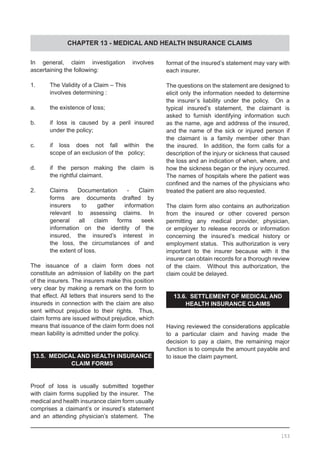
  • 260.
    CHAPTER 19 -PRACTICE OF GENERAL INSURANCE: POLICY FORMS No Claim Discount This section states the percentage discount granted on renewal where no claim is made under the policy. The discount ranges from 25% to 55%. Avoidance of Certain Terms and Right of Recovery The Road Transport Act 1987 makes it compulsory for any motorist to insure against liability in respect of death or bodily injury to third parties caused by or arising out of the use of a motor vehicle. If the insured has committed or omitted something which invalidates the policy or claim, the insurer will still be liable for the liability spelt out in the Act. When the insurer makes a payment under such circumstances, he can recover the amount from the insured. Similarly, if the insurer were to make any payment by virtue of the agreement between the Minister of Transport and the Motor Insurers’ Bureau, he could recover the amount from the insured. General Exclusions a. Any loss, damage or liability arising: • outside the geographical area; • whilst the motor vehicle is driven by any person who has not obtained a licence to drive; • whilst the motor vehicle is driven by any person other than authorized driver; • whilst the motor vehicle is used otherwise than stated in the limitations as to use; • whilst the motor vehicle is being driven under the influence of alcohol or drug to such an extent as to be incapable of having control; • whilst being used for an unlawful purpose; • whilst being tested in preparation for any motor sport or competition (other than treasure hunts). This includes (but is not limited to) reliability trials, hill-climbing tests and rallies; • whilst being left unattended with out proper precautions being taken to prevent further loss or damage and is being driven in an unroad worthy condition before the necessary repairs are effected, any extensions of the damage or any further dam age to the insured vehicle; • from flood, typhoon, hurricane, storm, tempest, volcanic eruption, earthquake, landslide, landslip or other convulsion of nature. b. Any loss, damage or liability caused directly or indirectly by: • invasion, war, foreign hostilities; • strike riots and civil commotion; • mutiny, rebellion, revolution, insurrection, military or usurped power. c. Liability arising out of an agreement entered by the insured and which would not exist in the absence of the agreement. d. Nuclear risks. 260
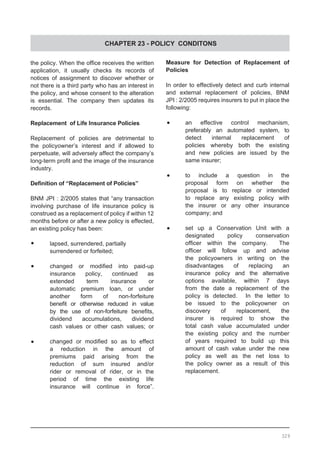
  • 261.
    CHAPTER 19 -PRACTICE OF GENERAL INSURANCE: POLICY FORMS Conditions 1. Duty of Disclosure The insured must disclose fully and faithfully, all the facts which he knows or ought to know. The insured must observe and fulfil the Terms, Conditions, Endorsements, Clauses or Warranties of the Policy. 2. Accidents and Claims Procedures a. In the event of any occurrence which may give rise to a claim under the policy, the insured must as soon as possible give written notice thereof to the Company, with full particulars. b. In the event that the insured vehicle is collided into by a third party vehicle, the insured may refer the claim for cost of repairs to the company. The insured’s NCD entitlement will continue unaffected if the insurer decides that the insured is not at fault. Such determination of fault shall be at the company’s entire discretion. Provided always that such third party vehicle is insured, identifiable and/ or not a vehicle used for the carriage of passengers for hire or reward (for example taxis, hire cars, public buses, stage buses, school buses and factory buses for hire), not a vehicle insured by non-Malaysian insurers and there is no personal injury claim involved. c. All accidents must be reported to the police as required by law. d. Every letter, claim, writ summons and process shall be notified or forwarded to the company immediately on receipt. Notice shall also be given to the company immediately the insured has knowledge of any im pending prosecution, inquest or fatal enquiry in connection with any such occurrence. In case of theft or other criminal act which may give rise to a claim under the policy, the insured shall give immediate notice to the police and cooperate with the company in securing the conviction of the of fender. e. The insured cannot make any negotiation, admission or repudiation of any claim without prior written consent from the insurer. f. The insurer has full discretion in the conduct, defence and/or settlement of any claim. g. No repairs may be authorized to the insured vehicle without prior writ ten consent from the insurer. h. In the event of an accident which gives rise to a claim, the vehicle must be removed to a PIAM Approved Repairer for repairs. Failure to do so would result in breach of the condition and the insurer has the right to decline liability under Section A of the policy. i. In any event giving rise to a claim or series of claims under Section B1b of the policy, the insurer may pay the insured the full amount of the iInsurer’s liability under Section B1b and relinquish the conduct of any defence, settlement or proceeding and the insurer shall not be responsible for any damage alleged to have been caused to the insured in consequence of any alleged action or omission by the insurer in connection with such defence, settlement or proceeding or by the insurer relinquishing such conduct nor shall the insurer be liable for any cost or expenses how whatsoever 261
  • 262.
    CHAPTER 19 -PRACTICE OF GENERAL INSURANCE: POLICY FORMS incurred by the insurer or any claimant or any person after the insurer has relinquished such conduct. 1. Cancellation a. The insured may cancel the policy at any time by giving the insurer a written notice and is entitled to a refund of premium based on the company short period rates, provided no claim has arisen. b. The insurer can cancel the policy by: • giving 14 days’ notice by registered post to the insured’s last known ad dress; • Refunding the premium at a pro rata rate (provided no claim has arisen during the then current period of insurance). c. The insured shall within 7 days from the date of cancellation under paragraph a or b above, surrender the certificate of insurance to the company or, if it has been lost or destroyed or it is not received by the company, to provide a statutory declaration to that effect. 2. Other Insurance The insured must give the insurer a written notice if there is other insurance covering the same vehicle. If there is subsisting insurance, the insurer is liable only for his rateable proportion of any loss, damage, compensation costs or expenses. 3. Subrogation The insurer can take over and conduct in the insured’s name the defence and settlement of any claim or prosecute for his own benefit any claimforindemnityordamagesorotherwise.The insurer has absolute discretion in the conduct or settlement of any claim and the insured should give all information and assistance the insurer requires. 4. Arbitration Clause This states the arbitration procedure. It also spells out that a claim which has been rejected by the insurer will be deemed to be abandoned and not recoverable if it is not referred to arbitration within one year from the date of the disclaimer. 5. Other Matters The policy will only be operative if: a. Any person claiming protection has complied with all its Terms, Conditions, Endorsements, Clauses or Warranties. b. The insured has taken all reasonable precaution to maintain the vehicle in an efficient roadworthy condition. c. The insured has taken all reasonable precautions to safeguard the vehicle from loss or damage. d. The insured must grant free access at all reasonable times for the insurer to examine the vehicle. Schedule The following particulars are stated in the Schedule: 1. name of insurer; 2. name, identity card number, address and occupation of the insured; 3. period of insurance; 4. description of motor vehicle: 262
  • 263.
    CHAPTER 19 -PRACTICE OF GENERAL INSURANCE: POLICY FORMS • registration mark, • make, • type of body, • engine number, • chassis number, • cubic capacity, • year of manufacture, • seating capacity, and • policyholder’s estimated value including accessories; 5. cover granted; 6. excess applicable; 7. geographical area; 8. legislation; 9. authorised driver; 10. limitations as to use; 11. premium; and 12. date of signature of the proposal and the declaration. Attestation This has the effect of binding the insurer to the contract 263
  • 264.
    CHAPTER 19 -PRACTICE OF GENERAL INSURANCE: POLICY FORMS SELF - ASSESSMENT QUESTIONS CHAPTER 19 1. Exclusions are inserted into policies for the following reasons, EXCEPT a. cover can be provided under more appropriate policies. b. the risks are uninsurable. c. the cover is not demanded by insureds. d. tnsurer requires additional premium for such cover. 2. A claim notification from the insured under a fire policy must be done a. immediately. b. immediately, and in writing. c. immediately,and followed by a notice in writing within 15 days. d. immediately, followed by a written notice with all relevant details of the claim. 3. The following persons are covered under a motor third party policy: a. any drivers. b. the insured. c. the insured and any authorized drivers. d. none of the above. 4. The wording in the recital clause of a fire policy is not prescribed by the tariff and may state the following, EXCEPT a. the insured has proposed to the company. b. the proposal and declaration shall be the basis of contract between the insured and the insurer. c. the premium must be paid before the risk commencement or acceptance by the insurer. d. the insured has paid or agreed to pay the first premium stated in the schedule as consideration. 264
  • 265.
    CHAPTER 19 -PRACTICE OF GENERAL INSURANCE: POLICY FORMS 5. Failure to notify the company of any other insurance effected on the same property before or after effecting the policy will allow the insurer to a. forfeit all benefits under the policy. b. pay only their portion of the claim. c. ask for written clarification from the insured. d. pay only for certain benefits and not the full sum insured. 6. The final component of the policy is/are the a. policy jacket. b. policy schedule. c. exclusions. d. conditions. 7. The item that is not covered under the Preamble of a motor policy is a. the cover note should be read together with the policy. b. the proposal form is the basis of the contract. c. mention of the premium as being paid or having been agreed to be paid. d. the insurer will provide the cover detailed in the policy. 8. Which of the following is NOT an exclusion under a standard comprehensive motor policy? a. death or bodily injury to policyholder due to motor accident. b. liability against claims from passengers in the insured’s vehicle. c. damage to windscreen of insured’s vehicle due to an accident. d. own damage to the insured vehicle due to an accident. 9. Premium will be considered paid only if a. a printed form of receipt signed by an official or an appointed agent of the company is given to the insured. b. the policyholder gives a written statement to say that he has paid the premium. c. the policyholder is able to produce a copy of the cheque given to the insurer. d. the policyholder has a copy of the cover note. 265
  • 266.
    CHAPTER 19 -PRACTICE OF GENERAL INSURANCE: POLICY FORMS 10. The fire insurance policy is extended to cover the following, EXCEPT a. wages of the policyholder’s employees. b. cost of replacement of fire fighting appliances. c. expenses incurred in preparing the claims documents. d. fire brigade charges incurred in extinguishing fire at or adjoining the situation of the property. YOU WILL FIND THE ANSWERS AT THE BACK OF THE BOOK. 266
  • 267.
    CHAPTER 20 - PRACTICEOF GENERAL INSURANCE: ETHICS AND CODE OF CONDUCT Overview 20.1. The Essentials of the Inter-Company Agreement on General Insurance Business 20.2. Commission 20.3. Cash-Before-Cover 20.4. Guidelines on Claims Settlement Practices OVERVIEW In this chapter, we shall look at the self-regulatory aspects of the general insurance industry in Malaysia. These will be considered under the following headings:- • The Essentials of the Inter-Company Agreement on General Insurance Business • Commission • Cash-Before-Cover • Guidelines on Claim Settlement Practices 20.1. THE ESSENTIALS OF THE INTER- COMPANY AGREEMENT ON GENERAL INSURANCE BUSINESS (ICAGIB) The Inter-Company Agreement on General Insurance Business was made on 24 April 1992. It superseded the three earlier Inter-Company Agreements on Motor Tariff, on Fire Tariff and on Agencies. The Inter-Company Agreement on General InsuranceBusiness,likethethreepreviousInter- Company Agreements stated earlier, was made amongst all members of Persatuan Insuran Am Malaysia (PIAM) with the objectives of:- • promoting and protecting the interests of the general insurance industry, for the mutual benefits of all the members of PIAM and the public, in connection with general insurance business; 267
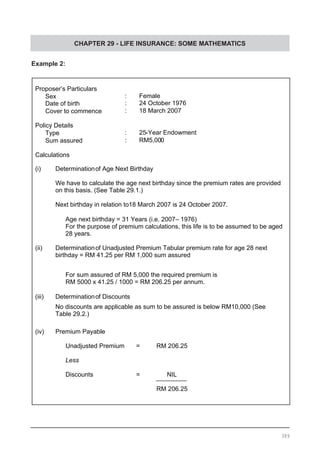
  • 268.
    CHAPTER 20 - PRACTICEOF GENERAL INSURANCE: ETHICS AND CODE OF CONDUCT • regulating and controlling the conduct and activities of every person transacting general insurance business in Malaysia; • monitoring the tariffs, commissions and remuneration applicable to general insurance business. For the purposes of regulating and controlling the conduct and activities of all registered agents and to ensure compliance with the Regulations, a Board is appointed by the Management Committee of PIAM with the expressed acceptance of all members of PIAM. The powers of the Board, amongst others, include the following:- a. to receive and to consider applications for registrations of any person or persons as registered agents in order to deal, sell, transact, negotiate and/or procure general insurance business for and on behalf of any insurer; b. to issue, renew or extend certificates of registration to approved persons; c. to approve and certify the appointment by any registered agents of any corporate nominees; d. to monitor and to control the conduct and activities of registered agents to ensure compliance in accordance with the Regulations and/or Guidelines; e. to recommend to the Management Committee the appointment of a Registrar or any other person for the administration of the functions of the Board; f. to notify the Management Committee of any breach or foreseeable breach of the Regulations and/or Guidelines committed or to be committed by any registered agents or any other person or persons; g. to consider and to approve appeals for exemptions from the terms of the Regulations and/or Guidelines; h. to consider and to approve the appointment and removal of motor vehicle franchise holders in the Second Schedule. Interested readers are directed to refer to Article VII of the Inter-Company Agreement on General Insurance Business for further details on this subject of Power of the Board. Enforcement of the ICAGIB is provided under Article VIII of the Agreement which provides, among other matters, for the formation and appointment of an Inspection Task Force. The Task Force is given the authority to conduct inspections and carry out investigation on the conduct and activities of any member of PIAM in accordance with the manner provided in the Agreement. This includes the authority to enter any of the member’s premises and the inspection of documents on the premises. Article IX of the ICAGIB provides for disciplinary procedures, penalties and appeals. It states that any alleged breach of the Agreement and/or the regulations thereunder shall be dealt with by the Management Committee of PIAM in accordance with Article 18 of the Constitution of the Association. Article 18 of the Constitution provides for the formation of a Disciplinary Committee by the Management Committee. When a breach is admitted or when the Disciplinary Committee has established positively that a breach has been committed, appropriate penalties (including the imposition of fines) or a combination thereof shall apply. 268
  • 269.
    CHAPTER 20 - PRACTICEOF GENERAL INSURANCE: ETHICS AND CODE OF CONDUCT - settle or approve insurance claims. Suspension of Registered Agent • Members of PIAM shall suspend immediately the operation of a registered agent found, by the Board after due investigations, to have breached the Regulations. The suspension is to be in force until further notice from the Board. Cancellation of Certificate of Registration • Members of PIAM shall terminate the appointment of a registered agent within thirty days of receipt of a notice from the Board that the agent’s certificate has been revoked, cancelled or refused renewal by the Board. Information • Members of PIAM shall :- - keep a complete and up-to-date record of all their agents, including their corporate agents, directors, shareholders and corporate nominees; - maintain proper and accurate accounts showing the amounts of commission paid by them to their agents; - provide the Board with any information concerning any of their agents as and when requested. 20.1.2. Motor Tariff Article V of the Inter-Company Agreement on General Insurance Business makes provisions for the following: 20.1.1. Dealings with Agents Article IV of the Inter-Company Agreement on General Insurance Business provides for the following: Authorized Agents • In dealings involving intermediaries, all members of PIAM shall only authorize, deal and/or transact general insurance business with registered agents or brokers (Registered agents are to have prescribed qualifications and are to be registered with the Registrar of PIAM.) Restriction on Payments • No commission of whatsoever nature shall be paid to anyone who is not a registered agent or broker whether directly or indirectly for procuring, selling, transacting, dealing or negotiating any general insurance business. Compliance with Regulations • All members of PIAM shall ensure that their registered agents comply with all the rules for the registration and regulation of general insurance agents provided under the Third Schedule of the ICAGIB (see below 20.1.4.). Scope of Agency • Members of PIAM shall not permit or authorize their agents to :- - issue or complete insurance policies; - conduct a loss survey or make loss adjustments; 269
  • 270.
    CHAPTER 20 - PRACTICEOF GENERAL INSURANCE: ETHICS AND CODE OF CONDUCT Malaysian Motor Tariff The Malaysian Motor Tariff applies to all classes ofmotorinsurancevehiclesgaragedinMalaysia, Brunei and the Republic of Singapore. The Motor Tariff provides: 1. the premium rates chargeable for the various classes of motor vehicles according to the different uses and covers provided; 2. standard and simplified wordings for the policy, endorsements and warranties; 3. specimen documents of the Policy Schedule, Certificate of Insurance and cover note; 4. general rules and regulations governing the conduct of motor insurance business in Malaysia. The Motor Tariff further provides that: a. There is no Motor Business which is non-Tariff unless specifically published and for cases not provided for, application for them must be submitted to PIAM. b. This Tariff does not apply to any motor vehicle which is not licensed and used on the road. c. Any cover in respect of use on the road of any motor vehicle may not be insured otherwise than under a Motor policy.” There are two segments in the Tariff, one is to cater for risks underwritten in West Malaysia and the other is for East Malaysia. The coverage afforded and the like are similar to one another except for the premium/rates which are lower in East Malaysia. Traditionally, East Malaysia has had a better claims experience owing to the fact that it has less roads and vehicles compared to West Malaysia. All insurance policies covering motor risks in Malaysia issued, accepted and endorsed by members of PIAM shall be applied at least the minimum rates stipulated in the Malaysian Motor Tariff. The Motor Tariff is divided into 11 sections, namely: 1. Knock-for-Knock Agreement (KfK) 2. General Regulations 3. Guide to Completion of Policy Schedules 4. Guide to Completion of Certificate 5. Private Car Tariff 6. Commercial Vehicle Tariff 7. Motor Cycle Tariff 8. Endorsements 9. Warranties The Rules and Regulations under the Malaysian Motor Tariff include those relating to the following: • Business Not Provided For • Policy Forms (inclusive of Endorsements, Clauses and Warranties) • Cover Available • Value of Vehicles • Period of Insurance 270
  • 271.
    CHAPTER 20 - PRACTICEOF GENERAL INSURANCE: ETHICS AND CODE OF CONDUCT • Short Period Rates • Premium – Payment, Computation, Reduction and Premium to be shown in Policies • Hire Purchase • Change of or Additional Vehicles • Transfer of Interest in a Policy and Transfer Fee • Cancellation of Policies (inclusive of Extra Benefits) • Announcements to Public regarding “Act” Policies • Cover Permissible and Discounts under “Act” Policies • Cover Notes • Certificate of Insurance - Original Issue, Return, Cancellation or Duplicates • No Claim Discount • Fleet Ratings • Joint Policies (Policies Issued in Joint Names) • Vehicles Laid Up in a Public or Private Garage • Strike, Riot and Civil Commotion • Minimum Premium • Warranty on Overloading of Vehicle Equipment All Risks Insurance policies in respect of all motor vehicles licensed for road use by the Road Transport Department shall be rated and comply strictly with the Malaysian Motor Tariff. No Rebate or Discounting No member of PIAM, agent or broker shall give to any insured or policyholder, any discount or rebate whatsoever on any commission paid or payable or on part or parts thereof under a motor insurance policy. 20.1.3. Fire Tariff Article VI of the Inter-Company Agreement on General Insurance Business makes provision for the following: Revised Fire Tariff All insurance policies covering loss of profits, fire and allied perils risks in Malaysia issued, accepted and endorsed by members of PIAM shall be applied at least the minimum rates stipulated in the Revised Fire Tariff. Members shall also comply with the rules and regulations provided under the Revised Fire Tariff. The Rules and Regulations under the Revised Fire Tariff include those relating to the following: • Application and interpretation of the Tariff • Fire policies, conditions and information to be shown • Company responsibility • Reinsurance • Commission/brokerage/co-insurance cost 271
  • 272.
    CHAPTER 20 - PRACTICEOF GENERAL INSURANCE: ETHICS AND CODE OF CONDUCT • Notification of losses • Submission of statistics • Floating policies. • Basis of settlement • Special perils • Temporary removal • Removal of debris • Architect’s, surveyor’s and consulting engineer’s fees • Other contents • Capital additions • Mortgagees/ Chargees • Term of insurance • Reinstatement • Declaration policies • Building in the course of construction • Stamp duties • Rates and special rating • Electrical plant and installations • Short period insurance • Long-term insurances and agreements • Cancellation • Premium - return, minimum and instalment • Warranties, clauses and endorsements • Package or combined policies • Fire consequential loss policies • All risks policies • Non-permissibility of discounts except as specifically provided in the Tariff relating to special features • Insurance of growing trees • Temporary storage • Sprinkler leakage • Subsidence and landslip • Construction, and trade/occupation classifications 20.1.4. General Insurance Agents Registration Regulations (GIARR) The rules for the registration and regulation of general insurance agents are enacted under the Third Schedule of the ICAGIB. The rules, known as the General Insurance Agents Registration Regulations, were formulated in consultation with BNM to provide the method of recruitment and supervision of intermediaries with a view to regulate, monitor and control the intermediaries’ professional conduct, work and activities and thereby create a cadre of dedicated and disciplined intermediaries with high professional standards. The provisions under the Regulations, among others, include the following: i. The definition of corporate agency; ii. The appointment of a General Insurance Agents’ Registrar who shall administer GIARR; 272
  • 273.
    CHAPTER 20 - PRACTICEOF GENERAL INSURANCE: ETHICS AND CODE OF CONDUCT iii. The keeping of a Register containing the names, addresses and such other subscribed particulars of all persons registered pursuant to GIARR; iv. The procedures for application for registration to be a general insurance agent; v. The requirement for every applicant to be registered to have first obtained the necessary written examination qualification, such as the Pre-Contract Examination for Insurance Agents of The Malaysia Insurance Institute; vi. The disclosure and restriction of other interest(s) of the applicant for registration, including the restriction that an insurance agent or any person employed or engaged by a corporate agency shall not be an employee or a director of or a shareholder or debenture holder in or have any interest in an insurance company, an insurance broking firm and/or a loss adjusting firm without the prior written approval of the Board appointed under the ICAGIB. The prohibition shall not apply where the shares of the company(ies) are listed on the Kuala Lumpur Stock Exchange; vii. The cancellation or suspension of registration or refusal to register by the Board of any person applying for registration or already registered in the Register who • is found to be of unsound mind; • has been convicted of criminal misappropriation, criminal breach of trust, cheating or forgery or abetment of or attempt to commit any such offence; • has been convicted of fraud, dishonesty or misrepresentation against any member of PIAM or against any person having official dealings with any member of PIAM; • has been declared a bankrupt or insolvent; • has outstanding premium debts or other financial obligations with an other insurer with whom he previously had an agency agreement; • has had his registration terminated by PIAM; • is subject to the restriction of other interest(s) mentioned in vi) above; • has obtained registration by a fraudulent or an incorrect statement; • has no subsisting agency agreement with any general insurance company or companies he purports to represent; viii. The compliance with the enforcement of the Cash-Before- Cover (CBC) Regulations) issued by Bank Negara Malaysia in relation to any agent, including any requirement by Bank Negara Malaysia for the suspension or cancellation of a Certificate or Registration issued to an agent; ix. The issue of a Certificate of Registration, valid for a period of two years (unless earlier cancelled), to a person registered in the Register; x. The display at all times by an insurance agent of his Certificate of Registration at his place of business, and at each 273
  • 274.
    CHAPTER 20 - PRACTICEOF GENERAL INSURANCE: ETHICS AND CODE OF CONDUCT branch office of the Certificate of Registration for the branch office; xi. The requirement that an insurance agent shall at all times ensure that each branch office has • proper office premises to transact general insurance business; • a valid licence obtained from the local authorities/municipality to operate such business; • a proper signboard on display indicating the name of the agent and the company or companies that he represents; • at least one qualified staff who is a holder of an approved written examination qualification, such as the Pre-Contract Examination for Insurance Agents of The Malaysian Insurance Institute, stationed at the branch office to attend to the daily transactions of general insurance business at the branch office; xii. The functions of a registered general insurance agent: Every general insurance agent shall solicit and procure new insurance business in the terms of his appointment as agent and shall endeavour to conserve the business already secured. In procuring new business the insurance agent shall: • take into consideration the needs of the proposers for general insurance and their capacity to pay premiums; • make all reasonable enquires in regard to the risks and to bring to the notice of his principal any circumstances which may adversely affect the risk to be written: • take all reasonable steps to ensure that the necessary proposal forms are fully and accurately completed by each proposer of insurance. With a view to instilling a higher level of professionalism and commitment amongst agents, a. every registered general insurance agent shall ensure that he procures sufficient general insurance business (be it new general insurance business or renewals of existing policies) which results in the actual receipt of gross premiums totalling at least RM20,000 for each agency (the “Minimum Maintenance Requirement”); b. the Minimum Maintenance Requirement shall be achieved during either the first or second years of the two (2) year period of validity of the Certificate of Registration. For the purposes of achieving the Minimum Maintenance Requirement, the agent shall not be entitled to take the cumulative amount of the gross premiums as actually received during the validity period of the Certificate of Registration; c. the Minimum Maintenance Requirement shall apply to all agents registered or whose Certificate of Registration is renewed after the amendments to GIARR to incorporate the Minimum Maintenance Requirement; d. any agent who fails to meet the Minimum Maintenance Requirement shall not be entitled to renew his Certificate of Registration or apply for registration as an agent for a period of twelve (12) months. 274
  • 275.
    CHAPTER 20 - PRACTICEOF GENERAL INSURANCE: ETHICS AND CODE OF CONDUCT In conserving the business already secured, the insurance agent shall endeavour to maintain contact with all persons who have become policyholders through him and shall render all reasonable assistance to the claimants in filing claim forms and generally in complying with the requirements laid down in relation to the settlement of claims. Insurance agents, however, are not permitted to perform the functions pertaining to loss surveys, loss adjustment or the settling or approving of any insurance claims; xiii. The conduct of a general insurance agent shall be guided by the General Insurance Business Code of Practice for All Intermediaries Other than Registered Insurance Brokers included as Appendix III of the ICAGIB. (See 20.1.5. of this chapter). A declaration of observance of this Code is signed by every registered general insurance agent. Insurance brokers in Malaysia are exempted from this Code as they are more specifically governed by the Code of Ethics and Conduct issued by the Insurance Brokers Association of Malaysia. In addition to being guided by the General Insurance Business Code of Practice for All Intermediaries Other than Registered Insurance Brokers, an insurance agent a. shall not make or issue or cause to be made or issue any written or oral statement misrepresenting or making misleading, unfair or biased comparison regarding the terms, conditions or benefits in any policy; b. shall not prevent the person effecting insurance from stating material facts to the insurance company or induce the person not to state them; c. shall not induce the person effecting insurance to make a misrepresentation to the general insurance company in regard to material facts; d. may not at any time represent more than two general insurance companies; e. shall not engage any person to solicit for insurance on his behalf and shall not pay to such person any commission or any other compensation in respect thereof. This prohibition does not apply to corporate agencies engaging full-time employees for functions other than for soliciting insurance; f. shall comply in all material respects with the terms and conditions of the ICAGIB made between and amongst the members of PIAM (as amended and as may be amended from time to time) and all rules and regulations issued thereunder: • that such agent conduct himself in any manner as may be required, • that the principal of such agent ensure that such agent conducts himself in any manner as may be required. xiv. Premiums or Monies Collected on Behalf of Principal a. An agent shall remit direct to to his principal or remit/deposit into a bank account designated by the principal in the name of the principal, all premiums and/or monies collected on behalf of his principal. 275
  • 276.
    CHAPTER 20 - PRACTICEOF GENERAL INSURANCE: ETHICS AND CODE OF CONDUCT b.1. An agent shall ensure that in the case of: aa. cash-before-cover motor policies, all premiums must be collected in full before the commencement of the assumption of risk and remitted to his principal within seven (7) working days from the date of collection or inception of the policy, whichever is earlier; bb. cash-before-cover for individual personal accident and individual travel insurance, all premiums must be collected in full before the commencement of the assumption of risk and remitted to his principal within fifteen (15) calendar days from the date of receipt of the premium or inception of the policy, whichever is earlier; cc. other classes of business with the exception of marine cargo, marine hull, bonds, contractors’ all risks and erection all risks policies, the agent may offer credit to his client for a maximum period of sixty (60) days from the date of inception of the policy and on such terms as are approved by his principal in writing. All premiums collected by the agent must be remitted to the principal within fifteen (15) calendar days from the date of collection. b.2. Pursuant to the revised Guide lines on CBC Requirements issued by Persatuan Insurans Am Malaysia under Members Circular No 187 of 2008 dated 15 September 2008 (“Guidelines on CBC Requirements”), each insurer is required to: aa. monitor compliance of their respective Agents with the requirements of cash-before-cover (motor) policies (“CBC Requirements”); bb. monitor compliance with CBC Requirements by their agents on a quarterly basis (“Reporting Quarters”) in respect of each period of two (2) calendar years (“Period”). The first of such two (2) calendar year periods shall commence from 1 July 2005 and expire on 31 December 2006. The monitoring of compliance with CBC Requirements shall start afresh for each Period; cc. submit a report to the Board within fourteen (14) days of each Reporting Quarter (“Report”) on any non-compliance with CBC Requirements by their agents; dd. notify the Board of a Suspension Event in relation to any of their agents. This notification is to be in writing (“Notification of Suspension Event”) and is to be issued to the Board not later than fourteen (14) days after the expiry of the Reporting Quarter when the Suspension Event took place; ee. suspend the relevant agent, upon a Suspension Event, from conducting any CBC business for a period of six (6) months (“the Suspension”) with the Suspension to commence fourteen (14) days from the date of issue of the Notification of Suspension Event; ff. immediately shut down computer access to the relevant agent, upon a Suspension Event, to stop the conduct of any CBC business. 276
  • 277.
    CHAPTER 20 - PRACTICEOF GENERAL INSURANCE: ETHICS AND CODE OF CONDUCT b.3. A “Suspension Event ” for the purposes of the Guidelines on CBC Requirements and for these Regulations is: aa. where the agent has one (1) principal, when the agent is not in compliance with CBC Requirements for any three (3) Reporting Quarters (whether consecutive Reporting Quarters or otherwise) within the Period; bb. where the agent has two (2) principals, when the agent is not in compliance with CBC Requirements for three (3) Reporting Quarters (whether consecutive Reporting Quarters or otherwise) within the Period for one or both principals. b.4. The Board shall notify and require the principal or all the other principals of the agent who has committed the Suspension Event to effect the Suspension within fourteen (14) days from the date of issue of the notification by the Board. b.5. Where an agent has been Suspended, the agent concerned is not allowed to appoint a new principal (if the agent has 1 principal only) and/or change his principal during the period the agent is suspended. b.6. Upon expiry of the suspension and where based on a Report the relevant agent is again in breach of CBC Requirements for any subsequent Reporting Quarter with any one principal, the Board shall cancel the certificate of registration issued to the agent. The cancellation of the certificate of registration shall be final and binding upon the agent. The agent is also barred from conducting any general insurance business for a period of twelve (12) months. b.7. The Reports and the Notification of Suspension Event issued pursuant to the Guidelines on CBC Requirements shall be treated as final and conclusive by the Board. b.8. The requirements of Regulations 9(iii), 19, 20 and 21 of these Regulations shall not apply in relation to the matters covered by the Regulations including the exercise of the powers of the Board conferred by this Regulation. The terms as defined in the Guidelines on CBC Requirements shall apply for the purposes of these Regulations. xivi. Effective 1 January 2005, all practitioners in the general insurance agency force must comply with the Guidelines on Continuing Professional Development (CPD) Programme. The objective of the CPD Programme is to raise the standard of competency and professionalism of the general insurance agency force. The CPD will serve as a guide as to what training programme the agency force should pursue in order to stayupdatedandcontinuouslyupgraded, keeping the agency force abreast of the latest development and demands of the financial services industry. There are four (4) Sections in the CPD Programme: Section 1 Minimum CPD Training Hours All registered agents are required to complete the minimum 20 CPD training hours annually. 277
  • 278.
    CHAPTER 20 - PRACTICEOF GENERAL INSURANCE: ETHICS AND CODE OF CONDUCT Section 2 CPD - Syllabus and Scope The credit points can be earned either through attendance of the programme or its assessment such as assignment, evaluation test, examination, etc. The training initiatives must be skills and knowledge-based programmes and purely motivational programmes are not encouraged. The breakdown of the 20 CPD training hours awarded for the various structured and unstructured courses will be as follows: i. Technical Training - minimum of 60% (12 hours) ii. Non-Technical Training - maximum of 40% (8 hours) The approved training programmes are categorized as follows: • Technical Subjects i. Property/Engineering ii. Liability iii. Marine iv. Healthcare/Medical v. Miscellaneous vi. Motor • Non-Technical Subjects i. Sales and Marketing ii. Computer Literacy iii. People Management iv. Personal Development v. General Knowledge • Seminars/Congresses and Conferences Seminars/Congresses and Conferences should not exceed 20% of CPD hours for a particular year. This 20% of CPD hours may be divided into technical or non-technical training, depending on the topics covered. List of Approved Providers The CPD hours will be awarded for attending seminars/ congresses/ lectures/ conferences/ coaching conducted by the following list of providers or insurance companies: i. Courses conducted by approved industry education providers like MII, CII, AII and other general insurance-related bodies; ii. MII Annual Lectures; iii. Annual General Insurance Agency Conventions, National Achievers Congress, company conventions and congresses; iv. In-house training on new products launched by insurers; v. Technical Courses provided by relevant institutions, e.g. The Inland Revenue Board, Actuarial Society, MIA, ACCA, ICMA, MICPA, etc. vi. Coaching of agents by principals. 278
  • 279.
    CHAPTER 20 - PRACTICEOF GENERAL INSURANCE: ETHICS AND CODE OF CONDUCT 279 Section 3 Credit Hours and Accreditation The rules and regulations governing credit hours accreditation:
  • 280.
    CHAPTER 20 - PRACTICEOF GENERAL INSURANCE: ETHICS AND CODE OF CONDUCT The following conditions will apply in awarding the credit points: • Credit points for CPD can be earned only once for the same programme, i.e. every individual can earn credit from the same programme only once per agency contract. • Credit points awarded through the first Principal are transferable to the second Principal under which the agent is registered with PIAM. • Extra credit points earned in a year cannot be carried forward to the following year. Section 4 Compliance The individual insurers shall be responsible to monitor the compliance with, to keep track of and to record all CPD requirements of their agents, and to submit them annually in a prescribed form to the PIAM Agency Board. In a situation where the agent has two principals, it would be the responsibility of the respective principals to ensure that their agent complies with CPD requirements. Penalties The following penalties will be imposed on general insurance agents who do not meet the 20 CPD training hours requirement: • First time offence: Letter of Warning to be issued to the agent by the insurer. • Subsequent offence(s): Suspension Letter to be issued to the agent by the insurer (commencing year 2006) and the agent would also be required to make up the shortfall of the 20 CPD hours in the following year. Section 4 also covers: The disciplinary and inquiry measures that the Board may take in cases of contravention of GIARR; and The powers of the Board to make rules to carry out the objectives and purposes of GIARR. 20.1.5. General Insurance Business for All Intermediaries Other than Registered Insurance Brokers Under Appendix III of the ICAGIB, PIAM has formulated the following:- • It is to be an overriding obligation of an intermediary at all times to conduct business with the utmost good faith and integrity. • The intermediary involved in a complaint from a policyholder is to cooperate fully with the insurance company concerned with a view towards establishing the relevant facts. The intermediary is also required to inform the policyholder of his rights to take the matter of dispute direct to the insurance company. a. The following general sales principles are to be abided by an intermediary :- The intermediary shall i. where appropriate, make prior appointment to call. Unsolicited or unarranged calls shall be made 280
  • 281.
    CHAPTER 20 - PRACTICEOF GENERAL INSURANCE: ETHICS AND CODE OF CONDUCT at an hour likely to be suitable to the prospective policyholder; ii. on contact with the prospective policyholder:- - identify himself; - inform the prospective policyholder that he wishes to discuss insurance; - make it known to the prospective policyholder the company/ies for which he is acting as an agent and that the company/ies concerned accept responsibility for his conduct. iii. ensure as far as possible that the policy proposed is suitable to the needs and resources of the prospective policyholder; iv. give advice only on those insurance matters in which he is knowledgeable and seek or recommend other specialist advice when necessary; v. treat all information supplied by the prospective policyholder as completely confidential to himself and the insurance company. The intermediary shall not i. inform the prospective policyholder that his name has been given by another person unless he is prepared to disclose that person’s name if requested to do so by the prospective policyholder and has that person’s consent to make that disclosure; ii. make inaccurate or unfair criticisms of any insurer; iii. make comparisons with other types of policies unless he makes clear the differing characteristics of each policy; iv. prevent the prospective policyholder from stating material facts to the insurance company or induce the person not to state them; v. induce the prospective policyholder to make a misrepresentation to the insurance company in regard to material facts. Factors to be Observed when Explaining a Contract: b. The following factors should be borne in mind when explaining the contract : The intermediary shall : i. identify the insurance company; ii. explain all the essential provisions of he cover provided by the policy or policies which he is recommending, so as to ensure as far as possible that the prospective policyholder understands what he/ she is buying; iii. draw attention to any restrictions and exclusions applying to the policy; iv. if necessary, obtain specialist advice from the insurance company in relation to ii) and iii) above; and v. not to impose any additional charges to those of the premiums required by the insurance company without disclosing the amount and purpose of such charges. 281
  • 282.
    CHAPTER 20 - PRACTICEOF GENERAL INSURANCE: ETHICS AND CODE OF CONDUCT c. The following shall be observed in the disclosure of underwriting information:- The intermediary shall, on obtaining the completed proposal form or any other material, - take all reasonable steps to ensure that the necessary proposal forms are fully and accurately completed by each prospective policyholder; - avoid influencing the prospective policyholder and make it clear that all the answers or statements are the prospective policyholder’s own responsibility; - ensure that the consequences of non disclosure and inaccuracies are pointed out to the prospective policyholder by drawing his attention to the relevant statement in the proposal form and by explaining them himself to the prospective policyholder; and - make all reasonable inquiries in regard to the risks and to bring to the notice of his Principal any circumstances which may adversely affect the risk to be underwritten. d. The following are to be observed in relation to accounts and financial aspects:- The intermediary shall, if authorized to collect monies in accordance with the terms of his agency appointment, - keep proper accounts of all financial transactions with his prospective policyholders, which involve transmission of money in respect of insurance; - acknowledge receipt of all money received in connection with an insurance policy and shall distinguish the premium from any other payment included in the money; and - remit any such monies so collected in strict conformity with his agency appointment. e. With regard to documentation: The intermediary shall not withhold from the policyholder any written evidence or documentation relating to the contract of insurance (including any endorsements or discounts or monies due to the policyholder thereon that are allowed by the insurance company). f. With regard to existing policyholders:- The intermediary shall: • abide by the principles set out in the code of conduct for intermediaries to the extent that these are relevant to his dealings with existing policy holders; • with a view to conserving the business already secured render appropriate after-sales service. g. With regard to claims : The intermediary shall: i. on being informed by a policyholder of an incident which may give rise to a claim, - inform the insurance company without delay (i.e. within three working days); 282
  • 283.
    CHAPTER 20 - PRACTICEOF GENERAL INSURANCE: ETHICS AND CODE OF CONDUCT - thereafter give prompt advice to the policyholder of the insurance company’s requirements concerning the claim, including the provision as soon as possible of information required to establish the nature and extent of the loss; - pass the information received from the policyholder to the insurance company without delay. ii. take note that the Code specifically forbids an intermediary from performing the function of a loss adjuster or surveyor or settling or approving any insurance claims. 20.2. COMMISSION An efficient and responsible insurer is one that conducts its business in a prudent manner which includes the exercise of control over collection of premiums, expenses and its business development strategies The Guidelines to Control Operating Costs of General Insurance Business issued by BNM, revised on 31 December 1993, provide amongst other matters for the maximum gross commissions and agency-related expenses for the following classes of insurance business written within Malaysia to be limited to the following percentages of gross direct premiums: The maximum limits should apply on a policy by policy basis from the date of commencement of risk. In respect of a package policy, the maximum is that applicable to the cover with the largest proportion of the premium. The Inter-Company Agreement on General Insurance Business further provides that no discount or rebate whatsoever shall be given to any insured or policyholder on any commission paid or payable under a motor insurance policy. (See section 20.1.2. of this chapter - No Rebate or Discounting.) The limit on commission for the fire classes of insurance under the BNM Guidelines is reiterated under the Revised Fire Tariff which states that the maximum amount payable by way of commission to agents, underwriting agents and brokers is 15%. It further provides that where the client deals with the insurer directly without an agent or broker as intermediary, the insurer may allow a discount not exceeding 15% on the premium receivable. 20.3. CASH-BEFORE-COVER Pursuant to section 141 of the Insurance Act 1996 regarding the assumption of risk, Part XV Regulation 65 of the Insurance Regulations 1996 identifies the policies of motor insurance as that which an insurer or its insurance agent shall not assume unless the premium for the policies • has been paid to the insurer or its agent (cash-before-cover); or • is secured by an irrevocable bank guarantee and is paid by the end of the month following the month in which the risk is assumed, failing which a demand is made on the bank guarantee. 283
  • 284.
    CHAPTER 20 - PRACTICEOF GENERAL INSURANCE: ETHICS AND CODE OF CONDUCT Regulation 65 also provides that where the premium in respect of a motor policy covering a commercial vehicle is more than RM5,000 an insurer may assume risk upon the payment to its account or the account of its insurance agent whom it authorizes, an amount of at least 30% of the premium, with the balance being secured for payment within 45 days of the assumption of risk. Part XV Regulation 66 provides that an insurance agent receiving payment of premium for a motor policy shall pay the amount into the insurer’s account within seven (7) working days from the date of assumption of risk. Penalty for breach is RM500,000. In this regard, an agent shall maintain a bank account designated in the name of the general insurance company which he represents and shall deposit into such account all premiums and/or monies collected on behalf of his principal insurance company (in gross before deducting any commission). The definition of “payment” has under Part XV of the Insurance Regulations 1996 been extended to include payment by way of credit/debit or charge cards and electronic fund transfers in the purchase of motor insurance. The old regulations provide only for payment by way of cash, cheque, money order or postal and bank draft/cashier’s order. In other classes of business with the exception of marine cargo, marine hull, bonds, contractors’ all risks and erection all risks policies, the agent may offer credit to his client for a maximum period of sixty (60) days from the date of the inception of the policy and on such terms as are approved by his principal in writing. An agent must ensure that all cheques or drafts from the insured are drawn in favour of the principal insurance company. 20.4. GUIDELINES ON CLAIMS SETTLEMENT PRACTICES An efficient and responsible insurer is one that conducts its business in an equitable and prudent manner and this includes meeting claims promptly and in a fair manner. If claims services and payments are delayed or withheld without satisfactory reasons, policyholders will lose confidence in the insurer and the insurance industry. With this in consideration, BNM issued the Guidelines on Claims Settlement Practices in February 1995, which laid down the basic principles of claims processing which need to be followed by the insurance industry The Guidelines are the minimum standards prescribed for handling general insurance claims and do not restrict or replace the sound judgment of insurers aimed at maintaining the goodwill and trust of customers. The Guidelines are divided into two parts: Part I deals with claims other than motor, while Part 11 covers motor insurance claims. The Guidelines also provide for the maintenance of a claims register and files which must be complete and updated at all times and containing at least the subscribed information of each claim. In Part I (Claims other than Motor), among others, the Guidelines deal with: i. Claims procedures • Notification of claims • Verification of facts • Assessment of claims • Settlement • Payment of claims 284
  • 285.
    CHAPTER 20 - PRACTICEOF GENERAL INSURANCE: ETHICS AND CODE OF CONDUCT ii. Disclosure of material fact In Part II (Motor Insurance Claims), among others, the Guidelines deal with i. Own damage claims • Notification of claims • Assessment of claims • Settlement ii. Total loss claims iii. Theft claims • Notification • Settlement iv. Subrogation agreements v. Third Party claims • Property damage claims • Knock-for-Knock Agreement • Excess clause • Non/Late reporting of motor third party property damage claims • Loss of use • Bodily injury claims • Notification of claim • Investigation of claim • Processing for settlement. 285
  • 286.
    CHAPTER 20 - PRACTICEOF GENERAL INSURANCE: ETHICS AND CODE OF CONDUCT SELF - ASSESSMENT QUESTIONS CHAPTER 20 1. Under the Inter-Company Agreement, agents are allowed to a. issue or complete insurance policies. b. settle and approve claims. c. conduct a loss survey. d. collect premiums. 2. When approaching a prospective policyholder, the agent must NOT a. surprise the prospective policyholder by calling when he is unprepared. b. explain fully the essential provisions of the cover. c. draw attention to any restrictions and exclusions. d. identify the insurer. 3. When informed of a claim by the policyholder, the agent must NOT a. inform the insurer immediately. b. pass on to the insurer all information received from the policyholder.. c. assess the loss and advise the policyholder of the amount of settlement. d. advise the policyholder of the requirements of the insurer in order to file a proper claim. 4. JPI/GPI (Revised) Guidelines on Claims Settlement Practices does NOT allow an insurer to repudiate a claim as a consequence of a. technical breaches of warranty or policy conditions which are not connected to the loss. b. breach of a warranty which has prejudiced the interest of the insurer. c. breach of a warranty which affects the loss amount. d. innocent misrepresentation of a material fact. 286
  • 287.
    CHAPTER 20 - PRACTICEOF GENERAL INSURANCE: ETHICS AND CODE OF CONDUCT 5. The objective of the Continuing Professional Development programme is I. to raise the standard of competency and professionalism of the general insurance agency force. II. to make sure that the number of agents in the market is limited. III. to serve as a guide as to what training programme the agency force should pursue in order to stay updated and continuously upgraded. IV. keep the agency force abreast of the latest development and demands of the financial services industry. a. I II and III. b. II, III and IV. c. I, III and IV. d. All of the above. 6. All registered agents are required to complete the minimum of a. 20 CPD training hours annually. b. 25 CPD training hours annually. c. 20 CPD training hours half-yearly. d. 25 CPD training hours half-yearly. 7. Members of PIAM shall NOT permit or authorize their agents to do the following, EXCEPT- a. issue or complete insurance policies. b. conduct a loss survey or make loss adjustments. c. settle or approve insurance claims. d. solicit business on their behalf. 8. Which one of the following statement is NOT true about Cash-Before-Cover regulations? a. Insurers or their agents shall not resume cover unless premium is collected. b. Insurers or their agents can resume cover once the promise to pay is made by proposer. c. If premium of a commercial vehicle exceeds RM5,000, risk may be assumed once 30% of premium is paid. d. Insurance agents receiving payment of premium for a motor policy shall pay the amount into the insurer’s account within 7 working days from date of assumption of risk. 287
  • 288.
    CHAPTER 20 - PRACTICEOF GENERAL INSURANCE: ETHICS AND CODE OF CONDUCT 9. Persatuan Insurans Am Malaysia directs the way that insurers do their business by implementing guidelines, agreements and manuals, which include the following, EXCEPT the a. Inter-Company Agreement on General Insurance Business. b. Inter-Company Agreement on Life Insurance Business. c. Malaysian Motor Tariff. d. Revised Fire Tariff. 10. Which of the following statement is NOT true about members of PIAM? a. They must keep a complete and up-to-date record of all their agents, including their corporate agents the directors, shareholders and corporate nominees. b. They must maintain proper and accurate accounts showing the amounts of commission paid by them to their agents. c. They must provide the Board with any information concerning any of their agents as and when requested. d. They may conceal information about CBC breaches by agent to PIAM. YOU WILL FIND THE ANSWERS AT THE BACK OF THE BOOK. 288
  • 289.
    CHAPTER 21 -LIFE INSURANCE PRELIMINARIES Overview 21.1. Introduction 21.2. Characteristics of Life Insurance Products 21.3. Basic Principles of Insurance as Applied to Life Insurance 21.4. Risks Covered By Life Insurance Policies 289 OVERVIEW This chapter serves as an introduction to Life Insurance. We shall familiarise ourselves with the:- • Characteristics of Life Insurance Products • Basic Principles of Life Insurance • Risks Covered by Life Insurance Policies 21.1. INTRODUCTION The first known case of a life insurance policy dated back to 1583 in England on the life of William Gybbon. The lack of mortality statistics then led to the issuance of life insurance policies on a short-term basis. This had many serious disadvantages. Principal amongst these were • cover was often denied when it was most needed; • the premiums tended to increase with duration to reflect the increasing risk undertaken. With the passage of time, reliable mortality tables based on assured lives were obtained and mathematical techniques were developed to deal with life insurance on a scientific basis. This paved the way in 1762 for the Equitable Society to issue life insurance policies based on the following principles:
  • 290.
    CHAPTER 21 -LIFE INSURANCE PRELIMINARIES 290 • cover was available to anyone who satisfied the initial health requirements and continued to pay the contractual premiums; • once accepted for insurance, further proof of continuing good health was not needed; • level premiums were to be payable throughout the term of the contract; these were determined at entry according to the insured’s age and the period for which the assurance was required; and • extra premiums were chargeable for special occupational risks and sub-standard health risks. It is remarkable to note that many of these principles are still in use and a modern life insurance contract may be defined as one ‘which secures the payment of an agreed sum of money on the happening of a contingency, or of a variety of contingencies, dependent on a human life’ [Fisher & Young, Actuarial Practice of Life Assurance, Cambridge University Press, 1971]. The transaction of life insurance business on the basis of the above principles poses many technical and administrative problems. In this part of the book we shall deal with the technical and administrative matters which are of relevance to a life insurance agent. 21.2. CHARACTERISTICS OF LIFE INSURANCE PRODUCTS LONG-TERM CONTRACTS WITH USUALLY LEVEL PREMIUMS Life insurance contracts are long-term contracts with usually level premiums. The usual requirements of level premiums have other implications for the conduct of this class of business. The long-term nature of the contract requires the insurer to adopt a cautious view of the many factors which enter into the premium rate calculations. Principal amongst these factors are:- • mortality • expenses • rate of investment returns • tax The insurer has to maintain sufficient reserves (i.e. assets) in respect of the contracts still in force. Legislative requirements in the form of minimum statutory reserves and solvency margins must be maintained. The insurer will usually operate in a competitive commercial environment. This essentially limits the premiums which can be charged and also the market share for the individual classes of business. OBSERVATION OF THE PRINCIPLE OF UBERRIMA FIDES BY BOTH PARTIES The principle of uberrima fides, i.e. utmost good faith, has to be observed by both the insured and the insurer. However, for life insurance contracts, there is generally no obligation on the part of the insured to report any changes of circumstances once the contract has been in force, except in respect of occupation and change of address. (Read also Chapter 3.1.3. - The Principle of Utmost Good Faith.) ALEATORY CONTRACTS In an aleatory contract, one party provides something of value to another party in exchange for a promise that the other party will perform a stated act if a specified, uncertain event occurs.
  • 291.
    CHAPTER 21 -LIFE INSURANCE PRELIMINARIES 291 In life insurance (especially for non-participating policies) and some general insurance contracts, for example personal accident insurance, the claim amount is determined at the very beginning of the contract. Thus such contracts are aleatory contracts. In distinct contrast, however, in general insurance, the aim is to place the insured in the same financial position (i.e. indemnify the insured), subject to the maximum limits of the insured amount, as before the occurrence of the insured risk. INSURABLE INTEREST Existence of insurable interest is a prerequisite for a life insurance contract.To have an insurable interest, the purchaser of a life insurance policy must stand to suffer a financial loss on the death of the person on whose life the life insurance policy has been bought. To elaborate the above, we have the following situations where insurable interest exists:- • every person is considered to have an unlimited interest in his or her own life; his or her spouse’s life; • a parent has an insurable interest in the life of a child below the age of majority; • a creditor has an insurable interest in the life of a debtor to the extent of the debt; • an employer has an insurable interest in the lives of key personnel, such as a managing director or a manager; • a partner in a business has an insurable interest in his other partner(s), especially if there is an agreement to buy out the share of a deceased partner. It is important to note that for life insurance policies, insurable interest needs to exist only at the inception of the insurance, i.e. when the policy is being effected. At the time of a claim arising, the absence of such an interest will not void the contract. Section 152 of the Insurance Act, 1996 elaborates on the principle of insurable interest. This section specifically voids any policy effected without an insurable interest. (Read also Chapter 3.1.1.- Insurable Interest.) TERMINATION OF CONTRACT WITH PAYMENT OF A CLAIM In life insurance, with the exception of permanent health insurance policies, the settlement of a claim ceases or terminates the contract. However, in the case of a general insurance contract, the contract is not terminated by the payment of a claim, and in fact, further claims can be made within the period of the contract, although once the total sum insured in respect of any part of the cover provided by a contract has been paid, that part of the contract would terminate. CONTRACT CANNOT BE CANCELLED UNILATERALLY BY THE INSURER Boththeinsurerandthepolicyholderhavecertain rights and obligations. However, it is important to note that during the term of the policy or before the maturity of the policy, the insurer has no right to invalidate or cancel the contract except due to non-payment of premium or if the policy is contested due to the suppression of material facts, and the policyholder is under no obligation to continue the payment of premiums. This is in keeping with the the principle of unilateral contracts.
  • 292.
    CHAPTER 21 -LIFE INSURANCE PRELIMINARIES 292 RISK TO BE INSURED INCREASES WITH TIME For life insurance contracts, the mortality risk increases with age and hence with the duration of the contract. In general insurance the insured risk may not increase with duration, and in fact, may decrease due to better safety measures taken by the insured (e.g. installation of water sprinklers). 21.3. THE BASIC PRINCIPLES OF INSURANCE AS APPLIED TO LIFE INSURANCE We discussed in Chapter 3 the basic principles governing the conduct of insurance business under the following headings:- • Insurable Interest, • Utmost Good Faith, • Indemnity, • Subrogation, • Contribution, and • Proximate Cause. It is obvious from what has been said that the principles of indemnity, subrogation and contribution have greater relevance to the conduct of general insurance business than to life insurance business. 21.4. RISKS COVERED BY LIFE INSURANCE POLICIES The risks covered by life insurance can be grouped under the following headings:- • Premature Death • Total Permanent Disability • Old Age A discussion of the main features of the above is provided next. PREMATURE DEATH Mankind is subject to the risk of premature death at all times. Thus, it becomes essential to protect the monetary value of our lives. In a large majority of families very little risk exists by way of property loss or other income- producing assets. It is only the current earning power of the breadwinner which represents the financial foundation of the family. Premature death of the breadwinner would result in financial loss to the family. Life insurance is therefore the only effective answer to provide some measure of financial security in such a contingency. TOTAL PERMANENT DISABILITY This situation is often referred to as economic death since the affected life ceases to be a productive force and the living expenses and medical attention required may pose increased demands on the slender resources of the individual. Provision could be made in life insurance policies for ensuring disablement income or lump sum payment in the event of disability and for relieving the disabled person from the burden of premium payment subsequent to the event.
  • 293.
    CHAPTER 21 -LIFE INSURANCE PRELIMINARIES 293 OLD AGE On attaining the age of retirement, a person ceases to be gainfully employed but there is a continuing need for income. It is important for the retired individual to be financially self-sufficient and be able to support himself and his wife during the remaining years of their lives. Although retirement is a known phenomenon, most people do not prepare for it in advance. Life insurance is a suitable means of providing against the inevitable loss of earning capacity on retirement, while ensuring protection against another economic hazard, i.e. premature death. Life insurance policies, especially endowment policies, incorporate the savings element as an essential feature. These policies provide for the payment of the sum assured and other additional benefits, if any, if the policyholders survive to the end of the term of the policies. The amounts payable, especially the basic sum assured, are often guaranteed. By providing this guarantee the insurer is accepting a certain level of investment risk that the performance of the underlying assets would not fall below the returns implicit in the guarantees provided.
  • 294.
    CHAPTER 21 -LIFE INSURANCE PRELIMINARIES 294 SELF - ASSESSMENT QUESTIONS CHAPTER 21 1. Which section of the Insurance Act 1996 elaborates the principle of insurable interest? a. Section 144 of the Insurance Act 1996. b. Section 152 of the Insurance Act 1996. c. Section 142 of the Insurance Act 1996. d. Section 151 of the Insurance Act 1996. 2. The earliest life insurance contract was found in England in 1583 on the life of a. Edmund Halley. b. William Gybbon. c. William Cybban. d. William Halley. 3. For life insurance, insurable interest needs to exist only a. at the time of claim. b. at the time of surrender. c. at the time of inception of the insurance. d. at the time of changing the beneficiary. 4. A life insurance contract is a contract of a. premature death. b. financial guarantees. c. permanent disability. d. uberrima fides (utmost good faith). 5. The basic assumptions that are used in the life insurance premium rate calculations are a. rate of mortality, rate of interest, rate of expenses and rate of taxation. b. rate of mortality, rate of lapsation, rate of interest and rate of taxation. c. rate of mortality, rate of surrender, rate of lapsation and rate of taxation. d. rate of mortality, rate of paid-up, rate of surrender and rate of taxation.
  • 295.
    CHAPTER 21 -LIFE INSURANCE PRELIMINARIES 295 6. _____________ is defined as the method of changing a uniform premium throughout the duration of the policy irrespective of the increase in the risk due to increase in the age of the life assured. a. Level premium system. b. Level payment system. c. Level term system. d. Increasing premium system. 7. The risks covered by life insurance include the following, EXCEPT a. retirement benefit. b. premature death. c. financial loss. d. permanent disability. 8. The following are characteristics of life insurance contracts, EXCEPT a. these are aleatory contracts. b. these are long-term contracts. c. these contracts cannot be cancelled unilaterally by the life companies. d. none of the above. 9. Life insurance policies which were issued on a short-term basis in the past had many disadvantages. What was/were they? a. Premium tended to increase with duration of time. b. Proposal for insurance was declined when it was most needed. c. a and b. d. None of the above. 10. Which of the following principle(s) of insurance has/have greater relevance to the conduct of general insurance business than for life insurance business? a. insurable interest. b. indemnity. c. subrogation. d. b and c. YOU WILL FIND THE ANSWERS AT THE BACK OF THE BOOK
  • 296.
    CHAPTER 22 -LIFE INSURANCE PRODUCTS AND FAMILY TAKAFUL BUSINESS Overview 22.1. Introduction 22.2. Types of Life Insurance Policies 22.3. Description of Life Insurance Contracts 22.4. Types of Family Takaful Business OVERVIEW In this chapter, we will focus on the main forms of life assurance products and family takaful plans, and their characteristics offered by insurers in Malaysia under the following headings: • Types of Life Policies • Description of Life Insurance Contracts • Term Insurance Policies • Whole Life Policies • Endowment Policies • Annuities • Permanent Health Insurance Policies • Dread Disease Cover • Investment-Linked Policies • Miscellaneous Policies • Types of Family Takaful Business 22.1. INTRODUCTION Life insurance is a voluntary method by which a large number of people jointly contribute to a common fund, so that a specified sum of money willbepaidonthedeathoranyothercontingency dependent on human life. The life office agrees to pay the assured a certain sum (known as the sum assured) and any accrued bonus on the happening of some specified contingencies such as the early death of the life assured or his survival to the end of the contract. The policyholder, on the other hand, agrees to pay a 296
  • 297.
    CHAPTER 22 -LIFE INSURANCE PRODUCTS AND FAMILY TAKAFUL BUSINESS regular sum (known as the premium) periodically to the life office for a specified term or until the death of the life assured; alternatively, he may pay a lump sum (known as single premium) at the inception of the contract. 22.2 TYPES OF LIFE POLICIES Events occurring during the span of human life are the concern of life insurance. These may be early death, disability or prolonged old age. Each of these situations creates a need. It is the aim of life insurance to meet these needs. For this purpose, life insurance companies have devised many types of policies. Each is designed to meet one or more of the needs created by these contingencies. There are mainly three kinds of life insurance contracts, namely: • ordinary; • home service, and • group insurance. Ordinary life insurance forms the bulk of life insurance written in this part of the world. The basic life assurance contracts are term insurance, whole-life insurance, endowment insurance and annuities. Companies often offer various combinations of these basic contracts to suit the varying needs of individuals, like the period of coverage, the method of premium payment, and the distribution of proceeds. Home service insurance brings life insurance to the lower income class of the population, comprising most of those who would not normally be interested in ordinary life insurance. Premium payments are made at more frequent intervals, usually weekly, so that the amount payable is small. The payment of premium is made convenient by home service representatives collecting the premium at the homes of policyholders so that there is less likelihood of the policyholders allowing the policies to lapse. Whole-life and endowment insurances with low sum assured are the most popular forms of contract in the home service sector. Products offered by insurers can be broadly categorized further into the following:- • Non-Participating Contracts Non-participating contracts are mainly for protection purposes. The main benefit, i.e. sum assured, is generally guaranteed. Non-participating contracts are often simple and easily compared; this means competition on premium rates is keen. • Participating Contracts Participating contracts are mainly used for saving. The benefit is generally made up of guaranteed benefits such as sum assured and cash value, projected bonuses and a projected final bonus. Thus, the final benefit payable depends to a great extent on the investment policy and its success or otherwise, pursued by the insurer. In the following sections, we shall look with greater detail at the characteristics of the main products offered by insurers in Malaysia. 297
  • 298.
    CHAPTER 22 -LIFE INSURANCE PRODUCTS AND FAMILY TAKAFUL BUSINESS 22.3. DESCRIPTION OF LIFE INSURANCE CONTRACTS 22.3.1. Term Insurance Level Term Insurance This is the earliest and simplest form of a life insurance contract. It is also known as temporary insurance. The sum assured under the policy is payable only in the event of death of the life assured within the stipulated term of the policy, and nothing is payable if the life assured survives the term. This nature of the policy enables for the provision of maximum life cover at minimum cost. The period of insurance may be anything from one year, two years, five years or in some cases, as long as 20 or 25 years or until the age of 55 or 75 of the life assured. These policies, prior to the advent of AIDS, usually carried guaranteed insurability options. Thus, these policies may be renewed for successive term periods at the option of the assured and without evidence of insurability. Term insurance applications are carefully underwritten, and various restrictions are imposed by many companies on the issuance of term contracts, such as limiting the size of the policy to a certain amount or the age beyond which it can be issued. A term insurance policy does not provide for any payment if death does not take place within the contract period. It can be likened to other property and liability insurance like fire, motor and accident insurance, where the cover is provided only if the insured event occurs within the contract period. The premium payable on a term insurance contract is consequently cheaper as compared to a permanent insurance contract. Since only death risk within a specified term is covered, this policy does not confer the benefit of cash surrender value, paid-up value, loan facility, etc. or non-forfeiture provisions to the policyholder. This policy is generally issued on a without-participating basis. • Renewable Term Insurance (Guaranteed Insurability Option) Generally five-year and ten-year term policies contain an option to renew for a limited number of additional periods ofprotection.The policyholder is allowed an option either at the expiry of the first term or at the end of any subsequent term period, to renew the policy without evidence of continued good health (i.e. irrespective of the state of health of the life assured at the time of renewal). Increased premium will be charged based on the attained age of the life assured at the time of further continuance of the policy. Usually, however, companies limit the age (generally 60 or 65, at the latest) at which such renewal term policies may be issued. The renewal option is a valuable privilege from the standpoint of the insured since in the absence of this option, poor physical condition or a hazardous occupation may pose problems while applying for a fresh insurance policy. • Convertibility Feature (Guaranteed Convertibility Option) Most term insurance policies also include a convertible feature, that is the privilege on the part of the insured to opt to convert the policy into a permanent insurance like whole-life or endowment insurance without evidence of insurability but subject only to proper adjustment in the premium charged. Some companies extend this privilege throughout the term of the policy. However, some other companies permit conversion for only a limited number of years, such as the first four or seven years of the term (for five- and ten-year policies respectively) or in the case of longer term policies, to a date several years before the expiry of the term. The use of restriction of this type is to discourage adverse selection. The conversion, when permitted, may be effected on the Attained Age or the Original Age basis. 298
  • 299.
    CHAPTER 22 -LIFE INSURANCE PRODUCTS AND FAMILY TAKAFUL BUSINESS Under the attained age basis, the term policy is replaced by a permanent policy of the form current at the date of conversion. The premium rate for the new policy is equal to that required or the attained age of the life assured. Under the original age basis, the term policy is replaced by a permanent policy of the form which would have been issued had the life assured opted for the permanent policy in the first instance. The premium payable is that applicable to this policy at the original age. However, the premium charged for a term policy at the original age will be lower than that of the permanent policy. Accordingly, most companies require the insured to pay the difference between the premium which would have been paid had the policy been issued at the same time as the original policy. Generally, this type of conversion is allowable only within five years of the date of issue of the term insurance policy. The purpose of the adjustment in premium is to place the life insurance company in the same financial position it would have held, had the permanent policy been issued in the first place. This type of policy is designed for young people with a moderate income but having good prospects for increased income later. These policies provide maximum protection at a low cost with guaranteed renewability or conversion options. Decreasing Term Insurance This type of insurance is an ordinary term insurance with a sum assured which decreases in amount at periodic intervals. It is generally utilized to cover loans which are gradually being repaid. This form of insurance is widely used as a rider for permanent contracts and as a separate policy to provide mortgage protection. Decreasing term insurance contracts are generally issued as mortgage policies for the purpose of mortgage protection. It generally happens when a person secures a mortgage loan to purchase a house, he repays the loan by instalments. Therefore, the amount needed to settle the outstanding loan in the event of the death of the borrower would also reduce with the passage of time. In such circumstances a level term insurance policy with a fixed sum assured may not be suitable and it may be worthwhile to have a policy where the sum assured is reducing to keep in step with the repayments of the loan. The major advantage of a decreasing term insuranceoverlevelterminsuranceformortgage protection is the lower cost of premium due to the progressive reduction of the sum assured. For decreasing term insurance, it is not possible to charge a level annual premium over the whole term as the insurance cover would be obtained at an uneconomic rate if the contract was discontinued during the early stages. Instead, a single premium at inception or a level annual premium limited to a somewhat shorter period than the term of the policy is charged to discourage policyholders from dropping the protection during the last few years when the amount of protection is quite low. Uses and Suitability of Term Insurance Policies Term insurance policies are especially designed to afford protection against contingencies that either require only the taking out of temporary insurance or call for the largest amount of insurance protection for the time being at the lowest possible cost. Term insurance is suitable for persons with small incomes for the present, with family obligations, but with good prospects for the development of a successful career. It is also suitable for persons who have placed substantial resources in the material assets of a new business that is still in its formative stages, and where premature death of the key personnel in that business would result in serious loss, if not destruction, to the invested capital. 299
  • 300.
    CHAPTER 22 -LIFE INSURANCE PRODUCTS AND FAMILY TAKAFUL BUSINESS As many young persons recognize the need for additional life insurance, especially as their incomes and families grow and the need for life insurance becomes greater, term insurance through its conversion feature, if provided, can serve as a hedge. Asadditionalprotectionforloans,terminsurance has been a boon to many borrowers as a means of protecting mortgage obligations. Summary: Term Insurance Premiums • Level monthly, quarterly, semi-annually or annual premium. • Occasionally single premium, especially short-term business and decreasing term insurance. • Decreasing term insurance normally has premiums payable over a shorter period than the cover. Benefits • Payment of the sum assured on death. • No surrender or maturity value. • Provides cheap guaranteed protection. • Exclusions are rare, although some recent policies have an AIDS exclusion. Guarantees • Guaranteed payment of sum assured on death within the term of the contract. Options • Term insurance can be renewable for a limited number of periods at the option of the assured and can also be converted into a permanent life insurance policy. Other Features • Non-smoker discounts are normally given. • Policies are subjected to strict underwriting. 22.3.2. Whole Life Assurance • Ordinary Life Policy Whole life insurance is a policy under which life insurance protection is provided for the whole duration of life with the sum assured including any accrued bonuses, becoming payable only upon the death of the life assured. It is the purest form of a permanent contract. It can be issued with or without participating, and if without participating, there is very little element of investment. The sum assured is payable at death and the premiums continue until a claim arises. This type of insurance provides a larger amount of life cover than any other permanent type of life insurance and it is therefore the cheapest form of permanent protection for dependants. It has the disadvantage that premiums continue even in old age when the ability to pay may be reduced by a reduction in income. These days most policies provide for payment of the sum assured upon the death of the life assured or upon his attaining of a certain advanced age such as 85, 90 or 100 years. In some cases, even the premiums cease upon reaching a specified age, e.g. 85 or more. 300
  • 301.
    CHAPTER 22 -LIFE INSURANCE PRODUCTS AND FAMILY TAKAFUL BUSINESS The ordinary life insurance policy is a very flexiblecontractandtheinsuredisnotirrevocably committed to paying premiums as long as he lives. During the earlier years of the insured’s life, this policy provides permanent protection for dependents at the lowest possible premium outlay. In the later years of life, when the need for change in the programme is felt necessary because of change in family circumstances, this policy provides a degree of flexibility to meet the different situations. Since the policy has a systematic saving element, if premiums are discontinued after a minimum number of years, the policy will be eligible for the benefits of non- forfeiture regulations, cash surrender value, loan, paid-up value, etc. • Limited Payment Whole Life Policy Under the terms of the limited payment whole- life policy, the sum assured is payable only upon death, but premiums are payable for a limited number of years only, after which the policy becomes paid-up for its full amount. The limitation may be expressed in terms of the number of annual premiums or the age up to which the annual premiums must be paid. The objective is to appeal to the assured with the idea of paying up the premiums during his working lifetime. It naturally follows that the annual level premium under this plan must be larger than that payable when premium payment continues throughout the life of the policy. The purpose of the plan is to have the policyholder pay an extra amount annually during the fixed premium paying period so that after the expiry of this period, the policy may remain in force and be carried to successful completion without further financial obligation on the part of the assured. Owing to the higher premium, the limited payment plan may not be convenient to those whose income is small and who are in need of a high insurance protection rather than the accumulation of a fund with the company. However, this disadvantage of higher premium is offset by the availability of a large savings or investment element. The greater cash value provided for under the policy may come in handy in times of emergency and at retirement for raising a loan thereunder. In addition, the policy is eligible for non-forfeiture privileges, surrender value, paid-up value, settlement options, etc. It is also possible to pay a single premium at the outset. Under this form of payment, the savings element is the predominating feature, and the protection element is substantially less. Consequently, such contracts are purchased primarily for investment purposes. Under an annual premium plan, as the number of premium payments increases, the annual premium and consequently the cash value or savings element becomes correspondingly smaller. The choice depends upon the circumstances and personal preference of the assured. • Whole Life Endowment Policy A whole-life endowment policy is a modified whole life policy and premiums are payable throughout the insured’s life. Usually, it is issued as a non-participating policy. It is a combination of a whole life and an endowment contract where the policyholder is offered an option of withdrawing a guaranteed cash bonus equivalent to 15% of the face amount of the policy. In most companies, the cash bonus is payable at the end of each 5th policy year. However, some companies also allow such withdrawal at each 3rd anniversary of the policy. The policyholder may opt to obtain the bonus to be paid in cash or deposit the amount with the company to accumulate with interest. Because of this special feature where the policyholder could withdraw some cash bonus at some specified period, the premium is higher when compared to the other two whole-life policies discussed earlier. The savings element is also greater, but immediately after the cash bonus is taken out, the reserve held back decreases substantially and accumulates again until the next period of payment of the cash bonus. 301
  • 302.
    CHAPTER 22 -LIFE INSURANCE PRODUCTS AND FAMILY TAKAFUL BUSINESS As the premium is so much higher than for other whole life policies, it is therefore not suitable for people who need the greatest protection from their premium outlay. On the other hand, it will meet the needs of those who require a lump sum of money at each period specified for business purposes or for travelling or other forms of needs. • Summary: Whole Life Assurance Premiums • Level monthly, quarterly, semi-annually or annual premium. • Premiums might cease at a certain age (e.g. 55 or 60) or after a certain term. This helps reduce premium collection costs. This is particularly relevant for small policies. Benefits • Payment of the sum assured on death. • Usually a minimum guaranteed surrender value available, typically after three years. • Minimum guaranteed paid-up values available. Guarantees • Guaranteed payment of total sum assured on death. Options • Normally there are none. Uses • This is the cheapest form of permanent protection. • Policy will be eligible for the benefits of non-forfeiture regulations, cash surrender value, loan, paid-up value, etc. after a minimum number of years. 22.3.3. Endowment Assurance Endowment policies provide not only for the payment of the face value of the policy upon the death of the life assured during a fixed term of years, but also for the payment of the full- face amount at the end of the said term if the life assured is living. Whereas policies payable only in the event of death are taken out chiefly for the benefit of others, endowment policies, although affording protection to others against the death of the life assured during the fixed term, usually reverts to the assured if the life assured survives the endowment period. This additional feature accounts for insurance which is a convenient means of accumulating a fund that will become available later for the use of the policyholder. Thus endowment insurance can be viewed as a decreasing term insurance and an increasing investment component. The investment part of the contract is considered as a gradually increasing savings accumulation available throughout the term except the initial two years or so through surrender or loan under the policy. In short-term endowments, the investment element predominates and the life insurance element is relatively unimportant. In long-term endowments the reverse is the case. 302
  • 303.
    CHAPTER 22 -LIFE INSURANCE PRODUCTS AND FAMILY TAKAFUL BUSINESS Uses of Endowment Insurance Endowment insurance is useful in very many ways. Short-term endowments are mostly effected with the idea of investment or to provide for the education of children but long- term endowments are used for the dual purpose of providing for old age or augmenting pension and for protection of the family’s interests. Usually the contracts are paid for by premiums payable throughout the term but, if desired, the premiums may be paid on the limited payment plan, as for example, a thirty-year endowment policy paid up in twenty years. Endowment insurance serves as an effective means to accumulate (save) a specific sum of money over a period of time, with the benefit of an insurance protection. The semi-compulsory nature of the premium serves as an incentive to saving. The greatest advantage of endowment insurance is that it provides a reasonable means of saving and a sure method of providing for old age or some other specific contingency within a specific timeframe. To summarize, endowment insurance may be useful in four main ways: • as an incentive to save in a systematic manner; • as a convenient and easy means of providing for old age; • as a means of hedging against the possibility of untimely death; • as a means of accumulating a fund for specific purposes. • Anticipated Endowment Insurance Anticipated endowment insurance is essentially an endowment policy with instalment cash payments, also known as survival benefits, by the insurers to the policyholder, payable at regular intervals during the term of the policy. This policy provides an additional benefit in that the full sum assured shall be payable in the event of the life assured’s death at any time during the term of the policy. However, if the life assured survives until the end of the term, he will be paid only the balance of the instalment payments, usually 50% of the sum insured. Most companies issue this policy for terms of 15, 20 or 25 years. A typical example of this plan can be as follows: 20-Year Anticipated Endowment Policy Schedule of Payments Summary: Endowment Insurance Premiums • Level monthly, quarterly, semi-annually or annual premium. Benefits • For non-participating policies, payment of the sum assured on death or at maturity. • For participating policies, payment of the sum assured plus bonuses on death within the term of the policy. 303
  • 304.
    CHAPTER 22 -LIFE INSURANCE PRODUCTS AND FAMILY TAKAFUL BUSINESS • Usually a minimum guaranteed surrender value available, typically after three years. • Minimum guaranteed paid-up values available. Guarantees • Guaranteed payment of total sum assured on death or at maturity. • Premiums are not reviewable. Options • Normally there are none. 22.3.4. Level Life Annuity Contracts Anannuitymaybedefinedasaperiodicpayment made during a fixed period of time or for the duration of the survival of a designated life (the annuitant) or lives. If the annuity payments are made during the lifetime of the annuitant, the contract is known as a life annuity. Life insurance has as its principal aim the creating of an estate, or accumulation of a lump sum fund. The annuity, on the contrary, has as its basic function the systematic liquidation of that which has been created. In that sense, the life annuity may be described as the opposite of insurance protection against death. In its purest form, a life annuity is a contract whereby for a cash consideration, the insurer agrees to pay the named life annuitant a stipulated sum (the annuity) periodically throughout life, with the understanding that the principal sum standing to the credit of the annuitant shall be considered liquidated immediately upon the death of the annuitant. The purpose of the annuity is to protect against the risk of outliving one’s income, which is just the opposite of that confronting a person who desires life insurance as protection against the loss of income through premature death. Experience has proved that females have a longer life expectancy and hence it is usual practice to give less favourable terms to women. There are many types of annuity contracts. The following explains the features of the main types: • Single Life Immediate Annuity In consideration of the purchase money paid, the life office undertakes to make a periodic payment for the remainder of the lifetime of a named life. The recipient is usually called the annuitant, and the annuity payments start immediately. • Guaranteed Immediate Annuity Under a normal life annuity, the annuity payment will cease on the death of the annuitant. Hence, if death should occur soon after the annuity has commenced, a loss would result. To overcome this objection, a guaranteed annuity has been designed. This contract provides guaranteed payments over a fixed period and thereafter until death. If the annuitant dies during the fixed period, the annuity payments will continue to be paid until the end of the guaranteed period. Alternatively, provision may be made for the return to the annuitant’s legal personal representativesofthedifference(ifany)between the purchase price and the sum already paid out as annuity instalments. 304
  • 305.
    CHAPTER 22 -LIFE INSURANCE PRODUCTS AND FAMILY TAKAFUL BUSINESS • Deferred Annuity In a deferred annuity, the annuitant pays a lump sum at entry or a periodic premium for a defined period. In return, it is provided that on the attainment of a specified age, or on the survival by the annuitant of a defined period, the office will pay an annuity of a specified amount until death. If death should occur before the annuity payment commences (i.e. during the period of deferment) the premiums paid are returned with or without interest, according to the terms of the policy. Surrender values are also allowable during this period. • Joint Life Annuity A joint life annuity is a contract that provides a specified amount of income for two or more persons named in the contract, with the annuity ceasing on the first death among the covered lives. • Last Survivor Annuity Unlike the joint life annuity explained above, this contract provides that the annuity payments continue as long as either of two or more persons lives. Since the annuity provides for payment until the last death among the covered lives, it will pay to a later date on average and hence is naturally more expensive than other annuity forms. In its normal form, the joint last survivor annuity continues the same amount of annuity until the death of the last survivor. However, provision can be made for the income to be reduced following the death of the first annuitant to two- thirds or one-half (depending upon the contract) of the original income. These contracts are usually issued to a husband and wife or other family relationships. • Reversionary Annuity The simplest type of reversionary annuity is that in which the annuity commences at the death of the assured person, provided that the annuitant (or nominee) is then alive. The annuitant instalments will continue throughout the lifetime of the annuitant. The most popular use of this form of annuity is to provide an income for a wife on the death of her husband. If the annuitant should die before the life assured, nothing is payable and the premiums are forfeited to the company. In this contract, the health of the life assured is of interest to the company and medical examination is often required. The premium can be paid either in a lump sum or by periodic amounts during the joint lifetime of both the annuitant and the life assured. • Annuity Certain An annuity certain is not a life annuity. In return for the payment of a certain sum, known as the purchase money, the office makes a series of yearly, half-yearly or quarterly payments for a specified number of years. Each payment represents a repayment of a portion of the purchase money and also an instalment of interest. This annuity is not dependent on the death or survival of the individual but is a contract for a fixed term. It must be noted that Section 7 of the Insurance Act 1996 provides that no insurer shall carry on annuity certain business in Malaysia unless it has the prior written approval of Bank Negara Malaysia and subject to such conditions as the Bank may specify. 305
  • 306.
    CHAPTER 22 -LIFE INSURANCE PRODUCTS AND FAMILY TAKAFUL BUSINESS Summary: Annuities Premiums • Single premium or periodic premiums Benefits • An income for life. Surrender values are not normally available for immediate annuities. Guarantees • Guaranteed payment of income. Options • None. Features • Annuities are mainly bought by older people seeking to convert capital from, e.g. a gratuity fund, and policy-maturing benefit into income for life. 22.3.5. Permanent Health Insurance (PHI) This type of policy provides for an income during periods of sickness or disability on a long-term basis. The income provided during total incapacity terminates at an age chosen by the insured when the insurance is effected. The income provided is limited to a maximum of two-thirds or three-fourths of the insured’s earnings. An important feature of such policies is that these cannot be cancelled by the insurer solely on the grounds of an adverse claims experience. Since the benefits payable are an income during total incapacity, the definition of “incapacity” must be tightly worded. A great deal depends on the reputation of the insurer as to whether its definition is accepted by the insured. The policies are usually arranged with a deferred period. During this period of disability no benefits are payable. The usual deferred periods are the first month, six months or twelve months of disablement. The deferred period has the effect of reducing the premiums payable on these policies. The deferred period is a feasible proposition since people may receive a substantial part of their salaries for a certain period when off work. Summary: Permanent Health Insurance Premiums • Level monthly, quarterly, semi-annually or annual premium. • Sometimes the premiums may increasein a fixed manner (e.g. if the sum assured also increases). Benefits • The benefit is an income during “sickness” as defined by the policy. • The income starts some time after the insured falls ill (the deferred period) and continues until recovery or reaches a certain chosen age (e.g. 55). • Policies normally do not acquire a surrender or maturity value. • The income might be level, or increasing in payment at a rate determined at the outset. • Premiums may be waived during periods of sickness. 306
  • 307.
    CHAPTER 22 -LIFE INSURANCE PRODUCTS AND FAMILY TAKAFUL BUSINESS Guarantees • Guaranteed payment of income on terms described. Options • Normally there are none. Other Features • Competition is in terms of premium and definition of “sickness” and reputation for paying claims. • Underwriting is strict. • Terms vary a lot for different occupations and risks. 22.3.6. Dread Disease Or Critical Illness Covers A dread disease plan, or commonly known as a critical illness plan, can be marketed as a rider to a life plan or as a basic life plan. A basic critical illness plan provides cover against loss of life, total permanent disability or upon diagnosis of suffering from any one of the 36 types of dread diseases when a lump sum payment is payable. The 36 common types of critical illness insured or covered events are : • Heart attack • Stroke • Coronary artery disease requiring surgery • Cancer • Kidney failure • Fulminant virual hepatitis • Major organ transplant • Paralysis/paraplegia • Multiple sclerosis, • Primary pulmonary arterial hypertension • Blindness • Heart valve replacement • Loss of hearing/deafness • Surgery to aorta • Loss of speech • Alzheimer’s disease / irreversible organic degenerative brain disorders • Major burns • Coma • Terminal illness • Motor neurone disease • AIDS due to blood transfusion • Parkinson’s disease • Chronic liver disease • Chronic lung disease • Major head trauma • Aplastic anaemia • Muscular dystrophy • Benign brain tumour • Encephalitis 307
  • 308.
    CHAPTER 22 -LIFE INSURANCE PRODUCTS AND FAMILY TAKAFUL BUSINESS • Poliomyelitis • Brain surgery • Bacterial meningitis • Other serious coronary artery diseases • Appallic syndrome • AIDS cover of medical staff • Full blown AIDS The benefit can take either of two main forms: • it may provide an acceleration of all or part of any death benefit, or • It may be a stand-alone benefit. Critical illness plans have become increasingly popular nowadays, especially among the health- conscious group of customers, as it provides a lump sum of ready cash to the policyholder for seeking treatments and for health recovery purposes. 22.3.7. Investment-Linked Policies Section 7 of the Insurance Act 1996 describes investment-linked insurance policies as contracts of insurance on human life or annuities where the benefits are, wholly or partly, to be determined by reference to the value of, or the income from, property of any description or by reference to fluctuations in, or in an index of, the value of property of any description. Investment-linked policies are an entirely different breed of insurance policies and operate on principles similar to those of unit trusts. A major portion of the insurance premium paid is used to purchase units in the investment-linked funds managed by the life offices. A lesser part is allocated for the purchase of mortality 308 protection, i.e. a sum assured selected by the policyholder and the expenses of managing the contract. The benefits such as death benefit and policy value upon maturity are not fixed at the outset as for the usual insurance policies that we have seen. This is because the investment returns fluctuate in value as market prices rise and fall and thus are not guaranteed. The great attraction of this class of policies lies in the manner the premiums paid are treated. Premium is divided into the following components: • expense-related, • mortality and/or morbidity cost-related, and • investments-related. For investment-linked policies, this division of premium components is made known to the policyowner, resulting in a more transparent operation of such policies. However, in an effort to protect the interest of the policyholder, the maximum amount allowed as basic insurance premium for protection under investment-linked policies is limited to RM5,000 per annum per insured life. The practical implementation of such contracts requires the insurer to maintain individual accounting records in respect of each policyholder. Statements showing the progress of the policyholder’s investment are furnished at regular intervals. It is obvious that the availability of an efficient IT system is a prerequisite for the conduct of this class of business. Having said all that we need to point out that the Insurance Act 1996 (Sec. 7) prohibits an insurer from carrying on investment-linked insurance business except with the prior written approval of Bank Negara Malaysia and subject to such conditions as the authority may specify.
  • 309.
    CHAPTER 22 -LIFE INSURANCE PRODUCTS AND FAMILY TAKAFUL BUSINESS In essence, investment-linked life insurance is equivalent to unit trust investment plus term life assurance. 22.3.8. Group Insurance The basis of a group insurance scheme is that, subject to certain conditions, it is possible to insure lives in large groups at low rates of premium and often without medical examination. This insurance covers all or a certain class or classes of employees of a company. Group life insurance is yearly renewable term insurance. It can also be issued to unions, associations, trusts and other entities. Coverage may extend to cover employees’ spouses and eligible children. Although it may appear that to insure a group of lives without medical examination would result in the inclusion of an unduly high proportion of bad lives with disastrous consequences due to adverse mortality experience for the insurance company, in practice, selection against the office is avoided to a large extent in the following ways: • The group of lives to be insured must exist for some purpose other than for the insurance, e.g. employees of industrial or commercial establishment or other organizations. • A stipulated percentage of all the lives in the group must be included, to enable the office to secure an average mortality experience in accordance with the basis of calculation. • The group must consist of a minimum number of lives if medical examination is to be exempted or waived, and some insurers name as few as 10 as a minimum number. • The lives assured must be in the regular employment of the assured employer, and casual employees will be excluded. Employees who are absent from work at the inception of some schemesarenotincludeduntiltheyreturn to work but this stipulation is sometimes not required at the commencement of a scheme. The contract of group insurance is solely between the insurance company and the employer who is named in the Master Policy as the ‘Grantee’. The policy is issued to the grantee, and by it the insurance company guarantees to pay a certain sum in respect of each employee dying during the term of the policy while in the employer’s service. The employees are incorporated by reference in the policy, but it is important to note that the individual employees have no right of action against the insurance company in respect of the insurance. The individual employee’s sum assured is determined in such a way that individual selection of risks is precluded. The insurance policy is designed to replace temporarily an employee’s earnings in the event of death during the course of his employment. Section 186 of the Insurance Act 1996 provides that no person shall arrange a group policy for persons in relation to whom he has no insurable interest without disclosing to each person: • the name of the insurer; • his relationship with the insurer; • the conditions of the group policy, including the remuneration payable to him; and • the premium charged by the insurer. 309
  • 310.
    CHAPTER 22 -LIFE INSURANCE PRODUCTS AND FAMILY TAKAFUL BUSINESS Section 186 further provides that an insurer shall be liable to the person insured under a group policy if the group policyowner has no insurable interest in the life of the person insured and if the person insured has paid the premium to the group policyowner regardless that the insurer has not received the premium from the group policyowner. Section 186 also states that the insurer of a group policy, where the group policyowner has no insurable interest in the lives of the persons insured, shall pay the monies due under the policy to the person insured or any person entitled through him. Penalty for default of section 186 is RM1 million. Minimum Requirements The minimum number of employees to be covered must be 10, although special consideration may be possible in certain cases where the number is between five and 10. If the employer pays all the cost or, in other words, the plan is non-contributory, 100% of all eligible employees must join the plan. If the employer and employees share the cost (or the plan is contributory), at least 75% of all eligible employees must join the plan. Eligibility All full-time employees between the ages of 16 and 55 and actively at work on the effective date of the plan are eligible to join the plan. Sometimes the maximum age for joining the plan may be extended to 59. Those who are not actively at work on the effective date shall be eligible to join the plan on the first day of the month after their return to active work. New employees will be eligible to join the plan on the first day of the month following the completion of a period called the waiting period. The employer will decide on the length of the waiting period. Evidence of Insurability If individual amounts of insurance are less than the Free Cover Limit, no medical underwriting is necessary. ‘Free Cover’ is the amount of insurance that can be applied for and for which insurance cover is given by the insurer without medical evidence. If an employee does not join the plan within 31 days from the date of eligibility, evidence of insurability satisfactory to the insurer must be furnished by the employee at his own expense when he decides to join the scheme at a later date. The free cover limit is determined each year and is revised when necessary. Amount of Insurance There are various ways in which the amount of insurance can be fixed. One simple method is to fix the same amount for all employees. As an example, a flat sum assured of RM10,000 may be fixed for each employee. Obviously, no consideration is given to the number of years of service, salary, job classification, sex or age. Another method is to classify employees according to salary or occupation. An amount of insurance may be fixed for various salary brackets and each employee is covered for the sum assured fixed for each salary bracket. The occupation classification system is used for salespersons working on commission or factory workers paid on a piece work basis. An example of grading according to occupation is to classify personnel by managerial, supervisory and other employees, and fix different amounts of cover for each group. Calculation of Premiums Group term life premium may be calculated according to age if the number of employees to be covered is small. If the number is large, an average premium depending on age and sex distribution of the group may be worked out, allowing for occupational rating where applicable. Such calculations are repeated 310
  • 311.
    CHAPTER 22 -LIFE INSURANCE PRODUCTS AND FAMILY TAKAFUL BUSINESS each year and unless there is a change in age and sex distribution of the group, the average premium may remain unaltered. Premium is paid annually though other modes of payment are allowed. Premium must be paid within the 60-day premium warranty period effective from the date of the policy commencement date. Extension of Insurance on Disability This provision extends the death benefit under thecontractifparticipatinginthegroupinsurance terminates due to total disability arising from accident or sickness. Application, Master Contract and Certificates An employer must make an application on a form to be supplied by the company and which should be signed by an authorized officer. Each employee will fill up a card which will include information about name, date of birth, beneficiary and relationship to beneficiary. A master policy is issued to the employer, which evidences the contract between him and the company. A certificate of insurance is issued to each employee. This contains information about his name and the amount for which he is covered. Other Features ‘Experience Rating’ is applied for large schemes of 2000 lives or more. It is defined as the general process whereby the premium charged during the first policy year is adjusted upwards and downwards for subsequent policy years, on the basis of the actual claim experience of the group. The rates of premium are representative of the experience of the group and provide a better net cost to the employer. Coverage provided under group insurance includes: • Group term life • Group personal accident • Group critical illness • Group hospitalization and surgical • Group endowment. A group insurance policy could be issued to include any one or two or more of the above coverage in any combination. The commission for new group and renewal business underwritten by a life insurer is 10% of the annual gross premium. 22.3.9. Supplementary Benefits A basic contract of life insurance generally provides for cash benefits to the beneficiaries in the event of death of the life assured or survival to the end of a selected term of years. There are a number of supplementary benefits that may be attached to a life insurance policy, which provide other benefits to the policyholder on the occurrence of specific events. The common ones are those relating to accidental death, disability and sickness. These benefits are attached to the basic policy (through the payment of extra premium) as riders. • Accidental Death Benefits Personal Accident Benefit Cover This rider provides for the payment of specified sums if the life assured should sustain any bodily injury solely and directly caused through external, violent and visible means. In view of the importance of the terms mentioned, the following explanations should be borne in mind: 311
  • 312.
    CHAPTER 22 -LIFE INSURANCE PRODUCTS AND FAMILY TAKAFUL BUSINESS Class 2 Persons engaged in wholesale or retail trade, sales, marketing or work of a supervisory nature and whose duties involve travelling in connection with their profession or business purposes but not involving manual labour or the use of tools and machinery or exposure to any special hazard. Class 3 Persons either occasionally or generally engaged in manual work not of a particularly hazardous nature but involving the use of tools and machinery. Common exclusions for personal accident covers are: a. War, terrorism, civil war, riot and civil commotion. b. Suicide; self-injury; diseases, parasitic, bacterial or viral infection; pre-existing physical or mental defect or infirmity; pregnancy; childbirth; miscarriage or any complications of pregnancy; HIV and or related HIV-related illness including AIDS; provoked murder or assault; drugs; and alcoholism. c. Professional or semi-professional sports, flying as a pilot or air crew member of any aircraft, mountaineering, skiing, polo, sledging, racing of any kind or steeple chasing, boxing, wrestling, parachuting, hang-gliding, skydiving, sea-angling , boating or yachting, motor sports rallies or competitions, speed testing, reliability trials or racing of any kind other than on foot. d. Air travel other than as a fare-paying passenger. “Accident” has been defined as an unlooked-for mishap or untoward event which is not expected or designed. “Bodily Injury” includes nervous shock and is not limited to the fracture of bones, bruising or organic injury. “Violence”: The smallest degree of violence is sufficient to satisfy the requirements of the contract. “External”: The cause must operate from outside the body, but internal injury is sufficient to give rise to a valid claim if caused by external means. “Visible”: An accident which is seen and can be confirmed by witnesses if there were any present at the time. The term was probably introduced to assist proof of accident. Life insurance companies offer usually cash payments on a predetermined scale for the various eventualities like death; loss of both eyes or two limbs or one eye and one limb; loss of one eye or one limb; permanent total disablement (other than those stated earlier); and temporary total disablement (up to 52 weeks). The capital sums in this regard are fixed in accordance with the sum assured under the basic life policy and the weekly benefits adjusted proportionately. The extra premium charged is determined with reference to the occupation of the insured and the claim experience. The benefits are usually not available beyond a specified age (varying from 60 or 65 years). An example of the occupation classification is as follows: Class 1 Persons whose occupation is generally sedentary in nature, that is persons engaged in professional, managerial, administrative and clerical positions. 312
  • 313.
    CHAPTER 22 -LIFE INSURANCE PRODUCTS AND FAMILY TAKAFUL BUSINESS Double Accident Benefit This benefit provides for the payment of double (or even treble) the sum assured under the basic policy in the event of death of the life assured as a direct result of bodily injury caused by violent, accidental, external and visible means. As with personal accident benefit, the extra premium charged will vary with different classes of occupation and an age limit also applies. Death arising from suicide, self-inflicted injuries, alcoholism, drug-taking, illness and disease are normally excluded. • Disability Benefits Permanent Disability Benefit This benefit provides that should the life assured, before the attainment of the age of 65, become disabled to such an extent that there is no prospect that at any future date he will be able to engage in any occupation or perform any work for remuneration or profit, the company will: a. waive all future premiums; and b. pay the sum assured together with any bonus attaching thereto in ten equal annual instalments. Upon the death of the life assured or maturity date before he has received the full ten instalment payments, the balance shall be paid in one lump sum. There are many variations to the definition of “permanent disability” and there are different exclusion clauses. Normally the exclusion clauses are consistent with those given in the accidental death benefits. There are other variations too, for example, advance payment of benefit if claim arises because of permanent disablement or extended payment should disablement continue after a certain period. • Waiver of Premium Benefit This form of supplementary benefit allows the company to waive the payments of future premiums falling due after the insured has sufferedtotalpermanentdisabilityforaprolonged period and proof of continued disability has been given to the company. Many companies grant this benefit without charging any extra premium on total and permanent disability. “Total permanent disability” means the complete inability of the life assured due to bodily injury or disease/illness, to engage in any occupation and to perform any work for remuneration or profit. The company reserves the right to call for proof of continued disablement. If no proof is forthcoming, or if the assured recovers sufficiently to be able to engage in remunerative work, the benefit is withdrawn and future premiums become payable as originally provided. • Sickness Benefits Hospitalization Benefit This supplementary benefit provides the insured some protection from financial loss arising from confinement to a hospital due to illness or injury and is usually available to those who are free from any physical defect or infirmity at the time when the insurance is effected. Some offices limit the payment of such benefit to the actual expenses incurred, i.e. on a reimbursement basis, while others offer this benefit at daily or weekly rates, subject to certain maximum limits which depend on the age of the life assured and the sum assured of the basic life policy. 313
  • 314.
    CHAPTER 22 -LIFE INSURANCE PRODUCTS AND FAMILY TAKAFUL BUSINESS Surgical and Nursing Fees Benefit Another variation of the sickness benefit is the surgical and nursing fees benefit. This benefit takes the form of an immediate advance against the sum assured to pay surgeon’s fees for and nursing fees occasioned by any surgical operation undergone by the life assured during the currency of the policy. The advance under such benefit is free of interest and will be deducted in full from the sum assured on death or maturity of the policy. The advance will not reduce the premium or affect any right to participate in any future bonus distributions. There are limitations in the minimum and maximum amount of the advance, the latter in proportion to the sum assured. In order to guard against abuses of such benefit, certain exclusions are imposed. Due to the complexity of the medical health insurance business, Bank Negara Malaysia, on 26 August 2005, issued JPI/GPI16, Guidelines on Medical and Health Insurance Business. It provides forthe standardization ofmedical policy wording, and guidelines for medical policies. All medical policies sold or renewed on 1 January 2006 and thereafter shall be subjected to JPI/ GPI16. For takaful operators writing medical policies, JPIT 11 is applicable for medical policies sold or renewed on 3 January 2008 and thereafter. 22.3.10. Miscellaneous Policies Joint Life Insurance Although the great majority of life insurance is written on the life of one person (single-life insurance), it is theoretically possible to issue life insurance contracts on any number of lives. Where a contract is written on two or more lives, it is known as a joint life policy. The joint life policy promises to pay the sum assured in the event of the first death among the two or more lives covered under the contract. If the sum assured is payable upon the death of the last of two or more lives, it is known as a last survivor policy. A joint life policy may be issued under any of the permanent policies such as whole life or endowment but it is never written on a term basis except for mortgage reducing term assurance. The premium under a joint life policy for a given sum assured would be smaller than the total of the separate premiums involved if individual policies were to be issued on the same joint lives concerned. However, following the death of one of the joint lives insured, the contract ceases and the survivors would have no further protection under an ordinary joint life policy. There are two main uses of this type of assurance: a. On the lives of a husband and wife. The policy moneys are usually payable to the survivor. b. On the lives of business partners. The object in the second case may be to replace the capital that may be withdrawn on the death of a partner. Generally upon the death of a partner, the partnership is dissolved and the surviving partners will be required to wind up the business and pay over to the estate of the deceased partner a fair share of the liquidated value of the business. Liquidation of a business which involves the forced sale of assets most invariably results in severe shrinkage of the value of the assets. From the viewpoint of the survivors, liquidation not only produces losses to them through a reduction in the value of the assets, but more importantly, it destroys the very means of earning a living. The seriousness of the consequences often leads survivors to an attempt to continue the business by buying out the interest of the deceased partner and reorganizing the partnership. A joint life policy will provide for the proceeds to be payable to the survivors on the first death and thus the survivors would be able to use the proceeds to purchase the deceased partner’s share. 314
  • 315.
    CHAPTER 22 -LIFE INSURANCE PRODUCTS AND FAMILY TAKAFUL BUSINESS • Children’s Insurances The business of life assurance has adapted itself to meet the new needs brought into being by changing social conditions. Among the more complex varieties of policies which have evolved from the first simple forms, the various types of children’s policies are of interest and importance. The issue of these policies fall into two main groups: i. the insurances which provide for education and for starting a child in life when he or she reaches the age of majority; and ii. deferred insurances which have as their object to start a permanent insurance programme for a child at a low premium rate and to ensure that the child will have some life insurance even if he or she later becomes uninsurable. a. Protected Education Policies One of the most onerous responsibilities of parentsistheprovisionofanadequateeducation for their children. The increasing facilities for higher education and the enhanced cost of taking advantage of those facilities involve a very heavy financial outlay during the school- going period and during the period their children undergo professional training. It is therefore of the greatest possible significance for the parents and guardians to have machinery at their service by means of which money may be safely and profitably set aside over a period of years to provide for a future need. A protected education policy is issued on the life of one of the parents. The child is designated as the beneficiary and the policy moneys are payable on the child attaining a specified age mentioned in the policy. The policy proceeds are intended to provide funds to meet the expenses of providing higher education for a child. This amount can be paid on maturity, either in one lump sum or in instalments spread over a certain number of years to meet the actual requirements. Generally, if the parent’s death occurs during the term, the premium ceases but the policy moneys will be payable at the end of the specified term, namely the attainment of the specified age by the designated child. The advantage of this policy is that the premiums payable may be eligible for relief under the Income Tax Act. b. Children’s Deferred Assurance Under children’s deferred assurance plans, the policy is generally effected by one of the parents on the life of a child. This policy looks ahead to the time when the child will attain adulthood. Parents normally desire that their children shall commence active life in the world either with a certain amount of capital at their disposal or with the security of life assurance already provided for them. In such cases, the parent may effect a deferred assurance on the life of the child during the child’s early years. The premiums are generally paid by the parent under the policy until the child attains the specified vesting age (normally 18 or 21) and can earn an income of his own. On attaining the vesting age, the child adopts the policy and future premiums may be paid by him. The risk cover or insurance protection usually begins at the chosen vesting age of the child, irrespective of the state of his health then. If the child were to die before reaching the vesting age, only a refund of premiums will be allowed. Once the policy vests in the child and the same is continued beyond the vesting age, any claim becomes payable. Normally, before the vesting age, the policy does not participate in profits but after the vesting age, it becomes eligible for bonus if it is a participating policy. The premiums are expected to be paid throughout the term, even if the parent happens to die before the policy vests in the child. However, an additional provision can be made (called ‘Premium Waiver Benefit’) in the policy whereby the office will agree to waive the future 315
  • 316.
    CHAPTER 22 -LIFE INSURANCE PRODUCTS AND FAMILY TAKAFUL BUSINESS premiums from the date of death of the parent until the specified vesting age. The additional feature amounts to insuring the life of the parent and as such the life office will assess the risk involved independently, even requiring a medical examination of the parent if necessary. The premium payable for this additional benefit will vary according to the age, occupational risk and health condition of the parent. It can be seen that this type of insurance is a pure endowment contract up to the time the child attains the vesting age and, after adoption, can be continued as whole life or endowment assurance as planned. Under the existing laws governing the Income Tax Act 1967, the premiums payable under child education plans and medical benefit policies are eligible for tax relief not exceeding RM 3,000 per annum. An education policy must satisfy the following; 1. The beneficiary should be the child; 2. If the insured is the parent, the child must be the nominee; 3. If the insured is the child, the life of the payor must be covered; and 4. Maturity benefits must be payable when the child is between the ages of 13 to 25. 22.4. TYPES OF FAMILY TAKAFUL BUSINESS A family takaful plan is basically a long-term protection and investment plan. The plan provides protection in the form of mutual financial assistance to participants against the misfortune of their untimely death or as an investment to provide for some future financial need if they survive the plan. Any individual between the age of eighteen and fifty-five years can participate in the plan. However, the plan must mature before the participant attains the age of sixty-five. In addition, participants in family takaful plans may elect to incorporate any of the following supplementary benefits: 1. Permanent Total Disability 2. Personal Accident 3. Hospitalization Benefit 22.4.1. Types Of Family Takaful Plans Takaful companies provide the following types of family takaful plans for participation by both individuals and corporate bodies: 1. Family Takaful Plans with terms of : a. ten years, b. fifteen years, c. twenty years, d. twenty-five years, e. thirty years, f. thirty-five years. 2. Takaful Mortgage Plans. 3. Takaful Plans for Education. 4. Group Takaful Plans. 5. Health and Medical Takaful Plans. 316
  • 317.
    CHAPTER 22 -LIFE INSURANCE PRODUCTS AND FAMILY TAKAFUL BUSINESS 22.4.2. Operation Of Family Takaful Plans A person who joins any of the family takaful plans and becomes a participant signs a takaful contract with the takaful company based on the principle of mudharabah. The contract shows clearly the rights and obligations of the parties involved in the contract. Upon joining the plan, the participant decides on the amount of takaful instalment which includes the proportion of tabarru’ to be paid regularly to the company. These instalments are then credited into a fund known as the Family Takaful Fund. 22.4.3. Participant’s Account (PA) And Participant’s Special Account (PSA) Each takaful instalment made by the participants shall be divided and credited by the company into two separate accounts, namely: 1. Participant’s Account (PA) 317 Table 1 Amount of Tabarru’ for Family Takaful Plan (per RM1,000 Family Takaful Death Benefit)Term in Years
  • 318.
    CHAPTER 22 -LIFE INSURANCE PRODUCTS AND FAMILY TAKAFUL BUSINESS 2. Participant’s Special Account (PSA) The division of the takaful instalment depends on the family takaful plan as suggested by the takaful company. For example, fifty per cent of the instalment goes to the PA and the rest to the PSA. The amount that is credited into the PSA is made with the intention of tabarru’ to be pooled into a risk fund. The takaful company shall use the fund to make payment of takaful benefits to the heir of any participant who may die before reaching the term of the plan. The remaining proportion of the instalment is credited into the PA. The main function of the PA is for saving and investments. It also important to observe that the amount credited into the PSA which comprises the participant’s tabarru’ reflects the annual cost of takaful against the covered risk. The factors, such as age of participant and term of plan, are similar to those determining the annual cost of a term policy in conventional assurance. Table 1 shows the amount of tabarru’ to be credited into the PSA. Contribution = PA + PSA = (saving/investment) + tabaru’ = (saving/investment) + risk premium The PA and the PSA are then pooled into the Family Takaful Fund to be managed by the company. The company will invest the fund in areas acceptable to the Syariah. Investment profits and underwriting surplus are then shared between the participant and the company according to the mudharabah agreement. For example, the division would be 20% to company and 80% to participant. 22.4.4. Family Takaful Benefits Family takaful benefits are divided into the following: • death benefit • maturity benefit • surrender value These benefits depend on an agreed ratio of participant’s PSA and the PA. For instance, the participant agrees to contribute 50% of his takaful contributions as his tabaru’, i.e. his PSA, and the rest of the contribution into his PA. The participant’s insurance benefit will then be calculated according to his PSA. The investment benefits will be the accumulated value of his PA. Family takaful benefits shall be paid to participant depending on three cases: Case 1: The participant dies before the term of the takaful plan: This is the death benefit where the amount is equal to the amount of death benefit defined by the plan, together with the accumulated value of the participant’s PA. Case 2: The participant survives to the end of the full term of the takaful plan: As for the maturity benefit, the amount to be paid out would be the total of the accumulated value of the participant’s PA and the share of surplus from the risk fund at the time of maturity. Case 3: The participant terminates the contract: This benefit amounts to only the accumulated value of the participant’s PA. 318
  • 319.
    CHAPTER 22 -LIFE INSURANCE PRODUCTS AND FAMILY TAKAFUL BUSINESS SELF - ASSESSMENT QUESTIONS CHAPTER 22 1. An option that allows the insured of a term assurance to convert the policy into permanent assurance like whole life or endowment assurance without evidence of insurability but subject only to proper adjustment in the premium charged is known as a. guaranteed insurability option. b. guaranteed convertibility option. c. guaranteed suitability option. d. guaranteed permanent option. 2. The three main classes of life insurance contracts are a. ordinary, short-term and home service insurance. b. ordinary, group and health insurance. c. ordinary, home service and group insurance. d. short-term, home service and health insurance. 3. What are the features of a term assurance policy? a. Payment of the sum assured is only in the event of death, there is no surrender or maturity value and it provides cheap guaranteed protection. b. Payment of the sum assured is at the end of the said term if the life assured is living, surrender or maturity value is applicable and premiums are reviewable. c. Payment of the sum assured is only in the event of death, the suicide exclusion is uncommon and premiums are reviewable. d. Payment of the sum assured is at the end of the said term if the life assured is living, paid-up value is applicable and premiums are not normally reviewable. 4. An agreement under which the life office, in return for the payment of a certain sum of money known as the purchase price, makes a series of payment at regular intervals from a fixed date until the death of the annuitant or at some other specified time is known as a. a superannuation scheme. b. an annuity. c. a family income benefit. d. an endowment insurance. 319
  • 320.
    CHAPTER 22 -LIFE INSURANCE PRODUCTS AND FAMILY TAKAFUL BUSINESS 5. Under the group insurance scheme the parties to the contract are the ______ a. employers and the employees. b. employees, the employer and the insurance company. c. employer and the insurance company. d. beneficiary, the employees, the employer and the insurance company. 6. The type of policies that provides for an income during periods of sickness or disability on a long-term basis are known as __________ a. dread disease policies. b. Investment-linked policies. c. permanent health insurance policies. d. permanent disability insurance policies. 7. Which of the following plans is not provided for by takaful companies? a. takaful mortgage plans. b. health and medical takaful plans. c. investment-linked plans. d. group takaful plans. 8. An education policy must satisfy the following conditions so as to eligible for the tax relief, EXCEPT a. the beneficiary should be the parent. b. if the insured is the child, the life of the payor must be covered. c. if the insured is the parent, the child must be the nominee. d. maturity benefits must be payable when the child is at aged 13 to 25. 9. The coverage provided by the group insurance department of life insurer does not include the following; a. group term life. b. group personal accident. c. group householders. d. group endowment. 320
  • 321.
    CHAPTER 22 -LIFE INSURANCE PRODUCTS AND FAMILY TAKAFUL BUSINESS 10. The maximum amount allowed as basic insurance premium for protection under the investment-linked policy is limited to _________ a year for each policyholder. a. RM 4,000. b. RM 5,000. c. RM 6,000. d. RM 7,000. YOU WILL FIND THE ANSWERS AT THE BACK OF THE BOOK. 321
  • 322.
    CHAPTER 23 -POLICY CONDITONS OVERVIEW In this chapter we shall look at the various policy conditions attaching to a life insurance policy under the headings: • Definition of “Policy” • Privileges and Conditions • Policy Transactions • Policy Alterations 23.1. DEFINITION OF “LIFE POLICY” A “life policy” may be defined as: “ any instrument by which the payment of money is assured on death (except death by accident only) or the happening of any contingency dependent on human life, or any instrument evidencing a contract which is subject to payment of premiums for a term dependent on human life.” (Section 33 of the Insurance Companies Act 1958, UK). “Policy” and “Contract” Distinguished It is important to understand that the words “policy” and “contract” are not synonymous. The contract is an intangible thing, a legally binding agreement between the concerned parties. On the other hand, the policy is the written document which embodies that agreement is in concrete form. Overview 23.1. Definition of “ Life Policy” 23.2. Privileges and Conditions 23.3. Policy Transactions 23.4. Policy Alterations 322
  • 323.
    CHAPTER 23 -POLICY CONDITONS 23.2. PRIVILEGES AND CONDITIONS The payment of the sum assured is subject to fulfilment of certain conditions included in the life policy. The conditions in the policy can be broadly classified under three groups: i. Those adding to the benefits of the assurance. Such conditions are also known as privileges; ii. Those limiting the scope of assurance. These are called restrictive conditions and generally involve those risks which are not taken into account in the calculation of premium rates; iii. Those explaining the nature of the contract. 23.2.1. Privileges Days of Grace Thirty days (or one calendar month) are allowed as days of grace for the payment of the yearly, half yearly, quarterly and monthly premiums. The cover under the policy continues during the days of grace for the full sum assured, but if the renewal premium is not paid within the days of grace, the policy ceases to have any further cover, subject to any non-forfeiture provisions, if applicable. Surrender Value Surrender value is the value which attaches to a policy of life insurance after premiums have been paid for a certain minimum number of years. Section 155 of the Insurance Act 1996 regulates the basis of surrender values as applicable in Malaysia. Accordingly, the Insurance Act provides that at any time after the inception of a single premium life insurance policy or in respect of other life insurance policy after it has been in force for three years or more, the policyowner on the surrender of the life policy becomes entitled to receive the surrender value of the life policy. Policy Loans Loans are generally granted up to 92% of the acquired cash value of a policy. The governing rate of interest on the loan shall be fixed by the company granting the loan. Normally the interest rate is higher than that of a fixed deposit rate . Such loans may be repaid during the currency of the policy or may remain as a charge on the policy money until a claim arises, provided interest is paid as and when due. The policyholder becomes entitled to a loan only after his policy has acquired a cash value, i.e. after the premiums have been paid for the minimum period of at least three years. Interest on loans advanced generally depends on the mode of payment. The amount of loan available will be quoted on application to the company. The loan together with accrued and outstanding interest will form the first charge in favour of the life company and will be deductible before any payment is made under the policy. Paid-Up Policy A paid-up policy (also known as a free policy) is a policy under which the cash value available is used as a single premium to provide for an insurance on the original terms, but for a reduced sum assured. 323
  • 324.
    CHAPTER 23 -POLICY CONDITONS Under endowment and whole life insurances with a limited premium-paying term, the paid- up policy is often that portion of the original sum assured which the number of premiums paid bears to the total number payable. If there is a policy loan taken, indebtedness should be recovered before conversion to a paid-up policy. Where the original policy is a participating policy, on conversion as a paid-up policy, it may cease to participate in future profits, subsequent to conversion. However, the bonus accrued prior to conversion may continue to remain attached to the sum assured. Non-Forfeiture Conditions The non-forfeiture conditions constitute a very valuable privilege to the assured who overlooks the payment of the premium or is temporarily unable to meet it. The non-forfeiture provision comes into play only after the policy has acquired a cash value. It is the cash value which is used to provide the non-forfeiture benefit. Section 156 of the Insurance Act 1996 provides that where a life policy has been in force for three years or more, it shall not lapse or be forfeited by reason of non-payment of premiums but shall have effect subject to such modification as to the period for which the policy is to be in force, or of the benefits receivable under it, or both. Although the three years’ period is imposed by law, the Act does give insurers the option to reduce the period the policy has to be in force to less than three years, as this would benefit the policyowner more. The following plans are generally in use as non- forfeiture provisions: • Automatic Premium Loan Under this plan, each premium is paid automatically as it falls due after the grace period, by the creation of a loan which, with interest, becomes a lien upon the insurance until paid. Premiums may be thus paid until the cash value has been entirely utilized, at which time the insurance cover ceases. Insurance companies make this provision in their contracts. The automatic premium loan provides for a continuation of the insurance cover in cases where the assured, through either carelessness or inability, fails to pay a premium, and it also allows the assured at any time the right to restore the original status by repaying the amount owed to the company. No evidence of insurability is necessary in bringing the policy to its original status. In addition, the use of the automatic premium loan allows continuity of supplementary benefits such as waiver of premium and accidental death benefits. This method of using cash values has some drawbacks. Policyholders may take advantage of this method of paying premiums even when they are able to meet their payments, because of the feature that it works automatically. The insurance protection decreases each time the amount of loan increases, as the money thus advanced is a lien (charge) against the policy. The object of the non-forfeiture clause is thus to protect the interests of the assured who has omitted to pay a premium or who is temporarily unable to pay under a permanent insurance policy. It is not intended to enable an assured to obtain life insurance cover at minimum cost. • Paid-Up Policy The paid-up policy option permits the assured to elect to exchange the net amount of the cash value for a paid-up insurance of the same type as the original policy for a reduced face amount. 324
  • 325.
    CHAPTER 23 -POLICY CONDITONS Once the policy is converted into paid-up policy, no further premiums are payable, and all riders and supplementary benefits such as for disability and accidental death are cancelled. Generally, a participating policy will cease to participate in future profits after such conversion. For some assured, this stopping payment of premium may be particularly attractive, especially as the assured approaches retirement, when an individual’s income would normally be reduced. Section 158 of the Insurance Act 1996 provides that a paid-up policy shall be treated as having come into force on the date the earlier life policy came into force. • Extended Term Assurance The third option of extended term assurance permits the assured to exchange the acquired cash value for a paid-up term insurance for the full sum assured but with a shorter duration of cover. The length of the term insurance depends on the available amount of the cash value applied as a net single premium at the time of conversion. This option would be more appropriate where the need for insurance protection continues, but where the financial capacity to meet payment of premiums becomes impaired. In the case of endowment policies, term insurance is not generally provided beyond the maturity date of the policy. Reinstatement Condition The reinstatement condition enables a person to apply for the reinstatement of the contract, notwithstanding that the days of grace and the period of non-forfeiture have both expired. Medical and/or other evidence may be required and the company usually reserves the right to impose its own terms on which reinstatement of the policy will be considered. Besides the days of grace and the period of non-forfeiture, there is usually a further period during which reinstatement of the policy can take place. During the period covered by the non-forfeiture clause, it is normally possible to continue the policy cover in full by paying the overdue premiums with interest, which is charged by some companies. Policies are reinstated subject to evidence of health. Reinstatement is normally not allowed for the following situations: • A policy which has lapsed for more than three years for whole life and endowment policies, and six months for term policies. • A female life assured who is pregnant 8 months and above. • A life assured who has attained age 60 age and above next birthday. A lapsed policy is only effectively reinstated when the reinstatement application has been duly approved, all premiums due to the company have been received, and notification has been given by the company. It is vital to point out here that for any reinstated policy, the effective date of the (i) incontestability clause and suicide provision contained in the Privilege and Conditions of the policy; and (ii) waiting period stipulated in the policy or riders shall commence from the date the policy is reinstated by the company. 325
  • 326.
    CHAPTER 23 -POLICY CONDITONS 23.2.2. Restrictive Conditions Suicide Clause If the insured commits suicide within a stated period of time (usually one year to two years) from the date of inception or reinstatement of the policy, the policy becomes void and the insurer is not liable to pay the claim except to refund all premiums paid. Foreign Travel and Residence Most policies do not impose any restriction on travel or foreign residence. Occupation and Dangerous Hobbies Additional premiums may be charged for occupational or avocation risks, for example motor racing, hang gliding, quarry workers, oil riggers, policemen, etc. Incontestability Clause An incontestability clause is commonly included in most insurance policies, which is in accordance with section 147 (4) of the Insurance Act 1996 which stipulates that no life policy after the expiry of two years from the date on which it was effected or reinstated, be called in question by the insurer on the grounds that a statement made or omitted to be made in the proposal for insurance or in a medical report or in a document which led to the issue of the policy was inaccurate or false or misleading, unless the insurer can show that such statement was made on a material fact which was fraudulently made or omitted to be made by the policyholder. This means that the insurer cannot deny liability on a policy after two years of its issue on the grounds of misrepresentation or non- disclosure alone unless he can prove that such misrepresentation or non-disclosure was made fraudulently by the insured. 23.2.3. Conditions Explaining The Contract Admission of Age The age of the life assured must be admitted during his or her life, on the production of satisfactory documentary evidence acceptable to a company. The following documents are generally acceptable as proof of age by life offices in Malaysia: • Official certificate of birth; • School leaving certificate from a government or government-aided school; • Extract from the service record of government, semi-government, public sector undertakings, and reputed commercial firms; • Certified extract from baptism register; • Identify Card issued by the Malaysian Government (the most commonly used document); • International passport; • Statutory declaration by the life assured or by an elderly relative where the birth certificate has been lost or destroyed or a duplicate copy is not obtained. Misrepresentation of Age If the age of the life assured is not admitted at entry, proof of age will be required before any payment can be made by a company under the policy. 326
  • 327.
    CHAPTER 23 -POLICY CONDITONS Section 146 of the Insurance Act 1996 provides that where proof of age of the life assured is a condition precedent to the payment of benefits under a life policy, the insurer shall issue on or with the life policy, a printed notice stating that proof of age of the life insured may be required prior to the payment. If there has been a misrepresentation of age, the following measures could be adopted: • If the age has been understated, the amount of money payable would be such sum as the premium paid would purchase according to the true age; and • excess premium paid could be refunded if the age has been overstated. Alternatively, the sum assured and bonuses could be proportionately increased to correspond with those for the true age. Section 147 (1) of the Insurance Act 1996 stresses that an insurer shall not dispute liability by reason only of a misstatement of the age of the life assured. This reverses the position at common law where the age of the life assured is a material fact and a misstatement in this regard by the assured may be used by the insurer as valid grounds to avoid liability under the policy. 23.3. POLICY TRANSACTIONS Policy transactions can be considered under the following headings:- • Duplicate policy, and • Assignment of a life policy. DUPLICATE POLICY When a policy document is lost, a replacement policy may be issued by the life insurance company. The insurer would normally require from the insured, amongst other things, the following before issuing the replacement policy:- i. a letter of request; ii. an undertaking to indemnify the insurer against any eventual loss due to the issuance of a duplicate policy. The replacement policy would be stamped “Duplicate Policy”. ASSIGNMENT OF A LIFE POLICY The legal rights vested under a life insurance policy may be transferred by an assignment (see section 3.1.2. of Chapter 3). Assignment can either be absolute or conditional. An absolute assignment is one which does not leave any rights with the assignor except the payment of premiums if he chooses to pay. On the other hand, a conditional assignment provides that the assignor can revoke all the rights if the assignee dies before the payment of the policy money becomes due under the policy or if the life assured survives until the maturity date of an endowment policy. The process of assignment can be carried out by following the procedures listed below: • the assignment shall be in writing. In the absence of a written notice, the insurer cannot be held liable for payments made to a person other than the assignee; • the assignment may be effected by an endorsement or a separate deed; 327
  • 328.
    CHAPTER 23 -POLICY CONDITONS • a written notice of the assignment must be served to the principal office of the insurer; • upon receipt of an assignment notice, the insurer should register it. This is necessary to establish the order of priority in a claim when a policy has multiple assignments. It is essential to note that earlier dated assignments rank ahead of later dated assignments. (Read also Chapter 6.1.2.5. - Legal Capacity to Contract.) REASSIGNMENT The assignee, having acquired the legal rights under the policy, is free to reassign these rights to the original policyholder or to some other party. 23.4. POLICY ALTERATIONS Life insurance contracts are long-term contracts, often extending over 20 or more years. It is conceivable that during this long period the policyholder’s circumstances might change. Flexibility in the structure of the contract is provided by allowing for certain forms of alterations to the policy. It is worthwhile to note that the insurer permits only alterations which are not damaging to his own interests. To this extent, if an alteration is allowed at all, the insurer would protect his interests by charging, say an additional premium for the costs incurred in carrying out the alteration. The most common forms of alterations are: • change of address. This form of alteration does not involve a change in the terms of the contract and is readily accepted by the insurer. An alteration to the records of the insurer would be made and the policyholder would be duly informed; • change of name (same original applicant / policyholder ). The change is effected through an endorsement. Documentary evidence would be required for this; • change in the mode of payment; • change in the sum insured. Insurers usually allow a reduction in the sum insured provided the reduced amount does not fall below the minimum sum insured for that category of business. However, insurers are usually reluctant to allow an increase in the sum insured for fear of anti-selection. In this situation,, a medical report proving good health would be required and the premium would be adjusted upwards to reflect the increase in the sum insured. Alternatively, the policyholder is encouraged to take up a fresh policy for the increased sum assured; • change in beneficiary; • change in the term of insurance, e.g. change from ten years to five years; • alteration of policy to a paid-up policy; • change of class of policy; • removal of extra premium when the life assured is no longer exposed to an extra risk, say a hazardous hobby, pastime or occupation. Each company has its own procedures for policy alterations. In general, the policy and the policyholder’s written instructions must be sent to the office, as the alteration is endorsed on 328
  • 329.
    CHAPTER 23 -POLICY CONDITONS the policy. When the office receives the written application, it usually checks its records of notices of assignment to discover whether or not there is a third party who has an interest in the policy, and whose consent to the alteration is essential. The company then updates its records. Replacement of Life Insurance Policies Replacement of policies are detrimental to the policyowner’s interest and if allowed to perpetuate, will adversely affect the company’s long-term profit and the image of the insurance industry. Definition of “Replacement of Policies” BNM JPI : 2/2005 states that “any transaction involving purchase of life insurance policy is construed as a replacement of policy if within 12 months before or after a new policy is effected, an existing policy has been: • lapsed, surrendered, partially surrendered or forfeited; • changed or modified into paid-up insurance policy, continued as extended term insurance or automatic premium loan, or under another form of non-forfeiture benefit or otherwise reduced in value by the use of non-forfeiture benefits, dividend accumulations, dividend cash values or other cash values; or • changed or modified so as to effect a reduction in the amount of premiums paid arising from the reduction of sum insured and/or rider or removal of rider, or in the period of time the existing life insurance will continue in force”. Measure for Detection of Replacement of Policies In order to effectively detect and curb internal and external replacement of policies, BNM JPI : 2/2005 requires insurers to put in place the following: • an effective control mechanism, preferably an automated system, to detect internal replacement of policies whereby both the existing and new policies are issued by the same insurer; • to include a question in the proposal form on whether the proposal is to replace or intended to replace any existing policy with the insurer or any other insurance company; and • set up a Conservation Unit with a designated policy conservation officer within the company. The officer will follow up and advise the policyowners in writing on the disadvantages of replacing an insurance policy and the alternative options available, within 7 days from the date a replacement of the policy is detected. In the letter to be issued to the policyowner on discovery of replacement, the insurer is required to show the total cash value accumulated under the existing policy and the number of years required to build up this amount of cash value under the new policy as well as the net loss to the policy owner as a result of this replacement. 329
  • 330.
    CHAPTER 23 -POLICY CONDITONS SELF - ASSESSMENT QUESTIONS CHAPTER 23 1. Regulations pertaining to the basis of surrender values as applicable in Malaysia can be found in a. Section 155 of the Insurance Act 1996. b. Section 156 of the Insurance Act 1996. c. Section 157 of the Insurance Act 1996. d. Section 158 of the Insurance Act 1996. 2. The period after the due date, which allows the policyholders of an ordinary life policy to pay premium without any forfeiture or penalty is known as the a. days of privileges. b. days of grace. c. days of non-forfeiture. d. days of renewal. 3. A policy under which the surrender value is used as a single premium to provide for an assurance on the original terms, but for a reduced sum assured is known as a. an extended policy. b. a paid-up policy. c. a term policy. d. a fees policy. 4. The transfer of legal rights under life insurance is called a. a trust policy. b. a CLA Section 23 policy. c. an assignment. d. a free policy. 5. Surrender value is granted if a life policy has been in force for a. six years or more. b. three years or more. c. five years or more. d. four years of more. 330
  • 331.
    CHAPTER 23 -POLICY CONDITONS 6. Which of the following documents are generally acceptable to the insurer as proof of age of the life assured? a. birth certificate, burial certificate and identity card. b. death certificate, citizenship certificate and passport. c. school leaving certificate, driving licence and ATM card. d. passport, birth certificate and baptism certificate. 7. Reference to the incontestability clause can be found in a. Section 147(1) of the Insurance Act 1996. b. Section 147(2) of the Insurance Act 1996. c. Section 147(4) of the Insurance Act 1996. d. Section 147(5) of the Insurance Act 1996. 8. In general, the loans are granted up to _______ of the acquired cash value of a life policy. a. 85 %. b. 90 %. c. 92 %. d. 95 %. 9. What is the document most commonly used as an evidence of proof of age and is acceptable to life insurers? a. identity card. b. international passport. c. school leaving certificate. d. birth certificate. 10. Which section of the Insurance Act 1996 states that an insurer shall not dispute liability by reason only of a misstatement of the age of the life assured? a. Section 145 (1). b. Section 146 (1). c. Section 147 (1). d. Section 148 (1). YOU WILL FIND THE ANSWERS AT THE BACK OF THE BOOK. 331
  • 332.
    CHAPTER 24 - PRACTICEOF LIFE INSURANCE: – NEW BUSINESS – PREMIUM RATING OVERVIEW In this chapter, we shall concern ourselves with the following aspects of new business:- • Underwriting and Selection of Lives • Premium Accounting • Life Insurance and Income Tax 24.1. INTRODUCTION As we have seen, life insurance contracts are long-term contracts and premiums are fixed at the outset. Thus, unlike in the case of general insurance contracts, the premiums for life insurance contracts cannot be revised during the term of the contract. In addition, the contracts cannot be cancelled unilaterally by the insurer. This necessarily means that the life insurer has to take a long-term view of those factors, namely mortality, investment returns, and the effect of inflation on expenses, tax rates, etc., which have a bearing on premium rates and the consequent ability to meet contractual liabilities and the expenses of management. We shall explore some aspects of the process of risk management in the practice of life insurance in this and the following chapters. 24.2. RISK MANAGEMENT For the life insurance business, the process of risk management can be considered under the following headings:- • Identifying the risk factors; Overview 24.1. Introduction 24.2. Risk Management 24.3. New Business Premium Accounting 24.4. Life Insurance and Income Tax 332
  • 333.
    CHAPTER 24 - PRACTICEOF LIFE INSURANCE: – NEW BUSINESS – PREMIUM RATING • The selection of lives to be insured; • Quantifying risk; • Costing risk; • Monitoring the insurance fund. In this chapter, we shall next explore the first two elements of risk management in some detail. The remaining elements form the subject matter of the following two chapters. 24.2.1. The Risk Factors: Mortality The major factors which influence mortality are:- age, sex, occupation, social status, ethnicity, geographical location, marital status, personal habits, avocation, and foreign residence. We shall provide a brief discussion of each of the factors. • Age It is a well-known fact that mortality increases with age. The progress of mortality rates, q , with age x is shown below in Figure 24.1. More deaths due to accidents with increased age Therateofmortalityincreasesimmediatelyafter birth (the infant mortality rate) and thereafter decreases sharply to a level which remains fairly constant over much of the younger age. This level progression is somewhat disturbed by the hump found around the ages of 18 to 24. This is attributed to the increased number of accidental deaths at these ages. Mortality rates increase sharply at the more advanced ages. It needs to be appreciated that Fig 24.1. provides a general feature the mortality characteristics of many populations, i.e. the scales of both the axes vary for different populations. Insured lives experience lower mortality than the population mortality The mortality rates of insured lives are lower than the population mortality rates. This is due to the fact that life insurance companies select the lives to be insured, and lives that have a slim chance of surviving even for a short period would be definitely excluded. The well-to-do generally buy insurance Furthermore, life insurance is bought by the more affluent sectors of the population who generally have access to better medical and other social amenities. 333
  • 334.
    CHAPTER 24 - PRACTICEOF LIFE INSURANCE: – NEW BUSINESS – PREMIUM RATING 334 Figure 24.1.The Progress of Mortality Rates with Age • Sex Female mortality is lower than male mortality Population and insured lives mortality statistics reveal that females experience lower rates of mortality than males. This phenomenon is true for all ages. Lower life insurance premiums for females The lower level of mortality experienced by females is reflected in slightly lower life insurance premiums for females than for males of equal age. The converse, however, is true for annuities. Female morbidity is higher than male morbidity However, in the case of morbidity, females experience higher rates of diseases and sickness than males, and accordingly, females are charged higher premiums for health and sickness related insurance. • Occupation Another important factor influencing mortality rates is occupation. Life insurance companies use broad categories of occupation to arrive at a loading to the normal premium rates due to the additional risk posed by different occupations. It is obvious that an executive and an oil- rig worker are exposed to different levels of occupational risk and thus it becomes essential to categorize insured lives according to their occupations. This will enable the office to charge a premium commensurate with the risk undertaken. As a simplified example, an office could adopt the following categories of employment:- Managerial, Executive, Clerical and Manual, and probably load its premiums for the Manual
  • 335.
    CHAPTER 24 - PRACTICEOF LIFE INSURANCE: – NEW BUSINESS – PREMIUM RATING 335 category, the loading for the Manual category being heavier than for the other categories of employees. • Social Status This factor is closely tied with the occupational factor. A person’s social status is largely determined by his/her income. This again is largely determined by the person’s occupation. • Ethnicity The ethnicity of an individual also has an important bearing on mortality and morbidity, e.g. in the case of aborigines. This can be largely attributed to cultural heritage, eating habits and attitude towards other aspects of life. • Geographical Location Here the distinction is primarily between rural and urban areas. Those staying in urban areas usually have easy access to better medical facilities, while those in rural areas may not be fortunate to have these facilities readily available. • Marital Status Statistics have shown that single males experience higher mortality than married males. • Personal Habits and Family History Personal habits such as smoking and the consumption of alcohol have a definite influence on mortality and morbidity. In addition, some forms of ailments are hereditary, and to this extent the family medical history is an important factor. • Avocation Some forms of avocation, such as motor racing, hang gliding, etc. are dangerous and those involved in such sport can be expected to experience a higher than average mortality rate. • Foreign Residence Residences in unhealthy areas or in areas prone to civil strife naturally have the effect of increasing mortality and morbidity. 24.2.2. Selection Of Lives To Be Insured As we saw in chapter 2, the insurer has to select the lives to be insured to avoid anti-selection. This is principally done through the process of underwriting. Life insurance contracts are not contracts of indemnity. The full sum insured has to be paid if the insured event occurs. Thus the underwriting process should also identify, besides the usual risk factors associated with a proposer’shealth,casesofoverinsurance.Thus, underwriting for life insurance contracts can be considered under two specific headings:- • Financial Underwriting The proposal form will be scrutinized for the following:- • the existence of insurable interest; • whether the amount of insurance applied for is commensurate with the financial standing, for example the earning capacity, of the proposer; • whether the insured maintains multiple insurancepolicieswithotherinsurers;and • whether other insurers have turned down the proposer’s application for insurance coverage, and if so, the reasons for this.
  • 336.
    CHAPTER 24 - PRACTICEOF LIFE INSURANCE: – NEW BUSINESS – PREMIUM RATING 336 In brief, financial underwriting seeks to discover the presence of moral hazard. • Medical Underwriting If financial underwriting does not reveal any odd features in the application, the next stage in the underwriting process is medical underwriting. The answers provided in the proposal form to questions concerning the proposer’s height, weight, personal and family medical history, and lifestyle form the starting point of the underwriting process. If the above reveal any unusual features, then the proposer may be required to answer supplementary questions, furnish medical reports or go for a further medical examination. If the answers provided, together with the medical report and examinations, if any, indicate that the proposer is in good health, the process of underwriting ends here, and the proposer would be offered coverage at normal terms. If the tests indicate that the proposed life is not in good health, it would be considered as a sub-standard life or as an impaired life. In this situation, the underwriter has to decide on the extent of the extra risk the insurer would be exposed to in accepting the proposal. The insurer usually employs any one of the following methods to deal with sub-standard lives:- • charge an extra premium; • charge a debt or a lien, i.e. reduce the amount payable in the event of death (Note: In this arrangement the insured pays the same premium as a normal or standard life, for a given sum insured.); • offer an alternate form of contract; or • decline or postpone coverage. In brief, medical underwriting seeks to assess the extent of physical hazard in connection with the applicant, when providing insurance coverage. • Non-Medical Underwriting Before the advent of AIDS, the mortality of assured lives showed continuous improvement. The improvement was mainly brought about by medical advances. This, together with the rising costs of obtaining medical evidence and the need to process increasing volumes of business quickly, led to the issuance of policies for which medical evidence was not required. However, this was done under some tightly drawn circumstances to protect the offices against any severe form of anti-selection. The privilege was usually given only to the permanent forms of insurance, namely whole life and endowment insurances, and age-related limits on the sums insured were imposed. The limits varied among individual offices and table 24.2. indicates the limits:- Table 24.2. Non-Medical Limit Underwriting for Life Assurance
  • 337.
    CHAPTER 24 - PRACTICEOF LIFE INSURANCE: – NEW BUSINESS – PREMIUM RATING 337 It is important to note that the proposer still has to complete a proposal form which is carefully designed to elicit information on personal and family history, weight, height and habits. If the answers provided show any adverse features, the insurer retains the right to request the proposer to go for a medical examination. Prior to the advent of AIDS, there was a trend towards shorter non-medical proposal forms, i.e. limiting the number of health-related questions, which diminished the role of underwriting in the selection process. However, the real possibility of anti-selection due to AIDS has reversed this trend and underwriting has been given its due recognition. • The Role of the Agent in the Underwriting Process of Non-Medical Insurance It is vital to point out that insurers rely on the integrity, loyalty and good judgement of their agents to ensure that the proposers for non-medical coverage disclose all material information honestly. • Objective of Selection The main purpose of selection is to decide whether the risk the life office is asked to cover is:- a. within normal limits and acceptable to the office on payment of the standard premium rates for the life insured’s age under the table proposed, such a life being referred to as “first-class”, “select” or “standard”; b. below average but still acceptable to the office, subject to some form of restriction to cover the extra risk, the life being referred to as “sub-standard”; c. below average to the extent that it is not acceptable to the office at the time of consideration, though lapse of time without further incident may allow for acceptance at a later date, i.e. the application is “deferred” for a specific period; or d. below average to the extent that the applicant cannot be accepted under any conditions , the life in this case being “declined” . Those risks which fall under (b) or (c) would require further information on build, family or personal history, race, occupation or residence before a final assessment can be made. MODES OF ACCEPTING SUB¬STANDARD LIVES Having determined from the evidence submitted that an applicant cannot be classified as “standard”, it is then necessary for the office to decide to what extent the degree of extra risks exist (assuming, of course, that the life is not uninsurable) and to determine the cost of this additional risk. Extra risks are classified generally as falling into three main groups: a. Increasing Extra Mortality An impairment which causes increasing extra mortality is one which, with increasing duration, becomes an increasingly potent factor in the failure to survive. For example, being overweight places strain on the heart and other organs. b. Level Extra Mortality Level extra mortality refers to the type of extra risk that will remain constant from year to year. Some hazardous or unhealthy occupations (for example, liquor trade) are generally assumed to produce this type of extra mortality.
  • 338.
    CHAPTER 24 - PRACTICEOF LIFE INSURANCE: – NEW BUSINESS – PREMIUM RATING 338 c. Decreasing Extra Mortality Decreasing extra mortality describes the types of risk which are present at the younger ages but which will lessen in later life. For example, a young person who suffered from tuberculosis but has been pronounced cured may tend to be less liable to a recurrence with the passage of time. The extra risks may be allowed for in several ways according to the group into which the extra mortality falls. i. Increasing Premium This is termed “loading” or “extra premium”. The standard rate of premium may be increased by a stated amount based on the expected increased rate of mortality, or the loading may be prescribed by charging a premium appropriate to a life of an age of a number of years greater than the actual age of the proposed. A flat rate of extra premium is usually applied to level extra risks whilst “age loading” is suitable for some types of increasing extra mortality. A rapidly decreasing extra risk may be acted upon by charging a temporary extra premium. ii. Decreasing Death Benefit In lieu of a cash loading, the additional risk may be covered by a provision to the effect that the sum insured shall be reduced by a stated percentage should death occur during a period named. This is known as a “contingent debt” or “lien”. The premium charged is the standard rate and should the life survive beyond the period during which the debt operates, the policy is then treated as though it had been issued on a standard life. A contingent debt may be constant or may decrease with time over a named period. Where the debt is constant, it may be called a “level” contingent debt and where it is decreasing it may be referred to as “decreasing” contingent debt. iii. Bonus Adjustment The adjusting of bonuses in a participating policy is a method seldom used. iv. Alternative Policy Plan Suggesting another policy arrangement may provide an acceptable solution. For example, an impairment may be met by restricting the term of the contract to be issued. v. Exclusion of a Particular Hazard The policy may carry a clause limiting the liability of the life office if death occurs directly or indirectly as the result of a particular impairment or participation in a specific form of activity. A combination of these methods may be used if necessary to cover the additional risk. COMMENCEMENT OF RISK Where a proposal is submitted to the insurance company without the initial premium and the proposal is approved by the company, a letter of acceptance is issued to the proposer requesting him to make the necessary payment of premium within a certain number of days (often 30 days). If the premium is not paid within the stated period, the acceptance shall have to be reconfirmed by the company. The company may call for a health declaration report on continued good health before re-confirming the acceptance. The letter of acceptance must also mention that the offer stands cancelled if there is any change in the health, occupation and other circumstances of the person since the date of proposal. If there is any adverse change, the proposer is expected to notify this to the insurance company and they may or may not re-confirm acceptance on getting this information. The insurer will be on risk immediately upon receipt of the first instalment premium after the issuance of the acceptance letter.
  • 339.
    CHAPTER 24 - PRACTICEOF LIFE INSURANCE: – NEW BUSINESS – PREMIUM RATING 339 Where a proposal is submitted together with the initial premium and a binding premium receipt is issued, the applicant is insured for accidental death only and only for a short, stated period of time. The insurance coverage begins immediately and remains in effect until the insurer either rejects the application or approves it and issues a policy. Within 15 days of receipt of the policy, the insured can return the policy without giving any reason and the insurer then has to refund the premium which has been paid, subject only to the deduction of the expenses incurred for the medical examination of the life insured. This is known as the “cooling off” period. LOADING LETTER In the case when there is an extra loading on the proposal, a letter indicating the loading is issued to the proposer as a counter-offer. If the proposer agrees to the terms and conditions imposed on his application, he will be required to return a copy of the signed letter of consent to the company. BACKDATING OF COMMENCEMENT DATE Sometimes, commencement of the policy may be backdated to an earlier date, usually up to a maximum of six months. The purpose of this exercise is to benefit the proposer by paying the lower premium applicable to a lower age. 24.3. NEW BUSINESS PREMIUM ACCOUNTING METHODS OF PAYMENT Premium payments of single premium policies, and yearly and half-yearly payment policies may be by a. cash, money order or postal order; b. current dated valid cheque, bank draft, cashier’s order, electronic fund transfer or any other mode of payment provided by a licensed financial institution, or c. charge to a valid payment card such as credit card, debit card and charge card. Other than the above, the other modes of premium payment are: i. by banker’s order; ii. by home service payment scheme; iii. by payroll deduction scheme. Details of i), ii) and iii) are provided under Chapter 8.2.2. PREMIUM RECEIPT The insurer will issue an official receipt upon receiving the premiums. An official receipt will often bear the printed reproduction of the signature of the Chief Executive or any other authority with the counter-signature of the cashier, etc. The official receipt provides the policyholder with evidence of premium payment. POLICY REGISTER It is a legal requirement in terms of section 47 of the Insurance Act 1996 that every insurer shall maintain an up-to-date register of all policies issued and none of these policies shall be removed from this register as long as the insurer is still liable for these policies. The policy register serves as an official record of policies issued by the insurer. The policy register could be kept in either a card form, or ledger sheet form or even in computer printout form, since the Insurance Act has not indicated any specific form for this purpose.
  • 340.
    CHAPTER 24 - PRACTICEOF LIFE INSURANCE: – NEW BUSINESS – PREMIUM RATING 340 24.4. LIFE INSURANCE AND INCOME TAX 24.4.1.Taxation Of Life Insurance Premiums In order to encourage national thrift and promote individual financial independence, particularly in old age, the government allows some tax relief in respect of premiums paid on life insurance policies and deferred annuities. This is a valid point of sale for life insurance policies. Thepremiumisallowablewhenthelifeinsurance or deferred annuity is: a. on the individual’s life; b. on the life of the spouse of the individual; c. on the joint lives of the individual and his/her spouse. The total relief allowable for all insurance premiums on the life of the individual or his/her spouse and on contribution to approved funds, e.g. to EPF, in the basis year is RM6,000. In the case of combined assessments for married couples, the total relief is the same, i.e. RM 6,000. Effective from the year of assessment 1997, the sum of relief allowable in respect of the payment of life insurance premiums for a life insurance policy is no longer subject to the limit of 7% of the capital sum insured of the respective policy. Premium paid by an employer for purposes of purchasing life policies which are expressly for thebenefitsoftheemployeesortheirdependents upon the occurrence of some definite events are usually treated as allowable deductions. Contributions made by an employer towards an approved provident, pension or other funds are allowed as expenses and the necessary tax relief is provided. Employers, however, must write to the Director General of Inland Revenue for prior approval. Some personal income tax basics are provided below: • Income Tax Rates and Relief The principal legal document regulating income tax in Malaysia is the Income Tax Act 1967. The rates of tax and relief are usually reviewed annually when the Finance Minister proposes the Budget for the year. These rates are then incorporated in the Finance Act for that year. • The Year of Assessment The year of assessment is the period from 1 January to 31 December. For taxation purposes, the Income Tax Act states that the income of the year of assessment shall be the income for the current year of assessment. As an example, the taxable income for the year 2008 shall be the actual income earned during the period 1 January 2008 to 31 December 2008. • Taxable/Assessable Income This is income derived in respect of a business, employment, dividend, interest, pension, annuity, etc. and any profit of a capital nature during a year of assessment. For those in employment, taxable/assessable income constitutes such items as: • salary; • leave pay; • commissions; • bonuses/dividends; • gratuity; • fees and allowances.
  • 341.
    CHAPTER 24 - PRACTICEOF LIFE INSURANCE: – NEW BUSINESS – PREMIUM RATING 341 • Allowable Deductions For businesses and those who are self- employed, the allowable deductions are generally those items of expenses incurred in the course of running the business. Thus, for an employer contributing to a group life insurance, the premiums towards this policy will be considered as an allowable deduction. For those gainfully employed, the allowable deductions are generally:- - contributions to approved funds such as the EPF, life insurance premiums, approved charity organizations; - personal relief; - medical expenses for parents; - supporting equipment for disabled dependent person; - purchase of books, journals , magazines and other publications; - full medical check-up; - purchase of personal computer for personal use; - deduction up to RM3000 per year for saving under the National Education Saving Scheme (SSPN). • Chargeable Income This represents the income on which tax is chargeable. It is arrived at after deducting all the allowable deductions from the assessable income for the year of assessment. Thus, for an individual, we have the following broad equation:
  • 342.
    CHAPTER 24 - PRACTICEOF LIFE INSURANCE: – NEW BUSINESS – PREMIUM RATING 342 Example: The following example illustrates the tax benefits of purchasing an approved life insurance policy for an individual whose personal details are as below: Age : 30 years Annual Income : RM 42,000 Dependents : Wife (unemployed), 1 child Approved Contributions i) RM 4,620 to EPF @ 11% ii) Premiums of RM1,400 (if purchased) towards a life policy with a sum insured of RM 100,000.
  • 343.
    CHAPTER 24 - PRACTICEOF LIFE INSURANCE: – NEW BUSINESS – PREMIUM RATING 343 24.4.2. Taxation Of Life Insurance Proceeds The following broad principles hold as regards the taxation of the proceeds from a life insurance policy:- • At present, the proceeds from a life insurance policy are not taxed, as these are not regarded as earned income. This also applies to dividends and bonuses in respect of the proceeds from participating policies. • However, if the proceeds are in the form of an employment benefit arising from an employer’s insurance policy (for example, from a group disability insurance policy), the proceeds are regarded as earned income, and are taxable. • If the policy proceeds are deposited with the insurer as part of a settlement option, the resulting interest income is considered to be earned income and accordingly, is taxable.
  • 344.
    CHAPTER 24 - PRACTICEOF LIFE INSURANCE: – NEW BUSINESS – PREMIUM RATING 344 SELF - ASSESSMENT QUESTIONS CHAPTER 24 1. Which is not a major factor that influences mortality? a. age. b. sex. c. friends. d. avocation. 2. Financial underwriting involves a. determining the amount of debts a person has. b. calculating the number of credit cards a person owns. c. determining the existence of insurable interest. d. determining the types of vehicles a person owns. 3. Which of the following methods is not used by insurers when dealing with sub-standard lives? a. charging an extra premium. b. offering an alternative form of contract. c. imposing a debt or a lien. d. providing a premium discount. 4. When a loading letter is issued by the insurer it is considered a. an offer to the insured. b. a rejection to the insured. c. a counter offer to the insured. d. a bonus declaration. 5. In respect of income tax for gainfully employed individuals, which are not allowable deductions? a. contributions to EPF. b. life insurance premium. c. dependent children’s support. d. personal medical bills.
  • 345.
    CHAPTER 24 - PRACTICEOF LIFE INSURANCE: – NEW BUSINESS – PREMIUM RATING 345 6. Which of the following statement is true? a. Female mortality is lower than male mortality. b. Female mortality is higher than male mortality. c. Female mortality is the same as male mortality. d. Female morbidity is higher than male morbidity. 7. What is the allowable deduction for savings under the National Education Saving Scheme (SSPN)? a. RM 2,000. b. RM 3,000. c. RM 4,000. d. RM 5,000. 8. Jamie Kong works for a multi-national company in Kuala Lumpur. Which of the following is/are taxable or assessable income(s) in his case? a. leave pay. b. commissions. c. gratuity. d. all of the above. 9. For married couples under combined assessment in the basis year, the total tax relief allowable for life insurance premiums and EPF contribution is a. RM 5,000. b. RM 6,000. c. RM 8,000. d. RM 12,000. 10. The commencement date of a life policy is usually allowed to be backdated up to a maximum of a. 3 months. b. 4 months. c. 6 months. d. 8 months. YOU WILL FIND THE ANSWERS AT THE BACK OF THE BOOK.
  • 346.
    CHAPTER 25 - PRACTICEOF LIFE INSURANCE: NEW BUSINESS – PREMIUM RATING OVERVIEW An insurer has to charge adequate premiums so that the emerging claims and expenses can be met. In this chapter, we shall look at the following elements of risk management in the practice of life insurance: • Quantifying Risk • Costing Risk • Calculation of Premium Rates • Other Considerations • Adjustments to Gross Premiums in the Rate Book • Numerical Rating System 25.1. QUANTIFYING THE RISK Pooling of similar risks The basic principle recognized in life and general insurance is that when a large number of similar risks are combined into a group, there will be less uncertainty about the amount of loss likely to be incurred within a certain period. Law of large numbers If, say a single life alone is to be insured against deathduringtheyear,itwillnodoubtbeagamble. But if a considerably large number of lives are insured, the fluctuation in the rate of death from year to year, under normal circumstances, i.e. excluding war, epidemics and the like, will not be very significant. Overview 25.1. Quantifying the Risk 25.2. Costing the Risk 25.3. Calculation of Premium Rates 25.4. Other Considerations 25.5. The Adjustments to Gross Premiums in the Rate Book 25.6. Numerical Rating System Conclusion 346
  • 347.
    CHAPTER 25 - PRACTICEOF LIFE INSURANCE: NEW BUSINESS – PREMIUM RATING Thus, an insurance company could safely and confidently determine in advance the approximate amount of probable death claims arising, say in respect of a group of life insurance policies. In order to conduct the business on a sound basis, the experience as to the rate of death in the past needs to be studied. The past forms a guide to the future The mortality statistics of insured lives give the results of the experience of the past, and these are used as a guide to chart the mortality trend for the future. In determining a premium rate for life insurance it is assumed that the deaths among a group of insured people of the same age will, in the future, follow a pattern similar to that of an identical known group in the past. The proportion of lives insured dying in a year varies as the age of the life insured increases. For example, consider a group of 100,000 lives insured all aged forty, 562 die during the year; and a group of 100,000 lives insured all aged sixty, 2415 die during the year. Hence, we may say that the chance of dying within one year is 562/100,000 (or 0.00562) at age 40, 2415/100,000 (or 0.02415) at age 60. This explains the chance of dying in a year. In life insurance, this is commonly termed as the rate of mortality. Table 25.1 below shows a typical mortality table. 347
  • 348.
    CHAPTER 25 - PRACTICEOF LIFE INSURANCE: NEW BUSINESS – PREMIUM RATING 348
  • 349.
    CHAPTER 25 - PRACTICEOF LIFE INSURANCE: NEW BUSINESS – PREMIUM RATING Table 25.1. A Typical Mortality Table 349
  • 350.
    CHAPTER 25 - PRACTICEOF LIFE INSURANCE: NEW BUSINESS – PREMIUM RATING 25.2. COSTING THE RISK 25.2.1. Mortality We have seen an extensive treatment of this factor in the previous chapter. Here, it would be sufficient to introduce ourselves to the mortality table, which is the practical tool the insurer employs in the estimation of mortality for groups of lives. What are Standard Mortality Tables? The insurer often uses Standard Mortality Tables, or a modification thereof, for premium calculation purposes. Standard Mortality Tables are derived from the combined mortality experience of life insurers operating in a territory and usually different standard tables are prepared for different types of policies, giving recognition to the fact that mortality rates also vary in accordance with the type of policy. How Mortality Tables are prepared In the preparation of mortality tables, statistical techniques are used to obtain the rates of mortality, first at each age, and these are then used, with an arbitrary figure (100,000 in Table 25.1.) at the youngest age to derive the other columnar values. It is essential that you appreciate this fact and that the mortality table is not prepared by observing a given cohort of lives of the same age from birth to death, as implied elsewhere. 25.2.2. Investment Returns This is another important factor which has to be taken into consideration for premium calculation purposes. What gives rise to the need for investment? Basically the balance of the premiums received, after paying for expenses, tax, claims, shareholders’ profits and so forth, are invested in income and capital-bearing assets. Though the investment of current receipts of this balance can be made at known investment return rates, the future receipts, however, have to be invested at rates prevailing then. Future investment returns are subjected to a whole host of factors, economic, political and social. These factors are impossible to predict within any degree of accuracy except possibly over the immediate short term. Thus, the insurer has to make prudent estimates of the likely rates of returns from investments over the medium to long term, for premium calculating purposes. Consequences of ignoring investment returns In view of the above fact, you may argue that it is better for the insurer to ignore this factor in the premium rating exercise. However, if the insurer chooses to ignore this factor, the ensuing premium rates would be higher than those of his competitors who take into consideration the rate of investment returns factor in their premium calculation exercises. The prudent estimate of this factor is usually expressed as a level per cent per annum figure, say 7 % p.a., and is often referred to as the interest rate assumption. 25.2.3. Expenses An insurance company, likes every other business organization, incurs expenses in running its business. Broadly speaking, the expenses that a life insurance company incurs in respect of each policy will fall into three categories: 350
  • 351.
    CHAPTER 25 - PRACTICEOF LIFE INSURANCE: NEW BUSINESS – PREMIUM RATING Categories of expenses • Initial expenses Initial expenses, which are high, are expenses incurred in the first year of the policy in order to place it on the books. These are significantly large in relation to the renewal expenses. Some examples are:- • advertising costs; • first year commission; • medical examination expenses; • policy issue expenses, etc. • Renewal expenses These are expenses incurred (not necessarily) every year throughout the duration of the policy. Some examples are:- • renewal commissions; • expenses of collecting the premiums; • expenses of servicing the policy, etc. • Termination expenses These are expenses incurred when the policy leaves the office. Some examples are: • claims payment expenses; • litigation expenses. Treatment of initial expenses While calculating the premium, the expense factor has to be taken into consideration. The heavier initial expenses are normally spread over the term of the policy and, together with the renewal expenses, are added to the net premium. 25.2.4. Tax Taxation is a complex area Aninsurancecompany,likeeveryotherbusiness organization, incurs tax liabilities. The subject of life office taxation is a very complex area which will not be covered at this level. 25.2.5. Other Factors The above four factors of mortality, interest, expenses and tax are central to the fixing of premium rates. However, it is sufficient here to mention some of the other relevant factors which go into the premium calculation process: - financing costs; - reinsurance costs; - bonus loadings (for participating policies); - cost for options and guarantees, if any; - cost of maintaining statutory re serves and solvency margins. 351
  • 352.
    CHAPTER 25 - PRACTICEOF LIFE INSURANCE: NEW BUSINESS – PREMIUM RATING 25.3. CALCULATION OF PREMIUM RATES Section 142 of the Insurance Act 1996 provides that a life insurer shall not issue a life policy unless the premium rate chargeable under that policy has been certified by its appointed actuary as suitable. The actuary, in certifying the premium rates, must be satisfied that they are suitable and in accordance with sound insurance principles consistent with the experience of the insurer and comply with such code of good practice as may be specified with regard to the actuarial basis for the determination of premium rates. In addition, the actuary shall have regard to the maximum rate of commission or discount proposed to be paid or allowed to a person for that description of policy. In the following sections, we shall explore the techniques by which premium rates are calculated. 25.3.1. The One-Year Pure Premium Or The One-Year Risk Premium Calculation of the pure or the risk premium With the introduction of the principle of the Rate of Mortality, it became possible for insurers to determine the cost of offering life cover to a person for a period of one year. Taking as an example a life aged 37, the rate of mortality at age 37 is 4.74 per thousand lives (see Table 25.1.). Let us assume that an insurance company has 100,000 persons all aged exactly 37 proposing for life insurance of one year. The company can expect to have 474 deaths (4.74 x 100,000 / 1,000) in one year. In other words, the company will receive premiums from 100,000 lives and will have to pay claims for 474 cases. For the sake of simplicity, let us assume that the company does not incur any expenses nor does it desire to make any profit. If the company intends to pay the claim amount (called the sum assured) of RM1,000 in each case, it must raise RM474.000 from all the 100,000 persons proposing insurance. In other words, it will have to collect RM4. 74 per person as the basic cost of offering insurance (called the premium) for one year. You will notice that the amount required to be collected from each person is identical to the rate of mortality. If each death claim is to be of an amount of RM5,000, the charge for each person would have to be five times RM4.74, i.e. RM 23.70. Risk Premium Increases with Age The basic cost of death risk is called the Risk Premium or the Natural Premium. The Risk Premium increases with the age of the insured. If the insurance company decides to charge premiums on the Risk Premium basis, it would have to charge increasing premiums for the same insured person for each following year. Early insurance contracts were of this nature but it was found that this method led to a lot of practical difficulties in running the insurance business. Disadvantages of a Yearly Renewable Life Policy Under yearly renewable policy contracts, both the insurer and the insured had the option to renew the contract or not to. If the contract got renewed the risk premium charged would be higher than that in the preceding year. If the insured was in bad health the insurer would not renew the contract. This deprived the insured of the benefit of insurance protection when he needed it most. 352
  • 353.
    CHAPTER 25 - PRACTICEOF LIFE INSURANCE: NEW BUSINESS – PREMIUM RATING 25.3.2. The Level (Uniform) Pure Premium Or Level Risk Premium Level Premiums Most of the individual insurance policies sold nowadays provide for the payment of a level amount of premium over a predetermined term. The contracts issued now are usually long-term contracts but the premium remains constant throughout. However, the basic principle of the Risk Premium varying with age is behind the concept of level premium. Let us assume that a level premium life insurance policy is to be given to a person aged 37 years for a period of five years and the sum assured amount is RM5,000. With the Risk Premium method, the insurance company, using the mortality table (Table 25.1.), would have charged the following varying amounts of basic premium at the beginning of each of the five years. Table 25.2. Calculation for Level Premiums For an Initial Period Level Premiums are In Excess of Yearly Renewable Premiums In the above example, in all, the insured would have paid a total amount of RM133.35 over a period of five years. Ignoring the interest rate and the other relevant factors, if the insurance company had wanted to charge a uniform premium, it would levy an amount of RM26.67 (133.35 / 5) per year. The uniform amount of RM26.67 per year works out to be higher than the risk premium required for the 1st, 2nd, and 3rd years (viz. RM23.70, RM25.10 and RM26.55) and less than the risk premium required for the 4th and 5th years (viz. RM28.10 and RM29.90). The illustration given above is a simplified one and does not take into account all the factors which usually go into the calculation of level premiums. However, the illustration establishes the basic principle involved in determining the level premium to cover a risk that increases with the passage of time. For Policies Providing Benefits on Survival The discussion so far has only covered the charge for covering the mortality risk (i.e. the risk of death). Often life insurance policies provide for survival benefits in addition to the death benefits. Survival benefits usually take the form of payments at specific interval(s) during the term of the policy, provided that the insured is alive at that time. For example, under an endowment insurance policy for 10 years the sum assured is payable in the event of death at any time during the 10 years or at maturity at the end of the 10 year period. These survival benefits require additional premiums over and above what is required for the provision of death benefits. Such additional premiums would also be in the form of uniform additions to the level premiums levied for covering the death risk. 25.3.3. The Gross Premium What Are Gross Premiums? For the purpose of administrative convenience, insurance companies prepare tables of gross premium rates varying according to age and term for different types of policies. The premium rates quoted in such a table of premium rates are different from the basic level pure premiums mentioned earlier in this chapter. While determining the gross premium rates, the insurance company has not only to take into account the cost of mortality but also other factors, the most important of which are 353
  • 354.
    CHAPTER 25 - PRACTICEOF LIFE INSURANCE: NEW BUSINESS – PREMIUM RATING the interest element and the expense element. Thus, in very general terms, we have the following relationship:- Gross Premium = Net Premium (see below) + Loading for expenses +Loading for profits and contingencies The Interest Rate Factor Revisited • Initial Excess is Accumulated to Meet Subsequent Shortfalls We have seen earlier that if a level annual premium is charged instead of a varying risk premium, the amount per year (known as the annual premium) works out to a figure higher than what is strictly required to cover the risk in the earlier years of the contract and less in the later years. The excess of the annual premium in the earlier years is therefore utilized to support the shortfall in the later years. This excess is invested by insurance companies to earn investment income until such time when it is required for making good the shortfall. In computing the level annual premium, the insurance company makes an explicit (and conservative) estimate of these future investment earnings, thereby reducing the premium that has to be paid. As stated earlier, life insurance policies nowadays often provide for survival benefits in addition to the death benefits. The additional premium payable for the survival benefits is also calculated taking into account the future investment income on it. • The Net Premium The charge for covering the cost of mortality alone is called the Risk Premium. When the charge is computed after taking into account the elements of mortality and interest, it is called the Net Premium. However, the net premium does not provide for expenses. • The Bonus Loading What are Bonus Loadings? Participating policies enjoy the right to share in the profits of the operations of a life insurance company in the form of bonuses. For this privilege they are charged a slightly higher premium than their non-participating counterparts and this additional premium is known as the Bonus Loading. 25.3.4. The Provision For Profits It is customary for insurance companies not to make any specific provision for profits in working out tabular premiums. While making provision for mortality, interest and expenses, insurance companies have to make broad estimates of the likely impact of these factors on future profits and these estimates tend to be cautious ones. What are a Life Office’s Profits? In actual practice, the experience in respect of these elements would invariably turn out to be different from what has been provided for and if the experience is found to be better than what is allowed for, the difference becomes available for the benefit of both the policyholders and the insurance companies. What becomes available for the benefit of the insurance company is its source of profit. 25.3.5. Summary In calculating the tabular (gross) premiums for non-participating policies, the elements normally taken into account are mortality, interest and expenses. In determining the tabular (gross) premium for participating policies, the 354
  • 355.
    CHAPTER 25 - PRACTICEOF LIFE INSURANCE: NEW BUSINESS – PREMIUM RATING corresponding elements are mortality, interest, expenses and bonus loading. 25.4. OTHER CONSIDERATIONS The tabular (gross) premiums calculated taking into account the elements of mortality, interest, expenses and bonus loading (for participating policies only) have to be further tested to ensure that they are adequate, competitive, equitable, consisitent, and profitable. Thus, a satisfactory premium rate structure is one which is all of the following: • Adequate: The premiums charged, together with the investment income that they yield, must be adequate to meet all the outgoes of the office in the form of claims, expenses of management, commissions, etc. • Competitive: The premiums must not differ greatly from those of other offices operating in the same area for similar types of policies. • Equitable: The premiums must be fair in the apportionment of claims and expenses to each policyholder. For example, it would not be correct to charge one class of policies a disproportionate share of the expenses of management. • Consistent: The premiums charged for different classes of policies and for different ages at entry must not contain any obvious inconsistencies. For example, the premium charged for an endowment insurance policy for a particular age at entry and a specific term must be slightly less than that for a combination of term and pure endowment insurance for the same entry age and term, even though both provide identical benefits. • Profitable: The premiums charged must broadly satisfy the office’s profit criterion under varying circumstances 25.5. THE ADJUSTMENTS TO GROSS PREMIUMS IN THE RATE BOOK 25.5. 1 The Premium Payment Mode Policyholders normally desire to have a choice regarding the mode of premium payment. Some would like to pay annually, while some others would like to pay more frequently, such as half yearly, quarterly or monthly. Insurance companies therefore have to allow for this benefit of choice to the policyholders and such choice is given at the beginning of the contract and once the choice is made, the policyholder is expected to continue paying accordingly. Types of Regular Premiums There are, in effect, two types of periodic premiums: • Instalment Premiums In the case of instalment premiums, in the event of death occurring before all the premium payments for that particular policy year have been paid, the remaining instalments of that year are deducted from the claim amount payable under the policy. • True Premiums With true premiums, the premium payments cease on death and no deduction is made from the claim amount as with instalment premiums. 355
  • 356.
    CHAPTER 25 - PRACTICEOF LIFE INSURANCE: NEW BUSINESS – PREMIUM RATING Periodic premium payments place the insurance company at a disadvantage when compared to annual premium payments. Disadvantages of Regular Premium Payments Other Than Annual Premium Payments Firstly, there is more administrative work in collecting premiums, sending out premium notices, etc. and hence an increase in expenses. Secondly, there is a loss of interest to the company on a portion of the premium for a part of the year. Finally, in the case of true premiums only, the company does not collect the periodic premiums after the date of death. For all these reasons, insurance companies usually charge a higher premium for modes of payment of premium other than yearly. Similarly, the period for which moneys are available for investment is longer when the policyholder pays the premium annually in advance than when he pays the premium half yearly or quarterly or monthly. 25.5.2. The Adjustments For Higher/Lower Sum Assured Expense Loading Adjustments Made to Reflect Equitable Treatment of Policies An adjustment is quite often made in the tabular premium for the sum assured of a policy. In determining premium rates, insurance companies usually calculate rates for the average size of the policy that they hope to sell and load for expenses pertaining to that size of policy. The calculated rates are then scaled down to give the rate per RM1,000 sum assured and tabulated. The Sum Assured Differential Method If the sum assured is of a higher amount than the average sum assured, the premium of the policy would be higher but certain expenses in relation to the policy, especially those for items such as issue of contract, remain the same irrespective of the size. Insurance companies therefore pass on the benefit of this relief in respect of large sum assured policies by allowing some deduction in the tabular premium. The converse is true for policies with a lower sum assured than the average policy. The practice is generally to lay down a scale according to the level of sum assured. A typical example would be as in Table 25.3. below. Table 25.3. Discounts for Large Sum Assured The Policy Fee Method Sometimes, companies deal with this situation in a different way. They adopt a practice of charging what is called a Policy Fee. This is a fixed addition to be made to the tabular premium for the appropriate amount of sum assured. As the addition is of a constant amount, it automatically gives better relief to larger sum assured policies than to smaller sum assured policies. 25.5.3. Health And Occupational Extras Premiums are Loaded to Reflect Additional Health and Occupational Risks We noted earlier that the risk premium is based on the principle of averages. The effective working of this principle depends upon the homogeneity of different members of the group. It has always been found that if the groups 356
  • 357.
    CHAPTER 25 - PRACTICEOF LIFE INSURANCE: NEW BUSINESS – PREMIUM RATING 25.5.4. Female Lives Lower Mortality of Female Lives Reflected by Charging Reduced Premiums As discussed earlier, it becomes necessary to consider a group separately if the mortality experience of its members differs greatly from that of another group. It has been past experience that females have longer lifespans than males. The premium rates charged for female lives should therefore be lower than those for male lives of the same age. Ideally, premium rates for female lives should be constructed using a mortality table based on the experience of female assured lives. However, such a mortality table is not available due to the shortage of adequate statistics on female assured lives. Therefore, as an expedient and to achieve broad equity, premiums for females are generally determined by notionally reducing their age, say by two to four years and charging the tabular premium appropriate to that notional age. 25.6. NUMERICAL RATING SYSTEM A technique which provides a means of introducing a high degree of consistency in decisions notwithstanding the infinite variety of cases to be considered, is called the Numerical Rating System. Originally, risk selection was entirely a question of individual judgement by the company’s Board of Directors. This method of personal judgement continued until 1919 when the numerical assessment system of underwriting was developed, and underwriting became dominated by statistical analysis. consist of people who are of substantially different backgrounds, they would experience different rates of mortality even if they are of the same age. Similarly, if there are two groups with different health standards, the rates of mortality observed would be different. To ensure that the groups have comparable health standards, insurance companies adopt the practice of subjecting the prospective policyholders to medical examinations. The tabular rates of premiums are offered to those who are found to be reasonably healthy. Persons who are found to have definite indications of substandard health are not allowed the benefit of tabular rates as it is expected that each member of such a group would experience a higher rate of mortality. It is customary to charge an additional premium called the Extra Health Loading over and above the tabular premium for such cases. The extent of the additional charge would depend upon the estimated extra rate of mortality for such persons. It is also normal practice to treat persons involved in hazardous occupations differently from others for the purpose of calculating the premium. Certain occupations are known to cause higher incidence of death because of such factors as environmental and industrial risk. In certain occupations, there is a greater proneness to accidents. In such cases, the higher possibility of death arises not because of the proponent’s existing health being less than average, but because of his exposure to certain hazards to which the average person is not exposed. Insurance companies usually charge an extra premium known as Occupational Extra over and above the tabular premium to allow for such extra risk arising due to the occupational risk. 357
  • 358.
    CHAPTER 25 - PRACTICEOF LIFE INSURANCE: NEW BUSINESS – PREMIUM RATING In 1919, Arthur H. Hunter and Dr. Decar H. Rudgers, then Actuary and Medical Director respectively of the New York Life Insurance Company, introduced the numerical rating system. The system assumes that a large number of factors enter into the composition of a risk and that the impact of each of those factors on mortality can be determined by a statistical study of people with each of the factors. For each of the factors considered, it is assumed that the average risk represents 100% mortality. Factors which have a favourable effect on mortality are assigned minus values called credits while unfavourable factors are assigned plus values called debits. The sum of the debits, the credits, and the standard basic rating value of 100% represents the numerical value of the risk presented by an individual applicant. An illustration of the numerical rating system is as follows: CONCLUSION In this chapter, we familiarized ourselves with the various factors an insurer has to take into consideration in arriving at suitable premium rates. We have also seen, in very elementary terms, how premium rates can be calculated. In the next chapter, we shall look into the other related areas of valuation of liabilities and participating policies’ bonus distributions. 358
  • 359.
    CHAPTER 25 - PRACTICEOF LIFE INSURANCE: NEW BUSINESS – PREMIUM RATING SELF - ASSESSMENT QUESTIONS CHAPTER 25 1. Which of the following are not considered initial expenses? a. advertising costs. b. medical examination expenses. c. policy issue expenses. d. expenses of servicing the policy. 2. Why do insurance companies have a bonus loading on certain life policies? a. to provide bonuses for their employees. b. to increase the profit of the company. c. to ensure sufficient risk premium. d. to allow their participating policyholders a share in the profits of the company. 3. Which of the following statements is incorrect? a. Risk premium increases with age. b. Claim payment expenses are grouped under the heading of termination expenses. c. Upon expiry the insurer must accept the renewal of a yearly renewal life policy. d. Instalment and true premiums are two types of periodic premiums. 4. Gross premiums do not consist of a. net premiums. b. loading for expenses. c. profit from the share market. d. expenses for contingencies. 5. Net premium takes into account the elements of a. mortality and interest. b. mortality and expenses. c. expenses and interest. d. profit and expenses. 359
  • 360.
    CHAPTER 25 - PRACTICEOF LIFE INSURANCE: NEW BUSINESS – PREMIUM RATING 6. A satisfactory premium rate structure is one which has to be a. adequate. b. profitable. c. competitive. d. all of the above. 7. Which of the following is an example of renewal expenses? a. advertising costs. b. medical examination test. c. renewal commission. d. litigation expenses. 8. _________ is one where the premium payment ceases on death and no deduction on the remaining premium is made from the claim payment. a. True premium. b. Instalment premium. c. One- off premium. d. Full premium. 9. The following are expenses incurred by life insurers in running their business, EXCEPT a. initial expenses. b. renewal expenses. c. termination expenses. d. profit share expenses. 10. Who introduced the numerical rating system in 1919? a. Arthur H. Hunter . b. Dr Decar H. Rudger. c. William Gybbon. d. a and b. YOU WILL FIND THE ANSWERS AT THE BACK OF THE BOOK. 360
  • 361.
    CHAPTER 26 - PRACTICEOF LIFE INSURANCE: MONITORING THE INSURANCE FUND OVERVIEW In this chapter, we shall focus our attention on the last element of risk management in the practice of life insurance, namely: • Monitoring the Insurance Fund. The subject is considered under the following headings:- • Valuation of Liabilities • Valuation of Assets • The Distribution of Surplus 26.1. INTRODUCTION It was explained earlier how the premium charged for a life policy is based, amongst other factors, on expected mortality, interest and expenses. It is very unlikely that the actual experience in respect of each of these elements would be exactly as expected. It could be better or worse. Whichever the case, it is necessary to monitor the actual experience from time to time. This periodic investigation into the financial position of a life office is in the nature of a stocktaking, the principal feature of which is the actuarial valuation of assets and liabilities. The actuarial valuation of a life office consists of calculating the present value of the liabilities under all policies in force on the valuation date and comparing this with the present value of the income and capital gains produced by the assets in the Life Fund. If the latter is greater than the former, the office is said to be solvent. Overview 26.1. Introduction 26.2. Valuation of Liabilities 26.3. Valuation of Assets 26.4. Surplus 361
  • 362.
    CHAPTER 26 - PRACTICEOF LIFE INSURANCE: MONITORING THE INSURANCE FUND Risk-Based Capital Framework for Insurers The Risk-Based Capital (RBC) Framework is a capital adequacy framework for all insurers licensed under the Insurance Act 1996. The proposed Framework requires each insurer to maintainacapitaladequacylevelcommensurate with its risk profiles. The insurer is required to compute its Capital Adequacy Ratio (CAR), which measures the adequacy of the capital available in the insurance and shareholders’ funds of the insurer to support its Total Capital Required (TCR). CAR serves as a major indicator of the insurer’s financial resilience, and will be an input to determine the appropriate progressive supervisory interventions on the insurer by Bank Negara Malaysia. The RBC Framework is applicable to business generated both within and outside Malaysia by all insurers, including a branch of foreign insurers licensed under the Insurance Act 1996. Business generated outside Malaysia by a branch of foreign professional reinsurers may be exempted from the requirements of the Framework if the specified conditions are fulfilled. Insurance companies must implement the RBC Framework by 1 January 2009. Insurers who have the capacity to adapt the framework earlier can migrate to it in 2008. THE PURPOSE OF A VALUATION EXERCISE An actuarial valuation of a life office may be conducted for several reasons. The more common of these are to: • test whether the company is solvent; • determine the amount of surplus, if any, that is available for distribution in the form of dividends or bonuses to the shareholders; • test the adequacy of the existing premium scales; • determine if any changes in the company’s operations are necessary; • comply with the statutory requirements. 26.2. VALUATION OF LIABILITIES The liabilities of a life insurance company are its contractual obligations to its policyholders, e.g. under a 10-year non-participating endowment policy, the office’s obligation is to pay the sum assured on death or at the end of the 10 year period, whichever occurs first, in return for regular premium payments by the policyholder. The present value of the liability under a life assurance policy can therefore be expressed generally as: Liability = The present value of the benefits payable plus The present value of expenses less The present value of the future premiums receivable The problem is to find the present values of the benefits payable and the future premiums receivable, at the company’s valuation date, taking into account any statutory valuation basis that the company may be governed by. 26.3. VALUATION OF ASSETS The assets of a life assurance company are the investments that it has made from the premiums it has received after meeting its outgoes in the form of claims and expenses. The assets may consist of some or all of the following: 362
  • 363.
    CHAPTER 26 - PRACTICEOF LIFE INSURANCE: MONITORING THE INSURANCE FUND • Cash in hand and at the bank; • Investments in government and semi-government securities; • Shares in corporate bodies; • Loans and debentures in corporate bodies; • Properties, land and building; • Loans to policyholders; • Furniture, fittings, motor cars and other office equipment. The assets may be valued in several ways, depending on the purpose of the valuation. Some of the more common methods of valuing assets are: - Cost Price This is the price at which the asset was acquired. - Book Value This is the value placed on the assets in the company’s accounts books. When an asset is originally acquired its book value will normally be its cost price. However, with time its value may appreciate or depreciate and the original book value may be increased or decreased, depending on the company’s accounting practices. For example, the company may have invested in a computer system five years ago at a cost of RM1 million. It may now be worth only RM100,000. When purchased, the book value of this asset would have been RM1 million and this value would have been gradually written down over the years to its present book value of RM100,000 if the company had been adopting a prudent accounting practice. - Market Value This is the value for which the assets can be sold in the open market. Whichever method is used, the assets of the company have to be valued on the same valuation date as the liabilities. The company’s valuation date would normally coincide with the end of the company’s financial year. 26.4. SURPLUS Surplus is the difference between the value placed on the assets and the value of the liabilities and it will vary according to the bases chosen for these valuations. It is derived mainly as a result of the actual experience in mortality, interest, expenses and asset values being more favourable than the experience assumed in the valuation. SOURCES OF SURPLUS Under current conditions, the main sources of surplus are: • Interest: This represents the excess interest (after tax) earned on the life fund over and above that assumed in the valuation, and is a major source of surplus, particularly when market rates of interest are high. • Mortality: Mortality surplus arises because of the difference between the actual mortality experienced by the office and the mortality basis assumed in the valuation. 363
  • 364.
    CHAPTER 26 - PRACTICEOF LIFE INSURANCE: MONITORING THE INSURANCE FUND • Expense: The excess, if any, of the allowance made for expenses in the valuation over the actual expenses incurred determines the amount of expense surplus. • Miscellaneous: Some surplus arises from sources such as surrenders, lapses, new business and alterations. Further contributions to surplus come from margins in the premium rates, and realized appreciation of assets. DISTRIBUTION OF SURPLUS The entire surplus disclosed by an actuarial valuation is not necessarily divisible. It may be felt desirable that a portion of the surplus should be applied to the strengthening of the valuation basis in certain respects. Some of the surplus may be transferred to contingency reserves. It may be deemed prudent to carry forward a small portion of the unappropriated surplus. The amount of surplus that remains is the divisible surplus, to be shared by the participating policyholders and the shareholders, in a proprietary company. The portion of the surplus that may be passed to the shareholders in the form of dividends is normally stated in the company’s Memorandum or Articles of Association or by registration and is in the region of 10% - 25% of the divisible surplus. The bulk of the surplus is reserved for participating policyholders and is distributed to them in the form of bonuses. Methods of Distributing Surplus There are various ways in which the policyholder’s share of surplus is distributed. Some of the methods are described below. • Simple Reversionary Bonus Under this method, the bonus is declared as a proportion of the sum assured and is payable in the same circumstances as the original sum assured, i.e. on death under a whole life policy or on maturity or earlier death under an endowment policy. The bonus is normally expressed as a rate per 1000 sum assured and once declared, becomes the property of the policyholder. The bonus may also be surrendered for cash (at a discounted rate) while the policy is still in force. 364
  • 365.
    CHAPTER 26 - PRACTICEOF LIFE INSURANCE: MONITORING THE INSURANCE FUND • Compound Reversionary Bonus Under this method, the bonus allotted is in proportion to the sum assured and the bonuses accumulated under the policy. Again, the bonus amount would be payable in the same circumstances as the original policy. Example : • Cash Bonus Under this method, the bonus usually takes the form of a cash distribution and is usually contingent upon the payment of the next premium. A distribution of surplus by way of reduction of premium is essentially the same as a cash bonus and also when reversionary bonus is surrendered for immediate cash payment. 365
  • 366.
    CHAPTER 26 - PRACTICEOF LIFE INSURANCE: MONITORING THE INSURANCE FUND • Maturity or Terminal Bonus This is a method of passing on to the policyholders some of the benefits of the unrealized capital appreciation of ordinary shares and property holdings of the company. The rate of bonus declared on each valuation is valid for the period up to the next valuation only and does not create any right to bonus beyond the next valuation date. Terminal bonus is only paid on policies resulting into claims either by maturity or death, provided the policies concerned had been kept fully in force by payment of premiums until such date of claim. Where premiums had been discontinued this bonus would not be payable. Also it is normal to prescribe a minimum period for which the policy should have been in force at the time payment becomes due, say 15 or 20 years. Any policy which has not been in force for this stipulated period may not be entitled to this bonus. The bonus is usually expressed as a percentage of the attaching reversionary bonuses, say 25% of all existing bonuses. It could even be expressed as a percentage of the basic sum assured for each year the policy has been in force. • Interim Bonus Bonuses are normally declared at the valuation date for the policy year preceding that date, i.e. in arrears. A question therefore arises as to what happens to policies which result in claims in between valuation dates. In these cases, bonuses are paid at an interim rate and are called Interim Bonuses. The rate of such bonuses is decided in advance and though in principle, it should be at the rate expected to be declared at the next valuation date, it usually is equal to the bonus last declared. • Guaranteed Bonus Some life insurance policies provide for a guaranteed bonus each year. Since the bonus is guaranteed, such policies are strictly non- participating policies with the sum assured increasing automatically each year at a predetermined rate. 366
  • 367.
    CHAPTER 26 - PRACTICEOF LIFE INSURANCE: MONITORING THE INSURANCE FUND SELF - ASSESSMENT QUESTIONS CHAPTER 26 1. The purpose of an actuarial valuation of a life office is to test and determine a. if any changes in the company’s operations are necessary. b. compliance with the statutory requirements. c. the adequacy of the existing premium scales. d. all of the above. 2. The investment that a life office has made from the premiums it has received after meeting its outgoes in the form of claims and expenses is called a. book value. b. surplus. c. assets. d. liability. 3. What type of bonus is only paid on in-force policies, which result in claims either by maturity or death? a. interim bonus. b. terminal bonus. c. cash bonus. d. guaranteed bonus. 4. Assets of a life office consist of the following, EXCEPT ______________ a. loans to policyholders. b. motor cars and office equipment. c. cash in hand. d. guaranteed bonus. 5. Identify the main feature(s) of a life insurance policy which provides for a guaranteed bonus each year. a. The bonus is guaranteed. b. The sum assured increases automatically each year at a predetermined rate. c. The policy is strictly a non-participating policy. d. All of the above. 367
  • 368.
    CHAPTER 26 - PRACTICEOF LIFE INSURANCE: MONITORING THE INSURANCE FUND 6. All life insurance companies must implement the risk-based framework on a. Jan 1 2008. b. July 1 2008. c. Jan 1 2009. d. July 1 2009. 7. A life policy which provides guaranteed bonus each year is strictly a a. with-profit policy. b. participating policy. c. non-participating policy. d. b and c. 8. The policyholder’s share of surplus could be distributed in the following ways, EXCEPT a. simple reversionary bonus. b. maturity bonus. c. interim bonus. d. all of the above. 9. The assets of life insurance company may be valued in several ways. What are they? I. Cost price. II. Book price. III. Market price. a. I and II. b. II and III. c. I and III. d. All of the above. 10. The portion of the surplus that may be passed to the shareholders in the form of dividends is in the region of __________ of the divisible surplus. a. 10 % - 15 %. b. 10 % - 20 %. c. 10 % - 25 %. d. 15 % - 25 %. YOU WILL FIND THE ANSWERS AT THE BACK OF THE BOOK. 368
  • 369.
    CHAPTER 27 -PRACTICE OF LIFE INSURANCE: POLICY DOCUMENTS OVERVIEW In this chapter, we shall provide a detailed description of the life insurance documents:- • Proposal Form • Medical Report • Policy Form • Endorsements Section 149 of the Insurance Act 1996 provides for the control by and lodgement of proposal forms, policies and brochures of insurers with Bank Negara Malaysia (BNM). In addition, Section 149 also provides that BNM may specify a code of good practice in relation to any description of proposal form, policy or brochure. 27.1. SOURCES OF INFORMATION FOR RISK ASSESSMENT A proper assessment of risk - moral and physical hazards - is an important prerequisite in the granting of life insurance coverage to an applicant. Informationnecessaryfortheproperassessment of risk is generally obtained from different sources. These include: • The Proposal Form • Medical Report / Special Investigations, such as X-ray, ECG, etc. • Attending Physician’s Statement • Agent’s Report • Previous Records. Overview 27.1. Sources of Information for Risk Assessment 27.2. The Proposal Form 27.3. The Medical Report/Special Examinations 27.4. Policy Form and Its Structure 27.5. Endorsements 369
  • 370.
    CHAPTER 27 -PRACTICE OF LIFE INSURANCE: POLICY DOCUMENTS 27.2. THE PROPOSAL FORM A major portion of the information relating to the applicant is furnished by the applicant himself. An insurer, in pursuance of Subsection 149(4) of the Insurance Act 1996, shall prominently display a warning in the proposal form that if a proposer does not fully and faithfully give the facts as he knows them or ought to know them, the policy may be invalidated. The proposal form completed by the applicant contains:- • personal particulars:- 1. name in full; 2. address; 3. occupation or profession; 4. place and country of birth, date of birth; 5. identity card number, etc.; 6. whether any proposal has ever been declined, deferred, withdrawn or accepted on special terms. • details of insurance:- 1. type of insurance required; 2. term of policy; 3. sum insured; 4. participating or non-participating; 5. additional benefits/riders; 6. frequency and method of premium payment. • occupation, residence, travel, and hazardous pursuits: 1. any change in occupation in the recent past, or change anticipated in the near future; 2. provision of full particulars of intention as to flying other than as a fare-paying passenger, or other hazardous pursuits; 3. provision of full particulars of intention as to engaging in sporting activities which involve additional risk of death by accident. • personal and family history :- 1. the particulars of medical treatment, names of physicians consulted in recent years; 2. date and reason for last consultation with a doctor; 3. current height and weight; 4. daily consumption of cigarettes, intoxicants. If a non-smoker or non- drinker, to state for how long; 5. any deaths occurred among the applicant’s parents, brothers or sisters. If so, to state age at death and cause of death; 6. whether the applicant has ever suffered from :- i. mental or nervous state, debility or breakdown ii. blackouts, fits or paralysis iii. asthma, bronchitis, tuberculosis or diseases of the chest 370
  • 371.
    CHAPTER 27 -PRACTICE OF LIFE INSURANCE: POLICY DOCUMENTS iv. heart trouble, chest pain, or raised blood pressure v. liver, kidney, or prostate trouble vi. rheumatism or arthritis vii. indigestion, peptic ulcer or abdominal disease viii. growths or glandular trouble ix. any other illness, deformity or injuries; - if the applicant has had any medical or surgical investigations, check-ups or X-rays; - if the applicant is now under medical care, receiving treatment, taking medication or on a special diet or under supervision at a hospital or clinic. • Declaration and authorization This section contains the applicant’s: 1. declaration that the above statements are, to the best of his knowledge, true and complete and that he has not withheld any material information; 2. permission authorizing the insurer to seek information from any doctor who has ever attended to him and any life office to which he has at any time proposed for insurance coverage. 27.3. THE MEDICAL REPORT/SPECIAL EXAMINATIONS Besides recording the applicant’s answers concerning his medical history, the examining doctor reports his findings. The examinations include:- - height and weight; - pulse and blood-pressure readings; - chest and abdomen measurements; - condition of the: i. heart, ii. lungs, iii. nervous system, and iv. urine analysis. In some cases, especially for large sums assured or advanced age or previous adverse history, more detailed examinations involving blood tests, chest X-ray, electrocardiogram are required. The medical examiner is asked to state whether he suspects that the applicant appears to have indulged in excessive drinking, etc. He also certifies the apparent age of the applicant besides reporting his findings on the physical examination and expressing his opinion on the insurability/or further requirements if any. ATTENDING PHYSICIAN’S STATEMENT When any adverse history of health is revealed, the insurer may call for the attending physician’s statement. For this purpose, the consent of the applicant is obtained beforehand while completing the proposal form/personal statement. The attending physician is required to give specific answers to the queries relating to the treatment given to the applicant in the past, the duration, diagnosis and his observation thereon. AGENT’S REPORT This report furnishes the agent’s impression about the applicant’s habits, appearance, character and financial status. (Read also Chapter 7.6.) 371
  • 372.
    CHAPTER 27 -PRACTICE OF LIFE INSURANCE: POLICY DOCUMENTS PREVIOUS RECORDS The insurance company can make a reference to previous records on the same life, if any, in the event of adverse features being present. 27.4. THE POLICY FORM AND ITS STRUCTURE The policy, as the instrument evidencing the contract of insurance, must be clear in its wording and in such a form that it can be easily understood by any person of average intelligence. It is a rule of law that any ambiguity in the document shall be construed against the insurer since the insurer is responsible for drawing it up. Two main forms of policy are in use, i.e. the narrative type and the schedule type. The narrative form, although formerly used, is now practically obsolete and the schedule type is very simple, readily understood and elastic in adaptability. The Main Sections The main sections found in most policies are described below: • The Heading • The Preamble • The Operative Clause • The Proviso • The Schedule • Attestation • Conditions and Privileges. THE HEADING At the head of the policy form there usually appears the name of the company and the address of its registered office, to which all notices of assignment of the policy must be served. THE PREAMBLE The preamble is the section which introduces the parties to the contract and states that the proposer has submitted an application for insurance including statements concerning the health of the life assured and that the assured has paid the first premium and agrees to pay subsequent premiums as they fall due. THE OPERATIVE CLAUSE The purpose of the operative clause is to state the event(s) upon which the policy becomes operative, i.e. when a claim is initiated. Thus, it usually mentions that the insurance company agrees to make payment of the sum stated in the schedule (referred to as the Sum Assured) upon the happening of the insured event mentioned in the operative clause, to the proper claimant or beneficiaries. The insurer will usually require the claimant to furnish proof of death to the insurer’s satisfaction before they meet the claim. THE PROVISO This section includes a declaration that answers given in the proposal and medical report forms shall form the basis of the contract. Further, the conditions endorsed on the policy are deemed to be incorporated in the contract, and the contract is subject to those conditions. THE SCHEDULE The following particulars are usually mentioned in the schedule: 372
  • 373.
    CHAPTER 27 -PRACTICE OF LIFE INSURANCE: POLICY DOCUMENTS • Name and address of the assured/ life assured; • Date of commencement of insurance; • Date of proposal; • Sum assured – amount, to whom and when payable, whether participating or non-participating, the event on which payable; • Types of insurance; • The premium - amount per annum, how payable, due date, period during which payable, date of final payment; • Date of birth/age of the life assured whether admitted or not; • Date of maturity; • Special conditions (if any). ATTESTATION This refers to the final portion of the policy. The policy is signed by certain officers of the company authorized to do so. CONDITIONS AND PRIVILEGES The conditions and privileges of a life policy can be divided into the following categories: a. Conditions limiting the scope of contract, e.g. suicide or incontestability clause. b. Conditions enlarging the scope of the contract, e.g. days of grace, non-forfeiture conditions, etc. c. Conditions explaining the scope of the contract, e.g. conditions which avoid the contract if the premiums are not paid in time or there is any misrepresentation of materials facts. Details on Conditions and Privileges can be found in Chapter 23.2. 27.5. ENDORSEMENTS The standard policy documents are often endorsed to take into account the differing aspects of individual circumstances and needs. Endorsements can be done either at : • the time of issue of the policy, or • after issue of the policy. 27.5.1. Endorsements At The Time Of Issue Of Policy In general, the following four special conditions need endorsement: - • those affecting the premium, or its frequency of payment. As an example, if instalment premiums are involved, then a suitable condition is necessary to provide for the deduction of any unpaid balance in the year of death; • those affecting the sum insured, or its mode of payment. As an example, if a settlement option to leave the policy proceeds as a deposit with the office is requested , then a special condition is necessary to provide for this; • those incorporating special benefits, e.g. options to convert to contracts of a different type; • those incorporating special restrictions. 373
  • 374.
    CHAPTER 27 -PRACTICE OF LIFE INSURANCE: POLICY DOCUMENTS 27.5.2. Endorsements After Issue Of Policy These give effect mainly to changes in the • mode of premium payment; • alterations to the form of the contract; • imposition or removal of extra premiums; or • surrender of bonus. The above may broadly be classified into the following groups relating to changes in the: • name or age of the insured life; • premiums to be paid - mode and date(s) of payment; • sum insured and premiums; • types of insurance; • attaching bonuses which can be either surrendered or used to reduce future premiums. 374
  • 375.
    CHAPTER 27 -PRACTICE OF LIFE INSURANCE: POLICY DOCUMENTS SELF - ASSESSMENT QUESTIONS CHAPTER 27 1. Which of the following statement is incorrect? a. The attestation clause requires the policyholder to sign in good faith. b. Blasters and parachutists are considered hazardous occupations. c. The premiums charged to policyholders vary with their ages. d. Proof of age must be submitted by the policyholder before any claim can be paid under the life policy. 2. Which of the following details appear in the proposal form? a. with or without profits. b. frequency and method of premium payment. c. sum assured and additional riders/benefits. d. all of the above. 3. ‘No life policy after the expiry of two years from the date on which it was effected be called in question by an insurer on the ground that there is a misrepresentation made in the proposal for insurance, or in a medical report or in a document which led to the issue of the policy. The above description is recited under the a. operative clause. b. suicide clause. c. incontestability clause. d. provisos. 4. Name, age, sex, occupation and address of the life assured are contained in a. the preamble. b. the schedule. c. the heading. d. attestation. 375
  • 376.
    CHAPTER 27 -PRACTICE OF LIFE INSURANCE: POLICY DOCUMENTS 5. This embodies the answers to the questions in the proposal form and the personal statements as the basis of contract. It also subjects the policy to the conditions and privileges printed in the policy document. What does this refer to? a. the preamble. b. the proviso. c. the operative clause. d. conditions and privileges. 6. Which of the following is a restrictive condition that appears in the policy document? a. suicide. b. days of grace. c. cash surrender. d. revival of lapsed policies. 7. Information necessary for the proper assessment of risk could be obtained from the following sources, EXCEPT the a. agent’s report. b. proposal form. c. medical report. d. police report. 8. Endorsements can be done either a. at the time of issue of the policy. b. at the time of submission of the proposal. c. after issuance of the policy. d. a and c. 9. The agent’s report furnishes the agent’s impression about the life proposer’s a. character. b. financial status. c. habits and appearance . d. all of the above. 376
  • 377.
    CHAPTER 27 -PRACTICE OF LIFE INSURANCE: POLICY DOCUMENTS 10. Which Section of the Insurance Act 1996 provides for the control by and lodgement of proposal forms, policies and brochures of insurers with BNM? a. Section 147. b. Section 148. c. Section 149. d. Section 150. YOU WILL FIND THE ANSWERS AT THE BACK OF THE BOOK. 377
  • 378.
    CHAPTER 28 -PRACTICE OF LIFE INSURANCE: CLAIMS Overview 28.1. Introduction 28.2. Death Claims 28.3. Maturity Claims 28.4. Total Permanent Disability Claims 28.5. Claims Arising Under Personal Accident, Sickness and Permanent Health Insurance Policies 28.6. Claims Register OVERVIEW In this chapter, the focus is on claim settlement procedures. The following claim procedures are described: • Death Claims • Maturity Claims • Claims Arising under Personal Accident, Sickness and Permanent Health Insurance Policies 28.1. INTRODUCTION The termination of a life insurance contract is usually marked by the settlement of a claim. A claim can arise under any one of the following situations:- • death of the insured; • maturity of the insurance policy; • sickness or disability benefits claims; • claims arising under supplementary contracts. It is expected of the agent and the insurer to service the claim promptly. The reputation of an insurer often lies on the promptness with which claims are settled. Thus, it is important for the agent to be well versed with the procedures and documents needed for a claim to be settled promptly. 378
  • 379.
    CHAPTER 28 -PRACTICE OF LIFE INSURANCE: CLAIMS 28.2. DEATH CLAIMS 28.2.1. Notification Of Death On the death of the policyholder, the beneficiary or claimant should notify the life insurance company and provide all of the following details:- • Policyholder’s name and identity card number • Policy number and policyholder’s address • Date and cause of death The life insurance company would then advise the beneficiary or claimant on the procedures to be followed and the necessary documentation needed to provide proof of death. 28.2.2. Proof Of Death The claimant has to provide the insurer with documentary evidence which establishes the death of the policyholder beyond any doubt. For the above purpose, the insurer would accept any one of the following documents as proof of death: • a death certificate; • a coroner’s report; • an order pronouncing a statutory presumption of death, say in the case of a person who has gone missing for more than 7 years; • a certificate evidencing the death of service personnel and war death; • a certificate showing that death has occurred at sea; • medical certificate by last medical attendant. 28.2.3. Proof Of Age The insurer would also request for proof of age of the deceased policyholder. See 23.2.3. for what can be accepted as proof of age. 28.2.4. Proof Of Title And Ownership The insurer has to ensure that the claim proceeds on a death are paid to the person entitled to receive them. For this purpose, any one of the following documents are acceptable to the insurer as proof of title and ownership:- • a deed of assignment; • a probate of the will obtained from a court of law; • a letter of administration issued by a court of law; • for a policy effected under section 23 of the Civil Law Act, the money would be paid to the trustees. 28.2.5. Concessions Under The Insurance Act 1996 Section 169 of the Insurance Act 1996 provides for the payment of claim proceeds to the proper claimant without letters of probate or administration. 379
  • 380.
    CHAPTER 28 -PRACTICE OF LIFE INSURANCE: CLAIMS Specifically, it provides that the insurer may pay: • the full amount if the policy proceeds do not exceed RM100,000; • RM100,000 if the policy proceeds exceed RM100,000; without a letter of probate or administration. 28.2.6. Interest On Claim Amount In respect of a life policy, including a life policy under Section 23 of the Civil Law Act 1956 and a personal accident policy, effected by a policyowner upon his own life providing for payment of policy monies on the policyowner’s death, Section 161 of the Insurance Act 1996 provides that where a claim upon the death of the policyowner is not paid within sixty (60) days of receipt of intimation of the claim, the insurer shall pay a minimum compound of 4% per annum or such other rate as may be prescribed on the amount of policy monies upon the expiry of the 60 days until the date of payment. 28.3. MATURITY CLAIMS In the case of endowment insurances and pure endowments, the maturity amount is payable in the event the policyholder survives to the end of the term of the contract. 28.3.1. Notification To Policyholder Theinsurerwouldusuallyinformthepolicyholder of the impending maturity of the policy and would request the policyholder to comply with the procedures to be followed. The insurer would forward an identify form, the survival form and a discharge form for completion to be returned with the policy. 28.3.2. Proof Of Claim The following are usually required in settling maturity claims:- • when the policyholder is the life insured 1. proof of age; 2. proof of survival; 3. discharge voucher completed by the policyholder; and 4. the policy document. • when the policyholder is not the life insured 1. a deed of assignment or any other title document; and 2. a simple statement that the insured is alive if he is unable or not available to sign the survival certificate. 28.3.3. Settlement Options Endowment insurance policies normally incorporate settlement options which can be exercised on their maturity. The following options are common:- 1. cash maturity proceeds; 2. conversion of the maturity proceeds into an annuity - an annuity certain or a life annuity; 380
  • 381.
    CHAPTER 28 -PRACTICE OF LIFE INSURANCE: CLAIMS 3. leaving the maturity proceeds as a deposit with the insurer on agreed terms; 4. drawing the cash by instalments over a number of years. Interest will be credited for the outstanding balances. 28.4. TOTAL PERMANENT DISABILITY CLAIMS There are two types of total permanent disability claims; one is due to natural causes or illness and the other is due to accidental causes. 1. Documents required for total permanent disability claim due to natural causes or illness are: • medical certification to be completed by the attending doctor after the life assured’s disability; • certified true copy of the life assured’s identification card; and • completed claim form. 2. Documents required for total permanent disability claim due to accident are: • medical certification to be completed by the attending doctor after the life assured’s disability; • certified true copy of the life assured’s identification card; • completed claim form; and • certified true copy of the police report. 28.5. CLAIMS ARISING UNDER PERSONAL ACCIDENT, SICKNESS AND PERMANENT HEALTH INSURANCE POLICIES The insured must prove his claim to the satisfaction of the insurer, and comply with all the other conditions of the contract. For personal accident policies, the doctrine of proximate cause is important as more than one condition can operate leading to a claim. It is important to note that if the insurer considers that the claim is brought about by an excluded peril, then the onus is on the insurer to establish this. It is customary for insurers to issue printed forms which, if properly filled, usually supply all the immediately needed information. These forms, in addition to requiring details of the accident or illness, also contain other questions which aim to establish whether or not the original basis of insurance has changed. If the insurer is satisfied as to the validity of all the documents furnished and any other inquiries which he may have conducted and there is no breach of the various policy conditions, the insurer will then pay the claim amount. However, where anything is in doubt or is subject to special consideration, the insurer may carry out an investigation. 381
  • 382.
    CHAPTER 28 -PRACTICE OF LIFE INSURANCE: CLAIMS 28.6. CLAIMS REGISTER It is a legal requirement in terms of Section 47 of the Insurance Act 1996 that every insurer shall maintain an up-to-date register of all insurance claims immediately upon the insurer becoming aware of it. None of these claims shall be removed from this register as long as the insurer is still liable for the claims. The claims register serves as an official record of claims notified to the insurer. The claims register could be kept in either a card form or ledger sheet form or even in computer printout form, since the Insurance Act has not indicated any specific form for this purpose. 382
  • 383.
    CHAPTER 28 -PRACTICE OF LIFE INSURANCE: CLAIMS SELF - ASSESSMENT QUESTIONS CHAPTER 28 1. Where the policy money becomes payable in consequence of the death of the life insured, who is the person entitled to claim? a. the person who originally effected the policy. b. a trustee. c. a surviving co-tenant. d. all of the above. 2. A notice of death should quote ____________ where possible. a. the policy number. b. the deceased’s full name and address. c. the name and address of the claimant and of his/her solicitor. d. all of the above. 3. Where a person has disappeared without trace for more than seven years, the Courts may presume death in the light of inquiries made in likely places of interested people who could be expected to have heard of him. This refers to a. presumption of death from circumstantial evidence. b. statutory presumption of death. c. unregistered death. d. false death. 4. If death occurs accidentally or suddenly without known cause or prior medical attention, what would be most useful as proof of death? a. medical certificate. b. certificate of death. c. coroner’s inquest. d. Commissioner of Oaths. 5. Before paying the maturity claim under an endowment insurance, the life office requires the following basic proofs, EXCEPT a. proof of age of the life assured. b. proof of death of the life assured. c. identity of the person entitled to the policy moneys. d. title of the payee. 383
  • 384.
    CHAPTER 28 -PRACTICE OF LIFE INSURANCE: CLAIMS 6. Proof of age is usually in the form of the a. birth certificate. b. baptism certificate. c. passport. d. all of the above. 7. A claim can arise under any one of the following situations, EXCEPT a. death of the beneficiary. b. maturity of the policy. c. sickness. d. disability benefit. 8. What is the interest rate payable by the insurer on the claim amount if a claim upon the death of the policyholder is not paid within 60 days of receipt of intimation of the claim? a. 4 % per annum. b. 5 % per annum. c. 6 % per annum. d. 8% per annum. 9. The following documents are required for a total permanent disability claim due to accidents, EXCEPT a. the completed claim form. b. a certified true copy of the police report. c. medical certification by the attending doctor. d. a certified true copy of the attending doctor’s identity card. 10. Which of the following is not required for settling maturity claim when the policyholder is the life insured? a. proof of age. b. proof of survival. c. death certificate. d. policy document. YOU WILL FIND THE ANSWERS AT THE BACK OF THE BOOK. 384
  • 385.
    CHAPTER 29 -LIFE INSURANCE: SOME MATHEMATICS OVERVIEW As a Life Insurance Agent, you may be asked to provide advice on various matters. One of them may be on the sums of money involved when a certain course of action is pursued. In this chapter, we shall pay attention to the following aspects:- • Calculation of Age According to Various Definitions • Using the Rate Book For Premium Calculations • Interest Charges • Guaranteed Surrender Value Calculations 29.1. CALCULATION OF AGE Age is a key factor in many of the calculations undertaken in life insurance. Companies adopt different bases for arriving at the age of an individual. The most common are:- • Age last birthday • Age next birthday • Age nearest birthday. We shall illustrate the calculation of the above with reference to a life born on, say 21 March 1965. Age last birthday calculations: The technique here is to obtain the date of the last birthday and perform the necessary subtraction as shown in the table below. Overview 29.1. Calculation of Age 29.2. Using the Rate Book for Premium Calculations 29.3. Interest Charges 29.4. Guaranteed Surrender Value Calculations 385
  • 386.
    CHAPTER 29 -LIFE INSURANCE: SOME MATHEMATICS Age next birthday calculations: The technique here is to obtain the date of the next birthday and perform the necessary subtraction as shown in the table below. Age nearest birthday calculations: The technique here is to obtain the date of the nearest birthday and perform the necessary subtraction as shown in the table below. Reference Date (Date of submission of the proposal) Last Birthday Age Last Birthday 20 May 2005 21 March 2005 2005 -1965 = 40 1 January 2005 21 March 2004 2004 – 1965 = 39 31 December 2006 21 March 2006 2006 – 1965= 41 386 Reference Date (Date of submission of the proposal) Nearest Birthday Nearest Age Birthday 20 May 2005 21 March 2005 2005 – 1965 = 40 1 January 2005 21 March 2005 2005 – 1965 = 40 31 December 2006 21 March 2007 2007 – 1965 = 42
  • 387.
    CHAPTER 29 -LIFE INSURANCE: SOME MATHEMATICS 29.2. USING THE RATE BOOK FOR PREMIUM CALCULATIONS As you are aware, the premiums charged for life insurance policies usually vary in relation to all of the following factors:- 1. the age and sex of the proposer; 2. the current state of health of the proposer; 3. the type of policy required; 4. the sum assured; 5. the term of the policy; 6. the premium payment mode. The premiums to be charged for the various policies and terms are summarized in tabular form in the Rate Book. It is important to note that these rates are applicable only to standard lives, i.e. lives found to be in good health by the underwriting process. Impaired or sub-standard lives may be subjected to extra premiums; and a quotation for this category of lives can only be obtained after a detailed underwriting has been done. In this section, we shall show the use of the Rate Book in relation to the calculation of annual instalment premiums. If the life office provides discounts for large sums assured, then this must be taken into account in arriving at the premium rates. A typical situation might be as suggested by Table 29.2. shown below. Table 29.2. Discounts For Large SumsAssured: 25-Year Endowment Insurance on Male Lives Table 29.1. shows a section of the tabular premiums in respect of 25-year endowment policies issued to male lives for sum assured of RM 1,000. Table 29.1. Premium Rates for 25-Year Endowment Insurance on Male Lives (Treat Female Lives As 3 Years Younger) 387
  • 388.
    CHAPTER 29 -LIFE INSURANCE: SOME MATHEMATICS Example 1: 388
  • 389.
    CHAPTER 29 -LIFE INSURANCE: SOME MATHEMATICS Example 2: 389
  • 390.
    CHAPTER 29 -LIFE INSURANCE: SOME MATHEMATICS Example 3: 390
  • 391.
    CHAPTER 29 -LIFE INSURANCE: SOME MATHEMATICS More Frequent Premiums:- If premiums are payable more frequently than annually, further adjustments would be made to the above calculations before arriving at the premiums payable. 29.3. INTEREST CHARGES These calculations usually arise under the following circumstances:- - Outstanding premium charges; - Policy loan repayments; - Policy revival. A lapsed policy may be reinstated on the provision of evidence of continued good health and the payment of the outstanding premiums together with the accumulated interest charges. As an example, consider the following insurance policy:- Sum insured : RM 100,000 Policy Type : Whole Life Annual Premium : RM 650 Premium Payment : 27 March Dates Last Premium Paid : 27 March 2004 Application for Reinstatement : 15 March 2007 Interest Charge : 6% per annum 391 Policies which accumulate cash values often carry the right to a policy loan. In the event of a claim arising under a policy on which a loan has been granted and if the loan has not been settled, the policy proceeds would be reduced accordingly. The reduction in the benefits payable would reflect the amount of the outstanding loan and interest thereon. 29.4. GUARANTEED SURRENDER VALUE CALCULATIONS Policies which carry the right to a guaranteed surrender value would normally incorporate a table of such values in their Schedules. It then becomes a straightforward exercise to calculate such values, given a particular duration at which surrender occurs. However, when surrender values are not guaranteed, the determination of such values requires actuarial considerations. It is beyond the scope of this book to deal with such issues. Calculation of Outstanding Premiums and Interest Charges:- RM Due 27 March 2005 650.00 Interest 650 x 6% x 1 39.00 689.00 Due 27 March 2006 650.00 1339.00 Interest charge from 27 March to 15 March 1,339 x 6% x 353/365 77.69 1416.69
  • 392.
    CHAPTER 29 -LIFE INSURANCE: SOME MATHEMATICS SELF - ASSESSMENT QUESTIONS CHAPTER 29 1. Among other factors, the premiums charged for life insurance policies usually vary in relation to a. the age, sex and number of children of the proposer. b. the state of health and wealth of the proposer. c. the age and sex of the proposer, type of policy required and the sum assured. d. the term of the policy, premium payment mode and the social environment, 2. What is the age last birthday, if the life assured was born on 21 March 1965 and the date of the proposal submitted was 1 January 1998? a. 31 years old. b. 32 years old. c. 33 years old. d. 30 years old. 3. What are the outstanding premium charges for the following situation? Sum Assured : RM100,000 Policy Type : Whole life Half-yearly premium : RM600.00 Premium Payment Dates : 1 April and 1 October Last Premium Paid : 1 October 1993 Application for Reinstatement : 1 July 1995 Interest Charge : 6% per annum a. RM1,882.58. b. RM1,889.86. c. RM1,890.40. d. RM1,908.93. 392
  • 393.
    CHAPTER 29 -LIFE INSURANCE: SOME MATHEMATICS 393 4. The proposer’s particulars: Sex : Male Date of Birth : 14 July 1970 Cover to commence : 31 December 1995 Policy Details : Term : 25-Year Endowment Sum Assured : RM30,000 The annual premium for the proposer is a. RM1,035.00. b. RM1,095.00. c. RM1,140.00. d. RM1,200.00. 5. The proposer’s particulars: Sex : Female Date of Birth : 30 March 1968 Cover to commence : 31 January 1996 Policy Details : Term : 25-Year Endowment Sum Assured : RM5,000 The annual premium for the proposer is a. RM192.50. b. RM197.50. c. RM206.25. d. RM218.00. Use the tables below for questions 4, 5 and 6
  • 394.
    CHAPTER 29 -LIFE INSURANCE: SOME MATHEMATICS 6. The proposer’s particulars: Sex : Male Date of Birth : 3 November 1969 Cover to commence : 31 December 1995 Policy Details : Term : 25-Year Endowment Sum Assured : RM50,000 The annual premium for the proposer is a. RM1,850.00. b. RM1,875.00. c. RM2,000.00. d. RM2,025.00. 7. Life insurance companies adopt the following bases for arriving at the age of the proposer:, a. age next birthday. b. age this year. c. age last birthday. d. any one of the above. 8. The premium rate stated in the rate book is only applicable to a. sub-standard lives. b. standard lives. c. outstanding lives. d. a and b. 9. A lapsed policy may be reinstated provided that there is a. evidence of continued good health. b. payment of outstanding premiums. c. settlement of outstanding premiums including interest charges. d. a and c. 394
  • 395.
    CHAPTER 29 -LIFE INSURANCE: SOME MATHEMATICS 395 10. Life insurance companies will impose interest charges in the following circumstance(s): a. outstanding premium. b. policy loan. c. service fees. d. a and b. YOU WILL FIND THE ANSWERS AT THE BACK OF THE BOOK.
  • 396.
    CHAPTER 30 -PRACTICE OF LIFE INSURANCE: ETHICS AND CODE OF CONDUCT OVERVIEW We acquainted ourselves with the need for self- regulation in Chapter 5: Consumer Protection and Statutory Regulations. In this chapter, we shall look at the self-regulatory aspects of the life insurance industry in Malaysia. The guidelines on this subject matter are formulated by the Life Insurance Association of Malaysia (LIAM) under the following headings: • Part I : Guidelines on the Code of Conduct • Part II : Life Insurance Selling • Part III : Statement of Life Insurance Practice 30.1. PART I: GUIDELINES ON THE CODE OF CONDUCT This part deals with the following aspects: • Code of Ethics (Statement of Philosophy) • Coverage • Monitoring Devices • Seven Principles of the Guidelines • Code of Conduct - Only a Guide We shall next familiarize ourselves with the relevant matters covered under the above. Overview 30.1. Part I: Guidelines on the Code of Conduct 30.2. Part II: Life Insurance Selling 30.3. Part III: Statement of Life Insurance Practice 30.4. Sales Materials/Advertisements 396
  • 397.
    CHAPTER 30 -PRACTICE OF LIFE INSURANCE: ETHICS AND CODE OF CONDUCT 30.1.1. Code Of Ethics (Statement Of Philosophy) The guidelines hinge on the following statement of philosophy: 1. The Life Insurance Business is based on the philosophy of risk sharing. It is universal that such business be operated and administered with the highest degree of integrity and ethics. 2. It is a business based on trust and honesty, requiring a high degree of responsibility and professionalism. 3. The confidence of policyowners and members of the public in the integrity and honesty of life insurers shall be safeguarded and enhanced. 4. Life insurers shall at all times see that their business is soundly managed to ensure the safety of policyowners’ savings and the credibility of their companies. 5. Life insurers shall maintain a policy of efficient and prompt service to policy- owners and, to assist and advise them where necessary, with the aim of promoting goodwill. In pursuance of the above objectives and philosophy, the life insurance industry has endeavoured to codify the ethics to provide guidance to those employed in the industry to promote and maintain uniform ethical standards, and to uphold the trust and welfare of policyowners at all times. It is evident from the above statement of philosophy that the life insurance business should be conducted in a responsible and professional manner with a high degree of integrity. This then will enable the commitments to the policy- owners, in the various forms of financial guarantees provided, to be met at all times. It is thus a natural requirement that those involved, including the agency force, conduct their affairs in a responsible manner so that any one insurer in particular, and the life insurance industry in general, can meet the objectives formulated in the Statement of Philosophy. The sections that follow provide summaries of the codified ethical rules which the employees of an insurer are expected to abide by at all times. 30.1.2. Coverage The guidelines cover all employees of an insurer operating in Malaysia. The guidelines set out the minimum standards of conduct expected of all employees of an insurer. Insurers, if they so desire, are free to formulate more comprehensive sets of rules for maintaining ethical standards amongst their employees. 30.1.3. Monitoring Devices To ensure adherence to the guidelines, the management of a life insurance company is required to establish the following minimal procedures: - i. require all employees (existing and upon appointment in the case of new employees) to sign a declaration to observe the guidelines; ii. require all intermediaries (existing and upon appointment in the case of new intermediaries) to sign a declaration to observe the guidelines; iii. assign responsibility to the heads of department to ensure compliance with the guidelines on a day-to- day basis and to handle enquiries 397
  • 398.
    CHAPTER 30 -PRACTICE OF LIFE INSURANCE: ETHICS AND CODE OF CONDUCT from employees on matters relating to the code of conduct; iv. breaches observed are to be reported to an Audit / Disciplinary committee which reports directly to the Board of Directors. In addition, the committee is required to submit quarterly reports to Bank Negara, the supervisory authority for insurance companies, on breaches observed and the actions taken on these, during the quarter; v. maintain centralised records of breaches; vi. report immediately cases of fraud to the Police and Bank Negara. 30.1.4. The Seven Principles Underlying The Guidelines The document on the Code of Ethics and Conduct dwells at length on the following principles. It is sufficient at this juncture to state these; the interested reader is encouraged to refer to the document. i. To avoid conflict of interest; ii. To avoid misuse of position; iii. To prevent misuse of information; iv. To ensure completeness and accuracy of relevant records; v. To ensure confidentiality of communication and transactions between the life insurance company and its policyholders and clients; vi. To ensure fair and equitable treatment of all policyowners and others who rely on or who are associated with the life insurance company; vii. To conduct business with the utmost good faith and integrity. 30.1.5. Code Of Conduct Only A Guide This section places emphasis on the following matters: i. The guidelines are intended to serve as a guide for • the promotion of proper standards of conduct; and • the establishment of sound and prudent business practices amongst life insurance companies. ii. It is not the intention of the guidelines to restrict or replace the matured judgment of employees in conducting their day-to-day business. iii. When in doubt as to the implications of the code of conduct, employees are to seek guidance from their respective heads of department, who may, if necessary, seek guidance from their company management or from Bank Negara Malaysia. 30.2. PART II: LIFE INSURANCE SELLING This part deals with the following aspects: • Introduction • General Sales Principles • Explanation of the Contract • Disclosure of Underwriting Information • Accounts and Financial Aspects 398
  • 399.
    CHAPTER 30 -PRACTICE OF LIFE INSURANCE: ETHICS AND CODE OF CONDUCT 30.2.1. Introduction The following generalities are introduced: i. The term “life insurance” used in the Code of Ethics and Conduct covers all types of: • Home Service • Ordinary Life Insurance • Annuities • Pension Contracts • Investment-Linked Insurances and • Permanent Health Insurance. ii. The Code applies to intermediaries, i.e. all those persons, including employees of a life insurance company, selling life insurance. Registered insurance brokers are specifically excluded, as they are subject to a separate professional code of conduct. iii. The onus is placed on the member companies of LIAM to enforce the code and to use their best endeavours to ensure compliance with the various provisions of the code, by all those involved in selling their policies. The Audit/Disciplinary Committee of the insurer is responsible for monitoring compliance by life insurance intermediaries. The Committee is also responsible for the submission of the quarterly report to Bank Negara Malaysia on breaches observed in a quarter and the corrective or punitive actions taken. iv. In the case of complaints from policyowners that an intermediary has acted in breach of the code, the intermediary shall be required to cooperate with the life insurance company concerned in establishing the facts. The complainant shall be informed that he can refer the complaint to the relevant life insurance company, if not so referred. v. It is stressed that an overriding obligation of an intermediary is to conduct business at all times with the utmost good faith and integrity. 30.2.2. General Sales Principles This and the following sections are reproduced from the Code of Ethics and Conduct to maintain the full spirit of the codes. 1. The intermediary shall: i. when he makes contact with the prospective policyowner, make it known that he is an agent of which insurance company and produce his Registered Intermediary Authorisation Card to identify himself; ii. ensure as far as possible that the policy proposed is suitable to the needs and not beyond the resources of the prospective policyowner; iii. give advice only on those matters in which he is competent to deal with and seek or recommend other specialist advice if this seems appropriate; iv. treat all information supplied by the prospective policyowner as completely confidential to himself and the life office which he represents; 399
  • 400.
    CHAPTER 30 -PRACTICE OF LIFE INSURANCE: ETHICS AND CODE OF CONDUCT v. in making comparisons with other types of policies or other forms of investment, make clear the different characteristics of each policy / investment; vi. render continuous service to the policyholder. 2. The intermediary shall not: i. make inaccurate or unfair criticisms of any insurers; ii. attempt to persuade a prospective policyowner to cancel any existing policies unless these are clearly unsuited to the policyowner’s needs. It has been agreed by all member companies of the Life Insurance Association of Malaysia (LIAM) that all agents are made fully aware that it is against the interests of a policy owner and the life insurance industry to practise twisting. The member companies have also agreed to cooperate to eliminate twisting. Appropriate action will be taken if twisting is proved. Definition of “twisting”: To discontinue a policy or to have a policy made paid-up and then to effect a new one in another company or the same company. The detriments that arise from twisting are: a. Every time a policyholder moves his basic assurance from one life office to another, he must commence again the qualifying period (usually two or three years) before this assurance will become eligible for a surrender value and come under the non-forfeiture system (i.e. the protection he is afforded against lapse of his policy and loss of its death cover should he accidentally or deliberately fail to pay a premium within the days of grace). b. The amount of the annual premium under an existing policy may be lower than that called for by a new policy having the same or similar benefits. Any replacement of the same type of policy will normally be at a higher premium rate based upon the insured’s then attained age. c. Since the initial costs of life insurance policies are charged against the cash value in the earlier policy years, the replacement of an old policy by a new one results in the policyholder sustaining the burden of these costs twice. d. The suicide clause and the incontestible clause (if any) begin anew in a new policy being denied by the company which would have been paid under the policy which was replaced. 30.2.3. Explanation Of The Contract 1. The intermediary shall: i. explain all the essential provisions of the contract, or contracts which he is recommending so as to ensure as far as possible that the prospective policyowner understands what he is committing himself to; ii. draw attention to any restriction including exclusions applying to the policy; iii. draw attention to the long-term nature of the policy and to the consequent effects of early discontinuance and surrender. 400
  • 401.
    CHAPTER 30 -PRACTICE OF LIFE INSURANCE: ETHICS AND CODE OF CONDUCT 2. Where a policy offers participation in profits, or otherwise depends on variable factors such as investment performance, descriptions of the benefits shall distinguish between fixed and projected benefits. In the case of a collateral policy where the maturity proceeds are for loan settlement but which are dependant on non-guaranteed benefits, the sales illustration should mention that “there is no guarantee that the full loan amount will be available on maturity”. 3. Where projected benefits are illustrated, it should be made clear where applicable, that they are based on certain assumptions, for example future bonus declarations, and hence are not guaranteed, and these benefits declared in the future may be lower or higher than those presumed, (past performance may not necessarily be repeated in the future). In the case of investment-linked policies, it should be made clear that unit values may fluctuate up or down depending on the value of the underlying investments. 4. When an intermediary has been supplied with an illustration by the life office, he shall use the whole illustration in respect of the contract which he is discussing with the prospective policyowner, and no other, and shall not add to it or select only the most favourable aspects of it. If the intermediary is authorised by the life office to prepare illustrations himself, he shall prepare them in accordance with the recommendations for bonus / interest / dividend / yield illustrations outlined in Appendix 1. (The interested reader can refer to the Code of Ethics and Conduct for further details on this.) 30.2.4. Disclosure Of Underwriting Information The intermediary shall on obtaining the completed proposal form or any other material: - i. avoid influencing the proposer and make it clear that all the answers or statements are the proposer’s own responsibility; ii. ensure that the consequences of non-disclosure and inaccuracies are pointed out to the proposer by drawing his attention to the relevant statements in the proposal form and by explaining them himself to the proposer. 30.2.5. Accounts And Financial Aspects The intermediary shall:- i. acknowledge receipt (which unless the intermediary has been otherwise authorised by the office shall be on his own behalf) and maintain a proper account of all moneys received in connection with an insurance policy and shall distinguish the premium from any other payment included in the moneys; ii. forward to the company without delay any moneys received for life insurance. 401
  • 402.
    CHAPTER 30 -PRACTICE OF LIFE INSURANCE: ETHICS AND CODE OF CONDUCT 30.3. PART III: STATEMENT OF LIFE INSURANCE PRACTICE This part deals with the following aspects: • Introduction • Claims • Proposal Forms • Policies and Accompanying Documents • Sales Materials / Advertisements 30.3.1. Introduction The aim of this part is to reduce the formalities involved in the issue of new policies and payment of a claim. In addressing these, the guidelines recognize the problems posed by non-disclosures and improper claims, albeit by a few policyholders. Due to these and possibly other reasons, the Statement of Practice is not made mandatory. The Audit/Disciplinary Committee of the insurer is responsible for monitoring compliance with the guidelines by the insurer. It is also responsible for submitting reports to Bank Negara Malaysia on the breaches and the corrective or punitive actions taken. 30.3.2. Claims i. The guidelines require that an insurer may not unreasonably reject a claim. In particular, an insurer may not reject a claim on the grounds of non-disclosure or misrepresentation of a matter that was outside the knowledge of the proposer. The exceptions to this are those circumstances mentioned in the policy provisions or the provisions of the Insurance Act 1996. ii. If there is a time limit for the notification of a claim, the claimant will not be expected to do more than to report a claim and subsequent developments as soon as reasonably possible. iii. On the claimant proving the insured event and the right to receive the claim, the claim has to be settled without undue delay. iv. The insurer shall not collect any claim processing fees from the policyholder or the beneficiary. 30.3.3. Proposal Forms a. If the proposal form requires the disclosure of material facts, then a statement should be included in the declaration or prominently displayed elsewhere on the form or in the document of which it forms a part. i. drawing attention to the consequences of failure to disclose all material facts. ii. warning that if the signatory is in any doubt about whether certain facts are material, these facts should be disclosed. b. A life insurer shall provide a copy of the proposal form relating to the policy to the policyowner together with the policy. 402
  • 403.
    CHAPTER 30 -PRACTICE OF LIFE INSURANCE: ETHICS AND CODE OF CONDUCT 30.3.4. Policies And Accompanying Documents a. Insurers will continue to develop clearer proposal forms and policy documents taking into consideration the legal nature of insurance contracts. In addition to proposal form, the client must also sign the “Customer Fact- Finding” during the process of concluding the purchase of a life insurance. b. The policy and accompanying documents must indicate whether there are rights to a surrender value. If the policy carries a right to a surrender value then this right must be indicated. In respect of a proposal for whole life or endowment assurance, the sales literature should bring out the following features of these contracts: i. these are long-term contracts; ii. surrender values, especially in the early years, are often less than the total premiums paid. 30.4. SALES MATERIALS AND ADVERTISEMENTS Insurers will ensure that information contained in the sales materials and advertisements is correct and truthful and thus not misleading to the public. 403
  • 404.
    CHAPTER 30 -PRACTICE OF LIFE INSURANCE: ETHICS AND CODE OF CONDUCT SELF - ASSESSMENT CHAPTER 30 1. The following are the principles underlying the guidelines on the Code of Ethics and Conduct, EXCEPT a. to avoid conflict of interest. b. to avoid misuse of position. c. to prevent transmission of information. d. to ensure completeness and accuracy of relevant records. 2. The following statements are true pertaining to the Code of Conduct, EXCEPT a. it serves as a guide for establishing sound and prudent business practices amongst life insurances companies. b. it intends to replace the judgment of employees in conducting their day-to- day business. c. it serves as a guide for the promotion of proper standards of conduct. d. none of the above. 3. The Code of Ethics and Conduct does NOT apply to a. those who sell life insurance. b. employees of a life insurance company. c. registered insurance brokers. d. none of the above. 4. When in doubt as to the implication of the Code at Conduct an employee should seek guidance from a. his head of department. b. the company’s Board of Directors. c. the Director General of Insurance. d. the Audit/Disciplinary Committee. 404
  • 405.
    CHAPTER 30 -PRACTICE OF LIFE INSURANCE: ETHICS AND CODE OF CONDUCT 5. Who are the parties involved in the case of a complaint from a policyholder that an intermediary has acted in breach of the Code of Conduct? I. the policyholder. II. the intermediary. III. the life insurance company. a. I and II only. b. I and III only. c. II and III only. d. I, II and III only. 6. The intermediary should a. make it clear that the projected benefits shown in the sales illustrations are not guaranteed. b. make clear the different characteristics of each policy in making comparisons. c. treat all information supplied by the prospective policyholder as completely confidential to himself and the life office which he represents. d. all of the above. YOU WILL FIND THE ANSWERS AT THE BACK OF THE BOOK. 405
  • 406.
    ANSWERS TO SELF-ASSESSMENTQUESTIONS CHAPTER 1 Answers : 1-D, 2-A, 3-D, 4-A, 5-D, 6-C, 7-C, 8-A, 9-A, 10-D CHAPTER 2 Answers : 1-C, 2-D, 3-D, 4-D, 5-D, 6-D, 7-B, 8-B, 9-A, 10-D CHAPTER 3 Answers : 1-A, 2-A, 3-C, 4-A, 5-D, 6-A, 7-A, 8-D, 9-C, 10-A CHAPTER 4 Answers : 1-D, 2-B, 3-B, 4-D, 5-D, 6-D, 7-C, 8-B, 9-C, 10-D CHAPTER 5 Answers : 1-B, 2-B, 3-A, 4-D, 5-D, 6-D, 7-B, 8-B, 9-C, 10-A CHAPTER 6 Answers : 1-D, 2-D, 3-C, 4-D, 5-A, 6-A, 7-A, 8-B, 9-B, 10-D CHAPTER 7 Answers : 1-D, 2-C, 3-D, 4-B, 5-C, 6-D, 7-B, 8-C, 9-D, 10-C CHAPTER 8 Answers : 1-A, 2-D, 3-D, 4-D, 5-D, 6-A, 7-D, 8-A, 9-A, 10-D CHAPTER 9 Answers : 1-B, 2-B, 3-B, 4-D, 5-B, 6-C, 7-C, 8-B, 9-C, 10-B CHAPTER 10 Answers : 1-A, 2-D, 3-B, 4-C, 5-C, 6-D, 7-C, 8-D, 9-A, 10-A CHAPTER 11 Answers : 1-B, 2-D, 3-A, 4-D, 5-B, 6-B, 7-C, 8-A, 9-B, 10-C, 11-A, 12-D CHAPTER 12 Answers : 1-B, 2-A, 3-B, 4-D, 5-A, 6-B, 7-B, 8-B, 9-C, 10-D, 11-A, 12-C CHAPTER 13 Answers : 1-C, 2-B, 3-A, 4-D, 5-C, 6-D, 7-A, 8-B, 9-C, 10-D, 11-A, 12-D CHAPTER 14 Answers : 1-C, 2-B, 3-C, 4-D, 5-D, 6-A, 7-B, 8-D CHAPTER 15 Answers : 1-D, 2-A, 3-B, 4-D, 5-D, 6-B, 7-C, 8-D, 9-A, 10-A CHAPTER 16 Answers : 1-C, 2-D, 3-D, 4-D, 5-D, 6-D, 7-D, 8-B, 9-A, 10-A, 11-A 406
  • 407.
    ANSWERS TO SELF-ASSESSMENTQUESTIONS CHAPTER 17 Answers : 1-D, 2-D, 3-C, 4-B, 5-B, 6-A, 7-A, 8-B, 9-C, 10-D CHAPTER 18 Answers : 1-C, 2-B, 3-C, 4-D, 5-A, 6-D, 7-B, 8-B, 9-B, 10-C CHAPTER 19 Answers : 1-B, 2-D, 3-C, 4-A, 5-B, 6-B, 7-D, 8-D, 9-A, 10-C CHAPTER 20 Answers : 1-D, 2-A, 3-C, 4-A, 5-A, 6-A, 7-D, 8-B, 9-B, 10-D CHAPTER 21 Answers : 1-B, 2-B, 3-C, 4-D, 5-A, 6-A, 7-C, 8-D, 9-C, 10-D CHAPTER 22 Answers : 1-B, 2-C, 3-A, 4-B, 5-C, 6-C, 7-C, 8-A, 9-C, 10-B CHAPTER 23 Answers : 1-A, 2-B, 3-B, 4-C, 5-B, 6-D, 7-C, 8-C, 9-A, 10-C CHAPTER 24 Answers : 1-C, 2-C, 3-D, 4-C, 5-D, 6-A, 7-B, 8-D, 9-B, 10-C CHAPTER 25 Answers : 1-D, 2-D, 3-C, 4-C, 5-A, 6-D, 7-C, 8-A, 9-D, 10-D CHAPTER 26 Answers : 1-D, 2-C, 3-B, 4-D, 5-A, 6-C, 7-C, 8-D, 9-D, 10-C CHAPTER 27 Answers : 1-A, 2-D, 3-C, 4-B, 5-B, 6-A, 7-D, 8-D, 9-D, 10-C CHAPTER 28 Answers : 1-B, 2-D, 3-B, 4-C, 5-B, 6-D, 7-A, 8-A, 9-D, 10-C CHAPTER 29 Answers : 1-C, 2-B, 3-A, 4-C, 5-B, 6-B, 7-D, 8-B, 9-D, 10-D CHAPTER 30 Answers : 1-C, 2-B, 3-C, 4-A, 5-D, 6-D 407