CBCA Shortlist – Early Childhood
Presented by John Fahy and Morgan Hills
Kogarah Library and Cultural Centre
Georges River Council
Book of the Year: Early Childhood
Entries in this category may be fiction, drama or
poetry and should be appropriate in style and
content for children who are pre-reading or
early stages of reading.
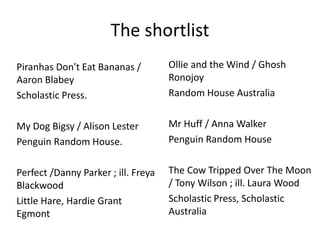
The shortlist
Piranhas Don't Eat Bananas /
Aaron Blabey
Scholastic Press.
My Dog Bigsy / Alison Lester
Penguin Random House.
Perfect /Danny Parker ; ill. Freya
Blackwood
Little Hare, Hardie Grant
Egmont
Ollie and the Wind / Ghosh
Ronojoy
Random House Australia
Mr Huff / Anna Walker
Penguin Random House
The Cow Tripped Over The Moon
/ Tony Wilson ; ill. Laura Wood
Scholastic Press, Scholastic
Australia
The cow tripped over the moon
Story about perseverance - Author inspired by
son’s struggles with cerebral palsy.
tonywilson.com.au
Parody on the classic nursery rhyme, which is
itself quite absurd.
Illustrations add a humorous cartoonish
quality and capture the soft, iridescent quality
of moonlight.
More suitable for older children in this
category? - 8 attempts - quite a lot of
concentration. Use of clock times adds
humour
Conceptually - Requires the reader to know
that the sun and moon are objects located in
outer space and that it is possible to travel to
the sun even though it is not daytime. Younger
readers might just enjoy the subversion of
expectation.
My Dog Bigsy
I found this one challenging to interpret:
Is it suitable for younger readers in this
category? How would it work with a large,
unruly story time crowd?
Quite lengthy. Absence of sustained dramatic
tension between characters. Characters that are
introduced by name that don’t appear
anywhere else in the story.
Lots of animal noises - some quite unusual
which may surprise children who expect
familiar noises. The narrator is interpreting the
emotion and intent behind these
“conversations.”
The reader is presented with scenes unfolding
that are not directly viewed by the narrator –
does this require a Theory of Mind, which
typically develops between 4 and 5 years of
age.
Opportunities for engagement
Hi degree of regularity in length and type of
sentence, absence of rhyming scheme could
could challenge children who have difficulty
concentrating, but it could also offer an
easily predictable structure:
• Naming the animals - “who is Bigsy
talking to now?” / Having the children
(carers) complete the part of the
sentence that names the animal.
• Have the children hear/imitate the
sounds and guess what the conversation
is about? (older children- smaller groups)
• Talking about direct experience of animal
behaviour - What are the cockies after in
the orchard? - problematic for urban
children.
Perfect
Gains little from reader’s theatre.
Perfect for reading in small groups
or one-on one.
Visual literacy is the key -
illustrations show a day trip to
and from the beach, events which
are not even hinted of in the text.
Children can participate by telling
the story - describing the pictures
back to the reader.
Absence of technology, very
reduced presence of adult figures
- nostalgia for a type of childhood
not commonly encountered.
Perfect
Analysis of language:
Absence of active nouns - emphasises act of
being in the present moment - experiencing the
now.
Absence of definite articles – much like a recipe,
it could be replicated in many places, many
childhoods. The images are a single
manifestation of something that applies more
broadly.
Insights into the inspiration behind the story:
freyablackwood.blogspot.com.au
Story inspired by his daughter
http://dannyparker.com.au/work-in-progress/
Ollie and the wind
Teachers notes:
http://www.randomhouse.com.au/content/teachers/ollieandthewind.pdf
Drew upon both his experiences of living in Wellington NZ seeing how people embrace the wind as a
source of art and energy, and remembering his childhood imagination.
Australian landscape was inspiration but the island is essentially imaginary.
Visual literacy & analysis:
Normally we cant see the wind. How do we know it’s windy? How do the pictures show that the wind is
there?
Red objects become a motif throughout the story. What can you spot that is red in the book?
Use of repetition to create large textures/ wallpaper-like quality
Low horizons tend to locate the story in the atmosphere giving the wind a greater physicality.
Mr Huff
Teachers notes:
resource.scholastic.com.au/resourcefiles/8368985_37512.doc
Cute stop-motion video of Mr huff made by Anna Walker:
https://www.youtube.com/watch?v=0XganveY7Us
Piranhas don’t eat bananas
Enjoyable for all ages:
Toilet humour; strong characters
Expressive, cartoonish faces with large eyes that convey
extreme (sometimes silent) emotion is typical Aaron
Blabbey style.
On a deeper level, the story is about transgressing
behaviour norms. Brian is the perpetually optimistic,
naive outsider who doesn’t accept that things should be
a certain way ‘just because.’
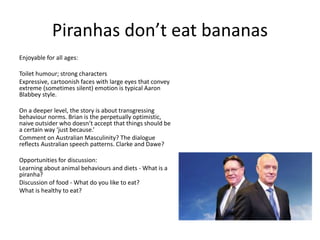
Comment on Australian Masculinity? The dialogue
reflects Australian speech patterns. Clarke and Dawe?
Opportunities for discussion:
Learning about animal behaviours and diets - What is a
piranha?
Discussion of food - What do you like to eat?
What is healthy to eat?

Pbwe2016 early childhood

  • 1.
    CBCA Shortlist –Early Childhood Presented by John Fahy and Morgan Hills Kogarah Library and Cultural Centre Georges River Council
  • 2.
    Book of theYear: Early Childhood Entries in this category may be fiction, drama or poetry and should be appropriate in style and content for children who are pre-reading or early stages of reading.
  • 3.
    The shortlist Piranhas Don'tEat Bananas / Aaron Blabey Scholastic Press. My Dog Bigsy / Alison Lester Penguin Random House. Perfect /Danny Parker ; ill. Freya Blackwood Little Hare, Hardie Grant Egmont Ollie and the Wind / Ghosh Ronojoy Random House Australia Mr Huff / Anna Walker Penguin Random House The Cow Tripped Over The Moon / Tony Wilson ; ill. Laura Wood Scholastic Press, Scholastic Australia
  • 4.
    The cow trippedover the moon Story about perseverance - Author inspired by son’s struggles with cerebral palsy. tonywilson.com.au Parody on the classic nursery rhyme, which is itself quite absurd. Illustrations add a humorous cartoonish quality and capture the soft, iridescent quality of moonlight. More suitable for older children in this category? - 8 attempts - quite a lot of concentration. Use of clock times adds humour Conceptually - Requires the reader to know that the sun and moon are objects located in outer space and that it is possible to travel to the sun even though it is not daytime. Younger readers might just enjoy the subversion of expectation.
  • 5.
    My Dog Bigsy Ifound this one challenging to interpret: Is it suitable for younger readers in this category? How would it work with a large, unruly story time crowd? Quite lengthy. Absence of sustained dramatic tension between characters. Characters that are introduced by name that don’t appear anywhere else in the story. Lots of animal noises - some quite unusual which may surprise children who expect familiar noises. The narrator is interpreting the emotion and intent behind these “conversations.” The reader is presented with scenes unfolding that are not directly viewed by the narrator – does this require a Theory of Mind, which typically develops between 4 and 5 years of age.
  • 6.
    Opportunities for engagement Hidegree of regularity in length and type of sentence, absence of rhyming scheme could could challenge children who have difficulty concentrating, but it could also offer an easily predictable structure: • Naming the animals - “who is Bigsy talking to now?” / Having the children (carers) complete the part of the sentence that names the animal. • Have the children hear/imitate the sounds and guess what the conversation is about? (older children- smaller groups) • Talking about direct experience of animal behaviour - What are the cockies after in the orchard? - problematic for urban children.
  • 7.
    Perfect Gains little fromreader’s theatre. Perfect for reading in small groups or one-on one. Visual literacy is the key - illustrations show a day trip to and from the beach, events which are not even hinted of in the text. Children can participate by telling the story - describing the pictures back to the reader. Absence of technology, very reduced presence of adult figures - nostalgia for a type of childhood not commonly encountered.
  • 8.
    Perfect Analysis of language: Absenceof active nouns - emphasises act of being in the present moment - experiencing the now. Absence of definite articles – much like a recipe, it could be replicated in many places, many childhoods. The images are a single manifestation of something that applies more broadly. Insights into the inspiration behind the story: freyablackwood.blogspot.com.au Story inspired by his daughter http://dannyparker.com.au/work-in-progress/
  • 9.
    Ollie and thewind Teachers notes: http://www.randomhouse.com.au/content/teachers/ollieandthewind.pdf Drew upon both his experiences of living in Wellington NZ seeing how people embrace the wind as a source of art and energy, and remembering his childhood imagination. Australian landscape was inspiration but the island is essentially imaginary. Visual literacy & analysis: Normally we cant see the wind. How do we know it’s windy? How do the pictures show that the wind is there? Red objects become a motif throughout the story. What can you spot that is red in the book? Use of repetition to create large textures/ wallpaper-like quality Low horizons tend to locate the story in the atmosphere giving the wind a greater physicality.
  • 10.
    Mr Huff Teachers notes: resource.scholastic.com.au/resourcefiles/8368985_37512.doc Cutestop-motion video of Mr huff made by Anna Walker: https://www.youtube.com/watch?v=0XganveY7Us
  • 11.
    Piranhas don’t eatbananas Enjoyable for all ages: Toilet humour; strong characters Expressive, cartoonish faces with large eyes that convey extreme (sometimes silent) emotion is typical Aaron Blabbey style. On a deeper level, the story is about transgressing behaviour norms. Brian is the perpetually optimistic, naive outsider who doesn’t accept that things should be a certain way ‘just because.’ Comment on Australian Masculinity? The dialogue reflects Australian speech patterns. Clarke and Dawe? Opportunities for discussion: Learning about animal behaviours and diets - What is a piranha? Discussion of food - What do you like to eat? What is healthy to eat?