August 12, 2013
Professional Development in
Emerging Careers
-Computing 101
-State of computing
-Change is afoot
-What are jobs like?
-Who’s right for computing?
-What can counselors do?
Today…
Along the way… Meet technical women
Increase the meaningful
participation of girls and women
in computing
Improve and expand
computer science (CS)
education at the high school
level throughout Chicago
Public Schools
Provide a compelling CS
experience for every
Chicago student
…equips counselors with up-to-date
information and resources they can use for
guidance.
…is a campaign through which students
(especially girls) are introduced to
computing and encouraged to pursue
education and careers in tech.
Counselors for Computing…
“empowering professional school counselors with the
knowledge, skills, linkages, and resources to promote
student success in the school, the home, the
community, and the world.”
Aligned with the ASCA Mission
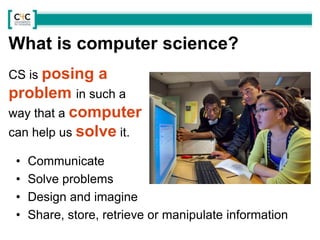
CS is posing a
problem in such a
way that a computer
can help us solve it.
• Communicate
• Solve problems
• Design and imagine
• Share, store, retrieve or manipulate information
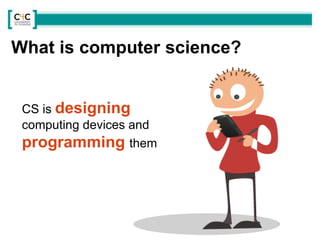
What is computer science?
CS is designing
computing devices and
programming them
What is computer science?
Francesca Slade
The State of Computing
Computing and IT Matter
» Ubiquitous, pervasive
» Driving the U.S. and global economies
» Backbone for transportation, communication, commerce
» Spurring innovation in science and technology
» Changing human relationships and infrastructures
IT jobs 22%
We can only fill 61%
of 1.4 million jobs
available by 2020
We can only fill 32% that
require a Bachelor’s or
advanced degree
US Computing Jobs > Candidates
88,161
144,500
22,000
CS AP Test
Takers
Break Time!
See you at
10:45
Introducing: CPS Brenda Wilkerson
Between
2006-2016
Projected job
openings in
Illinois that
could be filled
by computing
degrees:
70%
ILLINOIS
Projected job
openings in
Chicago
Metro that
could be filled
by computing
degrees:
8-66%Dist 13
8%
Dist 6
61%
Dist 7
51%
Dist 4, 5, 8, 9
23-32%
Dist 2
66%
Improve and expand computer
science (CS) education at the high
school level throughout Chicago
Public Schools.
Ultimately, provide a compelling CS
experience for every Chicago
student.
At the heart of a movement
•Chicago Mayor’s Initiative ThinkChicago
•NSF CS10K Project 10,000 teachers in 10,000 high schools
teaching new, rigorous curriculum by 2015
•Computing in the Core Policy effort to make CS count, as A-
G for graduation, sci/math for college - 11 states so far
•Computer Science Education and Jobs Act – Passing
through congress now.
•AP CS revision New CS Principles course aimed at
increasing participation among underrepresented groups
•Other initiatives: CS Education Week, Code.org, Khan
Academy…
Common Curriculum
rolling out nationally
California, Oregon, Illinois, Utah, Washington DC
Taste of Computing at a Glance
• Funded by the National Science Foundation
• Partnership between Loyola, UIC, DePaul, CPS
• 112 teachers trained so far, 54 schools
• An introduction to the breadth of CS
• In some cases, “swap out” for applications courses
Details
• Year-long course
• Typically grade 9 or 10
• Course numbers vary: CS, math, science
• CTE  part of IT cluster sequence:
networking, web design, programming, IT business
• Gen Ed  precedes CS Principles, AP CS
Instructional Units
1. Human Computer Interaction
2. Problem Solving
3. Web Design
4. Programming
5. Data Modeling
6. Robotics Game programming
Project management
STUDENT PROJECT: WEB PAGE
STUDENT PROJECT: VIDEO GAME
STUDENT PROJECT: RESCUE ROBOT
Quality of Jobs
Given commensurate levels
of education and time to
graduation, computing and IT
occupations are more stable
and pay better than other jobs.
Unemployment Low, Salaries High
Sample Jobs Available with Military
Training, Work Experience, Education
*Upon leaving service
Sample Jobs Available with 2-Year AA,
AAS Degree or Industry Certification
…continues with 4-yr, adv. degree jobs
Sample Jobs Available with
4-Year or Advanced Degree
So…
Who’s in these jobs?
…can you guess?
Who’s in these jobs?
Young women:
Undergraduate degree recipients 57%
AP test-takers 54%
AP calculus test-takers 46%
ISEF finalists in biochemistry 63%
Computing degree recipients 18%
AP computer science test-takers 19%
Computing-related occupations 26%
Young Women = Untapped Talent
Source: Data Retrieved from National Center for
Education Statistics Integrated Postsecondary
Educational Data System, 2010.
Women in Scientific Disciplines
Percentage of
Bachelor’s Degrees
Awarded to U.S.
Women in Various
STEM Disciplines
Lunch!
See you at
12:45
NCWIT is the National Center for
Women & Information Technology
Our coalition includes more than 250 universities, corporations, and non-profits.
Mobilizing for Change: NCWIT
Why do companies like Merck and Google
want a large and diverse technical
workforce?
Enhances Innovation
Expands the Qualified Employee Pool
Improves the Bottom Line
Promotes Equality
The Value of Diversity to Computing
Jane Cleland-Huang, DePaul University
Careers in Information Technology
The best career in the world… Software Engineering.
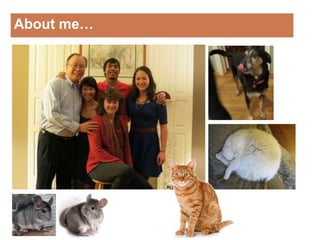
About me…
And in the office…
55
Students…
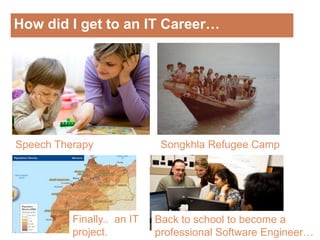
How did I get to an IT Career…
Speech Therapy Songkhla Refugee Camp
Finally.. an IT
project.
Back to school to become a
professional Software Engineer…
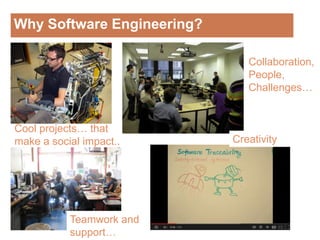
Why Software Engineering?
Collaboration,
People,
Challenges…
Teamwork and
support…
Creativity
Cool projects… that
make a social impact..
Opportunities for High School Students
Encourage high
schoolers to attend IT
summer camps.
Create supportive high
school environments for
minority students taking
IT courses.
Invite IT speakers to speak
at High School events
Jane Cleland-Huang, DePaul University
Careers in Information Technology
The best career in the world… Software Engineering.
Introducing Abril Vela
NCWIT Aspirations Award Winner
What Can Counselors Do?
What have
you done for
me lately?
 Challenge your own perceptions about who
is right for computing
 Help kids distinguish between computing
and computer literacy, applications courses
 Capitalize on factors that influence student
choices – which are?
What Can Counselors Do?
Factors influencing student
choices
1. Access to quality experiences
2. Exposure to role models
3. Encouragement
4. Recognition
ncwit.org/award
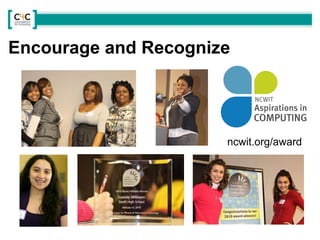
Encourage and Recognize
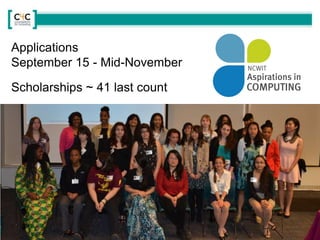
Applications
September 15 - Mid-November
Scholarships ~ 41 last count
Quality Experiences
Show what
real
people
accomplish
with
computing
Guide:
Tell a Compelling Story
Girls’ most-reported
college majors, according
to the SAT
1. Health and Allied Services
2. Social Sciences and History
3. Business and Commerce
4. Education
5. Visual or Performing Arts
Guide:
Connect with Girl’s Career Aspirations
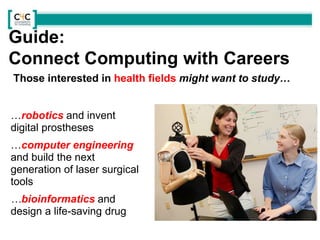
Those interested in health fields might want to study…
…robotics and invent
digital prostheses
…computer engineering
and build the next
generation of laser surgical
tools
…bioinformatics and
design a life-saving drug
Guide:
Connect Computing with Careers
Which message likely works best?
A. “Develop algorithms to
simulate excitation on
electrode arrays using a
microcontroller for a
cochlear implant.”
B. “Develop software for an
implant that will help deaf
people to hear.”
Guide:
Connect Computing with Careers
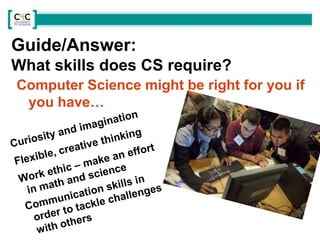
Guide/Answer:
What skills does CS require?
Computer Science might be right for you if
you have…
Advocate for sections of CS
Contact: Taste of Computing
Find: Kids in computer applications
courses and
Guide: toward Science, Math, Computing
course work
Teach: Introduce kids to CS 
Introduce Computing
C4C Counselor Lesson Plan, Slides, Activities
Use NCWIT C4C
Resources
Resources: Talking Points
Resources: Intersecting Pathways Poster
Pathway Cards
Military >> Community College >> University
(interest/need)
Are you
someone
who…?

You might
consider…
(iobs/salary/outlook)
For which
you
need…
(degree, cert) (next action)
i.e., Study
math, job
shadow
 
Resources for Students
Resources for You: C4C Infosheet
Working with Kids  Training Your Peers
(resourced) (compensated)
…Joining Counselors for Computing
Imagine Yourself …
Contact Us
Jane Krauss
Catherine Ashcraft
c4c@ncwit.org
Visit NCWIT www.ncwit.org/c4c
Questions, Thoughts, Comments
Artificial Intelligence, Computer and Information Sciences and Support
Services, Computer and Information Sciences, Computer and Information
Sciences, Computer and Information Systems Security/Information
Assurance, Computer Graphics, Computer Programming, Computer
Programming, Specific Applications, Computer Programming,
Vendor/Product Certification, Computer Programming/Programmer, General,
Computer Science, Computer Software and Media Applications, Computer
Support Specialist, Computer Systems Analysis/Analyst, Computer Systems,
Networking and Telecommunications, Computer/Information Technology
Svcs. Administration and Management, Data Entry/Microcomputer
Applications, General, Data Entry/Microcomputer Applications, Data
Modeling/Warehousing and Database Administration, Data Processing and
Data Processing Technology/Technician, Informatics, Information
Science/Studies, Information Technology, Information Technology Project
Management, Modeling, Virtual Environments and Simulation, Network and
System Administration/Administrator, System, Networking, and LAN/WAN
Management/Manager, Web Page, Digital/Multimedia and Information
Resources Design, Web/Multimedia Management and Webmaster
Technical Majors and Degrees Conferred in IL
Aurora University • Carl Sandburg College • Chicago State University •
Concordia University Chicago • DePaul University • East-West
University • Eastern Illinois University • Eureka College • Governors
State University • Greenville College • Harper College • Illinois Central
College • Illinois Eastern Community Colleges: Frontier Community
College • Illinois Eastern Community Colleges: Lincoln Trail College •
Illinois Institute of Technology • Illinois Valley Community College •
Illinois Wesleyan University • John A. Logan College • Joliet Junior
College • Lake Land College • Lewis and Clark Community College •
Loyola University Chicago • MacCormac College • MacMurray College •
McKendree University • Midstate College • Moraine Valley Community
College Northwestern University Oakton Community College • Olivet
Nazarene University • Principia College • Richland Community College
• Rock Valley College • Rockford Career College • Rockford College •
Saint Xavier University • South Suburban College of Cook County •
Southwestern Illinois College • St. Augustine College • University of
Chicago • University of Illinois at Urbana-Champaign • University of
Illinois at Chicago • Vatterott College: Quincy • Western Illinois
University • Westwood College: Chicago Loop
Tech Degree, Certification Granting Institutions in IL

NCWIT Counselors for Computing at Google Chicago

  • 1.
    August 12, 2013 ProfessionalDevelopment in Emerging Careers
  • 7.
    -Computing 101 -State ofcomputing -Change is afoot -What are jobs like? -Who’s right for computing? -What can counselors do? Today… Along the way… Meet technical women
  • 8.
    Increase the meaningful participationof girls and women in computing Improve and expand computer science (CS) education at the high school level throughout Chicago Public Schools Provide a compelling CS experience for every Chicago student
  • 9.
    …equips counselors withup-to-date information and resources they can use for guidance. …is a campaign through which students (especially girls) are introduced to computing and encouraged to pursue education and careers in tech. Counselors for Computing…
  • 10.
    “empowering professional schoolcounselors with the knowledge, skills, linkages, and resources to promote student success in the school, the home, the community, and the world.” Aligned with the ASCA Mission
  • 11.
    CS is posinga problem in such a way that a computer can help us solve it. • Communicate • Solve problems • Design and imagine • Share, store, retrieve or manipulate information What is computer science?
  • 12.
    CS is designing computingdevices and programming them What is computer science?
  • 14.
  • 15.
    The State ofComputing
  • 16.
    Computing and ITMatter » Ubiquitous, pervasive » Driving the U.S. and global economies » Backbone for transportation, communication, commerce » Spurring innovation in science and technology » Changing human relationships and infrastructures
  • 17.
  • 18.
    We can onlyfill 61% of 1.4 million jobs available by 2020 We can only fill 32% that require a Bachelor’s or advanced degree US Computing Jobs > Candidates
  • 19.
  • 21.
  • 22.
  • 23.
    Between 2006-2016 Projected job openings in Illinoisthat could be filled by computing degrees: 70%
  • 24.
  • 25.
    Projected job openings in Chicago Metrothat could be filled by computing degrees: 8-66%Dist 13 8% Dist 6 61% Dist 7 51% Dist 4, 5, 8, 9 23-32% Dist 2 66%
  • 27.
    Improve and expandcomputer science (CS) education at the high school level throughout Chicago Public Schools. Ultimately, provide a compelling CS experience for every Chicago student.
  • 28.
    At the heartof a movement •Chicago Mayor’s Initiative ThinkChicago •NSF CS10K Project 10,000 teachers in 10,000 high schools teaching new, rigorous curriculum by 2015 •Computing in the Core Policy effort to make CS count, as A- G for graduation, sci/math for college - 11 states so far •Computer Science Education and Jobs Act – Passing through congress now. •AP CS revision New CS Principles course aimed at increasing participation among underrepresented groups •Other initiatives: CS Education Week, Code.org, Khan Academy…
  • 29.
    Common Curriculum rolling outnationally California, Oregon, Illinois, Utah, Washington DC
  • 30.
    Taste of Computingat a Glance • Funded by the National Science Foundation • Partnership between Loyola, UIC, DePaul, CPS • 112 teachers trained so far, 54 schools • An introduction to the breadth of CS • In some cases, “swap out” for applications courses
  • 31.
    Details • Year-long course •Typically grade 9 or 10 • Course numbers vary: CS, math, science • CTE  part of IT cluster sequence: networking, web design, programming, IT business • Gen Ed  precedes CS Principles, AP CS
  • 33.
    Instructional Units 1. HumanComputer Interaction 2. Problem Solving 3. Web Design 4. Programming 5. Data Modeling 6. Robotics Game programming Project management
  • 34.
  • 35.
  • 36.
  • 38.
  • 39.
    Given commensurate levels ofeducation and time to graduation, computing and IT occupations are more stable and pay better than other jobs. Unemployment Low, Salaries High
  • 40.
    Sample Jobs Availablewith Military Training, Work Experience, Education *Upon leaving service
  • 41.
    Sample Jobs Availablewith 2-Year AA, AAS Degree or Industry Certification …continues with 4-yr, adv. degree jobs
  • 42.
    Sample Jobs Availablewith 4-Year or Advanced Degree
  • 43.
    So… Who’s in thesejobs? …can you guess?
  • 44.
  • 45.
    Young women: Undergraduate degreerecipients 57% AP test-takers 54% AP calculus test-takers 46% ISEF finalists in biochemistry 63% Computing degree recipients 18% AP computer science test-takers 19% Computing-related occupations 26% Young Women = Untapped Talent
  • 46.
    Source: Data Retrievedfrom National Center for Education Statistics Integrated Postsecondary Educational Data System, 2010. Women in Scientific Disciplines Percentage of Bachelor’s Degrees Awarded to U.S. Women in Various STEM Disciplines
  • 48.
  • 49.
    NCWIT is theNational Center for Women & Information Technology Our coalition includes more than 250 universities, corporations, and non-profits. Mobilizing for Change: NCWIT
  • 51.
    Why do companieslike Merck and Google want a large and diverse technical workforce?
  • 52.
    Enhances Innovation Expands theQualified Employee Pool Improves the Bottom Line Promotes Equality The Value of Diversity to Computing
  • 53.
    Jane Cleland-Huang, DePaulUniversity Careers in Information Technology The best career in the world… Software Engineering.
  • 54.
  • 55.
    And in theoffice… 55 Students…
  • 56.
    How did Iget to an IT Career… Speech Therapy Songkhla Refugee Camp Finally.. an IT project. Back to school to become a professional Software Engineer…
  • 57.
    Why Software Engineering? Collaboration, People, Challenges… Teamworkand support… Creativity Cool projects… that make a social impact..
  • 58.
    Opportunities for HighSchool Students Encourage high schoolers to attend IT summer camps. Create supportive high school environments for minority students taking IT courses. Invite IT speakers to speak at High School events
  • 59.
    Jane Cleland-Huang, DePaulUniversity Careers in Information Technology The best career in the world… Software Engineering.
  • 60.
    Introducing Abril Vela NCWITAspirations Award Winner
  • 63.
    What Can CounselorsDo? What have you done for me lately?
  • 64.
     Challenge yourown perceptions about who is right for computing  Help kids distinguish between computing and computer literacy, applications courses  Capitalize on factors that influence student choices – which are? What Can Counselors Do?
  • 65.
    Factors influencing student choices 1.Access to quality experiences 2. Exposure to role models 3. Encouragement 4. Recognition
  • 66.
  • 67.
    Applications September 15 -Mid-November Scholarships ~ 41 last count
  • 68.
  • 69.
  • 70.
    Girls’ most-reported college majors,according to the SAT 1. Health and Allied Services 2. Social Sciences and History 3. Business and Commerce 4. Education 5. Visual or Performing Arts Guide: Connect with Girl’s Career Aspirations
  • 71.
    Those interested inhealth fields might want to study… …robotics and invent digital prostheses …computer engineering and build the next generation of laser surgical tools …bioinformatics and design a life-saving drug Guide: Connect Computing with Careers
  • 72.
    Which message likelyworks best? A. “Develop algorithms to simulate excitation on electrode arrays using a microcontroller for a cochlear implant.” B. “Develop software for an implant that will help deaf people to hear.” Guide: Connect Computing with Careers
  • 73.
    Guide/Answer: What skills doesCS require? Computer Science might be right for you if you have…
  • 74.
    Advocate for sectionsof CS Contact: Taste of Computing Find: Kids in computer applications courses and Guide: toward Science, Math, Computing course work Teach: Introduce kids to CS 
  • 75.
    Introduce Computing C4C CounselorLesson Plan, Slides, Activities
  • 76.
  • 77.
  • 78.
  • 79.
    Pathway Cards Military >>Community College >> University (interest/need) Are you someone who…?  You might consider… (iobs/salary/outlook) For which you need… (degree, cert) (next action) i.e., Study math, job shadow   Resources for Students
  • 80.
    Resources for You:C4C Infosheet
  • 81.
    Working with Kids Training Your Peers (resourced) (compensated) …Joining Counselors for Computing Imagine Yourself …
  • 82.
    Contact Us Jane Krauss CatherineAshcraft c4c@ncwit.org Visit NCWIT www.ncwit.org/c4c Questions, Thoughts, Comments
  • 83.
    Artificial Intelligence, Computerand Information Sciences and Support Services, Computer and Information Sciences, Computer and Information Sciences, Computer and Information Systems Security/Information Assurance, Computer Graphics, Computer Programming, Computer Programming, Specific Applications, Computer Programming, Vendor/Product Certification, Computer Programming/Programmer, General, Computer Science, Computer Software and Media Applications, Computer Support Specialist, Computer Systems Analysis/Analyst, Computer Systems, Networking and Telecommunications, Computer/Information Technology Svcs. Administration and Management, Data Entry/Microcomputer Applications, General, Data Entry/Microcomputer Applications, Data Modeling/Warehousing and Database Administration, Data Processing and Data Processing Technology/Technician, Informatics, Information Science/Studies, Information Technology, Information Technology Project Management, Modeling, Virtual Environments and Simulation, Network and System Administration/Administrator, System, Networking, and LAN/WAN Management/Manager, Web Page, Digital/Multimedia and Information Resources Design, Web/Multimedia Management and Webmaster Technical Majors and Degrees Conferred in IL
  • 84.
    Aurora University •Carl Sandburg College • Chicago State University • Concordia University Chicago • DePaul University • East-West University • Eastern Illinois University • Eureka College • Governors State University • Greenville College • Harper College • Illinois Central College • Illinois Eastern Community Colleges: Frontier Community College • Illinois Eastern Community Colleges: Lincoln Trail College • Illinois Institute of Technology • Illinois Valley Community College • Illinois Wesleyan University • John A. Logan College • Joliet Junior College • Lake Land College • Lewis and Clark Community College • Loyola University Chicago • MacCormac College • MacMurray College • McKendree University • Midstate College • Moraine Valley Community College Northwestern University Oakton Community College • Olivet Nazarene University • Principia College • Richland Community College • Rock Valley College • Rockford Career College • Rockford College • Saint Xavier University • South Suburban College of Cook County • Southwestern Illinois College • St. Augustine College • University of Chicago • University of Illinois at Urbana-Champaign • University of Illinois at Chicago • Vatterott College: Quincy • Western Illinois University • Westwood College: Chicago Loop Tech Degree, Certification Granting Institutions in IL

Editor's Notes

  • #2 SHOW THIS SLIDE PRIOR TO PRESENTATION SO FOLKS KNOW THEY ARE IN THE RIGHT ROOM.
  • #3 PART 1: INTRODUCTION, (JANE)NCWIT works on a lot of levels, but particularly with girls we want to make sure they have experiences, role models, encouragement and recognition so they can be creative contributors through computer science and IT.We know counselors are important allies in this effort, and we’re grateful to ISCA and DePaul School of Counselor Education for partnering with us, and to Google for generously hosting our event today.
  • #4 PART 1: INTRODUCTION, cont., (CATHERINE)NCWIT has a talent development program called Aspirations in Computing– At the heart of it is an award called the Award for Aspirations in Computing that’s been conferred on almost 3,000 girls since 2008. We don’t talk about it as an award program anymore because it’s grown to be so much more, partly because of the fire we lit under so many girls across the country. We’ll talk more about this later and meet two champions of the program. For now,I’d like to show you a few pictures from our award event last April here in Chicago that get at our mission….
  • #5 PART 1: INTRODUCTION, cont., (CATHERINE)We want to make sure lots of girls like this little one…
  • #6 PART 1: INTRODUCTION, cont., (CATHERINE)Grow up with experiences like award winner Do’Monique Thompson from Kenwood Academy has had… so we turn out lots of highly skilled women like Tracy Austin, IT Global Infrastructure Operations Director at Kellogg’s… or like
  • #7 PART 1: INTRODUCTION, cont., (CATHERINE) …Khallai (‘Callie’)Taylor, who is a professor of Computer Information Systems at Triton College. Right now these girls and women are the exception, and we’d like to make them the RULE!
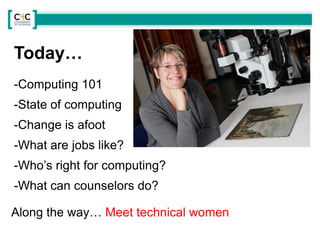
  • #8 PART 1: INTRODUCTION, cont., (CATHERINE)This is our agenda and the questions we’ll answer during the session. [go over points]Say: And in that vein, we want to paint a new picture of who does tech so throughout the our presentation you’ll see young woman involved with technology. This young woman is a software engineer who developed software that aids in art restoration.
  • #9 PART 1: INTRODUCTION, cont., (CATHERINE)So, we brought our initiative to Illinois for two reasons, one there’s a gap here between opportunity and preparedness– that is, there are more technical jobs than people prepared to fill them. AND there’s a lot of work going on here that we want to support. For instance, the initiative called Taste of Computing. Here’s their We both want to get more people and more kinds of people involved in computing --- opening up opportunity and increasing the size and makeup of the tech workforce. You’ll see in a bit that we are part of a large movement that is likely to have some impact on the way you approach career guidance and how you direct kids to next experiences. Let’s dig in.
  • #10 PART 1: INTRODUCTION, cont., (CATHERINE)WHAT IT IS [Read Slide] –On Click- HOW WE DO ITABOUT NCWIT and SPONSORS MERCK and GOOGLE Say: This is a project of the K-12 Alliance of NCWIT [enseewit], the National Center for Women & Information Technology. The K-12 Alliance includes ASCA, DePaul, and Google and 40 other organizations who are interested in building a strong IT workforce that includes women. The Merck Company Foundation and Google fund this program. Later we’ll ask you to imagine why companies like these would be interested in engaging counselors in this effort. So think about this: Why do companies like Merck and Google want a large and diverse technical workforce?3. GENDER INCLUSIVE INFORMATION AND RESOURCES Say: We want to let you know up front that while we emphasize female participation, this is a gender-inclusive campaign. All the information and resources you receive are useful when working with boys and girls.
  • #11 PART 1: INTRODUCTION, cont., (CATHERINE)1. ESTABLISH SHARED MISSION Say: In planning the campaign, the alliance focused on ASCA’s mission. The campaign shares your interest in promoting student success, and your commitment to your own professional growth. We are here because we know counselors play an integral role in guiding students’ education and career choices. We want to help you do your job by providing you with a quality professional development experience, and information and resources you can use back at work. These students are learning programming to create game animations.
  • #14 Part 2: WHAT IS COMPUTER SCIENCE?, cont. (JANE)We’re going to watch a 5 minute video that gets at the heart of computer science– programming, or “coding.” This group, Code.org, is intent on building out the talent pool and making sure more –and more kinds- of people are ready for CS. This video has had 10.5 million views since it went up in March. After we watch we’ll look at the computer science activities kids can do right on the Code.org website. Also, tune in to the people. When we showed this to kids in Sacramento, they really connected with one person. Imagine who your students would connect with.VIEWRETURN TO CODE.ORG SITE, do CodeHS Activity
  • #15 Part 2: WHAT IS COMPUTER SCIENCE?, cont. (JANE)INTRODUCE FRANCESCA SLADELet’s meet someone engaged in the work,Francesca Slade is a software engineer at Google. We came to know her because of her work with high school kids, some of whom are part of our Aspirations network. She is co-founder of Chicago Women Developers, a group that works on giving adult women access to technical education, so that they can have the computing skills they need to work in a modern world.
  • #16 PREVIEW OFPART 3: STATE of COMPUTING: CATHERINE Say: Now we’re going to dive into the state of computing nationally and locally to make you aware of the context, and why we need broader participation. By “broader participation” I mean we need more people as well as more kinds of people inventing our next technologies.Can you tell what’s going on in this picture? These young people are learning to program small devices.
  • #17 PART 3: STATE of COMPUTING - CATHERINE We want to make the case for why counselors and teachers and parents and everybody should care about getting more kids ready to contribute. Now, think about technology in your life for a moment. Are there any statements you disagree with? Or would want to add? [Discuss]Since IT is all these things it makes sense that a broad spectrum of people contribute to it. This isn’t the case today and we’ll discuss more about the value of diversity as we go on.YOUNG PEOPLE ARE PART WAY THERE, THAT’S YOUR HOOK. Say: Young people love technology are are good at using it. Conversations starting with their USE can easily segue into a conversation about inventing or improving IT: You might ask, Wouldn’t you like to improve your smart phone, or invent the next killer app?
  • #18 PART 3: STATE of COMPUTING - CATHERINENOTE- Catherine this slide is old slide the ave. all occupationsTHERE IS A HUGE DEMAND FOR TECH WORKERS. SAY: This chart shows projected employment in Science, Technology, Engineering and Math-related occupations. On average all STEM occupations are projected to grow by 10% between now 2008 and 2018. You’ll see that computing jobs (the first three) are growing at a faster rate than all jobs combined and other STEM jobs, too. [ON CLICK] Overall, IT growth is projected at 22%
  • #19 PART 3: STATE of COMPUTING - CATHERINEDEMAND FOR QUALIFIED WORKERS IS HIGH. Say: At current graduation rates and projected annual job openings, we’ll only fill 61% of the 1.4 million jobs that will be added by 2018. [ON CLICK] If you consider that most of these jobs require a bachelor’s degree, then we are prepared to fill 29% of them.
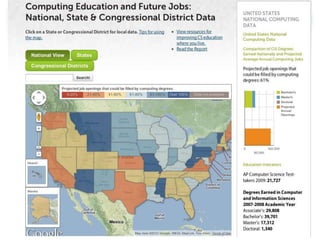
  • #21 PART 3: STATE of COMPUTING – CATHERINEThis slide is hot linked. Click on it to get to www.ncwit.org/edjobsmapEXAMINE National trends, discuss.
  • #23 PART 4STATE OF COMPUTING STATE AND LOCAL (JANE and BRENDA)Let’s talk about what is going on in CS Education and jobs in IllinoisIntroducing,Brenda Wilkerson, CTE Career Cluster Manager for IT Programs at Chicago Public Schools and who has her own background it tech. Did you ever get mentored like these girls? Things are changing!
  • #24 PART 4STATE OF COMPUTING STATE AND LOCAL (JANE)Notice that Illinois shows as blue, so the range shows we’re able to fill between 70% of jobs. And here are the job indicators.
  • #25 PART 4STATE OF COMPUTING STATE AND LOCAL (JANE)Compare the AP – (local preparedness) to Jobs available… We can drill down to the local level by looking at congressional districts here – [next slide]
  • #26 PART 3: STATE OF COMPUTING SLIDE 4 of 5We can drill down to the local level by looking at congressional districts hereYou’ll notice that the Chicago metro area are range from 8-66%. A lot of the jobs that could be filled by home-grown talent.[Go back to ed jobs map to look at edu/employment indicators]
  • #27 PART 4: STATE of COMPUTING – STATE AND LOCAL - JANEThis slide is hot linked. Click on it to get to www.ncwit.org/edjobsmapEXAMINE District trends, discuss. Look at congressional districts 7 (chicago) and the 13
  • #28 PART 4: STATE of COMPUTING – STATE AND LOCAL – JANE and BRENDAAs Catherine said, there’s change afoot, and one that warrents your attention is the Taste of Computing CS education initiative. So, here are the intentions ofWe both want to get more people and more kinds of people involved in computing --- increasing the size of the workforce and its makeup, too. You’ll see in a bit that we are part of a large movement that is likely to have some impact on the way you approach career guidance and how you direct kids to next experiences. Let’s dig in.
  • #29 PART 4: STATE of COMPUTING – STATE AND LOCAL – JANE and BRENDA
  • #30 PART 4: STATE of COMPUTING – STATE AND LOCAL – JANE and BRENDAAt the heart of a national movement – 35 CTE schools in Illinois
  • #31 PART 4: STATE of COMPUTING – STATE AND LOCAL – JANE and BRENDA
  • #32 PART 4: STATE of COMPUTING – STATE AND LOCAL – JANE and BRENDA
  • #33 PART 4: STATE of COMPUTING – STATE AND LOCAL – JANE and BRENDAParticipating HS – 28 of these have teachers who have been through the training two years, Teachers from the other 26 are in their first year.
  • #34 PART 4: STATE of COMPUTING – STATE AND LOCAL – JANE and BRENDACurriculum
  • #35 PART 4: STATE of COMPUTING – STATE AND LOCAL – JANE and BRENDA
  • #36 PART 4: STATE of COMPUTING – STATE AND LOCAL – JANE and BRENDA
  • #37 PART 4: STATE of COMPUTING – STATE AND LOCAL – JANE and BRENDA
  • #38 TRANSITION to PART 5 - QUALITY of JOBS (CATHERINE)This summer Chicago girls in computing were on the job teaching computer science to middle school kids. You’ll meet one of these ‘teacher-girls’ later today.Now we’re going to talk a little about the quality of jobs in tech.
  • #44 PART 6: WOMEN UNDERREPRESENTED IN COMPUTING (JANE)
  • #45 PART 6: WOMEN UNDERREPRESENTED IN COMPUTING (JANE)As you know, the field is dominated by white males. These are students at Boston University building remote-controlled flying robots.
  • #46 PART 6: WOMEN UNDERREPRESENTED IN COMPUTING (JANE)YOUNG WOMEN HAVE WHAT IT TAKES. Say: This is kind of a good news/bad news story. The problem doesn’t lie in ability, girls have what it takes. Notice that girls take the AP Calculus test at about the same rate as boys. In STEM, they tend to focus on the life sciences. ISEF is the International Science and Engineering Fair.APTITUDE IN SCIENCE AND MATH SHOULD CARRY OVER TO PURSUITS IN COMPUTING BUT IT DOESN’T. Say: We’ll talk about ways to reverse the trend.
  • #47 PART 6: WOMEN UNDERREPRESENTED IN COMPUTING (JANE)WOMEN ARE UNDERREPRESENTED IN IT.Say: Women have reached parity or even surpassed the number of men in biology, chemistry and math. [CLICK] Computer Science and Computer Engineering both hover around 10%. One thing this tells us is that women are good at science and mathematics, but it doesn’t translate into selecting a computing major.
  • #50 PART 7: BROADER PARTICIPATION MATTERS (CATHERINE)Say: We left you with a bad picture but it’s getting better and this is where NCWIT steps in. We look forward to bringing more women into the technology sector and into these good jobs. NCWIT, the National Center for Women & Information Technology is a group of alliances representing over 300 nonprofits, education institutions, corporations and start-ups that hold a shared vision for greater diversity in computing all across the pipeline. [Describe groups] Each group has projects intended to reform conditions in their sector. AND as its backbone, NCWIT has a team of social scientists who guide these groups (describe a little?)
  • #51 PART 7: BROADER PARTICIPATION MATTERS (CATHERINE)TtheK-12 Alliance of NCWIT, which guides C4Cis made up of 44 nonprofits, girl- and youth-serving organizations, education groups, professional member associations, high-tech companies and universities.Note that ASCA (American School Counselor Association) and ACTE (Association for Career and Technical Education) are members, as is Google, and as of last week (and too late to make the slide), so is Code.org who’s video you saw.Some are huge, some are small. Some help us with broad reach, others help us get to small but important niches, like Reinhardt and Associates [turtle, bottom row], which works on STEM issues with Native American youth in the Great Lakes region.
  • #52 PART 7: BROADER PARTICIPATION MATTERS (CATHERINE)Query: As we said, this campaign is funded by Google and the Merck Company Foundation. Why might companies like Merck need IT and want a large and diverse technical workforce? DISCUSS with a neighbor, then we’ll hear from you. (Participants usually come up with four or five good reasons.)Let’s hear a few different ideas. [We can anticipate they will come up with ideas that show up on next slide.] [If you want,DESCRIBE MERCK: 1) Innovation in drug design relies heavily on technology – it’s necessary for for modeling, designing testing, creating instrumentation, and other “bench science” research; also for computer-controlled manufacturing and quality control 2) HUGE back office IT workforce – from inventory management, to communications, to internal operations.]REINFORCE PARTICIPANT IDEAS, TEE UP NEXT SLIDE. Say: You came up with a lot of good reasons why broader participation matters. We’ll share what we know– you’ll see you were right on target. [advance next slide]
  • #54 Jane Cleland Huang, Associate Professor DePaul University School of Computer Science, Telecommunications, and Information Systems, Director of the Systems and Requirements Engineering Center
  • #61 PART 8: MEET TECHNICAL WOMEN (JANE)Abril Vela is a senior at Northside College Prep and an intern at 8th Light here in Chicago where she is learning to program in Ruby. She is a 2012 winner of the NCWIT Award for Aspirations in Computing and is one of the founders of Chicago Girls in Computing, a group of young women who are teaching middle school kids computer science! AND after her remarks she’s going to teach you about computer science, without a computer!
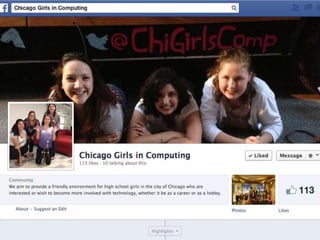
  • #62 PART 8: MEET TECHNICAL WOMEN (JANE)Show slides from here (ppt is hot linked)https://www.facebook.com/ChicagoGirlsInComputing
  • #63 PART 8: MEET TECHNICAL WOMEN (JANE)
  • #64 PART 9: WHAT CAN COUNSELORS DO? (CATHERINE)Say: So this little girl wants to know – WHAT’RE YOU GOING TO DO FOR ME? We understand there are four things that influence kids’ education and career choices. Can you guess what they are? (take responses)
  • #65 PART 7: WHAT CAN COUNSELORS DO, cont.Bullet 1: Lots of kids have the potential to be great at computing but we don’t always “see” it in them. Our own associations and history can get in the way, so we urge you to keep a fresh eye out for kids who might have an aptitude for computing. Creative kids, mathy kids, analytical kids…Bulltet 2: Those four factors are: Access to quality experiences, positive role models,, encouragement and recognition. Bullet 3: Say things like “Wonder what’s under the hood? How could you make it better?” or “How might you solve that problem with technology?Bullet 4: Help a girl gain recognition through the Award for Aspirations in computing.
  • #66 PART 9: WHAT CAN COUNSELORS DO? (CATHERINE)Let people riff on each, being particular about CS edu. Then we move on and provide some advice.
  • #67 PART 9: WHAT CAN COUNSELORS DO? (CATHERINE)ANOTHER PROJECT OF NCWIT (read slide). The idea is to recognize and encourage technical girls at the time when they are determining their education and career paths. If you know a technical girl, encourage her to apply. Tell other counselors and the computer science and IT teachers at your school to encourage a girl to apply. Fabulous prizes, exposure to companies and U’s that give scholarships, and access to a network of girls who support one another.
  • #68 PART 7: WHAT CAN COUNSELORS DO, cont.ANOTHER PROJECT OF NCWIT (read slide) These are the 2013 winners from IllinoisMany get scholarships as a result of this, mentoring, job shadows, internships, lots of corporate swag…
  • #69 PART 9: WHAT CAN COUNSELORS DO? (CATHERINE)Keep your eye out for this program we’ve just begun – It’s starting as a camp for middle school kids.
  • #71 PART 9: WHAT CAN COUNSELORS DO? (CATHERINE)TECHNOLOGY UNDERPINS THINGS GIRLS ARE INTERESTED IN. (reference slide.) This pic represents #5, She is working with 3-D motion-capture software that is used in the film industry. We don’t know what the cat is doing.
  • #72 PART 9: WHAT CAN COUNSELORS DO? (CATHERINE)Since Computing is an applied science, it underpins innovations across disciplines.
  • #73 PART 9: WHAT CAN COUNSELORS DO? (CATHERINE)USE LANGUAGE THAT MEETS KIDS WHERE THEY ARE Note: This appears progressively, so read A then show and read B. and then have them vote.TRANSITION TO RESOURCES TOUR. Say: So, we’ve described what you can do, now, here’s how we help you. Provide PD like this, and materials for yourself and for kids.
  • #74 PART 9: WHAT CAN COUNSELORS DO? (CATHERINE)This is the skill set of people who accomplish a lot through computer science. These skills are essential to working on technical teams and to invent new ways of doing things with computers.
  • #77 PART 9: WHAT CAN COUNSELORS DO? (CATHERINE)
  • #78 PART 9: WHAT CAN COUNSELORS DO? (CATHERINE)Talking Points Card – You should have several of these in the packet. It gives you the messages that are shown to work with kids about interests and opportunities. You have several so you can share them with your colleagues or with parents. Use them for the basis of discussion and give them away!
  • #79 PART 9: WHAT CAN COUNSELORS DO? (CATHERINE)Intersecting Pathways Poster– The poster in your C4C kit shows the intersecting routes to careers in computing. Notice that it directs kids to ask you for the Pathway cards that get into details about the kind of work and salaries they can expect.
  • #80 PART 9: WHAT CAN COUNSELORS DO? (CATHERINE)Pathways Cards. These are class sets of cards to use with kids. They consider three routes kids might take to a career in IT. Each of them takes this approach (describe sequence of information).
  • #81 PART 9: WHAT CAN COUNSELORS DO? (CATHERINE)We call this one the C4C Infosheet. It includes much of the information we presented today. Use it as a refresher and share with others.
  • #84 PART 3: STATE OF COMPUTING, cont.,
  • #85 PART 3: STATE OF COMPUTING, cont.,