Tinkering Under the Hood: Strategies to Enhance Critical Thinking Jane Krauss and Suzie Boss ISTE 2010, Denver June 29, 2010   www. wallwisher .com/wall/underthehood
Post-Session Update See the final slide for links to Wallwisher and a Google Doc where audience contributions were collected. Thanks, everyone! Keep your ideas coming. Jane Krauss  [email_address] ,  Suzie Boss  [email_address] .com
Let’s Get Acquainted Colleagues, co-authors,  PBL advocates Jane Krauss Suzie Boss
Today in the Tinker’s Shed We’ll  talking about: Inquiry cycles in project-based learning Thinking routines Tools to make thinking visible throughout projects Session materials: Tinkering Under the Hood in ISTE Community www.iste2010. org/group/tinkeringunderthehood
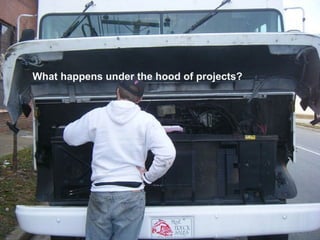
What happens under the hood of projects?
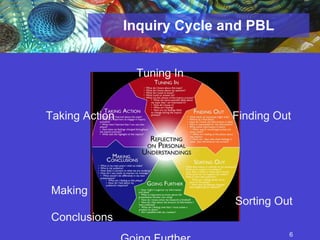
Inquiry Cycle and PBL Finding Out Tuning In Sorting Out Going Further Making Conclusions Taking Action
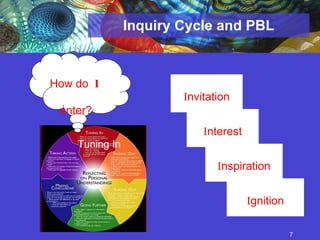
Inquiry Cycle and PBL Tuning In I nvitation I gnition I nterest I nspiration How do  I   enter?
Get the Gears Turning
Thinking Routines What thinking routines can you name? Brainstorm  in groups of 4 Push yourselves to come up with 10, 15, more?  3.  Share  your ideas:  www. wallwisher .com/wall/thinkingroutines
The Perfect Brainstorm IDEO  rules for engagement : Defer judgment Encourage wild ideas Stay focused on the topic Build on the ideas of others ( Change by Design , Tim Brown)
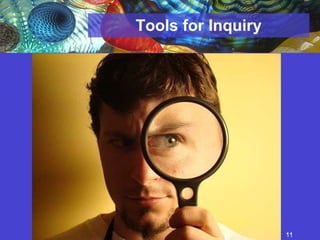
Tools for Inquiry
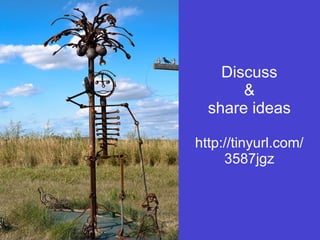
Discuss & share ideas http://tinyurl.com/3587jgz
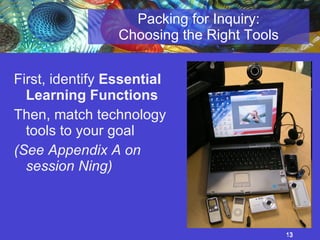
Packing for Inquiry: Choosing the Right Tools First, identify  Essential   Learning Functions Then, match technology tools to your goal (See Appendix A on session Ning)
Thank you !
Crowd-Sourced Smarts We asked participants to describe ways they come to understand and interact with students’ thinking. See:  www. wallwisher .com/wall/underthehood   Participants listed the thinking routines they employ in different phases of the inquiry cycle; See:  www.wallwisher.com/wall/thinkingroutines Participants supplied more strategies and tools that serve inquiry See the Google Doc:  http://tinyurl.com/3587jgz

Tinkering final

  • 1.
    Tinkering Under theHood: Strategies to Enhance Critical Thinking Jane Krauss and Suzie Boss ISTE 2010, Denver June 29, 2010 www. wallwisher .com/wall/underthehood
  • 2.
    Post-Session Update Seethe final slide for links to Wallwisher and a Google Doc where audience contributions were collected. Thanks, everyone! Keep your ideas coming. Jane Krauss [email_address] , Suzie Boss [email_address] .com
  • 3.
    Let’s Get AcquaintedColleagues, co-authors, PBL advocates Jane Krauss Suzie Boss
  • 4.
    Today in theTinker’s Shed We’ll talking about: Inquiry cycles in project-based learning Thinking routines Tools to make thinking visible throughout projects Session materials: Tinkering Under the Hood in ISTE Community www.iste2010. org/group/tinkeringunderthehood
  • 5.
    What happens underthe hood of projects?
  • 6.
    Inquiry Cycle andPBL Finding Out Tuning In Sorting Out Going Further Making Conclusions Taking Action
  • 7.
    Inquiry Cycle andPBL Tuning In I nvitation I gnition I nterest I nspiration How do I enter?
  • 8.
  • 9.
    Thinking Routines Whatthinking routines can you name? Brainstorm in groups of 4 Push yourselves to come up with 10, 15, more? 3. Share your ideas: www. wallwisher .com/wall/thinkingroutines
  • 10.
    The Perfect BrainstormIDEO rules for engagement : Defer judgment Encourage wild ideas Stay focused on the topic Build on the ideas of others ( Change by Design , Tim Brown)
  • 11.
  • 12.
    Discuss & shareideas http://tinyurl.com/3587jgz
  • 13.
    Packing for Inquiry:Choosing the Right Tools First, identify Essential Learning Functions Then, match technology tools to your goal (See Appendix A on session Ning)
  • 14.
  • 15.
    Crowd-Sourced Smarts Weasked participants to describe ways they come to understand and interact with students’ thinking. See: www. wallwisher .com/wall/underthehood Participants listed the thinking routines they employ in different phases of the inquiry cycle; See: www.wallwisher.com/wall/thinkingroutines Participants supplied more strategies and tools that serve inquiry See the Google Doc: http://tinyurl.com/3587jgz

Editor's Notes

  • #2 JANE - Wallwisher - delay intros
  • #3 Intros Jane and Suzie
  • #4 Intros Jane and Suzie
  • #5 Jane - Tee up why we are bringing this up.
  • #6 Show http://www.wallwisher.com/wall/underthehood -- connect to intro activity in PBL; bring in “I” Hard part of projects—planning over, now into implementation; lot happening—may have to peer over student’s shoulder to see what’s going on
  • #7 Introduce inquiry in the context of PBL. Planning, kick off, progress and presentation of learning. -- all way to presentation ; cycle of a project; jumping in deep in one key aspect of project work all along inquiry cycle--imagining how kids can be engaged; how support them --teacher/student interactions --tools that lay bare student thinking--hard to see and interact with; making thinking visible; "under the hood"
  • #8 Introduce inquiry in the context of PBL. Planning, kick off, progress and presentation of learning. -- all way to presentation ; cycle of a project; jumping in deep in one key aspect of project work all along inquiry cycle--imagining how kids can be engaged; how support them --teacher/student interactions --tools that lay bare student thinking--hard to see and interact with; making thinking visible; "under the hood"
  • #9 JANE Introduce a venerable technology to inspire inquiry: paper/glue DEBRIEF: Mirrors the inquiry cycle, gets at the social and emotional aspects (frustration; wanting to get hands on; satisfaction of figuring it out) 2. thinking routine it's most like: think/pair/share. processes: given time to collect thoughts w/out interference; pair: safe way, share what you're imagining, put it into words; share out: commitment to your idea. NEXT: Thinking routines in support of inquiry
  • #10 Debrief: Brainstorming itself is a thinkingi routine. What did pressing for more do to amp up brainstorming and get at better ideas?
  • #11 Brainstorming is so central to its work that IDEO has rooms dedicated to this process. At IDEO, teams are assigned project rooms where they can keep the artifacts of their work-in-progress. Keeping all this stuff visible "helps us identify patterns and encourage creative synthesis to occur," he says. It also gives team members opportunities to see and talk about each other's work.
  • #12 Jkrauss key technologies such as modeling software, digital cameras, sharable docs, blogs, wikis and other 'thought capture' tools. (cc) andercismo
  • #13 Jane Let’s talk about tools and how they support thinking routines all along inquiry cycle
  • #14 Suzie: Introduce ELFs—for example, making things visible and discussable. In chat: What do you imagine a couple might be?