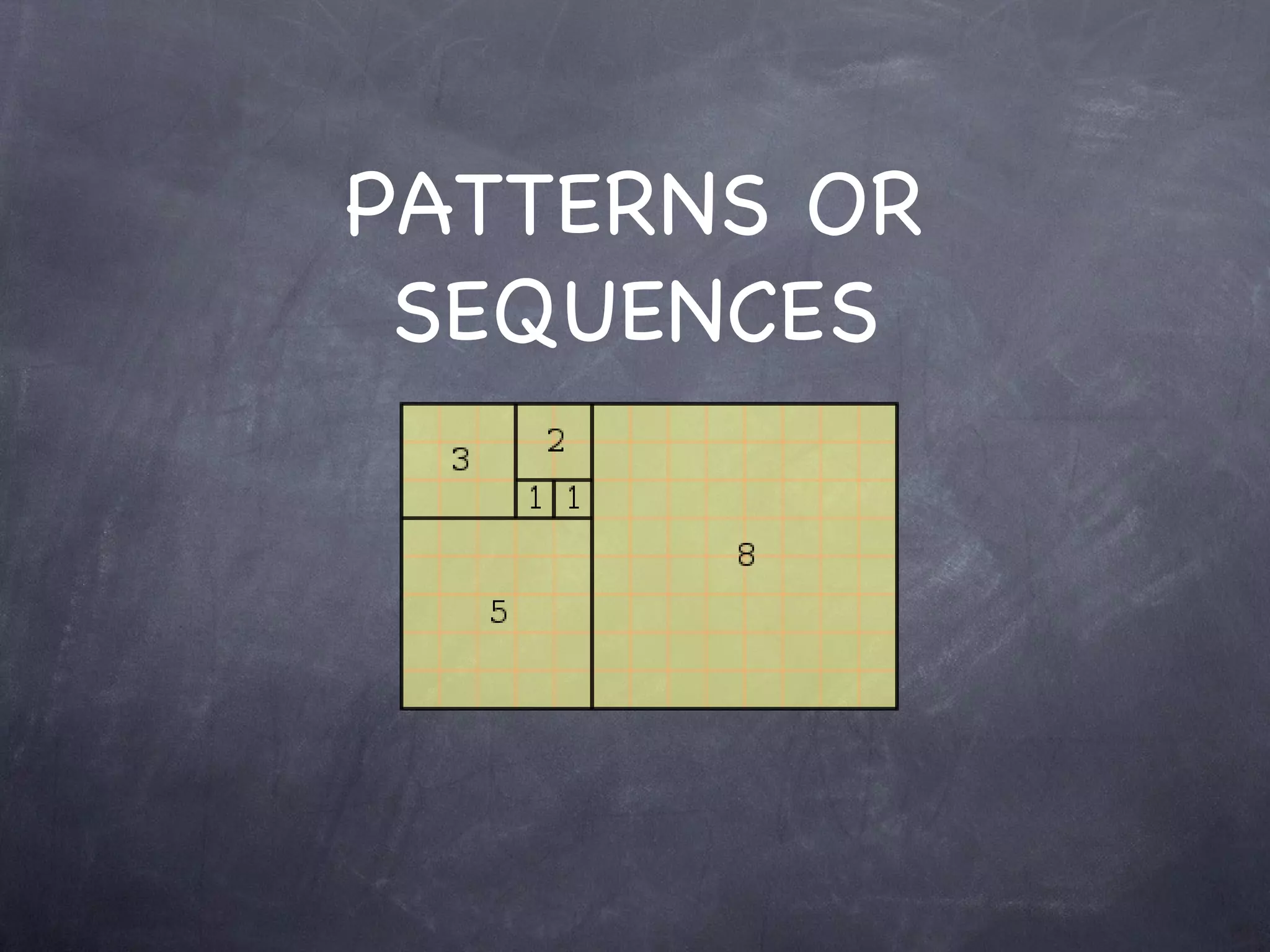
PATTERNS OR
 SEQUENCES
PURPOSE


•   To appreciate and investigate a numerical
    pattern
•   To look for evidence of mathematical
    patterns in nature
Order is the key

•   What do t hese sit uat ions have in common?

•   1 There are people wait ing for t heir t urn t o buy some fruit
     .-

•   2.- You are looking for your name on a list because you want t o
    know t he mark you got on your last exam

•   3.- You are t rying t o follow inst ruct ions, being careful t o do every
    st ep of t he process in order
KEY WORDS

•   The situations given before are related to a
    concept known as SEQUENCE
•   A sequence is an ordered list of things
    (objects, events, numbers,...)
•   Like a set it contains members (elements or
    TERMS
GUESS THE NEXT TERM OR ELEMENT OF THE
         SERIES GIVEN BELOW


•   A) O, T, T, F,....?
•   B) 1, 3, 6, 10,...? (HINT: TRIANGLE
    NUMBERS)
•   C) 1, 4, 9, 16,...?
•   D) -5, 4, -3, 2,...?
•   E) 1, 1, 2, 3, 5,... (FIBONACCI SEQUENCE)
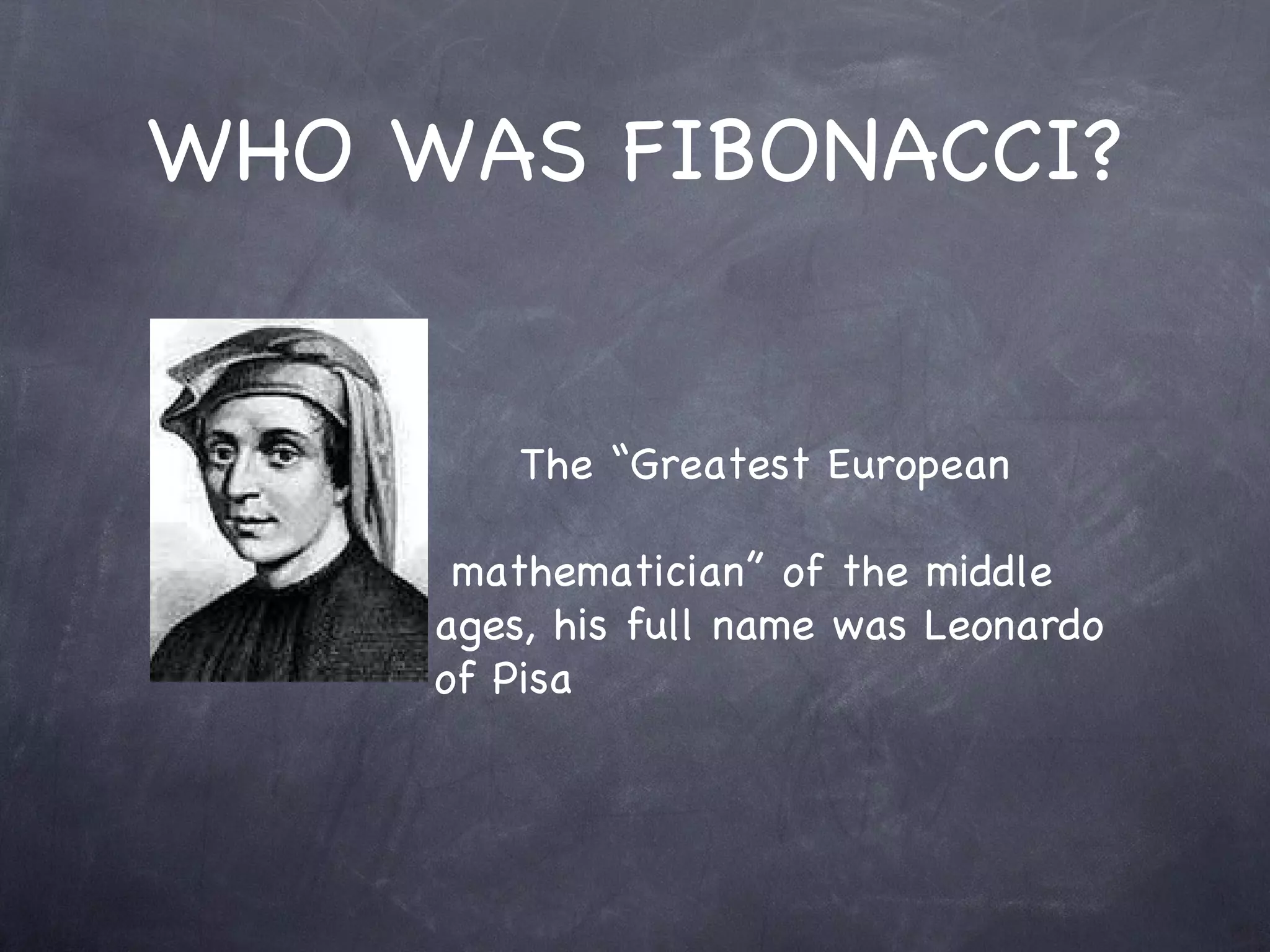
WHO WAS FIBONACCI?


    »       The “Greatest European

         mathematician” of the middle
        ages, his full name was Leonardo
        of Pisa
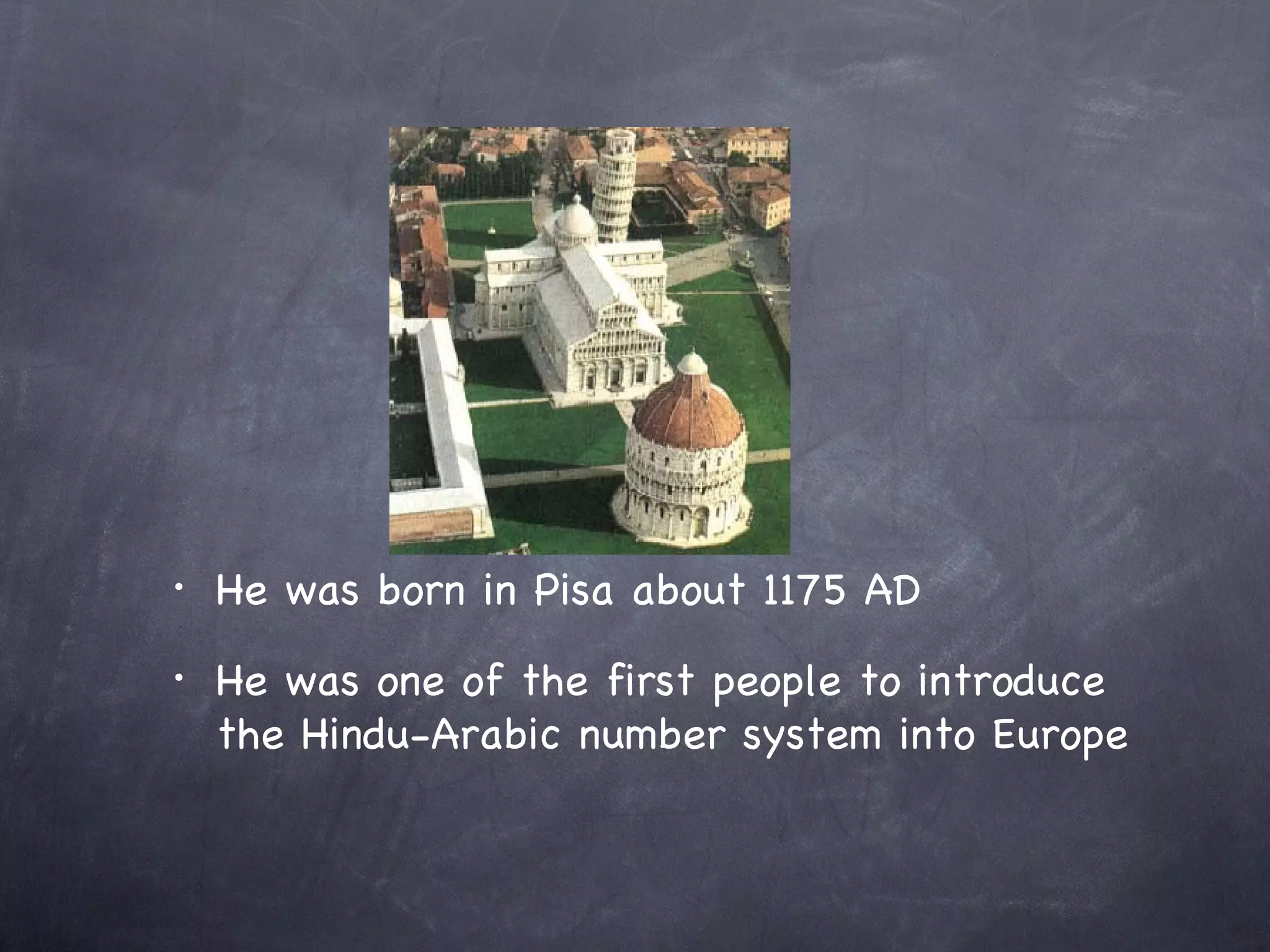
•   He was born in Pisa about 1175 AD
•   He was one of the first people to introduce
    the Hindu-Arabic number system into Europe
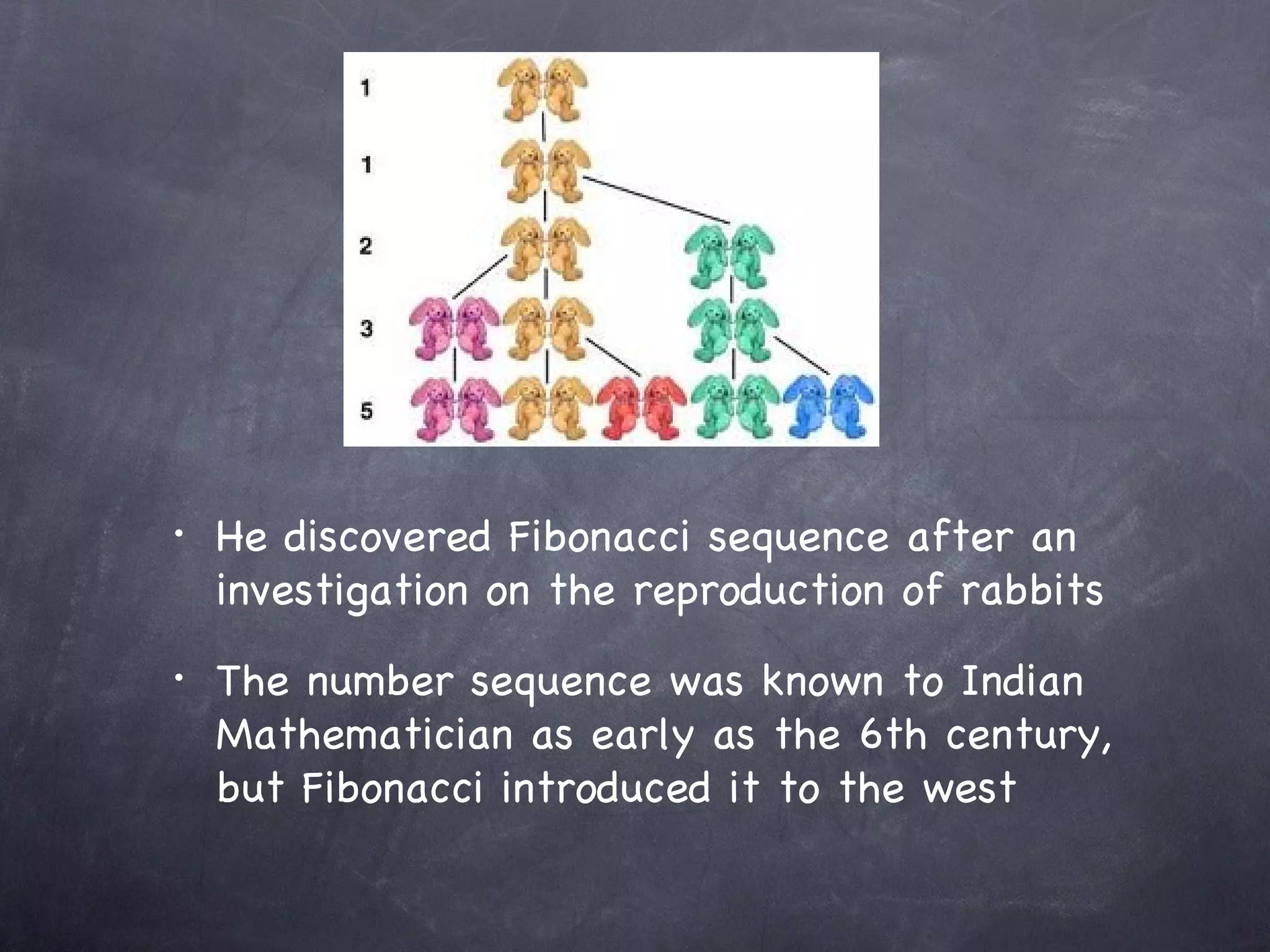
•   He discovered Fibonacci sequence after an
    investigation on the reproduction of rabbits
•   The number sequence was known to Indian
    Mathematician as early as the 6th century,
    but Fibonacci introduced it to the west
The rabbit problem
•   Suppose a newly-born pair of rabbits, one male, one female, are
    put in a field.

•   Rabbits are abble to mate at the age of one month so that at the
    end of its second month a female can produce another pair of
    rabbits.

•   Suppose that our rabbits never die and that the female always
    produces a new pair (one male, one female) every month from the
    second month on

•   How many pairs will there be in one year?

•   The numbers of pairs of rabbits in the field at the start of each
    month is 1, 1, 2, 3, 5, 8, 13, 21, 34, ...
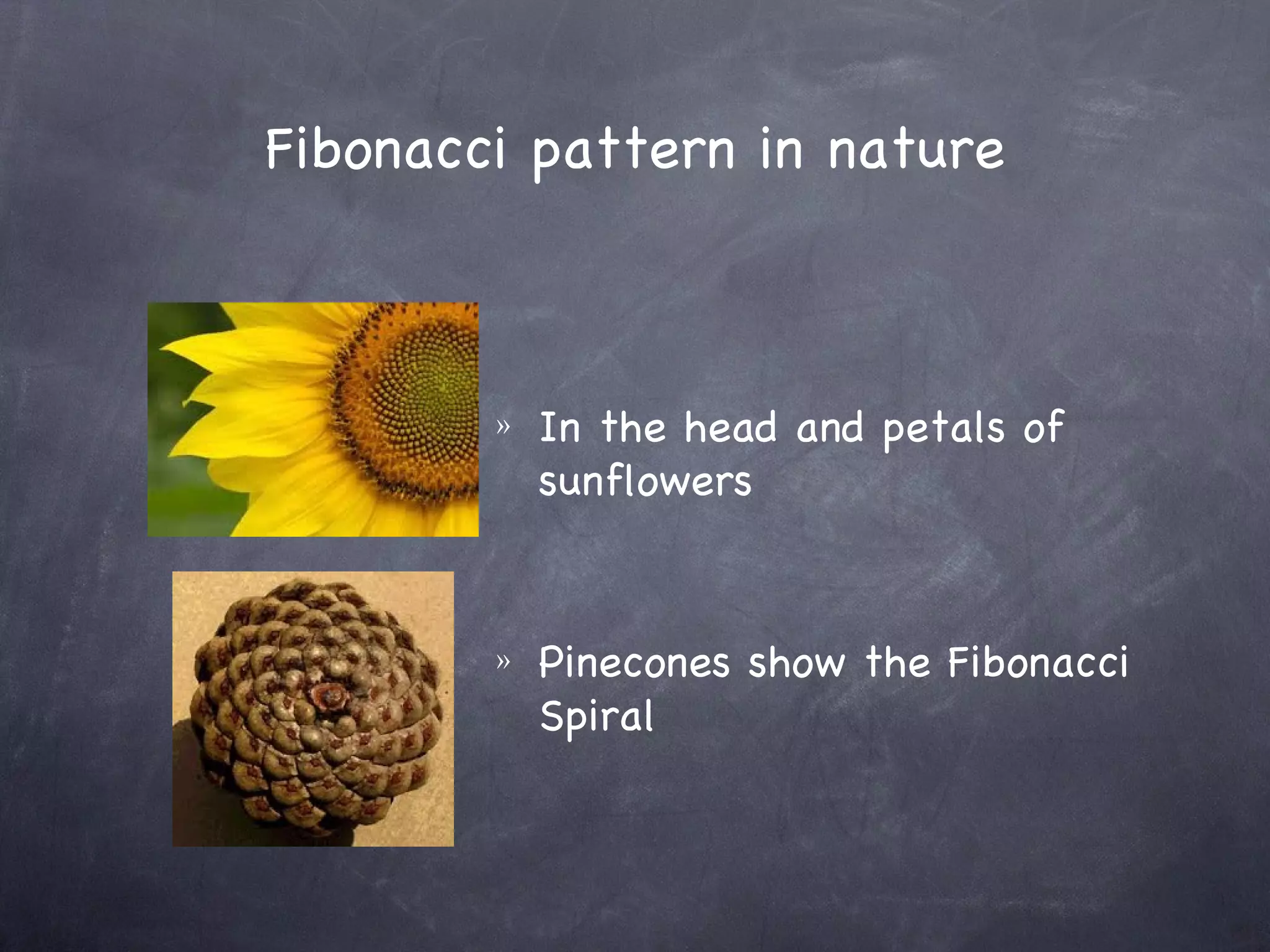
Fibonacci pattern in nature


        »   In the head and petals of
            sunflowers


        »   Pinecones show the Fibonacci
            Spiral
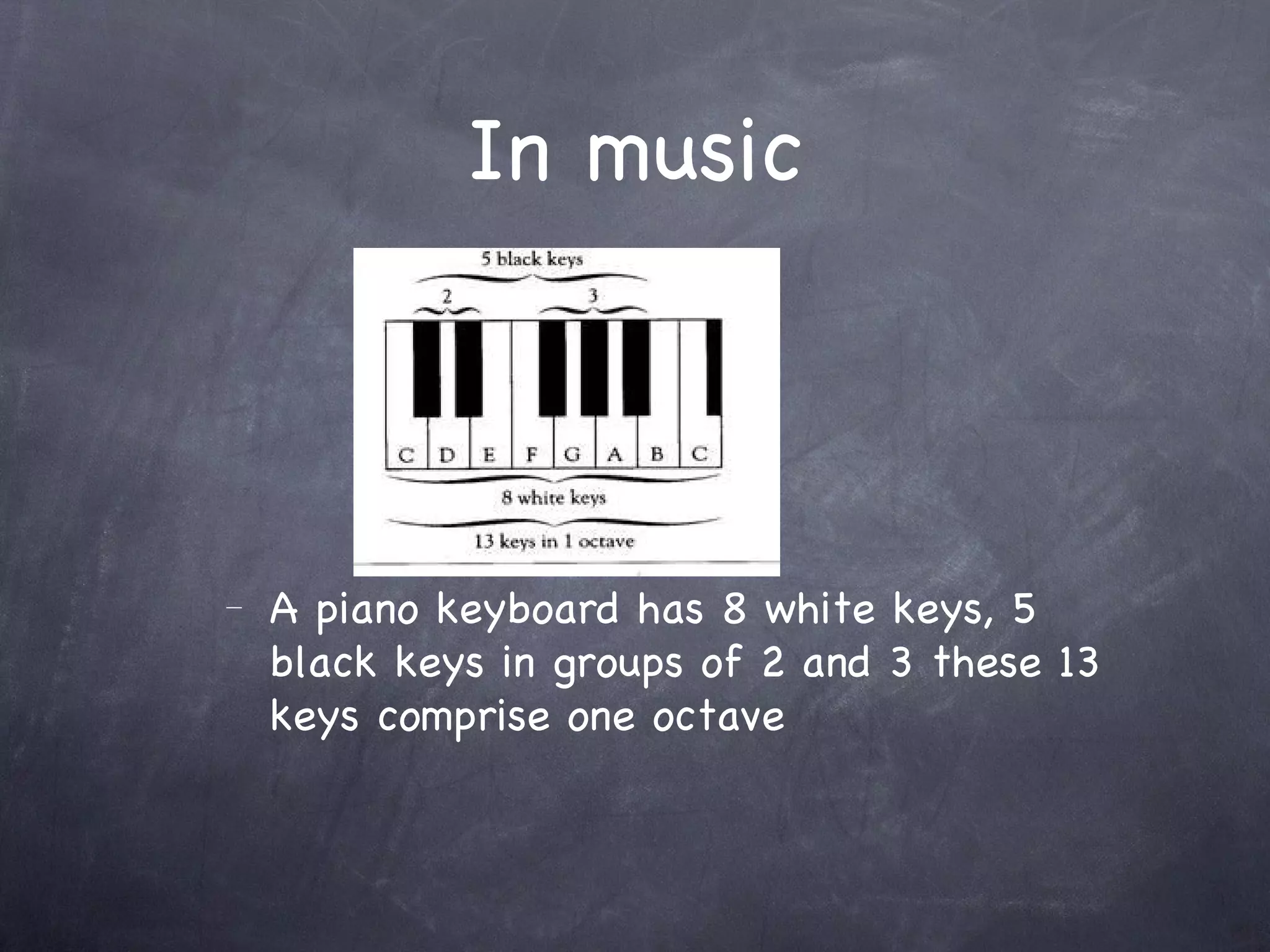
In music


–   A piano keyboard has 8 white keys, 5
    black keys in groups of 2 and 3 these 13
    keys comprise one octave
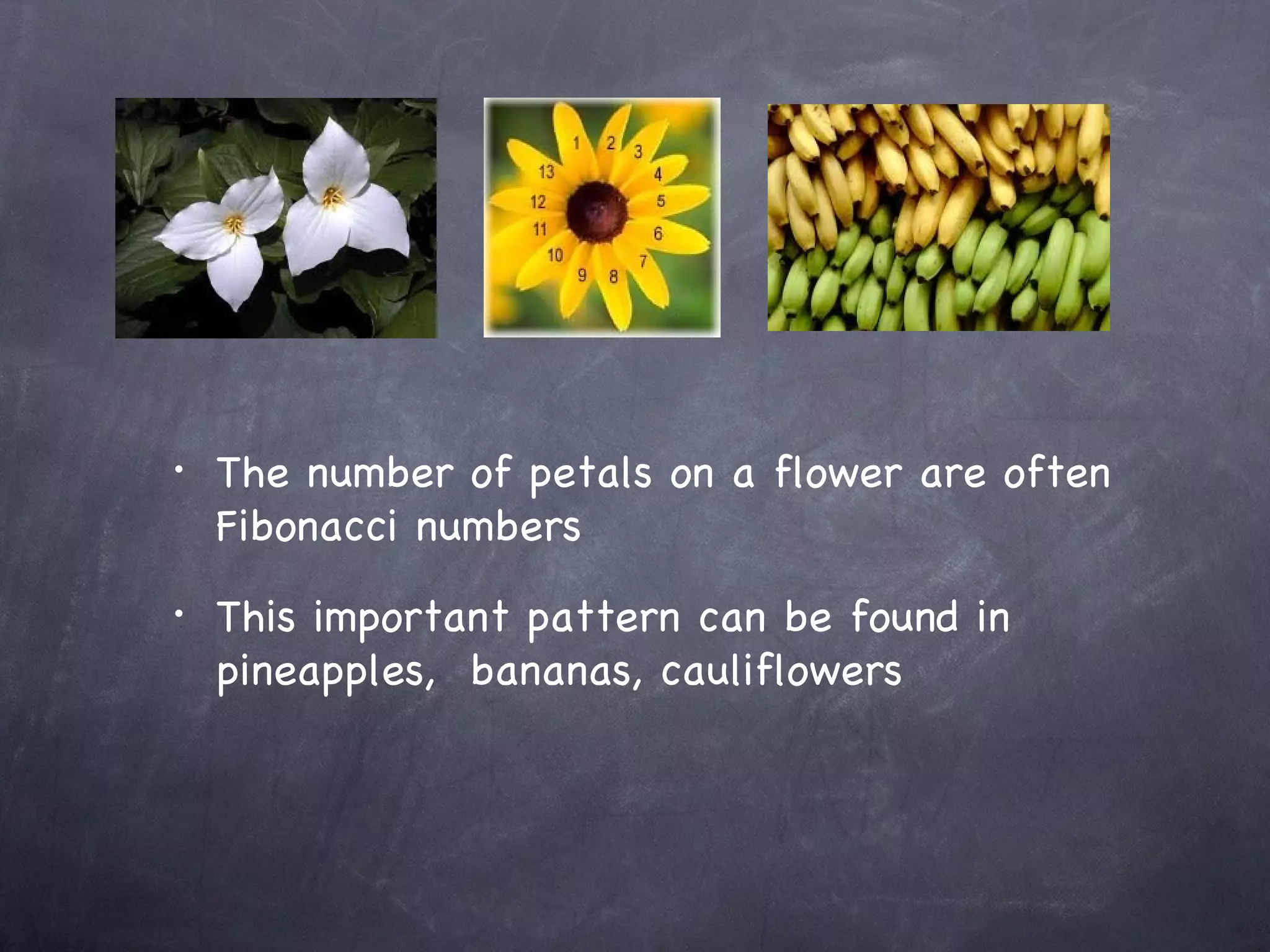
•   The number of petals on a flower are often
    Fibonacci numbers
•   This important pattern can be found in
    pineapples, bananas, cauliflowers
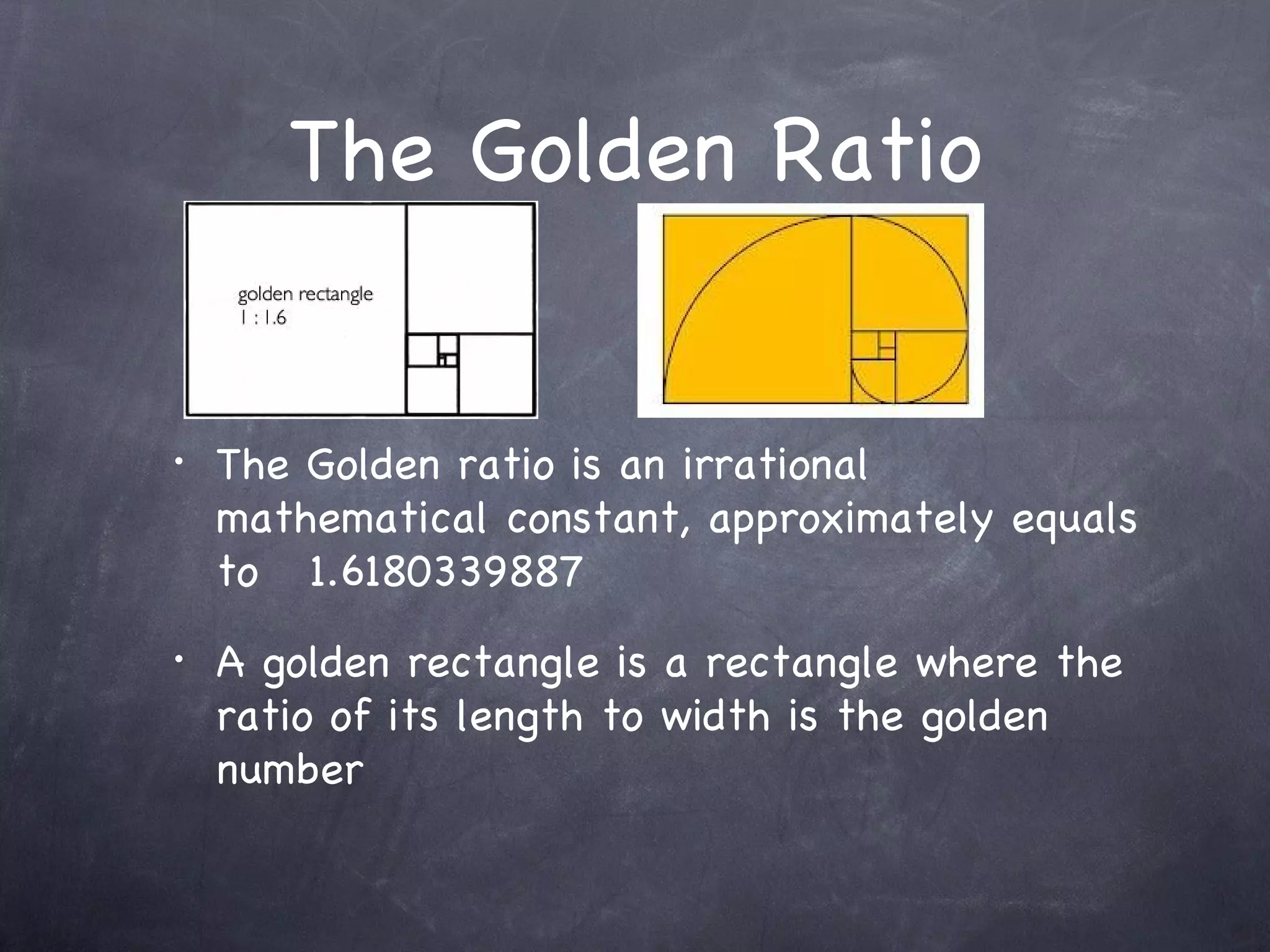
The Golden Ratio


•   The Golden ratio is an irrational
    mathematical constant, approximately equals
    to 1.6180339887
•   A golden rectangle is a rectangle where the
    ratio of its length to width is the golden
    number
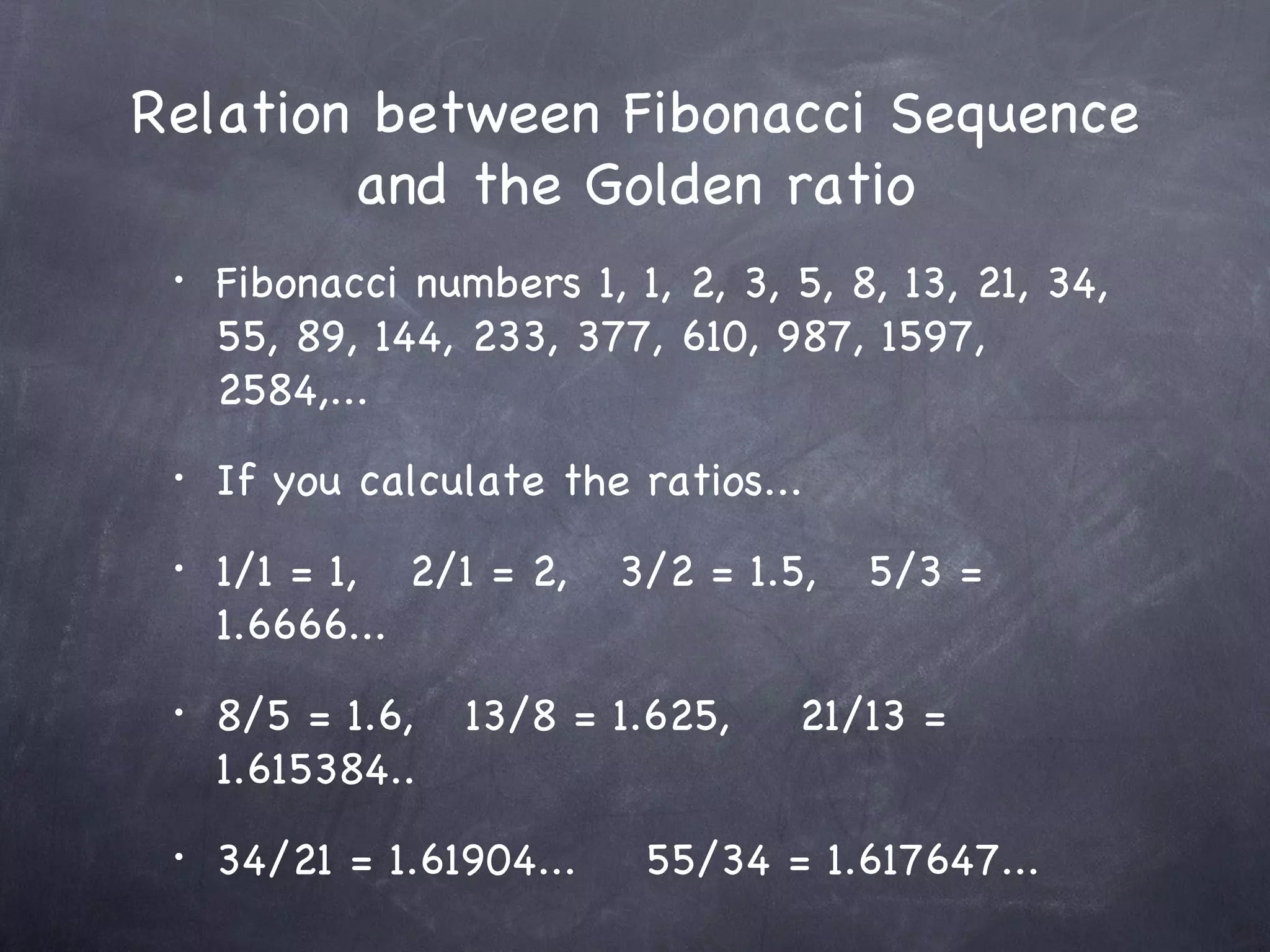
Relation between Fibonacci Sequence
        and the Golden ratio
 •   Fibonacci numbers 1, 1, 2, 3, 5, 8, 13, 21, 34,
     55, 89, 144, 233, 377, 610, 987, 1597,
     2584,...
 •   If you calculate the ratios...
 •   1/1 = 1, 2/1 = 2,    3/2 = 1.5,   5/3 =
     1.6666...
 •   8/5 = 1.6,   13/8 = 1.625,    21/13 =
     1.615384..
 •   34/21 = 1.61904...    55/34 = 1.617647...
•   Aha! Notice that as we continue down the
    sequence, the ratios seem to be converging
    upon one number
•   If we continue to look at the ratios as the
    numbers in the sequence get larger and
    larger the ratio will become the same
    number, and this number is THE GOLDEN
    RATIO 1.6180339887...
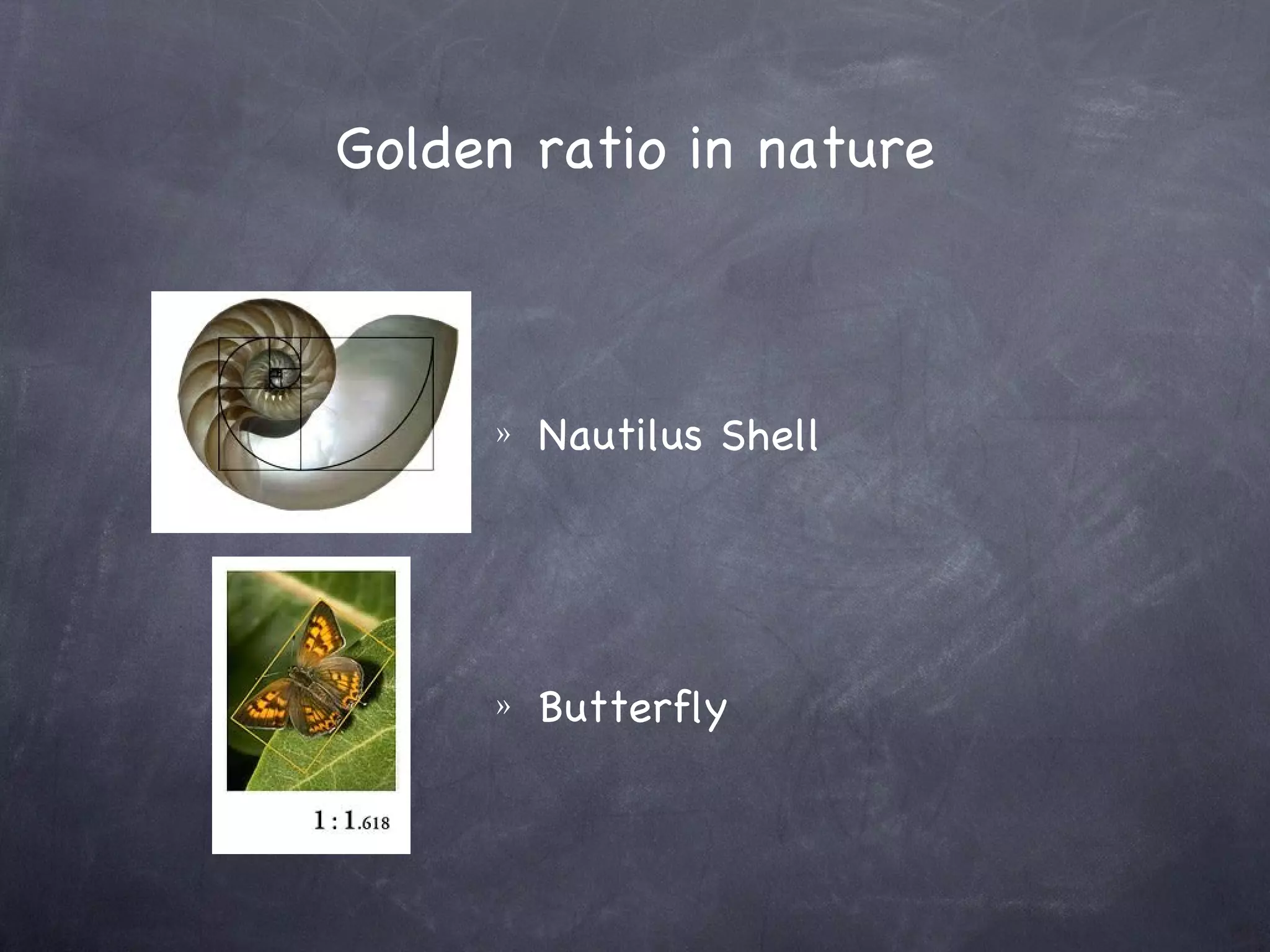
Golden ratio in nature


     »   Nautilus Shell


     »   Butterfly
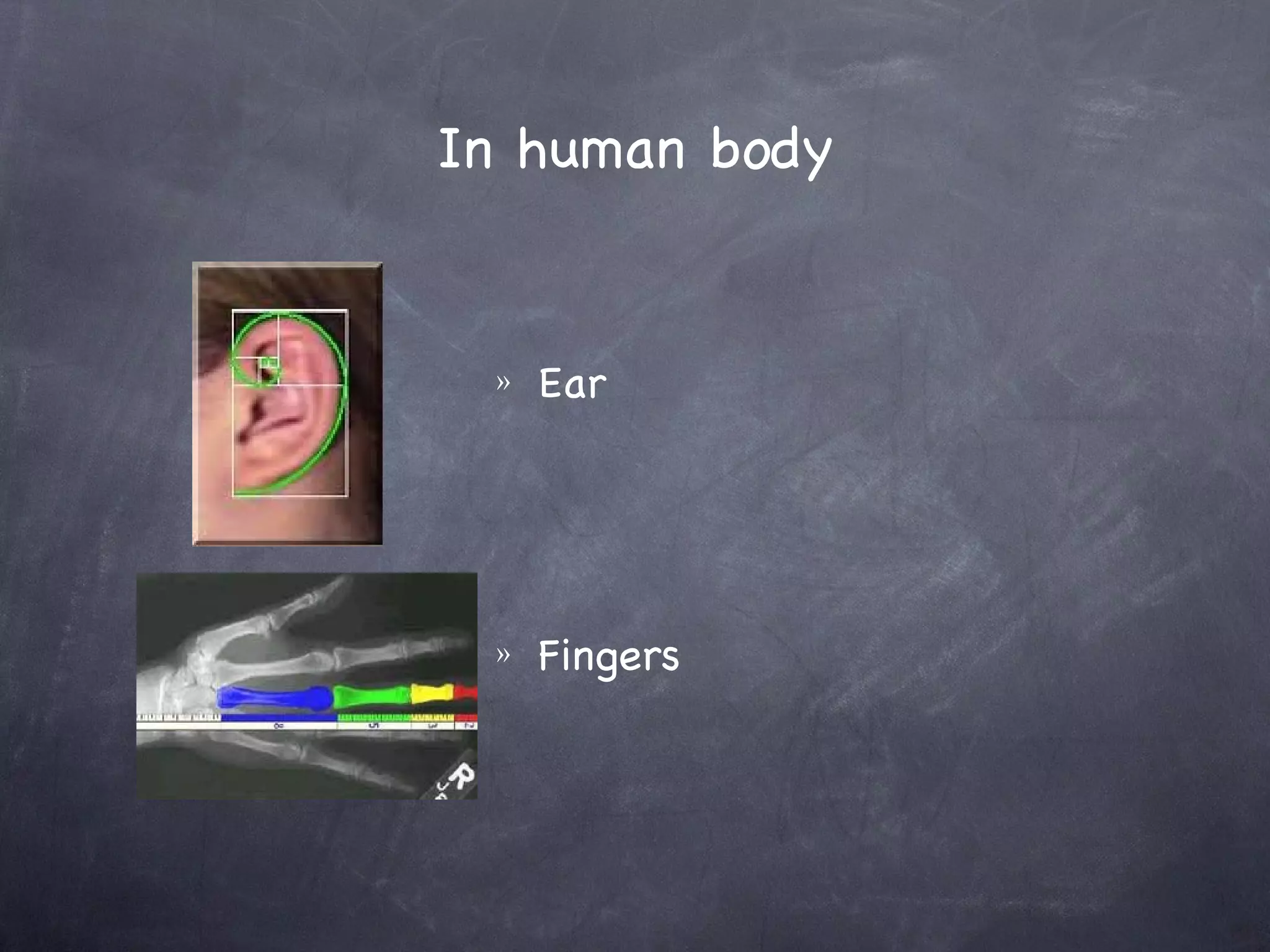
In human body


 »   Ear


 »   Fingers
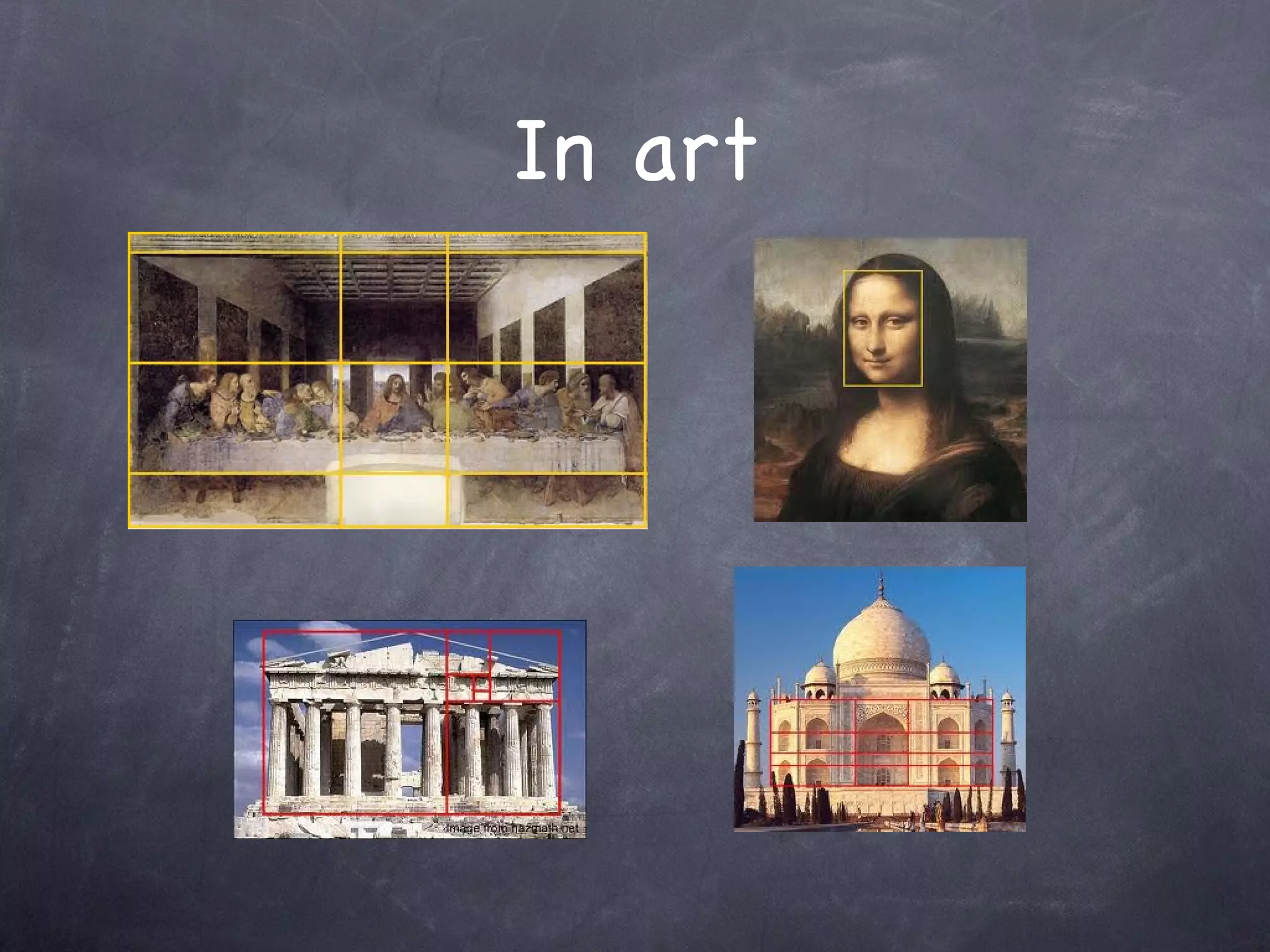
In art
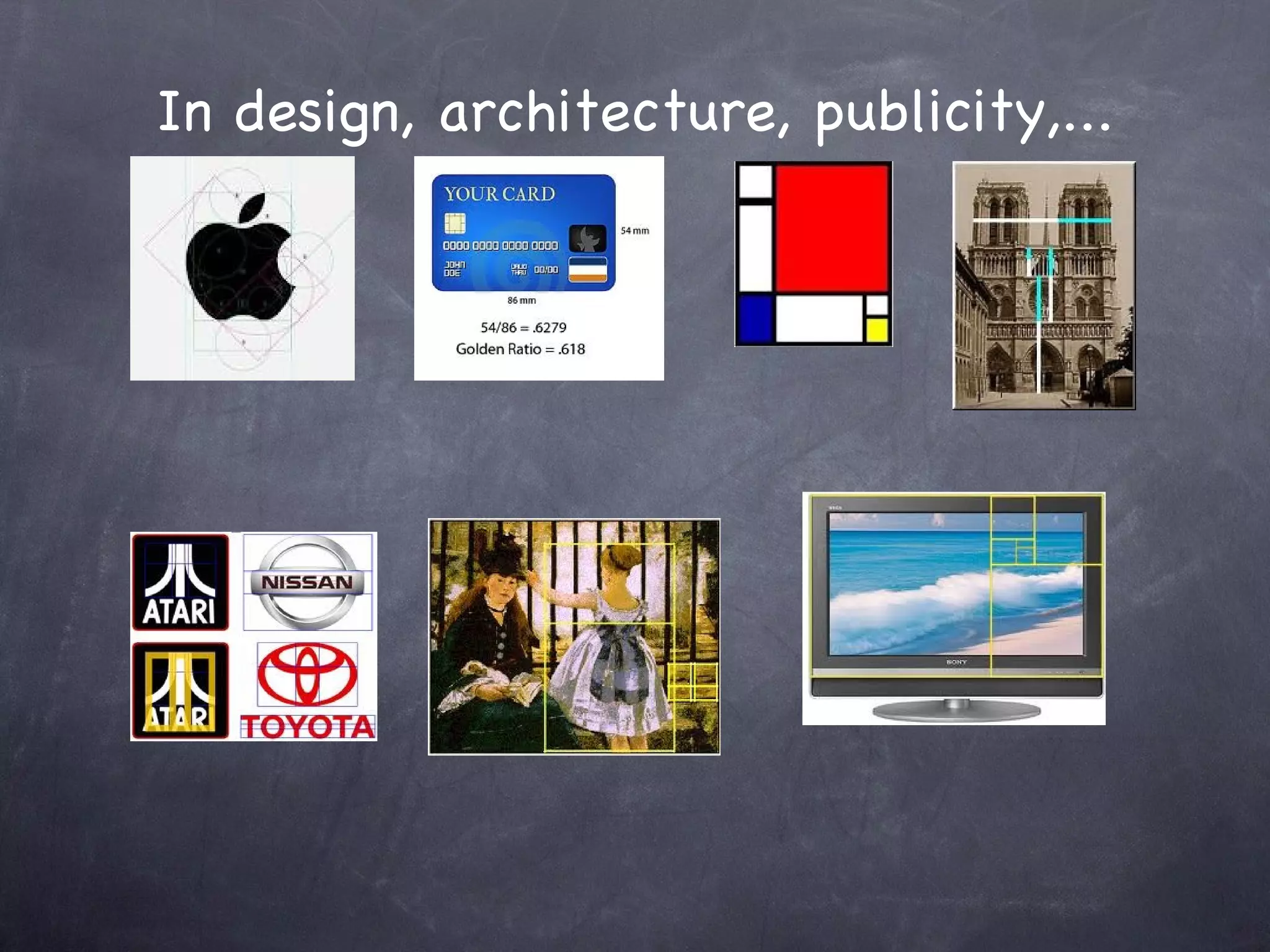
In design, architecture, publicity,...

Patterns sequences

  • 1.
  • 2.
    PURPOSE • To appreciate and investigate a numerical pattern • To look for evidence of mathematical patterns in nature
  • 3.
    Order is thekey • What do t hese sit uat ions have in common? • 1 There are people wait ing for t heir t urn t o buy some fruit .- • 2.- You are looking for your name on a list because you want t o know t he mark you got on your last exam • 3.- You are t rying t o follow inst ruct ions, being careful t o do every st ep of t he process in order
  • 4.
    KEY WORDS • The situations given before are related to a concept known as SEQUENCE • A sequence is an ordered list of things (objects, events, numbers,...) • Like a set it contains members (elements or TERMS
  • 5.
    GUESS THE NEXTTERM OR ELEMENT OF THE SERIES GIVEN BELOW • A) O, T, T, F,....? • B) 1, 3, 6, 10,...? (HINT: TRIANGLE NUMBERS) • C) 1, 4, 9, 16,...? • D) -5, 4, -3, 2,...? • E) 1, 1, 2, 3, 5,... (FIBONACCI SEQUENCE)
  • 6.
    WHO WAS FIBONACCI? » The “Greatest European mathematician” of the middle ages, his full name was Leonardo of Pisa
  • 7.
    He was born in Pisa about 1175 AD • He was one of the first people to introduce the Hindu-Arabic number system into Europe
  • 8.
    He discovered Fibonacci sequence after an investigation on the reproduction of rabbits • The number sequence was known to Indian Mathematician as early as the 6th century, but Fibonacci introduced it to the west
  • 9.
    The rabbit problem • Suppose a newly-born pair of rabbits, one male, one female, are put in a field. • Rabbits are abble to mate at the age of one month so that at the end of its second month a female can produce another pair of rabbits. • Suppose that our rabbits never die and that the female always produces a new pair (one male, one female) every month from the second month on • How many pairs will there be in one year? • The numbers of pairs of rabbits in the field at the start of each month is 1, 1, 2, 3, 5, 8, 13, 21, 34, ...
  • 10.
    Fibonacci pattern innature » In the head and petals of sunflowers » Pinecones show the Fibonacci Spiral
  • 11.
    In music – A piano keyboard has 8 white keys, 5 black keys in groups of 2 and 3 these 13 keys comprise one octave
  • 12.
    The number of petals on a flower are often Fibonacci numbers • This important pattern can be found in pineapples, bananas, cauliflowers
  • 13.
    The Golden Ratio • The Golden ratio is an irrational mathematical constant, approximately equals to 1.6180339887 • A golden rectangle is a rectangle where the ratio of its length to width is the golden number
  • 14.
    Relation between FibonacciSequence and the Golden ratio • Fibonacci numbers 1, 1, 2, 3, 5, 8, 13, 21, 34, 55, 89, 144, 233, 377, 610, 987, 1597, 2584,... • If you calculate the ratios... • 1/1 = 1, 2/1 = 2, 3/2 = 1.5, 5/3 = 1.6666... • 8/5 = 1.6, 13/8 = 1.625, 21/13 = 1.615384.. • 34/21 = 1.61904... 55/34 = 1.617647...
  • 15.
    Aha! Notice that as we continue down the sequence, the ratios seem to be converging upon one number • If we continue to look at the ratios as the numbers in the sequence get larger and larger the ratio will become the same number, and this number is THE GOLDEN RATIO 1.6180339887...
  • 16.
    Golden ratio innature » Nautilus Shell » Butterfly
  • 17.
    In human body » Ear » Fingers
  • 18.
  • 19.