FIBONACCI SEQUENCE
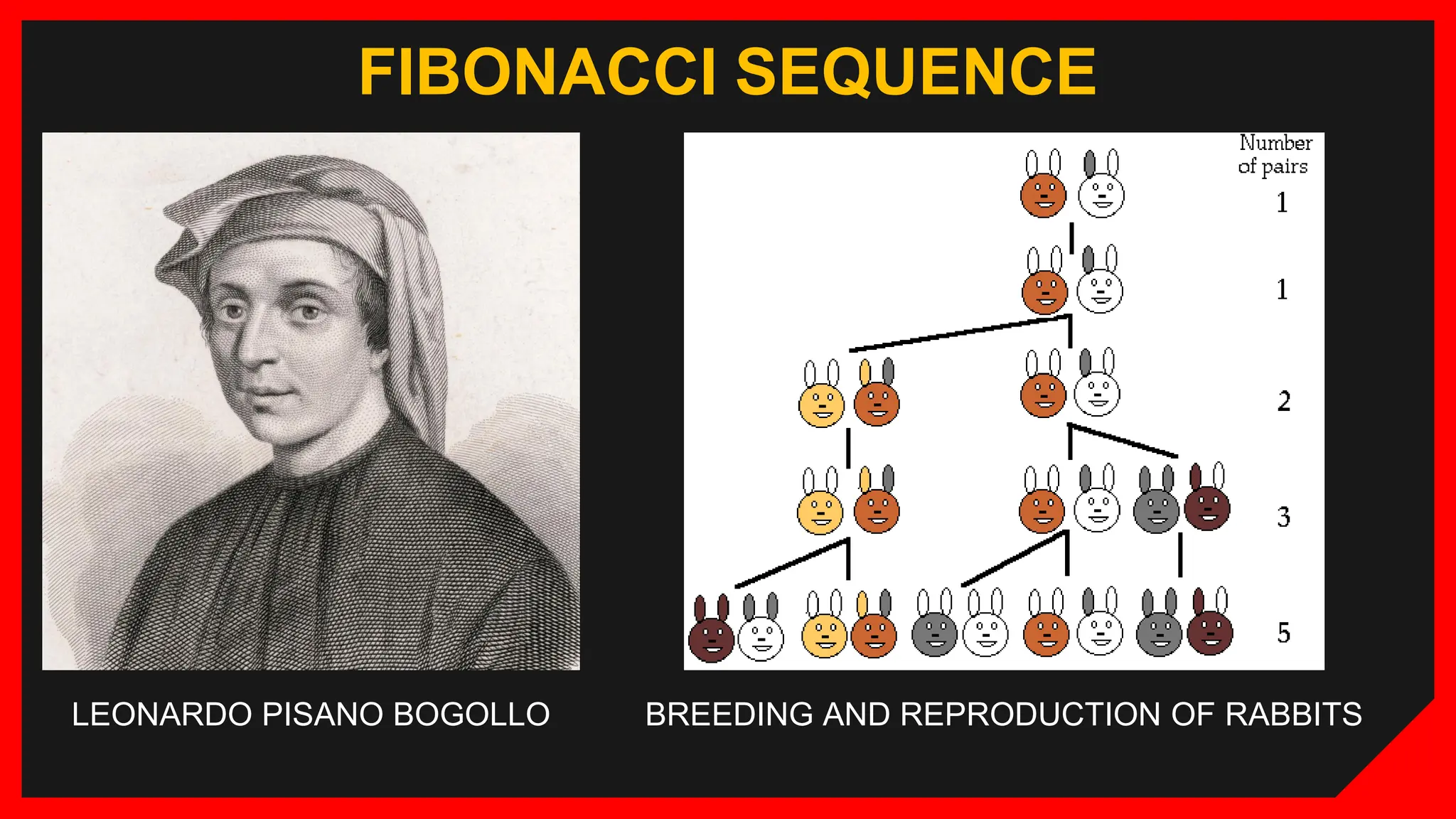
Discovery ofthis sequence:
Breeding and Reproduction of
Rabbits
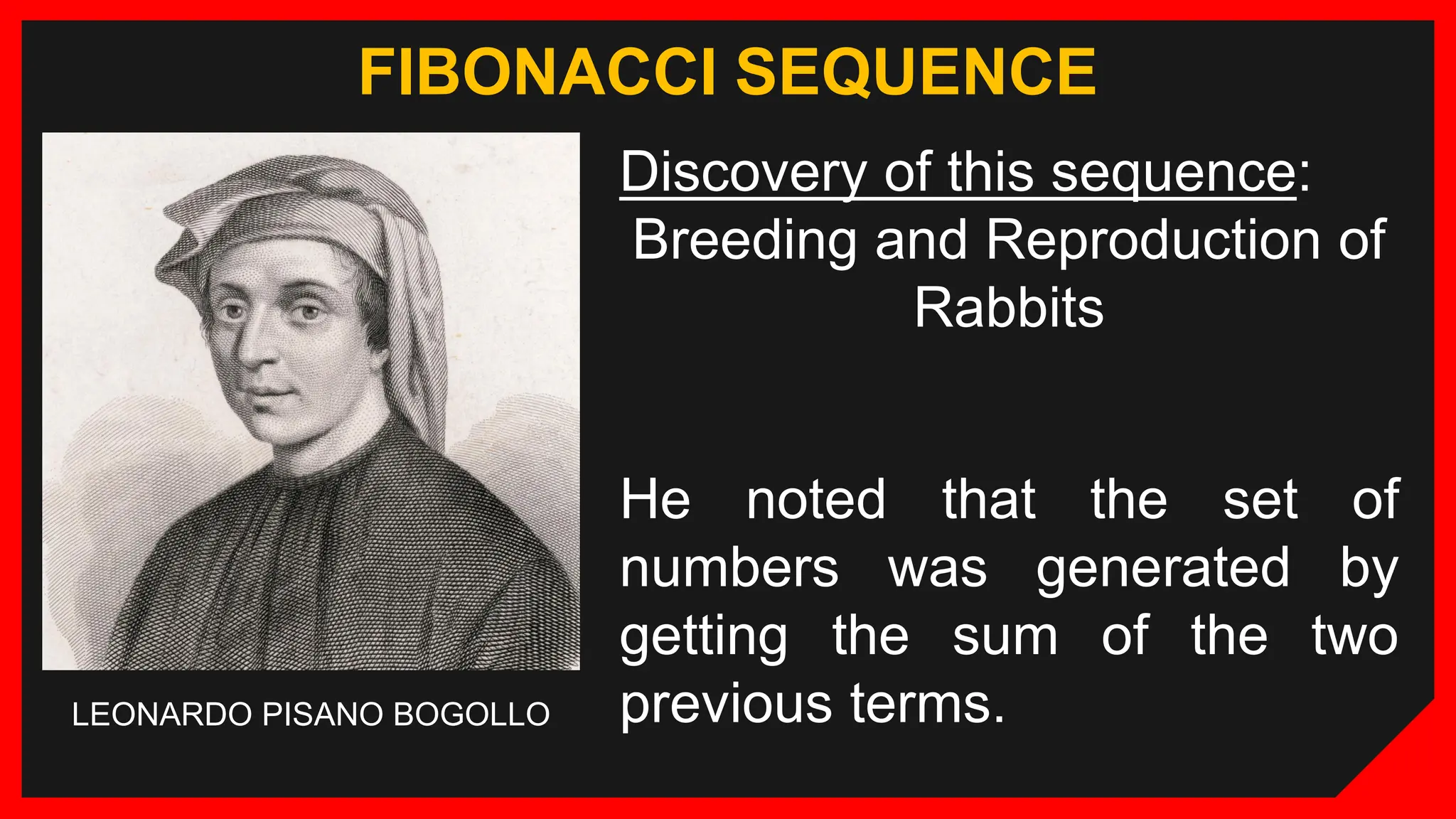
LEONARDO PISANO BOGOLLO
He noted that the set of
numbers was generated by
getting the sum of the two
previous terms.
6.
FIBONACCI SEQUENCE
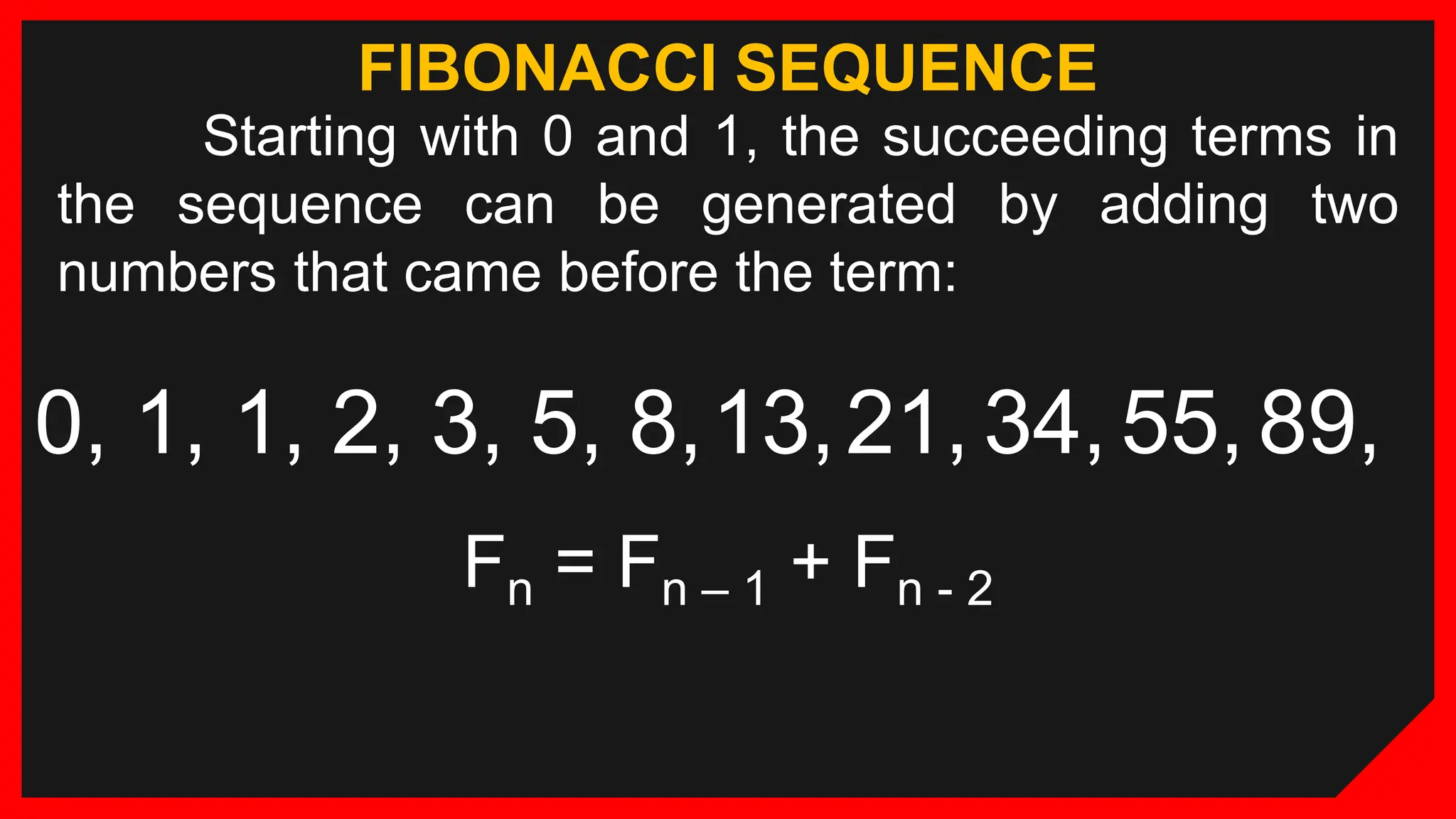
Starting with0 and 1, the succeeding terms in
the sequence can be generated by adding two
numbers that came before the term:
0, 1, 1, 2, 3, 5, 8,13,21, 34, 55, 89,
Fn = Fn – 1 + Fn - 2
7.
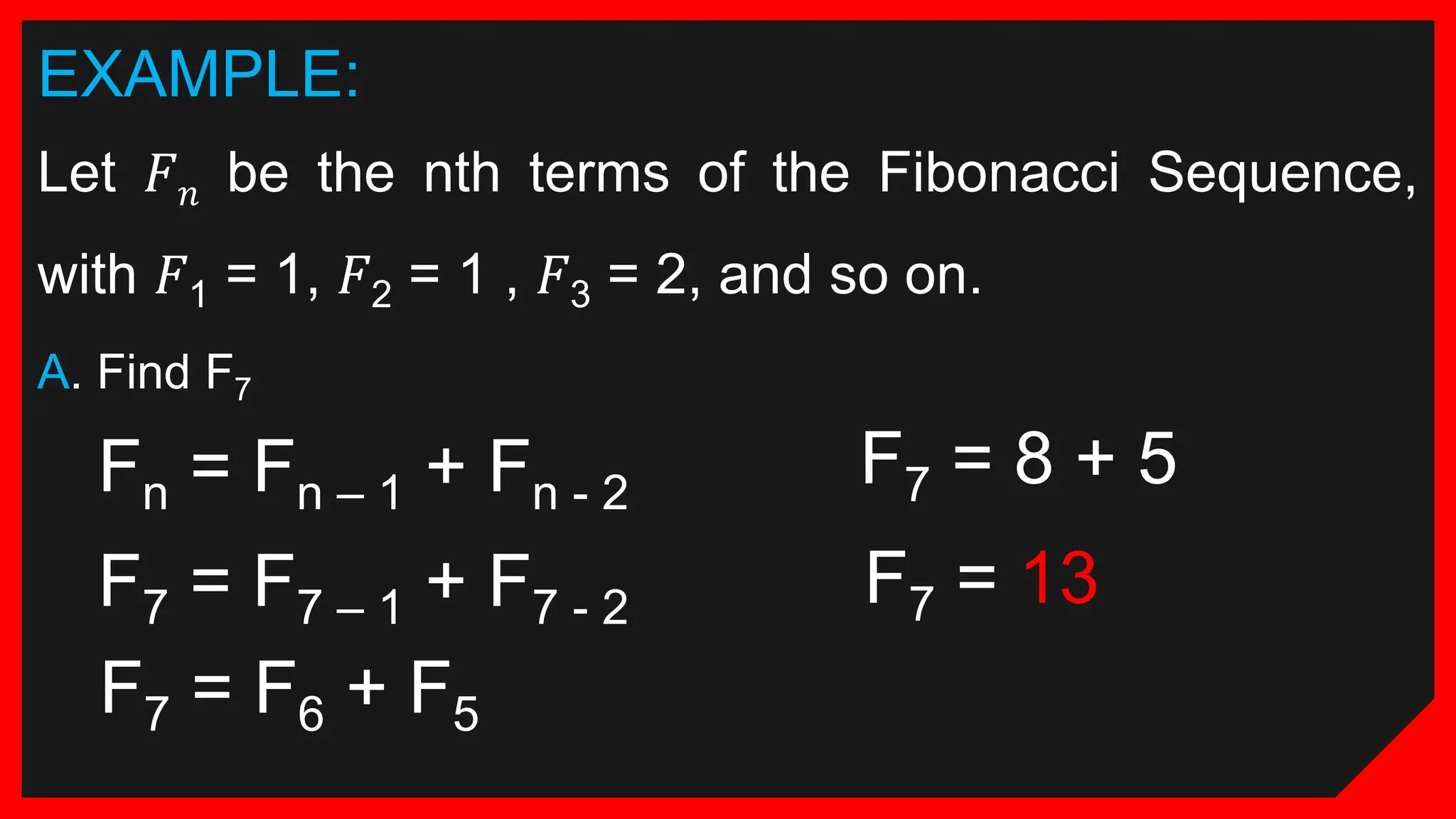
EXAMPLE:
Let 𝐹𝑛 bethe nth terms of the Fibonacci Sequence,
with 𝐹1 = 1, 𝐹2 = 1 , 𝐹3 = 2, and so on.
A. Find F7
Fn = Fn – 1 + Fn - 2
F7 = F7 – 1 + F7 - 2
F7 = F6 + F5
F7 = 8 + 5
F7 = 13
8.
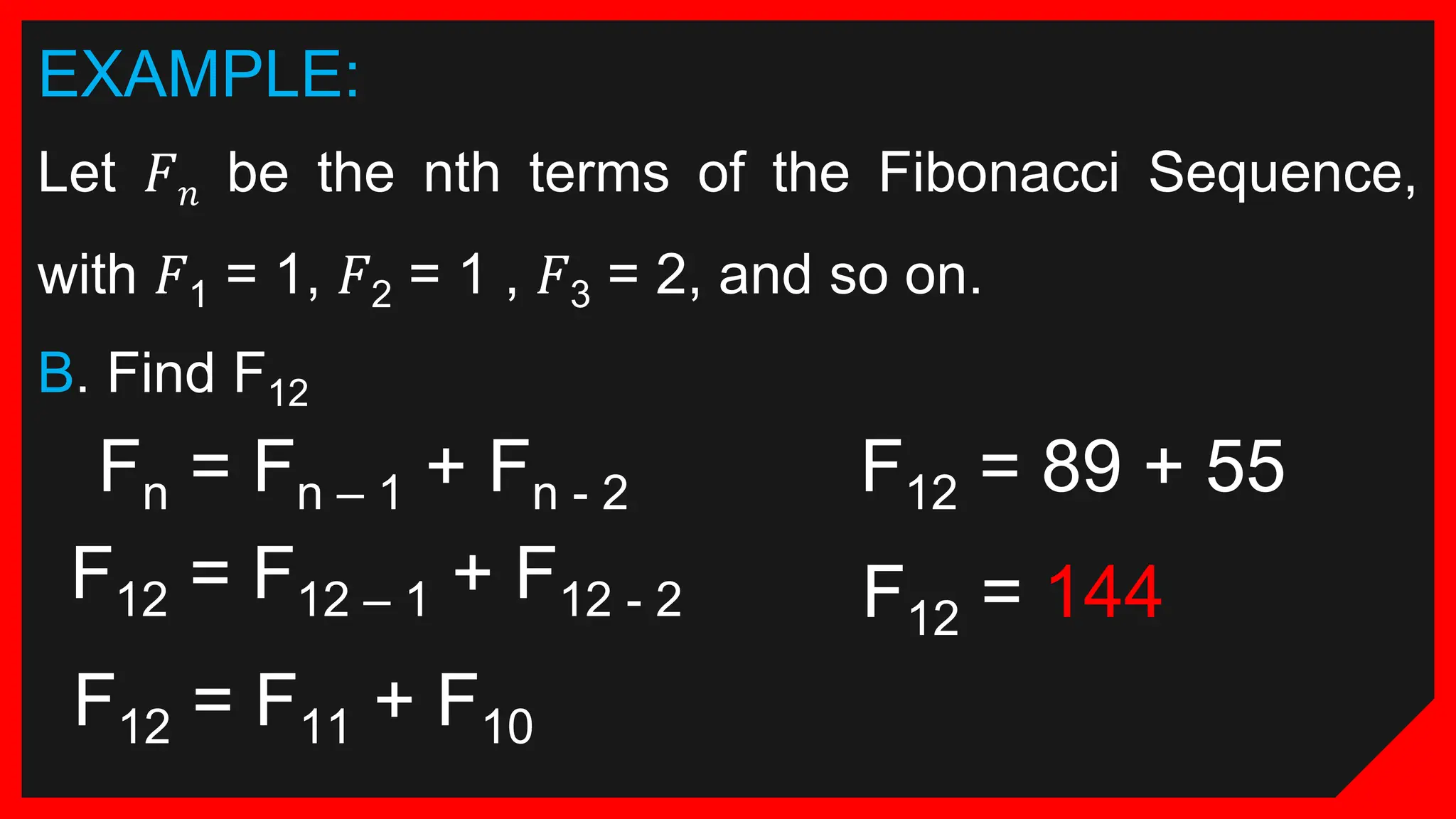
EXAMPLE:
Let 𝐹𝑛 bethe nth terms of the Fibonacci Sequence,
with 𝐹1 = 1, 𝐹2 = 1 , 𝐹3 = 2, and so on.
B. Find F12
F12 = F12 – 1 + F12 - 2
Fn = Fn – 1 + Fn - 2
F12 = F11 + F10
F12 = 89 + 55
F12 = 144
9.
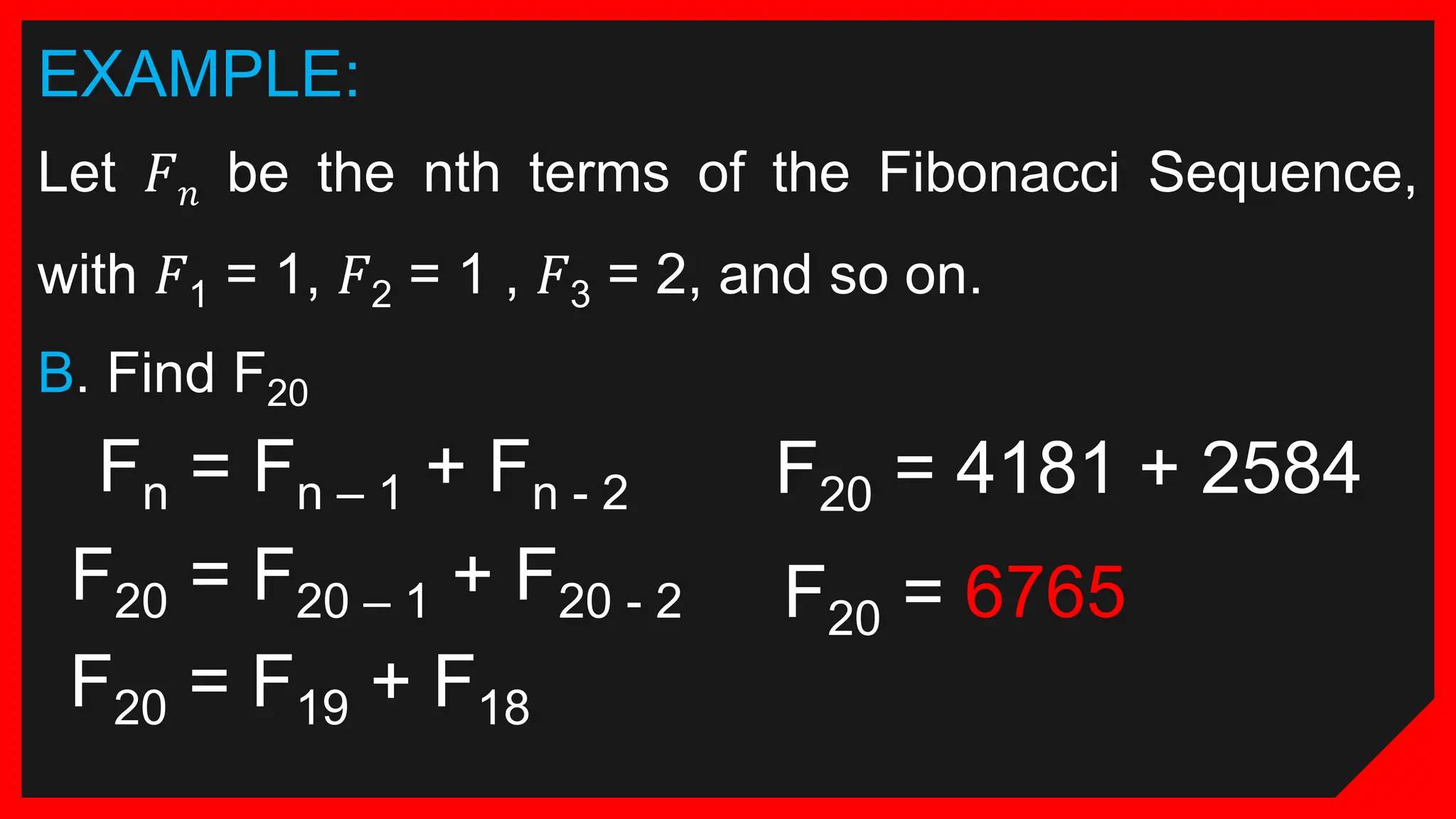
EXAMPLE:
Let 𝐹𝑛 bethe nth terms of the Fibonacci Sequence,
with 𝐹1 = 1, 𝐹2 = 1 , 𝐹3 = 2, and so on.
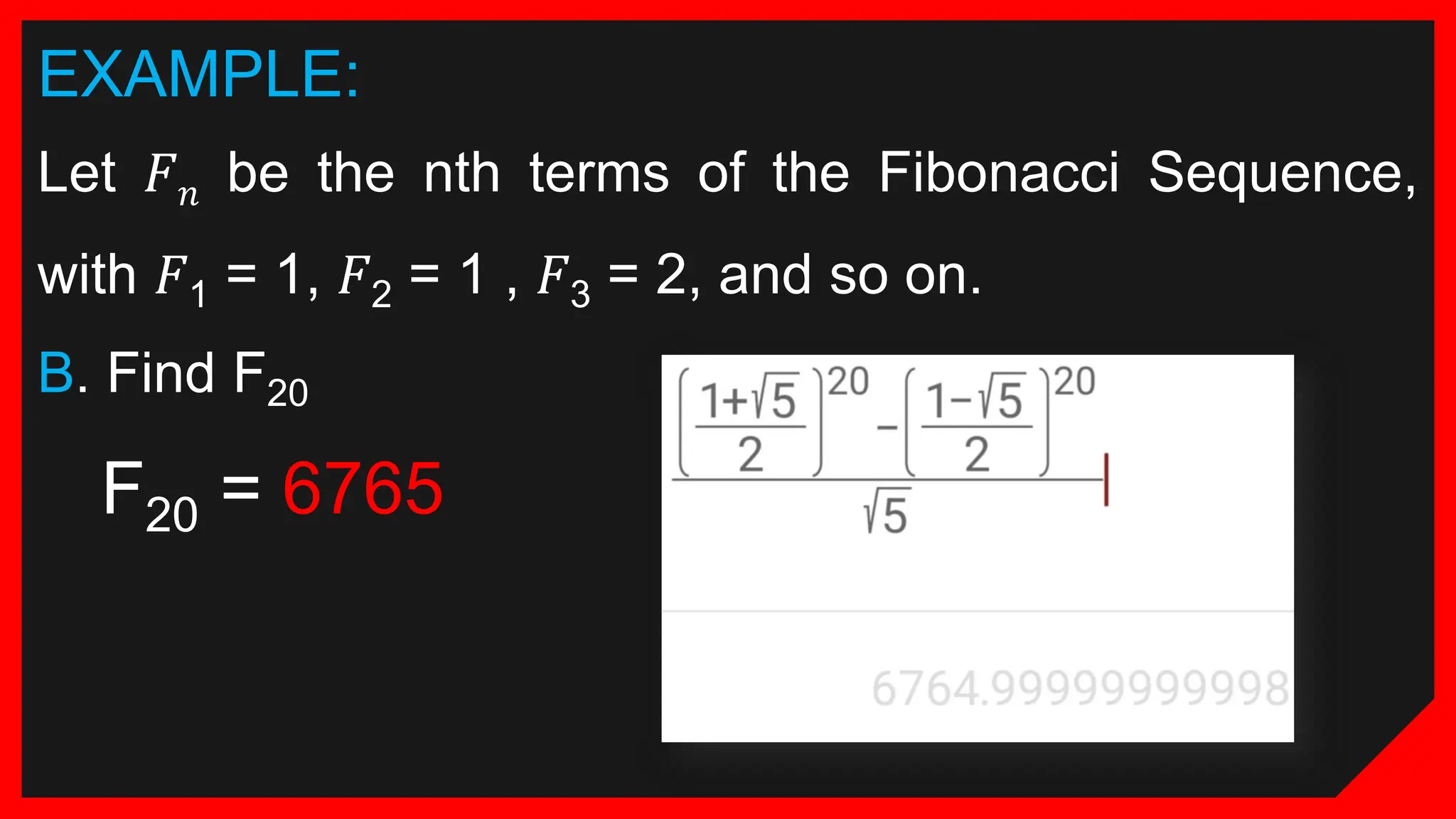
B. Find F20
Fn = Fn – 1 + Fn - 2
F20 = F20 – 1 + F20 - 2
F20 = F19 + F18
F20 = 4181 + 2584
F20 = 6765
10.
EXAMPLE:
Let 𝐹𝑛 bethe nth terms of the Fibonacci Sequence,
with 𝐹1 = 1, 𝐹2 = 1 , 𝐹3 = 2, and so on.
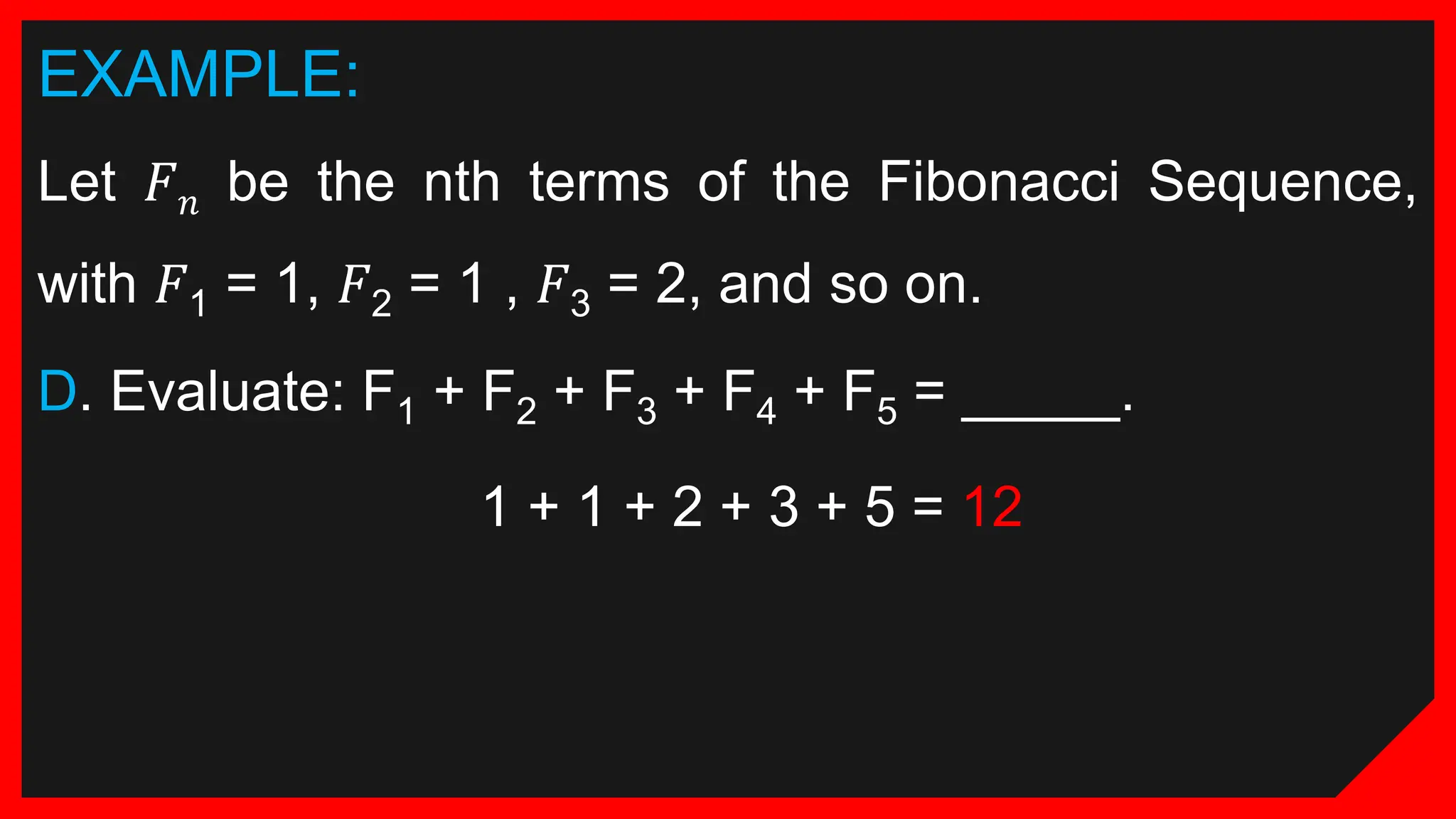
D. Evaluate: F1 + F2 + F3 + F4 + F5 = _____.
1 + 1 + 2 + 3 + 5 = 12
The Fibonacci sequencehas many
interesting properties. Among these is
that this pattern is very visible in nature.
16.
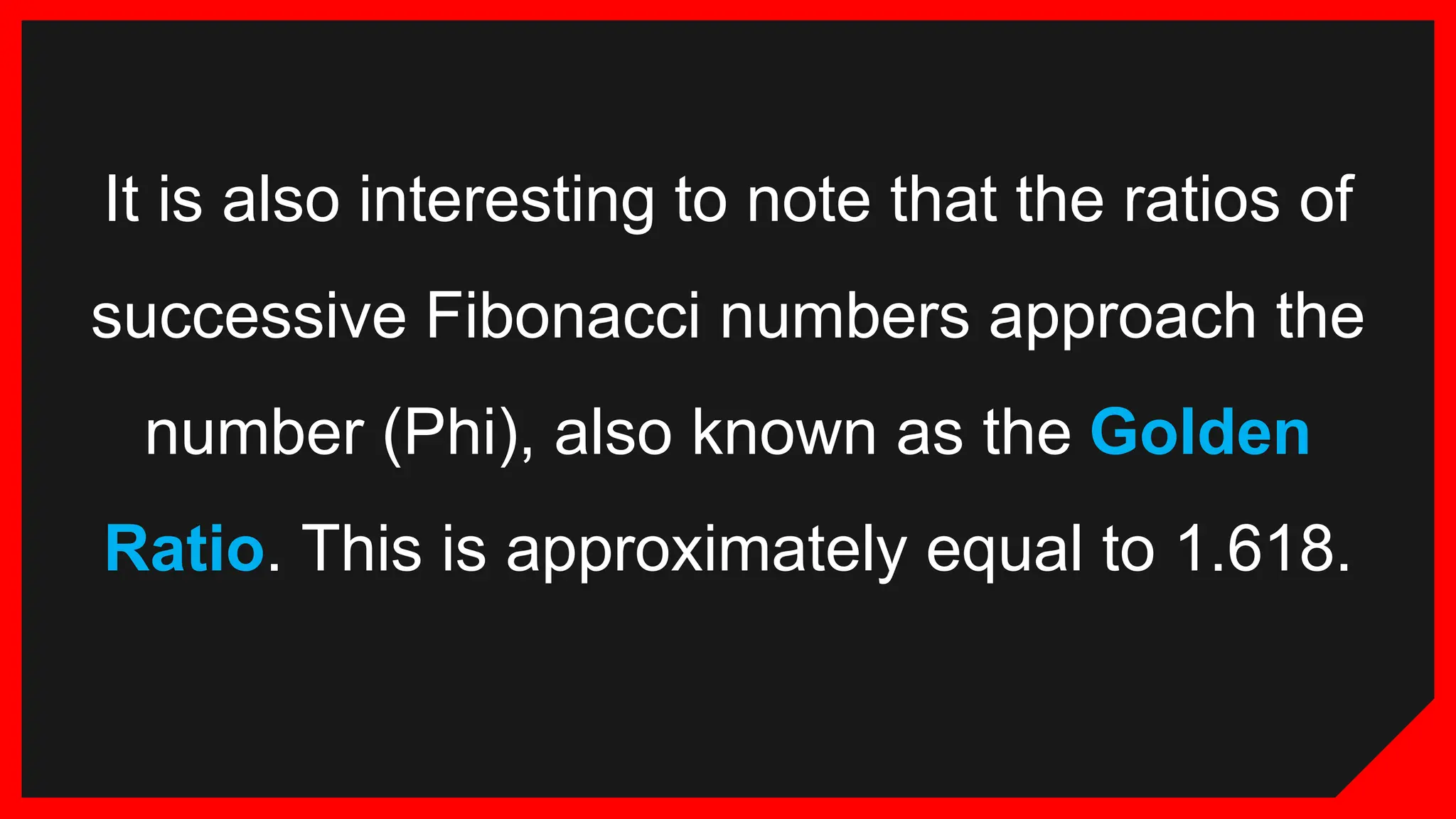
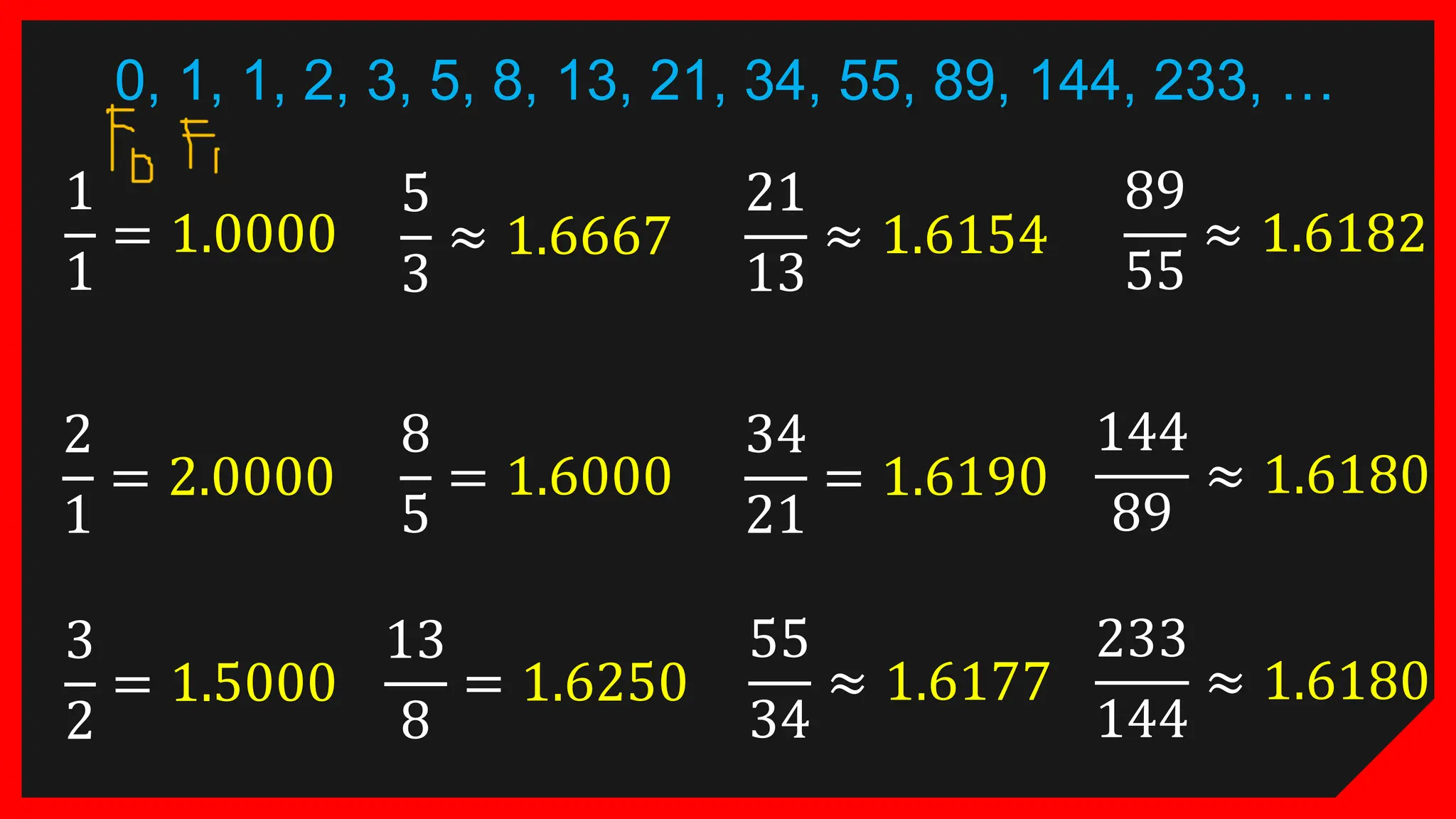
It is alsointeresting to note that the ratios of
successive Fibonacci numbers approach the
number (Phi), also known as the Golden
Ratio. This is approximately equal to 1.618.
17.
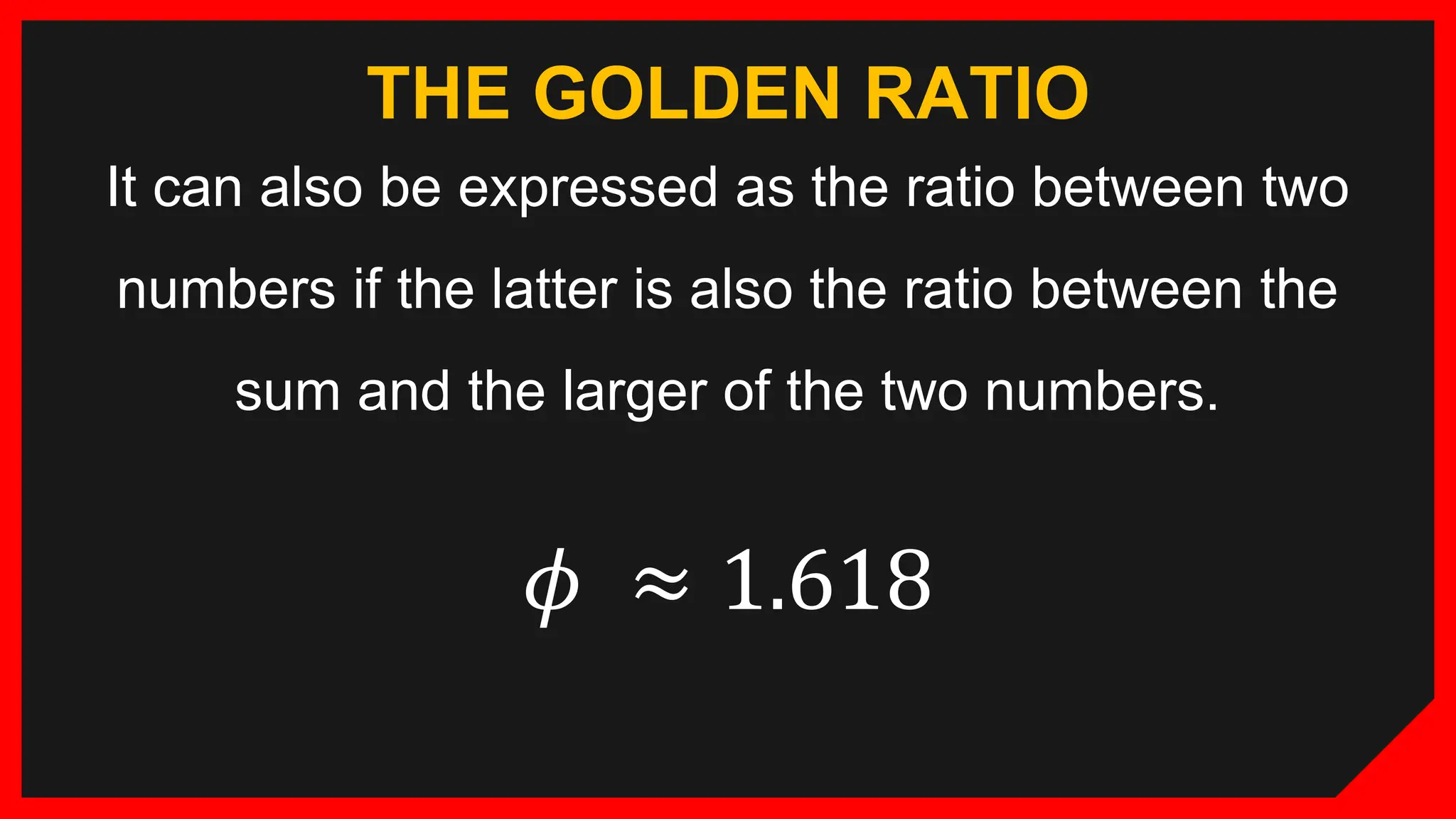
THE GOLDEN RATIO
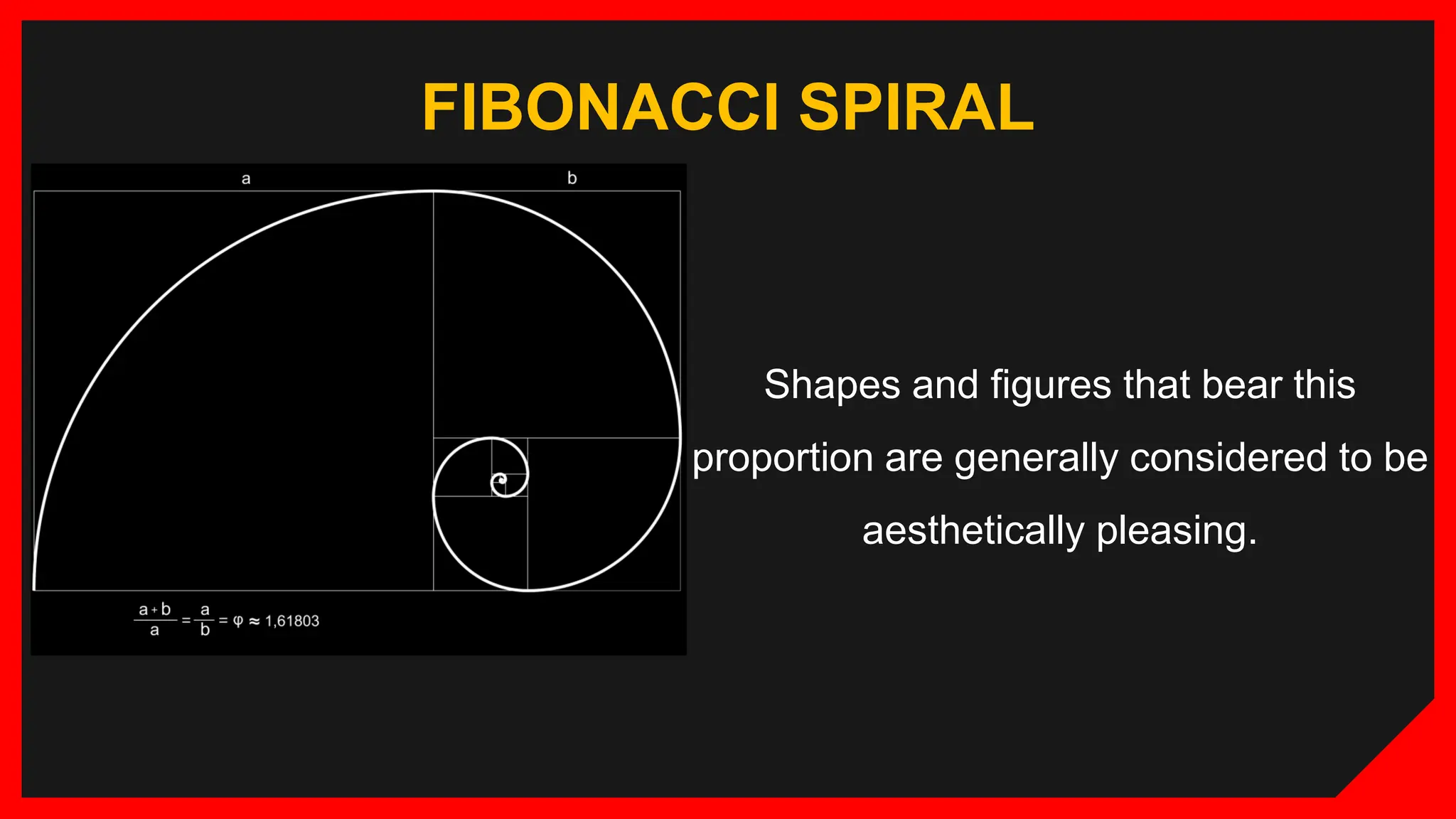
Itcan also be expressed as the ratio between two
numbers if the latter is also the ratio between the
sum and the larger of the two numbers.
𝜙 ≈ 1.618
FIBONACCI SPIRAL
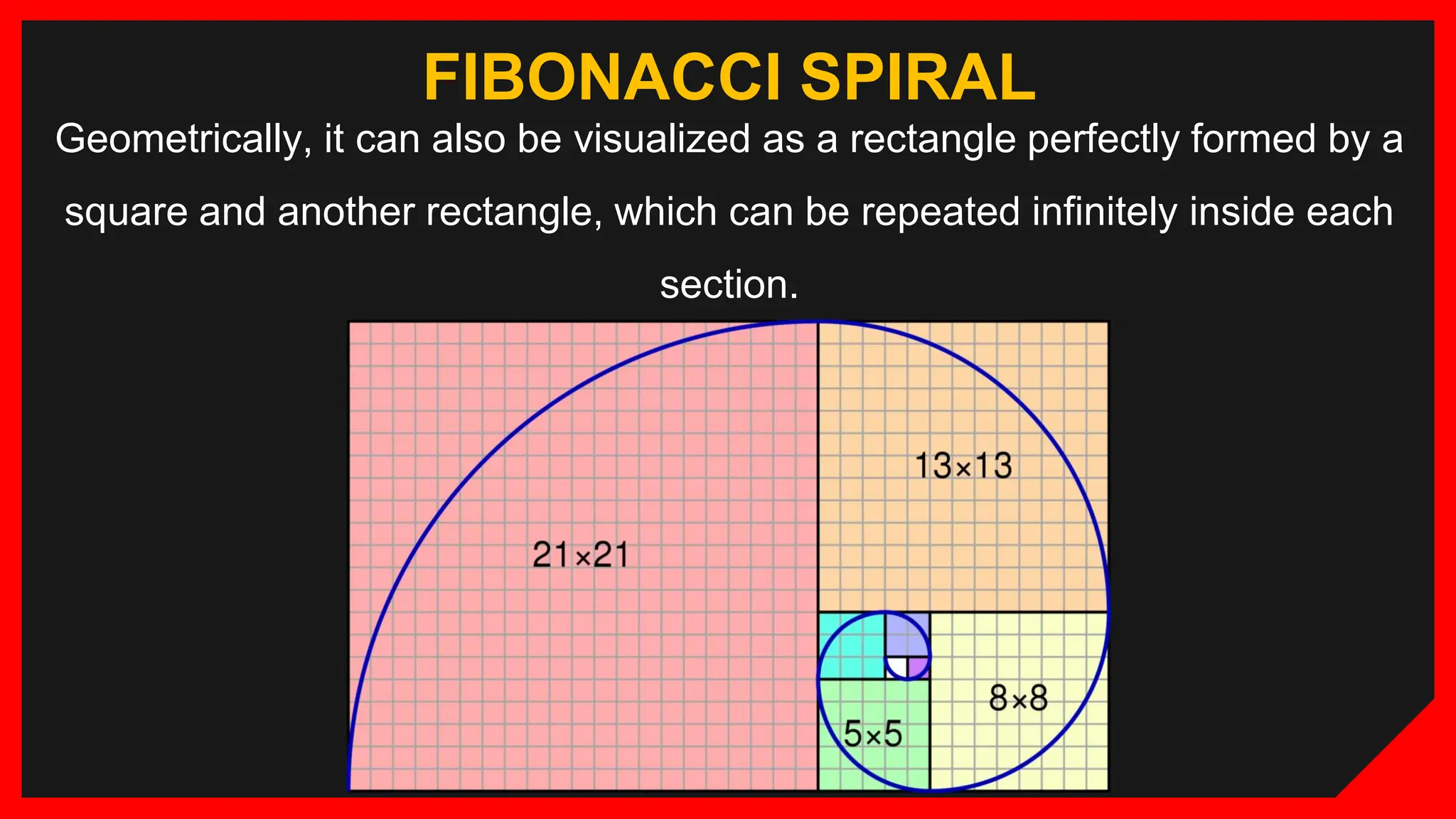
Geometrically, itcan also be visualized as a rectangle perfectly formed by a
square and another rectangle, which can be repeated infinitely inside each
section.
20.
FIBONACCI SPIRAL
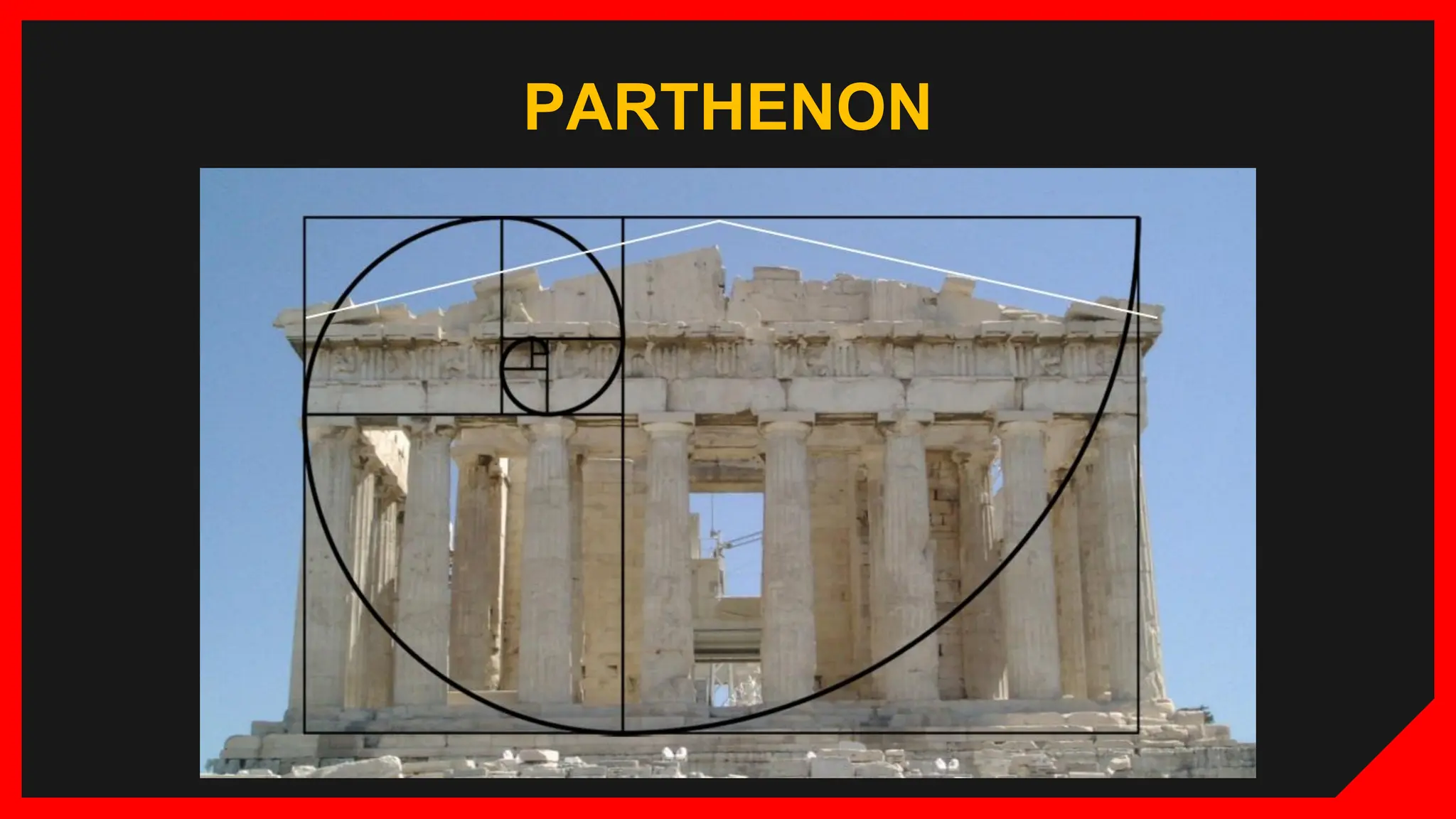
Shapes andfigures that bear this
proportion are generally considered to be
aesthetically pleasing.