PCORnet PPRN
Partner Meeting
Welcome!
Rachael Fleurence, Director
CER Methods and Infrastructure Program
PPRN Practices, Challenges,
and Opportunities
Sarah Daugherty, PhD MPH
PCORI PPRN Workshop
January 2014
3
Workshop Goal
“Create a culture between PPRNs
that fosters sharing of best practices
to avoid waste of resources and unnecessary
duplication.”
4
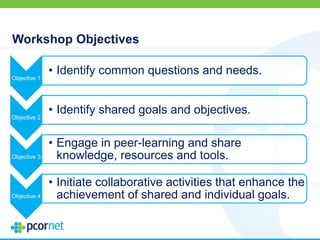
Workshop Objectives
Objective 1
• Identify common questions and needs.
Objective 2
• Identify shared goals and objectives.
Objective 3
• Engage in peer-learning and share
knowledge, resources and tools.
Objective 4
• Initiate collaborative activities that enhance the
achievement of shared and individual goals.
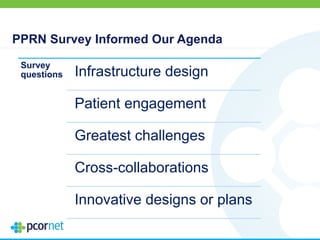
PPRN Survey Informed Our Agenda
Survey
questions Infrastructure design
Patient engagement
Greatest challenges
Cross-collaborations
Innovative designs or plans
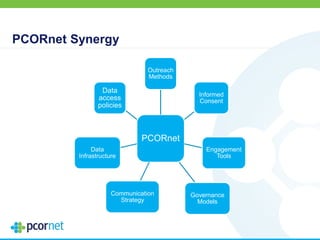
PCORnet Synergy
PCORnet
Outreach
Methods
Informed
Consent
Engagement
Tools
Governance
Models
Communication
Strategy
Data
Infrastructure
Data
access
policies
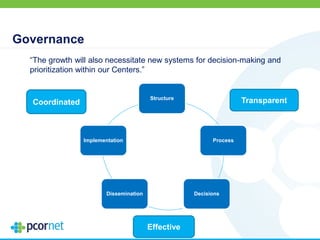
Governance
“The growth will also necessitate new systems for decision-making and
prioritization within our Centers.”
TransparentCoordinated
Effective
Structure
Process
DecisionsDissemination
Implementation
Outreach and Sustaining Engagement
“How do you bring people up the engagement ladder
so that they can get to own the whole process?”
“Do we focus on deep engagement from a smaller
number of patients, or just SOME engagement from a
large number of patients?”
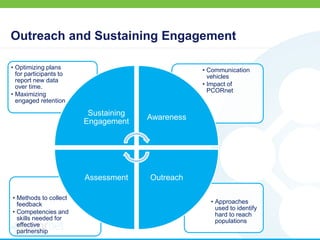
Outreach and Sustaining Engagement
• Approaches
used to identify
hard to reach
populations
• Methods to collect
feedback
• Competencies and
skills needed for
effective
partnership
• Communication
vehicles
• Impact of
PCORnet
• Optimizing plans
for participants to
report new data
over time.
• Maximizing
engaged retention
Sustaining
Engagement
Awareness
OutreachAssessment
Greatest Challenges
“Translating awareness to enthusiasm to action”
Misperceptions about privacy, security, and risks of sharing data
Attrition of original participants
Sustaining PPRN after month 19 and beyond
Cross-Collaborations
Common data model
Co-enrollment
Participant-friendly generic consent
Ongoing dialogue between PPRNs and CDRNs
Methods for collecting PRO in non-clinical setting
Basic information about purpose of PPRNs written
in generic way for all patients
Guiding Questions for Discussion
Common areas to address collectively?
What resources and tools exist already?
What resources and tools could be developed?
Processes to leverage collective skills and
knowledge?
What are the action items needed to move
forward?
How can PCORI facilitate continued sharing?
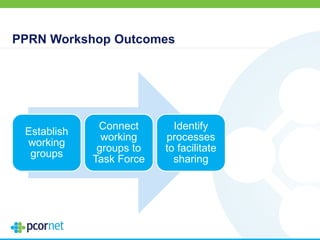
PPRN Workshop Outcomes
Establish
working
groups
Connect
working
groups to
Task Force
Identify
processes
to facilitate
sharing
Governance
Alison Rein, Seth Ginsberg, Michael
Kappelman, Barbara Kroner
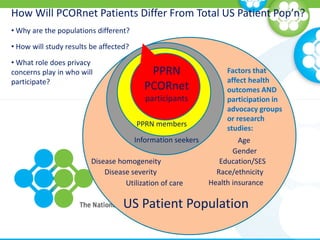
Disease homogeneity
PPRN
PCORnet
participants
Age
Gender
Utilization of care Health insurance
Race/ethnicity
Education/SES
Information seekers
PPRN members
US Patient Population
How Will PCORnet Patients Differ From Total US Patient Pop’n?
• What role does privacy
concerns play in who will
participate?
• Why are the populations different?
• How will study results be affected?
Factors that
affect health
outcomes AND
participation in
advocacy groups
or research
studies:
Disease severity
3 Levels of Patient Governance
Scientific leadership
Patient leadership
Community responsiveness
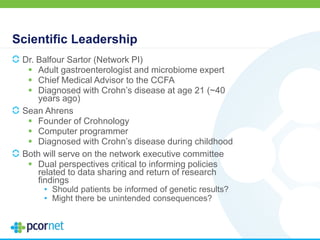
Scientific Leadership
Dr. Balfour Sartor (Network PI)
 Adult gastroenterologist and microbiome expert
 Chief Medical Advisor to the CCFA
 Diagnosed with Crohn’s disease at age 21 (~40
years ago)
Sean Ahrens
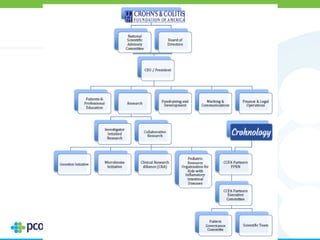
 Founder of Crohnology
 Computer programmer
 Diagnosed with Crohn’s disease during childhood
Both will serve on the network executive committee
 Dual perspectives critical to informing policies
related to data sharing and return of research
findings
• Should patients be informed of genetic results?
• Might there be unintended consequences?
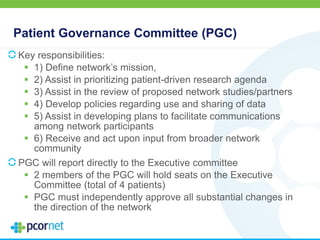
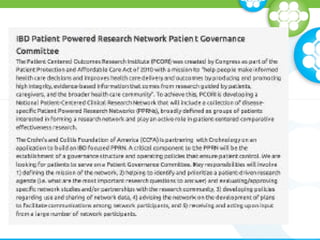
Patient Governance Committee (PGC)
Key responsibilities:
 1) Define network’s mission,
 2) Assist in prioritizing patient-driven research agenda
 3) Assist in the review of proposed network studies/partners
 4) Develop policies regarding use and sharing of data
 5) Assist in developing plans to facilitate communications
among network participants
 6) Receive and act upon input from broader network
community
PGC will report directly to the Executive committee
 2 members of the PGC will hold seats on the Executive
Committee (total of 4 patients)
 PGC must independently approve all substantial changes in
the direction of the network
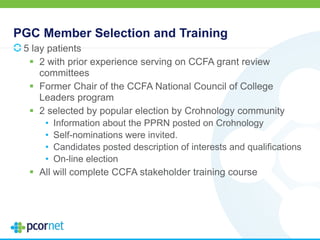
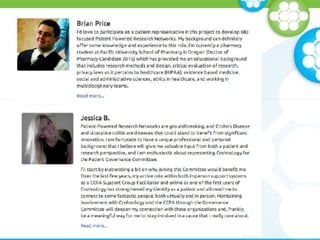
PGC Member Selection and Training
5 lay patients
 2 with prior experience serving on CCFA grant review
committees
 Former Chair of the CCFA National Council of College
Leaders program
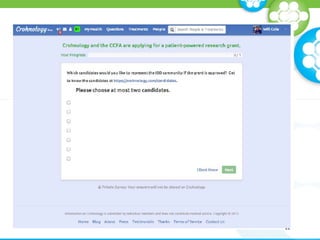
 2 selected by popular election by Crohnology community
• Information about the PPRN posted on Crohnology
• Self-nominations were invited.
• Candidates posted description of interests and qualifications
• On-line election
 All will complete CCFA stakeholder training course
Crowdsourcing to broaden responsiveness
Draft policies to be posted online
All network members will be able to comment,
suggest changes, or contribute more substantially
through the use of “wiki-style” editing.
The PGC will incorporate member feedback into
the final version of all policies.
Communication and dissemination of research
findings
Network updates will be posted on discussion pages (also
distributed by emails)
 Member comments and “hearts” will be periodically
reviewed by the PGC and the network’s scientific leadership
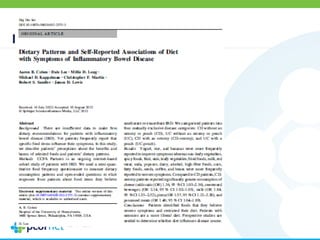
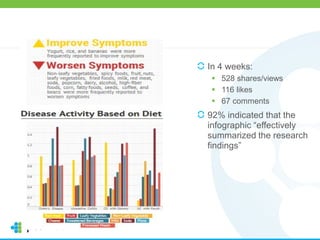
Research findings will be communicated using lay summaries
and infographics
Infographics
In 4 weeks:
 528 shares/views
 116 likes
 67 comments
92% indicated that the
infographic “effectively
summarized the research
findings”
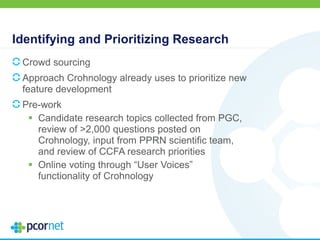
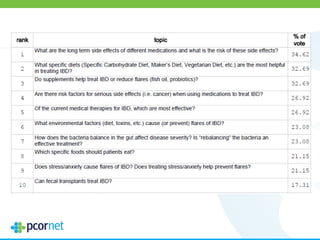
Identifying and Prioritizing Research
Crowd sourcing
Approach Crohnology already uses to prioritize new
feature development
Pre-work
 Candidate research topics collected from PGC,
review of >2,000 questions posted on
Crohnology, input from PPRN scientific team,
and review of CCFA research priorities
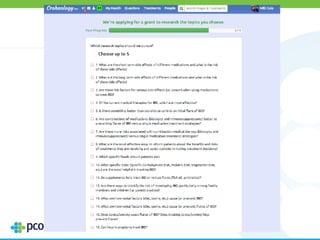
 Online voting through “User Voices”
functionality of Crohnology
Comments, Questions, Discussion?
Outreach and
Sustaining
Engagement
Sean Tunis, Andrew Nierenberg,
Susan Redline, Kathleen Sullivan
Research Issues: Conducting
Observational & Experimental
Research
Rich Platt
Research Issues:
Navigating Informed
Consent and IRBs
Rob Califf, Mark Pletcher, John Walsh
Pipeline to Proposal
Awards & PCORI
Ambassador Program
Sue Sheridan
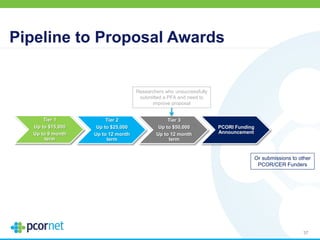
Tier 1
Up to $15,000
Up to 9 month
term
Tier 2
Up to $25,000
Up to 12 month
term
Tier 3
Up to $50,000
Up to 12 month
term
PCORI Funding
Announcement
Researchers who unsuccessfully
submitted a PFA and need to
improve proposal
Pipeline to Proposal Awards
37
Or submissions to other
PCOR/CER Funders
Tier I Pipeline Awards
(Up to $15,000 for up to 9 months)
Available to individuals,
consumer/patient organizations,
clinician(s), researcher(s) or a
combination of the above to
support:
 Community building around an
area of research interest to
improve outcomes for patients
 Creation of structure and
communication strategies
 Develop an understanding of
PCORI, and “research done
differently”
38
Tier II Pipeline Awards
(Up to $25,000 for up to one year)
Available to emerging
research/non-research
partnerships to support:
 Data network and registry
development
 Development of infrastructure
 Generation and refinement of
research questions through
community events, town hall
meetings, etc.
39
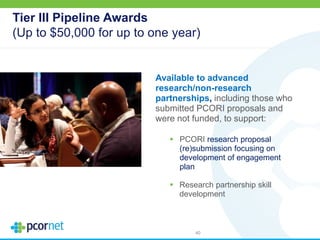
Tier III Pipeline Awards
(Up to $50,000 for up to one year)
Available to advanced
research/non-research
partnerships, including those who
submitted PCORI proposals and
were not funded, to support:
 PCORI research proposal
(re)submission focusing on
development of engagement
plan
 Research partnership skill
development
40
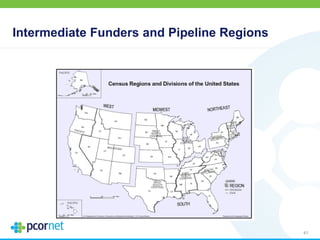
Intermediate Funders and Pipeline Regions
41
Western Region Pilot
Thirty Awardees Announced December 2013
Creating Healthy Communities: Engaging Native American and
Spanish-Speaking Families and Sharing Family Wisdom to
Reduce Childhood Obesity
Improving the Lives of Alzheimer's Patients and their Caregivers: A
Patient Centered Statewide Approach
Mobilizing Community Engagement for Health in a Southern New
Mexico Border Region Colonia
New Mexico LGBT Health Improvement Network
Usefulness of Pre-diabetes Management in Breast Cancer Care
The Hispanic Family Asthma Outcomes Research Network
Building Capacity for Novel Screening Delivery for Chronic
Conditions to Benefit Miners in New Mexico
Culturally Appropriate Options for Diabetes Prevention and Care
for Low-Income Latinos
Citizen scientist
Developing Infrastructure for Patient Centered Melanoma
Research
42
Western Region Pilot
Thirty Awardees Announced December 2013
Establishing a Patient-Centered Research Community for Cystic
Fibrosis
Sepsis Survivors Engagement Project (SSEP)
Preventing Missed Appointments for HIV Patients
Empowering Patients and Their Families to Improve Outcomes
That Are Most Important to Them after Lung Cancer Surgery
YOU COMPLETE ME! Demonstrating the Efficacy of An
Innovative Medical Appointment Model to Support Aging Patients
Healthy Outcomes for Older Foster Youth
Addressing Obesity in Latino Adolescents with Spina Bifida
Creating the Patient Centered Primary Care Council in the
Highland Hospital Adult Medicine Clinic: Strengthening Primary
Care Together
Health Literacy and the Patient Perspective in Primary Care
Engaging Communities in the Fight Against Preterm Birth
43
Western Region Pilot, by State
44
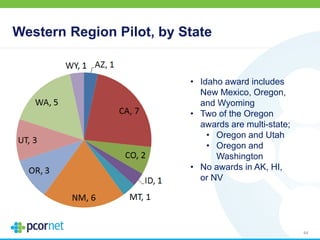
• Idaho award includes
New Mexico, Oregon,
and Wyoming
• Two of the Oregon
awards are multi-state;
• Oregon and Utah
• Oregon and
Washington
• No awards in AK, HI,
or NV
Next Steps
45
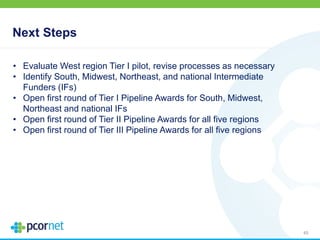
• Evaluate West region Tier I pilot, revise processes as necessary
• Identify South, Midwest, Northeast, and national Intermediate
Funders (IFs)
• Open first round of Tier I Pipeline Awards for South, Midwest,
Northeast and national IFs
• Open first round of Tier II Pipeline Awards for all five regions
• Open first round of Tier III Pipeline Awards for all five regions
Western Region Pilot
Thirty Awardees Announced December 2013
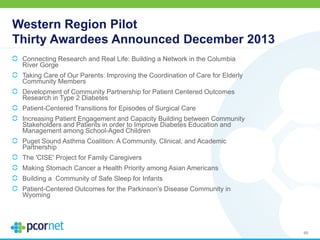
Connecting Research and Real Life: Building a Network in the Columbia
River Gorge
Taking Care of Our Parents: Improving the Coordination of Care for Elderly
Community Members
Development of Community Partnership for Patient Centered Outcomes
Research in Type 2 Diabetes
Patient-Centered Transitions for Episodes of Surgical Care
Increasing Patient Engagement and Capacity Building between Community
Stakeholders and Patients in order to Improve Diabetes Education and
Management among School-Aged Children
Puget Sound Asthma Coalition: A Community, Clinical, and Academic
Partnership
The 'CISE' Project for Family Caregivers
Making Stomach Cancer a Health Priority among Asian Americans
Building a Community of Safe Sleep for Infants
Patient-Centered Outcomes for the Parkinson's Disease Community in
Wyoming
46
PCORI Ambassador Program Update
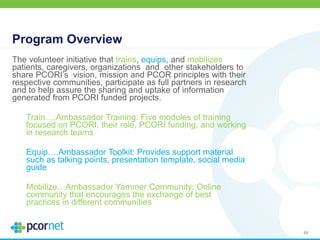
Program Overview
The volunteer initiative that trains, equips, and mobilizes
patients, caregivers, organizations and other stakeholders to
share PCORI’s vision, mission and PCOR principles with their
respective communities, participate as full partners in research
and to help assure the sharing and uptake of information
generated from PCORI funded projects.
Train….Ambassador Training: Five modules of training
focused on PCORI, their role, PCORI funding, and working
in research teams
Equip….Ambassador Toolkit: Provides support material
such as talking points, presentation template, social media
guide
Mobilize…Ambassador Yammer Community: Online
community that encourages the exchange of best
practices in different communities
48
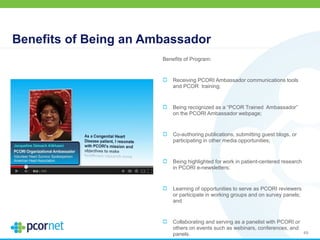
Benefits of Being an Ambassador
Benefits of Program:
Receiving PCORI Ambassador communications tools
and PCOR training;
Being recognized as a “PCOR Trained Ambassador”
on the PCORI Ambassador webpage;
Co-authoring publications, submitting guest blogs, or
participating in other media opportunities;
Being highlighted for work in patient-centered research
in PCORI e-newsletters;
Learning of opportunities to serve as PCORI reviewers
or participate in working groups and on survey panels;
and
Collaborating and serving as a panelist with PCORI or
others on events such as webinars, conferences, and
panels. 49
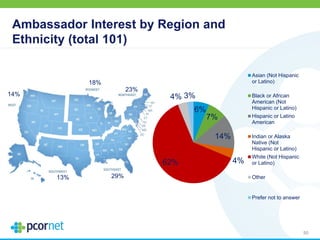
Ambassador Interest by Region and
Ethnicity (total 101)
6%
7%
14%
4%62%
4% 3%
Asian (Not Hispanic
or Latino)
Black or African
American (Not
Hispanic or Latino)
Hispanic or Latino
American
Indian or Alaska
Native (Not
Hispanic or Latino)
White (Not Hispanic
or Latino)
Other
Prefer not to answer
50
14%
13%
18%
29%
23%
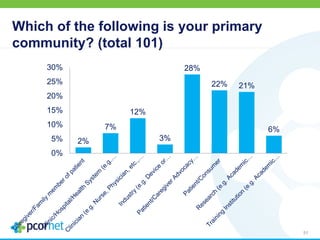
Which of the following is your primary
community? (total 101)
51
2%
7%
12%
3%
28%
22% 21%
6%
0%
5%
10%
15%
20%
25%
30%
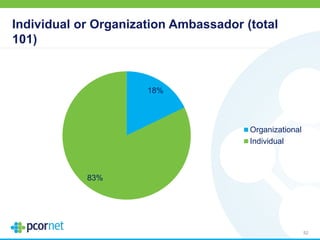
Individual or Organization Ambassador (total
101)
18%
83%
Organizational
Individual
52
Facilitating Interaction & Communication
Between PPRNs and CDRNs
Sarah Greene, MPH,
Senior Program Officer, CER Methods & Infrastructure
PPRN Partner Meeting
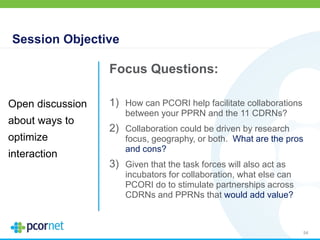
Session Objective
54
Focus Questions:
1) How can PCORI help facilitate collaborations
between your PPRN and the 11 CDRNs?
2) Collaboration could be driven by research
focus, geography, or both. What are the pros
and cons?
3) Given that the task forces will also act as
incubators for collaboration, what else can
PCORI do to stimulate partnerships across
CDRNs and PPRNs that would add value?
Open discussion
about ways to
optimize
interaction
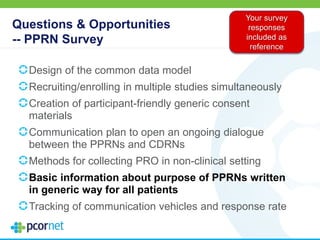
Questions & Opportunities
-- PPRN Survey
Design of the common data model
Recruiting/enrolling in multiple studies simultaneously
Creation of participant-friendly generic consent
materials
Communication plan to open an ongoing dialogue
between the PPRNs and CDRNs
Methods for collecting PRO in non-clinical setting
Basic information about purpose of PPRNs written
in generic way for all patients
Tracking of communication vehicles and response rate
Your survey
responses
included as
reference
Break Out Sessions:
1) Stakeholder Engagement
2) Integrating PROs with Clinical
Data
3) Standardized PCORnet Talking
Points
4) Ad Hoc
Recap and Next Steps
Sarita Wahba, Program Officer
CER Methods and Infrastructure Program
Agenda
Recap emerging ideas
Identify which ideas are timely and actionable
Channel your inner artist
PCORI and Coordinating Center next steps
58
Emerging Ideas
Categories
Patient Engagement
Communications / Branding
CDRN / PPRN Collaborations
Sustainability / Scalability
Disruptiveness
Engagement with non-patient Stakeholders
Integrating PROs
Creating Standardized PCORnet talking points
…And More
59
Emerging Ideas
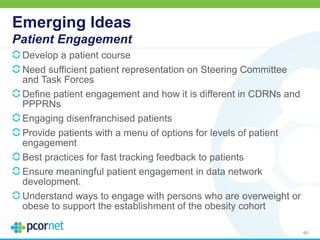
Patient Engagement
Develop a patient course
Need sufficient patient representation on Steering Committee
and Task Forces
Define patient engagement and how it is different in CDRNs and
PPPRNs
Engaging disenfranchised patients
Provide patients with a menu of options for levels of patient
engagement
Best practices for fast tracking feedback to patients
Ensure meaningful patient engagement in data network
development.
Understand ways to engage with persons who are overweight or
obese to support the establishment of the obesity cohort
60
Emerging Ideas
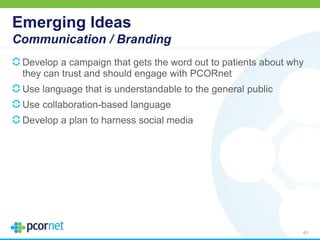
Communication / Branding
Develop a campaign that gets the word out to patients about why
they can trust and should engage with PCORnet
Use language that is understandable to the general public
Use collaboration-based language
Develop a plan to harness social media
61
Emerging Ideas
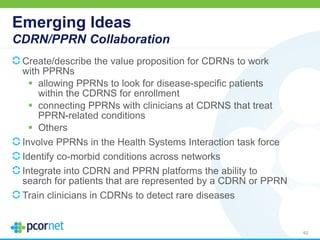
CDRN/PPRN Collaboration
Create/describe the value proposition for CDRNs to work
with PPRNs
 allowing PPRNs to look for disease-specific patients
within the CDRNS for enrollment
 connecting PPRNs with clinicians at CDRNS that treat
PPRN-related conditions
 Others
Involve PPRNs in the Health Systems Interaction task force
Identify co-morbid conditions across networks
Integrate into CDRN and PPRN platforms the ability to
search for patients that are represented by a CDRN or PPRN
Train clinicians in CDRNs to detect rare diseases
62
Emerging Ideas
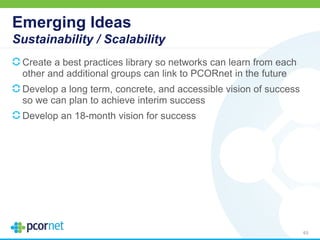
Sustainability / Scalability
Create a best practices library so networks can learn from each
other and additional groups can link to PCORnet in the future
Develop a long term, concrete, and accessible vision of success
so we can plan to achieve interim success
Develop an 18-month vision for success
63
Emerging Ideas
Disruptiveness
Use novel creative strategies (music, art, visual tools, humor) to
engage our partners and the general public
64
Emerging Ideas
Engagement with Non-Patient Stakeholders
Connecting claims data to EHR records
Best practices for involving health systems and communicating
the value proposition for health systems to engage with PCORnet
Expand the value proposition to address needs of all
stakeholders from vendors & funders to clinicians and patients
Link AHIP into the Health Systems Interactions TF
65
Emerging Ideas
Integrating PROs
Develop group collaborations for creating standards for new
PROs that are cross-cutting
66
Emerging Ideas
Creating Standardized PCORnet talking points
PCORnet elevator speech
67
Emerging Ideas
…and more
Create a forum to discuss research priorities
Develop a plan to increase diversity and engage minority and
underserved populations
Create a diagram of data validation
Incorporate rigorous methodology into data collection
Create a unique PCORnet patient identifier
Create a few menu options for engaging with IRB
IRB SWAT / SWOT team
Form mini-work groups to leverage best practices about
platforms
68
Emerging Ideas
…and more
Develop a mentor system
Share best practices in tiered/ modular informed consent
Leverage existing tools and take cues from other industries
(Apple, Amazon) to make research easier and more accessible
69
PCORI and CC Next Steps
Clarify milestones and contract issues
Clarify which work you can get started on that wont be derailed
by TF decisions
Send out information for logging onto the collaborative work
space
Invite networks to Task Force meetings
Send updated contract language
Post all of the CDRN and PPRN partner groups on the website
Create and post a glossary of acronyms, research terminology,
and other PCORnet specific terms (e.g., what we mean by a
"node")
70
PCORI and CC Next Steps, cont’d
Map intersections among the different partner networks
Communicate our communications plan (how we will reach out
to you)
Respond about task force co-chair
Create a page on the collaborative work space for existing
resources and best practice guides (please send us your best
practice resources)
Create a yammer community
Clarify the rationale for and the requirements for CDRN cohorts
and survey of cohorts
Clarify logistics around TF and SC meetings
71
PCORI and CC Next Steps, cont’d
After task force kickoffs, TFs will begin to prioritize the work that
needs to be accomplished over the next few months
We will reach out to ask if you for permission to post your
proposal or sections of your proposal
72
Debrief and Closing Remarks
Rachael Fleurence

Patient-Powered Research Network Workshop

  • 1.
  • 2.
    Welcome! Rachael Fleurence, Director CERMethods and Infrastructure Program
  • 3.
    PPRN Practices, Challenges, andOpportunities Sarah Daugherty, PhD MPH PCORI PPRN Workshop January 2014 3
  • 4.
    Workshop Goal “Create aculture between PPRNs that fosters sharing of best practices to avoid waste of resources and unnecessary duplication.” 4
  • 5.
    Workshop Objectives Objective 1 •Identify common questions and needs. Objective 2 • Identify shared goals and objectives. Objective 3 • Engage in peer-learning and share knowledge, resources and tools. Objective 4 • Initiate collaborative activities that enhance the achievement of shared and individual goals.
  • 6.
    PPRN Survey InformedOur Agenda Survey questions Infrastructure design Patient engagement Greatest challenges Cross-collaborations Innovative designs or plans
  • 7.
  • 8.
    Governance “The growth willalso necessitate new systems for decision-making and prioritization within our Centers.” TransparentCoordinated Effective Structure Process DecisionsDissemination Implementation
  • 9.
    Outreach and SustainingEngagement “How do you bring people up the engagement ladder so that they can get to own the whole process?” “Do we focus on deep engagement from a smaller number of patients, or just SOME engagement from a large number of patients?”
  • 10.
    Outreach and SustainingEngagement • Approaches used to identify hard to reach populations • Methods to collect feedback • Competencies and skills needed for effective partnership • Communication vehicles • Impact of PCORnet • Optimizing plans for participants to report new data over time. • Maximizing engaged retention Sustaining Engagement Awareness OutreachAssessment
  • 11.
    Greatest Challenges “Translating awarenessto enthusiasm to action” Misperceptions about privacy, security, and risks of sharing data Attrition of original participants Sustaining PPRN after month 19 and beyond
  • 12.
    Cross-Collaborations Common data model Co-enrollment Participant-friendlygeneric consent Ongoing dialogue between PPRNs and CDRNs Methods for collecting PRO in non-clinical setting Basic information about purpose of PPRNs written in generic way for all patients
  • 13.
    Guiding Questions forDiscussion Common areas to address collectively? What resources and tools exist already? What resources and tools could be developed? Processes to leverage collective skills and knowledge? What are the action items needed to move forward? How can PCORI facilitate continued sharing?
  • 14.
    PPRN Workshop Outcomes Establish working groups Connect working groupsto Task Force Identify processes to facilitate sharing
  • 15.
    Governance Alison Rein, SethGinsberg, Michael Kappelman, Barbara Kroner
  • 16.
    Disease homogeneity PPRN PCORnet participants Age Gender Utilization ofcare Health insurance Race/ethnicity Education/SES Information seekers PPRN members US Patient Population How Will PCORnet Patients Differ From Total US Patient Pop’n? • What role does privacy concerns play in who will participate? • Why are the populations different? • How will study results be affected? Factors that affect health outcomes AND participation in advocacy groups or research studies: Disease severity
  • 18.
    3 Levels ofPatient Governance Scientific leadership Patient leadership Community responsiveness
  • 19.
    Scientific Leadership Dr. BalfourSartor (Network PI)  Adult gastroenterologist and microbiome expert  Chief Medical Advisor to the CCFA  Diagnosed with Crohn’s disease at age 21 (~40 years ago) Sean Ahrens  Founder of Crohnology  Computer programmer  Diagnosed with Crohn’s disease during childhood Both will serve on the network executive committee  Dual perspectives critical to informing policies related to data sharing and return of research findings • Should patients be informed of genetic results? • Might there be unintended consequences?
  • 20.
    Patient Governance Committee(PGC) Key responsibilities:  1) Define network’s mission,  2) Assist in prioritizing patient-driven research agenda  3) Assist in the review of proposed network studies/partners  4) Develop policies regarding use and sharing of data  5) Assist in developing plans to facilitate communications among network participants  6) Receive and act upon input from broader network community PGC will report directly to the Executive committee  2 members of the PGC will hold seats on the Executive Committee (total of 4 patients)  PGC must independently approve all substantial changes in the direction of the network
  • 21.
    PGC Member Selectionand Training 5 lay patients  2 with prior experience serving on CCFA grant review committees  Former Chair of the CCFA National Council of College Leaders program  2 selected by popular election by Crohnology community • Information about the PPRN posted on Crohnology • Self-nominations were invited. • Candidates posted description of interests and qualifications • On-line election  All will complete CCFA stakeholder training course
  • 25.
    Crowdsourcing to broadenresponsiveness Draft policies to be posted online All network members will be able to comment, suggest changes, or contribute more substantially through the use of “wiki-style” editing. The PGC will incorporate member feedback into the final version of all policies.
  • 26.
    Communication and disseminationof research findings Network updates will be posted on discussion pages (also distributed by emails)  Member comments and “hearts” will be periodically reviewed by the PGC and the network’s scientific leadership Research findings will be communicated using lay summaries and infographics
  • 27.
  • 28.
    In 4 weeks: 528 shares/views  116 likes  67 comments 92% indicated that the infographic “effectively summarized the research findings”
  • 29.
    Identifying and PrioritizingResearch Crowd sourcing Approach Crohnology already uses to prioritize new feature development Pre-work  Candidate research topics collected from PGC, review of >2,000 questions posted on Crohnology, input from PPRN scientific team, and review of CCFA research priorities  Online voting through “User Voices” functionality of Crohnology
  • 32.
  • 33.
    Outreach and Sustaining Engagement Sean Tunis,Andrew Nierenberg, Susan Redline, Kathleen Sullivan
  • 34.
    Research Issues: Conducting Observational& Experimental Research Rich Platt
  • 35.
    Research Issues: Navigating Informed Consentand IRBs Rob Califf, Mark Pletcher, John Walsh
  • 36.
    Pipeline to Proposal Awards& PCORI Ambassador Program Sue Sheridan
  • 37.
    Tier 1 Up to$15,000 Up to 9 month term Tier 2 Up to $25,000 Up to 12 month term Tier 3 Up to $50,000 Up to 12 month term PCORI Funding Announcement Researchers who unsuccessfully submitted a PFA and need to improve proposal Pipeline to Proposal Awards 37 Or submissions to other PCOR/CER Funders
  • 38.
    Tier I PipelineAwards (Up to $15,000 for up to 9 months) Available to individuals, consumer/patient organizations, clinician(s), researcher(s) or a combination of the above to support:  Community building around an area of research interest to improve outcomes for patients  Creation of structure and communication strategies  Develop an understanding of PCORI, and “research done differently” 38
  • 39.
    Tier II PipelineAwards (Up to $25,000 for up to one year) Available to emerging research/non-research partnerships to support:  Data network and registry development  Development of infrastructure  Generation and refinement of research questions through community events, town hall meetings, etc. 39
  • 40.
    Tier III PipelineAwards (Up to $50,000 for up to one year) Available to advanced research/non-research partnerships, including those who submitted PCORI proposals and were not funded, to support:  PCORI research proposal (re)submission focusing on development of engagement plan  Research partnership skill development 40
  • 41.
    Intermediate Funders andPipeline Regions 41
  • 42.
    Western Region Pilot ThirtyAwardees Announced December 2013 Creating Healthy Communities: Engaging Native American and Spanish-Speaking Families and Sharing Family Wisdom to Reduce Childhood Obesity Improving the Lives of Alzheimer's Patients and their Caregivers: A Patient Centered Statewide Approach Mobilizing Community Engagement for Health in a Southern New Mexico Border Region Colonia New Mexico LGBT Health Improvement Network Usefulness of Pre-diabetes Management in Breast Cancer Care The Hispanic Family Asthma Outcomes Research Network Building Capacity for Novel Screening Delivery for Chronic Conditions to Benefit Miners in New Mexico Culturally Appropriate Options for Diabetes Prevention and Care for Low-Income Latinos Citizen scientist Developing Infrastructure for Patient Centered Melanoma Research 42
  • 43.
    Western Region Pilot ThirtyAwardees Announced December 2013 Establishing a Patient-Centered Research Community for Cystic Fibrosis Sepsis Survivors Engagement Project (SSEP) Preventing Missed Appointments for HIV Patients Empowering Patients and Their Families to Improve Outcomes That Are Most Important to Them after Lung Cancer Surgery YOU COMPLETE ME! Demonstrating the Efficacy of An Innovative Medical Appointment Model to Support Aging Patients Healthy Outcomes for Older Foster Youth Addressing Obesity in Latino Adolescents with Spina Bifida Creating the Patient Centered Primary Care Council in the Highland Hospital Adult Medicine Clinic: Strengthening Primary Care Together Health Literacy and the Patient Perspective in Primary Care Engaging Communities in the Fight Against Preterm Birth 43
  • 44.
    Western Region Pilot,by State 44 • Idaho award includes New Mexico, Oregon, and Wyoming • Two of the Oregon awards are multi-state; • Oregon and Utah • Oregon and Washington • No awards in AK, HI, or NV
  • 45.
    Next Steps 45 • EvaluateWest region Tier I pilot, revise processes as necessary • Identify South, Midwest, Northeast, and national Intermediate Funders (IFs) • Open first round of Tier I Pipeline Awards for South, Midwest, Northeast and national IFs • Open first round of Tier II Pipeline Awards for all five regions • Open first round of Tier III Pipeline Awards for all five regions
  • 46.
    Western Region Pilot ThirtyAwardees Announced December 2013 Connecting Research and Real Life: Building a Network in the Columbia River Gorge Taking Care of Our Parents: Improving the Coordination of Care for Elderly Community Members Development of Community Partnership for Patient Centered Outcomes Research in Type 2 Diabetes Patient-Centered Transitions for Episodes of Surgical Care Increasing Patient Engagement and Capacity Building between Community Stakeholders and Patients in order to Improve Diabetes Education and Management among School-Aged Children Puget Sound Asthma Coalition: A Community, Clinical, and Academic Partnership The 'CISE' Project for Family Caregivers Making Stomach Cancer a Health Priority among Asian Americans Building a Community of Safe Sleep for Infants Patient-Centered Outcomes for the Parkinson's Disease Community in Wyoming 46
  • 47.
  • 48.
    Program Overview The volunteerinitiative that trains, equips, and mobilizes patients, caregivers, organizations and other stakeholders to share PCORI’s vision, mission and PCOR principles with their respective communities, participate as full partners in research and to help assure the sharing and uptake of information generated from PCORI funded projects. Train….Ambassador Training: Five modules of training focused on PCORI, their role, PCORI funding, and working in research teams Equip….Ambassador Toolkit: Provides support material such as talking points, presentation template, social media guide Mobilize…Ambassador Yammer Community: Online community that encourages the exchange of best practices in different communities 48
  • 49.
    Benefits of Beingan Ambassador Benefits of Program: Receiving PCORI Ambassador communications tools and PCOR training; Being recognized as a “PCOR Trained Ambassador” on the PCORI Ambassador webpage; Co-authoring publications, submitting guest blogs, or participating in other media opportunities; Being highlighted for work in patient-centered research in PCORI e-newsletters; Learning of opportunities to serve as PCORI reviewers or participate in working groups and on survey panels; and Collaborating and serving as a panelist with PCORI or others on events such as webinars, conferences, and panels. 49
  • 50.
    Ambassador Interest byRegion and Ethnicity (total 101) 6% 7% 14% 4%62% 4% 3% Asian (Not Hispanic or Latino) Black or African American (Not Hispanic or Latino) Hispanic or Latino American Indian or Alaska Native (Not Hispanic or Latino) White (Not Hispanic or Latino) Other Prefer not to answer 50 14% 13% 18% 29% 23%
  • 51.
    Which of thefollowing is your primary community? (total 101) 51 2% 7% 12% 3% 28% 22% 21% 6% 0% 5% 10% 15% 20% 25% 30%
  • 52.
    Individual or OrganizationAmbassador (total 101) 18% 83% Organizational Individual 52
  • 53.
    Facilitating Interaction &Communication Between PPRNs and CDRNs Sarah Greene, MPH, Senior Program Officer, CER Methods & Infrastructure PPRN Partner Meeting
  • 54.
    Session Objective 54 Focus Questions: 1)How can PCORI help facilitate collaborations between your PPRN and the 11 CDRNs? 2) Collaboration could be driven by research focus, geography, or both. What are the pros and cons? 3) Given that the task forces will also act as incubators for collaboration, what else can PCORI do to stimulate partnerships across CDRNs and PPRNs that would add value? Open discussion about ways to optimize interaction
  • 55.
    Questions & Opportunities --PPRN Survey Design of the common data model Recruiting/enrolling in multiple studies simultaneously Creation of participant-friendly generic consent materials Communication plan to open an ongoing dialogue between the PPRNs and CDRNs Methods for collecting PRO in non-clinical setting Basic information about purpose of PPRNs written in generic way for all patients Tracking of communication vehicles and response rate Your survey responses included as reference
  • 56.
    Break Out Sessions: 1)Stakeholder Engagement 2) Integrating PROs with Clinical Data 3) Standardized PCORnet Talking Points 4) Ad Hoc
  • 57.
    Recap and NextSteps Sarita Wahba, Program Officer CER Methods and Infrastructure Program
  • 58.
    Agenda Recap emerging ideas Identifywhich ideas are timely and actionable Channel your inner artist PCORI and Coordinating Center next steps 58
  • 59.
    Emerging Ideas Categories Patient Engagement Communications/ Branding CDRN / PPRN Collaborations Sustainability / Scalability Disruptiveness Engagement with non-patient Stakeholders Integrating PROs Creating Standardized PCORnet talking points …And More 59
  • 60.
    Emerging Ideas Patient Engagement Developa patient course Need sufficient patient representation on Steering Committee and Task Forces Define patient engagement and how it is different in CDRNs and PPPRNs Engaging disenfranchised patients Provide patients with a menu of options for levels of patient engagement Best practices for fast tracking feedback to patients Ensure meaningful patient engagement in data network development. Understand ways to engage with persons who are overweight or obese to support the establishment of the obesity cohort 60
  • 61.
    Emerging Ideas Communication /Branding Develop a campaign that gets the word out to patients about why they can trust and should engage with PCORnet Use language that is understandable to the general public Use collaboration-based language Develop a plan to harness social media 61
  • 62.
    Emerging Ideas CDRN/PPRN Collaboration Create/describethe value proposition for CDRNs to work with PPRNs  allowing PPRNs to look for disease-specific patients within the CDRNS for enrollment  connecting PPRNs with clinicians at CDRNS that treat PPRN-related conditions  Others Involve PPRNs in the Health Systems Interaction task force Identify co-morbid conditions across networks Integrate into CDRN and PPRN platforms the ability to search for patients that are represented by a CDRN or PPRN Train clinicians in CDRNs to detect rare diseases 62
  • 63.
    Emerging Ideas Sustainability /Scalability Create a best practices library so networks can learn from each other and additional groups can link to PCORnet in the future Develop a long term, concrete, and accessible vision of success so we can plan to achieve interim success Develop an 18-month vision for success 63
  • 64.
    Emerging Ideas Disruptiveness Use novelcreative strategies (music, art, visual tools, humor) to engage our partners and the general public 64
  • 65.
    Emerging Ideas Engagement withNon-Patient Stakeholders Connecting claims data to EHR records Best practices for involving health systems and communicating the value proposition for health systems to engage with PCORnet Expand the value proposition to address needs of all stakeholders from vendors & funders to clinicians and patients Link AHIP into the Health Systems Interactions TF 65
  • 66.
    Emerging Ideas Integrating PROs Developgroup collaborations for creating standards for new PROs that are cross-cutting 66
  • 67.
    Emerging Ideas Creating StandardizedPCORnet talking points PCORnet elevator speech 67
  • 68.
    Emerging Ideas …and more Createa forum to discuss research priorities Develop a plan to increase diversity and engage minority and underserved populations Create a diagram of data validation Incorporate rigorous methodology into data collection Create a unique PCORnet patient identifier Create a few menu options for engaging with IRB IRB SWAT / SWOT team Form mini-work groups to leverage best practices about platforms 68
  • 69.
    Emerging Ideas …and more Developa mentor system Share best practices in tiered/ modular informed consent Leverage existing tools and take cues from other industries (Apple, Amazon) to make research easier and more accessible 69
  • 70.
    PCORI and CCNext Steps Clarify milestones and contract issues Clarify which work you can get started on that wont be derailed by TF decisions Send out information for logging onto the collaborative work space Invite networks to Task Force meetings Send updated contract language Post all of the CDRN and PPRN partner groups on the website Create and post a glossary of acronyms, research terminology, and other PCORnet specific terms (e.g., what we mean by a "node") 70
  • 71.
    PCORI and CCNext Steps, cont’d Map intersections among the different partner networks Communicate our communications plan (how we will reach out to you) Respond about task force co-chair Create a page on the collaborative work space for existing resources and best practice guides (please send us your best practice resources) Create a yammer community Clarify the rationale for and the requirements for CDRN cohorts and survey of cohorts Clarify logistics around TF and SC meetings 71
  • 72.
    PCORI and CCNext Steps, cont’d After task force kickoffs, TFs will begin to prioritize the work that needs to be accomplished over the next few months We will reach out to ask if you for permission to post your proposal or sections of your proposal 72
  • 73.
    Debrief and ClosingRemarks Rachael Fleurence