HUMAN GENOMICS AND PUBLIC HEALTH
IN A GLOBAL WORLD:
CHALLENGES FOR LOW & MIDDLE INCOME COUNTRIES
Helen M Robinson
HVP/International Co-ordinating Office
HVP5 May 2014
hmro@unimelb.edu.au
Human genetics and genomics in a global world…
1. Monitoring activity at the national level already happening
2. Engaging across political borders – research collaborations and data
generation and sharing
3. Setting a global policy agenda
4. Understanding the global burden of genetic and genomic disease –
estimating it, looking for regional patterns
5. Implications for developing health systems that leverage genomic
information
2
Monitoring and mapping activity
at the national and international levels
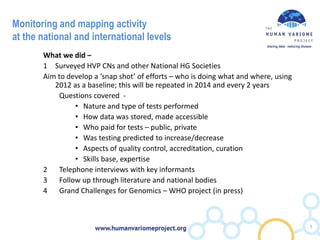
What we did –
1 Surveyed HVP CNs and other National HG Societies
Aim to develop a ‘snap shot’ of efforts – who is doing what and where, using
2012 as a baseline; this will be repeated in 2014 and every 2 years
Questions covered -
• Nature and type of tests performed
• How data was stored, made accessible
• Who paid for tests – public, private
• Was testing predicted to increase/decrease
• Aspects of quality control, accreditation, curation
• Skills base, expertise
2 Telephone interviews with key informants
3 Follow up through literature and national bodies
4 Grand Challenges for Genomics – WHO project (in press)
5
Monitoring activity at the national level
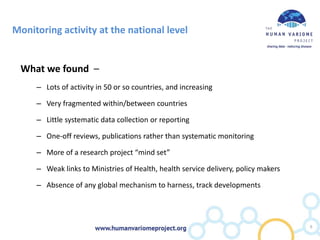
What we found –
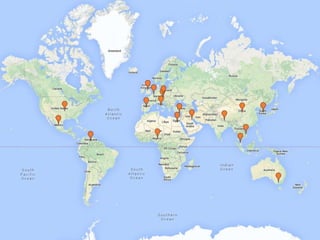
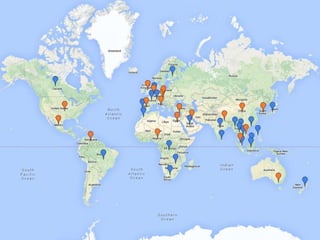
– Lots of activity in 50 or so countries, and increasing
– Very fragmented within/between countries
– Little systematic data collection or reporting
– One-off reviews, publications rather than systematic monitoring
– More of a research project “mind set”
– Weak links to Ministries of Health, health service delivery, policy makers
– Absence of any global mechanism to harness, track developments
6
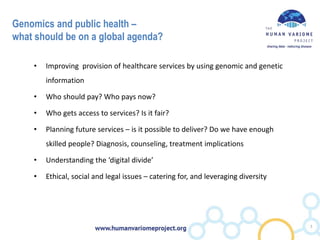
Genomics and public health –
what should be on a global agenda?
• Improving provision of healthcare services by using genomic and genetic
information
• Who should pay? Who pays now?
• Who gets access to services? Is it fair?
• Planning future services – is it possible to deliver? Do we have enough
skilled people? Diagnosis, counseling, treatment implications
• Understanding the ‘digital divide’
• Ethical, social and legal issues – catering for, and leveraging diversity
7
Shaping a global agenda - why collaborate globally?
• Global solidarity
• Pooling of resources – knowledge, data
• Disparities in disease burden
• Disparities in resources
• Social justice
• Efficiency, cost effectiveness
• Facilitating movement of data and information across national borders
• Need for global quality standards
• Leveraging diversity
8
Priorities identified for
international genomics and public health
1. How to build an appropriate evidence-base on genomic medicine to
engage and inform decision making by health policy makers
2. Merits of addressing health disparities between various populations by
using genetic and genomic services of various kinds
3. Dealing with patients from diverse ethnic, religious and cultural
backgrounds
4. Implications for the curricula of various medical and health related
education and training programs
5. What mechanism and coordination activities are needed and supported by
the stakeholders to enable this to happen – particularly across disease
types
9
1 How to build an appropriate evidence-base on genomic medicine
to inform decision making by health policymakers
• Implications of the uncertainties, risks and predictions of outcomes that
genomic medicine often entails
• Ensuring fair access to services
• Assessing the effectiveness of services that use genomic medicine
• Implications of genomic knowledge for conceptualizing health, disease
and illness
• Improving cost-effectiveness
• Planning for future needs for service delivery
10
2 Integrating genetic and genomic services of various kinds into
health service delivery
• Disparities in different parts of the world, in different ethnic groups, in
cultural groups
• Need to find solutions for low-income settings
• Issues of integrating genomics into health systems
• Treating the family group in an individually patient-centred world
• Capacity building and knowledge sharing between countries to address
inequities
11
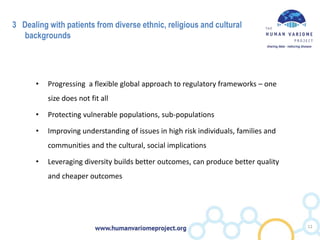
3 Dealing with patients from diverse ethnic, religious and cultural
backgrounds
• Progressing a flexible global approach to regulatory frameworks – one
size does not fit all
• Protecting vulnerable populations, sub-populations
• Improving understanding of issues in high risk individuals, families and
communities and the cultural, social implications
• Leveraging diversity builds better outcomes, can produce better quality
and cheaper outcomes
12
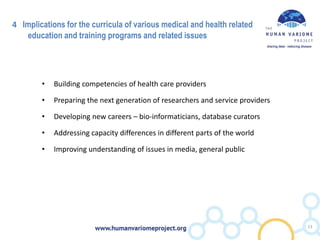
4 Implications for the curricula of various medical and health related
education and training programs and related issues
• Building competencies of health care providers
• Preparing the next generation of researchers and service providers
• Developing new careers – bio-informaticians, database curators
• Addressing capacity differences in different parts of the world
• Improving understanding of issues in media, general public
13
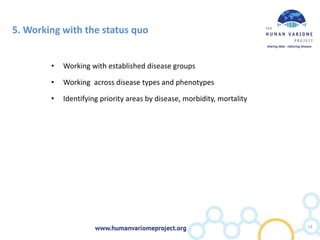
5. Working with the status quo
• Working with established disease groups
• Working across disease types and phenotypes
• Identifying priority areas by disease, morbidity, mortality
14
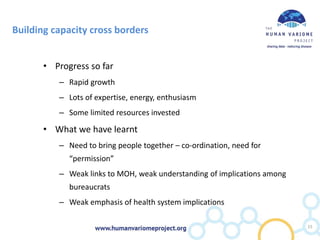
Building capacity cross borders
• Progress so far
– Rapid growth
– Lots of expertise, energy, enthusiasm
– Some limited resources invested
• What we have learnt
– Need to bring people together – co-ordination, need for
“permission”
– Weak links to MOH, weak understanding of implications among
bureaucrats
– Weak emphasis of health system implications
15
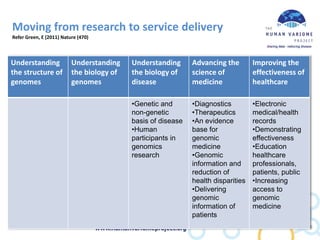
Moving from research to service delivery
Refer Green, E (2011) Nature (470)
16
Understanding
the structure of
genomes
Understanding
the biology of
genomes
Understanding
the biology of
disease
Advancing the
science of
medicine
Improving the
effectiveness of
healthcare
•Genetic and
non-genetic
basis of disease
•Human
participants in
genomics
research
•Diagnostics
•Therapeutics
•An evidence
base for
genomic
medicine
•Genomic
information and
reduction of
health disparities
•Delivering
genomic
information of
patients
•Electronic
medical/health
records
•Demonstrating
effectiveness
•Education
healthcare
professionals,
patients, public
•Increasing
access to
genomic
medicine
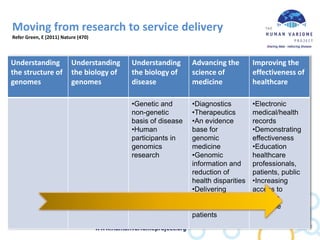
Moving from research to service delivery
Refer Green, E (2011) Nature (470)
17
Understanding
the structure of
genomes
Understanding
the biology of
genomes
Understanding
the biology of
disease
Advancing the
science of
medicine
Improving the
effectiveness of
healthcare
•Genetic and
non-genetic
basis of disease
•Human
participants in
genomics
research
•Diagnostics
•Therapeutics
•An evidence
base for
genomic
medicine
•Genomic
information and
reduction of
health disparities
•Delivering
genomic
information of
patients
•Electronic
medical/health
records
•Demonstrating
effectiveness
•Education
healthcare
professionals,
patients, public
•Increasing
access to
genomic
medicine
WHO: key components
of a well functioning health system
Responds in balanced way to population’s needs and expectations by –
 Improving health status of individuals, families and communities
 Defending the population against threat to its health
 Protecting people against consequences of ill-health
 Providing equitable access to people-centred care
 Making it possible for people to participate in decisions affecting their
health and health system
18
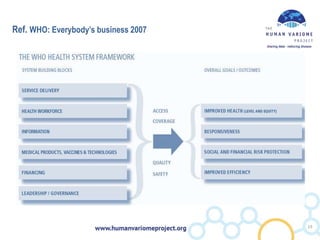
Ref. WHO: Everybody’s business 2007
19
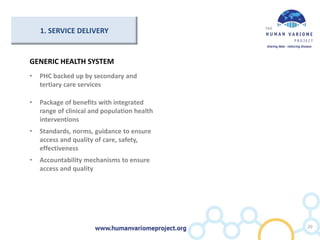
GENERIC HEALTH SYSTEM
• PHC backed up by secondary and
tertiary care services
• Package of benefits with integrated
range of clinical and population health
interventions
• Standards, norms, guidance to ensure
access and quality of care, safety,
effectiveness
• Accountability mechanisms to ensure
access and quality
20
1. SERVICE DELIVERY
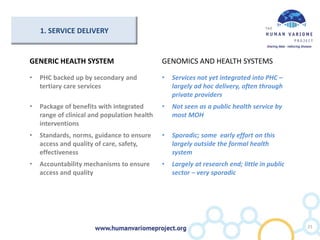
GENERIC HEALTH SYSTEM GENOMICS AND HEALTH SYSTEMS
• PHC backed up by secondary and
tertiary care services
• Services not yet integrated into PHC –
largely ad hoc delivery, often through
private providers
• Package of benefits with integrated
range of clinical and population health
interventions
• Not seen as a public health service by
most MOH
• Standards, norms, guidance to ensure
access and quality of care, safety,
effectiveness
• Sporadic; some early effort on this
largely outside the formal health
system
• Accountability mechanisms to ensure
access and quality
• Largely at research end; little in public
sector – very sporadic
21
1. SERVICE DELIVERY
2. HEALTH WORKFORCE
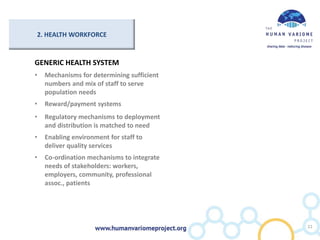
GENERIC HEALTH SYSTEM
• Mechanisms for determining sufficient
numbers and mix of staff to serve
population needs
• Reward/payment systems
• Regulatory mechanisms to deployment
and distribution is matched to need
• Enabling environment for staff to
deliver quality services
• Co-ordination mechanisms to integrate
needs of stakeholders: workers,
employers, community, professional
assoc., patients
22
2. HEALTH WORKFORCE
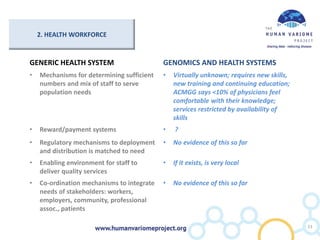
GENERIC HEALTH SYSTEM GENOMICS AND HEALTH SYSTEMS
• Mechanisms for determining sufficient
numbers and mix of staff to serve
population needs
• Virtually unknown; requires new skills,
new training and continuing education;
ACMGG says <10% of physicians feel
comfortable with their knowledge;
services restricted by availability of
skills
• Reward/payment systems • ?
• Regulatory mechanisms to deployment
and distribution is matched to need
• No evidence of this so far
• Enabling environment for staff to
deliver quality services
• If it exists, is very local
• Co-ordination mechanisms to integrate
needs of stakeholders: workers,
employers, community, professional
assoc., patients
• No evidence of this so far
23
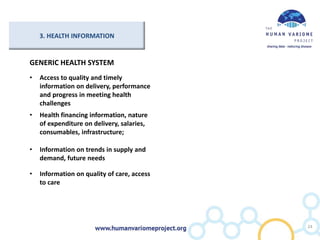
3. HEALTH INFORMATION
GENERIC HEALTH SYSTEM
• Access to quality and timely
information on delivery, performance
and progress in meeting health
challenges
• Health financing information, nature
of expenditure on delivery, salaries,
consumables, infrastructure;
• Information on trends in supply and
demand, future needs
• Information on quality of care, access
to care
24
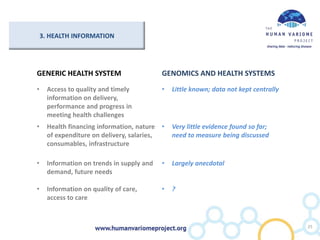
3. HEALTH INFORMATION
GENERIC HEALTH SYSTEM GENOMICS AND HEALTH SYSTEMS
• Access to quality and timely
information on delivery,
performance and progress in
meeting health challenges
• Little known; data not kept centrally
• Health financing information, nature
of expenditure on delivery, salaries,
consumables, infrastructure
• Very little evidence found so far;
need to measure being discussed
• Information on trends in supply and
demand, future needs
• Largely anecdotal
• Information on quality of care,
access to care
• ?
25
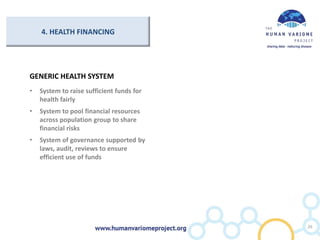
4. HEALTH FINANCING
GENERIC HEALTH SYSTEM
• System to raise sufficient funds for
health fairly
• System to pool financial resources
across population group to share
financial risks
• System of governance supported by
laws, audit, reviews to ensure
efficient use of funds
26
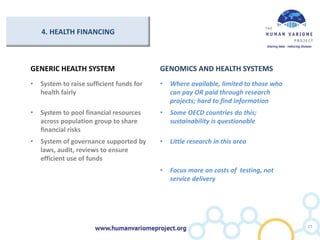
4. HEALTH FINANCING
GENERIC HEALTH SYSTEM GENOMICS AND HEALTH SYSTEMS
• System to raise sufficient funds for
health fairly
• Where available, limited to those who
can pay OR paid through research
projects; hard to find information
• System to pool financial resources
across population group to share
financial risks
• Some OECD countries do this;
sustainability is questionable
• System of governance supported by
laws, audit, reviews to ensure
efficient use of funds
• Little research in this area
• Focus more on costs of testing, not
service delivery
27
5. MEDICAL TECHNOLOGIES, PRODUCTS
GENERIC HEALTH SYSTEM
• Regulatory system for authorization,
quality and safety supported by
enforcement mechanisms
• List of essential medical products,
diagnostic and treatment protocols
linked to levels of care
• Supply and distribution system to
ensure equitable access
• Price monitoring system
• Programme to promote rational use
28
5. MEDICAL TECHNOLOGIES, PRODUCTS
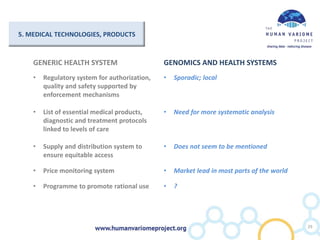
GENERIC HEALTH SYSTEM GENOMICS AND HEALTH SYSTEMS
• Regulatory system for authorization,
quality and safety supported by
enforcement mechanisms
• Sporadic; local
• List of essential medical products,
diagnostic and treatment protocols
linked to levels of care
• Need for more systematic analysis
• Supply and distribution system to
ensure equitable access
• Does not seem to be mentioned
• Price monitoring system • Market lead in most parts of the world
• Programme to promote rational use • ?
29
6. GOVERNANCE & LEADERSHIP
GENERIC HEALTH SYSTEM
• Ensuring that health authorities are
responsible for steering the entire
health sector – public and private –
for current and future health issues
• Defining health policies, strategies in
a transparent, inclusive manner
• Translate policies into effective
delivery supported by adequate
resources
• Delivery is equitable
• Implementing effective
regulation/oversight
30
6. GOVERNANCE & LEADERSHIP
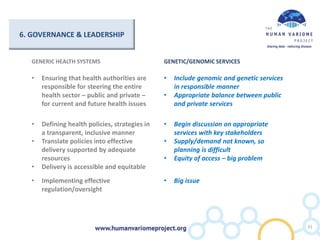
GENERIC HEALTH SYSTEMS GENETIC/GENOMIC SERVICES
• Ensuring that health authorities are
responsible for steering the entire
health sector – public and private –
for current and future health issues
• Include genomic and genetic services
in responsible manner
• Appropriate balance between public
and private services
• Defining health policies, strategies in
a transparent, inclusive manner
• Translate policies into effective
delivery supported by adequate
resources
• Delivery is accessible and equitable
• Begin discussion on appropriate
services with key stakeholders
• Supply/demand not known, so
planning is difficult
• Equity of access – big problem
• Implementing effective
regulation/oversight
• Big issue
31
Implications
• Adequacy, quality and effectiveness of service provision
• Understanding the barriers and incentives needed
• Acting responsibly
• Setting standards
• Building consistency of outcome globally
• Quality assurance
• Equity
• Need for a place to debate and resolve these issues
32
Issues arising from this
• The past ten years has told us – fragmented, competitive world
• Diversity of practice in different parts of the world can offer innovative solutions
• Need to develop strategies that are possible in resource poor environments
• Be more realistic in the promise
• Shift research agenda towards health systems responses
• Need for more collaboration – we are coming out of a project-based era into need
for more programmatic one
• Equity does not get much mention
• Developing countries must be considered
• Sustainability
33
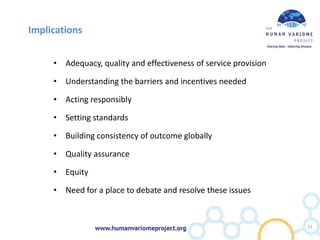
Next steps
1. Set up national repositories
2. Creating working groups of Council members to prepare short discussion
papers for Council meetings on key aspects of CN activity, for example:
– How to group and describe varies types of testing being done
– How to present changes in the nature of tests being performed
– Ethical and regulatory approaches in different parts of the world
– Analysis of who pays for tests in various parts of the world – public, private households
– Patterns in testing and data collection over time in various regions
– Analysis of national differences in approaches to quality standards
34
THANK YOU
Please contact me hmro@unimelb.edu.au
35

Human Genomics and Public Health in a Global World: Challenges for Low & Middle Income Countries

  • 1.
    HUMAN GENOMICS ANDPUBLIC HEALTH IN A GLOBAL WORLD: CHALLENGES FOR LOW & MIDDLE INCOME COUNTRIES Helen M Robinson HVP/International Co-ordinating Office HVP5 May 2014 hmro@unimelb.edu.au
  • 2.
    Human genetics andgenomics in a global world… 1. Monitoring activity at the national level already happening 2. Engaging across political borders – research collaborations and data generation and sharing 3. Setting a global policy agenda 4. Understanding the global burden of genetic and genomic disease – estimating it, looking for regional patterns 5. Implications for developing health systems that leverage genomic information 2
  • 5.
    Monitoring and mappingactivity at the national and international levels What we did – 1 Surveyed HVP CNs and other National HG Societies Aim to develop a ‘snap shot’ of efforts – who is doing what and where, using 2012 as a baseline; this will be repeated in 2014 and every 2 years Questions covered - • Nature and type of tests performed • How data was stored, made accessible • Who paid for tests – public, private • Was testing predicted to increase/decrease • Aspects of quality control, accreditation, curation • Skills base, expertise 2 Telephone interviews with key informants 3 Follow up through literature and national bodies 4 Grand Challenges for Genomics – WHO project (in press) 5
  • 6.
    Monitoring activity atthe national level What we found – – Lots of activity in 50 or so countries, and increasing – Very fragmented within/between countries – Little systematic data collection or reporting – One-off reviews, publications rather than systematic monitoring – More of a research project “mind set” – Weak links to Ministries of Health, health service delivery, policy makers – Absence of any global mechanism to harness, track developments 6
  • 7.
    Genomics and publichealth – what should be on a global agenda? • Improving provision of healthcare services by using genomic and genetic information • Who should pay? Who pays now? • Who gets access to services? Is it fair? • Planning future services – is it possible to deliver? Do we have enough skilled people? Diagnosis, counseling, treatment implications • Understanding the ‘digital divide’ • Ethical, social and legal issues – catering for, and leveraging diversity 7
  • 8.
    Shaping a globalagenda - why collaborate globally? • Global solidarity • Pooling of resources – knowledge, data • Disparities in disease burden • Disparities in resources • Social justice • Efficiency, cost effectiveness • Facilitating movement of data and information across national borders • Need for global quality standards • Leveraging diversity 8
  • 9.
    Priorities identified for internationalgenomics and public health 1. How to build an appropriate evidence-base on genomic medicine to engage and inform decision making by health policy makers 2. Merits of addressing health disparities between various populations by using genetic and genomic services of various kinds 3. Dealing with patients from diverse ethnic, religious and cultural backgrounds 4. Implications for the curricula of various medical and health related education and training programs 5. What mechanism and coordination activities are needed and supported by the stakeholders to enable this to happen – particularly across disease types 9
  • 10.
    1 How tobuild an appropriate evidence-base on genomic medicine to inform decision making by health policymakers • Implications of the uncertainties, risks and predictions of outcomes that genomic medicine often entails • Ensuring fair access to services • Assessing the effectiveness of services that use genomic medicine • Implications of genomic knowledge for conceptualizing health, disease and illness • Improving cost-effectiveness • Planning for future needs for service delivery 10
  • 11.
    2 Integrating geneticand genomic services of various kinds into health service delivery • Disparities in different parts of the world, in different ethnic groups, in cultural groups • Need to find solutions for low-income settings • Issues of integrating genomics into health systems • Treating the family group in an individually patient-centred world • Capacity building and knowledge sharing between countries to address inequities 11
  • 12.
    3 Dealing withpatients from diverse ethnic, religious and cultural backgrounds • Progressing a flexible global approach to regulatory frameworks – one size does not fit all • Protecting vulnerable populations, sub-populations • Improving understanding of issues in high risk individuals, families and communities and the cultural, social implications • Leveraging diversity builds better outcomes, can produce better quality and cheaper outcomes 12
  • 13.
    4 Implications forthe curricula of various medical and health related education and training programs and related issues • Building competencies of health care providers • Preparing the next generation of researchers and service providers • Developing new careers – bio-informaticians, database curators • Addressing capacity differences in different parts of the world • Improving understanding of issues in media, general public 13
  • 14.
    5. Working withthe status quo • Working with established disease groups • Working across disease types and phenotypes • Identifying priority areas by disease, morbidity, mortality 14
  • 15.
    Building capacity crossborders • Progress so far – Rapid growth – Lots of expertise, energy, enthusiasm – Some limited resources invested • What we have learnt – Need to bring people together – co-ordination, need for “permission” – Weak links to MOH, weak understanding of implications among bureaucrats – Weak emphasis of health system implications 15
  • 16.
    Moving from researchto service delivery Refer Green, E (2011) Nature (470) 16 Understanding the structure of genomes Understanding the biology of genomes Understanding the biology of disease Advancing the science of medicine Improving the effectiveness of healthcare •Genetic and non-genetic basis of disease •Human participants in genomics research •Diagnostics •Therapeutics •An evidence base for genomic medicine •Genomic information and reduction of health disparities •Delivering genomic information of patients •Electronic medical/health records •Demonstrating effectiveness •Education healthcare professionals, patients, public •Increasing access to genomic medicine
  • 17.
    Moving from researchto service delivery Refer Green, E (2011) Nature (470) 17 Understanding the structure of genomes Understanding the biology of genomes Understanding the biology of disease Advancing the science of medicine Improving the effectiveness of healthcare •Genetic and non-genetic basis of disease •Human participants in genomics research •Diagnostics •Therapeutics •An evidence base for genomic medicine •Genomic information and reduction of health disparities •Delivering genomic information of patients •Electronic medical/health records •Demonstrating effectiveness •Education healthcare professionals, patients, public •Increasing access to genomic medicine
  • 18.
    WHO: key components ofa well functioning health system Responds in balanced way to population’s needs and expectations by –  Improving health status of individuals, families and communities  Defending the population against threat to its health  Protecting people against consequences of ill-health  Providing equitable access to people-centred care  Making it possible for people to participate in decisions affecting their health and health system 18
  • 19.
    Ref. WHO: Everybody’sbusiness 2007 19
  • 20.
    GENERIC HEALTH SYSTEM •PHC backed up by secondary and tertiary care services • Package of benefits with integrated range of clinical and population health interventions • Standards, norms, guidance to ensure access and quality of care, safety, effectiveness • Accountability mechanisms to ensure access and quality 20 1. SERVICE DELIVERY
  • 21.
    GENERIC HEALTH SYSTEMGENOMICS AND HEALTH SYSTEMS • PHC backed up by secondary and tertiary care services • Services not yet integrated into PHC – largely ad hoc delivery, often through private providers • Package of benefits with integrated range of clinical and population health interventions • Not seen as a public health service by most MOH • Standards, norms, guidance to ensure access and quality of care, safety, effectiveness • Sporadic; some early effort on this largely outside the formal health system • Accountability mechanisms to ensure access and quality • Largely at research end; little in public sector – very sporadic 21 1. SERVICE DELIVERY
  • 22.
    2. HEALTH WORKFORCE GENERICHEALTH SYSTEM • Mechanisms for determining sufficient numbers and mix of staff to serve population needs • Reward/payment systems • Regulatory mechanisms to deployment and distribution is matched to need • Enabling environment for staff to deliver quality services • Co-ordination mechanisms to integrate needs of stakeholders: workers, employers, community, professional assoc., patients 22
  • 23.
    2. HEALTH WORKFORCE GENERICHEALTH SYSTEM GENOMICS AND HEALTH SYSTEMS • Mechanisms for determining sufficient numbers and mix of staff to serve population needs • Virtually unknown; requires new skills, new training and continuing education; ACMGG says <10% of physicians feel comfortable with their knowledge; services restricted by availability of skills • Reward/payment systems • ? • Regulatory mechanisms to deployment and distribution is matched to need • No evidence of this so far • Enabling environment for staff to deliver quality services • If it exists, is very local • Co-ordination mechanisms to integrate needs of stakeholders: workers, employers, community, professional assoc., patients • No evidence of this so far 23
  • 24.
    3. HEALTH INFORMATION GENERICHEALTH SYSTEM • Access to quality and timely information on delivery, performance and progress in meeting health challenges • Health financing information, nature of expenditure on delivery, salaries, consumables, infrastructure; • Information on trends in supply and demand, future needs • Information on quality of care, access to care 24
  • 25.
    3. HEALTH INFORMATION GENERICHEALTH SYSTEM GENOMICS AND HEALTH SYSTEMS • Access to quality and timely information on delivery, performance and progress in meeting health challenges • Little known; data not kept centrally • Health financing information, nature of expenditure on delivery, salaries, consumables, infrastructure • Very little evidence found so far; need to measure being discussed • Information on trends in supply and demand, future needs • Largely anecdotal • Information on quality of care, access to care • ? 25
  • 26.
    4. HEALTH FINANCING GENERICHEALTH SYSTEM • System to raise sufficient funds for health fairly • System to pool financial resources across population group to share financial risks • System of governance supported by laws, audit, reviews to ensure efficient use of funds 26
  • 27.
    4. HEALTH FINANCING GENERICHEALTH SYSTEM GENOMICS AND HEALTH SYSTEMS • System to raise sufficient funds for health fairly • Where available, limited to those who can pay OR paid through research projects; hard to find information • System to pool financial resources across population group to share financial risks • Some OECD countries do this; sustainability is questionable • System of governance supported by laws, audit, reviews to ensure efficient use of funds • Little research in this area • Focus more on costs of testing, not service delivery 27
  • 28.
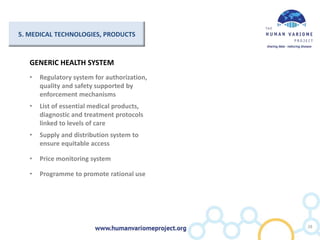
    5. MEDICAL TECHNOLOGIES,PRODUCTS GENERIC HEALTH SYSTEM • Regulatory system for authorization, quality and safety supported by enforcement mechanisms • List of essential medical products, diagnostic and treatment protocols linked to levels of care • Supply and distribution system to ensure equitable access • Price monitoring system • Programme to promote rational use 28
  • 29.
    5. MEDICAL TECHNOLOGIES,PRODUCTS GENERIC HEALTH SYSTEM GENOMICS AND HEALTH SYSTEMS • Regulatory system for authorization, quality and safety supported by enforcement mechanisms • Sporadic; local • List of essential medical products, diagnostic and treatment protocols linked to levels of care • Need for more systematic analysis • Supply and distribution system to ensure equitable access • Does not seem to be mentioned • Price monitoring system • Market lead in most parts of the world • Programme to promote rational use • ? 29
  • 30.
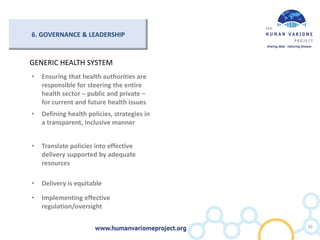
    6. GOVERNANCE &LEADERSHIP GENERIC HEALTH SYSTEM • Ensuring that health authorities are responsible for steering the entire health sector – public and private – for current and future health issues • Defining health policies, strategies in a transparent, inclusive manner • Translate policies into effective delivery supported by adequate resources • Delivery is equitable • Implementing effective regulation/oversight 30
  • 31.
    6. GOVERNANCE &LEADERSHIP GENERIC HEALTH SYSTEMS GENETIC/GENOMIC SERVICES • Ensuring that health authorities are responsible for steering the entire health sector – public and private – for current and future health issues • Include genomic and genetic services in responsible manner • Appropriate balance between public and private services • Defining health policies, strategies in a transparent, inclusive manner • Translate policies into effective delivery supported by adequate resources • Delivery is accessible and equitable • Begin discussion on appropriate services with key stakeholders • Supply/demand not known, so planning is difficult • Equity of access – big problem • Implementing effective regulation/oversight • Big issue 31
  • 32.
    Implications • Adequacy, qualityand effectiveness of service provision • Understanding the barriers and incentives needed • Acting responsibly • Setting standards • Building consistency of outcome globally • Quality assurance • Equity • Need for a place to debate and resolve these issues 32
  • 33.
    Issues arising fromthis • The past ten years has told us – fragmented, competitive world • Diversity of practice in different parts of the world can offer innovative solutions • Need to develop strategies that are possible in resource poor environments • Be more realistic in the promise • Shift research agenda towards health systems responses • Need for more collaboration – we are coming out of a project-based era into need for more programmatic one • Equity does not get much mention • Developing countries must be considered • Sustainability 33
  • 34.
    Next steps 1. Setup national repositories 2. Creating working groups of Council members to prepare short discussion papers for Council meetings on key aspects of CN activity, for example: – How to group and describe varies types of testing being done – How to present changes in the nature of tests being performed – Ethical and regulatory approaches in different parts of the world – Analysis of who pays for tests in various parts of the world – public, private households – Patterns in testing and data collection over time in various regions – Analysis of national differences in approaches to quality standards 34
  • 35.
    THANK YOU Please contactme hmro@unimelb.edu.au 35

Editor's Notes

  • #2  Introduction and thanks I will be talking from the view point of how we map and organise national, international efforts in genetics, genomics and public health – rather than the more technical aspects but how we understand global and regional trends and make sense of them How developments in genetics and genomics are being translated into health service delivery in various parts of the world and How we might influence /shape national and international agendas regarding genomics and public health, particularly in resource restrained environments where most countries are struggling to meet the health expectations of their populations – setting a global agenda Put emphasis on the needs of developing countries, particularly low and middle income countries - fairness and equity What some have called the hype or over promising from genomic testing – delivering real services
  • #3 The opportunity of HVP Many of these people are formed into nationally and regionally based groups that work together to “promote the storage, curation and sharing of variation data from genomic sequencing so that it can be increasingly used as medically or clinically actionable information in all countries of the world” This is done so that data access is free and open That there can be measurable improvement in the quality and quantity of curated databases That this is ethically and financially sustainable That equity in this – for poor people and poorer countries Set scene – innovation of services and reform of health systems What is HVP? – HVP consortium provides a pool of people who can assist: Clinicians, diagnosticians, bioinformaticians, researchers, database curators from more than 80 countries – hands on
  • #5 As well as these countries, we have in our data base published information from about another 25 or so countries – European countries, north African and Middle eastern – that are actively involved and who publish . It is an increasingly complicated scene and as far as we know, no one else is tracking these developments, looking at trends and taking a global interest in how it is developing from the public policy point of view.
  • #6 We will repeat this activity in every two years so we are gearing up for the report based on 2014 activities to come out in 2015 WHO Grand Challenges – I will talk abut this more detail in session on Wednesday
  • #8 There are however a clear list of issues that arise from this investigation that are clearly global in nature and that we can see from other international effort s in global health that appear to struggle to get on the agenda Starting to think of these issues early on in the process of innovation Some will say that the ‘hype and over promising’ of genome has been had to fathom Vision of future?
  • #9 There are many costs to collaborating globally – this is why it does not happen naturally Costs nee dot be out-weighed by the benefits we see from other areas of public health that -
  • #10 So we asked a range of key people in the field – heads of institutes, labs, professional societies, journal editors in different parts of the world for their views – what would be the priorities for - some of these seem very obvious but they do ont come up all that often in literature or opinion pieces Thye are by no means an exhaustive list, but rather a first attempt to try to bring together a range of disparate issues into some form of organizational framework
  • #11 Literature is weak ,fragmented yet this is what people say they are concerned about – interesting mis-match
  • #13 Most of work is done on European/Caucasian populations People move
  • #14 Data from Am Coll
  • #16 Now let us pick up on the last point and link back to the issues I raised at the beginning
  • #17 Eric Green’s helpful format – based on this – How do we try to define and describe what is happening in various parts of the world? What kind of typology will help us? And who is interested in knowing about this?
  • #18 Aim is to try to move to the right by putting more effort on those activities listed here Growing recognition of the need for this but unfortunately s we have seen, effort and involvement have not caught up – try to measure progress Let me know turn to how we might begin to think about this. Growing effort But the resources required are not always available not a priority but we need to change this by creating conversations/discussions abut the importance of this type of work
  • #19 Let us turn to definitions of health systems Work with WHO, Nossal Institute of Global Health What should well functioning health systems do
  • #20 Take each of the 6 components of the building block in turn and see how they are defined and what are the implications for genomics/genetics and public health This is a new research area and I am sharing this to generate discussions and on the basis of what we know from the country surveys I reported on earlier
  • #32 Place where to start the discussion – need for international intervention here – link back to where I started.
  • #33 Good news is - WHO has agreed to establish a genomics and genetics and public health program. We are currently looking for partners to set the work agenda and help fund the program.
  • #34 Some genomic interventions celebrated as “cost-effective” in developed countries are out of reach for many people living in developing countries, e.g next-generation genetic sequencing