INTERNATIONAL PATIENT SAFETY
GOALS
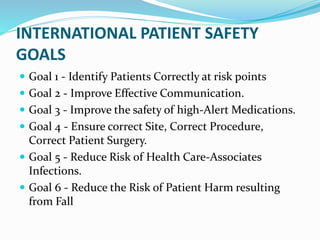
 Goal 1 - Identify Patients Correctly at risk points
 Goal 2 - Improve Effective Communication.
 Goal 3 - Improve the safety of high-Alert Medications.
 Goal 4 - Ensure correct Site, Correct Procedure,
Correct Patient Surgery.
 Goal 5 - Reduce Risk of Health Care-Associates
Infections.
 Goal 6 - Reduce the Risk of Patient Harm resulting
from Fall
Other initiatives
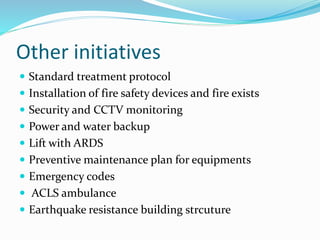
 Standard treatment protocol
 Installation of fire safety devices and fire exists
 Security and CCTV monitoring
 Power and water backup
 Lift with ARDS
 Preventive maintenance plan for equipments
 Emergency codes
 ACLS ambulance
 Earthquake resistance building strcuture
INCIDENT REPORTING
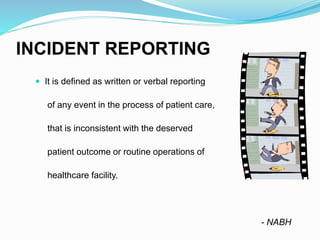
 It is defined as written or verbal reporting
of any event in the process of patient care,
that is inconsistent with the deserved
patient outcome or routine operations of
healthcare facility.
- NABH
PURPOSE
To provide a set of guidelines to distinguish between
various adverse events ranging from “ no harm “ to what
qualifies as Sentinel events.
NEAR MISS & NO HARM
A near –miss is defined when an error is realised just in the nick of time and
abortive action is instituted to cut short its translation.
In no harm scenario, the error is not recognised and the deed is done but
fortunately for the healthcare professional, the expected adverse event does
not occur.
Immediate action: information to area incharge/doctor
REPORTING:- To Quality department immediate or before 24 hours.
EXAMPLE
Near Miss
 Crocin medicine may be stopped in time because it suddenly transpires
thatthe patient is known to be allergic to crocin (near- miss).
No harm
 If this vital piece of information is overlooked and the crocin is
administered , the patient may fortunately not develop an reaction (no
harm event).
Medication error
 Medication error is any preventable event that
may cause or lead to inappropriate medication
use or prevent harm while the medication is in
the control of HCW.
Types : -
REPORT SUBMISSION TO: Area Incharge
IMMEDIATE ACTION: Inform to onduty doctor
ADR & ADE
Adverse Drug Reaction-
A response to a drug which is noxious and unintended and which occurs at
doses normally used in man for prophylaxis, diagnosis, or therapy of disease
or for modification of physiologic function.
Adverse Drug Event –
ADE extended beyond adverse drug reaction to include harm from overdose
and under doses usually related to medication errors.
Immediate action: information to area incharge/doctor , pharmacist
REPORTING:- To Quality department immediate or before 24 hours.
ADVERSE EVENTS
An injury related to medical management, in contrast to complications of
disease.
Medical management includes all aspects of care, including diagnosis
and treatment, failure to diagnose or treat, and the systems and equipment
used to deliver care. Adverse events may be preventable or non-preventable.
Immediate action: information to area incharge/doctor
REPORTING:- To Quality department immediate or before 24 hours.
SENTINEL EVENTS
 An unexpected incident, related to system or process deficiencies, which
leads to death or major and enduring loss of function* for a recipient of
health care services.
Major and enduring loss of function refers to sensory, motor, physiological,
or psychological impairment not present at the time services were sought
or begun. The impairment lasts for minimum period of two weeks and is
not related to an underlying condition.
Immediate action: information to area incharge/doctor
REPORTING:- To Quality department immediate or before 24 hours.
EVENT TYPE DESCRIPTION
SURGICAL EVENTS
 Surgery performed on the wrong body part
 Surgery performed on the wrong patient
 Wrong surgical procedure performed on the wrong patient
 Retained instruments in patient discovered after surgery/procedure
 Patient death during or immediately post surgical procedure
 Anaesthesia related event
DEVICE OR PRODUCT EVENTS
Patient death or serious disability associated with:
• the use of contaminated drugs, devices, products supplied by the
organization
• the use or function of a device in a manner other than the device’s
intended use
• the failure or breakdown of a device or medical equipment
• intravascular air embolism
PATIENT PROTECTION EVENTS
• Discharge of an infant to the wrong person
• Patient death or serious disability associated with elopement from the health
care facility
• Patient suicide, attempted suicide, or deliberate self-harm resulting in serious
disability
• Intentional injury to a patient by a staff member, another patient, visitor, or other
• Any incident in which a line designated for oxygen or other came to be delivered
to a patient and contains the wrong gas or is contaminated by toxic substances
• Nosocomial infection or disease causing patient death or serious disability
ENVIRONMENTAL EVENTS
Patient death or serious disability while being cared for in a health care
facility associated with:
• a burn incurred from any source
• a slip, trip, or fall
• an electric shock
• the use of restraints or bedrails
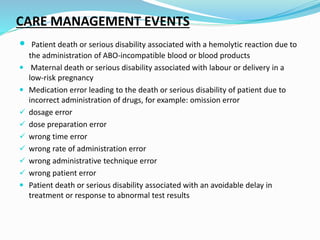
CARE MANAGEMENT EVENTS
 Patient death or serious disability associated with a hemolytic reaction due to
the administration of ABO-incompatible blood or blood products
 Maternal death or serious disability associated with labour or delivery in a
low-risk pregnancy
 Medication error leading to the death or serious disability of patient due to
incorrect administration of drugs, for example: omission error
 dosage error
 dose preparation error
 wrong time error
 wrong rate of administration error
 wrong administrative technique error
 wrong patient error
 Patient death or serious disability associated with an avoidable delay in
treatment or response to abnormal test results
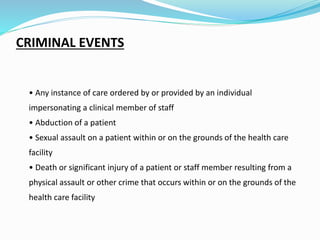
CRIMINAL EVENTS
• Any instance of care ordered by or provided by an individual
impersonating a clinical member of staff
• Abduction of a patient
• Sexual assault on a patient within or on the grounds of the health care
facility
• Death or significant injury of a patient or staff member resulting from a
physical assault or other crime that occurs within or on the grounds of the
health care facility
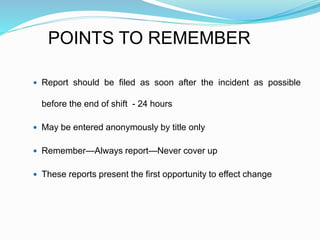
POINTS TO REMEMBER
 Report should be filed as soon after the incident as possible
before the end of shift - 24 hours
 May be entered anonymously by title only
 Remember—Always report—Never cover up
 These reports present the first opportunity to effect change
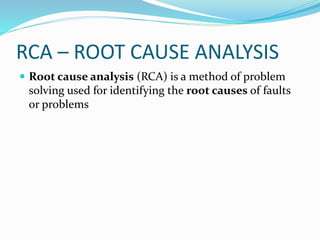
RCA – ROOT CAUSE ANALYSIS
 Root cause analysis (RCA) is a method of problem
solving used for identifying the root causes of faults
or problems
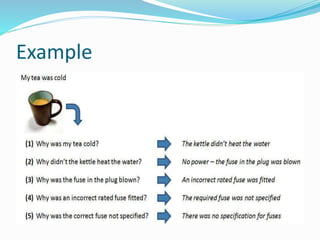
Example
Incident reporting form
THANKYOU

PATIENT SAFETY

  • 2.
    INTERNATIONAL PATIENT SAFETY GOALS Goal 1 - Identify Patients Correctly at risk points  Goal 2 - Improve Effective Communication.  Goal 3 - Improve the safety of high-Alert Medications.  Goal 4 - Ensure correct Site, Correct Procedure, Correct Patient Surgery.  Goal 5 - Reduce Risk of Health Care-Associates Infections.  Goal 6 - Reduce the Risk of Patient Harm resulting from Fall
  • 3.
    Other initiatives  Standardtreatment protocol  Installation of fire safety devices and fire exists  Security and CCTV monitoring  Power and water backup  Lift with ARDS  Preventive maintenance plan for equipments  Emergency codes  ACLS ambulance  Earthquake resistance building strcuture
  • 5.
    INCIDENT REPORTING  Itis defined as written or verbal reporting of any event in the process of patient care, that is inconsistent with the deserved patient outcome or routine operations of healthcare facility. - NABH
  • 6.
    PURPOSE To provide aset of guidelines to distinguish between various adverse events ranging from “ no harm “ to what qualifies as Sentinel events.
  • 7.
    NEAR MISS &NO HARM A near –miss is defined when an error is realised just in the nick of time and abortive action is instituted to cut short its translation. In no harm scenario, the error is not recognised and the deed is done but fortunately for the healthcare professional, the expected adverse event does not occur. Immediate action: information to area incharge/doctor REPORTING:- To Quality department immediate or before 24 hours.
  • 8.
    EXAMPLE Near Miss  Crocinmedicine may be stopped in time because it suddenly transpires thatthe patient is known to be allergic to crocin (near- miss). No harm  If this vital piece of information is overlooked and the crocin is administered , the patient may fortunately not develop an reaction (no harm event).
  • 9.
    Medication error  Medicationerror is any preventable event that may cause or lead to inappropriate medication use or prevent harm while the medication is in the control of HCW. Types : - REPORT SUBMISSION TO: Area Incharge IMMEDIATE ACTION: Inform to onduty doctor
  • 10.
    ADR & ADE AdverseDrug Reaction- A response to a drug which is noxious and unintended and which occurs at doses normally used in man for prophylaxis, diagnosis, or therapy of disease or for modification of physiologic function. Adverse Drug Event – ADE extended beyond adverse drug reaction to include harm from overdose and under doses usually related to medication errors. Immediate action: information to area incharge/doctor , pharmacist REPORTING:- To Quality department immediate or before 24 hours.
  • 11.
    ADVERSE EVENTS An injuryrelated to medical management, in contrast to complications of disease. Medical management includes all aspects of care, including diagnosis and treatment, failure to diagnose or treat, and the systems and equipment used to deliver care. Adverse events may be preventable or non-preventable. Immediate action: information to area incharge/doctor REPORTING:- To Quality department immediate or before 24 hours.
  • 12.
    SENTINEL EVENTS  Anunexpected incident, related to system or process deficiencies, which leads to death or major and enduring loss of function* for a recipient of health care services. Major and enduring loss of function refers to sensory, motor, physiological, or psychological impairment not present at the time services were sought or begun. The impairment lasts for minimum period of two weeks and is not related to an underlying condition. Immediate action: information to area incharge/doctor REPORTING:- To Quality department immediate or before 24 hours.
  • 13.
    EVENT TYPE DESCRIPTION SURGICALEVENTS  Surgery performed on the wrong body part  Surgery performed on the wrong patient  Wrong surgical procedure performed on the wrong patient  Retained instruments in patient discovered after surgery/procedure  Patient death during or immediately post surgical procedure  Anaesthesia related event
  • 14.
    DEVICE OR PRODUCTEVENTS Patient death or serious disability associated with: • the use of contaminated drugs, devices, products supplied by the organization • the use or function of a device in a manner other than the device’s intended use • the failure or breakdown of a device or medical equipment • intravascular air embolism
  • 15.
    PATIENT PROTECTION EVENTS •Discharge of an infant to the wrong person • Patient death or serious disability associated with elopement from the health care facility • Patient suicide, attempted suicide, or deliberate self-harm resulting in serious disability • Intentional injury to a patient by a staff member, another patient, visitor, or other • Any incident in which a line designated for oxygen or other came to be delivered to a patient and contains the wrong gas or is contaminated by toxic substances • Nosocomial infection or disease causing patient death or serious disability
  • 16.
    ENVIRONMENTAL EVENTS Patient deathor serious disability while being cared for in a health care facility associated with: • a burn incurred from any source • a slip, trip, or fall • an electric shock • the use of restraints or bedrails
  • 17.
    CARE MANAGEMENT EVENTS Patient death or serious disability associated with a hemolytic reaction due to the administration of ABO-incompatible blood or blood products  Maternal death or serious disability associated with labour or delivery in a low-risk pregnancy  Medication error leading to the death or serious disability of patient due to incorrect administration of drugs, for example: omission error  dosage error  dose preparation error  wrong time error  wrong rate of administration error  wrong administrative technique error  wrong patient error  Patient death or serious disability associated with an avoidable delay in treatment or response to abnormal test results
  • 18.
    CRIMINAL EVENTS • Anyinstance of care ordered by or provided by an individual impersonating a clinical member of staff • Abduction of a patient • Sexual assault on a patient within or on the grounds of the health care facility • Death or significant injury of a patient or staff member resulting from a physical assault or other crime that occurs within or on the grounds of the health care facility
  • 19.
    POINTS TO REMEMBER Report should be filed as soon after the incident as possible before the end of shift - 24 hours  May be entered anonymously by title only  Remember—Always report—Never cover up  These reports present the first opportunity to effect change
  • 21.
    RCA – ROOTCAUSE ANALYSIS  Root cause analysis (RCA) is a method of problem solving used for identifying the root causes of faults or problems
  • 22.
  • 23.
  • 24.