
INFERTILITY
ABOVE 40
Aboubakr Elnashar
Benha University Hospital,
Egypt
ABOUBAKR ELNASHAR
CONTENTS
1. INTRODUCTIOM
 Magnitude of problem
 Ovarian aging
 Age associated infertility
2. EVALUATION
 When
 What
3. TREATMENT
 Pre conception counseling
 Methods
CONCLUSION
3
ABOUBAKR ELNASHAR
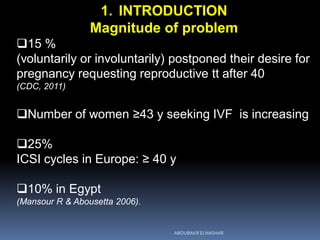
1. INTRODUCTION
Magnitude of problem
15 %
(voluntarily or involuntarily) postponed their desire for
pregnancy requesting reproductive tt after 40
(CDC, 2011)
Number of women ≥43 y seeking IVF is increasing
25%
ICSI cycles in Europe: ≥ 40 y
10% in Egypt
(Mansour R & Abousetta 2006).
ABOUBAKR ELNASHAR
Risk
Poor response to ovarian stimulation
Obstetric risks:
Miscarriage
PET
IUGR
Chromosomal defects in the offspring
ABOUBAKR ELNASHAR
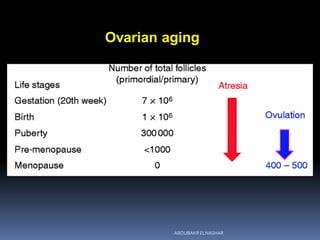
Ovarian aging
ABOUBAKR ELNASHAR
At birth:
1–2 million oocytes in her ovaries
As a woman ages:
absolute number of developing follicles declines at a rate that is bi-
exponential to her age.
At 37.5 y:
The rate of follicle loss (atresia) more than doubles when
reserves fall below the critical level of 25,000
As the ovarian follicular pool decreases:
Infertility
cycle shortening
cycle irregularity and finally
menopause
ABOUBAKR ELNASHAR
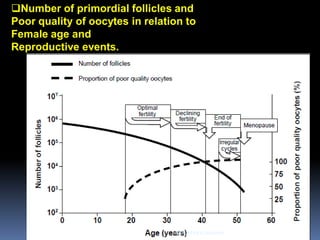
Number of primordial follicles and
Poor quality of oocytes in relation to
Female age and
Reproductive events.
ABOUBAKR ELNASHAR
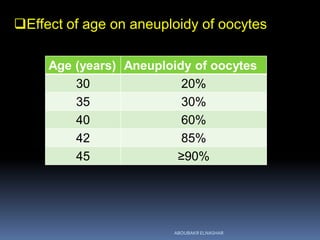
Aneuploidy of oocytesAge (years)
20%30
30%35
60%40
85%42
≥90%45
Effect of age on aneuploidy of oocytes
ABOUBAKR ELNASHAR
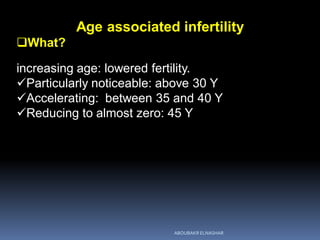
Age associated infertility
What?
increasing age: lowered fertility.
Particularly noticeable: above 30 Y
Accelerating: between 35 and 40 Y
Reducing to almost zero: 45 Y
ABOUBAKR ELNASHAR
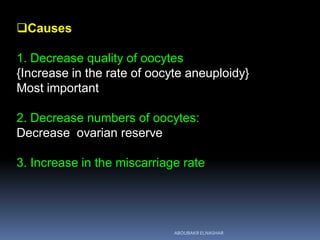
Causes
1. Decrease quality of oocytes
{Increase in the rate of oocyte aneuploidy}
Most important
2. Decrease numbers of oocytes:
Decrease ovarian reserve
3. Increase in the miscarriage rate
ABOUBAKR ELNASHAR
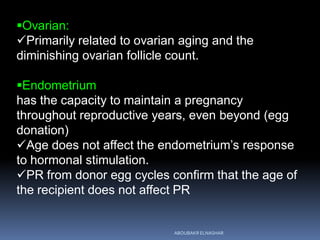
Ovarian:
Primarily related to ovarian aging and the
diminishing ovarian follicle count.
Endometrium
has the capacity to maintain a pregnancy
throughout reproductive years, even beyond (egg
donation)
Age does not affect the endometrium’s response
to hormonal stimulation.
PR from donor egg cycles confirm that the age of
the recipient does not affect PR
ABOUBAKR ELNASHAR
ABOUBAKR ELNASHAR
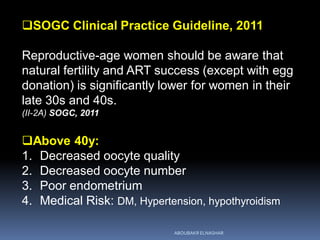
SOGC Clinical Practice Guideline, 2011
Reproductive-age women should be aware that
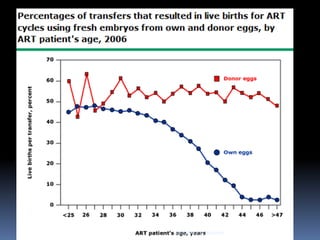
natural fertility and ART success (except with egg
donation) is significantly lower for women in their
late 30s and 40s.
(II-2A) SOGC, 2011
Above 40y:
1. Decreased oocyte quality
2. Decreased oocyte number
3. Poor endometrium
4. Medical Risk: DM, Hypertension, hypothyroidism
ABOUBAKR ELNASHAR
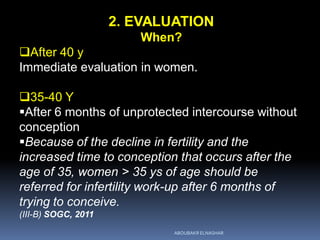
2. EVALUATION
When?
After 40 y
Immediate evaluation in women.
35-40 Y
After 6 months of unprotected intercourse without
conception
Because of the decline in fertility and the
increased time to conception that occurs after the
age of 35, women > 35 ys of age should be
referred for infertility work-up after 6 months of
trying to conceive.
(III-B) SOGC, 2011
ABOUBAKR ELNASHAR
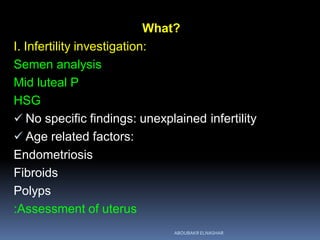
What?
I. Infertility investigation:
Semen analysis
Mid luteal P
HSG
 No specific findings: unexplained infertility
 Age related factors:
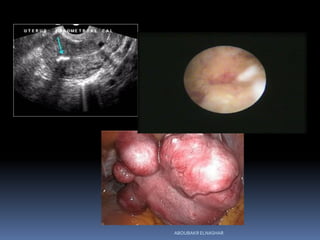
Endometriosis
Fibroids
Polyps
:Assessment of uterus
ABOUBAKR ELNASHAR
ABOUBAKR ELNASHAR
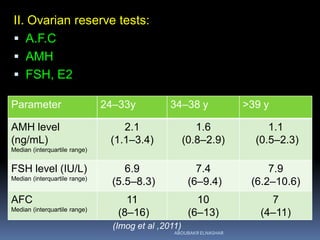
II. Ovarian reserve tests:
 A.F.C
 AMH
 FSH, E2
>39 y34–38 y24–33yParameter
1.1
(0.5–2.3)
1.6
(0.8–2.9)
2.1
(1.1–3.4)
AMH level
(ng/mL)
Median (interquartile range)
7.9
(6.2–10.6)
7.4
(6–9.4)
6.9
(5.5–8.3)
FSH level (IU/L)
Median (interquartile range)
7
(4–11)
10
(6–13)
11
(8–16)
AFC
Median (interquartile range)
(Imog et al ,2011)
ABOUBAKR ELNASHAR
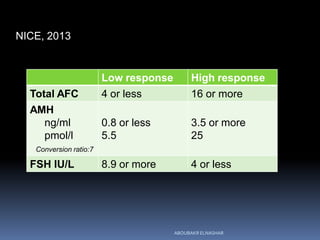
NICE, 2013
High responseLow response
16 or more4 or lessTotal AFC
3.5 or more
25
0.8 or less
5.5
AMH
ng/ml
pmol/l
Conversion ratio:7
4 or less8.9 or moreFSH IU/L
ABOUBAKR ELNASHAR
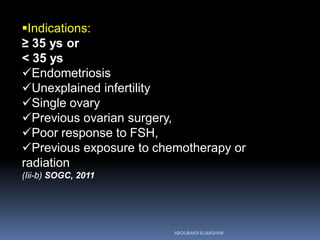
Indications:
≥ 35 ys or
< 35 ys
Endometriosis
Unexplained infertility
Single ovary
Previous ovarian surgery,
Poor response to FSH,
Previous exposure to chemotherapy or
radiation
(Iii-b) SOGC, 2011
ABOUBAKR ELNASHAR
Significance:
Particularly important ≥40y
1. All detect the quantity rather than the quality of the
follicular pool
(Broekmans et al. 2006)
2. Poor predictive value for non pregnancy and should
be used to exclude women from tt only if levels are
significantly abnormal.
(II-2a) SOGC, 2011
3. Predict response to ovarian stimulation and
potentially, successful outcome with ART.
4. Help in determining the dose of HMG/FSH and the
protocol of stimulation to be used but they are poor
predictors of PR
(Fauser B et al 2007)
ABOUBAKR ELNASHAR
3. TREATMENT
Pre-conception counseling
Risks of pregnancy above 40,
Promotion of optimal health and weight
Screening for medical condition: hypertension, DM.
(III-B) SOGC, 2011
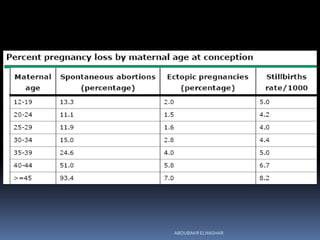
Women should be informed that increased risk of
spontaneous pregnancy loss
chromosomal abnormalities.
Women should be counseled about and offered
appropriate prenatal screening once pregnancy is
established.
(II-2A) SOGC, 2011
ABOUBAKR ELNASHAR
ABOUBAKR ELNASHAR
Methods:
1. CC and IUI
2. GnT and IUI
3. IVF
4. Oocyte donation:
The only effective tt for age-related infertility and
declining oocyte quality
ABOUBAKR ELNASHAR
1. CC and IUI
Simple, inexpensive
Aim: 2 or 3 dominant follicles of at least 18 mm.
PR/cycle
(Tsafrir et al, 2009, Dovey et al,2011)
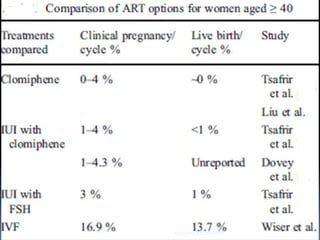
1–4 %
38 to 40y: 7%
41 to 42 y: 4%
42: 1%
ABOUBAKR ELNASHAR
LBR:
40-41y: low
>42 y: No LB
(Corsan et al.1996)
CC:
PR and LBR are low.
Little or no value
Swift referral for IVF after 1 or 2 failed cycles.
ABOUBAKR ELNASHAR
2. FSH and IUI
Aim:
2 or 3 dominant follicles. Ovulation induction may encourage
the recruitment of suboptimal follicles that may otherwise
have not developed.
PR/cycle
(Tsafrir et al.2009)
3%
LBR/cycle: 1 %
LBR/cycle
(Haebe et al, 2002)
40-42y: 9.8 %
>44: no live births
ABOUBAKR ELNASHAR
ABOUBAKR ELNASHAR
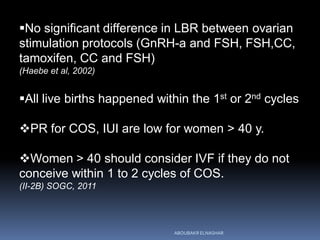
No significant difference in LBR between ovarian
stimulation protocols (GnRH-a and FSH, FSH,CC,
tamoxifen, CC and FSH)
(Haebe et al, 2002)
All live births happened within the 1st or 2nd cycles
PR for COS, IUI are low for women > 40 y.
Women > 40 should consider IVF if they do not
conceive within 1 to 2 cycles of COS.
(II-2B) SOGC, 2011
ABOUBAKR ELNASHAR
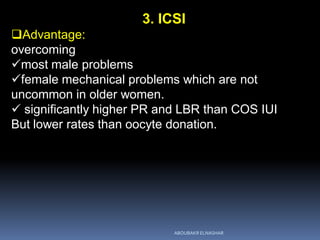
3. ICSI
Advantage:
overcoming
most male problems
female mechanical problems which are not
uncommon in older women.
 significantly higher PR and LBR than COS IUI
But lower rates than oocyte donation.
ABOUBAKR ELNASHAR
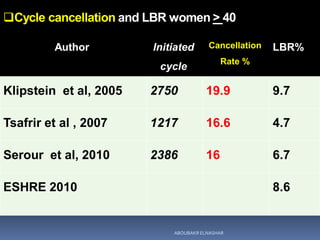
Cycle cancellation and LBR women > 40
Author Initiated
cycle
Cancellation
Rate %
LBR%
Klipstein et al, 2005 2750 19.9 9.7
Tsafrir et al , 2007 1217 16.6 4.7
Serour et al, 2010 2386 16 6.7
ESHRE 2010 8.6
ABOUBAKR ELNASHAR
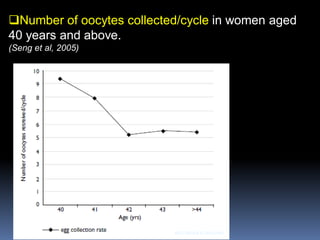
Number of oocytes collected/cycle in women aged
40 years and above.
(Seng et al, 2005)
ABOUBAKR ELNASHAR
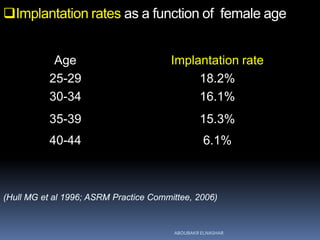
Implantation rates as a function of female age
Age Implantation rate
25-29 18.2%
30-34 16.1%
35-39 15.3%
40-44 6.1%
(Hull MG et al 1996; ASRM Practice Committee, 2006)
ABOUBAKR ELNASHAR
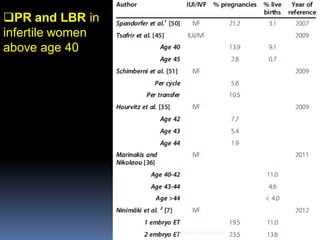
PR and LBR in
infertile women
above age 40
ABOUBAKR ELNASHAR
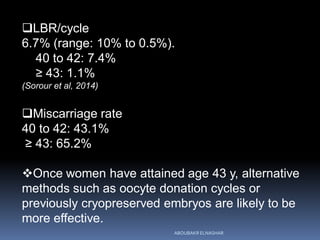
LBR/cycle
6.7% (range: 10% to 0.5%).
40 to 42: 7.4%
≥ 43: 1.1%
(Sorour et al, 2014)
Miscarriage rate
40 to 42: 43.1%
≥ 43: 65.2%
Once women have attained age 43 y, alternative
methods such as oocyte donation cycles or
previously cryopreserved embryos are likely to be
more effective.
ABOUBAKR ELNASHAR
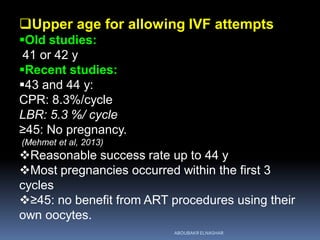
Upper age for allowing IVF attempts
Old studies:
41 or 42 y
Recent studies:
43 and 44 y:
CPR: 8.3%/cycle
LBR: 5.3 %/ cycle
≥45: No pregnancy.
(Mehmet et al, 2013)
Reasonable success rate up to 44 y
Most pregnancies occurred within the first 3
cycles
≥45: no benefit from ART procedures using their
own oocytes.
ABOUBAKR ELNASHAR
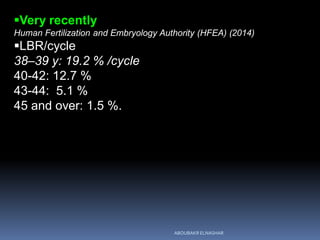
Very recently
Human Fertilization and Embryology Authority (HFEA) (2014)
LBR/cycle
38–39 y: 19.2 % /cycle
40-42: 12.7 %
43-44: 5.1 %
45 and over: 1.5 %.
ABOUBAKR ELNASHAR
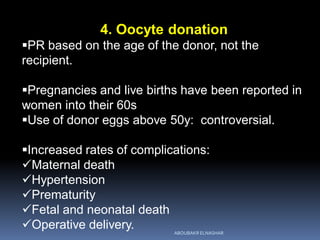
4. Oocyte donation
PR based on the age of the donor, not the
recipient.
Pregnancies and live births have been reported in
women into their 60s
Use of donor eggs above 50y: controversial.
Increased rates of complications:
Maternal death
Hypertension
Prematurity
Fetal and neonatal death
Operative delivery. ABOUBAKR ELNASHAR
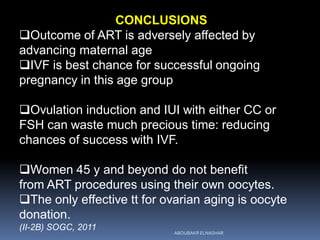
CONCLUSIONS
Outcome of ART is adversely affected by
advancing maternal age
IVF is best chance for successful ongoing
pregnancy in this age group
Ovulation induction and IUI with either CC or
FSH can waste much precious time: reducing
chances of success with IVF.
Women 45 y and beyond do not benefit
from ART procedures using their own oocytes.
The only effective tt for ovarian aging is oocyte
donation.
(II-2B) SOGC, 2011
ABOUBAKR ELNASHAR
Thank You
ABOUBAKR ELNASHAR

Infertility above 40

  • 1.
    INFERTILITY ABOVE 40 Aboubakr Elnashar BenhaUniversity Hospital, Egypt ABOUBAKR ELNASHAR
  • 2.
    CONTENTS 1. INTRODUCTIOM  Magnitudeof problem  Ovarian aging  Age associated infertility 2. EVALUATION  When  What 3. TREATMENT  Pre conception counseling  Methods CONCLUSION 3 ABOUBAKR ELNASHAR
  • 3.
    1. INTRODUCTION Magnitude ofproblem 15 % (voluntarily or involuntarily) postponed their desire for pregnancy requesting reproductive tt after 40 (CDC, 2011) Number of women ≥43 y seeking IVF is increasing 25% ICSI cycles in Europe: ≥ 40 y 10% in Egypt (Mansour R & Abousetta 2006). ABOUBAKR ELNASHAR
  • 4.
    Risk Poor response toovarian stimulation Obstetric risks: Miscarriage PET IUGR Chromosomal defects in the offspring ABOUBAKR ELNASHAR
  • 5.
  • 6.
    At birth: 1–2 millionoocytes in her ovaries As a woman ages: absolute number of developing follicles declines at a rate that is bi- exponential to her age. At 37.5 y: The rate of follicle loss (atresia) more than doubles when reserves fall below the critical level of 25,000 As the ovarian follicular pool decreases: Infertility cycle shortening cycle irregularity and finally menopause ABOUBAKR ELNASHAR
  • 7.
    Number of primordialfollicles and Poor quality of oocytes in relation to Female age and Reproductive events. ABOUBAKR ELNASHAR
  • 8.
    Aneuploidy of oocytesAge(years) 20%30 30%35 60%40 85%42 ≥90%45 Effect of age on aneuploidy of oocytes ABOUBAKR ELNASHAR
  • 9.
    Age associated infertility What? increasingage: lowered fertility. Particularly noticeable: above 30 Y Accelerating: between 35 and 40 Y Reducing to almost zero: 45 Y ABOUBAKR ELNASHAR
  • 10.
    Causes 1. Decrease qualityof oocytes {Increase in the rate of oocyte aneuploidy} Most important 2. Decrease numbers of oocytes: Decrease ovarian reserve 3. Increase in the miscarriage rate ABOUBAKR ELNASHAR
  • 11.
    Ovarian: Primarily related toovarian aging and the diminishing ovarian follicle count. Endometrium has the capacity to maintain a pregnancy throughout reproductive years, even beyond (egg donation) Age does not affect the endometrium’s response to hormonal stimulation. PR from donor egg cycles confirm that the age of the recipient does not affect PR ABOUBAKR ELNASHAR
  • 12.
  • 13.
    SOGC Clinical PracticeGuideline, 2011 Reproductive-age women should be aware that natural fertility and ART success (except with egg donation) is significantly lower for women in their late 30s and 40s. (II-2A) SOGC, 2011 Above 40y: 1. Decreased oocyte quality 2. Decreased oocyte number 3. Poor endometrium 4. Medical Risk: DM, Hypertension, hypothyroidism ABOUBAKR ELNASHAR
  • 14.
    2. EVALUATION When? After 40y Immediate evaluation in women. 35-40 Y After 6 months of unprotected intercourse without conception Because of the decline in fertility and the increased time to conception that occurs after the age of 35, women > 35 ys of age should be referred for infertility work-up after 6 months of trying to conceive. (III-B) SOGC, 2011 ABOUBAKR ELNASHAR
  • 15.
    What? I. Infertility investigation: Semenanalysis Mid luteal P HSG  No specific findings: unexplained infertility  Age related factors: Endometriosis Fibroids Polyps :Assessment of uterus ABOUBAKR ELNASHAR
  • 16.
  • 17.
    II. Ovarian reservetests:  A.F.C  AMH  FSH, E2 >39 y34–38 y24–33yParameter 1.1 (0.5–2.3) 1.6 (0.8–2.9) 2.1 (1.1–3.4) AMH level (ng/mL) Median (interquartile range) 7.9 (6.2–10.6) 7.4 (6–9.4) 6.9 (5.5–8.3) FSH level (IU/L) Median (interquartile range) 7 (4–11) 10 (6–13) 11 (8–16) AFC Median (interquartile range) (Imog et al ,2011) ABOUBAKR ELNASHAR
  • 18.
    NICE, 2013 High responseLowresponse 16 or more4 or lessTotal AFC 3.5 or more 25 0.8 or less 5.5 AMH ng/ml pmol/l Conversion ratio:7 4 or less8.9 or moreFSH IU/L ABOUBAKR ELNASHAR
  • 19.
    Indications: ≥ 35 ysor < 35 ys Endometriosis Unexplained infertility Single ovary Previous ovarian surgery, Poor response to FSH, Previous exposure to chemotherapy or radiation (Iii-b) SOGC, 2011 ABOUBAKR ELNASHAR
  • 20.
    Significance: Particularly important ≥40y 1.All detect the quantity rather than the quality of the follicular pool (Broekmans et al. 2006) 2. Poor predictive value for non pregnancy and should be used to exclude women from tt only if levels are significantly abnormal. (II-2a) SOGC, 2011 3. Predict response to ovarian stimulation and potentially, successful outcome with ART. 4. Help in determining the dose of HMG/FSH and the protocol of stimulation to be used but they are poor predictors of PR (Fauser B et al 2007) ABOUBAKR ELNASHAR
  • 21.
    3. TREATMENT Pre-conception counseling Risksof pregnancy above 40, Promotion of optimal health and weight Screening for medical condition: hypertension, DM. (III-B) SOGC, 2011 Women should be informed that increased risk of spontaneous pregnancy loss chromosomal abnormalities. Women should be counseled about and offered appropriate prenatal screening once pregnancy is established. (II-2A) SOGC, 2011 ABOUBAKR ELNASHAR
  • 22.
  • 23.
    Methods: 1. CC andIUI 2. GnT and IUI 3. IVF 4. Oocyte donation: The only effective tt for age-related infertility and declining oocyte quality ABOUBAKR ELNASHAR
  • 24.
    1. CC andIUI Simple, inexpensive Aim: 2 or 3 dominant follicles of at least 18 mm. PR/cycle (Tsafrir et al, 2009, Dovey et al,2011) 1–4 % 38 to 40y: 7% 41 to 42 y: 4% 42: 1% ABOUBAKR ELNASHAR
  • 25.
    LBR: 40-41y: low >42 y:No LB (Corsan et al.1996) CC: PR and LBR are low. Little or no value Swift referral for IVF after 1 or 2 failed cycles. ABOUBAKR ELNASHAR
  • 26.
    2. FSH andIUI Aim: 2 or 3 dominant follicles. Ovulation induction may encourage the recruitment of suboptimal follicles that may otherwise have not developed. PR/cycle (Tsafrir et al.2009) 3% LBR/cycle: 1 % LBR/cycle (Haebe et al, 2002) 40-42y: 9.8 % >44: no live births ABOUBAKR ELNASHAR
  • 27.
  • 28.
    No significant differencein LBR between ovarian stimulation protocols (GnRH-a and FSH, FSH,CC, tamoxifen, CC and FSH) (Haebe et al, 2002) All live births happened within the 1st or 2nd cycles PR for COS, IUI are low for women > 40 y. Women > 40 should consider IVF if they do not conceive within 1 to 2 cycles of COS. (II-2B) SOGC, 2011 ABOUBAKR ELNASHAR
  • 29.
    3. ICSI Advantage: overcoming most maleproblems female mechanical problems which are not uncommon in older women.  significantly higher PR and LBR than COS IUI But lower rates than oocyte donation. ABOUBAKR ELNASHAR
  • 30.
    Cycle cancellation andLBR women > 40 Author Initiated cycle Cancellation Rate % LBR% Klipstein et al, 2005 2750 19.9 9.7 Tsafrir et al , 2007 1217 16.6 4.7 Serour et al, 2010 2386 16 6.7 ESHRE 2010 8.6 ABOUBAKR ELNASHAR
  • 31.
    Number of oocytescollected/cycle in women aged 40 years and above. (Seng et al, 2005) ABOUBAKR ELNASHAR
  • 32.
    Implantation rates asa function of female age Age Implantation rate 25-29 18.2% 30-34 16.1% 35-39 15.3% 40-44 6.1% (Hull MG et al 1996; ASRM Practice Committee, 2006) ABOUBAKR ELNASHAR
  • 33.
    PR and LBRin infertile women above age 40 ABOUBAKR ELNASHAR
  • 34.
    LBR/cycle 6.7% (range: 10%to 0.5%). 40 to 42: 7.4% ≥ 43: 1.1% (Sorour et al, 2014) Miscarriage rate 40 to 42: 43.1% ≥ 43: 65.2% Once women have attained age 43 y, alternative methods such as oocyte donation cycles or previously cryopreserved embryos are likely to be more effective. ABOUBAKR ELNASHAR
  • 35.
    Upper age forallowing IVF attempts Old studies: 41 or 42 y Recent studies: 43 and 44 y: CPR: 8.3%/cycle LBR: 5.3 %/ cycle ≥45: No pregnancy. (Mehmet et al, 2013) Reasonable success rate up to 44 y Most pregnancies occurred within the first 3 cycles ≥45: no benefit from ART procedures using their own oocytes. ABOUBAKR ELNASHAR
  • 36.
    Very recently Human Fertilizationand Embryology Authority (HFEA) (2014) LBR/cycle 38–39 y: 19.2 % /cycle 40-42: 12.7 % 43-44: 5.1 % 45 and over: 1.5 %. ABOUBAKR ELNASHAR
  • 37.
    4. Oocyte donation PRbased on the age of the donor, not the recipient. Pregnancies and live births have been reported in women into their 60s Use of donor eggs above 50y: controversial. Increased rates of complications: Maternal death Hypertension Prematurity Fetal and neonatal death Operative delivery. ABOUBAKR ELNASHAR
  • 38.
    CONCLUSIONS Outcome of ARTis adversely affected by advancing maternal age IVF is best chance for successful ongoing pregnancy in this age group Ovulation induction and IUI with either CC or FSH can waste much precious time: reducing chances of success with IVF. Women 45 y and beyond do not benefit from ART procedures using their own oocytes. The only effective tt for ovarian aging is oocyte donation. (II-2B) SOGC, 2011 ABOUBAKR ELNASHAR
  • 39.